If the video above is not available, here are two other ways to view:
140705AM
ESH-21
Rich & Famous.docx
Biblical Exercises for Spiritual Health & Fitness in 2014 Series
The Discipline of Disciple-Making: How Should We Share the Gospel with the Rich, the Famous, & the Powerful?
Acts 24-26
Transcript
Let’s open our Bibles to the Book of Acts, and as we turn there, we’re looking at something I think is fascinating. There’s so many amounts of truth and challenge that we can get from this account this morning. Where we’re headed is in Acts 24. And really, it’s a question that we all could answer right now. So, it’s almost like, I don’t need to go through this process. But I want to go through the process to underline in your minds this truth. But the question is, how should we share the Gospel with the rich, the famous, and the powerful because that’s what Paul does. He talks to a 19-year-old girl that would be like morphing together, Miley Cyrus and Lindsay, drug rehab, Lohan and a couple of others all into one 19-year-old. She was generationally a Paris Hilton on steroids. [She] was the first person that Paul shares the Gospel with. And her husband is like a reincarnation of Michael Jackson. Just think of that couple. …And that you get called in front of them, and you get a few moments to share the Gospel. How would you share it? Basically, the same way you would if you were talking to someone at the rescue mission that was losing part of their mind from over toxification of everything with alcohol. See, I think sometimes we think that maybe we should package the Gospel this way if they’re famous and rich and powerful, and maybe this way if they’re indigent, homeless, whatever. So, you’ve already heard it, but I’m going to show you what I mean.
So, in the book of Acts, and I want you to think about as we’re going there, of the millions and millions and millions of people that live before and during the time period of the Bible. Now remember, this book was written over a time period, from around 1400 BC all the way through near the nearly 100 AD. So, [over] about 15 centuries the Bible was written. And in that time period there were millions and millions and millions of people that lived on Earth. But out of those, in fact, probably more than that because I looked up the, population reference bureau. That’s a think tank in Washington DC right there on one of those Northwest Avenues. And they calculated if the first human showed up in existence in 50,000 BC, which is probably the normal line in Washington DC because they don’t usually read the Bible. But if the first one showed up, they said that by the time of Christ there would have been 40 billion humans. Now, this is secular evolutionary thought, 40 billion people have lived up through the time of Christ but of all those 40 billion do you know how many we know a lot about? Very few. The Caesars. Some of the leaders in Egypt. The Pharaohs and all of their hieroglyphics. But other than that, a few Babylonians, a few Assyrians, a few founders of religions. How many people do we really know? Any their first and last name? How about anything about what they thought other than the people that are inscribed in stone, we know nothing about most. But in this book, you’re holding, God captured, biographical, divinely inspired God knowledge about 2,938 people.
Now, the way I know that is: Wilbur Smith, a bible scholar from a generation ago, spent his life counting everything. He counted them and found how many people we know about. But my question to you is why out of all those millions and billions of people do we have almost 3,000 lives mentioned? This is because God uses them to teach us something. He picked them and He wants us to know about them. And as we return to Acts and starting in chapter 2, we’re going to look at individual people that are named, that are described and who God Himself uses to unfold the most amazing story of all time.
What we’re looking at this morning is the unfolding of the Gospel. As we pause to think more deeply about what exactly it is we’re reading, think about this as we read these verses. We’re reading perfectly accurate accounts of the personal words, of the personal thoughts, and of the actions seen mostly only by God, which is very interesting. To think that God is watching everyone. He knows everything everyone is thinking and saying and doing. He is keeping a record of that. But out of that whole voluminous record, He just pulls this little file out. And that’s what we have in Acts.
In the book of Acts, we’re given an authorized record of the birth of the Church, the spread of the Gospel. And this account is from God Himself. And if you look in Acts chapter 2, I just want to show you one little number. If you look at verse 41 of chapter 2, it says, those who gladly received His Word and were baptized that day, were about 3,000 souls. So, right there is an amazing fact that God counted those.
But I just want you to think about that as we look at the Gospel unfolding, because that is the beginning of 22 Salvation message presentations. That record is preceded by how the Gospel was presented, and that’s where we started many weeks ago. But 3,000 people responded to it. But these 22 accounts that we’re plotting through are exactly the ones that God wants us to look at. Have you ever thought about with all the people alive, you know all those millions of people in the Roman Empire and all the billions of people that have lived up through the time of Christ… how much stuff is going on, talking, and events, and moving, and losing jobs, and getting sick, and getting well, and earning money, and everything, and out of all that life, God captures 22 distinct little scenes. Now, those weren’t the only times the Gospel was shared. But God wanted us to know those. So, I just want you to think, as we look at verse 41, of the numbers.

Okay, so there are 3,000 people born again, at a minimum, during the first week of the birth of the Church. Now, what it says is: 3,000 souls were added to them. So, we’re pretty sure this number is men, women, and children. So, 3,000 people responded at the very first invitation to the Gospel. That’s pretty good. Now, keep going to chapter 4. So, turn over the page to chapter 4. And so, God, in chapter 2 counts hearts and reports 3,000 are saved. And we get an updated count, a telethon where they keep raising what’s come in and we get a second numbering of how many people are saved. And that’s in chapter 4, verse 4. And what it says there is, however, many of those who heard the Word believed and the number of the men came to about 5,000. But now we’ve changed the way we’re calculating. It’s kind of like the way the government is doing the. The NOAA statistics, which they quietly revised back. They’re trying to make everybody think that we’re in this horrible global warming, we got to change everything. But actually, it was warmer in the thirties than it is now. But and few scientists pointed that out, that they were fudging the numbers, so they fixed them. But this is not fudging, this is God recording something. And you know what He says? By the time we get to 4:4, there are 5,000 men. This is a euphemism for heads of households because that’s how God looks at it. God looks at the man as the head of the household. That’s the gender specific role that He laid down.
And so, we’re talking now about family units. Now some of them could have been single men and some of them are just, couples. Others are families, were members of the families. But we have 5,000 units here of all different sizes that are saved. And that’s the cumulative number. So, with the count system used probably a lot of them are families. And so, the Church is made up of 5,000 family units of all sizes. And then if you add in what we know from 1 Corinthians 15:6, that before Pentecost there were 500 believers, solid believers. We know that, 1 Corinthians 15:6 tells us. Jesus came and met with only believers after His resurrection. He was never seen by lost people. So, Jesus, it says in 1 Corinthians 15:6, met with 500 individual people. Those were the fruit of His ministry. Those were the people that got saved. Can you imagine from all over Galilee, everybody that had believed on the Lord Jesus Christ as he was teaching, He shows up and said, that’s Me. I rose. I’m coming back for you. Do what I left you to do. Can you imagine the thrill? But that’s how the Church started. And so, Jesus, during those 40 days prior to his ascension, the 10 days prior to Pentecost He ascends, but 40 days prior to that He visited those solid believers. That means that by right here in chapter 4 there are at least 10,000 believers. Because a lot of those men have to be married. And what it was talking about is, that there are 5,000 units of people. So, I would just conservatively say 10,000 or even double that of men and women and children in Jerusalem, in the outlying areas who were Spirit filled, quite enthused and believers.

Now with all those numbers in mind, think of this, think of the initial surge. It’d be like, it’d be like getting a group of people in- filling a stadium and getting them all pepped up to do something and then while it’s still ringing in the ears, they all go out and they do it. That’s what’s going on in Jerusalem. They’re just blanketed.
Acts records, this ground floor event of the launch of the greatest event in history. Jesus is alive. Multitudes were being powerfully transformed by Him. See, that’s the difference between Judaism. Judaism was they just started getting in line with following all those rules. What was happening now is, Jesus was coming and personally changing people directly. That’s why when we get saved we don’t join Calvary Bible Church or wherever you were saved. We come to know Jesus Christ personally, face to face. We know Him. He moves in to live within us. See that’s what’s different about every religion and Christianity. Religions, you join something, Christianity, Christ joins you and me. It’s just absolutely unique. And so, God was mightily at work.
And Acts as the account of how He kept that work of Pentecost going. The stadium is like Pentecost and the people going out just were so excited. But how do you keep that going? You just keep calling him back to the stadium and reproducing Pentecost? Which is what a lot of Christendom thinks that’s what were supposed to do. And so, they try and reproduce the day of Pentecost nearly every meeting they have. Is that how the Lord did it? See, we need to consider… God saved people, and then God energized them, and then God continues to reenergize those early believers because they like us continued after they were saved to face hostilities, and difficulties, and challenges, and all the mundane day-to-day things that just wear us down because life is hard. It just seems … Elisha and I got the lawn mow and it needs to be mowed again. It’s like you just got all the dishes washed and there’s another load and life just is so full of the mundane.
So, how do you keep them going? God was at work in His Church. And that’s… let’s get to chapter 4 and what I want to show you is, starting in the first 4 verses, what the Lord did. And just, in fact, I put it in here for you. They are amazingly, look in chapter 4 and then we’re going to read this in just a second together, starting in verse 1. They spoke to the people, and the priest, and the captain of the temple, and Sadducees came upon them. This is after that, but I want you to see preceding this event. So, the Apostles get come upon. In other words, they’re being arrested. And verse 2, being greatly disturbed, that’s the leaders that they taught to people and preached Jesus and the resurrection from the dead. They laid hands on them and put them in custody. So, this is the first persecution the Church is facing until the next day. Before it was already evening. However, many of those who heard the Word believed and a number of them came to about 5,000.
So, look at verse 21. Now we’re getting down close to where we’re going to read. So, when they had further threatened them, that’s the apostles, they let them go. Finding no way of punishing them because the people all glorified God for what had been done. So, here’s the question. What happens to the regular believers? They’re in the stadium, Day of Pentecost, they get so excited, they get energized and they get gloriously excited about the Lord. And all of a sudden, they notice that their leaders get arrested and roughed up and threatened.
So, what’s the first response? Look at verse 21. It says they further threatened them. But they didn’t know what else to do. So, keep reading in verse 22. They talk about this man that was saved and then look what the apostles do in verse 23 of chapter 4 of Acts. And being let go, they went to their own. Now companions in the New King James is italicized, means it’s just understood but it doesn’t say it in the text. Do you understand? As soon as the apostles get roughed up and persecuted, as soon as they get released, they go to their own. And that’s really interesting. That usually, that’s a euphemism for they gathered with the Church, with the believers. They looked at, in all of the world of the billions and billions of people, their own were the other believers, the other members of the body of Christ. Now they had relatives, but if they weren’t saved, they weren’t their own. You understand? They looked on the Church as the closest, most vital group in the world to them. And so, they went to their own, verse 23 and reported all the chief priest had done. And when they heard that they raised their voice to the Lord in one accord and start this prayer.
Now, verse 31 is after the prayer, and this is going to be where we’re going to start this morning. This is our text because I want to show you something. I want to show you how the 22 scenes of Acts happened. It’s because God is doing something behind the scenes. How was God at work in His Church? Right here. He does something when people pray. And let’s watch it together.
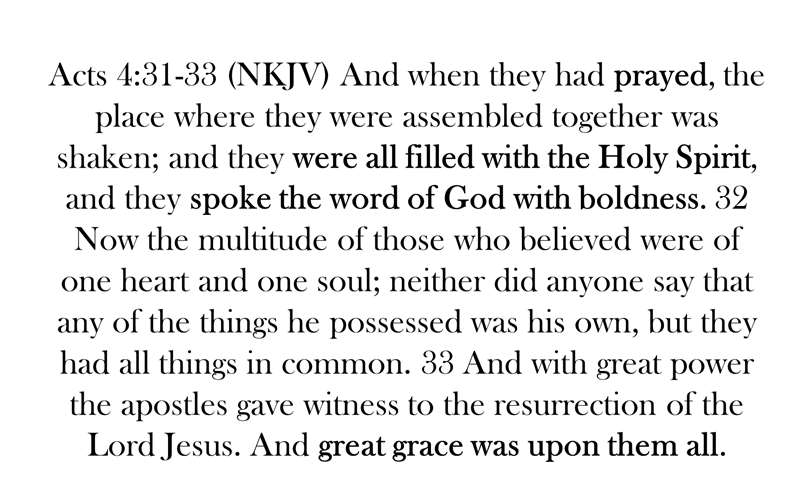
Okay. You ready? Let’s stand together. You got your Bibles? You can follow along. I’m going to read it from here because I want you to think about what it’s saying. So, they have this prayer and when they had prayed, verse 31 says, the place where they were assembled together was shaken. That must have been an event. Exciting. And they were all filled with the Holy Spirit and they spoke. And this is what’s fascinating. Not in tongues, they spoke the Word of God with boldness. Interesting. Verse 32. Now, the multitude of those who believe were of one heart and one soul, neither anyone say that any of those things they possess were their own. They said, everything I have belongs to you, God. What do you want me to do with it? They had all things in common. Verse 33. And with great power, the apostles gave witness to the resurrection of the Lord Jesus and great grace was upon them all. God was at work in His Church and we need to allow Him to be at work in us today.
Let’s bow before him in prayer. Father, I pray that the truth of Your Word would dawn upon us that what You have done from the very first moments of the launch of Your Church in this world, You’re still doing. First You saved and put Your Spirit within them on the day of Pentecost. And then You kept saving and You kept putting your Spirit in everyone. And when they faced adversity, all they had to do is pray and You filled them again with the Holy Spirit. But not so that they could be involved in some ecstatic worship service where they just helped each other out, but You filled them with boldness to go out and speak the Word of God. That’s the pattern for the rest of Acts and for the rest of the history of Your Church. And it’s the pattern for us today. I pray that we would want and invite and welcome You to be at work in us Your Church. And that we would allow You to reenergize and refill and embolden us, not just the missionaries, the Buffenbarger’s and Lake’s going out, but us who are called to go out here, in boldness for You. Stir our heart. Show us. I prayed, not just that we would hear what I’m saying, but that we would see what you say in Your Word and that Word would impact us today in a way that won’t go away, and that we will just keep inviting your re-energizing, energizing, refilling, and the renewal of boldness that we all need to keep going. In the name of Jesus we pray, amen.
You may be seated. As you’re seated. Note, several observations you can glean from what we just read. Before this verse, they suffered. They were roughed up. So, what did they do? They prayed. That’s amazing. They didn’t retreat. They didn’t have to go in for therapy. These guys were physically, this is the first, if you… that’s something that I love to do, I count. I’m a real counter. And I count all the way through the book of Acts. And if you count, there are over 30 times that are mentioned in the book of Acts where people are roughed up, beaten, mob scenes, that they’re threatened, that they’re abused. And you know what? The people just kept going. Is that because they’re made of different stock than us? No, it’s because of this pattern we’ve seen. They suffered; they prayed. God shook the place where they’re assembled, and then what happened? The question we’re looking at is how does God keep His Church working when they’re threatened, when they have all this uncertainty of the future, on top of all the normal drag of life. That our bodies are getting older, and everything’s running out, and we have to keep buying more. I look at it like the great supply. I’ve watched my wife for 30 years maintain a household and it seems every time I open the cupboard, everything’s always there. And it doesn’t just spontaneously get there. There is this constant drain and resupply going on. And we all know that in life. Just like your gas gauge, it’s just, everything is running down, so it needs to be renewed. That’s the same as how God knows He operates with us, His Church.
Was there another outpouring? By the way, as you look at this verse that I printed out for you here, was there another? This was the moment that we should have had a second Pentecost. What should have happened is when they prayed and He shook the place and they were filled with the Spirit, they should have been speaking in tongues and doing signs and wonders. That’s not how God operates in the Bible. That’s how He’s purported to operate all around the world. That’s not the pattern He gave in the Bible. There was only one… In Fact. When else do you see people speaking in tongues in Jerusalem ever again, in the rest of the Bible? None. You’d think that mother church would’ve become like Tulsa, Oklahoma. The mecca of charismatic events, what it became is the mecca of what God wants. He doesn’t want us confusing everyone with something that some people have and some people don’t. And we’re comparing how much of it you have and how much of it you don’t, which is where Christendom is getting today.
When they got filled with the Spirit, they spoke the Word of God with boldness to people. And when we get to the 1st century Miley Cyrus event, you’re going to see Paul boldly speaking to the rich and the famous, just like he spoke to the pagans and the poor. That’s just how God operates. Was there another outpouring of tongues, speaking report, in Jerusalem? No, not once. After the Church was born in Acts 2, there was never another tongue speaking event in Jerusalem ever mentioned by God. And just let that sink in to your minds for a minute. If God would’ve wanted what we’re seeing today perpetuated, we would see it perpetuated in the Bible. He doesn’t. Instead, if there was ever a time to pour out the best way to get the message into the world, it would be now. The moment we’re looking at it in chapter 4 is like D-Day for the Gospel. It was time to spread out, conquer for Christ, get as many people impacted as possible with the power of God onto salvation.
Instead of doing a repeat of Pentecost, what God does is, God manifests His power in those early believers in three ways. He refilled them with His Spirit because it’s so much a part of life that our tires run out of air and our cars run out of gas. And if we have an old leaky radiator, it runs out of water. And our houses run out of food and paper goods and our devices run out of battery power. And so, they all need to be refilled. And when God refilled them, God empowered them to speak His Word with boldness. And the end of the verse, if you notice what it says… look. It says… and great grace was upon them. All God poured out upon all of them is great grace, not signs, not wonders, not having all of them ecstatically speaking. He filled them with boldness to speak the Word of God.
And I think we need to realize, a lot of people say oh, if we just lived in the 1st century, if we just had the 1st century. We HAVE the 1st century power. We have the same setup. God is still offering a filling station. He wants to refill us. He wants to re-energize us. He wants to pour His great grace out upon us. All we have to do is want it, ask for it, seek it. He’s right there.
Why was God doing this? He’s orchestrating the spread of the Gospel. 3,000 people. Look at chapter 8. These 3,000 and 5,000, God further describes them in the first four verses of chapter 8 and it says, because they were like my beehive.
We have bees at home and only one hive this year. And when I opened that thing up, they’re just crawling all over each other. There are 20, 30, 40,000 sometimes in one hive, and they’re just on top of each other. They’re about 10 deep. They’re walking and feeling each other in the dark and going to the right place and putting in their pollen and the honey. And they are feeding all the little larva. Everything they’re doing there in the dark, which is amazing engineering that God designed. That’s what the Jerusalem church looked like. We have 10,000 plus people crawling on top of each other. Just, it was just like a big Bible conference. Can you imagine Peter and John and all the other apostles, and James giving stories about growing up with Jesus, and Nazareth, and it’s just, and the Church is mushrooming. And God says time for the conference to end.
Look at verse 1 of chapter 8, Saul consenting to his, that’s Stephen’s death. At that time, a great persecution arose against the Church, which was at Jerusalem. And verse 1 says, they were all scattered throughout the regions of Judea and Samaria except the apostles. What the Lord was saying is, I want you to boldly go and proclaim the Gospel somewhere else. You guys are just kind of in this big Bible conference and you need to go. And so, He uses the adversity of Saul and the persecution. And so, verse 2, devout men carried Stephen to his burial. Verse 3, Saul made havoc of the Church. He entered every house. You couldn’t even be safe in your house church. He was coming right in, systematically going into every house, and dragging off men and women, committing them to prison. Therefore, those who were scattered went everywhere, preaching the Word.
All that to say, I just read that to you because there must have been an immense amount of activity going on.
These people were so fired up and excited and the Spirit of God was filling them. And so, they said, boy… if you’re going to drive us out, we’re going to leave everything behind here and we’re going to wherever we can go. But they never stopped sharing the Gospel. And so, there was soul winning and discipleship and worship and ministry and church gathering and so much more. But all of that whirlwind of events, that immense cloud of individuals touched and moved by the Spirit, the Book of Acts only captures for us 22 little events. You understand? So much is going on. Why just these little ones? Because those are the events that God wanted us to know.
So, let’s go to chapter 24 and I want to get you to the event. Okay, the next one. So here it is, this is the 20th of 22. Salvation, and what we’re going to see, we’re going to read through this in chapter 24, and we’re going to, starting in verse 14, look at the Apostle Paul describing salvation as following the way of worshiping God. He says, I’m a follower of The Way and I worship God. That is not how I’ve ever heard the Gospel ever shared by anybody. And I know a lot of people say, oh the Book of Acts is transitional. It is. But this is one of the events out of the gazillions that were going on that God wanted us to focus on. And so, as we focus on it. Follow along. Look at verse 14. And just for the context of what is happening, Paul is dragged in, remember they tried to beat him up and he is dragged in, in chapter 24 before the Sanhedrin.
By verse 10, Paul is before the governor, and his name is Felix. He’s the Roman governor. And so, what’s happening is, Paul is starting his imprisonments and he ends up, this track leads him to ultimately his death. But he’s just in the very first of his Roman imprisonments at the front end of it. And so, he is being dragged in front of Felix. This slave that had a famous brother who was loved by the emperor, who was taken out of slavery and made a Roman Governor of a very important part of the empire. So, Felix was quite a guy. But Paul gets to talk to him. We haven’t got to Drucilla yet. And look what Paul says. But this, I confess to you, verse 14 of Acts 24, that according to The Way, which they call a sect, so I worship the God of my father’s. He doesn’t stop there. This is Paul’s Gospel presentation. He says, believing all things which are written in the law and the prophets, I have hope in God, which they themselves also accept that there will be a resurrection of the dead. Both of the just and the unjust. Verse 16. This being so I myself always strive to have a conscience without offense toward God and men. Verse 24. And after some days when Felix came with his wife, Drucilla. Whoa, that’s Miley. That’s the modern day Miley. She’s a 19-year-old that abandons one husband. She’s 19, and I don’t know how many husbands she’s had by now, and she’s going with this rising star, this provincial governor. So, Drucilla, who was Jewish by the way… He sent for Paul and heard him concerning the faith in Christ. Verse 25. Now, as he reasoned, so this is Paul’s Gospel presentation. When he gets Drucilla in there, he reasoned about righteousness, self-control, and judgment to come. Wow.

Okay. First of all, first question, who did Paul witness to? Who? Who we’re talking about here. Two people we need to see. Okay. Felix and Drusilla. And look at verse 24. Do you notice a couple of names there? First, we have Felix, and secondly, we have Drusilla. Who were they anyway? That’s where a good study Bible is so helpful. In fact, I grabbed my MacArthur Study Bible, my favorite study Bible, and I just flipped to Acts 24 and I looked, and here I’ll read to you. Here are the notes that are at the bottom of the page.

Felix, governor of Judea from AD 52 to 59. So right away we know when this is happening. This is happening between 52 and 59 and that’s helpful. Felix was a former slave whose brother, a highly favorite of Emperor Claudius, had obtained from him a position as governor. He was not highly regarded by the Romans of his day because he accomplished little during his term as governor. He defeated the Egyptians and their followers, that’s in 2138, but he brutally angered the Jews. His brutality angered the Jews, and it led to his ouster by Governor Nero two years later. So that’s Felix, nothing real big.
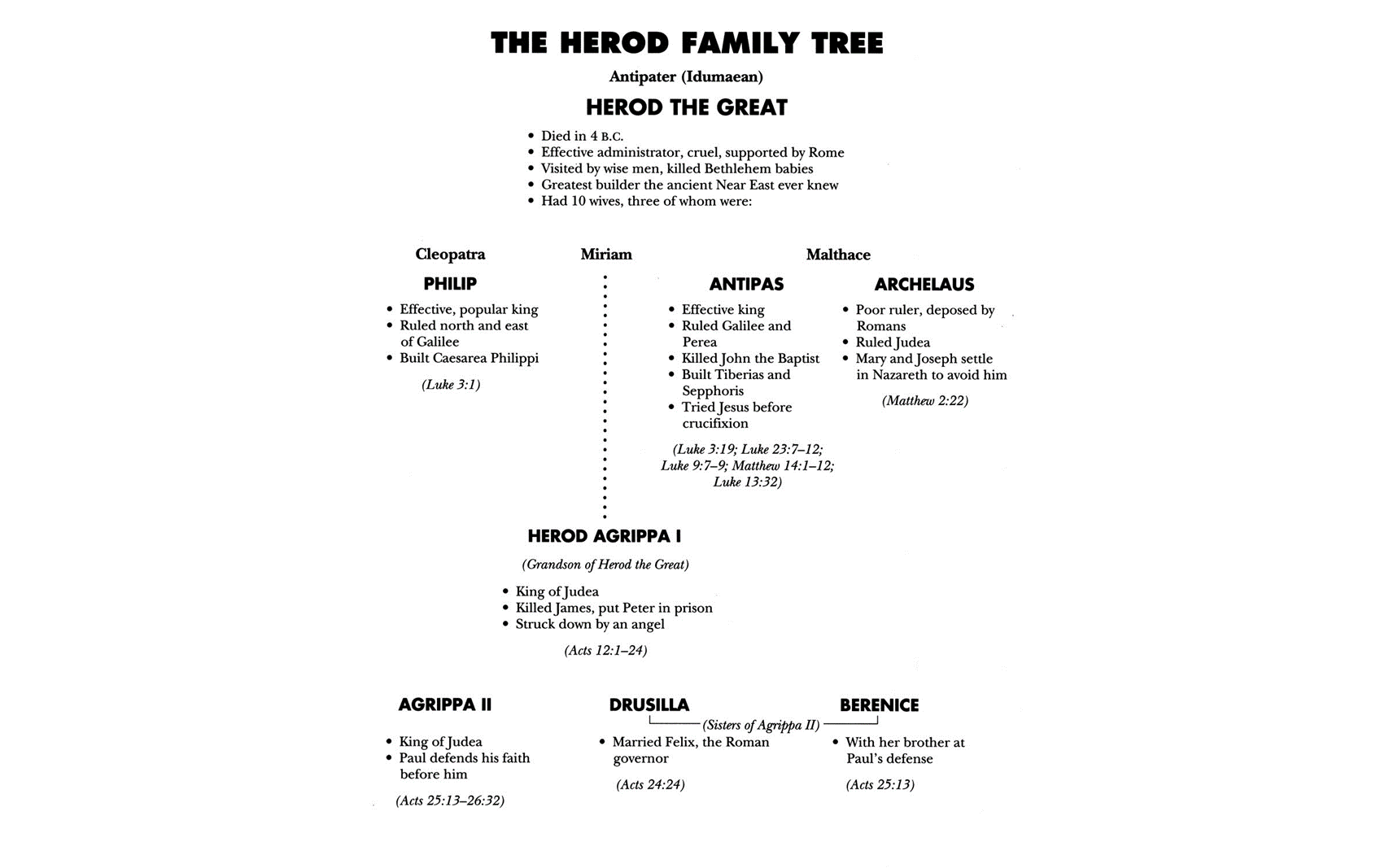
Drucilla. This is what the study Bible says. The youngest daughter of Herod Agrippa the first.
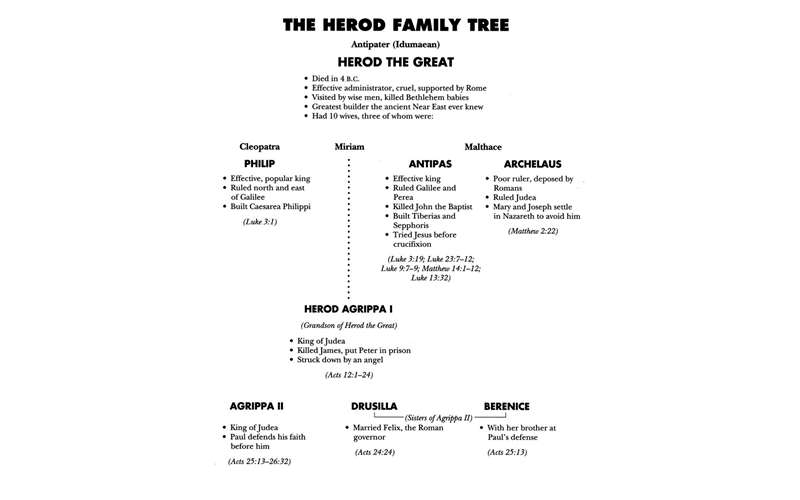
Now, this is interesting. Now, you can’t see this, but I’m going to draw on it. It’ll help. This is a family tree. This is the Bethlehem butcher, okay, Herod the Great. This is the guy that killed all the children under two years of age in Bethlehem, and he had these children. These children are in the Bible. And what’s fascinating is, this one was all right. He built Caesarea Philippi. This is the one, Archelaus is the one when Joseph is bringing back baby Jesus from Egypt. He doesn’t go to Judea because Archelaus was just like his dad. And so, he’s in the Bible. Antipas is the one that Jesus appears before at His crucifixion. He’s the one that beheads John the Baptist, and he’s the one that built this modern day city of Tiberius that’s still on the shores of the Sea of Galilee. So, he’s an interesting guy. Antipas. Remember, Jesus wouldn’t even talk to him. He said, do a trick. Do a trick for me, when Jesus was all arrayed in the robe, Jesus wouldn’t even talk to him.
So, here’s the one that tried to kill Christ. Here’s the one that basically allows Him to be crucified and kills John the Baptist. Here’s the one that Jesus couldn’t even get near because as a baby, the Lord knew He was going to be killed by him. Now we have this one. This is the grandson of Herod the Great, and this is the one that was so proud he was eaten up by worms in the book of Acts, chapter 12. This Drucilla is his daughter. Now, it isn’t as bad as these two. Wait till you meet them next time we’re together. This one was living in open incest with her brother. They were the talk of Rome; they were so grossly immoral. This one just was a man hopper. She couldn’t stay married to anybody very long. Kind of an Elizabeth Taylor of the 1st century. I don’t know how many husbands Elizabeth Taylor, the late Elizabeth Taylor had.
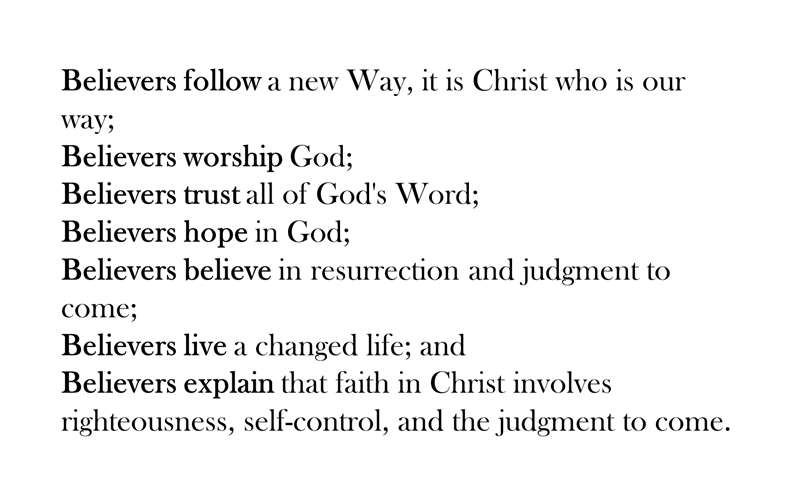
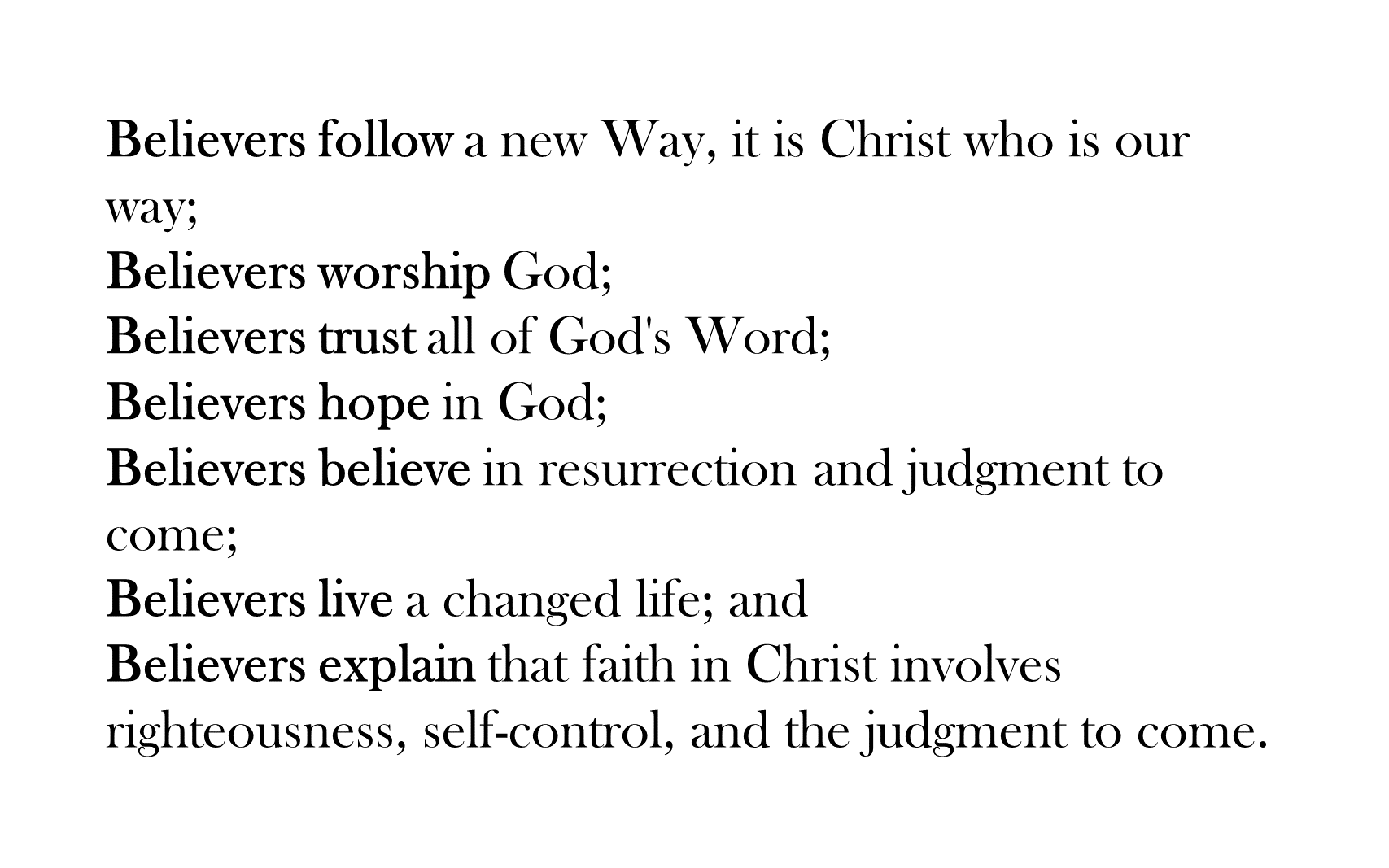
But this is the family tree. Now, I want you to think about generational wealth, notoriety, having anything you want. And basically, Paul is facing this teenaged, fabulously wealthy woman who is living in moral decadence and a rich and famous husband. And so, what does he share as the Gospel? This is the outline of what he says. He says, starting in verse 14, believers follow a new way and it’s Christ. He’s the way. And believers worship God and believers, he says, I believe everything that’s written in the Bible. Believers trust all of God’s Word. And believers hope in God. And believers believe in the resurrection and judgment to come and they live a changed life. And they explain that faith in Christ involves righteousness, self-control, and the judgment to come.

Did you know what Paul did? Paul made it hard. For Felix and Silla, Paul does not give an easy to believe, try Jesus message. Note the audience that heard Paul’s message. Paul is facing pagans steeped in sin, lost and doomed. And what does he tell them? He says, people need to be told that God demands perfection. He told him about righteousness. That’s where he started. He reasoned about righteousness. And what he said is, this is God’s standard and only perfect people go to Heaven. Are you perfect Felix and Drucilla? And Drucilla was starting to squirm her 19-year-old body in the chair, thinking about the man she’s still married to that she left in Rome and ran off with this latest one. She’s only 19. Wow.
The standard we share as God’s representatives is that perfect righteousness is needed by humans. And then we share the bad news that there is none righteous, not even one. And then we point them to the source of perfect righteousness, Christ. That’s the first thing Paul does. That’s a hard to take Gospel. You don’t just say, I’m going to give you an offer that’s too hard to resist, it’s so good. You just can’t believe how good it is. No. First he got them lost and he told them about their lack of righteousness.
Secondly, people need to be told that God demands that they conform to His absolute standard. It’s required that we begin to live in self-control. Paul look at what he says there, he reasoned with them in verse 25 of chapter 24, about righteousness, God’s perfect standard. Self-control. What happens to us when we get saved? When we get saved, the Holy Spirit comes in and starts to restrain us from the way we were. This self-control does not come from outward restraint imposed by others. It’s an inward change prompted by God’s grace. Paul always said, that’s what Titus 2 is, the grace of God that brings salvation teaches us to deny ungodliness and worldly lust and to live soberly, righteously, and godly. Titus 2:13. That’s the Gospel.
Finally, people need to be told, the third thing look at verse 25, about judgment. Anyone who fails to exhibit self-control and to conform them to God’s righteous standard apart from salvation which comes, His righteousness comes with salvation. If you don’t get that, then you’re facing judgment. They would be required to stand before God and answer for every evil deed they ever committed.

Was Paul afraid of offending Felix and Drucilla? I see this all the time. People… We get some famous Christian person on television and they’ve got some famous Christian personality on television interviewing them, and they lighten up on the Gospel because they don’t want to sound too bad. Paul doesn’t. That’s how you share with the rich and famous.
By the way, what does it say, in verse 25? Felix was afraid, and he says get out of here. He says, I’ll come when there’s a more convenient time. When Felix realized he might have to face the judgment of God this thought alarmed him. The result was not a quick conversion. Instead, Felix hastily dismissed Paul, and he said at the end of the verse, when I have a convenient time. As far as we know from history, he didn’t.
Basically, how does God keep His Church working? Here’s Paul, has this big witnessing opportunity. They reject it. So, does he get discouraged and say oh, I should have been easier on him? No. God’s way of working with the Church is always the same. God refills those with His Spirit. He re-empowers us to be bold and He pours out on us His great grace. All the Church is supposed to do is pray.
Notes
Of the millions and millions and millions of people that lived before and during the time period of 15 centuries when God’s Word was written, the vast majority are nameless. People were born, lived, and died without most of the rest of humanity before or after them even knowing their names. The Washington DC think tank called the Population Reference Bureau calculates that by the time of the first century over 40 billion humans had lived and died.[1]
But there are almost 3,ooo people that have found their way into God’s Word. The Bible names exactly 2,938 people according to Wilbur M. Smith (1894-1976), a scholar from a generation ago. Why out of millions and billions of people, do we have almost three thousand lives mentioned? God uses them to teach us something.
As we return to Acts, starting in chapter 2 today, look at the individual people named, described, and used to unfold the amazing account God gave to us of the spread of the Gospel, As we pause to think a bit more deeply about what exactly it is that we are reading: perfectly accurate accounts of the personal words, thoughts, and actions of people who lived 2,000 years ago.
In the Book of Acts we are given an authorized record of the birth of the church and spread of the Gospel. This account is from God Himself. Acts is the perfect, flawless, account of the sequence of events capturing the power of the Gospel at work. But the 22 salvation-message presentations in Acts, recorded at God’s request, are not an exhaustive record of every time the Gospel was shared: these 22 are just the exact accounts that God wanted us to have.
There were literally countless events going on in those first years of the church, just because of the sheer number of lives being touched by God.
Think of the Numbers
There were thousands of born-again believers at a minimum, during the first week of the birth of the church.
We get that from the numbers God chooses to share in the record in Acts. First, Acts 2:41 tells us that God counted hearts and reported that 3,000 were saved. Next, we get an updated count in Acts 4:4 where God says that 5,000 men was the cumulative number of those saved.
So with the count system used in other accounts like in the Four Gospels, that would mean some of those men were actually family units. So we could say that the Church was made up of 5,000 family units of all sizes. Finally, we know from1 Cor. 15:6, that there were already 500 solid believers from Christ’s ministry, that Jesus Christ personally met with in those 40 days prior to His Ascension, ten days prior to Pentecost.
That means that by Acts chapter 4, there were perhaps 10,000 or even double that, of men, women, and children in Jerusalem and outlying areas, who were Spirit-filled, and quite enthused: believers.
Now, with that large number in mind, pause and:
Think of that Initial Surge of Excited Sharing
Acts records the ground floor events of the launch of greatest event in history.
Jesus was alive.
Multitudes were being powerfully transformed by Him.
God was mightily at work.
Acts is God’s account of how He kept the work of Pentecost going. Thus we see in Acts, and find later explained in Paul’s Epistles, God’s plan that stretches to us today. What was the bottom line?
God first saves people, and then energizes them, and then God continues to re-energize those early believers. They, like all of us, continued after they were saved to face hostility, adversity, weariness, and normal life struggles. The bottom line is that:
God Was At Work in His Church
What does God do to keep His Church moving, sharing, and reflecting His glory? In Acts 4 the newly saved individuals, are described as being re-filled with the power, joy, and boldness of the Spirit after the first persecution comes to the leaders of the newly formed church. Look at that event in Acts 4:1-4; 21:
Acts 4:1-21 (NKJV) Now as they spoke to the people, the priests, the captain of the temple, and the Sadducees came upon them, 2 being greatly disturbed that they taught the people and preached in Jesus the resurrection from the dead. 3 And they laid hands on them, and put them in custody until the next day, for it was already evening. 4 However, many of those who heard the word believed; and the number of the men came to be about five thousand. 21 So when they had further threatened them, they let them go, finding no way of punishing them, because of the people, since they all glorified God for what had been done.
So what happens to the regular believers after their leaders are arrested and threatened? Look at Acts 4:23-24:
Acts 4:23-24 (NKJV) And being let go, they went to their own companions and reported all that the chief priests and elders had said to them. 24 So when they heard that, they raised their voice to God with one accord and said: “Lord, You are God, who made heaven and earth and the sea, and all that is in them,
So, the Apostles came to those they were close to, they prayed, and now watch what comes next. Move onward to Acts 4:31-33 and as we see this amazingly instructive note that God gives us about not just the Apostles, this was an assembly of other believers, please stand with me as we read:
Acts 4:31-33 (NKJV) And when they had prayed, the place where they were assembled together was shaken; and they were all filled with the Holy Spirit, and they spoke the word of God with boldness. 32 Now the multitude of those who believed were of one heart and one soul; neither did anyone say that any of the things he possessed was his own, but they had all things in common. 33 And with great power the apostles gave witness to the resurrection of the Lord Jesus. And great grace was upon them all.
Note several observations we can glean from this passage:
They suffered.
They prayed.
God shook the place they assembled.
Then what happened?
How Does God Keep His Church Working?
Was there another outpouring of tongues-speaking reported again in Jerusalem? No, once the Church was born in Acts 2, there is never another tongues-speaking event in Jerusalem, ever mentioned by God, in His Word.
Let that sink in for a moment.
If there was ever a time to pour on the best way to get the message out it would be now.
These moments were like the D-Day of the Gospel. It was time to spread out, conquer for Christ, and get as many impacted as possible with the power of God unto salvation.
Instead, what does God tell us was the manifestation of His power in those early believers lives after He shook the building where they gathered? What did God do to them?
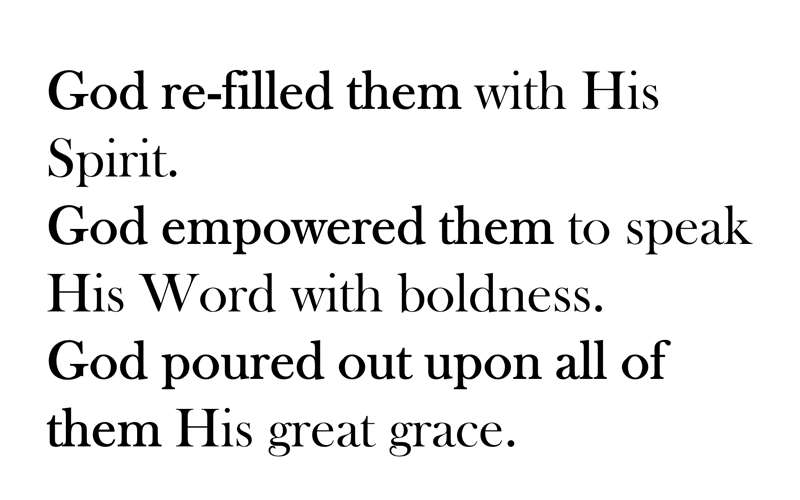
God re-filled them with His Spirit.
God empowered them to speak His Word with boldness.
God poured out upon all of them His great grace. That means:
God Keeps Orchestrating the Spread of the Gospel
These thousands are further described in Acts 8:1-4 where it is stated that they:
Acts 8:1-4 (NKJV) Now Saul was consenting to his death. At that time a great persecution arose against the church which was at Jerusalem; and they were all scattered throughout the regions of Judea and Samaria, except the apostles. 2 And devout men carried Stephen to his burial, and made great lamentation over him. 3 As for Saul, he made havoc of the church, entering every house, and dragging off men and women, committing them to prison. 4 Therefore those who were scattered went everywhere preaching the word.
All that to say there must have been an immense amount of activity going on with soul-winning, discipleship, worship, ministry, church gatherings, and so much more. But out of that whirlwind of events, and that immense cloud of individuals all touched and moved by the Spirit of God: the book of Acts has only the lives of the people, and the accounts of their lives that God wanted us to know.
There are so many stories of lives we have no final chapter. Part of the wonder of Heaven will be to see what happened to all these amazing believers we know nothing more about:
How did God use Nicodemus after he believed, help bury Christ, and then saw Him risen?
How did Joseph of Arimathea get to see God at work as he described the tomb Christ borrowed for one weekend that changed Joseph’s and the world’s eternal destiny?
What else did Barnabas do, and John Mark, all those women who ministered to Christ, and Cornelius who was from Italy and most likely went back. These are just a handful of the thousands Christ touched. Each were filled with the same Spirit of God. Each were empowered and served.
But God only tells us as much as He does about each life so we can learn what He wants us to know. The rest is left for the end when God reveals all that everyone did for Him, but that is yet future. We are to learn, understand, and go with what we have before us.
That is the backdrop for all of these presentations of the Gospel we have been studying. Now we come to Acts 24.
Salvation Is: Following the Way of Worshipping God
MESSAGE TWENTY (Paul): The next Gospel Presentation is in Acts 24:14-27, where salvation is described as a Way of Worship, that involves righteousness, self-control, and averts judgment; and that message makes the lost to fear.
Acts 24:14-16; 24-25 (NKJV) But this I confess to you, that according to the Way which they call a sect, so I worship the God of my fathers, believing all things which are written in the Law and in the Prophets. 15 I have hope in God, which they themselves also accept, that there will be a resurrection of the dead, both of the just and the unjust. 16 This being so, I myself always strive to have a conscience without offense toward God and men. 24 And after some days, when Felix came with his wife Drusilla, who was Jewish, he sent for Paul and heard him concerning the faith in Christ. 25 Now as he reasoned about righteousness, self-control, and the judgment to come, Felix was afraid and answered, “Go away for now; when I have a convenient time I will call for you.”
Who Did Paul Witness To?
Real quick look with me at v. 24, do you notice a couple of names there? First we have Felix, and secondly we have Drusilla. Who were they anyway? This is where a good study Bible is so helpful. The MacArthur Study Bible gives short bios[2]?
Felix: Governor of Judea from A.D. 52 to 59. Felix was a former slave whose brother (a favorite of Emperor Claudius) had obtained for him the position as governor. He was not highly regarded by the influential Romans of his day and accomplished little during his term as governor. He defeated the Egyptian and his followers (see note on 21:38), but his brutality angered the Jews and led to his ouster as governor by Emperor Nero two years after Paul’s hearing (v. 27).
Drusilla: The youngest daughter of Agrippa I (note the family tree chart), and Felix’s third wife. Felix, struck by her beauty, had lured her away from her husband. At the time of Paul’s hearing, she was not yet 20 years old.
So Paul was facing a teenaged, fabulously wealthy woman who was living in moral decadence, in the midst of the land of the Bible, surrounded by the birth of Christ’s Church and untouched by the message of salvation. Plus a man of poverty who meteorically rose to power, and got what he wanted despite the rules and costs.
So, the rich, famous, and powerful of the day are seated, Paul is given the platform to speak. Think of it as being like having a combination of Miley Cyrus, Lindsey Lohan, and Paris Hilton morphed into one 19 year old, who is married to someone with Michael Jackson’s fame and influence: and YOU get to share a testimony of Christ. What would you say?
As a guide, God gives us the elements of salvation that Paul weaves into his witness, they are:
Believers follow a new Way, it is Christ who is our way;
Believers worship God;
Believers trust all of God’s Word;
Believers hope in God;
Believers believe in resurrection and judgment to come;
Believers live a changed life; and
Believers explain that faith in Christ involves righteousness, self-control, and the judgment to come.
The short version of what Paul shared would be that it is:
Hard to Believe in Christ
Thus Paul gives not an easy to believe, “try Jesus” message! Note the audience that hears Paul’s message. Paul is facing pagans, steeped in sin, lost and doomed men and women. What does he tell lost people?
A message about Christ & salvation that makes it hard to believe, because it involves, conviction, confession, repentance, and life-change.
So how does Paul do personal evangelism with big shots, who have sordid lives? He hits them with God’s Word, God’s Law, God’s Holiness, and their utter failure to meet His standard.
Note what Paul says in Acts 24:25 righteousness, self-control, and the judgment.
- People need to be told that God demands perfection; and only perfect people are allowed into Heaven because of God’s perfect holiness. The standard we share, as God’s representatives, is that perfect “righteousness” is needed by all humans. Then we share the bad news that there is none righteous, not even one. Then we point them to Christ the source of perfect, imputed righteousness. (Mt. 5:48; Rom. 3:10; 2 Cor. 5:21)
- People need to be told that God demands that for people to conform to His absolute standard, it require they begin to live with “self-control.” This self-control comes not from an outward restraint imposed by others, but by an inward change prompted by God’s grace (Titus 2:11-13).
- People need to be told that for anyone that fails to exhibit self-control and to conform oneself to God’s righteous standard is (apart from salvation) “” They will be required to stand before God and answer for every evil deed seen and unseen.
What is the result of this type of evangelism that makes it “hard to believe” instead of so easy that no one could refuse the offer?
Was Paul Afraid of Offending Felix & Drusilla?
Felix was afraid. We know from history that Felix was living with this woman Druscilla, that he had lured away from her husband. Felix was convicted by the clear presentation of God’s standards that he had an obvious lack of “righteousness”; and lived with no moral “self-control.”
When Felix realized that he might have to face the “judgment” of God, this thought alarmed him. The result was no quick conversion, instead Felix hastily dismissed Paul.
Note what he says at the end of this verse: when I have a convenient time. That convenient time probably never came. Felix rejected his momentary conviction, the fear of God passed. Felix foolishly hardened his heart, pushed away the convicting work of the Spirit, and passed up what may have been his only opportunity to repent.
As the writer of Hebrews notes: while you hear His voice, don’t harden your hearts!
Back to where we started: how does God want to keep us boldly proclaiming His Word?
How Does God Keep His Church Working?
By re-energizing us by re-filling us with His Spirit.
What did God do to them?
God re-filled them with His Spirit.
God empowered them to speak His Word with boldness.
God poured out upon all of them His great grace.
Why not invite the Lord to come and take over again, every part of your life with these words:
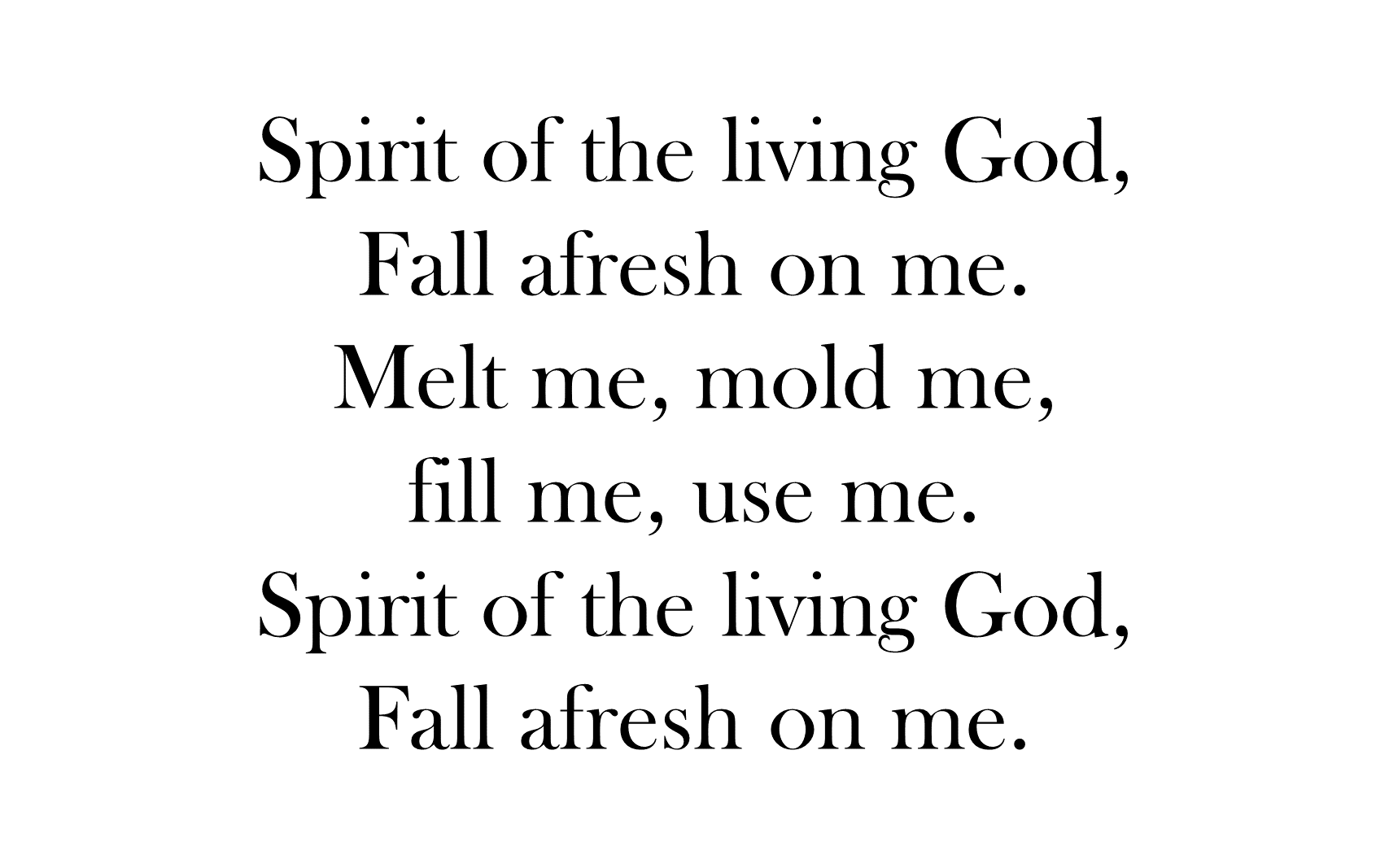
Spirit of the living God,
Fall afresh on me.
Melt me, mold me, fill me, use me.
Spirit of the living God,
Fall afresh on me.
[1] http://www.prb.org/Publications/Articles/2002/HowManyPeopleHaveEverLivedonEarth.aspx
[2] MacArthur, J., Jr. (Ed.). (1997). The MacArthur Study Bible (electronic ed., p. 1679). Nashville, TN: Word Pub.