If the video above is not available, here are two other ways to view:
140105AM Discipline Series Intro.docx
ESH-01
Biblical Exercises for Spiritual
Health & Fitness in 2014
1 Timothy 4:1-16
Transcript
Transcript
Let’s open our Bibles to 1 Timothy chapter 4.
First Timothy chapter 4 talks about biblical exercises that God wants us to all be doing so that we will live in spiritual health and fitness in the new year. Now, standing at the very beginning of this new year is an exciting time to think about. Because most people do this, this is when athletic memberships go off the charts. This is when all the resale shops are out of weightlifting things and all the exercise equipment. Everybody goes crazy for about three weeks, with all this new discipline in their life, and that’s good. And it’s good to exercise and eat right and all that.
But I’m talking about God’s prescribed spiritual exercises, and that’s what we find here. Especially, if you look down at your Bible at verse 7, we’re going to read 1 Timothy 4, the whole chapter. But verse 7, it says, exercise yourself for godliness.
Now, basically, what we’re looking at is we’re learning what really matters to God. Now what version of the Bible you have, it says exercise in the seventh verse, in the King James and New King James. And it says, discipline, and so there are disciplines that the New American talks about. Or training, but all of them are the very same Greek word, and that Greek word speaks of exercises that God has written down in His Word, that weren’t just for Timothy. They weren’t just for the first century. They were, if you look down at verse 11, these things command and teach. Timothy, the pastor of the largest church of the ancient world, the church at Ephesus, the prototype of all current pastor-teachers that are alive on Earth today and throughout the 20 centuries. He was the model through which Paul wrote the pastoral epistles that talk about how things are to be done.
He was told personally in verse 7 to exercise, or discipline, or to have these activities in his life, these spiritual exercises in his life. But then in verse 11, he’s supposed to command throughout the church and teach all of the church leaders throughout the centuries. That’s what God expects. So, this, if there could ever be a New Year’s topic, it would be how to get started in the spiritual exercises, the spiritual disciplines, the spiritual pursuits that God says are for us.
When you meet someone that has a stint put in their heart, little problem with their heart. And the doctor looks them right in the eye and says, you know what? If you don’t change your exercise and your diet, and if you don’t get serious about this, you’re not going to see your grandchildren. People just, boom. You’ve all met them. It gets so you can’t even see them. They get so thin. They’re out jogging constantly because they heard what was prescribed so that they would survive.
God says, it’s like He’s putting us on the little paper-wrapped bench in the doctor’s exam room, and He’s looking us in the eye. And He says, if you want to survive the evil of the 21st century, if you want to redeem your life for heavenly, eternal benefit, I prescribe these exercises, this kind of a diet. This spiritual regimen is what God says, I prescribe for you.
It’s very interesting. Let’s listen, chapter 4 verses 1 through 16, stand together, and feel like you’re sitting on that crinkly paper wearing that little robe that doesn’t close in the back. And this Person you trust and love with all your heart is looking you right in the eye, and it’s not your doctor, it’s God. And He’s saying, for 2014 this is what you ought to be paying attention to.
Here it goes, verse 1, now the Spirit expressly says that in the latter times some will depart from the faith, giving heed to deceiving spirits and doctrines of demons, speaking lies in hypocrisy, having their own conscience seared with a hot iron, forbidding to marry and commanding to abstain from foods which God created to be received with thanksgiving by those who believe and know the truth. For every creature of God is good, and nothing is to be refused if it is received with thanksgiving; for it is sanctified by the Word of God and prayer.
If you instruct the brethren in these things, you will be a good minister of Jesus Christ, nourished in the words of faith and the good doctrine which you have carefully followed. But reject profane and old wives’ fables and exercise yourself toward godliness. For bodily exercise profits a little, but godliness is profitable for all things, having promise of the life that now is and of that which is to come. This is a faithful saying and worthy of all acceptance. For to this end, we both labor and suffer reproach, because we trust in the living God who is the Savior of all men, especially of those who believe. Verse 11, these things command and teach.
Let no one despise your youth, but be an example to the believers in word, in conduct, in love, in spirit, in faith, in purity. Till I come, give attention to reading, to exhortation, to doctrine. Do not neglect the gift that is in you, which was given to you by prophecy with the laying on of the hands of the eldership. Meditate on these things; give yourself entirely to them, that your progress may be evident to all. Take heed to yourself and to the doctrine. Continue in them, for in doing this you will save both yourself and those who hear you.
Let’s bow for a word of prayer. Lord, I pray that we would hear Your voice. And as we can make choices to do anything this new year to focus, to invest, to attend to just about anything, the year is wide open right now. I pray that we would pay attention to these disciplines for our spiritual health and fitness in Your sight. Open our hearts to some part of Your message from this chapter this morning, that we may choose that area that we’re going to focus on spiritually, for Your glory, because we love You this morning. In the name of Jesus we pray, amen.
You may be seated, and the first thing to note in your mind is that these are exercises from God Himself. And as I go through this list, I’m just going to categorize them in little chunks. But I want you to look at, and basically there are 10 different areas that Paul points out to Timothy that he was supposed to pay attention to in his life.
Watch out for your cholesterol, and watch out for your blood pressure, and avoid this and that. This is the prescription systematically that God gives him that I want to go through with you. And basically, these spiritual exercises, God is giving to Timothy through Paul. But really, as we’ll see by the time we get to verse 11, they’re going right through Timothy to all of us, and this is really a time. You talk about sitting and reflecting on what’s important for the year ahead. This has got to be as high on the list as you can get because this is God saying, this is what I’d love you to have as a part of your life in the year ahead.
Number one, God said to Timothy, you need to, in the first 6 verses, expose evil doctrines and teachers. In other words, Timothy, you should be able to know when a doctrine is, and if you Look what it says in verse 1, when it’s from a deceiving spirit and a doctrine of demons. What do deceiving spirits and doctrines of demons always do? They deny the deity of Christ. They deny that Jesus Christ is God in human flesh.
Okay, let’s apply that, Timothy. If someone comes to your door, two of them, and they have a little name badge on, they’re wearing white shirts, and they’re clean cut, they deny Jesus is God in human flesh. What they’re knocking on your door with is a doctrine of demons. See, we have to start understanding what the Bible says.
And if they come carrying a black suitcase, and they’re two by two, and they say that they’re Jehovah’s Witnesses, you can say, no, you’re Jehovah’s false witnesses, because Jesus Christ is God in human flesh. So, you have to be able to understand and expose evil and false doctrine and teaching.
And the same is true, another demon doctrine is Islam. Does Islam believe Jesus Christ Is God the Son in human flesh? No, they do not. That’s a doctrine of demons. It’s denying the truth of God. So, Timothy, understand that.
Secondly, look at verse 6 at the end of it, after this, what you are against, it’s what you’re for with all of your heart. You should be a good minister, nourished in the words of faith. Timothy, nourish your own soul. Don’t just rely on being related to Paul as your spiritual father, nourish your soul.
Next, look at verse 7. Timothy, reject everything that’s profane and empty. Profane and empty living, reject that, don’t have anything to do with it. That’s fascinating when we think about today, but we won’t think about today for a little while. But that means in the first century there must have been profane areas that were alluring and empty areas of wasting time. And he said, Timothy, don’t get into that.
Next, look at verse 7, the second part, pursue personal godliness. Don’t just do corporate, because Timothy was a pastor, don’t just try and see Ephesus, which happened to have been the largest church of the ancient world, Eusebius tells us, and Timothy pastored it. Don’t just work on making the first church at Ephesus great. You! You, Timothy, pursue personal godliness.
The next one, verse 11. Don’t just study all this; command and teach, Timothy, others. Look at what verse 11 says: this message, these things I’m telling you, command and teach. Those are both imperatives. He says, you are to look people in the eye and, kind of like the doctor in the doctor’s office, you be a representative of God and tell people, this is how God wants you to live.
I’m living it, that’s what verse 7 is about, personal godliness through 10. So, Timothy could say, I’m experiencing this, and by the way, Timothy was a struggler. He was fearful. He cried a lot. He struggled with doubts. He wanted to quit all the time. Paul said, I know all of your struggles. He was also sick. He was weak. But Paul said, you’re not perfect, but you’re to pursue godliness.
And imperfect people pursuing godliness are to go to other imperfect people and tell them, that’s what God expects from me and you. See that element was the personal discipleship that everyone. Just because Timothy was a pastor of this vast church, didn’t mean he didn’t have a personal duty, as every believer has, to be involved in shaping other believers’ lives in the Word. So, he says, command and teach others to follow godliness.
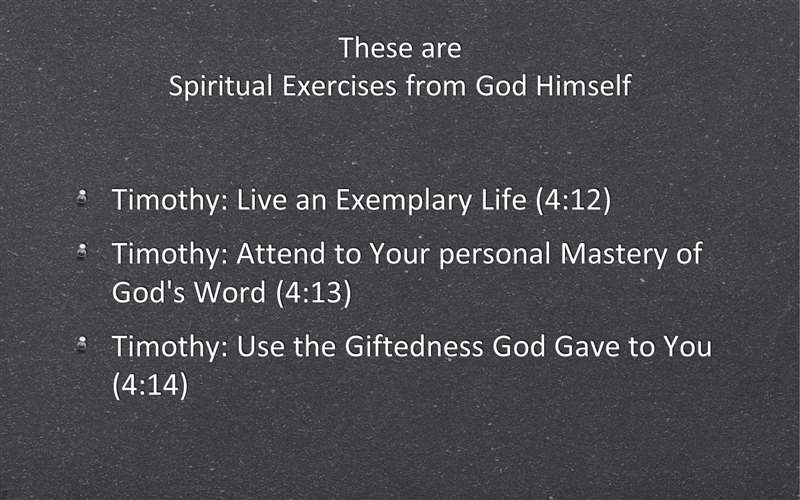
Doesn’t stop there, look at verse 12. Live an exemplary life, whether you’re in Ephesus or far away, live in such a way that you exemplify how Christ would live in that culture, in that location, in that arena, in that event, in that whatever. Exemplify Christ.
Boy, it doesn’t stop there. Look at verse 13, attend to your personal mastery of God’s Word. Did you know all of us master something? You can tell what people master; they talk about it all the time. They master woodworking. They master outdoor living. They master recreational arts. They master financial arts. They master communication. They master social media. They master computer and digital things. Whatever it is, you just know it. If you’re around them long enough, they get excited about it. They talk about it; they show it to you. They just can’t stop talking about whatever it is they’ve mastered. They can take an old clunker and soup it up, so it can go from zero to 60 and whatever, but they’ve mastered. Or they can cling to one of those longboards and do amazing things, but they have invested the time to master something.
You know what God says? Timothy, attend to your personal mastery of God’s Word. Every one of us are not supposed to say, oh, I have, the Ryrie Bible. Oh, I have the MacArthur Bible. Oh, I have the Dallas whatever. God says, no, if all that was taken away from you, how much of My Word have you personally mastered? How much can you, from just your Bible, defend and explain and declare what you believe and why?
Did you know that’s what Ken Ham with the Answers in Genesis team has found out in all their surveys? That we have a generation of biblically illiterate people in the Church today, and that’s why it’s so pendular. Whatever the newest thing is, they all just, like lemmings, they just run after it because they have not personally mastered the Bible. They aren’t grounded. They’re swept with every wave of the newest thing instead of being grounded.
And so how do you get grounded? You attend, Timothy, to your personal mastery of God’s Word, and it doesn’t end there. Use the giftedness God gave to you. You know the snow out here? Do you know one of the things, the snow, the New York Times just published this montage of the incredible cylindrical. I didn’t even know snowflakes looked like that. I thought they were all flat like doilies. The unbelievable beauty and symmetry and the intricacy, and we all know that. But we think about if God pays that much attention to water crystals.
Can you imagine us? We’re spiritual snowflakes. There are no two believers exactly alike. There’s no two believers with the same selection of circumstances, of unchangeable features that God puts into our life, and then He puts spiritual gifting and calling, and all that makes us like a spiritual snowflake. And, Timothy, Paul said, use the giftedness that God gave to you. God picked you for something nobody else could do. Do it, know it, be what I called you to be, Timothy.
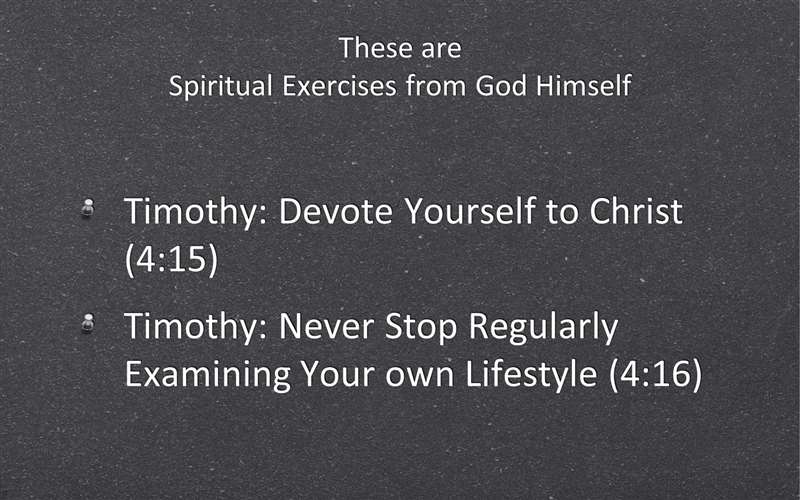
And then two more, verse 15, devote yourself to Christ. There’s nothing else that’s worth living for. And then never stop regularly examining your own lifestyle, Timothy. Don’t coast, is what he’s saying. Don’t think that because you’re my son in the faith, because you pastored that big church, because you had Mary the mother of the Lord attending your church and John the Apostle attending your church, don’t think you can coast. Never stop examining your spiritual life and making sure that you are not letting something slip, letting something go. Make sure you’re constantly disciplining yourself for the purpose of godliness.
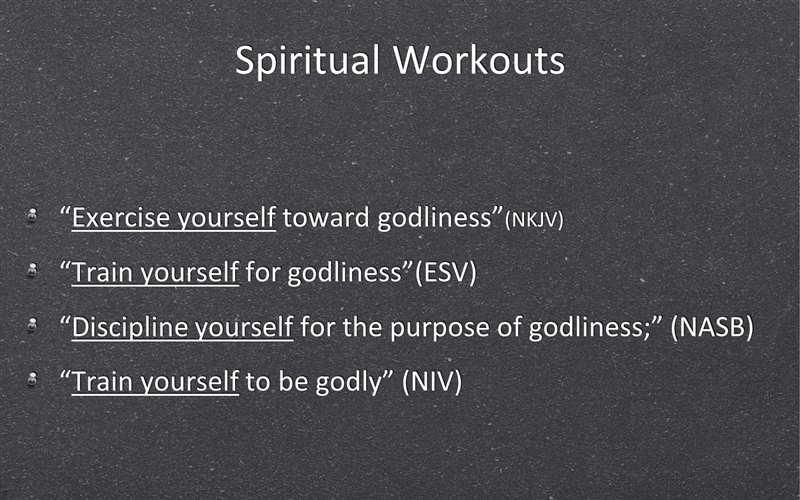
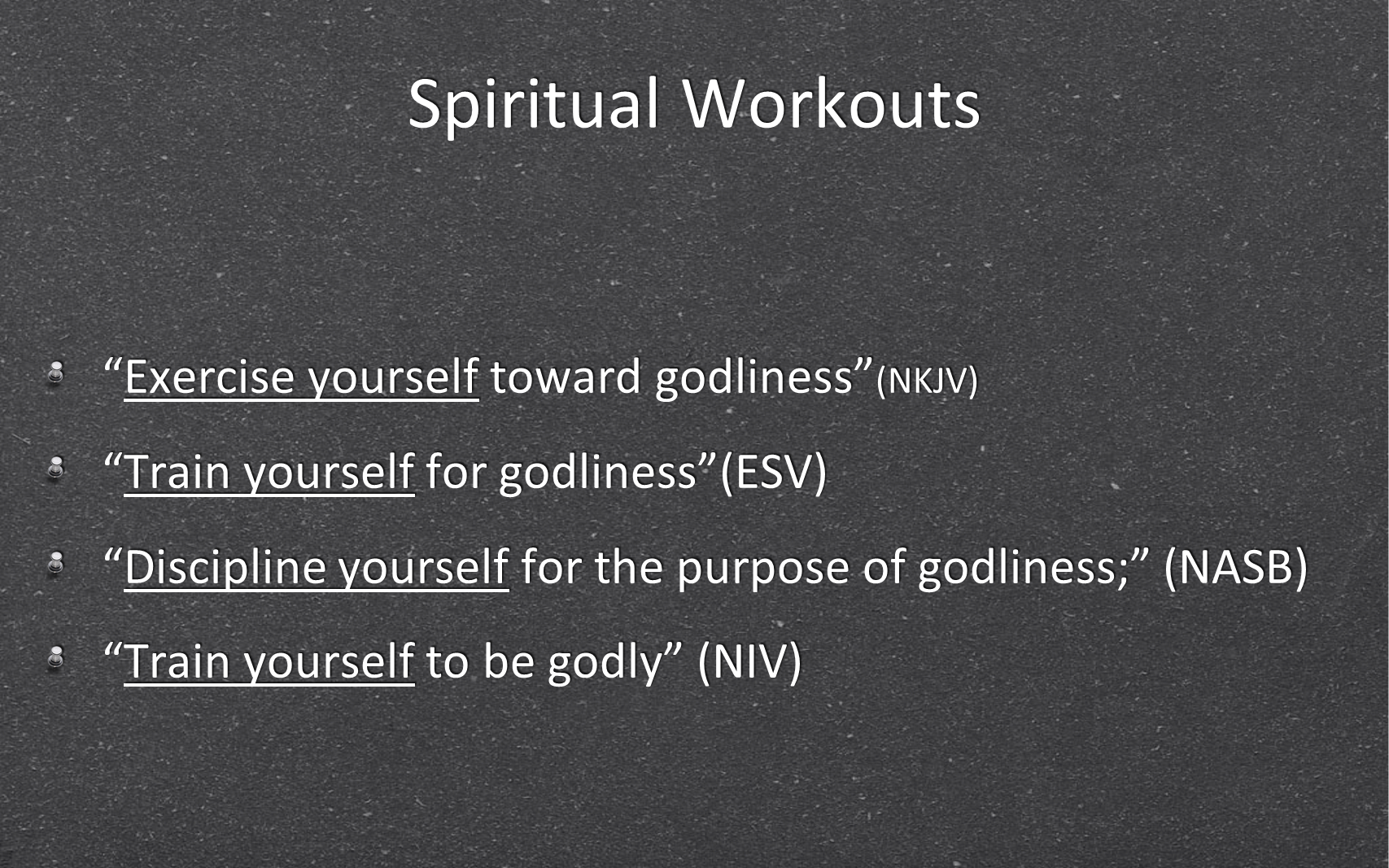
Those are the spiritual workouts. Basically, exercise yourself, train yourself, discipline yourself, train yourself to be godly.
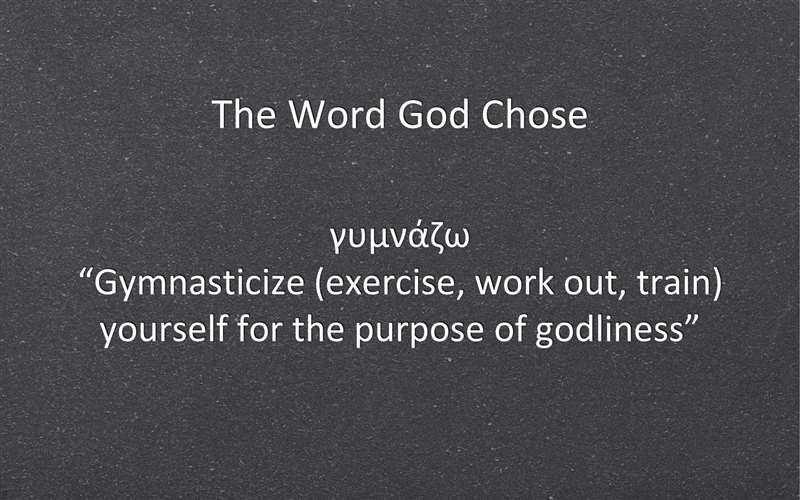
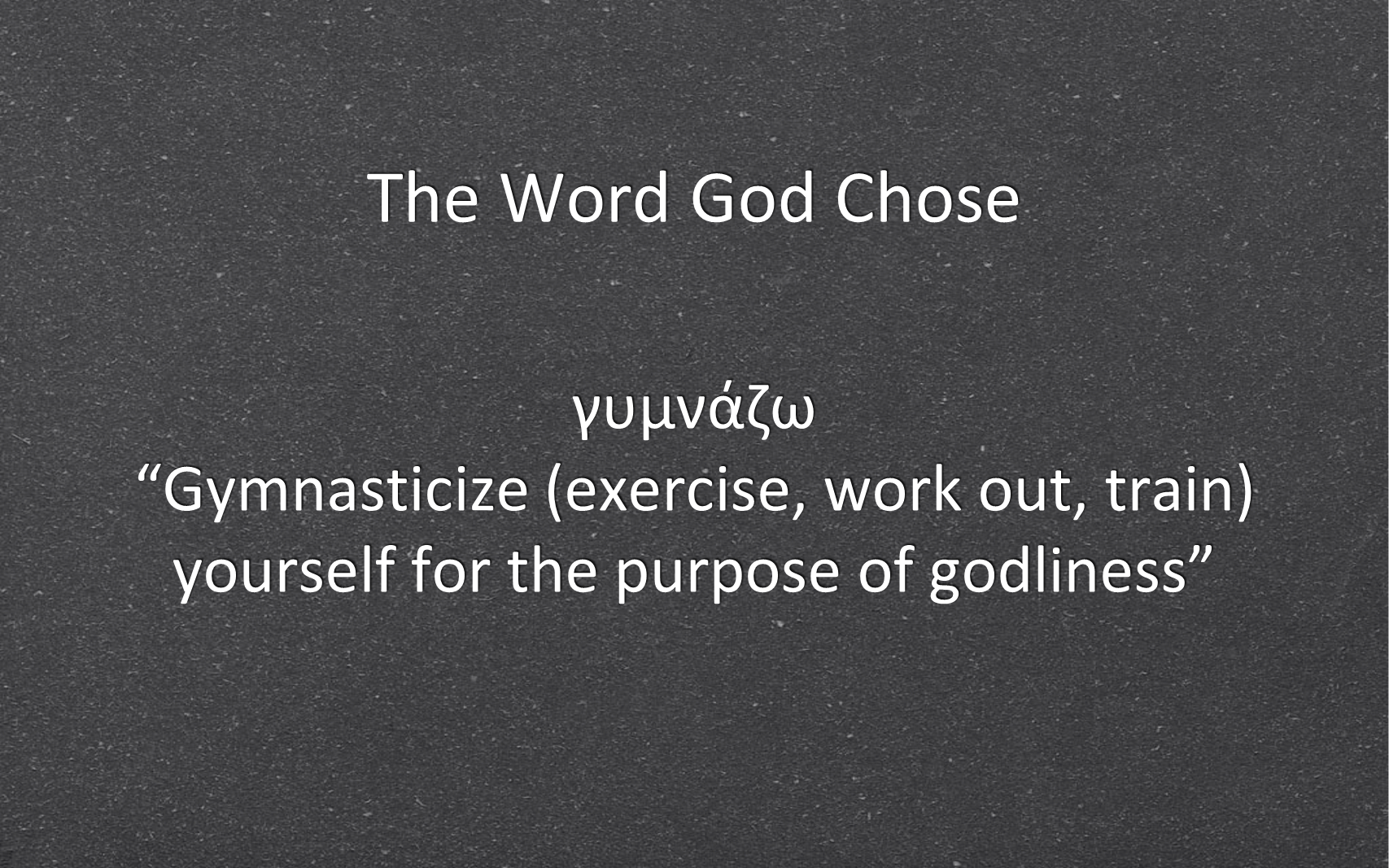
But all of those words are the same Greek word. In fact, I wrote it for you there. It’s gumnadso. Do you see it? G-U-M-N-A-D-S-O. Can you see that? Gumnadso, it’s very clear up there in Greek. It’s Greek to me too. But what that means is gymnasticize. That’s a very good translation of that word, gumnadso.
It means to gymnasticize. Have you ever seen a gymnast? Have you ever seen how they can control, and balance, and flip, and do all those things? Now, I’m not going to tell it first service because she’s here, but my wife was a gymnast on television for a decade. She could, I don’t want to say anything about it because it’d embarrassed her, but she used to be able to stand on her trainer’s hand and do all those things, and they would film her.
Do you think she just walked in and learned that overnight? It was endless hours of practice. Now look at that gymnasticize. It means exercise, work out, train, put the exertion, and the effort, and the time, and the sacrifice, and the denial of other things in order to accomplish that.
Now, as soon as we start talking about that with anything to do with spiritual things, what do people immediately think about? Oh, they think that’s legalistic. Let’s examine what that means because this exercise, first of all, is prescribed by God, but it’s not just prescribed by God. It’s centered on God. He’s the one that said, I want you to do it, and then He told us what He wants us to do. We know hard work is necessary in athletics and in the arts and in the sciences, but when it comes to our spiritual life, people hesitate when they hear words like discipline, and train, and exercise.
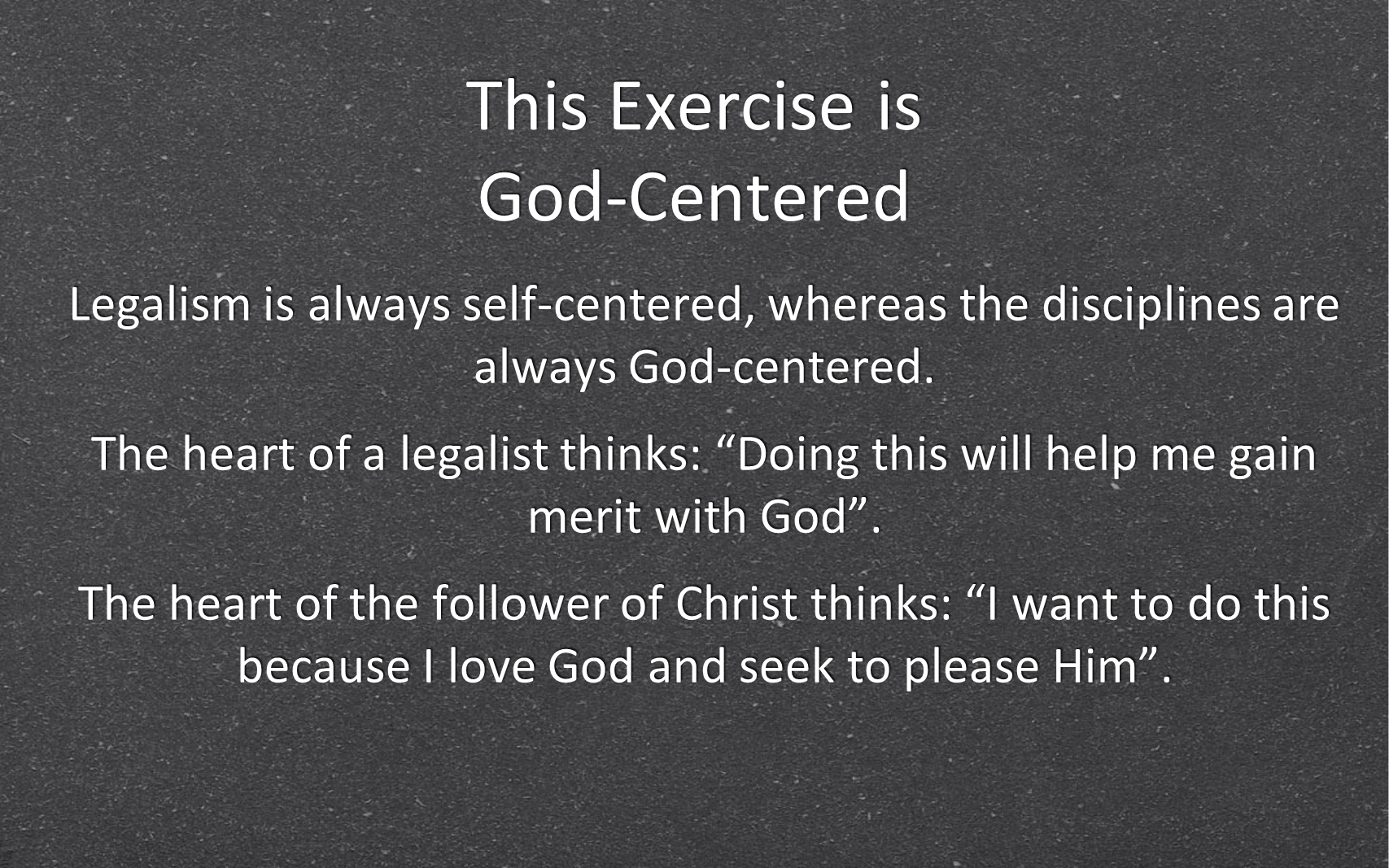
It sounds like legalism, but that’s an incorrect line of thinking if you read the Scriptures. Legalism is always self-centered, whereas the disciplines are always God-centered. The heart of a legalist thinks, doing this is going to help me gain merit with God; He’ll love me more if I do more of those things. But the heart of the follower of Christ thinks, I do this because I love the Lord, and I’m motivated by pleasing Him because He wants this. I love Him. I want to do this.
Paul had a lot of experience in knowing the difference between legalism and grace. Paul never would give an inch to the legalists. He constantly challenged them and told them that their self-effort would gain them nothing. And yet the same apostle challenged believers in every church to exercise, to train, and to discipline their own personal life for the purpose of godliness.
Paul’s life is a legendary example of personal denial. In fact, don’t lose your place too much, but if you want to see this, look back at 1 Corinthians chapter 15. Here’s Paul’s testimony in 1 Corinthians 15:10. He says, but by the grace of God, I am what I am. He was legendary. Paul was shipwrecked, beaten, stoned, imprisoned, run out of every town almost he ever visited. But he says, verse 10 of 1 Corinthians 15, by the grace of God, I am what I am, and His grace toward me was not in vain. What did he mean by that? Look at the next line of that verse: but I labored more abundantly than all of them. Yet not I, but the grace of God that was in me.
You know what Paul was saying? He’s saying there’s a great big pipe of God’s grace that comes down, and it’s right in front of every one of us, and we can avail ourself of as much or as little of as grace as we want to. That’s our choice. We exercise ourself toward godliness, we’re taking all we can, and we are, by His grace, denying ourselves and seeking Him.
Or we can just neglect all that. And he says, the reason I’m the legendary man that I am, Paul said, is because God’s grace that we all get, I took as much of it as humanly was possible. It’s amazing to think about. He labored more abundantly than them all, but it wasn’t Paul, it was the grace that was with me.
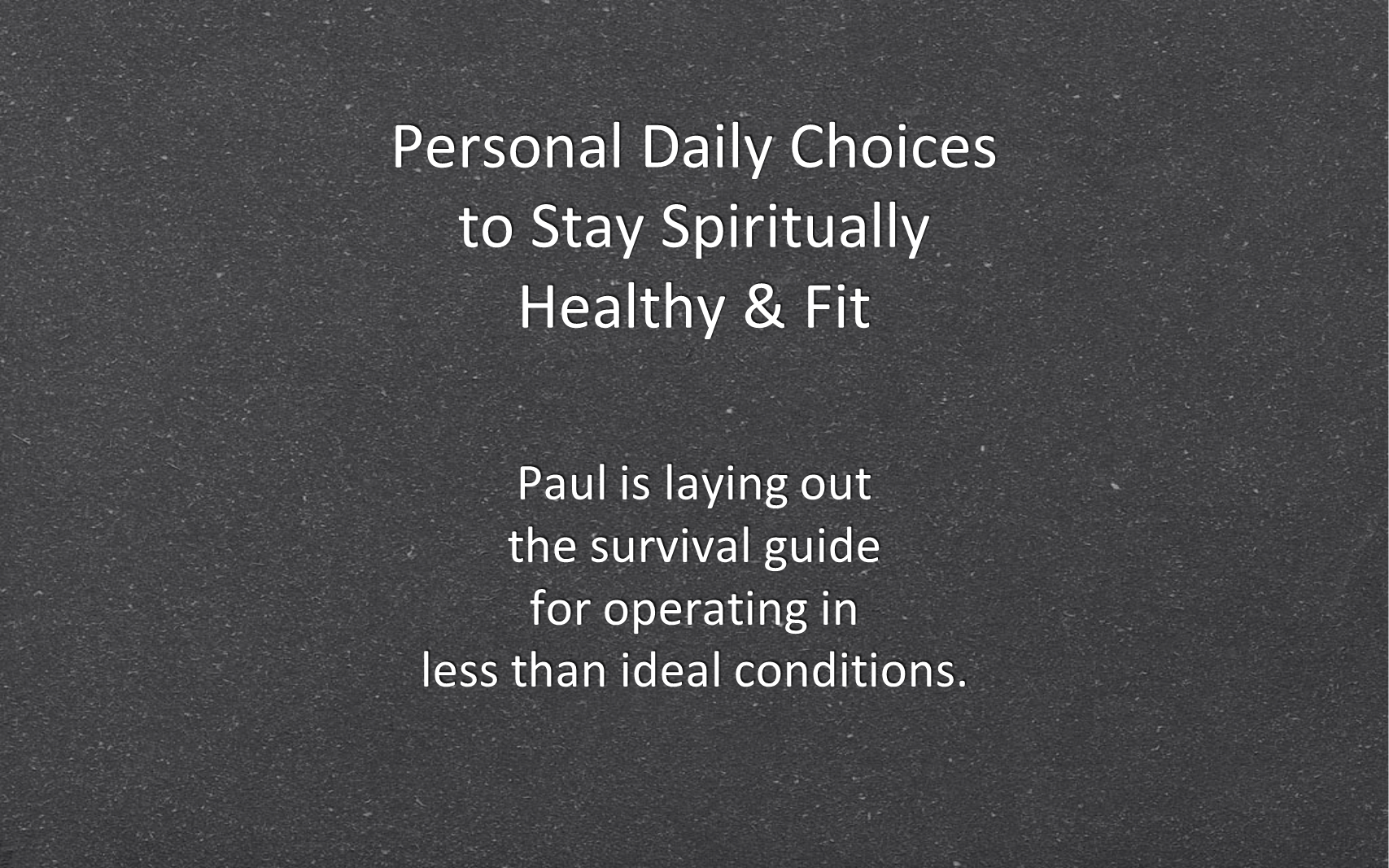
Basically, what he’s saying is these were personal daily choices he made to deny ungodliness, to stay fit, to be healthy spiritually. And basically, what Paul is saying is this is the survival guide. All of us live in a less than ideal world. In fact, when you think about Timothy, more than anything else, this person that Paul’s writing 1 Timothy. And go back to 1 Timothy 4 with me because I don’t want you to be too far away from that. But when you get there and see him talking to Timothy, think of Timothy in one way. Think of him as normal. Timothy was not an apostle. Timothy was not a prophet. Timothy didn’t write Scripture. Timothy, like us, just tried to understand it, and live it, and teach it.
So maybe we won’t be like Paul, but all of us should really relate to Timothy. In fact, if you could put up Timothy’s Facebook page, you’d find out that he’s more like each of us than almost anybody else in the New Testament. You would notice, if you studied his life in Acts, and also in 1 and 2 Timothy, those biographical notes, that Timothy was from less than a perfect home. He had a saved mother and grandmother, and all the rest of his family’s dad’s side were pagans.
Now, what does it mean to be a pagan Greek man? It’s pretty bad. It’s like the American stereotypical loose lifestyle. That’s what Greek men were about. They were self-centered, it was all about the body, it was all about what they could be. We talk about humanism. They were the quintessential humanists. And that was a less than perfect home. He had this mother and grandmother that were pushing him toward the Bible and God, and he had this dad that everything in his life was going the opposite direction.
So, he had a less than perfect home life, but that’s not all. He struggled, the Bible says, with fear. He had sorrows; he cried often. He also felt opposition very keenly. He frequently had to be encouraged by Paul to not quit. It’s kind of like the person on the team. “Oh, don’t quit. Come back, do another game. Come on, don’t quit.” That was Timothy. That was his normal life.
That’s where many believers find themselves at the dawn of this new year. They’re from less than perfect homes. They’re facing struggles every day with fear, with sorrows. They feel that people are opposing them, but down deep, they don’t want to quit.
But in 1 Timothy, go back to chapter 1 of 1 Timothy and look at verse 3 because there’s more. Timothy lived somewhere, and he lived, in verse 3 of chapter 1 of 1 Timothy. Above all the other challenges of his home life and his emotional life and his personal struggles, Timothy was also living in one of the most horrible places you ever had to live, and he wasn’t living there by choice.
It says in verse 3, I urged you when I went to Macedonia, you stay in Ephesus. Paul had planted a church and had spent three years; he’d spent a year and a half in Corinth. He spent three years in Ephesus, and when he left, he said, Timothy, I’m moving on, you stay here.
Now you say, Ephesus is neat. Some of you have gone on cruises, Bible cruises. I’ve taken countless, more than I can count, people to see Ephesus. People love Ephesus. What’s so bad about Ephesus? Ephesus was a place of great materialism, sensuality, and distraction, and great amusements. The words of Acts 19 tell us that there was real demonic influence there. It was a huge urban society filled with constant, endless activities. It was a huge bustling seaport that connected Ephesus to the whole world. It rivaled Rome in importance in the ancient world. And then there was all the overland trade routes that made this city almost never sleep. It was on the level in America of a New York or Chicago or LA.
But basically, what we see if we look at it is the situation that Timothy faced, we also face every day. How does a normal believer like Timothy stay fit and useful for the Lord in an environment like Ephesus? How does any average believer stay spiritually exercised and disciplined and not get marginalized by society or neutralized by sin, by our own flesh and by the strong powers of demons that just surround us every day? That’s why Paul wrote 1 Timothy 4:7,
And look back down. What does it say in 4:7? Get back to our chapter we’re looking at. What Paul said is the most timely words from God for each of us today because the same situation Timothy faced, we face, whether we realize it or not, that in the USA in 2014, it’s far more distracting than Ephesus ever was.
And if there was ever a time we need to exercise, and train, and discipline ourself for God, it’s nowadays. Living in Michigan in 2014 means that we each are like Timothy, living in a place and a time immersed in American materialism. Ephesus was one of the most materialistic banking centers of the ancient world. We live in the same thing today.
Each of us also live in a place and time where we’re flowing with America’s inescapable sensuality, things that feed our lusts and that tempt us constantly. We are living in a time when amusements and distractions are more available than any time in history of humanity. In fact, the January Pew Research Center said that 88 percent of all 18 and up adults in America are digitally connected, and an exponentially fast rise in those under 18 is occurring. Where it’s almost like by the time you’re two or three, you can handle that digital device almost like a 50-year-old because you have had it in your hands, and you are just natural with it.
In fact, we went out to lunch with someone recently, and their babysitting thing, they’ve strapped all these little two-year-olds into the highchairs, and then they handed them each an iPhone. Boom. Each of them were playing a game. I don’t even know where the games are on mine. They were in it, and that’s just life.
But now think what that means. That means that right in our hands, right before our eyes, right into our ears are, almost endlessly available anytime of the day or night in almost any location, text messages, and calls, and music, and games, and movies, and everything in the entire worldwide web of over 13 billion cached and indexed web pages on Google.
You know how many there are? Put the letter A in your Google search bar and hit, and in 0.35 seconds it will have searched 13,100,000,000 different web pages, and that’s how many, plus all the subterranean ones they don’t even tell you, there are out there. And that’s all instantly available. Never in human history has it been possible for us to be amused as we are today.
So, what’s the answer God gives? Verse 7. Believers who want to stay fit for God spiritually and healthy and strong, have to choose every day whether they’re going to train and discipline and exercise themselves for God. And what are those exercises or disciplines?
Over the centuries, the Church has identified various disciplines. In fact, back in the last generation a Quaker, his name was Richard Foster, he wrote down a book called The Celebration of Discipline, and basically, he said there are 12 of them. I’ll show them to you.
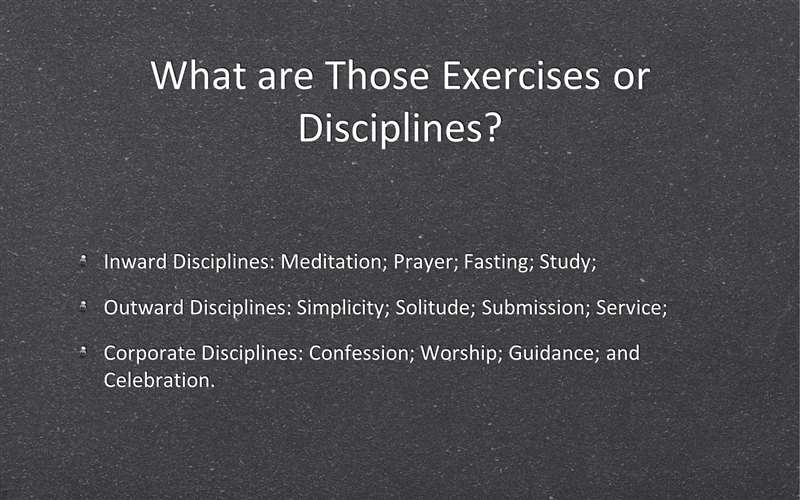
They’re inward disciplines: meditation, prayer, fasting, study. They’re outward disciplines: simplicity, solitude, submission, and service. There are corporate, that’s group disciplines: confession, worship, guidance, and celebration.
More recently, 10 years ago, the bestselling book in America was Rick Warren’s book on 40 disciplines. You all know it as The Purpose Driven [Life]. He said, the purpose that drives us is to discipline ourselves for what God wants us to do. And I could tell you a lot more; I studied every discipline book in my library. Some of them have 10, some of them have 17, some of them have 31. Some of them have 5 like Jerry Bridges’, 17 like Kent Hughes’. They all have identified different disciplines.
Let me ask you, which exercise does God ask Paul to command for Timothy and for us? By the way, Paul knew the entire Old Testament better than any of us, and Paul knew the apostles and Christ personally, and he knew everything they had taught and written. And Paul, who when he wrote, he wrote under the inspiration of the Holy Spirit.
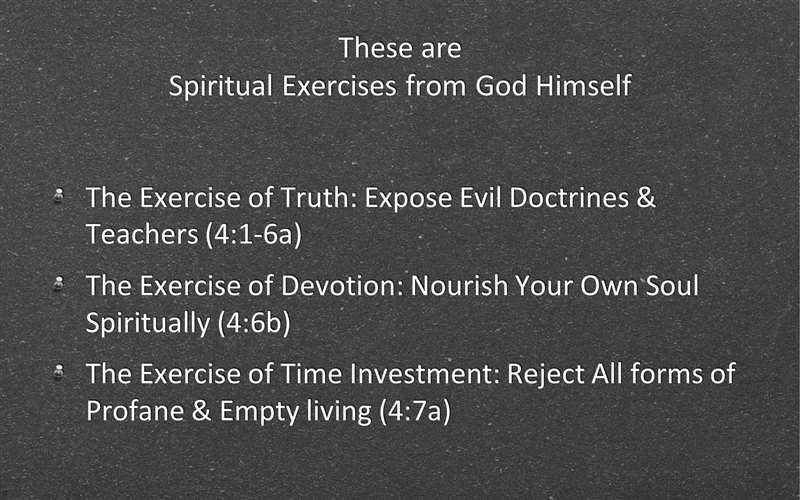
So, what exercises did the Spirit of God tell the Apostle Paul were to be attended to, that he wrote down? How about the exercise of truth? Do you know how to expose evil doctrines and teachers? That’s a spiritual discipline. And verse 11 says, all of us are commanded and are to be taught how to do that.
Do you know where to go in the Bible when one of those cult, false teachers, demon-influenced people comes to your door, or talks to you at work, or addresses you in school? Do you know the truth well enough to defend it? That is a spiritual discipline. It isn’t that you call in whoever the greatest apologist and have them talk, we’re supposed to know how to defend the truth. Not the elder, not the pastor alone, the individual. See that’s what’s happening to the 21st century Church.
I just did a funeral a few weeks ago, and what was interesting was, and I’ll just share with you what was said. It was Joe Smith. His son Michael went off to seminary at Dallas Seminary. When Michael came back with his graduate degree, he sat down with his father, and what Michael said is his father, who barely finished high school, knew the Bible equally and theology as well as Michael, who had just graduated from Dallas Seminary, except for Greek and Hebrew, which Joe had never had time—because he worked at Upjohn—to learn. He probably could have. What does that tell you? Something has changed in our generation.
It used to be that people that just barely made it out of high school mastered the truth of the Bible because they didn’t have anything else to do. They didn’t know 127 channels. They didn’t know the internet to surf around. They didn’t know that they could spend all their time playing games. They just wanted to know the truth, and master the truth, and defend the truth. That’s a discipline.
Secondly, the exercise of devotion, nourishing your own soul spiritually, not relying on someone else to feed you. Devotionals are great. I write them, I love them, but they have to flow from a nourished heart, that we have to nourish ourself and actually know how to eat, and chew up, and digest, and apply the Scriptures.
And here’s another discipline or exercise: time investment. Look at what verse 7 says. It says, we’re supposed to reject anything that’s profane and empty. That’s what an old wives’ tale was. It was empty, it was just vacuous. It might not be sinful. It just was worthless! It was a time robber.
Do you know how the generation ago that mastered the Bible did it? They neglected other things. They didn’t do profane things. Do you know what so much of sitcom America is about? Profane things, mocking, empty, making fun of sin. In fact, I cringe every time I see a good church that is doing something like doing a special on a sitcom. I read about one church, their church services were “What God says from The Office,” a sitcom, a profane sitcom, and they’re teaching God in that medium. Why don’t they just open the Bible? Because people wouldn’t listen to it, because we’ve gotten so amused. If we’re not amused in church, we don’t like it.
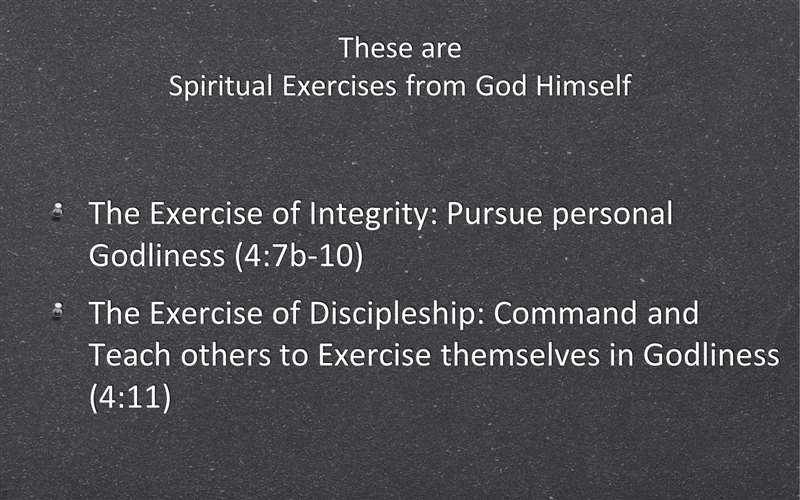
By the way, the exercise of integrity, look at verse 7, the second part. He says, you need to, Timothy, you’re not just preaching, you are personally to exercise yourself. And it’s not just Timothy. Every one of us, if someone comes up to you and that’s part of the church, we’re supposed to be able to go up to each other and say, how are you doing on your workouts? Now, I know some people in this church that if I ask you how you’re doing the workout, you say, oh, I’m doing 52 hundreds and 84 fifties. You know what you’re working on in your workouts and how far you’re running. But if you ask spiritually, they look at you and go, huh, what do you mean? What are you talking about? Because we don’t think in terms of working out and disciplining ourselves for personal godliness.
And here’s another one: the exercise of discipleship. Verse 11 says, not just Timothy, all of us are commanding and teaching others. Do you know what that means? Every believer is called to go into all the world and make disciples. Either you are or you’re not. And if you’re making a disciple, you know who it is because it’s an individual you sit face to face with and you, across the Word of God, are modeling and training them in righteousness. And that’s almost non-existent in the 21st century Church. Why? We don’t have time because we spend all our time in profane and empty things, or we spend it mastering everything but God. But God says, these are the spiritual exercises I want you to focus on.
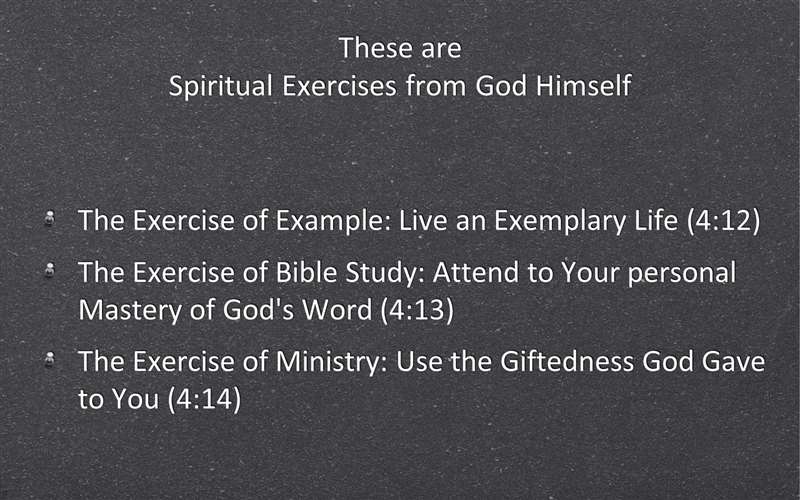
And verse 12, living an exemplary life, exercise yourself in Bible study, attend to your personal mastery of God’s Word, reading through it. In fact, Bonnie and I, every year we get Christmas cards like you do, and one of the things we enjoy is seeing people over the decades that we’ve ministered and hearing from them. We just got one, dear friend of ours, she said, you probably know Charles went to be with the Lord. And I thought, yeah, I heard about that. But the next line of her card was the best. She said, Charles and I marked our 14th year of reading through God’s Word together before the Lord called him home, and we got ready for his homegoing in the Word.
Boy, that related to us because I remember specifically the Sunday that this woman, who by the way, worked for Billy Graham and is an internationally known writer, where she came to me and said, you know what? I’ve written, I’ve done all this, but I’ve never read the whole Bible in my whole life. And she said, I would like to tell you, just to affirm it, she said, I am making it my goal to read through the Bible this year. And her husband was standing right there next to her, and he owned 250 rental homes in Tulsa. And I thought, busy boy there with all your homes. And he stepped up and he said, and I’m going to read it with her. And 14 years in a row, they went through the Bible, and he had cancer for 14 years, and they got ready to graduate Charles to Heaven.
Are you exercising yourself in Bible study? Do you attend to personally master God’s Word or do you want someone else to do that? And you’ll master outdoor living. Great, bring your kayak to the throne of God and see what He says about it. He’ll say, that was great. You saw a lot of nature. How’d you do mastering my Word? And you go, I didn’t. See, that’s what these exercises are about. Exercise your ministry. Do what God called you to do.
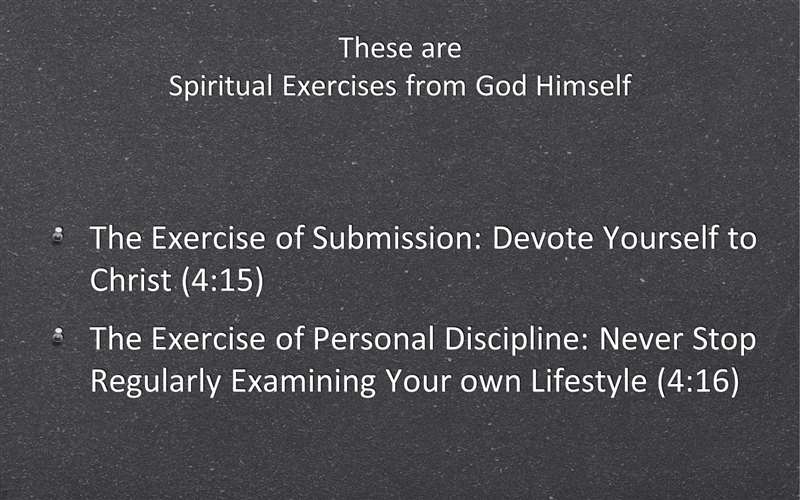
Submit ourselves to Christ. We’re supposed to seek first the Kingdom of God, Christ ruling in my life. I want to devote myself to that.
And finally, exercise the personal discipline of not ever stopping examining my lifestyle to see if. Did you know all these disciplines can be abused? There are some people that are so heavenly minded, they’re of no earthly use. They’re like the Mary and Martha syndrome, and we have to realize that. But you know what? Just because some people abuse the disciplines doesn’t mean that God doesn’t say to us, exercise yourself for the purpose of godliness.
Let’s bow for a word of prayer. As we bow, I’m going to invite the elders and deacons to prepare for serving us communion, and as they go, while we’re sitting here, I want to ask you something. Are you exercising yourself in truth? Can you expose evil doctrine? Are you exercising yourself in devotion? Do you nourish your own soul spiritually every day? Are you exercising yourself in time investment? You’re rejecting any misuse of time for profane or empty things? Are you exercised in integrity? Do you have personal godliness? Are you exercising yourself in discipleship? Are you meeting with someone to help them along in their spiritual life? Are you exercising yourself as an example? How about in Bible study? Are you mastering God’s Word? How about in ministry? Do you know what God gifted you and called you to do? How about your submission? Are you devoted to Christ? How about personal discipline? Are you examining your own lifestyle every day?
Father, as we come to communion at the beginning of a new year, You told Paul to tell Timothy to train himself in godliness. Then you told Timothy to tell everybody in the church that they’re to do the same. Father, as we gather at this beginning of 2014, I pray that you would get ahold of some hearts this morning and that there would be men and women and young men and women at this communion this morning that say, I want to discipline myself and train myself by God’s grace for godliness. And I pray that as we celebrate communion, the reminder of Your love, mercy, and grace poured out to us because of Your work on the cross that we would decide that we are going to gymnasticize ourself to be what You created and desire us to be, and we’ll do it because we love You.
In the name of Jesus, we thank You for this bread, a picture of Your love for us, and in the precious name of Jesus, we offer ourselves to You this morning, amen.
Notes
As we each stand at the doorway of a New Year, it is always a time of reflection, resolutions, and thoughts about what we really want to focus upon in the days ahead. This feeling is not new, it almost seems that God built into the seasons of both the Earth and of human life this element of pause, reflection, and renewal.
Just as the burst of life in Spring, and the flourishing of Summer into the harvest of Autumn, leads into the quietness and slowness of Winter to prepare and reflect upon the burst of Spring. So each New Year we pause to think about how to focus on what really matters. That is what this series is about:
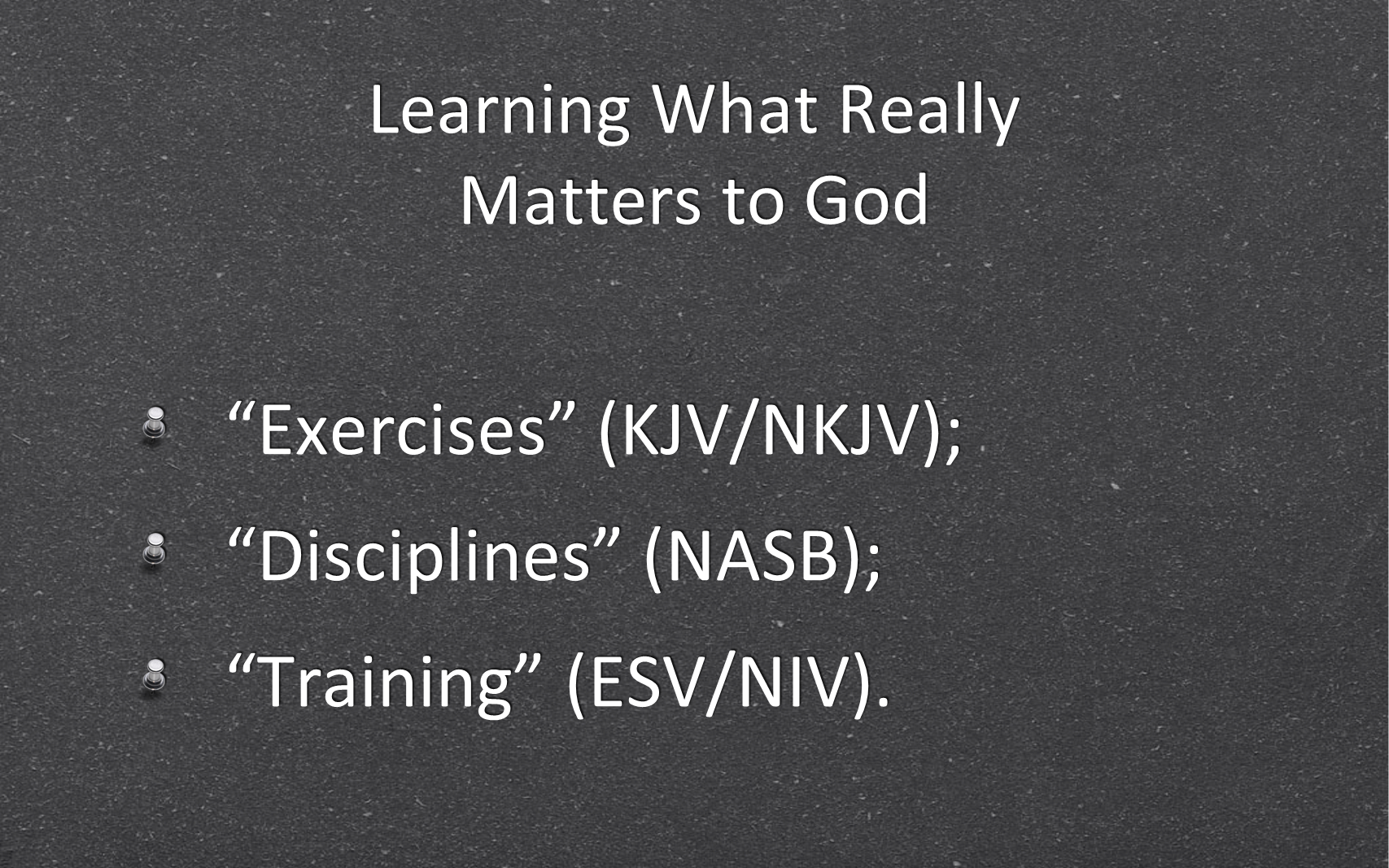
Learning What Really Matters to God
As we open to the New Testament epistle of 1 Timothy, we will find that God’s Word has a guide for us. There are lessons about what really matters to God from the example of Christ’s retreats for prayer and waiting upon His Father; and David’s Psalms from the alone times of reflection in the caves and wilderness; but we can see God’s priorities for us most clearly from Paul’s instructions to the Church through his training of Timothy.
Paul actually lays down a plan for Timothy to train the church he served, as well as individual leaders he nurtured. This plan has specific chosen “exercises” (as the KJV and NKJV call them); or personal “disciplines” (as the NASB calls them); or individual “training” steps (as the ESV and NIV call them).
These truths are all placed in one very powerful, very useful, very strategic chapter in God’s Word: 1 Timothy chapter 4. Today we begin a brief look at what we may call:
Biblical Exercises for Spiritual Health & Fitness in 2014
Please follow along in your Bibles as we hear God speaking through the Apostle Paul.
1 Timothy 4:1-16 (NKJV) Now the Spirit expressly says that in latter times some will depart from the faith, giving heed to deceiving spirits and doctrines of demons, 2 speaking lies in hypocrisy, having their own conscience seared with a hot iron, 3 forbidding to marry, and commanding to abstain from foods which God created to be received with thanksgiving by those who believe and know the truth. 4 For every creature of God is good, and nothing is to be refused if it is received with thanksgiving; 5 for it is sanctified by the word of God and prayer. 6 If you instruct the brethren in these things, you will be a good minister of Jesus Christ, nourished in the words of faith and of the good doctrine which you have carefully followed. 7 But reject profane and old wives’ fables, and exercise yourself toward godliness. 8 For bodily exercise profits a little, but godliness is profitable for all things, having promise of the life that now is and of that which is to come. 9 This is a faithful saying and worthy of all acceptance. 10 For to this end we both labor and suffer reproach, because we trust in the living God, who is the Savior of all men, especially of those who believe. 11 These things command and teach. 12 Let no one despise your youth, but be an example to the believers in word, in conduct, in love, in spirit, in faith, in purity. 13 Till I come, give attention to reading, to exhortation, to doctrine. 14 Do not neglect the gift that is in you, which was given to you by prophecy with the laying on of the hands of the eldership. 15 Meditate on these things; give yourself entirely to them, that your progress may be evident to all. 16 Take heed to yourself and to the doctrine. Continue in them, for in doing this you will save both yourself and those who hear you.
What is really amazing is that when we really examine these words God sent to us we find that we have:
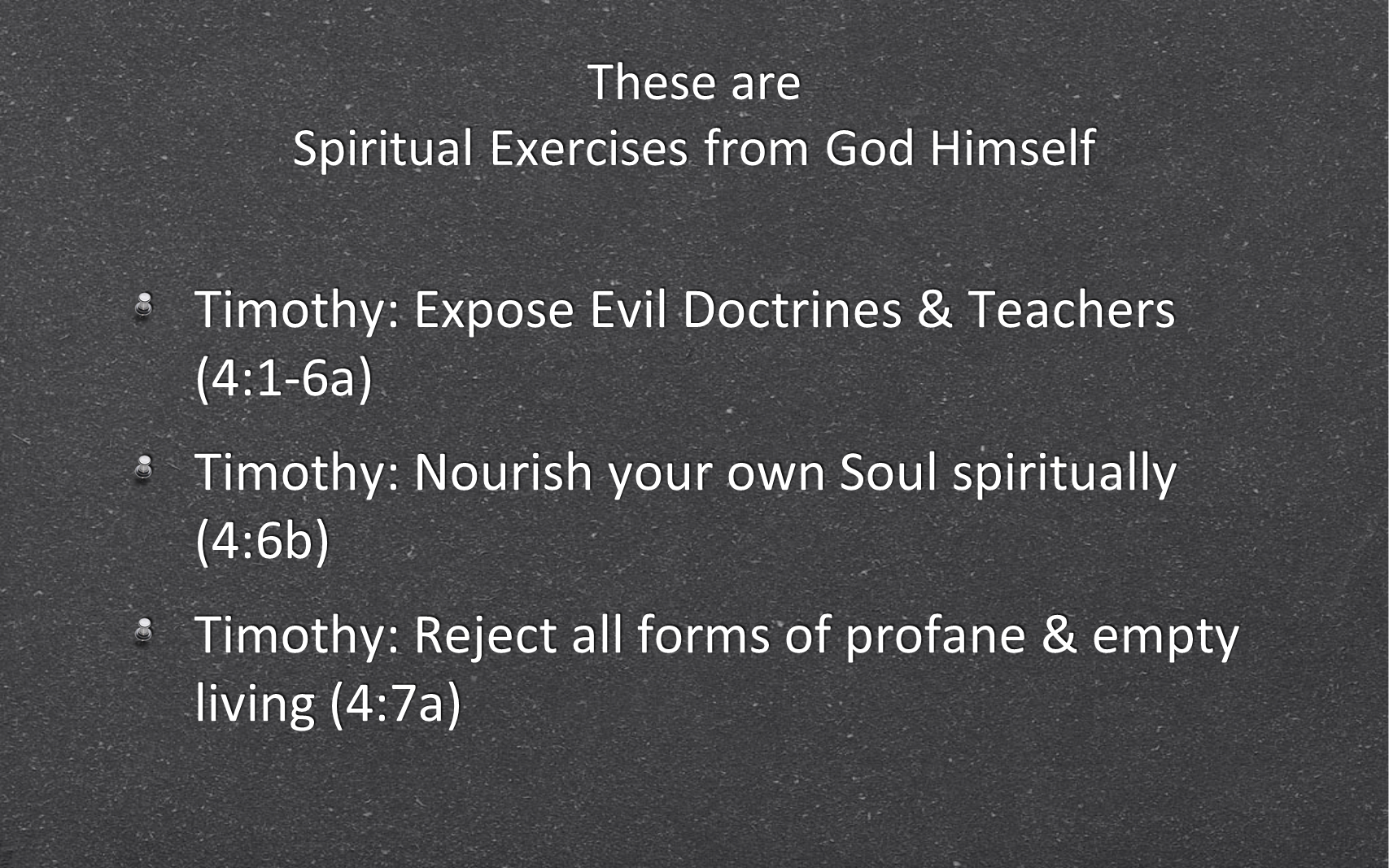
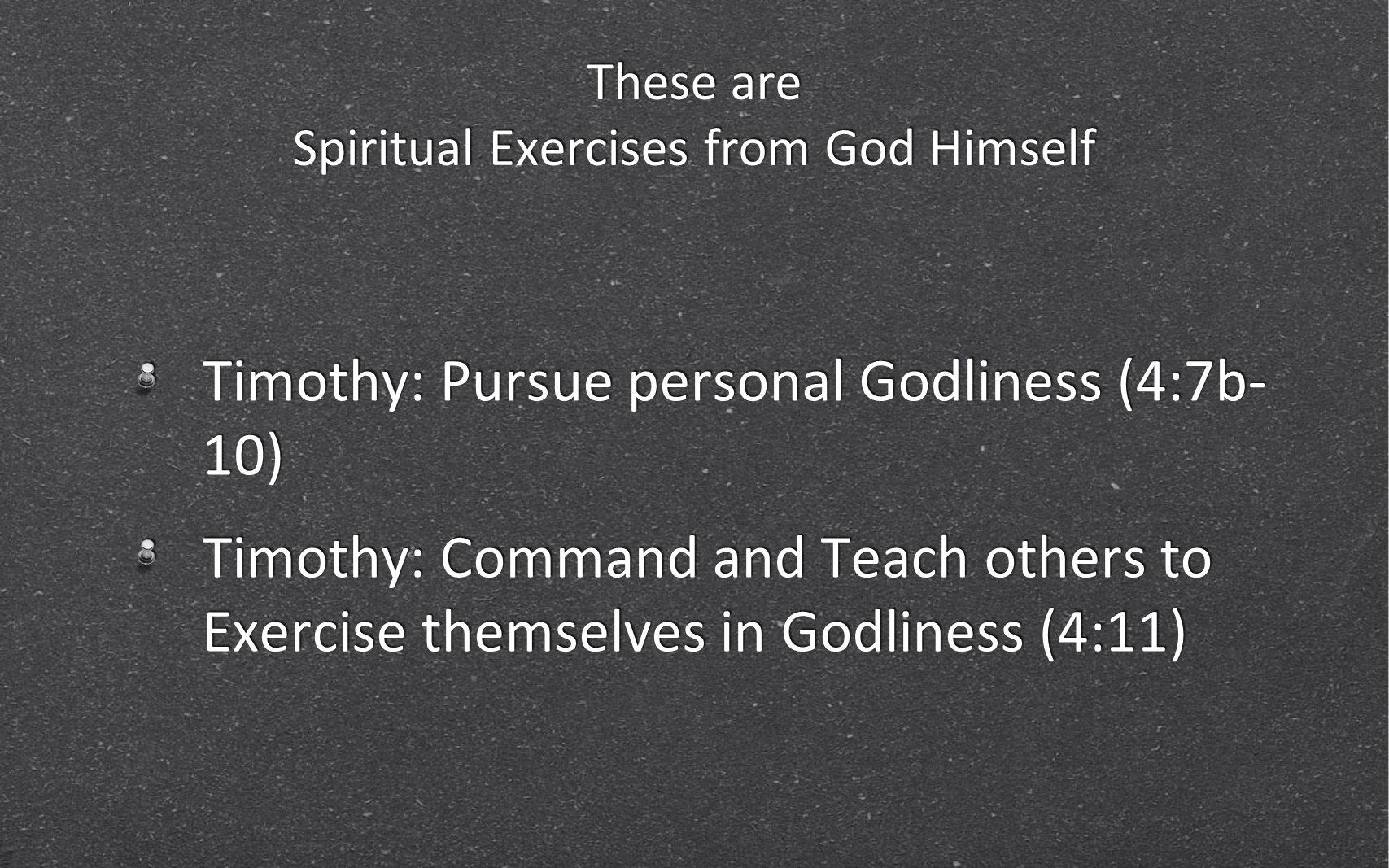
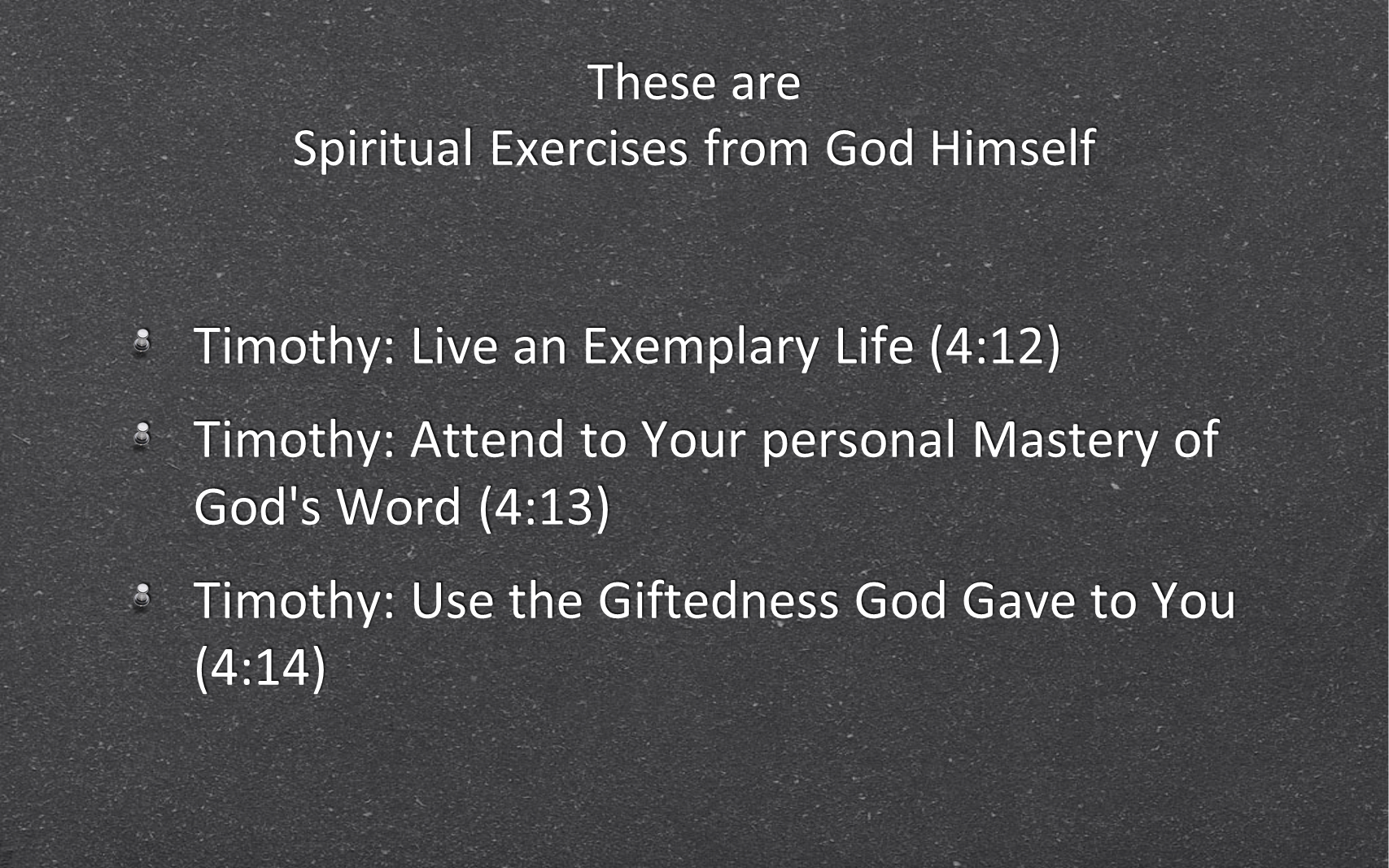
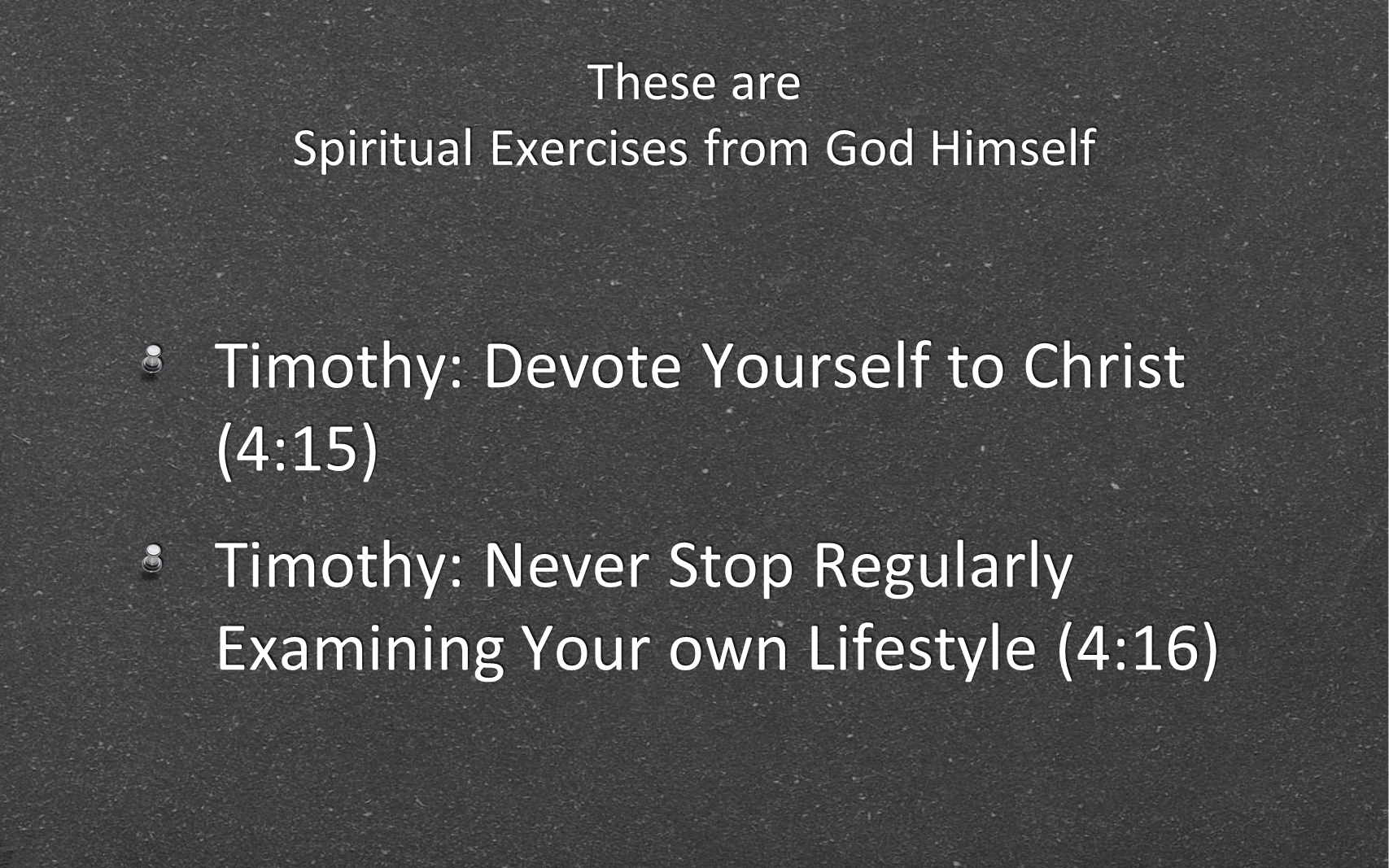
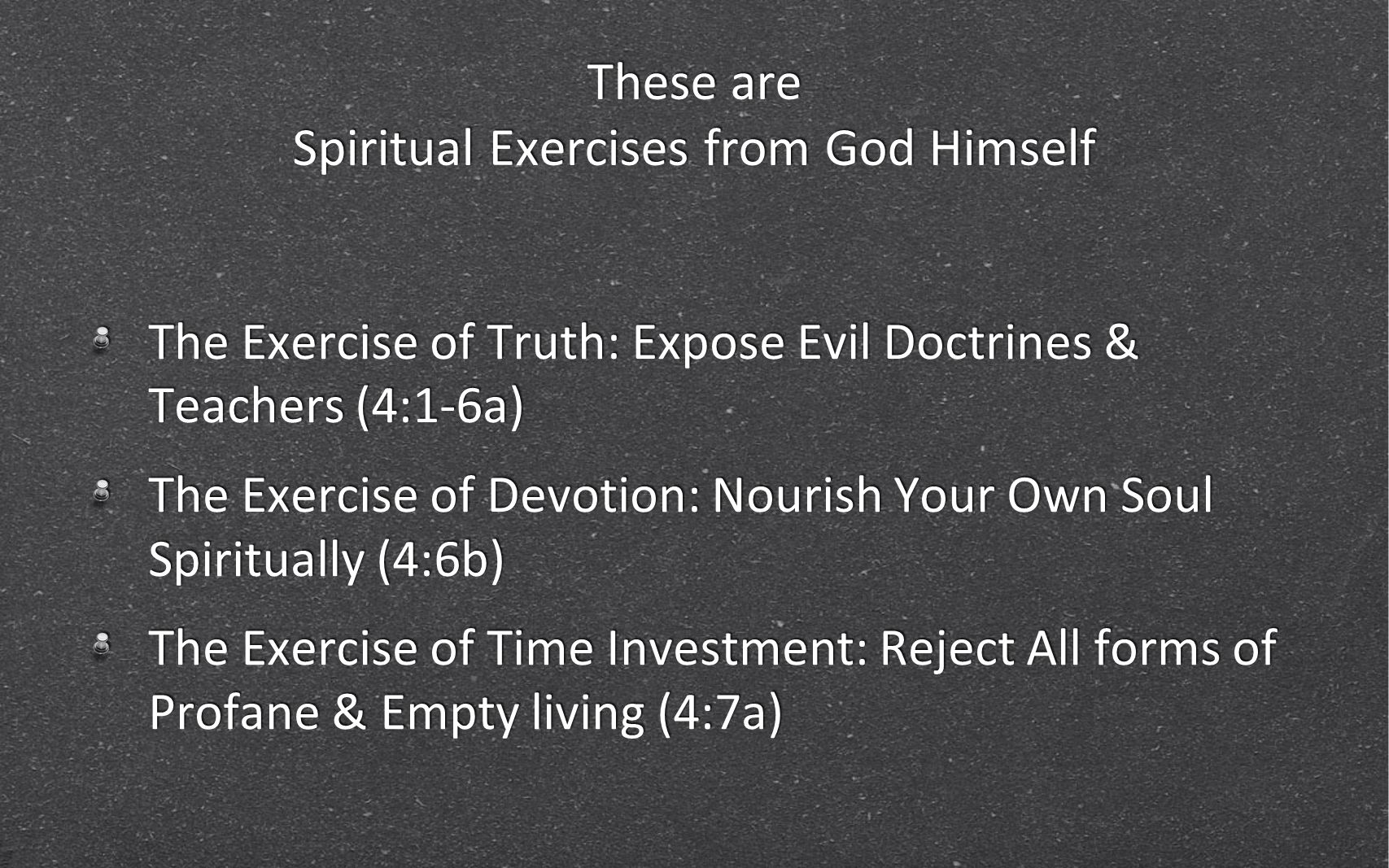
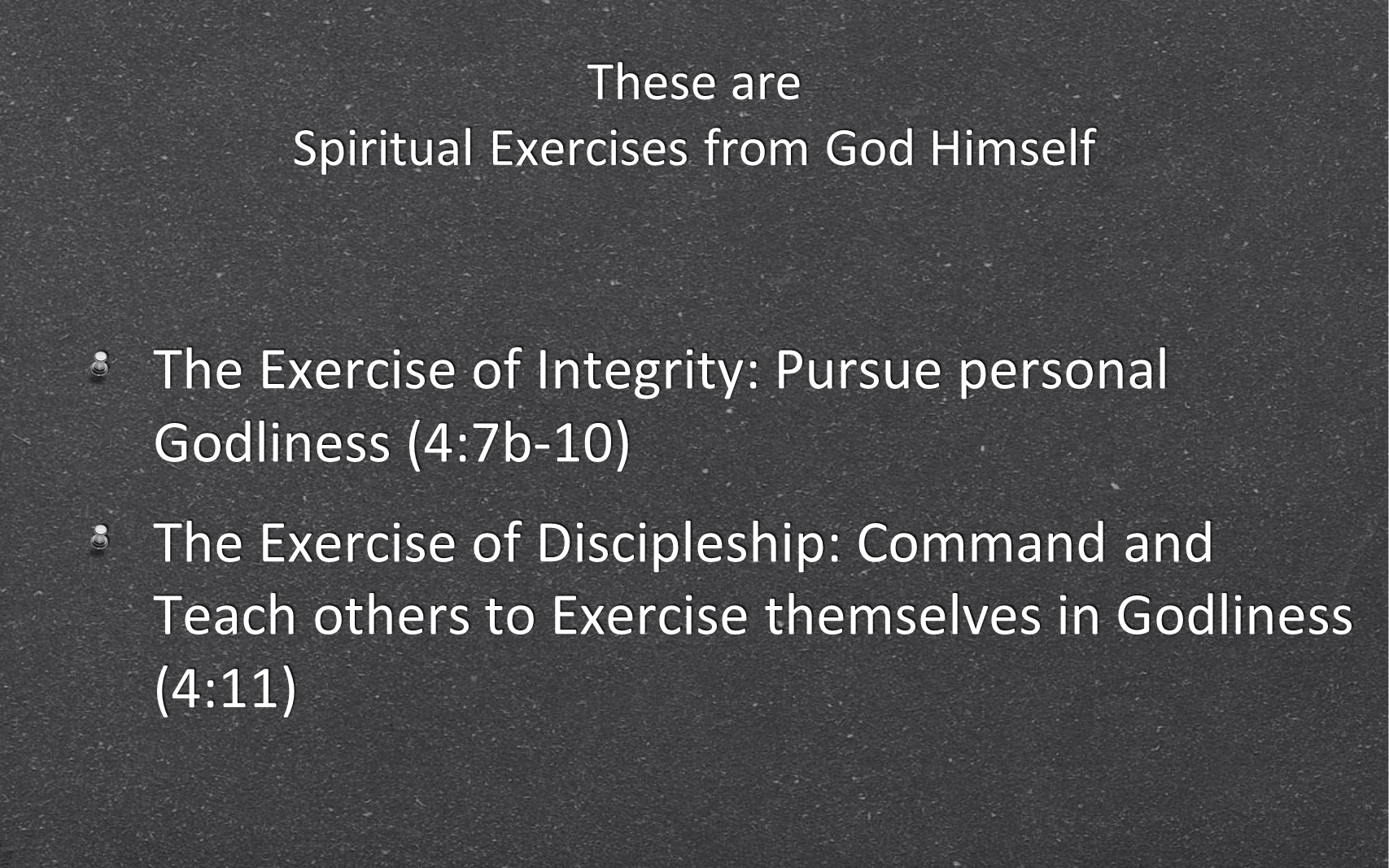
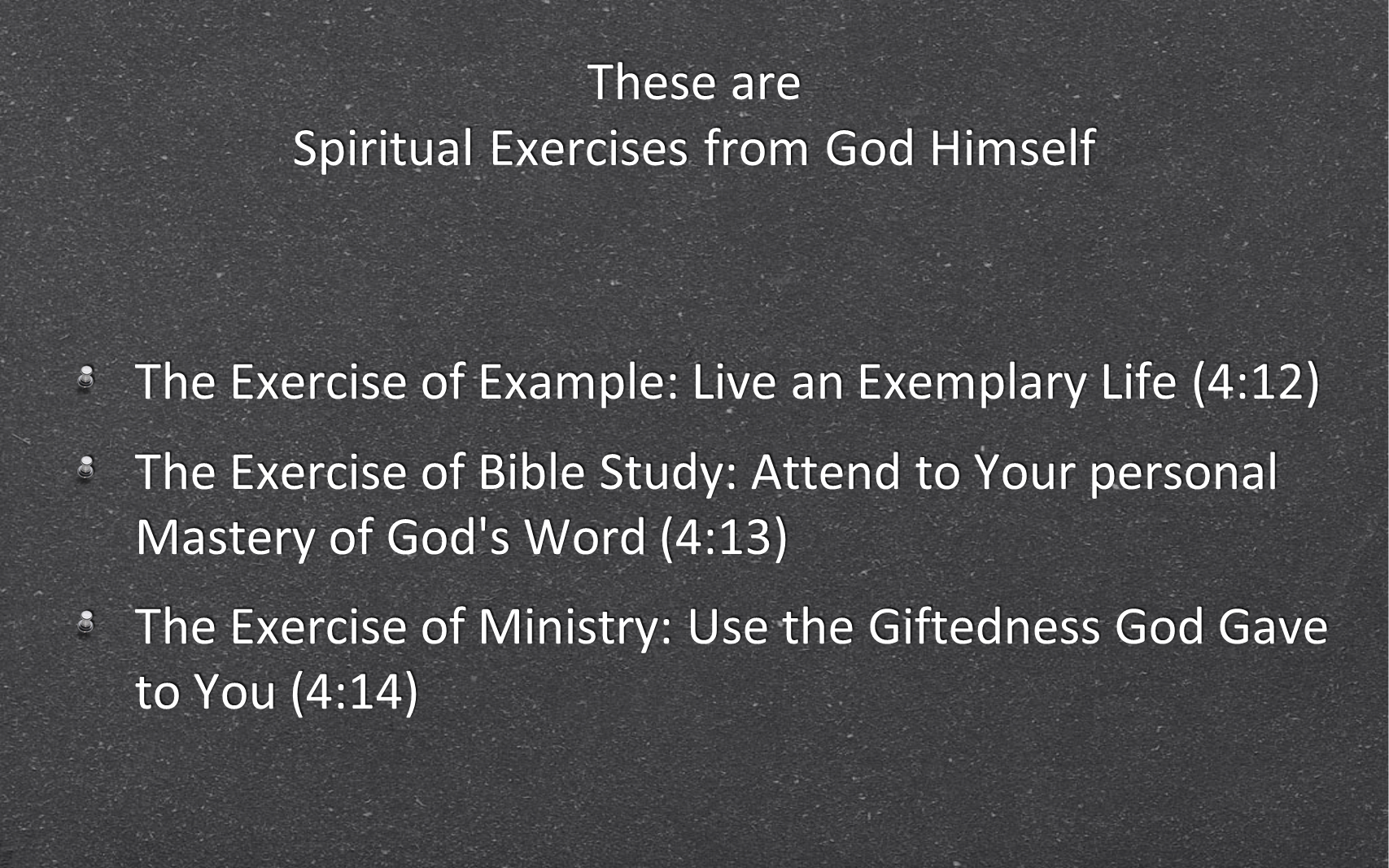
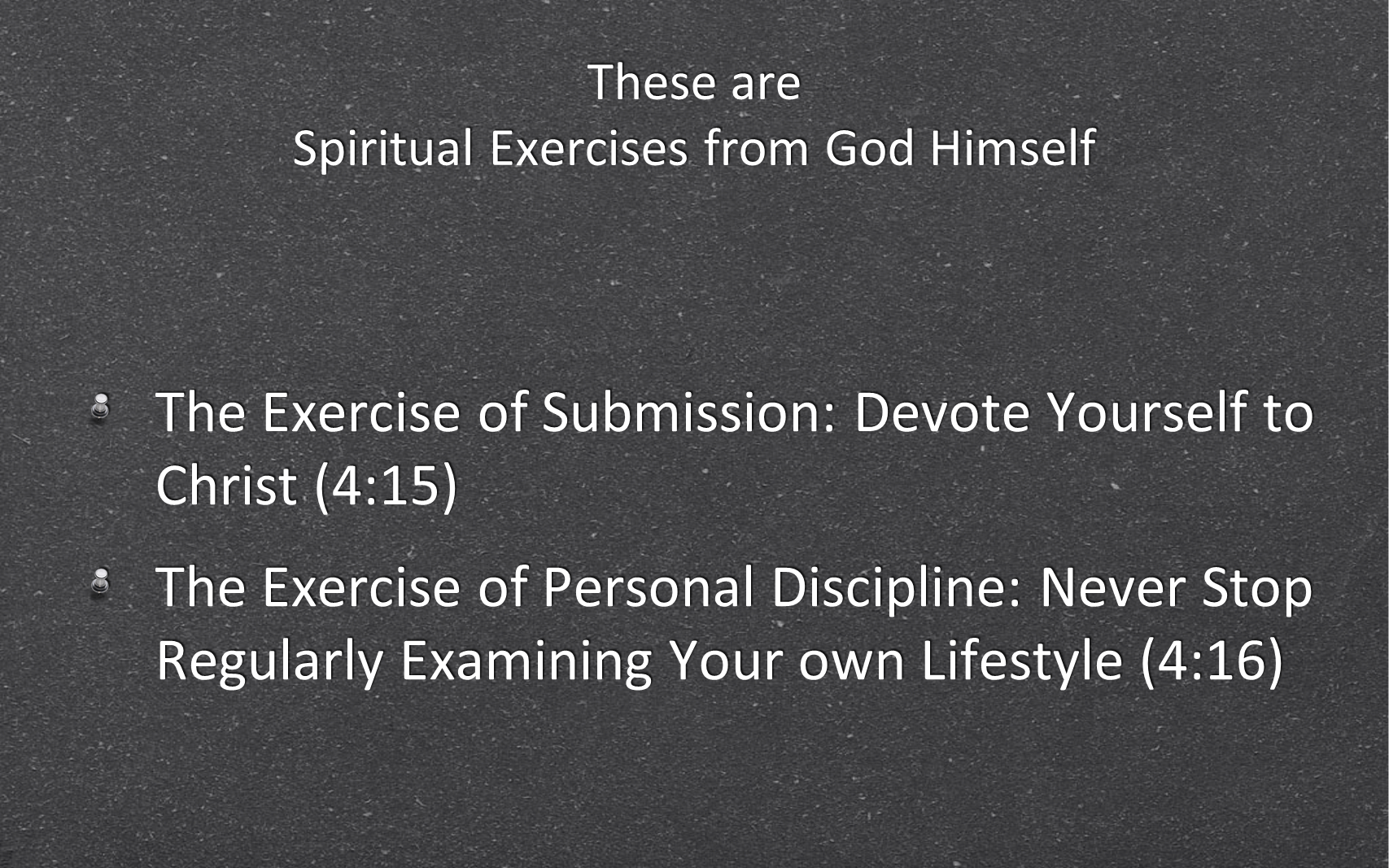
These are Spiritual Exercises from God Himself
Nestled right in the midst of those incredible 326 English words, translated from the 225 Greek words, into the 16 verses of this chapter: we have the demonstration of genuine spiritual life-coaching, poured out from the heart of Timothy’s father-in-the-faith, Paul.
Look at the basic divisions of this chapter:
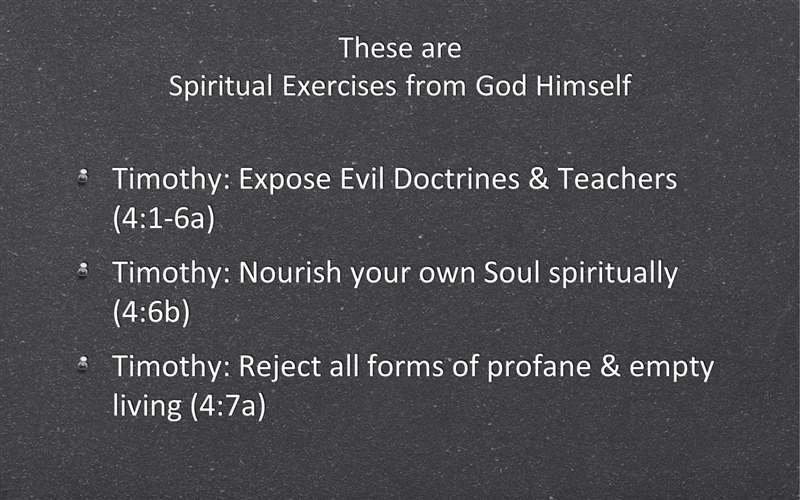
Timothy: Expose Evil Doctrines & Teachers (4:1-6a)
Timothy: Nourish your own Soul spiritually (4:6b)
Timothy: Reject all forms of profane & empty living (4:7a)
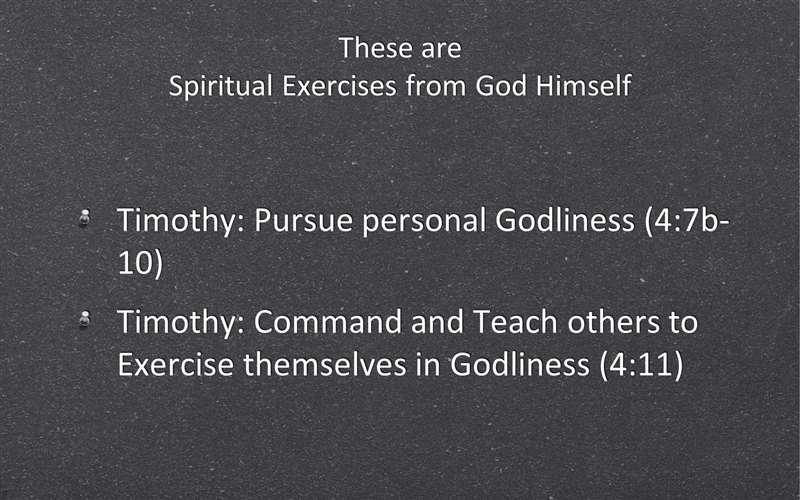
Timothy: Pursue personal Godliness (4:7b-10)
Timothy: Command and Teach others to Exercise themselves in Godliness (4:11)
Timothy: Live an Exemplary Life (4:12)
Timothy: Attend to Your personal Mastery of God’s Word (4:13)
Timothy: Use the Giftedness God Gave to You (4:14)
Timothy: Devote Yourself to Christ (4:15)
Timothy: Never Stop Regularly Examining Your own Lifestyle (4:16)
But each of these lessons Paul taught to Timothy surround a sense that they were ongoing, not just single use. In fact, as we look more closely, the Spirit of God inspired Paul to use a word from the arena of sports as very graphic illustration.
Paul packages these spiritual truths in the form of athletic “exercises”, or “disciplines”, or “training sessions”: as the various translations of the Bible render the Greek work in v. 7. Look again with me at 1 Timothy 4:7b in your Bible. Each of you should have one of these before you:
“and exercise yourself toward godliness.” (NKJV)
“ Rather train yourself for godliness;” (ESV)
“ On the other hand, discipline yourself for the purpose of godliness[1];” (NASB)
“rather, train yourself to be godly.” (NIV)
What is so important to note here is that “train yourself to be godly” in its context primarily refers to training ourselves in and by the Scriptures for the purpose of godliness. Our diet is to be the Scriptures, and we are to exercise ourselves in them. We will become godly only through the most godly Book ever written—God’s own Word.9[2]
Our diet is to be “every Word that proceeds from the mouth of God”, and we are to exercise ourselves in God’s Word.
We can see the key idea of this passage through one of the words that God chose to use to describe what He expects from us.
The Word God Chose
γυμνάζω: to control oneself by thorough discipline—‘to discipline oneself, to keep oneself disciplined.’ γύμναζε δὲ σεαυτὸν πρὸς εὐσέβειαν ‘keep yourself disciplined for a godly life’ 1 Tm 4:7. In a number of languages the equivalent of ‘to discipline oneself’ is literally ‘to make oneself obey.’ This may sometimes be expressed idiomatically as ‘to command one’s heart.’[3]
Kent Hughes, pastor of College Church in Wheaton said it this way: “Gymnasticize (exercise, work out, train) yourself for the purpose of godliness” conveys the feel of what Paul is saying. Run until your feet are like lead, and then choose to sprint. Pump iron until your muscles burn, until another rep is impossible, then do more.[4]
This Exercise is God-Centered
We know hard work is necessary in athletics, the arts, and sciences; but when it comes to our spiritual life, we hesitate. The words “discipline, train, exercise” sound so much like legalism. But this line of thinking is incorrect.
Legalism is always self-centered, whereas the disciplines are always God-centered. The heart of a legalist thinks: “Doing this will help me gain merit with God”. The heart of the follower of Christ thinks: “I want to do this because I love God and seek to please Him”.
Paul had great experience in knowing this difference, so he never would give an inch to legalists, while constantly challenging believers everywhere to “exercise, train, discipline yourself toward godliness”
Paul’s life is a legendary example of personal denial and sacrificial discipline, yet always he places the source of his strength as God’s grace. Listen to what Paul says in 1 Cor. 15:10 (NKJV): But by the grace of God I am what I am, and His grace toward me was not in vain; but I labored more abundantly than they all, yet not I, but the grace of God which was with me.
Personal Daily Choices to Stay Spiritually Healthy & Fit
Paul is laying out the survival guide for operating in less than ideal conditions. Timothy was more than anything else, “normal”. He was neither an apostle nor a prophet. He didn’t write Scripture, he just tried to understand it, live it, and teach it.
Timothy is probably more like each of us than most other New Testament personalities. If you had read his FB page back then you would have noticed a few things about Timothy. There are biographical notes that can be found in Acts and 1 & 2 Timothy: Timothy was from a less than perfect home; he struggled with fear, sorrows, and opposition. He frequently cried, and Paul had to keep encouraging him not to quit.
That is where many believers may find themselves at the dawn of this New Year called 2014: coming from a less than perfect home; facing struggles with fear, sorrows, and opposition; wanting not to quit.
But, above all those challenges Timothy faced personally, there was also the horrible place that he had to live. Paul had urged Timothy to stay on and serve at Ephesus (1 Tim. 1:3).
Ephesus was a Very Distracting Place to Live
Ephesus was a place of great materialism, sensuality, distractions, and amusements. With the words of Acts 19 we remember that there was a very real demonic influence there, plus a huge urban society filled with constant activities. With a huge, bustling seaport that connected Ephesus to the world, as well as all the overland trade routes: all that made this city almost never sleep. It was on the level of a New York City, Chicago, or LA.
So, how does a “normal” believer stay fit and useful for the Lord in that environment? How does an average believer stay spiritually exercised, and disciplined to not get marginalized by society, and not get spiritually neutralized by sin, our flesh, and the strong power of demons surrounding us each day? That is what Paul was addressing. That is what is tucked into this chapter.
These words surrounding 1 Timothy 4:7 may be some of the most timely words from God to each of us today. The same situation that Timothy faced, we also each face, whether we realize it or not.
USA in 2014 = Far More Distracting than Ephesus
Living in America in 2014 means that we each like Timothy are also living in a place and time that is immersed in American materialism. Each of us today live in a place and time overflowing with America’s inescapable sensuality, lusts, and temptations. We are living in a time when amusements and distractions are more available than any time in the history of humanity. There are mobile, digital devices in the hands of 88% of all adults (age 18 and up), and those under 18 are exponentially getting digitally enabled.
That means that right in our hands, right before our eyes, and right into our ears are almost endlessly available at any time of the day or night, and in almost any location: messages, calls, music, games, movies, and everything on the entire world wide web of over 13 billion Google scanned and cached web pages.
Never in human history has it been possible to be as amused as we are today.
So what is the answer God gives? It is found in v. 7: believers who want to stay fit for God’s use, spiritually healthy and strong must choose to “train”, “discipline” or “exercise” themselves for God.
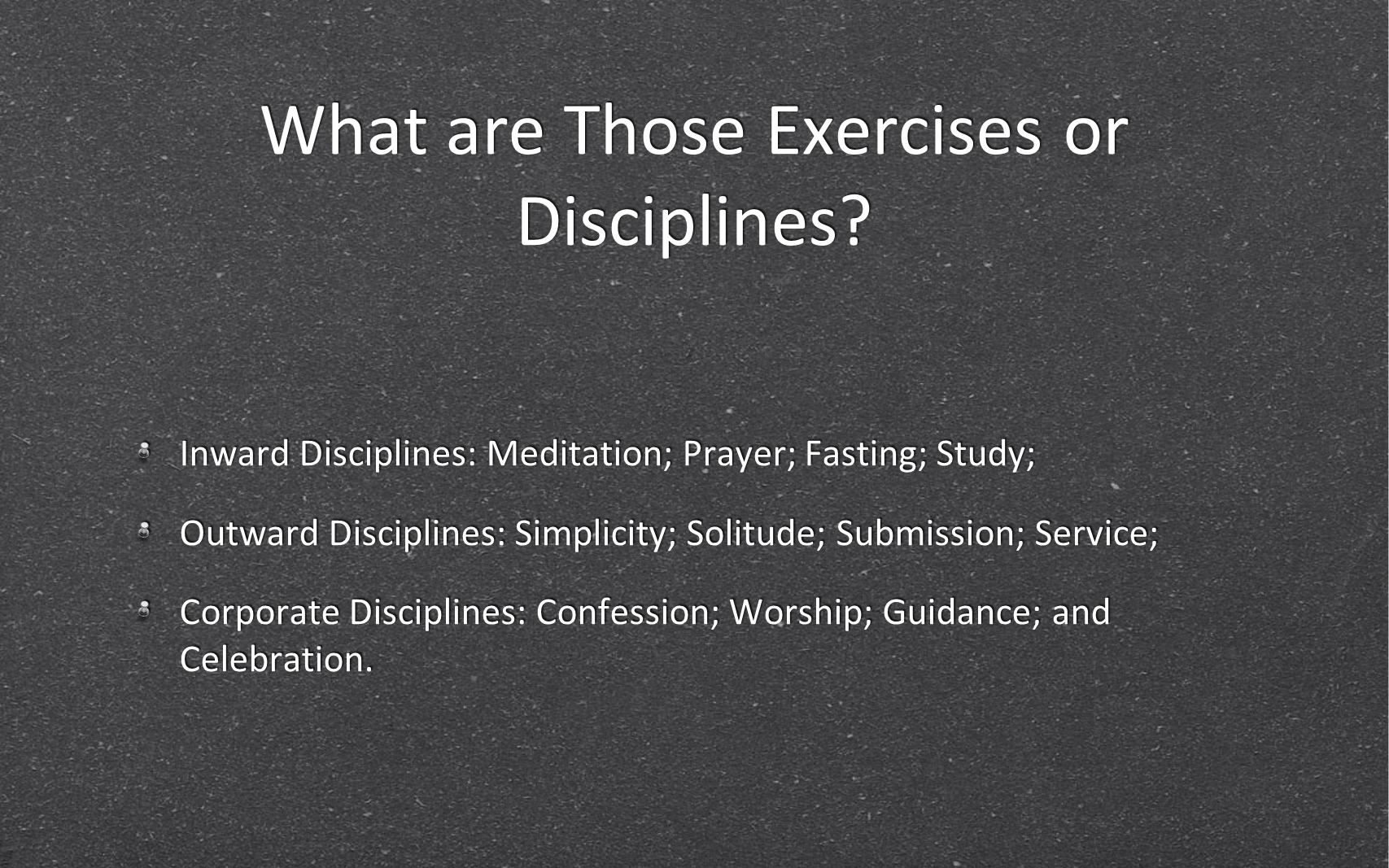
What are Those Exercises or Disciplines?
Over the centuries the Church has identified various disciplines, and in modern times these have been packaged into books[5].
The most widely known book on disciplines a generation ago was Richard J. Foster who wrote as a Quaker in his 1988 book called, Celebration of Discipline The Path to Spiritual Growth. Where he identifies twelve disciplines in three groups of four. Inward Disciplines: Meditation; Prayer; Fasting; Study; Outward Disciplines: Simplicity; Solitude; Submission; Service; and Corporate Disciplines: Confession; Worship; Guidance; and Celebration.
A decade ago a book on disciplines swept the church, written by Rick Warren it was bought and read by tens of millions. The Purpose Driven Life organized the forty spiritual disciplines into five categories: Planned for God’s Pleasure; Formed for God’s Family; Created to Become Like Christ; Shaped for Serving God; Made for a Mission.
As you can see there are many books, many disciplines, and many descriptions of these disciplines. But:
Which Disciplines Does God ask Paul to Command for Us?
What are the areas that Paul writes down for Timothy? Paul who knew the entire Old Testament better than any of us. Paul who knew from the Apostles and Christ Himself, what had been taught and written? Paul who spoke from a better vantage point than any of us. Paul who wrote under the inspiration of the Spirit, to the model of all future pastors (Timothy). What did Paul say were “the disciplines” to practice?
The Exercise of Truth: Expose Evil Doctrines & Teachers (4:1-6a)
The Exercise of Devotion: Nourish your own Soul spiritually (6:6b)
The Exercise of Time Investment: Reject all forms of profane & empty living (4:7a)
The Exercise of Integrity: Pursue personal Godliness (4:7b-10)
The Exercise of Discipleship: Command and Teach others to Exercise themselves in Godliness (4:11)
The Exercise of Example: Live an Exemplary Life (4:12)
The Exercise of Bible Study: Attend to personal Mastery of God’s Word (4:13)
The Exercise of Ministry: Use The Giftedness God Gave To You (4:14)
The Exercise of Submission: Devote Yourself to Christ (4:15)
The Exercise of Personal Discipline: Regularly Examine Your own Lifestyle & Never Step (4:16)
During each of the past twenty centuries of the Church’s history believers have practiced the basic, or classic spiritual disciplines. Almost all of these disciplines can be misused, but they are all proven over the centuries as very useful when Biblically balanced.
What is your present spiritual training plan? Which “exercises” are you practicing, and how often do you do them? Over the past year, how is your spiritual training progressing? Like physical exercise, spiritual exercise requires discipline, daily effort, and ongoing commitment. Just like daily exercise strengthens our muscles, so our daily spiritual disciplines can strengthen our “spiritual muscles.”
Focus Upon the Classics
The five classic Biblical disciplines ought to be part of every Christian’s life:
The Discipline of Bible Study: Reading God’s Word
The Discipline of Communication: Praying
The Discipline of Memorization & Meditation: Applying God’s Word
The Discipline of Worship: Attending public worship
The Discipline of Surrender: Giving time, money, and abilities to God’s service
Biblical Exercises for Spiritual Health & Fitness in 2014
This morning, on the doorstep of the year before us, communion is when we stop, reflect, and renew our desire for pursuing God. Please stand with me and summarize our time in the Word with the words of this song: Take My Life
Take my life: and let it be consecrated, Lord, to Thee.
Take my moments and my days: let them flow in ceaseless praise.
Take my hands: and let them move at the impulse of Thy love.
Take my feet: and let them be swift and beautiful for Thee.
Take my voice: and let me sing always, only, for my King.
Take my lips: and let them be filled with messages from Thee.
Take my silver and my gold: not a mite would I withhold.
Take my intellect: and use every power as Thou shalt choose.
Take my will: and make it Thine; it shall be no longer mine.
Take my heart: it is Thine own; it shall be Thy royal throne.
Take my love: my Lord, I pour at Thy feet its treasure store.
Take myself: and I will be ever, only, all for Thee.
—Frances Ridley Havergal, 1874
[1] “godliness” is a key word in 1 Timothy, occurring seven times: 3:16; 4:7,8; 6:3, 5, 6, 11.
9 John Stott, Guard the Truth (Downers Grove, IL: InterVarsity, 1996), p. 117.
[2] Hughes, R. K., & Chapell, B. (2000). 1 & 2 Timothy and Titus: to guard the deposit (p. 108). Wheaton, IL: Crossway Books.
[3] Louw, J. P., & Nida, E. A. (1996). Greek-English lexicon of the New Testament: based on semantic domains. New York: United Bible Societies.
[4] Hughes, R. K., & Chapell, B. (2000). 1 & 2 Timothy and Titus: to guard the deposit (p. 108). Wheaton, IL: Crossway Books.
[5] For example the noted President of Wheaton College, V. Raymond Edman, identifies thirty-one disciplines in his 1948 Scripture Press book called Disciplines of Life, in the form of daily devotionals for a month long focus. These include among others the Disciplines of: discipleship, disease, doubt, duty, disappointment and desire. Donald Whitney has identified ten disciplines in his 1991 Nav Press book called Spiritual Disciplines for the Christian Life: Bible Intake; Prayer; Worship; Evangelism; Serving; Stewardship; Fasting; Silence & Solitude; Journaling; and Learning. Pastor Kent Hughes also wrote in 1991 published by Crossway Books a book called The Disciplines of a Godly Man that identified seventeen disciplines arranged around four realms: Relationships—purity, marriage, parenting, friendship; Soul—mind, devotion, prayer, worship; Character—integrity, tongue, work, perseverance; Ministry—church, leadership, giving, witness, ministry. Jerry Bridges, in his 1994 Nav Press book The Discipline of Grace, God’s Role and Our Role in the Pursuit of Holiness, identifies five key disciplines: Commitment, Convictions, Choices, Watching, and Adversity. Finally, in 2007 Moody Press published Patrick Morley’s book called A Man’s Guide to the Spiritual Disciplines which also lists twelve disciplines, arranged around four realms: Works of God in creation; Word of God in Bible; Whisper of God in prayer, worship, Sabbath, fellowship, counsel, fasting, spiritual warfare; Witness for God in stewardship, service, and evangelism.