If the video above is not available, here are two other ways to view:
ESH-37 FTF-14
150104AM Best Life Possible.docx
Live the Best Life Possible:
Living & Walking in Consecration
Romans 12:1-2
Transcript
Let’s open our Bibles to Romans 12, and I’d like to share with you as we look at a brand new year right in front of us, what would be the very best way to live this year for the Lord. I know that New Year’s is one of the only universally celebrated holidays, at least on the news. It was just showing the fireworks as the new year started around the globe and what a big deal it was. But there’s something in every culture about a new year, a new beginning, a new start. Like the new page that hasn’t yet been soiled or stained or ruined yet. When you think of that now, just the fourth day of this new year, what would be, from God’s perspective, the best way to live the new year in front of us? That’s what I think Romans 12, more than any other text in the Bible for me, especially growing up.
Remember, I grew up going to church Sunday morning, Sunday night, and Wednesday night, and going to Christian Camp Barakel, in particular, the whole time; before I was a camper, as a camper, as a worker, as everything. But among all the things that I remember were the speakers, as a young person, who honed in on the message of Romans 12. So, for all of us, this is not unfamiliar territory. But this morning I pray it would be a precious renewal of what God says.
So, Romans 12. To live the best life possible, Paul says we should live and walk this way, the Romans 12 way, the way of consecration. That is what the Lord wants. Basically, God is saying in this book of Romans, the basis that He wants us to surrender our lives this morning. You’ll see as we look through these verses that Romans 12 breaks down according to the way the Lord wrote it in four explanations of what it means to consecrate our lives. As I go through each of these this morning, the goal is where we’re ending the day. We’re ending our time together this morning in a New Year’s communion service. Communion is when we renew our focus and our consecration based on the work of Christ on the cross. That’s exactly what Romans 12:1-2 is all about.
The New Testament book of Romans contains the most complete description of the most important event in all of history. In fact, the 11 chapters before we get to chapter 12, the 11 chapters are all predicated on the work of Christ on the cross, and why He had to die because we’re all sinners. In fact, if you look at verse 1, I beseech you therefore, in Romans 12:1, that’s the fourth time therefore is in the book of Romans. The first one is in chapter 3 verse 20. Therefore, because we’re all sinners. Chapter 5, therefore because of the justifying death of Jesus Christ. Chapter 8 because of that, therefore, there’s no condemnation. Now, on the basis of all that, the mercies of God, boom, therefore consecrate yourselves. So, this is just a beautiful sequence.
Romans 12:1-2 breaks into four clear elements describing the consecration God is asking for from everyone saved by Christ’s gracious sacrifice. If you have been saved by grace through faith, these verses are for you. So, let’s just plow through them.
To live the best life possible live and walk in consecration. That’s Paul’s basis. He reinforces that with this expression. Now remember, this is God’s Word. This is not a great Christian book. This is not a collection of ideas. This is God, His mechanism for, speaking to us. In fact, in the cover-to-cover, one-year Bible that many of us are reading through, in the opening comments, Dr. MacArthur says that the Scriptures are our intersection point. It’s how we connect with God. So, God connects with us, not silently. This is Him speaking, and so what does he say? He says the best life possible is living and walking, but the underlying truth is not in self-energized, but in Spirit-powered. This kind of life, a Romans 12:1-2 life, isn’t possible humanly.
So, here are the four divisions, and I’m going to go through these with you. We’re talking about consecration, and first of all, Paul gives the foundation, and look what it says, I beseech you, therefore brethren, by the mercies of God. The mercies of God are portrayed in Romans 1 through 11, and it’s talking about, God has said all of us are under His condemnation. There’s none righteous, no, not one. We all fall short of His glory. We all deserve endless punishment for our sins. But God, in His great mercy, has offered Jesus Christ. So, consecration is the foundation to consecrate ourselves, and to even consider this is God’s mercy to me. So in other words, you can’t be consecrated if you’re not saved. Salvation is the first step or element or the foundation for consecration. So, you have to experience God’s mercy. That has to be a personal experience that we have had.
But what we see is consecration is described. It’s not an emotion, it’s not a feeling, it’s not something that, it’s not a ritual. It’s me offering my body and what’s interesting is this word is a technical word. In fact, look at the second part of verse 1. It says that you present your body as a living sacrifice. The word present is exactly the word that’s used all the way through the Old Testament for every sacrifice that was placed on the altar. Now, think about the altar of God in the Tabernacle or Temple. You had a lamb, a ram, some bullock, or something to offer. Do you just bring it up and throw it on there? Do you just, do you think about the process? In fact, in one chapter in Leviticus, there are over 30 different steps that God delineates in how the offering is to be. This word says that we are to, in a similarly very thoughtful way, present ourselves to God.
Thirdly, what are the expectations? If I am doing what God wants me to do to live the best life possible in consecration, what am I supposed to do? Verse 2, and do not, it’s two expectations God gives to us. Do not be conformed to this world and be transformed by the renewing of your mind. God says that consecration is not only offering my body, but He wants my mind to come under His transforming power. Metamorphosis is the literal Greek word metamorphos. That’s what God wants to do to me. He wants to change us from caterpillar lives to butterfly lives. That’s one we all know, from tadpole lives to fully functioning frog lives. That’s metamorphosis in nature. God says I want to metamorphosize your entire being, starting with your mind.
Then finally, what’s the reward? And this is what’s so fascinating because this is probably the most common question as believers go through life, I want to know God’s will. What is God’s will? What is God’s will for me? Look at the end of verse 2, that you may prove what is the good and acceptable and perfect will of God. Consecration’s reward is God’s will is known in a consecrated life. That is an amazing power that God offers to us. If we’re saved, if we will consecrate our body, if we will allow Him to invade and transform our mind then He lets us know God’s will. That’s simply astounding.
This is what I’d like you to do. Since you’re there, let’s all stand with our Bibles, okay? Stand with me, and whatever version of the Bible you have, we’re going to now, in just a second, all of us, read these two verses. Now, you don’t have to belt them out, you can just read them like you’re reading them out loud, because it’s going to sound cacophonous because we have different versions, usually two or three or even four. But let’s read Romans chapter 12:1-2 together right now. Okay? I beseech you therefore brethren, by the mercies of God, that you present your bodies a living sacrifice, holy and acceptable to God, which is your reasonable service. And do not be conformed to this world, but be transformed by the renewing of your mind that you may prove what is that good and acceptable and perfect will of God. Oh, doesn’t that sound pretty? That almost is going to sound like tonight. Tonight we’re having an evening of prayer. In fact, we’re going to look from the scriptures at the ACTS model, the ACTS model. It’s right in the Bible from Daniel 9. Part of that is going to be a time of praying just like that, hearing all those prayers lifted to the Lord.
But let’s bow together right now. Father, we have read these words and I pray that now by the power of Your Spirit, they would be transformed from letters declaring Your unchangeable truths to the truth that You want to write on our heart, by Your Spirit, and bring alive and empower. Lord, I pray for all of us who at some time in our life or many times in our life, have renewed and offered ourselves in consecration. I pray that today will be another renewal of those sacred vows to You, that 100% we want to be Yours. And for any this morning that it’s been a long time or maybe never, that they can look back on and say, that’s my Romans 12:1-2 sacred vow of consecration. Because of what you have done I give myself 100% to You. Whichever it is, a renewal or a beginning, how I pray that today would be a day that we say, Lord, we want to live the very best life possible in 2015. We want to live it in consecration to You, in the precious name of Jesus we ask for this today. Amen.
You may be seated. As you’re seated this is going to be a fun journey. Consecration, number one, is God’s mercy to me. Look at the first part of verse 1. I beseech you, therefore, brethren, by the mercies of God. Paul is here summarizing all of the great work of God in the 11 preceding chapters, God’s mercy to completely fallen humans is the provision of His Son. Now, that’s what Romans is about. Romans 1, 2, and 3 are about the completely fallen humanity, and so completely sinful man was completely lost, and God provided complete righteousness through the complete sacrifice of His Son. See that’s what Romans is about. A completely fallen, sinful humanity was completely hopeless and so God Himself offered the only complete provision in His Son whose sacrifice completed all the righteous requirements of God. That’s what Romans is so much about.
So, God says through that, a completely new life and purpose is possible. So, in view of all that, of God’s mercy, God calls us. Because we are completely fallen, and because we are completely hopeless, and because Christ is the only One completely righteous, and the only One that can offer a complete sacrifice, God asks us to respond by completely giving ourselves. Do you see how it flows? The book of Romans is building on our complete, helplessness and hopelessness, and the complete sacrifice of Christ. By the time we get all the way to chapter 12, Paul says God said because I’ve done all this, this is what I would like in return. This is the response that pleases me. Amazing to think about.
In view of His mercy, God calls us to completely commit. Paul states our obligation to respond to what God has done. That’s why he says, I beseech you. That’s not mild. It isn’t I suggest, or it’s an idea, you should consider this. Now, the word beseech is fascinating. It’s the same word grouping; it’s actually the underlying form for the Holy Spirit being the comforter, the paraclete, this is the same word, parakaleó. Paul says, para, I come alongside of you and call you. So, it wasn’t a distant invitation. It’s hard to resist someone who comes up to you, like a high-schooler, and stops you in May in the hallway and looks you right in the eye and says, are you coming to my open house? You look at them and you don’t even know they’re old enough to graduate, and you don’t even remember that you got an invitation, but you’re looking them in the eye. It’s much harder to resist that than a pile of letters in the mail. Do you understand? Parakaleó means someone comes right alongside of you and calls you to a response. That’s verse 1. Paul says I’m coming to you and beseeching you to completely commit to what God has offered us because of what He’s done for us. The more we comprehend God’s amazing work, the more we want to surrender to Him.
Now, by the mercies of God. What is Paul talking about using common language? I put it this way: when we survey the cross, and let’s just do that, number 185. Grab your green hymn book. There should be one somewhere around you and you might have to look on with someone. This hymn by Isaac Watts 300 and some years ago distills down what we’re talking about. Watts was meditating on the work of Christ on the cross. Look what he says. When I survey the wondrous cross on which the Prince of Glory died, my richest gain, I count but loss and pour contempt on all my pride. So, what caused him to humble himself, surveying what Christ did on the cross? See Watts, this wasn’t put to music until after his lifetime. The fellow Lowell Mason, who put in this beautiful hymn that we have, was about 60 years after Watts. This is such a powerful reminder of his personal devotion to the Lord.
Look at the second stanza, forbid it, Lord, that I should boast. If I’m going to get up and talk about something, I want to make sure it’s saving the death of Christ My God. Because all the vain things that charm me most, I sacrificed them to His blood. He spent so much to purchase me that I surrendered back everything I have because of the mercies of God. Third stanza, see from His head, His hands, and His feet. Sorrow and love flow mingled down. Did e’er such love and sorrow meet or thorns compose so rich a crown?
Now, the last stanza is the consecration stanza and Watts beautifully says what Paul’s asking us to do. So, let’s read stanza four together and we’ll go all the way into the ending. Were the whole realm of nature mine, that were a present far too small; love so amazing, so divine, demands my soul, my life, my all. Demands my soul, demands my life, demands my all. That’s what surveying the cross according to God through the Apostle Paul is supposed to do to us. I beseech you therefore on the basis of pondering what Christ sacrificed, what that cost God in Christ for us to purchase our salvation, we should respond in adoring surrendering to Him. So, basically, Paul is saying, if we deepen our grasp on Christ’s sacrifice, we’ll deepen our surrender to God. People who think lightly of Christ’s sacrifice surrender lightly to God. People who think deeply about what it cost Christ to sacrifice deeply.
That leads us secondly to consecration’s description. So, how do you know if you’re consecrated this morning? How does God describe this process? He says number one, look at the second part of verse 1. He says that you present your body as a living sacrifice. That’s on the basis of God’s mercy, number one, I want you to present your body. Now, how do you present your body as a living sacrifice? A living sacrifice that is holy, a living sacrifice that is acceptable to God, and a living sacrifice, which is your reasonable service. The word reasonable is the word from which we get the English word logic. If you’re looking at a presentation, say a purchase or an investment, and someone lays out all the details. You’d say the only logical response to what you’re offering me is that you’ve laid it out so clearly. That’s about the only decision I could see that would be wise and logical. See, what Paul is saying? Because of what Christ did on the cross, the only logical response is that we present our bodies as a living sacrifice. That sacrifice has to be holy and acceptable because it’s offered to God, and that’s our reasonable, logical service.
Now, the word service is an interesting word too. This is one of the most graphic Greek word study verse passages in the Bible. Every word just, boom, it’s like fireworks. There’s so much in there. This is the word latreia, the word service. It’s a worship offerer. It speaks of a priest whose whole job is offering sacrifices in the Temple. It’s our logical priestly function to not offer somebody else’s animals, but to give our body and to leave it as a living sacrifice.
So, what does this mean? The way God describes consecration is He seeks our life. He wants it completely and He wants it offered worshipfully. This section of Romans 12:1-2 overflows with the imagery of the Old Testament of the Temple and of the Tabernacle. That’s what God designed. First, the word present is a technical word for placing a sacrifice right on the altar. Secondly, the word body sums up all the attachments to ongoing life, our hopes, our plans, our dreams, and everything important or precious to us. Anything we find fulfilling is attached to our body. So present your body and everything attached to it that means anything to you in life, present it on the altar, but as a sacrifice. That’s the third idea of this second part of verse 1. A sacrifice is a consuming fire, a holocaust from which nothing can be recovered. God wants me to irrecoverably gift Him anything important to me, gift it to Him, and put it in His hands. That’s what He’s saying. That’s the imagery, that’s the vividness of the words here.
How do we do it? How do I as a sacrifice? In the read through the Bible, there’s going to be a lot of days, if you’re reading through the Bible this year, that you’re reading about all this sacrificial stuff. A lot of people say, oh, it’s boring. Back up from the boring part and look at the meticulous detail. God did not want just commonplace, ordinary. He wanted us to come in a non-customary way before Him to present the offerings in the Old Testament. That’s the lesson that comes over into Romans 12.
Think of it this way. The prescribed routine for offering Old Testament sacrifices is reflected by this word present in Paul’s wording. Here’s what happened in the Old Testament. Number one, the obedient worshiper determined what God requested from His flock or field. The Lord was very specific about what He wanted. So, if you were an obedient Old Testament worshiper, you first determined what God said He wanted. You weren’t like Cain. Cain said I don’t care what God wants. I’m going to give Him what I want to give Him. God says no. If you want to be obedient, worshipful, holy acceptable to Me determine what I’m asking for. So, that was the first step in the Old Testament.
Number two, the Old Testament offerer then personally brought to the Tabernacle or Temple, what God said He wanted. So, they determined what God wanted then they brought it to the Tabernacle, but it wasn’t done yet. They didn’t just dump it at the front door. They didn’t ship it FedEx overnight with a return receipt requested. But thirdly, they presented it personally as an offering. That’s where you get all this Old Testament stuff about placing your hand and standing in front of the priest and putting your hand on the offering and presenting it. All of that, the personal connection to the sacrifice was third.
But finally, here’s the thing we don’t even think about. Then, after they hugged one last time, their pet lamb or after they brought the basket that they harvested of the grain offering, they released this possession from any longer being theirs. They didn’t have a rope attached to that nice little sheep, and they gave it to the Lord, and then they walked away and jerked it and it followed them home. They gave it up. So, now think of that. Think of the four steps of offering to God, determining what He wants, bringing it to Him, presenting it to Him, and releasing it to Him. The Old Testament sacrifices pervade this portrait in Romans 12 of a total irrecoverable, giving away. That’s what the whole if you want to summarize Exodus and Leviticus, all of the sacrificial, as far as the people’s involvement, it was a total obedient, irrecoverable gifting and releasing to God. Paul says that’s how you’re supposed to present.
But the contrast is in the Old Testament, the sacrifice was killed and consumed. In the New Testament, the sacrifice lives on, but under new ownership. The explanation is that we are to remain in the state in which we present ourselves. Look what it says in verse 1. Present your bodies a living sacrifice, now, look at the next words, holy and acceptable to God. That’s how He wants us to offer. The essence of consecrated living is to be pleasing and acceptable to God. We consecrate ourselves to His will. We seek His well done. We offer ourselves as His servants.
So, this basically is God calling us to total commitment. This is God saying I want you to determine what I say, bring to Me what I say, present to Me what I say, which is your body, and then release back to Me the ownership of your possession. See, we possess ourselves until we surrender and consecrate ourselves to the Lord. It’s such a beautiful picture.
What is amazing is the extent of this call from God. It’s not merely for pastors and elders. By the way, chapter 12 is not how we set aside our missionaries and set aside our elders, and set aside our pastors. Look where Paul is in chapter 12. I beseech you, therefore, brethren. He’s saying to all of you in the church, this is to the whole church. It’s not just a select few, it’s to everyone. What the Lord says is, I want complete consecration. By the way, complete means not to just offer 25%. That’s what some people, they go, I’m going to add the Lord to my life. I’ll give Him 25%. How about 50%? I’m going to invest 50%. Now, that’s a majority. If you own 50 plus percent, you are a major, and 50 point anything, you’re a majority stakeholder. God says, no, that’s half-hearted to Me. I don’t want 50% of you. I don’t want 25. I don’t want 75. Some people really think, ooh, three-quarters, I’m 75% committed. No, the Lord says, I want it all. Even half-hearted, 50% worship is not accepted. It’s irrational when we’re confronted with God’s mercy to only worship from 25% of our heart, or half or three-quarters, God says only worship that is wholehearted. That’s why David said, with my whole heart, have I sought you. Oh, let me not wander from your commandments.
We’re to give all that we have to all that we know about Christ. See, that’s something interesting. It’s not when I attain a full knowledge of Christ I can finally surrender fully. I give everything to as much as I know right now. The more I live and grow and study and read and follow and seek, I keep giving all that I am to all that I know about Christ. That’s what the Lord wants.
Thirdly, consecration’s expectation from God is that He wants my mind transformed because we can give our body, but then our mind takes it back bit by bit. Our mind is what’s controlling our body and what’s feeding our body and what’s flavoring our life. So, what Paul says is this I want you to, verse 2, not be conformed to this world, but be transformed. Here we find the Lord guiding Paul to give a positive and a negative description. Interestingly, the first part of God’s description is negative, and the second is positive. The first part is no worldly conformity, no going the old way. Then the positive is, but go the new way. So, you have to break with the old and start with the new. So, God says, make a monumental declaration of no, to not be conformed.
Now again, the Word of God is very clear. What does don’t be conformed mean? I’ve heard 58, soon to be 59, years of sermons. Of course, in the early years, I didn’t really hear them because I slept through church, but I was there anyway. But I’ve heard my lifetime of sermons on this. What does it mean to be conformed? The Greek word behind that is very interesting. It’s the word schema. We get the word scheme. Have you ever heard someone say, I want you to invest in my scheme? That means that they have a plan for you. They want you to conform to their plan. That’s the idea here. It says, don’t be syschema. Don’t be tied to the scheme of the world. What is that?
For just a moment just turn back to 1 John 5. I want to show you what the world scheme is. It’s frightening when you see what God says. I’ve heard all kinds of messages on beware of worldliness and worldliness, but look at 1 John 5, verse 19, almost the end of 1 John 5. It says we know that we are of God. So, John’s talking to the believers, 1 John 5:19, but look at the second half of the verse. The whole world lies under the sway of the evil one. Actually, the Greek words, the whole world lies under the evil one. The way you put it this way is Satan is in the saddle of the world, of the culture of the direction of things. Do you want to know where Satan is busily involved right now? He is directing culture. That’s what God says. The whole world is under his sway. God says I don’t want you to be influenced by his scheme. Don’t be swayed. Beware of listening to Satan’s advice instead of God’s.
Satan’s worldly scheme wants to get us hooked on anything but God. Do you understand that? He wants us to get hooked on anything. It can be anything, even good stuff, as long as that pulls and distracts and moves us away from total, 100% laying ourselves as a sacrifice on the altar and offering ourselves and removing our ownership from our lives and allowing our lives to come under God’s ownership. Satan said I’ll do anything to get that not to happen. I want you to follow my scheme, not God’s. See, that’s what conformed to the world is.
Basically, Satan’s cultural scheme wants us to be satisfied by anything but God. So, God will get us satisfied by our job or a relationship or something. Satan’s world system wants us distracted by everything but God. It’s like this Bible reading cover to cover. We all start, we’re so excited, but we get distracted so quickly.
By the way. It. We’re all strugglers against conformity to the world. We all, in some form or other, follow some part of Satan’s scheme. That’s why back to Romans 12, he says, I want you constantly to be presenting yourself so I can constantly be transforming your mind. That’s what the Lord wants.
We all need transformation and how does this transformation happen? Basically, by the renewing process, but it’s a passive imperative. God uses that, your mind’s renewed to say you can’t do it yourself. This is where the Holy Spirit comes in. We’ve been studying for 6, 7, 8 weeks the Holy Spirit. It’s the Holy Spirit alone that can renew our minds, but the method is He uses the Word of God.
Then what’s the wonderful reward? What’s the reward of consecration? Only to those who are saved, only to those whose bodies are surrendered, only to those whose minds are yielded to the consecrating work of the Holy Spirit, only to them is God’s will known. So, many people say I want to know the Lord’s will. I say you want to know the Lord’s will? Are you saved? Yes. Are you absolutely surrendered? Have you brought and laid on the altar, then taking your hands off, said, it’s up to you, God? Yes. Okay. Then are you on a daily basis calibrating your mind to the Spirit’s voice in His Word? Because that is the only way, look at the end of verse 2, then you will prove what is that good, acceptable, and perfect will of God. Romans 12:2. How? Only when we are gazing at the sacrifice of Christ, responding and giving our bodies, allowing this ongoing transformation of our minds. Then we get the reward. The reward is that we know God’s will. Knowing God’s will is a byproduct of willing, surrender.
By the way, it leads to confident living.
When we know God’s will, we become confident. When we know what the Lord wants, look at the end of verse 2, that you prove what is the good, acceptable, and perfect will of God. We have confidence knowing that is good. That’s acceptable. That’s what God wants. It’s perfect to Him. So, it’s what I want.
Before communion, I thought we’d do something. Now, this reminds me of my days as a youth pastor. Remember my first five years I was a youth pastor and I learned that you could preach all day to young people, but they had to come to a point of decision. So, I want you to listen carefully to this. Most of the greatest parts of my life are connected to promises I’ve made, like making and keeping my marriage vows, the sacred duties of the call to the ministry, and the promises to protect and care for my family. Often we are challenged by renewing sacred vows we’ve made. So, this morning some of you filled out a little paper and said I want to the best of my ability with God’s help go cover-to-cover this year. So, number one, if you’re part of the cover-to-cover partnership this year, and you would like to declare that this is your intention, that you desire to get in the Word every day and go all the way through the Bible this year, please stand with me. Let’s see how many of the 700 we have here. Okay. Now these are the cover-to-cover people. Look around at them.
Okay, number two. As all of you cover-to-cover people remain standing, if any of the rest of us are on a different pathway but we have the same goal: we want that intersection with God every day through His Word, you stand also. Okay? All of you who are on another Bible reading plan. Now, this is what I do at weddings. Will all of you witnessing these vows do all in your ability to encourage one another in this endeavor? If so, please answer we will. That means what you should do is right now, while I’m talking, look around, see if you recognize a few people, and when you see them in the days ahead, say to them, how are you doing? You know what we’ve done in our family? We’re reading this through out loud, around the living room. Everyone with their own cover-to-cover Bible. We’re reading and reading and two or three-fourths, two-thirds or three-fourths of the time, all of us are there and it’s about 10 o’clock at night. So, pray that the lights don’t go out at 10 o’clock because we’re all reading there. But what we’re doing is encouraging one another. Okay?
Now remain standing for prayer, and all of us let’s stand because I want the Elders and Deacons to be preparing for communion. But let’s bow and just have a consecration prayer as we transition into communion. Father, we stand before you and as the Elders and Deacons prepare to serve us this reminder of the mercies of God. Especially, I pray for every one of these saints gathered today who says, Lord, I want an intersection point with You every day in Your Word. I pray that You would go before us and make our path straight, and help us to find that time that works each day to invest those 20 to 25 minutes. And to even add to them a period of prayer before and after and say, God, meet with me in Your Word. Speak Lord, I’m your servant. I want to respond. I want to hear. I want to know and follow and obey You more fully. I want to present myself on the altar, holy and acceptable to you. Lord, that’s our sacred vow. We want to live for You, and I pray that You will bless us this year and help us to encourage one another this year as we read through Your Word, whatever plan we’re following. Help us to get more engaged in each other’s lives because we are a part of the community of the family, of the body of Jesus Christ in this place. Thank You for communion. Thank You for this bread that portrays Your mercy because You gave Yourself for us. I pray that we will worship You as we celebrate today, a communion of our sacred vows to consecrate our bodies and our minds to You. In the name of Jesus, we pray. Amen.
You may be seated. As you’re seated, the men are going to pass the bread to us. What we’re going to do is we’re going to sing because all this is possible. After all, God’s grace is greater than all of our sins. Marvelous grace of our loving Lord, grace that exceeds our sin and our guilt. Yonder on Calvary’s mount outpoured, there where the blood of the Lamb was spilt. Grace, grace God’s grace. Grace that will pardon and cleanse within. Grace, grace, God’s grace. Grace that is greater than all our sins.
In the second stanza, this is what’ll happen. Something will derail us. We’ll miss a day, or we’ll fall to our besetting sin. What we think right away is God, You don’t love me as much anymore because I failed You. That’s how we are. If someone fails us, we don’t love them as much anymore because we’re human. And God says, no, My grace is greater. You can’t do anything to make Me love you any less. Even by reading your Bible, you’ll never make Me love you more because I love you to the uttermost.
Let’s just quote the words and then we’ll come in and sing the chorus. Sin and despair like the sea waves cold, threaten the soul with infinite loss. Grace that is greater, yes, grace untold points to the refuge, the mighty cross, and let’s sing. Grace, grace, God’s grace. Grace that will pardon and cleanse within. Grace, grace, God’s grace. Grace that is greater than all my sin.
The scriptures say on that night, Jesus said, I’m instituting this supper for you to continuously celebrate this remembering Me. Now, Paul takes that and he says, based on the mercies of God, the work of Christ on the cross, I beseech you to present yourselves. Communion is the perfect tie to this consecration. We’re thinking of Jesus who offered Himself as the holy, harmless, undefiled, made separate from sinners, God in human flesh that became our sin. As we hold this picture, what we say is such love constrains me to give myself back, not just thrown on the altar, but carefully laid and surrendered, released to say, I want to live a holy by Your grace, acceptable, according to Your Word, sacrificial life for You. So, Jesus said remember, this is My body I gave for you. Let’s partake together.
Oh, Lord. Thank You for the privilege of consecration. And I pray this morning that we will truly, from our hearts renew, or for the first time determine You want all of us to present ourself to You and then release all of our desires and plans and hopes and goals, and what satisfies us and pleases us most and say, I sacrifice all of this to Your control. Oh Lord, make this a communion of consecration as we begin our new year for Your glory. In the name of Jesus, we thank You for this cup of blessing. In Your precious name. Amen.
As the men pass the cup to us, we’re going to sing this beautiful Isaac Watt song we looked at, and then we’re going to actually use it as our consecration. So let’s sing to the Lord this morning. When I survey the wondrous cross on which the Prince of Glory died, my richest gain I count but loss and pour contempt on all my pride. Ladies, second stanza. Forbid it, Lord, that I should boast, save in the death of Christ my God! All the vain things that charm me most, I sacrifice them to His blood.
Okay, men, here we go, the third stanza. See from His head, His hands, His feet, sorrow, and love flow mingled down! Did e’er such love and sorrow meet, or thorns compose so rich a crown?
Now, you have your cups in your hands. Now very carefully let’s all stand up. Oh! Where’d the words go? Keep, there we go. Let’s all stand now and what we’re going to do…boy, that scared me. Remember, I said I hope the power doesn’t go out while we’re reading at 10 o’clock. I hope the words don’t go out in communion. Okay, you’re holding your cup. This cup is a reminder of the mercies of God. Jesus poured out His life through His blood to purchase us. Paul said, you’re bought at a price, therefore glorify God. How do we glorify God?
Let’s read these words. We’re not going to sing them. We’re going to read them before we partake. Okay, let’s read them. Were the whole realm of nature mine, that were a present far too small; love so amazing, so divine, demands my soul, my life, my all.
Now, before you partake of the cup, think for a moment. Do you know that at some point in the past or for the very first time today, you have determined that Christ purchased you on the cross and you have presented yourself before Him? And laid, not an arm, a hand, put your foot up there, but actually crawled up on the altar and said I’m Yours, a hundred percent. Goals, plans, desires, career, whatever, our favorite things, the whole package, and then taken off your ownership, your plans, your running the show. That’s what communion is supposed to be. Because He poured out His blood we’re supposed to present to ourselves a living sacrifice. If you’ve never done that, then as you partake of this cup in your heart, say, I’m Yours, Lord. Today, by Your mercies, I’m presenting myself. If you have, as you partake of this cup, say I’m renewing that hundred percent giving myself in consecration to You.
Jesus said this cup is a new covenant in My blood. Do this as often as you drink, remembering Me. Let’s consecrate together. Love so amazing, so divine demands my soul, demands my life, demands my all. I pray, oh Lord, that as You search our hearts, You would see that everyone who has experienced Your mercies of salvation is today consecrating either a new and afresh or for the very first time our life to You. In the precious name of Jesus, we pray, and all of God’s people said, Amen. God bless you should go.
Notes
As we look at a brand new year right in front of us, what would be the best way to use the most precious commodity: our time we have to live? Perhaps no verse is better situated in the Bible to help us answer that questions that the one we turn to in Romans 12.
God says: The Best Life Possible is Living in Spirit Powered Consecration
The New Testament book of Romans contains the most complete description, of the most important event of all human history: Christ’s work on the Cross. In Romans 12 we find the response God expects from us as we begin to understand what salvation is all about.
Basically Romans 12:1-2 breaks into four clear elements describing the consecration God is asking for from everyone saved by Christ’s gracious sacrifice. If you have been saved by grace, through faith: these two verses are for you.
This is what Paul says:
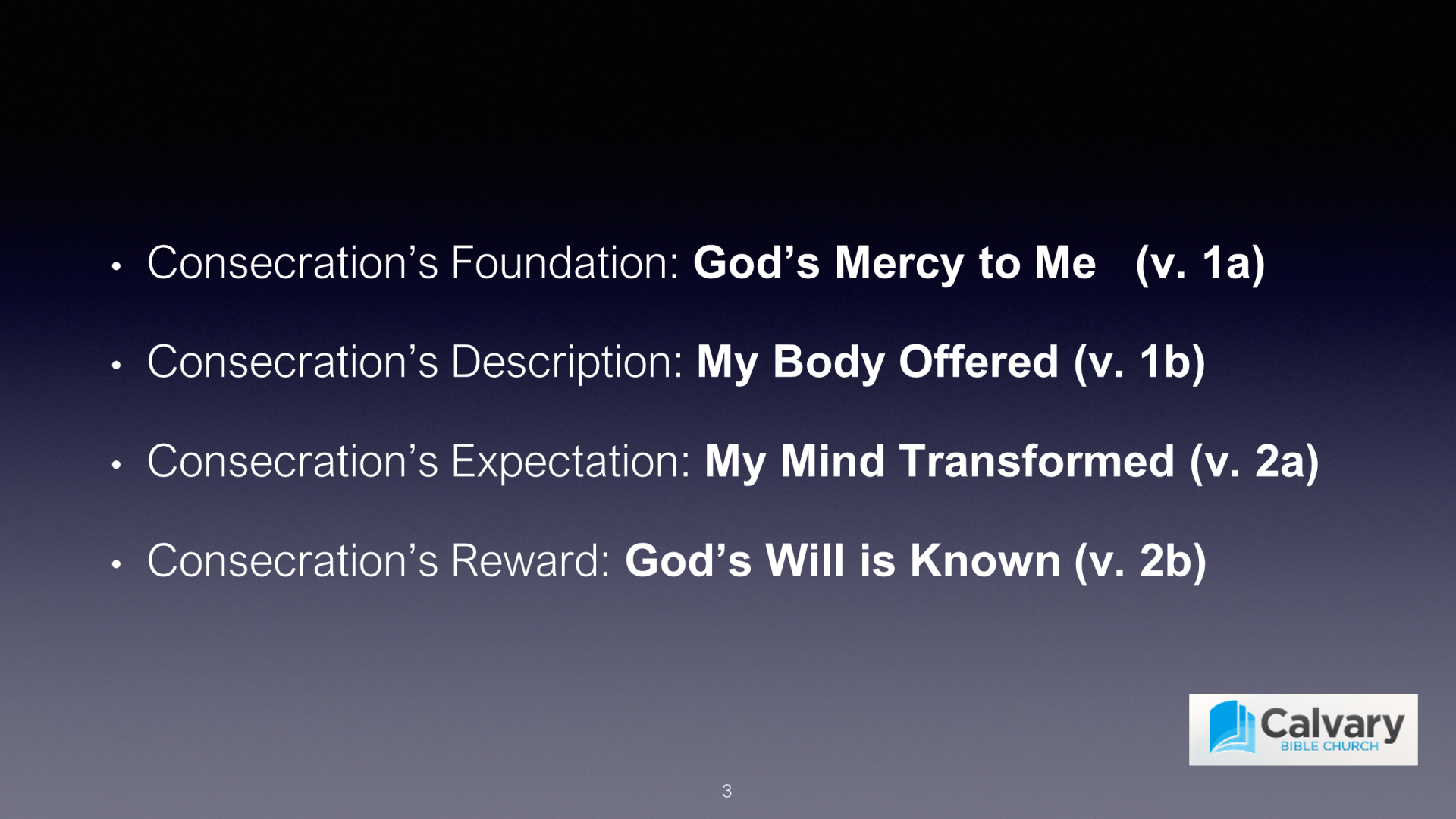
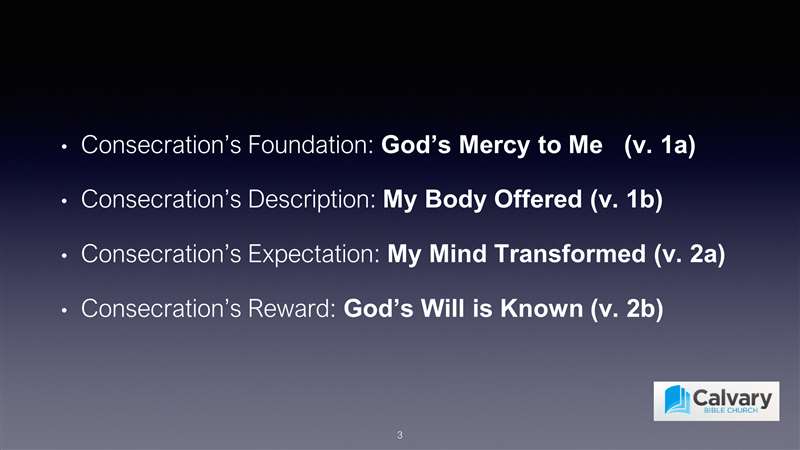
- Consecration’s Foundation: God’s Mercy to Me (v. 1a)
Romans 12:1a (NKJV) I beseech you therefore[1], brethren, by the mercies of God,
- Consecration’s Description: My Body Offered (v. 1b)
Romans 12:1b (NKJV) that you present your bodies a living sacrifice, holy, acceptable to God, which is your reasonable service.
- Consecration’s Expectation: My Mind Transformed (v. 2a)
Romans 12:2a (NKJV) And do not be conformed to this world, but be transformed by the renewing of your mind,
- Consecration’s Reward: God’s Will Is Known (V. 2B)
Romans 12:2b (NKJV) that you may prove what is that good and acceptable and perfect will of God.
So here we go. Please stand with me and read with me from your copy of God’s Word Romans 12:1-2.
Pray
- Consecration’s Foundation: God’s Mercy to Me (v. 1a)
Romans 12:1-2 (NKJV) I beseech you therefore[2], brethren, by the mercies of God, that you present your bodies a living sacrifice, holy, acceptable to God, which is your reasonable service. 2 And do not be conformed to this world, but be transformed by the renewing of your mind, that you may prove what is that good and acceptable and perfect will of God.
Paul is here summarizing the mercy of God in the eleven preceding chapters—God’s mercy to the completely fallen human race through the provision of his Son.
Completely sinful man was completely lost.
God provided a complete righteousness through the complete sacrifice of his Son.
A completely new life and purpose is now possible.
In view of His mercy, God calls us to completely commit. Paul is stating our obligation to respond to what God has done. The more we comprehend God’s amazing work, the more completely we surrender to Him.
When we Survey the Cross
Deeper meditation on Christ’s work leads to deeper surrender. As the hymn writer Watts confessed:
Love so amazing, so divine
demands my soul, my life, my all.
Please take your hymnbook and turn to #185 “When I Survey the Wondrous Cross”.
- When I survey the wondrous cross on which the Prince of Glory died;
my richest gain I count but loss, and pour contempt on all my pride.
- Forbid it, Lord, that I should boast, save in the death of Christ, my God;
all the vain things that charm me most, I sacrifice them to his blood.
- See, from his head, his hands, his feet, sorrow and love flow mingled down.
Did e’er such love and sorrow meet, or thorns compose so rich a crown.
- Were the whole realm of nature mine, that were an offering far too small;
love so amazing, so divine, demands my soul, my life, my all.
Ponder what Christ sacrificed to purchase our salvation.
Respond in adoring surrender to Him.
Deepening our grasp of His sacrifice leads to a deepening surrender of our lives. That leads us to see:
- Consecration’s Description: My Body Offered (v. 1b)
Romans 12:1-2 (NKJV) I beseech you therefore, brethren, by the mercies of God, that you present your bodies a living sacrifice, holy, acceptable to God, which is your reasonable service. 2 And do not be conformed to this world, but be transformed by the renewing of your mind, that you may prove what is that good and acceptable and perfect will of God.
The way God describes the consecration He seeks in our life is: complete and worshipful.
This section of Rom. 12:1 overflows with the imagery of the Temple & Tabernacle worship that God designed.
First, “present” is a technical work for placing a sacrifice on the altar.
Second, “bodies” sums up all attached to ongoing life: our hopes, plans, dreams, everything important or precious to us, and anything we find fulfilling must be offered.
Third, “sacrificed” is a consuming fire, a holocaust from which nothing can be recovered. God wants an irrecoverable gifting of anything important to us, into His Hands.
Offering My Life As a Sacrifice
The prescribed routine for offering Old Testament sacrifices is reflected by Paul’s wording. 1). The obedient worshipper determined what God requested from his flock or field; 2). They personally brought it to the Tabernacle or Temple; 3). They presented it as a personal offering; 4). And then released this possession from being any longer theirs.
Think of those four steps of offering to God: determined, brought, presented, and released. The Old Testament sacrifices a pervaded with the portrait of a total, irrecoverable, giving away.
But now comes the contrast: in the Old Testament the sacrifice was killed and consumed. In the New Testament the sacrifice lives on, but under new ownership. The explanation is that we are to remain in the state we presented ourselves: holy and acceptable or pleasing to God.
The essence of consecrated living is to be pleasing & acceptable to God. We consecrate ourselves to His will, seek His well done, and live as His servants. That is the only pathway God gives to finding, knowing, and doing His will.
This Is God’s Call To Total Commitment
What is amazing is the extent of this call from God. It is not merely to pastors, elders, deacons, and missionaries. This call to consecration is addressed to anyone that has experienced the mercies of God.
God is speaking to everyone in Christ’s Church, grade-schoolers, middle-schoolers, high-schoolers, college students, young adults, singles, young marrieds, un-marrieds, single-parents, those at the start of their career, at the height of their career, and after their career. The call is the same for all: complete consecration.
The medieval distinction between clergy & laity is wrong. We are all called to complete consecration, the many, not the few. That is God’s plan for each of our chosen vocations. God calls for, expects, desires, and blesses consecration.
To just offer 25% surrender is disobedient; to offer 50 or 75% is irrational once confronted with God’s mercies.
That means worship from 25% of your heart, is not accepted by God.
Even half hearted or 50% worship is not accepted.
God says the only worship He will take is what David describes as: “with my whole heart” I want to love, worship, and serve You Lord.
We are to give all that we have to all that we know about Christ. The more we know, the more we are to give. Now we get to the details, the instruction manual, and the fine print.
- Consecration’s Expectation: My Mind Transformed (v. 2a)
Romans 12:1-2 (NKJV) I beseech you therefore, brethren, by the mercies of God, that you present your bodies a living sacrifice, holy, acceptable to God, which is your reasonable service. 2 And do not be conformed to this world, but be transformed by the renewing of your mind, that you may prove what is that good and acceptable and perfect will of God.
Here we find the Lord guides Paul to give both a positive and a negative description of God’s requirements. Here are God’s expectations of anyone who has experienced His gracious mercies.
Interestingly the first is negative, and the second is positive. No to worldly conformity & yes to godly transformation are the two sides of a genuine commitment to God. Genuine surrender has a negative and a positive set of duties.
First, God says we are to make a monumental declaration of NO to the old ways of the lost person we once were. The big resolve is to NO more live like that.
My first duty, expected by God is to declare over and over by my choices: v. 2 I do not want to be conformed any longer by this fallen, sinful, rebellious, proud, lust-filled, and pleasure seeking world.
What Does ‘Do Not Conform’, Mean?
Again the words the Spirit guided Paul to write are so clear. “Conformed” comes from the Greek root “schema” which corresponds to the English word scheme. God is saying, that the world around us is being directed by the god of this world, namely Satan.
So, beware of getting influenced by his scheme. Beware of listening to Satan’s advice instead of God’s. Beware of getting pulled in by the multitude.
Satan’s worldly scheme wants to get us hooked on anything but God.
Satan’s cultural scheme wants us to be satisfied by anything but God.
Satan’s world system wants us distracted by everything but God.
Avoid those schemes of the Devil, those patterns, and the momentum of culture. All of those are being prompted by the one who God describes like this, in 1 John 5:19:
1 John 5:19 (NKJV) We know that we are of God, and the whole world lies under the sway of the wicked one.
We All Struggler Against Conformity to the World
The sad and painful truth is that all of us struggle to some degree with conformity to the world. That is why Paul asked every believer to make that monumentally large roadblock, say NO MORE.
Then start the re-orientation of our minds back on downloading more of the transforming truths about Christ each day. We are not to abandon culture; nor move away from being near any lost people and stay in monasteries. We are to be in the world, but not be of the world.
Since Satan is in the saddle of human culture, we should be suspicious of conforming to the current trend just because it is fashionable, popular, or the current rage.
We must seek God’s wisdom in what we read, watch and listen to.
We must seek God’s strength to not fear challenging others’ presuppositions.
Above all, we must seek God’s power to be different as in: “holy and acceptable to God”.
We All Need Transformation
Paul states the positive command next: but be transformed by the renewing of your mind. Here the Greek language shines again. Transformed is the word “morphed” like the frog gradually coming from that tadpole, and the beautiful butterfly waiting to be released from the caterpillar: we are all to seek God morphing us.
When this word is used three other times in the New Testament, it is even more vivid. In Mt. 17:2 and Mk. 9:2 we see glory shining out of Christ on the Mt. of Transfiguration. The essence of the fullness of the Godhead briefly peeked out of Christ. He changes, is morphed into glowing like the Sun shining in its power.
Then Paul takes that same word and places it into 2 Cor. 3:18 and says that is exactly what God wants to do in us, day by day. We are to be experiencing this “change” throughout each day of our lives to look a bit more like Christ. This is God’s expectation for us:
2 Corinthians 3:18 (NKJV) But we all, with unveiled face, beholding as in a mirror the glory of the Lord, are being transformed into the same image from glory to glory, just as by the Spirit of the Lord.
How does this Transformation happen?
God clearly explains the process of consecration by the Greek word behind the English translation: “be transformed” (it is a passive imperative). God uses that passive form to explain that this consecration must be done by someone else, not us; and that Someone else is the Spirit of God. We can’t consecrate ourselves, we can only surrender & yield to Him.
The next phrase is in the present tense to convey an ongoing, continuous process of “the renewing of your mind”. The transforming metamorphosis (summorphos) of a believer culminates in Heaven when we are at last fully in the image of Christ for eternity. Romans 8:29 is that future event, but the process takes place because of the choices to surrender to the daily consecrating work of the Spirit.
Kent Hughes[3] ably states: “As we answer the call to commitment, we are called to voice a monumental “no” to the schemes of this fleeting evil age and a determined “yes” to the transforming work of the Holy Spirit in renewing our minds.
The “no” without the “yes” will lead to a life of futile negation.
The “yes” without the “no” will lead to frustration because Christ will not dwell in Satan’s house. These are not suggestions, but are rather imperial commands to be obeyed by all.”
- Consecration’s Reward: God’s Will is Known (v. 2b)
The ending of this message from God, on the work of the Spirit and our responsibility to respond, ends with one of the greatest promises in the entire Bible.
Listen to the offer God is making to every one of us who will stop to listen and respond:
Romans 12:1-2 (NKJV) I beseech you therefore, brethren, by the mercies of God, that you present your bodies a living sacrifice, holy, acceptable to God, which is your reasonable service. 2 And do not be conformed to this world, but be transformed by the renewing of your mind, that you may prove what is that good and acceptable and perfect will of God.
Consecration pays well. God has promised something that most earnest & sincere believers long for.
Here Paul was given the inspired duty to lay down God’s pathway to the longing of our hearts: How to Know God’s Will.
A life of consecration has the power from God to understand His will.
Knowing the will of God is a byproduct of willing surrender.
We are to consciously surrender to as much as we know about Christ’s work for us on the Cross. We grow in knowing Him through His Word.
The more we surrender, the more He reveals of His will.
Consecrated Living Means Confidant Living
As we live the consecrated life, Paul says we will see life more and more clearly. Those who will not surrender are the double-minded James warned about. They are tossed, confused, empty, dissatisfied, and restless.
But when we surrender we find life as God designed it not easy but as the good, acceptable & perfect will or plan of God.
Nothing short of complete surrender makes any sense when you really think about it.
God said it is the logical thing to do: consecration is the right response, and it pays very well.
Making Sacred Vows of Surrender to His Will
Most of the greatest parts of my life are connected to promises that I have made, like making and keeping my marriage vows, the sacred duties of the call to ministry, and the promises to protect and care for my family.
Often we are challenged by the renewal of our sacred vows of surrender to the Lord’s call to consecration.
So I invite you today to do something with me:
- If you are part of the cover2cover partnership this year, and would like to declare that it is your intention to get into the Word each day and go all the way through the Bible this year: please stand with me.
- As you remain standing, if any of the rest of you are on a different pathway, but with the same goal of being in fellowship with God each day through His Word: please stand with us.
- Will all of you standing seek to meet with the Lord each day of this New Year? If so please answer aloud: I Will.
- You may be seated.
Communion is a time of renewing our consecration.
Surrender To Christ Again Today
Deeper meditation on Christ’s work leads to deeper surrender. Deepening our grasp of His sacrifice leads to a deepening surrender of our lives. Ponder what Christ sacrificed to purchase our salvation. Respond in adoring surrender to Him.
To declare again your surrender to Christ today, hold your cup and stand with me and say these words to the Lord:
Were the whole realm of nature mine/ That were an offering far too small/ Love so amazing, so divine/ Demands my soul / Demands my life/ Demands my all.
Now, for personal application as yourself:
When We Are Not Consecrated: What Happens?
When we are not consecrated, we are also not staying “filled” by the Holy Spirit. When we get out of step with the Spirit, there are over a dozen symptoms that begin to show up in our lives.
Take some time to prayerfully examine each of these passages. If any of them are present, then cry out to the Lord, repent of any straying away from His plan, and seek the immediate re-filling of His Spirit:
- John 7:38-39 says we dry up inside;
- Rom 8:1-13 says we get bound again by sin;
- 8:14-17 says we get distant from God;
- 1 Cor. 6:19-20 says the fire goes out on the altar of our heart;
- 2 Cor. 1:20-22 says we begin to feel lost;
- 2 Cor. 3:5-6 says our words begin to kill;
- 5:18 says we start to wander;
- 5:22 says we get fruitless;
- 6:17 says we get fearful & defeated;
- 1 Jn. 2:27 says the Word makes no
- 5:22 says we get fruitless;
- 6:17 says we get fearful & defeated;
- 1 Jn. 2:27 says the Word makes no
[1] This is the fourth “therefore” of Romans: 3:20 we are all guilty; Rom. 5:1 in Christ alone is justification; Romans 8:1, only in Christ do we escape condemnation; and Rom. 12:1 God expects consecration.
[2] This is the fourth “therefore” of Romans: 3:20 we are all guilty; Rom. 5:1 in Christ alone is justification; Romans 8:1, only in Christ do we escape condemnation; and Rom. 12:1 God expects consecration.
[3] This quote and other ideas are drawn from Preaching the Word: Romans—Righteousness from Heaven, in loc.