
If the video above is not available, here are two other ways to view:
How to End the Hurry
NR1-37 NR7-19 RIG-05 DWM-34 WFF-48 WWJ-29
000903AM
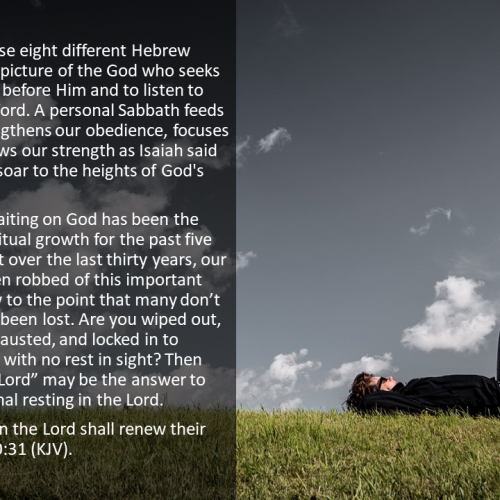
 The Holy Spirit chose eight different Hebrew[1] words to paint the picture of the God who seeks us to come silently before Him and to listen to Him through His Word. A personal Sabbath feeds our patience, strengthens our obedience, focuses our spirit and renews our strength as Isaiah said “like an eagle” we soar to the heights of God’s presence.
The truth is that waiting on God has been the foundation for spiritual growth for the past five thousand years. Yet over the last thirty years, our generation has been robbed of this important truth. And it is now to the point that many don’t even see what has been lost. Are you wiped out, tired, fatigued, exhausted, and locked in to hurrying to and fro with no rest in sight? Then “waiting upon the Lord” may be the answer to our loss of a personal resting in the Lord.
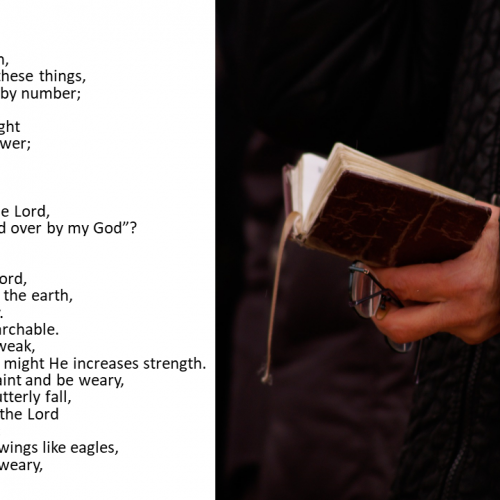
They that wait upon the Lord shall renew their strength.” Isaiah 40:31 (KJV).
One noted pastor wrote, “I found myself hurrying God, I just kind of fit Him in wherever He needed to be fit in. And one day God’s Word showed me God was not going to fit around my schedule. I had to fit my schedule around His. That changed my whole life.” The truth is, if we will not recover the discipline of waiting, God is under no moral obligation to speed up His timetable to accommodate our urgency. We will find Him in all His peace, refreshment and sweetness when we seek Him with all our heart (Deut. 4:29) and “Rest in the Lord and wait patiently for Him…” Psalm 37:7 (KJV).
Let’s see the offer God makes as we turn together this morning to the last verse of Isaiah 40, and listen to the offer God has made for you and me.
Now we return to Mark 2:27-28 as we are look at the Biblical Teaching on the Sabbath. Jesus clearly sets the tone for the controversies of the day and speaks to us to this day on the Sabbath.
- First, SABBATH PURPOSES: what did Jesus say about the Sabbath? As Lord of Sabbath He said one thing, the Sabbath was made for man to worship God. It was not a prison, a straight jacket, a death squad to hunt Sabbath breakers, no; it was a delightful offer of spiritual communion with God.
- Secondly, SABBATH PROMISES: do we need rest and to cease from our wearying schedules? Yes, and that is what this Old Testament picture teaches us New Testament saints! God offers rest!
- Thirdly, SABBATH LAWS: should we really meet on Sunday or on the Sabbath Day, which is Saturday? We study that tonight!
- Fourthly, SABBATH BLESSINGS how do we apply all this to our lives? How do we cultivate a rest, a cessation from weariness in our lives? How do we make worship of the Lord special on our Day of Gathering, the Lord’s Day? That is next week!
- Fifthly, SABBATH THIEVES what takes away the blessings and promises of the rest God offers? This morning we start this examination of what robs us of the blessings of a personal Sabbath rest.
- First, LOVELESS OBEDIENCE robs us of the promised Sabbath rest.
- Secondly, PASSIONLESS SEEKING robs us.
- Next time we will see that MEDIA OVERLOAD STEALS OUR REST: A Personal Sabbath Rest: Helps us Root out the contamination of the media: Research has demonstrated that we store three trillion “videotape” images in our brain by the time we are thirty years old. But, worrisomely, we have no volitional control over selective forgetting. Once the images are there, we must then live with the consequences of that visual imprint.
- SUPERFICIALITY STEALS OUR REST: A Personal Sabbath Rest: Helps us Root out the contamination of Superficiality in our culture-
- LEGALISM STEALS OUR REST: A Personal Sabbath Rest: Helps us Counter the claims we are required to worship on the Sabbath day.
- Busyness STEALS OUR REST: A Personal Sabbath Rest: Helps us Repent of the pride of Busyness – The busier we appear, the greater the respect afforded us. While the person sitting on a lawn swing is scorned, the speed-of-light jet jockey is venerated.
- Hurry STEALS OUR REST: A Personal Sabbath Rest: Helps us “Ruthlessly Eliminate Hurry”
- The ceaseless pressures of Debt[2] STEAL OUR REST: debt can rob our taking advantage of God’s Promised Quietness or Tranquility?
- SABBATH PLANS what are some simply wonderful plans we can make to heighten our worship, our communion with God? Some real blessings can come with some small changes and some preparations.
- SABBATH PICTURES what are the illustrations that Jesus, His apostles, and all the Old Testament saints used to show the plan of God? God’s Holidays, the Feasts. And each is a wonderful picture and pathway to deepening our devotion to Jesus.
- Finally, SABBATH rest what does God want more than anything? Our minds. What is the key to our spiritual success? A mind that rests upon, and is fixed upon the Lord God Almighty!
 The first thief that steals our personal Sabbath rest is loveless obedience to God. When Jesus said that all the Law was fulfilled by love, He meant it. In our text Jesus reminds the loveless obeyers (the Pharisees) in v. 27 of the original purpose of the Sabbath was for man. And in v. 28 that we must obey our Lord Jesus as Lord over the Sabbath. This morning, this side of the Cross how can we do that? We learn this by listening to Jesus, Turn back to Matthew 22 for a moment. He said all of God’s Law was fulfilled by love:
Matthew 22:37-40 Jesus said to him, “ ‘You shall love the Lord your God with all your heart, with all your soul, and with all your mind.’38 “This is the first and great commandment.39 “And the second is like it: ‘You shall love your neighbor as yourself.’40 “On these two commandments hang all the Law and the Prophets.”
Does that mean He was doing away with the 10 Commandments for His disciples, the Church, and us today? No! Christ fulfilled them! Love is God’s standard and He doesn’t change! Christ was pointing to God’s love behind the law. Galatians 5:14 For all the law is fulfilled in one word, even in this: “You shall love your neighbor as yourself.”
Now, we need to practically apply the Ten Words or commandments. Turn for a moment to Exodus 20:3-17 and let’s see #4 commandment in context of love and why all 10 still reinforce God’s love. Now, if we love God we should do these things for Him!
Now here’s the hard part. Do we spend more of our focus on improving our minds and bodies or souls? It’s so easy to get into the run-us-and-the-kids-to syndrome that they are too tired to be in God’s presence. What are you teaching by your example about loving God?
1. LOVE FOR GOD GUARDS HIS PLACE IN OUR LIVES: so as His children we remain true to Him (Commandment #1) Thou shalt have no other gods before Me” (v3). Love is loyal, not fickle. God is just saying, “Will you love Me enough to not leave Me for some other god? Love doesn’t make other gods or turn its back on the one, true God…it’s loyal.
2. LOVE FOR GOD GUARDS HIS WORSHIP: so as His children we Stay faithful to Him (Commandment #2) “Thou shalt not make unto thee any carved image, or any likeness of anything that is in heaven above or that is in the earth beneath, or that is in the water under the earth; thou shalt not bow down thyself to them, nor serve them; for I, the Lord thy God, am a jealous God, visiting the iniquity of the fathers upon the children unto the third and fourth generations of them that hate Me; and sowing mercy unto thousands of them that love Me, and keep My commandments” (vv. 4-6).
3. LOVE FOR GOD GUARDS HIS NAME: so as His children we guard God’s Holiness (Commandment 3) “Thou shalt not take the Name of the Lord thy God in vain; for the Lord will not hold him guiltless that taketh His name in vain” (v7).
4. LOVE FOR GOD GUARDS HIS TIME FOR INTIMACY: so as His children we seek intimacy with Him (Commandment #4) “Remember the Sabbath day, to keep it holy. Six days shalt thou labor and do all thy work; but the seventh day is the Sabbath of the Lord thy God; in it thou shalt not do any work, thou, nor thy son, nor thy daughter, thy manservant, nor thy maidservant, nor thy cattle, nor thy stranger that is within thy gates; for in six days the Lord made heaven and earth, the sea, and all that in them is, and rested the seventh day; wherefore, the Lord blessed the Sabbath day, and hallowed it” (vv8-11).
 Love draws aside for intimacy. God is saying, “If you love Me, you won’t just go live your life apart from Me, you’ll draw near to Me. You’ll want to be with Me and fellowship with Me, so you’ll drop all your activities one day a week and just spend it with Me.” Love is intimate.
So love is: The first four commandments are just talking about loving God. In fact, Jesus summed it all up in Mark 12:30 when He said, “And thou shalt love the Lord thy God with all thy heart, and with all thy soul and with all thy mind, and with all thy strength; this is the first commandment.” Now, the last six commandments define love toward men:
- LOVE FOR GOD Seeks to Honor Parents (Commandment #5) “Honor thy father and thy mother, that thy days may be long upon the land which the Lord thy God giveth thee” (v12). Love is not lawless, nor is it rebellious – it is respectful and honoring. One of the great characteristics of love is that it always seeks to say the best about everyone. It also seeks to aid, to help, to assist, and to honor. Love is respectful.
- LOVE FOR GOD Protects Life (Commandment #6) “Thou shalt not kill” (v13). True love would never murder another. Love is harmless…it hurts no one.
- LOVE FOR GOD Seeks Purity (Commandment #7) “Thou shalt not commit adultery” (v14). Love always seeks the purity of another. Adultery defiles but love seeks only purity.
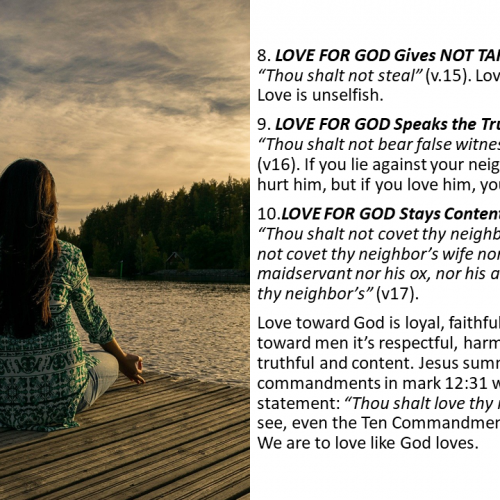
- LOVE FOR GOD Gives, Not Takes (Commandment #8) “Thou shalt not steal” (v.15). Love gives; it doesn’t take. Love is unselfish.
- LOVE FOR GOD Speaks the Truth (Commandment #9) “Thou shalt not bear false witness against thy neighbor” (v16). If you lie against your neighbor, you’re trying to hurt him, but if you love him, you’ll only tell the truth.
- LOVE FOR GOD Stays Content (Commandment #10) “Thou shalt not covet thy neighbor’s house; thou shalt not covet thy neighbor’s wife nor his manservant, nor his maidservant nor his ox, nor his ass, nor anything that is thy neighbor’s” (v17).
Love toward God is loyal, faithful, reverent, and intimate; toward men it’s respectful, harmless, pure, unselfish, truthful and content. Jesus summed up the last six commandments in mark 12:31 with the following statement: “Thou shalt love thy neighbor as thyself.” You see, even the Ten Commandments tell us to be like God. We are to love like God loves.
So loveless obedience robs us. Here is another, look at Job 23:12.
Now turn back to Job 23:12 I have not departed from the commandment of His lips; I have treasured the words of His mouth More than my necessary food.
Psalm 27:4 One thing I have desired of the Lord, That will I seek: That I may dwell in the house of the Lord All the days of my life, To behold the beauty of the Lord, And to inquire in His temple.
So here is another thief that steal this personal rest and waiting upon God, robbing us of our personal Sabbath rest? One of the most obvious one doctor has called Datacide.[3] Here is how he describes the problem:
Everywhere you look, we are surrounded by data. The burgeoning amount of information available has strained all systems attempting to deal with it. A landmark edition of The New York Times (13 November 1987) was more than sixteen hundred pages long, contained more than two million lines of type comprised of twelve million words[4], and weighed twelve pounds. In Germany, the annual Frankfurt Book Fair is the world’s largest, where seven thousand publishers from eighty countries show each other 350,000 titles. In the average office, sixty percent of each person’s time is spent processing documents. The typical business manager is said to read one million words per week.
Using transistors[5] etched onto microchips, computerization has thrown the information age into turbo gear. Every month, four quadrillion transistors are produced more than half a million for every human on the planet and each costing far les than a staple. More than seven million transistors are etched on each tiny Pentium II chip, in lines one four-hundredth the thickness of a human hair.
It is now[6] possible to cram 11.6 gigabytes of data into one square inch of disk space, which is equivalent to storing an eighteen-story stack of double-spaced typed pages on your thumbnail.

The antidote for datacide
Use the Test of Time Publishers sometimes contend that the jar of mayonnaise in the refrigerator has a longer half-life than most books. Information pollution has a way of dying a fairly quick natural death. Understanding this, devote time to the works that have stood the “test of time.” Read the Bible, the saints, the classics, the best of literature. Step up a level or two from data to information to knowledge to wisdom. There is a difference. The further up the line we ascend, the greater the possibility it will stand the test of time.
Isaiah 40:8 The grass withers, the flower fades, But the word of our God stands forever.”
It Is Okay Not to Know “By giving[7] yourself permission not to know, you can overcome the fear that your ignorance will be discovered. When you can admit to ignorance, you will realize that if ignorance isn’t exactly bliss, it is an ideal state from which to learn.”
Deuteronomy 4:29 “But from there you will seek the Lord your God, and you will find Him if you seek Him with all your heart and with all your soul.
Matthew 6:22 “The lamp of the body is the eye. If therefore your eye is good, your whole body will be full of light.
Increase Your Information Selectivity, Remember Jesus said
Matthew 10:16 “Behold, I send you out as sheep in the midst of wolves. Therefore be wise as serpents and harmless as doves.
Pitch the Pile In nearly every home or office there is a stack of unread journals and magazines. Cancel publications you don’t have time to read. Quit stockpiling journals, magazines, newspapers. If you don’t have time to read them today, it is purely illusory that you will somehow have time next month. Swenson’s suggestion: If the stack is more than six inches high, save the top inch and throw the rest away. If the stack is more than two feet high, throw the whole pile. Why? The piles can block our view of Jesus!
Hebrews 12:1-2Therefore we also, since we are surrounded by so great a cloud of witnesses, let us lay aside every weight, and the sin which so easily ensnares us, and let us run with endurance the race that is set before us,2 looking unto Jesus, the author and finisher of our faith, who for the joy that was set before Him endured the cross, despising the shame, and has sat down at the right hand of the throne of God.
So we celebrate the One who is Lord of the Sabbath this morning.
We remember the One who ended the bondage of law keeping righteousness and poured out upon us richly His perfect righteousness.
We worship Him who is our promised rest!
Paul cries across the centuries:
Galatians 6:14 But God forbid that I should boast except in the cross of our Lord Jesus Christ, by whom the world has been crucified to me, and I to the world.
The Lord’s Supper is when we remember the great work of Christ. It is our collective glorying in Christ’s Cross that has loosened death’s vice grip and set us free. Note these glorious events:
Christ died, Christ rose, and Christ ascended to God’s Right Hand,
Christ took my penalty upon Himself, Christ imputed His righteousness upon me,
Sin was dealt with, guilt was passed away, and sins shackles were broken,
Satan was defeated, the fear and power of death was destroyed, eternal life was given, and the destiny of Hell was blotted out of the future for all who came.
——–
Appendix:
Roman Catholic Sunday Legislation
In the course of Constantine’s wars with his rivals to establish himself on the throne, on October 27, 312 A.D., on the eve of the battle of Milvain Bridge just outside of Rome, he is reported to have seen in the sky a vision of the cross with the words: “In this Sign Conquer.”
By the end of the Imperial Persecutions (313 A.D.), Christians, then an illegal sect, numbered about half of the population of the Roman Empire. The embracing of this growing underground movement could simply have been an extremely clever stratagem for consolidating[8] power.
Emperor Constantine served from 306 – 337 A.D. He ultimately abolished slavery, gladiatorial fights, the killing of unwelcome children, and crucifixion as a form of execution. The Edict of Toleration, 313 A.D: By this edict, Constantine granted to “Christians and to all others full liberty of following that religion which each may choose.” This was the first edict of its kind in history.
On March 7, 321, Constantine[9] introduced the first civil legislation concerning Sunday: “Let all the judges and town people, and the occupation of all trades rest on the venerable day of the sun.” In 325 A.D., Constantine issued a general exhortation to all his subjects to embrace Christianity. He ordered 50 Bibles to be prepared[10] under the direction of Eusebius, on the finest vellum and by skillful artists.
The “Christian Sabbath” View
This view holds that Sunday is the Christian Sabbath, the observance of which is a moral obligation based on the 4th commandment of the Decalogue. This view emphasizes the divine institution of the Sabbath at the close of creation. God’s blessing and sanctification of the seventh day is taken to mean that He intended one day in seven to be observed by all men in all ages as a sacred day of rest and worship.
It is regarded as a moral command of universal and perpetual obligation. It is held that Jesus affirmed that He was “lord even of the Sabbath” and therefore had the authority to change the day of its observance. It is usually held that this change took place during the 40 days between Christ’s resurrection and ascension when He spoke to them concerning the kingdom of God Acts 1:13.
Sabbatarianism is the doctrine of those Christians who believe that Sunday is the Christian Sabbath, to be observed in accordance with the 4th commandment. In its strictest form, it was the creation of the Scottish and English Reformers, especially John Knox. The Scottish Presbyterians and the Puritans brought their views to the colonies, where rigorous “blue laws” were enacted.
Sabbatarians insist that Jesus intended to perpetuate the Sabbath and extend its application to all men. Much stress is placed on His statement, “The Sabbath was made for man, not man for the Sabbath,” as evidence that Jesus regarded the Sabbath as an institution which is grounded in the very constitution of man, and which was instituted by God from the very beginning not only for Israel but for the whole human race. The teachings of Paul regarding the Sabbath are taken to refer only to the Jewish Sabbath and not to the “Christian Sabbath.”
The Bible does teach that God instituted the Sabbath at the close of Creation, and the Sabbath is identified as “the seventh day,” not as one day in seven.[11] There is both a moral element and a ceremonial element in the 4th commandment. The moral element provides for the worship of God. The ceremonial elements are viewed as applying only to the Israelites. Jesus Himself treated the Sabbath law as ceremonial when He defended His disciples for plucking grain on the Sabbath. A moral law could never be suspended by circumstances of hunger or by the requirements of merely ceremonial regulation. Paul made no distinction between ceremonial and moral laws when he declared that all external law is abrogated for the Christian.[12]
The basic weakness of this theory is the teaching that a change was made in the day of the week to be observed as the Sabbath. There is not the slightest hint in the New Testament that Jesus transferred the Sabbath to another day of the week.
If one insists on the perpetual and universal obligation of the 4th commandment, and at the same time recognizes that there is no New Testament ground for a change in the day of its observance, the only logical position to which one is forced to maintain is that the seventh day of the week, and not the first day, should be observed as the Sabbath, as the 4th commandment stipulates.
The Seventh-Day Sabbath View
[Christians who believe that the Sabbath should still be observed on Saturday are also sometimes called Sabbatarians.] This view, held by the Seventh-Day Baptists who originated in England in the 17th century, and by Seventh-Day Adventists who originated in America in the 19th century, insists that the Christians are obligated to keep the seventh day of the week as the Sabbath.
They regard the Ten Commandments as “the Law of God,” to be distinguished from the ceremonial laws, which are called “the law of Moses[13].” They find evidence for the observance of the seventh day in the New Testament. They appeal to the practice of Jesus and the apostles attending the synagogue on the Sabbath[14].
They apply Jesus’ prophecy regarding the future flight from Jerusalem and His exhortation that they should pray that their flight should “not be on the Sabbath day[15].” (They seem to ignore the possibility that this event might be post-rapture and refers to “those who are in Judea.”)
They also contend that the reference in Revelation to “being in the Spirit on the Lord’s day” is a reference to the seventh-day Sabbath.[16] (This author, however, believes that this is actually a reference to the “Day of the Lord” as portrayed by Joel, et al. The aorist tense in the Greek would seem to support the uniqueness of John’s experience.)
Actual “evidence” of Sunday worship is circumstantial, and describes actions of observant Jews. The distinctions advanced by the Sabbatarians have no direct Biblical evidence or attendant instruction. And as for compulsory ritualistic commitments, Paul definitely included the Sabbath command among those ordinances, which were done away with in Christ.
The evidence from the early church leaders is clear that they did not regard Sunday as a continuation of the Hebrew Sabbath.
[1] Hebrew word stats: most used is # 6960 quaveh “to hope, eagerly look, anticipate.” (Psalm 25.5, 21; 27.14; 37.9, 34; 52.9;69.6; 130.5; Jer. 14.22; Lam. 3.25; Isaiah 30.18; 40.31; 49.23; Hos. 12.6) Other words translated wait are in: Zeph. 3.8-2442; Lam. 3.26-1748; Micah 7.7-3176; Isaiah 8.17-2442; Psalm 37.7-2342; 59.9-8104; 62.5-1826; 69.3-3176).
[2] Richard A. Swenson, M.D., The Overload Syndrome. Colorado Springs, Colorado: NAVPRESS, 1998, p. 97-98.
[3] Swenson, Overload, p. 137-160.
[4] David Shenk, Data Smog: Surviving the Information Glut (New York, NY: HarperEdge, 1997), pp. 30-31.
[5] Walater Isaacson, “Man of the Year…Driven by the Passion of Intel’s Andrew Grove,” Time, 29 December 1997-5 January 1998, pp. 48 and 50.
[6] Thomas Becker, “Thinking Small,” Newsweek, 12 January 1998, p. 8.
[7] Wurman, pp. 14 and 140, as quoted by Swenson.
[9] Corpus Juris Civilis Cod., lib. 3, tit. 12, Lex. 3, given in Latin and in English in Philip Schaff’s History of the Christian Church, Vol. 3, 3d period, chapter 7, sec. 75, p.380, fn 1. Also in Albert Henry Newman’s A Manual of Church History, rev. ed., The American Baptist Publication Society, Philadelphia PA, 1933, Vol 1, pp.305-307; and in Leroy E. Froom, The Prophetic Faith of Our Fathers, Review and Herald Publishing Assoc., Washington DC, Vol 1., pp.376-381.
[10] We generally fail to appreciate the costliness of such an undertaking in the absence of modern printing
[11] Genesis 2:3; Exodus 16:29; 20:10; Deuteronomy 5:14.
[13] A. L. Baker, Belief and Work of Seventh-Day Adventists, p.74.
[14] Luke 4:16; Acts 13:14, 42; 16:13; 17:1, 2; 18:4.
Slides



Check Out All The Sermons In The Series
You can find all the sermons and short clips from this series, Delights of a Word-Filled Marriage here.
Looking To Study The Bible Like Dr. Barnett?
Dr. Barnett has curated an Amazon page with a large collection of resources he uses in his study of God’s Word. You can check it out here.