
Walking on Holy Ground
KGD-05 TAB-20 XAS-18
020804PM
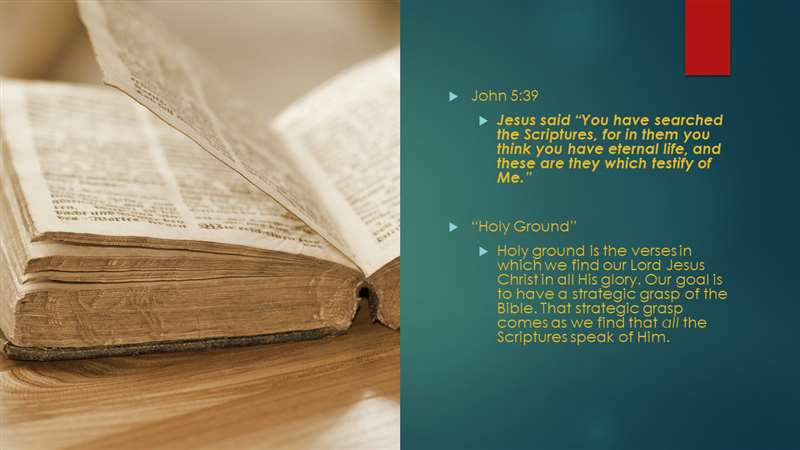
Let’s open our Bibles to the Gospel by John chapter 5. I’m only going to give you the 39th verse this evening and then we’re going to use that to do what that verse says. What we are looking at is a strategic grasp of the Bible. What I mean by that is a hold on the Bible, an understanding of this book that gives you a grasp so that you can see what the Lord is doing comprehensively as far as in the whole book. I think a lot of times our predisposition in a Bible church is to really get to know one little piece really well. When actually I believe far more beneficial, especially when it comes to the world we live in, is to understand the whole scope of the scripture. It gives us the heart of God for this world rather than our special preferential part that we’ve really mastered. It gives us the broader look. And that’s what a strategic grasp is.
Look what it says in verse 39. Jesus said, you search the scriptures. By the way, what were the scriptures He was talking about? The Old Testament, okay? The New Testament had not been written yet, the Gospel writers had not been inspired by the Holy Spirit to record the life and work of Christ. He said, you search the Tanakh, that’s the Old Testament, for in them you think you have eternal life. Now, here’s the key. And these, that’s the Old Testament scriptures, are they which testify of Me. Does this book testify of Christ? Yes, Colossians, yes, Philippians, He humbled Himself. Yes, to Thessalonians, He’s coming back. Yes, Romans, He is the One who offered the sin sacrifice to justify us. Yes, the Gospels do. Yes, the book of Acts does. Yes, the Revelation does. But does Hosea? Does Exodus very often? Does Leviticus? Does two-thirds of the Bible testify of Christ? That’s the purpose of this concept of the strategic grasp of the Scriptures.
Tonight, we’re going to look at holy ground. Now, what do you mean by that? When I say that what do I mean by that? Holy ground is what this book should become to you. It should be that anywhere that you dig in this book, you ought to find holy ground, where you find Jesus Christ. You can make any part of this book to be that holy ground in which you discover the scriptures speaking of me, as Jesus said.
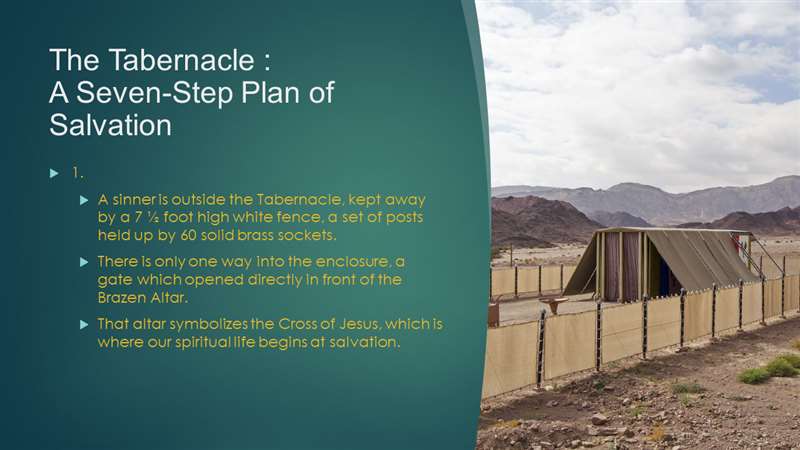
Now specifically, I’d like to do some digging in the Tabernacle. So tonight, I’d like to show you, first of all, that the Tabernacle illustrates in seven steps the salvation Christ offered. What I want you to do is go beyond just the pictures and I want you to think in your life where you are. Because the Tabernacle is a living illustration of what God wants for us to achieve. It puts together all of those beautiful epistles of Paul. It puts together all of the wonderful letter writing he made to those churches. It helps us to have a measurable way of knowing where we are as far as our walk with Jesus Christ.
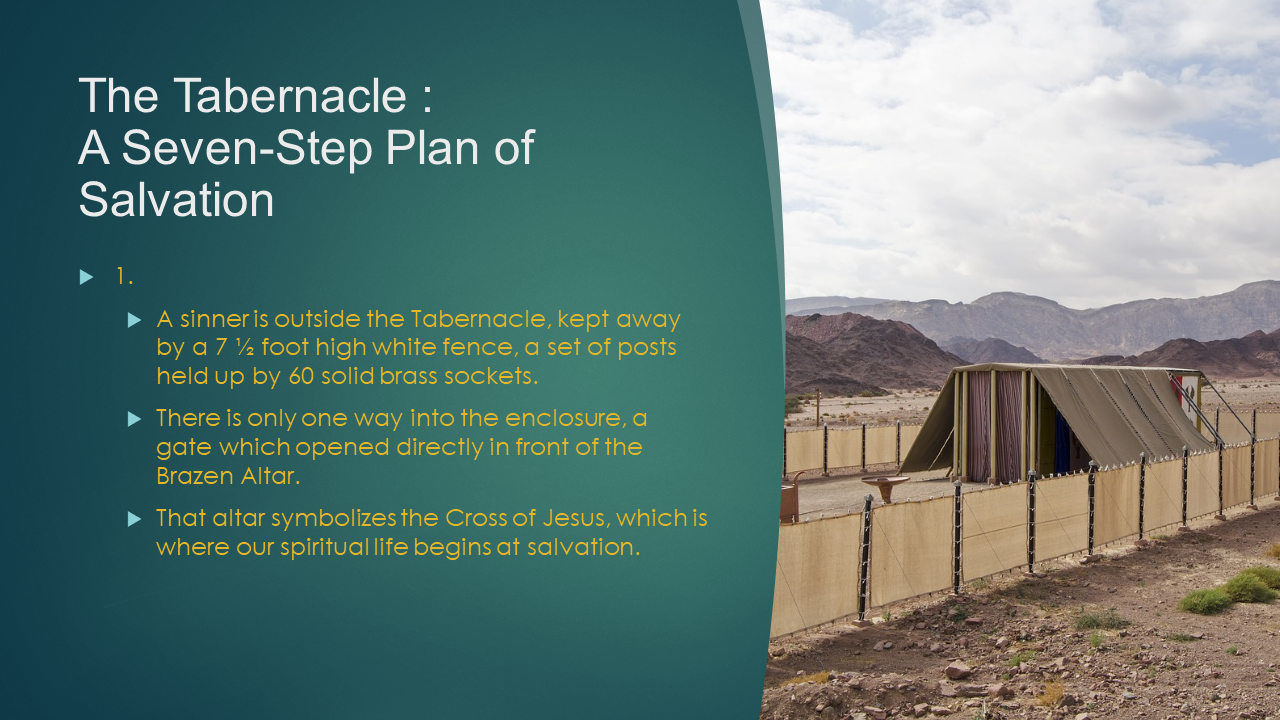
Number one, a sinner stands outside, and step one of salvation is to admit that you’re outside. Now, what I’m showing you there is a tent with 450 feet of fence around it. Each one of those posts, and there are 60 posts that go all the way around it, each one of those is set in a solid brass socket in the sand. There were 450 feet of white linen 7.5 feet high, basically the size of a modern building lot, 75 by 100, or maybe a little bit bigger, and there was a sacred enclosure. It had only one gate and it was a white wall so that you couldn’t see in. It was a big reminder that sinners were on the outside. Step 1 of salvation is admitting that you’re on the outside. Sinners were kept away by a 7.5-foot high white fence set in those solid brass sockets with only one way or gate into that enclosure. So, you see that the one gate in was a reminder that all of us were born outside. The white wall excludes us from entrance because we cannot enter into God’s presence except if we come that one way. That one way is Jesus Christ who said, I am the gate. That one way is a very wide beckoning entrance, but it’s only one exclusive way in and that’s what Christ invites us to.
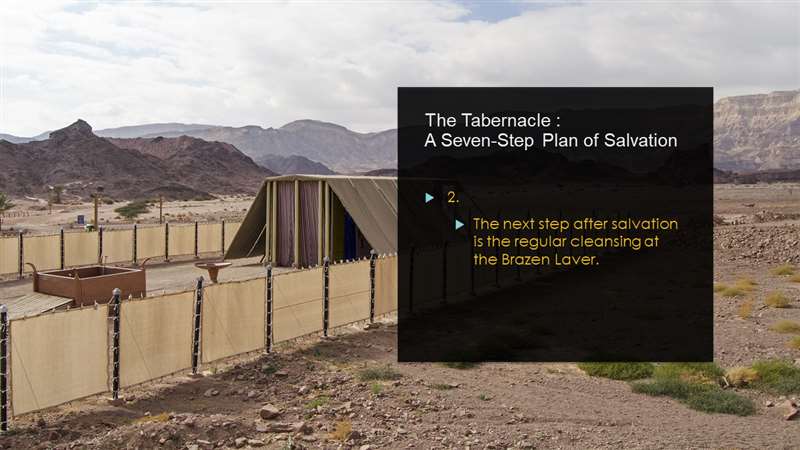
Secondly, and the next slide tells us, that the next step of salvation is when we come in that gate and we see that we come to that brass altar. That brass altar is exactly, and that’s where we left off last time, what you run into when you come in that gate. In fact, it was positioned such that if you walked in, it was the largest object of all the pieces of furniture, and you had to stand in front of it. It confronted you as you walked in. That is a reminder that the only way of salvation is through the cross of Jesus Christ. He is the cross for sinners. That’s where we come to the fact that Jesus Christ is the beginning of our spiritual life, and spiritual life begins at salvation, and the altar is the cross of Jesus. We looked at it last time, all the wonderful truths about it. It was a complete sacrifice. It was a total consuming of the sacrifice. The ashes that were taken outside the camp and were buried in the ground and so many details that prefigured and beautifully portrayed Jesus Christ, but that is the entrance.
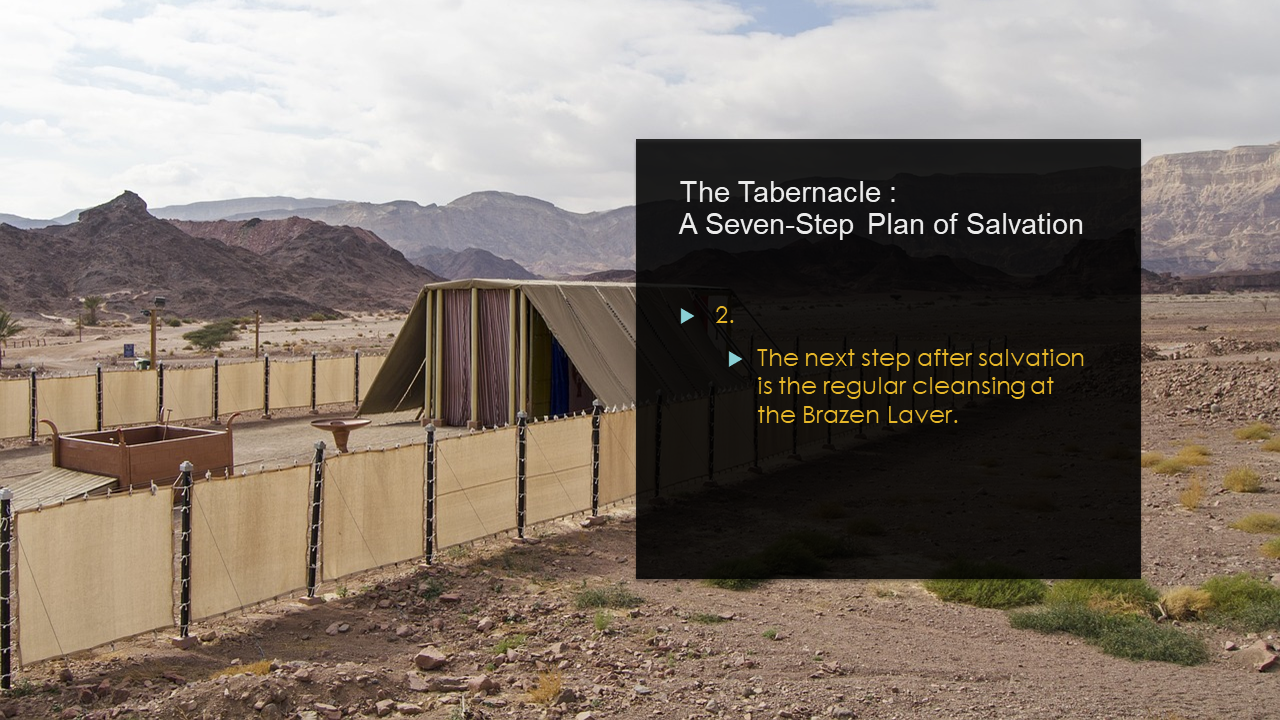
Next, as we go past that altar, we come to the laver. Step two is that believers must understand that though they were totally cleansed, and I was totally washed 40 years ago, and someone was washed in 1953 I heard so that would be almost 50 years ago they were born again, we still get dirty. In fact, do you know what I learned this week studying about the Tabernacle that I never knew before? It doesn’t have a floor, we’re going to see that later on, nor does the sacred tent on the inside. Do you know why that laver was so important? God says, you can’t serve me if you have any defilement. What did He tell Peter at the Last Supper? He said, Peter, you’re totally washed, but I need to wash your what? Your feet. Peter said, no, Lord, wash all of me. He said, no, I already washed all of you. You’ve come to the altar. You’ve been saved. You’ve come to the cross. You’re born again, but you must come to the laver regularly because you cannot serve Me, you cannot fellowship with Me, you cannot commune with Me, you cannot pray to Me, you cannot offer any acceptable worship if you’re not cleansed.
Now, you say, what’s the big deal about no floor? That laver wasn’t just for washing hands. If you read the text, it’s for washing feet also. In fact, a lot of the Jewish representations have changed from the one up there to one a little bit different that has little spigots out the bottom as they’re preparing for their third temple, they call it. As they prepare for that, they’re trying to figure out how to fulfill the Levitical laws and part of it is washing of the feet. Because as we would walk, as they walked around that sacred enclosure, that 450-foot fence and inside of it was 150 feet long and 75 feet wide. Inside of there was a dusty dirty ground and they would get dirty. They would get dusty as they hustled around. They would get blood on them from killing the animals. They did all that and so God says you must, every time you’re defiled, stop at the laver and be cleansed.
Because the unfruitful, defeated life of a person stuck between the brazen altar and the laver is where we find many Christians. They know they’re saved, but they can’t figure out why they’re defeated. They can’t figure out why they doubt. When Don comes up and says, when were you saved? They wouldn’t be caught dead saying it because they’re not even sure. They don’t even know if God wants them. They don’t know what’s going on. They’ve prayed so many times, and they’ve read so many times, and they’ve gone forward here and there. When Billy Graham’s preaching, they say what he says to say, and they still don’t feel like they’re a Christian. The reason is, many people are stuck between the burnt offering altar and the laver. They don’t realize that we need daily cleansing. We need to have the blood of Jesus Christ, not only once and for all forgiving our sins, but on a daily basis cleansing us of our sins. The Bible says if I cherish, if I hold on to, if I am stained with sin, the Lord can’t hear me. What we find is we have to seek daily cleansing for sin, or we are defeated, and we’re distant from God.
Think in your life, if you feel far from God tonight, which I bet three quarters of you wouldn’t even understand. You’re stuck at 16 and a half. Does anybody remember the old record players? That’s before 8 tracks. They don’t even know what that means. There used to be records all different sizes and your record player had 16, 33, 45 and 78, it was a little lever you moved. The long play records were 16 and they would go slow, but if you were playful, you put them on 33 and they’d go fast. If you really wanted to be funny, you put them on 78 and they’d talk like chipmunks or something like that. They talked really fast. You know what? A lot of people are stuck down there at 16 in the singing. Why? Because they’re defeated. They’re distant from God. They know they should be singing. They know they should be in church. They know they should be studying the Bible, but they don’t get anything out of it. They don’t get anything out of the singing. Why? Because they don’t stop at the laver. They run up to the place of fellowship and nothing happens.
God says, if we agree with Him about our sins, if we confess He is faithful and just to forgive us already. The tense is wonderfully in the book of 1 John. It’s not tit for tat. We don’t confess and He forgives. He’s already forgiven us of everything. If He’s forgiving you of one sin, He’s forgiving you of all of them from now until the end and from the point you and I were saved onward. It’s not forgive as confess, it’s cleanse. Listen to the verse, 1 John 1:9, If we confess our sins, constantly confessing, He is faithful and just, and the tense of the verb in 1 John 1:9 is once and for all to have forgiven us. That’s a nice thought. If you don’t remember anything else, if you check in and out, check in for this one: He forgave you once for all from the moment you were born into this world to the last breath when you die. The last sin you and I commit He already has forgiven us. You don’t have to beg Christ to forgive you. He has already forgiven. But what we do is we confess, and we receive the cleansing and the benefit of it.
Now there is another thing in play. If we are not willing to forgive others, then we don’t receive the assurance of the benefit of our forgiveness. That’s why it says, forgive us as we forgive those who trespass against us. There seems to be a spiritual connection, very powerfully, between our willingness to forgive and God’s willingness for us to have the full assurance that we’re forgiven. But many Christians, and I want you to think tonight, on holy ground, you’ve come. You come here because you love God’s word, because you love to speak with God and know Him, but if you feel distant, detached, if your heart feels dark, if you feel cold, if it just doesn’t seem to connect, you might be lying flat on your face just inside the tent. You’ve made it to the altar, but you haven’t obeyed and regularly come to the laver. We’re going to talk about some verses about that later.
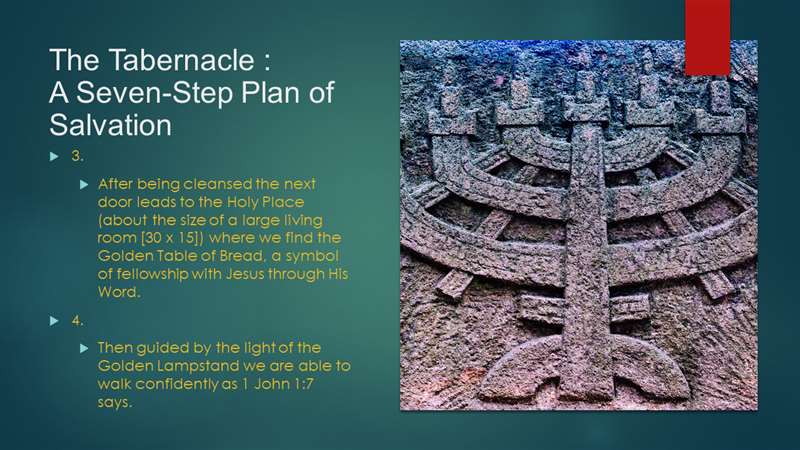
The next, step 3 is regular fellowship with the Lord. That’s where we all want to be. The Holy Place is a place of daily fellowship with the Lord. After being cleansed, the next door leads to that Holy Place. It’s about the size of a bedroom. I was telling this to my family. They couldn’t believe it at lunch. I said, hey, I’m so excited about what I’m going to talk about tonight, let me tell you about it. I said, do you know how big the Holy of Holies, that’s the back end, was? It’s about the size of a normal bedroom, 15 by 15. How many houses have 15 by 15? Maybe they have 8 by 12. Most bedrooms nowadays, at least the master bedroom, ought to be 15 by 15. That’s the Holy of Holies. It was no bigger. You know what the size of the Holy Place was? 30 by 15. That’s the size of a good sized living room. We’re talking about a very small thing. The kids were all sitting there with their mouths open. They said, I thought the Tabernacle was huge. No, not huge at all. It would fit nicely right in here. In fact, we could put the whole thing right up here. On the stage, 15 feet wide and 45 feet long. It’s not very big, but when you went into that place, it was a place of fellowship with God.
After you were saved, which is the typical representation of coming through that gate which is Jesus, and coming to the cross which is that brazen altar, and regularly stopped to get cleansed, then you can come into the place of fellowship with God. Then you can come to the Holy Place and find the first object. The next slide shows us that first object inside is the table of showbread and that’s where fellowship starts at the golden table of Christ’s Word that feeds us. If we want to get something out of the Word, make sure you wash your hands. I go through great efforts to tell the children, when I call you to eat, stop and wash your hands. Did you know there’s a biblical reason for that? Not because cleanliness is next to godliness, that’s only in Ben Franklin’s Bible. It’s because you can’t eat in God’s presence until you have clean hands and a pure heart. Do you want to know another reason why a lot of people don’t get anything out of the Bible? Their hands aren’t clean. The heart isn’t pure. God says it’s a progressive movement toward Him. It starts at the cross once and for all, but it’s maintained by that laver. Where our feet, that’s our walk, and our hands, that’s our acts, where those things are regularly cleansed. Then we can come and fellowship with Him at the golden table of Christ’s Word that feeds us.
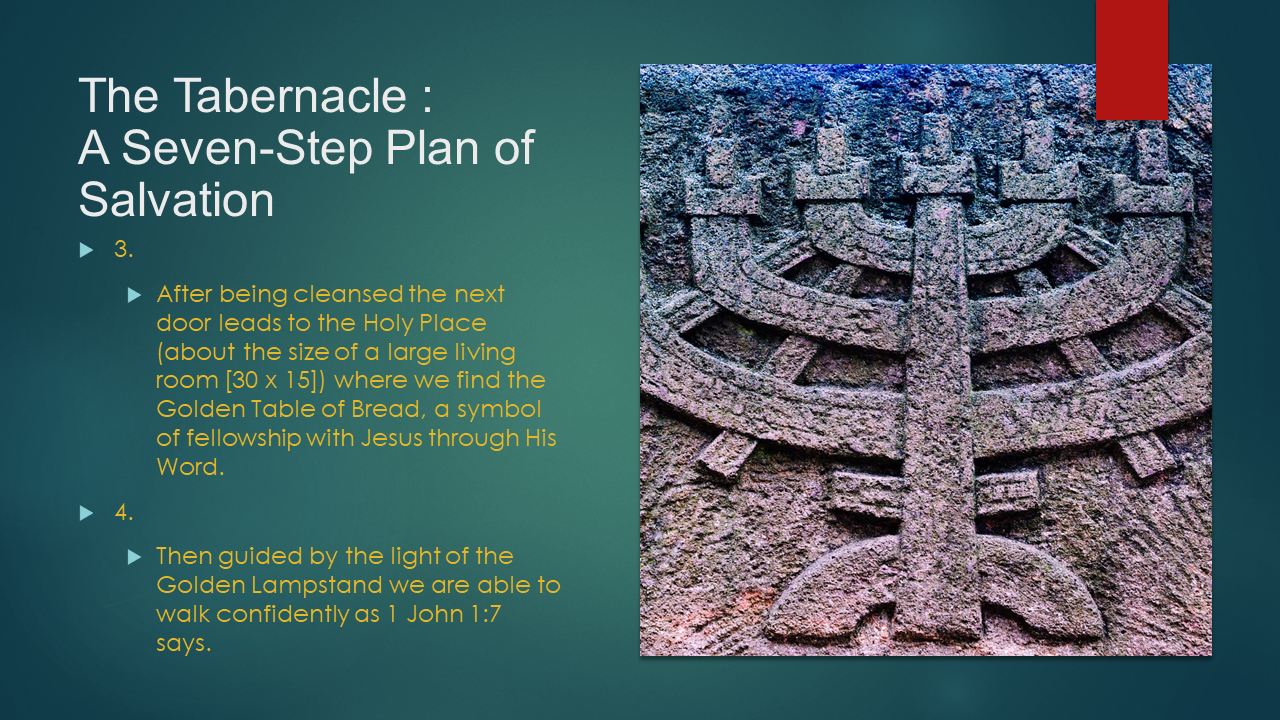
The next stop is the light of the golden lampstand, step four of our Christian life. Step one is being saved, step two is regular cleansing, step three is regular time in the Word. Step four, if you want to have a growing and godly Christian life is learning to walk in the light. Don quoted 1 John 1:7, if we walk in the light as He is in the light. Where is the light? The light is in His presence. The light is beautifully portrayed by that golden lampstand. That golden lampstand was only in one place. If you wanted to walk in the light, you had to get there, and the only way you could get there is to come to the brazen altar and be saved. Then come to the laver and be cleansed. Then enter into His presence. Feeding on His word, which helps us to walk in the light. It’s a beautiful progression, learning to walk in the light.
Step five, and on the next slide, we can then, and only then, understand the reality of prayer. Again, people pray and pray and pray and pray. Oh Lord, what do you want me to do for this job? Oh Lord, who do you want me to marry? Where do you want me to go to college? What should I do here? Should I do this or that? Prayer is a byproduct that’s led by the illumining power of the Holy Spirit and fed and nurtured by the word of God. It’s only available to save people who’ve been cleansed. You don’t even start praying until you’re saved. You don’t even start praying until you’re cleansed. You don’t even start praying until you’ve been fed by the word of God. You can’t pray. What do you pray about? You pray from the word, illumined by the Holy Spirit, and then with holy hands you lift clean hands and pure hearts before God.
Do you see how the Tabernacle is a living sermon illustration of what God wants from us? God dictated all these details. We didn’t. They’re not from Broadman Press or from Erdman’s or Zondervan’s or from some kind of youth organization. God dictated every one of these details: the size, the shape, the entrance, the gate, the configuration, the order that they were gone to. Why? Because they are His picture of the progression of the Christian life.
The next slide takes us into the Holy Place. Step six is coming into God’s presence by prayer. There’s something about prayer that grows on you. At first, when people get their cell phones they’re just calling everybody they know, showing off. Don’t you remember when cell phones started? I remember our first cell phone, it was like as big as an old camcorder. It was a big bag, and you couldn’t take it out of the car, it just ate power, it was heavy. I remember our first one, we were so excited, it was many years ago, I still chuckle about this, Bonnie and I. We went out to eat with one of the families in the church and as we started the car, I plugged in the phone and cranked it up and got it all set. We called them from the car, and they were all on the porch waving at us. All of a sudden, they ran into the house to answer the phone and it was us. We were so proud of that. You just play with your phones, and you wear them everywhere. People have phones growing out of their ears, but you know what? After a while, a phone becomes something different. It’s not a toy, and it’s not to show off, and it’s not a joke. It becomes a way that you’re in touch and linked and accomplishing a purpose.
You know what? Prayer grows until prayer becomes coming into God’s presence because we never want to leave His presence and because He says lo, I’m with you always. Do you know what happens? We pray without what? Ceasing, but wait a minute. You can’t pray unless you’re saved You can’t pray unless you’re cleansed. You can’t pray unless you’re fed on the Word, illumined by the Spirit. Then you pray, and as you continue in prayer, you find yourself abiding in the presence of God.
Last step, number seven. Step seven is finding peace and security at that mercy seat. That’s what the writer of Hebrews was talking about when he said, let’s come boldly to the throne of grace and mercy to find what we need. That ark was the repository of the three emblems that were inside: the tables of the law and the manna and the rod which all pictured Christ. The law and the prophets and the manna, which is the feeding of God, all that stuff, but that blood on the mercy seat reminded them that God’s wrath would forever be kept from them because it covered up the demands of the law. So, there’s great peace there, but then the security is that Ark had over those cherubims the rising up glory cloud of the Shekinah, which God says, lo, I want to be with you always. So, there’s peace and security as we come into His presence.
These seven steps are wonderful. The sinner is outside, acknowledging his lostness. He comes into the brazen altar and is saved. Then he comes to the laver and is cleansed. He’s going from there into the Holy Place where he understands about the fellowship with God through the bread of the table, understands the wonderful illumination of the golden lampstand, understands what prayer is all about at that golden altar of incense. Through prayer he’s transported into the very presence of God. Then as he comes to that Ark he finds peace and security through the once and for all sacrifice of Christ. What a beautiful picture of our salvation.
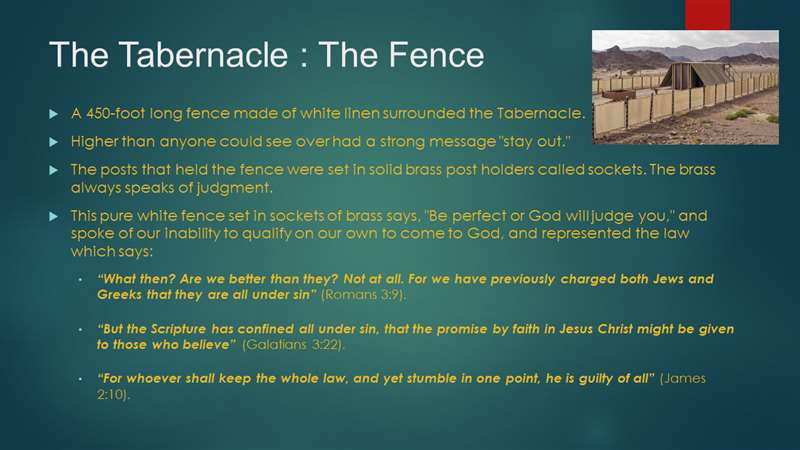
Next, we look at this 450-foot fence, and I just want to talk to you about that for a little while. A 450-foot fence made of white linen that surrounded the Tabernacle. What was it for? That 450-foot fence was a picture of the law that says, stay out! It was high enough so nobody could see over it. It was 7.5 feet high. God says, you can’t even see what’s going on with Me until you come My way. Until you come through the one gate to the place of sacrifice. The law stay out.
Now, let me just remind you, look in your Bibles at Romans chapter 3. I want to remind you what a hopeless condition we’re in. Romans chapter 3 in verse 9. I’m going to start giving you lots of good verses to ponder. Romans 3:9 says, What then? Are we better than they? Not at all, for all have previously charged that both the Jews and Greeks are all under sin. What does the law say? The law says we’re all under sin. We are all excluded from God’s presence. Keep going past Romans to Galatians 3:22. This is where the Old Testament is the New Testament concealed and the New Testament is the Old Testament revealed. Look at Galatians 3:22. Paul, who was very acquainted with the Old Testament scripture, says that the scripture has confined all under sin. That the promise by faith in Jesus Christ might be given to those who believe. What he’s saying is the barrier we have is that God’s holy law says all of us are sinners.
You say, wait a minute, I’m not that bad. I’m glad you said that because look at James chapter 2 and verse 10. Keep going. Galatians, Ephesians, Philippians, Colossians, 1 and 2 Thessalonians, 1 and 2 Timothy, Titus, Philippians, Hebrews, James. There it is, chapter 2 and verse 10. Look what it says. It says, For whoever will keep the whole law and yet stumble in one point, just one: not loving the Lord our God with all our heart and soul and mind and strength, or maybe not loving our neighbors as ourselves. Just offend in one point, we’re guilty of all.
So back to that 450-foot fence of pure white linen. By the way, each of the 60 posts, there are only 60, you can count them. The 60 posts around there were set in huge brass. In fact, 7,000 pounds of brass were used. Each one of the bottoms of those 60 posts weighed 120 pounds. Each one of those 120 pound sockets was set. They dug into the sand, they set that socket in the sand, then they placed that acacia wood post in it, then they draped over it that white 450-foot long fence. Why? What’s the brass for? God judges sin, and God’s holy wrath is against sin. What’s the white for? God’s standard is so high, it’s impenetrable. You cannot make it. That’s why it was taller than a human being could see over. No matter what we try, even tippy toes can’t see over, because we fall short. So that fence reminds us of the law, and the law says stay out.
The next slide reminds us of what that front door is about. There was a 30-foot gate. Now, 450 feet, 60 posts, and 7.5 feet were between every one of those posts. So, between four of those posts, three panels were erected. Three panels were put up and that was called the gate or the door and that was the broad entrance. Broad as far as it was large enough to accommodate as many that wanted to come in, but narrow in that the whole tent wasn’t open, only one little spot. It was wide enough for all and that was a picture of God’s grace that says come on in!
What’s interesting is if you read in the book of Exodus about the curtain that was there, in the front it says that it was tapestry woven with blue and scarlet and purple and white. I’ve told you many times that those four colors are always in the Tabernacle in that order. Those four colors always parallel the cherubim that always faces God’s presence. Those four cherubim and those four colors always parallel the four Gospels. That gate is a 30-foot-wide picture of Jesus Christ. He was scarlet. He was the suffering servant. He was the one who gave His blood and His life. He was purple, He’s the King of the Jews. He is like how Matthew presents Him. He is white like Luke presents Him, as the perfect Son of Man. He is blue like John presents Him with the face of the cherubim like an eagle. What’s an eagle? What are two things about an eagle? It can see a long way and it’s up high. God is omniscient; He can see all, and He is divine. That’s the picture of Jesus Christ through the four faces of the cherubim, through the four colors of the Tabernacle, and through the four Gospels. So, you had to come through Jesus Christ as the perfect Son of Man, the perfect Son of God, the King of the Jews, and the suffering servant. That was the only way in. Even the gate, even the front door, pictures Jesus Christ.
That wonderful pure white fence set in sockets of brass says to be perfect or God will judge you. It says that the gate was wide enough for all who would come. In fact, I want you to turn back with me to Exodus 38 because maybe some of you are reading through the Bible, or maybe you’re going to start over again, or maybe next year you’re going to start reading through again and try and finish it. When you get to Exodus, I want you to mark this in your Bible so you can get excited to have something to look forward to. When you get there, you can remember tonight, okay?
So, Exodus 38, I want you to look at verse 18. Exodus 38:18, says in this 18th verse, the screen for the gate of the court was woven, the screen for the gate to the court. So that identifies going into the court, that’s the inside where the altar and all the activities were going on. That’s the court. Later in the temple, it became the Court of the Gentiles and beyond that the Court of the Women and all that. This is the entrance to the enclosure, the sacred enclosure so that we’re tracking. This is a description God gave. It was woven of blue. Why did God pick blue? Why didn’t He say pink? Or green? Or brown? Because everything in the scriptures God supernaturally engineered. It all fits together better than the blocks of Herod’s Temple or even the pyramids. Those are great engineering wonders, but nothing fits together so well as the Bible. The Bible was fabricated, as it were, on three different continents by 40 different men over 1,500 years. They all were subcontracted by the Holy Spirit to make one of the blocks. None of them knew each other. None of them saw anybody else’s block, and they all made their own block. When you put it all together it makes the 66 pieces of God’s word, and it fits together infinitely perfect because it’s forever settled in Heaven. So, it’s all beautifully engineered.
That’s why the blue, as I mentioned before, speaks of the Gospel of John presenting the Son of God with the reminder of one of the four faces of the cherubim. Do you remember what I mean? When you get to Revelation there are these four flying things that have four faces. They fly and they’re always facing God’s throne. The reason the four faces are always facing in this way is so that whatever direction you look, you’ll see all four faces no matter what angle. When you get to Heaven, check this out, okay? When you get there, and you’re standing around the glassy seat, some of you can go like this looking all around and every way you look, you’ll see all four of the faces. Each of the cherubim had, in symmetric order, these four faces: the face of a man, the face of an ox, the face of a lion, and the face of an eagle. Those four, not five, not six, not three, are the four representations of what you need to see before you get to God. And you know what? No one comes unto the Father, but by what? Me, Jesus said. He is revealed in a fourfold way. The Bible reveals Him with four stunning pictures, the Gospels. That’s prefigured in this curtain. It says with blue and purple and scarlet and the thread of fine woven linen. White linen I might add, because the scriptures talk about it being white linen.
So, what are each of those? The blue was the cherubim face of the eagle, which is a picture of the Son of God, the Gospel by John. Purple, that’s the lion, that’s the color of royalty, that’s the King of the Jews, and that’s how Matthew presents Him. Scarlet, that’s the ox, the servant of the Lord, that’s how Mark presents Him. Then the fine woven white linen is the picture of the face on the cherubim of a man, the Son of Man as Luke presents Him as perfect. It’s interesting the order that God gives. It’s interesting to me that it starts out with the blue, which if you want to have the most beautiful picture in symbols of Jesus Christ, it’s in the Gospel by John. Remember John wrote the book of John and the book of Revelation.
In the book of Revelation, we see seven trumpets, and seven bulls, and sevens, and sevens, and half of seven, and all this stuff. It’s the same thing in the Gospel by John, it’s just not so blatant. There are seven titles of Christ, followed by seven signs of Christ, which produce seven wonderful discourses by Christ, in which He makes seven declarations of I Am. The whole book is sewn together with a group of sevens, so it’s no wonder that the first color is blue. Then Matthew with his royalty of Christ, then Mark with his servanthood of Christ, and finally Luke with the perfections of Christ. But I want to stress one thing: that it’s a picture of God’s grace, and God says come in. I hope we never forget the Gospel the way God presents it, okay? I’m hearing more and more these days about how theologians present the Gospel. I always back up, and I say wait a minute, how does God present the Gospel?
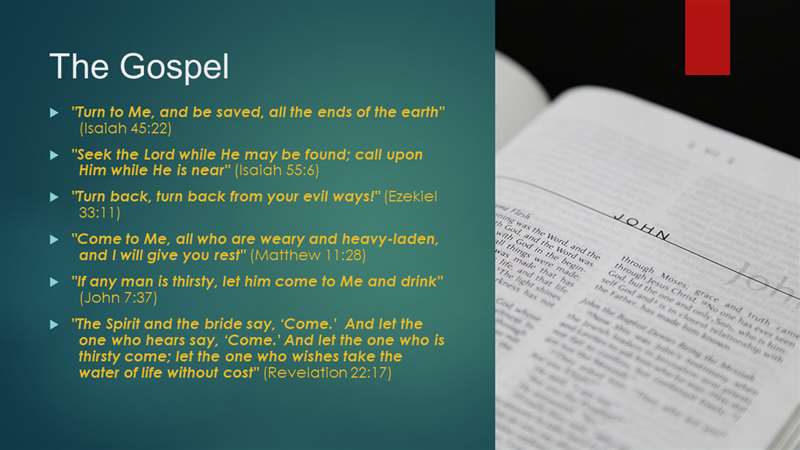
Let me just show you for a second how the Lord Himself, when He presents the Gospel, presents it. Look at Isaiah 45. Isaiah 45. In fact, this is the verse that the famed Prince of Preachers, Charles Haddon Spurgeon, heard at a primitive Methodist church. This is the Gospel that converted him 150 years ago. Isaiah 45:22, when God presents the Gospel, this is what He says. Isaiah 45:22, says, Turn to Me and be saved all the ends of the Earth. Look a little bit later in Isaiah 55. By the way, the book of Isaiah is the Gospel of John in the Old Testament. It’s the most powerful presentation of the Gospel and of the person of Jesus Christ, the suffering servant, and all of His sacrifice. Isaiah 55 in verse 6, Seek the Lord while He may be found. Call upon Him while He is near.
My children were having a big discussion at lunch. If you read the Bible at your house, you’ll get questions. They said, do those verses mean what they say? They’re really struggling with this whole reformed and non-reformed view. I said if I took one of the kids and I tied him to the chair, tied him down, and then I said hey, come on to me. Come on, come to me. Would that be a legitimate offer? Think about it. Think about whether or not the Lord meant this when He said, turn to Me and be saved all the ends of the Earth. I believe God offers salvation to all the ends of the Earth and you don’t have to cloud it with whether it’s efficacious, or sufficient, or general, or wide. We use a lot of words that aren’t in the Bible. If you just are simple, and the Bible’s written to simple people, it sounds like God’s offering it to everyone. I hope you don’t ever think He offered it to less than everyone because He doesn’t seem to think so and Jesus didn’t seem to think so.
In fact, turn to Matthew, and look at what Jesus said in Matthew 11. You can read men on both sides of the theological divide. I read what one of the most profound reformed commentators said, and do you know what he said about 11:28? He said the same thing Jesus said about it. Matthew 11:28, and I quote from his commentary. He said this, During His earthly ministry, Jesus said to the sinful multitudes, all of them, everybody that was out there, not to any special individuals. He said to all of them, Matthew 11:28, He said, Come unto Me, all who are weary and heavy laden, and I will give you rest.
Turn over to Matthew 7 and look at the same thing in verse 37. I’m sorry, John chapter 7. The Gospel by John in verse 37. Because this gate is very open and God is saying, come in. Jesus said this in John 7 in verse 37, If any man is thirsty let him come to Me and drink. I really believe, without having a profound theological education, that being a slave like most people were in the 1st century, I really think that they would have thought that if means if, and any means any, and all means all. That’s something I think is changing in our world.
Look at the last verse of the Bible, just go to the very end. Not the concordance, Revelation, okay? Revelation 22. I want you to watch the ending so that we don’t get confused because remember the most important thing about the revelation of God in scripture is that it’s an unfolding revelation. If you want to really understand the Bible, always track down the first occurrence of when something’s introduced because it’s very vital. The first time love shows up in the Bible is in the account of Abraham offering his son Isaac. The first time grace shows up in the Bible is with Noah. All of these are so important, and you see the unfolding revelation of God.
Even more important than how it starts, is where it ends because the summation of all biblical revelation is in the revelation of Jesus Christ. What I think is one of the most amazing verses in the Bible is the 17th verse of the 22nd chapter. From Heaven, through the Apostle John, Jesus is recorded to have said this. John is there and he’s listening. God asked him to, under the inspiration of His Spirit, write this down. Listen to what Jesus says: the Spirit and the Bride say, come. And let the one who hears say, come. And let the one who is thirsty come. And let the one who wishes to take the water of life without cost. I hope you never cease to remind people that the law says stay out, but God’s grace says come in. That’s the message our Lord Jesus Christ gave.
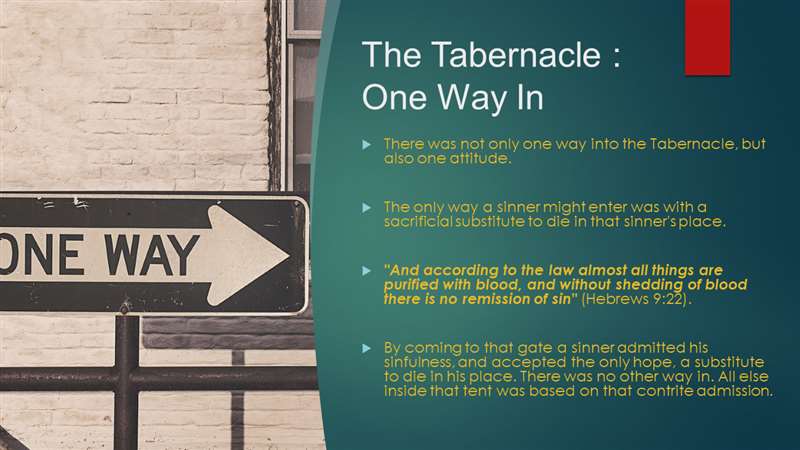
There’s one door, but there has to be one attitude. You say, oh, how do you go through that door? The Bible clearly defines that. There was not only one way into the temple, that gate we just described but there’s also one attitude. The only way a sinner might enter was with a sacrificial substitute to die in that sinner’s place. Now you’re in Revelation, turn back to Hebrews chapter 9 and look at verse 22. Hebrews 9:22 says this, According to the law, remember the white wall, almost all things are purified by blood, and without the shedding of blood there is no remission of sin. Okay? A sinner on the outside cannot catapult in, tunnel under, or find their own way in. They have to come God’s way. God’s way is that you have to bump into the substitute sacrificial altar. You have to bring something with you, see the guy leading the cow? That’s not there by accident. A sinner could not come to that gate without admitting his sinfulness and accepting that his only hope was a substitute who died in his place. There’s no other way in. Everything else inside that 450-foot-long wall that surrounded that thing and everything inside of that 30-foot-long and 15-foot-wide inner tent; everything was predicated on coming through that door and bringing a substitute with you.
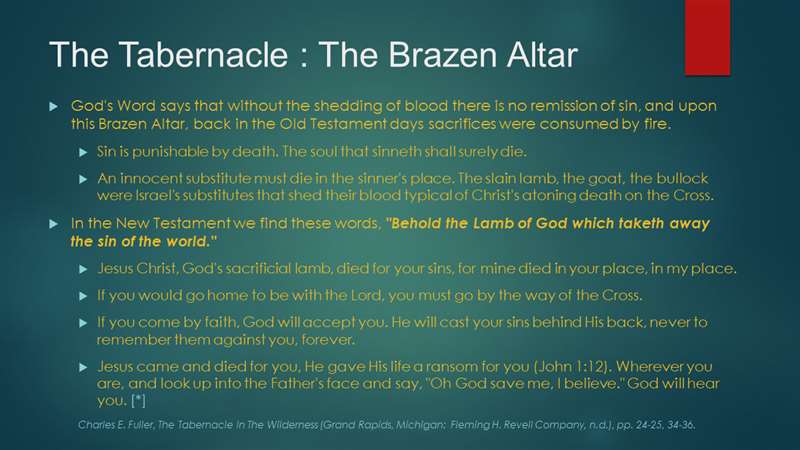
Now see the Old Testament, the old covenant, the old economy, was you had to bring one every time, so it was a constant shedding of blood. Jesus said no. I, once and for all, have offered Myself as the ultimate, final, complete sacrifice. But listen, God’s word says that without shedding of blood there’s no remission of sin. On that brazen altar, back in the Old Testament days, sacrifices were consumed by fire. It teaches us that sin is punishable by death. The reason there were all those fires burning those sacrifices is to remind you that if you didn’t bring a sacrifice and have it consumed by fire, you would be someday. It was a very sobering reminder. The people who stayed outside the tent and never were represented on the inside with their sacrifice would face the vengeance of eternal fire. That’s why Hell is part and parcel with Heaven. The judgment of God on sinners is part of the presentation of the salvation of God for sinners. If you neglect the salvation you get the judgment.
It also teaches us, that altar, that an innocent substitute had to die in the sinner’s place. The slain lamb, the goat, and the bullock were Israel’s substitutes that shed their blood, typical of Christ’s atoning death. So, in the New Testament, we find the words that open John’s Gospel, Behold the Lamb of God who takes away the sin of the world. Jesus Christ is God’s sacrificial lamb. He died for our sins. He died for my sins. He died in my place. He died for your sins. He died in your place. I think it’s interesting again in the controversy that goes back and forth in Christendom. Behold the Lamb of God that taketh away not the sins of certain ones, but the sin singular of the world. Amazing thought to think about. Even the number of the words of God’s Word.
If you would go home to be with the Lord, you must go by the way of the burnt altar, the way of the cross. If you come by faith, God will accept you. God promised He would cast our sins behind His back. He will never remember them against us. We should take God at His word. The sin question has to be settled. Either we as a sinner have to die for our sins or an innocent substitute will die in our place. Do you know what the judgment of the Great White Throne is? God says either you let My Son be your advocate and stand in for you and say, no, their sins are paid for. Or you get to stand yourself in front of God and try and defend yourself for why you sinned, even one sin, and why you should be allowed in when He paid for that sin, and you did not accept or receive that payment.
Do you want to defend yourself in front of God? I wouldn’t because if God should mark iniquity, we already know what the Bible says, no one would stand. Yet, a countless multitude is going to stand at that Great White Throne, and they’re going to all be marshaled up one at a time to stand before that throne and to look up. God’s going to say, do you have any defense for yourself? It says they’re going to be silent because God is going to show them their sin, His substitute, and their neglect of it. What a beautiful picture that we can take God at His word. The sin question is settled. Jesus came and died for you. He gave His life as a ransom for you. Wherever we are, if we look up at our Father’s face and say, oh God, save me, I believe in that substitutionary sacrifice, God said, I will hear you. By the way, do you want to know the order of salvation? Acts 16:31, Believe on the Lord Jesus Christ and thou shalt be saved. Belief precedes salvation. I don’t know if some people even realize that. You have to believe to be saved and that’s the way God presents it.
The next slide tells us this: the Tabernacle had no floor. Once you get inside this structure, you come into a place that’s very dirty and that reminds us of the next slide. The next slide tells us that the only measureless object in the Tabernacle was the laver. I think that’s very significant, that the God who is so concerned with details and so concerned with measurements was very concerned about the cleansing of His priests that served Him.
I want to just begin, and we’ll pick this up next time, but turn to 1 Corinthians chapter 6 because we have the perennial question about what you do with sinning Christians. What do you do with Christians that don’t act like Christians? I think that God talks about that very clearly. We can see that again, as I told you, everything’s explained beautifully in this Tabernacle. That laver was not for a bath. That laver was for cleansing hands and feet. The person was totally cleansed before they got to the laver, but once they do get inside the sacred precinct, they would get dirty. When a priest became a priest, he did not move into an insulated, isolated spot where he was removed from the earth. Where he was no longer in the dust and dirt of this world. When you and I get saved, God does not levitate us six inches off the ground so we stay out of contact with the earth.
You know, that’s what the monastic orders, the Aramites, and the other monks of the Middle Ages. If you know anything about them, the pillar saints like Simon Stylites, who lived for 40-some years on top of a 40-foot pillar so he would not be near the earth. He lived up there, and they would put food on a rope. He sat in this little tiny 3-foot by 3-foot pillar for 40-some years because he didn’t want to be tainted by the Earth. That’s not how the Bible presents Christianity. God presents Christianity that gets dirty from the dirt of this world and comes for cleansing regularly.
Now look at what 1 Corinthians chapter 6 says, starting in verse 9. Don’t you know the unrighteous will not inherit the kingdom of God? Don’t be deceived, neither fornicators. Now what’s that? That’s a person who’s characterized by fornication. That’s not a Christian who commits fornication. That is a person whose life is characterized by it: they want it, they love it, they seek it, and they do it. By the way, fornication in God’s word is any contact, whether mental or physical, with a woman you are not married to. If she happens to be married and you have contact, it’s adultery and it doesn’t have to be physical. It doesn’t have to be consummated as our famous president asked what it means. God says it means you’re a fornicator, or adulterer if you even think or practice or plan or fantasize or whatever.
But don’t be deceived, fornicators. Think about it, is your life continually characterized by illicit sexual desire? Or idolaters, are you willing to sacrifice anything for your idol, whatever it is, material or pleasure or whatever? Or adulterers, those who can’t stay within the holy bonds of marriage. Nor homosexuals, those who have a burning desire contrary to the way that God intended for it to be, men with men and women with women. Nor sodomites. By the way, the reason both words are used is that it is the active member of the relationship and the passive member, both are guilty. Nor thieves, someone who wants what they want so much that they will take anything to get it. Nor covetous, they just lust after what they want. Nor drunkards, those who are controlled by substances be they liquid, or powder, or injected, or snorted, or drunken. It doesn’t matter. Nor revilers, nor extortioners will inherit the kingdom of God.
Now look at verse 11, such were some of you. So, there is a transformation in life. Such were some of you, but you were washed. That’s the wonderful total cleansing at the cross. But you were sanctified. That is the ongoing process of daily confessing and that’s measureless, unending. God says I will cleanse you to the uttermost. Do you know what that has led to in Church History and most especially in our generation? This grace doctrine that there are no bounds in my life. God will forgive me for all of it.
With that in mind, let me take you to 2 Corinthians, chapter 12. Here’s the result of the wrong view of God’s grace. 2 Corinthians, chapter 12. Paul wrote all this to them. By the way, at the end of the 6th chapter he says, you are the holy temple of God, and you ought to live like it. Look what happens after all of his ministry. 2 Corinthians, chapter 12, verse 20. For I fear lest when I come, I will not find you such as I wish and that I shall be found by you such as you don’t wish. Lest there be, now listen to the eight sins present within the church among believers in the city of Corinth. In Paul’s day, after they had the Bible written to them personally by the Apostle Paul, listen to what was still going on. Lest there be contentions, jealousies, outbursts of wrath, selfish ambition, backbiting, whispering, conceits, and tumult. That doesn’t sound too bad. It’s wicked, it’s horrible, but most of us think those are almost the allowable sins.
Jealousy, you wish you had their house or their car or their job. Selfish ambitions, people do that in their ministries. They’re always vying for who gets the most exposure and can blow their own horn. Backbiting, whenever someone’s not looking, you tell on them. The whole thing. Whisperings, I want you to pray about this, that’s whisperings. You actually just want to tell them, but you cloak it with I want you to pray about it. You actually can’t wait to tell them someone else’s miseries. Conceits, our secret view, we’re so great. Tumults, the people who are always stirring things up. Look at verse 21, Blessed when I come again, my God will humble me among you, and I will mourn for many who have sinned before and haven’t repented of…Now look at this list, we’re still in the Church. Uncleanness, fornication, and lewdness, which they practiced. Those are the unacceptable sins. Even for those things, there was a measureless object in the Tabernacle that reminds us.
But, Paul didn’t stop there. He didn’t say, okay, you can live in that Corinthian or Californian or whatever you want to call it way. Look at chapter 13, verse 5. This is what he said, in the next chapter, verse 5. If you are living that way, with those tumults and un-cleanness’s and all that, examine yourself whether you are in the faith. Even though God’s forgiveness is measureless, it’s only measureless for those who’ve come to the cross and have humbly acknowledged their lostness wanting to turn from sin to the Savior. There’s a lot more about the laver, but we’ll have to pick it up next time lest we go over time and one of you fall out the window because I can’t raise people from the dead.
Okay, let’s do this, let’s thank the Lord for His measureless cleansing, thank Him for what He’s taught us tonight, and ask Him to help us to live our lives on holy ground. Let’s bow together. Father in Heaven, I thank You for the measureless, boundless forgiveness that we find in You once and for all at the instant of our salvation. And moment by moment the cleansing we receive if we agree with You that sin is horrible. We hate it, it is no longer to characterize our life and we want to no longer grieve Your Spirit. We want to turn in repentant faith back to You. I pray that tonight, some who struggle with sin, all of us struggle, but some seem to never get above that. I pray that they would check and see if they’re just flat on their face on the ground between the altar and the laver. I pray they’d get up, and by Your grace, come to Your word and find that they can preach the Gospel to themselves. They can say that you have already saved the chiefest of sinners and so all of us are less than that. The chiefest of sinners is totally saved and is convinced that which he committed he is able to have kept until that day. So, Paul knew he was going to Heaven, and we should know too. But if we do not confess our sins and if we don’t come for cleansing then we are cold and empty and distant and detached from anything that’s of value. We can’t feed on Your word. We can’t be guided in our lives. We can’t offer prayer, and then we don’t know Your presence, and so we don’t have peace and security. So, I pray that tonight this little holy ground of Your Tabernacle will deeply be impressed on our hearts. Most of all, we need to come for daily cleansing to that laver and thereby enjoy all the benefits of our salvation. Let us walk in that gracious light confessing our sins, walking in the light, and having fellowship with You. In the name of Jesus, we thank You. Amen. God bless you as you go.
Walking on Holy Ground
I would like to invite you to walk with me on holy ground. That Holy Ground is the verses in which we find our Lord Jesus Christ in all His glory. Our goal is to have a strategic grasp of the Bible. That strategic grasp comes as we find that ALL THE Scriptures speak of Him. In John 5:39 that is exactly what Jesus said, and that is what we aim to see.
First join me in a quick overview of how God laid out the plan of salvation so clearly in the detailed plans for the Tabernacle. The Tabernacle portrays a seven-step plan of salvation:
- A sinner is outside the Tabernacle, kept away by a 7 ½ foot high white fence, set of posts held up by 60 solid brass sockets. There is only one way or gate into the enclosure, which opened directly in front of the Brazen Altar. That altar is the Cross of Jesus, which is where our spiritual life begins at salvation.
- The next step after salvation is the regular cleansing at the Brazen Laver.
- After being cleansed the next door leads to the Holy Place [about the size of a large living room (30 x 15)] where we find the Golden Table of Bread as we fellowship with Jesus through His Word.
- Then guided by the light of the Golden Lamp stand we are able to walk confidently as I John 1:7 says.
- Then and only then can we understand the power of prayer as portrayed by the Golden Altar of incense.
- Through prayer we enter the Holy of Holies of God’s very presence.
- In that Holiest Place we find the peace and security of the Ark of the Covenant, the blood sprinkled mercy seat and the glow of the Shekinah of God’s presence.
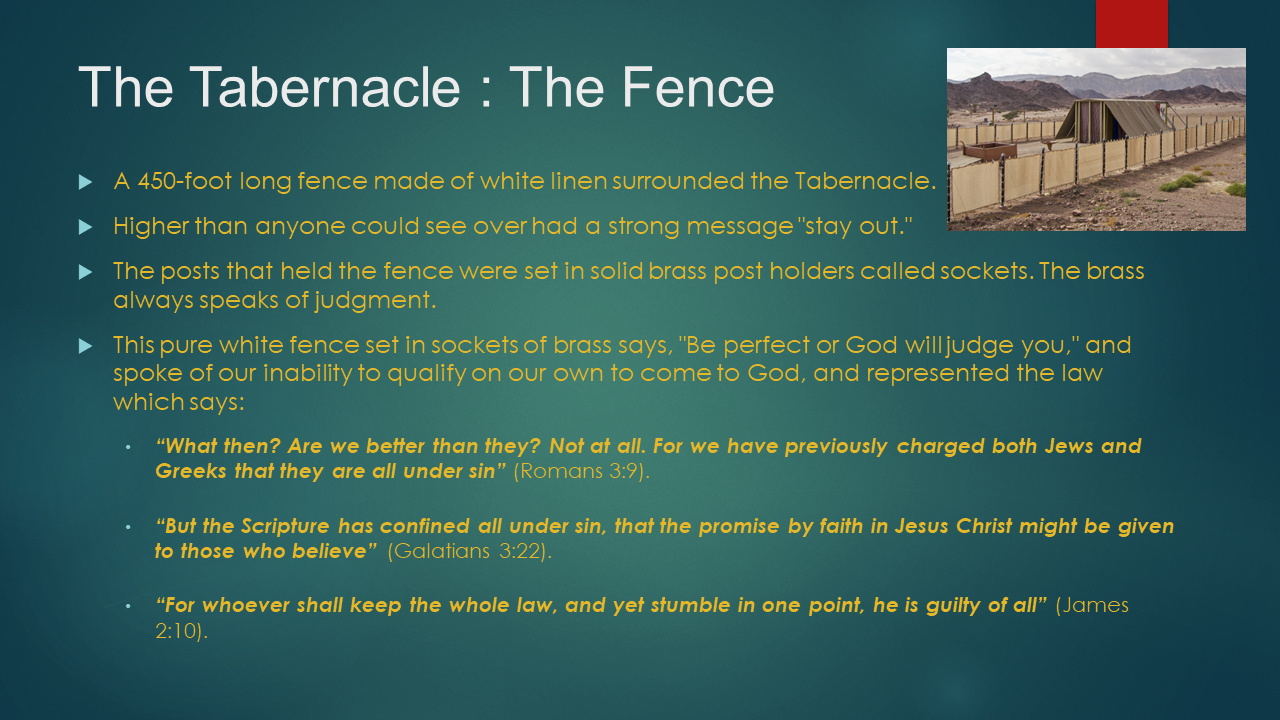
A 450-foot long fence made of white linen surrounded the Tabernacle. This wall that was higher than anyone could see over had a strong message “stay out”. The posts that held the fence were set in solid brass post holders called sockets. The brass always speaks of judgment. This pure white fence set in sockets of brass says be perfect or God will judge you, and spoke of our inability to qualify on our own to come to God, and represented the law which says:
- Romans 3:9 What then? Are we better than they? Not at all. For we have previously charged both Jews and Greeks that they are all under sin.
- Galatians 3:22 But the Scripture has confined all under sin, that the promise by faith in Jesus Christ might be given to those who believe.
- James 2:10 For whoever shall keep the whole law, and yet stumble in one point, he is guilty of all.
The Gate into the Tabernacle was very wide, 30 feet to be exact speaking of God’s Grace and loudly saying “come in”.
- Exodus 38:18 The screen for the gate of the court was woven of blue(Eagle/Son of God/ John), purple (Lion/King of Jews/Matthew), and scarlet (Ox/Servant of the Lord/Mark) thread, and of fine woven white linen (Man/Son of Man/Luke). The length was twenty cubits, and the height along its width was five cubits, corresponding to the hangings of the court.
- Through Isaiah He made the appeals “Turn to Me, and be saved, all the ends of the earth” (45:22) and “Seek the Lord while He may be found; call upon Him while He is near” (55:6). Through Ezekiel He warned, “Turn back, turn back from your evil ways!” (Ezek. 33:11). During His earthly ministry, Jesus said to the sinful multitudes, “Come to Me, all who are weary and heavy-laden, and I will give you rest” (Matt. 11:28) and, “If any man is thirsty, let him come to Me and drink” (John 7:37). From heaven, through the apostle John, Jesus said, “The Spirit and the bride say, ‘Come.’ And let the one who hears say, ‘Come.’ And let the one who is thirsty come; let the one who wishes take the water of life without cost” (Rev. 22:17).
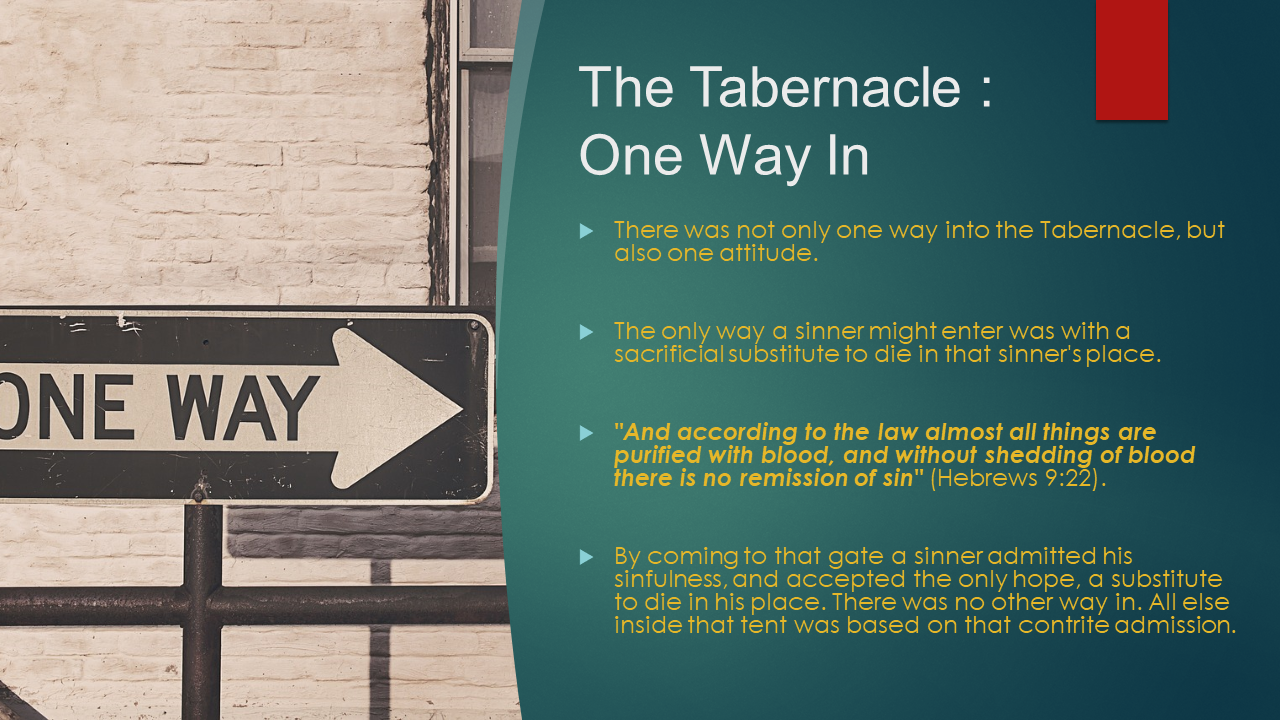
So there was not only one way into the Tabernacle, but also one attitude. The only way a sinner might enter was with a sacrificial substitute to die in that sinners place. Hebrews 9:22 And according to the law almost all things are purified with blood, and without shedding of blood there is no remission. By coming to that gate a sinner admitted his sinfulness, and accepted the only hope, a substitute to die in his place. There was no other way in. All else inside that tent was based on that contrite admission.
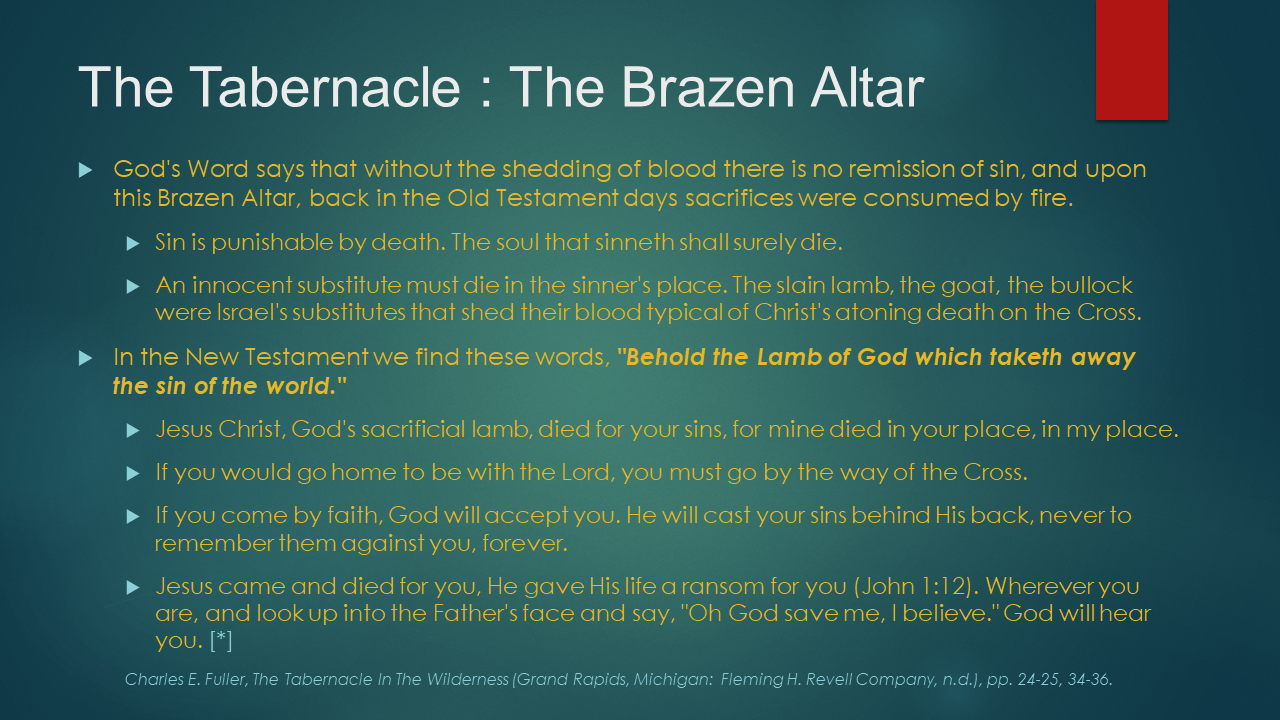
God’s Word[1] says that without the shedding of blood there is no remission of sin, and upon this Brazen Altar, back in the Old Testament days sacrifices were consumed by fire. This teaches us that sin is punishable by death. The soul that sinneth shall surely die. It also teaches us that an innocent substitute must die in the sinner’s place. The slain lamb, the goat, the bullock were Israel’s substitutes that shed their blood typical of Christ’s atoning death on the Cross. So in the New Testament we find these words, “Behold the Lamb of God which taketh away the sin of the world.” Jesus Christ, God’s sacrificial lamb, died for your sins, for mine died in your place, in my place. If you would go home to be with the Lord, you must needs go by the way of the Cross. Yes, if you come by faith, God will accept you. He will cast your sins behind His back, never to remember them against you, forever. Take God at His word. That sin question must be settled, either the sinner must die for his sin or an innocent substitute die in his place. Jesus came and died for you, He gave His life a ransom for you (John 1:12). Wherever you are, and look up into the Father’s face and say, “Oh God save me, I believe.” God will hear you.
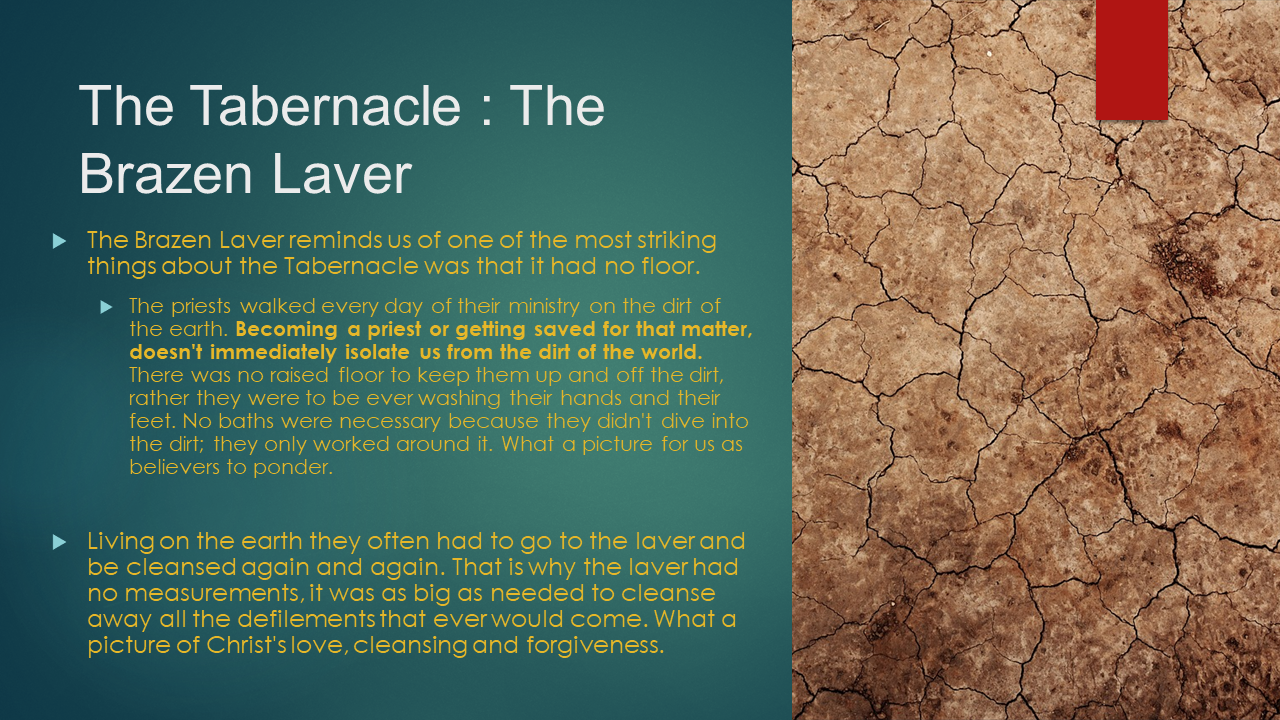
The Brazen Laver is the next once we get inside the fence, and finish at the Brazen Altar or in the picture of the Tabernacle are saved. As we are confronted by the next piece of furniture called the Brazen Laver we are reminded of one of the most striking things about the Tabernacle was that it had no floor. The priests walked every day of their ministry on the dirt of the earth. Becoming a priest or getting saved for that matter, doesn’t immediately isolate us from the dirt of the world. There was no raised floor to keep them up and off the dirt, rather they were to be ever washing their hands and their feet. No baths were necessary because they didn’t dive into the dirt only worked around it. What a picture for us as believers to ponder.
Living on the earth they often had to go to the laver and be cleansed again and again. That is why the laver had no measurements, it was as big as needed to cleanse away all the defilements that ever would come. What a picture of Christ’s love, cleansing and forgiveness.
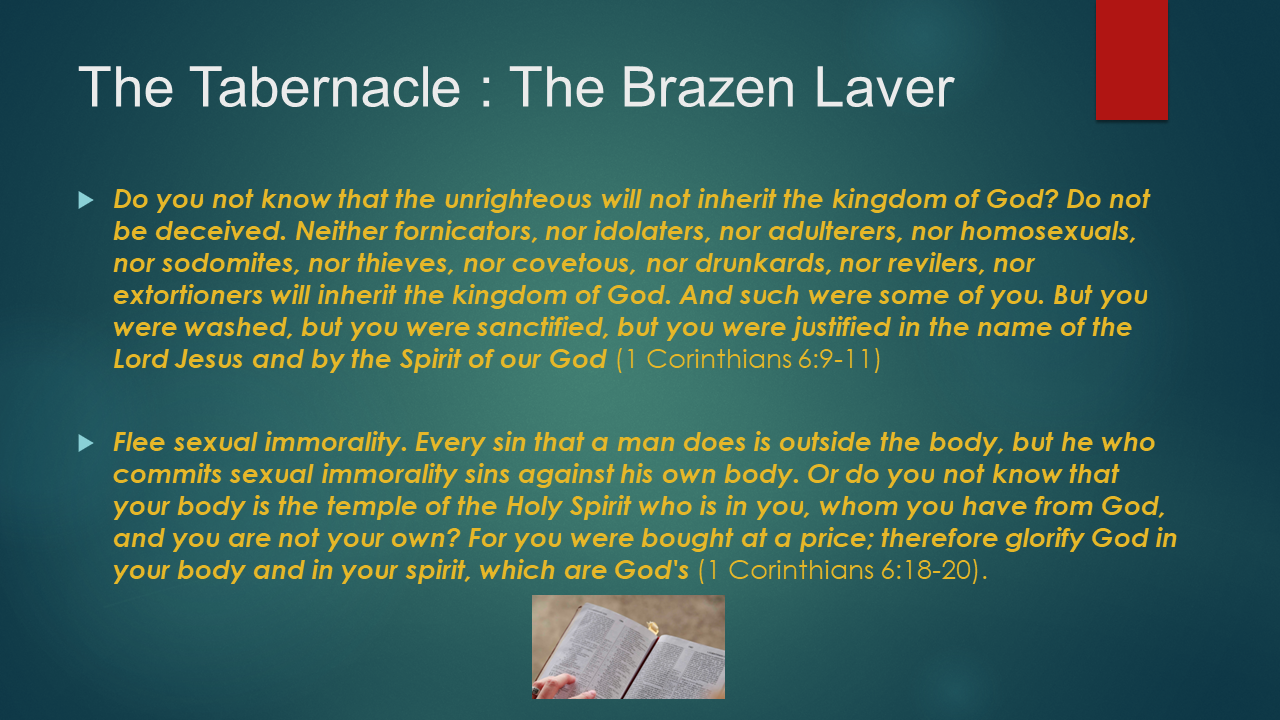
- 1 Corinthians 6:9-11 Do you not know that the unrighteous will not inherit the kingdom of God? Do not be deceived. Neither fornicators, nor idolaters, nor adulterers, nor homosexuals, nor sodomites, 10 nor thieves, nor covetous, nor drunkards, nor revilers, nor extortioners will inherit the kingdom of God. 11 And such were some of you. But you were washed, but you were sanctified, but you were justified in the name of the Lord Jesus and by the Spirit of our God.
- 1 Corinthians 6:18-20 Flee sexual immorality. Every sin that a man does is outside the body, but he who commits sexual immorality sins against his own body. 19 Or do you not know that your body is the temple of the Holy Spirit who is in you, whom you have from God, and you are not your own? 20 For you were bought at a price; therefore glorify God in your body and in your spirit, which are God’s.
- 2 Corinthians 12:20-21 For I fear lest, when I come, I shall not find you such as I wish, and that I shall be found by you such as you do not wish; lest there be contentions, jealousies, outbursts of wrath, selfish ambitions, back bitings, whisperings, conceits, tumults; 21 lest, when I come again, my God will humble me among you, and I shall mourn for many who have sinned before and have not repented of the uncleanness, fornication, and lewdness which they have practiced.
- 2 Corinthians 13:5 Examine yourselves as to whether you are in the faith. Test yourselves. Do you not know yourselves, that Jesus Christ is in you?—unless indeed you are disqualified.
- Hebrews 9:14 how much more shall the blood of Christ, who through the eternal Spirit offered Himself without spot to God, cleanse your conscience from dead works to serve the living God?
- Hebrews 10:22 let us draw near with a true heart in full assurance of faith, having our hearts sprinkled from an evil conscience and our bodies washed with pure water.
- 1 John 1:7-9 But if we walk in the light as He is in the light, we have fellowship with one another, and the blood of Jesus Christ His Son cleanses us from all sin. 8 If we say that we have no sin, we deceive ourselves, and the truth is not in us. 9 If we confess our sins, He is faithful and just to forgive us our sins and to cleanse us from all unrighteousness.
- Revelation 1:5 and from Jesus Christ, the faithful witness, the firstborn from the dead, and the ruler over the kings of the earth. To Him who loved us and washed us from our sins in His own blood.
Check Out All The Sermons In The Series
You can find all the sermons and short clips from this series, Christ in all the Scriptures here.
Looking To Study The Bible Like Dr. Barnett?
Dr. Barnett has curated an Amazon page with a large collection of resources he uses in his study of God’s Word. You can check it out here.