If the video above is not available, here are two other ways to view:
150705AM HFG-10 Resting-2 Sabbath Bondage.docxx
HFG-10
Sabbath Bondage & Knowing the Joys of
Christ’s Rest on This Side of the Cross
Genesis 2; Exodus 16-20
How did the 7th day of Creation become the Sabbath Day and the central focus of so much of the legalistic, spiritual bondage religion of the Pharisees and Sadducees in New Testament Judaism?
What is God’s plan for Saturday in the Creation Week, and the Sabbath regulations given by God to Moses for the nation of Israel?
THE ORIGIN OF THE 7TH DAY
To understand the 7th Day we need to first open to Genesis 2.
After the wonders of Genesis 1, God crowned the creative week with a memorial to His amazing work of Creation in Genesis 2. God elevated Saturday as a day to always reflect upon how amazing it was that he created everything we will ever discover in the universe around us in only six days.
Think about it as science continues to uncover more complexities in the vast reaches of outer space: God did all of that in just part of those six days. Then think about all of the intricacies of the varied forms of life all around us, beneath and above us, residing on this pale blue perfectly tuned habitat called earth: God made all of that in those six days.
Then God says pause each week with gratitude and worship for such an Almighty God who did so much in just six days. Join me reading Genesis 1:31-2:3.
Genesis 1:31-2:3 (NKJV) Then God saw everything that He had made, and indeed it was very good. So the evening and the morning were the sixth day. 2: 1 Thus the heavens and the earth, and all the host of them, were finished. 2 And on the seventh day, God ended His work which He had done, and He rested on the seventh day from all His work which He had done. 3 Then God blessed the seventh day and sanctified it because in it He rested from all His work which God had created and made.
Pray
A THEOLOGY OF THE 7TH DAY
For just a few minutes lets just do an inductive Bible Study and note just exactly where we are and what God says in this part of His Word.
Transcript
.jpg)
Open your Bibles to Genesis, chapter 2. This is another one of those rare moments where we touch on something that is an incredible proof of the inspiration of the Bible and our God all around us that we can see in the world. We can if we have a biblical worldview; a biblical worldview is that you see life through the Word of God, as God has framed it. But with that worldview, something interesting happens, and it’s this. We’re talking about today, the seventh day of creation, and the later Mosaic Sabbath bondage. By that, God completely bound the nation of Israel to this observance of the Sabbath, which, if you do the math, do you remember what the Sabbath is?
I was talking about this in the car with my kids, and they said the Sabbath means more than just Sarah. I said, oh, it was a whole lifestyle. The seventh day belonged to the Lord. Seven feasts belonged to the Lord. The seventh year belonged to the Lord. The seventh times seventh year plus the 50th year belonged to the Lord. So, this is one day a week: that’s 52 days a year. These feasts, these seven feasts, were big. Some of them lasted eight days long, and they had to be observed in Jerusalem. Three of them. You had to truck, or cart, or ride all the way to Jerusalem round trip. Remember when Jesus was in the temple and they left him there and all that? The round trip was a week. So, God says, you take a whole week out of your life to spend eight days down in Jerusalem. If you add all that up, that adds up to approximately 34 days a year. Then the entire seventh year. Then the 49th year and the 50th year, which is in itself 2 percent of your life, every 50th year. Guess what? Altogether, 40 percent of their time was tied up in this observance of the Sabbath.
How would you like to have 10 hours of every day given over to something like that? That you couldn’t do a lot of stuff? That became bondage. When I read to you the ten things, and we look them up in the Bible, that’s what we’re going to look at, how that formed the difference between the seventh day and the Sabbath day.
But we’re celebrating Communion today. Communion is knowing the joys of Christ’s rest. See, the Sabbath day was to remind them of their sinfulness, of their utter inability to keep all the rules. There are so many rules to keep. Everyone broke, all of them, sometimes. That was a schoolmaster that God designed to bring them to the point of realizing, I am not good enough to ever merit any righteousness in God’s sight. Therefore, I need this substitute. That’s why they were constantly, on the Sabbath day, all of this 40 percent was tied to sacrifices pointing to the cross. All of those sacrifices, and there were seven different sacrifices, each one of them pointed to Christ.
.jpg)
All that to say this: as we get to Genesis 2, where did the Sabbath day come from, and is it different than the seventh day? How did the seventh day of creation, starting in the 31st verse of chapter 1, become the Sabbath day? How did it become the central focus for Judaism? And, after we understand the Sabbath day, we’ll see something that God instituted for us also to remember.
Verse 31, before we read verse 31, we’re looking after the wonders of creation in Genesis 1. So, the 31st verse is a summary of all of chapter 1. God crowns His creative week with a memorial. Now the seventh day was a day, Saturday, was a day that God says, I’m leaving a memorial. Now let me ask you this: where did the seven day week come from? How did we get an obtuse number like 7 to divide into 360 days, or 365 depending on if you’re lunar or solar year? How did we get 7 as a divisor? It’s an obtuse number. What is that for? It’s the signature of God from the very week of creation. God says, I worked for six evenings and mornings, six days, and I rested from, I ceased my creative work on the seventh day. From now on, you’re to live in multiples of seven.
Now, remember I told you this is the second one in close proximity? A couple of Sunday nights ago, we looked at languages. Over the weekend, our family harvested honey from our hives. We are beekeepers. My sons are actually; I just eat the honey. I’m Pooh Bear. Those of you who have children, you know the story. Did you know that every bee in the world can communicate with one another? But every human in the world cannot. We can only communicate with other humans that are of our language group unless we’re like the Dakines and can learn all kinds of languages. But normal people cannot communicate with other humans because they don’t know their language.
How come every other creature in the world communicates with each other? You can bring a bee from Europe and put it over here with a bee from Africa and they talk to each other and they go get the honey. But you can’t do that with humans. Why? Because Genesis 11 says that God confused their languages. He confused them into 70 subsets that Genesis 10 describes.
Did you know that right now, the ethnologists of the world have realized that there are 90 different language groups? Pretty soon they’re going to catch up with God and find out there are actually 70, but they’re getting close. But no ethnologist can explain why, of all species of creatures alive on this Earth, only humans can’t communicate. If they just had a biblical worldview, bingo, they’d understand. The same goes for the seven day week. There is no reason for there to be seven day weeks. There should be ten. Then you could divide it into 360 or 365. The reason there’s seven is God set it up as a memorial that He created everything in six days and ceased on the seventh. That’s what we’ll see as God says, pause every week with gratitude and worship, because I am such an almighty God. I created all the intricacies and varied forms of life all around you, beneath us and above us, that are residing on this pale blue, perfectly tuned habitat called Earth. God said, I did all that in six days. Every seventh day, think, wow, God is amazing. That’s what He says.
Do you have your Bibles open? Chapter 1 let’s read the last verse, and then we’re going to read the first three verses of chapter 2. Let’s all stand together for the reading of God’s Word, and you follow along, and then I’ll pray. Here’s what it says. This is God’s conclusion of His creation week. Verse 31, chapter 1. Then God saw everything that He had made, and indeed it was very good. So, the evening and the morning were the sixth day. Remember that from last week, how God measures days, evening, morning.
Now, chapter 2, verse 1. Thus, the heavens and the Earth and all the host of them were finished. On the seventh day, God ended His work which He had done. He rested on the seventh day from all His work, which He had done. Then God blessed the seventh day and sanctified it. Now, look up from your Bibles for a second. This is the first occurrence in the whole Bible of the word holy. The word sanctified is the word all the way through the Bible for holy. Holy, Lord God Almighty. It’s holy. Now, isn’t it fascinating that the God of the universe attaches a day that you remember He created the whole universe in six days, and he said that remembrance of who I am as Creator is the introduction of the concept of holiness.
Holiness actually means elevation, where you elevate something, and God is most elevated, and we elevate ourselves, and our attention, and our lives toward Him, and set them apart for Him. God says that this seventh day is an elevated day to remember that I’m Creator. That’s the only purpose. The only one that rested on it was God. Nobody else. Okay. So, He blessed it. He sanctified it. Verse 3, I’m continuing. Because in it He rested from all His work which God had created and made.
Let’s bow together. Father, I pray that we would, especially this morning, be so thankful that we are on this side of the cross. Thank You for the Sabbath bondage that You instituted on Israel to make them a beautiful picture for all of us of how desperately wicked we all are. We’re all lawbreakers. We’re all law-haters. We’re all proud and like to conform externally but internally be untransformed. All of that was revealed vividly week after week in Israel. I pray that we’d realize our rest, our freedom, our liberty, and our great Savior as we celebrate Him today, on Sunday. The day we remember that our Savior rose from the dead. Open our minds to Your truth, we pray in Jesus’ name. Amen.
.jpg)
You may be seated. As you’re seated, what we’re going to do real quickly is a theology. Remember theos, the word theos is the Greek word for God, and logia is words about, or a study of, or teaching. So, we’re going to do a study of what God says about the seventh day. That’s what a theology would be. What does God reveal about this seventh day?
.jpg)
If we were doing a little inductive Bible study, we would take notes. The first thing, if you closely look back at what we just read, is that you’ll notice four points.
Number one, no rest is commanded to anyone. There’s no rest command. God doesn’t say, rest. Stop working. He doesn’t say anything. He says, I did. God said I did. He doesn’t say anything. There’s no rest command to any human, and nobody rests on the seventh day in the whole book of Genesis. You say, how do you know? God does not record that, so we don’t need to think that they did. God says that only He rested. Adam didn’t rest, Enoch didn’t rest, and Noah didn’t rest. We don’t see any of the patriarchs, Abraham, Isaac, Jacob, or even Joseph, resting on the Sabbath day or even worshipping on the Sabbath day. They just worshipped. It doesn’t say Saturday is the day.
What was it for? This is all it was for. The seventh day was a Creator reminder. Pause on that seventh day and think, wow, you did all this in six days. Now God repeats that, actually, 11 times. 7 times in the Old Testament, it says, for as in six days God created the heavens and the Earth, six days. Do you know what one of them is? We’re going to see it in a moment. It’s in the Ten Commandments. It’s in the part of the Bible written by the flaming finger of God Himself. I’ve met people that say, I’m not sure, it could be allegorical, or it could be the creation account. We could be misinterpreting it.
Let me ask you this. God had an audience of three million people who were slaves, who were working constantly, seven days a week for the Pharaoh. Pharaoh didn’t even know how they got seven days in a week, but the Hebrews did. Their God made the week. They were working seven days a week, and God stopped their work by the Exodus deliverance, brings them to the foot of a mountain, and booms out from the mountain and says, no longer do you work seven days a week. Now you work six days a week. Remember, three million people were living 24 hour days. They were the Israelites, out of bondage. God says, you will now work the evening and the morning, the evening and the morning, the evening and the morning, the evening and the morning, six days, and rest the evening and the morning of the seventh day. It’s a reminder that I created everything in six days.
That’s why all evolutionary thought, naturalistic and theistic, denies not what Moses might have fabricated. It denies what God said, wrote with His fiery finger, and left His signature. This seven day week is God’s signature that I started everything. I did it in six, stopped the seventh, and I’m going to perpetuate that throughout all the world, throughout all history, as a reminder to you that I am the Creator God. You should be thankful that you know who I am and that you should acknowledge Me, and then God rested. He’s the only one that rested on the seventh day. Now I mean everybody has to rest sooner or later, but I mean commanded to rest is not in the book of Genesis.
.jpg)
.jpg)
So where do we get the Sabbath day? Now again, let’s do the theology, what God says about the Sabbath day. What does God say? Let’s open here. Go to the next book. Exodus 20. Look at verses 10 and 11. This is the fiery finger of God I was just telling you about. This, of course, most of us know the Ten Commandments. We know them in order. We’re taught them. We’re trained in them.
Not this week, but in the future what we need to realize is that nine out of the ten are moral. They are moral Law of God. One out of the ten is totally described as ceremonial law. What’s interesting is, just as a quick math exam for you, nine out of the ten commandments, all but number four, which is the Sabbath, nine out of ten find their way in the New Testament. They’re repeated, restated, reaffirmed by God, through His apostles, and by Christ. One of the ten never makes it into the New Testament description of the moral character of God. It’s the Sabbath day. Why?
The Sabbath day was written, by the way, and one through three of the ten commandments are about how God is holy. Number four is the Sabbath day. Five through ten is about how man is sinful. That’s what the fifth through the tenth is about. What that means is we’re so sinful we don’t honor our parents, and we murder one another, and we commit adultery, and on and on. Finally, we covet everything. All the way through, five to ten. So, what is the fourth day for? God made Israel pause an entire day to think about how holy He was, how sinful they were, and how much they needed help from this holy God.
So, in the Ten Commandments, look at the fourth, starting in verse 10 of chapter 20 of Exodus. But the seventh day is the Sabbath of the Lord your God. It belongs to Him. It’s the day He stopped creating things. It’s His day that He blessed, that He sanctified, that He elevated, and now He’s doing something with it for Israel. By the way, all the way through the Bible, the Sabbath, over and over, is a sign for Israel, is a sign for Israel, is a sign for Israel.
By the way, how did we get blue laws and all this uneasiness about what I should do or not do on Sunday? Where did that come from? It didn’t show up until 1689 in the Baptist Catechism. Blame those Baptists. In the Baptist Catechism of 1689, they first instituted on the American Puritan Church in New England the strict Old Testament based observance of the Sabbath. Why? Because of John Knox, the Presbyterian from Scotland. John Knox, right? The founder of the Presbyterian Church wanted to take the Sabbath laws. Remember, he believed that circumcision became baptism and that Israel became the Church. So why wouldn’t the Sabbath day become Sunday? It was just fitting with his beliefs. He was a great guy, knew the Lord. He was trying to institute almost a theocracy.
We’re going to cover that; we’re going to touch on that tonight in the Q& A. Someone asked about the Inquisition, the Spanish, but we’ll talk about all the Inquisitions. They talked about the Salem Witch Trials and all that stuff. What we’re going to talk about is how we even got into this mess of people thinking that you’re supposed to legislate capital punishment for witches. Where is that? That’s in the theocracy. That’s in the Old Testament. That’s Jewish. God never commanded any other culture on Earth to kill witches, homosexuals, or rebellious children except Israel, when He was running it, as a picture of how serious sin is. But no one was supposed to perpetuate that, certainly not the Puritans or, sadly, the Roman Catholic Church. How’d we get off on all that?
Back to the Sabbath day, verse 10. But in it, you shall do no work. I’m in the middle of verse 10. You, nor your son, nor your daughter, nor your male servant, nor your female servant, nor your cattle, nor your stranger that’s in your gate. In verse 11, why? For in six days, see how big God is on this six-day creation? He wrote this with His own finger. For in six days, the Lord made the heavens and the Earth and the sea and all that is in them and rested the seventh. Therefore, the Lord blessed the Sabbath. He’s just repeating what we read in Genesis 2.
So, rest was commanded for the people. It was a reminder of their fallenness. The law is a schoolmaster to show us. Do you know what? People didn’t like all those rules, and it showed their rebellious heart. The Creator is a lawgiver, and He said, this is what you must do. They said, we don’t want to do it. We’re not going to do it. We’re going to hide. We’re going to fake. We’re going to do it externally. Our sinfulness is revealed when we have rules because we want to cut the corners, and break the rules, and hide what we’re doing. We’re rebels at heart. Which made them realize, as soon as they paid attention, that they were racking up sins against a holy God who said, you shall be holy as I’m holy, or you cannot be in My presence.
So, a Redeemer was needed. All of the sacrifices of Israel, excuse me, were pointing to the need of a Redeemer. On the seventh day, remember I showed you 40 percent of their life, all the seventh day was built around these sacrifices that reminded them they came as sinners, put their hands on the innocent animal, and the animal was martyred and butchered because of their sin to remind them that a Redeemer was needed.
But by the way, after Genesis 2, God stopped resting. Why? Because sin brought the decay of the universe, and God is now holding together a decaying universe. It says in Hebrews 1 and Colossians 1 that God is upholding. If He wasn’t holding this thing together, it would bust apart. God is now upholding all things. He’s no longer resting from His work. His work is now upholding.
.jpg)
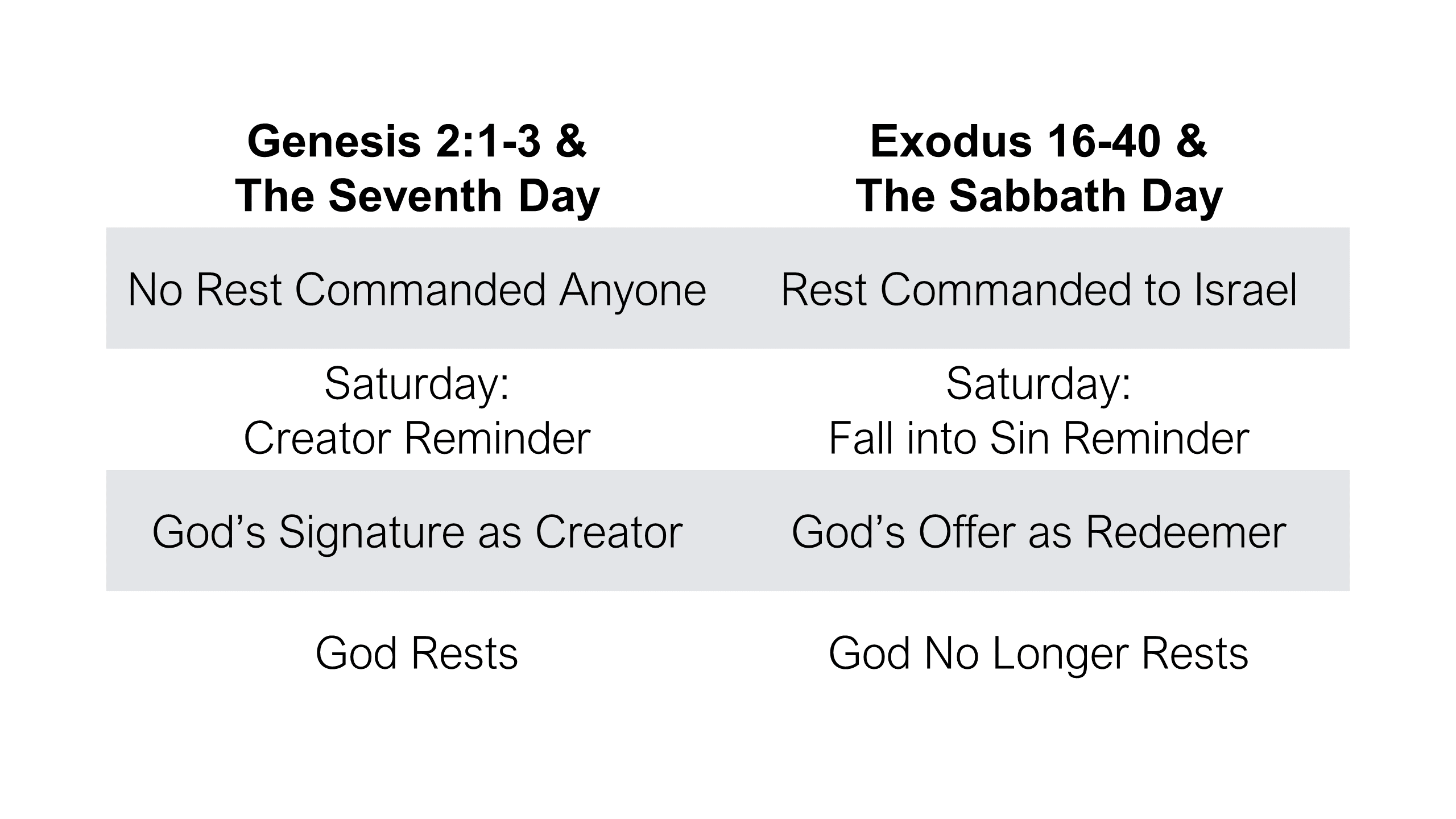
What we can see is a comparison. On the seventh day, no rest. It’s a reminder of your Creator in six days. His signature is in the seven day week. God rests because no more creation is needed. He made a perfect world and universe that is now groaning in sin. The Sabbath day. After sin, Israel became a picture of humanity’s sinfulness. Rest was commanded to them. It was a fallenness reminder to them, a memorial to their need of salvation. The Redeemer that they had to look forward to was portrayed in all those sacrifices, and God was now holding the universe together.
.jpg)
I meet people all the time. Seventh-day Adventists. Seventh day Baptists. A lot of others that kind of say we observe the Sabbath. I say, do you really? You observe the Sabbath? Do you know what the Sabbath says? Let’s look, just in case you wonder about that. I’m not talking about this Saturday remembering God. I’m talking about this that God gave to Israel. What did he give to Israel? What were the rules of the Sabbath?
.jpg)
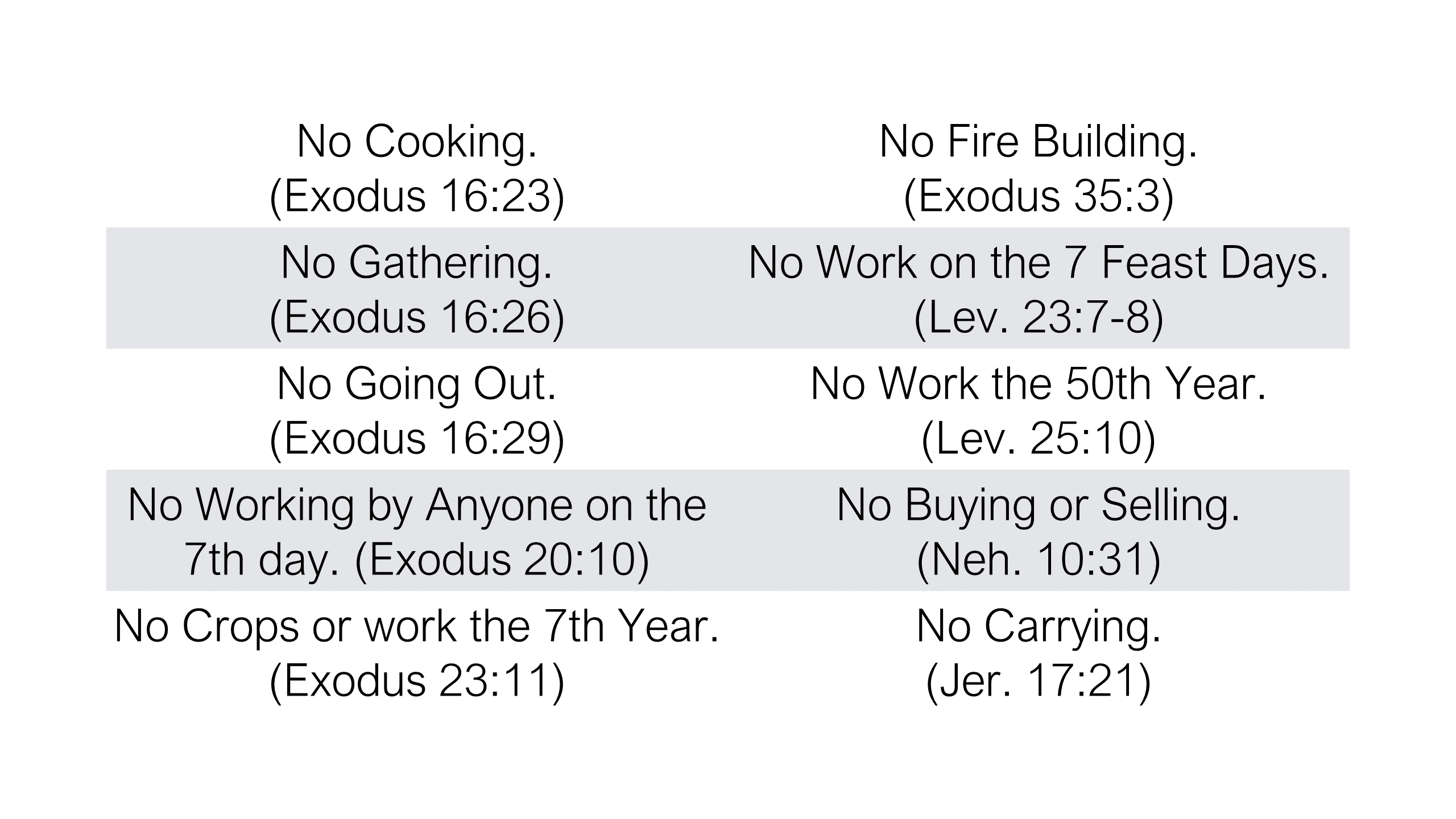
Now, you’re in Exodus, back up to chapter 16. I’m going to start in 16 and show you there are 10 very clear rules for the Sabbath day. The first one is in Exodus 16:23, and here it is. No cooking from sundown Friday to sundown Saturday. God didn’t say switch that to Sunday. If you’re a Sabbath observer, if you were a Jew and under the law and the bondage of the Sabbath, you could not cook anything from sundown Friday to sundown Saturday.
Secondly, you couldn’t gather any food. Remember, they went out and got their food, their manna. That means you can’t go to the store. You can’t gather food. You can’t go to your garden and cut some tomatoes. No gathering of food, verse 26 says. Look at verse 29. It gets worse. No cooking. A lot of us need a little time of no cooking and no eating. That would help us out, but no gathering food, that would get precarious. But no going out of the house. That’s what it says in verse 29. Stay in your dwelling. Boy. Except to go to the Tabernacle or Temple. That was strict.
Then, no one could do any kind of work all day long on that Shabbat day. That’s what we just read. Nobody in your house, none of your servants, none of your animals, none of your children, and certainly not your wife. No one could work at all. They’re customary work. No crops, or any kind of work in the fields and the vineyards could be done the seventh year. Do you know anybody who does this? I don’t. You can’t build a fire inside your home or your tent. That’s what Exodus 35 says.
On top of that, God called the Sabbath a holy convocation. The Sabbath was to convene everybody around a central purpose of meditating about how sinful we are and realizing how much we need a Savior. Then, looking at the method, He made for us to approach Him through all these seven sacrifices. The seven sacrifices also played into seven specific feast days.
Do you know what they are? There was Passover, and Unleavened Bread, and First Fruits. Then there’s the Day of Pentecost, and then there’s the Feast of Trumpets, and the Day of Atonement, and then there’s the Feast of Tabernacles. There were seven specific feast days. Now some of these lasted, like this one, for eight days. This one lasted for eight days, and this whole Day of Atonement deal lasted for eight days. Three of them were major events that you could only celebrate in Jerusalem. You had to take a whole week round trip to go to Jerusalem. So, if you followed this, you had 34 days out of your year that you could not work and that you were doing all this Sabbath stuff in Jerusalem. Did you know if you add all this up? It’s 40 percent of their life that was focused on their sinfulness and their need of a Savior. Do you think God wanted them to think about that? He built their whole schedule around it.
Here’s 2 percent of their life. Every 50th year, if they lived to be 100 at least, Leviticus 25:10 says that’s the year of Jubilee. Nothing went on. So, the 7th year, the 14th, 21st, 28th, 35th, 42nd, and 49th year you did nothing. And the 50th! It was a double. 49th and 50th year. On top of that, on all of the Sabbath days, no buying or selling. Not even on Amazon, in your house, nothing. And no carrying. That’s why they got so upset in John 5 about the guy carrying his little mat. No carrying, it says, outside or inside, Jeremiah 17. That’s the Sabbath regulations.
.jpg)
I have one word to say about that. Wow, that was a burden. That was what bound the people to think about their sinfulness.
.jpg)
.jpg)
So, what does the Lord do? He says to back up and think. We’ll get to this when we get into what Jesus said in the New Testament. He said that God first wants you to remember you have a Creator. See Him as Creator’s. God rested from His work, and He didn’t command anybody to rest. But after the fall of Israel, He commanded Israel to rest, and for them to think about their sinfulness, for them to look for a Redeemer, and to realize God has to hold the universe together.
.jpg)
.jpg)
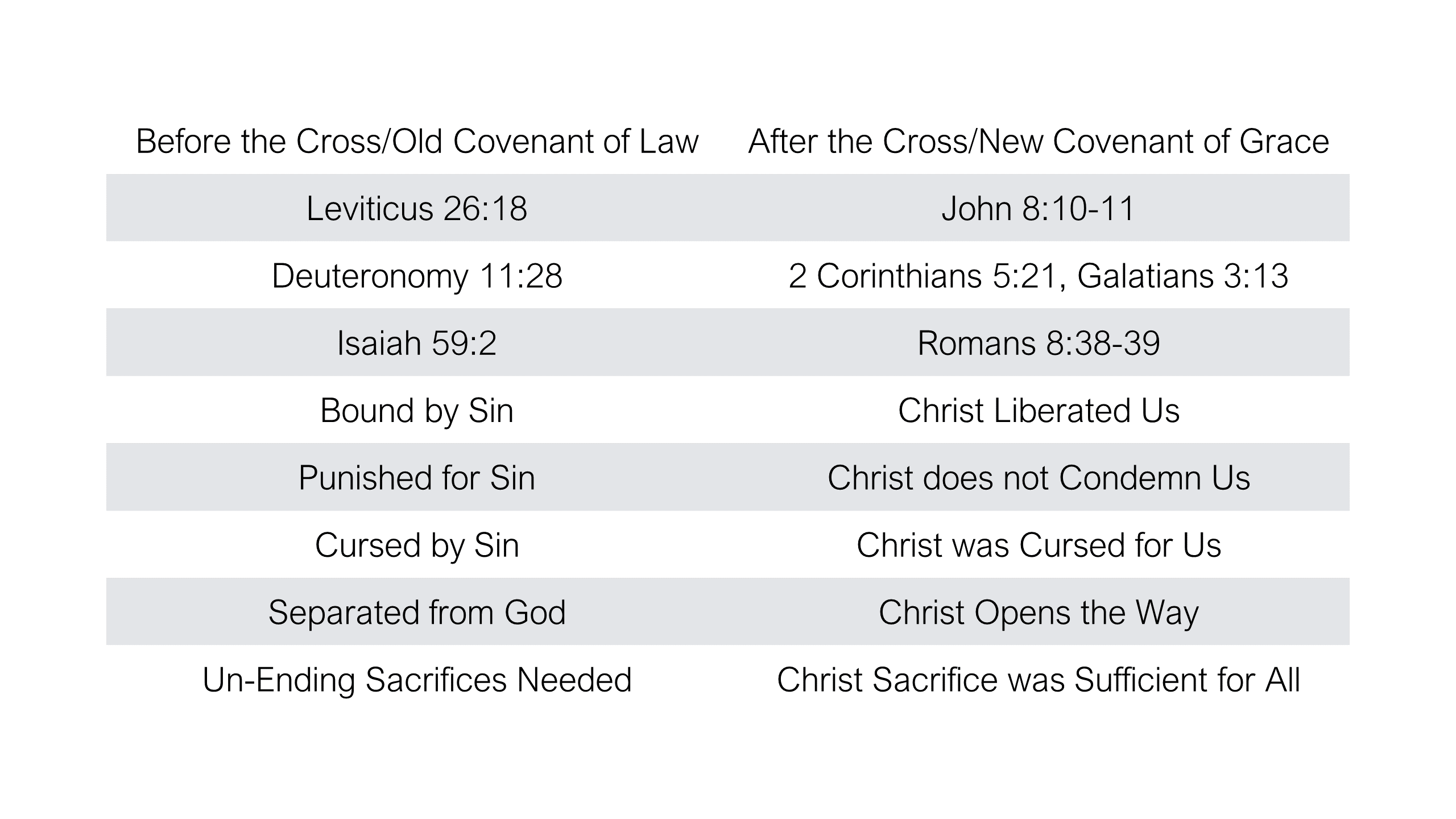
So basically, for us, I think sometimes without studying this, we don’t realize how good it is. We sing that song, oh, how good it is. What is good? We’re on this side of the cross. Look what they had to look forward to. In Leviticus 26, if you have time to look these up, God says, if you sin, I’m going to seven times punish you if you keep sinning. Deuteronomy 11:28 says I’m going to curse you. In Isaiah 59:2, God says I’m going to separate Myself from you. I’m not going to let you see My face. So, what does the law do? It curses us, separates us from God, makes us face sin and the punishment for sin, and it reminds us we’re bound by sin.
All of that produces unending sacrifices. Do you know there’s no chair or bench or anything else in the Tabernacle or Temple? Why? Because the work was never done. Twenty-four hours a day, seven days a week, they were constantly trimming, moving, and stoking the fire, and adding incense, and killing some more animals, and sprinkling the blood around. You just read one of those sacrificial days, and there are thirty or forty steps they had to follow. Unending sacrifices are needed because of the constant awareness of our separation, curse, and punishment because we’re bound by sin. That is the Old Testament.
Now, let’s just make a little cross here. This is before the cross in the Old Covenant. You’re going to face God’s judgment, and you’re cursed, and you’re separated, and there are endless sacrifices. But look what we have that we’re celebrating this morning at Communion. After the cross is the New Covenant of grace. What is that? I think it’s beautifully stated by Jesus in John 8:10-11. Do you know what Jesus said? He said, where are your accusers, to the woman that was being stoned. She said, I don’t know Lord, they’re not there. He says, I don’t condemn you either. That is one of the most beautiful expressions of the grace that flows from justification, that Jesus became our sin so He will never condemn us for our sins.
He became sin for us on the cross. He became a curse for us because He hung on a cross, as Galatians 3 says. He said nothing can separate us from His love. So, Jesus liberated us from our sins like he did that woman in John 8. He does not condemn us. He took the curse for us. He opens the way. Do you know what Hebrews 9 says? He is a new and living way. In chapter 10, He opened the way to God. It says that we can come boldly, in chapter 4 of Hebrews, to the throne of grace and mercy. Why? Because Christ’s sacrifice was sufficient for all.
So, what was the Old Testament all about? They were supposed to sit in their house with no fire, no food, going nowhere, to think about how lost they were. Then, after they sat a while, the dad would say, let’s go to the Tabernacle, or the Temple, and let’s go celebrate the fact that though we are such desperate sinners, we have an incredible God who’s made a way to come before Him.
.jpg)
What was Saturday for? Remember the Creator. What did Saturday become? Remember how sinful you are. What did Sunday become? Remember you have a Savior. We’re set free from that bondage.
.jpg)
What’s the real purpose of our gathering today? To remember what Jesus Christ did, because we are sinners. He is our Creator, and He is holy. We don’t elevate our lives the way we should. So, we’re painfully aware that we’re sinners, and we should be joyfully aware That we have the Savior.
So, this is what we’re going to do. It’s 11:31. It’s time to get ready for Communion. So, let’s all stand, and as you stand, the elders and deacons are going to go and prepare to serve us, and we’re going to read this to prepare our hearts. This is what I want you to meditate on as we quietly wait to be served. We’re going to meditate on the truth that we read together. So, is everybody ready? Let’s read. I know that according to presentation standards, that is way too many words for one slide. But we’ve got to do it so we can be together.
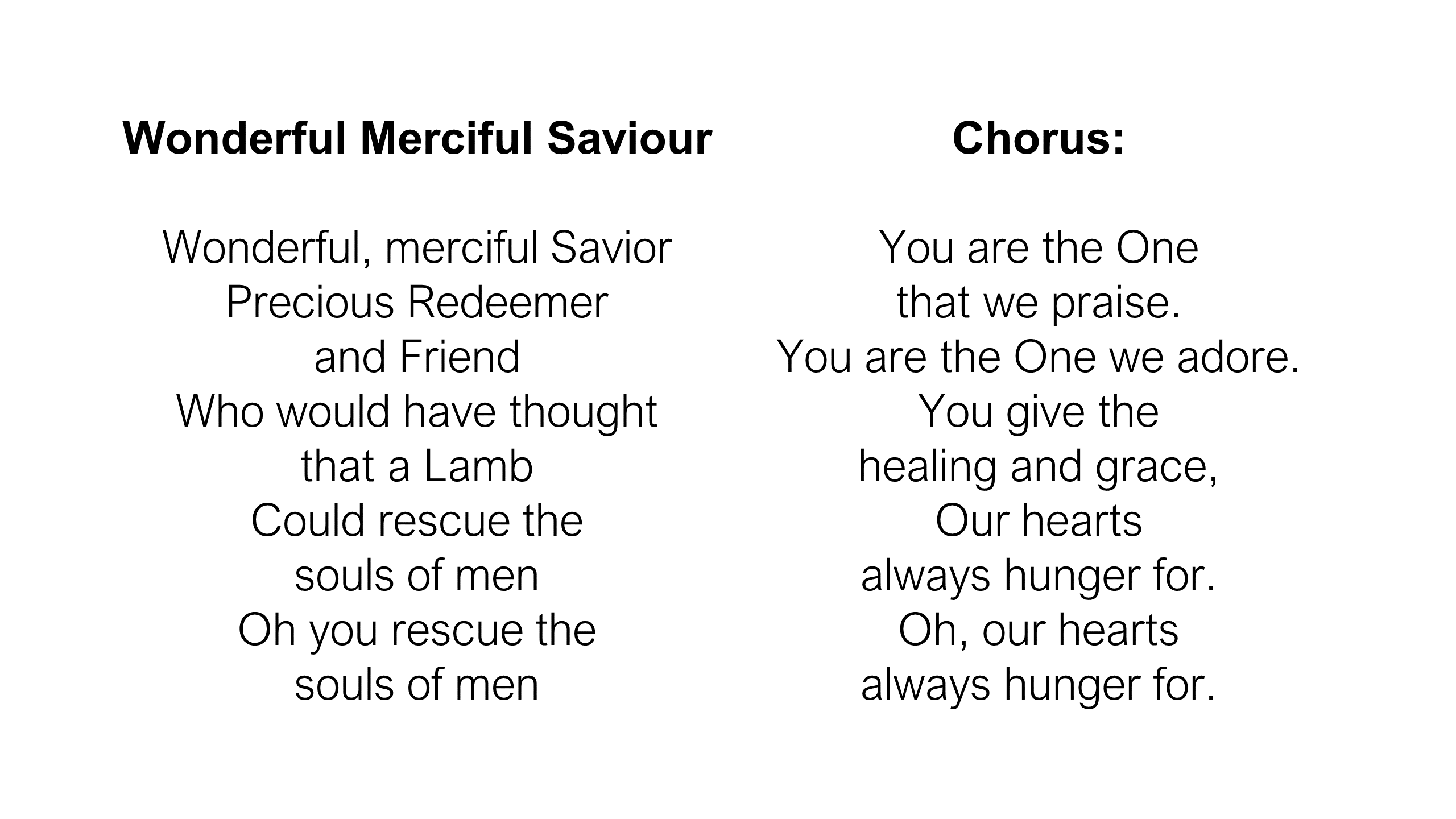
Here we go. Reading with me. Wonderful, merciful Savior. Precious Redeemer and Friend. Who would have thought that a Lamb could rescue the souls of men? Here’s the chorus. By the way, this is a song. You are the One that we praise. You are the One we adore. You give the healing and grace our hearts always hunger for. Oh, our hearts always hunger for.
Let’s bow before our Creator, who is our Redeemer. Father, I pray that as we go through our weeks and Saturday comes around and we’re out mowing or golfing or fishing or puttering and not having to be at work or school. I pray that we’d remember that You created this amazing, intricate, beautiful universe in six days. You are a creator and a lawgiver to remind us that we are fallen creatures that You created and we’re sinners. That you sent a Redeemer. I pray that every time we gather for Communion, our hearts will overflow with gratitude for our wonderful, merciful Savior who died in our place. May we meditate on that truth as we are served this bread, and may we be able to worship You, whose grace is greater than all of our sins. Thank you. In the name of Jesus, we give thanks. Amen.
NOTES
How did the 7th day of Creation become the Sabbath Day and the central focus of so much of the legalistic, spiritual bondage religion of the Pharisees and Sadducees in New Testament Judaism? What is the plan God had for Saturday in the Creation Week, and the Sabbath regulations given by God to Moses for the nation of Israel?
The Origin of the 7th Day
To understand the 7th Day we need to first open to Genesis 2.
After the wonders of Genesis 1, God crowned the creative week with a memorial to His amazing work of Creation in Genesis 2. God elevated Saturday as a day to always reflect upon how amazing it was that he created everything we will ever discover in the universe around us in only six days.
Think about it as science continues to uncover more complexities in the vast reaches of outer space: God did all of that in just part of those six days. Then think about all of the intricacies of the varied forms of life all around us, beneath and above us, residing on this pale blue perfectly tuned habitat called earth: God made all of that in those six days.
Then God says pause each week with gratitude and worship for such an Almighty God who did so much in just six days. Join me reading Genesis 1:31-2:3.
Genesis 1:31-2:3 (NKJV) Then God saw everything that He had made, and indeed it was very good. So the evening and the morning were the sixth day. 2: 1 Thus the heavens and the earth, and all the host of them, were finished. 2 And on the seventh day God ended His work which He had done, and He rested on the seventh day from all His work which He had done. 3 Then God blessed the seventh day and sanctified it, because in it He rested from all His work which God had created and made.
Pray
A Theology of the 7th Day
For just a few minutes lets just do an inductive Bible Study and note just exactly where we are and what God says in this part of His Word.
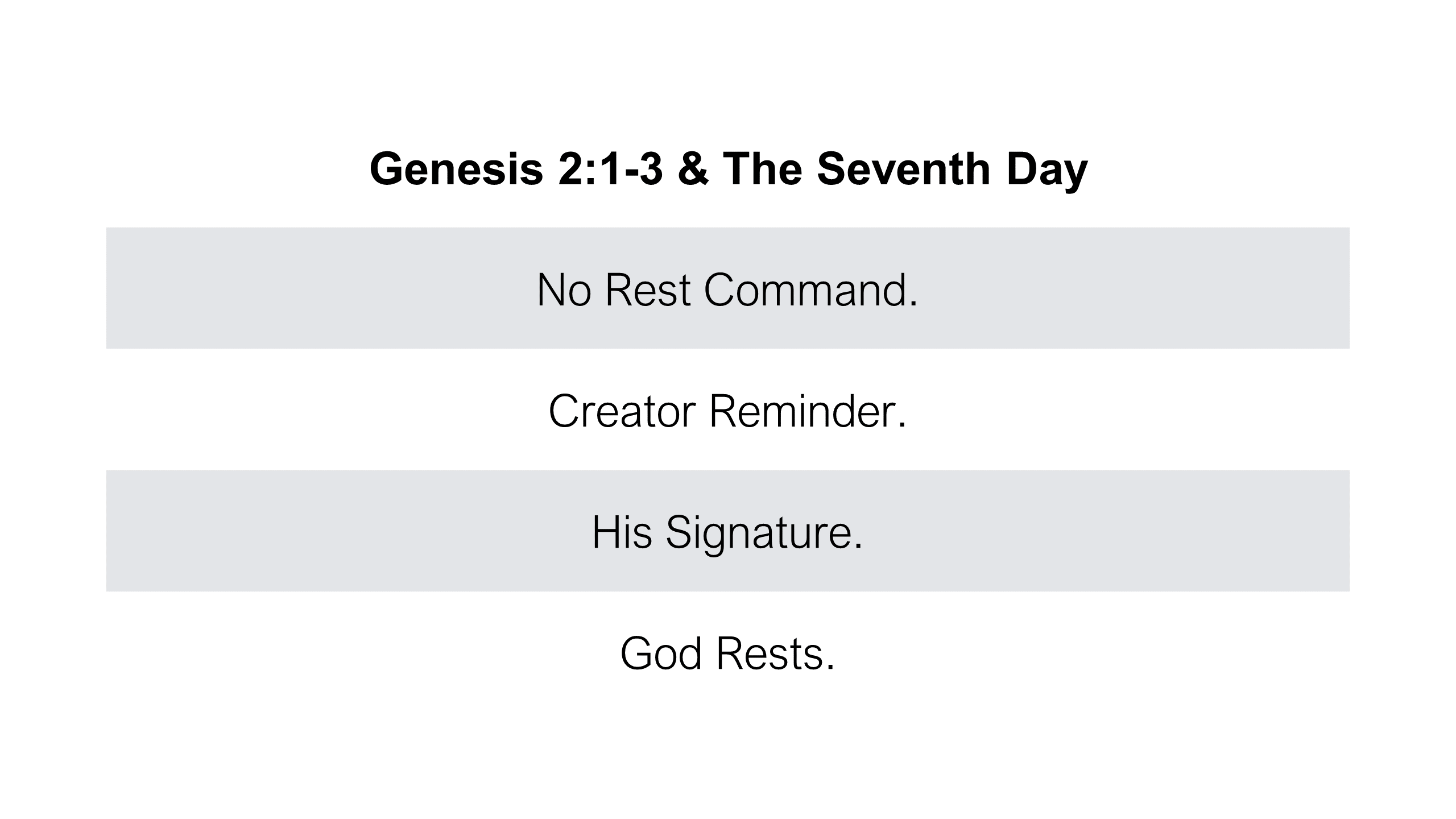
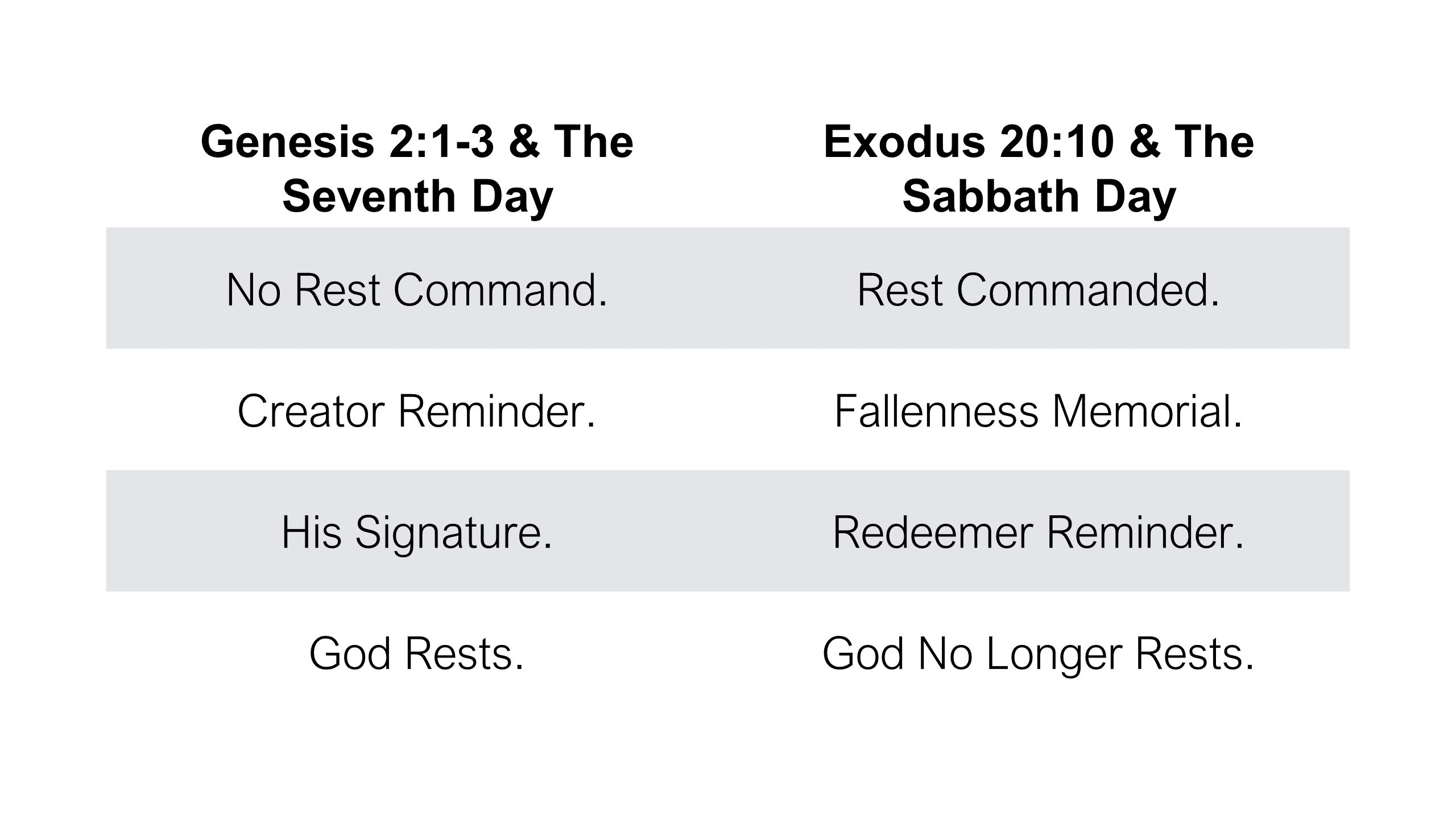
| Genesis 2:1-3 & The Seventh Day |
| No Rest Command.
What does God say? There is no commanded day of rest here or anywhere else in all 50 chapters of Genesis. No one does until Moses. |
| Creator Reminder.
What does God mean? God made every Saturday a perpetual memorial to the fact that He created everything in 6 days. The word used is “holy” first time in Bible, which elevates the remembering of God as Creator to be the first named act of worship. God tells us 11 times (7 in the Old and 4 in the New) that He made everything, and did so in six days. The Bible even ends with a vivid reminder of this in Rev. 14:7.[1] |
| His Signature.
What does God start? A seven-day week. God left His signature on the world (is there any other possible way such an obtuse measurement of 7 is used instead of 10? God made the seven-day week to observed all throughout humanity as a weekly signpost to Him as the Creator God, so humans could be grateful and worship Him. Remember the indictment of humanity that God makes in Romans 1? Romans 1:20-25 (NKJV) 20 For since the creation of the world His invisible attributes are clearly seen, being understood by the things that are made, even His eternal power and Godhead, so that they are without excuse, 21 because, although they knew God, they did not glorify Him as God, nor were thankful, but became futile in their thoughts, and their foolish hearts were darkened. 22 Professing to be wise, they became fools, 23 and changed the glory of the incorruptible God into an image made like corruptible man—and birds and four-footed animals and creeping things. 24 Therefore God also gave them up to uncleanness, in the lusts of their hearts, to dishonor their bodies among themselves, 25 who exchanged the truth of God for the lie, and worshiped and served the creature rather than the Creator, who is blessed forever. Amen. |
| God Rests.
What does God stop? Only God rests from creating, no hint at mankind being asked to rest in this passage or anywhere else in Genesis. |
So, Genesis has no commanded day of rest for anyone but God.
From Genesis 2 through Exodus 15 there is no Patriarch that worshipped on the Sabbath, nor is there any command to rest on the Sabbath anywhere in God’s Word the Bible.
God’s rest gets cut short at the Fall of Man, because since the fall of the Universe into sin God is at work.
In Hebrews 1 we find that He is now upholding all things. In Colossians 1 God makes all things continue, apart from God holding everything together it would dissolve. So God is at work from Genesis 3 onward but still has no commanded rest for mankind until Exodus.
A Theology of the Sabbath day
Turning onward to Exodus 20, we need to see exactly what God instituted for the Sabbath Day.
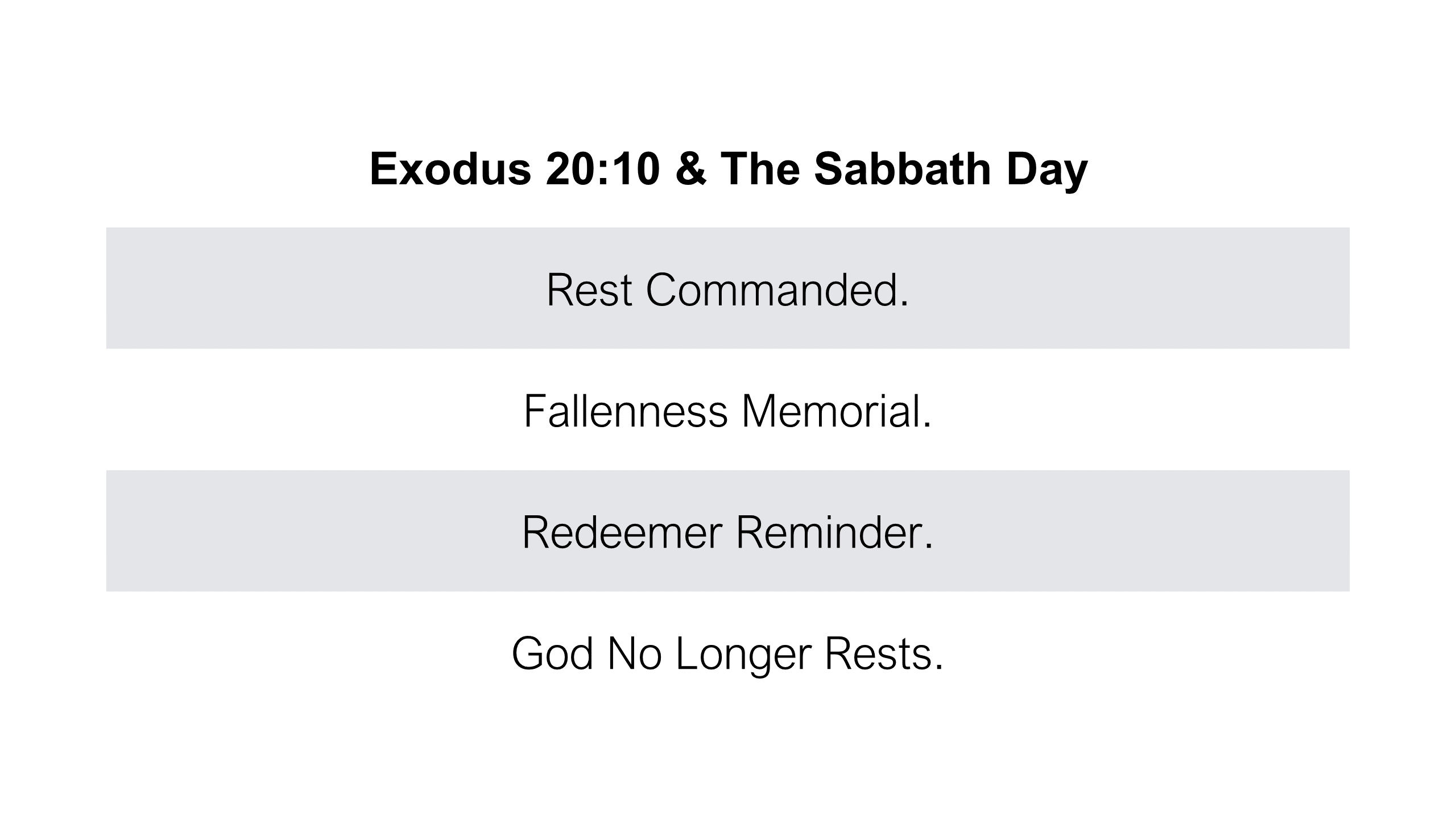
| Exodus 20:10 & The Sabbath Day |
| Rest Commanded.
God institutes a mandatory day of rest for Israel to be observed every seventh day as a part of an entire Sabbath cycle for their national calendar. |
| Fallenness Memorial.
God made every Saturday a memorial to the fact of sin, our utter fallenness, ongoing moral failures and many imperfections. The Sabbath came packaged in the Law of God that condemns us all as guilty. God is Law Giver, because we are sinners, we need help. |
| Redeemer Reminder.
God continues to make Saturday a day of sacrificial worship that is the way to deal with sin. The weekly focus of Saturday was for a time of contrition over our sinfulness and a time of repentance from those sins. We are in need of a Redeemer. |
| God No Longer Rests.
Because of sin, God no longer rests from His work. No He is upholding a cursed and dying Universe. |
God actually encloses the Sabbath Day ceremonial law Sabbath command, inside as the 4th commandment. It sits in the midst of the other nine expressions of His unchanging moral law of the Ten Commandments.
This is how we are to see the Ten Commandments:
Numbers 1-3 expresses the truth that God is Holy.
Then the fourth commandment is for Israel to pause and look at God as Holy (1-3) and at how sinful we are as humans (5-10).
So the Sabbath Day was a central point to think between two truths: God is Holy & Man is Sinful.
Now, what exactly did God command for the Sabbath Day?
The Mosaic Law: Sabbath Rules
As we turn back to Exodus 16 we find the very first command to rest in the Sabbath Day for anyone in God’s Word. These words were from God, through Moses, for the nation of Israel. These regulations stretch from the Book of Exodus through the Book of Jeremiah.
There are ten major areas impacted by God’s rules about the Sabbath Days. The limitations are astounding to us today:
- No Cooking. (Exodus 16:23, NKJV) Then he said to them, “This is what the Lord has said: ‘Tomorrow is a Sabbath rest, a holy Sabbath to the Lord. Bake what you will bake today, and boil what you will boil; and lay up for yourselves all that remains, to be kept until morning.’”
- No Gathering. (Exodus 16:26, NKJV) Six days you shall gather it, but on the seventh day, the Sabbath, there will be none.”
- No Going Out. (Exodus 16:29, NKJV) See! For the Lord has given you the Sabbath; therefore He gives you on the sixth day bread for two days. Let every man remain in his place; let no man go out of his place on the seventh day.”
- No Working by Anyone on the 7th day = 14.25% of life. (Exodus 20:10, NKJV) but the seventh day is the Sabbath of the Lord your God. In it you shall do no work: you, nor your son, nor your daughter, nor your male servant, nor your female servant, nor your cattle, nor your stranger who is within your gates.
- No Crops or work the 7th Year = 14.25% of life. (Exodus 23:11, NKJV) but the seventh year you shall let it rest and lie fallow, that the poor of your people may eat; and what they leave, the beasts of the field may eat. In like manner you shall do with your vineyard and your olive grove.
- No Fire Building. (Exodus 35:3, NKJV) You shall kindle no fire throughout your dwellings on the Sabbath day.”
- No Work on the 7 Feast Days = 9.3% of life. (Lev. 23:7-8, NKJV) On the first day you shall have a holy convocation; you shall do no customary work on it.8 But you shall offer an offering made by fire to the Lord for seven days. The seventh day shall be a holy convocation; you shall do no customary work on it.’”
- No Work the 50th Year = 2% of life. (Lev. 25:10, NKJV) And you shall consecrate the fiftieth year, and proclaim liberty throughout all the land to all its inhabitants. It shall be a Jubilee for you; and each of you shall return to his possession, and each of you shall return to his family.
- No Buying or Selling. (Neh. 10:31, NKJV) if the peoples of the land brought wares or any grain to sell on the Sabbath day, we would not buy it from them on the Sabbath, or on a holy day; and we would forego the seventh year’s produce and the exacting of every debt.
- No Carrying. (Jer. 17:21, NKJV) Thus says the Lord: “Take heed to yourselves, and bear no burden on the Sabbath day, nor bring itin by the gates of Jerusalem;
So from Sundown on Friday until Sundown on Saturday there was to be:
No cooking of food; no gathering of food; no getting out of the house (except for going to the Tabernacle or Temple), on Sabbaths.
No work by anyone attached in any way to the household including animals; no planting crops the 7th years; and no building of fires on Sabbaths.
No work during the days of the 7 Annual Holy Convocation feasts; no work or crop planting the 50th Jubilee Year; no buying or selling on Sabbaths; and no carrying outside or inside your home on Sabbaths.
The Burden & Bondage of the Sabbath
All I can say is: Wow.
That was an amazing burden that the Law placed upon the people of Israel. What for? To remind them that their Creator God, was also the absolute Law Giver who found everyone guilty of sin.
The Sabbath was a time to stay home and do nothing but think about God: either you loved Him more and more, or hated Him more and more for all His rules. They were to be acutely aware of their sins and humbly contrite seeking God’s forgiveness.
Sadly, no one could keep all the rules. It was impossible to perfectly fulfill all of God’s rules. , The goal of the Law was to lead each person to the awareness of their helplessness. As Paul said, the Law was a school master that pointed helpless and hopeless rule breakers to the only One who could save, forgive, and give them righteousness unearned and undeserved.
Realizing that each person faced an impossible standard. Only Christ could perfectly keep the Law and fulfill the Law.
The Contrast of the 7th Day & The Sabbath Day
| Genesis 2:1-3 & The Seventh Day | Exodus 16-40 & The Sabbath Day | |
| No Rest Commanded Anyone | Rest Commanded to Israel | |
| Saturday: Creator Reminder | Saturday: Fall into Sin Reminder | |
| God’s Signature as Creator | God’s Offer as Redeemer | |
| God Rests | God No Longer Rests |
The Blessings of this Side of the Cross
Now think of the two sides of the Cross. As we review this list think of how wonderful it is to know Christ who died in our place, was punished for our sins, and lavishes His grace upon us.
| Before the Cross/Old Covenant of Law | After the Cross/New Covenant of Grace |
| Leviticus 26:18 (NKJV) ‘And after all this, if you do not obey Me, then I will punish you seven times more for your sins. | John 8:10-11 (NKJV) When Jesus had raised Himself up and saw no one but the woman, He said to her, “Woman, where are those accusers of yours? Has no one condemned you?” 11 She said, “No one, Lord.” And Jesus said to her, “Neither do I condemn you; go and sin no more.” |
| Deuteronomy 11:28 (NKJV) and the curse, if you do not obey the commandments of the Lord your God, but turn aside from the way which I command you today, to go after other gods which you have not known. | 2 Corinthians 5:21 (NKJV) For He made Him who knew no sin to be sin for us, that we might become the righteousness of God in Him. Galatians 3:13 (NKJV) Christ has redeemed us from the curse of the law, having become a curse for us (for it is written, “Cursed is everyone who hangs on a tree”), |
| Isaiah 59:2 (NKJV) But your iniquities have separated you from your God; And your sins have hidden His face from you, So that He will not hear. | Romans 8:38-39 (NKJV) For I am persuaded that neither death nor life, nor angels nor principalities nor powers, nor things present nor things to come, 39 nor height nor depth, nor any other created thing, shall be able to separate us from the love of God which is in Christ Jesus our Lord. |
| Bound by Sin | Christ Liberated Us |
| Punished for Sin | Christ does not Condemn Us |
| Cursed by Sin | Christ was Cursed for Us |
| Separated from God | Christ Opens the Way |
| Un-Ending Sacrifices Needed | Christ Sacrifice was Sufficient for All |
Conclusion
Sunday has become for us a reminder of our Savior.
On Saturday (and every day): we remember our amazing Creator who made everything in six days.
On Saturday (and every day): we remember that we have fallen so short of His glory, and are convicted sinners.
On Sunday (and every day): we remember our Savior, our Redeemer, and our Friend.
Jesus was hung on a tree and cursed for us by the Law.
Jesus became our sin, and suffered God’s punishment for each of our sins.
Jesus places upon us His perfect obedient life we never could live, and makes us righteous forever in God the father’s sight.
What a wonderful Savior, and what a blessing to be free from the bondage of the Law, the bondage of sin, and the bondage of the Sabbath rules.
Join me in expressing that blessing by these words:
Wonderful Merciful Savior
Song by Selah
Wonderful, merciful Savior
Precious Redeemer and Friend
Who would have thought that a Lamb
Could rescue the souls of men
Oh you rescue the souls of men
Counselor, Comforter, Keeper
Spirit we long to embrace
You offer hope when our hearts have
Hopelessly lost the way
Oh, we hopelessly lost the way
Chorus: You are the One that we praise
You are the One we adore
You give the healing and grace
Our hearts always hunger for
Oh, our hearts always hunger for
Almighty, infinite Father
Faithfully loving Your own
Here in our weakness You find us
Falling before Your throne
Oh, we’re falling before Your throne
.
[1] Ex. 20:11, 31:17; 2 Chr. 2:12; Ps. 134:3, 136:7; Jer. 33:2; Jonah 1:9; Acts 4:24, 14:15, 17:24; Rev. 14:7.