
If the video above is not available, here are two other ways to view:
David’s Life of Finding Refuge
COR-19
050911AM
David’s Life of Finding Refuge
Sometimes its good to pull over and look at the map. Just to see where you are, where you’re headed, and how far you have come. This morning we are on a wonderful journey finding all the sites in God’s Word where Christ is our refuge. We arrived at the third truth—Christ the Refuge for the Lonely.

Then we began to look at David. We have found that David’s life is often described in the Bible. But is there any significance to the items about David captured in the Old Testament?
To find out, open with me to Ruth 4 this morning and look at the last verse. I’d like to show you the person God chose to write about more than any other person in the Bible.
Yes, I know that Christ is the theme of every chapter and every book of this Bible. But the most described and talked about person in God’s Word is David. His strengths, weaknesses, virtues and vices, character and habits are all there—more than any other person.
David God’s Example to Us
I believe that God captured David’s highs and lows for our benefit. God records his successes and failures for our learning. And all that is because God is teaching us how to please Him by the correct responses to our circumstances in life.
David has been recorded by God in His Word as an example to us in how to find all we need in Jesus—no matter we ever will face in life, David mirrors a response that pleases God that we can follow.
As we start here in Ruth 4 and go through all the chapters that deal with David’s life we find that there are over 140 chapters of the Bible about David. That is astounding. Let me show them to you. Here is the first mention of David.
As we turn to 1st Samuel 16, we see the first appearance of David in God’s Word.
God always has the best plans and will show us what they are if we listen and obey Him.
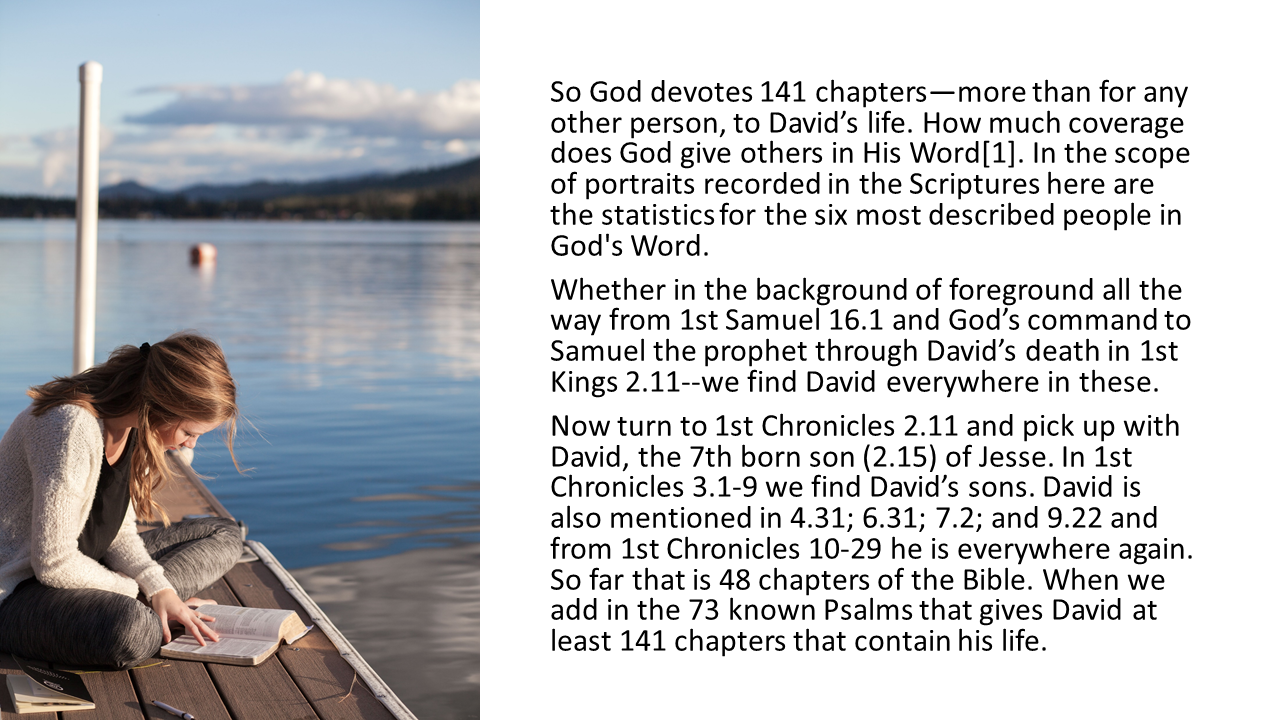
Whether in the background of foreground all the way from 1st Samuel 16.1 and God’s command to Samuel the prophet through David’s death in 1stKings 2.11–we find David everywhere in these .
 Now turn to 1st Chronicles 2.11 and pick up with David, the 7th born son (2.15) of Jesse. In 1st Chronicles 3.1-9 we find David’s sons. David is also mentioned in 4.31; 6.31; 7.2; and 9.22 and from 1st Chronicles 10-29 he is everywhere again. So far that is 48 chapters of the Bible. When we add in the 73 known Psalms that gives David at least 141 chapters that contain his life.
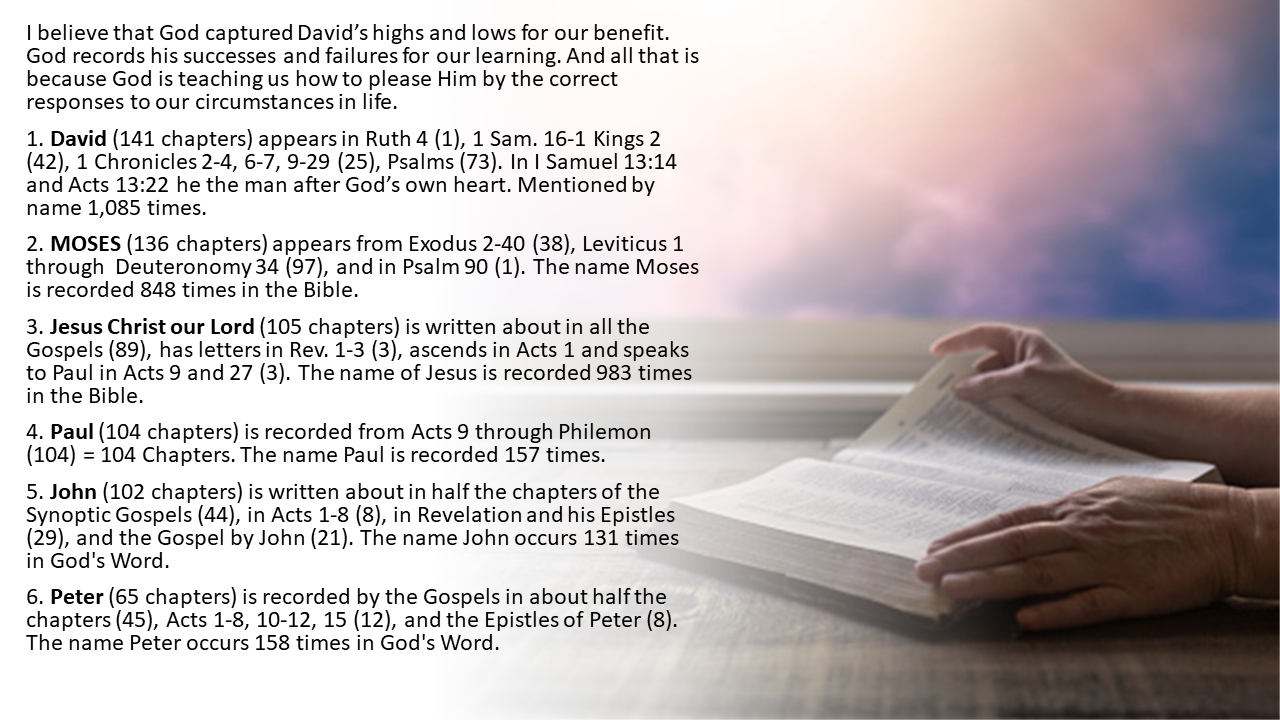
So God devotes 141 chapters—more than for any other person, to David’s life. How much coverage does God give others in His Word[1]. In the scope of portraits recorded in the Scriptures here are the statistics for the six most described people in God’s Word.
- David (141 chapters) appears in Ruth 4 (1), 1 Sam. 16-1 Kings 2 (42), 1 Chronicles 2-4, 6-7, 9-29 (25), Psalms (73). In I Samuel 13:14 and Acts 13:22 he the man after God’s own heart. Mentioned by name 1,085 times.
- MOSES (136 chapters) appears from Exodus 2-40 (38), Leviticus 1 through Deuteronomy 34 (97), and in Psalm 90 (1). The name Moses is recorded 848 times in the Bible.
- Jesus Christ our Lord (105 chapters) is written about in all the Gospels (89), has letters in Rev. 1-3 (3), ascends in Acts 1 and speaks to Paul in Acts 9 and 27 (3). The name of Jesus is recorded 983 times in the Bible.
- Paul (104 chapters) is recorded from Acts 9 through Philemon (104) = 104 Chapters. The name Paul is recorded 157 times.
- John (102 chapters) is written about in half the chapters of the Synoptic Gospels (44), in Acts 1-8 (8), in Revelation and his Epistles (29), and the Gospel by John (21). The name John occurs 131 times in God’s Word.
- Peter (65 chapters) is recorded by the Gospels in about half the chapters (45), Acts 1-8, 10-12, 15 (12), and the Epistles of Peter (8). The name Peter occurs 158 times in God’s Word.
All that to say that, the most talked about, the most portrayed, the most described example for us in all of God’s Word is-David.
So it would be good to stop and get the big picture of his life as recorded in God’s Word all over again. This is a time to jot notes in your Bible or take some extra notes and just see the whole scope of the dealings of the Lord with this special servant he called the man after His own heart!
FIRST WE FIND DAVID’S PSALMS FROM HIS EARLY YEARS
- David suffers the intense loneliness of family
 disappointments—and from these times he grows in his relationship with the Lord. His testimony from his early years is captured in Psalms 19 and 23. In First Samuel 16 David is the shepherd boy writing Psalms 19 and 23. David was overlooked, ignored and even disliked by his family in First Samuel 16-18. He is left out of family gatherings, unrecognized for great achievements and basically left alone much of the time to do his “job” with the family’s flock of sheep. David found God was with him while alone as a young shepherd boy writing Psalms 19 and 23. He had many a lonely night in the fields, the woods and the hill sides of Judea. Instead of hating and fleeing those lonely times, he turned them into meditations upon the faithfulness of God.
- Psalm 19 has three basic lessons: v. 1-6 explains that David meditated upon the character of God when he was alone; v. 7-11 explains that David listened to the Word of God when he was alone; v. 12-14 explains that David feared the disapproval God (heeded His Word) when he was alone.
- Psalm 23 is the testimony of what you can learn about God in times of loneliness. Listen to David’s testimony of what he experienced, what he clung to from his long dark nights, and long lonely days. As you listen, ask the Lord to give you the same desire, then echo each of David’s affirmations and make them your own testimony. Confess these loneliness lessons and find them true!
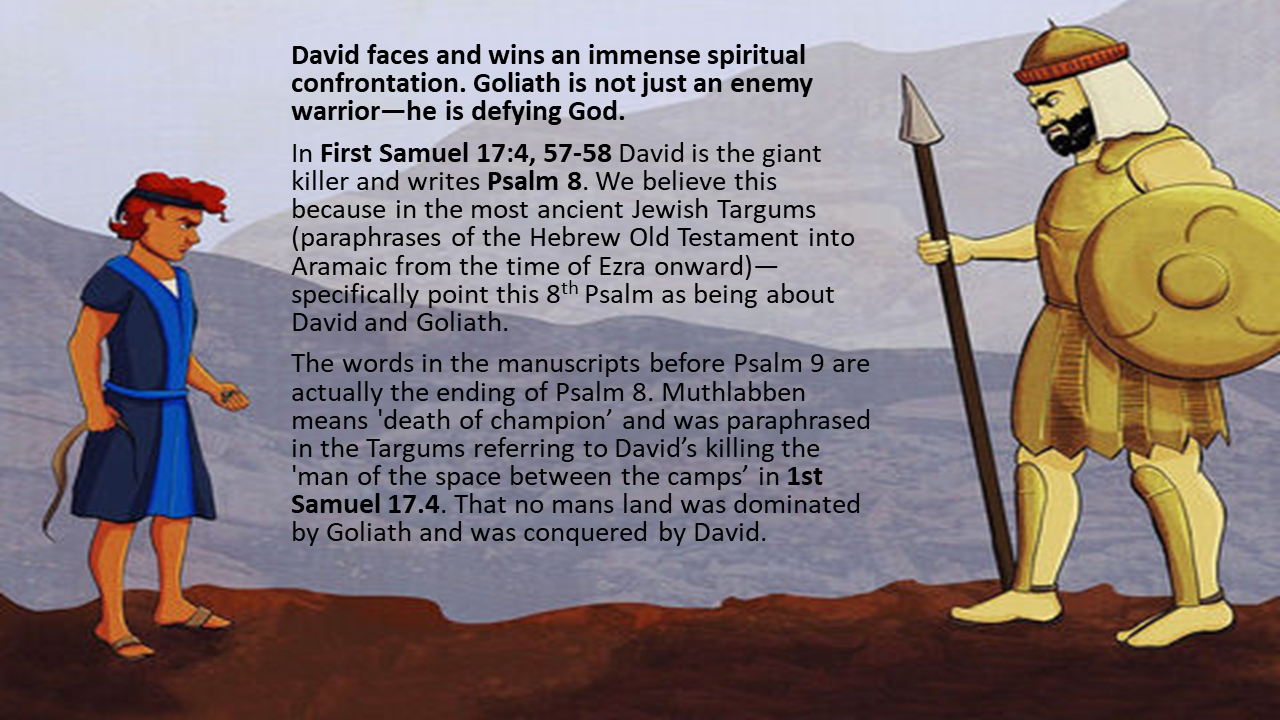
- David faces and wins an immense spiritual confrontation. Goliath is not just an enemy warrior—he is defying God.
- InFirst Samuel 17:4, 57-58 David is the giant killer and writes Psalm 8. We believe this because in the most ancient Jewish Targums (paraphrases of the Hebrew Old Testament into Aramaic from the time of Ezra onward)—specifically point this 8th Psalm as being about David and Goliath.
- The words in the manuscripts before Psalm 9 are actually the ending of Psalm 8. Muthlabben means ‘death of champion’ and was paraphrased in the Targums referring to David’s killing the ‘man of the space between the camps’ in1st Samuel 17.4. That no mans land was dominated by Goliath and was conquered by David.
- Much like Satan was defeated by Christ’s coming to earth. David may have sung this Psalm while in Saul’s court to comfort him when the demons troubled him.
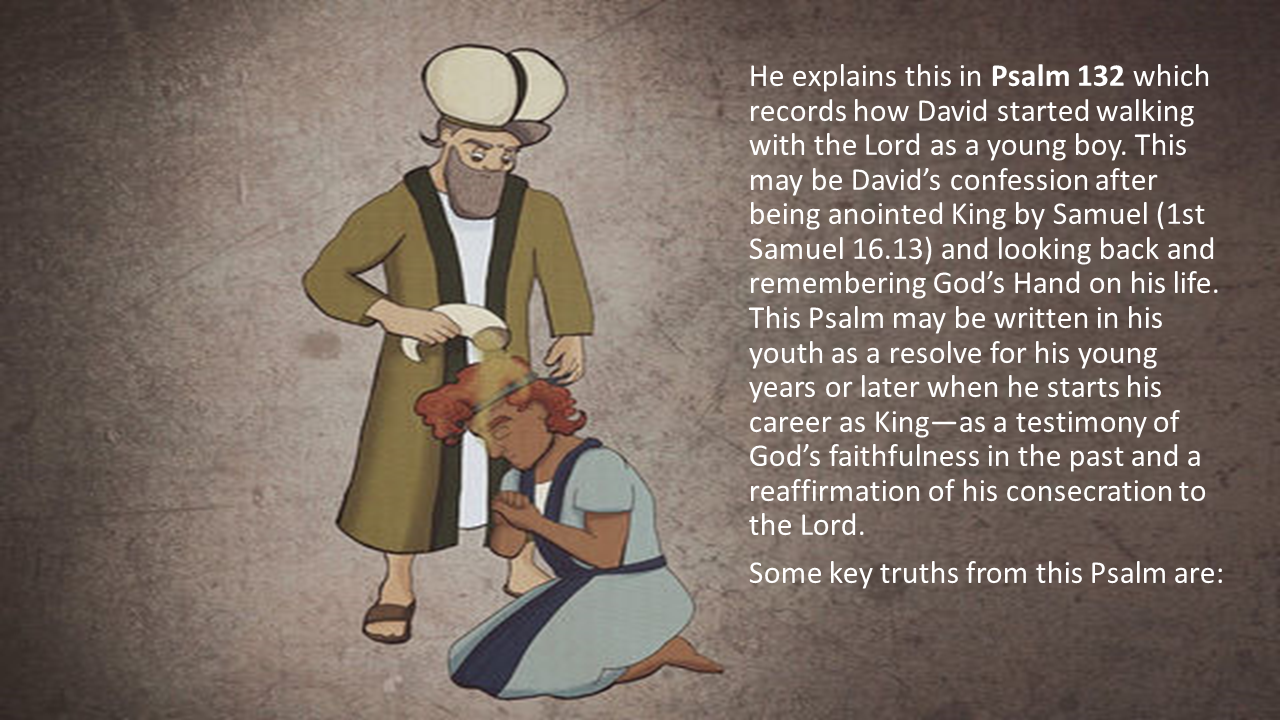
- David explains his habits as a young man that fortified him for Goliath, a life of hardship and for being so useful to God. He explains this in Psalm 132 which records how David started walking with the Lord as a young boy. This may be David’s confession after being anointed King by Samuel (1st Samuel 16.13) and looking back and remembering God’s Hand on his life. This Psalm may be written in his youth as a resolve for his young years or later when he starts his career as King—as a testimony of God’s faithfulness in the past and a reaffirmation of his consecration to the Lord.

Some key truths from this Psalm are:
- This psalm could be called David’s spiritual secret—what made him the Giant that we see him to be from the Scriptural record of his life.
- David put God ahead of comfort in v. 3-5. He made time for God a holy habit in his life. Is it yet for you? Without regular, consistent, disciplines time alone with God—you and I will never amount to anything for eternity!
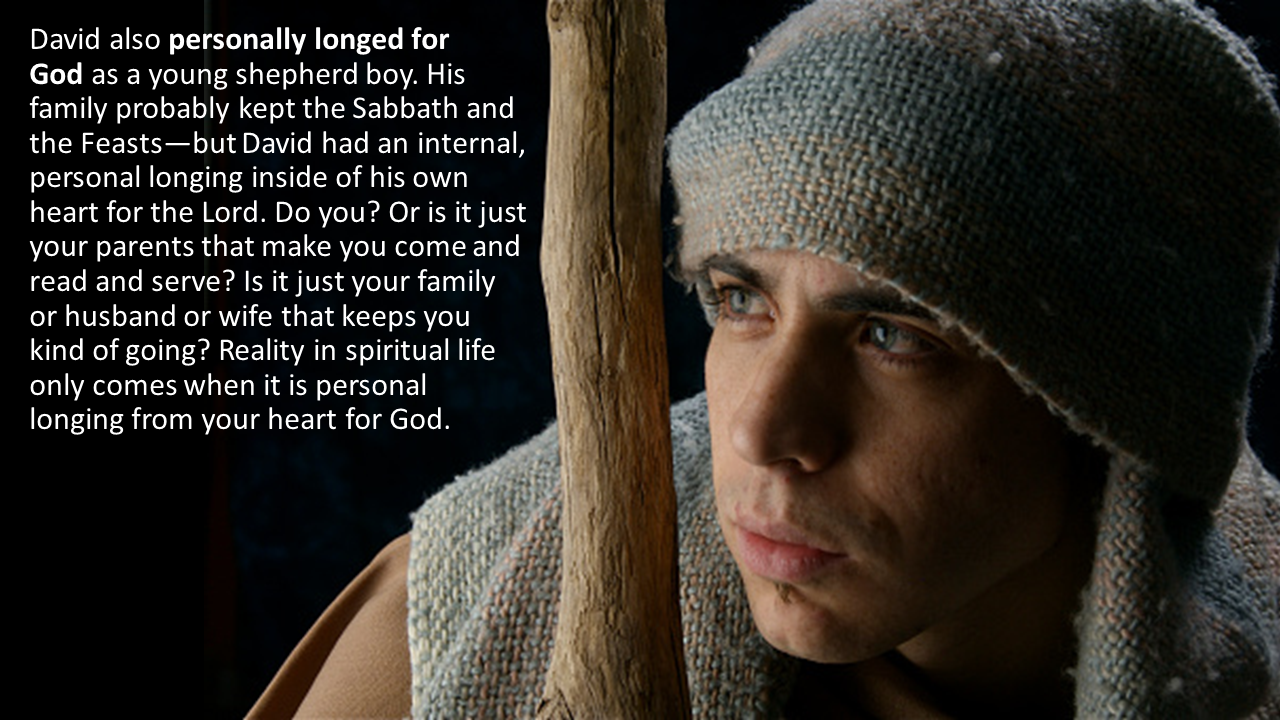
- David also personally longed for God as a young shepherd boy. His family probably kept the Sabbath and the Feasts—but David had an internal, personal longing inside of his own heart for the Lord. Do you? Or is it just your parents that make you come and read and serve? Is it just your family or husband or wife that keeps you kind of going? Reality in spiritual life only comes when it is personal longing from your heart for God.
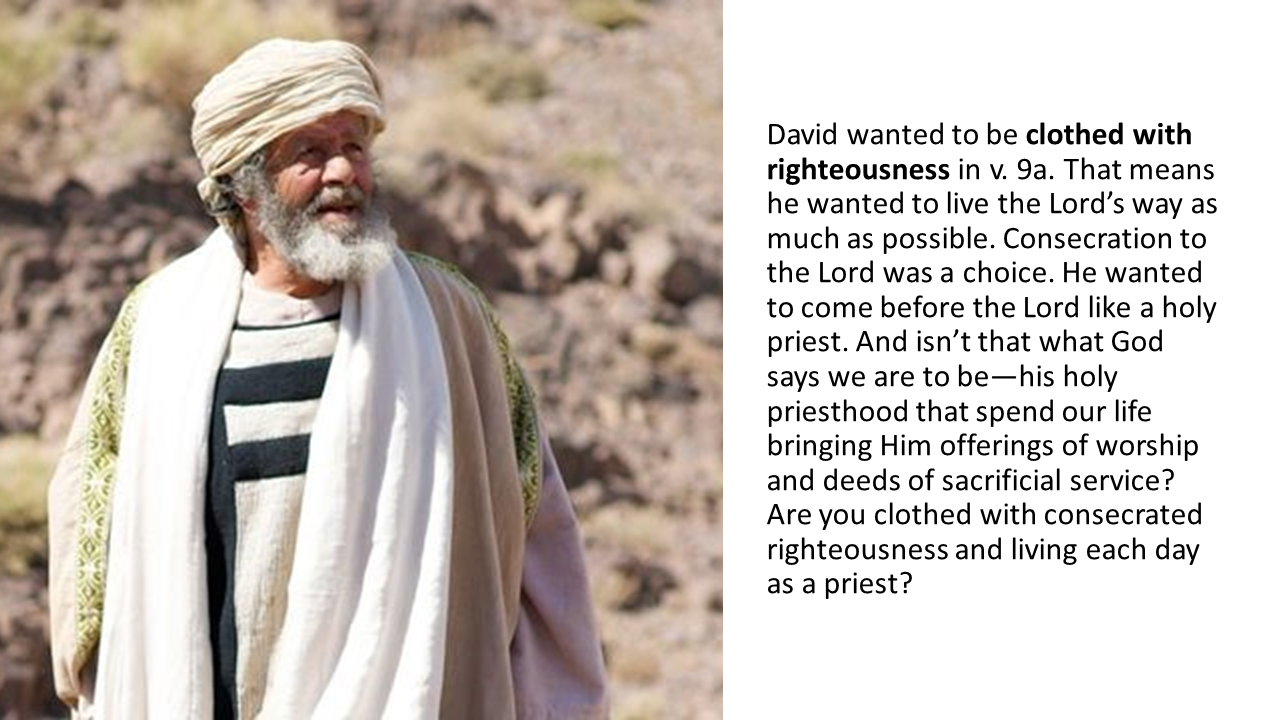
- David wanted to be clothed with righteousness in v. 9a. That means he wanted to live the Lord’s way as much as possible. Consecration to the Lord was a choice. He wanted to come before the Lord like a holy priest. And isn’t that what God says we are to be—his holy priesthood that spend our life bringing Him offerings of worship and deeds of sacrificial service? Are you clothed with consecrated righteousness and living each day as a priest?
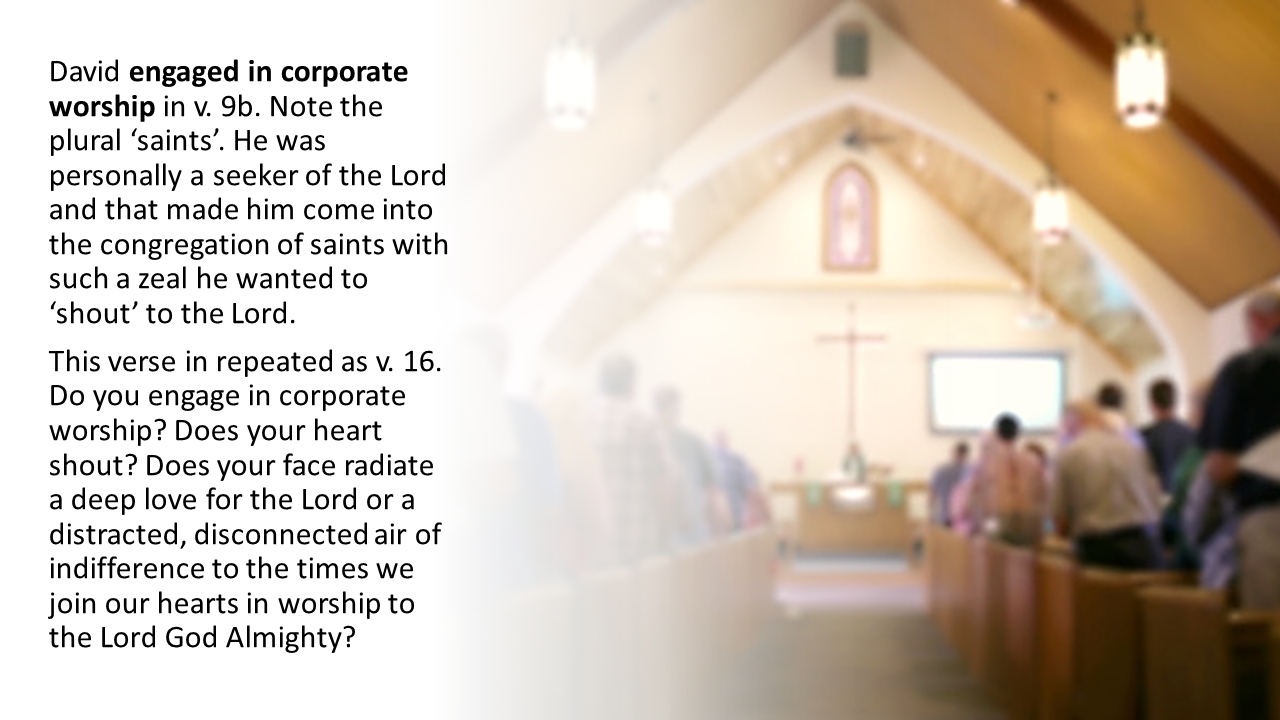
- David engaged in corporate worship in v. 9b. Note the plural ‘saints’. He was personally a seeker of the Lord and that made him come into the congregation of saints with such a zeal he wanted to ‘shout’ to the Lord. This verse in repeated as v. 16. Do you engage in corporate worship? Does your heart shout? Does your face radiate a deep love for the Lord or a distracted, disconnected air of indifference to the times we join our hearts in worship to the Lord God Almighty?
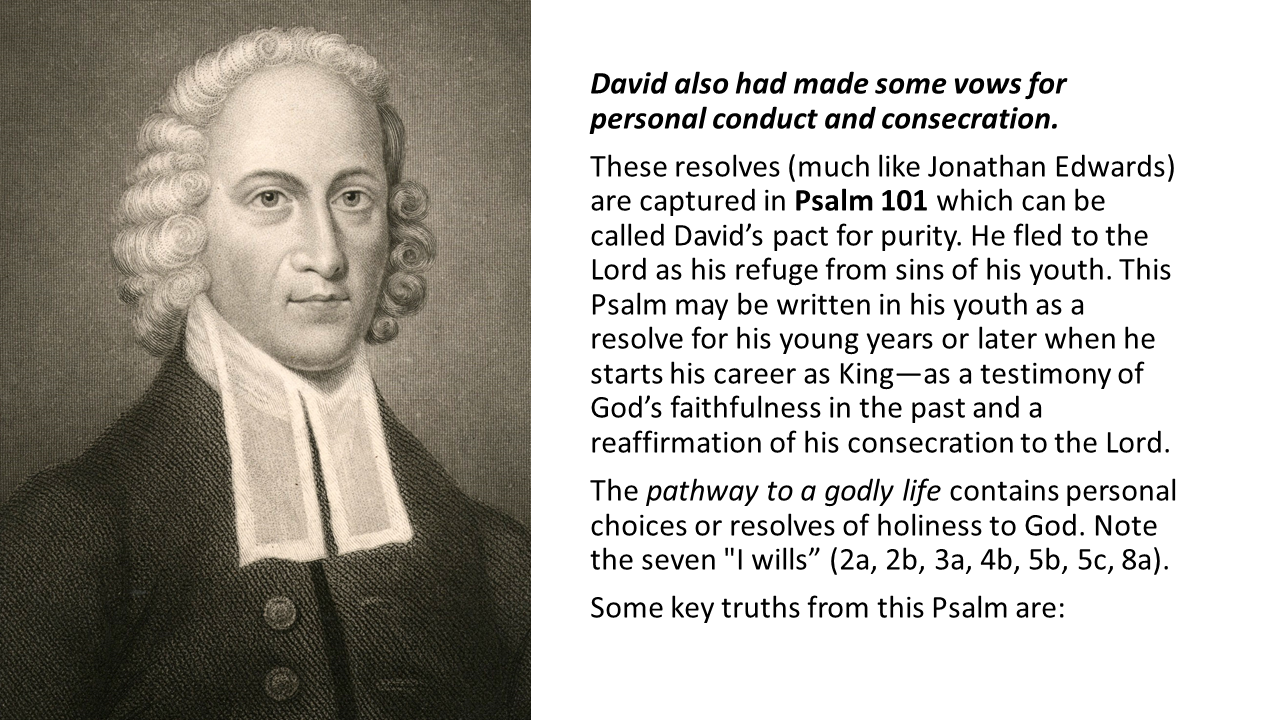
- David also had made some vows for personal conduct and consecration. These resolves (much like Jonathan Edwards) are captured in Psalm 101 which can be called David’s pact for purity. He fled to the Lord as his refuge from sins of his youth. This Psalm may be written in his youth as a resolve for his young years or later when he starts his career as King—as a testimony of God’s faithfulness in the past and a reaffirmation of his consecration to the Lord. Some key truths from this Psalm are:
- The pathway to a godly life contains personal choices or resolves of holiness to God. Note the seven “I wills” (2a, 2b, 3a, 4b, 5b, 5c, 8a).
- David sought personal integrity as his goal v.2b.
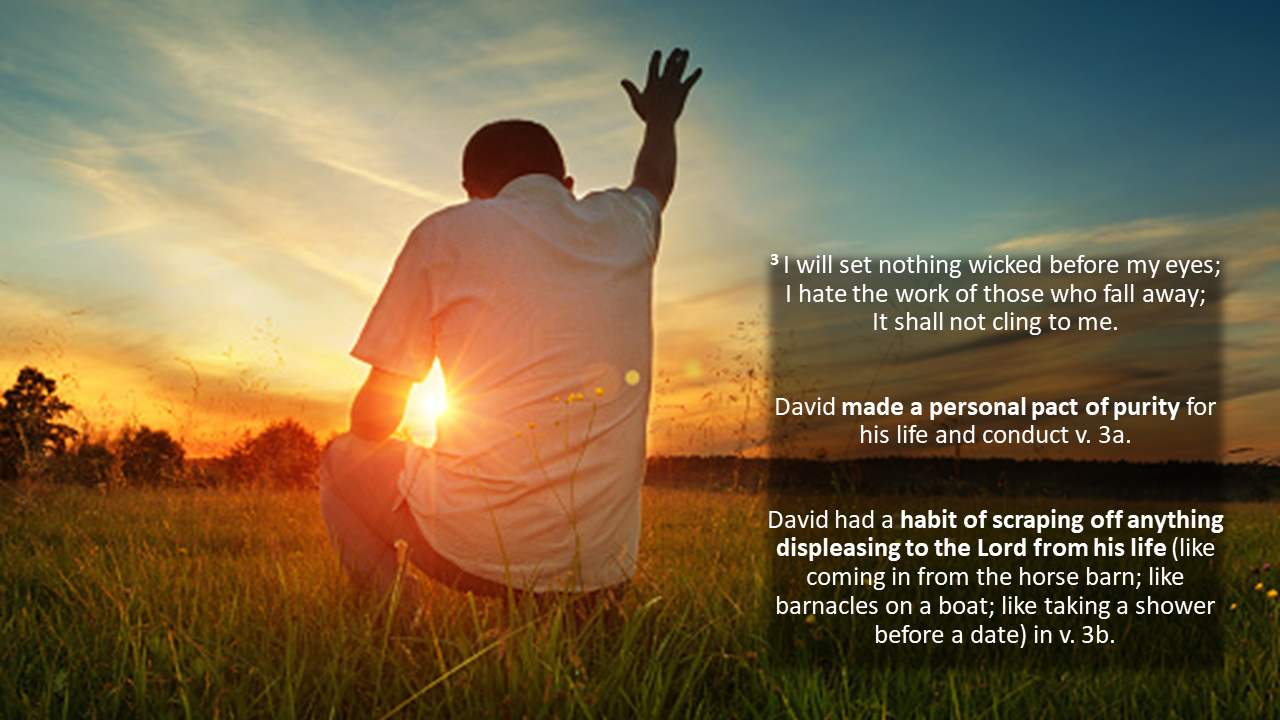
- David made a personal pact of purity for his life and conduct v. 3a.
- David had a habit of scraping off anything displeasing to the Lord from his life (like coming in from the horse barn; like barnacles on a boat; like taking a shower before a date) in v. 3b.
- David chose to limit his exposure to evil and things that would displease the Lord in v. 4-5. He specifically says any sin I will not look at (v. 3 ‘nothing wicked before my eyes’ and v. 4b ‘not know [experience for myself] wickedness’).
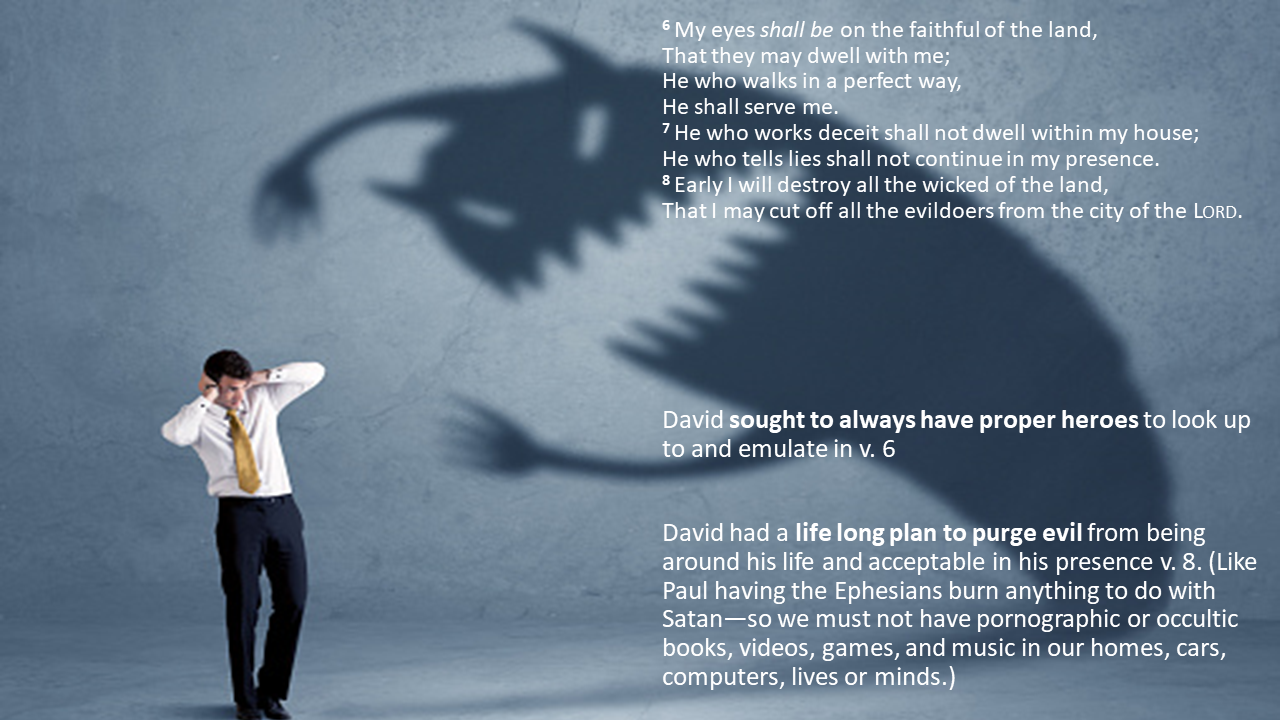
- David sought to always have proper heroes to look up to and emulate in v. 6a.
- David had a life long plan to purge evil from being around his life and acceptable in his presence v. 8. (Like Paul having the Ephesians burn anything to do with Satan—so we must not have pornographic or occultic books, videos, games, and music in our homes, cars, computers, lives or minds.)
THEN WE FIND DAVID’S SONGS FROM HIS STRUGGLING YEARS
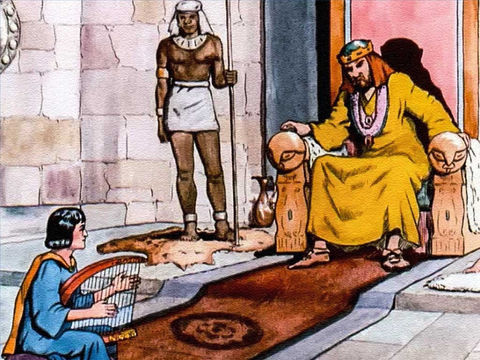 David suffers intense loneliness as he faces family conflict and danger. In I Sam 19:11 as Saul tries to murder him, David writes Psalm 59. These times of danger are from his boss and father-in-law King Saul. Instead of being eaten up by the intense loneliness he must have felt with job and family pressures all dumped on him at once–he expresses his needs to God. His prayerful responses to these tough times are captured in the Psalms and show a pathway through loneliness to the One who is closest of all. In that time of feeling so alone David writes Psalm 59—how to overcome the feelings of loneliness when we are in danger. David finds an unshakeable trust in God’s protection.
Some key truths from this Psalm are:
- David turns to God in his fearful times v.1.
- David trusts God in his fearful times v.9.
- David triumphs through God in his fearful times v. 16.
David learns to live with fear as he is a newlywed and faces the unpredictable outbursts of deadly rage from Saul. In First Samuel 20:35-42 as Jonathan warns him of the danger of Saul’s wrath, David writes Psalms 11 and 64.
- Psalm 11 is a meditation on why David should not just run away from dangers—he needed to run to the Lord first.
- Psalm 64 is the Psalm about the poison of jealous, hateful, and hurtful tongues. After David’s meteoric rise to giant slayer, King’s helper, royal son-in-law and commander—there were many who hated and envied him. God shows him how to deal with poisonous language directed at him. This could be in the time of Saul or also in the time of Absalom’s rebellion and the evil accusations of Ahithophel and Shimei (2nd Samuel 15-19)
David suffers intense loneliness as he loses his job, and is separated from his family. David writes Psalm 52—how to overcome the feelings of loneliness when we are away from our work, home, and family. In First Samuel 21:1-9 as he flees to Ahimelech the priest, David writes this Psalm. Some key truths from this Psalm are:
-
- v. 1 God is good no matter what!
- v. 2-4 People will always hurt us.
- v. 5-7 Take God as your strength in times like this.
- v. 8-9 Wait for God, cling to Him, grow through the alone time!
David is captured and goes from fear to terror to nearly a complete breakdown because of fear.
- In 1 Sam. 21:10-12 when David is captured at Gath he writes about this in Psalm 56. In this Psalm David is confident (Ps. 56:9)! Why! “THIS I KNOW THAT GOD IS FOR ME”. He confesses a distinct impression God is on his side!
Seek God.
Cry out to Him. Four times in three verses (v. 4, 10-11) David cries to Elohim—the Creator of the dove and everything else!
Remember His closeness in alone times. This Psalm was very popular. Psalm 56 is quoted by the writer of Hebrews 13:6 (Psalm 56:4, 11); by Paul in Romans 8:31 (Psalm 56:9); and most of all by Jesus Himself in John 8:12.
 Remember that God cares. The tears in the bottle phrase speaks loudly of God’s promise to never leave us, never forget us, and we are not to fear what man can do to us.
- But as the time goes on his confidence fades and in 1 Sam. 21:13-15 we see him go into a terrible time of fear. Yet as he looks back on this dark hour he writes Psalm 34. In this Psalm we see David magnifying God. Because of his unwavering awareness God was watching.
Psalm 34:3 Oh, magnify the LORD with me, And let us exalt His name together.[he gives glory to God]
Psalm 34:4 I sought the LORD, [even in tough times he always sought for God]
Psalm 34:6 This poor man cried out, [During tough times he had a proper view of himself; he was poor in spirit as Christ would later say.]
Psalm 34:8 Oh, taste and see that the LORD [is] good; [he had a personal experience of God] Blessed [is] the man [who] trusts in Him!
Psalm 34:9 Oh, fear the LORD, [During tough times he practiced the presence of God, acknowledging Him is to fear him. it changed his behavior. If we believe right we will behave right!]
Psalm 34:15 The eyes of the LORD [are] on the righteous, [During tough times he knew he was in touch with God]
Psalm 34:22 The LORD redeems the soul of His servants, And none of those who trust in Him shall be condemned. [During tough times the cross is the ultimate refuge] (NKJV)
David left Gath and was so alone that he despairs. And now David feels abandoned as moves to a new location that is very foreign to him. David wrote Psalm 13—how to overcome the feelings of despair, abandonment and loneliness when we are in a very dark situation that seems hopeless.
- My life feels like an endless struggle. Psalm 13:1a How long, O Lord? Will You forget me forever? By repeating himself four times he shows how deep this feeling runs. What David says is, “I just can’t go on.”
- My life seems to have lost God’s blessing. Psalm 13:1b How long will You hide Your face from me? David saw a lack of the apparent blessing on God. My family doesn’t seem blessed anymore. My work doesn’t seem blessed anymore. My ministry doesn’t seem blessed anymore. My spiritual life doesn’t seem blessed anymore. What David says is, “I don’t SEE YOU anymore in my home, my work, or my life.”
- My mind seems so troubled. Psalm 13:2a How long shall I take counsel in my soul, Having sorrow in my heart daily? David said that he had dark thoughts and uncontrolled emotions. What David says is, “I can’t stop these feelings of dejection and abandonment.”
- My life seems to have lost God’s victory. Psalm 13:2b How long will my enemy be exalted over me? What David says is, “I am constantly defeated.”
 David feels intensely alone as moves to a new location that is very foreign to him. In First Samuel 21:11 as he fled from Saul to the Philistine city of Gath, David wrote Psalms 40 and 70—how to overcome the feelings of loneliness when we are in a new situation that is very foreign situation. And in these Psalms he gives the pathway out of the pit that end with praising from the pits and praying from the pits. The Pathway out of the Pits
- LIKE DAVID–REMEMBER GOD’S WORK IN YOUR LIFE. David first notes the five ways God had worked in his life. Here is God’s grace directed towards David—Psalm 40:1-3 The first step out of the pits is to remember God’s work in our lives. Like David, we need to remember God’s work of grace in our lives.
- LIKE DAVID–REAFFIRM YOUR TRUST IN GOD. Psalm 40:4-5 David verbally says that he trusts God. Like David, we need to reaffirm our trust in the Lord.
- LIKE DAVID—RENEW YOUR SUBMISSION TO GOD. Psalm 40:6-8What a beautiful way to look at hard times! God is tunneling a well of water to refresh me; God is making room to bury into my life His greatest treasures.
- LIKE DAVID–REPEAT TRUTHS ABOUT GOD—He is Righteous. Psalm 40:9-12. Like David, we need to repeat truths about the Lord.
- LIKE DAVID–REJOICE IN GOD EVEN IN THE PITS. Psalm 40:13-17(Psalm 70:2-5) Like David, we need to rejoice in the Lord.
- LIKE DAVID–PRAY FOR OTHERS WHILE YOU GO THROUGH THE PITS. Psalm 40:16-17
David suffers intense loneliness as he lives and works with a tough crowd. David wrote more Psalms in this period than at any other time in his life. These cave Psalms are 4, 57, 141-142—how to overcome the feelings of loneliness when we are far from home and feel exiled. In First Samuel 22:1-2 as he moved into a cave at Adullam with an incredibly difficult group of men, David wrote more Psalms than at any other time in his life. These cave Psalms are 4, 57, 141-142.
- In Psalm 142 We see David calling on God because of his unfailing hope God was listening and hearing.
- We find in1 Sam. 24:16-22 the context for Psalm 57. Here we see David rising above discouragement by applying his great discoveries about God he learned in Psalm 142.
David suffers the intense loneliness of unemployment and unsettled home life. David takes time to write Psalms 17 and 63—how to overcome the feelings of loneliness when we are insecure. This was a time of no sure place to live, no reliable source of income and provision. In First Samuel 22:5 and 23:14-16 as he was hiding from Saul in the Wilderness of Hareth, David takes time to write Psalms 17 and 63. 1 Sam. 23:13-14 > Ps. 63 We see David seeking God. Why? ABUNDANT SATISFACTION GOD REFRESHED HIM. Psalm 63 may have been in his time of fleeing Absalom as also are Psalms 3, 4, 5, and 63. Some truths from Psalm 63: v.4 worked for God; v. 5 witnessed God; v. 6-7 waited for God; and v. 8 walked with God.

David suffers the intense loneliness when betrayed by friends. David writes Psalms 7, 31, 35-36, and 54 as he records his heart on how to overcome the feelings of loneliness when we are betrayed by those we trusted as friends. In First Samuel 23:10-13 as he escapes from Saul at Keilah and goes into hiding in the mountains of Ziph, David writes Psalms 31 and 54. 1 Sam. 23:19-25 > Ps. 54 We see David finding refuge in God. Why? CONSTANTLY SETTING GOD BEFORE HIMSELF v. 30. In First Samuel 23:29 as he hides in the cave at En-gedi, David writes Psalms 35-36. In First Samuel 24:1-16 after he spares the life of his mortal enemy King Saul, David records his heart in Psalm 7. Psalm 7 may also refer to other Benjamite adversaries such as Shimei and Sheba both who hated and attacked David.
David suffers the intense loneliness when wronged in a business deal. David writes Psalm 53—how to overcome the feelings of loneliness when we are in danger of bitterness over being hurt in a business deal. In First Samuel 25 in the Wilderness of Paran as he faces the danger of his anger toward Nabal “the fool” and as God delivers him, David writes Psalm 53. The key to this Psalm is the word fool which in Hebrew is Nabal (15 times in this Psalm and 15 times in the account of 1st Samuel 25).
David suffers the intense loneliness of the complete loss of his family, friends, and finances—and finds hope in the Lord in this dark hour. David writes Psalms 16 —how to overcome the feelings of loneliness when we suffer the loss of family, or friends, or finances—or even all three at once. Finally in First Samuel 27 as he is grieved and endangered over the raid on his family and city of Ziklag, David writes Psalms 16 and mirrors the wording of his plea to Saul in 1st Samuel 26.19-20. So it seems that Psalm 16 is written after this event with Saul and the key is seen in 1st Samuel 30.6b when David ‘strengthened himself in the Lord his God’. That was the One he had entrusted with his life. Psalm 16:11 You will show me the path of life; In Your presence is fullness of joy; At Your right hand are pleasures forevermore. Psalm 16 is a Michtam or an engraved Psalm. Michtam speaks of something so special it can’t merely be written on the surface like a pen on paper, it must be engraved like a chisel into stone to preserve it. So these truths were engraved into David’s heart and life—he knew that God would show him, lead him, and give him the promises of His Word. There are actually six Michtams (Psalms 16, 56-60) all of which come from the furnace of affliction surrounding Saul’s hunting down David to destroy him.
NEXT WE FIND DAVID’S TESTIMONY OF GOD’S CLOSENESS DURING LIFE AS DAVID WAS IN HIS PEAK OR HIS STRONG YEARS
- Psalm 132 may be David’s confession after being anointed King by Samuel and looking back and remembering God’s Hand on his life.
- Psalm 101 was David’s pact for purity. He fled to the Lord as his refuge from sins of his youth.
David feels the loneliness of those struggling years of unending work in his career. David writes of his desires to serve the Lord as he enters his career as King David over Israel. He writes Psalm 15, 24, 68 and 101 in this time. II Samuel 6.
- One special note on the Psalms is the usage of the Psalms in the daily Temple worship from Solomon’s time through the time of Christ. Here are the Psalms that were sung[2] each day at the Temple: Sunday—Psalm 24. Monday—Psalm 48. Tuesday—Psalm 82. Wednesday—Psalm 94. Thursday—Psalm 81. Friday—Psalm 93. Saturday—the Sabbath Psalm 92.
- Psalm 15 seems to be the outline Jesus used for the Sermon on the Mount. That sermon follows quite closely[3] the flow of this Psalm.
David suffers the intense loneliness of temptation and failure. David writes Psalm 32—how to overcome the feelings of loneliness when we are tempted and fail. From the depths of conviction after his fall into sin with Bathsheba,2 Samuel 11; David writes Psalm 32. and 38?
David suffers the intense loneliness of chastisement and restoration. David writes Psalm 51—how to overcome the feelings of loneliness when we are chastened by the Lord and restored. From the pain of chastisement that leads to repentance and restoration, 2 Samuel 12; David sings of his faithful God in Psalm 51.
And finally, at the end of his magnificent career. David extolls his Master and King in Psalm 18. Especially note his life long praise to God in Psalm 18:46 The Lord lives! Blessed be my Rock! Let the God of my salvation be exalted. 2 Sam. 5:17-25 – 2 Sam. 22 > Ps. 18. We find David triumphing over all enemies! Why? SEEING LIFE FROM GOD’S PERSPECTIVE, And what might that be? P
Psalm 18 tells us: v.1-3 God is greatest attraction; v. 4-6 We are in desperate condition; v. 7-15 God is awesome; v. 16-24 It is God who rescues; v. 25-29 God is just; v. 30-36 God reveals Himself; v. 37-45 God conquers enemies; v. 46-50 God is to be praised. This Psalm is in God’s Word twice. Once at David’s coronation and then again at the close of his life—it was like a way of saying that he wanted to start his career right and end it well for the Lord!
FINALLY WE FIND DAVID’S SONGS FROM HIS CLOSING YEARS
- Finally We Find David’s Testimony Of God’s Closeness During His Old Age or His Waning Years. David faces the loneliness of old age. David writes Psalm 71 and 116—how to overcome the feelings of loneliness when we are old, weak, and leave behind our health, comfort, friends, family, and security. Psalm 70 is the intro to Psalm 71 in the Hebrew Bible and Psalm 70 is the last five verses of Psalm 40. So we conclude that Psalm 71 is David’s prayer and testimony of how to be a godly man to the end of life.
- David suffers the intense loneliness when betrayed by friends. In First Samuel 23:10-13 as he escapes from Saul at Keilah and goes into hiding in the mountains of Ziph, David writes Psalms 31 and 54.
- David suffers the intense loneliness of unemployment and unsettled home life. In First Samuel 22:5 and 23:14-16 as he was hiding from Saul in the Wilderness of Hareth, David takes time to write Psalms 17 and 63—how to overcome the feelings of loneliness when we are insecure. This was a time of no sure place to live, no reliable source of income and provision.
- In First Samuel 23:29 as he hides in the cave at En-gedi, David writes Psalms 35-36—how to overcome the feelings of loneliness when we are betrayed.
- In First Samuel 24:1-16 after he spares the life of his mortal enemy King Saul, David records his heart in Psalm 7.
- David suffers the intense loneliness when wronged in business .In First Samuel 25 in the Wilderness of Paran as he faces the danger of his anger toward Nabal “the fool” and as God delivers him, David writes Psalm 53—how to overcome the feelings of loneliness when we are in danger of bitterness.
- David suffers the intense loneliness of the complete loss of his family, friends, and finances. Finally in First Samuel 27 as he is grieved and endangered over the raid on his family and city of Ziklag, David writes Psalms 16, 38 and 39—how to overcome the feelings of loneliness when we are in threat of loss.
- David suffers the intense loneliness of temptation and failure. From the depths of conviction after his fall into sin with Bathsheba in II Samuel 11, David writes Psalm 32—how to overcome the feelings of loneliness when we are tempted and fail.
- David suffers the intense loneliness of chastisement and restoration. From the pain of chastisement that leads to repentance and restoration in II Samuel 12, David sings of his faithful God in Psalm 51—how to overcome the feelings of loneliness when we are in chastisement and restoration.
- David suffers the intense loneliness of old age. And finally, at the end of his magnificent life, David extolls his Master and King in Psalm 18—how to overcome the feelings of loneliness when we are in our last days before death. Especially note his life long praise to God in Psalm 18:46 The Lord lives! Blessed be my Rock! Let the God of my salvation be exalted.
Let’s do something this week:
1. Be concerned for God’s honor – stand alone;
2. Trust God’s protection: don’t fear;
3. Realize God is on your side – you are valuable;
4. Remember God’s watching – fear God;
5. Expect God to hear : pray;
6. Be satisfied in God’s refreshment : seek Him;
7. Set God first: deny self;
8. Apply God’s great truth – live it
The bottom line of life is—who do you want to please? There are only two possible choices at the deepest level. Either we please God or we in one way or another are seeking to please ourselves. David wanted God to be pleased. It started way back in his youth as we saw in Psalm 19.
- Psalm 19:14 Let the words of my mouth and the meditation of my heart Be acceptable in Your sight, O Lord, my strength and my Redeemer.

David broke with the crowd, stopped getting and seeking approval from his peers and went straight to the top. He wanted God and God alone to be his goal. And that was still his desire.
One way or another we all get what we want in life. David wanted God. Do we? Really, down deep in your heart of hearts are you planning, figuring, calculating, scheming—how do give God more of your life? David was and did and look at him now—forever settled in Heaven as a man after God’s own heart.
Tonight join me in 1st Samuel as we look on the map of David’s life. First we need to see where we have been, then we will see where we are headed in the study of how David fled for refuge to the Lord in every situation of life.
Now as we turn to 1st Samuel 22 we are walking into David’s cave. For a moment turn back with me to First Samuel 21-22 and get our bearings. But before we head into the group event of all those men who flock to David—we will catch him all alone.
David wrote more Psalms during this time–than at any other time in his life. These cave Psalms are 4, 13, 40, 57, 70, 141-142—lessons on how to overcome the feelings of loneliness and abandonment when we are far from help, or away from home and feel unable to go on.
I wonder have you ever felt prehistoric? And I know if you’ve watched television very much you’ve seen the conditions of what cave men look like. For them life reduced to grunts and groans. And life is an endless pursuit of nothingness at times. I like the way Edna St. Vincent Mallay put it a few years ago she said: “life must go on . . . I just can’t remember why”.
That’s what I’m talking about— a cave man sort of existence. A life when a vicious swirl of getting up, going to work out of the home or in the home if you’re a mom— dropping into bed exhausted at the end of the day only to find out that the entire month has gone by and falling further behind instead of ahead. That’s the kind of life that I’m talking about and it’s not foreign to most of us. We know what it’s like; we know what it’s like when it’s hard.
Christ is Our Lifelong Refuge from Loneliness
In I Samuel 22 where we will come to the fifth of the twelve severe times in David’s life portrayed in the Psalms.
David suffers intense loneliness as he feels abandoned while he begins to live and work with a tough crowd. In First Samuel 22:1-2 as he moved into a cave at Adullam with an incredibly difficult group of men.
Hiding from Saul Psalms 52 to 56
The Cave starts in 57.
Some practical steps to overcome loneliness are these:
- Deal with sin. Be sure that there is no unconfessed or unforsaken sin left in your life to give the Devil a place in your life. (Eph. 4:27)
- Share your burdens. Clearly tell the Lord all your fears, all your struggles, all your pains—remember that He knows our frame that we are dust. (Psalm 103)
- Abandon all self-pity. Constant self-sorrow is a one way ticket to loneliness. Self-pity denies we have a responsibility to deal with our emotions and thus frustrates any cure. As Jesus said, coming after Him means we deny our self (Luke 9:23).
What simple lessons can we find in cave times? Use lonely times to grow. One of the greatest truths we can discover is that lonely times usually accomplish great discoveries about God. David is at the depth of loneliness. He has been on the run for years and now he is hiding in a desolate cave in a crowd of malcontents, feeling very much alone. He has two choices. Stay in the cave of loneliness, descend into self-pity and sin or look up and use the time alone to grow.
Guess what David does? Psalm 142:5-7 is the answer.
Trapped in a cave David baby sat four hundred fellow fugitives. That’s his address in Psalm 142. From the cave of Adullam he looks up and discovers some great truths about God. So can we.
As we look there, why don’t you take a moment and mark these for someone else who may need them someday. Or even for you if you ever feel the twinge of loneliness in your life. Look now and find:
 When alone I learn that You alone are my true REFUGE. Psalm 142:5a: loneliness means its time to flee to your Refuge. I will believe Your promise and turn to You as my Refuge right now.
- When alone I learn that You alone are my true PORTION. Psalm 142:5b: loneliness means its time to feed on your Portion. I will believe Your promise to be all I need in this hard time.
- When alone I learn that You alone are my true LISTENER. Psalm 142:6 ‘Give heed my cry’: loneliness means its time to speak to your Master. I will believe Your promise and pour out all my troubles to You who care for me.
- When alone I learn that You alone are my true DELIVERER “bring” Psalm 142:7a: loneliness means its time to trust in your Redeemer. I will believe Your promise and let You rescue me now.
- When alone I learn that You alone are my true OBJECT OF WORSHIP Psalm 142:7b: loneliness means its time to adore your Lord. I will believe Your promise and worship You even when I don’t feel like it.
- When alone I learn that You alone are my true PROVIDER “surround” Psalm 142:7c: loneliness means its time to rest in His Sufficient Provision. I will believe Your promise and let You surround me now with everything I need.
So again we ask ourselves—is Christ my refuge? Is that a personal chosen reality or just a fact I’ve heard? God will rock your boat just to see what you will do. Loneliness is a tool to glorify God, to turn and trust and triumph, and to make some great discoveries about God.
- Are you feeling the loneliness of youth? Jesus says I am always with you!
- Are you feeling the loneliness of life facing family conflict and danger? Jesus says I am always with you!
- Are you feeling the loneliness of job loss, and family separation? Jesus says I am always with you!
- Are you feeling the loneliness of moving to a new location that is very foreign to you? Jesus says I am always with you!
- Are you feeling the loneliness of living and working with a tough crowd? Jesus says I am always with you!
- Are you feeling the loneliness of unemployment and unsettled home life? Jesus says I am always with you!
- Are you feeling the loneliness of betrayal by friends? Jesus says I am always with you!
- Are you feeling the loneliness of being wronged in a business deal? Jesus says I am always with you!
- Are you feeling the loneliness of the complete loss of his family, friends, and finances? Jesus says I am always with you!
- Are you feeling the loneliness of temptation and failure? Jesus says I am always with you!
- Are you feeling the loneliness of chastisement and restoration? Jesus says I am always with you!
- Are you feeling the loneliness of old age? Jesus says I am always with you!
Psalm 71 Christ our Refuge in the Loneliness of Weakness and Sickness before Death
 Psalm 116 the Christ our Refuge in the Loneliness of Death
- We are not lonely at death if we always remember He hears us. Psalm 116:1 I love the Lord, because He has heard My voice and my supplications.
- We are not lonely at death if we pour out our fears and needs. Psalm 116:2 Because He has inclined His ear to me, Therefore I will call upon Him as long as I live.
- We are not lonely at death if we always remember that troubles and sorrows are neither wrong nor avoidable. Psalm 116:3 The pains of death surrounded me, And the pangs of Sheol laid hold of me; I found trouble and sorrow. Every great saint since the Garden of Eden (except two) have died in pain of one form or another. Jesus died most painfully. It is not wrong or sinful to have troubles and sorrows—it is normal and also a part of God’s plan.
- We are not lonely at death if we seek the Lord’s aid when life hurts. Psalm 116:4 Then I called upon the name of the Lord: “O Lord, I implore You, deliver my soul!”
- We are not lonely at death if we praise Him for His mercy and goodness that have followed us all through our life. Psalm 116:5-7Gracious is the Lord, and righteous; Yes, our God is merciful. 6 The Lord preserves the simple; I was brought low, and He saved me. 7 Return to your rest, O my soul, For the Lord has dealt bountifully with you.
- We are not lonely at death if we make it a habit to walk with God each day we live. Psalm 116:8-10 For You have delivered my soul from death, My eyes from tears, And my feet from falling. 9 I will walk before the Lord In the land of the living. 10 I believed, therefore I spoke, “I am greatly afflicted.” The same One who walks through life with us keeps walking and takes us through the Valley of Death’s shadows. And shadows of death are all we get—not death. Jesus said who ever lives and believes in Him will never die.
- We are not lonely at death if we drink from the cup of salvation. Psalm 116:12-13 What shall I render to the Lord For all His benefits toward me? 13 I will take up the cup of salvation, And call upon the name of the Lord. Believers never die!
- We are not lonely at death if we seek to obey Him during life. Psalm 116:14 I will pay my vows to the Lord Now in the presence of all His people. Jesus said His sheep hear His voice, follow Him—and He gives them endless life, even when their body dies!
- We are not lonely at death if we serve Him in life. Psalm 116:15-16Precious in the sight of the Lord Is the death of His saints. 16 O Lord, truly I am Your servant; I am Your servant, the son of Your maidservant; You have loosed my bonds. Serving God is what saints are going to be doing forever!
- We are not lonely at death if we thank Him through life. Psalm 116:17-19 I will offer to You the sacrifice of thanksgiving, And will call upon the name of the Lord. 18 I will pay my vows to the Lord Now in the presence of all His people, 19 In the courts of the Lord’s house, In the midst of you, O Jerusalem. Praise the Lord!
[1] All statistics from the KJV Bible.
[2] John Phillips, Exploring the Psalms, vol. 1, page 180.
[3] John Phillips, Exploring the Psalms, vol. 1, page 121.
Slides








Check Out All The Sermons In The Series
You can find all the sermons and short clips from this series, Christ our Refuge here.
Looking To Study The Bible Like Dr. Barnett?
Dr. Barnett has curated an Amazon page with a large collection of resources he uses in his study of God’s Word. You can check it out here.