
If the video above is not available, here are two other ways to view:
Graduating from the Cave of Troubles
COR-21
051002AM
Graduating from the Cave of Troubles
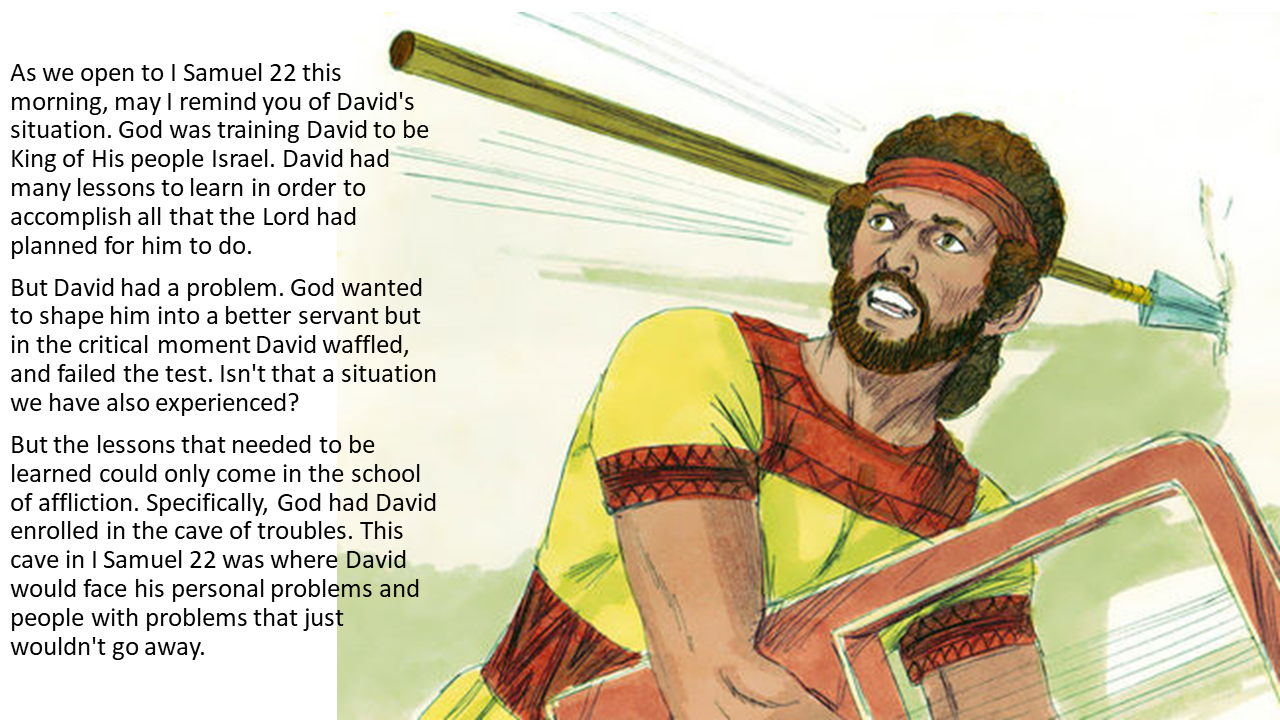
As we open to I Samuel 22 this morning, may I remind you of David’s situation. God was training David to be King of His people Israel. David had many lessons to learn in order to accomplish all that the Lord had planned for him to do.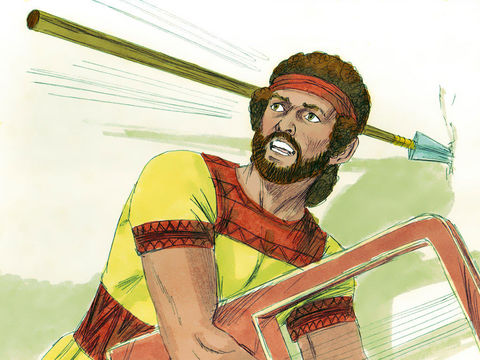
But–David had a problem. God wanted to shape him into a better servant but in the critical moment David waffled, and failed the test. Isn’t that a situation we have also experienced?
But the lessons that needed to be learned could only come in the school of affliction. Specifically, God had David enrolled in the cave of troubles. This cave in I Samuel 22 was where David would face his personal problems and people with problems that just wouldn’t go away.
Now, where had David just arrived from when he entered the Cave at Adullam? David was fleeing from Saul. Remember that all this trouble in David’s life started when God took the kingdom from Saul because he refused to live by the new heart God had given him.
God then gave the kingdom to David because David was “a man after [God’s] own heart” (1 Sam. 13:14). David pleased God’s heart because God pleased David’s heart. “I will give thanks to the Lord with all my heart,” he sang (Ps. 9:1).
David’s deepest desire was, “Let the words of my mouth and the meditation of my heart be acceptable in Thy sight, O Lord, my rock and my Redeemer” (Ps. 19:14).
David prayed, “Examine me, O Lord, and try me; test my mind and my heart” (Ps. 26:2).
And, when God told David, “Seek My face,” David’s heart replied, “Thy face, O Lord, I shall seek” (Ps. 27:8).
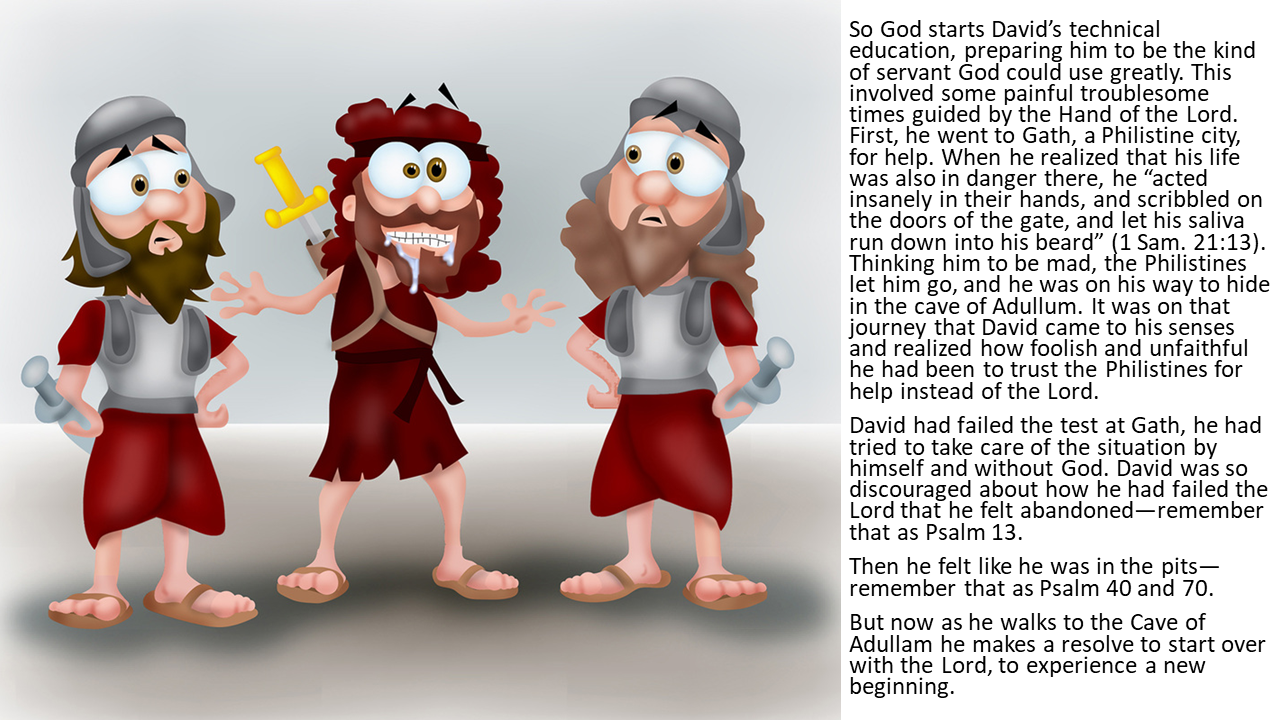
So God starts David’s technical education, preparing him to be the kind of servant God could use greatly. This involved some painful troublesome times guided by the Hand of the Lord. First he went to Gath, a Philistine city, for help. When he realized that his life was also in danger there, he “acted insanely in their hands, and scribbled on the doors of the gate, and let his saliva run down into his beard” (1 Sam. 21:13). Thinking him to be mad, the Philistines let him go, and he was on his way to hide in the cave of Adullam. It was on that journey that David came to his senses and realized how foolish and unfaithful he had been to trust the Philistines for help instead of the Lord.
David had failed the test at Gath, he had tried to take care of the situation by himself and without God. David was so discouraged about how he had failed the Lord that he felt abandoned—remember that as Psalm 13.
Then he felt like he was in the pits—remember that as Psalm 40 and 70.
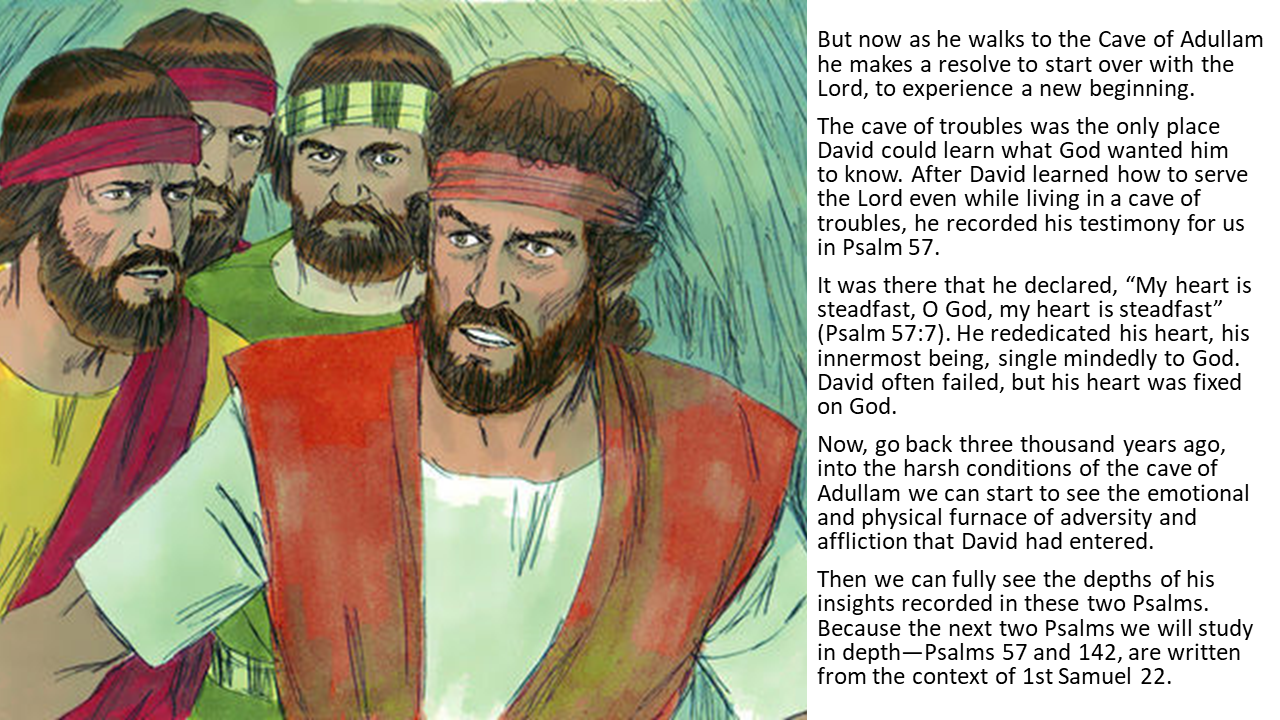
But now as he walks to the Cave of Adullam he makes a resolve to start over with the Lord, to experience a new beginning.
The cave of troubles was the only place David could learn what God wanted him to know. After David learned how to serve the Lord even while living in a cave of troubles, he recorded his testimony for us in Psalm 57.
It was there that he declared, “My heart is steadfast, O God, my heart is steadfast” (Psalm 57:7). He rededicated his heart, his innermost being, single-mindedly to God. David often failed, but his heart was fixed on God.[1]
Now, go back three thousand years ago, into the harsh conditions of the cave of Adullam we can start to see the emotional and physical furnace of adversity and affliction that David had entered.
Then we can fully see the depths of his insights recorded in these two Psalms. Because the next two Psalms we will study in depth—Psalms 57 and 142, are written from the context of 1st Samuel 22. Stand/pray
- 1 Samuel 22:1-4 David therefore departed from there and escaped to the cave of Adullam. So when his brothers and all his father’s house heard it, they went down there to him. 2 And everyone who was in distress, everyone who was in debt, and everyone who was discontented gathered to him. So he became captain over them. And there were about four hundred men with him. 3 Then David went from there to Mizpah of Moab; and he said to the king of Moab, “Please let my father and mother come here with you, till I know what God will do for me.” 4 So he brought them before the king of Moab, and they dwelt with him all the time that David was in the stronghold.
 One truth gripped my heart the longer I studied this passage—this event is so relevant to our world today.
Often we are struck with the question in our minds–does God have any insights for me a 21st century believer faced with such challenges at work and at school? In other words, how do you make it in the classroom and workplace of America today?
- MINISTRY KEY: David found and wrote down how God helped him to minister to these desperate men. The group that came to live and work around him were so representative of what the culture around us is all about. They were distressed, drowned by debt, and discontented with life. Isn’t that an apt description of an average American these days? And as we find in Psalm 57, David was able to minister to them.
- PERSONAL KEY: David also learned how to not get his life and emotions dragged down by those around him. As we read these verses note the emotional condition of everyone that joined up with David. They were a very needy group. And in all their need, they invaded the life of someone just coming out of the pits. It was just the right recipe for a relapse by David into despair and a return into the pits. But the good news is—that didn’t happen, and the reason why is just what we are going to learn from God’s Word.
So let’s go to the place where David learned to live in the midst of troubled people. Three types of men came: those who were in distress, those who were in debt, and those who were discontented.
Those Who Were in Distress
So what kind of distress did these men who came to David face? Deep distress! How deep, you may wonder? We can learn so much from the words that God inspired David to use to describe the condition of these hundreds of men surrounding him at this time.
The first word is those in distress (Hebrew word number 4689 matsowq)means squished and trapped and unable to escape. Here is an expansion on what that word means from other parts of the Bible.
- Distressed in the Old Testament is used for being at the end of your rope, feeling that death is knocking at your door, and no hope or help is possible. Deuteronomy 28:53-57
- Distressed in the Old Testament is also a condition of deep sadness that can happen to even very strong believers like Ezra. Psalm 119:143 Trouble and anguish have overtaken me, Yet Your commandments are my delights.
- Distressed in the Old Testament, in ordinary use it stands for an unusually hopeless condition when people do things they would never do at any other time, but are willing to do—because they are in such distress. Jeremiah 19:9
Satan wants us to despair, feel abandoned, and give up. David found, as we can–that his soul was kept safely in the arms of the Lord to Whom he had fled for refuge.
- Hebrews 4:15-16 For we do not have a High Priest who cannot sympathize with our weaknesses, but was in all points tempted as we are, yet without sin. 16 Let us therefore come boldly to the throne of grace, that we may obtain mercy and find grace to help in time of need.
Those Who Were in Debt
The Hebrew word for those in debt describes those who are hopelessly in debt. (Hebrew word number 5378 nasha means ‘money lent at usury’)
In Saul’s day, many men in debt were in danger of being sold into slavery. But before they could be taken into slavery, they ran off and joined up with David. That is the context of this passage. We have a similar problem facing us today as Americans.
We are surrounded by the pressures that our debt driven society heaps upon us. Competition, rivalry, discontentment, pride, and greed all combine to make Americans work long hours, multiple jobs—and still not have all they want. As a nation we are flooded worst than New Orleans was with water—with overwhelming debt! And the toll of the mental, physical, and emotional pressures and stresses we bear are mounting each day.
The National Public Debt that each of us as citizens of the USA collectively owe stood at $ 7,918,009,471,434.33 yesterday.
The US population on Saturday stood at: 295,734,134
That amounts to $26,774.08 each of us here this morning—man, woman, and child owes to our creditors mostly foreign investors. That means each of us are probably hopelessly in debt—when you combine personal and public debt!
So why don’t you pay your share? Well, most of us can’t pay; we are in debt. However, we all owe a greater debt that merely the dollars of the National Debt.
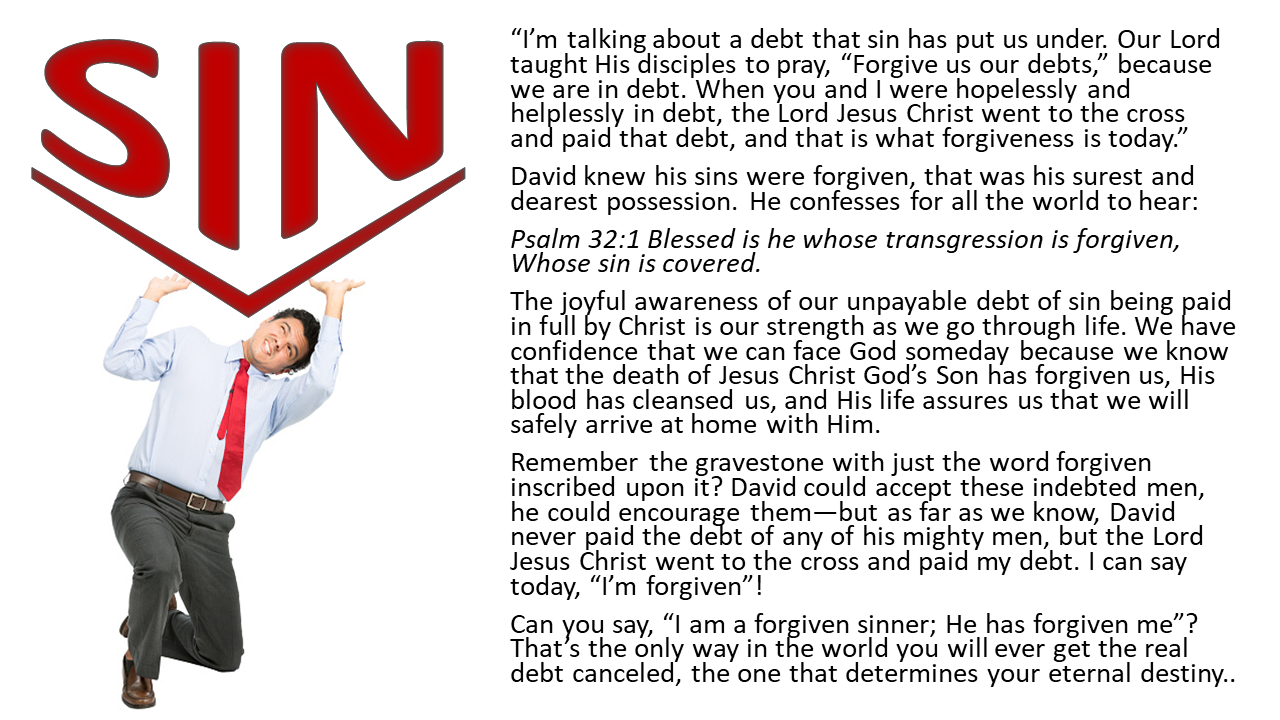
“I’m talking about a debt that sin has put us under. Our Lord taught His disciples to pray, “Forgive us our debts,” because we are in debt. When you and I were hopelessly and helplessly in debt, the Lord Jesus Christ went to the cross and paid that debt, and that is what forgiveness is today.” [2]
David knew his sins were forgiven, that was his surest and dearest possession. He confesses for all the world to hear:
- Psalm 32:1 Blessed is he whose transgression is forgiven, Whose sin is covered.
The joyful awareness of our unpayable debt of sin being paid in full by Christ is our strength as we go through life. We have confidence that we can face God someday because we know that the death of Jesus Christ God’s Son has forgiven us, His blood has cleansed us, and His life assures us that we will safely arrive at home with Him.
Remember the gravestone with just the word forgiven inscribed upon it? David could accept these indebted men, he could encourage them—but as far as we know, David never paid the debt of any of his mighty men, but the Lord Jesus Christ went to the cross and paid my debt. I can say today, “I’m forgiven”!
Can you say, “I am a forgiven sinner; He has forgiven me”? That’s the only way in the world you will ever get the real debt canceled, the one that determines your eternal destiny..

Those Who Were Discontented
Then the third group—those who were discontented—came to David. They were bitter of soul, discontented with life. Many in Israel who were attempting to make an honest living saw the injustice of Saul’s reign, saw the way things were going, and one day dropped their tools, left it all, and went out to join up with David. So many millions of people across our land and around the world wake up each day to a world they want changed. They feel hopelessly able to have and do what they long for. They spend their days longing to be somewhere else, do something else, or have something else. They live lives of growing discontent and desperation as time passes them by.
The Hebrew word for the discontented is actually the word for bitterness of the soul. Everyone who came to David had some poison of bitterness ravaging their soul. (Hebrew word number 4751 mar means ‘bitter’)
What a picture of the world we live around these Scriptural scenes portray. The word discontented or literally ‘bitter of soul’
- LIKE ESAU WHO LOST IT ALL AND WAS BITTERLY DISCONTENTED WITH LIFE. Genesis 27:34-35 When Esau heard the words of his father, he cried with an exceedingly great and bitter cry, and said to his father, “Bless me—me also, O my father!” 35 But he said, “Your brother came with deceit and has taken away your blessing.”
- LIKE THE POISONED WATERS OF MARAH THAT BITTERLY DISAPPOINTED THE THIRSTY ISRAELITES. Exodus 15:23 Now when they came to Marah, they could not drink the waters of Marah, for they were bitter. Therefore the name of it was called Marah.
- LIKE THE WATER OF THE CURSE FOR INFIDELITY THAT SPRANG FROM THE BITTERLY SUSPICIOUS AND JEALOUS HUSBAND OF AN UNFAITHFUL WIFE. Numbers 5:18 Then the priest shall stand the woman before the Lord, uncover the woman’s head, and put the offering for remembering in her hands, which is the grain offering of jealousy. And the priest shall have in his hand the bitter water that brings a curse.
- LIKE THE HOPELESSNESS OF BITTER TEARS OVER CHILDLESSNESS FOR HANNAH. 1 Samuel 1:10 And she was in bitterness of soul, and prayed to the Lord and wept in anguish.
- LIKE THOSE ENRAGED BY FEAR. 2 Samuel 17:8 For,” said Hushai, “you know your father and his men, that they are mighty men, and they are enraged in their minds, like a bear robbed of her cubs in the field; and your father is a man of war, and will not camp with the people.
- LIKE THOSE AWAITING EXECUTION THAT HAVE NO HOPE. Esther 4:1 When Mordecai learned all that had happened, he tore his clothes and put on sackcloth and ashes, and went out into the midst of the city. He cried out with a loud and bitter cry.
- LIKE WORDS THAT ARE SPOKEN TO CAUSE INTENTIONAL WOUNDING AND PAIN. Psalm 64:3 Who sharpen their tongue like a sword, And bend their bows to shoot their arrows—bitter words,
All over the world today there are bitterly discontented people—sick of life, hopeless, and injuring those around them. We are really heading towards some dark days as Christ’s words foretold in Matthew 24. Because of the corruption and injustice of the world, a great many people are seeking a change. Are you discontented today?
These desperate men after listening to David became his mighty men who led his army to victory for 40 years! Personally, I think the greatest period in the life of David was the time when he was gathering mighty men around him[3].
If you stop to think about it—this is exactly what Christ is doing today. Jesus Christ is sending out the invitation. He is gathering a group of desperate sinners, hopelessly in debt because of sin, distressed with life, and discontented to the point of despair—and giving us life that is forgiven, and filled with His abundant joy.
Where are you today? Still distressed, in debt and discontent? Or have you come to the One who died for you, offers to save you—and gives life that is real and abundant?
Are you forgiven? Do you know the security of fleeing to Christ as your personal refuge? If not do so today!
God forgave my sins in Jesus Name…sing that with me as we prepare to commune with our Savior.
 One of the times God had me enrolled me in a cave of troubles started thirty years ago as I entered Bible college. I volunteered to drive an evangelistic team on weekends that traveled out from the school. My car had eight seats and that was the draw—but it was a 1973 Plymouth station wagon with over a hundred and sixty thousand miles on it.
I was in training for the ministry and was always asking the Lord to teach me what I needed to know to serve Him better. Little did I know way back then, that He would send the lessons through a series of troubles. For the entire year my car would break down in the most troublesome ways, and with the most wonderful lessons in God’s care.
One weekend we were headed to Goldsboro, NC just five hours from school. We left in plenty of time to start the meetings by 7 PM. A half an hour outside Goldsboro the car died. All the lights went black as the engine stopped, and we rolled to the edge of the interstate. Within five minutes a state trooper pulled up, assessed the situation and told us we had to get the car towed off the highway.
It was a bad section with not enough shoulder room for all the semis that filled that stretch of highway. Because it was a highway the tow truck had to be a double hook to secure the car for highway towing. All that to say it cost much more than we had or could spend on towing as we piled into the tow truck.
The state trooper gave the rest of the team a ride to the service station. He had stayed long enough to watch all eight of us on our knees around the back of the wagon. The team had knelt in prayer with me before being picked up for a belated arrival for the services that night.
Just before the trooper left he came up to me and said, “I just wanted to help a little” and handed me $10 out his window as he drove away.
So an hour after the car died I was all alone in a service station somewhere in the dark NC hills. The mechanic soon found me and reported it was an electrical problem and it would be expensive. The towing was already $75 which we didn’t have. Usually the church paid for the gas when we arrived and then gave us enough to get home on after the meetings.
As I sat in the smoky waiting room reading my Bible and praying while they worked on the car, I thought what was the Lord doing? We were committed, focused, and serving. We were only doing this trip to help share the gospel with lost and needy ones in a far off place.
Why would this have to happen to us? I knew that I could borrow the money, then pay it back over the weeks ahead, but that would curtail my ability to transport the team. None of it made sense at that moment.
After two more hours I got a call from the team that the meetings went well and they would send someone to get me if needed. Just then the service station owner came up. He told me that he had also seen us pray, and had watched the NC State Trooper hand me $10 out the window. So he said that he wanted to help too.
He handed me the bills and said the tow bill, the repair bill and even some gas were his way of helping. Everything was paid for and I could go!
What lesson did the Lord want me to learn? He wanted me to know that when troubles come unexpectedly, He has some powerful lessons for me to learn–lessons that I could only learn from going through difficult situations. It was after this year of troubles that I was prepared for the next area of ministry the Lord had planned for me–going behind the Iron Curtain and having to trust the Lord at all times for everything!
This psalm brings us to another delightful cluster of psalms (56-60) known as the michtam psalms. What does michtam mean? It speaks of that which is substantial, or enduring, or fixed. Michtam literally means “engraven” or “permanent.” This word pictures that which is unmoveable, steadfast, stable and enduring. In Psalm 57:7 when David says, “My heart is fixed,” that is a michtam[4] Fixed is the Hebrew word (3559) kuwn prepare 85, establish 58, ready 17.
- Ezra 7:10 For Ezra had prepared his heart to seek the Law of the Lord, and to do it, and to teach statutes and ordinances in Israel.
- Psalm 37:23 The steps of a good man are ordered by the Lord, And He delights in his way.
- Psalm 40:2 He also brought me up out of a horrible pit, Out of the miry clay, And set my feet upon a rock, And established my steps.
- Psalm 51:10 Create in me a clean heart, O God, And renew a steadfast spirit within me.
- Psalm 112:7 He will not be afraid of evil tidings; His heart is steadfast, trusting in the Lord.
- Psalm 119:133 Direct my steps by Your word, And let no iniquity have dominion over me.
- Proverbs 16:3 Commit your works to the Lord, And your thoughts will be established.
- Proverbs 16:9 A man’s heart plans his way, But the Lord directs his steps.
Remember that these michtam psalms have to do with that which is permanent and enduring, that which is substantial and lasting.
- My heart is fixed, O God, my heart is fixed: I will sing and give praise [Ps. 57:7].
David is saying—
- I’m not going back to trying to rescue myself like I did in Gath (Psalm 34) and miserably failed.
- I’m not going back to refusing to look at You and feeling abandoned (Psalm 13) and suffering through those long dark days.
- I’m not going back to laying in the mud of my sin and despair (Psalm 40, 70) in the pits of life.
 No, my heart is fixed. I am holding on from now on to You!
- When Troubles come—David pulls over and calls for help from the Lord. HIS HOPE IS IN THE LORD. (v. 1-3) In his earlier life we see David in great distress. David’s problems in I Samuel 24 are the backdrop as he searches for strength in Psalm 57. He finds it in God Himself. Remember, he is in a weak time in life. This is when depression often hits.
- Psalm 57:1-3 Be merciful to me, O God, be merciful to me! For my soul trusts in You; And in the shadow of Your wings I will make my refuge, Until these calamities have passed by. 2 I will cry out to God Most High, To God who performs all things for me. 3 He shall send from heaven and save me; He reproaches the one who would swallow me up. God shall send forth His mercy and His truth.
- Then David waits for the Tow Truck. HIS STRENGTH COMES FROM THE LORD. (v. 1-11) Note that David talks about God seven times, That is a complete set. He is saying that God is enough. God and God alone is enough. He knew, and trusted, and rested in—the God who is enough!
- Psalm 57:1-11 Have mercy on me, O God, have mercy on me, for in you my soul takes refuge. I will take refuge in the shadow of your wings until the disaster has passed. I cry out to God Most High, to God, who fulfills his purpose for me. He sends from heaven and saves me, rebuking those who hotly pursue me; Selah God sends his love and his faithfulness. I am in the midst of lions; I lie among ravenous beasts — men whose teeth are spears and arrows, whose tongues are sharp swords. Be exalted, O God, above the heavens; let your glory be over all the earth. They spread a net for my feet — I was bowed down in distress. They dug a pit in my path — but they have fallen into it themselves. Selah My heart is steadfast, O God, my heart is steadfast; I will sing and make music. Awake, my soul! Awake, harp and lyre! I will awaken the dawn. I will praise you, O Lord, among the nations; I will sing of you among the peoples. For great is your love, reaching to the heavens; your faithfulness reaches to the skies. Be exalted, O God, above the heavens; let your glory be over all the earth. (NIV)
- Sitting in the waiting room he grows. HIS DISCOVERIES ARE NOW ABOUT THE LORD. (v. 1, 5, 7, 11) For emphasis, note how David doubles three aspects of God’s nature. This is what David finds: God is Gracious, God is Steadfast, God is Praise Worthy. With this truth to hold onto, he testifies that it works. And he gets his focus off his troubles. He went beyond his cave world and onto Lord!!
- Psalm 57:1 Have mercy on me, O God, have mercy on me, for in you my soul takes refuge. I will take refuge in the shadow of your wings until the disaster has passed. Psalm 57:5 Be exalted, O God, above the heavens; let your glory be over all the earth. And in v.7 My heart is steadfast, O God, my heart is steadfast; I will sing and make music. And in v. 11 Be exalted, O God, above the heavens; let your glory be over all the earth. (NIV)
- Finally David drives off from the situation deeply blessed for the hard time. HIS FOCUS IS ON THE LORD. (v. 5, 11) Finally David gets God’s perspective that lifts him above the storm of Saul’s murderous pursuit, above the din of hundreds of needy and desperate men—and into the peaceful calm around the Throne of God! More than any self pity or gloom, he clings to the Lord. As a New Testament writer Paul reminds us:
- Romans 5:1-5 Therefore, having been justified by faith, we have peace with God through our Lord Jesus Christ, 2 through whom also we have access by faith into this grace in which we stand, and rejoice in hope of the glory of God. 3 And not only that, but we also glory in tribulations, knowing that tribulation produces perseverance; 4 and perseverance, character; and character, hope. 5 Now hope does not disappoint, because the love of God has been poured out in our hearts by the Holy Spirit who was given to us.
Some practical steps to overcome loneliness are these:
- Deal with sin. Be sure that there is no unconfessed or unforsaken sin left in your life to give the Devil a place in your life. (Eph. 4:27)
- Share your burdens. Clearly tell the Lord all your fears, all your struggles, all your pains—remember that He knows our frame that we are dust. (Psalm 103)
- Abandon all self-pity. Constant self-sorrow is a one way ticket to loneliness. Self-pity denies we have a responsibility to deal with our emotions and thus frustrates any cure. As Jesus said, coming after Him means we deny our self (Luke 9:23).
[1] MacArthur, John F., The MacArthur New Testament Commentary, (Chicago: Moody Press) 1983.
[2] McGee, J. Vernon, David: A Man After God’s Own Heart, (Nashville, TN: Thomas Nelson Inc.) 2001, c2000.
[3] McGee, J. Vernon, David: A Man After God’s Own Heart, (Nashville, TN: Thomas Nelson Inc.) 2001, c2000.
[4]McGee, J. Vernon, Thru the Bible with J. Vernon McGee, (Nashville: Thomas Nelson Publishers) 2000, c1981.
Slides




Check Out All The Sermons In The Series
You can find all the sermons and short clips from this series, Christ our Refuge here.
Looking To Study The Bible Like Dr. Barnett?
Dr. Barnett has curated an Amazon page with a large collection of resources he uses in his study of God’s Word. You can check it out here.