
If the video above is not available, here are two other ways to view:
Esau – The Power of Little Choices
060305AM
DSS-11
Hebrews 12
Transcript
.jpg)
Let’s open our Bibles to Hebrews chapter 12. As Mark was playing and when before the throne, I’ll sing, I’ll sing, I think about the blessings of communion. Communion is when we celebrate our salvation. When we celebrate that we are delivered from the wrath we deserve, that Jesus Christ accomplished by one sacrifice forever everything that’s ever needed, that we don’t have to add to it, that we don’t need to be good enough to deserve it because you couldn’t and I couldn’t, and we never can. And so, we just believe and trust in that sacrifice. But sometimes that can get old, and sometimes we can grow up around that, and some can even be exposed to that their whole life and never embrace Christ. And that’s what we’re going to look at this morning. We’re going to look at the little decisions that one individual made four thousand years ago and look at the continuing effect that those little decisions had.
.jpg)
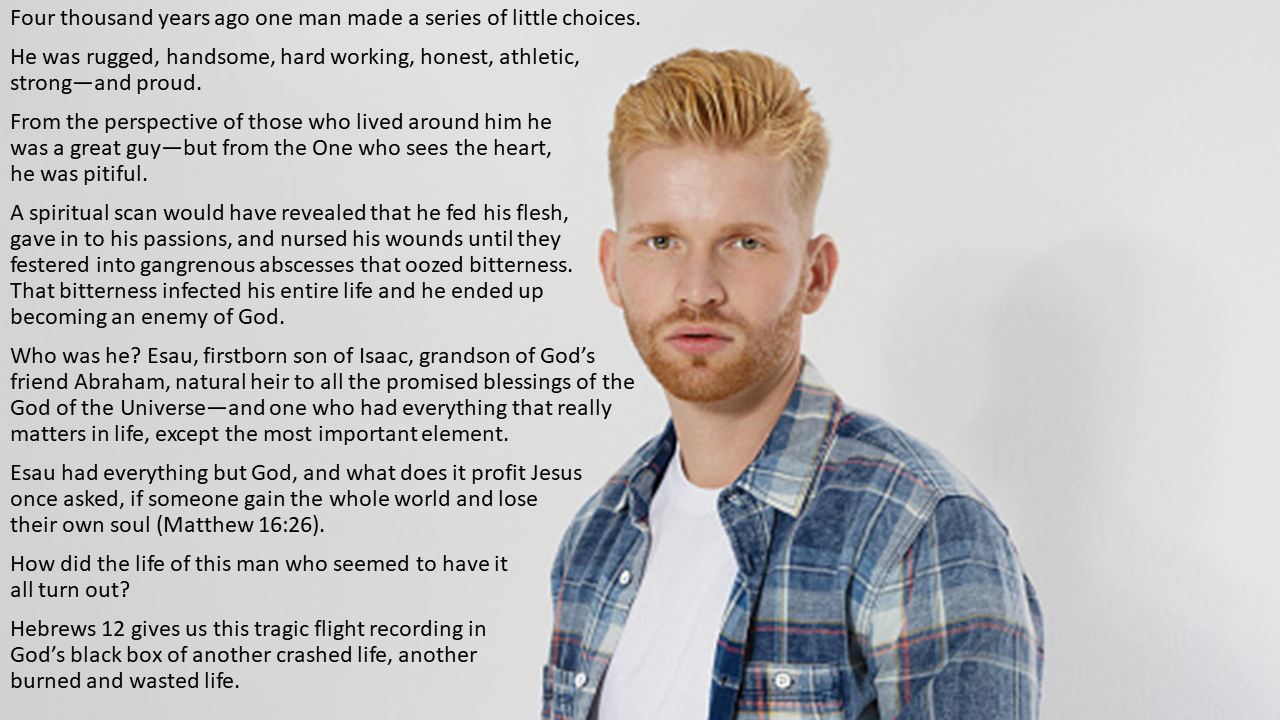
Four thousand years ago, one man made a series of little choices. The man we’re going to see in Hebrews 12 was rugged, he was handsome, he was hardworking, he was honest, he was athletic, he was a sportsman, he was strong, he was also a very proud man. A man who was so proud, he did not need God, and that’s a dangerous place to be. From the perspective of those who lived around him, he was a great guy, but from the One who sees the heart, he was pitiful and wretched. A spiritual scan, if there was such a thing as a mobile kind of, there’s a CAT scan. If we had a heart scan or a spirit scan, a spiritual scan, if you’d have put this fellow in that tube and scanned him, it would’ve revealed that he was feeding his flesh, not his spirit, that he was giving in to his passions, that he was nursing his wounds until they festered into gangrenous abscesses that oozed out of his life bitterness. And as we’ll see in Hebrews 12, that bitterness infected his entire life and he ended up becoming God’s enemy. And that’s a very, very terrible Revelation from Hebrews 12.
Who was he? He was Esau, the firstborn of Isaac. This is the grandson of God’s friend Abraham in Hebrews 12, and he is the natural heir to all the promised blessings of God. The God of the universe had promised to his grandfather this inheritance which had passed to the firstborn son—the son of promise at least, the second-born but chosen by God—Isaac, and now the firstborn of Isaac was Esau. He was the natural heir to all the promises and blessings of the God of the universe, and that’s who we’re going to read about in our text this morning. He was one who had everything that really matters in life. He had everything except the most important thing, which is God. And from his perspective, he had the blessings, the promises. He had the inheritance. He had the possessions. He had the land stretching before him, and the only thing that he didn’t have or want was the God who was providing those things. Esau had everything but God. And what does it profit, Jesus once asked, if someone gains the entire world and yet loses their own soul? Matthew 16:26. How did the life of this man who seemed to have it all turn out? What does a life turn out like of someone that has everything?
In fact, as I was, I picked up Julia at the Master’s College this week, and we were on our way down and I took the circuitous way to get to the airport. And we actually drove up over, I’ve never done this before in my life, we drove up over the top of Hollywood Hills and went from the top down like this all the way down and then wove down to Burbank. And as we drove, we went by all these places that were marked. We went by a place that is the home of Jennifer Aniston and Brad Pitt, or used to be, and then we went by the home of I can’t even remember all of them. We were just going down, and I looked at all these things. And I thought, in the world’s eyes, these people have everything. What does the life of someone that has everything but God end up like? That’s what Hebrews 12 is all about. And we are going to see the tragic flight recording in God’s black box of another crash and life that was burned because it wasn’t lived for Jesus Christ.
.jpg)
Let’s stand together, and I’m going to read the entire twelfth chapter, and you follow along in your Bibles, and then we will catch up with Esau as we get down to the twelfth verse. Therefore we also, since we are surrounded by so great a cloud of witnesses—that’s chapter 11—let us lay aside every weight, and the sin which so easily ensnares us, and let us run with endurance the race that is set before us, looking unto Jesus, the Author and Finisher of our faith, who for the joy that was set before Him endured the cross, despising the shame, and has sat down at the right hand of the throne of God—signifying the completion of everything ever needed for our salvation. Verse 3, for consider Him who endured such hostility from sinners against Himself, lest you become weary and discouraged in your souls. You have not yet resisted to bloodshed, striving against sin. And you have forgotten the exhortation which speaks to you as to sons: my son, do not despise the chastening of the LORD, nor be discouraged when you are rebuked by Him; for whom the LORD loves he chastens, and scourges every son whom He receives.
Verse 7, if you endure chastening, God deals with you as with sons, for what son is there whom a father does not chasten. But if you are without chastening of which all have become partakers, then you are illegitimate and not sons. It’s very sobering verse if you go through life. Saying you’re saved and God never interferes with you, and you just live for yourself and just go through life with sin here and there and undealt with what it says on the base of the Word of God. If you and I are never chastened, spanked, disciplined, pulled up short by God for our life, then He says, then you are illegitimate and not sons. Verse 9, furthermore, we have had human fathers who corrected us, and we paid them respect. Shall we not much more readily be in subjection to the Father of spirits and live? For they indeed for a few days chastened us as seemed best to them, but He for our profit, that we may be partakers of His holiness. Now no chastening seems to be joyful for the present, but painful; nevertheless, afterward it yields the peaceable fruit of righteousness to those who have been trained by it.
.jpg)
Now he’s going to talk about someone who is never chastened, someone whose life was never interrupted, and that starts in verse 12 with Esau. Therefore, strengthen the hands which hang down, and the feeble knees, and make straight paths for your feet, so that what is lame may not be dislocated, but rather be healed. Pursue peace with all people, and holiness, without which no one will see the Lord: looking carefully lest anyone fall short of the grace of God; lest any root of bitterness springing up cause trouble, and by this many become defiled. Verse 16, which was the heart of what we’re looking at this morning. Lest there be any fornicator or profane person like Esau, who for one morsel of food sold his birthright. For you know that afterward, when he wanted to inherit the blessing, he was rejected, for he found no place for repentance, though he sought it diligently with tears. Very ominous warning there.
Verse 18, for you have not come to the mountain that may be touched and that burned with fire, and to blackness and darkness and tempest, and the sound of a trumpet and the voice of words, so that those who heard it begged that the word should not be spoken to them anymore. (For they could not endure what was commanded: and if so much as a beast touches the mountain, it shall be stoned or shot with an arrow. And so terrifying was the sight that Moses said, I am exceedingly afraid and trembling.)
.jpg)
But you have come to Mount Zion and to the city of the living God, the heavenly Jerusalem, to an innumerable company of angels, to the general assembly and Church of the Firstborn who are registered in Heaven, to God the Judge of all, to the spirits of just men made perfect, to Jesus the Mediator of the new covenant, and to the blood of the sprinkling that speaks better things than that of Abel.
See that you do not refuse Him who speaks. For if they did not escape who refused Him who spoke on Earth, much more shall we not escape if we turn away from Him who speaks from Heaven, whose voice then shook the Earth; but now He has promised, saying, yet once more I shake not only the Earth, but also Heaven. Now this, yet once more, indicates the removal of those things that are being shaken, as of things that are made, that the things which cannot be shaken may remain. Therefore, since we are receiving a kingdom which cannot be shaken, let us have grace, by which we may serve God acceptably with reverence and godly fear. For our God is a consuming fire.
Let’s bow before Him this morning. Father in Heaven, as we briefly look at the life of Esau and see the implications of what a godless life ends up producing, I pray that we would be sobered. And then as we see what Your wrath poured out against sinners accomplishes, may we understand how grateful we should be that Calvary covers it all. Our sins, our disobediences, all of our iniquities, that You paid for them. You are not paying for them; they are already paid for once and for all. And that’s what we celebrate this morning, that our justification has been accomplished, that Your redemption is complete and all we need to do is believe and rest trusting in what You have already accomplished. May this be a great celebration but may this time in Your Word be a preparation of our hearts, examining ourselves, lest we also for any reason do not appropriate Your grace that You offer to us this morning. In the precious name of Jesus, we ask for You to open our hearts to Your Word and our souls and spirits to worshiping You. In the name of Jesus, we pray, amen.
.jpg)
You may be seated, and as you’re seated, I want to remind you about Esau. Esau is a man, as we look back at four thousand years ago, that had every conceivable blessing offered to him. But yet, as we examine closely the heart of Esau, which God opens for us, we have open heart surgery going on here. We have God revealing his heart in verses 15 through 17. As God does that, He does a biopsy and He shows that there is a cancer growing inside of the very core of the being of Esau. That cancer is growing, it’s unseen, and it’s unchecked. In verse 15, it says in the NIV that no one misses the grace of God. Esau missed the grace of God. In verse 16, it says He was sexually immoral and godless. In verse 17, the NIV also says he could bring about no change of his mind. It was too far, too long, too much. He had resisted God’s grace too greatly. He had hardened himself, and he could not bring about a change. The New American puts it this way in verse 15, he comes short of God’s grace. Verse 16, he was immoral and godless. And in verse 17, he was rejected, for he found no place for repentance. Those are very sobering words, and that’s the biopsy report.
.jpg)
Now I want you to turn back with me to the actual life. This is the report from the New Testament but go back to Genesis 25 with me. I want to take you back four thousand years in history. This is the only accurately recorded record of life on this planet that’s flawless four thousand years ago. Now, the Bible goes far before this. It goes back to the beginning. It goes all the way to the end. The Bible is the only perfectly flawless record that was breathed out by God, and it’s what we need to know to see God’s perspective on the past. And so, four thousand years ago, we see Esau in Genesis 25 and verse 24. In the twenty-fourth verse, he’s the firstborn son of Isaac. As the firstborn son, Esau began with every imaginable opportunity and blessing. The world lay before him; the God of the universe was behind him, backing him as that firstborn son, inheriting the promises of God. He lived with every earthly success. He died surrounded by an abundance of everything but God in his life. If you read the passage, he was phenomenally successful in every way. He had all these children and possessions, and he had his own secure inheritance, an amazing man. Esau was proud, and even though he was proud, and even though he was profane, and even though he was immoral, as Hebrews explained to us, God allowed him to live. Even though he rejected God, God allowed him to live. God allowed him to have a large family. God allowed him to have many descendants. Now, that is an example of the goodness of God, that Esau who rejected God, God did not immediately incinerate him.
A lot of people think that because there’s no immediate response from God for a choice they make that it’s okay, that He accepted, a kind of argument of silence. If God doesn’t smack me, it must be not as bad as I thought. And that’s not how it is, because God is so just, no sin goes unpunished. It’s just, He’s not immediate oft times in the disposition of His wrath against sin. Without the insight we got from Hebrews 12, we would not know all that was going on inside of Esau’s heart.
Remember, if you would’ve lived by him, you would’ve wanted to be his friend. Nobody would’ve wanted weaselly Jacob! This guy was a kind of an apron-wearing, the stay in the house and cook, and pale skin, non-athletic, a weaselly guy that was always trying to get his own way. That wasn’t Esau. Esau was the suntanned, muscular, all-American, the hunting guy. The one that you, if you needed help, you’d call to Esau. And that’s how we would’ve looked at him. But God was looking at his heart, and that’s why it says that Esau was not only immoral; Hebrews 12 tells us he was profane or God-less, godless. Now, we’re going to see his godlessness in just a moment because he had no ethics, or faith, or scruples, or reverence; he had no regard for the good, the truthful, divine. He was totally worldly. Living in the covenant family, living with those who most knew God on the planet. His grandfather was God’s personal friend, Abraham. His father was this revered heir of the promise, and heir is the grandson, Esau. And he was godless. He was totally secular, totally profane. That’s why the writer of Hebrews tells us to see to it that there would be no one contaminating Christ’s body, no immoral or godless person like Esau. And that’s evident by the little choices he makes.
Let me just point out some of the choices. Keep reading because we’re going to go down and look at the choices that he made, especially when he gets rid of his covenant promise. It’s the last verse of the twenty-fifth chapter. And if you look at that, it says in verse 34 that Jacob gave Esau bread and stew and lentils. I don’t know if I would’ve wanted that, sounds too healthy for me. And he ate it and drank, and arose, and he went his way. And look at this: thus, Esau despised his birthright. We’re going to examine that in a moment, but what we’re seeing according to Hebrews 12. Is that at that moment he persisted in a profane, God-pushing-out-of-his-life attitude that he wanted God not to be there. And he says, I don’t want this birthright. By the way, what was the birthright? The birthright was his right to be the covenant continuer, the one who would continue this relationship with God, that he would continue this knowing God, this talking to God, this being His man in the world, the heir of all those promises that God gave, and he said, I don’t want that. In fact, I’d rather have a bowl of soup than a relationship with God. Very serious, yet it goes on around us all the time.
.jpg)
That reminds me of a song from a generation ago written about Esau. Let me just read you the words that a songwriter wrote about Hebrews 12:15 to 17. It says, someday you’ll hear God’s final call to you to take His offer of salvation true. This could be it, my friend, if you but knew. God’s final call; God’s final call. How can you live another day in sin? Thinking some day in Christ you will begin. See, Esau said, later. See, it says in the book of Hebrews that later he changed his mind. Later Esau decided God might be important to have in his life, but he could find no place to change his mind as the NIV puts it. He could find no place, as the new King James put it, of repentance. He couldn’t. He had gone too far, as the songwriter says. If you reject God’s final call of grace, you’ll have no chance your footsteps to retrace. All hope will then be gone and doom you’ll face. O hear His call; O hear His call.
.jpg)
But I remind you how patient God was with Esau. God is so patient. Esau was given every imaginable opportunity and blessing. He lived with continuous earthly successes. Even though he was totally profane and godless, he had every earthly success. In fact, if I just list for you some of his descendants, it’s amazing. He died surrounded by an abundance of everything except God. And even though he was proud, even though he was profane, even though he was immoral, God allowed all this. In fact, the godless, profane Esau’s family line lived on till the time of Jesus Christ. Did you know that? All these people are doing their family trees. How would you like to live four thousand years ago and have an unbroken succession of descendants, many of whom were very famous for two thousand years? That’s what Esau had. Esau had many famous descendants we see described in the Bible. One was Edom. He was called Edom. The Edomites, the descendants of Esau are the Edomites. Those are his people. Petra, the great rock, red rock rose city of Jordan today are the people of Esau.
That’s not all! The Amalekites that we are looking at, and that’s how we even got here in the life of Saul we’re looking. And I’m going to connect this in a moment that the Amalekites that Saul was to wipe out were Esau’s descendants. Here’s another one, Haman. You remember the time of Esther and Mordecai? He was a descendant of Esau. Haman, the Agagite. How about this one? This one shocked me the most. The most notable and famous of all Esau’s descendants was the evil, godless, immoral, murderous King Herod the Great was a direct descendant of Esau. That’s fascinating. Isn’t it interesting that Esau’s descendant, Herod the Great, met Jacob’s descendant, Jesus Christ? Isn’t it amazing what little choices in our lives produce? And Herod’s son Antipater faced Jesus Christ. Two kings, one through the flesh and sin and Edom and Esau, and the other through promise and faith, the God of the universe, and they face each other. Shows how disparate our endings can be.
.jpg)
That first descendant God wants us to know about is a few chapters to the right of Esau, so go to chapter 36. I want to show you the key to what happens in his life, how he got so far away from God. The grandson of Esau was the great [great] grandson of Abraham, who is the person I want you to focus on briefly. It says in Genesis 36:12, now Timna was the concubine of Eliphaz, Esau’s son, and she bore Amalek to Eliphaz. Now, that’s just a little one of those boring parts of the Bible. In fact, this is in the thirty-sixth chapter, which among theologians is called the Dukes of Edom. It’s one of the most obscure, why is it even in the Bible chapters? I think it’s only there for, the twelfth verse, to tell us that Esau’s grandson was named Amalek, and he became the father of the Amalekites, and you’re going to see why that’s so important as we continue. So, Esau’s grandson was Amalek.
And time continues to pass, and I want you to turn five hundred years. Remember, we started four thousand years ago. Now I want you to go five hundred years to the right in your Bible and go to Exodus 17. Okay? So, in those few pages are five hundred years. Now I want you to see what happened to Esau, vile, profane, fornicatious, immoral, godless, Esau, who has a son, and then that son has a son and his name is Amalek. And then God puts the spotlight for us to see what happens to just one of his descendants, he had many, just one named Amalek. And that’s in Exodus 17:8 through 15, the events that occurred thirty-five hundred years ago. As we have passed from the birth of the Amalekites to the full-blown nation, the Amalekites now are a people, they’re a nomadic race. They inhabit the southern part of Canaan. They didn’t move far from home. They stayed right where Esau planted them, basically, and they just are living there, and they became perennial enemies of the Israelites. They were fearful warriors. In fact, their intimidating presence was one of the reasons the Israelites disobeyed God and didn’t go into the Promised Land back in Numbers. And in Numbers 13, God was bringing them out of Egypt, and they came up to the land, and they saw these fearsome, and they backed away from God and didn’t want to obey Him and had to wander 40 years because of the fearful warriors called the Amalekites that were so, so evil, and wicked, and skillful in warfare. So that’s just a little background for them.
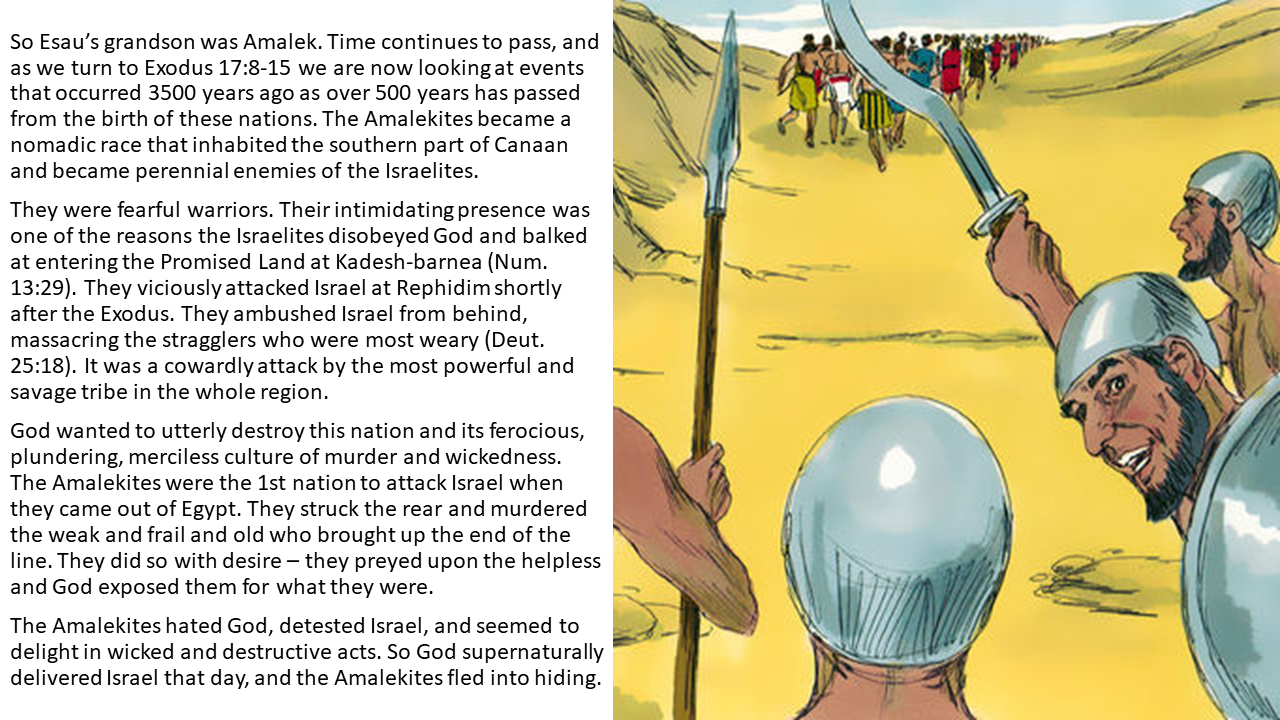
But what we find in Exodus 17 is they viciously attacked Israel at Rephidim. Shortly after the Exodus, they ambush Israel from behind. Now, this isn’t all right here. You have to piece together what it says in Numbers and what it says in Deuteronomy. But specifically in Deuteronomy 25, it tells us that the Amalekites were so evil that they followed, stalked like terrorists, the children of Israel. And they would see the old people and the sick people that couldn’t keep up with the caravan, and gradually the caravan of all the Exodus people were out in front and they were stumbling along. And they’d pick them off from behind and they were just killing the weak and the elderly at the fringes of the camp and stealing and plundering them. Kind of like the lowest desperados is what they were. It was cowardly to attack these weak and elderly people when you are the most powerful and savage tribe in the whole region. And so, these people were showing their heart. The Amalekites hated God and detested Israel. They seemed to delight in wicked and destructive acts.
.jpg)
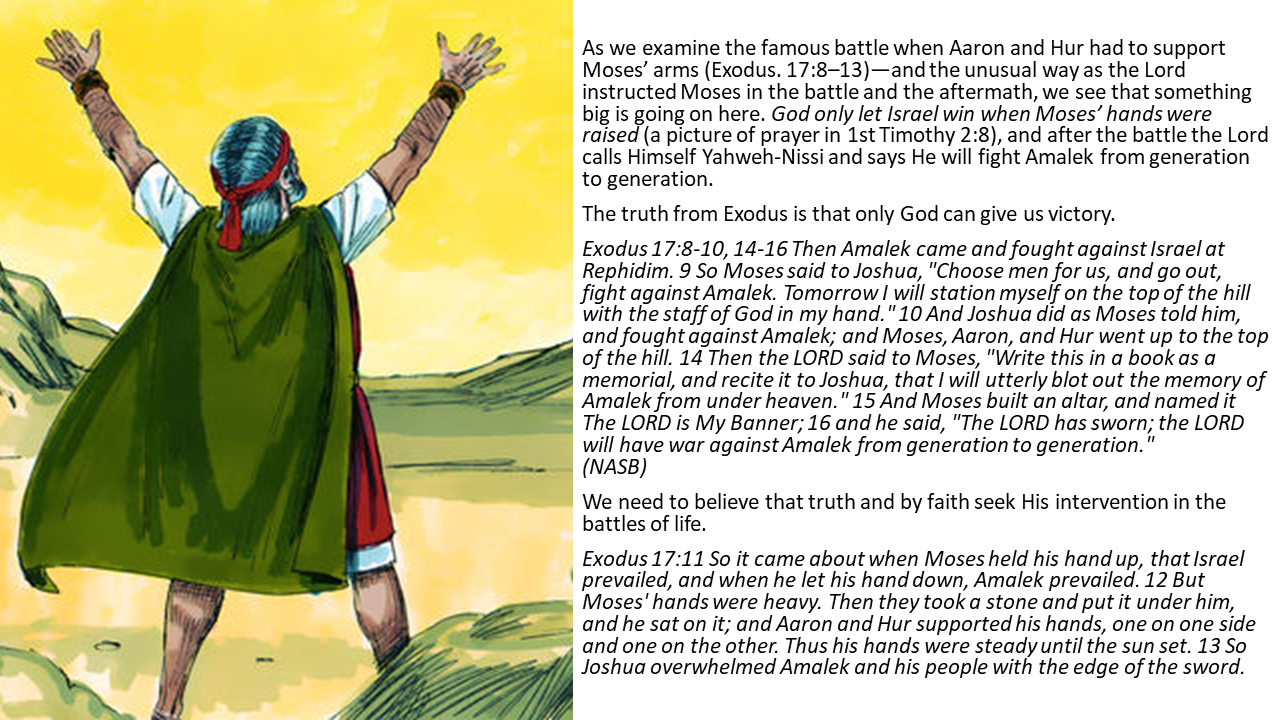
And so, what happens in chapter 17, starting in verse 8? Amalek came and fought with Israel at Rephidim. And Moses said to Joshua, choose some of the men, go out, and fight with Amalek. Now look at this, all of a sudden as you should read this something strange is happening. Instead of going to the command center and working out the strategy with Joshua of how to attack, and come this way, and bring out our best weaponry, look what Moses does. Tomorrow I will stand on top of the hill with the rod of God in my hand. So, Joshua did as Moses said to him and fought with Amalek. And Moses, Aaron, and Hur went to the top of the hill. And so it was, verse 11, when Moses held up his hand, Israel prevailed; and when he let down his hand, Amalek prevailed. But Moses’ hands became heavy; so, they took a stone and put it under him, and he sat on it. And Aaron and Hur supported his hands, one on one side, the other on the other side; and his hands were steady until the going down of the sun. And Joshua defeated Amalek and his people with the edge of the sword. That’s a cute little Sunday school story, isn’t it? Isn’t that an interesting story? Isn’t… we just breeze right by that, but there’s a lesson for us because Amalek is specifically named as a descendant of a godless and profane, fornicatious, not-needing-God man who knew God, Esau. And his descendants met his brother’s descendants and fought wickedly and viciously against them.
Let’s see what’s going on here. Because as we examine the famous battle with Aaron and Hur supporting Moses’ arms, the unusual way the LORD instructed Moses in the battle, in the aftermath, we see something big is going on here. God only let Israel win when Moses’ hands were raised. Now, Paul gives us a little insight into that. In 1 Timothy 2:8, he says, I would that all men everywhere, prayed lifting holy hands. There’s a connection between those hands raised and prayer and seeking God and His power, and His faithfulness, and His might, and that’s what the rod was in Moses’ hand a symbol of, God’s power. The truth from Exodus is that only God can give us victory. It wasn’t the army of Israel. They didn’t know anything about fighting. They were slaves, and farmers, and herdsmen. They didn’t know how to use weapons. The reason that Israel defeated Amalek was not superior tactics. God gave them the victory. So, it’s a simple lesson. Look at verse 11. We need to believe that truth and, by faith, seek God’s intervention. It came about when Moses held his hands up, Israel prevailed. God wanted to utterly destroy this nation of ferocious, plundering, merciless murderers with all their wickedness. And so, God wanted to show He alone could destroy them. They, Israel, was not powerful enough for that.
.jpg)
What’s going on? Basically, it’s this, we’re seeing two things. Sin left unchecked in Esau’s life sired a whole nation of wickedness. That’s one element. The other element is only God can defeat that. That’s the message of chapter 17 of Exodus. In Genesis, Esau despised the blessing. Esau was proud and self-sufficient. He was profane and immoral in a spiritual sense. Esau represents the flesh. His grandson Amalek becomes a biblical illustration of the flesh and the lifelong battle each of us will wage in our flesh. If you look at the continuing story, look at verse 14, this is how we know something big is going on in Exodus 17. After Amalek and the people were defeated with the edge of the sword, the LORD says, Exodus 17:14, to Moses, write this for a memorial in the book—and that’s what you’re holding this morning, of the book that God wrote that has all these important records in it—and recount it in the hearing of Joshua, that I will utterly blot out the remembrance of Amalek from under Heaven. And Moses built an altar and called its name, The-LORD-My-Banner. Verse 16, by the way, that’s Jehovah Nissi if you’re a name of God student. And then look at verse 16, for he said, because the LORD has sworn: the LORD will have war with Amalek from generation to generation. Immediately we know there’s something more going on here than a little nomadic tribe out in the desert that’s sniping on the back edge of the children of Israel because Amalek is cited for us as a direct descendant of Esau, and he keeps popping up. We find him in chapter 15 of 1 Samuel, where we encounter him with Saul. We find him again in the book of Esther, and we find another descendant of Esau trying to kill Jesus Christ at His birth. And his descendants trying to kill the apostles. So, there’s something major going on here.
There’s three conclusions we can draw from Exodus 17. First, God is going to get rid of Amalek. In other words, God is going to get rid of the flesh, sooner or later. He promises that. Physically, God was going to destroy these people. The implication is that this constant warring against His people, which we know from the New Testament, is our flesh. Our biggest enemy is not usually the devil or the world; it’s our own flesh. I fall prey more often not to some demon getting me or not to some enticement of the world; it’s usually starting right here at home, in my flesh, as Paul said, where no good thing dwells. It’s my enemy. Number two, secondly, the Lord will never compromise with Amalek. He will have war with Amalek from generation to generation. God says, I don’t want you to compromise with your flesh. I don’t want you to ever say, okay, I will mortify that but not this, because it’s too hard. And there’s a spiritual application which we’ll see tonight when we get into Romans; Ephesians 4-6; and Colossians 3. But the third important item is that we will constantly have conflict as long as we live this life. God says Amalek is going to be fought from generation to generation. And you know what we do? Our comfortable, well-adjusted Americans in the 21st century, we go, this is thirty-five hundred years ago. Those people are extinct, and we don’t see the implication of why Paul said in 1 Corinthians 10 that these were written as an example for us. Therefore, no one should think when he stands that everything is okay, lest he fall. Because there’s no temptation that takes us but such as is common to all of us, and God makes the way of escape. What is the way of escape?
.jpg)
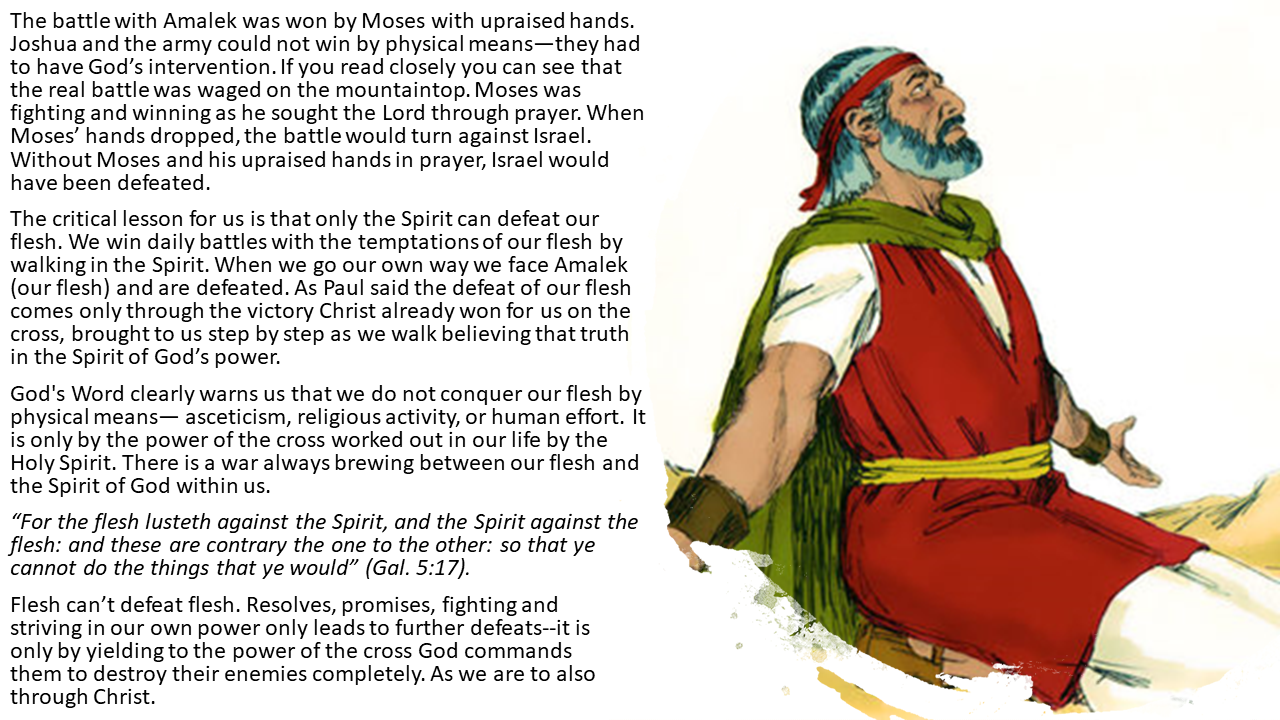
The battle with Amalek was won by Moses with upraised hands. Joshua and the army could not win by physical means. They needed God’s intervention. If you read closely, you see the real battle was waged on the mountaintop. Moses was fighting and winning the battle as he sought the LORD through prayer. When Moses’ hands dropped, the battle would turn against Israel. Without Moses and his upraised hands seeking God’s power, Israel would’ve been defeated. I hope that sticks in your mind because Amalek is portrayed in the Scripture as a picture of our battle with the flesh. And if we think by human means, by resolutions, and resolves, and trying harder, and learning another verse, and praying a little bit more, that somehow, we are going to overcome our flesh without the upraised hands seeking God’s grace, God’s favor, God’s power, then we will live in defeat. The critical lesson for us is only the Spirit of God can defeat our flesh. We’ll win daily battles with temptations of our flesh by walking in the Spirit. When we go our own way, we face Amalek, our flesh, and we’re defeated. And as Paul said, the defeat of our flesh comes only through the victory Christ already won for us on the cross. He brought us step by step to defeat our flesh in the power of the Spirit as we believe the truth of the Spirit by God’s power. God’s Word clearly warns us we do not conquer flesh by physical means, asceticism, religious activity, human effort. No, it’s only the power of the cross. And that’s what we celebrate this morning.
And I want you to turn with me where we’re going to begin this evening to Colossians chapter 3. And this is what I want you to think about as we prepare our hearts. Colossians 3 and starting in verse 5, because we are celebrating this morning the cross of Jesus Christ. And the cross of Jesus Christ is that Jesus Christ accomplished everything that needs to be done, first of all to get me to Heaven, secondly, to defeat the flesh that I’m going to have with me till my last heartbeat and my last brainwave on this Earth, and so are you, by the way. And like Amalek, it’s always going to be coming on our weak backside, and always sniping at us, and cowardly attacking us. So, what do we do about it?
.jpg)
Look at Colossians 3 because Amalek was their foe, but the flesh is our foe. And it says in Colossians 3:5, therefore consider the members of your earthly bodies as dead: immorality, impurity, passion, evil desire, greed, which amounts to idolatry. The Amalek[ite’s] are an apt illustration of the sin that remains in our lives as believers. That sin is already utterly defeated, but has to be dealt with, not in our own strength. I don’t defeat the lust of my flesh myself in my human cunning, thinking, I’ve got a new idea. This is how I’ll do it. I defeat it solely through coming to Christ, who has already not only paid the price for all my sin, but has said I have given you a victory that is a victory indeed in me. By faith I have defeated, I can put to death that in your life, if you will walk, submitting to Me. Communion is when you say, I submit. I trust in Your power, O Christ. You have cleansed me. I can do nothing to achieve my standing with you, but I can choose by Your grace to please You by obedience. That’s what we do this morning.
.jpg)
Let’s bow before the Lord with your Bible open before you, and let’s ask Him to open our hearts this morning to how we can be crucified with Christ, how we can allow His grace to cause us to walk and triumph, how we cannot strive but trust. But ask Him to cleanse your hands and purify your hearts as the men prepare to serve us the Lord’s Supper. Quietly do some business with the Lord. And Father, we come before You in the words of Your servant Paul. God forbid that we should glory save in the cross of Jesus Christ. And we’ve come to celebrate Your cross, Your death, Your life poured out for us, Lord Jesus. And You’ve told us that at this celebration, the world can be crucified to us and us to the world. May we believe the truth of the cross, the truth of Your finished work, Your death in our place. And then confidently as Colossians 3 before us says, put to death our passions, put to death our impurities, our passions and evil desires, our greed, any covetousness, which is idolatry. You hated sin. You wanted the Amalekites exterminated. That shows us Your wrath on sin. That’s what we deserve for any of our sins this morning. We deserve eternal extermination, but we celebrate the One who was not guilty, who took our guilt, who was not deserving of any punishment but took our well-deserved punishment. Such love constrains us to well up with gratitude and then to respond by saying no to our flesh and being victorious. I pray that this communion will prepare us for living this day, and that we will search the Scriptures. And even as we go tonight through the warfare passages of Romans 6 and Ephesians 4-6 and Colossians 3, that we’ll see what it means to defeat the Amalek the flesh of our lives, lest we be like Saul, who knew you, but wouldn’t get rid of the flesh. Thank You for the bread. We honor Your body becoming sin for us so we might be your righteousness. Bless us as we participate in You this morning. In Jesus’ name, amen.
Notes
Four thousand years ago one man made a series of little choices.

He was rugged, handsome, hard working, honest, athletic, strong—and proud.
From the perspective of those who lived around him he was a great guy—but from the One who sees the heart, he was pitiful.
A spiritual scan would have revealed that he fed his flesh, gave in to his passions, and nursed his wounds until they festered into gangrenous abscesses that oozed bitterness. That bitterness infected his entire life and he ended up becoming an enemy of God.
Who was he? Esau, firstborn son of Isaac, grandson of God’s friend Abraham, natural heir to all the promised blessings of the God of the Universe—and one who had everything that really matters in life, except the most important element.
Esau had everything but God, and what does it profit Jesus once asked, if someone gain the whole world and lose their own soul (Matthew 16:26).
How did the life of this man who seemed to have it all turn out?
Hebrews 12 gives us this tragic flight recording in God’s black box of another crashed life, another burned and wasted life.
Please turn there with me, and join me as we prepare our hearts to know God better through His Word.
Let’s read the entire chapter.
Hebrews 12, pray.
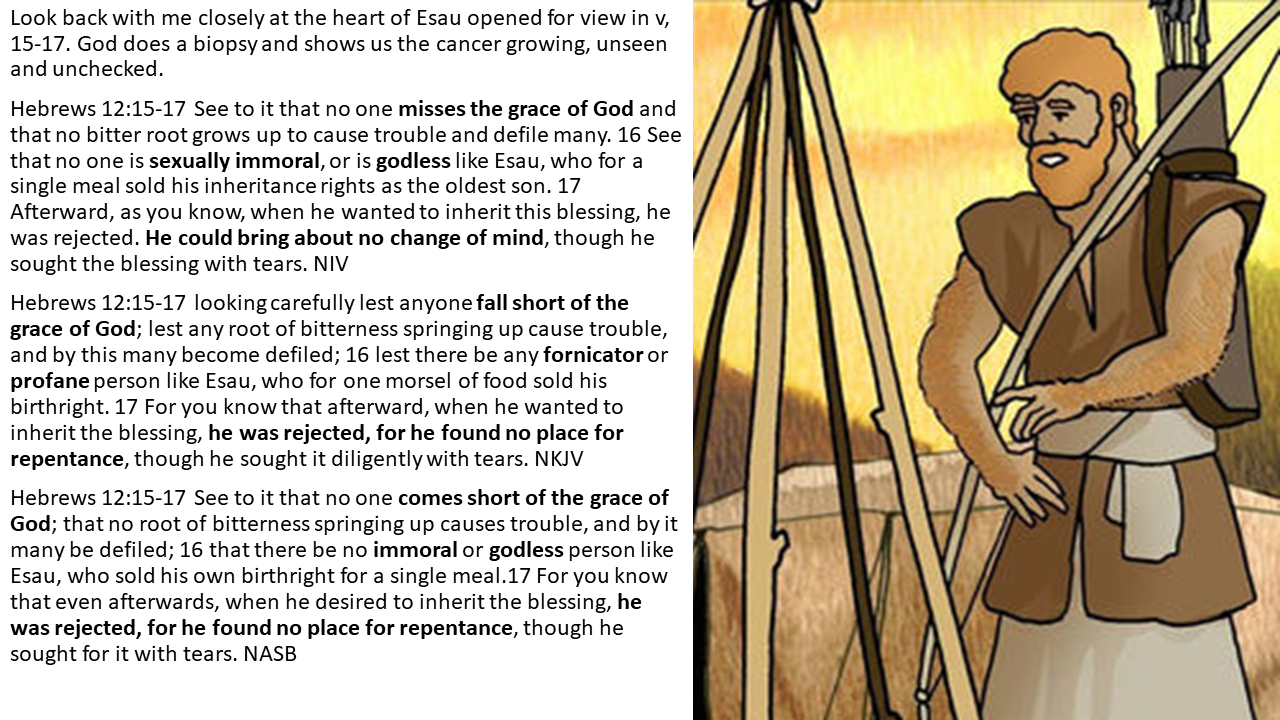
Look back with me closely at the heart of Esau opened for view in v, 15-17. God does a biopsy and shows us the cancer growing, unseen and unchecked.
Hebrews 12:15-17 See to it that no one misses the grace of God and that no bitter root grows up to cause trouble and defile many. 16 See that no one is sexually immoral, or is godless like Esau, who for a single meal sold his inheritance rights as the oldest son. 17 Afterward, as you know, when he wanted to inherit this blessing, he was rejected. He could bring about no change of mind, though he sought the blessing with tears. NIV
Hebrews 12:15-17 looking carefully lest anyone fall short of the grace of God; lest any root of bitterness springing up cause trouble, and by this many become defiled; 16 lest there be any fornicator or profane person like Esau, who for one morsel of food sold his birthright. 17 For you know that afterward, when he wanted to inherit the blessing, he was rejected, for he found no place for repentance, though he sought it diligently with tears. NKJV
Hebrews 12:15-17 See to it that no one comes short of the grace of God; that no root of bitterness springing up causes trouble, and by it many be defiled; 16 that there be no immoral or godless person like Esau, who sold his own birthright for a single meal.17 For you know that even afterwards, when he desired to inherit the blessing, he was rejected, for he found no place for repentance, though he sought for it with tears. NASB

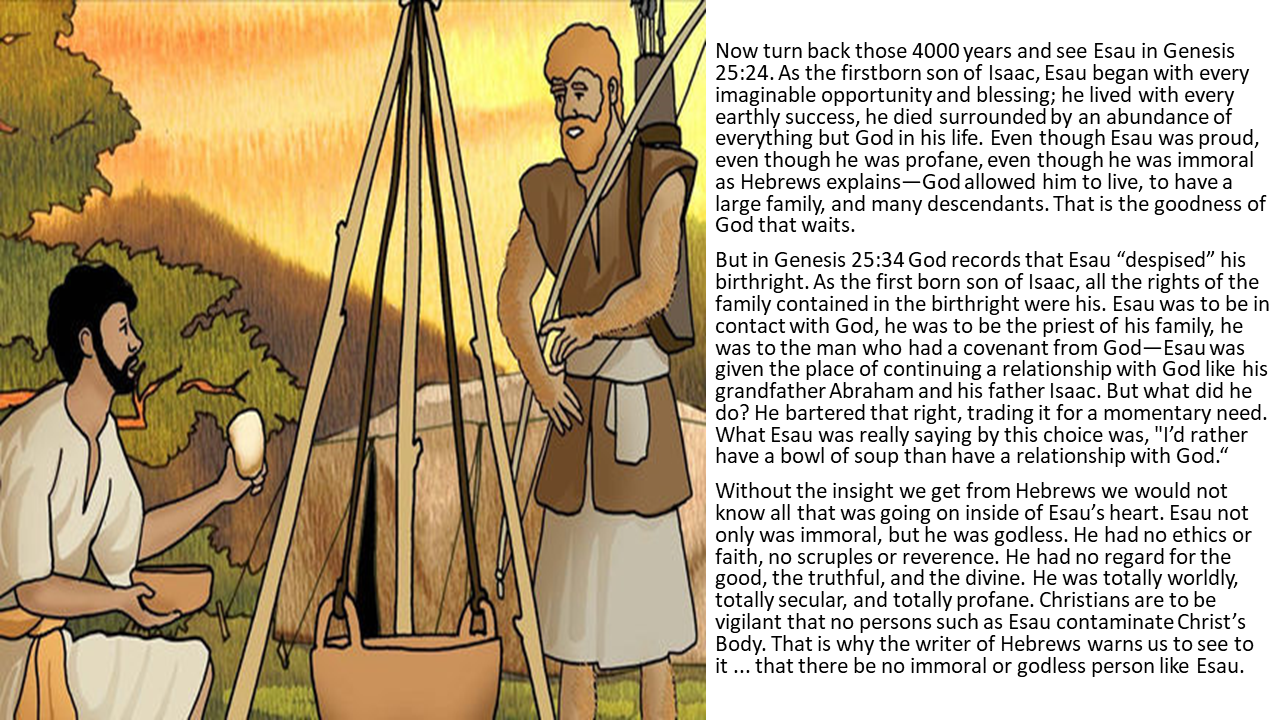
Now turn back those 4000 years and see Esau in Genesis 25:24. As the firstborn son of Isaac, Esau began with every imaginable opportunity and blessing; he lived with every earthly success, he died surrounded by an abundance of everything but God in his life. Even though Esau was proud, even though he was profane, even though he was immoral as Hebrews explains—God allowed him to live, to have a large family, and many descendants. That is the goodness of God that waits.
But in Genesis 25:34 God records that Esau “despised” his birthright. As the first born son of Isaac, all the rights of the family contained in the birthright were his. Esau was to be in contact with God, he was to be the priest of his family, he was to the man who had a covenant from God—Esau was given the place of continuing a relationship with God like his grandfather Abraham and his father Isaac. But what did he do? He bartered that right, trading it for a momentary need. What Esau was really saying by this choice was, “I’d rather have a bowl of soup than have a relationship with God.”
Without the insight we get from Hebrews we would not know all that was going on inside of Esau’s heart. Esau not only was immoral, but he was godless. He had no ethics or faith, no scruples or reverence. He had no regard for the good, the truthful, and the divine. He was totally worldly, totally secular, and totally profane. Christians are to be vigilant that no persons such as Esau contaminate Christ’s Body. That is why the writer of Hebrews warns us to see to it … that there be no immoral or godless person like Esau.
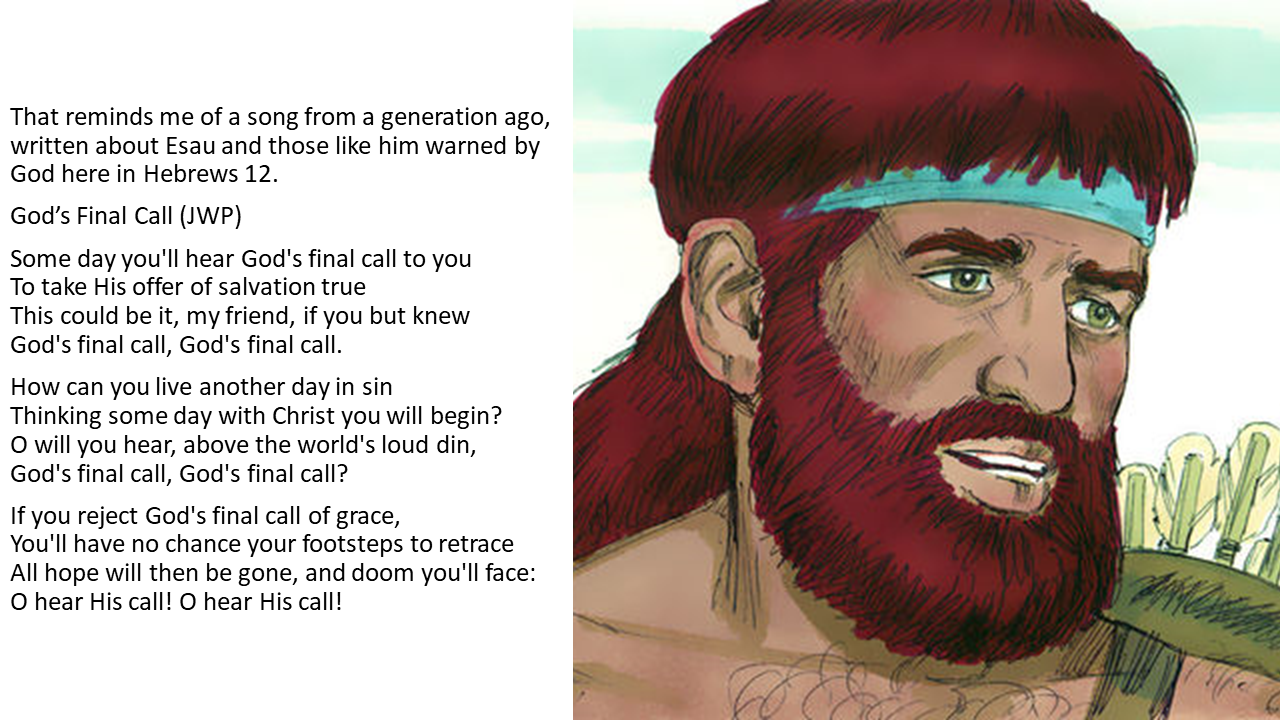
That reminds me of a song from a generation ago, written about Esau and those like him warned by God here in Hebrews 12. God’s Final Call (JWP)
Some day you’ll hear God’s final call to you To take His offer of salvation true This could be it, my friend, if you but knew God’s final call, God’s final call. How can you live another day in sin Thinking some day with Christ you will begin? O will you hear, above the world’s loud din, God’s final call, God’s final call? If you reject God’s final call of grace, You’ll have no chance your footsteps to retrace All hope will then be gone, and doom you’ll face: O hear His call! O hear His call!
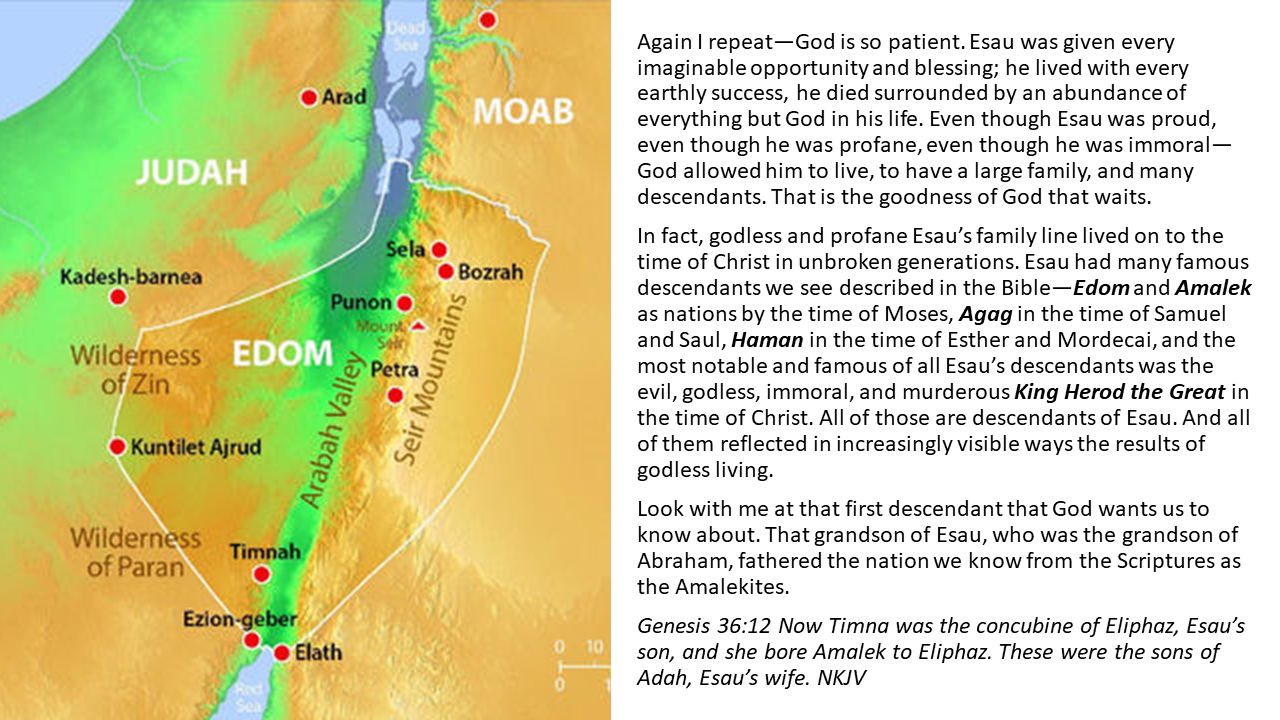
Again I repeat—God is so patient. Esau was given every imaginable opportunity and blessing; he lived with every earthly success, he died surrounded by an abundance of everything but God in his life. Even though Esau was proud, even though he was profane, even though he was immoral—God allowed him to live, to have a large family, and many descendants. That is the goodness of God that waits.
In fact, godless and profane Esau’s family line lived on to the time of Christ in unbroken generations. Esau had many famous descendants we see described in the Bible—Edom and Amalek as nations by the time of Moses, Agag in the time of Samuel and Saul, Haman in the time of Esther and Mordecai, and the most notable and famous of all Esau’s descendants was the evil, godless, immoral, and murderous King Herod the Great in the time of Christ. All of those are descendants of Esau. And all of them reflected in increasingly visible ways the results of godless living.
Look with me at that first descendant that God wants us to know about. That grandson of Esau, who was the grandson of Abraham, fathered the nation we know from the Scriptures as the Amalekites.
Genesis 36:12 Now Timna was the concubine of Eliphaz, Esau’s son, and she bore Amalek to Eliphaz. These were the sons of Adah, Esau’s wife. NKJV
 So Esau’s grandson was Amalek. Time continues to pass, and as we turn to Exodus 17:8-15 we are now looking at events that occurred 3500 years ago as over 500 years has passed from the birth of these nations1. The Amalekites became a nomadic race that inhabited the southern part of Canaan and became perennial enemies of the Israelites. They were fearful warriors. Their intimidating presence was one of the reasons the Israelites disobeyed God and balked at entering the Promised Land at Kadesh-barnea (Num. 13:29). They viciously attacked Israel at Rephidim shortly after the Exodus. They ambushed Israel from behind, massacring the stragglers who were most weary (Deut. 25:18). It was a cowardly attack by the most powerful and savage tribe in the whole region.
The Amalekites hated God, detested Israel, and seemed to delight in wicked and destructive acts. So God supernaturally delivered Israel that day, and the Amalekites fled into hiding.
As we examine the famous battle when Aaron and Hur had to support Moses’ arms (Exodus. 17:8–13)—and the unusual way as the Lord instructed Moses in the battle and the aftermath, we see that something big is going on here. God only let Israel win when Moses’ hands were raised (a picture of prayer in 1st Timothy 2:8), and after the battle the Lord calls Himself Yahweh-Nissi and says He will fight Amalek from generation to generation.
The truth from Exodus is that only God can give us victory.
Exodus 17:8-10, 14-16 Then Amalek came and fought against Israel at Rephidim. 9 So Moses said to Joshua, “Choose men for us, and go out, fight against Amalek. Tomorrow I will station myself on the top of the hill with the staff of God in my hand.” 10 And Joshua did as Moses told him, and fought against Amalek; and Moses, Aaron, and Hur went up to the top of the hill. 14 Then the LORD said to Moses, “Write this in a book as a memorial, and recite it to Joshua, that I will utterly blot out the memory of Amalek from under heaven.” 15 And Moses built an altar, and named it The LORD is My Banner; 16 and he said, “The LORD has sworn; the LORD will have war against Amalek from generation to generation.” (NASB)
We need to believe that truth and by faith seek His intervention in the battles of life.
Exodus 17:11 So it came about when Moses held his hand up, that Israel prevailed, and when he let his hand down, Amalek prevailed. 12 But Moses’ hands were heavy. Then they took a stone and put it under him, and he sat on it; and Aaron and Hur supported his hands, one on one side and one on the other. Thus his hands were steady until the sun set. 13 So Joshua overwhelmed Amalek and his people with the edge of the sword.
God wanted to utterly destroy this nation and its ferocious, plundering, merciless culture of murder and wickedness. The Amalekites were the 1st nation to attack Israel when they came out of Egypt. They struck the rear and murdered the weak and frail and old who brought up the end of the line. They did so with desire – they preyed upon the helpless and God exposed them for what they were2.
What is going on? Basically this. We are seeing how sin left unchecked, like deadly cancer grows and grows. In Genesis Esau despised the blessing. Esau was proud and self-sufficient, profane and immoral. In a spiritual sense, Esau represents the flesh. His grandson Amalek becomes a Biblical illustration of the flesh and the life long battle each of us will have with our flesh.
There are three conclusions we can draw from Exodus 17: 1. First, God is going to get rid of Amalek. In other words, God is going to get rid of the old nature. 2. Secondly, the Lord will never compromise with the old nature. He will have war with Amalek from generation to generation. 3. The third important item is that this constant conflict will go on as long as we live in this life. The flesh and the spirit will always war against each other. Only the Holy Spirit of God can give us victory. We need to recognize this fact3.
The battle with Amalek was won by Moses with upraised hands. Joshua and the army could not win by physical means—they had to have God’s intervention. If you read closely you can see that the real battle was waged on the mountaintop. Moses was fighting and winning as he sought the Lord through prayer. When Moses’ hands dropped, the battle would turn against Israel. Without Moses and his upraised hands in prayer, Israel would have been defeated.
The critical lesson for us is that only the Spirit can defeat our flesh. We win daily battles with the temptations of our flesh by walking in the Spirit. When we go our own way we face Amalek (our flesh) and are defeated. As Paul said the defeat of our flesh comes only through the victory Christ already won for us on the cross, brought to us step by step as we walk believing that truth in the Spirit of God’s power.
God’s Word clearly warns us that we do not conquer our flesh by physical means— asceticism, religious activity, or human effort. It is only by the power of the cross worked out in our life by the Holy Spirit. There is a war always brewing between our flesh and the Spirit of God within us.

“For the flesh lusteth against the Spirit, and the Spirit against the flesh: and these are contrary the one to the other: so that ye cannot do the things that ye would” (Gal. 5:17).
Flesh can’t defeat flesh. Resolves, promises, fighting and striving in our own power only leads to further defeats–it is only by yielding to the power of the cross
God commands them to destroy their enemies completely. As we are to also through Christ.
Amalek was their foe. Deuteronomy 25:17-19 “Remember what Amalek did to you along the way when you came out from Egypt, 18 how he met you along the way and attacked among you all the stragglers at your rear when you were faint and weary; and he did not fear God. 19 “Therefore it shall come about when the LORD your God has given you rest from all your surrounding enemies, in the land which the LORD your God gives you as an inheritance to possess, you shall blot out the memory of Amalek from under heaven; you must not forget. (NASB)
The flesh is our foe. Colossians 3:5 Therefore consider the members of your earthly body as dead to immorality, impurity, passion, evil desire, and greed, which amounts to idolatry. (NASB)
The Amalekites make an apt illustration of the sin that remains in the believer’s life. That sin—already utterly defeated —must be dealt with ruthlessly and hacked to pieces, or it will revive and continue to plunder and pillage our hearts and sap our spiritual strength. We cannot be merciful with Amalek or Agag, or they will turn and try to devour us. In fact, the remaining sin in us often becomes more fiercely determined after it has been overthrown by the gospel.4
One final truth we need to see is in Galatians.
Galatians 2:20 “I have been crucified with Christ; and it is no longer I who live, but Christ lives in me; and the life which I now live in the flesh I live by faith in the Son of God, who loved me, and delivered Himself up for me. NASB
Galatians 6:14 But may it never be that I should boast, except in the cross of our Lord Jesus Christ, through which the world has been crucified to me, and I to the world. NASB
The battle is already won, the enemy defeated and we just need to believe that and act upon that truth! How do we do that more regularly?
This evening we are going to survey the war chapters of God’s Word Romans 6, Ephesians 4-6, and Colossians 3—and there we find the tactics God left us to win. He has defeated our enemy, armed us with superior weapons, and offers to lead us into victory every time we follow Him!
1 Abraham was born 2166 BC; Isaac was born 2066 BC; Esau & Jacob were born 2006 BC. Esau married at age 40 in 1966 BC and had a son and then grandson named Amalek. The Exodus was 1446 BC and the attack of Amalek was soon after in Exodus 17.8. From Esau’s marriage to that cowardly attack was about 550 years (1966 BC to 1446 BC = 550 years).
2 J. Vernon Magee, p. 268.
3 McGee, J. Vernon, Thru the Bible with J. Vernon McGee, (Nashville: Thomas Nelson Publishers) 2000, c1981.
4John F. MacArthur, Jr., The Vanishing Conscience – Drawing the Line in a No-Fault, Guilt-Free World, (Dallas, Texas: Word Publishing) 1997.
Slides

Check Out All The Sermons In The Series
You can find all the sermons and short clips from this series, David’s Spiritual Secret here.
Looking To Study The Bible Like Dr. Barnett?
Dr. Barnett has curated an Amazon page with a large collection of resources he uses in his study of God’s Word. You can check it out here.