
If the video above is not available, here are two other ways to view:
Imperatives of the Crucified Life – 3
060319AM
DSS-15
Colossians 3
Transcript
.jpg)
Let’s open to Colossians this morning again. Colossians chapter 3, and as Paul sat to write the Colossians, that was a literal church, a literal group of people just like us. As he sat to write them, he had never visited them. Paul had never been to Colossae, never got, as far as we know, to see them. As he says, those whose faces I’ve never seen. He didn’t get there, but his letter did. And he was writing to a group of saints who were literally swimming each day against the strongest imaginable currents of the world, the flesh, and the devil. These people were in the center of the height of the culture of the Roman Empire. And so, Colossae in Roman Asia was at the crossflow of every type of sin with the commercial roots and with all that was going on in the civilization then. They were saints that were faced with an environment that was very unfriendly to believers. There was heretical, wrong teaching, gnostic teaching. There was all the flesh and the world, and there was also the spiritual warfare that went on accompanying that. And those people were faced with that.
.jpg)
And what did Paul give them as the answer to their needs? This third chapter. What he told them was, it was a challenge to make daily choices for God, to sanctify their attitudes, how they responded to people and their behavior, what they did with their body. So, what their attitude, their mental response to things in life, and what their behavior of their body was. And those two things are addressed so clearly in this third chapter, and as we read this passionate letter to the Colossians saints, by this third chapter, we hear Paul plead with them to allow Christ’s work, what Jesus did on the cross for us. He said, I plead with you to let that be unleashed in your life. That’s what he’s gotten to in the third chapter. It would be wise if we ask ourselves the same questions. He is considering with them; he is reasoning with them if they’re allowing what Christ did for them in the past on the cross to be presently at work in their lives. And what we can do 2000 years later is ask the same questions to ourselves.
.jpg)
So, I hope as I go through this chapter, especially from 5 to 17, that you will be asking and answering these questions. Basically, he’s asking, do you have a habit of crucified living? That’s what this mortify or put to death. He’s saying, that’s another word for it, being crucified with Christ, he says, do you have, Colossians, a habit of crucified living? He was asking them, do you know what it means? Have you put every area of your life beneath the sanctifying power of Christ? That’s what it means to be crucified with Christ. Have you started to have a hit list, targets you want to give to Christ for Him to put to death?
I love all the ongoing technology of America. It’s amazing. All of our young soldiers are over there facing these guerilla warriors in Iraq, and now they’ve deployed literally hundreds of these little aerial reconnaissance drones. And what those drones do is they look over walls, and they look down into the canyons and all the, whatever they’re facing in the warfare. And they target where the aggressors are, where the terrorists are, where the insurgents are. And they either specify where artillery shells or mortar rounds are to go, or else they actually shoot one. They target things that are dangerous. What he’s saying here is, have you targeted in your life what it says starting in verse 5? Have you given to Christ to put to death those areas that you want to stop hindering your spiritual life? The book of Colossians lists target areas we have to bring to our Great Physician. He talks about pockets of pride, lust, selfishness, anger, untruthfulness, anything that’s unclean. And those areas, we say, Christ Jesus, because You died on the cross, I want You to crucify that. I want You to put it to death.
Now, let’s just change the metaphor from drones and warfare to modern medical terminology. If you went to the doctor, and the doctor said, I see a tumor and I believe it’s malignant, and you have a choice. Either you can just let it keep growing and see what happens, or we can deal with it. What do 99 percent of all Americans do? Skin cancer? Do something about it. Do something about it. Is it a little tumor here or there? Is it cancer? Is it in the early stages? Do something about it! That’s our normal response. Paul is saying, look on sin like malignancy and decide that you will go to the heavenly Physician and say, if I need surgery, if I need radiation from the Word, if I need the chemotherapy of the Word, I want it because I don’t want that deadly malignancy of sin to grow in my life.
So, what are we consciously putting to death of our old life today? And as I read from verse 5 on, can you name an area from this list that you are holding before the Lord and say, I don’t, I want to put to death my flesh. I want to put to death lustful desires. I want to put to death any uncleanness, my comfort level with uncleanness. I want to put to death pride in my life. Are there areas of your spiritual life that you are targeting to be crucified by the Lord? Can you name an area that you’re holding out to Christ, as your oncologist, an area affected by sin you want Him to remove because it’s doing a deadly work in our life? Do you have an area that you’re saying, Lord, I want You to work on. Have we examined our lives against this Scripture and agreed with God about surrendering specific areas of our life to Him? If so, what comes to your mind as I say this? Do you immediately think of what you’re asking Him to change, or is it just vague? You see, if you generally think about this and not specifically, then there’s just this general non-effect of the work of Christ in our lives. It’s like we are hearers, but not what? Doers. We’re not actually saying, Lord, change this in me. And what He’s asking them to do is to make a choice. If nothing comes to our minds, we’re probably not living a crucified life. Paul said, every day I live by faith that Christ is crucifying my old life.
.jpg)
Now, you know about crucifixion. I am not talking about crossbars and nails. I’m talking about the concept because this theological concept is sanctification. And before I read these verses from 5 to 17, I want to remind you that this is a central chapter about biblical sanctification. Let me just give you a reminder. Sanctification requires our participation. It requires our obedience. It requires a response from us. That’s what Paul is laying down to them. He’s saying, you who are saved. Now, another word for salvation is justification. Those of you who are justified, who are saved, you must have a response, a conscious, obedient response because you’re justified, because you’re saved. And that conscious, obedient response is called being sanctified. That’s what this third chapter is about. It’s probably the most practical sanctification chapter in the Bible. And what Paul is telling us is that salvation, just like the first New Testament epistle, remember James? James talks about faith without what is dead? Works. So, faith—justification—without works—sanctification is not-ification. Okay? That’s a new word that means it’s not there, it’s vain, it’s empty. And so, that’s James’s way of putting it.
Paul talks about justification and sanctification, not faith and works. He’s talking about the very same thing. And in this chapter, he’s asking us to do what he told the Colossians to do. And he asked them this, he says, I want you to remember, look at verse 1, if you were raised with Christ, you. That’s what Christ did for us on the cross. I have nothing to do with being raised with Christ. That is a total aspect of justification, but because of that, sanctification is what Christ is doing in me because of the cross. Justification was immediate and completely finished the instant I was saved. That’s why he says, if then you were raised with Christ. He doesn’t say, you are being raised. It’s a past event. That’s justification.
Now, look at the next line of verse 1. Seek those things. That’s the ongoing process that’s never completed on Earth until I meet Jesus face-to-face. That’s what sanctification is all about. It’s me making choices to cooperate with this process of Him changing me from the inside out. He goes on to say, because we were raised with Christ, verse 1, we are to, verse 2, set our minds. What is that? That’s growing with every obedient choice I make. I grow in having my mind set on things above, my mind fixed on what Christ wants for me. Justification is my position. God declared that I was right in His sight. But sanctification is my practice, my everyday life being made more and more Christlike. Because of that, Paul says, because you’re saved, because you’re justified, you should live sanctified.
.jpg)
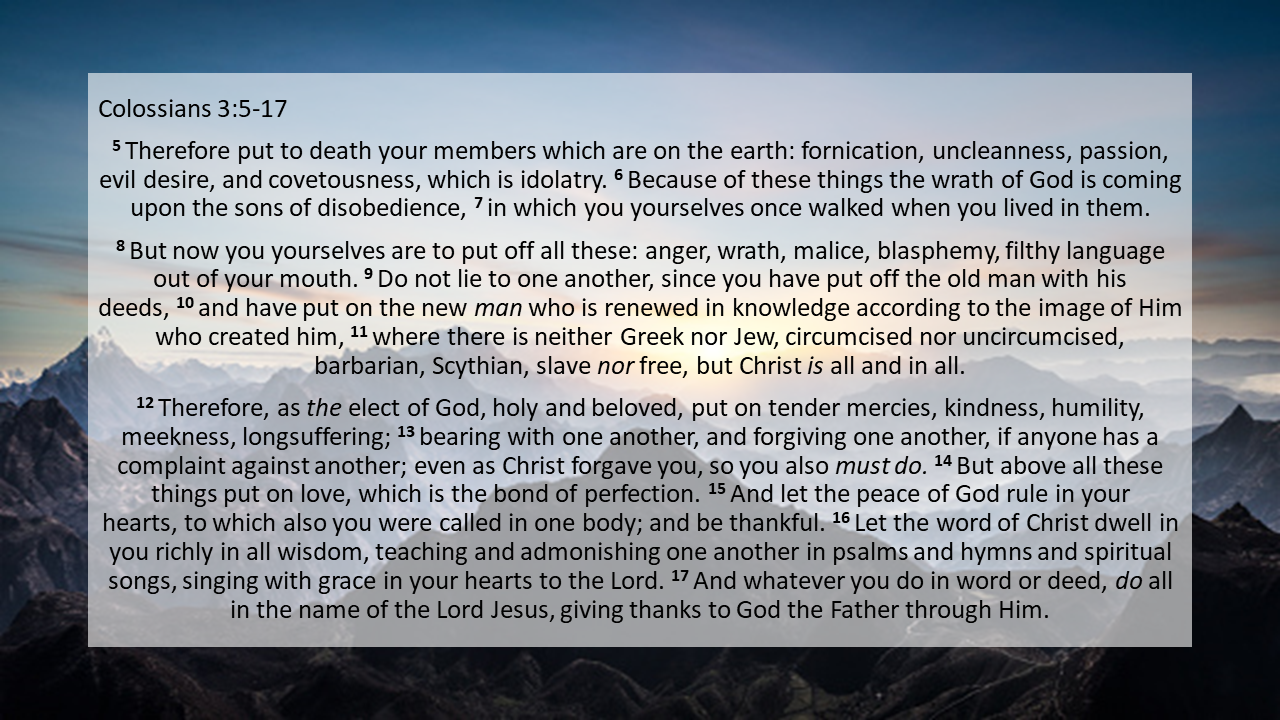
And let’s read what we’re supposed to live like starting in verse 5. Let’s stand together. You follow along. Let me read 5 to 17, and you think about your and my responsibility. Okay? All the way through this, everything I’m reading here, are my obedient responses that God wants from me. Starting in verse 5, therefore—because you and I are justified or saved or have been born-again—verse 5, put to death your members which were on the Earth. Offer to Jesus Christ and say, I want You to remove my wrong desires for fornication, for uncleanness, for passion, for evil desires, for covetousness. As we saw last time, the insatiable desire for more, which is idolatry. Verse 6, because of these things the wrath of God is coming on the sons of disobedience, in which you yourselves once walked when you lived in them. But now you yourselves, verse 8, are to put off all these things: anger, wrath, malice, blasphemy, filthy language out of your mouth. Do not lie to one another, since you have put off the old man with his deeds, and have put on the new man who is renewed in knowledge according to the image of Him who created him, where there is neither Greek nor Jew, circumcised nor uncircumcised, barbarian, Scythian, slave nor free, but Christ is all in all.
Therefore, as the elect of God, holy and beloved. Again, therefore, because you are justified, because you are Christ’s, because you are saved, put on. We saw last week, it’s an imperative. It’s something we need to respond to. It’s something God asks us to do and gives us the power to do. Here’s what we’re to put on: tender mercies, kindness, humility, meekness, longsuffering; bearing with one another, forgiving one another, if anyone has a complaint against another; even as Christ forgave you, so you must also do. But above all these things put on—it’s the third time he’s said it—put on love, which is the bond of perfection. And let the peace of God rule in your hearts, to which also you were called in one body; and be thankful. Let, verse 16, the Word of Christ dwell in you richly in all wisdom, teaching and admonishing one another in psalms and hymns and spiritual songs, singing with grace in your hearts to the Lord. And whatever you do in word or deed, do all in the name of the Lord Jesus, giving thanks to God and the Father through Him.
Let’s bow together. Father in Heaven, I thank You for sanctification as it’s so clearly portrayed in Your Word. And I pray that You would help us this morning to not merely hear all these things but decide by the power of Your Spirit in obedient choices to see our behavior change and be conformed to Christ as we are sanctified more each day. In the name of Jesus, we ask this, amen.
.jpg)
You may be seated. As you’re seated, I want to remind you that you should be careful what you read. I was thinking this week, in fact, we were out to dinner with some dear friends of ours, and I was telling them that when I was a teenager, I was given a set of books, and someone I deeply admired, an older person that I thought was great, they said, you need to read these because these books will really affect your life. And I thought, okay. So, I started reading them. And you hear all the time about this set of books. I read about George Müller of Bristol, and then I read about Hudson Taylor of China, then I read about C. T. Studd of Africa, and of course all the other great missionary leaders. But those were the first three volumes, and those were the ones that I was deeply touched by.
So often you’ve heard me touch, or at least a little bit touch, on the life of C. T. Studd, but I usually talk about his life and ministry up till 1931. So, what I did this week is I read the sequel. I read the record of what happened in Africa from 1931, when he died, to 1951, when the book was published. That’s getting a little closer to home. I was born in ’56. So, what was happening just in the decade that I came into the world with this man that seems like from ancient times? And as I read that. I’d like to emphasize something with you, you haven’t heard before. What happened after that great missionary, that I’ve talked about so many times, after he was gone? What happened in the lives of these people? And by the way, he had a very simple way… When he went to Africa, I’ve told you this many times, he only took a Bible with him. In fact, he took two because it was so rainy and moldy, he didn’t want to have no Bible, so he took two and he kept them in oilskin. And his whole method of ministering was teaching the simple Word and telling them that because of Christ’s death on the cross, what God says could happen in their lives. And he would do that for hours. He didn’t have any other programs. He just taught them the Word by the hour.
.jpg)
What happened in their lives? Let me read to you what I found this week because the incredible life changes go on in those jungles. What was the long-term effect of those simple Bible truths that C. T. Studd taught? Colossians was one of his favorites because it’s such a practical, simple book. He believed those truths. He discipled thousands of savages to believe them. And so, to find out, I read the chronicle of those two decades from 1931 to 1951. For those of you that don’t even know who I’m talking about, C. T. Studd was born in 1858. He was born to one of the wealthiest British families over in the United Kingdom, in England. His father owned plantations and factories all over the British Commonwealth, all over the colonies of Britain. And so, he grew up very wealthy, went to famous schools, and everything like that. But he got saved in the late 1870s when he was just in college. After he was saved, he began to be discipled by Dwight L. Moody. He was saved through the Dwight L. Moody crusades that was going on then, an American evangelist over there. And he was sent off to be discipled by one of the people from the crusade in crucified living, they called it. The truth of crucified living impacted him deeply to the point that he made some big choices. And his choice is that he wanted to serve the Lord. He just said, I just want to serve the Lord, and I don’t know what He wants me to do, but I want to do it.
So, his father died in 1880, and he inherited the estate of his father, which was hundreds of thousands of British sterling pounds, but in our day, it would be tens of millions of dollars or more. And so, he started managing that money for a while, and by the time it got to 1887, he found out that it was getting in the way. So, on January 13th, 1887, C. T. Studd wrote nine checks and gave away his fortune as carefully as a businessman would invest in some kind of stocks and bonds. He chose a safe, high-yielding security for his money, and he called it the Bank of Heaven. And basically, the fortune that C. T. Studd gave to Christ went to these places. First, he sent money to Hudson Taylor, and Hudson Taylor used that money to found the extension of the China Inland Mission to every province of China. The second check he sent was to George Müller, and he bought him more orphan houses to more than double the orphanage space. The next few checks he sent to General Booth with the Salvation Army, and he sent workers out to China, to India, and all over the place through Salvation Army. And the last check he sent was to Dwight L. Moody because he said Moody told him he wanted to start a school. And you might know that school today; it’s called Moody Bible Institute. And so, C. T. Studd sent the money that was used to found Moody Bible Institute, to found Salvation Army’s outreaches across the world, to found George Müller’s expansion of his orphanage houses, and to start the China Inland Mission with Hudson Taylor.
.jpg)
.jpg)
When he gave his money away in 1887, he packed up his new bride, went to China, and said, I’m going to stay here the rest of my life. And that’s what this multimillionaire, athletic hero did. He got very sick in China and became an invalid. He was a museum of diseases when he left China, he had come back to England, he was so sick. He had asthma. He had malaria that would never seem to stop. He had dysentery that caused him terrible problems. And finally, he had gallstones, inoperable gallstones. But in spite of that, he decided that he would go to, in 1910, after a few years back in England, he decided he’d go to Africa. He says, who wants to die in England? I want to go to Africa. So, in 1910, he moved to the heart of Africa. And in spite of his gallstones, and malaria, and asthma, and everything else, at the age of 53 as what we would call an invalid, he decided he’d live the rest of his days there. And he lived for 21 years with his gallstones, and asthma, and malaria. The end of his life came, and this is where I usually have ended, in the hot steamy days of 1931. But after 21 years, in front of him sit 5,000 headhunters. Now, that entrances me because just with teaching them through an interpreter and learning very roughly the language, teaching the simple truths of Colossians 3; Romans 6. He really loved Romans 6 through 8 and Colossians 3. Those were the main areas he taught from all over the jungles. He had 5,000 former cannibals saved. And they sat in front of him, and formerly demon inhabited, formerly temples of Satan, these were now temples of the living God. They were modestly clothed. They sing by the hour, and they are no longer savage.
And in this 20 years that went on, it told about one man. I’ll just tell about one man, one man and his brothers. He had two brothers. Before C. T. Studd came, those three brothers had 150 children. They had dozens of wives. Those three men had 90 sons and 60 daughters, and they lived in the worst way you could imagine people living. And Studd came, led this guy, a chief, to the Lord. And this guy, at the end of his life, provided for all of his wives, lived with only one, and started a school and educated all 150 of his children and sent more than half of them out as missionaries, many of whom were going to other cannibal tribes and were losing their lives. That’s just one. It was just an amazing, it’s called With Studd in the Jungles of the Congo [With C. T. Studd in Congo Forests]. It was an unbelievable book. I didn’t even want to tell you about all of it. If you ever want to read about what the Holy Spirit can do, you ought to read it. But that last time he spoke, he spoke to them for about an hour during the night he died, and in the morning, they found his shriveled little body, and C. T. Studd was in Heaven.
In Africa, at his death, the mission counted 30,000 born-again, baptized and discipled pygmies. When he died, there were 30,000 of them. When he found them in 1910, every one of them were naked, murderous, grossly immoral cannibals who butchered each other in the darkest jungles of Africa. In 1951, there were 200,000. So, they went from 30,000 in 1931, 20 years later, they had increased sevenfold. There were 200,000 organized in churches, and mission schools, and mission stations trying to reach out across Africa. Today, those many cannibals sing around the throne of the Lamb, all clothed in white raiment, worshiping Jesus with C. T. Studd, who won them to Christ and discipled them. How’d he do that? Did he graduate from seminary? No, C. T. Studd was discipled in college with one truth. Colossians 3 verse 5, put to death your members. Verse 8, put off all these things. And verse 12, put on all these things. That crucified life that we’re looking at is what he believed. That action, to live the life of killing our flesh, mortifying our flesh, living the crucified life with Christ was what he taught. I looked at his journals, and I’ll read you a couple lines.
.jpg)
As we’re saved only by the accomplishment of Christ’s sacrifice on the cross, so we live each day by faith, the same faith by which we were saved. We are always dependent on Christ’s death that saves and keeps us. So, with that little truth, he discipled those people.
And what I would like to do is, this morning, walk through these verses and ask you as I’ve asked myself all week long, what part of my life, of my behavior, of my attitudes have I examined and seen that they are not Christlike? And not just mentally, just done a little inventory, but what parts of my life have I said, Lord, I want You to work on this. I want You, this week to make me, verse 5, have less of my members, which are involved in things that displease You. Verse 8, I want less of my attitudes to reflect these un-Christlike attitudes. And I want more of, verse 12, I want more of You to transplant into me. Modern medicine, we not only take out the bad parts; we put in good parts, right? They’re transplanting hearts, and they’re transplanting kidneys, and they’re transplanting all these different things, and it’s very much medically what God wants to do spiritually. He wants to transplant into us, verse 12, the very attitudes of Christ. So, sanctification, as we’ll see verse by verse, is the process of becoming Christlike, of growing in holiness. It began the instant we were converted, and it won’t end until we meet Jesus face-to-face, and through the work of His Spirit, through the power of the Word of God, and through the ministry of other believers.
Now, I’m going to challenge you in this way this morning. God put us all into groupings. If you’re married to a believer, you have a natural accountability partner that you might not even be using fully to God’s glory. If you were born into a Christian family, you have a couple of the, if you have believing parents, you have a couple of the greatest disciplers that could ever disciple you because they know you better than anybody else. And if you’re not in a Christian marriage, and if you’re not in a Christian home, then you have a church full of saints that would love to encourage you to do these things. You know what happens to most of us? We try and do this all by ourself, and we’re like two little islands. Us with our husband or wife, us with our parents living in the same house. We’re all trying to accomplish the same things; be Christlike. If you’re saved, you should be wanting to do that. But we’re doing it without the encouragement, the prayers, and the help of those around us. So, we’ll get to that in just a moment.
.jpg)
But sanctification renews our mind as God peels away our desires for sin. It’s all about the choices and behavior. It involves work on our part. As we’re empowered by God’s Spirit, we strive, we fight sin, we study Scripture, we run hard, we pursue holiness. That’s what sanctification is all about. It’s about us making choices. Starting in verse 1, since you were raised with Christ. That’s justification. The rest of the chapter’s about sanctification. Seek those things which are above. We saw that last week. Verse 2, set your mind on things above. And if you have trouble, even now, some of you, your mind’s wandering off to the movie you saw yesterday; you’re wandering off to the, what you’re going to do this afternoon, go out to have fun. If you really want to listen this morning, you know what you can do right where you’re sitting? Say, Lord, verse 2, set my mind on Your things because You saved me. I know You can sanctify me. I need my mind focused in. I’m only in here for an hour a week, and I need to listen to this. You have to consciously ask the Lord to tune you in and to cast down imaginations and everything that confuses us and bring every thought into captivity to Christ. That’s what verse 2 is about. Verse 5, put to death your members. Remember, we talked about that last Sunday.
Verse 8, put off, Paul says, there’s certain things you have to strip yourself. The word he uses for putting off clothes. It’s a picture from the life of the early Christians. When they were baptized, they would tear off their old dirty clothes. They’d go down into the water, and then when they came up out of the water, the church members would provide them with a brand-new white raiment, a robe to put on, which was a picture that in Christ we’re buried and the old life goes down to the grave with Him, and the new life is what we come out to live. But that sanctification process is repeated day by day as we have to strip off all those things that are mentioned in verse 8: anger, and wrath or rage as the NIV puts it, malice, blasphemy or slander, cutting down other people, filthy language out of our mouth.
.jpg)
Now verse 9, don’t lie to one another because you put off the old man with his deeds and have put on the new man, verse 10 says. Now, verse 11 is very significant, where there is neither Jew nor Greek, circumcised nor uncircumcised, barbarian, Scythian. That’s an interesting word. I read about that. I won’t tell you everything I read because they were the most horrific people of the ancient world. But barbarians, the word Barbar just means they weren’t a Greek; they were heathen. Scythians, though, were the worst barbarians. Scythia is in the area we would call the Caucasus Mountains around the Caspian Sea, where they’re making all the oil and gas discoveries now, and they’re building all those pipelines. That’s the Caucasus Mountains. Now, you say, why do you even think about that? Let me describe them, and then I’ll tell you who their descendants are. Okay?
Let me describe the barbarians called the Scythians. They were brutal, mean, heathen. When they captured their enemies, they scalped them, like the Native Americans used to do. And they would use their skull as a cup and would drink the blood of the victim from their own skull. I can’t think of anything more barbaric than that. And so, these people lived in the Caucasus Mountains. Have you ever filled out a form, and it said gender: male, female? And then next it would say, are you a Caucasian? Caucasian! Caucasus Mountain person. These people were known as white-skinned people. That’s why they’re called Caucasians. The Scythians were Caucasians. Are you a Caucasian? Look where you’ve come from. Do you still scalp people? Do you cut their heads off and drink their blood? That’s why, look at what he says here. He says, verse 9, you have put off the old man with his deeds, you Caucasians. You put on the new man renewed in knowledge according to image of Him, where there’s neither Greek nor Jew, circumcised nor uncircumcised, barbarian, Scythian—these barbaric, horrible, murderous people—slave or free. No, you’re new. Christ is all and in all. Did you know every time I fill out a federal form, I think about that? When I look at that, Caucasian, I think, yeah, I was one of those. I’m not anymore. I am new in Christ. I’m not a barbarian; I’m not a Scythian. I am new in Christ, and Christ is all in all.
.jpg)
Keep reading. Verse 12. Let’s get to the good part. Therefore, as the elect of God. On the basis of your justification, that one-time, instantaneous act where Christ has totally transformed us, you’re holy and beloved, put on. That’s an imperative. An imperative is something God asks us to do, and that means He gives us the power to do it. That means we can do it. If He commands us to do it, we can do it. It’s not impossible. So put on the following things. The NIV says, clothe yourselves with. It’s the picture putting on clothing. So, what we say is, because of Christ’s death on the cross, He can now make me wear His truth. We can actually look up at the Lord and say, Lord Jesus, right now, clothe me with Your personality. Do you want to be Christlike? Ask Him, say, I want You to clothe me! I want to put on! This morning, I pulled this suit out, and I found this tie. Bonnie helps me because I’m not good. She puts things together so it’s not wrong. And it’s kind of like it was there, and I had a choice. I could put it on. What can we put on? Look at this: tender mercies, a heart of compassion. The NIV calls it compassion. The King James, bowels of mercies. Remember splagchnoi? We covered that a few months back, that meant the innermost part, they called the seat of their feelings their intestines, their splagchnoi. That’s the same word. This bowels of mercy is a heart of compassion.
I think about that because our world has become so indifferent and mechanical, so impersonal, and Christians are supposed to be personal and compassionate. If there’s one thing the ancient world needed, it was mercy. Animals were cruelly treated. The maimed and sickly went to the wall. There was no provision for the aged people, the older people. The treatment of handicapped people was unfeeling, and that’s what the world was like Christianity was born into. And Christianity brought mercy, tender mercies into this world. In fact, historians have said it’s not too much to say that everything that has been done for the elderly, the sick and the weak in body and mind, and kindness to animals, to children and to women, has been done as an inspiration to Christianity because before Christ, there was no tender mercy. It was a dog-eat-dog, compassionless, mechanical world. But because of Christ’s death on the cross, because I’m justified, He can now make me feel His compassion. And I can say to Him, Lord Jesus, right now, clothe me with Your compassion, so when I look at people, I am moved. Remember Jesus? When He looked at the multitude, He was moved with compassion, so can I be. And I can be non-mechanical and have tender mercies in life. That is not human, normal, and part of our culture. It is divine to have a heart of compassion, and we have to ask for it.
.jpg)
Kindness. That’s the second word in verse 12. It’s an interesting word, chrēstotēs. Sounds like Christ also. It means gentleness. In fact, one word writer, Trench says, it’s a lovely quality. The virtue of a man whose neighbor’s good is as dear to him as his own. In fact, Isaac, remember in Genesis 26? He dug wells, and when his neighbors wanted them, he gave them to them. That’s a kind person. Remember Abraham’s son, Isaac? He would dig a well, and the other inhabitants would say, that’s our land. He’d say, okay, you can have it, and he’d go dig another one. They’d say, that’s our well, and he’d say, okay, you can have it. That’s a kind person. They don’t fight for it and say, it’s mine, and I want it back. They say, you want it? Remember, Jesus said, if they ask for your outer coat, give them your outer coat and give them your inner coat too. If they compel you to go one mile, what? Go two. That’s kindness. Same word Jesus uses in Matthew 11:30. He says, My yoke is easy, or kind. Goodness by itself can be stern, but chrēstotēs, this word, is goodness that is kind. Jesus in us has that kindness, that willingness to give even when under duress.
.jpg)
The third word is humility. This word is a virtue that truly was created by Christianity. In fact, there’s no word in classic Greek for humility. There’s not a single Greek word for humility. In all of their vast writings, they didn’t have that word because they thought of that as a cringing weakness. But we find, our humility is being, number one, realizing that God is our Father, that we are His children, that we reflect Him, and that He has created others, and we cannot lord over them. And there’s a humility that comes of knowing that you’re born from above. And so, he says, clothe yourself with humility. Lord Jesus, right now, we humble ourselves in Your sight, is what Paul was telling them, that the attitude had to be asking Him to clothe ourselves, to live among others with no arrogance, with realizing that, as Paul said, what do I have, I haven’t received. And why do I glory as if it’s me? And so, that’s the attitude we have. And you know what? If you put on humility and someone takes the credit for something else, you rejoice because God is getting the glory, because God did that, and I don’t have to get the credit, and there’s a freedom that comes to life.
.jpg)
Meekness or gentleness is the next word. This is a gentleness of spirit. It’s a person who’s self-controlled because they’re God-controlled. They’re angry at the right time and never angry at the wrong time. There’s a gentleness about them, a longsuffering, as the next word. Or patience, the NIV puts it. The word means long burning. It has a long fuse. It doesn’t explode. It just goes. And you’re waiting for the explosion to [fuse burning sound]. It never explodes. That’s this makrothymia. It’s a patience that is never lost with fellow men. Their foolishness, their unteachability never makes us ill treat them. And because of Christ’s death on the cross, we can look up to the Lord and say, this is getting hard. Things are going the wrong way. I ask You to give me Your patience. We can’t crank it up ourself. This is not self-effort. This is not deciding I’m going to make it a little further today. It’s not from within; it’s from without. It’s a supernatural endowment. That’s what grace is. Grace is Christ, His work for me, and His work in me makes me patient or longsuffering.
.jpg)
Verse 13, all of these things mean I’ll bear with others. I’ll forgive others because I’m constantly remembering that Christ forgave me. And in verse 14, this is a paraphrastic phrase. It’s kind of like an overcoat. Above everything else, above this compassion, and kindness, and humility, and meekness, and all this stuff, he says, put on love like an overcoat over all that. The Christian forebears and forgives, he does so because he’s forgiven. We must always be forgiving because God forgave us, and only the forgiving, Jesus said, can be forgiven. Remember that. The Lord says, watch out. Remember what He said in Matthew 18? The torturers that come to the unforgiving one. We must never be unforgiving if we want to be forgiven.
Verse 15 continues, let the peace of God rule in your hearts, to which also you were called; and be thankful. And because of Christ’s death on the cross, the Christian can be thankful and can have the Umpire of the Holy Spirit. The Spirit of God governs our hearts. There’s all this basketball going on these days, and when the umpire blows the whistle, when the ref blows the whistle, they’re supposed to stop. And even that perfect shot that goes after that doesn’t count. The Lord says, I want to rule in your life. I want to tell you when to stop. I want to be the Umpire of your life. I want My peace to rule in your life. And because of Christ’s death on the cross, we can ask for His peace to rule in our hearts. Not anxiety, not fear, not turmoil. We can ask for peace, even when everything around us is falling apart, even when things aren’t turning out the way we want them to. Even when the expected or desired result isn’t there, we can turn to the Lord and be made complete. That’s what peace means. Shalom means to be made complete. His peace, in the Hebrew sense, is a completion of our lives. Not by circumstances, it’s a life detached from circumstances and attached to Him.
.jpg)
Verse 16 tells us more about how all this works. Let the Word of Christ dwell in you richly in all wisdom, teaching and admonishing one another in psalms, hymns, and spiritual songs, singing with grace in your hearts to the Lord. That awareness of His sacrifice for us, His grace, the way that He accomplished our salvation. And whatever you do in order deed, do all in the name of the Lord Jesus. That’s why He says that we won’t have the attitudes and the behaviors that displease Him because we say, I want Your attitude. Would Christ respond with anger, with wrath, with this malicious harmfulness we saw? No. That’s your attitude. So, clothe me with compassion. Put on me. I want the garment of kindness, of gentleness, of a long-burning fuse. See, we allow this Word of Christ to dwell in us. Let means to invite, to welcome, to give ourself to. The Word of Christ is any part.
I was with a Bible study this week, and I said to them, how are you seeing the Lord at work in your life? What things are you seeing Him take of your old life? And I said, I’ll start. For example, I said, verse 8. I had them turn to Colossians. I says, I have to ask the Lord to strip off from me every one of these things in verse 8, and I got through the list, and I was just starting to go on and explain. And someone raised their hand, and they said, you mean at Tulsa Bible Church, I thought when we confessed sins here, we were supposed to say, I only learned five verses this week instead of eight. That’s about the most serious sin that that most people can think of, that they only learned five, memorized five verses instead of eight. I said, no. Every one of us, look at Colossians 3:8, every one of us have to consciously put off one of these this week: anger, or wrath, or malice, or blasphemy, or slanderous talk, or filthy language out of our mouth. And maybe not all of them, maybe not in the same degree, but all of us have to be stripping off those old clothes. You know what was so neat the rest of the time in that group? Everybody was honest. Everybody was saying, this is the one I struggle with, this verse, this verse, this verse. And you know what we’re supposed to do? Not just stop there and say, yeah, I struggle with anger, but lift our heads to the Lord and say, Lord, You who saved me and justified me can sanctify me, and You can put on kindness, and I ask for that now. See, it’s a conscious going beyond mental awareness and asking for His sanctifying work to take place.
Dwell in you richly. Look again at verse 16, let the Word of Christ dwell in you richly. The background of this word means that it overflows, it spills forth. It’s like a fountain. It’s this rain that we’ve seen, that is, the rich dwelling of the rain. Sometimes we get a little sprinkle, and it doesn’t do anything and evaporates. This rain is going into the ground. Let the Word of Christ come into your life. Now for me, I’ve told you this many times. It was leading up to the last election. I made a conscious choice. I was going to surrender all of my car time to the Lord because I drive thousands of miles, and I’m in the car so much. I decided I would surrender it to the Lord, and so I turned off the radio and turned on the constant playing of the Bible. In fact, it’s so sweet when the kids get in the car. They go, you going to turn it on? I said, what? Oh, the Bible! I said, I want to talk to you. We want to listen to that too. Where are you now? In fact, one of them said yesterday, how come it seems every time we’re in the car we’re in the Old Testament? I said, because it’s 80 percent of the Bible. So, eight out of ten times you’re in the car, it’s going to be Old Testament. Okay. They thought, we thought you just didn’t have New Testament tapes. I said, nope, got them all. Just sit in the car long enough and you’ll get there.
But look what it says, let the Word of Christ dwell in you richly. Let it drench you and soak you. It can’t be just a quick, unless you hold on to it. Now, that’s meditation. You can drench yourself by not, you don’t have to listen to eight hours of the Bible. You can think about one phrase, one word, one sentence, one verse, one theme of a chapter all day long, but let it drench you. And, in you, means in your mind, in your thoughts, in your life. Let it touch your plans. Let it touch your world, your marriage, your family, your home, and your job, and that’s what he’s talking about. Let the Word of Christ richly dwell in you. And when we do this, the Word of God, through the Spirit of God, has a sanctifying effect, and He touches every dimension of our life. We begin to allow the Great Physician to amputate any sinful manifestations in our hearts or minds. In our actions at home, in our work, everything is touched by the power of the Spirit. And look what happens, look at verse 18. This is our world gets turned upside down when we start allowing the Holy Spirit to take the Word of God, to give us the power to come to Christ and ask Him to amputate any fleshly response in my life.
.jpg)
What’ll happen? Verse 18, wives—this is another imperative—submit to your own husbands, as is fitting to the Lord. Now, this is an interesting word. Submit means that they line up behind them. It doesn’t say obey. It’s a very interesting word. It’s a different word for children in verse 20. They have to obey, obey, obey, obey, obey every little word. This is a higher calling. This is a chosen lining up. And that’s a command. And wives are to submit to their husband, a voluntary attitude of giving in, cooperating, assuming responsibility, and carrying a joint burden. Verse 19, husbands are commanded to love. That’s the self-sacrifice one. Boy, is that hard to sacrifice my plans, my desires, my agenda, and to sacrifice it for another. The love is what encourages the submit. And the submission, the voluntary verse 18 cooperating and assuming responsibility, it’s predicated by the Christlike commanded verse 19 love of the husbands.
Children, seeing this mutually loving, submissive relationship, verse 20, obey their parents in all things. Why? Because they have great parents? They probably do, but the real reason is because it’s well pleasing to the Lord. Verse 21, fathers, another command, the fourth one. So, wives are affected, husbands are affected, children are affected. Now fathers are affected. Do not provoke—or NIV puts it, embitter—your children, lest they become discouraged. One of the great ways you do that is telling them that you struggle too. Say, you know what? When I see you being selfish, it reminds me of how much I struggle with that, how much I have to, how often I have to ask the Lord to mortify that selfishness in my life. When I see you angry, I think about how many times today I’ve asked the Lord to strip off from me that fleshly anger. They’ll go, you do? Really? It’s like the guy this week that said, I thought the only thing you could confess at TBC is not memorizing enough verses. I didn’t know that we sinned around here. That was facetious. But in our homes, how often do children get provoked and embittered because they never see their parents struggle too? They never hear, I was wrong. I’m sorry. Please forgive me.
And whatever, verse 22, bondservants—that’s our work life—obey in all things your masters according to the flesh, not just when they’re watching with eyeservice, as men-pleasers, but in sincerity of heart, pleasing the Lord. And whatever you do, verse 23, do it heartily as to the Lord and not to men. Why? Because you know from the Lord you’ll receive the reward of the inheritance; for you serve the Lord Christ. And he who does wrong will be repaid. The Lord will recompense those who are wronging us. There’s no partiality with Him.
.jpg)
Okay, we have three minutes. Let me give you the recipe. Okay? How do you do something with all this you heard? We just tramped through a whole chapter of the Bible, looked at 14 imperatives from Colossians this morning. Do you want to take a big step forward in your spiritual life? Systematically begin to work on what you’ve learned from this chapter. How do we do that? Find something in God’s Word you’ve been able to take a hold of. Pick one of these in either verse 5, verse 8, or verse 12, or in this list from 18 to 22. You can work on anything. You can work on your members in verse 5. You can work on your attitudes in verse 8. You can work on the put-ons in verse 12, or you can work on your relationships with others from verse 18 to 22 with your husband, wife, parents, and employer. Pick one of those. Take a hold of them and say, God, I want You to use this in my life. So, right now I’ll give you 15 seconds. Everyone look down at either 5, 8, or 12, and pick one thing you, no one is perfect in this room. There has to be someone that doesn’t have enough tender mercy, or kindness, or meekness, or whatever. Look at one of them. Pick one right now. Okay, now look up. Did you pick one? Yes or no? Say it out loud. Okay, all the nos. Isn’t that, in parliamentary you say the opposite sign?
Okay, now this is what you’re supposed to do. If you are married to a believer, pick one of those put-offs or put-on, as Paul calls them, and share it with them. Tell them what you have asked the Lord to do, and ask them to pray for you and ask how you’re doing. In other words, if you are a born-again married couple today, sometime pull your husband or wife aside, or both of you just stand together and say, what did you pick? Okay, this is what I picked. And look them right in the eye as a believer and say, would you pray for me? I’m really serious. I want the Lord to strip that off of my life, or I want Him to put that on me. Will you pray for me? And will you ask me how I’m doing? And they’ll say yes. And they’ll be shocked because it might be the most spiritual thing you’ve done in ages with them. Okay, number two, then say, now I want to know yours. What are you asking the Lord to either take off, strip off of your life, or put on you? Because I want to pray for you. I want to encourage you.
Number two, if you live at home with believing parents, young people, pick one of these put-offs or put-on, as Paul calls them, share them with your parents and say, this is what I’ve asked the Lord to do. I want Him to take away my selfishness. I want Him to take away my response, my irritability. I want Him to take away the way I drag my feet at obeying. I know that’s wrong, and I’ve asked the Lord to strip that off of me. I’ve asked for His grace, for the power of the Spirit. But would you pray for me, and would you ask me how I’m doing? When we resuscitate your parents, they will be blessed. Okay? Because to have a child come and say, Mom and Dad, I’ve asked the Lord to take off my maliciousness, I try and hurt; or my slander, I’m always cutting down; or filthy language that I hear and I repeat, and I want it out of my mouth. They will just be super blessed.
But you say, what if you aren’t living with a believing husband or wife or parents? Then you need a godly accountability partner. And if you can’t think of one, your elder of your flock would prayerfully help you find one. Did you know that there are a whole group of people in this church that say, if I knew who I could call, talk to, meet with, pray for, encourage, I would do it because I know that’s what lasts forever. We just need to get those two together. If you don’t live with a godly husband or wife, if you don’t have godly parents and you want to be a part of an accountability with a godly spiritual person, then you need to just ask. We have 13 elders, and they know who can disciple, who can hold accountable. And I don’t mean meeting for five hours a day, phoning once a week. Don’t go overboard; start small. And then just grow from that and tell them what you’re struggling with, your accountability partner. Tell them what you picked out of Colossians 3:5, 8, and 12. Ask them to pray with you. Ask them to ask you how you’re doing.
Okay, now to practice this. What is tonight? Does anybody know what we’re doing tonight? It’s the third Sunday night. What do we do every third Sunday night? Communion. Do you know what you’re supposed to do at communion? What I’m supposed to do at communion? Verse 16 of Colossians 3, we’re supposed to speak to one another. The Word of Christ is dwelling in us, and we’re supposed to be encouraging one another with that Word. And so, what we’re going to do several times tonight, we’re going to pray for all the EE people, we’re going to get in little groups, we’re going to share what we have learned from the Word of God. So, I’m putting you on notice. If you haven’t yet learned something before communion tonight, read Colossians 3 or somewhere else so that you can have a little marker there, so when I say, okay, I want you all to go and tell someone what you’ve learned in the Bible, you have it ready and you go across and find someone and share it with them. And then, when we come to communion, when we have that bread and that cup, what we’re going to be doing right where we are is we’re going to be saying, Lord, I am asking You to crucify my anger, crucify my wrath, crucify my fornicatious thoughts, my impurity, my maliciousness. We all have those things. We smile like we don’t, but we all have them, and He wants to kill them, and we need to want them killed.
.jpg)
Okay, let’s bow before the Lord in prayer. Father, I thank You this morning that Paul wrote a whole chapter of how to be sanctified. The effort, the work, the choices that we have to make, it’s hard work, but it’s empowered and prompted by Your Spirit, and it starts with us wanting Christ to be in our attitude and our behavior. And Lord, I pray we would make those choices today. If we’re in a Christian marriage, I pray that You would revolutionize scores of marriages by having this level of talk going on. Lord, I pray some husbands would maybe for the very first time say, honey, I want God to change this part of my life and be specific. Would you pray with me? And I’d like some wives to say the same to their husbands. How that would revolutionize your husband feeling like he ministers to you. And what a wonder if some children today would say to their parents, Mom and Dad, I see that I’m untruthful. I see that I’m ungrateful. I see that I’m unclean, and I have asked God to change that. Would you pray with me and encourage me? And for some singles and some, those who are in marriages where they don’t have believing partners, I pray that they would talk to us as elders and say, who can I meet with? Who can I talk to? I need someone to pray for me and to ask me how I’m doing.
Now, with your heads bowed and eyes closed, I want to ask you three questions. Keep, don’t look around, especially husbands and wives, don’t look, and kids don’t look at your parents. How many of you husbands say, I picked an area out, and pray for me this afternoon, before tonight I want to tell my wife. Okay, hold your hand up husbands, if you picked an area out. Okay, that’s wonderful! Okay, I saw there are five perfect men in this building. They found nothing they need. Okay! Keep your heads down. Wives, how many of you say, I picked one area, and I want to share it with my husband? Hold your hand up high. Say, I want to, I’m going to, I’m going to try to. Okay. Now, this is the acid test. Nobody look around. Children, how many of you children were listening enough that you found one thing that you want to ask mom and dad to pray with you about to change in your life? Hold your hand up real high. Amen. You can put them down. Now the rest, if you aren’t in a godly home, godly marriage, and you’re a godly married person without a saved husband or wife, or a single person. You say, I need someone that I can hold to pray for me and can hold me accountable. Hold your hand up. I want to see how many of those you have. You say you want someone to help you. Ah, I see about 20 or so. Okay, you can put your hands down.
Father, I pray that those 20 would find their elder or an elder around them and get hooked up with a godly man or woman that will hold them accountable. I pray for these young people. I saw a lot of enthusiastic hands. Help us to be listening this afternoon, and I pray for these couples, that they would take this big step forward and work together in the sanctification process of their life and marriage. And we ask all that in the name of Jesus and for His glory, and all God’s people said, amen. God bless you. Let’s go do it!
Notes
 One day the great Church leader Augustine was walking down the street when one of the prostitutes of his past life spotted him and ran to him calling out his name. He turned and looked at her straight in the eye and said, “That man you seek—has died!” That is the change of life Paul writes about.
As Paul sat to write to the Colossians, he was writing to a group of saints swimming each day against in the strongest imaginable currents of the world, the flesh, and the devil.
Colosse in Roman Asia was at the cross flow of every type of sin. What was Paul’s answer to their needs for growing in that environment? He challenged them to make daily choices to sanctify their attitudes and behavior.
As we read this passionate letter to the Colossian saints, we hear Paul plead with them to allow Christ’s work to be unleashed into their lives. It would be wise to ask ourselves the same questions.
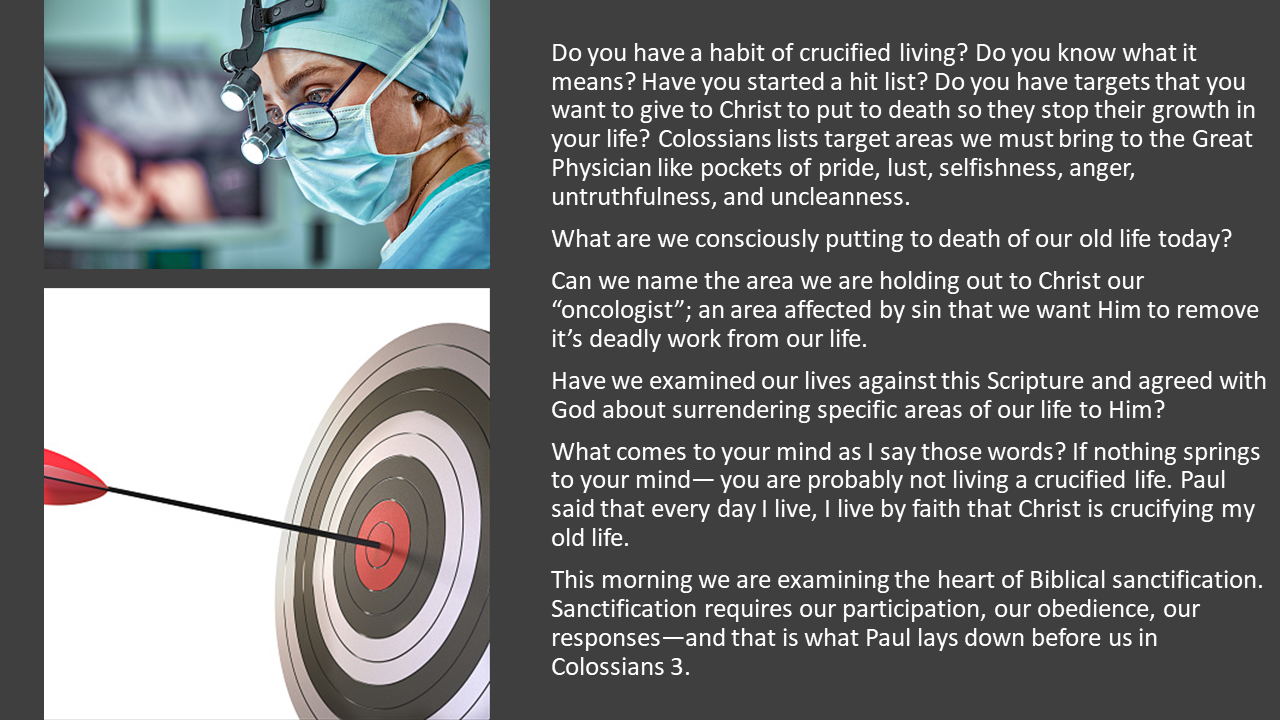
Do you have a habit of crucified living? Do you know what it means? Have you started a hit list? Do you have targets that you want to give to Christ to put to death so they stop their growth in your life? Colossians lists target areas we must bring to the Great Physician like pockets of pride, lust, selfishness, anger, untruthfulness, and uncleanness.
- What are we consciously putting to death of our old life today?
- Can we name the area we are holding out to Christ our “oncologist”; an area affected by sin that we want Him to remove its deadly work from our life.
- Have we examined our lives against this Scripture and agreed with God about surrendering specific areas of our life to Him?
- What comes to your mind as I say those words? If nothing springs to your mind— you are probably not living a crucified life. Paul said that every day I live, I live by faith that Christ is crucifying my old life.
This morning we are examining the heart of Biblical sanctification. Sanctification requires our participation, our obedience, our responses—and that is what Paul lays down before us in Colossians 3.
Just before we read what Paul wrote, may I again remind you of the two sides of the coin of salvation. We could call the two sides faith and works as James does. Another way would be to use Paul’s words from Romans—justification and sanctification. To best understand what Paul is asking us to do in Colossians let me contrast and explain justification and sanctification.
- Justification is what Christ did for me on the cross–sanctification is what Christ is doing in me because of the cross.
- Justification is immediate and was completely finished in me the instant I was saved—sanctification is an ongoing process never completed on earth until I meet Jesus face to face at death or His coming.
- Justification is activated the moment I trust in the Person of Christ Jesus and His finished sacrifice of the cross—sanctification grows with each obedient choice I make empowered by the Holy Spirit.
- Justification is my position declared right in God’s sight—sanctification is my practice made right by becoming more conformed to s image.
Listen to Paul say that because you are saved (justified) this is how you should live (sanctified), as we stand and read Colossians 3:5-17 and then pray.
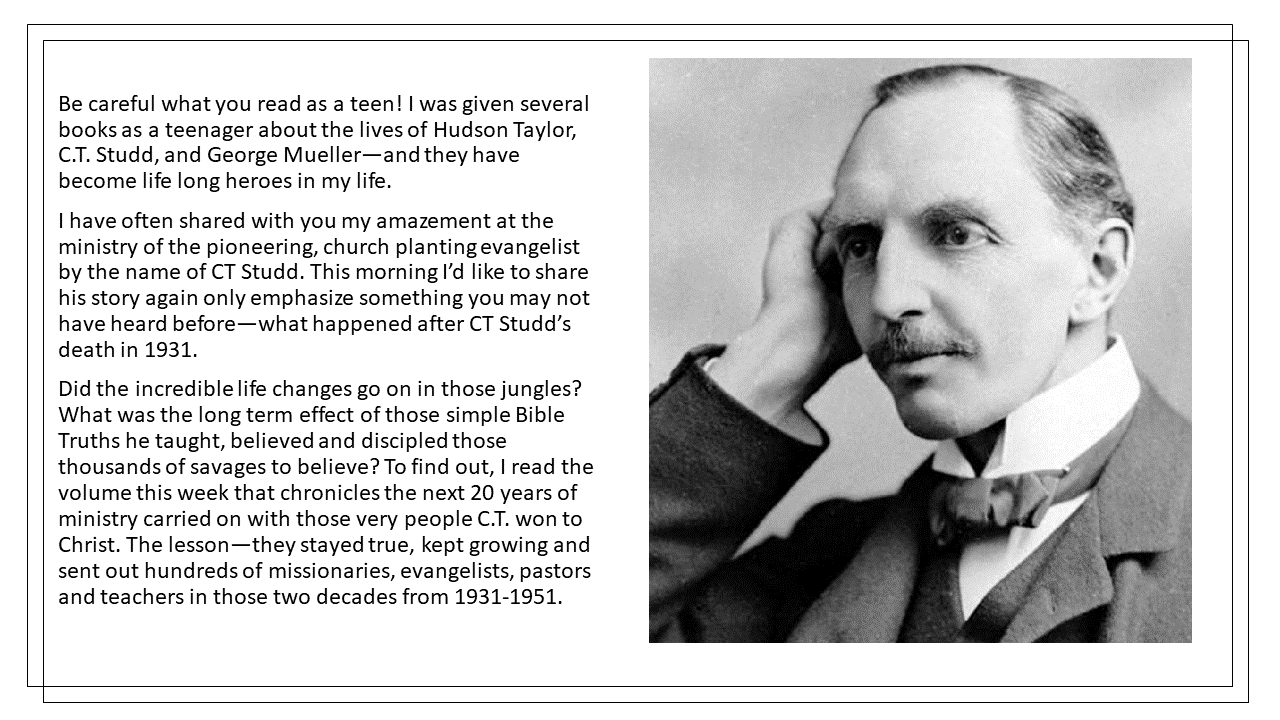
Be careful what you read as a teen! I was given several books as a teenager about the lives of Hudson Taylor, C.T. Studd, and George Mueller—and they have become life long heroes in my life.
I have often shared with you my amazement at the ministry of the pioneering, church planting evangelist by the name of CT Studd. This morning I’d like to share his story again only emphasize something you may not have heard before—what happened after CT Studd’s death in 1931.
Did the incredible life changes go on in those jungles? What was the long term effect of those simple Bible Truths he taught, believed and discipled those thousands of savages to believe? To find out, I read the volume this week that chronicles the next 20 years of ministry carried on with those very people C.T. won to Christ. The lesson—they stayed true, kept growing and sent out hundreds of missionaries, evangelists, pastors and teachers in those two decades from 1931-1951.
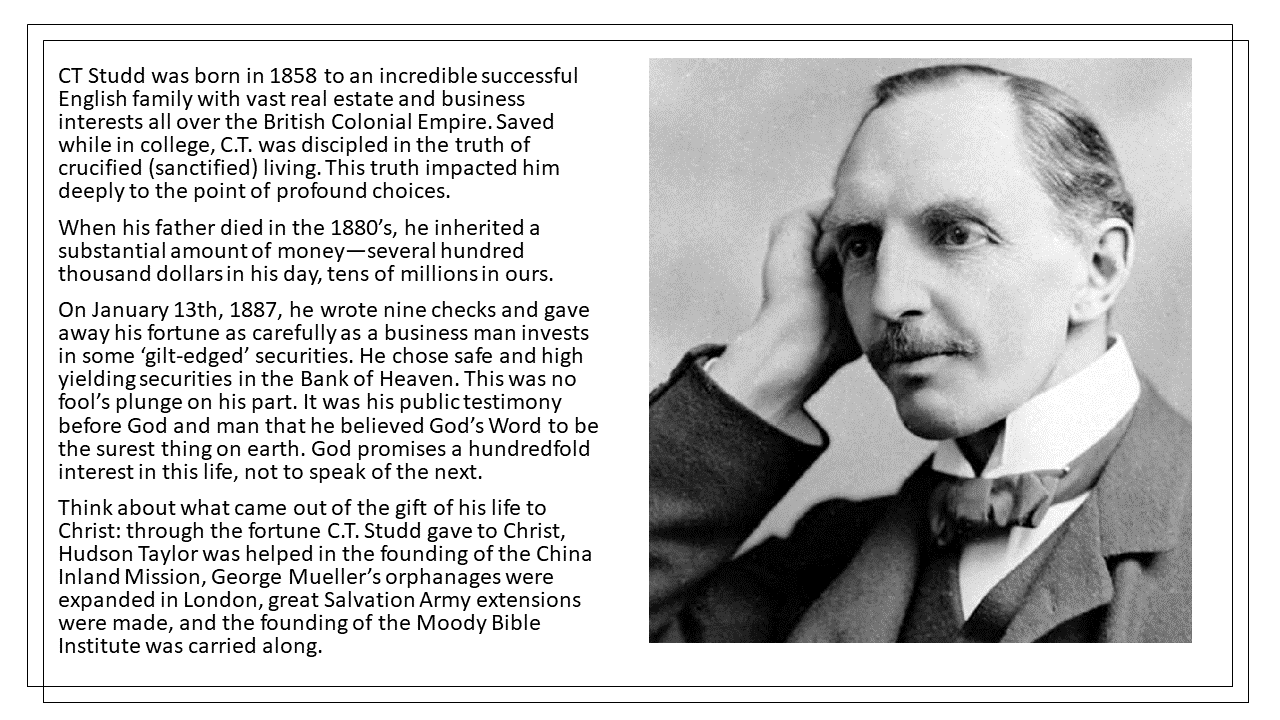
 CT Studd was born in 1858 to an incredible successful English family with vast real estate and business interests all over the British Colonial Empire. Saved while in college, C.T. was discipled in the truth of crucified (sanctified) living. This truth impacted him deeply to the point of profound choices.
When his father died in the 1880’s, he inherited a substantial amount of money—several hundred thousand dollars in his day, tens of millions in ours.
On January 13th, 1887, he wrote nine checks and gave away his fortune as carefully as a business man invests in some ‘gilt-edged’ securities. He chose safe and high yielding securities in the Bank of Heaven. This was no fool’s plunge on his part. It was his public testimony before God and man that he believed God’s Word to be the surest thing on earth. God promises a hundredfold interest in this life, not to speak of the next.
Think about what came out of the gift of his life to Christ: through the fortune C.T. Studd gave to Christ, Hudson Taylor was helped in the founding of the China Inland Mission, George Mueller’s orphanages were expanded in London, great Salvation Army extensions were made, and the founding of the Moody Bible Institute was carried along.
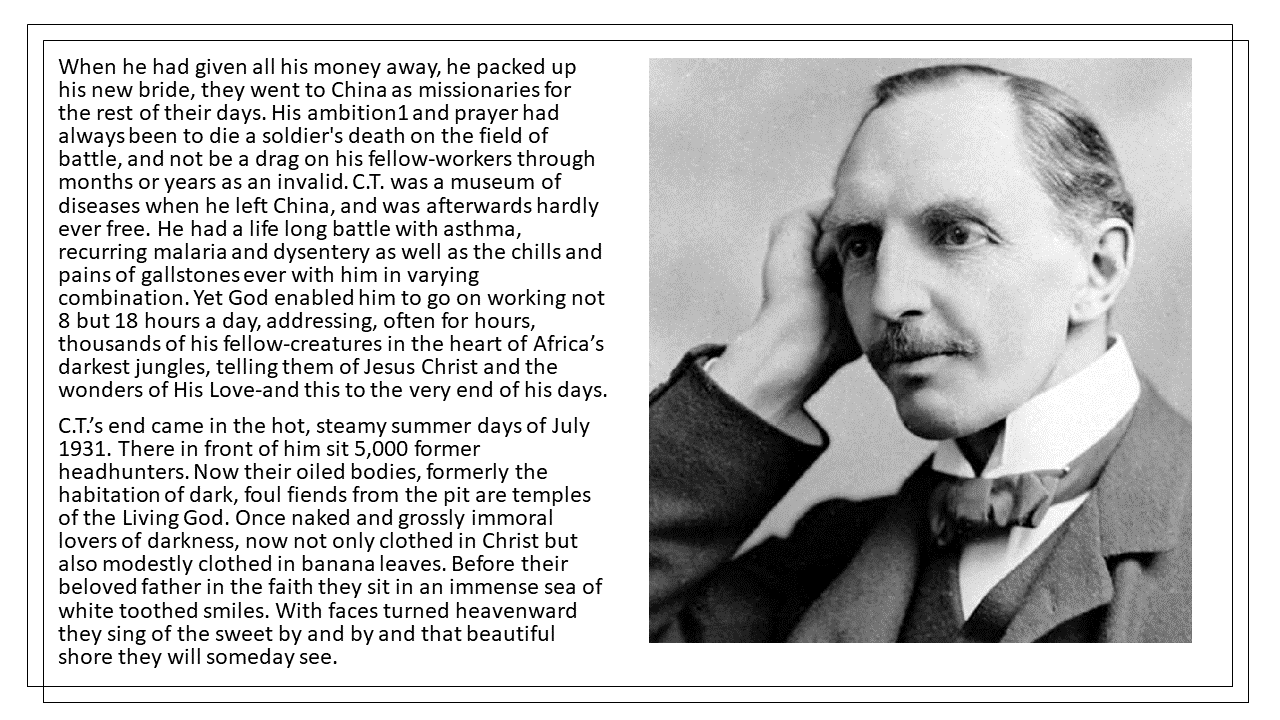
When he had given all his money away, he packed up his new bride, they went to China as missionaries for the rest of their days. His ambition1 and prayer had always been to die a soldier’s death on the field of battle, and not be a drag on his fellow-workers through months or years as an invalid. C.T. was a museum of diseases when he left China, and was afterwards hardly ever free. He had a life long battle with asthma, recurring malaria and dysentery as well as the chills and pains of gallstones ever with him in varying combination. Yet God enabled him to go on working not 8 but 18 hours a day, addressing, often for hours, thousands of his fellow-creatures in the heart of Africa’s darkest jungles, telling them of Jesus Christ and the wonders of His Love-and this to the very end of his days.
C.T.’s end came in the hot, steamy summer days of July 1931. There in front of him sit 5,000 former headhunters. Now their oiled bodies, formerly the habitation of dark, foul fiends from the pit are temples of the Living God. Once naked and grossly immoral lovers of darkness, now not only clothed in Christ but also modestly clothed in banana leaves. Before their beloved father in the faith they sit in an immense sea of white toothed smiles. With faces turned heavenward they sing of the sweet by and by and that beautiful shore they will someday see.
Passed now are the years of darkness and savagery. The former enemies sit shoulder to shoulder. No weapons of war are left, only the bond of love. This would be the last sight of his dear saintly converts Studd would see. After his message uttered between gasps for air, with every ear strained to catch each word, he is carried back to his hut. Exhausted, he rests; though only his Savior knew it was his last.
In the night the Faithful Shepherd who had led him to China, then India and finally to the very heart of Africa – took CT home. In the morning only the shriveled earthly tent was left. But around that hut and to the furthest reaches of the jungles and on mission stations around the world, the footprints of this giant can be found today.
In Africa at his death there were 30,000 born again, baptized and discipled pygmies whom C.T. found in 1910 as naked, murderous, grossly immoral cannibals butchering each other in the darkest jungles of Africa. Today they sing around the Throne of the Lamb, clothed in white raiment and worshiping Jesus–those C.T. won to Christ, discipled and served.
C.T. Studd lived a crucified life, surrendering every thing to Christ. And in return he lost nothing. This morning join me in Colossians 3, as we see the action we must take to live the life of killing our flesh, mortifying our flesh—and living the crucified with Christ life!
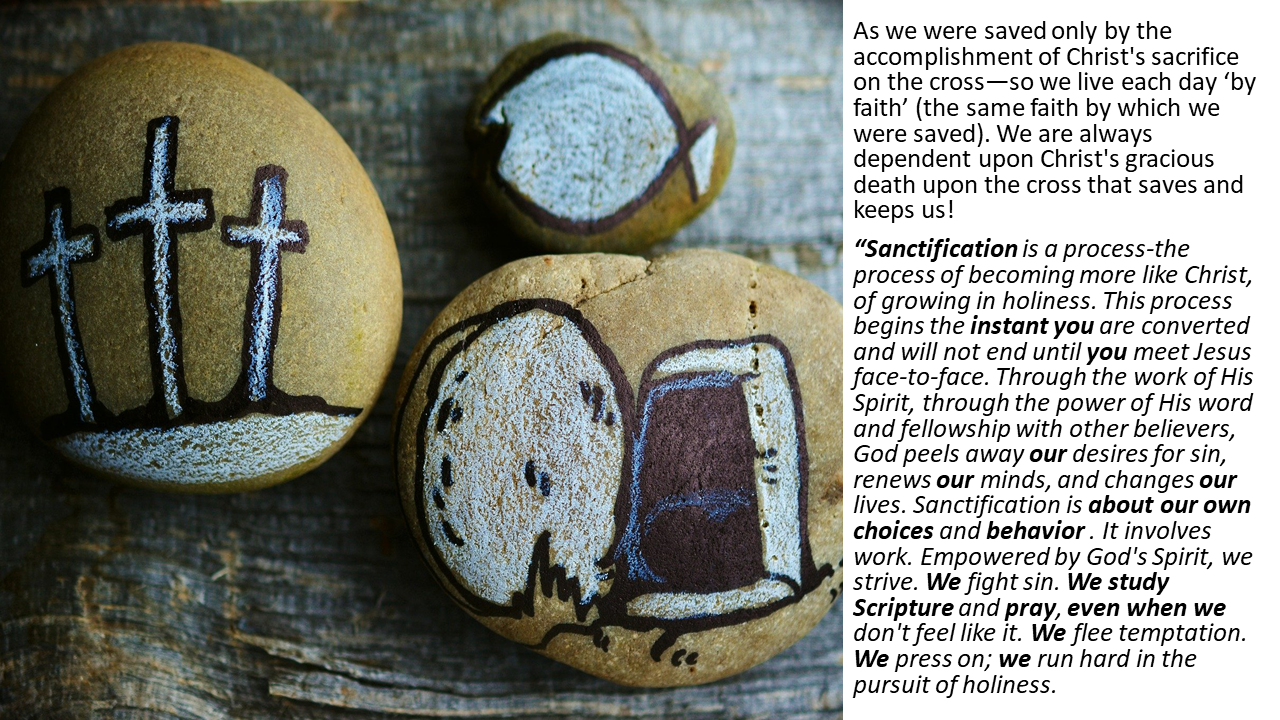
As we were saved only by the accomplishment of Christ’s sacrifice on the cross—so we live each day ‘by faith’ (the same faith by which we were saved). We are always dependent upon Christ’s gracious death upon the cross that saves and keeps us!
“Sanctification is a process-the process of becoming more like Christ, of growing in holiness. This process begins the instant you are converted and will not end until you meet Jesus face-to-face. Through the work of His Spirit, through the power of His word and fellowship with other believers, God peels away our desires for sin, renews our minds, and changes our lives. Sanctification is about our own choices and behavior . It involves work. Empowered by God’s Spirit, we strive. We fight sin. We study Scripture and pray, even when we don’t feel like it. We flee temptation. We press on; we run hard in the pursuit of holiness.2
 Colossians 3 is built around 14 imperative commands. Remember that God never commands me to do what He hasn’t already given me the grace to accomplish by faith through His Spirit!
“Our participation in the process of sanctification comes only after we’ve been totally accepted and made right before God through faith in Jesus. So yes, we work hard at obeying God’s word. We read our Bibles. We pray. We meditate on Scripture. We memorize Scripture. We share the gospel. We serve in our church. We fast. God commands us in His Word to do many things, and our obedience is both pleasing to Him and brings His blessing to our lives. But not one adds to our justification, our standing before God, our eternal life. Only grace sustains lasting change and sanctification. Through the cross we overcome not only the guilt of sin, but the power of sin as well3.
Let’s walk back through this chapter, see what Paul relates to us from the Lord, and then pause and ASK the Lord to unleash these powerful spiritual qualities in our lives today.
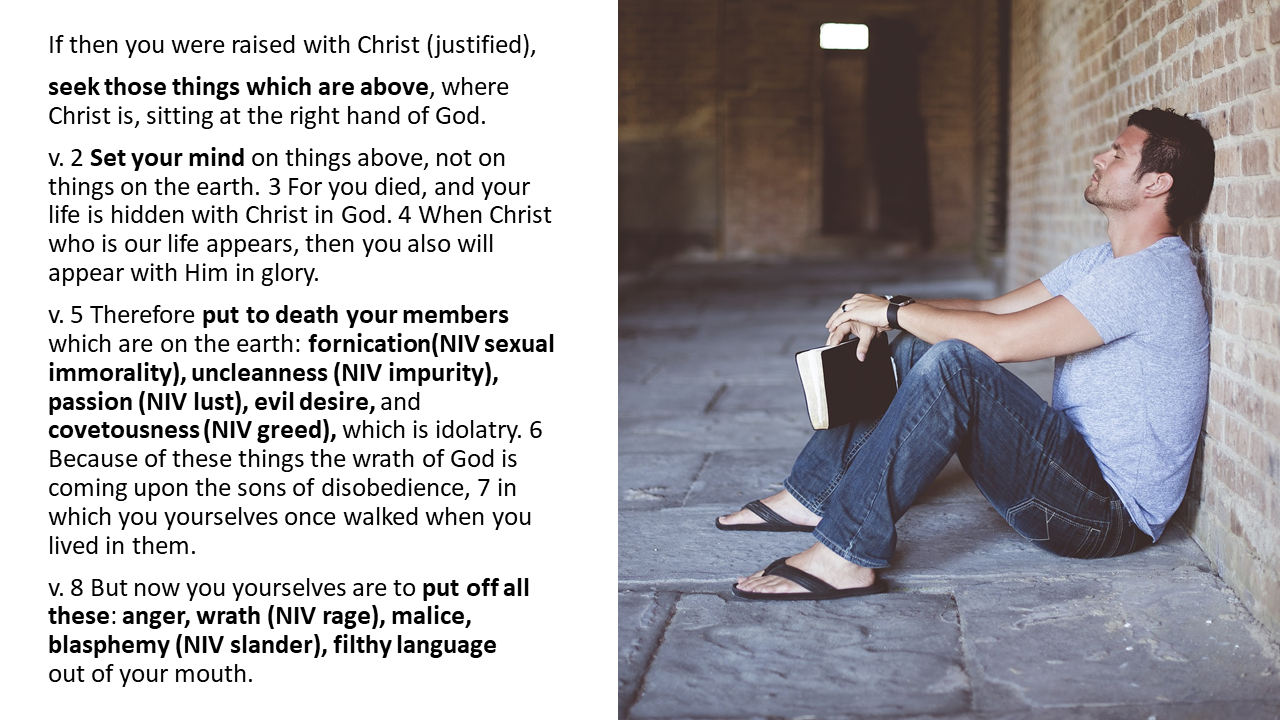
If then you were raised with Christ (justified), seek those things which are above, where Christ is, sitting at the right hand of God.
v. 2 Set your mind on things above, not on things on the earth. 3 For you died, and your life is hidden with Christ in God. 4 When Christ who is our life appears, then you also will appear with Him in glory.
v. 5 Therefore put to death your members which are on the earth: fornication
(NIV sexual immorality), uncleanness (NIV impurity), passion (NIV lust), evil desire, and covetousness (NIV greed), which is idolatry. 6 Because of these things the wrath of God is coming upon the sons of disobedience, 7 in which you yourselves once walked when you lived in them.
v. 8 But now you yourselves are to put off all these: anger, wrath (NIV rage), malice, blasphemy (NIV slander), filthy language out of your mouth:
Paul says that there are certain things of which the Colossians must strip themselves. The word he uses is the word for putting off clothes. There is here a picture from the life of the early Christian. When the Christian was baptized, he put off his old clothes when he went down into the water and when he emerged he put on a new and pure white robe. He divested himself of one kind of life and put on another.
v. 9 Do not lie to one another, since you have put off the old man with his deeds, 10 and have put on the new man who is renewed in knowledge according to the image of Him who created him, 11 where there is neither Greek nor Jew, circumcised nor uncircumcised, barbarian, Scythian, slave nor free, but Christ is all and in all:
SALVATION brought a complete change in our personality. We put off the old self and put on the new self, just as the candidate for baptism puts off his old clothes and puts on the new white robe.
Barbarians were those who were not Greeks, those whom we would call heathen today. The Scythian was the worst kind of barbarian. Scythia was north of the Black Sea and the Caspian Sea in the area around the Caucasus Mountains. The people who lived there were probably the most barbaric the world has known. You talk about pagan, heathen, brutal, and mean! They would take their enemies and scalp them; then they would use the skull as a cup and drink the blood of their victims out of the skull! I cannot think of anything more heathen than that! Did you know that the ancestors of many of us who have white skin came from that territory? We are called Caucasians after the area where these barbarians lived.
[Because of Christ’s death on the cross—He can now make me live the truth. Close your eyes, look up at the Lord and say, Lord Jesus right now live through me so that I do not live a lie by talking the talk but not living the truth.]
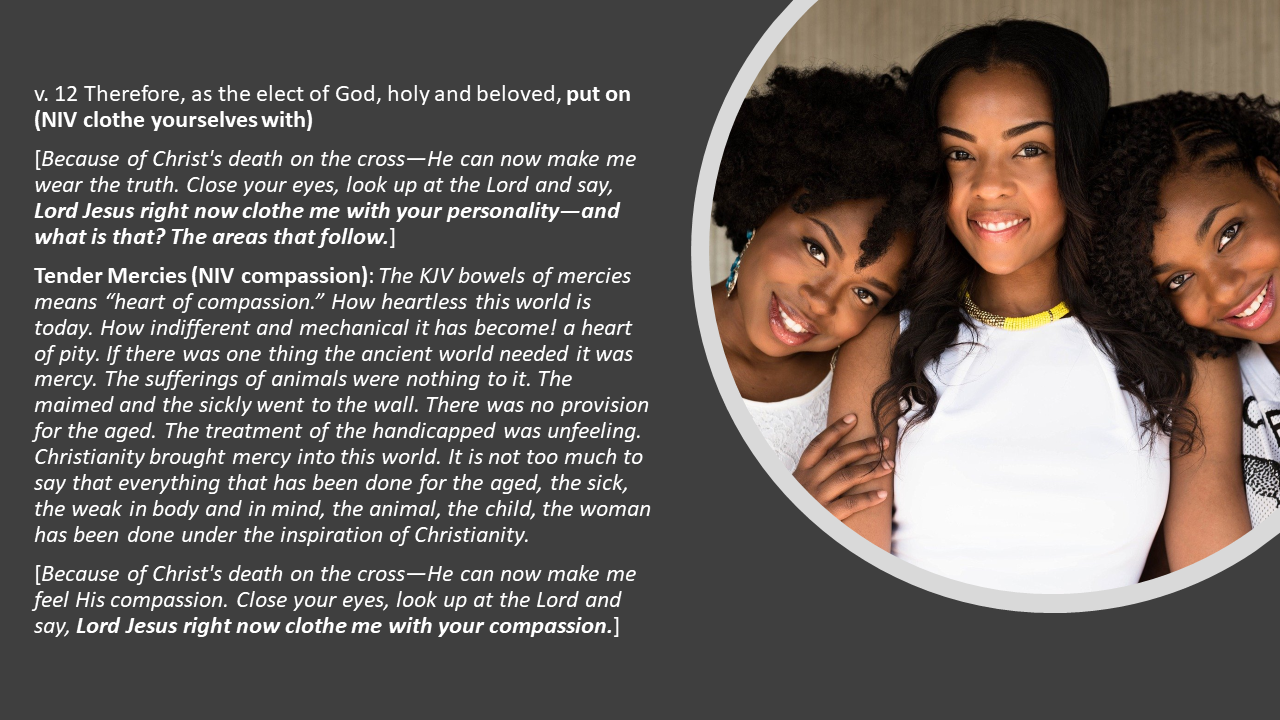
 v. 12 Therefore, as the elect of God, holy and beloved, put on (NIV clothe yourselves with)
[Because of Christ’s death on the cross—He can now make me wear the truth. Close your eyes, look up at the Lord and say, Lord Jesus right now clothe me with your personality—and what is that? The areas that follow.]
- tender mercies (NIV compassion):
The KJV bowels of mercies means “heart of compassion.” How heartless this world is today. How indifferent and mechanical it has become! a heart of pity. If there was one thing the ancient world needed it was mercy. The sufferings of animals were nothing to it. The maimed and the sickly went to the wall. There was no provision for the aged. The treatment of the handicapped was unfeeling. Christianity brought mercy into this world. It is not too much to say that everything that has been done for the aged, the sick, the weak in body and in mind, the animal, the child, the woman has been done under the inspiration of Christianity.
[Because of Christ’s death on the cross—He can now make me feel His compassion. Close your eyes, look up at the Lord and say, Lord Jesus right now clothe me with your compassion.]
- kindness:
This kindness means gentleness (chreμstoteμs). Trench calls this a lovely word for a lovely quality. The ancient writers defined chreμstoteμs as the virtue of the man whose neighbor’s good is as dear to him as his own. Josephus uses it as a description of Isaac, the man who dug wells and gave them to others because he would not fight about them (Genesis 26:17–25). It is the word used when Jesus said, “My yoke is easy.” (Matthew 11:30). Goodness by itself can be stern; but chreμstoteμs is the goodness which is kind, that type of goodness which Jesus used to the sinning woman who anointed his feet (Luke 7:37–50).
[Because of Christ’s death on the cross—He can now make me have His kindness. Close your eyes, look up at the Lord and say, Lord Jesus right now I want Your kindness in my life.]
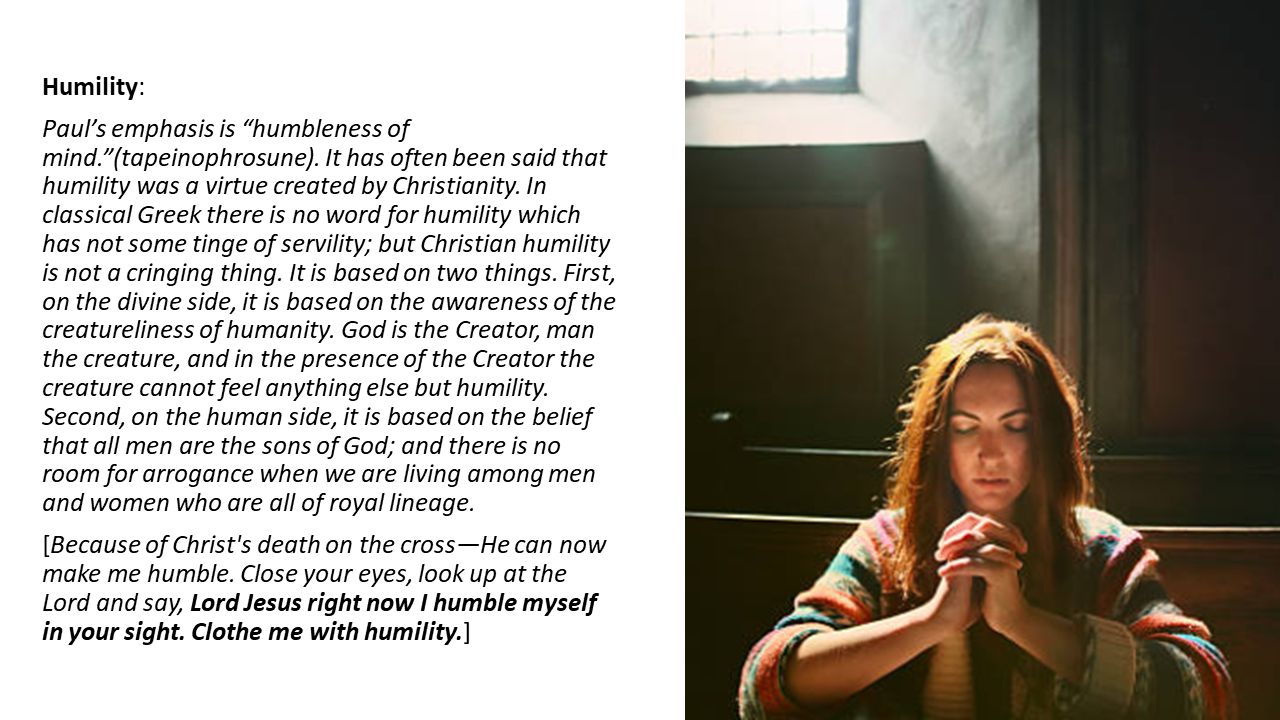
- humility:
Paul’s emphasis is “humbleness of mind.”(tapeinophrosune). It has often been said that humility was a virtue created by Christianity. In classical Greek there is no word for humility which has not some tinge of servility; but Christian humility is not a cringing thing. It is based on two things. First, on the divine side, it is based on the awareness of the creatureliness of humanity. God is the Creator, man the creature, and in the presence of the Creator the creature cannot feel anything else but humility. Second, on the human side, it is based on the belief that all men are the sons of God; and there is no room for arrogance when we are living among men and women who are all of royal lineage.
[Because of Christ’s death on the cross—He can now make me humble. Close your eyes, look up at the Lord and say, Lord Jesus right now I humble myself in your sight. Clothe me with humility.]
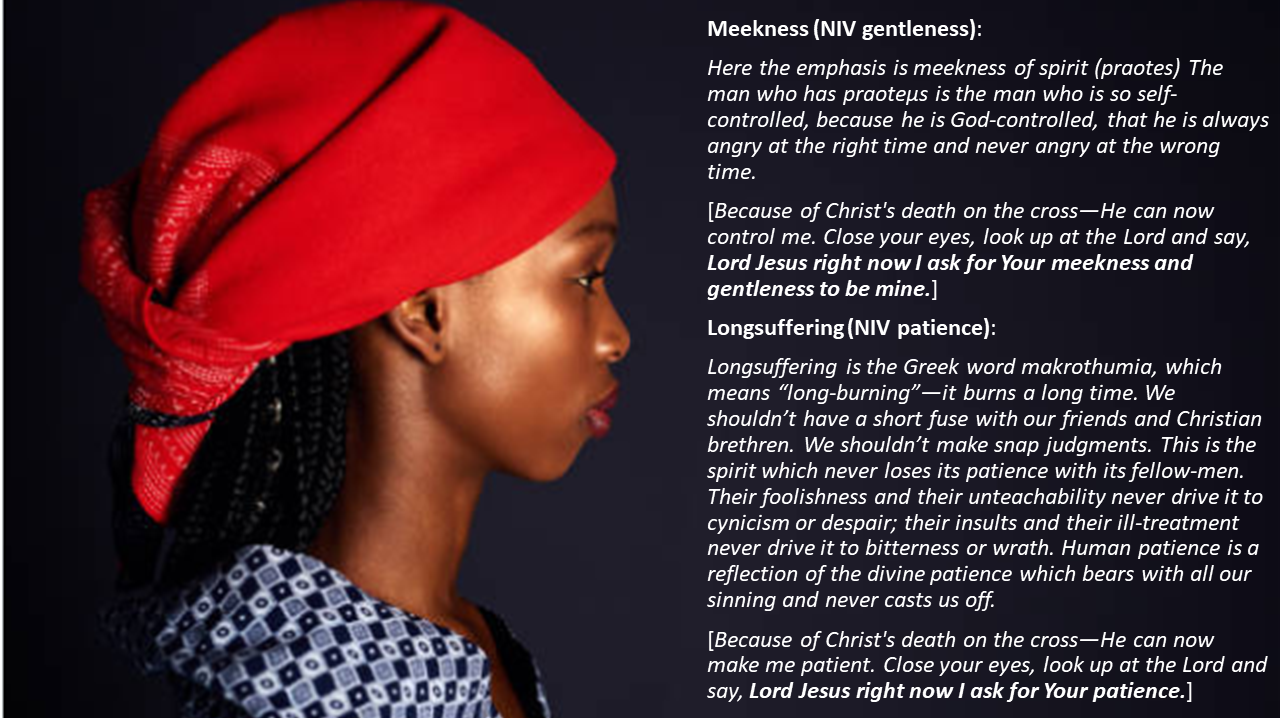
- meekness (NIV gentleness):
Here the emphasis is meekness of spirit (praotes) The man who has praoteμs is the man who is so self-controlled, because he is God-controlled, that he is always angry at the right time and never angry at the wrong time.
[Because of Christ’s death on the cross—He can now control me. Close your eyes, look up at the Lord and say, Lord Jesus right now I ask for Your meekness and gentleness to be mine.]
- longsuffering (NIV patience):
Longsuffering is the Greek word makrothumia, which means “long-burning”—it burns a long time. We shouldn’t have a short fuse with our friends and Christian brethren. We shouldn’t make snap judgments. This is the spirit which never loses its patience with its fellow-men. Their foolishness and their unteachability never drive it to cynicism or despair; their insults and their ill-treatment never drive it to bitterness or wrath. Human patience is a reflection of the divine patience which bears with all our sinning and never casts us off.
[Because of Christ’s death on the cross—He can now make me patient. Close your eyes, look up at the Lord and say, Lord Jesus right now I ask for Your patience.]
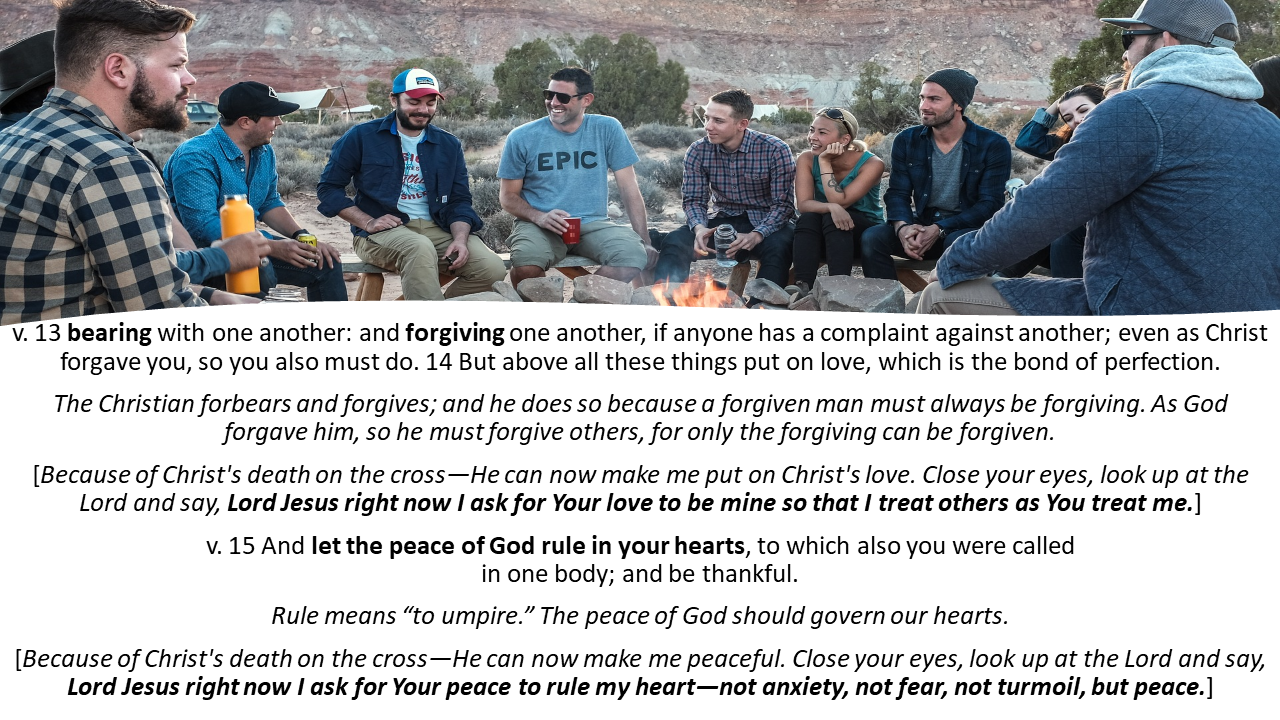
v. 13 bearing with one another: and forgiving one another, if anyone has a complaint against another; even as Christ forgave you, so you also must do. 14 But above all these things put on love, which is the bond of perfection.
The Christian forbears and forgives; and he does so because a forgiven man must always be forgiving. As God forgave him, so he must forgive others, for only the forgiving can be forgiven.4
[Because of Christ’s death on the cross—He can now make me put on Christ’s love. Close your eyes, look up at the Lord and say, Lord Jesus right now I ask for Your love to be mine so that I treat others as You treat me.]
v. 15 And let the peace of God rule in your hearts, to which also you were called in one body; and be thankful. Rule means “to umpire.” The peace of God should govern our hearts.5 [Because of Christ’s death on the cross—He can now make me peaceful. Close your eyes, look up at the Lord and say, Lord Jesus right now I ask for Your peace to rule my heart—not anxiety, not fear, not turmoil, but peace.]
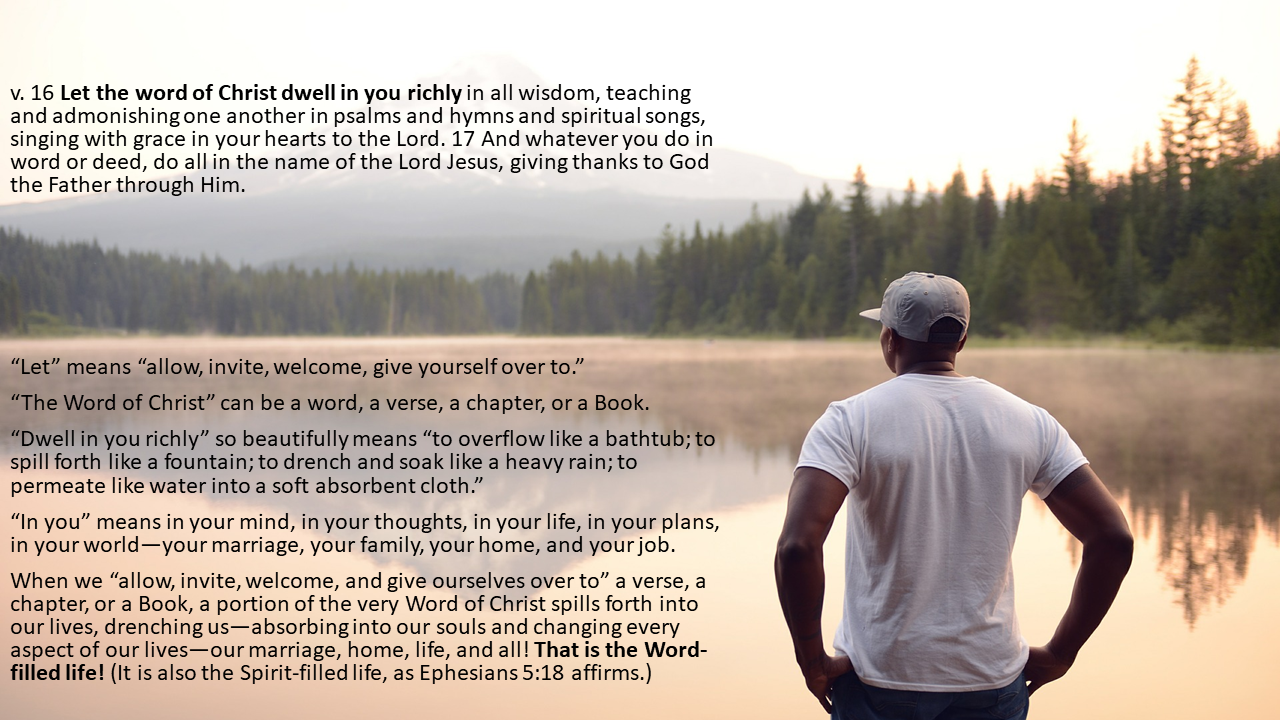
v. 16 Let the word of Christ dwell in you richly in all wisdom, teaching and admonishing one another in psalms and hymns and spiritual songs, singing with grace in your hearts to the Lord. 17 And whatever you do in word or deed, do all in the name of the Lord Jesus, giving thanks to God the Father through Him.
- “Let” means “allow, invite, welcome, give yourself over to.”
- “The Word of Christ” can be a word, a verse, a chapter, or a Book.
- “Dwell in you richly” so beautifully means “to overflow like a bathtub; to spill forth like a fountain; to drench and soak like a heavy rain; to permeate like water into a soft absorbent cloth.”
- “In you” means in your mind, in your thoughts, in your life, in your plans, in your world—your marriage, your family, your home, and your job.
When we “allow, invite, welcome, and give ourselves over to” a verse, a chapter, or a Book, a portion of the very Word of Christ spills forth into our lives, drenching us—absorbing into our souls and changing every aspect of our lives—our marriage, home, life, and all! That is the Word-filled life! (It is also the Spirit-filled life, as Ephesians 5:18 affirms.)
When we have a Word-filled life it means that we are: inviting God to speak; seeking His guidance; seeking divine help, godly wisdom, supernatural involvement; and cooperating with the Holy Spirit. This amounts to plugging in the power for life, using the map God has provided, following the directions in His Book, and listening to the instructions He has left us for daily living.
A Word-filled life is inviting God to speak; welcoming His help; seeking His input; wanting His advice; getting His help; showing we honor Him; partnering with God in parenting; and unleashing Him into every corner of our lives. We must start each day seeking to be emptied of self, with His Word read, our God sought, and His Spirit invited—to work in us so that Christ is honored.
When we walk in the Spirit every dimension of life is transformed. When we allow the Great Physician to amputate any sinful manifestation in our hearts, minds, and actions at home and work everything is touched by the power of the Spirit and the blessing of God! Note each area Paul points to.
 18 Wives, submit to your own husbands, as is fitting in the Lord. This was “a voluntary attitude of giving in, cooperating, assuming responsibility, and carrying a burden”.
19 Husbands, love your wives and do not be bitter (NIV harsh) toward them.
20 Children, obey your parents in all things, for this is well pleasing to the Lord.
21 Fathers, do not provoke (NIV embitter) your children, lest they become discouraged.
22 Bondservants, obey in all things your masters according to the flesh, not with eye service, as men-pleasers, but in sincerity of heart, fearing God.
23 And whatever you do, do it heartily, as to the Lord and not to men, 24 knowing that from the Lord you will receive the reward of the inheritance; for you serve the Lord Christ. 25 But he who does wrong will be repaid for what he has done, and there is no partiality. NKJV
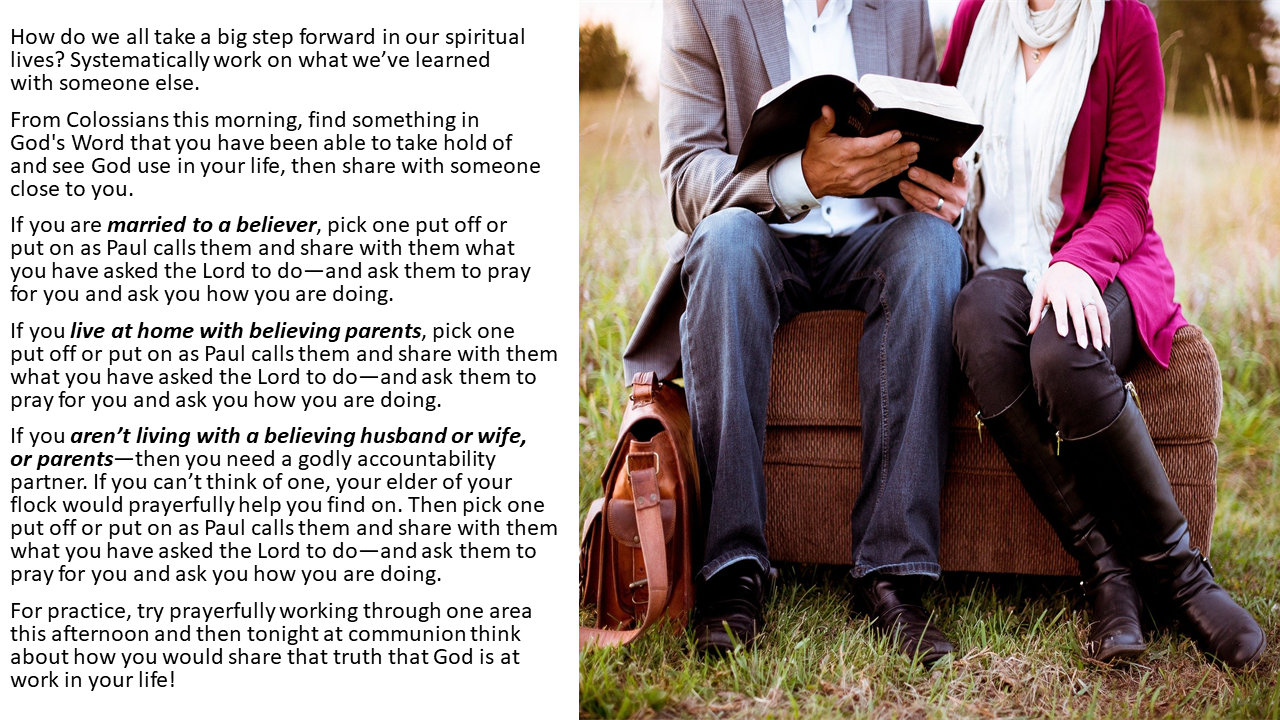
How do we all take a big step forward in our spiritual lives? Systematically work on what we’ve learned with someone else.
From Colossians this morning, find something in God’s Word that you have been able to take hold of and see God use in your life, then share with someone close to you.
- If you are married to a believer, pick one put off or put on as Paul calls them and share with them what you have asked the Lord to do—and ask them to pray for you and ask you how you are doing.
- If you live at home with believing parents, pick one put off or put on as Paul calls them and share with them what you have asked the Lord to do—and ask them to pray for you and ask you how you are doing.
- If you aren’t living with a believing husband or wife, or parents—then you need a godly accountability partner. If you can’t think of one, your elder of your flock would prayerfully help you find on. Then pick one put off or put on as Paul calls them and share with them what you have asked the Lord to do—and ask them to pray for you and ask you how you are doing.
- For practice, try prayerfully working through one area this afternoon and then tonight at communion think about how you would share that truth that God is at work in your life!
#206 There is a Redeemer #203 And Can it be
1 Norman Grubb, CT Studd, p. 216-217.
2 C. J. Mahaney, The Cross Centered Life, Sisters, OR: Multnomah Publishers, 2002, p. 31-34.
3 C. J. Mahaney, The Cross Centered Life, Sisters, OR: Multnomah Publishers, 2002, p. 31-34.
4 Many definitions above adapted from Barclay, William, Daily Study Bible Series: The Letters to the Philippians, Colossians and Thessalonians (Revised Edition), (Louisville, KY: Westminster John Knox Press) 2000, c1975.
5 Some definitions above adapted from McGee, J. Vernon, Thru the Bible with J. Vernon McGee, (Nashville: Thomas Nelson Publishers) 2000, c1981.
Slides





Check Out All The Sermons In The Series
You can find all the sermons and short clips from this series, David’s Spiritual Secret here.
Looking To Study The Bible Like Dr. Barnett?
Dr. Barnett has curated an Amazon page with a large collection of resources he uses in his study of God’s Word. You can check it out here.