
If the video above is not available, here are two other ways to view:
David’s Unguarded Moments
060423AM
DSS-17
1st Kings 15:5
Transcript
.jpg)
As you’re turning toward 1 Kings 15, that’s an unusual place to go. The Pentateuch, then Joshua, Judges, Ruth, 1 and 2 Samuel, 1 Kings. So, it’s about the 10th book of the Bible if you start back in the left there. But 1 Kings 15. We’re going to look at the fifth verse momentarily. We’re going back to the life of David. We’re going back to the last chapter of the life of David. It has a very sad start, but a wonderful ending. But I’d like to focus this morning on David’s unguarded moments.
.jpg)
Most of us do really well when we think about what we’re supposed to do. We get those verses that we’re memorizing or have memorized, and we read our Bibles, and we’re in our Bible studies or accountability groups, and we do really well. But it’s those unguarded moments that lead to sin. Sin always has inevitable, painful consequences. Those inevitable, painful consequences always bring about what the Scriptures say in believers, which is the godly sorrow that works repentance, which leads to joyful obedience. And God goes on wonderfully ministering.
But it’s those unguarded moments I want you to think about this morning. Examine with me the life of David because that’s exactly why David has this sad postscript in 1 Kings 15:5, that’s been tacked onto his life by the eternal God of the universe. We see this morning that in David’s life, an unguarded moment led to a tragic sin. That sin had some inevitable consequences that led to pain in his life, and not just momentary pain. We’re going to see, as we go through this, that there are chapter after chapter, year after year of painful consequences to a momentary sin. An unguarded moment in his life led to years of fratricide, brother killing brother, of the death of children as he lost the child he conceived with Bathsheba, as brother killed brother. He lost children, and then the whole nation was convulsed with all that happened because of that unguarded moment. But praise the Lord, the painful, godly sorrow brought repentance, and humble obedience led to joy.
All that is what David learned in the most horrible time of his life. In 1 Kings 15, we’re looking at David. Remember again what I’ve told you so many times, if you’re just checking in or have forgotten, he’s the most commemorated, the most written about man in the Bible. He is the most featured life that God features on the screen of His Word. We’re returning to the life that God wrote most about in the book He left us called the Bible. We’ve already seen over the past weeks that God gave us this divine record to see how David responded in every part of life, in every era of life, in every situation.
In fact, there was a great book written by a fellow, which showed that every possible emotion, he examined the Psalms, his name was Prothero. He examined the Psalms and the ones that David wrote, and he said, every conceivable human emotion has been mirrored and reflected in the life of David. So, David truly is the one that we see in every category as a human being. We’ve seen him struggle. We’ve seen him run. We’ve seen him hide. He’s become totally depressed. He lived in discouragement. Then, as Psalm 40 triumphantly says, God brought him up out of all of his struggles and sorrows, and troubles.
.jpg)
But, I want to remind you, we know more from the perspective of God through His inspired Word about David’s life than anybody else. There are over 141 chapters devoted to his life, to different facets of it. That’s more than anyone else within the pages of the Scripture. Therefore, that means we know more about David’s boyhood, about his youth, about his growing up than anybody else in the Bible. We know more details about what his family life was like, what his personal life was like, and what his habits were like, and we looked at all those. We also know more about David’s struggles and pains and emotional turbulences and depressions than any other biblical character. How he dealt with these things and what triggered them and what brought him out, and what God used, and how he shaped his life through all of those terrible times.
We know more about David’s career choices and successes than any other biblical character. David did a lot of wise things. He had a great philosophy. His career was truly God-honoring, and he made a lot of great godly choices that we have looked at. We know more about David’s finances and what he treasured and the possessions that meant a lot to him than anybody else in the Bible. What’s really neat is that anything that was special to him, he always dedicated it to the Lord. He gave his treasures to the Lord. He gave his loot and all of his winnings from all the battles. He was an undefeated general. All these things he gave to the Lord, and that’s a great learning experience. We saw that.
We also know more about David’s family struggles than any other biblical character. The interaction between brother and sister, between David and his wives, between the wives he got along with and the ones he didn’t, between the children that got along and didn’t, and how David raised them. We know more about that than any other family. David’s family is the most clearly laid out family in the Scriptures.
.jpg)
But this morning, in 1 Kings 15, we’re beginning the next phase of this series. I’ve called it David’s Spiritual Secret, and the under heading is Overcoming Life’s Unending Struggles. As we go into this next phase, we see, sadly, the darkest time of David’s life. That’s why we spent this morning examining it soberly. We know more about the sin of David’s unguarded moments than we do about anybody else’s personal, private life. It is laid open for us. God scans it. He puts it through the MRI. He puts it through the CAT scan. He puts it through the divine illuminated microscope, and God shows us what exactly was going on.
In fact, there are 15 different Hebrew words for sin. When God describes David’s sin in the first verse, He uses four of the most intense words for sin. That’s how serious David’s life is. He covers the gamut of every word God could think of for sin. We know more about the pain of the consequences that followed for years to come, but most of all, we know more about David’s humble, obedient response to God, which prompted the marvelous grace that we know of our loving Lord, the grace that exceeded David’s sin and his shame. We see David’s joy in his last days.
What’s so good about this is the man whose sin is forever settled in the book God wrote, the Bible, is also joyously up there as the one that God named his Son after. He said that Jesus Christ is the son of whom? David. Because He came, Jesus, to seek and to save that which was lost, and David was one of His treasured possessions. So, David ends triumphantly, and I think that’s a lesson for us. In spite of his failure, in spite of the painful consequences, he has a triumphant, joyous, peaceful, fulfilling, and very blessed life from God.
.jpg)
As we enter into 1 Kings 15:5, I want to describe the man we’re reading about because the man we’re reading about is at his peak. Okay. David, where we left off last time, was up here. He became King. He was at the zenith, the final phase where we met him this morning. He is at the top of his career. David is a successful king. He is a powerful ruler. He is an undefeated general. And by the way, he went out with his soldiers to battle and actually fought with them side-by-side. He led the battles, and he was undefeated in war as a general. He was also a wealthy businessman. He was surrounded on every side by God’s blessing. David is writing worship music, probably the best-known worship music in the world.
I noticed in the paper that someone who’s visiting a church in town and they’d written seven of the top choruses. All of their choruses seem to come from one man’s writings, David, so he was writing excellent worship music. He served the Lord in public worship. He practiced personal worship. He loved the Lord. But look at the incredible postscript to his life in 1 Corinthians. I’ve got Corinthians on my mind, 1 Kings 15.
Let’s all stand to read 1 Kings 15:5. I want you to see the incredible postscript to an incredible life that should stop each of us dead in our tracks because I want you to see one word that God emphasized in the life of David. Verse 5, because David did what was right in the eyes of the Lord and had not turned aside from anything that He, that is the Lord, commanded him all the days of his life. But does the verse end there? Sadly, it doesn’t.
This is God’s perspective on David. God says, David, the guy that struggled with his emotions, David, the guy that struggled with his family, David, the guy that struggled with his marriage…marriages, David, the man that struggled with his brothers, and his family, and didn’t get along with his dad at times, David. All of the things that David went through, in My sight, God said, David did what was right, and he never turned aside from anything I commanded him all the days of his life, except. That little postscript, that little footnote, is very sobering. Except in the matter of Uriah, the Hittite. We never really even say that fella’s name, do we? It’s so rare we say it. Did you know that’s what God thought about? He didn’t say Bathsheba. He said what David did with respect to Uriah. It kind of gives us a little insight that maybe it was Bathsheba who was not as unguilty, that she was just as guilty as David. It is Uriah that was wronged, that was murder that was adulterated against by David. That was the honorable, and David the dishonorable. David did that which was right in the eyes of the Lord. He did not turn aside from anything that He commanded him all the days of his life, except in the matter of Uriah, the Hittite.
Do you know what this verse tells us? God forgives our sins. God forgets our iniquities, but the consequences, the loss, God remembers and puts into this book, and that’s what he did with David’s life. I really believe that when we get to Revelation and when God wipes away all tears, it’s because we are so aware, in Heaven, not of our sins and iniquities, but of the loss that they caused us in this life. I hope this morning you’ll soberly with me, beware of unguarded moments in your life.
Let’s bow before the Lord in prayer. Father in Heaven, I thank You that You are the God who forgives our sins and iniquities and forgets them. But you’re the God that tells us the consequences and losses are for us to remember and someday to sorrow over as we see our life, the parts of it that were unguarded turned to ashes, to soot, and to nothingness. I pray that we would have the same sober response that the Apostle Paul did and say, let everyone that thinks he stands take heed lest he fall. Help us to have the same view of life that the Apostle Peter did, saying that our adversary, the Devil, is always stalking us and wants to devour us. And we want to watch and pray, lest in an unguarded moment we enter into temptation. Teach us this lesson. May we resolve in our hearts, and by Your Spirit’s power, and through conscious choices in our will that we will guard, and not let down our guard, because we want to please You and not to waste our lives. In the name of Jesus, we pray, Amen.
.jpg)
You may be seated, and as you’re seated, I want you to listen to some of the benefits we have on this side of the cross. Okay? If you want to turn somewhere, you can turn with me to 1 Corinthians chapter 10 in verse 12 in the New Testament. I kept saying, and I want to get you there, 1 Corinthians 10:12, because that’s this side of the cross. David lived on the back side of the cross, looking forward and anticipating what Christ would do. We live on the other side, knowing what He has done. But on this side of the cross, we have many advantages, and one of them is the finished revelation of God in this book that we hold called the Bible.
Two of the greatest New Testament writers simplified their daily lives. Peter and Paul simplified how you make it through daily life. They did it in two very clear little verses. They say, Peter starts, he says, every day of our life we’re stalked by a ravenous lion called the Devil. Don’t forget that. Don’t forget that. That ravenous lion can stalk you in your car, in your home, in your bedroom. He can stalk you at work. He can stalk you out and about in whatever you do. He is always roaring and watching and waiting to pounce on us.
The second thing is, Paul says, that we will be devoured if we don’t take heed. Look at 1 Corinthians chapter 10 and verse 12. I’m going to read Peter’s verse to you, and then you follow along when I pick up with 10:12 and see how Paul rounds this out. Peter says this, be sober, be vigilant, because your adversary, the Devil, walks about like a roaring lion seeking whom he may devour. Now, look at verse 12 of chapter 10 of 1 Corinthians. Therefore, let him who thinks he stands take heed lest he fall. The first part of 1 Corinthians 10 is all about all the terrible things that we can fall prey to, and they’re all examples of our adversary, The Devil, crouching and waiting and pouncing on unsuspecting and unprotected, and unguarded lives. Therefore, Paul tells us, let him who thinks he stands, take heed lest he fall. Beware of allowing any unguarded moments in your life. That’s the lesson this morning.
Beware of thinking you’re safe from sin’s reach, that it won’t bother you anymore. It’s at that moment that the ravenous devourer himself, the Devil, is crouching and preparing to spring. That’s what David discovered, only it was too late. David thought the sin thing he had taken care of. He thought that his life was under control. He was successful in every realm, especially in the realm of God, worship, and walking with God.
.jpg)
This morning, as we look at the final era of David’s life, there are three parts of it we need to think about. Number one, unguarded moments led to sin, think of Uriah and Bathsheba. First, the saddest chapter, the darkest one we all wince at, is the one that records his sin with Bathsheba. We’ll look at that, 2 Samuel 11, later. Secondly, inevitable consequences led to pain in David’s life. We can all chronicle that we know about those inevitable consequences: Absalom, his son and the rebellion, Shimei the curser of David, and I could go on and on about all the chapters of the horrible things that happened in David’s life. In fact, from 2 Samuel 12 all the way to 21, 10 chapters of woes come because of a momentary unguarded moment in David’s life.
But the joy is that humble obedience led to joy: the birth of Solomon, the writing of the Psalms, and the building of the resources for the Temple’s construction. The final days of David’s life, despite his failures besides the Bathsheba incident that God postscripts, David truly shows from beginning to end that he was after God’s own heart, except in this matter of Uriah, the Hittite.
There are lessons to be learned from David that are very difficult, but so necessary. For any and all of us today, Paul’s words that you have before you ring across the twisted wreckage of so many lives on the highway of the redeemed, and that is verse 12. Therefore, because of what’s in the Old Testament, because we have such an insight into all these events, and especially the most written about person in the Old Testament, therefore let him that think as he stands take heed lest he fall. Don’t ever let down your guard is what the apostle is telling us. Don’t ever think, oh, I don’t have to worry about that anymore, because that instant is when the Devil senses the opening and crouches and springs.
Why would David ever drop his guard and have this dangerous, unguarded moment in his life? Think about how far he came, and I want you just to sit back and think about the weeks we’ve studied his life.
.jpg)
First, he had a stellar youth. He wrote two psalms in his youth that are unbelievable: Psalm 19 and Psalm 23. Psalm 23 is one of the best-known pieces of literature in the world. Many, many people know that by heart. They don’t even know where they learned it; they just know it, maybe from being at too many funerals. I don’t know. Maybe growing up in Sunday school, but they just know the 23rd Psalm. That was David’s youth.
He summarized it in Psalm 19. He said, I want the words of my mouth and the meditations of my heart to be acceptable to you. When David was a youth, we saw many weeks ago, he broke with the crowd. He stopped getting and seeking approval from his peers. Do you remember when we studied that? Psalm 19:14 says, David broke with going with the group and said, I want to impress God. I want Him to be the one that I look up to, that I try and emulate, that I try and copy. Now, that’s a real lesson every young person should learn because most young people are in bondage to impressing their peers, and they don’t want to get out of step with their peers. David said, I want to get out of step with my peers, and I want to get in step with God. That Psalm 19:14 from his youth, David had a stellar walk with God.
From his fugitive years, starting with Psalm 56 all the way through Psalm 142, we have an example of a man who walked with God through the valleys, through oppression, as a fugitive through desperate times. So, David thought I could make it. Then we have the greatest days of his career. We have from those Psalm 15, Psalm 24, Psalm 68, Psalm 101. In fact, turn back to 101 with me, I want to remind you of how great David’s life was. This is David’s, Psalm 101, pact for purity. Do you remember when we studied that? It should be marked up in your Bible. This is what David wrote as he thought about the Lord being the refuge from the sins of his youth. He writes of his desire to serve the Lord as he entered his career. Most of those who classify the Psalms put Psalm 101 right there at David’s entrance into the kingship, and it’s like the reaffirmation of his life.
He is 30 years old and crowned King, and he reigns for seven years in Hebron, and then 33 years in Jerusalem. So, David is at this climactic moment of ascending to be king, and he writes the 101st Psalm. You remember, it’s the pathway to a Godly life. It’s his I wills. I will sing; I will sing praises. Verse 2, I will behave wisely. I will walk within my house properly. Verse 3, I will set nothing wicked before my eyes. Verse 4 at the end, I will not know wickedness. Remember, we went through all these. David is saying, these are what I’m going to be. What a great start to his career, how God blessed him.
Then he wrote Psalm 132. If you want to turn over to there, that’s also at his pinnacle, the 132nd Psalm. In the 132nd Psalm, which is how we started this whole series, that’s where I brought out this idea of David’s Spiritual Secret. David looks back to his youth, and he says, there I have a whole bunch of holy resolves starting in verse 3. I won’t go into my house or the comfort of my bed. Verse 4, I won’t sleep till I find a place, verse 5, for the Lord. This guy had a tremendous habit of seeking God. That’s why the Lord blessed him so much. God founded him, a man whose heart was completely toward Him. That’s where we find David at this incredible moment at the height of his career.
But then came the unguarded moments that led to sin. As you turn to 2 Samuel chapter 11, and that’s where we’re going to be this morning, 2 Samuel, chapter 11. We’re going to go back and forth to earlier and later verses, but 2 Samuel 11. I want you to think about this.
.jpg)
Did you know that the greatest event in history in David’s life was that climactic moment when, as a young man, as a teenager, David, the shepherd boy, defeated the greatest warrior of his day? David did that, and that’s back in 1 Samuel 17, because David and God were an unbeatable team. In fact, God alone is an unbeatable team, but when you get on His team, you always win.
Have you ever done that when you’re in school? I remember I wasn’t very good at athletics, but I did know who was good, and I always got on their team. It’s fun to win with the winners, and it’s just as great to see someone who really excels. David said, God, you always lead me in triumph. I want to be on Your team. He did that. That moment is in our minds. But what’s equally amazing is when you think about that, one of the greatest events in history, David and Goliath has an equally tragic sequel. You know how we have sequels to novels and sequels to movies? There’s a sequel to David and Goliath, and it’s almost more tragic than the glory of the initial run because after David and Goliath, there’s the sequel that’s horrible called David and Bathsheba.
What’s sad is that in David and Goliath, David killed Goliath. By God’s power as a humble teenager, he slew God’s enemy. But a little over 25 years later, a proud David ignored God’s Word and allowed another giant to come right into the city of Jerusalem. That giant David welcomed, he was God’s enemy. He, the man after God’s own heart, in his midlife, welcomed the giant named lust to dwell with him. David suffered the consequences of not guarding himself against that second giant. David was slain by the giant called lust, and that story is forever contained in the Scripture.
.jpg)
Far more dangerous than Goliath that he faced as a teenager is the giant of lust that had crept slowly into his own inner chambers. David, in a moment, blinded by his own selfish desires, was slain. Do you remember Paul’s simple command about what to do with lust? It is in an easy reference to remember, 2 Timothy 2:22. Okay? Just write that down somewhere. I’ll read it to you, but remember 2 T, 2, 2, 2. It’s one of those verses; once you know that it’s one of those unusual references, you can never forget it. Here’s what it says. Paul said, I command you to always flee youthful lust and pursue righteousness, faith, love, and peace with those who call in the Lord. Note, he doesn’t say, just do this when you’re a youth. He doesn’t say as a youth flee lust, he says, I command you to always flee youthful lust.
When we get to 2 Samuel 11, David has forgotten the imperatives of Psalm 101 and 132. David has forgotten his holy resolves. He’s forgotten I will set nothing wicked before me. He’s forgotten that I want to be clothed with holiness. He’s forgotten what we know on this side of the cross. As Paul said, I command you to always flee. The lust that we allow to be nurtured and fed in our youth follows us all the way through life. That’s why it’s so important when you’re a teenager, what you allow your mind and your private thoughts to nurture, and what habits you bring into your life because those habits will stay with you and only grow through life. And those lusts of the youth become the giants that slay us in later life. That’s what David didn’t realize.
The command is so clear: flee, run at all costs, leave the presence of lust when you see it start to smolder and come to the flame of passion. When you see it starting to raise its wicked head in your life, run from it, Paul said. The Lord will always make an escape route. That’s the promise of God. That’s what David had known for decades in his life, but in an unguarded moment, that’s what he forgot.
.jpg)
David, the giant killer, was killed by the giant of lust, and it took six dreadful steps for him to get to the bottom. He was enticed, he was baited, he was hooked, he was reeled in by lust, and lust destroyed the life of David and his testimony. It’s very insightful how it occurred.
Look at verse 1, and I just want you, if you are a Bible marker, to mark these in your Bible. Number one, David desensitized his conscience by incomplete obedience. Now, that’s before verse 1, and I’m going to show you that actually David and Bathsheba did not start when he was bored and strolling around his rooftop. That is not when this problem began. The Puritans used to say this: that the wagons of lust follow the ruts of our life. It is something that started previously, and we’re going to spend time examining it. But in verse 1, what we see is that David relaxed his grip on personal purity, and we’re going to examine that first verse.
David was not supposed to stay in Jerusalem when every other able-bodied man left town and left their wife behind. It was the custom, as it says in verse 1, when the men went out to battle, there’s a good reason why the king went out to battle: because all the other men were out to battle, and he shouldn’t stay behind, but he relaxed his grip on his personal purity, and we’ll examine that this morning.
Verse 2, David fixated his heart on his physical desires. Verse 3, David rationalized in his mind about his wrong decisions. Verse 4 is the depth of this whole section. He plunged his life into lustful sin. You know what that did, those simple little steps? David destroyed his testimony by the sin of a moment of stolen pleasure. He caused death. He produced deceit. He committed murder. He committed immorality. He caused spiritual oppression. He caused poverty and famine in his soul and in the nation. Those are only a few of the byproducts of this moment of sin.
.jpg)
First, though, before verse 1, we need to back up to chapter 5. So, back up to 2 Samuel 5 because I want to really show you David’s first step downward this morning. David desensitized his conscience by incomplete obedience. You remember, I pointed this out in the life of Saul several months back. I said that Saul’s downfall, the king before David, was one of selective obedience. God told him to do something, and he said I don’t like all that, but I’ll take the little part I do like, and I’ll do that. That is always a step downward in our spiritual lives. When we selectively obey God, when we only obey the easy parts or the parts we want to and not the parts that are hard and we don’t want to do. When we do that, we begin a process of disobedience because partial obedience, selective obedience, is disobedience. That’s what David does.
2 Samuel 5, and look at verse 13. As we read this verse, it reminds me of the warning signals. Have you ever had a warning signal on your car, especially? I didn’t know ours had so many. Recently, it said low tire pressure. Usually, I see the door ajar. It said low tire pressure. I banged it a couple of times, thought that’s nothing, so I drove home. The tire was almost flat, and I thought, how did the dashboard know my tire was almost flat? Unbelievable.
It reminded me of when I was younger. Do any of you remember when they started putting in cars the buzzers for seat belts? Are any of you old enough to remember that? It was the most annoying thing. Cars had seat belts. I don’t remember when they started, but they didn’t matter at all until they put the buzzers in. All of a sudden, you get in the car and you’d start it and [whirring sounds] until you click that thing, and it just was so annoying. I was pretty smart mechanically. I got under while it was [whirring sounds], and I pulled the thing out. The car stopped running. It was hooked into the whole ignition system of the car. Smart. I put it back in. I had to buckle my seatbelt. Do you know that’s what we like with warnings? We like to pull them out. We don’t want to hear them. David didn’t pay attention to the warning signal in his life.
.jpg)
What am I talking about? It says in 2 Samuel 5:13 that David took more concubines and wives from Jerusalem. Now remember, David has already been king by the time he gets to 2 Samuel 5. By the time he got there, he had been king for seven years. He started his kingship in Hebron. Then he moves into Jerusalem after seven years, when he makes that his capital. So, notice what it says. David took more concubines and wives from Jerusalem. When David set up his kingship in Jerusalem, he was an old pro at being a king. But he’d forgotten something.
This just sounds like you’re reading the news when you read the first part of verse 13. Nothing major, nothing bad, it’s neutral. After he’d come from Hebron, it says in the rest of the verse, more sons and daughters were born to David. So, what’s wrong with that? When you read the Bible, don’t you just say what’s wrong with that? Didn’t all the men back then do it? Didn’t Abraham have multiple wives? Jacob had several wives. Why, they’re all God’s people. What’s so bad about that? God says it’s wrong even if everybody else does it. But did God say it was wrong?
We need to backtrack on what happened to David when he became the king, because 600 years after Abraham had all of his wives, God had Moses write down in the Bible, write down in the Bible, rules for kings. Did you know that? Did you know that when David became the king, he was instructed by the priests and read from the law of God what God wanted from him? It’s just a little short section of the Bible. In fact, turn back with me to the book of Deuteronomy, and I want you to look at it, chapter 17. Because I want to show you what God wrote, and what David read, and what David stopped obeying, which desensitized his conscience.
.jpg)
These are the only instructions, Deuteronomy 17, starting in verse 15, that God gave for the king of Israel. David was only the second king. David was following a king who crashed and burned because of his partial and selective obedience. So, I’m sure David would’ve carefully listened to these words as he was anointed king, because Samuel knew them, the priests knew them, those who possessed the law of God knew them, because they were doing something new. They were having their only second king of all. So, these words were, I’m sure, intoned to David, the man who knew the Bible so well. He quotes from Deuteronomy all the time in the Psalms. So, this was his marching order from God.
Starting in verse 15 of chapter 17. I want you to follow along. I’m going to read God’s instructions for His leaders. Deuteronomy 17:15. You shall surely set a king over you whom the Lord your God chooses. So, that’s David. So, here we’re tracking. One from among your brethren, you shall set as king over you. You shall not set a foreigner over you who is not your brother. Verse 16, he shall not multiply horses for himself. David didn’t have a problem with that. Solomon did, but David didn’t. Nor cause the people to return to Egypt to multiply horses. David didn’t have a problem with that; his son did. For the Lord said to you, you shall not return that way again. Verse 17, neither shall he multiply wives for himself. David, up until the moment that he became king, had Ahinoam, and he had Abigail, and he had Michael, so he had at least three wives.
But the moment he became king, he wasn’t off the radar screen down there, what God overlooked, because God intended one man, one woman for life. But they had gotten this polygamy thing if you’re wealthy enough to afford it. But once he became king, God says, look at verse 17, neither shall David, when he becomes king, multiply wives for himself, lest his heart turn away. But he did get the next statement, nor shall he greatly multiply silver and gold for himself. David knew that. What did he do with everything he conquered as a king? He donated it all to the Lord, dedicated all to the Lord, put it in the Lord’s treasuries, but not in this one little area.
Now, when I read this 17th verse, the first part of it, I think of if you ever drive up I-44 towards St. Louis, do you ever notice on the side of the road in Missouri there’s a big sign that says what part of thou shalt not is not clear? Have you ever seen that? What part of thou shalt not, don’t you understand? Look what this says. Thou shall not multiply wives for yourself if you’re going to be king. This is the code the kings were supposed to live by. It’s very powerful. It’s God’s instructions for his leaders. There are very, very few instructions. David, in 2 Samuel 5:13, blew right by that commandment, and it says he took many wives for himself. He desensitized himself. David personally disobeyed God because he multiplied for himself wives and possibly multiplied for himself opportunities for his heart to get turned away.
Now, keep reading. Look at verse 18. God says, don’t do that. But He also told him something else to do. Look at verse 18, and it shall be when he sits on the throne of his kingdom that he shall write for himself a copy of this law in a book, from the one before the priests, the Levites. So, this is how we know he read it, because this was the very foundational element of a king’s rule. It was to personally write down the Torah, the Pentateuch, the law of God. Now, that would’ve taken a long time. The Pentateuch, the first five books of the Bible, has 5,852 verses, which comes down to just under 160,000 Hebrew words.
So, this week as I was studying, I pulled out my pen and paper, and I wrote one Hebrew verse down. I had to copy it from the Hebrew Bible, and I was sitting there. Now, I have a nice, easy-to-use pen. I didn’t have to keep cleaning it off and sharpening it and dipping it in the ink. I was writing on plain old paper, and I didn’t have to spread it out and try and write on animal skin or whatever. I timed how long it took me to write one verse. It says here that David had to write all 160,000 Hebrew words of the first five books. Look what it says. He shall write for himself a copy of this Law, and it is not speaking of this verse. The Law at that time spoke of the Pentateuch, the Law, and the Books of Moses were summed up under the Law. Do you know how long that would take? Conservatively speaking, about 900 hours. That’s half a year’s work. So, he was supposed to spend the first half of his first year as King doing a Bible study about what he was and wasn’t supposed to do.
.jpg)
Now, look at verse 19. And it shall be with him. He’s supposed to carry this thing around, this personal Bible study, this copy of the Bible he made. And he shall read it all the days of his life. Wow. Can you imagine what a king was to be? He was supposed to be a living personal student of the Word that was meditating on it, carrying this thing around, reading it, living it, and teaching it in all that he did as king. Why is that? That he may, look at the next phrase in verse 19, learn to fear the Lord his God, because a continued exposure to this book causes us to learn about God and live a life that acknowledges Him.
The next phrase, and be careful to observe all the words of this Law and these statutes. Verse 20, that his heart may not be lifted up above his brethren. What does that mean? So, he doesn’t think that he can look over the rooftop of his house and look at anybody’s wife he wants to and take them. That’s exactly what happened. David’s heart was lifted up, and he said, wow, I’m the number one warrior. I’m the giant killer. I’m the wealthiest guy in this whole country. I’m the greatest. I’m the king of God’s people, and I can have whoever and whatever I want, whenever I want it. That’s what happens to David. David did not do what Deuteronomy 17:20 says. He didn’t guard his heart from being lifted up above his brethren.
Then the ending of this 20th verse, that he may not turn aside from the commandment, to the right or to the left, that he may prolong his days in his kingdom, he and his children in the midst of Israel. So, because of that little warning from God that was ignored, David’s life moves on without God’s protection.
.jpg)
Now, go back with me to 2 Samuel 11. Let’s look at step two. Step one was in 2 Samuel 5:13, David desensitized his conscience by incomplete obedience. He just said I don’t have to do that. I know the king’s supposed to do that. I know that I’m supposed to do that. I’m not going to do that. I’m going to multiply wives for myself. I don’t think he consciously said, all right, God, I’m going to disobey you. He just said, oh man, everybody else is doing it. It’s okay.
Step two, David, because his life is moving on without God’s protection, because of selective obedience, because of incomplete obedience, because of desensitization of his conscience, because he, as I did in my car, pulls out the buzzer, that annoying buzzer. I’m sure that he didn’t read that part of the rules for the king about not multiplying wives. He didn’t like that. He didn’t even realize that he started driving in his own power. He started going without God’s protection. Step two, he relaxes his grip on personal purity. David had let little things slide in his life, things that went so well for so long that he forgot to be on guard. David relaxed his grip on personal purity.
It says in verse 1, it happened. Doesn’t that sound so innocuous? It happened. It was just so innocent. It happened in the spring of the year, the time when Kings go out to battle, that David sent everybody else to battle and all of Israel, and they destroyed the people. But look at the end of verse 1. But David remained at Jerusalem. Did you know temptation usually strikes when we’re alone? One of the most frequent times of temptation is the times when we’re alone. David remained at Jerusalem. David relaxed his grip on personal purity.
I remember the old days of T-Ball and Little League when the kids were in that. The first day they’re in their uniforms, and they’ve got that mitt on, and the coach says, all right, everybody, and they all run on the field, and they stand like this, and they’re so ready. But, after about three or four minutes, what happens? They turn around. They’re not facing the game anymore. A lot of times, you see them sitting on the ground, and they’re picking up the dandelions and throwing them. The mitt is on the ground. They’ve totally lost touch with the game. What we see is just like the little leaguers lose touch, they lose their grip on their position. You know, they’re supposed to be facing the game and holding the mitt and at least getting hit by the ball. David is at the height of his life, and David has lost his grip on purity. He’s playing with dandelions in the presence of a ravenous lion of lust.
You say you’re reading that in. No, we know from what happens that lust is already in his life. I don’t know where it came in, but I do know that it was because David relaxed his guard. He was no longer Psalm 101; I will set no wicked thing before my eye. He was no longer Psalm 132 saying, I want to be clothed with righteousness. No, he is a bored, over satisfied with too many things man looking for a new form of satisfaction. He had lost his grip on purity, and he’s playing with the ravenous lion of lust. We need to be doing what it takes to maintain purity in our lives.
.jpg)
Now, I want to close. This is where we’re going to start tonight, but I want to close by taking you to Matthew 5. So, go to Matthew 5. Nobody could say this better than Jesus Christ Himself. Matthew chapter 5. Too bad David didn’t have this verse. Okay. But we do, so we’re even more responsible than he. In Matthew chapter 5, Jesus told us once how serious we must be about sexual sin. Most people dismiss Christ’s words as hyperbole, overkill, or something else other than what it says. But at this moment in David’s life, maybe we should read Christ’s words and ponder them personally because this is what David didn’t do.
Matthew chapter 5, starting in verse 27. This is the Sermon on the Mount. Matthew 5. Listen with new ears to Christ’s words. You have heard that it was said, Jesus says in verse 27, do not commit adultery. But I tell you, anyone who looks at a woman lustfully has already committed adultery. So, when did David’s adultery really happen? It happened on the rooftop, not in the bedroom. It happened when he looked. They found his palace in the last six months.
By the way, the archeologists in Jerusalem were reading the Bible. They’ve already found the City of David, and the chief archeologist, Eilat Mazar, was reading the Bible, and she said, huh! It says in the Bible that David came down from his palace to the fortress when the Philistines attacked. She said that must mean that his palace is higher. So, they went up the hill and started digging, and they found David’s palatial home, which was higher than the whole city. You could see from that home down into every courtyard in that city. That’s because it’s what the Bible says. The archaeologist found it.
David, who is there, up in that palatial home looking down into the city, look what it says in verse 27. Whoever looks at a woman lustfully, up there in that palace looking down, has already committed adultery with her in his heart. So, Jesus says, it’s your heart that you have to guard.
Now look, usually we stop there, but Jesus doesn’t stop there. Look at how radically he talks about sexual immorality, how radically he says, we have to look at it, and deal with it. If your right eye causes you to sin, gouge it out and throw it away. As soon as we read that, we go, woo, ooh, that’s dumb. What is He talking about? That’s self-mutilation. He’s not talking about cutting out your eye. He’s saying take radical moves to deal with sin. Do whatever it takes is what He’s saying. They understood. I don’t think anybody went and bought an eye spoon to pop their eye out.
Did you ever have a schoolmate who had glass eyes? It used to always bother me. We had a friend, he’d pop his eye out, put his mouth, and put it back in. Yeah, it was just gross. That’s what I think about. So, I don’t read this very often. But now I’m serious about it because look at this, what He says. In the light of David, if your right eye causes you to sin, gouge it out and throw it away; it was meant to shock us. It is better for you to lose one part of your body than for your whole body to be thrown into Hell. Is Jesus serious here or not?
He doesn’t stop there. If your right hand. See, back then, people were all right-handed. Right-handed in their sword, right-handed in everything. That’s why they shook hands, because you couldn’t stab someone if you had their hand. They couldn’t grab their sword. That’s why Ehud got Eglon because he was left-handed. So, back then, everyone was right-handed. So, they shook hands, and he said, if your right hand, which you need for life, for work, for war, to defend yourself, if your right hand, that is so valuable to you, causes you to sin, cut it off and throw it away. It is better for you to lose one part of your body than for your whole body to go into Hell. Okay? Jesus is radical.
.jpg)
Let me start something because I read a magazine article where someone wrote their personal testimony from Matthew 5:27-30. I just want to read to you a few of their words because I respect them deeply. It’s a great senior pastor from a generation before me, but this is what he said on this verse. The title of the article in this magazine is called Jesus the Radical. He says, why does Jesus paint such a shocking picture in Matthew 5:27-30? I believe He wants us to take radical steps to do whatever is necessary to deal with sexual temptation. He wrote this many years ago. It’s dated. I’m not going to read the whole article, but if he thought sexual temptation was bad back in his day, it’s worse today.
He continues. Let me keep reading. Now, the hands and the eye are not the causes of sin. Jesus said gouge out your eye, cut off your hand. A blind man can still lust. A man without a hand can still steal, but the eye is the means of access for both godly and ungodly input. As the hand is the measure for performing righteous or sinful acts, therefore, we must govern what our eye looks at and what the hand does. If we take Jesus seriously, we need to think far more radically about sexual purity. The battle is too intense. The stakes are too high to approach purity casually or gradually.
Now, the reason I’m reading this to you is that a while back, I don’t know when, but some time I preached a sermon here, and I said, there’s only one command God says about temptation, and that is to flee. Somehow it got broadcast on the radio, and then it got on the internet, where they rebroadcast everything. About three months ago, I got a letter from Singapore from a drug rehab center. They were listening online to our archived radio broadcast. This guy, who was graduating from the drug and alcohol addiction thing, who was also addicted to all kinds of immorality, was told by them he had to be discipled by someone. This was the most amazing thing. I read this letter to my family.
So, this guy who works for some high-tech company said, I’m going to be discipled by the internet. So, he typed in flee lust. I don’t know how, but he found that message, and he wrote me a letter three months ago and said, I have just finished listening to all 900 of your online MP3s. He said, I feel like I know you. He included a $50 bill and said, go buy a cup of coffee. From Singapore, it’s gotten out. Someone knows I drink coffee. But then he said this, he said, I’ve listened to 900 hours. The thing that meant most to me was when you said the way you deal with sin is to flee from it. Isn’t that a blessing that someone on the other side of the world can catch that who is from Singapore?
Jesus said this: He said, if we take Jesus seriously, we must do something not casually or gradually. We have to act. This is where we’re going to pick up tonight. How do you apply this today? We don’t live in the fortress of Jerusalem looking down. I don’t know anybody who can look down into everybody’s backyard and see people. You can on Google, but you can’t see anything. It’s from a satellite. How do you apply it today?
Let me finish a few more points of this guy’s article. If you can’t keep your eyes away from explicit images, don’t go to video rental stores. You say, come on, everybody goes there. No, you shouldn’t if it causes you to sin. Do your thoughts trip you up when you’re with certain people? Stop hanging out with them. Do certain kinds of music charge you up, erotically? Stop listening to it. If this seems like a crutch, fine, use whatever crutch you need to help you walk. Some people fall into mental adultery through ads, through billboards, through watching people jog who dress immodestly. Stop looking, he says, and stop putting yourself in the position to look.
Do you know why David fell into sin? Not because he was a worship leader, not because he wrote Psalms, not because he was an undefeated general, not because he was a wealthy businessman. It’s because he had unguarded moments. He thought, I’ve come to the place in my life where that area won’t bother me. They can all go off to war. I’ll be fine at home. Just go. I’m okay. As Paul’s words ring across the ages, across the littered hulks of burned-out and ruined lives that litter the highway of the redeemed, David thought he stood. Paul says, if you think you stand, take heed lest you fall. Tonight, we’re going to pick up in Matthew 5:27 and look at how we can guard every moment and say no to sin.
.jpg)
Let’s bow before the Lord in prayer. Father, I thank You this morning for David’s life. It’s sobering, and some of the things you said, Lord Jesus, are a little distasteful to us. But You said radical moves have to be taken to preserve our purity. We already know the ending. When You return in the Tribulation, the whole world is headlong into immorality, and we see it around us today. We want to take radical steps to make sure that our eyes and our hands do not lead us into sin. Help us to learn from David’s life, from Your words, and by Your Spirit’s power to say no and flee sin. We ask for that because we love You, because Your Spirit, which is the Holy Spirit, lives within us. So, we pray that You would quicken us to take radical steps, to have the purity that You honor in our lives. And for any who haven’t taken that first step, which is a step of faith and confession, repentance from the old and turning in a cry of save me from my sins, Lord, I pray they take that this morning. Anyone this morning can reach out to You by faith and begin the walk of faith. But, primarily this morning, we mostly, in this room, know You. Help us to take to heart Matthew 5:27-30 and start practicing and cultivating it in our lives. In the precious name of Jesus, we pray, and all God’s people said, Amen. God bless you as you go.
Notes
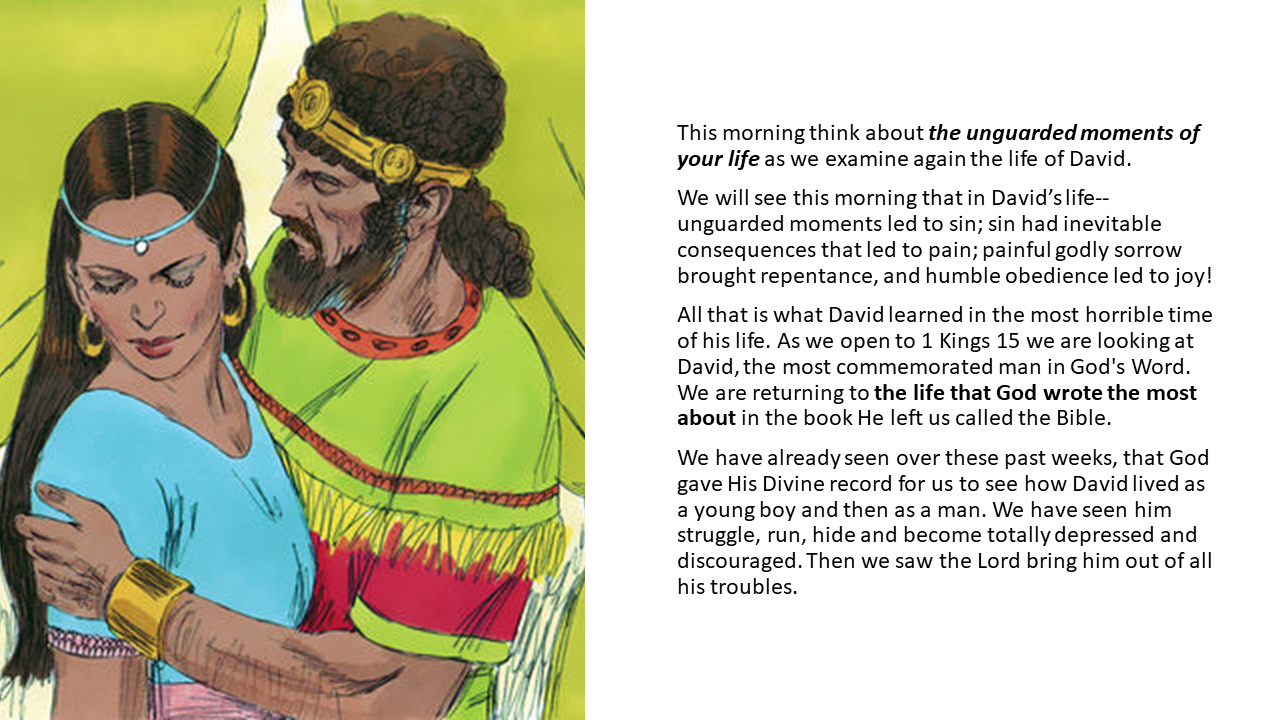
This morning think about the unguarded moments of your life as we examine again the life of David.
We will see this morning that in David’s life–unguarded moments led to sin; sin had inevitable consequences that led to pain; painful godly sorrow brought repentance, and humble obedience led to joy!
All that is what David learned in the most horrible time of his life. As we open to 1st Kings 15 we are looking at David, the most commemorated man in God’s Word. We are returning to the life that God wrote the most about in the book He left us called the Bible.
We have already seen over these past weeks, that God gave His Divine record for us to see how David lived as a young boy and then as a man. We have seen him struggle, run, hide and become totally depressed and discouraged. Then we saw the Lord bring him out of all his troubles.
May I remind you that we know more from the perspective of God through His inspired Word about David’s life (by the sheer mass of 141+ chapters devoted to his life in God’s Word) than any other human that has ever lived. That means—
- We know more about David’s boyhood, youth and growing up years than any other Biblical character.
- We know more about David’s struggles, pains, emotional turbulences, and depressions than any other Biblical character.
- We know more about David’s career choices and successes than any other Biblical character.
- We know more about David’s finances and treasured possessions than any other Biblical character.
- We know more about David’s family struggles than any other Biblical character.
We begin this morning the next phase of this series which I am calling “David’s Spiritual Secret: Overcoming Life’s Unending Struggles”. As we do so we sadly enter into another area of David’s life we know more about.
- We know more about the sin of David’s unguarded moments than we do about anyone else;
- We know more about the pain of the consequences that followed for years to follow. But most of all—
- We know more about David’s humble obedience prompting the marvelous grace of our loving Lord—grace that exceeded David’s sin and his shame.
- We see David’s joy in his last days as he returns to joy, peace, fulfillment and blessings from God.
As we enter into this final phase of David’s life, where we meet him this morning–he is at the top of his career. He is a successful king, powerful ruler, undefeated general, wealthy businessman, and surrounded on every side by God’s blessing. David is writing worship music, serving the Lord in public worship, practicing personal worship and loving the Lord.
But, there is an incredible postscript to an incredible life that should stop each of us dead in our tracks. Look with me at 1st Kings 15:5 and listen as I read and emphasize that one word God emphasizes for us.
1 Kings 15:5 because David did what was right in the eyes of the Lord, and had not turned aside from anything that He commanded him all the days of his life, except in the matter of Uriah the Hittite. NKJV
God forgives the sins, and God forgets the iniquities. But the consequences and loss are recorded in the Bible, God’s forever settled in Heaven Word.
Pray
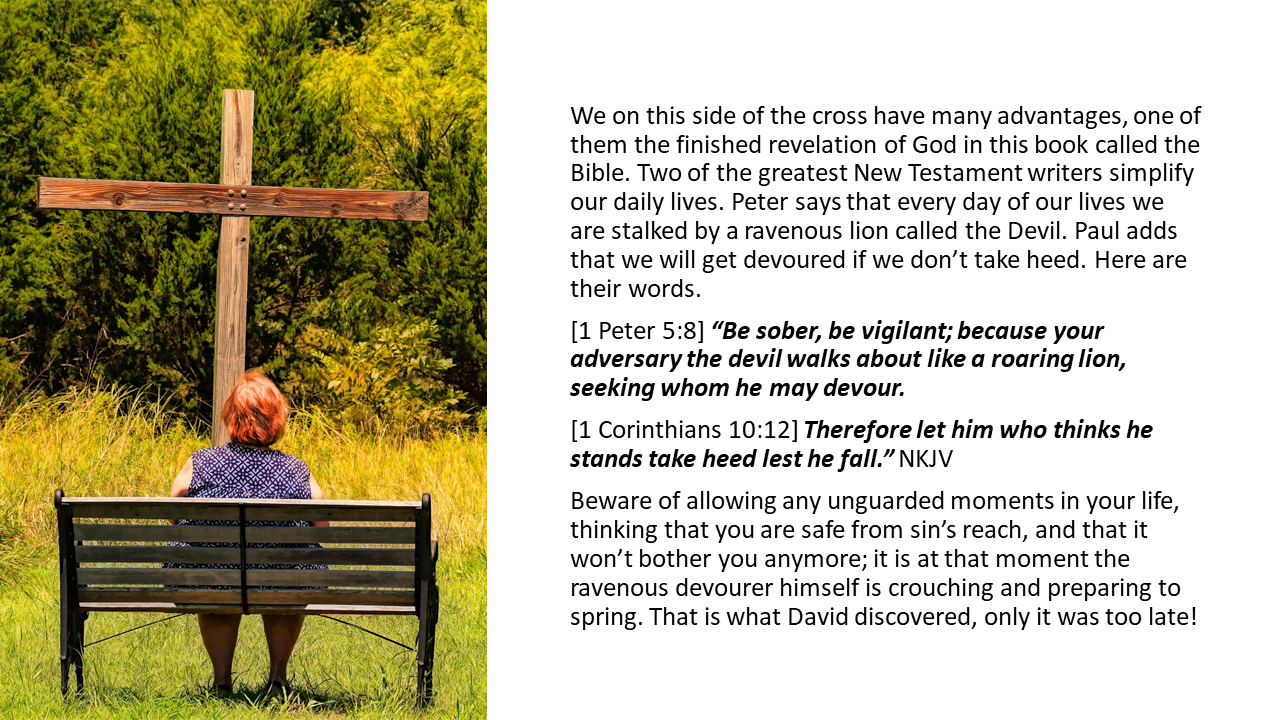
 We on this side of the cross have many advantages, one of them the finished revelation of God in this book called the Bible. Two of the greatest New Testament writers simplify our daily lives. Peter says that every day of our lives we are stalked by a ravenous lion called the Devil. Paul adds that we will get devoured if we don’t take heed. Here are their words.
[1 Peter 5:8] “Be sober, be vigilant; because your adversary the devil walks about like a roaring lion, seeking whom he may devour. [1 Corinthians 10:12] Therefore let him who thinks he stands take heed lest he fall.” NKJV
Beware of allowing any unguarded moments in your life, thinking that you are safe from sin’s reach, and that it won’t bother you anymore; it is at that moment the ravenous devourer himself is crouching and preparing to spring. That is what David discovered, only it was too late!
We begin this morning a careful look at the three final eras of David’s life. They need to be studied and heeded by all of us.
- Unguarded Moments lead to SIN—Uriah and Bathsheba. First is the saddest chapter, the darkest and the one we all wince at—his sin with Bathsheba. 2nd Samuel 11
- Inevitable Consequences lead to PAIN—Absalom and Shimei. These are the chapters that record the many years of painful consequences because of David’s sin. 2nd Samuel 12-21, 24
- Humble Obedience lead to JOY—Solomon, Psalms and the Temple. And last, the final days of David’s life. When we see that despite the failures of Bathsheba incident—David truly was after God’s own heart. We see him end well, using his final days for God’s glory. 2nd Samuel 22-23
There are lessons to be learned from David that are very difficult but so necessary. For any and all of us today ring Paul’s words across the twisted wreckage of so many lives that litter the highway of the redeemed—
1 Corinthians 10:12 Therefore let him who thinks he stands take heed lest he fall. NKJV
Why would David ever drop his guard and have these dangerous and unguarded moments in his life? Well, think of how far he came.
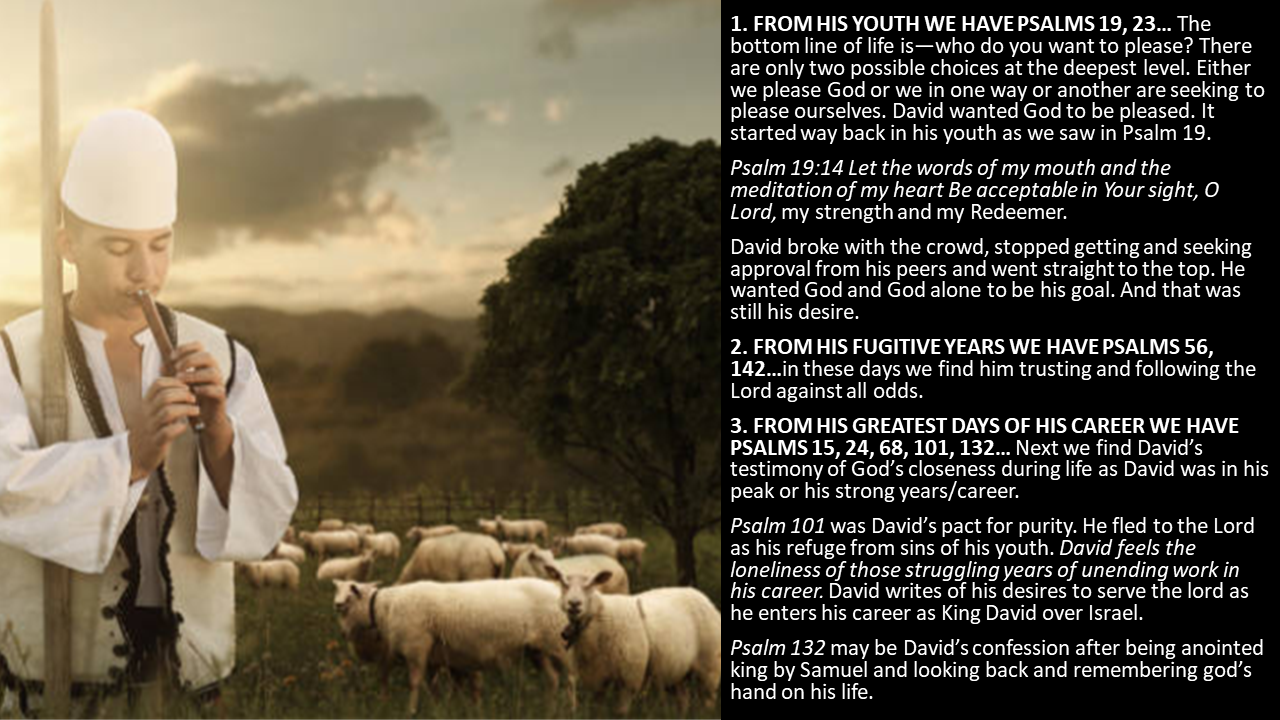
1. FROM HIS YOUTH WE HAVE PSALMS 19, 23… The bottom line of life is—who do you want to please? There are only two possible choices at the deepest level. Either we please God or we in one way or another are seeking to please ourselves. David wanted God to be pleased. It started way back in his youth as we saw in Psalm 19.
Psalm 19:14 Let the words of my mouth and the meditation of my heart Be acceptable in Your sight, O Lord, my strength and my Redeemer.
David broke with the crowd, stopped getting and seeking approval from his peers and went straight to the top. He wanted God and God alone to be his goal. And that was still his desire.
2. FROM HIS FUGITIVE YEARS WE HAVE PSALMS 56, 142…in these days we find him trusting and following the Lord against all odds.
 3. FROM HIS GREATEST DAYS OF HIS CAREER WE HAVE PSALMS 15, 24, 68, 101, 132… Next we find David’s testimony of God’s closeness during life as David was in his peak or his strong years/career.
Psalm 101 was David’s pact for purity. He fled to the Lord as his refuge from sins of his youth. David feels the loneliness of those struggling years of unending work in his career. David writes of his desires to serve the lord as he enters his career as King David over Israel.
Psalm 132 may be David’s confession after being anointed king by Samuel and looking back and remembering god’s hand on his life.
Unguarded Moments Lead to Sin
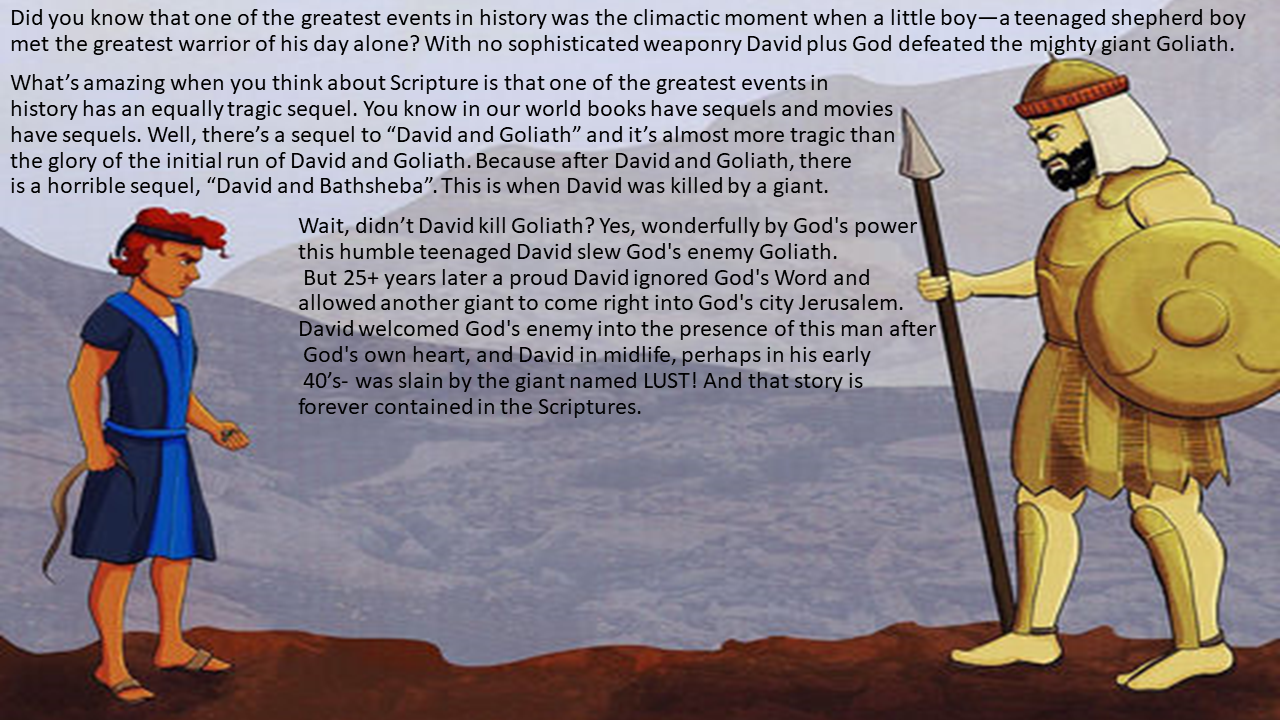
Did you know that one of the greatest events in history was the climactic moment when a little boy—a teenaged shepherd boy met the greatest warrior of his day alone? With no sophisticated weaponry David plus God defeated the mighty giant Goliath.
What’s amazing when you think about Scripture is that one of the greatest events in history has an equally tragic sequel. You know in our world books have sequels and movies have sequels. Well, there’s a sequel to “David and Goliath” and it’s almost more tragic than the glory of the initial run of David and Goliath. Because after David and Goliath, there is a horrible sequel, “David and Bathsheba”. This is when David was killed by a giant.
Wait, didn’t David kill Goliath? Yes, wonderfully by God’s power this humble teenaged David slew God’s enemy Goliath. But 25+ years later a proud David ignored God’s Word and allowed another giant to come right into God’s city Jerusalem. David welcomed God’s enemy into the presence of this man after God’s own heart, and David in midlife- perhaps in his early 40’s- was slain by the giant named LUST! And that story is forever contained in the Scriptures.
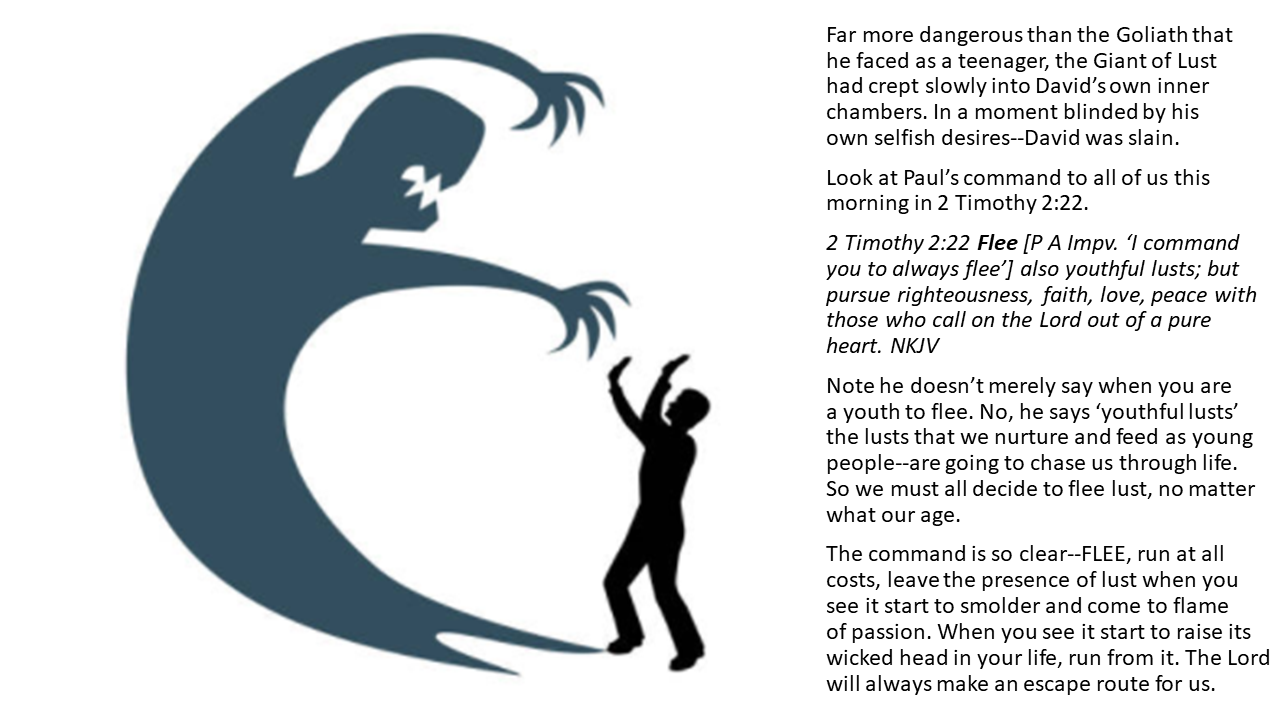
Far more dangerous than the Goliath that he faced as a teenager, the Giant of Lust had crept slowly into David’s own inner chambers. In a moment blinded by his own selfish desires–David was slain. Look at Paul’s command to all of us this morning in 2nd Timothy 2:22.
2 Timothy 2:22 Flee [P A Impv. ‘I command you to always flee’] also youthful lusts; but pursue righteousness, faith, love, peace with those who call on the Lord out of a pure heart. NKJV
Note he doesn’t merely say when you are a youth to flee. No, he says ‘youthful lusts’ the lusts that we nurture and feed as young people–are going to chase us through life. So we must all decide to flee lust, no matter what our age.
The command is so clear–FLEE, run at all costs, leave the presence of lust when you see it start to smolder and come to flame of passion. When you see it start to raise its wicked head in your life, run from it. The Lord will always make an escape route for us.
 David the giant killer, killed by the giant of lust, took six dreadful steps downward. He was enticed, baited, hooked and reeled in by lust. Then lust destroyed David’s life and testimony. It’s very insightful how this occurred, note his downward steps.
1. David Desensitized his conscience by incomplete obedience (II Sam 5:13).
2. David Relaxed his grip on personal purity (II Sam 11:1).
3. David Fixated his heart on physical desires (II Sam 11:2).
4. David Rationalized his mind about wrong decisions (II Sam 11:3).
5. David Plunged his life into lustful sin (II Sam 11:4).
6. David Destroyed his testimony by the sin of a moment of stolen pleasure. Death, deceit, murder, immorality and spiritual oppression, poverty and famine of the soul are only a few offspring of this act of momentary pleasure.
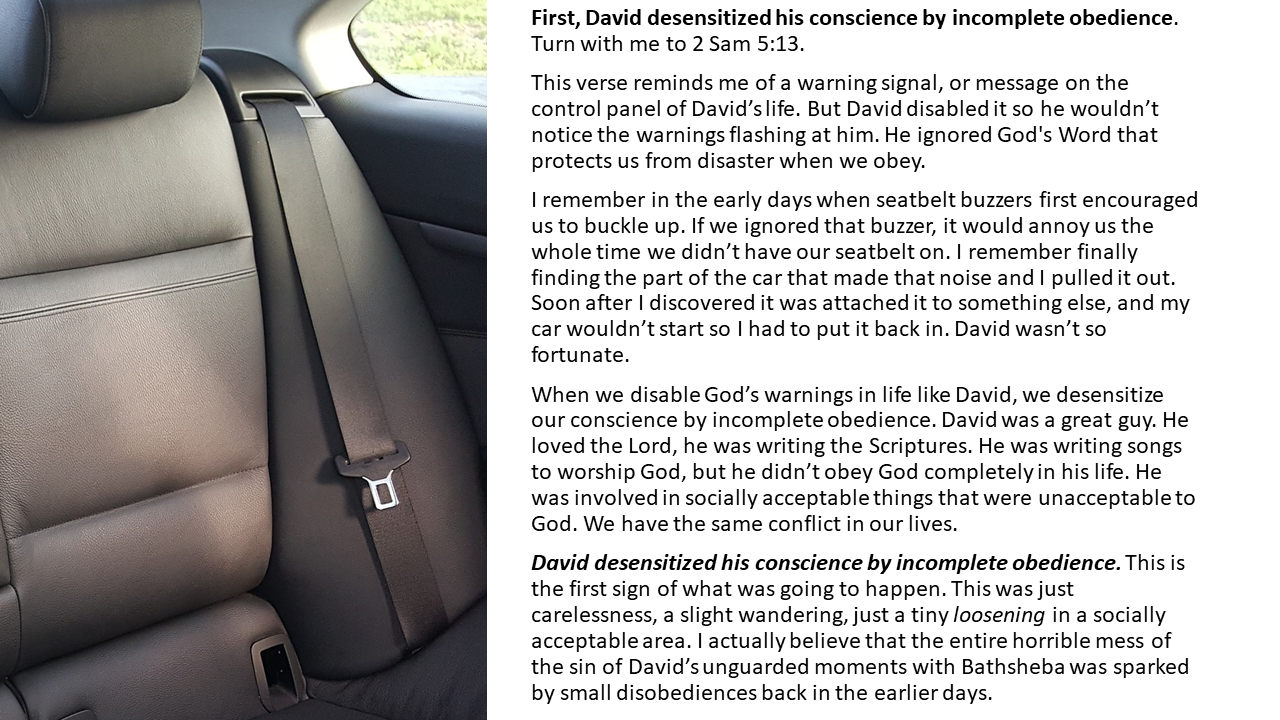
First, David desensitized his conscience by incomplete obedience.
Turn with me to II Sam 5:13.
This verse reminds me of a warning signal, or message on the control panel of David’s life. But David disabled it so he wouldn’t notice the warnings flashing at him. He ignored God’s Word that protects us from disaster when we obey.
I remember in the early days when seatbelt buzzers first encouraged us to buckle up. If we ignored that buzzer, it would annoy us the whole time we didn’t have our seatbelt on. I remember finally finding the part of the car that made that noise and I pulled it out. Soon after I discovered it was attached it to something else, and my car wouldn’t start so I had to put it back in. David wasn’t so fortunate.
When we disable God’s warnings in life like David, we desensitize our conscience by incomplete obedience. David was a great guy. He loved the Lord, he was writing the Scriptures. He was writing songs to worship God, but he didn’t obey God completely in his life. He was involved in socially acceptable things that were unacceptable to God. We have the same conflict in our lives.
David desensitized his conscience by incomplete obedience. This is the first sign of what was going to happen. This was just carelessness, a slight wandering, just a tiny loosening in a socially acceptable area. I actually believe that the entire horrible mess of the sin of David’s unguarded moments with Bathsheba was sparked by small disobediences back in the earlier days.
David relaxed his grip on the way God asked him to live. Watch the unfolding of the story of these deadly little things David allowed into his life. Here is the record of his early days as king:
2 Samuel 5:13 And David took more concubines and wives from Jerusalem,
[Remember David has already been king for seven years. This verse sounds like you’re just reading the news—nothing major, nothing bad, it’s kind of neutral– after he had come from Hebron.]
Also more sons and daughters were born to David.
[So you ask, was it really wrong? Didn’t all the men back then do it? Didn’t Abraham have multiple wives? You know Jacob had several wives. Why they’re all God’s people is it really so bad? But if God says it is wrong, it is wrong even if everybody does it! Yes, but 600 years after Abraham God told Moses to write down His rules for future kings.]
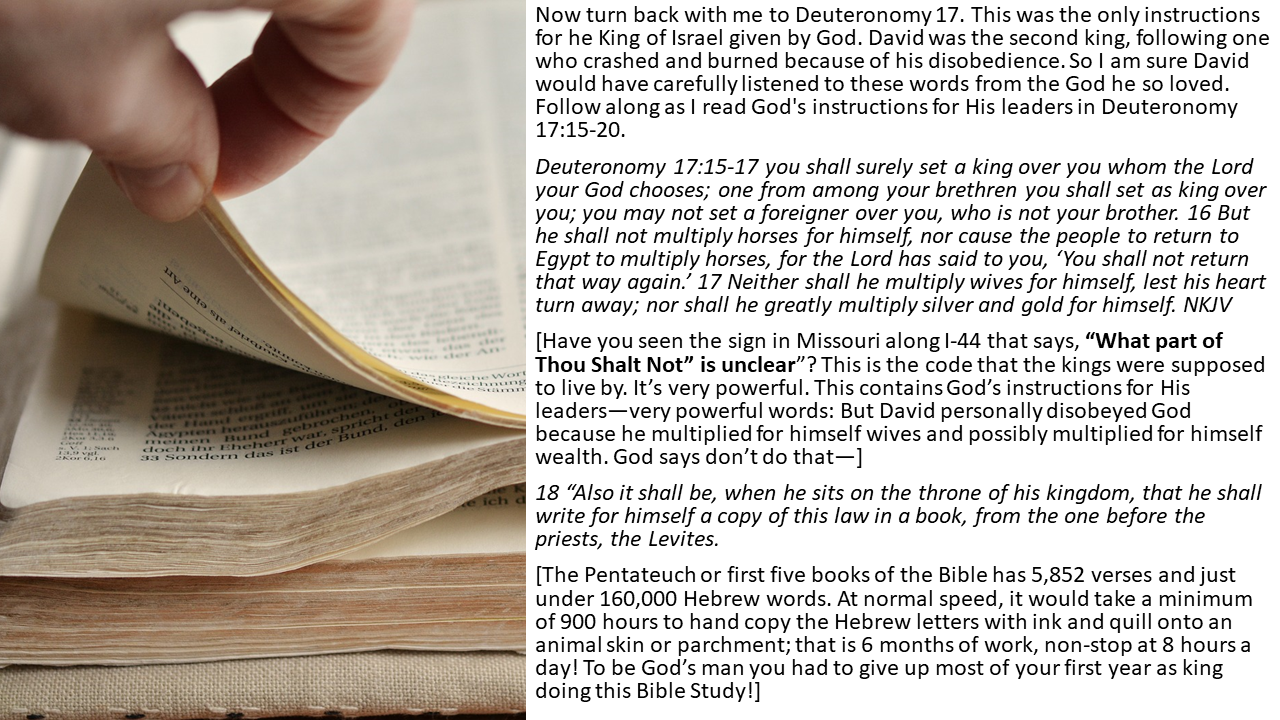
 Now turn back with me to Deuteronomy 17. This was the only instructions for he King of Israel given by God. David was the second king, following one who crashed and burned because of his disobedience. So I am sure David would have carefully listened to these words from the God he so loved. Follow along as I read God’s instructions for His leaders in Deuteronomy 17:15-20.
Deuteronomy 17:15-17 you shall surely set a king over you whom the Lord your God chooses; one from among your brethren you shall set as king over you; you may not set a foreigner over you, who is not your brother. 16 But he shall not multiply horses for himself, nor cause the people to return to Egypt to multiply horses, for the Lord has said to you, ‘You shall not return that way again.’ 17 Neither shall he multiply wives for himself, lest his heart turn away; nor shall he greatly multiply silver and gold for himself. NKJV
[Have you seen the sign in Missouri along I-44 that says, “What part of Thou Shalt Not” is unclear”? This is the code that the kings were supposed to live by. It’s very powerful. This contains God’s instructions for His leaders—very powerful words: But David personally disobeyed God because he multiplied for himself wives and possibly multiplied for himself wealth. God says don’t do that—]
18 “Also it shall be, when he sits on the throne of his kingdom, that he shall write for himself a copy of this law in a book, from the one before the priests, the Levites.
[The Pentateuch or first five books of the Bible has 5,852 verses and just under 160,000 Hebrew words. At normal speed, it would take a minimum of 900 hours to hand copy the Hebrew letters with ink and quill onto an animal skin or parchment; that is 6 months of work, non-stop at 8 hours a day! To be God’s man you had to give up most of your first year as king doing this Bible Study!]
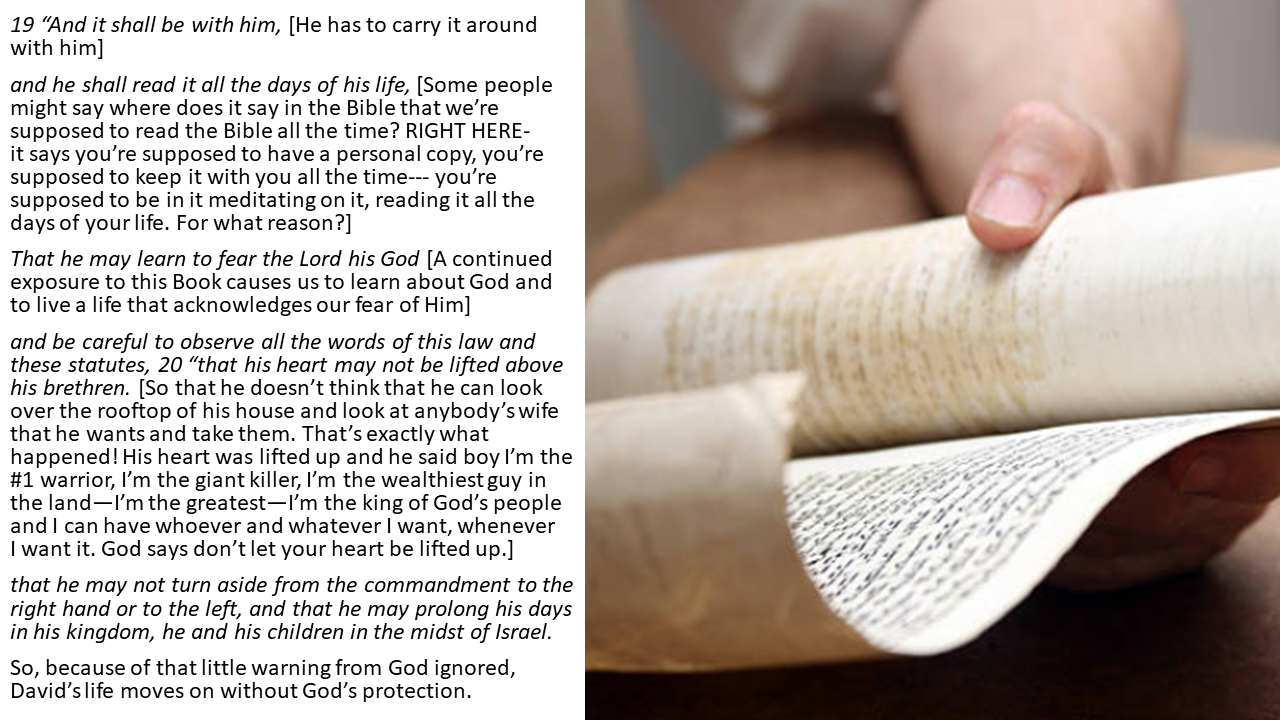
19 “And it shall be with him,
[He has to carry it around with him]
and he shall read it all the days of his life,
[Some people might say where does it say in the Bible that we’re supposed to read the Bible all the time? RIGHT HERE- it says you’re supposed to have a personal copy, you’re supposed to keep it with you all the time— you’re supposed to be in it meditating on it, reading it all the days of your life. For what reason?] That he may learn to fear the Lord his God [A continued exposure to this Book causes us to learn about God and to live a life that acknowledges our fear of Him] and be careful to observe all the words of this law and these statutes, 20 “that his heart may not be lifted above his brethren.
[So that he doesn’t think that he can look over the rooftop of his house and look at anybody’s wife that he wants and take them. That’s exactly what happened! His heart was lifted up and he said boy I’m the #1 warrior, I’m the giant killer, I’m the wealthiest guy in the land—I’m the greatest—I’m the king of God’s people and I can have whoever and whatever I want, whenever I want it. God says don’t let your heart be lifted up.]
that he may not turn aside from the commandment to the right hand or to the left, and that he may prolong his days in his kingdom, he and his children in the midst of Israel.
 So, because of that little warning from God ignored, David’s life moves on without God’s protection.
1. David Desensitized his conscience by incomplete obedience II Sam 5:13 2. David Relaxed his grip on personal purity II Sam 11:1 3. David Fixated his heart on physical desires v. 2 4. David Rationalized his mind about wrong decisions v. 3 5. David Plunged his life into lustful sin v. 4 6. David Destroyed his testimony by the sin of a moment of stolen pleasure. Death, deceit, murder, immorality and spiritual oppression, poverty and famine of the soul are only a few offspring of this act of momentary pleasure.
Second, David relaxed his grip on personal purity (II Sam 11:1)
David had let little things slide in his life—things went so well he forgot to be on guard. David relaxed his grip on personal purity. Think of what we sometimes see in T-ball and Little League. Those early ball players at the beginning of the game are in their positions. They’re ready for anything that comes, especially if they’re an infielder. They’ve got that glove on and they’re looking like pros. Then by about the second inning they’ve turned around, they aren’t watching the game, and they’re throwing dandelions. They’ve lost their grip on their position.
David at the height of his life lost his grip on purity and he was playing with dandelions in the presence of the ravenous lion of lust.
We need to be doing what it takes to maintain purity in our lives.
Jesus told us once how serious we must be about sexual sin. Most people dismiss His words as hyperbole, overkill or something. But at this moment in David’s life—maybe we should read Christ’s words again and ponder them personally?
Please turn back to the Sermon on the Mount, recorded in Matthew 5, and listen with new ears to His Christ’s words:
“You have heard that it was said, ‘Do not commit adultery.’ But I tell you that anyone who looks at a woman lustfully has already committed adultery with her in his heart. If your right eye causes you to sin, gouge it out and throw it away. It is better for you to lose one part of your body than for your whole body to be thrown into hell. And if your right hand causes you to sin, cut it off and throw it away. It is better for you to lose one part of your body than for your whole body to go into hell” (Matthew 5:27-30).
Now, let me share part of an article from someone I really respect, that I read in a magazine once that was written about this verse.
Jesus, the radical1
“Why does Jesus paint this shocking picture? I believe He wants us to take radical steps, to do whatever is necessary to deal with sexual temptation.
Now, the hand and eye are not the causes of sin. A blind man can still lust and a man without a hand can still steal. But the eye is a means of access for both godly and ungodly input. And the hand is a means of performing righteous or sinful acts. We must therefore govern what the eye looks at and the hand does.
If we take Jesus seriously, we need to think far more radically about sexual purity. The battle is too intense, and the stakes are too high to approach purity casually or gradually.
So … if you can’t keep your eyes away from those explicit images, don’t ever go to a video rental store. Come on. Everybody goes into those stores.
No. If it causes you to sin, you shouldn’t. Period.
Do your thoughts trip you up when you’re with certain persons? Stop hanging out with them. Does a certain kind of music charge you up erotically? Stop listening to it.
If these things seem like crutches, fine. Use whatever crutches you need to help you walk.
1 http://afajournal.org/2003/september/903purity.asp
Slides



Check Out All The Sermons In The Series
You can find all the sermons and short clips from this series, David’s Spiritual Secret here.
Looking To Study The Bible Like Dr. Barnett?
Dr. Barnett has curated an Amazon page with a large collection of resources he uses in his study of God’s Word. You can check it out here.