
If the video above is not available, here are two other ways to view:
The Consequences Years
060625AM
DSS-21
2nd Samuel 11:27b
Transcript
.jpg)
Let’s open our Bibles to the last verse of 2 Samuel 11. 2 Samuel 11 verse 27, and we’re only going to look at the last sentence of the verse as you’re turning there. And as you do turn there, I’d like to remind you that all that really matters in life can really be reduced to one simple reality.
.jpg)
What does God think of you? In other words, is what you and I are doing pleasing or displeasing to God? That’s really all that matters in life if you really reduce life down to its simplest denominator. And as we open to this verse 27 in 2 Samuel 11 and read the words we’re going to read in just a moment, that is exactly the perspective that God presents to us as He analyzes David’s life. And I want you to think how important it is what God thinks of you and of me, of our lives, what His opinion is. All that mattered at that moment and for eternity is what God thought of what David had done. And the sad reality of these words, the few words at the end of verse 27, is David did not please the LORD.
Now, follow along as I read these. The last sentence of verse 27, but the thing that David did displeased the LORD. Isn’t it interesting that this is the first time the LORD has shown up in this whole account? Remember, we’ve been going through it for weeks, looking at David’s horrific dissent into sin with Bathsheba, and the LORD has been strangely absent from the account in chapter 11. This is the first time we see Him surfacing because David had forgotten God in this time, and what he did displeased the LORD.
.jpg)
And I want you to think about the moments, and the hours, and the days, and the weeks that followed those words. Because if all that really matters in life is what God thinks of what is done, then if God’s opinion, which matters most, was displeasure, something is going to happen. And for the next hours, that turned into days, that stretched into weeks, and finally became months, David’s life becomes heavily under the hand of the LORD, who is displeased with what he had done.
David, the most written about person in God’s Word, begins to change. If you’d been living around him and been in the ornate halls of Jerusalem’s royal palace, you would’ve found that David all of a sudden becomes strangely silent. It’s almost as if David had lost his voice. And the people that knew him, that had lived with him, had been around him, it just happened so slowly that they just couldn’t figure out. They started scratching their heads. What is changing around here? And finally, they realized that David had lost his song. He no longer was singing around the palace. David had slowly withdrawn from what had most characterized him for all the years since he was a shepherd boy on the hills of Judea. David’s song had stopped. In day’s past, the sweet songs of God’s power were often heard. David always sang about what God was doing in his life, whether God was delivering him from great enemies, or whether God was just being his Rock and High Tower, or just his Good Shepherd, those songs have been a part of his life. And from the throne room of this victorious warrior, those songs are what we now call them, psalms, would flow. David sang of the greatness of God. David had oozed and just flowed with the wonder of who God was. The shepherd boy who became king had carried his stringed instrument, a harp or a lyre, into the daily life as he led God’s people. He didn’t separate the Lord from his daily life. He had carried that harp right into life, and he often would break into song at great events in the life of the nation of Israel and God’s people. He became a living and talking expression of God’s heart. David was always refreshing those he touched with his praises to the Lord.
Think what it must’ve been like to actually have been in his court back then, to actually have been someone working for the nation, working for the king, and what a treat it was to just be around David every day. The myriads of aides and clerks, the military attachés, would hear their king as he rapturously would sing great hymns of worship. David was a man full and overflowing with God. And down the halls of that royal palace in old Jerusalem had flowed rivers of praise to the Lord. And those rivers of praise would go down the hallways, and they would pass all the rooms filled with the conquered treasures of fallen kingdoms that David had conquered. They would go by all the storehouses of the consecrated gold and silver that he was piling up for that future soon-to-be-built Temple. Over that time, those songs poured out of David’s mouth because he had a heart filled with the goodness of God. And each song or psalm sent from God to David was such a treasure from God.
And what’s amazing is we have them this morning. Those songs or psalms make up more than half of the middle of our Bible, the book of Psalms. One of the easiest ways when children learn to do Bible drill, they always learn if you open the Bible right in the middle, you’ll hit that longest book, the 150 chapters of the book of Psalms, and then you can go one direction or the other in your search for books of the Bible. But what’s so wonderful is we have those songs.
.jpg)
God carved the life of David into the bedrock of His Word. And what’s most amazing is the Lord recorded many of those 71 psalms that David wrote directly from events in his life, whether they are the heights of his conquest or the depths of his sin and of his hiding from God. Those psalms that flowed from the most wonderful and the most wrenching hours of David’s life can be great encouragement to us because we’ll go through wonderful and wrenching hours in our lives, and that’s why God recorded David’s life more completely than anybody else in Scripture, so that we can be rebuked or encouraged, can be guided, can be taught by what God lifts out of the days of his life. The psalms that are before us have been preserved for 3000 years.
Just going back to the land reminded me of the pillaging armies that swept across the Middle East. They traveled like hordes of locusts, and fires would burn for weeks behind them as they would conquer and despoil that land. Often the blood has flown like rivers across that land. Earthquakes have leveled cities and towns. Floods and storms without number raced down the hillsides. But the book that all of us hold this morning still holds those songs that God sent. They’ve been preserved for us, every one of them by God, and every one of them with a very special message. David’s life makes up nearly half the book of Psalms, and most of us hold a copy of that.
As we look at them, in fact, I’d like you to turn to Psalm 8 with me this morning, and I want to start letting you know what it would’ve been like to have been around David 3000 years ago because this is just a small sampling. I’m only going to go through a few of the 70 psalms that flowed out of the throne room of the king of Israel, that flowed out of the heart of the man who was pursuing God with all of his heart, that flowed from the life of a man who so deeply loved the Lord: the life of David, recorded in the Psalms. Let me give you a reminder of what was going up and down the halls of Jerusalem’s royal palace for so long but now had become extinct in this last verse that we read in 2 Samuel 11.
.jpg)
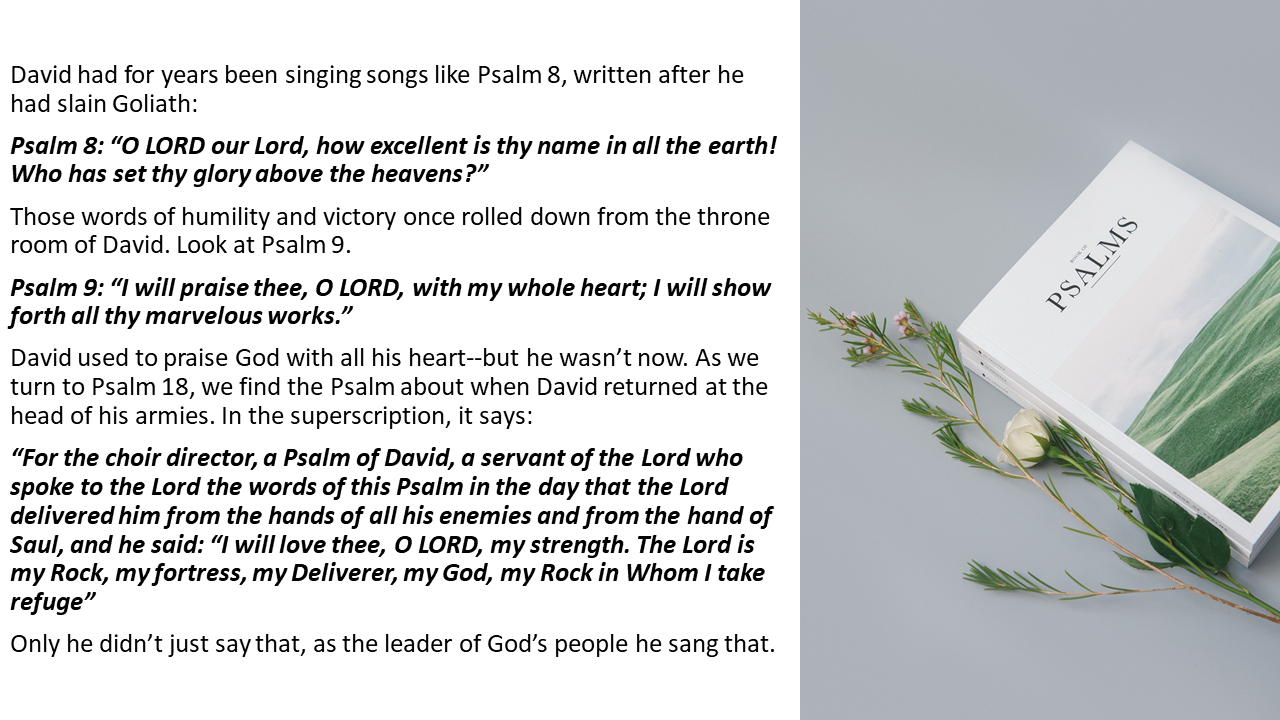
In Psalm 8, David had for years been singing the song like Psalm 8. David actually wrote this psalm after he had slain Goliath. And it says in Psalm 8, O LORD, our LORD, how excellent is Thy name in all the Earth, who has set Thy glory above the heavens! What a humble shepherd boy he’d been. He didn’t want the glory. This psalm, the superscription talks about Gath, and the word Muth is in there, which is the death at Gath, so it speaks of the Goliath of Gath who died. But in that great event, one of the crowning events of David’s life, he said, O LORD, I want You, verse 1, I want Your glory to be above the heavens. Those words of humility and victory once rolled down from the throne room of David. Look at the next psalm, Psalm 9. He says this, I will praise Thee, O LORD, with my whole heart; I will shew forth all of Thy marvelous works. David used to praise the LORD with his whole heart, but he’s not anymore where we find him in 2 Samuel 11 in verse 27.
As we turn to Psalm 18, nine more psalms over, before you read the actual psalm, your Bible might record the superscription. In the Hebrew manuscripts in those scrolls, often the psalms would have a first verse in the Hebrew language, which was the superscription or the attribution of the context of the psalm, which is considered part of the actual manuscript. Let me read to you that superscription about David when he returned at the head of his armies. It says this, for the choir director, a Psalm of David a servant of the LORD, who spoke to the LORD the words of this psalm in the day that the LORD delivered him from the hands of all his enemies and from the hand of Saul. And he said—and then here comes the psalm—I will love Thee, O LORD, my strength. The LORD is my Rock, my Fortress, my Deliverer; my God, my Rock, in whom I take refuge. Only David had not just said those words. As the leader of God’s people, he had often sung this psalm to the nation, ascribing all that was happening, all the victories in the battles, all the conquest of the surrounding nations with all of their armies, he ascribed all that had happened to the LORD and gave Him the credit and the glory.
.jpg)
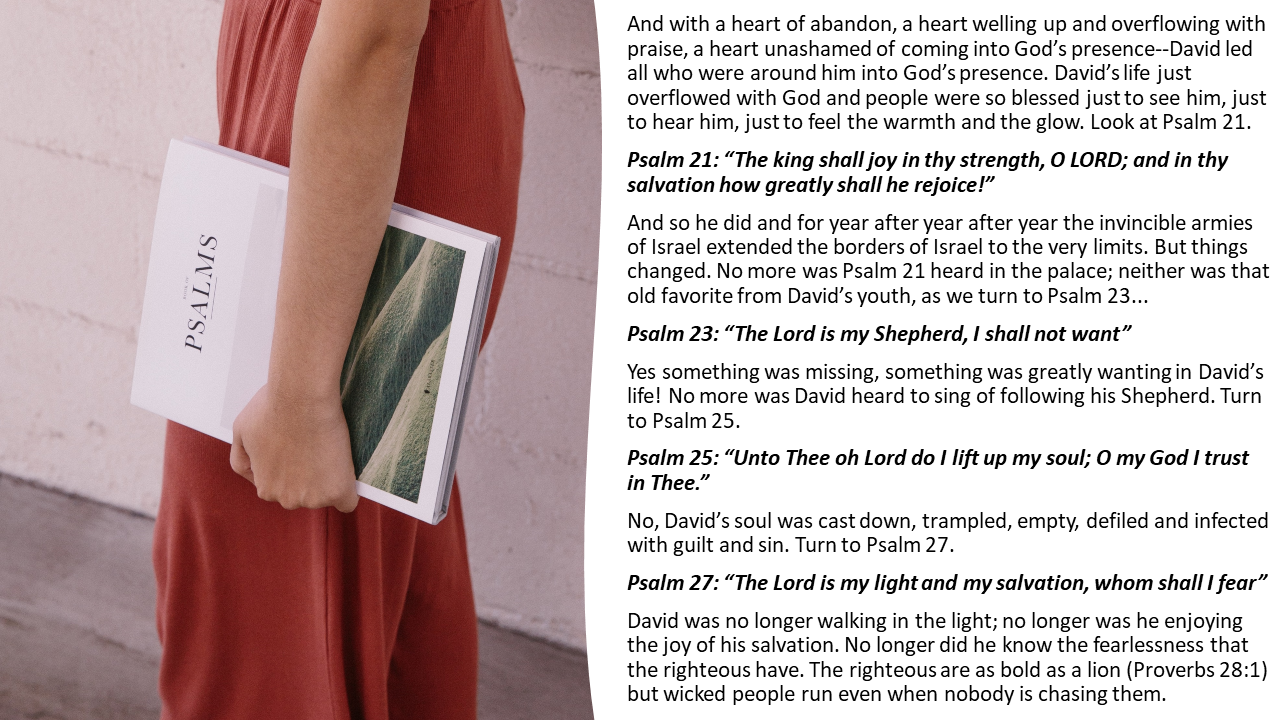
And with a heart of abandon, a heart that welled up and overflowed with praise, a heart that was unashamed of coming into God’s presence, David would lead all who were around him into God’s presence. Psalm 18 is such a reminder that David’s life just overflowed with God, and people were so blessed just to see him, just to hear him, just to feel the warmth of his soul glowing with love for the LORD.
Go three more psalms, go to Psalm 21 with me. Here’s another personal testimony David had. I can just see him sitting on his throne, his harp near at hand, and he would break into this song. And he’d say in Psalm 21, the king shall rejoice in Thy strength, O LORD; and in Thy salvation how greatly shall he rejoice! And that was David’s testimony year after year after year as the king of Israel. As the invincible armies of Israel extended the borders of Israel to the very limits, David sang of their God who accomplished all that, but things had changed. No more was Psalm 21 heard in the palace. After the hidden incident of David taking the wife of Uriah, whose name was Bathsheba, David began to be strangely silent. There were no new songs coming out of him. In fact, if you turn to Psalm 23, two more over from 21, one of the favorite songs of all times from David’s youth had often been the favorite of the people of the land as David would rapturously sing that the LORD is my Shepherd, and I don’t want for anything in my life. But that was missing. Something very great was wanting in David’s life. No more was David heard to sing of following his Shepherd.
In fact, Psalm 25, just two more psalms past, was also gone. Psalm 25, David had said, unto Thee, O LORD, do I lift up my soul. O my God, I trust in Thee. But now, David’s soul was cast down. His soul was trampled. His soul was empty. He was defiled. He was infected with guilt and sin. In fact, two more psalms, look at Psalm 27. David had often told the people that the LORD was my Light and my Salvation; and whom shall I fear? But David was no longer walking in the light. David was no longer reflecting and enjoying the joy of his salvation. No longer did he know the fearlessness that the righteous have.
.jpg)
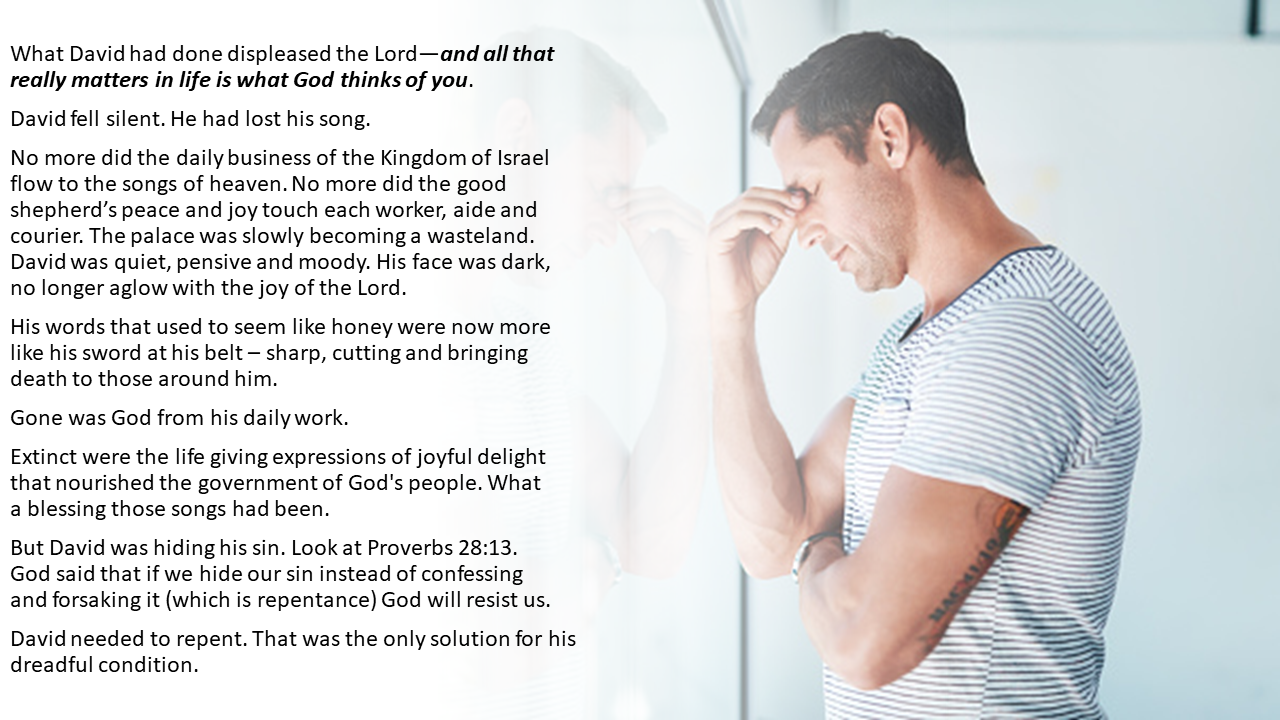
As Proverbs would later record through his son’s writing, Solomon, that the righteous are as bold as a lion, but the wicked run even when no one is chasing them. David was running. David was hiding. David was empty. David was not acknowledging his sin. David had fallen silent. David had displeased the LORD. And all that really matters in life is what God thinks of you. And when God was displeased with David, his life dried up literally. David’s very sustenance of his bones and of his body had begun to dissipate, and he had begun to become parched, and he had begun literally in the Hebrew to wither. Like a plant out on your deck that goes through the scorching 90-degree days, that doesn’t get a morning or evening watering. It begins first the blooms dry up, and then the buds begin to dry up, and then the leaves begin to wither. And that progression was happening in David’s life. No more did the daily business of the kingdom of Israel flow to the songs of Heaven. No more did the Good Shepherd’s peace and joy touch every worker, aide, and courier. The palace of David was slowly becoming a wasteland. David was quiet, pensive, moody. His face, if you could see him, was dark. It was no longer aglow with the joy of the LORD. His words that used to seem like honey were now more like the sword that hung at his belt. His words were sharp and cutting and brought death to those around him. David had changed. Gone was God from his daily work. Extinct were the life-giving expressions of joy and delight that had not only nourished David but the governance of God’s people. What a blessing those songs had been.
Let’s go to Proverbs 28 because I want to show you in verse 13 what God was bringing about in David’s life. Proverbs 28 and verse 13 tells us this. David was hiding his sin, and God said that if we hide our sin instead of confessing and forsaking it, which is repentance, that God Himself gets in the position of resisting our lives. Proverbs 28:13, he who covers his sin will not prosper. He who hides and tries to obfuscate and mask what is really going on behind the scenes that only God can see. Whoever hides his sin will not prosper. But look at the second half of the verse, verse 13 of Proverbs 28, but whoever confesses and forsakes them—those sins that were covered—will have mercy. David needed to repent. That was the only solution to his dreadful condition. He was going downhill. All of those former psalms were meaningless to him. All of the former joy was distant from him. All of the former peace was far off from him because he was hiding and covering up his sin. That’s what’s going on between verse 27 of chapter 11 and verse 1 of chapter 12.
I wonder, this morning, with this graphic picture that God captures for us of David’s life before us, I wonder if we shouldn’t just pause and think about, in our lives has something similar happened? Can you remember a time when God was close, when His Word was more important than eating food, when you just lost track of time when you were reading the Bible, you just lost track of time when you were praying, you just lost track of time when you were thinking about those and how to share the Gospel? Have things changed in your life?
.jpg)
I wonder if you just pause for me for a moment and turn your attention from David, this king that’s grown dark, and pensive, and moody, and sharp, and acerbic tongued, and think about instead of David, what’s going on in your life.
In fact, for just a moment, let’s do something unusual. Let’s just all bow our heads, and quietly before the Lord, let me read some words to you. And I want you to ask yourself, just in your heart quietly, silently to yourself, these questions as we focus on what God wants from each of us. Answer these questions silently in your heart. Have you lost your song like David? Did you use to be closer to the Lord than you are this morning? Are you holding onto some sin that right now displeases the Lord? And is your heart growing restless and cold just before the Lord? With no one else, just between you and the Lord, quietly in your heart, if that is happening, the only remedy is to confess and forsake whatever sin has caused God’s displeasure right now. As we’ll see, if you wait like David did, there are severe consequences that inevitably will come. This is what God says: he who covers his sin will not prosper, but whoever confesses and forsakes them will have mercy. Quietly before the Lord, is there something right there, right now that the Spirit of God’s just touching your heart with that you need to say right now, Lord, I confess that? You know it; I know it, but I want to forsake that sin. Don’t wait. David paid horribly dearly for waiting.
Father, I pray that right now that Your Spirit would freely be able to examine our hearts and to see if there is something displeasing to You, and that we would very, very willingly abandon, and forsake, and turn in repentance from anything and everything that displeases You. I’d like to know, with your head bowed, just as I pray for you, how many of you say, the Lord has convicted me about something, and I want to today forsake that, and I want Him to let me prosper? For some of you, I want the song back. Some of you, I want the joy of the Lord back. If that’s you, nobody’s looking around; the Lord’s looking at your heart, would you just raise your hand and say, that’s me? I am coming back. I want that joy. Father, You see many hearts, and I pray that as we examine the horrible consequences that covered sin brought in David’s life, that we would joyously be those who are forsaking and repenting and no longer hiding what displeases You. Give us, by Your Spirit, the grace to confess, and forsake, and to walk in the power of Your Spirit. In the name of Jesus, we thank You, amen.
.jpg)
Let’s go back to David’s life in 2 Samuel, if you would with me, because I want to show you the pathway, the terrible, horrible pathway that David followed in 2 Samuel 11 because we’re in the saddest era of David’s life. We’re in the months and years of consequence that followed his sin with Bathsheba. We don’t know exactly how long, but we do know this, that David didn’t confess and forsake his sin until he was faced with a fearless prophet. In fact, one of the most fearless events, one of the bravest events of all, is what Nathan does, and we will look at later on. Be aware of allowing any unguarded moments.
.jpg)
2 Samuel 11 records, starting in verse 1, the unguarded moments of David’s life. As we carefully look at the final eras of David’s life, the first era that we already examined a few weeks ago is that David had unguarded moments that led to sin in his life. Now, if you haven’t looked at these, I want to make sure that you’ve traced them in your Bible. If you heard them but didn’t quite let them sink in, let me just once more show you because I actually mark all these things in my Bible. They’re like a roadmap for me. I regularly look at this, and I say, Lord, I don’t want to have unguarded moments in my life.
In fact, we were standing, I don’t know how many days ago in the actual excavations of the city of David, and everybody was just looking around and having fun. And I let the tour guide talk for quite a while, and finally I was standing over on the side right by the railing, and I said, why don’t all of you come over on this side? when the guy was taking a breath. So, they all came over on this side, and I said, we’re standing in a spot that’s been reconstructed to approximately the same height as David’s palace, which they have found. They’ve actually found the palace that he lived in in Israel, and we were standing approximately at the height of the rooftop. And I said, all of you, look over here. And at that moment, a woman was coming out with her laundry and hanging it on the line. And as we stood there, you could almost hear everybody going, ha, because it was so distinctly above. You could look down and see there was nothing that was possible to hide in that rooftop of the home that was right next to that reconstructed palace. It is so steep, the hill, and I heard many people say, it’s just unbelievable to think how clearly David could have seen, and how vivid a temptation that was, and how much he would’ve had to have chosen to not look down into everyone’s backyard. But he did, and the pages of Scripture record an even horrible, more horrible than we could conceive of, minefield that David walked into starting in verse 1. I showed you that David had relaxed his grip on personal purity in verse 1. He sent the army, but he stayed back. He was the only man of military age left in the city. Do you remember? We studied that. He sent everybody else off, and he very, very unwisely stayed home.
As we were driving around Israel, we came to one spot, and I remember they slowed the bus down, and Ellie said, look out there, and there were these triangular bright red signs, and he says, y’all see that? He said, those are minefields left over from the Syrian military battles that they’ve had with Israel, and they would mine these vast areas to keep the Israelis from coming up to their positions. And the Israelis have left those minefields because they’re so dense with mines. It’s very hard to diffuse all those. And so, there are these large signs that say, don’t enter on penalty. And it shows a little body blowing up on the little sign. It’s graphic. David entered a minefield in verse 1. He relaxed his grip on personal purity. He formerly…
In fact, on this trip I learned something wonderful. One of the men on the trip, I said to him, hey, did you see the news today? And he said, no. He said, many years ago when I became a traveling businessman, I made a covenant with the Lord. I would never turn the television on when I travel on the road so that I would never be tempted to sit there and watch the television, and watch it, and watch it, and watch it, and watch it, and slowly my heart would get cold and I’d forget to read the Bible. I thought, there is a person that is guarding their grip on their personal purity. They didn’t even know the weather or the bombings in the Middle East because they never watched television when they travel. David did worse than watch television. He watched his neighbor’s wife. He relaxed his grip on personal purity.
In verse 2, he fixed his heart on his physical desires. We saw that. Another terrible step downward. In verse 3, he rationalized in his mind about his wrong decision. He rationalized that he deserved that, that he needed that, that he wanted that so much that he just totally fixated and then rationalized in his mind about the error of his way. Verse 4 we saw last time of chapter 11 of 2 Samuel, he plunged his life into lustful sin. And what happens from verse 4 onward is that David destroyed his testimony. One moment of sin, one moment of blowing by all the barriers God put up. His servants, remember we looked at this? They said, David, that’s Uriah’s wife. Uriah is one of your mighty men. His father is one of your mighty men. His wife’s grandfather is one of your counselors. David, that woman is quite connected. Her husband’s one of your great warriors. He’s not home right now. Her father-in-law is one of your great warriors who’s not home. Her grandfather is in your court right now. Are you sure you know what you’re doing? And David said, bring her to me. And in that moment, David destroyed a lifetime of testimony. David destroyed his testimony by the sin of his stolen pleasure. Death, deceit, murder, immorality, spiritual oppression, poverty, famine of his soul were only a few of the offspring of that momentary pleasure. Those unguarded moments led to what we’re going to begin looking at this morning. The inevitable consequences.
Now, last year we, one Sunday we looked at what I call the consequence engine. Do you all remember that? The consequence engine that even in a believer’s life. Even in the New Testament, the Scriptures say, be not deceived, God’s not mocked; whatever we sow, we’re going to reap. Now, this is not Old Testament. This is New Testament. This is in our lives. There is a consequence for every sin that we willfully commit. Now, there is an eternal consequence removed by the cross of Jesus Christ, but there is a temporal in-this-life consequence to sin. I told you the story. If you drink, even though the Lord forgives you, it will slowly destroy your liver. If you use drugs, I remember my classmates who came out of the drug culture, and they would work twice as hard on everything that we did because they had so affected their brain. God does give you a new heart. He doesn’t give you a new brain. He gives you a new Spirit. He doesn’t give you a new stomach. You know what I mean? There are physical consequences to what we do, and David faced those inevitable consequences.
And those inevitable consequences of what he did, in verse 4 and onward, led to the pain of David’s chastisement. He went into a time period that is chronicled in three psalms in the Scripture, Psalm 32, 38, and 51, each of which we’ll look at, that mark the painful time of his hiding his sin. Following David’s chastisement, his son Absalom rebels, and David had to go through the pain of his own son seeking to destroy his life. And David wrote Psalm 3 about that event in his life, and we’ll examine that. And then Shimei’s slander. Eleven chapters of those years of painful consequences of David’s chastisement, Absalom’s rebellion, and Shimei’s slander, and many other events are from chapter 12 through 21 and then 24.
.jpg)
But this morning, I want to just look at one element. I want to look at what it was that’s going on in David’s life that caused him to do those steps downward that I just reminded you of and hope you have marked in your Bible. Verse 1, he relaxed his grip. In verse 2, he fixated his heart. In verse 3, he rationalized his mind. In verse 4, he plunged his life. Those consequences are all based on one thing. And to understand that I want you to turn back with me to the New Testament to 1 Corinthians 10. 1 Corinthians 10, and I want to show you Paul talks about this event in David’s life. I don’t know if you realize that. In fact, in Paul’s great doctrinal treatise in his, the book of Romans in chapter 4, when Paul wants to describe our salvation, he says, do you remember what David experienced when he got God’s great forgiveness? So, this event, David’s sin, was much on Paul’s mind, and I believe that 1 Corinthians 10 starting in verse 12 is the words of Paul as he looks across the twisted wreckage of so many lives of Christians that destroy themselves. He writes these words, starting in verse 12 of 1 Corinthians 10, to help us avoid the minefield that David blundered into. See, Paul puts it pretty plain to us. He gives us a warning. It’s the clearest warning in Scripture. Verse 12, therefore let him who thinks he stands take heed lest he fall. See, David thought he stood. He already had the bestselling songs about God in the world. He had Psalm 8 about defeating Goliath. He could defeat any giant. He had Psalm 9 about all the LORD’s greatness to him. He had the LORD as his Light in Psalm 21. He had the LORD as his Shepherd. He had the LORD in Psalm 25 as the One he rejoiced in. He was the one who was the mouthpiece of God, and he came to the point that Paul warns about in 1 Corinthians 10:12. Let him who thinks he stands take heed lest he fall.
Why? Verse 13, because no temptation has overtaken you except such as is common to man—we’re all facing the same temptations—but God is faithful, who will not allow you to be tempted beyond what you’re able. David wasn’t tempted beyond what he was able. God sent warnings to him: his servants! His servants just stood in his way. They literally said, don’t do this. Stop. But David just blew right by them. See, God is, look at what it says in verse 13, God is faithful. He won’t allow you to be tempted beyond what you’re able but will with the temptation always make a way of escape, that you may be able to bear it. Verse 14, therefore, my beloved, flee from idolatry. Flee from worshiping anything more than God. Flee from any desire that will cause you to be blinded to God. Flee from making your lust, your passion, your possessions, your pleasure an idol that you will serve rather than God. Flee that, Paul says.
.jpg)
David’s years of consequence, so painful, all lead back to one simple reality. David forgot something. David forgot something critical. I’d like you to look with me exactly what David forgot because David forgot to look for God. Look at what it says in 1 Corinthians 10:13. It says, God is faithful. God is faithfully there. 1 Corinthians 10:13 reminds us of something. Now, did David know this? Yes. Let me read you David’s own testimony. He wrote it down, and this is what David forgot the night he sauntered over to the edge of his rooftop of his palace and began looking at what he could see. David was surfing the city that night. David’s desires were driving him to look for something he didn’t have at the moment. Here’s his testimony. David forgot to look for the God who’s always faithfully there. Psalm 139, you don’t have to turn there; I’ll just read it to you. This is what David wrote in verse 7, where can I go from Your Spirit? Where can I flee from Your presence, O God? If I ascend into Heaven, You’re there; if I make my bed in Hell, behold, You are there. If I take the wings of the morning, if I dwell in the uttermost parts of the sea, even there Your hand shall lead me, and Your right hand shall hold me. If I say, surely the darkness shall fall on me, even the night shall be light about me. Wow. David knew God was watching. David knew God was there. David believed that. David wrote a song about that. That’s another one of his bestselling songs.
.jpg)
But on this side of the cross, the truth is even plainer to us. You have your Bibles open. Look again at Paul’s warning after verse 12. Verse 13 of 1 Corinthians 10 says this, that no temptation will overtake us except such as is common; but God is faithful. Now, don’t let this old familiar verse escape you. I want you to think about what Paul is saying to us because what escaped David back in that moment of passion is what sometimes escapes us. He had an overfamiliarity with an old truth. Now, what’s the old truth of verse 13? Verse 13 of 1 Corinthians 10 is a call for all of us who know and love the Lord to look for God in times of temptation because whenever we are tempted, God is always there. That’s what it says in verse 13. The Apostle Paul gives us extreme hope in one short verse, that whenever, anytime we’re tempted with anything, there is a promised presence of God at that moment. Specifically in the time of temptation, God is faithful. God will not allow us to be tempted beyond what we are able. Let me read an amplified version of this verse. You know how it just says the obvious over and over again? No temptation will ever overtake us or spring upon us except the ones that God has prepared us for in His Word. There are no new strains of old sin viruses that have escaped God’s notice. Whatever old temptations we get attacked by, we can be sure God faithfully has already guarded us against that. God Himself has promised that He will not allow us to be tempted beyond what we are able to take. Our God knows our limits. Our God always stands right beside us, protecting us, and holding open the way of escape. Our God does not want us to succumb to the snare of the devil. God is always there. He is always close enough to grab hold of our hand to pull us out. Now, if you will take the time to meditate on 1 Corinthians 10:13, you’ll find that there’s a shadow looming over that verse. The more you read it, the more the shadow of God looms over that. God says, when you’re tempted, I’m standing over you. You should see My shadow. You should notice My presence. You should not forget to look for Me. That’s what Paul is telling us. It is God who towers over this passage. God is there all the time.
When Peter was walking on the water in the Gospels. Do you remember that? During the storm, and he says, Jesus, bid me come to You. And Jesus bid him come, and he walks on the water. When Peter walked on the water, when he looked away from Jesus, when he started to sink, how close was Jesus to Peter? He was close enough that the instant that Peter cried out, Lord, save me! Just like that, Jesus reached out His hand and lifted him. Jesus wasn’t far away at that instant. He was sinking in his temptation, his fear of the storm. Jesus was right next to him, and He was waiting for Peter to cry out, and He grabbed him. That’s how close the Lord is when we are tempted. He rescued Peter. God is always near. God is always close enough to hear and respond to our cry for help. He tells us He’s faithful. And when we think we’re alone, we’re not alone. God has already measured and limited the attack of the world, our flesh, and the devil. He’s already provided an escape route if we’ll just look up, if we’ll just cry out, if we’ll just seek Him. If it were just us facing temptation, we would hopelessly be defeated, but God knows that we are helpless, and so He’s always there with us. God is there all the time. God is there all the way through life. God is there every time we’re tempted, and He has the best way of escape clearly marked. That’s why He’s a mighty God.
.jpg)
We all have heard the touching story a father once told of his son’s first conflict at school, but maybe we should remember it again. You remember the story of the dad whose son came home and told him that he was being roughed up, and someone had punched him at school? And so, the dad said, okay, son, you need to be prepared for this. And he taught him how to diffuse a situation. A soft word turns away wrath. But he also gave him a few tips on how to defend himself and just showed him a little bit about if he got into a fight, what to do. And then the next morning the father prayed and sent off the son. And those bullies had said that the next morning they were going to meet the little kid on the way to school and beat him up. And so, the son tearfully looked at his dad and he says, dad, he says, I’m afraid. And dad said, don’t worry, don’t worry. And so, the son with trembling lip, choking back his tears, got on his bike and began the lonely, long ride to school. What the boy did not know was that every block he rode, he was under the watchful eye of his dad. He drove his car at a safe distance from his son, just out of sight but always ready to speed up and assist if the scene became too threatening. The boy thought he was alone, but he wasn’t at all. His father was there all the time, and that’s a touching story. But an even greater sense, the God of the universe is always driving right next to us all the time. He is with us, though often unseen. He’s gone ahead. He has been tempted in every way like we are. He has triumphed. He’s joined us in every temptation and makes us a way of victory open. God says, look for Me. I’m always faithful. We should look for God at all times.
.jpg)
I don’t have time to retrace all the history of this but let me tell you about those who did look for God and found Him faithful. Abraham looked for God when he was in the mountain of despair, when he thought that he was going to have to offer his own son Isaac. All that ever mattered was going to be lost, and though Abraham couldn’t understand, he trusted God. He looked and found God faithful. And God, remember Jehovah Jireh? The LORD supplied all he needed even when he didn’t understand in Genesis 22. Joseph looked for God when he unexpectedly found himself in the den of passion. Joseph was accosted, blatantly faced with strong physical temptation. He cried out to the God he couldn’t see but knew was there. And when we do the same, we’ll find, like Joseph, that God sees us and rescues us. That’s a summary of Genesis 39. Jeremiah looked for God when he was in the gloom of failure. Jeremiah was rejected by his own people. He was single and never married. He was seemingly a failure in all he did, and Jeremiah just had one thing: he trusted the Lord. And when we will do the same, we will find that God is actually shaping us through our sorrows to be even greater reflectors of His faithfulness. That’s what Jeremiah found in Jeremiah 16. Daniel looked for God when he was in the spotlight where pride could have gotten him. Every eye was on him as he stepped forward to answer the king’s question, and as he did so, he pointed the praise to God. And when we do the same, we’ll find, like Daniel, that God wants to use us if He knows we’ll give the credit back to Him. That’s the summary of Daniel chapter 2. As I already mentioned, Peter looked for God when he was sinking in the fury of a storm. The instant Peter cried, Lord saved me, Christ’s hand was lifting him to safety. When we do the same, we’ll always find, like Peter, that God saves us. That’s a summary of Matthew 14. Finally, Paul looked for God when he was in the grip of pain. Paul found that all of his weaknesses and inabilities were the source of Christ’s strength made perfect through his infirmities and inabilities, and when we will come to the same place in our life, we’ll find God’s grace is sufficient for us. That’s a summary of 2 Corinthians 12.
We must look for God. Maybe we’ll never be looking over a housetop into someone’s backyard, but we might be in the spotlight of pride. We might be in the fury of a storm. We might be in the grip of pain. We might have all the eyes of the world on us, and we need in that moment of temptation—to pride, to lust, to fear—to look for God and to look for His hand stretched out to us. And to say, Lord, save me from this. I don’t want to sin.
Now, maybe we should make decisions like that businessman did many years ago that he would never allow himself to be slowly drawn into temptation, and that’s a pretty radical decision to never turn on the television when you travel. But I’ll tell you what, it was, I didn’t know that! It was amazing! What a testimony. What a powerful testimony of saying, I don’t want anything to keep me from pleasing God. I don’t want His displeasure because His opinion of me matters most. David forgot to look for God. Don’t forget to look for God.
.jpg)
We have just a few more moments. I want to show you a second thing David forgot. David forgot to use the Word of God. Look at Psalm 119. This is David’s testimony I’m sure, even though the 119th psalm wasn’t written by David. The Word of God had been very powerful in his life. But look what the psalmist writes in Psalm 119 and verse 9. It’s a verse that all of us memorize or should at some time in our life, especially, this is a verse that’s often challenged to young men because it’s postured that way. But David knew so much of God’s Word, much of it he had written down for God. But gripped by lust, David suffered spiritual amnesia. The only hope we have for purity and obedience through temptation is to quote Scripture like David didn’t and like Jesus did. When Jesus faced the devil in Matthew 4, He used the Word to combat the devil. We need to be planned and prepared. We need to say like Psalm 119:9-11 says, how can we cleanse our way? Verse 9, by taking heed according to Your Word. With my whole heart I have sought You; oh, let me not wander from Your Commandments! Your Word I have hidden in my heart, that I might not sin against You. You know what David forgot? He forgot the Word. He forgot the Word he knew. He forgot the Word he’d written. He forgot the Word he’d sung. He forgot the Word that he represented. If we want to not fail when tempted, number one, we have to look for God and see He’s there and call out to Him, and He’ll grab us. Secondly, we need to use the Word of God. And you should in your life know and seek to find verses that speak to your particular unique combination of weaknesses and temptations. We all are subject to like temptations. Remember it says, Elijah was a man subject to like passions. We all have what is, as Paul said in 1 Corinthians 10:13, common to man. And so, part of our Bible study is not merely making progress and checking off we’ve got another chapter read. It is a careful sifting and looking for treasures, for Scriptures that speak to the needs of our heart that we mark, that we memorize, that we meditate on so that we have the only offensive weapon, the sword of the Spirit, Ephesians 6, which is the Word of God. Connected with praying always because prayer and the Word always go together. But that sword is what we have to meet our adversary of the devil. And we should know those Scriptures. We should know what it is we struggle with, and we should know what God says about what it is we struggle with. And then we should memorize that portion of Scripture, and then we should meditate frequently on it and distill from it the truth that God wants for us to be victorious.
.jpg)
Last one. Look at 2 Timothy 2:22, and this is where we’re going to close. The last thing that David forgot is what Paul clearly commands us that we are to do whenever we face temptation in any of its various forms. The command is found at that easy-to-find address I’ve already told you: 2-T-2-2-2, 2 Timothy 2:22. Always remember that. This verse should be noted in your Bible because this is the final word on what to do when tempted and, all of a sudden, we feel the strong desire to succumb to that temptation. What does God want us to do? Does He want us to stay there and start ministering to the one that’s tempting us? No, there’s a clear, concise, imperative command. This is what it says: flee also youthful lusts. Why does God say that? Because sensuality is the biggest obstacle to godliness today. Sensuality is wreaking havoc in the Church. The reason that there is not a holy boldness in many believers’ lives is there is an unholy sensuality that is just beneath the surface. Believers today can easily talk about and meander through life in a sensuous world and not be offended, while the God who lives within them is grieved and quenched. Godliness and sensuality are mutually exclusive, and whoever is in the grasp of sensuality can never rise to godliness. In David’s unguarded moments, his mind controlled by lust had an infinite capacity to rationalize, and so will ours.
I want to read to you the piercing insight Leon Morris, the great Bible commentator, wrote on 2 Timothy 2:22. This is amazing. He wrote this: the person who carries on an act of impurity is not simply breaking a human code or even sinning against God, who at some time in the past gave him the gift of the Spirit. He is sinning against the God who is present at that very instant. He’s sinning against the One who’s continually giving him His Spirit. The impure act is an act of despite against God’s good gift at the very moment is being offered. This sin is seen in its true light only when seen as a preference for impurity rather than a desire for the Spirit who is holy. You know what he said? It’s not just sinning against God who saved us in the past. When we yield to temptation, it’s sinning against the God who is present at that moment with His hand extended to us, waiting for us to say, Lord, save me! That’s the seriousness of us not fleeing lust.
.jpg)
Let’s bow before our holy God with His Word on our minds. Father in Heaven, I ask in the name of Jesus that we would not merely be hearers of Your Word this morning, not just come to another service that we enjoyed, and we learned some new verse or some new thought. I pray that we would be confronted with Your shadow looming over our life right now. When we leave this place, we are going back into our normal lives where we will be confronted with temptation in every form. And I pray that we would decide this morning that we are going to look for You, we’re going to use Your Word, and we’re going to run from lust. That we are going to look for You when we’re tempted, know Your shadow is there, know that You’ve accompanied us, and know that You want to rescue us and help us to grow stronger because we did flee to You. I pray that we wouldn’t do despite to the Spirit of You, our holy God, by sinning in spite of all You have done by Your grace to make a way of escape. Lord, right now, place on our hearts those things that we know defeat us. And may we right now say, Lord, save me from that! When that temptation, that lust, that desire sweeps over me, may I cry out to You, Jesus, save me now! And may we not give in to that fear, to that pleasure, to that desire, to that lust, to that person, to that substance. May we say no and flee to You. In the name of Jesus, and all of us who want to do that by God’s grace said, amen. God bless you as you go.
Notes
All that really matters in life may be reduced to one simple reality–what does God think of what you are doing or have done.

As we open in our Bibles to the last sentence of 2nd Samuel 11:27, and read those words—that is exactly the perspective God presents of David’s life at that moment.
All that mattered at that moment and for eternity–is what God thought of what David had done. And David did not please the Lord!
2 Samuel 11:27b “…But the thing that David had done displeased the Lord.” NKJV
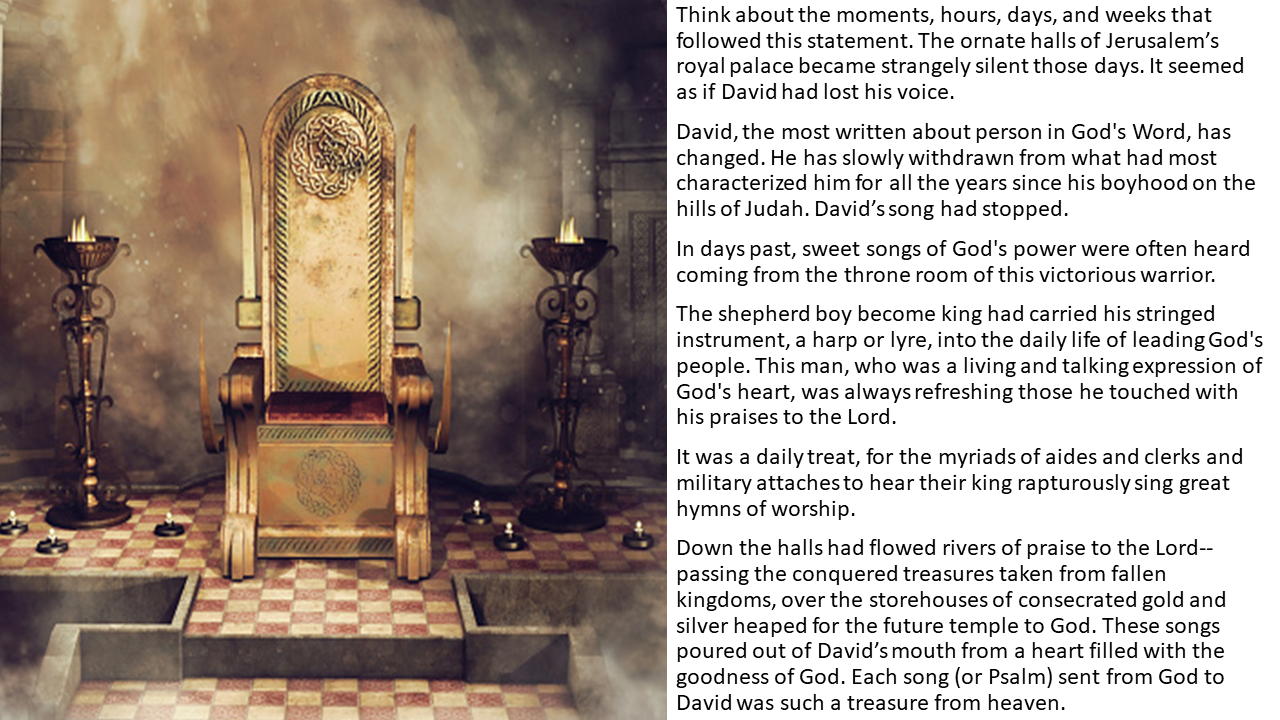
Think about the moments, hours, days, and weeks that followed this statement. The ornate halls of Jerusalem’s royal palace became strangely silent those days. It seemed as if David had lost his voice.
David, the most written about person in God’s Word, has changed.
He has slowly withdrawn from what had most characterized him for all the years since his boyhood on the hills of Judah. David’s song had stopped.
In days past, sweet songs of God’s power were often heard coming from the throne room of this victorious warrior.
The shepherd boy become king had carried his stringed instrument, a harp or lyre, into the daily life of leading God’s people. This man, who was a living and talking expression of God’s heart, was always refreshing those he touched with his praises to the Lord.
It was a daily treat, for the myriads of aides and clerks and military attaches to hear their king rapturously sing great hymns of worship.
Down the halls had flowed rivers of praise to the Lord–passing the conquered treasures taken from fallen kingdoms, over the storehouses of consecrated gold and silver heaped for the future temple to God. These songs poured out of David’s mouth from a heart filled with the goodness of God. Each song (or Psalm) sent from God to David was such a treasure from heaven.
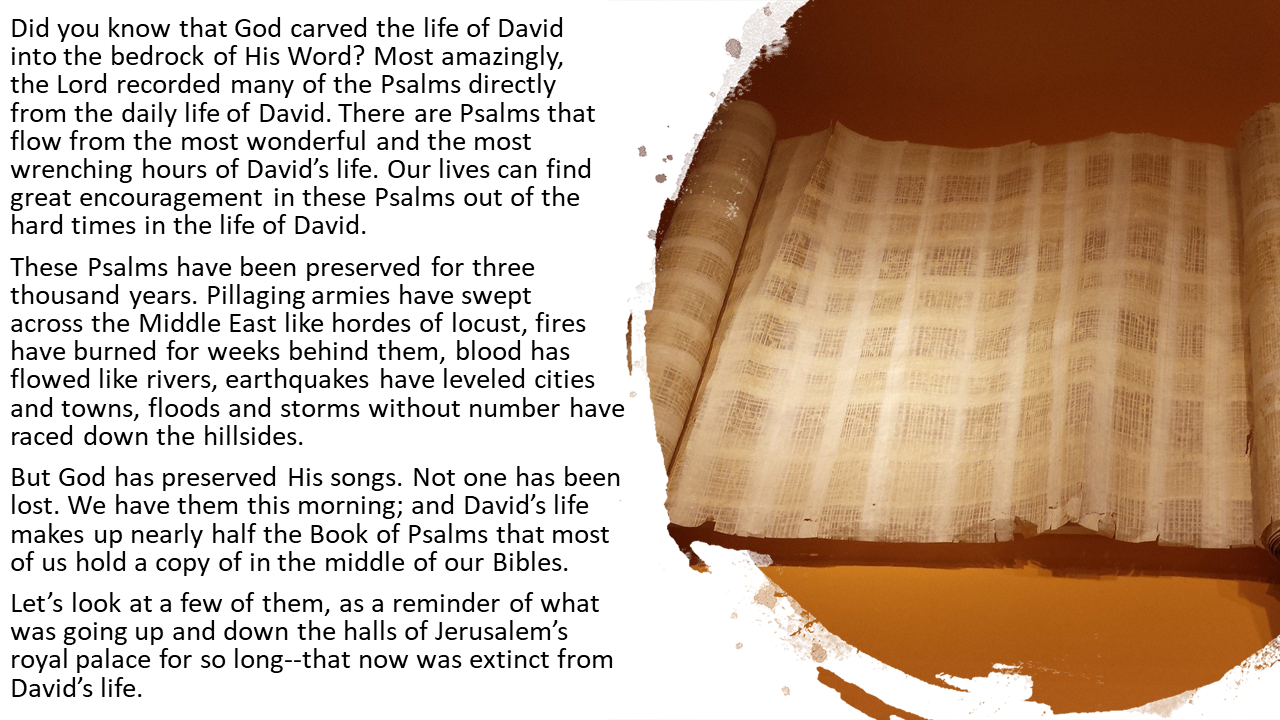
Did you know that God carved the life of David into the bedrock of His Word? Most amazingly, the Lord recorded many of the Psalms directly from the daily life of David. There are Psalms that flow from the most wonderful and the most wrenching hours of David’s life. Our lives can find great encouragement in these Psalms out of the hard times in the life of David.
These Psalms have been preserved for three thousand years. Pillaging armies have swept across the Middle East like hordes of locust, fires have burned for weeks behind them, blood has flowed like rivers, earthquakes have leveled cities and towns, floods and storms without number have raced down the hillsides.
But God has preserved His songs. Not one has been lost. We have them this morning; and David’s life makes up nearly half the Book of Psalms that most of us hold a copy of in the middle of our Bibles.
 Let’s look at a few of them, as a reminder of what was going up and down the halls of Jerusalem’s royal palace for so long–that now was extinct from David’s life.
David had for years been singing songs like Psalm 8, written after he had slain Goliath:
Psalm 8: “O LORD our Lord, how excellent is thy name in all the earth! Who has set thy glory above the heavens?”
Those words of humility and victory once rolled down from the throne room of David. Look at Psalm 9.
Psalm 9: “I will praise thee, O LORD, with my whole heart; I will show forth all thy marvelous works.”
David used to praise God with all his heart–but he wasn’t now.
As we turn to Psalm 18, we find the Psalm about when David returned at the head of his armies. In the superscription, it says:
“For the choir director, a Psalm of David, a servant of the Lord who spoke to the Lord the words of this Psalm in the day that the Lord delivered him from the hands of all his enemies and from the hand of Saul, and he said: “I will love thee, O LORD, my strength. The Lord is my Rock, my fortress, my Deliverer, my God, my Rock in Whom I take refuge”
Only he didn’t just say that, as the leader of God’s people he sang that.
And with a heart of abandon, a heart welling up and overflowing with praise, a heart unashamed of coming into God’s presence–David led all who were around him into God’s presence. David’s life just overflowed with God and people were so blessed just to see him, just to hear him, just to feel the warmth and the glow. Look at Psalm 21.
Psalm 21: “The king shall joy in thy strength, O LORD; and in thy salvation how greatly shall he rejoice!”
And so he did and for year after year after year the invincible armies of Israel extended the borders of Israel to the very limits.
But things changed. No more was Psalm 21 heard in the palace; neither was that old favorite from David’s youth, as we turn to Psalm 23…
Psalm 23: “The Lord is my Shepherd, I shall not want”
Yes something was missing, something was greatly wanting in David’s life! No more was David heard to sing of following his Shepherd. Turn to Psalm 25.
Psalm 25: “Unto Thee oh Lord do I lift up my soul; O my God I trust in Thee.”
No, David’s soul was cast down, trampled, empty, defiled and infected with guilt and sin. Turn to Psalm 27.
Psalm 27: “The Lord is my light and my salvation, whom shall I fear”
David was no longer walking in the light; no longer was he enjoying the joy of his salvation. No longer did he know the fearlessness that the righteous have. The righteous are as bold as a lion (Proverbs 28:1) but wicked people run even when nobody is chasing them.
What David had done displeased the Lord—and all that really matters in life is what God thinks of you. David fell silent. He had lost his song. No more did the daily business of the Kingdom of Israel flow to the songs of heaven. No more did the good shepherd’s peace and joy touch each worker, aide and courier. The palace was slowly becoming a wasteland. David was quiet, pensive and moody. His face was dark, no longer aglow with the joy of the Lord. His words that used to seem like honey were now more like his sword at his belt – sharp, cutting and bringing death to those around him. Gone was God from his daily work. Extinct were the life giving expressions of joyful delight that nourished the government of God’s people. What a blessing those songs had been. But David was hiding his sin. Look at Proverbs 28:13. God said that if we hide our sin instead of confessing and forsaking it (which is repentance) God will resist us. David needed to repent. That was the only solution for his dreadful condition.
 Would you just pause with me for a moment and turn your attention from David and look at your own heart? To help focus on what God wants from each of us, please quietly bow your head and answer these questions silently in your heart.
- Have you lost your song like David?
- Did you used to be closer to the Lord?
- Are you holding onto some sin that displeases the Lord?
- Is your heart growing restless and cold?
If so, the only remedy is to confess and forsake the sin that has caused God’s displeasure right now. Don’t wait like David did and suffer the consequences that inevitably came.
Proverbs 28:13 He who covers his sins will not prosper, But whoever confesses and forsakes them will have mercy. NKJV
We are in the midst of a journey through the Scriptures, mining the treasures God has recorded from the life of David. The lessons David learned are by God’s Spirit also intended for us!
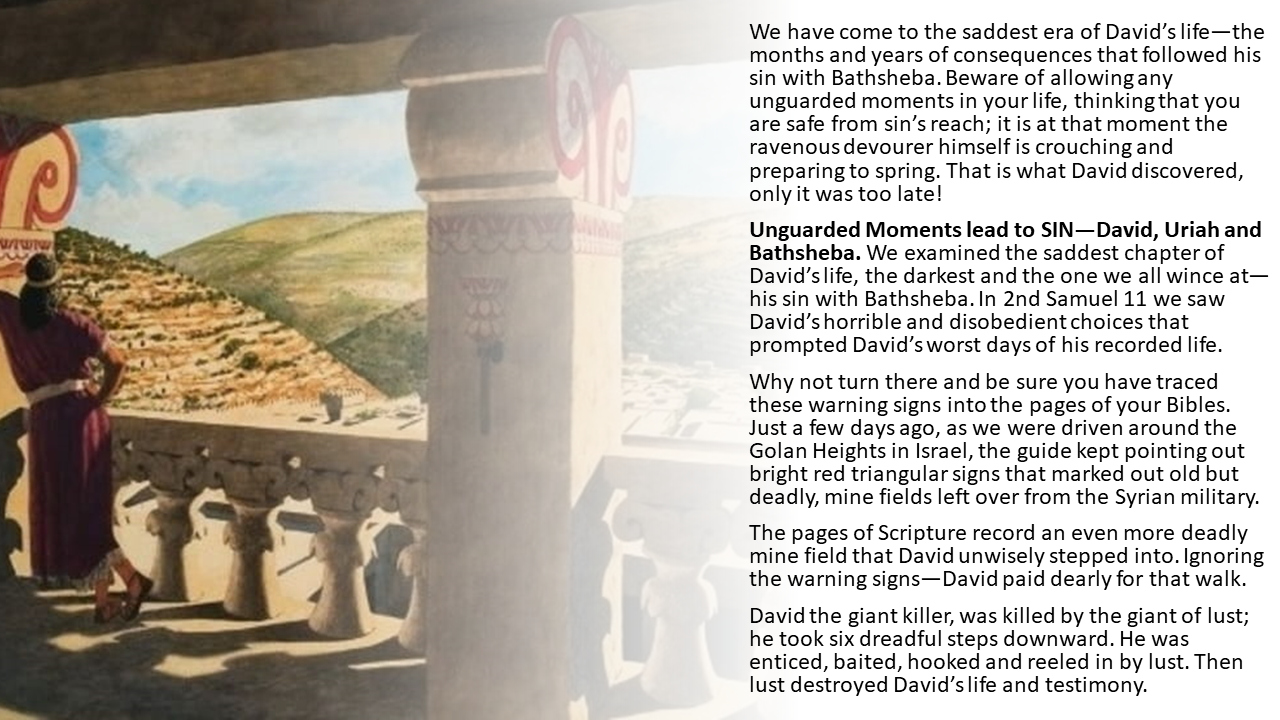
We have come to the saddest era of David’s life—the months and years of consequences that followed his sin with Bathsheba.
Beware of allowing any unguarded moments in your life, thinking that you are safe from sin’s reach; it is at that moment the ravenous devourer himself is crouching and preparing to spring. That is what David discovered, only it was too late!
We continue this morning a careful look at the three final eras of David’s life. They need to be studied and heeded by all of us. First we saw last time in 2nd Samuel 11 that– 1. Unguarded Moments lead to SIN—David, Uriah and Bathsheba. We examined the saddest chapter of David’s life, the darkest and the one we all wince at— his sin with Bathsheba. In 2nd Samuel 11 we saw David’s horrible and disobedient choices that prompted David’s worst days of his recorded life.
Why not turn there and be sure you have traced these warning signs into the pages of your Bibles. Just a few days ago, as we were driven around the Golan Heights in Israel, the guide kept pointing out bright red triangular signs that marked out old but deadly, mine fields left over from the Syrian military.
The pages of Scripture record an even more deadly mine field that David unwisely stepped into. Ignoring the warning signs—David paid dearly for that walk.
David the giant killer, was killed by the giant of lust; he took six dreadful steps downward. He was enticed, baited, hooked and reeled in by lust. Then lust destroyed David’s life and testimony.
We are warned as we watch how this occurred; note his downward steps.
1. David desensitized his conscience by incomplete obedience (II Sam 5:13).
2. David relaxed his grip on personal purity (II Sam 11:1).
3. David fixated his heart on physical desires (II Sam 11:2).
4. David rationalized his mind about wrong decisions (II Sam 11:3).
5. David plunged his life into lustful sin (II Sam 11:4).
6. David destroyed his testimony by the sin of a moment of stolen pleasure. Death, deceit, murder, immorality, spiritual oppression, poverty and famine of the soul are only a few offspring of this act of momentary pleasure.
Those unguarded moments led to what I call The Inevitable Consequences. Remember the consequence engine we studied last October in the Christ our Refuge series?
And those inevitable consequences lead to the PAIN of—David’s chastisement, Absalom’s rebellion, and Shimei’s slander. There are 11 chapters that record the years of painful consequences from of David’s sin (II Samuel 12-21, 24).
This morning we will start several weeks examining truths that God has for us from this tragic part of David’s life that I call the—

The Consequence Years
There are lessons to be learned from David that are very difficult but so necessary. For any and all of us today ring Paul’s words across the twisted wreckage of so many lives that litter the highway of the redeemed. To avoid the mine field that David blundered into we need to heed Paul’s warning. Please turn to the clearest warning in Scripture.
1 Corinthians 10:12-14 therefore let him who thinks he stands take heed lest he fall. 13 No temptation has overtaken you except such as is common to man; but God is faithful, who will not allow you to be tempted beyond what you are able, but with the temptation will also make the way of escape, that you may be able to bear it. 14 Therefore, my beloved, flee from idolatry. NKJV
David’s years of consequences, so painful, all lead back to one simple reality—David forgot something. This morning we need to learn from asking and answering this question—what did David forget?
DAVID FORGOT TO LOOK FOR GOD
Listen to David’s own testimony, he wrote it down, but on that fateful evening—he forgot to look for the God who is always faithfully there when we need Him!
PSALM 139:7-11 Where can I go from Your Spirit? Or where can I flee from Your presence? If I ascend into heaven, You are there; If I make my bed in hell, behold, You are there. If I take the wings of the morning, and dwell in the uttermost parts of the sea, even there Your hand shall lead me and Your right hand shall hold me. If I say, “Surely the darkness shall fall on me,” Even the night shall be light about me; NKJV
This side of the Cross the truth is even plainer to us. Look back again at Paul’s warning; after v.12 he gives the wonderful promise of v. 13:
I Corinthians 10:12b-13 “…Therefore let him who thinks he stands take heed lest he fall. No temptation has overtaken you except such as is common to man; but God is faithful, who will not allow you to be tempted beyond what you are able, but with the temptation will also make the way of escape, that you may be able to bear it.” NKJV
Don’t let an old familiar verse escape without holding on to this truth. I Corinthians 10:13 is a call to all of us who know and love the Lord to Look for God in times of temptation. Whenever we are tempted–He’s always there!
The apostle Paul gives us extreme hope in this one short verse of Scripture. Let me just amplify this verse to help you capture what God is saying—
No temptation will ever overtake us or spring upon us except the ones that God has already prepared us for in His Word. There are no new strains of sin viruses that have escaped God’s notice. And what ever old temptation we get attacked by we can be sure that God is faithfully on guard. God Himself has promised us that He will not allow us to be tempted beyond what we are able to take. Our God knows our limits and always stands right by us protecting us and holding open the way of escape so that we do not succumb to the snare of the Devil. God is always there, He is close enough to grab hold of His Hand that will pull us out.
The longer you meditate on this verse, the bigger the shadow looming over it becomes.
It is God who towers over this passage: God is there all the time.
When Peter was walking on the water, looked away from Jesus, and started to sink— how close was Christ? You know the story. As soon as Peter said ‘Lord save me” Jesus stretched out His hand and rescued Peter. God is always near, always close enough to hear and respond to that cry for help!
He tells us He is faithful. When we think we are alone, we are not alone.
God has already measured and limited the attack of the world, our flesh and the devil upon us.
He has already provided an escape route if we will only look for it and take it. If it were just us facing temptation, we would be hopelessly defeated. But God knows that we are helpless and so He is always there with us.
All the time. All the way. Every time. And He has the best way of escape clearly marked for us. What a Mighty God we serve!
We all have heard the touching story a father once told of his son’s first serious conflict at school. But it bears repeating.
Once his son was being picked on by two or three bullies. They punched the youngster a time or two, pushed him over when he was riding his bike home from school, and generally made life miserable for the lad. They told him they would meet him the next morning and beat him up.
That evening the dad really worked with the boy at home. He showed him how to defend himself, passed along a few helpful techniques, and even gave him some tips on how he might try to win them over as friends. The next morning the lad and dad prayed together knowing that the inevitable was sure to happen. With a reassuring embrace and a firm handshake, the father smiled confidently and said, “You can do it, Son. I know you’ll make out all right.”
Choking back the tears, the boy got on his bike and began the lonely, long ride to school. What the boy did not know was that every block he rode he was under the watchful eye of his dad…who drove his car a safe distance from his son, out of sight but ever ready to speed up and assist if the scene became too threatening. The boy thought he was alone, but he wasn’t at all. The father was there all the time.
In even greater measure, the God of the Universe is near.
He is with us though often unseen. He has gone ahead. He has been tempted in every way like us and triumphed. He has joined us in every temptation and makes the way of victory marked and open for us.

Look for God! He is always faithful!
Where should we look for God? We should look for Him when we face all of the various temptations that are never new, but always so unexpected and powerful. Think of the blessing of the following testimonies.
- Abraham looked for God and found Him when he was on the Mountain of Despair. Abraham saw all that ever mattered to him being lost, and though he could not understand—he trusted God. Abraham looked and found God Faithful. When we do the same we also find like Abraham did that God Supplies all my needs. Genesis 22:1-14.
- Joseph looked for God when he unexpectedly found himself in the Den of Passion. Accosted, blatantly faced with strong physical temptation Joseph cried out to the God he could not see but knew was there! When we do the same we also find like Joseph that God Sees and rescues me. Genesis 39:1-9
- David looked for God when he was all alone and so weak in the Cave of Fear. Hunted, alone, depressed and surrounded by bad attitudes David found the only place he could look was up. When we do the same we also find like David that God Supports me. Psalm 142; 56
- Jeremiah looked for God when he was in the gloom of failure. Rejected by his own people, single and never married, seemingly a failure in all he did Jeremiah trusted the Lord. When we do the same we also find like Jeremiah that God is shaping me. Jeremiah 16.1-13
- Daniel looked for God when he was in the Spotlight of Pride. Every eye was on him as he stepped forward to answer the king’s question he pointed the praise to God. When we do the same we also find like Daniel that God wants to use me. Daniel 2:24-28
- Peter looked for God when he was sinking in the fury of the storm. The instant that Peter cried out ‘Lord save me’ Christ’s hand was lifting him to safety. When we do the same we also find like Peter that God saves me. Matthew 14:24-31
- Paul looked for God when he was in the grip of pain. Paul found that all of his weaknesses and inabilities were the sources of Christ’s strength made perfect through him. When we do the same we also find like Paul that God’s grace is sufficient for me. II Corinthians 12:7-10
Don’t forget to look for God. What else did David forget?
DAVID FORGOT TO USE THE WORD
David knew so much of God’s Word, much of it he had written down for God. But gripped by his lust David suffered spiritual amnesia. The only hope we have for purity and obedience through temptation is to quote Scripture like Jesus! Remember what Christ’s method was in Matthew 4:1-11? Jesus used the Word to combat the Devil. He planned and prepared.
If the Word of God is hidden in our hearts:
We will say with the Psalmist (119:9-11) How can a young man cleanse his way? By taking heed according to Your word. With my whole heart I have sought You; Oh, let me not wander from Your commandments! 11 Your word I have hidden in my heart, That I might not sin against You! (NKJV)
We will say with Paul in Galatians 5:16 I say then: Walk in the Spirit, and you shall not fulfill the lust of the flesh. NKJV
We will say with John (1 John 5:18) We know that whoever is born of God does not sin; but he who has been born of God keeps himself, and the wicked one does not touch him. NKJV Don’t forget to use God’s Word! What else did David forget?
DAVID FORGOT TO RUN FROM LUST
Always remember Paul’s clear command for what we are to do when facing lust in any of its various forms. The command for us is found at that easy to find address in God’s Word 2 Timothy 222. Look there and be sure this verse is somehow noted for future need in your Bible.
II Tim. 2:22 Flee also youthful lusts; but pursue righteousness, faith, love, peace with those who call on the Lord out of a pure heart. NKJV
Sensuality is easily the biggest obstacle to godliness today and is wreaking havoc in the Church.
Godliness and sensuality are mutually exclusive, and those in the grasp of sensuality can never rise to godliness. As we saw in David’s unguarded moments, a mind controlled by lust has an infinite capacity for rationalization.
Listen to this piercing insight that the New Testament scholar Leon Morris has written: “The man who carries on an act of impurity is not simply breaking a human code, not even sinning against the God who at some time in the past gave him the gift of the Spirit. He is sinning against the God who is present at that moment, against One who continually gives the Spirit. The impure act is an act of despite against God’s good gift at the very moment it is being proffered…. This sin is seen in its true light only when it is seen as a preference for impurity rather than a Spirit who is holy.”1

IF DAVID HAD ONLY CONSIDERED THE CONSEQUENCES
If David had only considered the consequences of his immorality. He forgot to think about God who also is a part of all we do and say and think. God has another perspective for us to consider. David took the wife (completer) of Uriah to be his completer. That is a dangerous thing to do. To complete your life with anything but what God has designed and planned for you is to make an idol out of something God has made—and that always brings God’s displeasure.
2 Samuel 12:9 Why have you despised the commandment of the Lord, to do evil in His sight? You have killed Uriah the Hittite with the sword; you have taken his wife to be your wife, and have killed him with the sword of the people of Ammon. NKJV
Who is completing you? Physically and emotionally it MUST be your wife if you are married—not another woman, not your work, not your hobbies, not a habit, not videos, pictures, chats, or work.
The sword shall not depart.
2 Samuel 12:10 Now therefore, the sword shall never depart from your house, because you have despised Me, and have taken the wife of Uriah the Hittite to be your wife.’ NKJV
The pain, the cutting that would tear his family would relentlessly be the consequence of his sin!
If David had only known what his sin would do to Bathsheba as she watched their child die; as she was reminded every day about the horrible death her husband suffered as he fell under a rain of arrows and lay their in agony dying; as she looked into the faces of her friends and saw behind their smiles the disbelief that she would ever do such a thing.
If David had only known what his sin would do as Uriah’s lifeless body was brought back by a military detachment who carried him the 44 miles from Amman to Jerusalem. Bathsheba watched his body was washed, anointed and wrapped for burial in the family tomb, seeing the arrow’s deadly marks that spoke of the agony of his final hours helpless as his life ebbed in anguish from his body. She would have thought that he was thinking of her as he died…thinking he died nobly. But instead he was murdered in the deceit of adultery’s sinful grip!
If David had known what his sin would do to Ahithophel, Bathsheba’s grandfather as he advised those who sought to kill David and overthrow his kingdom.
If David had only known what his sin would do to Absalom, Amnon, and Tamar as the lives of his own children were ravaged by lust, murder and death.
David gave up his credibility with his sons and daughters, (“Why listen to a man who betrayed Mom and us?”)
• Ammon raped Tamar—but didn’t dad kind of do that? • Absalom killed Amnon—but didn’t dad kill Uriah?
• Adoniajah took the throne without asking—but didn’t dad do something like that?
• Joab betrayed David and took the side of his enemy—but didn’t David do that?
These are only some of the consequences. If only we would rehearse in advance the ugly and overwhelming consequences of immorality, we would be far more prone to avoid it. May we live each day in the love and fear of God.
And on and on we could go. Sin has consequences and they are painful!
Don’t forget—to look for God, to use His Word, and to run from lust!
God is close.
Cry out to Him.
He will rescue you every time!
1 R. Kent Hughes, The Disciplines of a Godly Man, pp.
Slides

Check Out All The Sermons In The Series
You can find all the sermons and short clips from this series, David’s Spiritual Secret here.
Looking To Study The Bible Like Dr. Barnett?
Dr. Barnett has curated an Amazon page with a large collection of resources he uses in his study of God’s Word. You can check it out here.