
If the video above is not available, here are two other ways to view:
The Miracle of Complete Forgiveness
060701AM
DSS-23
PSALM 32
Transcript
.jpg)
Let’s open to Psalm 32. Psalm 32 is the testimony of David in song that came to his heart when he received complete forgiveness. The thirty-second psalm is a Hebrew psalm celebrating the joys of complete forgiveness.
.jpg)
Now, complete forgiveness is a miracle. To receive the absolute remission of all sins, all guilt, all punishment, all future retribution for what we have done wrong is a miracle, and that’s what David is celebrating. He has experienced what the Scriptures often declare, that God is a God who offers to us, His fallen and sinful creations, we sons and daughters of Adam and Eve, He offers to us complete forgiveness. And I just want to remind you of what the Scriptures say before we delve into the wonders of this psalm, and I’m going to read to you just a few of the great promises of complete forgiveness. It says in Psalm 103, as far as the east is from the west, so far has He removed our transgressions from us. So, God has completely, through Christ to all who receive Him, removed as far as the east is from the west. Now, the interesting thing is the North and South Poles, you can come to a place where north and south meet, you’re at the Poles, and they meet. But the east and west is an endlessness you can never quite come. If you keep going, you’re going one direction or the other, and so that’s the wonder, in the Hebrew mind, it’s gone, our sins.
It says in Isaiah 1:18, come now, let us reason together, says the LORD, though your sins are like scarlet, they shall be as white as snow; though they are red like crimson, they shall be as wool. Again, the precious complete forgiveness He offers us. Isaiah also says in 38:17, God says, I have cast all your sins behind My back. How do you like that? God says, I’ve just, I’ve cast them out of My sight. I’ll remember them no more. Also, in Isaiah 44, I have swept away, God says, your offenses like a cloud. I’ve swept away your sins, like the morning mist. Return to Me, for I have redeemed you. God continues to say in Jeremiah 31:34, I forgive their wickedness, I remember their sins no more. The wonder of complete forgiveness.
At the Last Supper, Jesus commanded His own to drink from the cup, and this is what He says in Matthew 26 and verse 28. He said, this is My blood of the covenant, which is poured out for many for the forgiveness of sins. His blood not yet poured out, He spoke of it as already poured out. In fact, God often speaks of that tense of salvation, that He was the Lamb slain before the foundation of the Earth. And so, Jesus said, this is the blood of the covenant, My blood poured out, as if it already had been, for the sins. His blood poured out to completely forgive sin. It says in Romans 8:1, there is now therefore no condemnation to those who are in Christ. Complete forgiveness. Now remember, Jesus says, if I haven’t forgiven all of your sins, I haven’t forgiven any of your sins. And Christians struggle with that. We believe He’s covered most of them, but a lot of believers get into this rut that there’s some He just can’t completely forgive, and they are anxious and discouraged over those. John said this in 1 John 1, if we are confessing our sins, He is faithful and just to once and for all have forgiven us our sins and to purify us from all unrighteousness.
David had just experienced the greatest of all miracles that God does on this planet today. Psalm 32 is his song about that. He had experienced the miracle of complete forgiveness. Now, I want you to think about what a miracle it is because it’s the miracle that God is still doing. The Gospels, the four Gospels record 37 specific times Jesus performed a miraculous work in someone’s life. And if you catalog all of those miraculous works of Jesus Christ, they are very, very specific. Jesus performed many, many miracles. Just to list off, I won’t read all of them, but He gave sight to the blind, hearing to the deaf, life to the dead, health to the sick. He did tremendous miracles supernaturally, but every one of those miracles was temporal. Have you ever thought in that sense? You read the Gospels through, and we just are amazed at eyes, and leprosy gone, and hands, and feet returned, and hearing.
.jpg)
But of all Christ’s miracles, which one was the greatest? Not the temporal ones. The paralyzed, the lame, the mute, and the blind that Jesus gave back eyes, and fingers, and toes, and skin eventually lost all of them again when they got sick and died some years later. So, that was just a temporary miracle. Peter’s mother-in-law miraculously set free from a deadly fever, but years later, she died of other causes, which probably had a fever attached to them. It was only a temporary miracle. The food that was miraculously created by Jesus feeding the 5,000 at one time and the 4,000 at another was consumed by them and used up, and their hunger returned the next day. That was a temporal miracle. The eyes Jesus restored to blind Bartimaeus were used, they were worn out, they were dimmed, and by the time he died, they were probably not seeing very well anymore. That was a temporary miracle. The hearing that the deaf received were subject to the natural downward slide of the human body and faded, and most likely by their death, their hearing wasn’t very good, even though they had temporary brand-new perfect hearing given by Jesus Christ. Those dancing feet after Christ touched that the lame possessed soon turned to shuffling feet and then stopped working altogether as those feet were attached to a body that laid in bed awaiting death many years later, another temporal miracle. Lepers who found fresh new skin and limbs and saw themselves again returned to full health slowly saw themselves return to wrinkles, and then weakness, and finally immobility, and circulation, and respiration, and digest, and all slowly were assaulted by the weight of many years. And those new bodies they were given temporarily faded. So yes, Jesus performed 37 specific miracles, but all of them but one were temporary.
.jpg)
So, what’s the greatest miracle that Jesus performed? It’s the miracle of the forgiveness of sins. That’s the greatest miracle of all because that’s not temporary. That’s the one that never ends, and that’s the one that we celebrate at communion this morning. And that’s the one that David was so excited about because the answer to the greatest of all of Christ’s miracles is it’s the one that never faded, never aged, never ended. It was a miracle that was unfaded by time, untouched by health, and unaffected by circumstances. And that miracle, the greatest miracle, is one Jesus is still doing in our midst today. It’s the miracle that I’ve personally experienced and every one of us here who have received God’s gracious gift have experienced the greatest miracle of all, which is the complete forgiveness of our sins.
I wonder, though, what it was like just up to the moments before Psalm 32. That’s what we’re looking at today. We’re looking at David’s song, but what was it like just before he started singing this song? As you see the words, O how blessed is he, in verse 1, whose transgression is forgiven. Before he started singing that, what was it like just before that event of his forgiveness? Have you ever thought about who David was? Because David was one who probably had trouble thinking that God really was going to forgive him. If you look at his pedigree, what makes complete forgiveness seem even more impossible is if you’re someone who most people would never dream of as having any kind of struggle with sin. The former bad people, we expect them to have had trouble with sin. If they were a drug addict or some alcoholic or some whoremonger-ous, fornication person, we say, ah, they were bad and they were forgiven. But what if you grew up around the things of God your whole life? That’s what David was like. Do you remember where David was before Psalm 32? He’d been living as a constant testimony of God. And those people who know the Lord have the greatest trouble really believing that all their sins are forgiven because they have tried so hard to live for God. David had.
David in Psalm 132, a hundred psalms from where we are, had written as a little boy, a young shepherd boy. He said, this is the discipline of my life as a young boy. Verse 3, I’m going to have God ahead of comforts. He says, I’m not going to lay my head down until I make room for God. Now, what a great commitment. David made that as a young boy, and he said, God ahead of comfort in my life. And people went, wow! And he said, devotions, in verse 4 of Psalm 132, are going to be my holy habit. I’m going to make priority for God. In Psalm 132:5, we found months back, he says, God is going to have time in my life, and he says, I have genuine longings for Him. And verse 9 was the worst one of Psalm 132. He says, I’m going to live a pure life, and he did. From the young shepherd boy, he had a consistent upward, yes struggling at times, but visibly, outwardly, a seeker of God.
Then when he became king, and you might want to turn there, we’ll come back to Psalm 32, but look at Psalm 101. This is the most pronounced declaration that David had made publicly. Most believers believe that Psalm 101, those who have written about it at least, they think Psalm 101 was David’s declaration when he became king at age 30. When he became king of God’s people, he, in his coronation, made this declaration, Psalm 101. He laid out his plan for integrity. It had become his personal operating system. What he had known personally, he declares publicly at this momentous time, and that’s probably the background, his coronation for this 101st psalm. And do you remember what he said? He said in verse 1 and 2 of Psalm 101, I will sing of Your mercy and justice; O LORD, I’ll sing praises. I will behave myself wisely. When will You come to me? Verse 2, I will walk within my house—when no one’s looking, he’s implying—with a perfect heart. You know what he said publicly as he became king? He said, I’m going to personally commit to a non-hypocritical life of integrity. People just went, that’s our king. That’s our man. That’s our example. Boy, people just followed David. He was such a wonderful example.
Then he goes on in verse 3. He says, I’m going to make this personal pact of purity. I will set nothing wicked before my eyes. He said, I will never consciously, knowingly set anything and choose to look at something that grieves, or quenches, or defiles the Holy Spirit of God working and living in me. He continues in verse 3. He said, I’m never going to allow sin to build up in my life. At the end of it, he says, I hate the work of those who fall away; it will not cling to me. I’m going to scrape off any cling sin in my life. And the people just, what a testimony David had, and he lived this. He lived this for decade after decade. Verse 4, he continues. He says, I’m going to limit all my exposure to sin. A perverse heart will depart from me; I will not personally experience wickedness. I’m going to limit my exposure to it. And anybody that secretly is slandering their neighbor and they come and tell me about it, I’m not going to have anything to do with that. The haughty person, the proud heart, I’m not going to endure. I won’t give them the time of day; I’m just going to limit my exposure to sin.
Verse 6, he says, I’m going to choose to only hold on to proper heroes. I’m going to cling to people that are faithful, verse 6, in the land, they’re going to dwell with me. Those who walk in upright, mature way, that’s the one that’s going to serve me. Anybody that works deceit isn’t going to dwell in my house; anyone that’s a liar, that’s hypocritical, they’re not going to continue in my presence. What a personal operating system, and I’ve commended this to you many times, and this is what David lived, and this is what he wanted, and this is what he proclaimed, and this is what he sang about.
The 101st psalm is also a public song that he sang. Verse 8, he said, I’m going to follow in, Psalm 101:8, a pattern of regularly cleaning out of my life anything that displeases the LORD. Early! He said, it’s going to be a priority of my life. I’m going to destroy all the wicked of the land. Kind of like emptying your deleted items file in your spam killer and junk mail stuff. You just [click] hit that. You just early, right on. You just don’t want any of that stuff to pile up. And he says, I am going to destroy anything wicked. I’m going to cut off the evildoers. I don’t want anything to do with that. It’s not going to build up around me.
.jpg)
But as wonderful as all those personal, and private, and public choices may have been, David drifted away. David had gotten out of touch with the Lord. And by the time we got to 2 Samuel 11, as we have been seeing, David fell headlong deeply, plunging into sin. God exposed him. The initial consequences of guilt and shame had multiplied, and David had come to the end of himself, and David wondered if it could get any worse. He was just mulling over this. Probably, most scholars believe that it was a whole year between the act of sin and the confrontation with Nathan, the prophet. So, David had stewed, and withered, and wasted away, and felt the onslaught of the heavy hand of God for a year. And he thought, could it get any worse? And David reflected on his sin, how he had one of his most trusted and loyal friends murdered, how he took his wife, how he angered her family that included two of the most trusted bodyguards. Because David, Uriah wasn’t only just David’s bodyguard, his father was too, Eliam. And Bathsheba’s grandfather happened to be his personal closest counselor. This was a big deal. It wasn’t just Uriah or Bathsheba; it was a whole family that was connected to that. And now David is exposed.
When Nathan comes, and let’s go back to Psalm 32 and we’ll look at his confession there. The whole world found out why his baby had died, why his loyal friend Uriah was killed, and what David had been up to when everyone else was out of town. And David, as Nathan approached him, wanted so desperately to be forgiven. He was so crushed by his sin, but he thought, is all that possible? As we come to Psalm 32, we come to a place in our Bibles, we can flee whenever we wonder inside, can I ever be forgiven completely? Can I who knows so much, can I who grew up in church, can I who memorized all those verses, can I who have done so much public ministry in whatever setting it may be, can I be sure that I’m completely forgiven? That’s what David was thinking, and that’s what the thirty-second psalm declares. And it sets down how God forgives completely because Psalm 32 is a song that was sung and recorded by God’s Spirit for good people that do bad things and are crushed beneath a load of guilt and shame over what they had done.
.jpg)
I think about the testimony of one man who had experienced this, who actually many years ago wrote a similar song, uninspired, of course, but very, very much capturing this. Maybe you know the words, you possibly even say them from time to time in your heart. Bill Gaither wrote this: shackled beneath a heavy burden, ‘neath a load of guilt and shame. Then the hand of Jesus touched me, and now what? I am no longer the same. He touched me, oh, He touched me, and oh, the joy that floods my soul. Something wonderful happened, and now I know He touched me. That’s the miracle of complete forgiveness.
.jpg)
David wrote it this way. He wrote in Psalm 32 that the light of God’s forgiveness dawned on him in a dark place. He had hope in a weary land, the promise from the God who cannot lie that he would be forgiven. Psalm 32 verses 1 and 2, which is all we will look at in the New King James, it says this, blessed is he whose transgression—literally rebellion. David said, I defied God’s rule. That’s what that word means. His rebellion is forgiven. We saw last time lifted up. The word for forgiveness means not just not think about it, but it’s actually lifted up off of me. The rebellion that David committed that was crushing him, his defiance of God’s rule, the Lord lifted off of him. That’s the first element of his forgiveness. Whose sin—this word sin is specific. It’s a specific missing the mark; it’s shooting at something and not just kind of but clearly missing the mark. He says, my sin, he says, I completely missed God’s mark. And my sin of missing the mark—look what he says—is covered. The word covered speaks of… This missing of the mark exposed me to God’s wrath, and I’m now shielded from God’s wrath. That’s what he was singing about.
Verse 2, blessed is the man whom the Lord does not impute iniquity. That word iniquity speaks of an intentional, warped ruining of something. It’s kind of like leaving something out, and it rains on the wonderful leather baseball mitt, and it just gets ruined. Or leaving open your car, and the storm comes in and it ruins something inside your car, or your windows, or whatever. It gets warped by the decision you made. Only, it wasn’t an accidental; it was an intentional one. He says, I’m so thankful, verse 2, that the LORD does not impute iniquity to me. I have intentionally committed iniquity. I’ve intentionally warped and twisted my life by this bad choice. And he said, and the LORD has cleared out the debt I owed to Him because it’s His life that I warped. It’s His name that I despoiled. And then he said, in whose spirit, the end of verse 2, is no deceit—nothing hidden in the secret places.
Literally, we could translate this, in fact, when I was going through this and looking at all these Hebrew words, I wrote down literally what he’s saying, if you just put everything I just said. He said, oh, the happiness of the man whose rebellion has been forgiven, whose record of failures has been erased. How happy is the man on whose account the LORD does not put his crookedness, and in whose spirit is no hidden sin. And he was excited about that, and he wrote a song about that, and he said, oh, the blessedness of complete forgiveness. The miracle of complete forgiveness.
.jpg)
David had been guilty of each of those sins in those first two verses. David had rebelled against God’s Law. David had failed to meet God’s righteous standard, both as king and as a husband and as a man. He had failed on every count. David had yielded himself up to his crooked nature’s control, and David had deceitfully covered the whole matter for over a year and paid the terrible price. But when he received God’s complete forgiveness, it was so wonderful he began to sing about it. And he wrote this song down, the thirty-second psalm, for all who have ever lived that life of seeking the Lord and then failed.
Total forgiveness is something to celebrate. It’s beyond anything that positive thinking, or therapy, or hypnosis can provide. That’s all our world, by the way, has to offer for people that have failed and sinned grievously. They can say, oh, just think positively, forget it, or go through therapy, or get hypnotized or shock therapy or something so you can get it out of, and go on. But God’s forgiveness is complete. God’s forgiveness that He offers extends to both conscious and unconscious sins in our lives because God knows everything, and it’s the blood of Jesus, the infinite, omnipotent, omnipresent Son of God, His blood that cleanses us from all unrighteousness and sin. Think about who is doing the cleansing and how much They know. And that’s what the miracle of complete forgiveness is all about. Anyone can be forgiven no matter what their sin is, David reminds us. Whether they are the torturous commandant of some Nazi death camp, they could be forgiven of all that. Or some serial murderous killer a couple decades ago, John Wayne Gacy and all of his evil. Or whether the most immoral or even the most moral person in America, total forgiveness is possible, but only through Christ. And
.jpg)
God’s forgiveness is always based on sin’s penalty being paid. Not this God who overlooks it. God doesn’t overlook sin. God only forgives what’s been paid for. That’s His righteous holiness that needs to be paid for by a proper sacrifice.
The sad part in America today is that many Christians are depressed about their sins and failures. They operate under a false notion that God still remembers some or all of their sins against them, and they’ve forgotten the Scriptures we read earlier. Do not forget that because God has taken our sins upon Himself. They are separated as far as the east is from the west. Don’t ever forget that. When Satan tries to remind you of your sins, remind him back that God said, I have removed your sins from you as far as the east is from the west. Those who labor and depress themselves over their sins forget God’s promise through Isaiah that one day He would wipe out our transgressions that are like a thick cloud and our sins that are like a heavy mist because He redeemed us. Often believers forget what Revelation says. Revelation 13:8 reminds us that God looked down the corridors of time, even before He made the Earth, and He placed the sins of the world on the head of His Son, the Lamb of God. For He was the Lamb slain from the foundation of the world. And at Calvary, Jesus took the sins of all who would believe an eternal distance away from them. That’s something that should be celebrated. At Calvary, Jesus took your sins, if you have believed in Him, an eternal distance away from you and from me.
Believers who labor over their sins forget that hundreds of years before Calvary, Micah proclaimed that the Messiah’s death would provide a way for complete forgiveness. As it says in Micah 7:18-19, who is like Thee, O God, who pardons iniquity, who passes over the rebellious acts of the remnant of Thy possession? You do not retain your anger forever because you delight in unchanging love. You’ll again have compassion on us; You will tread our iniquities underfoot. Yes, You will cast all our sins in the depths of the sea. You’ll cast them, as Isaiah said, where You can see them no more. Don’t forget that Christ promised to never condemn us. When Jesus comes into our lives as Savior and Lord, He says what He said to the woman caught in the act of adultery in John 8 and verse 11, neither do I condemn thee. Go your way. And Paul added, there is now therefore no condemnation for those who are in Christ.
.jpg)
Because we continue to sin, we need the continued forgiveness of cleansing, but we do not need the continued forgiveness of redemption. There is a big difference. He redeemed us once and for all. We need constant cleansing because we continue to sin, but He has once and for all dealt with our sins. We don’t need to be redeemed, and redeemed, and redeemed, and redeemed, and saved, and saved, and saved. We need to be cleansed when we sin. Jesus told Peter, he who has bathed needs only to wash his feet, but he’s completely clean, John 13:10. Even though we continue to sin, Jesus is faithful and righteous to forgive us our sins and cleanse us from all unrighteousness. This doesn’t mean we no longer sin, but when we do sin, we have no harmful effects that are eternal. Though sin profoundly affects our growth, it does not affect our destiny. There are no second-class Christians, no deprived citizens of God’s Kingdom or children in His family. Every sin of every believer is forgiven forever. That’s the heritage of all who are in Christ, and that’s what we celebrate.
.jpg)
We confess, as one of the great saints of the past said, the Bible is a corridor between two eternities down which walk the Christ of God. His invisible steps echo through the Old Testament, but we meet Him face to face in the New. It’s through that Christ alone crucified for me that I have found forgiveness for sins and life eternal. The Old Testament is summed up in the words of Christ. The New Testament is summed up in the words of Jesus the Christ. And the summary of the whole is that Jesus is the Christ, the Son of God who loved us and has forever freed us from our sins.
.jpg)
And Father, I pray that You would know that we live for You, that our husbands and wives would know that we live for You, that our children would see that we live for You. That the people that we grace with our presence at lunch, at home, or in some restaurant or out would know that we believe that the people that follow us on the roads front and behind and ride in our cars would know that we believe. Those we work with tomorrow, or vacation with, or go to school with would know that you believe. And that we would express by our lives the miracle that we are completely forgiven. May we go in Your power because we believe. In the name of Jesus Christ, and all of His redeemed saints said, amen. God bless you as you go.
Notes
 Have you ever wondered secretly in the back of your mind if you could be completely forgiven of all your sins? I mean the really bad ones that most or nearly all people don’t know about?
COMPLETELY FORGIVEN
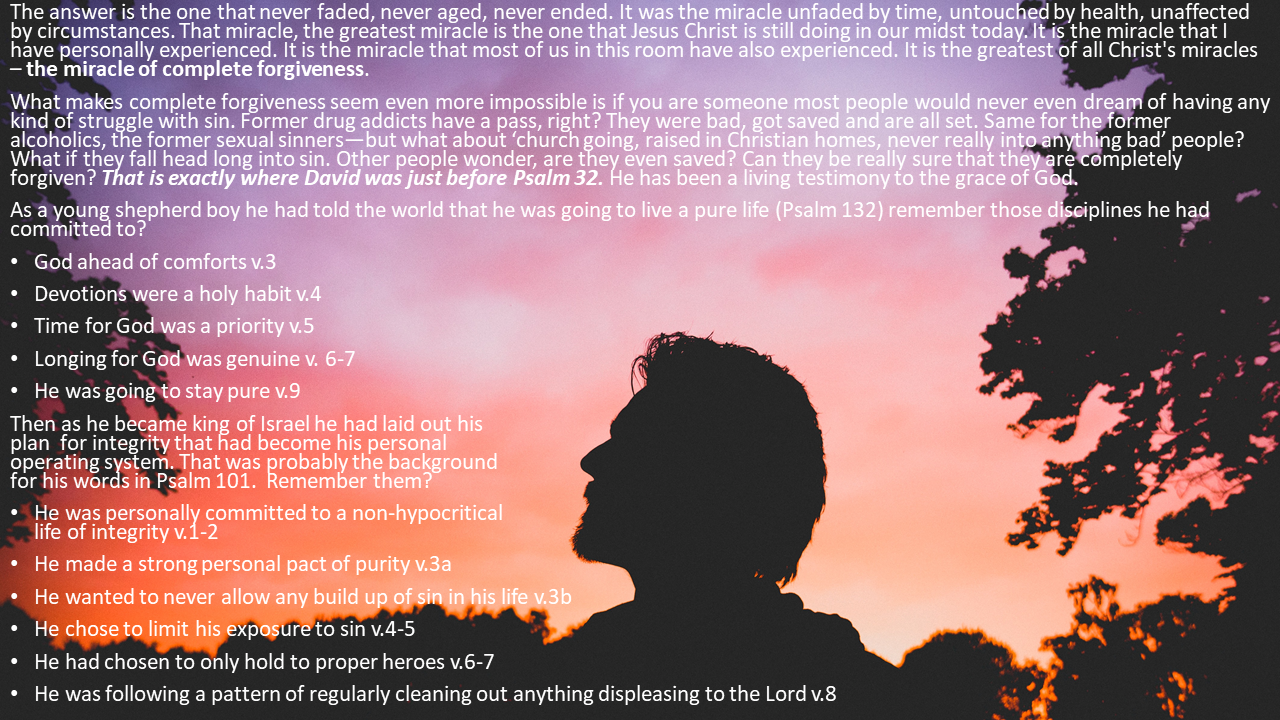
What makes complete forgiveness seem even more impossible is if you are someone most people would never even dream of having any kind of struggle with sin. Former drug addicts have a pass, right? They were bad, got saved and are all set. Same for the former alcoholics, the former sexual sinners—but what about ‘church going, raised in Christian homes, never really into anything bad’ people? What if they fall head long into sin. Other people wonder, are they even saved? Can they be really sure that they are completely forgiven?
That is exactly where David was just before Psalm 32. He has been a living testimony to the grace of God.
As a young shepherd boy he had told the world that he was going to live a pure life (Psalm 132) remember those disciplines he had committed to?
- God ahead of comforts v.3
- Devotions were a holy habit v.4
- Time for God was a priority v.5
- Longing for God was genuine v. 6-7
- He was going to stay pure v.9
Then as he became king of Israel he had laid out his plan for integrity that had become his personal operating system. That was probably the background for his words in Psalm 101. Remember them?
- He was personally committed to a non-hypocritical life of integrity v.1-2
- He made a strong personal pact of purity v.3a
- He wanted to never allow any build up of sin in his life v.3b
- He chose to limit his exposure to sin v.4-5
- He had chosen to only hold to proper heroes v.6-7
- He was following a pattern of regularly cleaning out anything displeasing to the Lord v.8 But as wonderful as all those personal, private, and public choices may have been—he had drifted away and gotten out of touch with the Lord in 2nd Samuel 11. And as we have been seeing, he fell deeply into sin.
And God had exposed him. The initial consequences of guilt and shame had multiplied and he came to the end of himself. David wondered, could it get any worse? David reflected on his sin, how he had one of his most loyal friends murdered, took his wife, angered her family that included two of his most trusted body guards and also one of his most senior advisors—and now he is exposed.
The whole world found out why his baby died, why his loyal friend was killed and what David had been up to when every one else was out of town.
He wanted to be forgiven—but now is all that possible?
Welcome to Psalm 32, a place in your Bible to flee when you wonder, “Can I ever be forgiven completely ?”
The Gospels record just 37 specific miracles that Jesus performed during His earthly ministry. These include sight to the blind, hearing to the deaf, life to the dead, health to the sick – and many other tremendous miracles supernaturally performed by Christ.
 FORGIVENESS IS THE GREATEST MIRACLE
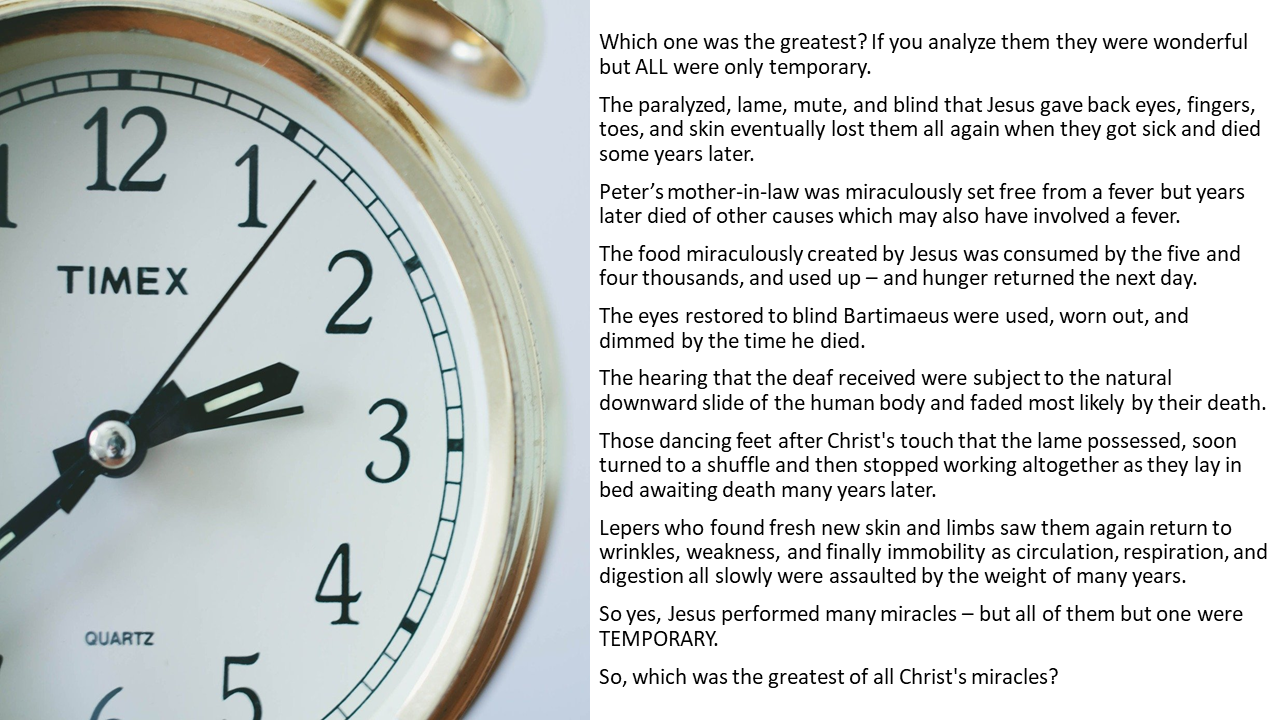
Which one was the greatest? If you analyze them they were wonderful but ALL were only temporary.
• The paralyzed, lame, mute, and blind that Jesus gave back eyes, fingers, toes, and skin eventually lost them all again when they got sick and died some years later.
• Peter’s mother-in-law was miraculously set free from a fever but years later died of other causes which may also have involved a fever.
• The food miraculously created by Jesus was consumed by the five and four thousands, and used up – and hunger returned the next day.
• The eyes restored to blind Bartimaeus were used, worn out, and dimmed by the time he died.
• The hearing that the deaf received were subject to the natural downward slide of the human body and faded most likely by their death.
• Those dancing feet after Christ’s touch that the lame possessed, soon turned to a shuffle and then stopped working altogether as they lay in bed awaiting death many years later.
• Lepers who found fresh new skin and limbs saw them again return to wrinkles, weakness, and finally immobility as circulation, respiration, and digestion all slowly were assaulted by the weight of many years.
• So yes, Jesus performed many miracles – but all of them but one were TEMPORARY.
So, which was the greatest of all Christ’s miracles?
The answer is the one that never faded, never aged, never ended. It was the miracle unfaded by time, untouched by health, unaffected by circumstances.
That miracle, the greatest miracle is the one that Jesus Christ is still doing in our midst today. It is the miracle that I have personally experienced. It is the miracle that most of us in this room have also experienced. It is the greatest of all Christ’s miracles – the miracle of complete forgiveness.
But up until the moments just before Psalm 32, David wasn’t so sure.
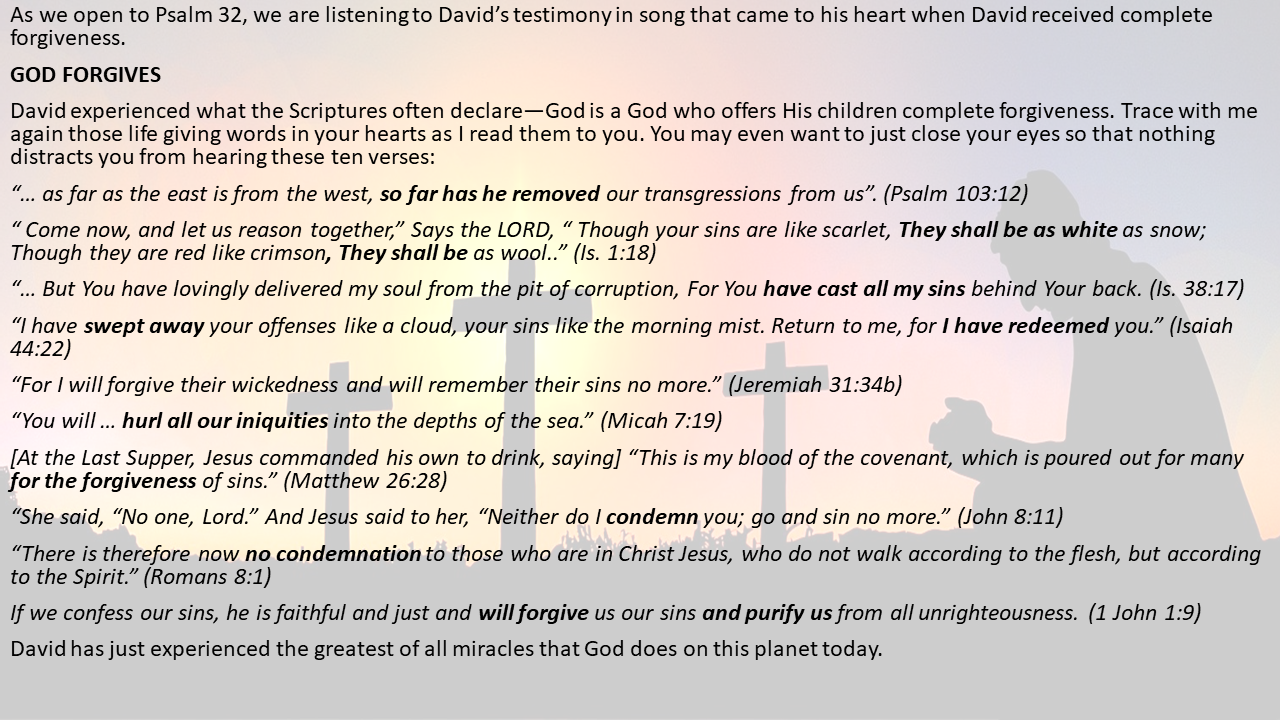
As we open to Psalm 32, we are listening to David’s testimony in song that came to his heart when David received complete forgiveness.
GOD FORGIVES
David experienced what the Scriptures often declare—God is a God who offers His children complete forgiveness. Trace with me again those life giving words in your hearts as I read them to you. You may even want to just close your eyes so that nothing distracts you from hearing these ten verses:
• “… as far as the east is from the west, so far has he removed our transgressions from us”. (Psalm 103:12)
• “ Come now, and let us reason together,” Says the LORD, “ Though your sins are like scarlet, They shall be as white as snow; Though they are red like crimson, They shall be as wool..” (Is. 1:18)
• “… But You have lovingly delivered my soul from the pit of corruption, For You have cast all my sins behind Your back. (Is. 38:17)
• “I have swept away your offenses like a cloud, your sins like the morning mist. Return to me, for I have redeemed you.” (Isaiah 44:22)
• “For I will forgive their wickedness and will remember their sins no more.” (Jeremiah 31:34b)
• “You will … hurl all our iniquities into the depths of the sea.” (Micah 7:19)
• [At the Last Supper, Jesus commanded his own to drink, saying] “This is my blood of the covenant, which is poured out for many for the forgiveness of sins.” (Matthew 26:28)
• “She said, “No one, Lord.” And Jesus said to her, “Neither do I condemn you; go and sin no more.” (John 8:11)
• “There is therefore now no condemnation to those who are in Christ Jesus, who do not walk according to the flesh, but according to the Spirit.” (Romans 8:1)
• If we confess our sins, he is faithful and just and will forgive us our sins and purify us from all unrighteousness. (1 John 1:9)
David has just experienced the greatest of all miracles that God does on this planet today.
Please stand with me and listen to David sing his gratefulness for God’s complete forgiveness. Psalm 32 Read and Pray.
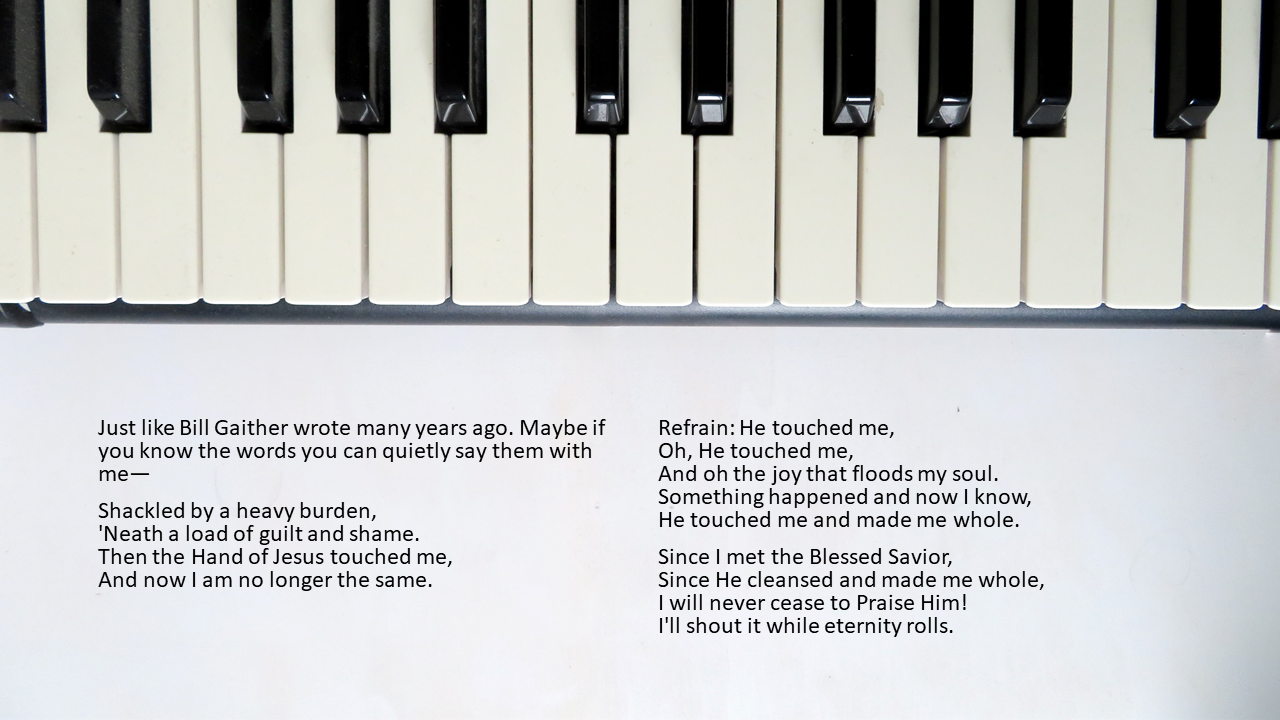
Psalm 32 is a song sung and recorded by God’s Spirit for good people that do bad things and are crushed beneath a load of guilt and shame. Just like Bill Gaither wrote many years ago. Maybe if you know the words you can quietly say them with me–
Shackled by a heavy burden, ‘Neath a load of guilt and shame. Then the Hand of Jesus touched me, And now I am no longer the same.
Refrain He touched me, Oh, He touched me, And oh the joy that floods my soul. Something happened and now I know, He touched me and made me whole.
Since I met the Blessed Savior, Since He cleansed and made me whole, I will never cease to Praise Him! I’ll shout it while eternity rolls.
 THE MIRACLE OF COMPLETE FORGIVENESS
The Miracle of Complete Forgiveness–A light in a dark place. A hope in a weary land. A promise from the God who cannot lie—neither do I condemn thee, I am willing, you are completely cleansed and forgiven in the Name of Jesus and because of His payment made for your sins.
Look back at Psalm 32, listen to what David literally sang in those first two verses:
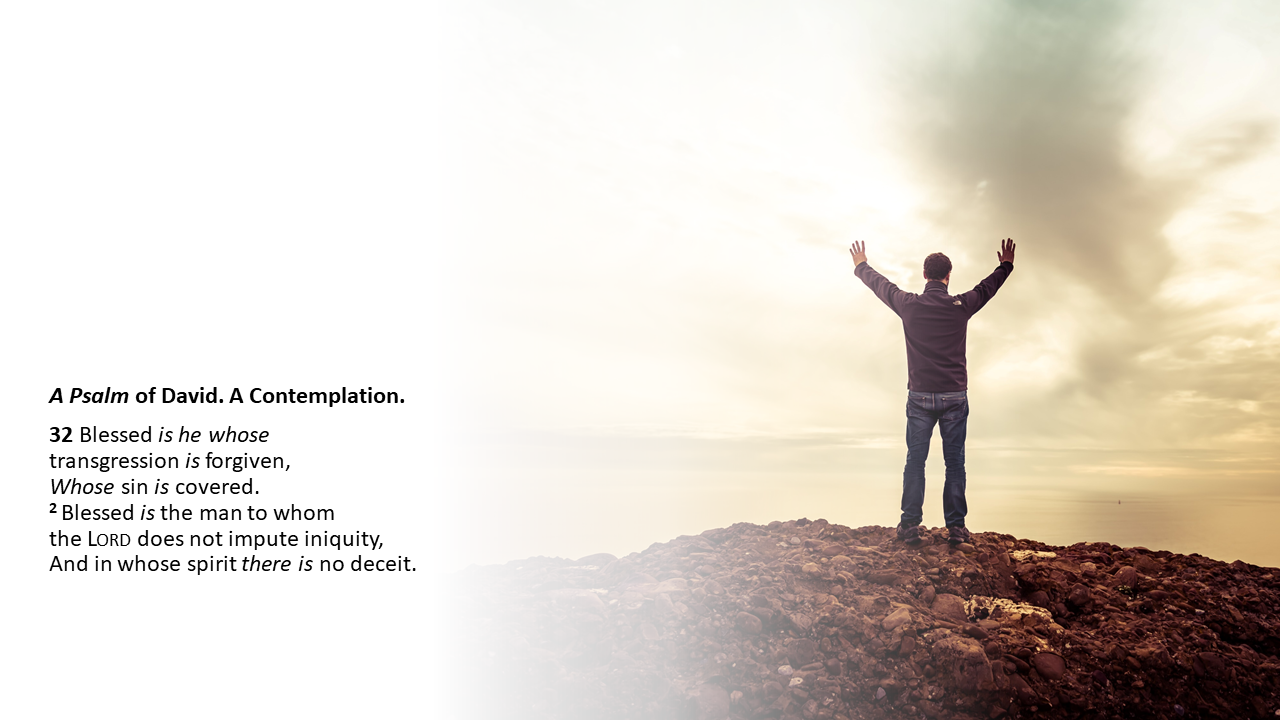
“Oh, the happiness of the man whose rebellion has been forgiven, whose record of failures has been erased. How happy is the man on whose account the Lord does not put his crookedness, and in whose spirit there is no deceit.” [author’s amplified translation]
David had been guilty of each of those sins: David rebelled against God’s Law; David failed to meet God’s righteous standard; David yielded himself to his crooked nature’s control; and David deceitfully covered the whole matter up for a year. So when he received God’s complete forgiveness it is so wonderful he sings–
“Total forgiveness is something to celebrate. It is beyond anything positive thinking, therapy, or hypnosis can provide. It is complete, extending to the conscious and unconscious sins in our lives, because God knows all things and because Jesus’ blood is infinite.
And anyone can be forgiven, no matter what their sin is, whether they are the torturous commandant of Auschwitz or a serial killer like John Wayne Gacy or the most immoral (or even the most moral) person in America. Total forgiveness is possible through Christ.”.1
God’s forgiveness is always based on sin’s penalty being paid. Only an acceptable payment can satisfy God’s holy justice. God required a substitute—a perfect sacrifice to die in the sinner’s place. The chosen substitute—and the only one who qualified—was Jesus Christ the Lamb of God. Salvation during OT or NT times is always based on Christ’s sacrifice. When any sinner comes to God, convicted by the Holy Spirit that he cannot save himself from the deserved penalty of God’s wrath, God’s promise of forgiveness is granted when he believes.
But the modern tragedy is that many Christians are depressed about their sins and failures. They operate under the false notion that God still holds some or all of their sins against them. These misguided believers forget the Scriptures we read earlier.
• They forget that because God has taken their sins upon Himself, they are separated from those sins “as far as the east is from the west” (Ps. 103:12).
• They forget God’s promise through Isaiah that one day He would wipe out the transgressions of believers “like a thick cloud” and their “sins like a heavy mist. Return to Me,” He said, “for I have redeemed you” (Isa. 44:22).
• They forget that God looked down the corridors of time even before He made the earth and placed the sins of the world on the head of His Son, the Lamb of God. “…the Lamb slain from the foundation of the world.” (Revelation 13:8) At Calvary Jesus took the sins of all who would believe an eternal distance away.
• They forget that hundreds of years before Calvary, Micah proclaimed that the Messiah’s death would provide a way for complete forgiveness–“Who is a God like Thee, who pardons iniquity and passes over the rebellious act of the remnant of His possession? He does not retain His anger forever, because He delights in unchanging love. He will again have compassion on us; He will tread our iniquities under foot. Yes, Thou wilt cast all their sins into the depths of the sea” (Micah 7:18–19).
• They forget Christ’s promise to never condemn them. When Jesus comes into our lives as Savior and Lord, He says to us what He said to the woman caught in the act of adultery, “Neither do I condemn you; go your way” (John 8:11). “There is therefore now no condemnation for those who are in Christ Jesus. For the law of the Spirit of life in Christ Jesus has set you free from the law of sin and of death” (Rom. 8:1–2).
Listen to these profound words expressing the miracle of our complete forgiveness.
“Because we continue to sin, we need the continued forgiveness of cleansing; but we do not need the continued forgiveness of redemption.
Jesus told Peter, “He who has bathed needs only to wash his feet, but is completely clean” (John 13:10). Even though we continue to sin, Jesus “is faithful and righteous to forgive us our sins and to cleanse us from all unrighteousness” (1 John 1:9). He forgives all our sins in the sweeping grace of salvation.
That does not mean we will no longer sin, nor that when we do our sins have no harmful effect. They have a profound effect on our growth, joy, peace, usefulness, and ability to have intimate and rich communion with the Father. Thus the believer is called on to ask for forgiveness daily so that he may enjoy not just the general forgiveness of redemption, but the specific forgiveness of daily cleansing, which brings fellowship and usefulness to their maximum.
There are no second class Christians, no deprived citizens of God’s kingdom or children in His family. Every sin of every believer is forgiven forever.
God knows how we were, how we now live, and how we will live the rest of our lives. He sees everything about us in stark–naked reality.
Yet He says, “I am satisfied with you because I am satisfied with My Son, to whom you belong. When I look at you, I see Him, and I am pleased.” 2
 The greatest miracle is Christ’s sacrifice applied to us as believers so we know that in Christ all sins—past, present, and future—are forgiven forever. In Christ all guilt and all penalty are permanently removed. In Him we will stand totally guiltless and holy for the rest of eternity.
And so we confess as one great saints of the past said:
The Bible is a corridor between two eternities down which walks the Christ of God; His invisible steps echo through the Old Testament, but we meet Him face to face in the New; and it is through that Christ alone, crucified for me, that I have found forgiveness for sins and life eternal. The Old Testament is summed up in the word Christ; the New Testament is summed up in the word Jesus; and the summary of the whole Bible is that Jesus is the Christ the Son of God.3
When God saves, He ultimately takes away all sin, all guilt, all punishment. How is all that possible? That is what we will see as we study God’s Word tonight.
The miracle of complete forgiveness is what Jesus said we are to celebrate every time we come to His table! And complete forgiveness that David experienced is #201 in your hymnbook.
Marvelous grace of our loving Lord, Grace that exceeds our sin and our guilt! Yonder on Calvary’s mount outpoured, There where the blood of the Lamb was spilt.
Sin and despair, like the sea waves cold, Threaten the soul with infinite loss; Grace that is greater, yes, grace untold, Points to the refuge, the mighty cross. Dark is the stain that we cannot hide. What can avail to wash it away? Look! There is flowing a crimson tide, Brighter than snow you may be today.
Marvelous, infinite, matchless grace, Freely bestowed on all who believe! You that are longing to see his face, Will you this moment his grace receive?
Refrain: Grace, grace, God’s grace, Grace that will pardon and cleanse within; Grace, grace, God’s grace, Grace that is greater than all our (MY) sin!
1 Hughes, R. Kent, Preaching the Word: Ephesians—The Mystery of the Body of Christ, (Wheaton, IL: Crossway Books) 1997.
2 MacArthur, John F., The MacArthur New Testament Commentary, I Corinthians 1:7 in loc, electronic edition, (Chicago: Moody Press) 1983.
3 Adapted from a statement attributed to Bishop Pollak by McGee, J. Vernon, Thru the Bible with J. Vernon McGee, (Nashville: Thomas Nelson Publishers) 2000, c1981. 3McGee, J. Vernon, Thru the Bible with J. Vernon McGee, (Nashville: Thomas Nelson Publishers)
Slides



Check Out All The Sermons In The Series
You can find all the sermons and short clips from this series, David’s Spiritual Secret here.
Looking To Study The Bible Like Dr. Barnett?
Dr. Barnett has curated an Amazon page with a large collection of resources he uses in his study of God’s Word. You can check it out here.