
If the video above is not available, here are two other ways to view:
David – Purge Me
060813AM
DSS-28
PSALM 51:1-7
Transcript
.jpg)
Let’s open our Bibles to the 51st Psalm. As you’re turning there, have you ever felt so dirty, so covered and caked with dirt, you just couldn’t go on? You just had to do something about it.
.jpg)
I was thinking back 11 years ago. I saw one of the men this morning who came over with the whole army of TBC Saints and cleared off the lot that we built our house on 11 years ago this summer. Those men came in with their chainsaws and their brush hogs and their loppers and their chippers. We just blasted away. I remember that at the end of that day, I was just covered from head to toe with dirt, mud, and sawdust. Later, I would find poison ivy. It was just a wonderful time. I remember Bonnie saw me and said, you survived. I said, yes. I said, but I have to go straight to the shower, and of course, I made a track all the way through the house and left sawdust and mud. It was just like you couldn’t even talk. You just had to deal with that dirt.
That’s where David has come in the 51st Psalm. After months of sweating out in the wilderness of sin, after months of trudging through the filthy wasteland of guilt, he had been brought to the sad and bitter end of himself. David needed a bath. He was dirty, and he knew it, and there was one remedy, and that’s all he wanted. Scrubbed, cleansed, and purged is what he cried for. If you do that, God, he said, I’ll be clean. Wash me. I want to be white.
David cries out in his 51st Psalm to God from a heart that longed to know again what he had known in the past, the sweet fellowship that he had loved and enjoyed in his youth, the deep spiritual intimacy that he had experienced in his mature years. But he also had an assurance of security for his final years. When David cries to God in the first 7 verses of this 51st Psalm, he cries, wash me, purge me. The context of that cry is a heart that is deeply, deeply aware of the promises that God made.
Remember the Old Testament sacrificial system? That was a promise of sacrifice and atonement. God had designed a way that sinners could know God, that sinners could receive God’s wonderful salvation. Today, as we look back on that system that David was a part of and that David practiced, we see the most complete, the most beautiful, and the most powerful picture of all that Jesus Christ accomplished as He hung for us on the cross.
.jpg)
As you join me in the 51st Psalm, I want you to listen to David. These words of these verses, which we have read in the past, sometimes get so familiar that we need to hear this song to maybe a different tune. So, I would like to read a modern rendition of this 3,000-year-old song of David’s prayer to God. So, with Psalm 51 open, would you just stand with me? Follow along, I’ll read the verses. Though the language of this paraphrase of the song may shock you a little bit, I want you to hold onto the concepts as you follow along in your copy of God’s Word. Because the depth of the cry to God that David offers must not escape us this morning, lest we not understand the complete forgiveness that’s offered to each of us this morning by the same God who alleviated David’s great need.
.jpg)
Psalm 51, verse 1, generous in love, God give grace. Huge in mercy, wipe out my bad record. Verse 2, scrub away my guilt. Soak my sins in your laundry. Verse 3, I know how bad I’ve been. My sins are staring me down. Verse 4, You’re the one I violated, and You’ve seen it all. You’ve seen the full extent of my evil. Verse 5, You have all the facts before You. Whatever You decide about me is fair. I’ve been out of step with You for a long time. In the wrong since before I was born. Verse 6, what You’re after is truth from the inside out. Enter me, then conceive a new true life. Verse 7, soak me in Your laundry. I’ll come out clean. Scrub me, and I’ll have a snow-white life. Verse 8, tune me in to foot-tapping songs. I think he was listening to the Merrells, right then. Keep going to foot tapping songs, verse 8 at the end. Set these once broken bones to dancing.
.jpg)
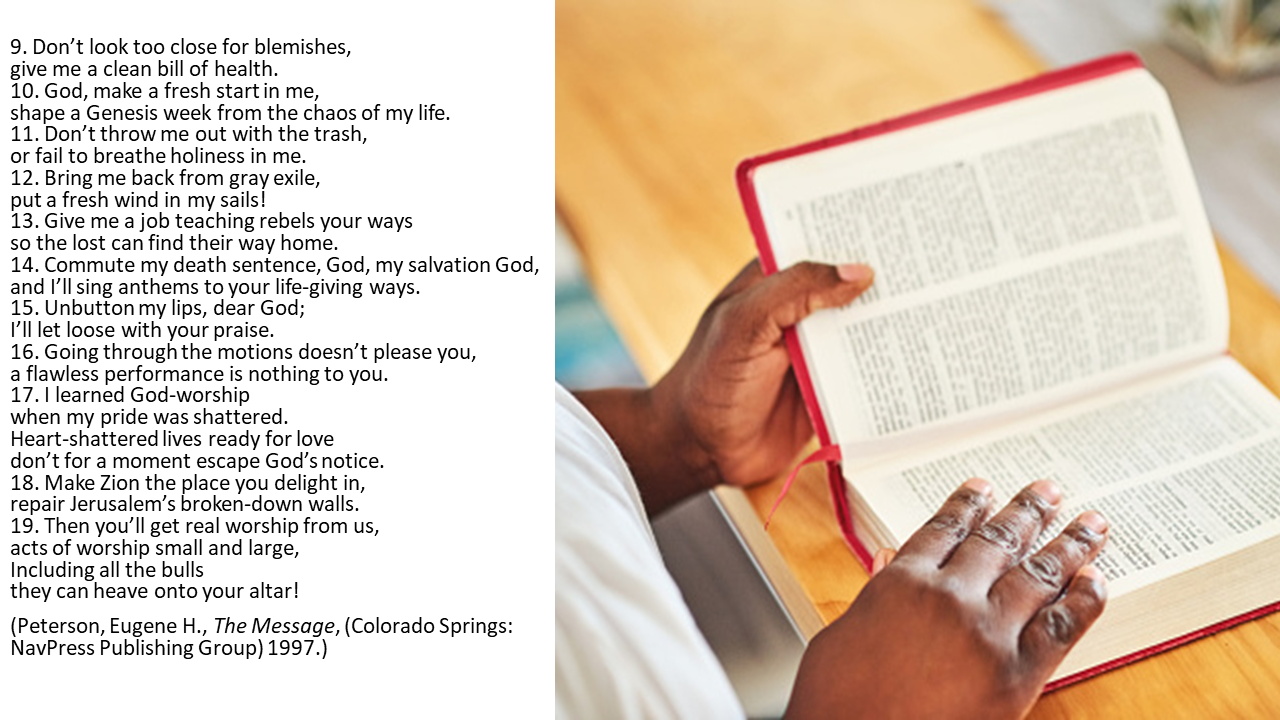
Verse 9, don’t look too close for blemishes. Give me a clean bill of health. Verse 10, God, make a fresh start in me. Shape a Genesis week from the chaos of my life. Verse 11, don’t throw me out with the trash or fail to breathe holiness in me. Verse 12, bring me back from gray exile. Put fresh wind in my sails. Verse 13, give me a job teaching rebels Your ways so the lost can find their way home. Verse 14, commute my death sentence, God, my salvation God. I’ll sing anthems to Your life, giving ways. Verse 15, unbutton my lips, dear God, I’ll let loose with your praise. Verse 16, going through the motions doesn’t please You. A flawless performance is nothing to You. Verse 17, I learned God worship when my pride was shattered. Heart-shattered lives ready for love don’t for a moment escape God’s notice. Verse 18, make Zion the place You delight in. Repair Jerusalem’s broken-down walls. Verse 19, then You’ll get real worship from us. Acts of worship, small and large, including all the bulls they can heave onto your altar.
Let’s bow before our great forgiving, redeeming God. Father in Heaven, we thank You that David, his sin exposed, his guilt accepted, his cleansing sought, cried out to You. Thank You for the depth of his love for You and the wideness of Your mercy for him. Thank You that the same God overall is rich to all who will call upon Him. So, this morning, in any area of our life, in any corner of our heart, in any depths of our spirit where we need to cry out, may we ask, and seek, and find, and experience, and know that we receive Your washing, Your cleansing, Your renewing. In the name of Jesus, which means that You are our salvation, we pray, Amen. You may be seated.
.jpg)
Psalm 51, where you are right now, is one of the greatest examples of God’s forgiving love in the whole Bible. David sinned. He was chastened. He was convicted. He turns back to God in humble contrite repentance, and now he’s pleading for the cleansing that only God can give. When we looked at this last time, we saw how clearly David saw his sin. In fact, this whole process starts with him acknowledging his sin was against God and that all sin is against God. This always has to be the starting place for any relief, any forgiveness, any cleansing. As David looked up at God and said, I am guilty. Until we come to that spot, we never have any remission, cleansing, forgiveness, or assurance. We must see that our sin is against God. That’s the first thing that David says in verse 1 at the beginning.
But next, he says at the end of verse 1, wash me. Remember, when it comes to our spiritual side, our minds, our consciences, our hearts, that part of us that lives in this eternal body, only the Lord can wash that part of us. Other elements, other people, other forces, other agents can affect us on the outside, but only God can come inside, only God can renew, and restore, and return us to Him. That’s what David saw.
This next section of Psalm 51, starting at the end of verse 1, that we’re going to cover this morning, is so very important. Maybe not this moment. Maybe you’re all prayed up, and cleansed, and walking in the Spirit, but it won’t be too far in the not-too-distant future that each of us will once again have to seek God for His cleansing when we sin. Through this inspired record of David’s prayer cry to God, we see just how God operates when we ask Him for His cleansing.
.jpg)
Follow along with verses 1 and 2 because I want to underline in your minds, if you weren’t here last time, the end of verse 1 and then verse 2, what David asked for. He says this, have mercy upon your God according to your loving kindness, according to the multitude of your tender mercies. Now, watch this: blot out. That’s the first half of this request. My transgressions, that’s the second half. So, he asked God to do something about something he had done. So, blot out my transgressions, very significant words. Verse 2, wash me thoroughly. Then he says, from my iniquity. He uses a completely different word. First, the end of verse 1, transgressions, and the first part of verse 2, iniquity. Then at the end of verse 2, he says, and cleanse me, a totally different word than this blot, and wash. So, it’s three different requests. He says, I want you to blot, wash, and cleanse. And three different targets God is supposed to hit in his life. I want You to blot my transgressions, I want You to wash my iniquity, and I want You to cleanse my sin.
.jpg)
Now, last time we touched on these first three requests for cleansing: blot, wash, and cleanse. But this morning I want to tie them, and I want you to see how powerful they are when we look at what it was David wanted cleansed away from his life. Because there are not only three words for cleansing, there are three types of stains that need to be washed away. The stain of transgressions, the stain of iniquity, and the stain of sin. The verbs that David employed for removing these three are comprehensive. They show how deeply we’re stained, how completely we need what only God, and God alone, can bring to us. Complete forgiveness only comes from the Lord by His multitude of tender mercies.
First of all, blot out at the end of verse 1. He says, blot out Hebrew. It’s a Hebrew word, machah, which means wipe out or blot out. So, to us, wipe out. I don’t know, wipe out a city with a tornado. I don’t know what image comes to your mind when you think of wipe out, but there is a distinct word picture in the minds of the Hebrew people as David wrote these words. This comparison David makes is his sins to a record that needs to be erased. That’s how he looked at it. When he says blot out, he’s saying, I want you to wipe away. I want you to completely erase a record.
Now, keep your finger here and look at Colossians 2:14 because, remember, this is the same God between the Old and the New Testament. It’s the same salvation, and in Colossians 2 and verse 14, when Paul is talking about Christ’s work on the cross, he uses exactly the same picture. Because the same God overall is rich. The same God that forgave David is the same God that, a thousand years later, was inspiring the Apostle Paul to write these words, Colossians, chapter 2, and verse 14. This is Paul’s description of what Christ did for us on the cross.
He says, verse 14 of chapter 2 of Colossians, having wiped out. It’s the same exact description in a New Testament word of the Old Testament word that the Spirit of God inspired David to use. So, he says, having wiped out. Now, look at this, the handwriting of requirements that was against us. David was talking about the same thing, this record, all of the listing of all of the failures and all of the sins and all of the transgressions and all of the iniquities and all of the guilt he had incurred. He says, I want you to wipe out.
Then look what it says at the end of verse 14 of Colossians 2, has taken it out of the way. How? Just going up and taking a dry-erase mark and going [erasing sound] and saying, hey, it’s gone now. No, no. Sin has to be dealt with. The record has to be paid for. So, Paul says this: He took it out of the way, having nailed it to the cross.
See, God is not some benevolent old forgetful grandfather in Heaven that just says, ah, it’s okay. Every single sin has to be paid for, and either you and I will pay for it forever because we’ll never pay enough for our sins, even one offense against God. Or we let Christ, look at verse 14, having nailed it to the cross. There’s the plan of salvation. Either you bear your sins, or Christ bears your sins. Either you receive the free gift, or you try to pay for it yourself. Either you believe God accomplished everything in Christ and it’s finished, or you try to do it yourself. There’s no middle ground. I’ve just described the difference between God and every religion in the world. Every religion in the world says, you’ve got to do a little bit, you’ve got to try real hard, and maybe you’ll outweigh your good with your evil. Maybe God will overlook it. Jesus said, no, God has to pay for everything; either you will or Christ will.
Now, the word in Colossians 2:14 is exaleiphō. It means to wipe off. It’s like erasing a blackboard. In the ancient world, documents were written on papyrus. Remember the crisscross reads that grew along the marshy banks of the Nile or from the vellum, which was animal hide that they would scrape until it was really smooth and finish it, and they would write on animal hide. Ink in that time, 2,000 years ago, in the Bible times, ink did not have acid in it, and ink would not soak into either the parchment or the vellum. It just sat there and dried on the top. The ink was just sitting on the top of the material. Since ink remained on the surface, it could be wiped off if a scribe wanted to reuse the material. If you read the news these days, you’re finding out that through x-rays they’re taking old manuscripts and they are looking at all the different things that were written on them because even though they wiped it off on the surface, little bits of it remain. They make out the various usages of the manuscripts because they used to not have many manuscripts, and they would write both directions and try to use them as much as possible.
Paul here says that God is wiping out the record. He nailed it to the cross, and no trace of it will remain because God’s going to turn off the X-ray. He’s going to remember it no more. He is not going to see our sins and iniquities once they’re nailed to Christ. So, David asked God in Psalm 51, and you can turn back there with me to the end of verse 1. David asked God to do what Paul says Christ did on the cross. David asked God to wipe out the record of his sins. He says, God erase them. When God did, David rejoiced. David believes in God. Now, some today struggle with the assurance of forgiveness of sins. They ask God to wipe out the record, but for some reason, there’s a little disconnect. They don’t believe He’s able to, or wants to, or did.
But you notice the tense of what Paul said. It says, having nailed. You see, salvation in the truest sense is not just a future event getting to Heaven, not just a present possession, but it’s anchored in a past event. It is already complete. It is already finished. It’s not; some priest has to offer some sacrifice for me, or somebody has to offer some atoning sacrifice for me after I die. It has already been accomplished by one sacrifice forever. He has perfected all who come to Him. So, it’s a finished work that David was rejoicing in.
.jpg)
But look at verse 2 of Psalm 51, blot out what we just saw. Wash away. Kabas means to thoroughly wash. That’s why the Hebrew translation washes me thoroughly from my iniquity. Now, the word that David uses is comparing what God does to something that was common in Jerusalem 3,000 years ago. Back then, if you had your clothing needing to be washed, and by the way, in the ancient world, clothing was thought to be an extension of the person. Your clothing, when God says that your righteousness is like filthy rags, what He’s saying is your inward condition is just like if you were wearing just vile, filthy, sodden clothing. So, this idea of washing clothes doesn’t mean he’s taking sin and putting it away from himself. David is saying, I need to be washed like clothes. I look on my sin as permeating even my clothing. So, he uses this graphic picture.
Now, how did they wash clothes back then? They would take their dirty clothes that needed a complete cleansing, and they would dunk them in the cold water of their ponds and streams, and they would beat them. They would beat them, as our agitator washing machines do, only they would actually literally would beat them. You can still see them do this in primitive parts of the world. They wet it in the river, they put it on the rock, and they just have these various devices that they beat on the clothing. They put it back in the water, rinse it out, and beat on the clothing. He says, I need to be on the rocks. I need to be beaten, and then I need to be put out in the sun to be bleached. I need that complete cleansing.
How do we get it? Great verse. You don’t need to turn there because we’re going to come right back to Psalm 51. Let me read it to you. It says in Revelation 1:5, Jesus Christ, the faithful witness, the firstborn from the dead. To Him who loved us and washed us from our sins, not by beating us with a stick on a rock. But Revelation 1:5 says with His own blood. Ephesians 1:7 says the same thing: in whom we have redemption through His blood, even the remission of sins, they’re gone. David says, wash them away thoroughly. Put me in the cold water, beat behind the rocks. Do whatever, like my clothing. I want to be thoroughly washed.
Then look at the end of verse 2. Blot out, wash away, and cleanse the end of verse 2 says, and cleanse me from my sin. This word, used by David, stresses a whole different part. The blotting out was like a bunch of written records that needed to be wiped out. The wash was like dirty clothing that needed to be washed with extreme measures. But this cleansing speaks of and stresses the ceremonial cleansing so that his sin wouldn’t keep him or others from being able to come before God. Remember all of God’s rules? If you did some infraction, something that made you unclean, you couldn’t come into the Tabernacle. You couldn’t come into the Temple. You were barred from it, and you could contaminate others. So, David here uses the word ṭāhēr, which means clean me so I don’t contaminate anyone else.
David did not want to hinder anyone else by what he had done. This is an acknowledgement that sin contaminates everything: our souls, our lives, our homes, our society. David says, cleanse me of my contamination so no one else will get defiled by my life. So, he didn’t just want the record of his sins gone. He didn’t even want the stain of his sins gone. He wanted the effects that would exclude himself and others from fellowship with God. He wanted that away too. Kind of like the cloud was removed. Like the restriction of boldly coming with joyful, confident assurance to God. He said I want anything that hinders me from coming before You removed.
.jpg)
What sin is David talking about? Sin is such an offense to God that God really delineates sin. In fact, the Old Testament has 15, 15 different words that are translated in our Bibles as sin. God has a very big vocabulary of what offends Him, what is against His holiness, what is an offense to His righteousness and His justice. So, there are 15 different words. When David’s adultery stole his neighbor Uriah’s little ewe lamb from the already overflowing banqueting table David had, that’s the illustration Nathan uses when he pointed his finger at him, David had sinned.
If you took all the Old Testament teaching about sin, it would basically come under three distinct areas. These 15 words line up in three columns if you do kind of an analysis of what they’re pointing at that offends God. What’s amazing is that each of the three broad areas that God uses to describe sin, each of those descriptive words is used in this 51st Psalm. In other words, David exhausts the vocabulary of sin to say I’m guilty of it all.
Now, tonight, we’re going to look at how David literally broke every one of the commandments. Every one of the 10 plus, as James 2:10 says, if you break even the smallest, you’re guilty of all. We’re going to see that this evening and how God dealt with it.
But let me just show you verse 1 again, the other half of verse 1. Remember, we just looked at blotting out, erasing the handwriting? David says, I am guilty of resisting or defying Your rule, oh God, in my life. That’s what it meant by transgressions. If you want to understand transgressions, the meaning of this word is the resisting or the defying of God’s rule in my life. Now, this is what we were born with. This is why children go, no. That’s why they just pout and stomp when they don’t get their way. Remember, Isaiah says, all we like sheep have gone astray. We’ve turned everyone what? In our own way. This idea of transgression that he said, blot out, he says, I want You to erase all of my guilt in resisting and defying You ruling my life.
Now, think through that with me. God has put up certain boundaries in this life. God has certain laws. He has certain moral laws. He has certain spiritual laws, and anytime we attempt to step over them, ignore them, or break them, we suffer the consequences. Now, we’re going to see that in the future. David truly is the most glaring picture of the consequence engine at work in his life. This one brief incident with Bathsheba spawned a decade-plus of consequences for him. That’s because any sin of transgression, God says, always elicits a response from Him of consequence. When we defy His rule, when we step over a fence, when we break down a barrier, God says there’s a consequence to that, and we’ll see that in the New Testament.
The word the Holy Spirit guided David to use is a powerful picture of how God looked on David’s sin. Transgression is the Hebrew word pesha, and it means to go away, to depart, to pass over a boundary, or to do what is prohibited or to rebel against an authority. It’s such a picture of how our actions are directly an affront against the Lord Himself. Pesha means I directly go against something God has set up, something God has instituted. I go against it, and that’s what a transgression is.
This is why David starts by saying it’s against You, and You alone I have sinned. We must come to the place where we see that sin is not just a little failure, just a little weakness. That’s this level. We have to raise our sights and see who it is that we just directly affronted, and that’s what David does. Each day in our lives, we transgress against the Lord when we step over a boundary that God established or when we defy God by crossing over the line He drew. With David, we need to say to God, I have gone over the line. You had a fence up. I climbed right over it. That’s the first word he uses. That was the first realm that he discovered about his relationship with God that had been broken. He said, God, I crossed the line. I climbed over the fence. You put up fences, but I didn’t want your fence. I wanted to keep going my way. I climbed right over it knowingly. He said I have transgressed.
.jpg)
All of our transgressions need to be removed. Remember when we talk about eternal spiritual things, only God can remove those. No psychological, psychiatric, or medical person can remove a spiritual impediment. When we lived in California, Bonnie and I used to comment that one thing that you didn’t do out there was ask people too closely why they moved to California. 20 years ago, in the eighties, most people were moving to California to get a new start, and if you probed around too much, you’d find that there was some disaster in their past. They just thought that by physically coming to the land of the sun and fun, they would forget and start over. You know what so many of them found? Their problems came right with them because they were inside, they were spiritual, and only God can deal with spiritual problems and sin.
All of our transgressions have to be removed, and only God can do that. God pulls them off of us, we who lie beneath the load of sin that crushes us. In the confrontation in 2 Samuel 12, verse 13, when Nathan pointed his finger right at David, and he said, you’re the one. You’re the one. He says, you have done this sin, it’s you. When Nathan did that, he used the word that David would not die, but his sins would be forgiven. Now, what David needed was this forgiveness. Now, he’s calling it blotting out, washing, and cleansing. But the big word in the New Testament that we like to hold onto that kind of encompasses all three of those pictures that David used is the word forgiveness. Forgiveness is when God takes away, He lifts off, He carries away our sin by wiping it off the record, by beating it out of the fabric of our life, through the sacrifice of Christ, by renewing our past, which we have abrogated by a fellowship with Him, by our sins.
But that all happens only by one means, and that’s why David hearkens back to the sacrificial system. Because there had to be a vicarious, you know what vicarious means? A substitutionary payment. Some substitute had to pay the penalty that David had incurred, the debt that David had racked up, the offense that David had committed. Someone had to absorb or take that. So, forgiveness is when God lifts, just removes the sin from us. But, He doesn’t just wad it up and throw it somewhere. He takes it and places it on Jesus Christ. That’s what David was asking for. Only in God’s holy justice can Christ’s vicariously or substitutionary sacrifice take away sin.
All of us are being crushed by the transgressions we keep around. Sometime if you want to look up Ezekiel 33:10, Ezekiel compares our sins to an avalanche. I always see it in a picture. When I read Ezekiel 33, verse 10, it says, their sins have just come upon us. It’s like being at the foot of the Alps, and an avalanche comes crashing down. That’s what life is like. We all are all just running along and going through life, going our own way, and our sins are just flying around us. Pretty soon, they just avalanche us, and we’re underneath them. So, as we’re crushed by the avalanche, it smothers us and suffocates us and squishes the very life out of our souls.
But David turned. He looked up. Remember that’s how he was in those months that he hid his sin and thought he was getting away with it. He was gradually under the avalanche of his sin, getting suffocated and smothered. In that moment when he finally came to just cry out to the Lord and ask for His cleansing, he said, I’m guilty, I’m not going to hide anymore, and I asked for Your cleansing. At that moment, he was asking for a redeemer who would take his place. That’s what these words speak of. They speak of sacrifice, they speak of atonement, they speak of substitution. He said, Redeemer set me free. To his only hope, David fled. God cleansed David’s sins that were smothering him, and he was forgiven.
.jpg)
Now, look back for just a moment at the parallel passage, Psalm 32. You’re in Psalm 51, back up to 32. Because in Psalm 32, this is David’s joyful song. The mechanics of how it happened are in 51, but the praise song of what happened is in Psalm 32. Now, Psalm 38 is also about this, but these two are our most clearly linked, 32 and 51. In Psalm 32, look how this Psalm starts as he says, oh, the blessedness of he whose transgression, there’s that transgression, is forgiven. Whose sin is covered. When David turned to God, his only hope, when he fled to God, God cleansed David’s sin that was smothering him and forgave him, and that becomes a theme of his song in Psalm 32. David couldn’t help but break into song when he knew the powerful redemptive work of God, his savior. God lifted off of him the load of his sin, and when God lifted that off of him, he couldn’t stop singing for joy. David was so aware that the forgiveness of his sins meant that they were no longer smothering him, separating him, staining him, that he just broke into song, and he wrote it down in Psalm 32, and we studied that weeks back. The depth of that wonderful Psalm.
I wonder this morning, have you ever felt buried by your sin? Have you ever felt smothered? Have you ever felt the avalanche come over you? Have you just felt like you just can hardly even breathe because you’re just so aware of your separation from God and of your stain? When we come to that point, that’s how we experience the wonder of the God of our salvation. When we cry out to Him, and when we say, I’m guilty, and You’re holy, and I’ve sinned. Help me now and save me from my life stained by my sins. We find every time we cry, He responds, and we are cleansed. It’s a wonderful awareness to know that this very moment, all of our sins have been lifted off of us by the One who took our place on the cross, the One who died the death that we deserved, the One who was not guilty, but bore every one of our sins and bore them, not just temporarily, but forever away. That’s what David experienced. But when David experienced that, the Spirit of God welled up in his heart, and all he could do was respond by saying, oh, what a blessed Redeemer. You have forgiven me.
Sometimes we just academically think about all this, but this morning I was thinking about something that’s in our hymn book. I don’t even know if mine’s here. I was actually teased this week about the hymn book, but I’m still going to use it. Turn to number 206 with me for just a minute because I looked this up, and this one is actually here. Don’t get rid of your Bibles, but I want you to see a modern, this is only 20, 23 years old, 24 years old, but this is a modern testimony. It’s number 206, and it’s a modern testimony of what David experienced because when David came to this point of crying out to the Lord, he didn’t just know the truth. He didn’t just feel the truth academically, he responded. He cried out in a song of thanks to the One who delivered him from being smothered. That’s what this one’s about. 206.
Read along with me. Okay. Someone else said to me last week, they said, will you let us sing once in a while? We don’t like to just read. We’ll see about that. Okay. But read with me. 206, Keith Green’s song, together. There is a redeemer, Jesus, God’s own Son, precious Lamb of God, Messiah, holy One. Refrain. Thank You, oh my Father, for giving us Your Son and leaving Your Spirit till the work on Earth is done. Jesus, my redeemer, name above all names, precious Lamb of God, Messiah, oh for sinners slain. That’s for my sin. That’s for your sin. When you know that He has taken your sin on Himself and borne it forever away, what response do you think God wants from us? This refrain. Let’s say it to the Lord. Thank You, oh my Father, for giving us Your Son and leaving Your Spirit till the work on Earth is done.
Okay, let’s stand, and we will sing the last one if Royce can get me on the right key. I just found out another thing. This was a very devastating week for me. You know what else I found out? The overflow people behind that camera right there, they don’t hear you. When we sing, they only hear me. Okay. So, I’m going to back up away from the microphone, okay? And let’s sing when I stand in glory. You know the refrain so well, why don’t you, if you haven’t done this in a long time, just tip your heart back and let loose with a thank You, oh, my Father, for giving us your Son. Just thank Him for the blessing that you’re not smothered by your sins anymore. You’re not suffocated by them; they’re all on Christ. Let’s sing that to him as Royce leads us to stand. Amen. You may be seated; you may not go yet. We still have a little more. Okay.
Keep looking at the next verse, which is Psalm 51 and verse 2, because David first said that his sin was transgression. Transgression is when I climb over the fence. When I cross the line. When I break down the barrier. That’s a transgression. But he doesn’t stop there. He said, that’s not all I’ve done. That’s not the only thing I need my Redeemer for, that is going to take my sin upon Himself and absorb God’s wrath. He says, I’ve done more than that. He says, I have also, look at verse 2, he says, wash me thoroughly from my iniquity.
.jpg)
Now, when you see that word iniquity in the Bible, iniquity is describing a very specific offense that we commit against our holy God. What David is saying here is, secondly, he says, I am guilty of, and this is what iniquity means, twisting, warping, defacing, or distorting your image, God, in my life. When we were saved, we bore the image of Christ. We become Christ’s one, we become a Christian, we become one of His children. Children bear a resemblance to their parents. So, we have a spiritual likeness that we are becoming through life more and more like the one who loved us and saved us. We bear His image.
What David is saying here is that my iniquity, which I want you to wash me from thoroughly, is my wicked internal filth. I’m iniquitous on the inside. He’s talking about what I’ve done to the spiritual work of God within me. This Hebrew word is ʿavon. If you ever want to look it up, it means an inward crookedness. It means perversity. It means what is altogether wrong, and it’s when I can’t excuse what I do, when I can’t offer some sort of an apology, when I can’t in any way condone it. It’s when I see that what comes out of me is twisted. What comes out of me is corrupt. What comes out of me is a distortion of what God wants to be the product of my life when I see that I’m crooked.
This is a word picture. This word, when David grabs it and uses it by the Spirit of God’s inspiration, talks about what sin does to us on the inside when we deliberately, by either neglect of resisting and fleeing sin, or by actually going towards sin, and pursuing our lust. When either one of those takes place in our lives, we allow sin to twist us and warp us. That’s why people do things that you just would never dream of them doing.
I was at the conference a couple of weeks ago, and someone came and told me about this godly older pastor in his seventies and how he got into a situation, and he did something you would expect an 18-year-old to have done, not a 70-something-year-old person to do. All the people just came to me, and they said, we can’t believe that he was just so warped. I said, that’s what sin, undealt with by God’s Spirit in our lives, will do to anyone. It warps and twists and makes us perverse in our actions when sin is not dealt with. David says, I want you to know the only remedy is coming into your hands. The precious blood of Jesus Christ that cleanses us is all that can wash us thoroughly from our defacing, warping, and twisting what God wants.
God wants us to have love, but sin twists it into lust. God wants us to have compassion, but sin twisted it into self-centeredness, so that I have compassion for me. It’s a twisting, a warping, and a defacing of God’s plan. Only Jesus Christ can thoroughly wash us like they did the clothes in Jerusalem 3,000 years ago, beaten against the rocks, bleaching in the sun. I wonder this morning, have you allowed what David asked for to happen in your life?
.jpg)
In fact, I told Bonnie last night, I was reading a biography of a pastor who served here in the United States. His name was Elisha Hoffman. His pastoral way was that he loved to pose questions to the people. He pastored in a time, it was 1878, when the record of his life was written. So, maybe in that time that was more of a responsive back-and-forth dialogue kind of sermon. But he loved questions, and he did a sermon once where he asked his people if they had been washed by Jesus Christ. I found this as I was reading through, as I looked at the second verse of Psalm 51, because isn’t that what David is asking? He’s saying, I want to be washed thoroughly from my iniquity. What that record brings to us is, have we likewise been washed thoroughly from our iniquity?
Let me read to you what Elisha Hoffman wrote in his sermon. By the way, it became a hymn years later but let me just read it to you. He said to his congregation, have you been to Jesus for the cleansing power? Are you washed in the blood of the Lamb? If so, are you fully trusting in His grace this hour? Are you washed in the blood of the Lamb? Are you washed in the blood, in the soul cleansing blood of the Lamb? Are your garments spotless? Are they thoroughly in the cold water, beaten against the rocks, and laid out to bleach so that they are clean? Are your garments spotless? Are they as white as snow? Are you washed in the blood of the Lamb? And then he said, are you walking daily? After you get washed by the Savior’s side? Do you rest each moment in the crucified? When the bridegroom comes, will your robes be white? Will your soul be ready for the mansions bright? Lay aside the garments that are stained with sin. Be washed in the blood of the Lamb. There’s a fountain flowing for the soul unclean. Oh, be washed in the blood of the Lamb. Then he repeats it. Are you washed in the blood, in the soul cleansing blood of the Lamb? Are your garments spotless? Are they as white as snow? Are you washed in the blood of the Lamb?
David was. Do you know why? He asked. He looked up and said, I’m guilty. My sin is against you. Wash me thoroughly. This morning, you can actually go to your car and go to wherever you’re going this afternoon, knowing you are washed thoroughly. Not because you came here. Not because you sang here. But only because you have asked. Ask for His cleansing. Ask for His thorough washing. Ask Him to take our twisted lives and take away how we’ve warped ourselves and ask Him to make us new. Because only God can work on the inside, no one else can.
.jpg)
Let’s bow before Him right now in this quiet moment, and I’m going to read Eisha Hoffman’s words. I want you in your heart to respond. When I sing, are you washed in the blood of the Lamb? I can’t say his words. I always say yes, I’m washed in the blood, in the soul cleansing blood of the Lamb. Yes, my garments are spotless. Yes, they’re white as snow. Yes, I’m washed in the blood of the Lamb. That’s because I am trusting in the blood of Jesus Christ, God’s Son, who cleanses me, are you? If you’re not, you can be right now. If you’re not sure, you can make sure right now where you sit before Him. With heads bowed, have you been to Jesus for the cleansing power? Are you washed in the blood of the lamb? Are you fully trusting in His grace this hour? Are you washed in the blood of the Lamb? If not, lay aside your garments that are stained with sin, and be washed in the blood of the Lamb. This morning, there’s a fountain flowing for the soul unclean. Oh, be washed in the blood of the Lamb.
Father in Heaven, right now, as You look down on us, it is You who the seeker. It is You who have come to seek and to save that which is lost. Since the Garden of Eden to the last words of Revelation, it is you, oh God, who come looking for Your fallen creatures, and You are here this morning. Any who are out of touch with You, any who are still dead in their trespasses in sin, You offer to them the healing, cleansing stream; the blood of Jesus Christ who can cleanse us from all iniquity, all warped, all transgressions, all barriers we’ve blown through if we’ll just believe and receive. I pray that anyone this morning whose hearts are convicted by Your Spirit, and whose hearts are being drawn to Your love, would respond in faith and say, yes, wash me. Yes, cleanse me. Yes, blot out that list of all my offenses against You. We know that You have promised that in the name of Jesus Christ, there is forgiveness. May no-one leave this place twisted, defaced, warped by sin. But may they leave it all on You, oh Christ, and walk out of here whiter than snow. Snow can get dirty, but You keep us whiter than snow because You constantly cleanse us from our sins. We thank You for all that You have promised and will do as we, by faith, come and ask and receive. In the name of Jesus Christ, we thank You, Amen.
Notes
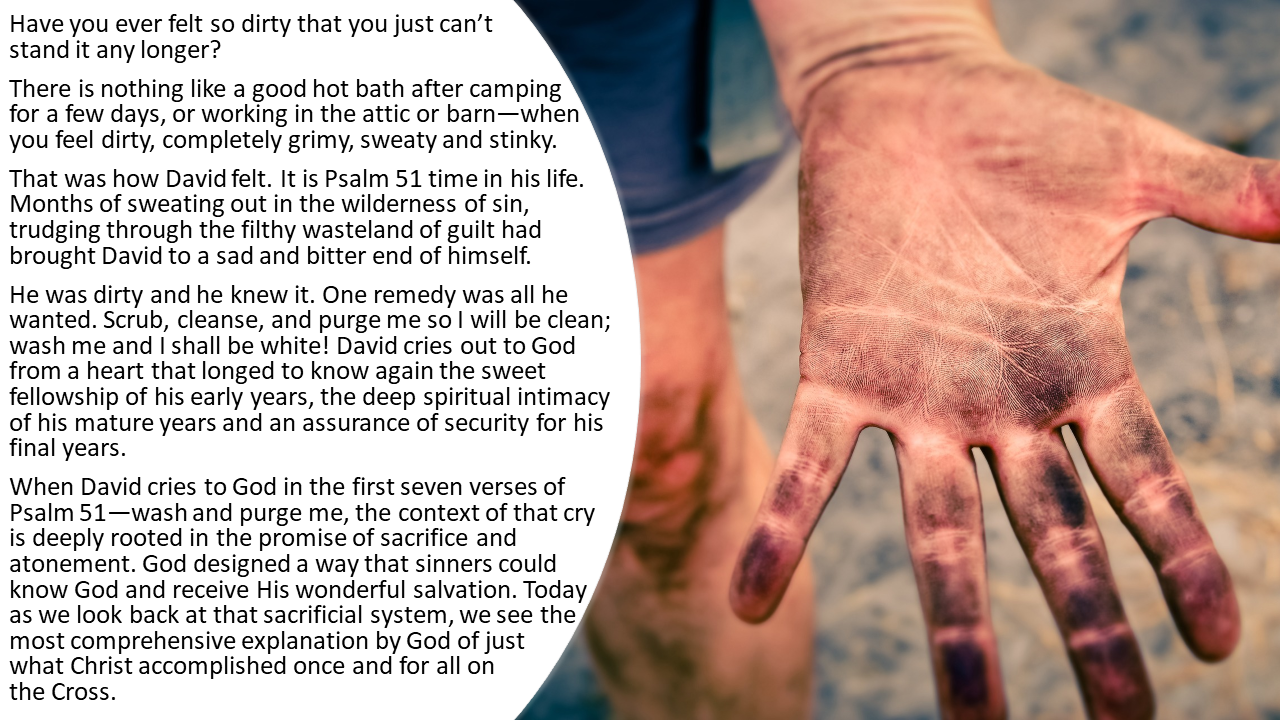
Have you ever felt so dirty that you just can’t stand it any longer?
There is nothing like a good hot bath after camping for a few days, or working in the attic or barn—when you feel dirty, completely grimy, sweaty and stinky.
That was how David felt. It is Psalm 51 time in his life. Months of sweating out in the wilderness of sin, trudging through the filthy wasteland of guilt had brought David to a sad and bitter end of himself.
He was dirty and he knew it. One remedy was all he wanted. Scrub, cleanse, and purge me so I will be clean; wash me and I shall be white!
David cries out to God from a heart that longed to know again the sweet fellowship of his early years, the deep spiritual intimacy of his mature years and an assurance of security for his final years.
When David cries to God in the first seven verses of Psalm 51—wash and purge me, the context of that cry is deeply rooted in the promise of sacrifice and atonement. God designed a way that sinners could know God and receive His wonderful salvation. Today as we look back at that sacrificial system, we see the most comprehensive explanation by God of just what Christ accomplished once and for all on the Cross.
Join me in the 51st Psalm as we listen to David.
Sometimes those words are so familiar that we need to hear them to a different tune. The following is a modern paraphrase of the 3,000 year old words of David’s prayer to God.
Please stand with me, open to Psalm 51 and follow along in your Bible as I read this paraphrase. Though the language may shock you, hold on to the concepts that this Psalm gives us about the deadly work of sin and God’s offer to purge us from its curse.

Psalm 51:1-19
1. Generous in love—God, give grace! Huge in mercy—wipe out my bad record.
2. Scrub away my guilt, soak out my sins in your laundry.
3. I know how bad I’ve been; my sins are staring me down. 4. You’re the One I’ve violated, and you’ve seen it all, seen the full extent of my evil.
5. You have all the facts before you; whatever you decide about me is fair. I’ve been out of step with you for a long time, in the wrong since before I was born. 6. What you’re after is truth from the inside out. Enter me, then; conceive a new, true life.
7. Soak me in your laundry and I’ll come out clean, scrub me and I’ll have a snow-white life. 8. Tune me in to foot-tapping songs, set these once-broken bones to dancing.
9. Don’t look too close for blemishes, give me a clean bill of health. 10. God, make a fresh start in me, shape a Genesis week from the chaos of my life.
11. Don’t throw me out with the trash, or fail to breathe holiness in me. 12. Bring me back from gray exile, put a fresh wind in my sails! 13. Give me a job teaching rebels your ways so the lost can find their way home.
14. Commute my death sentence, God, my salvation God, and I’ll sing anthems to your life-giving ways. 15. Unbutton my lips, dear God; I’ll let loose with your praise.
16. Going through the motions doesn’t please you, a flawless performance is nothing to you. 17. I learned God-worship when my pride was shattered. Heart-shattered lives ready for love don’t for a moment escape God’s notice.
18. Make Zion the place you delight in, repair Jerusalem’s broken-down walls. 19. Then you’ll get real worship from us, acts of worship small and large, Including all the bulls they can heave onto your altar!1
Pray
We are returning to one of the greatest examples of God’s forgiving love in the entire Bible.
David sinned, he was chastened and convicted, he turns back to God in humble contrite repentance—and now he pleads for the cleansing only God can give.
 We saw last time how clearly David saw that his sin was against God. This must be the starting place for any relief, any forgiveness, and any cleansing.
I AM GUILTY
That is the first thing David says (51:1a), next David says—
WASH ME PSALM 51:1b–7
Remember that when it comes to our spiritual side, our minds, our consciences and that part of us that is eternal—only the Lord can WASH US CLEAN.
This next section of Psalm 51 is so very important, if not this moment, then in the not too distant future each of us will seek for cleansing when we sin. That is what God explains through this inspired record of David’s prayer.
Read along with me Psalm 51:1-2 again. Note the end of verse 1 and then verse two the very clear cry to God made by David:
Have mercy upon me, O God, According to Your loving-kindness; According to the multitude of Your tender mercies, o Blot out my transgressions. o 2 Wash me thoroughly from my iniquity, o And cleanse me from my sin.
We saw last time that there were three requests for cleansing:
blot, wash, cleanse.
Now we need to examine what it was that David wanted cleansed away from his life. Notice, there are not only three words for cleansing, there are also three types of stains being washed away. Those three are: transgressions, iniquity, and sin.

The three verbs David employed for removing his sins are a comprehensive look at how deeply we are stained and how completely Christ can clean us up.
1. Blot out (machah, “wipe or blot out”) v. 1b “Blot out my transgressions”. David compares his sins to a human record that needed to be erased. In the New Testament Paul also uses this idea in Colossians 2:14:
“…having wiped out the handwriting of requirements that was against us, which was contrary to us. And He has taken it out of the way, having nailed it to the cross.”
The word Paul uses is Exaleiphoμ (canceled out) means “to wipe off,” like erasing a blackboard. Ancient documents were commonly written either on papyrus, a paper like material made from the bulrush plant, or vellum, which was made from an animal’s hide. The ink used then had no acid in it and did not soak into the writing material. Since the ink remained on the surface, it could be wiped off if the scribe wanted to reuse the material.
Paul says here that God has wiped off our certificate of debt, having nailed it to the cross. Not a trace of it remains to be held against us. Our forgiveness is complete. David asked God to wipe out the record of his sins, God erased them, and David rejoices.
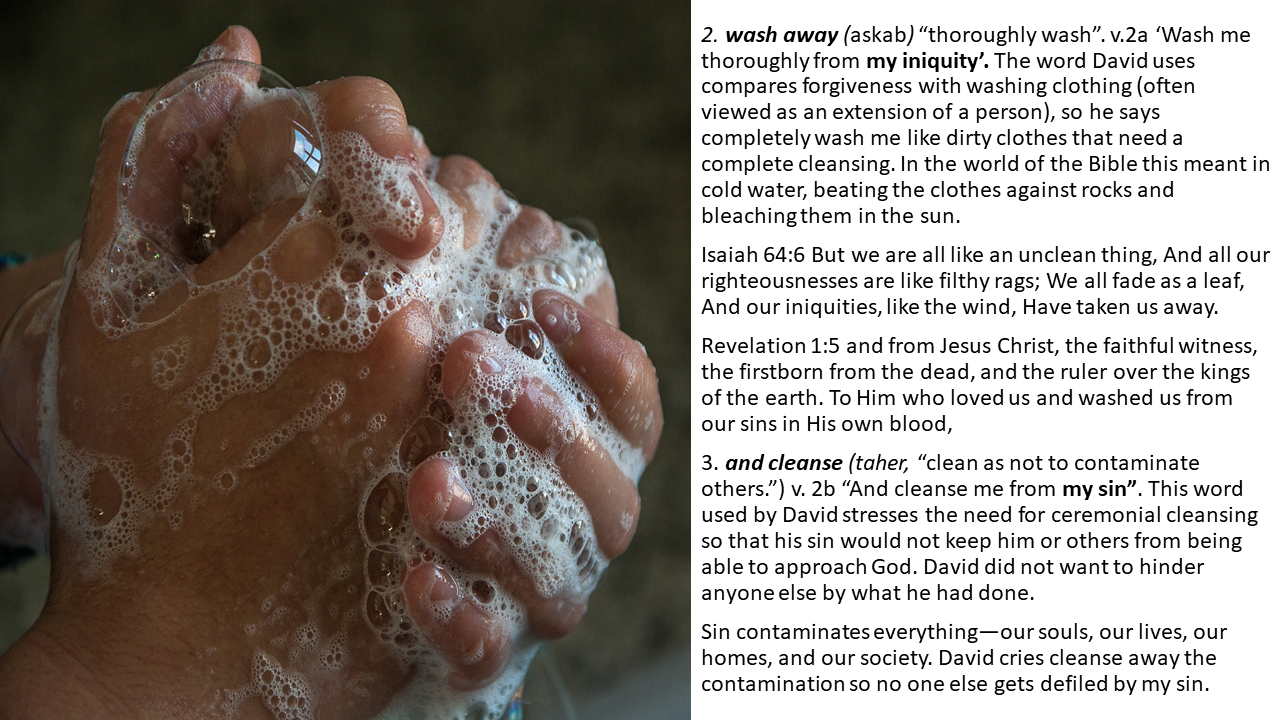
2. wash away ( kaμb _as ) “thoroughly wash”. v.2a ‘Wash me thoroughly from my iniquity’. The word David uses compares forgiveness with washing clothing (often viewed as an extension of a person), so he says completely wash me like dirty clothes that need a complete cleansing. In the world of the Bible this meant in cold water, beating the clothes against rocks and bleaching them in the sun.
Isaiah 64:6 But we are all like an unclean thing, And all our righteousnesses are like filthy rags; We all fade as a leaf, And our iniquities, like the wind, Have taken us away.
Revelation 1:5 and from Jesus Christ, the faithful witness, the firstborn from the dead, and the ruler over the kings of the earth. To Him who loved us and washed us from our sins in His own blood,
3. and cleanse (taher, “clean as not to contaminate others.”) v. 2b “And cleanse me from my sin”. This word used by David stresses the need for ceremonial cleansing so that his sin would not keep him or others from being able to approach God. David did not want to hinder anyone else by what he had done.
Sin contaminates everything—our souls, our lives, our homes, and our society. David cries cleanse away the contamination so no one else gets defiled by my sin.
What Sin is David talking about?
SEEING SIN ON GOD’S TERMS
Sin is such an offense to God that He has to use 15 different words in the Hebrew Old Testament just to describe it. When David’s adultery stole his neighbor Uriah’s little ewe lamb for his already overflowing banqueting table he defied the rules God had laid down.
There are three major Hebrew word groups that communicate the concept of sin in the Old Testament. Each of them is used in David’s prayer of confession, Psalm 51.
David now sees his life as God saw him. God had to deal with these areas of sin in his life.
1. First David says, I am guilty of resisting or defying God’s rule in my life, and that is sin. v. 1b “Blot out my transgressions”.
God has put up certain boundaries in this life: God has certain physical laws, He has certain moral laws, He has certain spiritual laws. And anytime we attempt to step over them, we suffer the consequences. That kind of sin is always called transgression.
The word the Holy Spirit guided David to use is such a powerful picture of how God looked upon David’s sin. It was a transgression [Hebrew peshah]: ‘a going away’, ‘a departure’, ‘a passing over a boundary’, ‘doing what is prohibited’, or ‘a rebellion’ against God and his authority. This is a picture of how our actions are in direct affront against the Lord Himself. That is why David starts by saying, it was against You and You alone, I have sinned!
So each day in our lives we transgress against the Lord when ‘stepping over the boundaries that God has established’; or ‘defying God by crossing over the line God has drawn’. With David we need to say to God, I have gone over the line. You had a fence up and I climbed right over it. That’s the first word he uses. David first called his sin “transgression” and so should we.

All our transgressions need to be removed, and only God can do that. God can pull them off of us who lie beneath a load of sin that crushes us. When Nathan had told David that he would not die, but rather that his sins would be forgiven (2 Samuel 1213; Psalm 31:1)—he used the word which literally means having our sin lifted off or carried away. This can only happen in God’s Holy justice by Christ’s vicarious (or substitutionary) sacrifice.
We are being crushed by any transgressions we keep around (Ezekiel 33:10). They suffocate, smother and squish the very life of our soul. But there is a Redeemer who can set us free.
And to his only hope, David fled. God cleansed David’s sin that was smothering him; he was forgiven. That was the theme of the song he already sang for us in Psalm 32, “Blessed is he whose transgression is forgiven”. David couldn’t help but break into song when he knew that powerful redemptive work of God his Savior.
So, God lifted up and off of David his sin that has smothered him. Complete forgiveness means that my sins no longer smother me. If you feel buried, smothered by sin—cry out to God, say I am guilty, you are holy. I have sinned, help me now. Save me from my sins—and He will!
If you know this moment that all your sins have been lifted off by the One who took your place on the Cross; the One who died the death you deserved; the One who was not guilty yet bore each and every one of ours sins forever away—then allow the Spirit of God to energize a song in your heart back to Him.
For just a moment, let’s not just hear this truth, let’s respond. Grab your hymnbooks and turn to #206 and sing with me to the One who has delivered each of us from being smothered by our transgressions.
There is a Redeemer (Keith Green, 1982)
There is a redeemer, Jesus, God’s own Son, Precious Lamb of God, Messiah, Holy one,
* Thank you oh my father, For giving us your son, And leaving your spirit, ’til the work on earth is done.
Jesus my redeemer, Name above all names, Precious lamb of god, messiah, Oh, for sinners slain. *
When I stand in glory, I will see his face, And there I’ll serve my king forever, In that holy place. *
2. Secondly David says, I am guilty of twisting, or warping, or defacing, or distorting God’s image in my life, and that is sin. v. 2a “Wash me thoroughly from my iniquity”.
My iniquity is my wicked internal filth. He says I am iniquitous on the inside. Iniquity means inward crookedness, perversity; that which is altogether wrong. You can’t excuse it; you can’t offer some sort of apology; you can’t in any way condone it. Iniquity [Hebrew hawon] means ‘corrupt’ or ‘twisted’, “twisted out of shape”, or ‘crooked’. This word pictures what sin does to us inside as it warps and ruins us.
The only remedy as we saw earlier is in God’s Hands. He has the precious blood of Jesus Christ that cleanses us, washing us whiter than snow. That word wash we saw means thoroughly wash like they did in Jerusalem 3,000 years ago in cold water, beating the clothes against rocks and bleaching them in the sun.
Have you allowed the Lord to take you to the cleaners? Have you been to Jesus for the cleansing His blood provides?
That is the question of Elisha Hoffman’s hymn # 190 in our hymnbooks.
 Are You Washed in the Blood? (Elisha Hoffman, 1878)
Have you been to Jesus for the cleansing power? Are you washed in the blood of the Lamb? Are you fully trusting in His grace this hour? Are you washed in the blood of the Lamb?
*Are you washed in the blood, In the soul cleansing blood of the Lamb? Are your garments spotless? Are they white as snow? Are you washed in the blood of the Lamb?
Are you walking daily by the Savior’s side? Are you washed in the blood of the Lamb? Do you rest each moment in the Crucified? Are you washed in the blood of the Lamb? *
When the Bridegroom cometh will your robes be white? Are you washed in the blood of the Lamb? Will your soul be ready for the mansions bright, And be washed in the blood of the Lamb? *
Lay aside the garments that are stained with sin, And be washed in the blood of the Lamb; There’s a fountain flowing for the soul unclean, O be washed in the blood of the Lamb! *
3. Thirdly David says, I am guilty of falling short of God’s perfection and missing God’s mark in my life, and that is also sin. v. 2b “And cleanse me from my sin”.
Sin means missing the mark. David says I have missed the mark. And God says we all fall short of His glory. God is perfect and holy–and no matter how hard we try, we just can’t get up to Him. We fall short of Him.
There is a divine standard which, for some reason, a person does not live up to. That’s all—just to miss the mark. You don’t come up to God’s standard. It’s in that sense that all of us today are sinners. None of us come up to the standard of God. All come short of the glory of God.
This word for sin [Hebrew chattath] is same as hamartia in Greek ‘coming short’ or ‘falling short’ as in an arrow falling short. The target is God’s law and sin is missing the mark on the target. This is a picture of failing to measure up to God’s Divine Law.
Sin must be cleansed, removed from God’s sight. It is odious and abominable, and must be put out of sight. David’s song in Psalm 32 also describes this cleansing as the blessing of one ‘whose sin is covered’. The word David uses in Psalm 32 for sin being ‘covered by God’ is the same word that is used for the ark of the covenant in the Tabernacle, covered by the mercy-seat. It is also used for the earth covered by the flood, and the Egyptians were covered by the depths of the sea.
When God takes our sins they are buried and unable to return. As Spurgeon said at this point in Psalm 51, what a cover must that be which hides away forever from the sight of the all-seeing God all the filthiness of the flesh and of the spirit!”
Our sins washed, cleansed, and covered also speaks of the strong imagery in the events of the day of atonement. On that day the High priest took the blood of an animal and sprinkled it onto the mercy seat. Above the mercy seat was the presence of God portrayed by the outstretched arms of the cherubim. Beneath the lid of the ark were the tablets portraying God’s divine law.
In essence, the blood on the mercy seat stood between a holy God and the sinners who broke His law, averting His wrath. David cried for joy when the wrath of God was turned away from him. So our sins are covered away by the blood of Jesus shed for us! God cleansed David’s Sin that soils: now they were covered by the cleansing blood.
I sometimes have to just borrow the poets and one put it this way-Horatio G. Spafford once penned these blessed words:
 My sin, oh the bliss of this glorious thought— my sin, not in part, but the whole, Is nailed to the cross and I bear it no more, Praise the Lord, praise the Lord, O my soul!
So David says
Blot out my transgressions–I have crossed the line. You said don’t go over that and I went over that.
Wash me thoroughly from my iniquity–I am dirty inside and I can’t make it to You.
And cleanse me from my sin–I’ve missed the mark so I ask You to cleanse me.
1Peterson, Eugene H., The Message, (Colorado Springs: NavPress Publishing Group) 1997.
Slides

Check Out All The Sermons In The Series
You can find all the sermons and short clips from this series, David’s Spiritual Secret here.
Looking To Study The Bible Like Dr. Barnett?
Dr. Barnett has curated an Amazon page with a large collection of resources he uses in his study of God’s Word. You can check it out here.