
If the video above is not available, here are two other ways to view:
David – Facing Consequences
060820AM
DSS-31
PSALM 51
Transcript
.jpg)
Let’s open again in our Bibles to the 51st psalm. The greatest treasure in life is knowing God, and that treasure comes to us through His Word. Faith comes by hearing, hearing by the Word of God. I wonder this morning, are you finding the treasures that God has placed so prominently out in His Word? They’re in plain sight in His book, the Bible. One of the most treasure-laden chapters in all the Bible is the 51st psalm. I’m so glad I went to the Ministry Fair. I got two comments this morning. One of them was from a dear friend who said, is this our second year studying David, or are we still only in our first? And what I didn’t have time to tell him was when I went to Grace Community Church on staff, we marked our duration of time at Grace Church by what chapter of the Bible we came in that John was preaching on. It took him seven years to go through 28 chapters. And so, people would say, oh, I came in chapter 8. And they said, oh, really? Way back then? We came in chapter 9! And take heart, David is mentioned in 141 chapters, and we’ve done that in almost a year, so we are at lightning speed.
.jpg)
But the 51st psalm, these 19 verses that are before us this morning have been the source of hope to countless believers, those who have been troubled by sin, those who have been comforted with David by the reality of a repentant heart and of the forgiving love that the Lord has so clearly offered. But history records that often some of the most amazing treasures in life can be walked over and not even noticed. And I think that as believers sometime when we get used to a portion of Scriptures, when we get used to maybe a book or a chapter of the Bible, we just go through it rapidly and we don’t pause to scoop up the treasures that the Lord has just laid before us. That can happen through overfamiliarity. Physically, with our surroundings, if we live in a certain place long enough, we stop seeing the beauty. That can happen spiritually by overfamiliarity with a certain passage of Scripture.
.jpg)
There’s a bit of American History just about that theme that fascinates me, and I’d like to share it with you. In 1859, gold was found at the head of the Six Mile Canyon. Now, all of you have heard of that because it’s called the Comstock Lode, but most people don’t realize that the real treasure was out in plain sight, and no one saw it. There were two miners, Pat McLaughlin and Peter O’Reilly, who struck Gold 1859 on their claim in Nevada. A fellow miner, whose name was Henry Comstock, was quite a conniver. And he went to them and convinced them that they had moved their claim over on his property, moved their markers back, and he took the claim for the gold, and assured himself with his name Comstock as a place in history. The rest of the story, multitudes of treasure hunters came to the Comstock Lode.
The interesting thing about it was that they would follow this outcropping. There’s a vein of gold that was encased in quartz, and they would just break, all day long, the quartz, trying to extricate the little vein of gold, and they would do that. But what was interesting is they spent each day slogging their way up and down the Six Mile Canyon to chip away at this outcropping of gold. They labored, but it was very slow going. Now, the first part is because it was in quartz, and it was hard to break the quartz and pull out the ore. But the other thing was the curious nature of the Six Mile Canyon. Their feet felt like lead as they walked in. Their wagons became encased with this strange, bluish gray mud that just was clinging to everything. Their picks would soon be covered with it. They would come back, and they would feel tired just from the mud. Day after day, the miners would complain. The biggest problem in their grubstake paradise was that sticky, blue-gray mud, and they said it seemed like they were just unable to work because of the weight of that.
Finally, one miner, who was brand new on the scene, saw the mud differently than everyone else. Thousands of men saw it as a nuisance. The first day on the job, this miner came in and he took his boot and picked it up and looked at it totally encased, and he took his boot off and put it through the grill of the assayer’s office and said, could you check what exactly this is on my boot? That scraped-off mud was assayed and proved to be silver ore worth 2,000 dollars a ton. In 1859, that was a dollar for every shovelful that they shoveled. Every shovel was a dollar. In a day when earning a dollar a week was a real fortune, they got a dollar a shovelful. In our current worth of silver in 2006 prices, every shovel was worth a hundred dollars. Every shovel that you stuck in the ground and put in your wagon; you would make a hundred dollars. So, that’s why there was such a great fortune made in that time. In fact, some of the greatest California fortunes, the Crocker Bank, if you remember that, the Hearst dynasty, all that came from that. But the rest of what happened is history. They’d all been walking through the Comstock Lode. Beneath their feet, that sticky, blue-gray mud on the surface was worth 400,000,000 dollars, and all they had to do was scoop it up and haul it off. The common mud that thousands of miners had walked on for months was the greatest lode of silver ever discovered in all of history. Far more valuable than the gold they had feverishly chipped from the hard quartz veins in the mountain sides was the silver-laden mud, and all they had to do was stop and scoop it up.
.jpg)
Now, as you look at Psalm 51, don’t walk through Psalm 51, or any other portion of God’s Word again, without scraping off what you find. Scrape it off in the presence of the Lord, ask Him to show you how much it’s worth, and start a lifelong habit of scooping treasures out of this book. If you see it that way, it will totally change the way you look. There is no old passage that’s so familiar you’ll never get anything else out of it, and that’s what God wants us to remember. Our return to Psalm 51 is a careful look at the final era of David’s life. There are about 20 years from the Bathsheba incident, his adultery, till the end of his life. Many commentators and scholars believe that he was about 50 years of age when this tragic event took place. The last 20 years of his life divide into three distinct lessons. We’ve been looking at just the first one, which is Psalm 51. Over Psalm 51, as well as Psalm 32, and also Psalm 38, should be these words written in your heart: that unguarded moments lead to sin. That’s the whole lesson of what David finds his unguarded moment led to sin. We should never isolate the psalms that flow from a period of David’s life from the actual events. Don’t just look merely at Psalm 52, Psalm 32, Psalm 38, and this evening Psalm 3, don’t look at them merely alone, isolated. Always look at them in the context of the event that surrounds them, and those events give us God’s perspective. So, the unguarded moments that lead to sin, Uriah and Bathsheba, that’s the saddest chapter, the darkest event we all wince at. And from that event, which is 2 Samuel 11 and 12, flows this psalm.
.jpg)
But what we’re transitioning into and as we go this evening, we’re going to start looking at the succession of painful consequences. There are almost 20 years David lived with painful consequences for a momentary choice he made, and that is widely recorded in the Scriptures. Many psalms and chapters chronicled this 20-year period of the inevitable, painful consequences. Eleven chapters of the book of 2 Samuel record these events. And the inspired record gives us the psalm, Psalm 3, we’ll see tonight, Psalm 31:55, even Psalm 63. One of the great psalms that we all love was written during this time of David fleeing from Absalom. The good news is that those unguarded moments that led to sin roll into the inevitable consequences that led to pain, but then we see the true character of David’s life. His humble obedience led him right back into the joyous finale of his life, and there are many chapters extolling what God did. But as we examine these lessons that are so difficult and so necessary, there’s a guiding principle of how we should look at the 51st psalm.
.jpg)
So, I want you to turn to the New Testament with me to 2 Timothy 3. I want to show you the most well-known verse on inspiration. I want to show you a little principle that’s buried in that verse. 2 Timothy, go from Psalm 51 all the way to the right to the end of your, nearly the end of your New Testament, and see this wonderful exposition of what God wants us to see in His Word. 2 Timothy 3, look at verses 16 and 17. It says this, all Scripture. All. The good parts, favorite parts, the marked-up parts, the unmarked-up parts, the memorized parts, the non-memorized parts, the boring parts, the exciting parts, all. Verse 16 says of 2 Timothy 3, Scripture is given—breathed out by God, Theopneustos—by inspiration of God. And continuing this all-Scripture heading, is profitable for doctrine, and all Scripture is profitable for reproof, and all Scripture is profitable for correction, and all Scripture is profitable for instruction in righteousness, and all Scripture is so that the man of God may be complete, and all Scripture is to thoroughly equip us for every good work. That all Scripture modifies these six successive phrases that are enlargements upon this idea of the inspiration of Scripture. Real briefly, every shovelful of Scripture, to think in terms of Henry Comstock, every shovelful of Scripture that we lift up can be producing in us these six areas.
It first of all can be profitable for doctrine. Paul said the Scripture was designed by God, given by God to do something in our life. And the first thing is, as we read Psalm 51 for example, it is profitable for doctrine. That’s God teaching us what is right. Doctrine. Don’t think of doctrine as scary, frightening, whatever. Think of it as God, doctrine is God teaching us what He says is right. In fact, the word for this, the Greek word is didaskalia. It’s the content of the message, not the method or means of communicating it. Doctrine is not communicated in any one means, but it is the content, the message that God’s talking about. The message, the content God wants to teach us is for us to see what is right.
Secondly, in verse 16 it says, for reproof. That’s God teaching us what is wrong. God wants to teach us. He wants to show us, in fact, this Greek word for reproof refers to the pointing out of errors. In conduct. It’s an unusual word. Elegchos is the word, and it means that either there’s an error in our conduct or in our belief. In fact, a friend of mine, Jim Berg, always says, if you believe right, you’ll behave right. And that’s so true. And often any behavior problems we have really can be traced back to a wrong belief about the nature of God, His purpose, His sovereignty, whatever, His timing. But God wants to reprove us. He wants us to know what is wrong.
Thirdly, it says, for correction. Now, there’s a difference between reproof and correction. God teaches us in correction not only what’s right, what’s wrong, but specifically this correction is how to get right. Do you remember driver’s ed? Do you remember that teacher that sat there almost motionless till you did something wrong and they reached over on the wheel and helped you not go off the road? They also had their own brake pedal often, and they were the ones that helped you get right. The spiritual life is God going through life with us correcting us, teaching us how to get right. The Greek word refers to God’s Word restoring someone back on their feet after stumbling or falling. When it’s used outside the Bible, it speaks of someone who tips over, stumbles, or whatever, and you help them, and you lift them back up. God says His Word lifts us back up, steadies us, gets us on the right path, keeps us out of the ditch, puts the brakes on, turns the wheel. It’s what we need to teach us how to get right. It’s the edification and building-up ministry. Edification, building up, getting on the right road, keeping on the right road.
Then it says, for instruction in righteousness. That’s God’s Word teaching us how to stay right. So basically, this first section is doctrine is what God says is right. The reproof is God saying it’s wrong. The correction is God saying this is how you can get back and get right. And instruction in righteousness is God teaching us how to stay right, getting us back on the road, but keeping us on the road. That word, paideia, that is instruction in righteousness, is used for child training. It’s paideia, it speaks of child development. And what it evolved into, it was any type of positive training and positive reinforcement in righteousness is what it’s talking about. And God says, that’s what My Word does, and that’s what I want you to see.
Then it continues. Look at the next part in verse 17, that the man of God may be complete. That’s God teaching us that He’s enough, that it isn’t like you need one more seminar, you need one more book, or you need to have one more experience, or go one more place. God and God alone. He is enough. He says, you need to go through the Word to Me and find that I’m enough and find that you are complete. That the man of God may be complete. Artios, that word that’s used, refers to the reality that God’s Word makes us completely capable and proficient for anything He calls us to do. Now, God’s Word is not a telephone. It’s not a rake. It doesn’t mean that you don’t need anything else in life to get work done, but spiritually speaking, there is the complete, enough in God. We don’t need to keep searching for some other experience, some other secret knowledge. God says, if you know Me, that’s all you need. In fact, that’s an old message. That’s in Job. El Shaddai, the God who is enough, is the most frequently mentioned name of God in the book of Job. What Job needed to learn is no matter what he was facing in all of his personal difficulties, God was enough. And God was enough 5,000 years ago, and He is still enough.
The verse ends this way, that we, through God’s Word, will be thoroughly equipped for every good work. That’s God teaching us how to serve. It’s actually that same word thoroughly, only it’s got little preposition on it, exartizō. It’s like a duplication of the previous word. And what it means is, if I paraphrased, it would be enabled to meet all the demands that a righteous life brings. God’s Word mends us. That’s what equipped means. You notice it says, thoroughly equipped? Equipping is the word that’s used for sewing fishermen’s nets. In fact, when Jesus called His disciples, it says that He found them equipping their nets along the sea of Galilee. Does that mean they’re having seminars for them? No, it means that they were making the net, sewing it together so it would cling together and do its job. The purpose that we are to fulfill for God is to help one another. The Church is to be equipping the members of the body, sewing them together, helping them to fit together, helping them to connect together, helping them to minister to one another. A net does no good if it’s torn apart; it doesn’t accomplish its purpose. Neither does a member of the body of Christ. When we are mended by God’s Word, or equipped, then we can build up and strengthen the lives of those around us. And that’s the whole; you notice where this whole Bible reading and studying thing goes with Paul. He said the Scripture’s inspired, and it’s supposed to have this effect on you so that you can be involved in others’ lives. I read the Word so that I can adequately minister to others. You read the Word so you can adequately minister to those God has put into your life.
So, turn back to Psalm 51 with me, and I’m going to put that, what we just learned, as an overlay over this psalm, and we’re going to be looking at the successive verses of it, but think of this concept. As we turn to Psalm 51, we’re entering a portion of Scripture that was inspired, so it is profitable for doctrine. God is going to teach us what’s right about David’s response to his sin. That’s the first thing we see in Psalm 51, the doctrine of what God said David did right when he sinned. His response to God’s correction was right. Secondly, for reproof. God points out what’s wrong in David’s life that led to his sin, and that’s going to be in the 51st psalm. There’s some reproof in there, things that David did he shouldn’t have done, and things that by wise insight we also should learn we shouldn’t do. And that’s what the reproof secondarily comes to us. For correction. God explained to us how to get right with Him using David as an example. In fact, that’s why I said this is a treasure-laden chapter. David shows us so many ways of coming back to God. In fact, we spent a whole morning looking at coming back to God, and this is all about God explaining how for us to get right with Him, and He uses David as an example. Next, the fourth 2 Timothy 3 example is it’s for instruction in righteousness. The 51st psalm is God directing us how to stay right with Him, using a real living and breathing example, David. David makes some resolves in this 51st psalm. David makes some requests of God. He has some prayer requests. He has some insights that will help us learn, like he did, to stay right with God. And each believer also is made complete. And the 51st psalm is God reminding us that He’s more than enough for all we’ll need, as we see how David endures the painful consequences.
Now tonight, we’re going to look at David being abused. That’s a real buzzword nowadays, people really use abused a lot. David was abused. He was physically abused. He was verbally abused. He was incredibly driven out of town. He, in fact, it’s one of the saddest moments in the Bible. David walks out of Jerusalem with his head down, with a cloth over his head, his tears falling to the ground, and it says you could hear him loudly weeping. It’s one of the most touching moments in David’s life. While he’s doing that, there’s a man standing just above him on the hillside, kicking dirt at him, throwing rocks at him and hurling curses at him. And what does David do? David says, don’t bother him. Maybe God sent him to do that. It’s learning from David’s life how to handle painful situations, and that’s what this being complete, reminding us God’s all we need to even handle things like that, and we’ll be thoroughly equipped. God teaches us how we can serve Him like David before he failed, after he failed, the rest of our lives. David is such an encouragement.
.jpg)
Psalm 51, what we’ve already seen the first four verses, David said, I saw that all sin is against God, and we spent a long time on that. That’s the starting place. The starting place of salvation is saying, against You, I’ve sinned. And the starting place of continuing our lives spiritually is when we sin, we don’t say it’s merely a failure, it’s merely a weakness. We say, all sin is against You, and we learn to deal with it the way God wants us to deal with it. That’s what David’s life teaches us in the first four verses.
Secondly, David not only saw that all sin was against God. He took the blame for his own sin, verses 5 through 9. Now, that’s what our culture’s gotten good at. We blame our sin on someone else. We blame our sin on stress at work. We blame our sin on the way I was raised. We blame our sin on the car broke down. We blame our sin on that I’m not… And we find some person or some thing that we can blame it on. David says no. I took the blame for my sin and repented. You can’t repent of something if you don’t take the blame for it. That’s why our mental health community is having such a difficulty with so many people. The people cannot get over things because they never take the responsibility for them, and so they have to be constantly dealt with, and that dealing causes increasing anxiety, and increasing guilt, and increasing decimation of their mental, and emotional, and physical health. But they never come to the point that David did. He says starting in verse 5, I am taking the blame for my sin, as we saw last time in verse 7. He very clearly says, I’m taking the blame for it, and I will repent for my sin against You. Now, it doesn’t mean you have to repent and confess everybody else’s sin. He isn’t saying to just go around and take the blame for everything. He’s saying, I know what I did, and I’m taking the blame for it, and I’m going to repent of it, and that’s where we pick up.
Let’s go there right now, starting with the next verse, verse 8. We’ve already studied the first seven verses, but as we start with verse 8, watch David as he continues to take the blame for his sin and as he repents and turns successively from each thing he brings up starting verse 8. He says, make me hear joy and gladness, that the bones You have broken may rejoice. David says, now that I’ve repented, I need Your joyfulness. He says, I was just trying to keep myself afloat all these months going into a year. He was just going through the motions. He was smiling when he went to the Temple. He was smiling when he saw people coming, but there was war in his heart, as the psalms say. The psalms say, his words were smooth as butter, but war was in his heart. That was David. And David says, no, no, no. Make me, verse 8, hear joy and gladness, that the bones You have broken may rejoice. As sinners, we lose our joy. David said, I lost my song. I don’t hear Your joyful song anymore. I want You to make me. It is just like what we saw with Joseph, another abused man, abused by his dad, his brothers, his employer, his employer’s wife. You know Joseph, the whole story in Genesis? Do you remember what he came to in Genesis 41? God made me forget. God made me fruitful. David says, God will make me hear joy and gladness. There’s times in life where there is nothing externally that can bring us any joy or gladness. It’s like everything is no good, and we have to say, God, You and You alone can make me again have Your joy and gladness. It’s acknowledging the source, and that’s the first thing he does in his taking the blame for sin and repenting. He says, God, You’re going to have to be the One that brings back my joy.
Look at verse 9. When David repented, he longed for fellowship with God. He said, hide Your face from my sins. Blot out all my iniquities. Do you remember we saw earlier, blot out means to erase the record of? He repeats that idea because he was having trouble remembering. When God forgives, He forgets. Psalm 103, as far as the east is from the west, so far has He removed our sins from us. They’re buried in the depths of the deepest sea. When God forgives, He forgets. When we remember, we’re plagued by them, and God doesn’t remember them. Our sins and iniquities, He remembers no more. And so, what David says is, hide Your face from my sins, blot out my iniquities. What he’s saying is, assure me, assure me of that fellowship. I feel that my fellowship with You is ruined. And he says, I don’t want to feel that way, and that’s our human response when we sin. So often we think I’ve ruined it with God. And God says, you haven’t ruined it with Me; I’ve forgiven you. Do you remember when the prodigal son came to himself? He was in the far country feeding the pigs, probably in the Decapolis region where the seven tribes of the Canaanites had moved. And he was there and it says, while he was feeding the pigs and eating the pig food, he came to himself, and he repented and turned from his sin, came back to his father. Do you remember? His father was looking for him and ran to him, and Jesus said, that’s the way God deals with us. The father was watching and longing for his return. David says, oh, I long for Your fellowship. In Eden, Adam and Eve hid from God. Sin separated and blinded them to God’s presence. So, David says, instead of the sin blinding and separating me, I want You to restore that fellowship I had. What he’s saying is, God, I love You more than my sin.
What you see from Psalm 51 onward is David never again allows sin to make him consciously ruin his fellowship with God. Now, he still sins, he’s human. All of us will sin to our dying day, but it was much diminished. It’s kind of like we were having marshmallows the other night, and I love big fires, and we had our big, protected fireplace, but I let it get a little big, and they had to get the hose out and cut that marshmallow fire down a little bit. And what we see is David’s repentance cut down. It was so genuine that lust never flamed up in his life again. God hosed him, and he wanted God more than any sin.
.jpg)
Now look at the next verse because verse 10 is fascinating how God does this, because only God, see, David asked for help starting in verse 10. He asked for help because only God can cleanse and restore. Now, that’s why we have the Gospel. We introduce to people the reality of what only God can do. No change of environment, no moving to California as I said last week to get away from it all, no getting a better, nicer house, better job, swapping off, getting a better partner for life. None of that can fix us on the inside. David found that out in the tragedy he went through. And he says, only You, God, can cleanse and restore me. Verse 10, here’s what he says. Create. Now, just stop on that word, create. That is the word, create. That’s the exact word used only for God, how He can make something and bring it into existence from nothing that’s never existed. Create, verse 10 of Psalm 51, in me a clean heart. There’s not one there. You and You alone can do this. I’m asking You to do this, God. Create in me a clean heart, O God, and renew a steadfast spirit within me. This word, create, speaks of what only God can do by His gracious power. But when David was saying this, it’s so tempting to think that God’s forgiving grace, wonderful as it is, permits or even encourages us to go on sinning.
The Church has dealt with that too. People say, in fact, in our Bible study this week, one of our men, actually two of them go out to one of the districts here in Tulsa, and they preach the Gospel in front of the bars. And they were preaching and declaring that God’s righteousness against sin. And one of the barhopping, sinful-life-living persons that they were preaching to said, 1 John 1:9, 1 John 1:9. You know what they were saying? Hey, I can go and live like the devil and go in this bar because I’m going to be forgiven anyway. They don’t know the grace of God because the grace of God that bringeth salvation teaches us that if you have been brought salvation, you deny ungodliness. And anybody that walks into the bar saying 1 John 1:9 doesn’t really understand God’s grace. Because God’s grace, His forgiving grace, wonderful as it is, neither permits or encourages us to go on sinning. In fact, Romans 6:1 says, shall we go on sinning so grace can increase? And Paul says, mē genoito, by no means. We who have died to sin can live no longer in it, Romans 6:1 and 2.
For just a moment, I want to show you something. Don’t lose Psalm 51 but go to John 8. Keep your finger there; we’re going to be right back. I’m going to put a marker in but look at John 8 because I want to show you the delicate balance between God’s gracious forgiveness and the call to turn from sin. The ending of the story of Jesus and the woman trapped in adultery is John 8:11. Christ’s concluding words are so important and often overlooked. That’s why I want you to turn there. I’m not just going to read this to you. I want you to see it. Jesus, having forgiven this woman, look what He says in verse 11. He says to her, go now and sin no more. Literally, leave your life of sin. I want you to analyze that with me. Having forgiven her, Jesus adds at the end of verse 11, go now and leave your life of sin. Now, this is as clear as it gets. This is Jesus the Forgiver, Jesus the Sacrifice, Jesus the Lamb that taketh of away the sin of the world. Looking to this woman, He completely forgave her. Completely forgave her. But the story doesn’t end there. A lot of times we’re so happy we just go right on. He says, no, leave your life of sin. God’s grace always demands a change. Always following forgiveness will be Christ’s words: leave your life of sin. If we are saved, we must have an impediment started in our life against aggressively sinning. We can’t go through the bar district and wave at the people telling us it’s sin and say, 1 John, 1:9, because that’s turning the grace of God into a license for sin, and God never intended that. At the same time, we can be grateful that Jesus spoke as He did. For notice, He did not say, leave your life of sin, and I will not condemn you.
Look at the order of what He said. He doesn’t say that. If He’d have said that what hope could there be for us? Because our problem is precisely that we do sin. There could be no forgiveness if forgiveness was based on our ceasing to sin. Instead of that, Jesus actually spoke in the reverse order. That’s why this verse is so vital. First, he granted forgiveness freely without any conceivable link to performance. There’s some people that think they’ve never gone fishing. Jesus said, go and I’ll make you fishers of men. Have you ever been fishing? You catch the fish before you what? Clean them. You don’t clean them and then catch them, and see that’s a real, and a lot of people struggle with that. They think, I got to clean up my life before I can come to Christ. No, He’s the one that cleans up your life. When He catches you, you get clean. But you don’t get clean before He catches you. And so, look at the order. It’s a reverse order. First, He granted forgiveness freely with no connection to the performance, and forgiveness is granted only on the merit of Christ’s atoning death. But then, having forgiven her and us freely, Jesus told her and us with equal force, stop sinning. That doesn’t mean don’t ever sin again. Stop the unhindered direction of sin in your life. Want, as David said, to be purged and for a new heart to be created, a heart that doesn’t long, and hunger, and seek after sin. That’s the only evidence of salvation that you can truly see Jesus giving this woman. He says, I don’t condemn you. I completely forgave you. I command you to stop your life of sin.
Of course, if He tells us to do something, He’ll give us the strength to do it. Turn to two of my favorite verses in Hebrews. I’m just going to read them. Keep going to the right, Hebrews 9:14. Because the wonderful power of new beginnings through Christ’s blood applied to our hearts is right here stated in the Scripture. Hebrews 9:14, how much more shall the blood of Christ, who through the eternal Spirit offered Himself without spot to God—that is the powerful atoning sacrifice of Christ—purge your conscience, Hebrews 9:14, from dead works to serve the living God? You notice that He catches us, He cleans us, He enables us by His grace to serve the living God.
Now, if you’re in 9:14, turn over to 10:22, Hebrews 10 and verse 22. I’ll have to confess I always say this whenever I get near these. When I was in my fifth year of graduate school, working on my comprehensives for PhD work, they had this horrible test we had to take. You had to be able to, they’d throw a Greek Testament in front of you, and you had to, in front of the faculty, translate any verse they said. And you had to do it with just, it was an unmarked, they just throw a Greek text in front of you, and it was called your comprehensive Greek exam. Oh, I was so nervous about that. And my slot was coming up, and I had four months to it. And so, I asked the head of the doctoral thing, I says, do you know what part of the Greek Testament? He says, oh yeah. He says, we’ve already slotted you for the book of Hebrews. I said, really? Thank you for telling me. I counted up the verses. There were only 303. I only had to learn 10 a day. So, boom, I learned the whole book of Hebrews. It was amazing. I got the highest score in Greek anybody ever had gotten, and in a twinkle of his eye, the presiding professor said, sounded awful King Jamesy to me! Because I had memorized it, okay! I will never forget stumbling on these verses in my pacing, learning those verses for my comprehensive.
And I was just learning them just to get the test over with, and I got to Hebrews 9:14, and it says, how much more shall the blood of Christ, who through the eternal Spirit offered Himself without spot to God, purge your conscience from works that lead to death? And in that instant, I stopped in my graduate hall apartment and I thought, that means God can open the file cabinets of my mind and all the things that I wish I had never seen, wish I had never done, wish I’d never heard, wish I’d never been near. You mean He can actually open that and clean it out? And I remember meditating on this verse, and that’s exactly what it says. He will purge.
And then look at 10:22 I asked you to turn to. Because He purges us and opens the file cabinets of our mind and cleanses out all the areas of our life that we lay open to Him. That’s why you shouldn’t hold back anything because if you leave anything hidden away, it starts to get stinky and starts to fester. You should lay open and let Him cleanse every part of your mind. But 10:22 says, let us draw near with a true heart—that means wide open, one that’s completely toward Him—in full assurance of faith—believing in His power—having our hearts sprinkled from an evil conscience. The devil cannot come in, and condemn, and point, and say, you who say not to murder, why do you have that hateful thought? You who say not to lust, why do you have that lustful thought? We should have our hearts sprinkled from an evil conscience, our bodies washed with pure water. And we can draw near to God.
Back to Psalm 51 because that’s what David wanted in verse 10. He says, God, verse 10 of Psalm 51, create in me what only You can do. Give me a new beginning. Give me a new heart. Purge me from my sin. Cleanse me. Remember, we saw that last time. Purge with hyssop, and we talked about hyssop in the Old Testament. He says, only You can do that. And that’s what I want, God. I want You to give me a new beginning. I want You to create. I can’t do it. I can’t turn over enough leaves. I can’t do enough resolves. I can’t try any harder. I’m not going to try. You are the One that has to create a new heart, and God does. And God’s grace that gives us a new heart, as Jesus said to the woman taken in adultery, he said to the man taken in adultery, David, I don’t condemn you but leave your life of sin. That’s the byproduct of what only God could give him, a new beginning.
.jpg)
Look at verse 11. David knew also that only God could restore his walk in the Spirit. You see, what’s happening here, and that’s why I say it’s such a treasure and don’t just walk through this passage. David is successively restoring everything that got shut off. When the power goes off around here, all of the power things are making the power, whatever they’re called, backup deals, they all start whistling and blinking and doing stuff, and you have to go around and reset them all. David, the power went off, and he fell into sin. And so, everything is squeaking and needs to be reset, and he’s going through one sector of his life at a time and letting God reset him. And when we get to the eleventh verse, he says, don’t cast me away from Your presence. Now, don’t ever read the Bible in a vacuum. What did he say in Psalm 139? Remember? Whither shall I go from Your presence? Whither shall I flee Your Spirit? I could go anywhere, he said, I could even go to the depths of Hell, and I can’t be out of Your presence. But what didn’t he have at this point? He didn’t feel, he didn’t experience the joy of God’s presence. So, he says in verse 11, don’t cast me away from Your presence. He says, only You can restore the work of the Spirit in my life. Don’t take Your Holy Spirit from me. The days had stretched into weeks and months of spiritual wasteland. David had experienced times so bad he never wanted to revisit those times again. He was so aware of the sweet influence of the Holy Spirit that had come upon him, that had filled his heart with joy, and with songs, and with peace. And that had been pulled back. There was a time in his life he was closer to the Lord. The Lord felt nearer. He had come to a point where he knew in his heart of faith, in his mind, he knew he was restored, but he’s asking for or God to bring back that joy of his salvation, that awareness of God’s presence. He was resetting these parts of his life.
And so, he says, verse 10, I want to be renewed. My heart, create in me a new one. Verse 11, bring back the walk I had in the Spirit. And then he goes to verse 12. He says, I also want the fruit of the Spirit in my life. Notice what he says in verse 12. Restore to me the joy of Your salvation. Remember, the fruit of the Spirit is love, what? Joy. Joy is not wasting your money and buying a lottery ticket and winning. That just brings a temporal enticement to spend more money to try and find more happiness. No, no. Joy is a byproduct of the Holy Spirit dwelling in us, ungrieved and unhindered. And what he’s saying here in verse 12 is he knew only God could renew the fruit of the Spirit.
.jpg)
And joy of salvation is something only the Spirit of God can give us. And so, he’s saying, God, uphold me by Your generous Spirit, which means sustain me, give me a willing spirit. It’s not something we get by moving to a nicer home. We don’t get joy by a better neighborhood. It’s just temporary. It’s not something we get by buying something we really want because it’s so brief you’ll want something else, and that joy will go away. It’s not something we get by accomplishing some deed of greatness because that’s so fragile. Everyone’s always, did you see on the front page, maybe it was yesterday, the tallest buildings? Did you know each of those buildings were tall in their day, but someone always had to outdo them? And it showed Tulsa’s tall building and who was the tallest. Everyone always outdoes someone else. If you get your joy by some accomplishment, someone will ruin your day by accomplishing something more. And so, you don’t and I don’t get joy externally as David. He realized it’s an internal fruit borne by the Spirit of God that grows deeper and deeper inside of us. David says, bring back the fullness of Your Spirit in my life. I’m going to focus on You. I want You to wash my heart, verse 10. I want You to restore me walking in Your Spirit, verse 11. I want You to renew Your fruit growing inside of me. Basically, what he’s saying is, I want You, and so he’s asking God to reset all the things that had flipped and the breakers that had crashed in his sin.
.jpg)
And then he goes to the next one. This is very hard for most people, verse 13. David knew that only God could prepare him for further ministry. What David was saying is, is there anything I can do now after this? The whole world knows about his sin. It’s forever recorded in Heaven, the details. It’s in the Bible. And he said, is there anything for me? Verse 13, when David got his new heart, the new beginning in verse 10, the walk in the Spirit in verse 11, the fruit of the Spirit in verse 12, he says, God, You are now preparing me for further ministry, and I want You to minister through me. He says in 13, then—when I get this new beginning, this new heart, this new joy. Then, verse 13, I will teach transgressors Your ways, and sinners shall be converted to You. He says, when I let You, God, do all this, when I let You wash my heart, when I let You restore my walk in the Spirit, when I let You renew Your bringing forth fruit in my life, You will prepare future ministry for me. Sometimes when we hit bottom, when we’re in sin, we just think it’s all over. I’m useless. God will never use me again. What David says is, I’m going to come back, and I’m going to serve You. Not my way, not the way I, and David never was able to quite serve the Lord the same, right? God would not allow him to build the temple because he was a man of blood, and God would not allow him to have that incredible, tranquil kingdom he had had in the past because of his adultery, but he still served God. In fact, some of the best psalms he wrote after his fall into sin. He didn’t go back when he was still in sin, and there was quite a long period of time, but God worked him through the process. God utterly cleansed him.
.jpg)
God filled him back up with joy, and starting in verse 14, David rehearses how God gave him a new start. And I want to just zip through these because I want you to get your shovels out, and you can read them. I’m going to read them fast, and you can look at them more deeply because we don’t have much time. Verse 14, David sought God, first of all, by calling his sin what it was. And if you want to have a new beginning, learn to call sin what it really is. He says, deliver me from my lapse. Is that what your Bible says? Deliver me from my weakness. Deliver me from my possible mistake. No. Look what he calls his sin. Deliver me from the guilt of bloodshed, O God, the God of my salvation, and my tongue shall sing.
Wait a minute. What do we? We’re always focused on the adultery. That was just a part of the equation. What did David know? [That] was really at the heart of all this. He was willing to kill a person to get what he wanted sexually, and he was willing to kill Uriah to get it. And that’s what, you never hear him talking about adultery in the 51st psalm. His theme is the ultimate I wanted what I wanted so much, anyone, anything in my way I will destroy, or crush, or whatever. See, the center of this was all we like sheep have gone astray; we’ve turned, everyone, to our own way. And he said, I’ll do anything to have my own way.
Deliver me from bloodshed, this blood guiltiness. He showed us we must repent of sin. We must turn from it. We must change our mind about it. We must want to get rid of it. We must be uncomfortable with it. A lot of people are willing to say, I’ve made a mistake. They’re willing to say, I didn’t do that as well as I should have, instead of saying, I sinned. We don’t like to humbly confess when we’ve sinned. Why? Because our flesh, our pride rebels against humble repentance. We don’t want to say we’ve sinned. We want to say we made a mistake, we’re weak, but not that we sinned. But David calls his sin what it really was: blood guiltiness, bloodshed. When David truly turned to God, he called his sin by what it was. He unabashedly prays verse 14, deliver me from blood guiltiness. I killed Uriah. O God, O God of my salvation. And if You’ll deliver me my tongue, verse 15, will show forth Your praise. I’ll call sin what it is. My life has sin in it. God, forgive me of it, cleanse me, renew me. He just nailed it, and he was willing to openly say, I sinned. David sought God by calling sin what it was.
.jpg)
Verse 15, he wanted to talk to God. He says, Lord, open my lips. I want to praise You by being transparent with his sin. Psalm 32. For months, sin had drained him. Now he said, I want You to open my mouth. I want to talk to You. I want to get all this out. I want to say everything You want me to say. I want to confess. I want to praise You by obeying You.
.jpg)
Verse 16, he wanted to get real. He says, I don’t want to be external. You don’t desire the mechanics of sacrifice, verse 16 says, or else I’d give it to You; You don’t delight in burnt offering. The sacrifices of God are not external ceremonies. It’s true contrition. It’s inside is what God wants. He says, the sacrifices of God are inside. They’re a broken spirit, verse 17, a broken and a contrite heart. These, O God, You won’t despise. What did David say? He says, I want to get real with You, God. It would’ve been easy for David to just take a lamb, walk to the Tabernacle, have them kill it. It would’ve been easy to just [do] all that, but he says, I’m not going to do all that until from the inside I’m afflicted, until I confess.
.jpg)
It says in 2 Corinthians 7, Paul put it this way, verse 10, godly sorrow produces repentance leading to salvation, but the sorrow of the world produces death. Both are, sorry. Only one is forgiven. Godly sorrow is when we say to the Lord like David did, I’ve sinned against You. I’ve broken Your righteous standard. Against You I have, and we name the sin the way God names it. The sorrow of the world it’s just saying, oh no, I just lost my health through what I did. Or I’ve just lost my job because of what I did. Or I have a sexually transmitted disease, or I’m pregnant, or whatever. We sorrow for what it did to us instead of what our sin does to God.
.jpg)
Reminds me of seminary days. Howie Hendricks used to always exhort us in our classes at Dallas. I remember one day, he was telling us about a fellow that got in trouble, and he says, there’s so many people that admit their sin; they just never confess it. And he said, let me share with you. He says, when a man goes into a convenience store… Now that dates this illustration. Convenience store? No, it would be nowadays online. And sees pornographic material, and stands there, and looks at it, and begins the fire burning within him. When he comes out, he says, O God, I’m sorry. I shouldn’t have looked at that magazine. Howie always said, that’s not confession. That’s an admission. Confession would be, I offended You, my holy God. I lusted because I want to lust. I started a fire that the Bible says will burn me up, and God, I ask You to cleanse that and take away that wicked desire. Now, that’s confession. That’s not an admission.
David says, deliver me from blood guiltiness. I wanted what I wanted so bad I was willing to destroy everybody around me. Then he ends in verses 18 and 19, and so will we. David finally says, I want to chase after You, God. He says, do good in Your pleasure to Zion; build the walls of Jerusalem. You’ll be pleased with the sacrifices of righteousness. He says, I’m going to zealously worship You anew and afresh. He says, I’m going to chase You, God. And that’s what the sixty-third psalm comes out, later on.
Have you come to the place where you say, God, I want You to do what only You can do on the inside. I want You to create a new heart. And in that new heart, I want You to systematically restore all the systems that have broken down and have been tripped by my sin. And I want You to bring back my joy, and I want You to bring back Your Spirit’s closeness to me, and I want You to bring back Your fruit in my life. I want You to restore me into ministry. I want to get real with You, and I want to call sin what it really is, not admitting but confessing. I’m going to get real with You, and then I’m going to chase You. That’s how you know everything’s right between you and the Lord, when you can talk openly to Him and call sin what it is. And then you can say, I love You so much I’m going to start chasing You and experiencing genuine, heartfelt pursuit of You, O God. I hope that’s where you are today.
.jpg)
Let’s stand for closing prayer. As you stand, and as I pray, right where you’re standing, you might want to do a little inventory. Have you come to the place where you have asked God to give you a new heart? Where you have started calling sin what it really is? Where you have said, I’m going to get real, I’m not going to go through the mechanics, through the external, just through the rituals? I want You; I’m going to get real with You? You have, if you’ve started seeing in your life that you’re leaving sin behind. John used to say, I’d hear him preach all the time. The Christian life is a decreasing frequency of sin and an increasing frequency of my responding to God. Is that what you’re doing? That’s what God wants.
Let’s bow before Him. Father in Heaven, where we stand right now, we stand in Your sight. Any one of us in this room that breathes out to You, saying I’ve sinned against You, and we named that sin as You see it, You instantly, completely, forever remove that sin from us. It’s not how hard we ask; it’s who we ask. And the blood of Jesus Christ Your Son, O God, cleanses us from all unrighteousness. But that’s just the beginning because when we experience Your grace, You look at us and very strongly say, leave your life of sin. Stop feeding your lust. Stop going, and doing, and being in a situation where I’m grieved and quenched as your God. And we say, I’m going to chase You. I’m going to stop chasing sin. I pray that there would be someone this morning that says, that’s me. This morning, our last morning in Psalm 51, I am going to chase God. I’m going to get that new heart, and I want Your grace to teach me to deny ungodliness. You can do it, O Lord, You’ve promised it. You never ask us to do something You don’t give us the grace to accomplish. May we have a new beginning with a new heart by Your grace today. And then with that new heart as we’ll learn tonight, face whatever abuse and pain life may bring pleasing You in the name of Jesus, and all of God’s people said, amen. God bless you. See you back tonight!
Notes

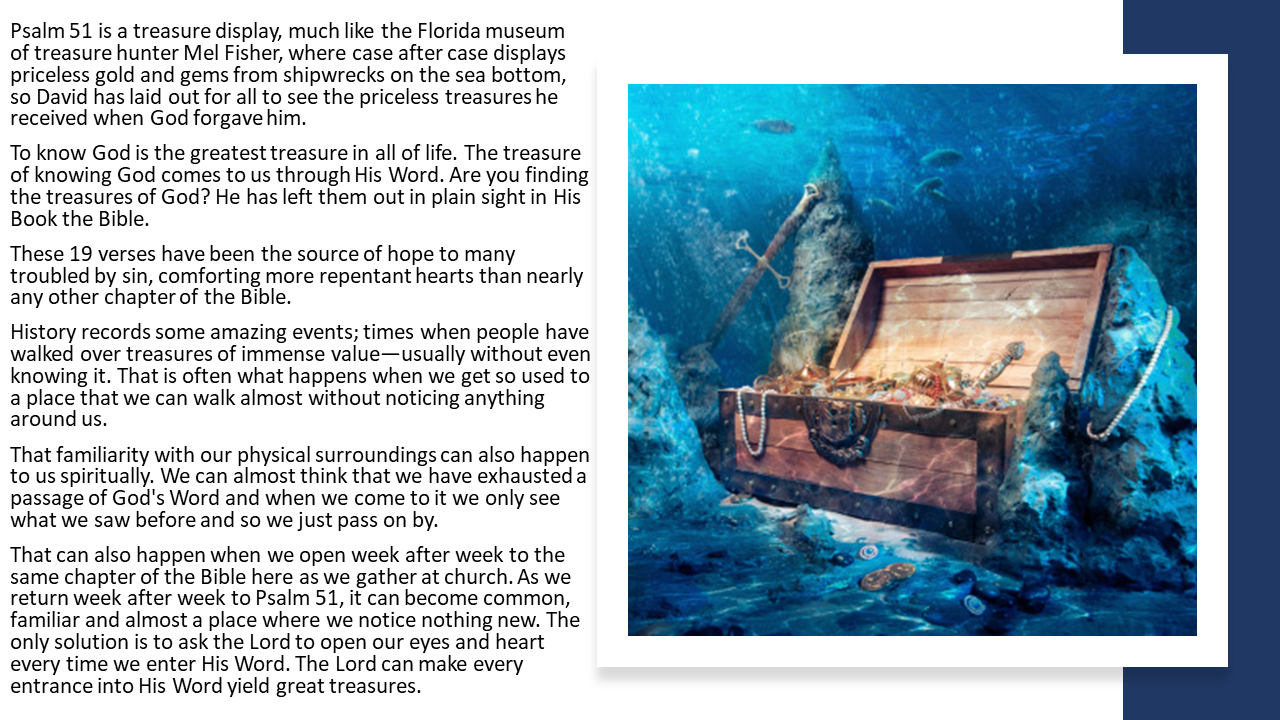
Psalm 51 is a treasure display, much like the Florida museum of treasure hunter Mel Fisher, where case after case displays priceless gold and gems from shipwrecks on the sea bottom, so David has laid out for all to see the priceless treasures he received when God forgave him.
To know God is the greatest treasure in all of life.
The treasure of knowing God comes to us through His Word.
Are you finding the treasures of God? He has left them out in plain sight in His Book the Bible.
Please open with me to one of the most treasure laden chapters in the Bible—Psalm 51.
HOPE FOR THE STAINED
These 19 verses have been the source of hope to many troubled by sin, comforting more repentant hearts than nearly any other chapter of the Bible.
History records some amazing events; times when people have walked over treasures of immense value—usually without even knowing it.
That is often what happens when we get so used to a place that we can walk almost without noticing anything around us.
That familiarity with our physical surroundings can also happen to us spiritually. We can almost think that we have exhausted a passage of God’s Word and when we come to it we only see what we saw before and so we just pass on by.
That can also happen when we open week after week to the same chapter of the Bible here as we gather at church. As we return week after week to Psalm 51, it can become common, familiar and almost a place where we notice nothing new. The only solution is to ask the Lord to open our eyes and heart every time we enter His Word. The Lord can make every entrance into His Word yield great treasures.
That reminds me of a bit of American History that has always fascinated me.
Gold was found at the head of Six-Mile Canyon in the territory of Nevada in 1859 by two miners named Pat McLaughlin and Peter O’Reilly. A fellow miner, Henry Comstock, stumbled upon their find and claimed it was on his property. The gullible McLaughlin and O’Reilly believed him and assured Comstock a place in history when the giant lode was named.
Soon multitudes of treasure seeking miners, lured by gold fever, began following the vein of gold up the canyon. They spent each day slogging their way up and down that narrow Six Mile Canyon chipping the outcropping of gold encased in quartz. Though they labored feverishly it was slow going for two reasons—the quartz was so hard to break, and the only way to their mining claims was that unusual canyon filled with strange, heavy, almost glue like mud, it’s entire length.
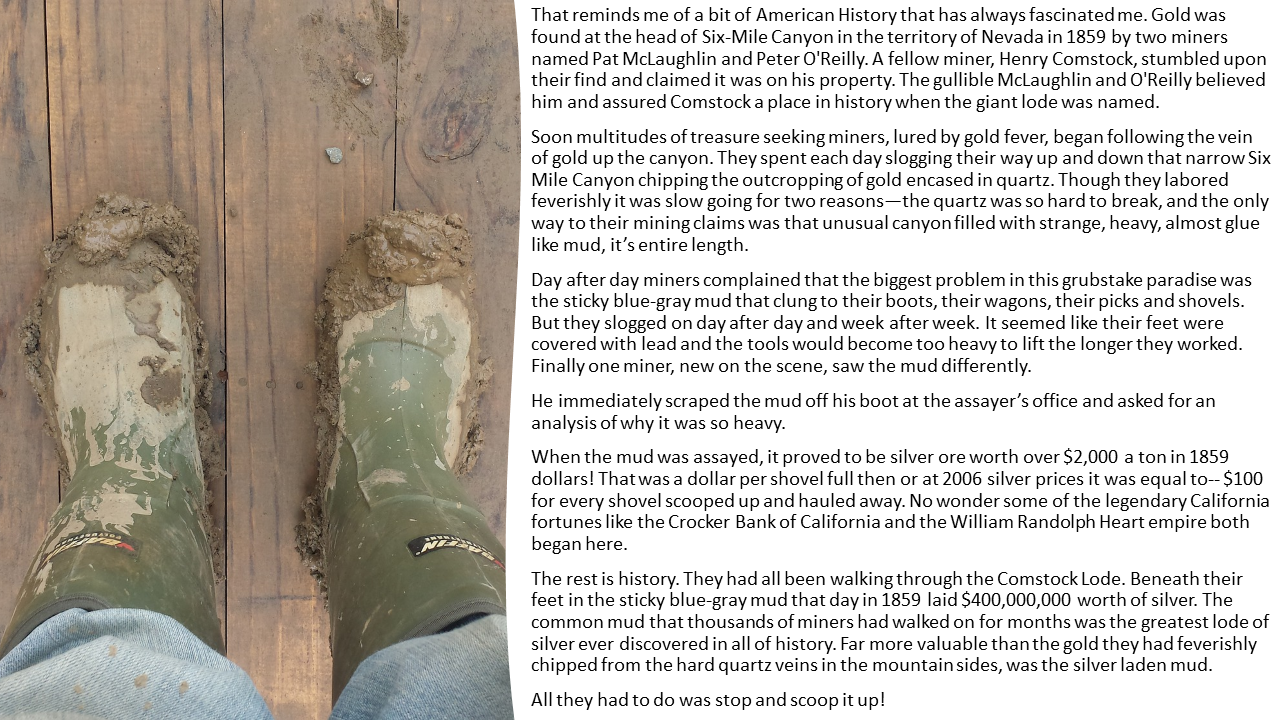
Day after day miners complained that the biggest problem in this grubstake paradise was the sticky blue-gray mud that clung to their boots, their wagons, their picks and shovels. But they slogged on day after day and week after week. It seemed like their feet were covered with lead and the tools would become too heavy to lift the longer they worked.
 Finally, one miner, new on the scene, saw the mud differently.
He immediately scraped the mud off his boot at the assayer’s office and asked for an analysis of why it was so heavy.
When the mud was assayed, it proved to be silver ore worth over $2,000 a ton in 1859 dollars! That was a dollar per shovel full then or at 2006 silver prices it was equal to-$100 for every shovel scooped up and hauled away. No wonder some of the legendary California fortunes like the Crocker Bank of California and the William Randolph Heart empire both began here.
The rest is history. They had all been walking through the Comstock Lode. Beneath their feet in the sticky blue-gray mud that day in 1859 laid $400,000,000.00 worth of silver.
The common mud that thousands of miners had walked on for months was the greatest lode of silver ever discovered in all of history. Far more valuable than the gold they had feverishly chipped from the hard quartz veins in the mountain sides, was the silver laden mud.
All they had to do was stop and scoop it up!
STOP AND SCOOP UP THE TREASURE
Don’t walk through Psalm 51 or any other portion of God’s Word again without scraping what you find off in the Presence of the Lord—ask him to tell you how much it is worth. Then start a life long habit of scooping up the treasures of His Word. It will be a spiritual fortune.
As we examine these lessons from David, they are very difficult but so necessary. For any and all of us today ring Paul’s words across the centuries as a reminder to stay in the diligent study of God’s Word. Turn there with me next—
2 Timothy 3:16-17 All Scripture is given by inspiration of God, and is profitable for doctrine, for reproof, for correction, for instruction in righteousness,17 that the man of God may be complete, thoroughly equipped for every good work.
 Every shovelful of the Scriptures that we prayerfully dig through in our devotional quiet time can yield something powerful from God’s Word for each of us. As Paul said, all Scripture was designed by God and given by God to do something in our lives. Note the six phrases Paul uses:
“…profitable for doctrine”, (That is God teaching us what is RIGHT). This Greek word disdaskalia refers to the content or message of God’s Word not the particular method or means of communicating it.
“…for reproof”, (That is God teaching us what is WRONG). This Greek word elegmos refers to using God’s Word to point out errors in conduct or belief.
“…for correction”, (That is God teaching us how to get RIGHT). This Greek word epanorthosis refers to using God’s Word for restoring someone back on their feet after stumbling or falling; it is the edification and building up ministry of God’s Word.
“…for instruction in righteousness”: (That is God teaching us how to stay RIGHT). This Greek word paideia refers to using God’s Word for positive training and discipling us in righteousness.
“…that the man of God may be complete”, (That is God teaching us He is ENOUGH). This Greek word artios refers to the reality that God’s Word makes us complete and capable to be proficient for anything God call us to do.
“…thoroughly equipped for every good work.” (That is God teaching us how to SERVE). This Greek word exartidzo could be paraphrased, “enabled to meet all demands of righteousness.” When we are mended by God’s Word (that is what equipped mean) we are then able to build up and help strengthen the lives of those around us.
So, as we turn back again to Psalm 51, we are entering a portion of Scripture that is:
- profitable for doctrine (God teaching us what is right about David’s response to his sin),
- for reproof (God pointing out what was wrong in David’s life that led to his sin),
- for correction (God explaining to us how to get right with Him using David as an example),
- for instruction in righteousness (God directing us how to stay right with Him again using David as a real living and breathing example);
- That each believer may be complete (God reminding us that He is more than enough for all we will need through life as we see His dealings with David the most recorded life in the Bible),
- Thoroughly equipped for every good work (God teaching us how we can serve Him like we saw in David’s life before he failed, after he failed, and for the rest of our lives).
Our return to Psalm 51 is part of a careful look at the three final eras of David’s life. The twenty or so years after David’s sin with Bathsheba (when he was about age 50) divide into three distinct lessons that are captured for our learning by God’s Word. May I underline once more in your mind where we are, and where we are headed?
Over Psalm 51 as well as Psalm 32 and 38 you should write these words in your hearts and minds—“Unguarded Moments Lead to Sin”. We must never isolate the Psalms that flow from a period of David’s life (like Psalm 32, 38, and 51) from the inspired record of that period. Let me trace the three periods of David’s final days and the inspired record of God’s perspective on the events that surround those Psalms.
Unguarded Moments lead to SIN—Uriah and Bathsheba. The saddest chapter, the darkest and the event we all wince at—is his sin with Bathsheba. God gives us a Divine record of those moments and days in 2nd Samuel 11-12. Out of this time period Psalms flow explaining the effects of what I call “David’s Unguarded Moments that led to SIN”. These are Psalm 32; 38; 51. That is what we are concluding in this study today.
Inevitable Consequences lead to PAIN—Absalom and Shimei. Eleven chapters record the many years of painful consequences because of David’s sin from 2nd Samuel 12-21, and 24. This inspired record of that period that I call “David’s Inevitable Consequences that led to Pain” explains the Psalms that flow from David’s PAIN. These are Psalms are 3; 31; 55; 63.
Humble Obedience leads to JOY—Solomon, and the Temple. And last, the final days of David’s life. When we see that despite the failures of Bathsheba incident—David truly was after God’s own heart. We see him end well, using his final days for God’s glory. Four chapters capture these years in 2nd Samuel 22-23 and I Kings 1-2. The Psalms that flow from this final era I call “David’s Humble Obedience that leads to JOY” are Psalms 18; 71.
 First, a quick reminder of the four main ideas of Psalm 51. David says, I–
#1 David said, I…Saw that all Sin is Against God. (Psalm 51:1-4)
#2 David said, I …Took the blame for my sin and repented. (Psalm 51:5-9)
#3 …Asked for help, because only God can cleanse and restore. (Psalm 51:10-13)
#4 …Sought God for a fresh start. (Psalm 51:14-19)
We have already studied the first seven verses. This morning we will begin with verse 8, as we watch David taking the blame for his sin and repenting.
When David repented he needed joyfulness v. 8 Make me hear joy and gladness, That the bones You have broken may rejoice.
As sinners we lose our joy. He says I have lost my song, I don’t hear Your joyful song anymore.
When David repented he longed for fellowship with God v. 9 Hide Your face from my sins, And blot out all my iniquities.
In Eden we saw Adam and Eve hiding from God. Sin separates and blinds us to God’s Presence. So David wants instead fro the sin that blinds and separates to be taken away. He wants God more than any sin.
Thirdly, David explains, I …Asked for help, because only God can cleanse and restore. (Psalm 51:10-13)
David knew that only God could give him a new beginning. v. 10 Create in me a clean heart, O God, And renew a steadfast spirit within me.
This word create speaks of what only God can do by his gracious power.
We must never think that God’s forgiving grace, wonderful as it is, either permits or encourages us to go on sinning.… “Shall we go on sinning so that grace may increase?” asked Paul. He answered, “By no means! We died to sin; how can we live in it any longer?” (Rom. 6:1–2).
Remember the ending of the story of Jesus and the woman trapped in adultery in John 8? Christ’s concluding words are so important, and so overlooked. They are another treasure of God’s Word.
[Having forgiven her, Jesus] added in John 8:11, “Go now and leave your life of sin.”
God’s grace always demands a change; always following forgiveness will be Christ’s words–if we are saved, we must stop sinning.
At the same time, we can be grateful that Jesus spoke as he did. For we notice that he did not say, “Leave your life of sin, and I will not condemn you.” If he had said that, what hope for us could there be? Our problem is precisely that we do sin.
There could be no forgiveness if forgiveness was based upon our ceasing to sin. Instead of that, Jesus actually spoke in the reverse order. First, he granted forgiveness freely, without any conceivable link to our performance.
Forgiveness is granted only on the merit of his atoning death. But then, having forgiven us freely, Jesus tells us with equal force to stop sinning.1
Two of my favorite verses in God’s Word explain the wonderful power of new beginnings as Christ’s blood is applied to our hearts.
Hebrews 9:14 How much more shall the blood of Christ, who through the eternal Spirit offered himself without spot to God, purge your conscience from dead works to serve the living God? o Hebrews 10:22 Let us draw near with a true heart in full assurance of faith, having our hearts sprinkled from an evil conscience, and our bodies washed with pure water.
David knew that only God could restore his walk in the Spirit v. 11 Do not cast me away from Your presence, And do not take Your Holy Spirit from me.
The days that had stretched into the weeks and months of that spiritual wasteland David had just experienced were so bad he wanted to never revisit that time again. He was so aware that the sweet influence of the Holy Spirit came upon him that filled his heart with joy, with songs, with peace that made him a blessing had been pulled back. So David says 1. I want You to renew my heart by washing it. (v. 10) 2. I want You to restore my walk by giving me Your Spirit back. (v. 11) 3. I want You to bring back the fruit of the Spirit in my life. (v.12)
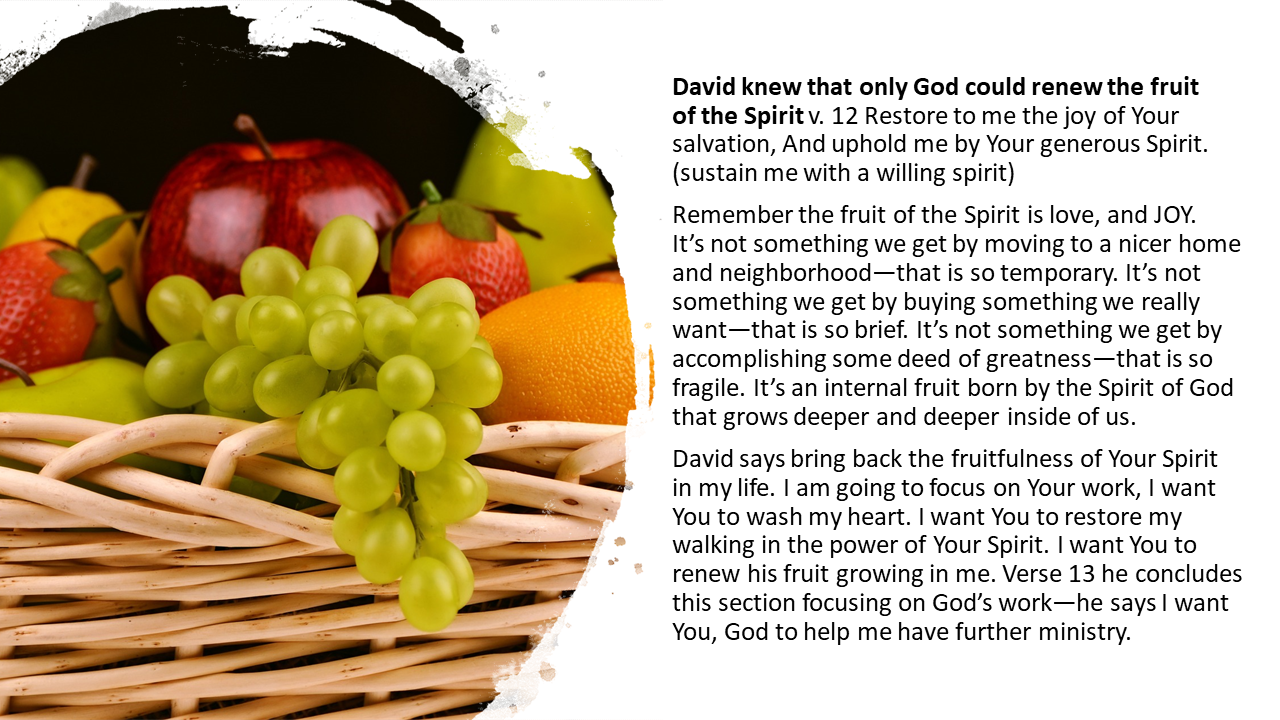
David knew that only God could renew the fruit of the Spirit v. 12 Restore to me the joy of Your salvation, And uphold me by Your generous Spirit. (sustain me with a willing spirit)
 Remember the fruit of the Spirit is love, and JOY. It’s not something we get by moving to a nicer home and neighborhood—that is so temporary. It’s not something we get by buying something we really want—that is so brief. It’s not something we get by accomplishing some deed of greatness—that is so fragile. It’s an internal fruit born by the Spirit of God that grows deeper and deeper inside of us.
David says bring back the fruitfulness of Your Spirit in my life. I am going to focus on Your work, I want You to wash my heart. I want You to restore my walking in the power of Your Spirit. I want You to renew his fruit growing in me. Verse 13 he concludes this section focusing on God’s work—he says I want You, God to help me have further ministry.
David knew that only God could prepare him for further ministry v. 13 Then I will teach transgressors Your ways, And sinners shall be converted to You.
When I let You, God do all this, when I let You wash my heart, when I let You restore my walk in the Spirit, when I let You renew His bringing forth His fruit in my life, You prepare me for further ministry.
You know sometimes when we hit the bottom, when we are into sin, we just think it’s all over- nothing, I can’t do anything, I’m useless. Look at what he says in Wow, David says I am going to come back, I’m going to serve You.
Now he didn’t go back when he was still in sin. There was quite a long period of time. God had worked through the process and it utterly cleansed him and filled him back with joy.
Fourthly, David explains, I …Sought God for a fresh start. (Psalm 51:14-19)
David sought God by calling sin what it is. v. 14 Deliver me from the guilt of bloodshed, O God, The God of my salvation, And my tongue shall sing aloud of Your righteousness.
We must repent of sin. Turn from it, change your mind about it, want to get rid of it, get uncomfortable about it. A lot of people, they are willing to say I have made a mistake. They are willing to say I didn’t do that as well as I should have. Instead of saying I sinned. We don’t like to humbly confess when we’ve sinned. Why? Because to say I’ve sinned, we have to agree with God. And all that’s within us, our flesh and our pride rebels against humble repentance. We don’t want to say that we have sinned. We want to say we made a mistake, that we are weak—but not that we have sinned.
David called his sin what it really was. Look at v. 14, “Deliver me from blood guiltiness”. Wait a minute. Did David literally kill Uriah? No, an Ammonite archer shot arrows and did it for him. But it was really David who killed Uriah; David sent him there, David ordered Joab to send Uriah to the front lines and get him killed.
When David truly turns to God, he repents by calling his sin what it really was. So unabashedly David prays, “Deliver me from blood guiltiness, I killed Uriah–O God, thou God of my salvation: [and] my tongue shall sing aloud of thy righteousness. I’ll call sin what it is—in my life that was sin. God, forgive me of that, cleanse me of that, renew me.”
David wanted to talk to God. v. 15 O Lord, open my lips, And my mouth shall show forth Your praise.
Remember we saw in Psalm 32 that those months of hiding his sin had dried up David both physically and spiritually.
When we are attached to our sin, we are strangely silent towards God. That’s what Psalm 32 is all about. David had dried up spiritually—he just closed his mouth, he wasn’t talking to God in fact he wasn’t talking to anybody. He was just empty inside. When he lost his song, he wasn’t interested in talking to God.
But when we call sin what it is, when we repent, we have to start talking to God.
We have to just open our lips and say like David said, ‘God open my mouth back up–don’t let me hang around down here in the low lands. Let my mouth declare Your praise’.
When we are down, if all we will do is just start praising God for who He is and what He has done, and what He means to us, God will restore our joy.
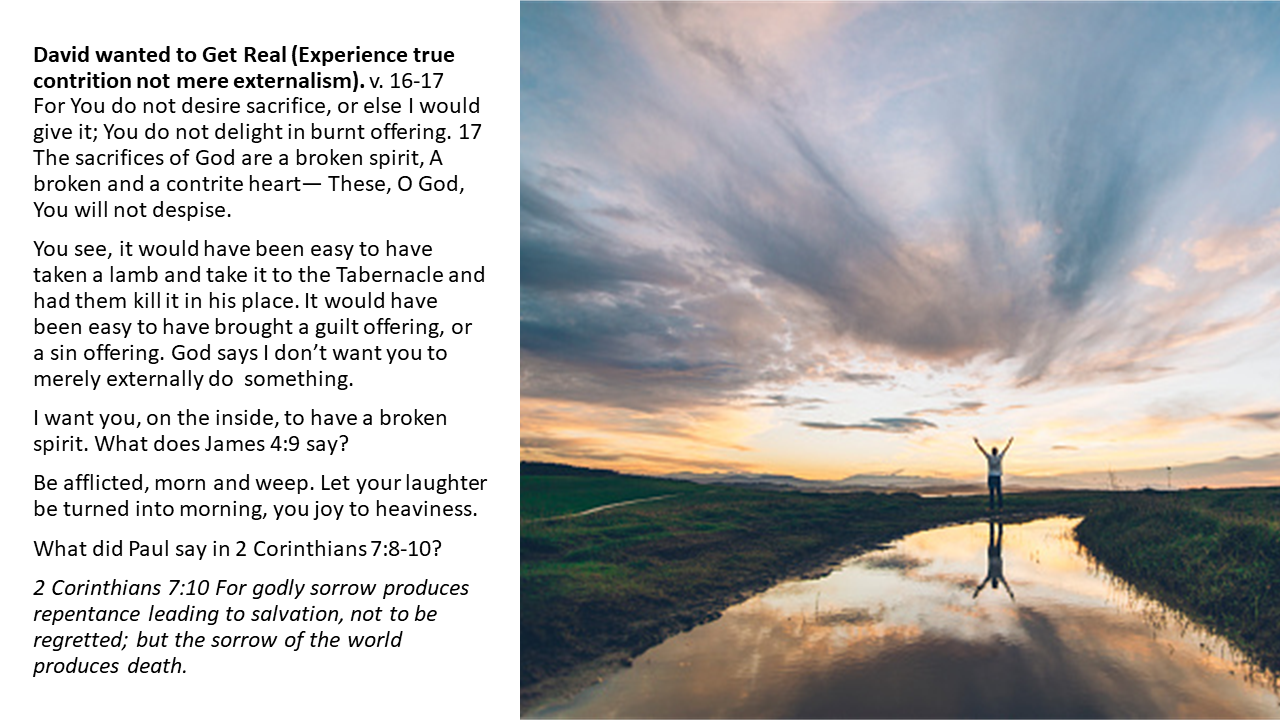
David wanted to Get Real (Experience true contrition not mere externalism). v. 16-17 For You do not desire sacrifice, or else I would give it; You do not delight in burnt offering. 17 The sacrifices of God are a broken spirit, A broken and a contrite heart— These, O God, You will not despise.
You see, it would have been easy to have taken a lamb and take it to the Tabernacle and had them kill it in his place. It would have been easy to have brought a guilt offering, or a sin offering. God says I don’t want you to merely externally do something. I want you, on the inside, to have a broken spirit. What does James 4:9 say?
Be afflicted, morn and weep. Let your laughter be turned into morning, you joy to heaviness.
What did Paul say in 2 Corinthians 7:8-10?
2 Corinthians 7:10 For godly sorrow produces repentance leading to salvation, not to be regretted; but the sorrow of the world produces death.

Let me explain the difference. Godly sorrow is when we say to the Lord like David did:
- God I have sinned against You.
- God I have broken Your righteous standard.
- God against You I have ____ and you name the sin.
Do you know what the sorrow of the world is?
- Oh no, I’ve lost my health.
- Oh no, I’ve lost my job.
- Oh no, I have a sexually transmitted disease.
- Oh no, I’m pregnant. Or whatever.
- It is just sorrow over what happens to us and that’s not Godly sorrow. That’s not sorrow that brings repentance.
It reminds me of what Howard Hendricks said once while I was in seminary. He said when the man goes in to the convenience store (or nowadays online) and sees the pornographic material and stands there and looks at it; and begins the fires burning within him; when he comes out he thinks—‘God I’m sorry I looked at the magazine’.
Howie always said, “That’s not confession that is only an admission”.
Confession is saying, “I offended You my Holy God; I lusted and wanted to lust; I started a fire as the writer of Proverbs says, inside that will burn me up. God I ask You to cleanse that and take away that wicked desire.” That’s confession. Admission doesn’t count.
If you are facing lust you need to consider the final result of it. What can we do right now to get us started back to God’s path or keep us on that path? Let me give you three choices we need to make:
1. Make yourself look at the final result or ultimate form (mature plant) of the momentary choices of (or seeds you are planting) today.
- If your parents knew what you have been hiding from them, would it crush them and grieve their hearts?
- If your husband or wife knew about the area you have surrendered to lust, would it rob your relationship of joy and trust?
- If you keep on in this path what will it do to your body, your family, your reputation and your heavenly reward?
- Is it really worth as much as it will eventually cost you?
2. Choose to cultivate new and godly choices—remember every time we descend into lust our flesh is strengthened. It’s takes control of more of our life. And I’ll tell you the tragic result of a life of lust and sin is the life of those that can’t stop sinning because lust controls them and God says that He has given them over to the desires of their heart. that will become habits of holiness for old and ungodly patterns. Cut cable or online service for a few months and join an accountability group or Bible study; take a fast from TV watching (even sports) and start a Scripture memory plan like our “108 verses”.
3. Remember it will only be harder to stop tomorrow. Every wrong choice we make sets in motion a wave of consequence and growing bondage throughout our mind and body. Every obedient choice we make set in motion a wave of liberating blessing and spiritual strength.
David says here I’m not going to admit, I am going to confess. I am going to experience true contrition, not mere externalism. I am not just going to offer some little lamb. I am going to be broken hearted inside.
David wanted to Chase After God (Begin zealous worship anew and afresh) v. 18-19 Do good in Your good pleasure to Zion; Build the walls of Jerusalem. 19 Then You shall be pleased with the sacrifices of righteousness, With burnt offering and whole burnt offering; Then they shall offer bulls on Your altar.
What he is saying is- God now that I am back with you, I am going to zealously follow Your program. I am going to zealously praise You in Zion. I am going to zealously bring my offerings to You–but not as a token, but now from a true heart.
1 James Boice quoted by John F. MacArthur, Jr., The Vanishing Conscience – Drawing the Line in a No-Fault, Guilt-Free World, (Dallas, Texas: Word Publishing) 1997, electronic edition, n.p..
Slides



Check Out All The Sermons In The Series
You can find all the sermons and short clips from this series, David’s Spiritual Secret here.
Looking To Study The Bible Like Dr. Barnett?
Dr. Barnett has curated an Amazon page with a large collection of resources he uses in his study of God’s Word. You can check it out here.