
If the video above is not available, here are two other ways to view:
When Life Doesn’t Turn Out
DSS-33
060820PM
Psalm 3
Transcript
.jpg)
Let’s turn to our Bibles to 2 Samuel 15. As you turn there, we’re going to be reading in a few moments, starting in verse 13 of 2 Samuel 15.
.jpg)
But this is the most touching moment, I believe, the most poignant moment. 2 Samuel 15 and verse 13 records that moment in the life of David when he begins facing the consequences. Now, I want to right up at the front explain that there’s a difference between chastisement for sin, which God does, and it’s like spanking. He spanks and spanks and spanks until we stop sinning. That is what David goes through in Psalm 32 when his body dries up, when his bone marrow shrivels, when his whole system is aging and he’s just unable to even go on. That is a divine punishment against sin. That’s what chastisement is. Until we repent.
But afterward, and we have the sweet joy of forgiveness, the Scriptures say be not deceived, God is not mocked. Whatever you sow you will reap. He that sows the Spirit will reap life everlasting. He that sows to the flesh will from the flesh reap corruption. There are consequences just like the third law of Newton’s laws, saying for every motion there’s an equal and opposite reaction, or for every action there is an equal and opposite reaction. In the spiritual world, there is also a hundred percent accurate law. It’s called the consequence engine. We’re going to see that. These things, David doesn’t cause. He doesn’t cause Shimei to sin. Shimei was going to sin on his own. David didn’t cause Absalom to rebel; Absalom rebelled on his own. But all of those things were precipitated by the actions that David and his sin committed, and these followed those sins. They’re kind of like consequences. It’s not a reflection saying, David is persisting in his sin. David’s doing something wrong. God is judging him. It’s just the inevitable result of certain decisions that were made.
What God’s looking for here, I want to emphasize, and we won’t be able to cover it because it’s so huge, but we will see kind of the foundation of it. What God’s looking for is, in this time of consequence, how will David respond? Look how he responds, starting in verse 13. We’re going to read it in a moment, but to the loud wails of the country people, that’s down in verse 23, a somber band of commanders. That’s all of David’s mightiest men in their armor, walking in formation. They were surrounding the King of Israel, now deposed by a rebellious son, driven from his throne, banished from his city, fleeing for his life.
David is walking head down. The tears, as verse 30 tells us, are dropping silently to the ground. His face is wet; his eyes are swollen and red. His head is covered, and he trudges heavily down the slopes of Zion. He’s going toward a brook called Kidron. As he steps across the stones, as the water runs across them, the steep upward incline of the path points David’s feet toward the Mount of Olives, that hillside green with countless olive trees. There, David walks nearby where another would walk to a garden called Gethsemane, where the son of David would also weep, both of them for the sins of others. David, who had faced lions and bears, armies and giants, stumbles out of his beloved Jerusalem with his eyes blurred by his own tears. He’s fleeing for his life, and he’s left everything.
Behind him is the Ark of God. Behind him is the Tent of Meeting and God’s presence. Behind him is Zion, the city of his great God. Behind him are the trophies of all of his battles. Behind him, he leaves the treasures amounting to the largest personal fortune in gold and silver ever amassed by anyone ever. It’s all behind him. As David walks weeps and covers his head.
.jpg)
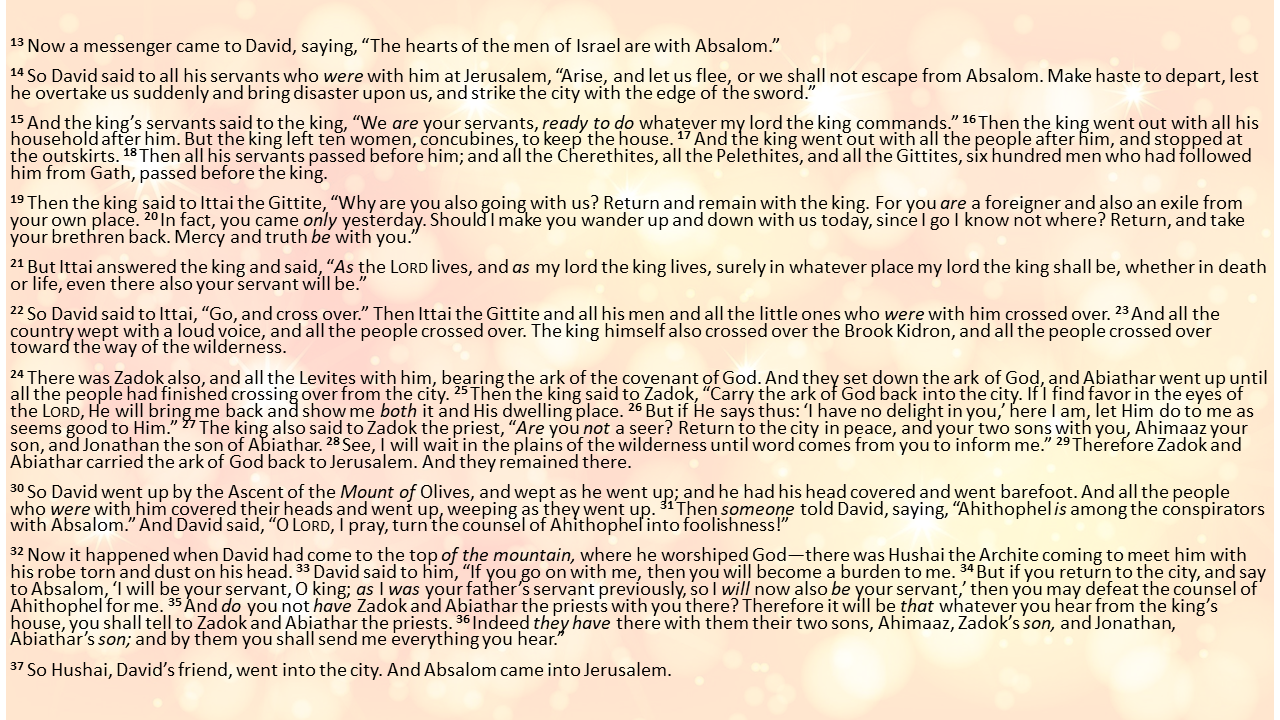
2 Samuel, let’s get this moment in our mind, starting in chapter 15, verse 13 to 37. Now, a messenger came to David, saying the hearts of the men of Israel are with Absalom. So, David said to his servants, who were with him in Jerusalem, arise, let us flee, or we shall not escape from Absalom. Make haste to depart lest he overtake us suddenly and bring disaster upon us and strike the city with the edge of the sword. The king’s servant said to the king, we are your servants, ready to do whatever, my Lord, the king commands. Then the king went out with all his household after him, but the king left 10 women, concubines, to keep the house, and the king went out with all the people after him and stopped at the outskirts.
Then all his servants passed before him. All the Kerethites and the Pelethites; and all the Gittites, 600 men who had followed him from Gath, passed before the king. And the king said to Ittai the Gittite, why are you also going with us? Return and remain with the king. For you are a foreigner and also an exile from your own place. In fact, you came only yesterday. Should I make you wander up and down with us today, since I go, I know not where? Return, take your brethren back. Mercy and truth be with you. But Ittai answered the king and said, as the Lord lives and as my Lord, the king lives surely in whatever place my Lord the king shall be, whether in death or in life, even there also your servant will be.
So, David said to Ittai, go and cross over. Then Ittai the Gittite and all his men and all the little ones who were with him crossed over. Verse 23, and all the country wept with a loud voice, and all the people crossed over. The king himself also crossed over the Brook Kidron, and all the people crossed over toward the way of the wilderness.
There was Zadok also and all the Levites with him bearing the Ark of the Covenant of God, and they set down the Ark of God, and Abiathar went up until all the people had finished crossing over from the city. Then the king said to Zadok, carry the Ark of God back into the city. If I find favor in the eyes of the Lord, he will bring me back and show me both it and His dwelling place. But if he says, thus, I have no delight in you, here I am. Let Him do to me as seems good to Him. The king also said to Zadok the priest, are you not a seer? Return to the city in peace, your two sons with you, Ahimaaz and your son Jonathan, the son of Abiathar. See, I will wait in the plains of the wilderness until word comes from you to inform me. Therefore, Zadok and Abiathar carried the Ark of God back to Jerusalem, and they remained there. Verse 30. So, David went up by the ascents of the Mount of Olives and wept as he went up, and he had his head covered, and he went barefoot. All the people who were with him covered their heads and went weeping as they went up.
Then someone told David, saying, Ahithophel is among the conspirators with Absalom. And David said, oh Lord, I pray, turn the counsel of Ahithophel into foolishness. Now, it happened when David had come to the top of the mountain. He worshiped God. Now, it’s interesting if you are a Bible marker, right there, there’s actually an entire psalm written in the Book of Psalms that David wrote as he was fleeing from Absalom and paused in this period at the top of the mountain. It’s Psalm 3. It’s just if you like to mark stuff. It’s right there. He came to the top, and he worshiped God.
There was Hushai, continuing in verse 32, the Arkite coming to meet him with his robe torn and dust in his head. David said to him, if you go on with me, you’ll become a burden to me. But if you return to the city and say to Absalom, I will be your servant as I was to your father, oh King, previously so I will now also be your servant, then you may defeat the counsel of Ahithophel for me. Verse 35, do you not have Zadok and Abiathar, the priest with you there? Therefore, it will be that whatever you hear from the king’s house, you shall tell Zadok and Abiathar the priest. Indeed, they have with them the two sons, Ahimaaz, Zadok’s son, and Jonathan, Abiathar’s son. By them, you shall send me everything you hear. So, Hushai, David’s friend, went into the city, and Absalom came into Jerusalem.
Let’s bow for a word of prayer. Father, I pray that You’d open our hearts, the eyes of our hearts, our understanding, our minds, and touch our wills as we see how David faces the painful consequences, the painful abuse of others that he did not cause, but that he inherited by his actions. How You teach us profitable things that are for doctrine, for reproof, for correction, that will instruct us in righteousness and help us to be thoroughly equipped for every good work. Help us to, again, be stirred by Your Word and not just get more facts, more interesting insights, but have the truth that we become doers of. That’s what we ask for in the name of Jesus, and for His glory we pray, Amen.
.jpg)
We’ve opened to the final chapters of David’s life. It’s interesting when God describes the final 20 years of David’s life, it’s almost like he puts a little parenthesis around it, little brackets around it. Those little brackets are the event with Bathsheba, and they kind of covers this period of his life. It just is what influences and flavors everything that’s going on. It’s amazing that David’s final years, from God’s perspective, begin with his fall into sin. Everything from 2 Samuel 11, which is just a few pages back where the adultery occurred, all the way through 1 Kings 2, which is the death of David. Everything in those intervening chapters, those 20 years of his life, is touched, affected, and colored by the sin with Bathsheba.
God forgives the sin, and God forgets the iniquity. That’s the truth of the Scripture. But the consequences and loss are recorded in the Bible. The consequences David faced are many. In this little passage, the 24 verses that we read tonight, we see just one slice of those consequences in our text this evening: the great pain of his son’s betrayal. Then David faces the verbal abuse in chapter 16 by Shimei. That’s another part of this whole scene. Then the physical abuse, the death threats from his own son is Absalom begins hunting him down and trying to find him and destroy him. All of that is resulting from David’s sin and the consequences that sin brought to him.
If you turn a little bit to the right, you’re in 2 Samuel. Keep going to the right to 1 Kings 15. If you haven’t underlined this yet in your Bibles, this is a good time if you’d like, because God put a postscript to the incredible life of David. Remember the 141 chapters that were written by God about David make him the most recorded life, the most talked about person in the Bible. The most examined single individual life in the Bible is David. Look in 1 Kings 15:5 at the postscript that God wrote about David, because it should stop us and make us soberly think about where our life inhabits, and the secret parts of our lives are heading us.
It says in 1 Kings 15 and verse 5, as I read this, I’m going to emphasize one word, which should just jump out at you. It says, because David did what was right in the eyes of the Lord and had not turned aside from anything that God commanded him all the days of his life except, you see that one word? Except in the matter of Uriah, the Hittite.
.jpg)
Let’s turn to the right in our Bibles to Galatians 6. This is really the theme of this section. The New Testament: Galatians, and then Ephesians, Philippians, Colossians, right after the big 1 and 2 Corinthians, and then Galatians 6 in your New Testament. Because over everything we look at tonight is a reminder, as we’ve seen, that the unguarded moments in David’s life led him to sin. That’s 2 Samuel 11 and 12, and Psalm 32, and Psalm 38, and Psalm 51. But now we transition to the second big theme of David’s final years, and that is that the inevitable consequences of his sin led to pain in his life.
Tonight, we’re going to look at the pain he received from Absalom, the pain he receives from Shimei, and the pain he receives from the whole preceding event. Absalom rebelled because Ammon raped his sister, Tamar (Absalom’s sister), and that made Absalom angry, and so he murdered his brother. All these things, the Scriptures tell us, all of these things were the consequences of David’s sin. When Nathan pointed at David and pointed out that he had sinned, he said, the sword will never depart from your house, David. He said, you’re going to pay fourfold for what you’ve done. David did. He lost four sons. The baby that Bathsheba conceived died. Ammon was murdered. Absalom was killed by Joab. Adonijah was also killed by Solomon after the rebellion. Four sons in a row. Fourfold response.
.jpg)
Look at what it says in Galatians 6, starting in verse 7, because there are lessons to be learned from David that are difficult, but so necessary. For any and all of us today, we should heed Paul’s words as they ring across the twisted wreckage of so many lives, and here they are. Do not be deceived, Galatians 6:7, God is not mocked. For whatever a man sows that he will also reap. For he who sows to his flesh will from the flesh reap corruption, but he who sows the Spirit will of the Spirit reap life everlasting. Verse 9, let us not grow weary while doing good, for in due season we shall reap if we do not lose heart.
Although we often forget about it, both halves of this verse apply to us as believers, and it impacts us deeply. In fact, most Christians find that they are still reaping the unpleasant long-term consequences of past bad choices. What’s amazing is when we get saved, God does not stop all the bad consequences of things we did in our past life, and it also runs into our current life. We can still make bad decisions. We can still do things that have ongoing consequences even after we’re saved.
So, we can have the first half of this verse, but the second half is even more powerful. It says: and he that sows the Spirit, the second half of verse 8, will also reap life everlasting. There is sowing for the Spirit for a future positive harvest. As much as you and I, tomorrow, can redeem some of the time and as much as we want to for eternal things, we can also waste it and suffer the consequences of wasted time. You know what one of the consequences I hear at the end of many people’s lives? Oh, if I had only, oh if I had only, oh if I had only, oh, I wish I had. Now, all that is the consequence of their not getting serious about God earlier. It’s not a sin, it is just a waste. The consequence is that they grieve at the end of their life that there were so many things they wish they had done for Christ.
.jpg)
That’s why Paul wrote these words. That’s why Galatians 6 verses 7, 8, 9 are in the Bible because sin will always pay us back with boredom, guilt, shame, loneliness, confusion, emptiness, loss of purpose, and not to speak of loss of rewards. So, we should hate sin, and that’s what’s happening to David. We followed him through so many of the Psalms. If you remember in months past, we saw David as he was struggling so many times in his life. But now in this section, the negative consequence engine for David, as David was finding out, was operative in his life.
.jpg)
Let’s go back to the Old Testament. I want to take you now to 2 Samuel chapter 12 because I’ve alluded to this, but I want you to see it, actually, not just hear this. 2 Samuel chapter 12. I want you to note clearly what was going on in David’s life. Starting in verse 13 of 2 Samuel chapter 12, David was forgiven. I want to be really clear about this. Consequences are not punishments. It’s not the chastening punishment. A consequence is just an inevitable result of a decision we make, and it should be part of our decision-making process. We should look every day, for everything we do, there’s going to be a consequence to it. Either it’s going to be redeeming the time for life everlasting, or it’s going to be a waste, and it’s going to be a loss of reward, and it’s going to be a pain, and it’s going to be a problem. We have to make a choice. But it doesn’t affect whether our sins are forgiven or not because 2 Samuel 12 and verse 13 clearly says, the Lord has taken away your sin. The Lord’s forgiveness was there, but the Lord’s forgiveness never takes away the earthly consequences of our sin.
I told you about my parents, who used to have a rescue mission ministry, and I used to preach. In fact, someone asked me this morning, they said, did all the activity over here bother you? I said, are you kidding? Nothing bothers me when I speak. I started at the rescue mission. All the drunks would sit where you are, and all the food was up there in the balcony, and they would be there, and they had to sit through my sermon before they could eat. They used to get on their knees and crawl and go like this and go right by me to eat. I’d finish my sermon even if they were all back there eating. So, I just have to never be interrupted. I just finished.
But you know what my parents reminded me? When I got done, I’d look at those men. Many of them had come to Christ, but they never got a new liver. They never got a new stomach. They never got a new brain. They were saved, but they lived for the rest of their life with the consequences of days and weeks and months and years of choices they made. You know what all of them said who came to Christ? When you go, and don’t speak at the rescue mission, when you speak somewhere else, would you tell them that though we are absolutely assured of our forgiveness, how we wish we hadn’t sown to the flesh? So, wherever you are on your spiritual pilgrimage, I hope that David’s life says, stop and think of the consequences of current choices.
David had fully experienced. God’s matchless gracious forgiveness. But look at the first six verses of 2 Samuel 12, because if we examine closely, we’ll find an amazing explanation of the cost to David of his sin. Nathan, the prophet, said David would have to make restitution fourfold. Notice what he said. Nathan tells a little story. Verse 1, two men, rich and poor. Verse 2, the rich man had a lot of flocks and herds. Verse 3, the poor man had nothing but one, which he nourished, and brought one little lamb. Verse 4: A traveler came to the rich man. He refused to take from his own flock, and he stole from the man who only had one. Verse 5, so David’s anger was greatly aroused. He said at the end of verse 5, as the Lord lives, the man who’s done this shall surely die. Look at verse 6, and shall surely restore fourfold for the lamb because he did this thing and because he had no pity. Then Nathan said to David, you’re the man. It’s a fascinating little look at a little parable. It’s a little interesting historical note.
But we can easily see in the parable that the rich man was David. The poor man was Uriah. The ewe lamb was Bathsheba. If you read Exodus 22:1, you can see the penalty for stealing and slaughtering an ox or a sheep is not death, but restitution. So, this parable is tracking with the Scripture. In Nathan’s parable, the wrongful taking and using of the lamb pointed to David’s adultery with Bathsheba. Under the Mosaic law, both the sins of adultery and murder were punishable by death. When David pronounced judgment on the rich man, which he does, remember, he says in verse 6, you’ll have fourfold for the lamb. He was condemning himself first, in the fifth verse, to death and then to a fourfold restitution. It’s very possible that this fourfold restitution could be seen in the tragic events of David’s final years.
In fact, scholars are divided on whether the four sons’ dying is the fourfold restitution. I already mentioned Bathsheba’s first son, and then Ammon, and then Absalom, and then Adonijah. But there’s also a possibility that there are other ways you could look at it. It never explains it to us. It just records the events. It could be that this whole rebellion of Absalom is one of the four. It could be the great numbering of the people event, where the plague comes as one of the four. It could be the insurrection of Adonijah trying to get the throne. It could be Sheba the Bichrite, who leads all the Israelites in rebellion against David. …We don’t know.
.jpg)
But the lesson that is learned is this: every sin that I, as a Christian, commit is forgiven by Christ. But no sin is ever right or good, and no sin we ever commit ever produces anything right or good. Remember, you don’t do wrong to make a right, and that is a spiritual law. The price for doing some things is terribly high and terribly unprofitable. Sin always will bring loss. That’s the lesson of David’s life.
David was a man after God’s own heart. He was greatly used of the Lord in leading and writing. But when he did what he did, that monumental sin, when, through the prophet Nathan, God said, look at verse 10 in chapter 12. He says, the sword will never depart from your house. I will raise up evil against you from your own household. Then he says down in verse 14, you’ve caused the enemies of the Lord to blaspheme. Look at the end of 14, and the child who is born to you shall surely die. David paid for the sins that he committed almost every day of his life. He never forgot that sin.
The blessing is that once he repented, once he knew the cleansing forgiveness, though it was painful; from that painful time in his life came the greatest of all of his ministry for the Lord, the greatest of his Psalms, the greatest of his worship. In fact, the 18th Psalm, one of the most magnificent declarations of the wonderful sovereign majesty of God, was written during this time period.
Well, God’s Word gives us a pathway. What I want you to see is that the wonderful grace of Jesus is that He absolutely erases the record of our sin. He absolutely condemns us no more. Then He gives us the grace to walk through life and to be triumphant for Him and worship Him, even as we have to endure the consequences of our wrong actions.
So, the thing about the Lord is, what David learned, we can stop on the mountains of life like David did, fleeing from Jerusalem, crying, and covering his head. He paused at the top of the Mount of Olives, and he lifted his head to the Lord. Sometime if you’d like to read something great, read Psalm 3. As David worshiped God, he knew that God was the one who was just and right, and God was the one who blotted out all of his sins. God gave him the grace to live with the consequences. Be not deceived, God is not mocked. Whatever we sow, we’ll reap. And as we’re reaping them, let’s not grow weary in well-doing because God’s grace is sufficient even for us as we get a new beginning in Christ.
.jpg)
Father in Heaven, thank You for the lessons of Your Scripture that are profitable for doctrine, teaching us what is right, for reproof, for showing us where we’re wrong, for correction, showing us how to get right for instruction and righteousness, showing us how to stay right with You. May we always look at Your Word and determine those truths. Then not merely hear all this, but at moments like this moment as we’re bowed before You, saying, Lord, I want to present my body as a living sacrifice to You. I want to be holy to You. I want to be acceptable. I want You to keep me from conformity to the world. I want transformation by Your Spirit, taking Your Word within me. Then I want to walk through life knowing what Your good, acceptable, and perfect will, and that’s my heart’s desire. In the name of Jesus, we pray, Amen.
Notes
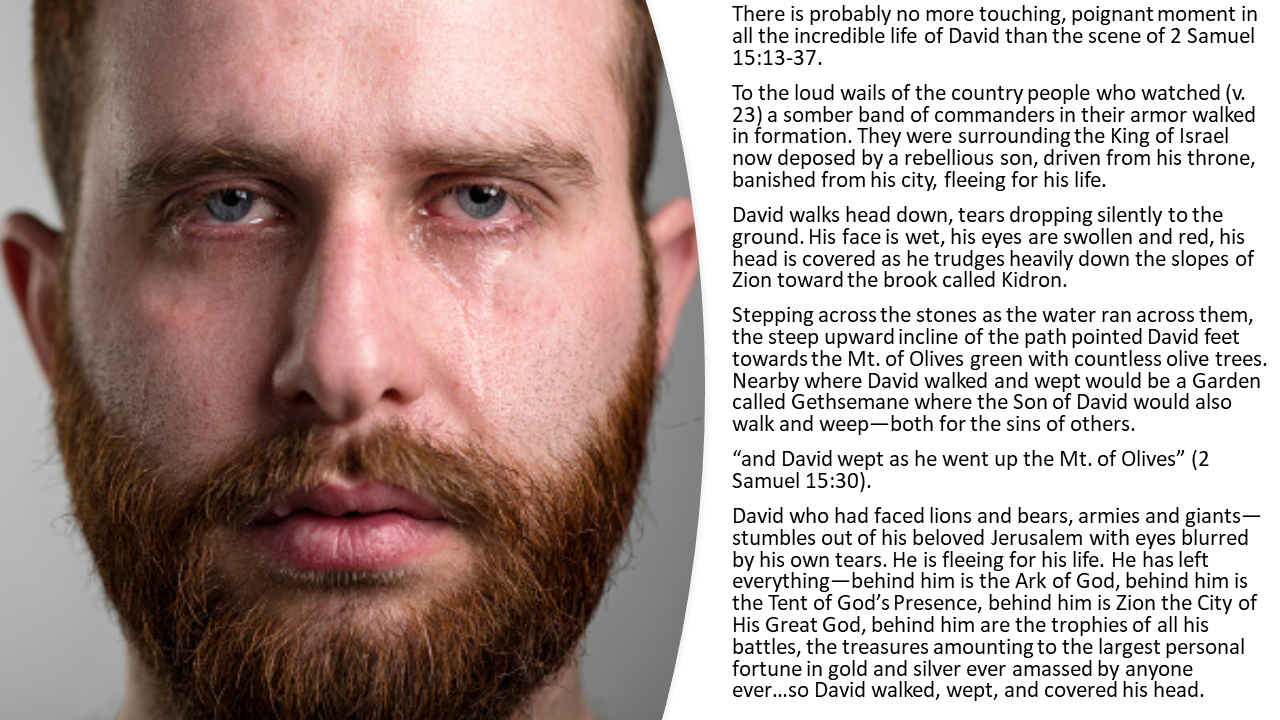
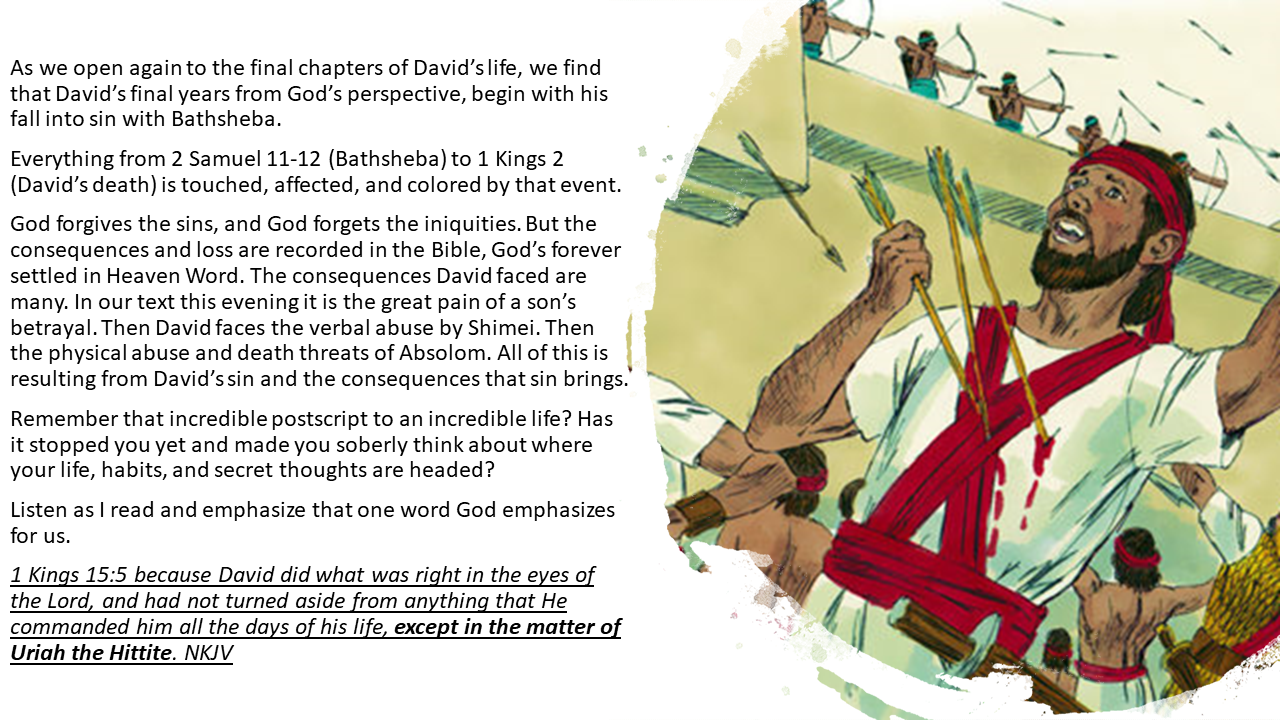
There is probably no more touching, poignant moment in all the incredible life of David than the scene of 2 Samuel 15:13-37.
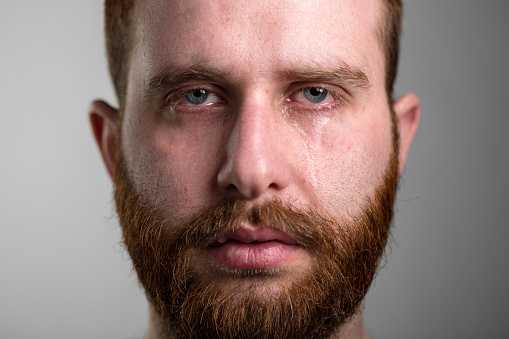
To the loud wails of the country people who watched (v. 23) a somber band of commanders in their armor walked in formation. They were surrounding the King of Israel now deposed by a rebellious son, driven from his throne, banished from his city, fleeing for his life.
David walks head down, tears dropping silently to the ground. His face is wet, his eyes are swollen and red, his head is covered as he trudges heavily down the slopes of Zion toward the brook called Kidron.
Stepping across the stones as the water ran across them, the steep upward incline of the path pointed David feet towards the Mt. of Olives green with countless olive trees. Nearby where David walked and wept would be a Garden called Gethsemane where the Son of David would also walk and weep—both for the sins of others.
“and David wept as he went up the Mt. of Olives” (2 Samuel 15:30).
David who had faced lions and bears, armies and giants—stumbles out of his beloved Jerusalem with eyes blurred by his own tears. He is fleeing for his life. He has left everything—behind him is the Ark of God, behind him is the Tent of God’s Presence, behind him is Zion the City of His Great God, behind him are the trophies of all his battles, the treasures amounting to the largest personal fortune in gold and silver ever amassed by anyone ever…so David walked, wept, and covered his head.
As we open again to the final chapters of David’s life, we find that David’s final years from God’s perspective, begin with his fall into sin with Bathsheba.
Everything from 2 Samuel 11-12 (Bathsheba) to 1 Kings 2 (David’s death) is touched, affected, and colored by that event.
God forgives the sins, and God forgets the iniquities. But the consequences and loss are recorded in the Bible, God’s forever settled in Heaven Word. The consequences David faced are many. In our text this evening it is the great pain of a son’s betrayal. Then David faces the verbal abuse by Shimei. Then the physical abuse and death threats of Absalom.
All of this is resulting from David’s sin and the consequences that sin brings. Remember that incredible postscript to an incredible life? Has it stopped you yet and made you soberly think about where your life, habits, and secret thoughts are headed?
Listen as I read and emphasize that one word God emphasizes for us.
- 1 Kings 15:5 because David did what was right in the eyes of the Lord, and had not turned aside from anything that He commanded him all the days of his life, except in the matter of Uriah the Hittite. NKJV
Over Psalm 51 as well as Psalm 32 and 38 you should write these words in your hearts and minds—“Unguarded Moments Lead to Sin”. Also never isolate the Psalms that flow from a period of David’s life (like Psalm 32, 38, and 51) from the inspired record of that period. Let me trace the three periods of David’s final days and the inspired record of God’s perspective on the events that surround those Psalms.
Unguarded Moments lead to SIN—Uriah and Bathsheba. The saddest chapter, the darkest and the event we all wince at—is his sin with Bathsheba. God gives us a Divine record of those moments and days in 2nd Samuel 11-12. Out of this time period Psalms flow explaining the effects of what I call “David’s Unguarded Moments that led to SIN”. These are Psalm 32; 38; 51. That is what we are concluding in this study today.
- Inevitable Consequences lead to PAIN—Absalom and Shimei. Eleven chapters record the many years of painful consequences because of David’s sin from 2ndSamuel 12-21, and 24. This inspired record of that period that I call “David’s Inevitable Consequences that led to Pain” explains the Psalms that flow from David’s PAIN. These are Psalms are 3; 31; 55; 63.
- Humble Obedience leads to JOY—Solomon, and the Temple. And last, the final days of David’s life. When we see that despite the failures of Bathsheba incident—David truly was after God’s own heart. We see him end well, using his final days for God’s glory. Four chapters capture these years in 2nd Samuel 22-23 and I Kings 1-2. The Psalms that flow from this final era I call “David’s Humble Obedience that leads to JOY” are Psalms 18; 71.

There are lessons to be learned from David that are very difficult but so necessary. For any and all of us today ring Paul’s words across the twisted wreckage of so many lives that litter the highway of the redeemed—
- Galatians 6:7-9 Do not be deceived, God is not mocked; for whatever a man sows, that he will also reap. 8 For he who sows to his flesh will of the flesh reap corruption, but he who sows to the Spirit will of the Spirit reap everlasting life. 9 And let us not grow weary while doing good, for in due season we shall reap if we do not lose heart.
Although we often forget about it, both halves of this verse impact all of us. In reality, most Christians find we may still be reaping the unpleasant long-term consequences of past bad choices and at the same time, as forgiven sinners, we are probably also sowing to the Spirit for a future positive harvest.
Sin always pays us back with boredom, guilt, shame, loneliness, confusion, emptiness, loss of purpose, not to speak of–loss of rewards.
This was happening to David as we followed him through Psalm 13, 34, 40, and 70. His bad choices led to guilt and shame, produced numbing loneliness, profound confusion, emptiness, and a complete loss of purpose. When we suffer through similar times we need to look back and see if there are consequences of choices we have made also at work.
The negative consequence engine for the Christian should never be thought of as punishment for sins–because Jesus has already been fully punished for the believer’s sins–all of them. Consequences of our bad choices is not the same thing as punishment for sin. Neither is it to be confused with God’s corrective discipline of his wayward sons and daughters (Hebrews 12:6-17).
David was forgiven. “The Lord also has taken away your sin” (2 Samuel 12:13), but the Lord’s forgiveness never seems to take away the consequences of the sin.
When David wrote Psalm 51, it was in the joy of assured forgiveness but also in evident painful remorse and agony.
- David fully experienced God’s matchless and gracious forgiveness.
- David fully saw the awfulness of his sin. “Against Thee, Thee only, I have sinned, and done what is evil in Thy sight” (v. 4).
- David also had to endure the coming years of painful consequences, which he did with peace and settled faith in the goodness and wisdom of God.
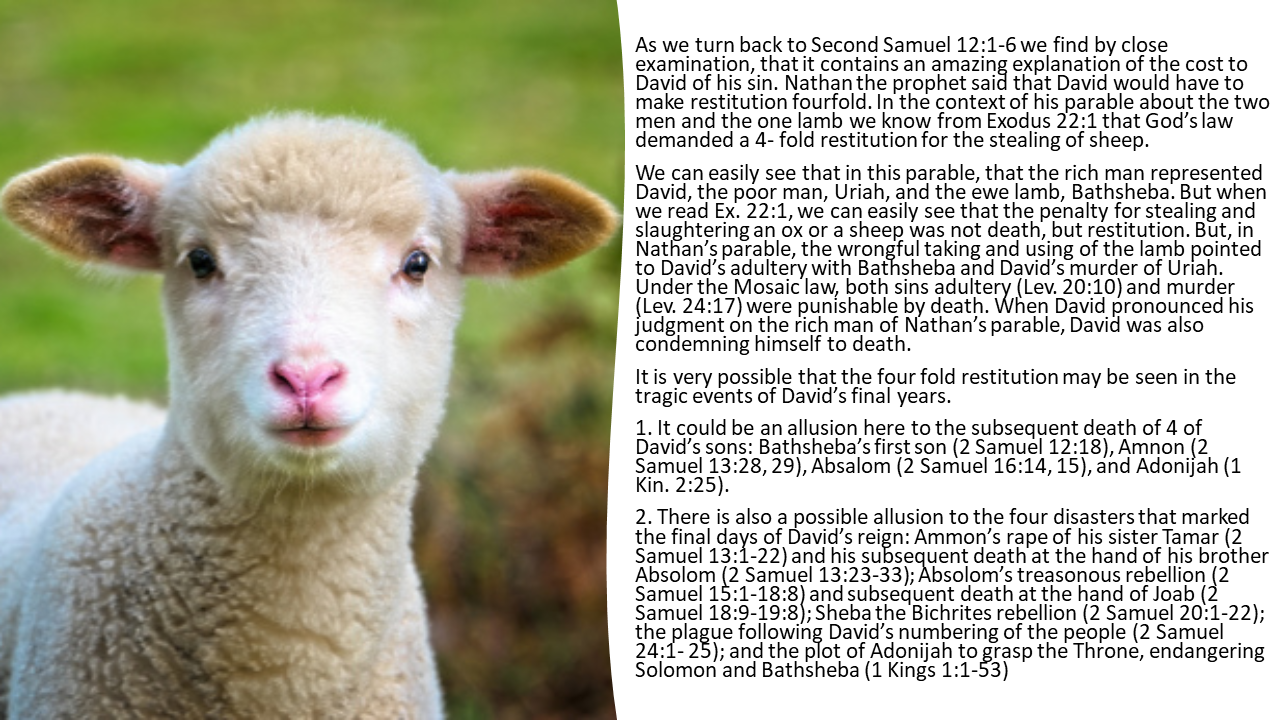
As we turn back to Second Samuel 12:1-6 we find by close examination, that it contains an amazing explanation of the cost to David of his sin. Nathan the prophet said that David would have to make restitution fourfold. In the context of his parable about the two men and the one lamb we know from Exodus 22:1 that God’s law demanded a 4-fold restitution for the stealing of sheep.
We can easily see that in this parable, that the rich man represented David, the poor man, Uriah, and the ewe lamb, Bathsheba. But when we read Ex. 22:1, we can easily see that the penalty for stealing and slaughtering an ox or a sheep was not death, but restitution. But, in Nathan’s parable, the wrongful taking and using of the lamb pointed to David’s adultery with Bathsheba and David’s murder of Uriah. Under the Mosaic law, both sins adultery (Lev. 20:10) and murder (Lev. 24:17) were punishable by death. When David pronounced his judgment on the rich man of Nathan’s parable, David was also condemning himself to death.

Four Fold Restitution
It is very possible that the four fold restitution may be seen in the tragic events of David’s final years.
- It could be an allusion here to the subsequent death of 4 of David’s sons: Bathsheba’s first son (2 Samuel 12:18), Amnon (2 Samuel 13:28,29), Absalom (2 Samuel 16:14,15), and Adonijah (1 Kin. 2:25).
- There is also a possible allusion to the four disasters that marked the final days of David’s reign: Ammon’s rape of his sister Tamar (2 Samuel 13:1-22) and his subsequent death at the hand of his brother Absalom (2 Samuel 13:23-33); Absalom’s treasonous rebellion (2 Samuel 15:1-18:8) and subsequent death at the hand of Joab (2 Samuel 18:9-19:8); Sheba the Bichrites rebellion (2 Samuel 20:1-22); the plague following David’s numbering of the people (2 Samuel 24:1-25); and the plot of Adonijah to grasp the Throne, endangering Solomon and Bathsheba (1 Kings 1:1-53).
What a lesson David becomes of the goodness and justice of the Lord. God’s grace is free, but the cost of sin is high.
Every sin I as a Christian commit is forgiven in Jesus Christ.” But no sin is ever right or good, and no sin ever produces anything right or good. The price for doing some things is terribly high, terribly unprofitable. Sin never brings profit; it always brings loss.
David was a man after God’s own heart and was greatly used of the Lord in leading Israel and even in writing Scripture. But David was not exempted from the consequences of his sin. He committed adultery with Bathsheba and she became pregnant. He then arranged for her husband to be killed in battle and took her as his own wife. “But the thing that David had done was evil in the sight of the Lord” (2 Sam. 11:27).
Through His prophet Nathan, God told David that because of his sin, “the sword shall never depart from your house. … I will raise up evil against you from your own household,” and “the child also that is born to you shall surely die” (12:10-11, 14).
David paid for those sins almost every day of his life. Several of his sons were rebellious, jealous, and vengeful, and his family life was for the most part a tragic shambles.[1]
When David faced the consequences for his sins he faced them in a godly way. Part of genuine repentance is the grace to go forward no matter what life may bring. Our text this evening shows the way a godly person faces abuse. When we are saved we begin to live for the first time in our lives deliberately. We know at last why we are here, where we are going, and how to get there.
We also know who wants to lead and guide us. And we want to follow Him. That is living deliberately. One facet of living deliberately is facing painful abuse in the strength of the Lord. And that is exactly what David did.
[1] MacArthur, John F., The MacArthur New Testament Commentary I Corinthians 6:12 , (Chicago: Moody Press) 1983, in loc.
Slides

Check Out All The Sermons In The Series
You can find all the sermons and short clips from this series, David’s Spiritual Secret here.
Looking To Study The Bible Like Dr. Barnett?
Dr. Barnett has curated an Amazon page with a large collection of resources he uses in his study of God’s Word. You can check it out here.