
If the video above is not available, here are two other ways to view:
How to Respond when Slandered
060827AM
DSS-35
2 Samuel 16:1-14
Transcript
.jpg)
.jpg)
Let’s open our Bibles to 2 Samuel. As you turn there, we’re looking at one of the oldest tricks in the book. The Devil likes to kick us when we’re down. David is down, as we saw last week, we’re right in the middle of looking at the saddest day of his life. What I want you to see this morning is just like someone who is just recovering from illness and they go into work and find out they’ve lost their job. Or, as happened to one of our dear friends this week, they got a second job to get out of debt, and on their first day on the job, they get held up at gunpoint and are robbed and they get further in debt. That’s what it’s like to get kicked when you’re already down, but what’s important is what happens next. What comes out of us when at the bottom, someone attacks us, when we’re already as far down as it seems we can get, and then insult is added to injury because that defines what we really are. David shows what happens when someone is trusting in the power of God, communicated to us through Christ, through what He did, the price He paid, the work He’s begun, and we find David showing us how to sing and how to come through the worst days of our life glorifying to God.
.jpg)
As we open to, in 2 Samuel 15, start in verse 14, I want to show you this kind of tracking with David. We’re watching him when he is down. It’s the saddest day of his life in 2 Samuel 15:14. It’s a day when he is at the bottom, when he is really down and driven out of town, and right in the midst of it, right as he’s getting driven, literally for his life, fleeing out of town, he gets hit unexpectedly. He’s attacked, slandered, painfully abused, and all of this from a totally unexpected source, a person he just did not intend to run into. In that moment, as we’ll see in this text, the real David comes out. The real David is exposed. Where you and I are at our most desperate moments is a glimpse into what we really are. Where we decide to turn when we’re kicked, when we’re down, shows us what is really on the inside. The good news is that what comes out of David at this most painful moment in his life is a song. In fact, we sang it. It was one of the choruses this morning, “Thou, O Lord, Art a Shield About Me.” That song is what comes out of David at this moment. The song that David sang is so good that God captured it and made it a forever-recorded-in-Heaven part of His Bible. When you have a song like that, it’s better than hitting the top of the charts.
When we lived in California, we lived next to a guy who had all gold and platinum records, and I don’t know how many you have to sell, hundreds of thousands, millions, I don’t know. But when we’d visit him, he was, by the way, the voice of Goofy. How do you like that? We live next door to Goofy. Maybe that affected me, I don’t know. But he was the Disney voice of Goofy, and all, they rate, I guess, the reprinting of the film or something. So, his whole wall was just covered with gold and platinum records. Better than having gold and platinum or top of the billboards, top of the charts, is to have God be pleased with what comes out of us. Whatever you and I can do in this life that pleases God, that’s what will make it to the top of God’s charts, and that’s what lasts forever.
David shows us how to live even in pain, even through tears, even while slandered, even when living through painful abuse. David shows us how to live pleasing God, how to gain eternal rewards from every part of our life. You don’t have to just teach or serve in a ministry. You can also gain rewards in addition to all those things in just living life in a way that pleases God. See, that’s what He measures. He doesn’t measure where we do it. He doesn’t measure what exactly it is we do. He measures why we do it and whether or not it pleases Him, and that’s what David shows us. David is barefoot, he’s crying, he’s fleeing for his life. He’s thinking, can it get any worse? That’s where he is in 2 Samuel 15, and that must have been on his mind as this saddest day unfolds, and the Bible records all of the events. It’s just fascinating, and I’m going to profile them for you, but God goes to great ends to record all these elements. David is speechless. His tears are running. The wail of sobs, as we saw last week, of his friends is rising about him. A lot of people don’t even realize this. David is about 60 years of age. Now, you know the little shepherd boy with the five stones in his pouch and hitting Goliath, but a lot has happened in between. As far as we know, this is sometime in the fall of 980 BC, so it’s almost a thousand years before Christ, about 3,000 plus years ago. David is at the bottom, and being at the bottom isn’t uncommon.
.jpg)
I think that a modern songwriter once felt a bit like David must have felt. In fact, he captured his feelings in twentieth century and twenty-first century terms about 35 years ago. It’s a songwriter many of us know. His name is Bill Gaither. Listen to Gaither’s testimony. If he would have been walking with David, this is what he would’ve been saying. If there were ever dreams that were lofty and noble, those were the dreams of mine at the start. the hopes for life’s best were the hopes that I harbored down deep in my heart—kind of like David ascending—but my dreams turned to ashes. My castles all crumbled, my fortune turned to loss. Then Gaither says what David experienced, so I wrapped it all in the rags of my life and laid it at the cross. Something beautiful, something good. All my confusion He understood. All I had to offer Him was brokenness and strife, but He made something beautiful of my life. That’s what God wants to do, and especially when we’re at the bottom, and especially when while we’re at the bottom we get kicked, hit unexpectedly one more time.
.jpg)
We’re in the darkest day of David’s life. Remember how Satan often attacks when we’re at our weakest point? David was at the bottom, but life was just about to get a little worse. So much is happening to David all at once. Actually, it starts in verse 13. A messenger comes to him in 2 Samuel 15:13 and says, the hearts of the men of Israel are with Absalom. So, as we read from verse 14 on, all these details, I want you to remember what we saw last week. Number one, God catches each detail in this text for His purpose of doctrine, we learned last week, teaching us what God thinks is right, so God’s going to show us what is right in this situation. Secondly, for reproof, teaching us what’s wrong. Thirdly, for correction, teaching us how to get right. And in instruction in righteousness, how to stay right. That’s why God preserved these pages of Scripture that lay open before us.
So, in verse 14, we see David with all of his servants who are with him at Jerusalem saying, arise, let’s flee. So, David in verse 14 leaves the city of David on Mount Zion, where it still sits today, and it’s being excavated. Every time I go over there, they got more of the city of David out from under the dust of time. He walks down Zion, and look at verse 23 of the same chapter, into the Kidron Ravine. He just crosses over the little brook of flowing water. By verse 30, he’s following the pathway up the Mountain called Olives. At verse 32, he pauses in the midst of the darkest day of his life, in the midst of all of his swollen red eyes and tears and wailing, and he’s barefoot. Look what he does in verse 32. He pauses and offers worship to the Lord.
Then he runs into a series of people: Hushai the Archite, and then he is run into by Ziba the servant of Mephibosheth. If you remember, he’s the crippled son of David’s friend, Jonathan the son of Saul. He brings food to help David. That’s the first four verses of chapter 16. David, remember, the whole time is joined by his faithful soldiers. There’s hundreds of them, 600, they’re actually numbered, and they are mighty men. He’s been sought out by the good and godly priests. He’s been fed by the humble servants of others. So, the last visitor that comes to him, which is going to be the text we’re going to read when Shimei comes along in verse 5. This last one was so unexpected. After the worst day of his life had dawned, David starts having a wave after wave of comfort. The mighty men come with him, and the priests come with him, and the friends from afar come, and they bring supplies, and great wise people come and counsel, and he’s even at the mountaintop able to worship the Lord. But in all of this, David is just reeling. The whole insurrection coup d’état was so unexpected, he just can’t believe the speed at which everything fell apart. When our lives fall apart, it just happens so fast. It’s like a blowout on the highway. It’s just you have to respond with instant reflex.
But David couldn’t believe his trusted son drew away the entire nation. David’s thought raced back and forth from all the battles he had fought to save these people defected from him, now, from their past enemies, he’d given his life for them. That’s often what happens. The people closest to us often can inflict the most injurious wounds. Now those people’s children, the people he’d rescued, their children had grown up and had become the army that was attacking him because usually armies are made of the young and strong and the youth of the land. Absalom had garnered his generation to join in trying to kill David.
.jpg)
Then he thought how often he’d rescued Absalom before Absalom was old enough to even realize it, David had kept him from Saul’s hand. David had to evacuate his family because Saul was trying to kill them. Later, David had risked his life to attack the raiding bans of the desert peoples who had kidnapped Absalom and his mother and all of the rest of David’s family. David attacked them in the desert, rescued Absalom from their grasp. Then David remembered bringing young and handsome Absalom up to Jerusalem the city of David, Zion the city of God. How it had thrilled David’s heart to build a home for Absalom to live in and provide for. David used to come home from his work, and he’d see all of his family and children playing, and his wives so happy, but nothing would ever be the same. Tamar had been raped by Amnon, Absalom had killed Amnon, and now Absalom was seeking to kill his own father, David. Nothing was right. Nothing would ever make this go away. So, back and forth David’s thoughts, painful questions, kept flooding his mind. Why do the people turn away so quickly? Why does my own son hate me? Why does God allow all this?
And then as David looks around at his mighty men, all 600 of them. But the inner core are the 30 mighty men drawn up marching around him like a wall of strength. There was a space that was once occupied by the bravest of the brave, and that little space very close to David was empty. then in a moment, the same Uriah that went to his death, at David’s deceitful bidding and murderous plot did so because he had been loyal all of his life to David. David saw that empty spot, and it just flooded his mind again. This whole painful memory of what he had done. So, David’s thoughts raced back and forth over the years, and he was smitten with contrition. He knew again the consequences he was suffering because he’d sinned against the Lord.
In the midst of all that, in the midst of all those thoughts of son, and family, and nation, and mighty men, and God’s forgiveness, while still barefoot, while still trudging along somewhere in the midst of those thoughts mingled with tears, a barefooted David hears trouble coming. Before he saw him, he could hear the hatred of his curses. Coming up from Bahurim, we’ll see in the text, the first village on the downward slope of the Mount of Olives as it goes toward the Jordan River, is the figure of an angry man, bitter to the point of blindness. This distant relative of King Saul with the poison of a venomous serpent on his tongue, curses David. Dust and rocks fly from a one-man army named Shimei. With every means possible, he tries to attack David when David is down. That’s what always happens. That’s when temptations come. The Devil, in alliance with our flesh, and the world around us, and the demons, always tries to get us at our weakest moment, and it was perfect timing. David was physically, emotionally, mentally, and humanly at his weakest and lowest point. But much to Satan’s disappointment, he was not spiritually at his lowest point, and that’s the essence of what we’re going to see. David’s response in the verses of our texts this morning are the most beautiful example of how to respond when attacked, slandered, and painfully abused, and that’s what David’s going to teach us.
.jpg)
Let’s look at 2 Samuel 16. Stand together with me and just follow along. I’m going to read starting at verse 1 down through verse 14, and then we’ll pray. I hope these verses are never the same to you again. I hope that your heart will be captured. The next time that insult is added to your injury, the next time you’re kicked when you’re down, I hope this song that David sings in this moment that we sang this morning will just flood your soul. Verse 1, 2 Samuel 16, when David was a little past the top of the mountain, there was Ziba the servant of Mephibosheth, who met him with a couple of saddled donkeys, and on them 200 loaves of bread, 100 clusters of raisins, 100 summer fruits, and a skin of wine. The king said to Ziba, what do you mean to do with these? And Ziba said, the donkeys are for the king’s household to ride on, the bread and summer fruit is for the young men to eat, the wine is for those who are faint in the wilderness to drink. The king said, where’s your master’s son? And Ziba said to the king, indeed he’s staying in Jerusalem, for he said, today the house of Israel restored the kingdom of my father to me. Now we know from the succeeding text, that probably wasn’t true, and Ziba was possibly an opportunist and took advantage of Mephibosheth’s immobility, but that’s a different section to study. Verse 4, so the king said to Ziba here, all that belongs to Mephibosheth is yours. Ziba said, I humbly bow before you, that I may find favor in your sight, my lord, the king.
Verse 5. Here’s trouble. Now when King David came to Bahurim, there was a man from the family of the house of Saul, whose name was Shimei the son of Gera, coming from there. And he came out, cursing continuously as he came. Verse 6, and he threw stones at David and at all the servants of King David. And all the people and all the mighty men who were on his right hand and on his left. Shimei said thus when he cursed the man: come out! Come out! You bloodthirsty man, you rogue! The LORD, verse 8, has brought upon you all the blood of the house of Saul, in whose place you have reigned; and the LORD has delivered the kingdom into the hands of Absalom, your son. So now you are caught in your own evil, because you are a bloodthirsty man!
Remember, Shimei’s on the upper ground, the hillside. He’s throwing handfuls of dust and rocks and just spitting out curses and kicking, and verse 9. Remember I said the wall around David? Then Abishai the son of Zeruiah said to the king, why should this dead dog curse my lord the king? Please, let me go over and take off his head! Now, that was very direct. He said, let me just lift his head with my sword. He’d done it often! But the king said, what have I to do with you, you sons of Zeruiah? So let him curse—now look at David’s view of the sovereignty of God—because the LORD has said to him, curse David. Wow. David didn’t immediately repel attacks thinking, that dirty, rotten scoundrel! Go finish him off! He said, God doesn’t allow anything to happen except for His purpose. Don’t get in the way of God. Who then shall say, the end of verse 10, why have you done so?
And David said to Abishai and all his servants, see how my son who came from my own body seeks my life. How much more now may this Benjamite? Let him alone, let him curse; for so the LORD has ordered him. See, David saw all adversaries, all enemies, all attacks, all unexpected kicking when he is down, he saw that as being always coming through the lens, the filter of the sovereignty of God who works all things together. Nothing can come through into our life that doesn’t go through that filter. God has already pre-designed that all things He is causing to work together for good. David, long before Romans 8:28, knew the same God and trusted Him, and so he says, the LORD has ordered him, verse 11. He accepted this from the LORD. Verse 12, it may be that the LORD will look on my affliction, and that the LORD will repay me with good for his cursing this day. And as David and his men went along the road, Shimei went along the hillside opposite him and cursed him as he went, threw stones at him and kicked up dust. Now that is true meekness on David’s part. He had the mightiest of the mighty. One man in his army killed 850 enemies with one spear. I don’t even know if I could kill one person with a spear, let alone being surrounded by thousands and kill 850 of them. He had the best of the best, and he didn’t exercise that strength. Verse 14, now the king and all the people who were with him became weary; they refreshed themselves there. What a wonderful portion of God’s Word.
.jpg)
Let’s bow together in prayer. Father, I thank You for capturing these details. May they never escape us, that You weren’t just looking to fill out a quota of pages, that You supernaturally engineered this book for a purpose. we want to, by careful waiting before You with your Spirit’s illumination of our hearts, we want to know what You want us to know, and we want to learn the doctrine, what’s right. We want to be corrected, what we’ve done wrong. We want Your reproof and instruction in righteousness showing us how to do what pleases You and how to keep on staying in that path. So, I pray this morning we’d learn that, and that it would always come right back to the whole source of our spiritual life and power, and that is Your sacrifice for us, Lord Jesus, that makes it possible for us to respond when we’re attacked, and slandered, and painfully abused in the way David did. Because it glorifies You when we allow Your grace to be sufficient for us. In the name of Jesus, we thank You, amen.
You may be seated, and as you’re seated, I want to just go through this whole passage with you and look at all these sad moments of David’s life. Because as David faced all the consequences, remember we’re in the consequence section, as he faced all the consequence section of his sins, God was looking how he’d respond to them because even as he responded, he was able to glorify the Lord going through all this pain. The good news is what we just read in these 14 verses, David responds consistently through his painful consequences for God. He, before Bathsheba and after Bathsheba, was truly God’s man. What we see is that Bathsheba was merely him slipping into sin, repenting, and walking back to the walk he’d always walked from then on, and that’s the joy.
This is the third section that we’re looking at in the final section of David’s life, and this final section is the 20 years, the last 20 years of his life. He probably slipped into sin with Bathsheba at age 50, 10 years of little problems: little daughter raped, son murdered. But now things culminate with rebellion from Absalom. This period of time is flowing from David’s unguarded moments, which we examined in depth, his unguarded moments that led to sin. That’s Uriah and Bathsheba, that whole thing. The sobering reminder is the second part. We’re right in the middle of this, the inevitable consequences of that sin, and there’s a whole era of David’s life that’s just filled with looking at the inevitable consequences. Chapter 15, where we were looking, chapter 16, where we read, are just two of 11 chapters of consequences that the Bible records. It’s just massive, the inevitable consequences that led to pain in David’s life. David, in this painful time, writes a successive group of psalms. We’re going to see one, especially this evening, where he writes this right there as he’s fleeing from Absalom, and he writes Psalm 3. He also writes Psalm 31, Psalm 55, most likely Psalm 63 that was alluded to also this morning.
.jpg)
Of course, the good news is from the God of new beginnings, that the last chapter of David’s life is the chapter where he, through humble obedience and proper responses to the Lord, has a joyful ending despite his failures with Bathsheba. David truly was a man after God’s own heart, and he ends so well, and we’ll see that not too long in the future.
But here’s a summary of what is in the first 14 verses. If I was to summarize verses 1 through 14 of 2 Samuel 16, it would be this: even when we face the consequences of our sin, even when they’re so painful, it is even then we can praise God, glorify our Savior and experience His grace that’s more than enough. So, don’t lose heart if you’re going through consequences of former events in your life. Even then, you can offer some of the richest praise and magnify the Lord, and glorify Him, and have a life that lasts forever because it pleases God.
.jpg)
Back up to chapter 15, 2 Samuel 15, and I want to start and just show you the elements of how God was glorified during David’s painful consequences starting in 2 Samuel 15:19. I want to show you through the time we have this morning if we have enough time, eight wonderful truths, eight beautiful lessons that David gives us of a right response to a painful consequence. The first one is in verses 19 through 21 of 2 Samuel 15. It says in 19, the king said to Ittai the Gittite—we read this last week—why are you going with us? Return and remain. This is when they’re leaving town, and this is when the mighty men join him. Verse 20, in fact, you came only yesterday. Should I make you wander up and down with us today? And verse 21, Ittai answered the king, as the LORD lives, and as my lord the king lives, look at the end of verse 21, surely whatever place my lord the king shall be, whether in death or life, even there also your servant will be.
The first lesson is when David was at the bottom, first lesson is God sent him help. Did you know that? The Lord knows right where we are every day. What you’ll find is, in fact, even yesterday we were at the Tulsa Zoo, and we were, I think, somewhere between the hippos, and the rhinos, and the elephants or something, and the phone rang. It was, the phone rang, my phone, it was for Bonnie, and I gave it to her, and I heard her listen and share a little word of counsel. She closed the phone and handed it to me. I said, what was that? And she told me, and she said, let’s just stop right here. So, the kids were on the spider web, and the elephants were okay by themselves, so we just stood there and prayed. We prayed for two things: that at that moment the Lord would send that person in desperate need someone that would encourage them, and that the Lord would help them see their sin. So, we went on merrily looking at all the other animals. About two hours later, the phone rang again, and it was the same person. They said, you wouldn’t believe what happened. Right after I talked to you, someone came to me. See, isn’t that what happens right here in 19 through 21? The Lord, when David was at the bottom, God sent him help, and that’s what God always does. If you want to pray for someone in a situation, pray for that perfect person that will be right there like Ittai the Gittite.
.jpg)
But keep going. Look at verse 25 because when David was at his weakest point, secondly, not only does God send him help, but he waits for God’s provision for all of his other needs. Verse 25, then the king said to Zadok, carry the ark of God back into the city. If I find favor in the eyes of the LORD, verse 25 says, He will bring me back and show me both His dwelling place and the ark. You notice David doesn’t try and take things into his own hands. David waits for the Lord to provide the rescue he needs. He doesn’t rescue himself. He doesn’t defend himself. David left his burdens with the Lord, and he didn’t have to take matters into his own hands. Notice David does not have to grasp onto things. Do you remember the ark? That was quite an amazing little box. God designed it, Moses had it built, it became the representative of the presence of God. God’s glory hovered over it. When the Philistines captured it in battle, it wiped out the whole nation of the Philistines. It was killing them faster than Israel could have killed them. It was a powerful little thing to have around. David said, I don’t want it. He said, I don’t need a representation of God. I don’t need to grasp some trinket and some object to help me be delivered. He says, because I have God Himself. Do you understand? He says, take the box back. I don’t need it. I don’t need to protect myself. The strength and serenity that David had only could come from the Lord. It’s unusual, it’s magnificent to see such strength. David knew the Lord was with him. He didn’t need a box covered with gold to remind him he had the Lord Himself. He would leave the ark and the tent and go out of the city trusting God alone. So, you can make it even without all the normal things that hold us up through life. What he’s saying here is I don’t need to drag along my whole support system because I have the most important part. I have the Lord. I don’t need the box. I don’t need the priests. I don’t need you, and I don’t need to grasp, and protect, and defend myself.
.jpg)
Keep going to verse 30 because thirdly, when David was at the lowest moment of his life, he bows and offers up a psalm of praise to God. This is really what we’ll find, especially tonight, was the essence of his life. He didn’t get drowned in his depression and sorrow because he praised God even at the darkest times. Verse 30, so David went up by the Ascent of the Mount of Olives and wept as he went up; had his head covered and went barefoot. We’ve seen that repeatedly. And all the people with him were wailing and weeping as they went up with their heads covered. But look at verse 32, now it happened when David came to the top of the mountain, he worshiped God. That’s where he worshiped God. He came up to the spot where he was physically as high as possible to be, and at that moment of his sorrow, and his weeping, and his bare footedness, he just worships God. Something happens in that moment. Something happens in that exchange that carries him through the Shimei deal that we read when we stood a little while ago. God’s servants can continue to worship even when life is tough, and difficult, and almost looking like it’s impossible. That record of worship that flowed from David can flow from us. David worshiped God.
What did he worship about God? The third psalm is divided into three parts. We’re going to see it tonight. Each one is ending with that Selah, Selah, Selah. First, he reiterated the terrible place he was that everybody is saying there’s no help from God. Then he says, God, You’ve always helped me and always heard me, and I trust You. So, the last section said, so I can lay myself down and sleep. David didn’t deny his problems. He remembered God’s faithfulness, and he trusted God, and that’s what comes out of him in the third psalm. David trusted God’s control even through bitter tears of sorrow and grief. He relied on it, prayed for it, and instead of fear, he had faith and gave worship. Something changes right here in verse 32, and David isn’t the same. He can’t even look up. He has his head covered; his tears are rolling. He’s walking like this, trudging along till he gets to the top of the mountain. He must have just been processing all this, and then he worships God, praises God, lifts his heart to God. He can go through the whole Shimei thing.
.jpg)
Look at verse 31 that I skipped over because the fourth truth we learned… The first truth is when David was at the bottom, God sent him help. Second truth is when he is at his weakest point, he waited; he didn’t take matters in his own hands. Third one is when he is at the lowest moment, he bows and offers up a psalm of praise. But fourthly, in verse 31, when David was in the least control of his circumstances, he entrusted his situation to the Lord. He’s the least in control at this moment. Look what happens in verse 31, then someone told David, saying, Ahithophel is among the conspirators with Absalom. That was the worst thing that could happen because Ahithophel was the man that was so wise that whatever he said was just like hearing from God. He was the chief counselor for good reason; David knew that he had helped him immensely. Now, look what David does. David said, verse 31, O LORD, I pray, turn the counsel of Ahithophel into foolishness! What did David do when he was in least control of his circumstance? He turned his situation over to the Lord. He said, I can’t do it. I can’t. I’m, I’ve run out of town. Ahithophel is back there with all the armies of Israel and my renegade, rebel son. I can’t do anything except give it to You. You know what you’ll find out? Anything you give to the Lord, He does a much better job.
You remember the story of Sir Walter Raleigh and Queen Elizabeth? And how Raleigh was asked to go on a voyage, and he says, I don’t know how I can do this. The queen says, while you’re away, I’ll watch over your business. When Sir Walter Raleigh came back from his voyage to the New World, he found all of his businesses were so magnified. He had the greatest business because the queen had done all of her shopping through all of his different companies, and he was a wealthy man. That’s a material sense of the spiritual reality that David realized.
When he didn’t know what to do and he couldn’t do anything about it, instead of muddling through and making a mess, he just said, You’re going to have to take this Lord. And he says, LORD, the end of verse 31, I pray You take the counsel of Ahithophel and make it foolish! People can often share reports that either lead us to fear or prompt us to prayer. David, it prompted him to pray, and he lifted his heart in prayer to the Lord at this evil report. That was the worst thing that they could have said militarily, that Ahithophel was on the opposition. David knew it, and he didn’t let that get him. He just lifted it up to the Lord, and the very next verse is, he worships God. That was a whole part of the process. So, fourthly, when David was least in control of his circumstances, he entrusts his situation to the Lord.
.jpg)
Now, slip over to chapter 16 and look at verse 9 because I want to get all of these principles. When David was attacked, he realized God allows adversaries for his own purposes. Now, that’s one we all need to learn. That’s the fifth one. When you and I have an adversary attacking us, someone that’s making it their job to make our life miserable, we need to realize what David realized. Look at verse 9. Abishai, the son of Zeruiah, said to the king, why should this dead dog curse the king? Let me take his head off! Look at David’s response, verse 10, what have I to do with you? Let him curse, because the LORD has said to him, curse David. Nothing can happen without God allowing it to happen, and God doesn’t just push things off and see how they’re going to turn out. God causes all things to work together for His good and secondarily for ours. That’s the one we have trouble with. Okay, You’re in control, God. But what about me? God says, whatever’s good for Me is good for you, and I’m not going to let anything happen that is not going through the lens and the filter of My sovereign care of you.
So, David knew that lesson. He says, the LORD has said to him, and then look at the end of verse 11, let him alone, let him curse; for so the LORD has ordered him. David entrust his personal adversaries to the LORD. David knew that God raises up and puts down. He knew adversaries are allowed by God, and he wanted to respond correctly. God often allows us to be attacked by various adversaries just so God can see what’s inside of us and let it come out. So, the next time you have an enemy and you have an attack, and you have an adversary, you have a persistent person that’s dogging you at work, or at school, or in your family, or in whatever, in your neighborhood that just keeps coming, acknowledge the fact, as verse 10 tells us, that the LORD has said to them, bother you. when David was attacked, he realized God allows adversaries for His own purposes. What we’re supposed to do is instead of getting rid of the adversaries, and undermining them, and discrediting them, and letting the world know that they’re false, we step back and say, what kind of response are you looking for from me from this, Lord? See, that’s what David did. He stepped back, and he said, what response do You want? And the Lord said, I want you to see that I am in charge of your situation and your circumstances. David said, great, You can do things better than I can. Take over. that was such a turning point in his life.
.jpg)
The next one is in verse 12. Look at 2 Samuel 16:12. When painful abuse was overwhelming him, David fled to the Lord for hope. It says in verse 12, it may be the LORD will look on my affliction, and the LORD will repay me with good for his cursing this day. You notice what he doesn’t say? He doesn’t say, let him have it, Lord. Eat him up, burn him up, kill him, send him to whatever! He says, maybe the LORD will repay me with good for all of his cursings. What David is saying is when he was overwhelmed with painful abuse, but he fled to the Lord, not for vengeance, but for hope and for the Lord to bless him. David knew God cared. He knew that God saw his troubles. He knew the Lord can cause all things to work together for good. He always entrusted his personal sufferings to the Lord.
He didn’t do his own self pain management. Nowadays, they have the little things. You’re in the hospital, and you can push the little button and get a little [pain killer] … you are in charge of your pain management. We like that. We like to be in charge of our management of our life. We like to manage our pain, and our suffering, and our afflictions, and we just want to push that button, get a little another drip so we don’t feel it. God says, no, no, no… That’s nice. I’m glad you have pain management, but that’s not how I run things in your life. I want you to entrust to Me your afflictions and your troubles.
.jpg)
Keep going down to… another one, it’s in the next chapter. Go to chapter 17 and verse 14 because the seventh lesson, we’re going to see this morning, real quickly is this: even when David’s situation looked hopelessly impossible, God was managing everything. Do you remember that little prayer that David offered in chapter 15? He said, turn the counsel of Ahithophel into foolishness. Look at the answer to that prayer in 2 Samuel 17:14. It says, and Absalom and all the men of Israel said, the counsel of Hushai the Archite is better than the counsel of Ahithophel. Now look at the next part. I have it all underlined and marked in my Bible. For the LORD had purposed to defeat the good advice of Ahithophel, to the intent that the LORD might bring disaster—or evil—upon Absalom. Now, look at this. David entrusted his vengeance to God, and God took it. God caused foolish Absalom to not accept the best counsel of all. If Absalom would’ve deployed his army, if he’d have just sent the ones he had at that moment instantly out, and if they would’ve chased David, they could have overrun David and his 600 older mighty men that were with him. All these young, new zealous warriors could have just ran over them, and they could have zeroed in and gotten David, and he would’ve been gone. He would’ve been assassinated. God knew that, and so God frustrated the wise counsel of Ahithophel by using his servant Hushai the Archite.
What does that mean? When David’s situation looked hopelessly impossible, God was managing everything, and He gets all the credit. When we let God take care of us, when we entrust our personal vengeance to the Lord, the Lord can do what we could never possibly imagine to remedy the situation. That’s why it says in the Bible, vengeance is mine, saith the Lord, Hebrews 10:30. We should allow the Lord to recompense our enemies. David had many enemies, many adversaries, but he let the Lord deal with all of them. That’s why he was undefeated. David never, ever took a battle on his own except one that wasn’t even a battle. It was a small temptation he allowed to get out of hand and overwhelmed him, and we know that story. But every other battle David entrusted to the Lord, and he always won.
.jpg)
Go to verse 27 of 2 Samuel 17. Here’s the last one, 2 Samuel 17:27. At just the exact moment God planned, all of David’s needs are met. Verse 27, now it happened. I love that. It’s kind of like, just happened. Oh, what a coincidence! Isn’t that a remarkable coincidence? Can, don’t you see? It’s just so cute! Now it happened when David had come to Mahanaim. Now, that’s on the other side of the Jordan. He’s finally where he is going to camp for the night. That Shobi the son of Nahash from Rabbah of the people of Ammon, Machir the son of Ammiel from Lo Debar, and Barzillai the Gileadite from Rogelim. You ought to read that for devotions, right? That’s a great tongue twister, okay! Verse 28, brought beds and basins, and earthen vessels and wheat, and barley and flour, and parched grain and beans, and lentils and parched seeds. Boy, were they healthy! I don’t think any of those things we could find nowadays in the stores. Verse 29, honey and curds, sheep and cheese from the herd, for David and the people who were with him to eat. For they said, the people are hungry and weary and thirsty in the wilderness. Isn’t that amazing? Just at the right time. If they would’ve come with all that stuff on the top of the Mount of Olives, how would they have carried it all? And they might’ve dropped it when they got angry at Shimei cussing them out. If they’d have got it on this side of the Jordan, they couldn’t have got it across the Jordan. Isn’t God’s timing perfect? At just the exact moment God planned, every need David had was met. That is just such a beautiful little section. God works behind the scenes in the heart of people to provide just what David needed to continue on, so a servant of the Lord must always entrust his personal needs to the Lord. Okay?
.jpg)
Now slip back to chapter 15 and verse 30, and that’s where we’re going to close this morning with the reference that we get there. Because David was at his lowest point, and at his lowest point we see that God sends him help. Right then, all those men join him. He waits for God’s provision. He doesn’t take the ark. He bows and offers up this worship we’re going to look at in verse 30. He entrusts his situation to the Lord. He says, remember that little prayer? LORD, confuse Ahithophel’s counsel. Make it foolish. He didn’t chafe at the adversaries that the Lord sent. He said, don’t cut off the head of Shimei. He fled to the Lord for hope. He says, LORD, You’ll repay me for good, won’t You? He saw God was managing everything because the Lord defeated Ahithophel’s counsel. And at just the right moment, he gets everything he needs. But look at this, back to verse 30. David’s going up the Mount of Olives. The pathway is still there today. There is an ancient pathway. The one Jesus walked on, the one David walked on, and the one all the pilgrims walk on. It’s just the road over the mount of Olive. It follows the natural terrain. He’s just trucking up that, weeping as he went up, head covered.
And look at verse 32, it happened when David came to the top of the mountain, he worshiped God. Now, there’s a whole, the very first psalm called a psalm in the Bible, the very first psalm in the Bible that has David’s name on it, the very first psalm in the Bible that tells us what the event is that that psalm’s written about, and the first psalm that’s punctuated with the little exclamation point, Selah, Selah, Selah, stop and think about it, is what David wrote at this juncture in his life. God’s servants can continue to worship even when life is tough, and difficult, and almost looking like it’s impossible.
I want you to turn now to the exact record. I have written in my Bible right next to chapter 15 verse 32, I wrote a little arrow like that and I wrote Psalm 3. So, slip over to Psalm 3, and this is where we’re going to pick up tonight. But for all of you that have better things to do, you’re going to miss it, so I’ll give it to you right now so you can do whatever else you want to do and miss this, but I’ll give it to you now. Psalm 3 real quickly.
.jpg)
Look at Psalm 3. This is what the exact record of the worship that flowed from David. This is what can come from us if we, like David, will bow in worship when the bitter tears of sorrow and grief fall across our life. This is what can come out of us when we know and trust God is in control, when we rely upon God and pray for His help, and instead of fear, we can have faith in worship. So, what does David do? He writes a psalm. A psalm is a worship song. It’s a truth offered to God in worship that’s to be shared by participation. And by writing this psalm, David invites us, with God’s help and power, to join in with him. When we’re attacked, when we’re down unexpectedly and kicked when we’re really at the bottom, He said, why don’t you let this come out of you too?
Psalm 3. Now, if you have a Bible that follows the Hebrew manuscripts, you should have somewhere written before verse 1, you should have a little something there, and it should say something like this. A Psalm of David when he fled from Absalom his son. Okay? That’s the very first verse in the Hebrew manuscript. That’s in the Bible of Jesus and the apostles that they carried around, that was verse 1. It’s the first time anything in the Bible is called a psalm, so it’s really the first literal named psalm. Secondly, it’s the first time David is listed as the author. Thirdly, it’s the first time we know why a psalm was written. It says, look at, when he fled from Absalom his son. You know what the key is? Verse 3, look at verse 3 of the third psalm. But You, O LORD, are a shield for me, You’re my glory. It’s not my treasures back in Jerusalem, not all my war trophies back in Jerusalem, not all of my maps showing everything I conquered and own and all my records of my flocks, and herds, and vineyards, and everything else. No, You are my glory. You know what is really valuable in your life is what you would have if you lost everything you own. Every dime you had, whatever you have left, is what’s really valuable in your life. What did David have left? You, O LORD. You’re my glory, and I love this, You’re the One who lifts up my head.
Now, some of you have been a long time since you had little children at home, but when something happens, like they tip over on their bike, or they spill their milk, or their Lego creation gets knocked over and falls apart, or their painting gets smeared and you didn’t even know it was a painting and you thought it was trash and you throw it away, they are just like David. Tears running, head down and covered, barefooted, and standing before you and at the bottom. You know what David [said]? He uses a term from childhood. He said, LORD, You’re the One that puts Your hand under my chin, and You lift up my face, and You look at me and say it’s going to be okay. We can get it out of the of the trash. We can get a new bike. We’ll buy more Legos. Don’t worry. Look what he says, LORD, You are a shield about me. I don’t need to fear. You’re my glory. I can lose everything else. I have Christ. What want I more? And You’re the One who can lift up my head and let me see things correctly.
As we’ll see tonight, you know why most of us get discouraged? We have our head down. We’re looking at all of our problems. Run out of time, run out of money, run out of life, run out of health, run out of friends, running out of everything. The Lord goes like this [lifts our head]. Oh, You! I’m going to Heaven. Oh yay! I don’t need to worry about all that stuff. See, that’s what Psalm 3 is all about.
.jpg)
Let’s bow before our great One who lifts up our head and let Him lift our heads up. Father in Heaven, I thank You. You are a shield about us, whatever we’re facing, wherever we are in life, even when we’re at the bottom, even when someone insults us after we’re injured and we have every possible thing going wrong. If we’ll just stop like David did and worship You, You’ll lift up our head, and suddenly everything comes into perspective, and You are the One that we realize is our glory. And You’re all that matters, and having You is the greatest treasure in life. I pray You do some lifting up of heads today. Help us not to focus on our problems, our adversaries, our situation in life we’re in, but to let You lift our head. That’s through the power of the cross, through the power of Your death, Your burial, Your resurrection that cleaned us up and gives us new indestructible life. Help us to live that way through the power of Christ in us. And for any who don’t yet have that, may they realize that You are here and You’re able to save, and cleanse, and lift, and all You ask is for us to cry out to You that You be merciful to us in our sinfulness, and that we embrace You, O Christ and Your perfect sacrifice. So, let us live with You, the One who lifts up our faces. In the name of Jesus, all of God’s people said, amen. God bless you as you go.
Notes
 One of the oldest and meanest tricks in the book is to hit someone when they’re down. Just sneak up on them when they are distracted by something else and hit them with a knockout blow.
That is one of Satan’s tactics.
EXPECT SATAN’S ATTACK WHEN YOU ARE DOWN
He used it on Joseph after his being sold into slavery by his brothers, before he could get over that–Potiphar’s wife lands him in prison. But by God’s grace, it didn’t work, and Joseph keeps following the Lord!
For Job is was one wave after another of bad news, each wave higher, deeper and more devastating—and then his wife turns on him. But by God’s grace, it didn’t work, and Job keeps following the Lord!
We can trace the same pattern in Abraham’s life, Elijah’s life, Daniel’s life, and many other Old Testament heroes.
In our lives it may be when we are in the midst of recovering from being sick and we lose our job. Or just when we finally find a job our wife can’t go on and wants to move back to her family. Or just after we weather the loss of a parent through death we get a report that one of our children is secretly leading an alternate lifestyle.
It is sudden, it is unexpected—and it is always at our weakest moments when it is the worst time possible.
As we open to 2 Samuel 15:14 we are watching David while he is down. It is the saddest day of his life. And that day while he is at the bottom, when he is really down and driven out of town—he gets an unexpected hit. He is attacked, slandered, and painfully abused from a totally unexpected person. In that moment—we see the real David.
What you and I are at our most desperate moments is a glimpse into what we really are. Where we decide to turn, when we face what we never wanted, never dreamed of happening to us—that is when what is really on the inside comes out.
The good news is that what comes out of David at that most painful moment of his life is a song.
And it was a song that was so good, God captured it and made it forever recorded in Heaven. That is better than the top of the charts, better that the top of the billboard, better than gold or platinum—because it pleased God. What ever you and I can do in this life that pleases God; that is what will last from our life eternally.
Watch David show us how to live even in pain, even through tears, even while slandered, and even when living through painful abuse.
David shows us how to live pleasing God. We can gain eternal rewards from every part of our life that is lived in a way that pleases God.
Barefoot, crying, and fleeing for his life. Could it get any worse? That must have been on David’s mind as the saddest day of his life unfolded.
To face the hatred of pagan Philistines was one thing—but the hatred of your own son is quite another. To have a murderous father-in-law is devastating, but to have a murderous child is beyond words.
So David was speechless as his tears ran and the wailing sobs of his friends rose about him.
WHEN OUR DREAMS TURN TO ASHES
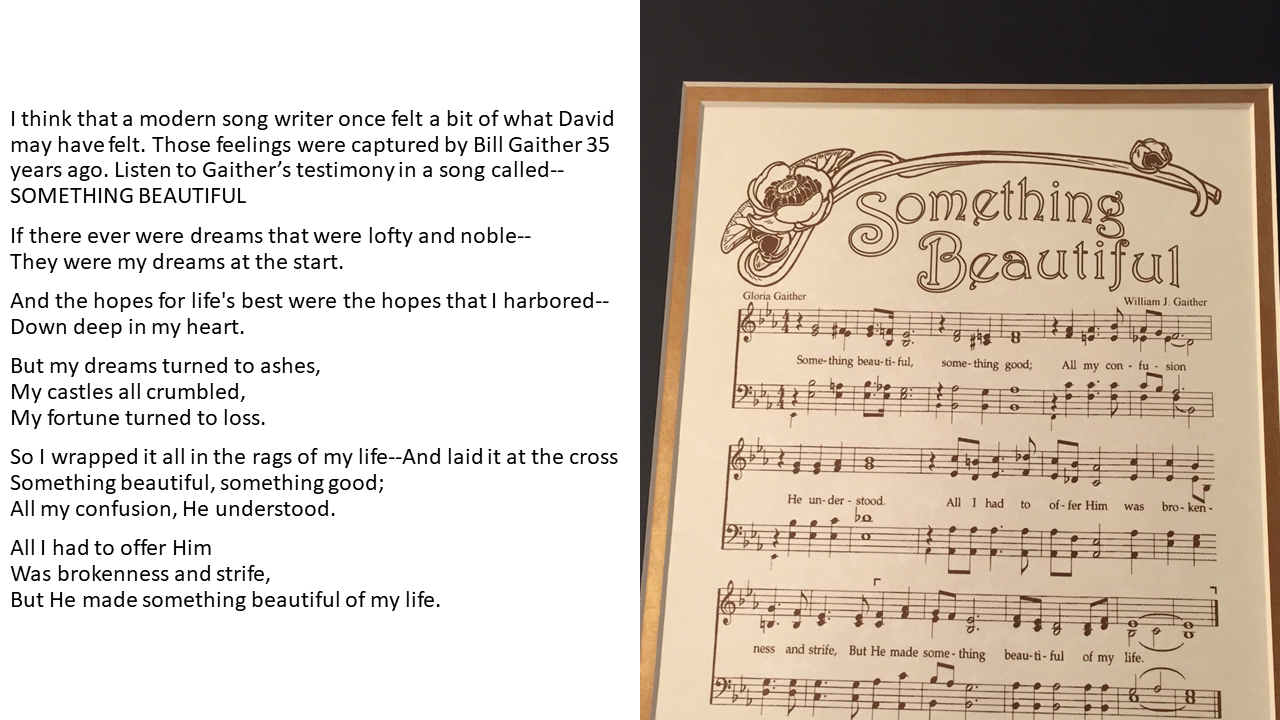
That was how life became for a nearly 60 year old King David in the fall of 980 BC1. I think that a modern song writer once felt a bit of what David may have felt. Those feelings were captured by Bill Gaither 35 years ago. Listen to Gaither’s testimony in a song called–SOMETHING BEAUTIFUL2
 If there ever were dreams that were lofty and noble– They were my dreams at the start.
And the hopes for life’s best were the hopes that I harbored– Down deep in my heart.
But my dreams turned to ashes, My castles all crumbled, My fortune turned to loss.
So I wrapped it all in the rags of my life–And laid it at the cross
Something beautiful, something good; All my confusion, He understood.
All I had to offer Him Was brokenness and strife, But He made something beautiful of my life.
Just as we saw last time, this was the darkest day yet in David’s life. Remember how Satan often attacks us when we are at our weakest point? David was down—and life was about to get much worse.
So much happened to David all at once, and God catches each detail for His purposes of doctrine (teaching us what is right); for reproof (teaching us what is wrong); for correction (teaching us how to get right); and instruction in righteousness (teaching us how to stay right). That is why God has preserved these pages of Scriptures that lay open before us.
Just to help you understand this day, God’s Word gives us a step by step account. Follow along in your Bibles as we trace the events of that fateful day.
In 2 Samuel 15:14 David has left the City of David on Mount Zion (where it still sits today now excavated after centuries beneath the dust of time); he walks down Zion to the Kidron ravine, passes over a small brook of flowing water (15:23), follows the pathway up the mountain called Olives (15:30).
At the very top he pauses (15:32) and offers worship to the Lord. Then he runs into Ziba the servant of Mephibosheth (the crippled son of David’s friend Jonathan, son of Saul) who brings food to help David (16:1-4)
David has been joined by his faithful soldiers and mighty men. He has been sought out by the good and godly priests. He has been fed by the humble servants of others. So this next visitor was so unexpected. But so was everything else happening on this fateful day.
David is just reeling from it all. The whole insurrection or coup d’etat was so unexpected. The speed at which a loved and trusted son was able to draw the entire nation away from David was staggering. David’s thoughts raced back and forth from all the battles he had fought to save these people of Israel from their enemies. And now those very people’s children were the army that had joined his son to kill him.
WHEN MEMORIES TASTE BITTER
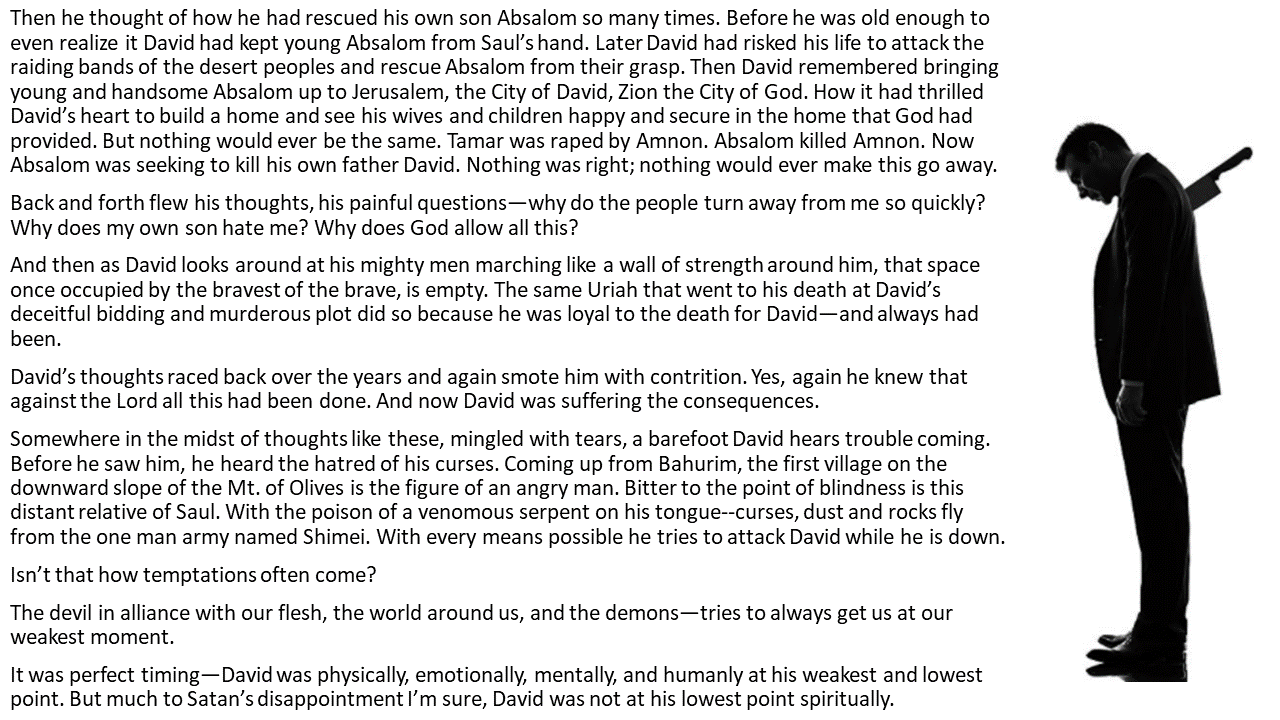
Then he thought of how he had rescued his own son Absalom so many times. Before he was old enough to even realize it David had kept young Absalom from Saul’s hand. Later David had risked his life to attack the raiding bands of the desert peoples and rescue Absalom from their grasp. Then David remembered bringing young and handsome Absalom up to Jerusalem, the City of David, Zion the City of God. How it had thrilled David’s heart to build a home and see his wives and children happy and secure in the home that God had provided. But nothing would ever be the same. Tamar was raped by Amnon. Absalom killed Amnon. Now Absalom was seeking to kill his own father David. Nothing was right; nothing would ever make this go away.
Back and forth flew his thoughts, his painful questions—why do the people turn away from me so quickly? Why does my own son hate me? Why does God allow all this?
And then as David looks around at his mighty men marching like a wall of strength around him, that space once occupied by the bravest of the brave, is empty. The same Uriah that went to his death at David’s deceitful bidding and murderous plot did so because he was loyal to the death for David—and always had been.
David’s thoughts raced back over the years and again smote him with contrition. Yes, again he knew that against the Lord all this had been done. And now David was suffering the consequences.
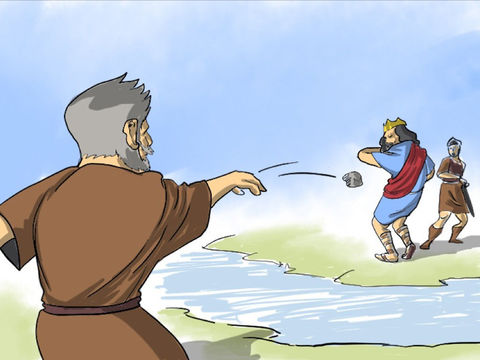 Somewhere in the midst of thoughts like these, mingled with tears, a barefoot David hears trouble coming. Before he saw him, he heard the hatred of his curses. Coming up from Bahurim, the first village on the downward slope of the Mt. of Olives is the figure of an angry man. Bitter to the point of blindness is this distant relative of Saul. With the poison of a venomous serpent on his tongue–curses, dust and rocks fly from the one man army named Shimei. With every means possible he tries to attack David while he is down.
Isn’t that how temptations often come?
The devil in alliance with our flesh, the world around us, and the demons—tries to always get us at our weakest moment.
It was perfect timing—David was physically, emotionally, mentally, and humanly at his weakest and lowest point. But much to Satan’s disappointment I’m sure, David was not at his lowest point spiritually.
WHEN ATTACKED—DO THIS
David’s responses, in the verses of our text this morning are the most beautiful example of how to respond “When Attacked, Slandered and Painfully Abused”!
Please stand with me as we read 2 Samuel 16:1-14.
Pray.
Now let’s examine this passage capturing the saddest of all moments in David’s life as he fled from his son Absalom. We know that this was part of the inevitable consequences. But even as David faced those consequences—God was still watching to see what choices he would make. Either he would respond in a selfish and thus sinful way, or he would respond in a godly or glorifying way.
The good news is what we just read. David responds consistently for God—before Bathsheba and after Bathsheba. He was truly God’s man—that slipped into sin, repented and walked the walk from there on out.
We are in part two of a three part examination of the final era David’s life. The first era starts when David seems from the biblical chronology to be about 50 years old. And in that era, David’s unguarded moments lead to sin—Uriah and Bathsheba.
Part two is the sobering reminder that the–
Inevitable Consequences of David’s sin led to PAIN—Absalom and Shimei.
Chapters 15 and 16 where we stop today are two of the eleven chapters from 2nd Samuel 12-21, and 24 recording the many years of painful consequences because of David’s sin. This inspired record of that period that I call “David’s Inevitable Consequences that led to Pain” explains the Psalms that flow from David’s PAIN. These are Psalms are 3; 31; 55; 63.
Of course the good news from the God of New Beginnings is that the 3rd and final chapter of David’s life records David’s Humble Obedience leads to JOY— Solomon, and the Temple.
It is here we see that despite the failures of Bathsheba incident—David truly was after God’s own heart. We see him end well, using his final days for God’s glory. Four chapters capture these years in 2nd Samuel 22-23 and I Kings 1-2. The Psalms that flows from this final era I call “David’s Humble Obedience that leads to JOY” are Psalms 18; 71.
But here is the summary of what God has captured for us in this text. o Even when we face the consequences of our sin, o even when they are so painful—it is even then that we can praise our God, glorify our Savior, and experience even more than ever His grace that is always enough.
Now as we go step by step through this sad and painful day we can mine 8 wonderful truths to live by when we also suffer abuse, attacks, and slander.
Look how God was glorified in David’s painful consequences.
1. When David was at the bottom—God sent him help.
2 Samuel 15:19-21 Then the king said to Ittai the Gittite, “Why are you also going with us? Return and remain with the king. For you are a foreigner and also an exile from your own place. 20 In fact, you came only yesterday. Should I make you wander up and down with us today, since I go I know not where? Return, and take your brethren back. Mercy and truth be with you.” 21 But Ittai answered the king and said, “As the Lord lives, and as my lord the king lives, surely in whatever place my lord the king shall be, whether in death or life, even there also your servant will be.” NKJV
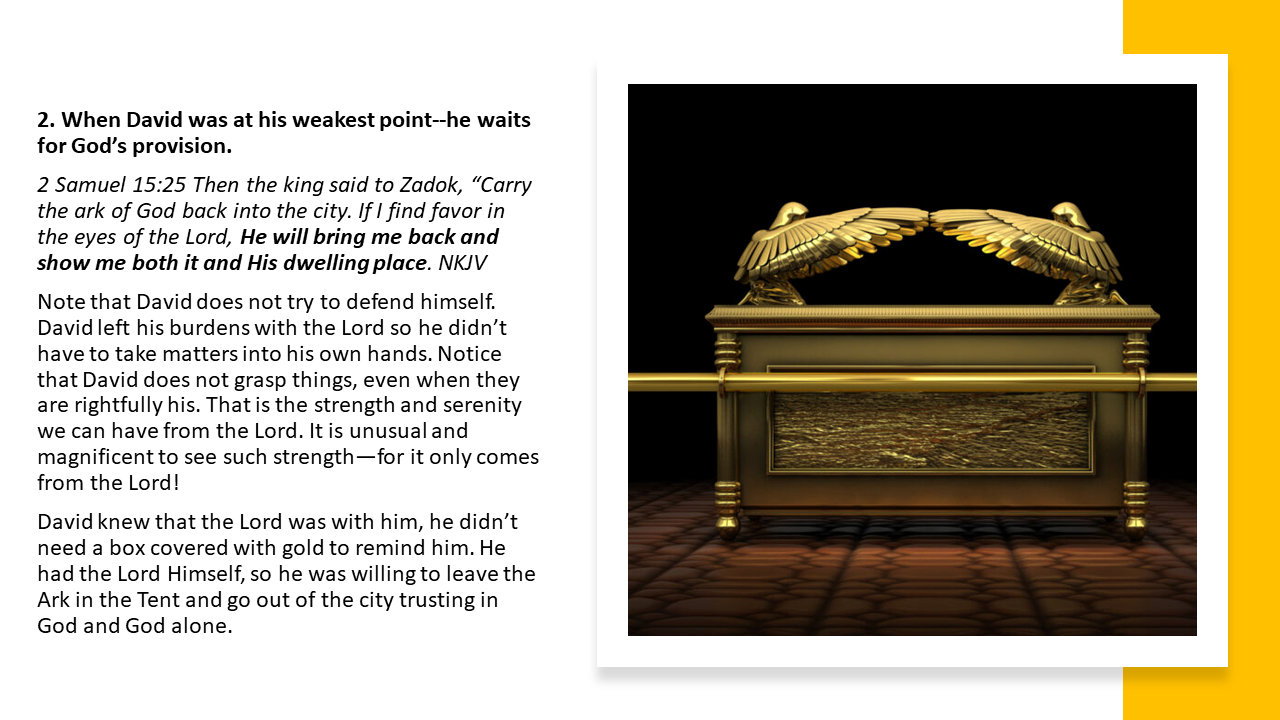
2. When David was at his weakest point–he waits for God’s provision.
2 Samuel 15:25 Then the king said to Zadok, “Carry the ark of God back into the city. If I find favor in the eyes of the Lord, He will bring me back and show me both it and His dwelling place. NKJV
Note that David does not try to defend himself. David left his burdens with the Lord so he didn’t have to take matters into his own hands. Notice that David does not grasp things, even when they are rightfully his. That is the strength and serenity we can have from the Lord. It is unusual and magnificent to see such strength—for it only comes from the Lord!
David knew that the Lord was with him, he didn’t need a box covered with gold to remind him. He had the Lord Himself, so he was willing to leave the Ark in the Tent and go out of the city trusting in God and God alone.
 3. When David was at his lowest moment of his life–he bows and offered up a Psalm of praise to God.
2 Samuel 15:30, 32 So David went up by the Ascent of the Mount of Olives, and wept as he went up; and he had his head covered and went barefoot. And all the people who were with him covered their heads and went up, weeping as they went up. 32 Now it happened when David had come to the top of the mountain, where he worshiped God—there was Hushai the Archite coming to meet him with his robe torn and dust on his head. NKJV
God’s servants can continue in worship even when life is tough, difficult, and almost looking like it is impossible to go on. Turn with me to the exact record of the worship that flowed from David. This is what can flow from us if we like David—bow in worship when the bitter tears of sorrow and grief fall across our lives.
David trusted God’s control—even through bitter tears of sorrow and grief. He relied upon it and prayed for it. Instead of fear he had faith and gave worship.
4. When David was least in control of his circumstances—he entrusts his situation to the Lord.
2 Samuel 15:31 Then someone told David, saying, “Ahithophel is among the conspirators with Absalom.” And David said, “O Lord, I pray, turn the counsel of Ahithophel into foolishness!” NKJV
People often share reports that can either lead us to fear or prompt us to prayer. David lifts his heart in prayer to the Lord at this evil report!
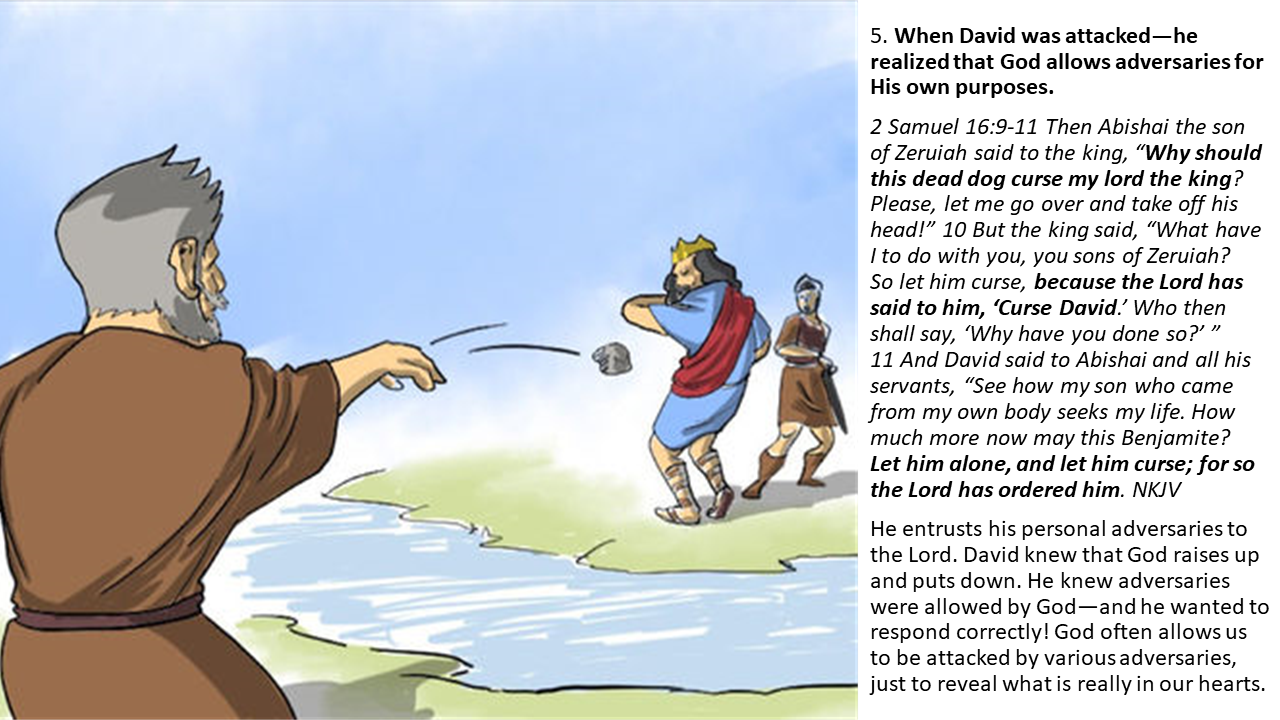
5. When David was attacked—he realized that God allows adversaries for His own purposes.
2 Samuel 16:9-11 Then Abishai the son of Zeruiah said to the king, “Why should this dead dog curse my lord the king? Please, let me go over and take off his head!” 10 But the king said, “What have I to do with you, you sons of Zeruiah? So let him curse, because the Lord has said to him, ‘Curse David.’ Who then shall say, ‘Why have you done so?’ ” 11 And David said to Abishai and all his servants, “See how my son who came from my own body seeks my life. How much more now may this Benjamite? Let him alone, and let him curse; for so the Lord has ordered him. NKJV
He entrusts his personal adversaries to the Lord. David knew that God raises up and puts down. He knew adversaries were allowed by God—and he wanted to respond correctly! God often allows us to be attacked by various adversaries, just to reveal what is really in our hearts.
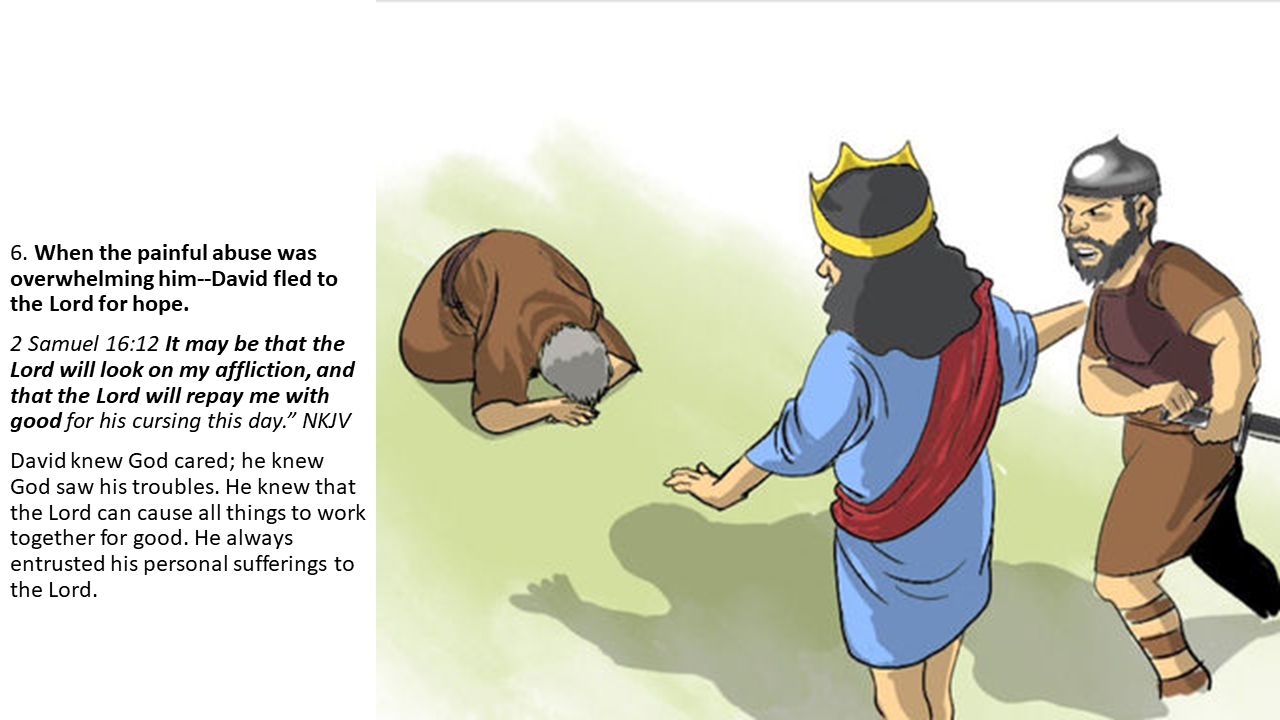
6. When the painful abuse was overwhelming him–David fled to the Lord for hope.
2 Samuel 16:12 It may be that the Lord will look on my affliction, and that the Lord will repay me with good for his cursing this day.” NKJV
David knew God cared; he knew God saw his troubles. He knew that the Lord can cause all things to work together for good. He always entrusted his personal sufferings to the Lord.
7. Even when David’s situation looked hopelessly impossible–God was managing everything.
Second Samuel 17:14 And Absalom and all the men of Israel said, The counsel of Hushai the Archite [is] better than the counsel of Ahithophel. For the LORD had appointed to defeat the good counsel of Ahithophel, to the intent that the LORD might bring evil upon Absalom. (KJV)
When we let God take care of us, and when we entrust our personal vengeance to the Lord—the Lord can do what we never could to remedy the situation. ‘Vengeance is mine saith the Lord’ (Hebrews 10:30). Allow the Lord to recompense your enemies. David had many enemies and adversaries, but he let the Lord deal with them all.
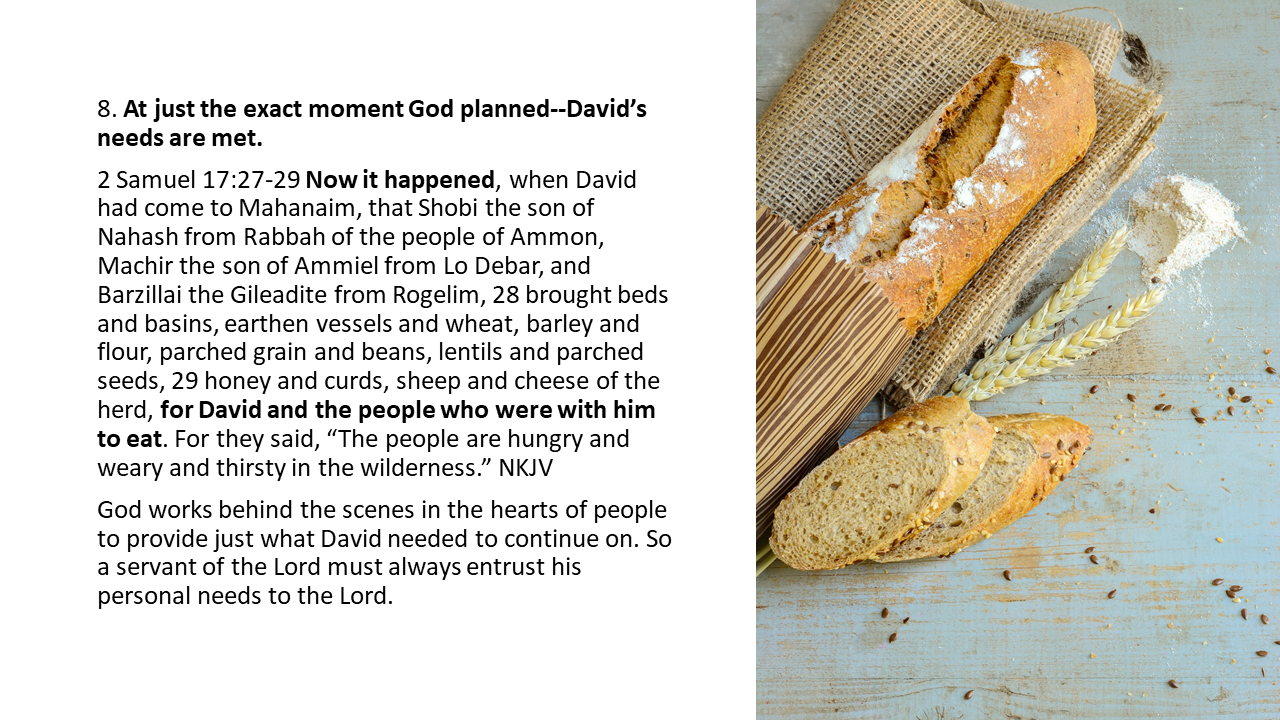
8. At just the exact moment God planned–David’s needs are met.
2 Samuel 17:27-29 Now it happened, when David had come to Mahanaim, that Shobi the son of Nahash from Rabbah of the people of Ammon, Machir the son of Ammiel from Lo Debar, and Barzillai the Gileadite from Rogelim, 28 brought beds and basins, earthen vessels and wheat, barley and flour, parched grain and beans, lentils and parched seeds, 29 honey and curds, sheep and cheese of the herd, for David and the people who were with him to eat. For they said, “The people are hungry and weary and thirsty in the wilderness.” NKJV
God works behind the scenes in the hearts of people to provide just what David needed to continue on. So a servant of the Lord must always entrust his personal needs to the Lord.
 Now, slip back with me to that third point we saw. When David was at his lowest moment of his life–he bows and worshipped and offered up a Psalm of praise to God—even through bitter tears of sorrow and grief.
2 Samuel 15:30, 32 So David went up by the Ascent of the Mount of Olives, and wept as he went up; and he had his head covered and went barefoot. And all the people who were with him covered their heads and went up, weeping as they went up. 32 Now it happened when David had come to the top of the mountain, where he worshiped God—there was Hushai the Archite coming to meet him with his robe torn and dust on his head. NKJV
God’s servants can continue in worship even when life is tough, difficult, and almost looking like it is impossible to go on. Turn with me to the exact record of the worship that flowed from David. This is what can flow from us if we like David—bow in worship when the bitter tears of sorrow and grief fall across our lives.
David trusted God’s control. He relied upon it and prayed for it. Instead of fear he had faith and gave worship.
What does David do? He writes a Psalm. A Psalm is a worship song, truth offered to God in worship that is to be shared by participation. David invites us by God’s help and power to join in and participate in praising God for what He has done.
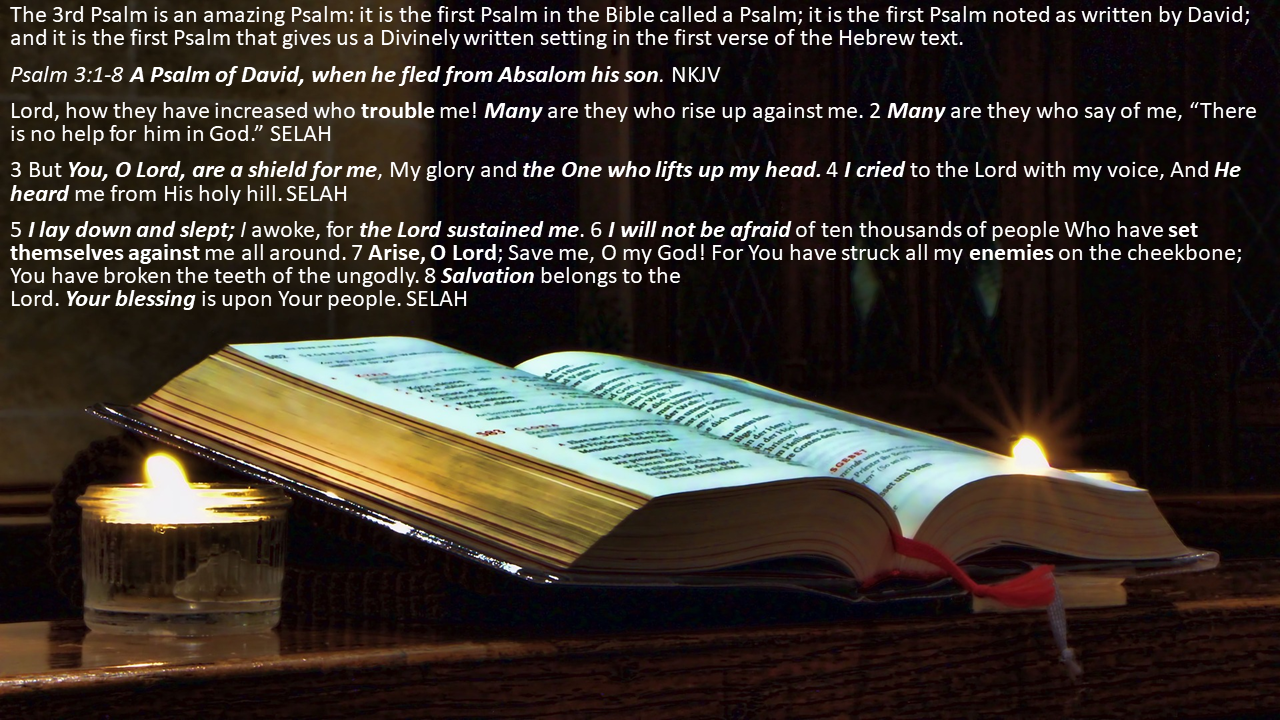
The 3rd Psalm is an amazing Psalm: it is the first Psalm in the Bible called a Psalm; it is the first Psalm noted as written by David; and it is the first Psalm that gives us a Divinely written setting in the first verse of the Hebrew text.
Psalm 3:1-8 (NIV) A psalm of David. When he fled from his son Absalom.
LORD, how many are my foes! How many rise up against me! 2 Many are saying of me, “God will not deliver him.” Selah
3 But you are a shield around me, O LORD; you bestow glory on me and lift up my head. 4 To the LORD I cry aloud, and he answers me from his holy hill. Selah
5 I lie down and sleep; I wake again, because the LORD sustains me. 6 I will not fear the tens of thousands drawn up against me on every side. 7 Arise, O LORD! Deliver me, O my God! Strike all my enemies on the jaw; break the teeth of the wicked. 8 From the LORD comes deliverance. May your blessing be on your people. Selah
Psalm 3:1-8 (NAS) A Psalm of David, when he fled from Absalom his son.
Lord, how my adversaries have increased! Many are rising up against me. 2 Many are saying of my soul, “There is no deliverance for him in God.” [Selah].
3 But Thou, O Lord, art a shield about me, My glory, and the One who lifts my head. 4 I was crying to the Lord with my voice, And He answered me from His holy mountain.[Selah].
5 I lay down and slept; I awoke, for the Lord sustains me. 6 I will not be afraid of ten thousands of people Who have set themselves against me round about. 7 Arise, O Lord; save me, O my God! For Thou hast smitten all my enemies on the cheek; Thou hast shattered the teeth of the wicked. 8 Salvation belongs to the Lord; Thy blessing be upon Thy people! [Selah].
Psalm 3:1-8 A Psalm of David, when he fled from Absalom his son. NKJV
1 Lord, how they have increased who trouble me! Many are they who rise up against me.
2 Many are they who say of me, “There is no help for him in God.” SELAH
3 But You, O Lord, are a shield for me, My glory and the One who lifts up my head.
4 I cried to the Lord with my voice, And He heard me from His holy hill. SELAH
5 I lay down and slept; I awoke, for the Lord sustained me.
6 I will not be afraid of ten thousands of people Who have set themselves against me all around.
7 Arise, O Lord; Save me, O my God! For You have struck all my enemies on the cheekbone; You have broken the teeth of the ungodly.
8 Salvation belongs to the Lord. Your blessing is upon Your people. SELAH

This Psalm is set in the context of battles. If you trace through the verses you find about seven different indications of warfare and battlefields are the setting:
1. David was facing “foes” NIV; “adversaries” NAS (v. 1);
2. David needed a “shield” (v. 3);
3. David saw them deployed like an army v.6 “set against me” (NAS/NKJV) “drawn up against me” (NIV);
4. David calls them “enemies (v. 7);
5. David cries “arise O Lord” v.7 and uses the actual formula for entering battle from Numbers 10:35;
6. David speaks of armies (“people” in v. 8 can also be used for an army);
7. David sought victory implied by the word “deliverance” (v. 8 NIV), and deliverance from the Lord is a war cry.
This Psalm divides up the message God is giving through David by the use of the word SELAH. Selah means ‘lift up’ and is a musical term for crescendo. It means boom it out, crank it up—punctuate that with emphasis. Then stop and ask yourself what do you think of that?
So at the end of verse two, ‘many say there is no help for him in God.’ Selah—boom! Stop and consider this. What do you think of that? And David pauses and thinks about that and finds a lifetime of definite proof that God did care for him.
So at the end of verse four he says, ‘He answered me…’. Selah—boom! Stop and consider this. What do you think of that? And David reflects upon his steadfast hope, and confident faith that God has rescued him in the past and will continue to do so.
So at the end of verse eight he says, ‘Salvation is of the Lord’. Selah—boom! Stop and consider this. What do you think of that? And David reflects upon the truth that it is God who alone can save us from all and any of our deepest troubles.
1 David’s scouts hid in a well where grain was spread to cover their hideout means fall; David reigned from 1010-970 BC and this tragic scene with Absalom was approximately 9-10 years before his death in 970 BC.
2 © 1971 by William J. Gaither. All rights reserved.
Slides




Check Out All The Sermons In The Series
You can find all the sermons and short clips from this series, David’s Spiritual Secret here.
Looking To Study The Bible Like Dr. Barnett?
Dr. Barnett has curated an Amazon page with a large collection of resources he uses in his study of God’s Word. You can check it out here.