If the video above is not available, here are two other ways to view:
DYG-08 & WFL-36
031123AM
Meditation: Finding Comfort in Painful Times DYG: Message Eight
- From the constant changes that filled the lives of Enoch, Noah, and Abraham we found the secret to Living a Word Filled Life – In Distracting Times.
- From Moses, we learned that in spite of the swirl of life in Egypt, the whir of life in the desert, and the immensity of life on the 40 year Wilderness wandering camping trip – it is possible to Live the Word Filled Life – in Busy Times.
- From the life of Joshua, we saw in God’s Word that it is our joyful duty to Live the Word Filled Life – in Fearful Times.
- And this morning, in Ruth, we learn from her pain-filled life, that it is possible to Live the Word Filled Life – even in Painful Times.
Transcript
.jpg)
.jpg)
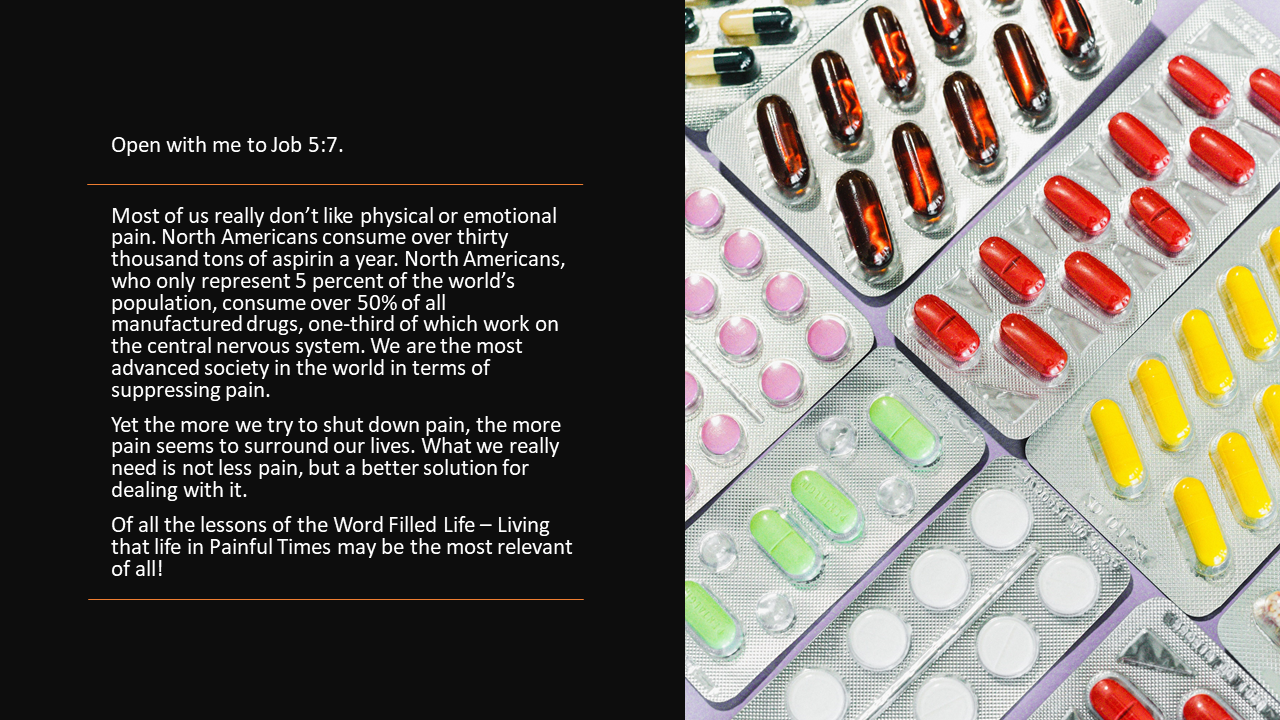
Let’s turn the Book of Job. Okay. The Book of Job chapter 5 introduces us, this morning, to a look at what I like to call Word filled living in painful times. Now, if you think about it, life is painful. No matter how you cut it, you’re going to go through pain in life. Now, Americans, we don’t like pain. In fact, we do everything we can to get away from it. In fact, north America constitutes 5% of the population of the planet, and we consume 50% of all pain relievers. Us, little 5% consume half of all the pain relief. In fact, just America eats 30,000 tons of aspirin, 30,000 tons of little aspirin, just to alleviate the constant pains. That is not the way the rest of the world is. And so sometimes it’s hard to even talk about this. But we’re going to see in Job chapter 5, especially down in verse 7, something you’ve heard the person that quipped once there are two things sure in life, death and taxes.
Actually, the Bible says there’s something else you can be sure of. In verse 7, yet man is born to trouble. And that word speaks of troublesome pains. The pains of life. Both the physical pains, it refers to the troubles of physical pain as well as the trouble of emotional pains, of going through painful internal feelings, as well as the physical ones as the sparks fly upward. And the idea is it’s like a campfire. If you’ve ever been outside with the campfire, you know that as it’s burning, the air comes in and the hot air rises and sparks go up on that hot air and smoke out of the flame. Just like every campfire. After it burns a little while we’ll have sparks flying upward on the smoke. So, every life He’s saying here is born to painful troubles. That’s what God says.
.jpg)
When did he say that? 5,000 years ago, these words were written. 5,000 years ago. Before there were pyramids in Egypt, before the ice sheets had totally receded. There were glaciers up in Northern Europe 5,000 years ago. In fact, Los Angeles, just in the LA Times last month they said they discovered that there was a glacier on the mountains that just burned last month. A mountain of ice up there over Los Angeles 5,000 years ago, looking down on the LA Basin. While all that was going on in the planet, Job was living in the world of the Bible. And he was spoken to by three prosecuting friends. And those words in verse 7 were perfectly recorded in this priceless treasury of the Bible. And what they say is that as these men were trying to pin down the cause of Job’s painful condition and accuse sin on him, he said, no, no, no. God says, that’s not what’s wrong. But they did say something true, that pain and suffering and emotional and physical pain is as much a part of life as breathing and eating and sleeping.
.jpg)
If you think about it, we entered this world painfully. Think about that. Every baby comes in crushed and twisted through the birth canal. Other than those few that come C-section, most of us were just about crushed to death to get into the world. That’s the beginning of life in between lots of pain. The ending, most of us will depart this world painfully by age and decay as we trudge through the valley of the shadow of death. And most of us don’t like physical or emotional pain. We try to shut it out and shut it down. In fact, half of all the painkillers in the world that affect the central nervous system are used by our population. But God says the lessons He wants to teach us from a Word filled life is that we can live a life that pleases Him in painful times.
What I want to do with you is to go from Job back to the Book of Ruth. Okay? Back to the eighth book of the Bible. Now, if you’re new with us, start in Genesis. Go, Genesis, Exodus, Leviticus, Numbers, Deuteronomy, Joshua, Judges, and then the eighth book is the Book of Ruth. And I want to introduce to you two individuals. The first one is Ruth, and we’re going to meet her in Ruth chapter 1. The second one a little bit later is Hannah and she’s in the next book.
.jpg)
And what we see is that there is a life the scriptures called the Word filled life. That’s what we’ve been studying. The Word filled life works no matter what you’re going through.
We saw from Enoch, Noah, and Abraham that you can have, and I can have a Word filled life when times are distracting. Remember, they were moving and changing jobs and the world was falling apart and everything was distracting. They had a Word filled life.
Then a few weeks later we learned about Moses. In spite of all that was going on his busy life, he still lived this Word filled life.
Then last time we looked at Joshua and saw from God’s Word that it’s our joyful duty to live the Word filled life in fearful times. And we talked about the fearful times he lived in and those that are ahead.
But this morning in Ruth, we learned from her pain filled life that it’s possible to live even in painful times, full of God’s Word.
.jpg)
Ruth is an immense spiritual figure. As you look in the first six verses, or the first five verses introduce us to a lot of characters. Look at some of these names. Verse 2, Elimelech, Naomi, Mahlon, Chilion Those are all in verse 2, verse 3 Naomi, verse 4 Orpah and Ruth. Now to us, as we read this, a lot of people get all caught up in just all these words, but I was interested to read from the encyclopedia Judaica which explains the Hebrew meaning. Remember people in the Bible times, their names, they didn’t just pick them out to rhyme, or to go…, have… we have all J’s and E’s in our family, they didn’t do that. They picked out a name that characterized either what they hoped that child would be or what they already saw that they were. And so, let me read to you the first five verses with the Hebrew names. Okay.
I thought this was fascinating. This is a commentary on the Jewish names from some of the encyclopedias. This is what it says.
.jpg)
The book of Ruth opens in the period of Judges. That’s the book that’s just before, but this book has set in the middle of that where apostasy, decadence, violence, and anarchy, and warfare were normal. So, it was a really bad time to live, it’s what they’re saying. Famine has struck Bethlehem. That’s verse 2. Bethlehem. Verse 1 mentions it too. So, Bethlehem, which in Hebrew means the house of bread. Famine strikes. And in this time of need, Elimelech, and that’s the man that, that’s mentioned in verse 2. Elimelech, whose name means my God is my king. But you know what? He departs from that. He doesn’t seem to believe God is his king because he leaves the place of promise, the land of Israel. And takes Naomi, which means pleasantness in favor, away from the land of promise, and away from the covenant people of God to the land of Israel’s enemies the Moabites.
They take with them their two sons Mahlon… and by the way, there are many different meanings, but the Jewish encyclopedia says Mahlon means joyful song. So, this joyful song son and Chilion… which in Hebrew means an ornament of perfection. These men with their father seemed to have stepped out of God’s will, and they marry pagan, gentile women of God’s enemies.
.jpg)
And so, away from the land of promise in Moab, who by the way, were the descendants of Lot, and those people worshiped this human sacrifice desiring God named Chemosh. So, they marry women from that culture. And Elimelech, my God is King, dies. And so does Mahlon, joyful song. And now we’re down to verse five, joyful song and Chilion, ornament of perfection, die. And after 10 years of hardship Naomi, who means pleasant sweetness, becomes Mara which means bitterness and with all those she ever loved buried beneath the sod of Moab, her husband and two sons, she finally looks back at the land of promise, and food she hears is available, that’s verse 6. And so, she sets off to return home and she ask her daughters-in-law in verse 8 to go back to their families and find a new life.
And one of the most touching moments of the scripture, Ruth, which now we’re down to, verse 13 and 14, Ruth, which means satisfied fullness, clings to Naomi. That’s the end of verse 14, and to the God of Israel. But Orpah, which interestingly enough the Hebrew meaning of that word is stiff necked, turns away from the God of Israel and departs and goes back to her people in Moab. So, that’s an enlargement of those first 14 verses.
.jpg)
One extra thing I thought was fascinating is most of us never wonder what happened to or Orpah. Let me read to you the rest of the article. Extra biblical history of this period from the Jewish encyclopedia and the Encyclopedia Judaica both record this note on these two women, Orpah and Ruth. Orpah and Ruth, it says in Encyclopedia Judaica were descendants of Eglon king of Moab. When Orpah left Naomi forsaking the God of Israel, she went back and embraced the gods of Moab. She later married into and bore a child through a marriage with a Philistine nobleman. So she went across the valley, over into the area of Philistia, the prosperous Philistine culture. Marries one of them and one of her descendants, was Harafah who became the mother of four Philistine warriors. One of them, the Jewish encyclopedia says his name was Goliath. Amazing. Orpah, Ruth’s fellow daughter-in-law. (Sister-in-law). Orpah becomes the great great grandmother in Jewish genealogical records of Goliath. Fascinating.
But who is Ruth? Ruth becomes the great grandmother of David. And isn’t it interesting the result of a simple turn in the path of life that Orpah’s grandson was killed by Ruth’s grandson, David. What big differences little decisions, little turns in the road that we make have in the future.
.jpg)
With all that in mind, let me go through chapter 1 with you of Ruth. Let me introduce to you and then we’ll read it in just a moment, Ruth. First of all, Ruth knew the pain of the past. Her distant relatives I just told you were Lot and his daughter. She was a result of a line of people from an incestuous relationship. A father with his daughter producing a race of people called the Moabites. And she was from this line of people cursed by God for 10 generations. And to make matters worse, all of that I just told you was written down and kept in print by God’s Word. So, it was inescapable. So, she had a painful past that everybody knew about. When she introduced herself as Ruth, the Moabitess, they knew about her past and it was painful.
Secondly, she knew the pain of prejudice because she was an immigrant from Moab. When she moved to Israel, she was from a marked ethnic background. Her type of people were publicly singled out as unacceptable in that society, and they were intentionally excluded from being comfortable in Jewish society. God says that the Moabites were not to be welcomed into the assembly for 10 generations. And so that pain she knew of prejudice, which we’re so aware of in our society.
She also knew the pain of poverty. She was a widow. That means no one to provide for her. She was homeless. When her husband died, the debts took away the farm. That’s why they left. They didn’t have anywhere to go. She was homeless. She also was left to care for an adult parent, her mother-in-law, Naomi. And no one ever helped her. So, she was impoverished and that’s a painful thing.
And finally, she had financial pressure when she got to Israel, as we read the record there. She entered the job market and could only get work at the lowest entry level, low wage work. She went out picking up stuff off the ground and that’s not enough to feel the financial pressure, she also had to go on public assistance. She was in welfare. In Israel, they would harvest their fields in a circular manner, the square field, so that the four corners were left unharvested. And that was the public welfare system of Israel. That the poor people of the land could go in and cut down those corners and thresh that wheat, and that’s how they were provided for. And so, she had the pain of living on public assistance financial pressure, a low level job. And through all that emotional pain, the physical weariness of her labor and all the unknowns of where she was going to live and what she was going to do. This woman, as we’re going to read right now, shines in the Old Testament as a monumental woman of faith, a woman of the Word, a woman who clung to the God of Israel and knew Him personally.
.jpg)
Ruth, chapter 1, and I’m going to read with you starting in verse 14 down through verse 17. Verse 14, follow along in your Bible. Then they lifted up their voices and wept again, Orpah kissed her mother-in-law, but Ruth clung to her. And she said, look, your sister-in-law’s gone back to her people and to her gods. The false human sacrifice, gods of Moab. Return after your sister-in-law. Verse 16. Praise the Lord, Ruth said. Entreat me not to leave you or to turn back from following after you. For wherever you go, I will go. Wherever you lodge, I will lodge. Your people will be my people. And your God, my God. Where you die, I will die and there I will be buried. The Lord do so to me and more also if anything but death parts you and me. What a testimony of following the God, she just had come to know.
.jpg)
Let’s bow before our Lord in prayer. Father, I thank you that we can be here on this beautiful worship day and affirm that we can let Your Word fill our lives, so that we can live after the power of an endless life, even in painful times. Teach us from Your Word. Let Your spirit speak to our hearts. And help us to make choices like Ruth, and like Hannah did. Little choices that will make a big difference after time goes by. Well, thank you for speaking to our hearts. In the name of Jesus we pray, amen.
.jpg)
Real quickly, let me show you what was going on in Ruth’s life. Starting in verse 6, and if you are a Bible marker, this is the first clue. It says in verse 6 that she arose with her daughters. This is Ruth 1:6. That she might return from the country of Moab for she had heard in the country of Moab that the Lord had visited His people by giving them bread. See, what happened is, Naomi heard about God’s blessing in her land. And Naomi knew that God didn’t want him in Moab, God didn’t want them doing what they were doing. And so, Naomi said, I’m going back to my God. I’m returning. I want to go back to where God is worshiped, where His covenant is kept, where we can be following and worshiping Him in obedience to Him. That was the first time, we see in the text, that Ruth has given a choice.
She had a choice of either going back where it was comfortable to her people, to her clan, to her family, and they would take her as a widow, or going off to this God that had visited His people in a faraway land. So, she ponders that revelation of God.
.jpg)
Now look at verse 14. The moment of truth, the choice came. And it says at the end of verse 14 that Ruth clings to the representative and the one that revealed the God of Heaven to her. She heard about God through Naomi, and so she said, I want your God. And one of the most beautiful, in fact this is often quoted up here in weddings, in vows. Many times, women use these words as part of their vows to their husbands. They say, where you go, I’ll go and your people will be my people. The context of that is this woman who let the Word that was revealed through her mother-in-law come to her and she says, I want You, oh God. And finally in the end of verse 17, she claims the Lord. She uses the covenant name Yahweh or Jehovah. In a personal sense she says, the Lord do to me and more. She says, I am going to follow the Lord.
What’s the lesson from her life? Ruth was going to hang on for dear life. She had found the truth. She only had a little portion of the Word, but she met the God of Heaven and everything else in her life, her family, her friends, and her future, everything else would peel away, but one thing would stay, the revelation of God. And she clung to that, she sought for that, and she wouldn’t give that up for anything. That’s what a Word filled life is like. You find out the truth of God and you say whether I’m busy, whether I’m distracted, whether I’m fearful, or as we’re looking at this morning in painful times, I’m going to let that Word fill my life and direct what I do and where I go.
Is there any doubt why God made her the great-grandmother of the man after God’s own heart, David? Ruth is David’s great-grandmother. She’s mentioned not just here, but in another place in the Bible. She’s mentioned in the New Testament. Her presence is acknowledged in the genealogy of Christ. And so, I guess we can say as a New Testament says, that Jesus is a son of David. And it does say that Jesus is a son of David. And if Jesus is a son of David, then we could say that Jesus is the great, great grandson of Ruth. Interesting way to look at it.
Just think what unbelievable things God did with her because she decided to clinging to Him. And just think what unbelievable things God can do in your life and in my life if I will clinging to the revelation that I’ve received through this book. And I’ll let God’s Word fill my life even if I’m going through painful times like Ruth did, I can clinging to him and I can see him do great things in my life.
.jpg)
Just before we go four chapters to the right, to 1 Samuel 1. I want to introduce one other person and give you a quick synopsis of her life. 1 Samuel, that’s the next book, four chapters to the right is the next stop. We’re going to meet Hannah. A lot of us have heard of Hannah, but it’s fascinating to study her life. She lives truly a Word filled life. Now, if there’s any Old Testament woman that we can point to that had a Word filled life, it’s this woman. And wait till you hear what she went through. She’s living in one of the most incredibly difficult times that anybody could have lived.
Number one, she faced the pain of a very difficult home situation. Look at chapter 1 verse 6. Actually, the whole story talks about this man Elkanah and he had two wives, Peninnah and Hannah. And Peninnah, the rival other wife is in verse 6. And her rival, that’s the other woman married to her husband, also provoked her severely to make her miserable. This is who she lived with in the same house who she had to cook meals with and do the housework with and try and please her husband. This other wife that he had was a rival and was constantly trying to make Hannah’s life miserable. Okay. She couldn’t get away from her. She had to be around her all the time. So, Hannah, first of all, faced the pain of a difficult home situation.
Secondly, if you look at verse 3, it says that she only got to go into the Lord’s presence up in Shiloh yearly. See how it says in verse 3? The man went up to his, from his city yearly to worship and sacrifice to the Lord in Shiloh. And he would take up his wives with him and his family. And so, Hannah had a difficult home situation, but she lived in the Old Testament world far from any spiritual help. Shiloh, where the tabernacle was set up, was so far away they only could go once a year. So, she was in this day in, day out, 7/24, 365 day situation where this rival severely was just making her life miserable. So that’s the first pain that she felt the pain of a difficult home.
The second one is at the end of verse 6, it says, the Lord had closed her womb. Remember God grants conception. There are no accidental babies. I remember when I went to high school, I met a boy and he said, I was an accident after a football game. I said, no. You weren’t an accident after a football game. I said, you were conceived by the direct will of a sovereign God. God grants conception. So, Hannah faced the pain of being childless. And it says in verse 6, every day, she saw everyone else and their children around her, and she knew she was missing out on one of the greatest joys of life because she was childless.
So, what did she do with all that pain and grief? And look what it says in verse 7. She would go and weep. And they would, this rival, would provoke her and she would weep. What did she do with all that? Did she get embittered and angry and vicious, and internally build up and lash out at her husband and at this rivalist wife? No. She channeled all that potential for grief and self-pity into seeking God. And you know what?
She had limited resources. Verse 3 said she could only get up around the Lord’s house once a year. She had limited time. She had all of her work at home to do. She had limited exposure to the Word of God. Remember, they didn’t all have one of these nice books called the Bible back then. The Bible was contained in the Tabernacle tent. The holy scrolls of the Word of God were kept there and the only person we know of in the ancient world, outside of the priest they had a copy of the Bible, was the king. And she was neither, she wasn’t a priest, nor the king. So, she… and there wasn’t even a king then. It was in the time of the judges. And so, here she is with no personal copy of God’s revelation. She could only go into the presence of the priest of God once a year. And what does she do? Here’s the good news.
.jpg)
In her yearly trips, instead of feeling sorry for herself, being angry and embittered and built up inside and just so upset at not having children and having a bad husband maybe and home situation, what did she do? We’re going to see from the text she memorizes seven verses. How do I know that? Because in her prayer, turn over to chapter 2… Okay, the first 10 verses contain one of the most beautiful prayers in the Bible. It’s so beautiful that Mary quotes this prayer in Luke 2 in the Christmas story. When you’re reading the Christmas story to your family and you get to Luke 2 about the Magnificat, who is Mary modeling and quoting? Hannah.
.jpg)
Now what does Hannah have? Listen to this. Here is a woman who seeks for and finds just seven verses. That’s something she quotes. If you look carefully in her prayer, she quotes seven different verses and she meditates on them so long these verses begin to spill out of her heart in her prayers. You know what that teaches me? One of our blights in America, we’re constantly wanting to get more information, we never can have enough. We want more books and more information and more studies. We’re always signing up and getting more and more stuff and we never thoroughly process and digest and inculcate and start living out what we just learned. We get some more, and we get some more, and we get some more. And so, we have a lot of breadth in America of knowledge, but we have very little depth that we see in Hannah’s life. What did she do? She listened; those trips up every year to the tabernacle. And she listened and somehow captured verses. In fact, what verses does she capture?
She captures, first of all, verses from Job. Then, verses from Exodus. And then, verses from Deuteronomy chapter 4, 8, and 32. And she hears these being read as they go up and they had the readings from the different portions of the scriptures. She heard these verses. Memorized those verses. Meditated on those verses. And she captures in her prayers, those verses from her heart. She weaves them. I like to think of them as… in fact we were in Istanbul just four days ago, just before those bombs. And we stood and watched them knitting together these tapestries. And we bought these little tiny bookmarks for a dollar from this tapestry stuff. And it was so intricate. All the weavings that went in with the multicolor, that’s what I see in her prayer.
.jpg)
Verses 1-10. She’s weaving this prayer and including all these verses that she had memorized, the seven verses that she memorized. Here’s a woman who immersed herself in God in the Old Testament world and became a role model. She became a hero and she became a mentor of the greatest woman in the Bible, Mary the mother of Jesus. In Luke 2:46 it is Mary who quotes Hannah, who quotes her meditations to God in prayer. Mary is quoting Hannah, who is quoting the scripture that she has meditated on and prays those verses to the God of Heaven; out of her pain, out of her suffering, out of her difficult home situation, out of her grief over not having children, out of her limited resources and time and exposure to God. She has grabbed and held onto seven little parts of God’s Word and she wouldn’t let go of them. And she digests them through her heart and they’re on her mind and they come out in her prayers.
It just made me think this, are we immersing ourselves in God’s Word? You know you are, if it comes out of your life. If what you’re learning starts showing up in your life, if you start making choices, if you start making decisions based on what you hear from the Word of God and saying, I’m going to do that in my life, by your grace. God, I want that in my life. You’re digesting it. Are we doing that? This woman lives so deeply for the Lord in such a desperate situation in spite of her pain and adversity. How did she do it?
One way she learned while she was being provoked by Peninnah, to meditate in God’s Word. She learned every time she was overwhelmed with grief at her inability to bear children, instead of getting angry and bitter she meditated in God’s Word. Every time she realized how little time she had and how difficult her life was, she meditated on those verses that she’d learned.
Let’s look at what comes out of her life. I’m going to read her prayer and just kind of show you where she quotes from the scriptures. By the way, her verse 10 of chapter 1, if you want to look back there, it’s a start of her prayer life. It says in chapter 1, verse 10 of 1 Samuel, she was in bitterness of soul and prayed to the Lord and wept in anguish, and she made a vow to the Lord. So that’s the start of her prayer life. She had a habit of prayer. And now look at chapter 2 verse 1.
And Hannah prayed. Now this is the marvel of the scriptures. You have an exact record, a flawless record, a recording of what this woman prayed to the God of Heaven. That’s the wonder of inspiration. And this is what she prayed. She said, my heart rejoices in the Lord. My horn is exalted in the Lord. I smile at my enemies. There’s old Peninnah who is trying to, as it says in chapter 1 verse 6, she is trying to provoke her and make her miserable. And she says, you know what? I smile at my enemies. How can you smile at your enemies? Because I rejoice in your salvation. She meditated on the fact that she belonged to God. You wouldn’t believe how powerful it is when you’re facing pain to meditate on your salvation. I meditate on my salvation. I know who I belong to and where I’m going.
Look at verse 2. She said, no one is holy like the Lord. There’s no one beside You, nor is there any rock like our God. Where’d she get that from? Exodus 15. It says there’s no one like You, oh God. Verse 11, Deuteronomy 32 says, He is the rock. So, she put together Exodus 15 and Deuteronomy 32, those two verses. And she takes, Your glorious and holiness, no one is like You and You’re the rock. And she says, there’s no one like You. There’s no rock like our God.
.jpg)
Skip down to verse 6. She quotes another verse. She said, the Lord kills and makes alive. He brings down to the grave and brings up. Where’d she get that from? Deuteronomy 32, verse 39. It says, the Lord kills and makes alive. He is the only one that can do that. He’s the only author of life. And she meditated on that and says, Lord, You’re in charge of my life. You can bring me down to the grave, you can raise me up. Look at verse 7. The Lord makes poor and rich. He brings low and lifts up. Where’s that from? That’s from Deuteronomy 8. It says, the Lord lifts up and gives wealth and power in verse 17 and other places there.
.jpg)
Then in verse 8, she says. He raises the poor from the dust. He lifts the beggar from the ash heap. Who’s that? That’s Job now she’s quoting. To set them among princes to give them an inheritance. A throne of glory, for the pillars of the Lord of the Earth. Where she get that? Job 36, it says in verse 7, and also Job 38. And then she goes through and concludes her prayer in verses 9 and 10.
Now, what’d I even show you that for? To show you a woman who had a pain filled life. A miserable causing partner in her home that made her home life difficult. She was already struggling with being childless. And what did that pain do to her? It drove her to grasp what she could get in those yearly visits to the tabernacle, and to get those verses and write them on her heart. And then every time her enemy came into her presence and made her life miserable, she smiled at her and prayed the scriptures back.
.jpg)
Okay. What’s going on in your life? Do you have deep pain? Are you like, Ruth? Do you have the pain of your past and of prejudice? Poverty? Do you have financial pressure just killing you? Or like Hannah, do you have a difficult home situation? The pain of childlessness? Or limited resources or time? What is that doing to you? Ruth and Hannah chose to practice letting the Word of God fill their life. Even in painful times Ruth clung to the Lord. Hannah clung to the Word. Both of them let it fill their lives and they clung to the Lord in the good times and the bad, they never let go. Even when life and people and days were hard and lonely, empty and painful. God offers a Word filled life to us in painful times, and He will give us a strength to go through the pain. He’ll give us a strength to be more than conquerors through Him if we’ll let His Word fill our lives.
Five thousand years ago – before the pyramids were finished in Egypt, while ice covered most of northern Europe and glaciers towered over the Los Angeles basin, a man named Job lived in the ancient world of the Bible Lands.
Listen to these words, spoken to Job by one of his three prosecuting friends, perfectly captured and flawlessly recorded in this priceless treasury – God’s Word! Job 5.7 is the effort of the three false comforting friends of Job. They were trying to pin down the cause of Job’s painful condition. They attached an accusation of sin upon him. As they were doing this, they said something powerfully true.
Open with me to Job 5.7.
Pain is as much a part of life as breathing, eating, and sleeping.
We enter this world painfully crushed and twisted through the birth canal.
We depart this world painfully by age and decay, trudging through the valley of the shadow of death.
Most of us really don’t like physical or emotional pain. North Americans consume over thirty thousand tons of aspirin a year. North Americans, who only represent 5 percent of the world’s population, consume over 50% of all manufactured drugs, one-third of which work on the central nervous system. We are the most advanced society in the world in terms of suppressing pain. Yet the more we try to shut down pain, the more pain seems to surround our lives. What we really need is not less pain, but a better solution for dealing with it. So of all the lessons of the Word Filled Life – Living that life in Painful Times may be the most relevant of all!
God offers His Presence and Influence to surround every part of my life. This life is called a Word Filled Life. And that is what we have been studying these past few weeks.
o From the constant changes that filled the lives of Enoch, Noah, and Abraham we found the secret to Living a Word Filled Life – In Distracting Times.
o From Moses we learned that in spite of the swirl of life in Egypt, the whir of life in the desert, and the immensity of life on the 40 year Wilderness wandering camping trip – it is possible to Live the Word Filled Life – in Busy Times.
o From the life of Joshua we saw in God’s Word that it is our joyful duty to Live the Word Filled Life – in Fearful Times.
o And this morning, in Ruth, we learn from her pain filled life, that it is possible to Live the Word Filled Life – even in Painful Times.
Please open to Ruth 1. Ruth is an immense spiritual figure in God’s Word. If anyone has experienced pain, Ruth has. She is recorded to have gone through nearly ever major category of life stopping pain. Think about her life with me.
Ruth is a book about a man who made a bad choice by leaving the land of Israel with his wife and two sons. They continue by taking foreign wives for their sons. He dies, the sons die, his wife Naomi is left alone with two foreign daughter in laws.
The book of Ruth opens during the period of the Judges when apostasy, decadence, violence, anarchy and warfare were the norm. Famine strikes Bethlehem which means a house of bread. In this time of need, Elimelech which means my God is King, seems to depart from the plan and desires of God. He takes Naomi which means pleasantness and favor, away from the land of promise and the covenant people of God into the land of Israel’s enemies, Moab. With them go their two sons Mahlon which means joy or song, and Chilion which means ornament or perfection. These men seem to have stepped out of the revealed will of God in His Word, by marrying pagan, gentile women of God’s enemies.
Away from the land of promise in Moab [descendants of Lot who worshiped Chemosh a god of human sacrifice by burning], Elimelech [my God is King] dies and so does Mahlon [joyful song] and Chilion [ornament of perfection]. After ten years of hardship Naomi [pleasant sweetness] becomes Mara [bitterness]. With all those she ever loved buried beneath the sod of Moab [her husband and two sons]. She finally looks back at the land of promise because food is available in Bethlehem. As she sets off to return home she asks her daughter-in-laws to go back to their families and find a new life. In one of the most touching moments of the Scriptures, Ruth [satisfied, fullness] clings to Naomi and the God of Israel. Orpah [stiff necked, double minded] departs for her people in Moab.
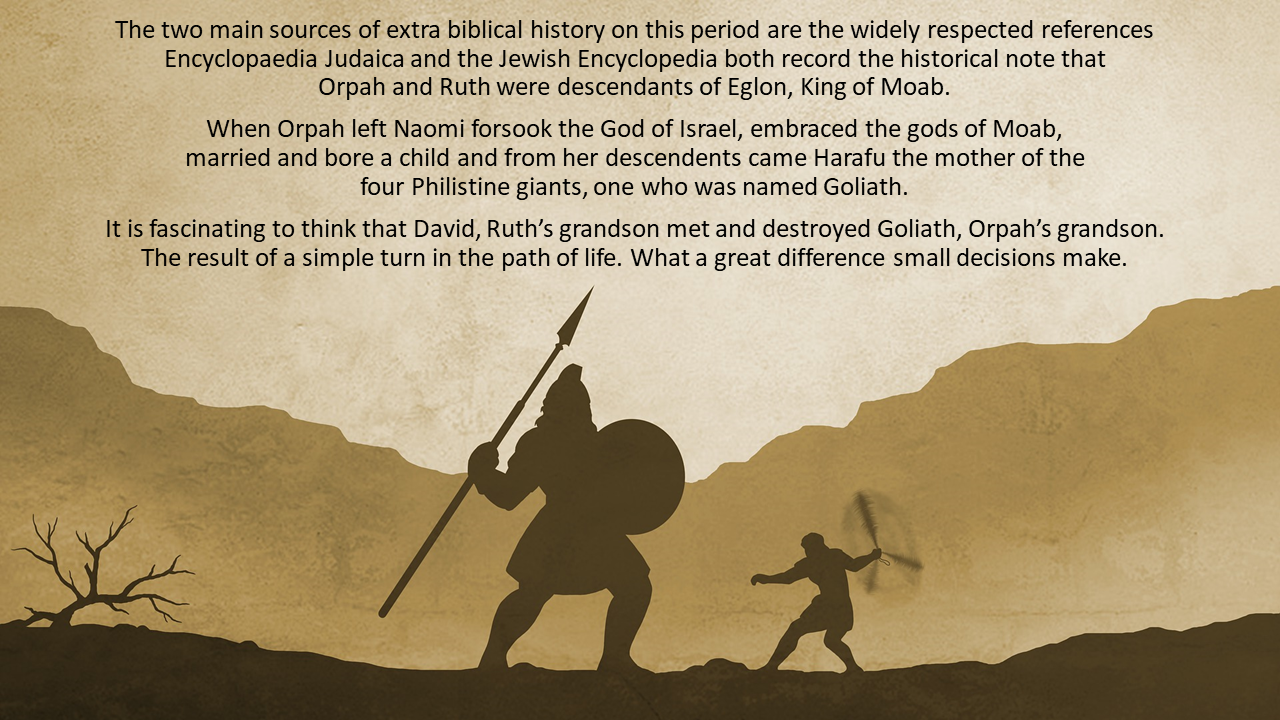
The two main sources of extra biblical history on this period are the widely respected references Encyclopedia Judaica and the Jewish Encyclopedia both record the historical note1 that Orpah and Ruth were descendants of Eglon King of Moab. When Orpah left Naomi forsook the God of Israel, embraced the gods of Moab, married and bore a child and from her descendants came Harafu the mother of the four Philistine giants, one who was named Goliath. It is fascinating to think that David, Ruth’s grandson met and destroyed Goliath, Orpah’s grandson. The result of a simple turn in the path of life. What a great difference small decisions make.
o Ruth knew the Pain of the Past: her distant relatives were Lot and his daughter. She was the result of a line of people from an incestuous relationship. She was from a line of people cursed by God to the tenth generation. And to make matters worse, all that was written down and kept in print by God’s Word – so it was inescapable.
o Ruth knew the Pain of Prejudice: she was an immigrant from a marked ethnic background. Her type was publicly singled out as unacceptable – and purposefully excluded from being comfortable in Jewish Society.
o Ruth knew the Pain of Poverty: she was widowed, she was homeless, and she was left to care for an adult parent who was her mother-in-law, and never had any help.
o Ruth knew the Pain of Financial Pressure: Ruth had to enter the job market and could only get work at the lowest entry-level low wage work as a temporary. She had to go on to welfare via Public Assistance and only got half of those funds, as she was caring for her mother-in-law.
o Through all that emotional pain, physical weariness, and stress of unknowns Ruth shines as one of the godliest women of the Word Filled Life. Ruth lived a life of faith, hope, and love. How did she do it? Ruth chose to practice a Word Filled Life even in Painful Times by clinging to the Lord in the good times, and the bad – never letting go even when life, people, and her days were hard, lonely, empty, and long!
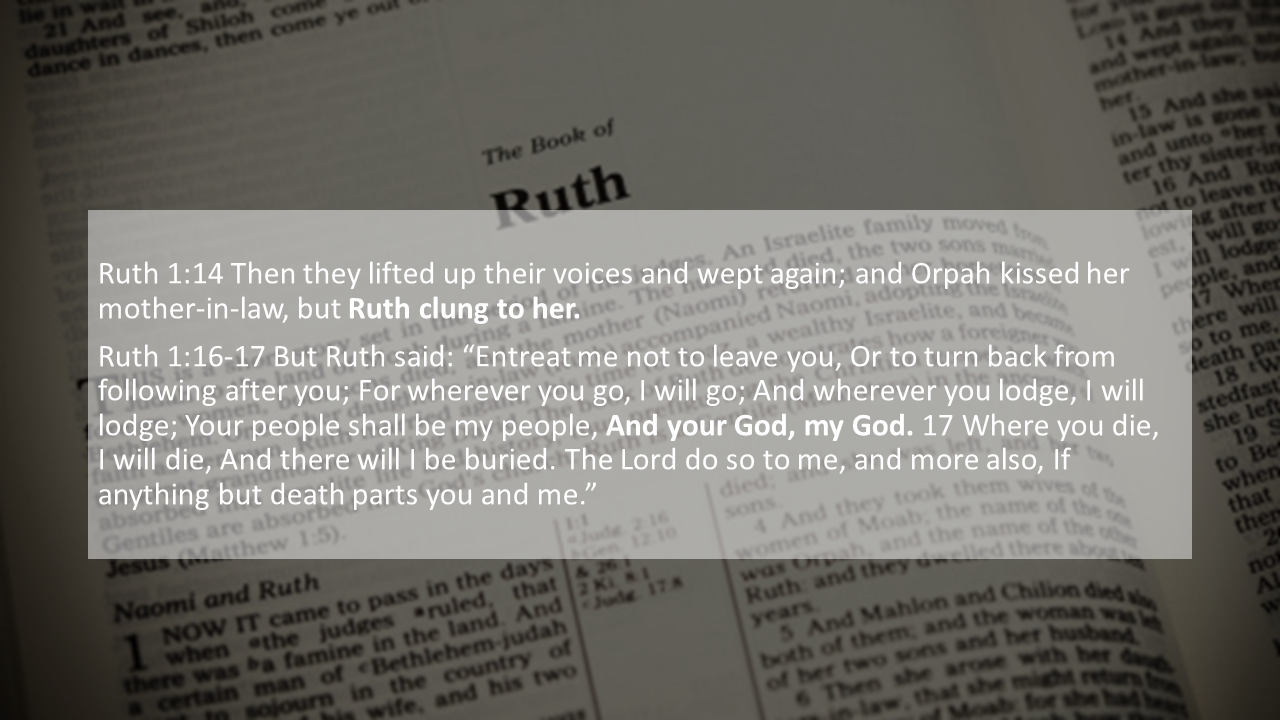
Ruth 1:14 Then they lifted up their voices and wept again; and Orpah kissed her mother-in-law, but Ruth clung to her. Ruth 1:16-17 But Ruth said: “Entreat me not to leave you, Or to turn back from following after you; For wherever you go, I will go; And wherever you lodge, I will lodge; Your people shall be my people, And your God, my God. 17 Where you die, I will die, And there will I be buried. The Lord do so to me, and more also, If anything but death parts you and me.”
o Ruth was going to hang on for dear life. She found the truth. She met the God of Heaven.
o Everything else – family, friends, future – everything else peeled away. One thing stayed – the revelation of God. That was what she clung to, sought for, and wouldn’t give up – for anything. o Is there any doubt why God made her the great –grandmother of the Man after God’s own heart David?
o I guess we can say as the New Testament says Jesus is the son of David. And if so then Jesus is the great-great grandson of Ruth.
o Just think what unbelievable things God will do with you if you decide today to cling to Him.
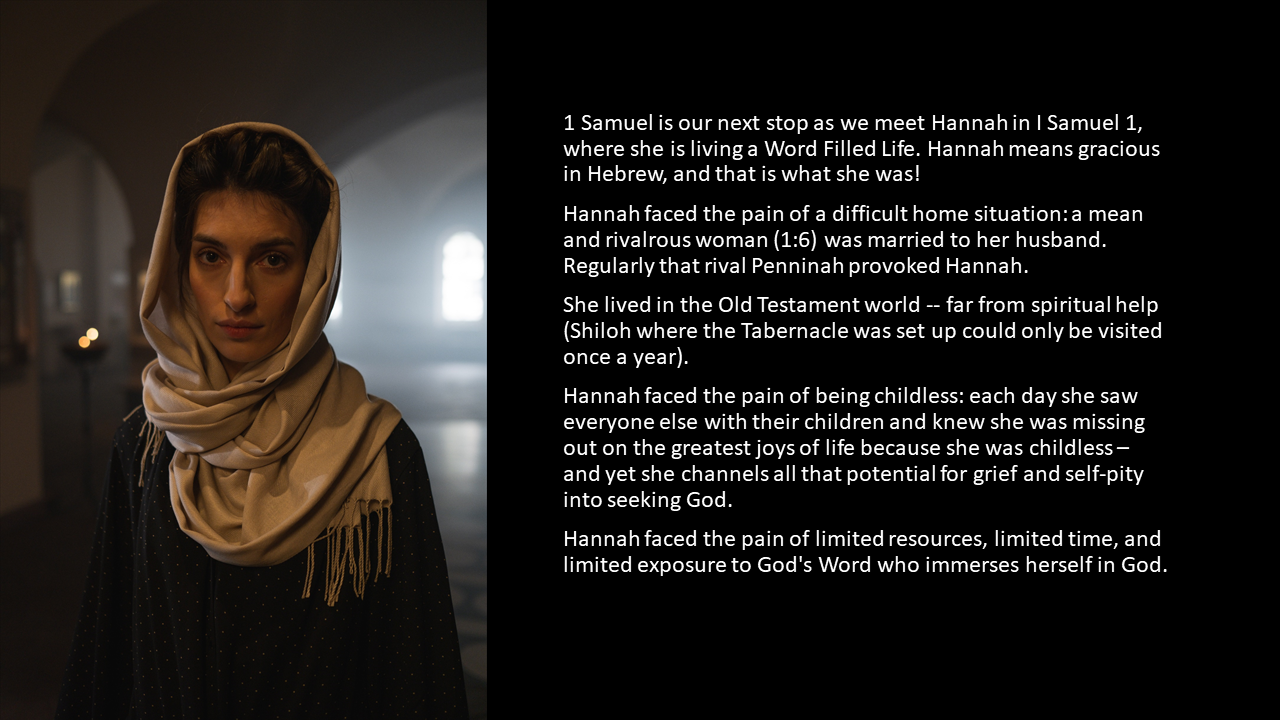
1st Samuel is our next stop as we meet Hannah in I Samuel 1, where she is living a Word Filled Life. Hannah means gracious in Hebrew, and that is what she was!
o Hannah faced the pain of a difficult home situation: a mean and rivalrous woman (1.6) was married to her husband. Regularly that rival Penninah. Yet she lived in the Old Testament world — far from spiritual help (Shiloh where the Tabernacle was set up could only be visited once a year).
o Hannah faced the pain of being childless: each day she saw everyone else with their children and knew she was missing out on the greatest joys of life because she was childless – and yet she channels all that potential for grief and self-pity into seeking God.
o Hannah faced the pain of limited resources, limited time, and limited exposure to God’s Word who immerses herself in God.
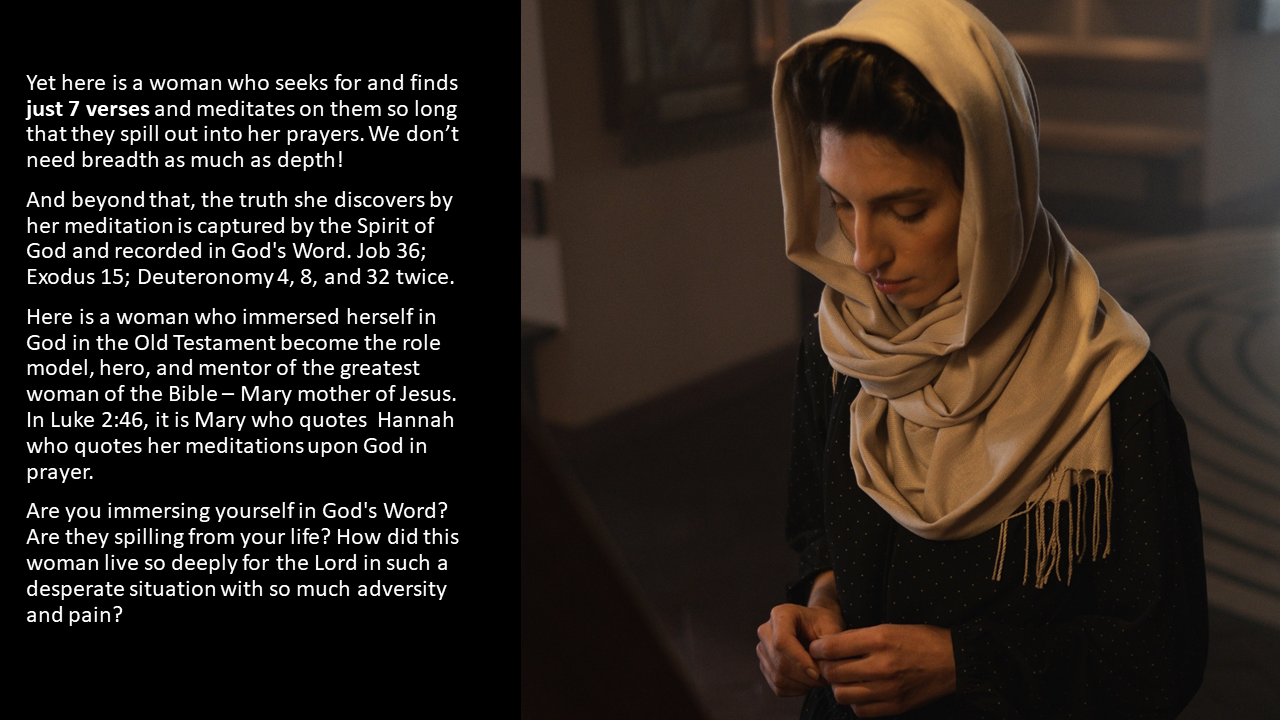
o Yet here is a woman who seeks for and gets just 7 verses and meditates on them so long that they spill out into her prayers. We don’t need breadth as much as depth!
o And beyond that, the truth she discovers by her meditation is captured by the Spirit of God and recorded in God’s Word.
o Here is a woman who immersed herself in God in the Old Testament become the role model, hero, and mentor of the greatest woman of the Bible – Mary mother of Jesus. In Luke 2.46ff, it is Mary who quotes Hannah who quotes her meditations upon God in prayer.
o Are you immersing yourself in God’s Word? Are they spilling from your life? How did this woman live so deeply for the Lord in such a desperate situation with so much adversity and pain?
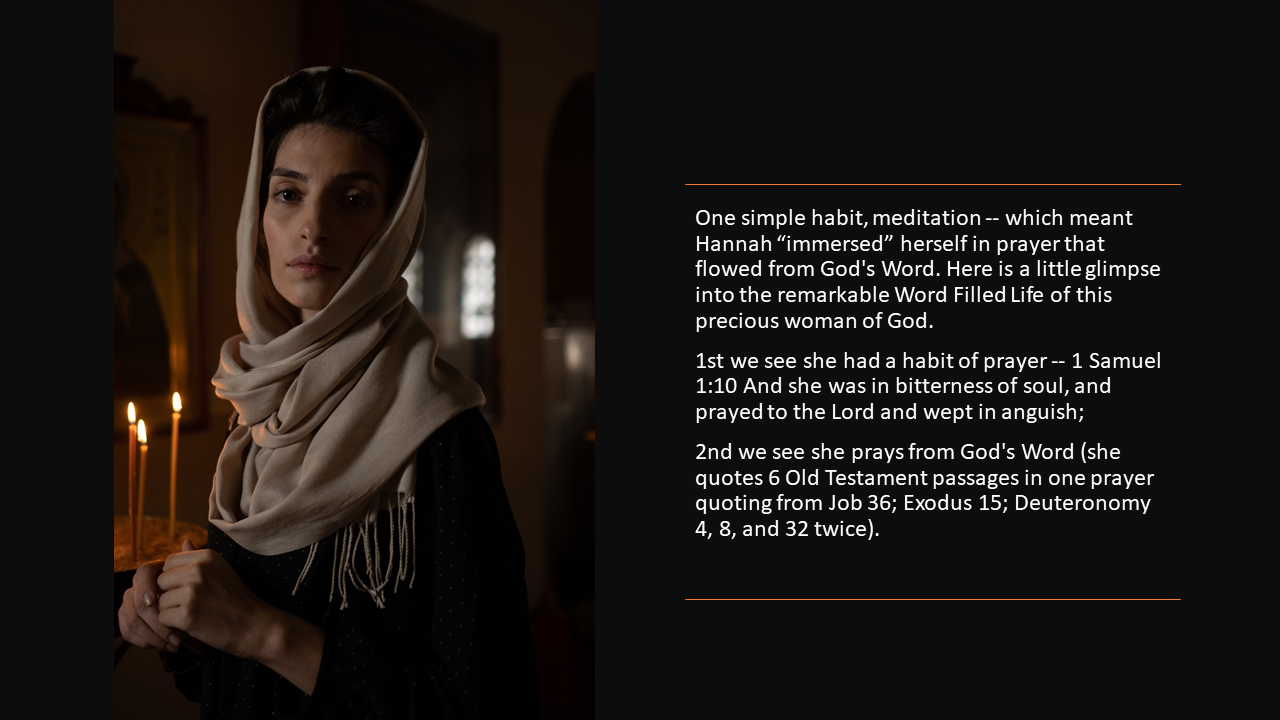
One simple habit, meditation — which meant Hannah “immersed” herself in prayer that flowed from God’s Word. Here is a little glimpse into the remarkable Word Filled Life of this precious woman of God. o 1st we see she had a habit of prayer — 1 Samuel 1:10 And she was in bitterness of soul, and prayed to the Lord and wept in anguish;
2nd we see she prays from God’s Word (she quotes 6 Old Testament passages in one prayer quoting from Job 36; Exodus 15; Deuteronomy 4, 8, and 32 twice).
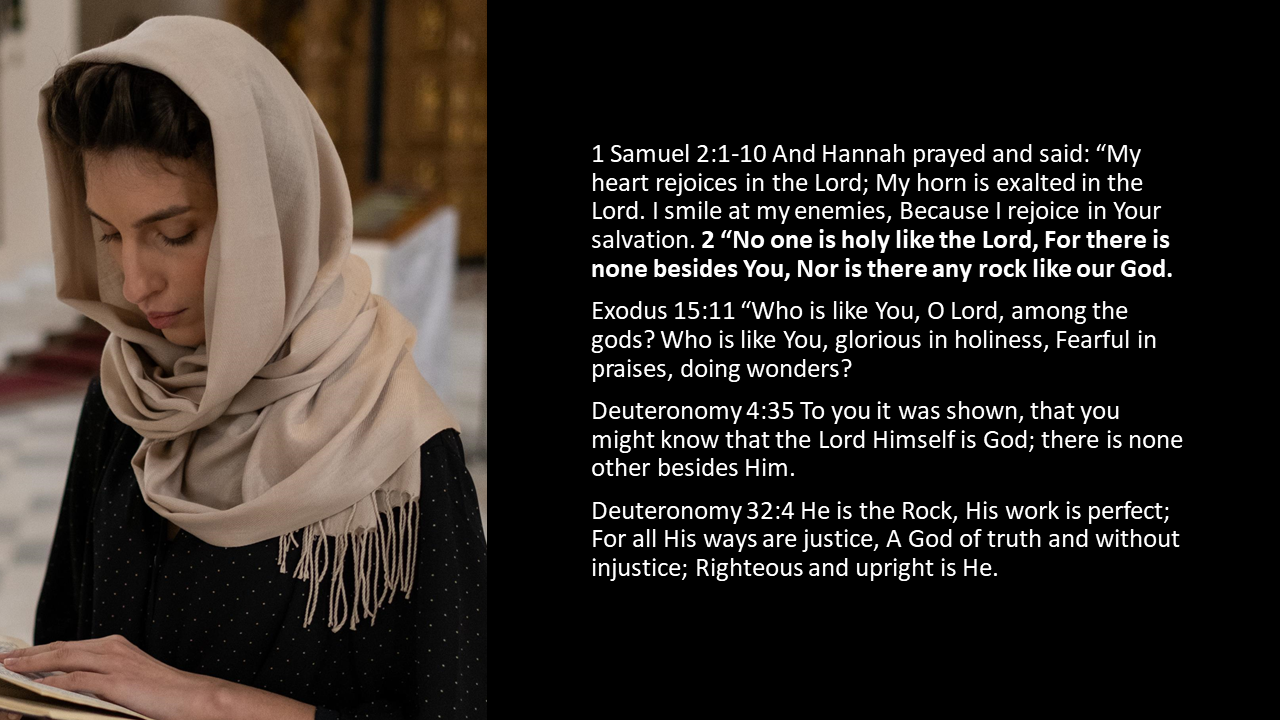
1 Samuel 2:1-10 And Hannah prayed and said: “My heart rejoices in the Lord; My horn is exalted in the Lord. I smile at my enemies, Because I rejoice in Your salvation. 2 “No one is holy like the Lord, For there is none besides You, Nor is there any rock like our God.
o Exodus 15:11 “Who is like You, O Lord, among the gods? Who is like You, glorious in holiness, Fearful in praises, doing wonders?
o Deuteronomy 4:35 To you it was shown, that you might know that the Lord Himself is God; there is none other besides Him.
o Deuteronomy 32:4 He is the Rock, His work is perfect; For all His ways are justice, A God of truth and without injustice; Righteous and upright is He. 6 “The Lord kills and makes alive; He brings down to the grave and brings up.
o Deuteronomy 32:39 ‘Now see that I, even I, am He, And there is no God besides Me; I kill and I make alive; I wound and I heal; Nor is there any who can deliver from My hand. 7 The Lord makes poor and makes rich; He brings low and lifts up.
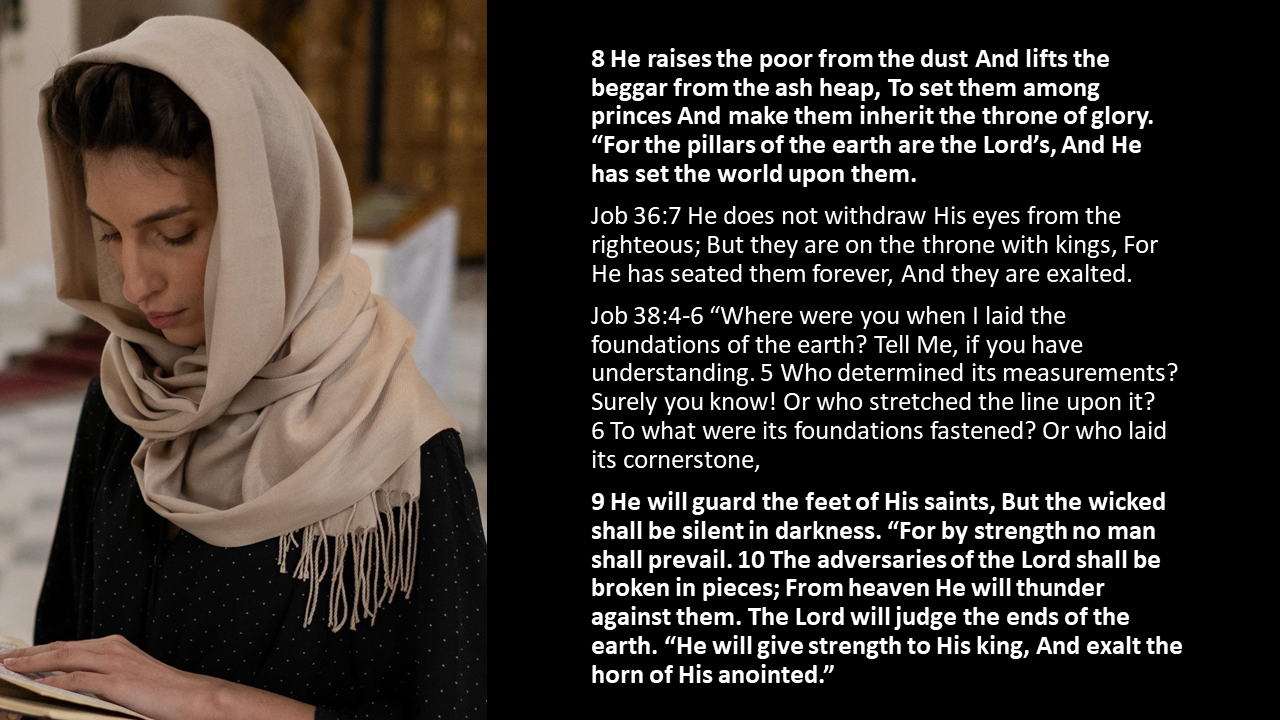
o Deuteronomy 8:17 then you say in your heart, ‘My power and the might of my hand have gained me this wealth.’ 8 He raises the poor from the dust And lifts the beggar from the ash heap, To set them among princes And make them inherit the throne of glory. “For the pillars of the earth are the Lord’s, And He has set the world upon them.
o Job 36:7 He does not withdraw His eyes from the righteous; But they are on the throne with kings, For He has seated them forever, And they are exalted.
o Job 38:4-6 “Where were you when I laid the foundations of the earth? Tell Me, if you have understanding. 5 Who determined its measurements? Surely you know! Or who stretched the line upon it? 6 To what were its foundations fastened? Or who laid its cornerstone, He will guard the feet of His saints, But the wicked shall be silent in darkness. “For by strength no man shall prevail. 10 The adversaries of the Lord shall be broken in pieces; From heaven He will thunder against them. The Lord will judge the ends of the earth. “He will give strength to His king, And exalt the horn of His anointed.”
What is going on in your life? Do you live with deep pain?
o Like Ruth do you know the Pain of a stained Past?
o Like Ruth do you know the Pain of Prejudice?
o Like Ruth do you know the Pain of Poverty?
o Like Ruth do you know the Pain of Financial Pressure?
o Or like Hannah do you face the pain of a difficult home situation?
o Or like Hannah do you face the pain of being childless?
o Or like Hannah do you face the pain of limited resources, limited time, and limited exposure to God’s Word?
Through all that emotional pains, physical weariness, and stress of unknowns — Ruth & Hannah shine as some of the godliest women of the Word Filled Life.
Both lived a life of faith, hope, and love.
How did they do it?
Ruth & Hannah chose to practice a Word Filled Life even in Painful Times by clinging to the Lord in the good times, and the bad – never letting go even when life, people, and days were hard, lonely, empty, and long!
God offers to us a Word Filled Life this morning – even as we go through Pain Filled Times!
Some other Word Filled Lives…
Flip to the right through the rest of 1st and 2nd Samuel and head to 1st Kings 19. Elijah was in the full time, vocational ministry. He had all the demands, defeats, and discouragements of life. In fact James tells us he was subject to the same passions as all of us experience.
o Yet he who knew the power of God so strongly in his life that he could make the Jordan River dry up and stand still also knew fear so great he could turn and run from it.
o He who was fearless and able to call down fire from God in Heaven was also able to become so discouraged he wanted to die.
o He who stood in front of an entire nation on Mount Carmel, quits the ministry to hide from people in a cave. Yet God rescued him from his fears, refreshed his soul from the darkness he felt, met and spoke to him face to face and translated him to his Heavenly home in a fiery chariot without tasting death!
o How did Elijah overcome his fears, his depressions, his insufficiencies to rate such a powerful ministry and prayer life in God’s sight? One word sums up his walk with the Lord — meditation, which meant Elijah “listened” to the Lord in and out of troubles and triumphs. 1 Kings 19:12 and after the earthquake a fire, but the Lord was not in the fire; and after the fire a still small voice.
o When on the mountain tops of life – Elijah listened to the Lord, and faithfully followed Him.
o When in the pits of life and all seems dark – Elijah listened to the Lord, and faithfully followed Him.
o When at the end of life and the Lord says I am done with you and it is time for you to go home – Elijah listened to the Lord, and faithfully followed Him.
o Elijah had the same passions and problems as any of us have and he listened to the Lord, and faithfully followed Him.
Elijah learned that when God speaks – we listen. So he simply made himself listen to God, and he never stopped listening. At mountains top times, at cave depths, in fear of life, and in hope of death – each and every pain and fear was an opportunity to listen to the voice of God. NOW LISTEN – when we open this book – God’s Word , we can hear the prophets speak, we can hear the apostle’s voices, and most of all, we can hear the Voice of Jesus Himself. All this because as He said, My sheep hear My voice!
Keep heading to the right in your Bible to Job 1. Job maintained a Word Filled Life when he was a wealthy businessman, farmer, rancher, and influential citizen. Job practiced a Word Filled Life when he was a busy dad with TEN children. Job lived a Word Filled Life as a faithful husband and a man with close friends. Job preserved his Word Filled Life even — when he suffered immense financial reversal, when he lost his job, when he learned of his children being killed in a tornado, when he lost his wife’s companionship and affection, and even when he lost his own health becoming an invalid shut in at home with open sores that smelled sickeningly of death. Meditation meant Job “feared” Job 1:8 Then the Lord said to Satan, “Have you considered My servant Job, that there is none like him on the earth, a blameless and upright man, one who fears God and shuns (turns away; puts aside; departs from) evil?”
o Job knew what God wanted and did it.
o Job knew what God hated and avoided it.
o Job knew God was watching and acted like it.
o Have you found and done that from God’s Word? That is the Word Filled Life!
Next to the Psalms where in the 63rd Psalm we meet David. David is probably the easiest person for any of us to relate to in God’s Word – this is because he experienced nearly every emotion you and I ever could feel. He knew the pain of a lost child, the pain of a murdered son, the pain of a wayward son, the pain of a raped daughter, the pain of a traitorous family member, the pain of an unfaithful wife, the pain of a hateful father-in-law, the pain of a bitter employee, the pain of jealous brothers, the pain of disqualification from spiritual ministry…and countless other pains. David also knew the joys of falling in love and marrying a woman he deeply admired, having children that were bright and gifted, excelling in his career as a songwriter and worship leader, earning an immense amount of money, giving sacrificially to the Lord, earning the deep respect, admiration, and undivided loyalty of his friends and co-workers… In short we can say David is among the greatest individuals of ancient history. He is the most well known songwriter of all time. He has written the words to more different songs in more languages that anyone else. His poetry is the most widely held, and known of any poet in human history. His public and personal life is a matter of public record more so that nearly anyone else from the public sector. His royal line is the longest surviving lineage of any nation ever to exist on planet Earth. He is the only person promised that their family would actually survive the Tribulation and be enthroned as the earthly ruler of the Nation of Israel in the Millennium. How did David ever accomplish so much in his lifetime? One habit sets him apart, meditation meant David “sought God longingly” Psalm 63:1-2 O God, You are my God; Early will I seek (to seek early, earnestly, or diligently) You; My soul thirsts for You; My flesh longs (to long for, faint, faint with longing; The word2 seems to mean “has gone blind”, or “gone dark”. How vivid Hebrew poetry is! Then seek is a most revealing verb. Basically it means longing for the first light of the dawn.) for You In a dry and thirsty land Where there is no water. 2 So I have looked for You in the sanctuary, To see Your power and Your glory.
o As a shepherd boy David chose to follow the Lord as his own personal Shepherd in Psalm 23.
o As a man at his peak of strength and accomplishment he gave all his trophies to the Lord in I Samuel ___.
o As an old man he gave all the credit for the good in his life – to the Lord in Psalm 18.
Daniel was a career politician; his life was lived in the bright spotlight of public scrutiny. Everywhere he went, everyone he met, everything he said – could be and was used against him. He lived for over 66-recorded years in this glass house – and ended with one of the most profoundly influential lives ever recorded in the Bible. Meditation meant Daniel “purposed” Daniel 1:8 But Daniel purposed (to put in place, set, appoint, make; to direct toward) in his heart that he would not defile himself with the portion of the king’s delicacies, nor with the wine which he drank; therefore he requested of the chief of the eunuchs that he might not defile himself.
o So many qualities flowed from that choice Daniel made as a teenager to point his heart at God.
o Daniel started a habit of seeking God by thinking about Him and His Word.
o This led to an amazing prayer life in all the flurry of the height of his career that found him three times daily on his knees! Daniel — one of the busiest administrators of the Old Testament, was also a towering giants among the Old Testament saints. The key to his life from just a teenager? He was in the habit of getting alone with God three times a day. Daniel 6:10 Now when Daniel knew that the writing was signed, he went home. And in his upper room, with his windows open toward Jerusalem, he knelt down on his knees three times that day, and prayed and gave thanks before his God, as was his custom since early days.
o Then it led to a life long study of the Bible. As an eighty year old he was reading, studying, and praying through God’s Word.
o And to the end of his life Daniel was faithful to that purpose that drove his life pointed toward the Lord.
What a TEAM. What a lesson for us. Often however we don’t hear the voice of the Lord in His Word because our lives are too full and too complex. One of the best ways to experience the discipline of meditation – and the immense rewards that it will bring to our lives, is to practice a spiritual fast.
Psalm 119 Divisions
1. Psalm 119:1-8 Desperate Seeking God’s Heart, The Psalmist’s Desire, The Psalmist’s Dilemma, The Psalmist’s Decision-29;
2. Psalm 119:9-16 How Can I Ever Be Clean? Focus the Heart, Feed the Heart51;
3. Psalm 119:17-24 Getting the Most Out Of Life, Learning from the Word, Longing for the Word, Leaning on the Word-69;
4. Psalm 119:25-32 Burned Out, Burdened Down, and Built Up, Burned Out, Burdened Down, Built Up-89;
5. Psalm 119:33-40 Prayer That Grips God’s Heart, Teach Me, Enlighten Me, Direct Me, Incline Me, Focus Me, Promise Me, Protect Me, Quicken Me-107;
6. Psalm 119:41-48 How To Be Confident Without Being Cocky, Conscientious Requests, Committed Resolutions, Confident Results-131;
7. Psalm 119.49-56 Remember to Remember, Remember the Word, Remember the Past, Remember the Song, Remember the Name-151;
8. Psalm 119:57-64 My Piece of the Pie, My Portion, My Pattern, My Praise, My Partners, My Perspective-171;
9. Psalm 119:65-72 The School of Affliction, The Truth Upon Which The School Is Based, The Transcript Required for Admission, The test Given To All Students, The Target of the Curriculum, the Transformation of Value System-189;
10. Psalm 119:73-80 How To Be Stable In A Shaky World, You Must Have Specific Purpose, You Must Pray, Specific Petitions-205;
11. Psalm 119:81-88 Almost Consumed, But Not Quite, David’s Desperate Plight, David’s Divine Picture, David’s Definite Pattern-223;
12. Psalm 119:89-96 God’s Absolute Word, A Settled Word, A Saving Word-241;
13. Psalm 119:97-104 Loving God; Listening to God; Living God; What he loved, lived, got Living The Word Of God, What He Was, What He Got, What He Did, What He Fed On, What He Lived-259;
14. Psalm 119:105-112 Driving through the Smoke of Life: Ezra’s Struggles; Ezra’s Obstacles; Ezra’s Hope; A Light In The Fog, Instrumentality of God’s Word, Integrity of David’s Word, Illumination of life’s Path, Investment in Eternity’s Heritage, Inclination of David’s Heart-275;
15. Psalm 119:113-120 You are my Hiding Place The Real Hiding Place, David’s Focus, David’s Fortress, David’s Faith, David’s Fear-293;
16. Psalm 119:121-128 In A Position to Appraise The Word of God, In A Position of Obedience, In A Position of Submission-309;
17. Psalm 119:129-136 How to live and Extraordinary Life How the Common Man Becomes Uncommon, Principles for Practical Living, Patterns for Powerful Praying, Product of Prayerful Living-325;
18. Psalm 119:137-144 Balancing Life’s Demands What Is Righteousness?, A Righteous Word, An Everlasting Word-343;
19. Psalm 119:145-152 Paying the Price for Power with God- wholehearted prayers; unscheduled visits The Price of Power With God, Cry Unto God With Both Heart & Soul, Seek for God Both Morning & Evening, Trust In God Whether Weak Or Strong, Watch For God Whether Near Or Far, Believe God’s Word Forever & Ever-361;
20. Psalm 119:153-160 How to Deal With Problems Too Big To Handle-379,
21. Psalm 119:161-168 Power of the Attorney, Plea of the Accused, Principles of Justice-379;
22. Psalm 119:169-176 Great Peace, Choose Great Spoil, Receive Great Peace, Give Great Testimony-395;
23. Psalm 119: Putting It All Together, Petition, Praise, Practice, Perspective-411.
1 Quoted from Israel my Glory, Feb/Mar 1993, p. 10.
2 Psalm 63 notes by Knight, George A. F., Daily Study Bible Series: Psalms, Volume 1, (Louisville, KY: Westminster John Knox Press) 2001, c1984.