If the video above is not available, here are two other ways to view:
DYG-09 & WFL-04
030126AM
Discipline Four—Stewardship: Living Totally for Jesus DYG: Message Nine
Transcript
.jpg)
Why don’t you open with me in your Bibles to where you would turn if one of your best friends you found out was terminally ill and they were dying, and you had to share something from the Bible about how to get ready to die. Where would you open in the Bible? That happens to me all the time. I get to be with people when they get that news, when they find out they only have six days, six weeks, six months left to live.
.jpg)
Where’s the most comprehensive place that you would turn in the Bible when someone is facing, as a saint, death? I’m glad you said that. It’s the 116th Psalm, and that’s where I go because that’s the Psalm that right in the middle, in the 15th verse says, precious in the sight of the Lord is the death of His saints. And that Psalm explains the habits of how we, as stewards of our lives, can by habit prepare for that greatest day of our life, the day that we enter the Lord’s presence. And so, the 116th Psalm is what we’re going to look at. But the reason I’m doing that is I’ve been praying and concentrating and thinking about this next lesson as we’re looking at our disciplines of a godly life. And we’re looking at stewardship, the stewardship of our life.
.jpg)
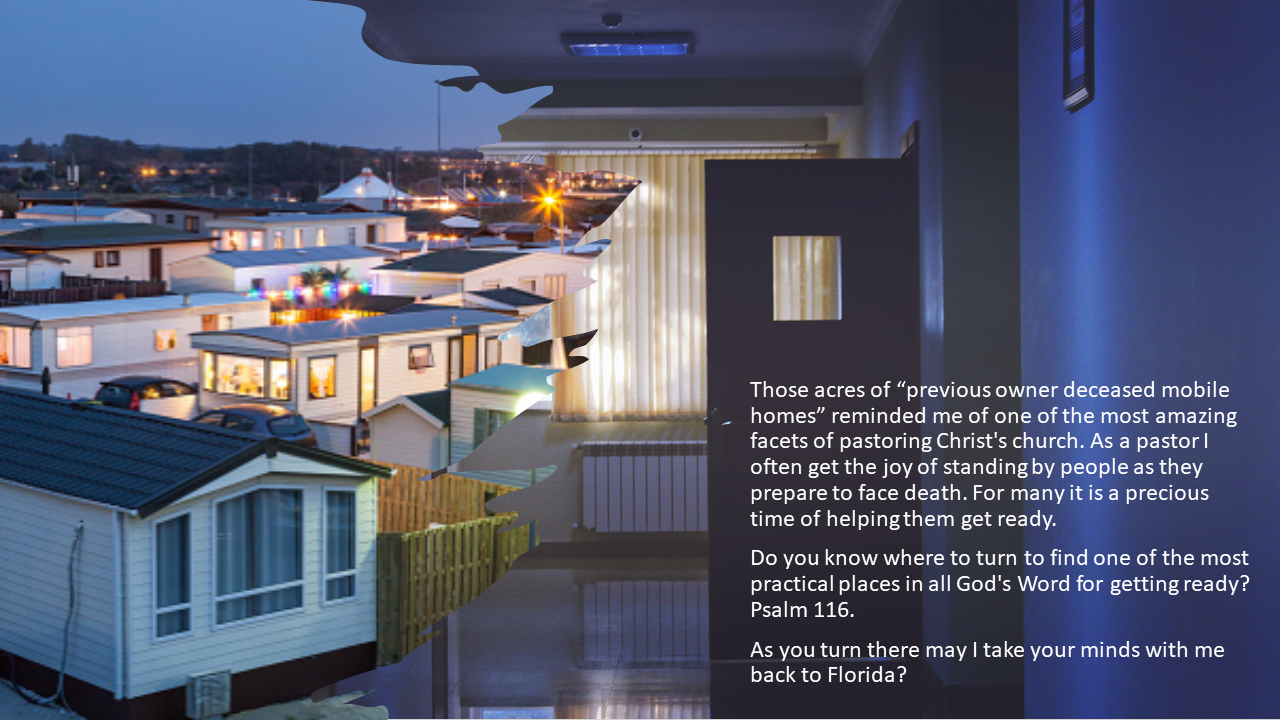
And so, this week with my family, we were driving, actually from one side of Florida to the other, from the Gulf to the Atlantic side. And if you know anything about central Florida, it looks basically the same. It’s either citrus trees or swamps. There’s not very much else, maybe a few cows here and there. And so all ten pairs of eyes were looking out the window for something to see in that couple hours. And so, we were driving along, and it was pretty monotonous for a while until we topped one hill and I couldn’t believe it. We, I thought we came to a mobile home farm. I had never seen so many trailers in my life, and they were just acres. They were just probably square miles of them. They were just going off, just lined up and the kids from the back said, what is that? And I looked, and there was a sign that said Pre-owned Mobile Home Liquidators. And so, I was driving along, and I heard one of the kids say, mama, what’s a pre-owned mobile home? And Bonnie said, there are so many senior citizens in Florida, a lot of them have died, and this is the place where all those homes, that they don’t know what to do with, from the senior citizen population in Florida. They’re actually 4.2 million of them down there living. They just, they have acres of them.
.jpg)
I start thinking about that. I started thinking about death and the inevitability and the incapability of it, and the fact that I get the privilege of so many times standing next to people in their last days and weeks and months and share with them this 116th Psalm. Then I thought, these habits are great when you’re still alive and kicking.
This can be the greatest set of habits that all of us should practice. So, I want you to go through it with me in just a moment because those acres of previously owner-deceased mobile homes reminded me that we need to be ready. That we need to live our life like the Psalmist did. And by the way, this Psalm, look at verse 3, the pangs of death surrounded me. The pangs of the grave, or Sheol, laid hold of me. I found trouble in sorrow. It’s just really hard. Verse 8, You’re delivering me from death. And on it goes. Verse 10, I’m greatly afflicted. We’re going to read every bit of it, but this 116th Psalm has death and the grave written all over it, but superimposed over that, is a beautiful lesson on a way of life we can live that causes us to be actually spiritually robust in health to our last breath, to our last moment. But before we get in the 116th Psalm, I want to go back to Florida because I want you to think about one of the greatest impediments to live in the 116th Psalm lifestyle, getting ready for death all throughout life and being prepared to have a life that is precious in God’s sight.
.jpg)
There are sixteen+ million people in Florida. Over four million, 26% of the population, are in their golden years, and that means that they’re at the peak of their experience of their life history, and most of them of their wealth, and of those, in last year in 2002, over 170,000 of them died. Now the question is how much did those 170,000 leave behind? And the answer, we all know everything, right? They all left everything behind. In my mind, looking at those trailers and what I’d seen on the Gulf Coast and what I saw on the Atlantic coast, I saw a lot of some of the largest homes I’ve ever seen. I went on a walk, I went, I would walk five miles one day. I don’t think I was ever out of sight of mansions, just lining the coast. Just manicured mansions right on the ocean. And Bonnie and I checked the price of one of them, a one room, and one of these things was selling for $1.5 million. I thought, ah, it’s not enough. I want a bigger one than that in Heaven, but I just looked on the tax records. You can look this up. State of Florida tax records say that there are over 9 million deeded pieces of personal real estate in Florida, worth assessed value of $$1.1 trillion. And I continued reading and said 40% of those are owned by those 55 and up year-old people. So, they own 40% of that $1.1 trillion in real estate, a little bit more than their share of the population. There’s only a fourth of the population, but of course they’re at their peak. So, if 40% of that $1.1 trillion is owned by those senior citizens, do you know what that works out to? Every one of those couples, those retired couples, have approximately, I mean, if everybody was equal, $12.5 million worth of real estate. Oh. Isn’t that amazing? Now, I know the people in those trailers didn’t have $12.5 million, that left those trailers behind, but that’s a vast amount of wealth owned by people who are getting older and older by the moment.
.jpg)
And the question we need to think about as we read this 116th Psalm is, how hard is it going to be for those people to die when they have so much wealth? You say, why do you say that? Because people who lay up their treasure on Earth spend their lifetime accumulating it, securing it, and keeping it. And like we talked about, about four weeks ago, as they get older, they spend their life backing away from everything that’s valuable, important that they invested their whole life in.
And death for them becomes dreadful because they’re getting further away from what’s important to them. That’s an unsaved person’s life. A saved person, on the other hand, realizes that you can’t take it with you so you can send it ahead. So, they actually give the title deed and ownership of their life and all their treasures back to the Lord.
So, life for them is going closer and closer to what’s most valuable to them, to the Lord, and to Heaven. Now, those who spend their life moving away from treasures have more and more reason to despair. The approach of death is dreadful to them. Those who spend their life moving toward their treasure have more and more reason to rejoice.
Now, the older you get, does death cause dread and despair because you’re backing toward Heaven or is death gain? As the apostle Paul said, for me to live is Christ, but to die is gain. You say, what a bizarre question to ask. No, it’s something to think about now. Not when you’re in the hospital or at home and your family calls and says, they’re terminal.
Could you come and speak to them? And I come over armed with the 116th Psalm. No, we should think about this today because these are habits.
.jpg)
And by the way, since I go on the spot, I already have it written in my Bible. I have it written right in front of the 116th Psalm: Eight habits that take the sting out of death. What a blessing. Let’s let God’s Word teach us these eight habits that can keep us spiritually healthy until death, and wouldn’t it be good if every one of us this morning were in robust spiritual health? Looking forward to Heaven, to our last breath.
.jpg)
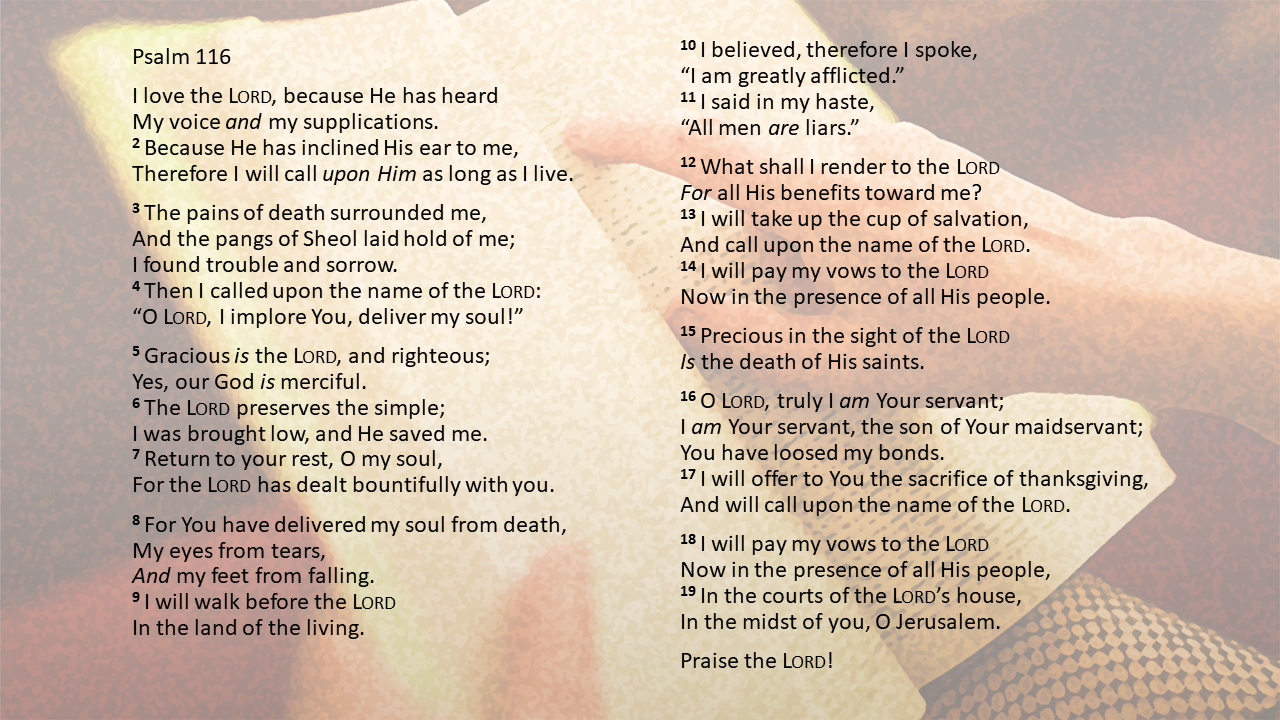
116th Psalm, starting in verse 1. I love the LORD because He has heard my voice and my supplication. Because He has inclined His ear to me, therefore, I will call upon Him as long as I live. Verse 3. The pains of death surrounded me, the pangs of the grave, Sheol laid hold of me; I found trouble and sorrow. Then I called upon the name of the LORD: Oh LORD, I implore You, deliver my soul! Verse 5, gracious is the LORD, and righteous; Yes, our God is merciful. The LORD preserves the simple; I was brought low, and He saved me. Return to your rest, o my soul, for the LORD has dealt bountifully with you. Do you see what’s happening? He thought he was dying, cried out the Lord, learned a lesson, the Lord spared his life, and he recorded this lesson. Verse 6, for you have delivered my soul from death, my eyes from tears, my feet from falling. Now look at the resolves he makes. Verse 9, I will walk before the LORD in the land of the living. I believed, therefore, I spoke, I am greatly afflicted. And I said, my haste, all men are liars. Verse 12. What shall I render to the LORD for all His benefits toward me? He starts thinking through his life. Verse 13, I will take up the cup of salvation and will call on the name of the LORD. I will pay my vows to the LORD now in the presence of His people. Verse 15, precious in the sight of the LORD is the death of His saints. Oh LORD, truly, I am Your servant; I am Your servant, the son of your maidservant; You have loosed my bonds. I will offer to You the sacrifice of thanksgiving and will call upon the name of the LORD. I will pay my vows to the Lord now in the presence of all His people, in the courts of the LORD’s house, in the midst of you, o Jerusalem. Praise the Lord!
.jpg)
Wow, what a Psalm. Let’s bow before the Lord. Father in Heaven, teach us the habits that take the sting out of death. Teach us how to be such stewards of this life that we spend our life joyfully walking toward You who are our treasure, and that we would learn, as good stewards, that the title deed of all we are, all we have, all we ever hope to be, belongs to You. And if we truly surrender that back, our future, our security, our plans, our pleasures, then life is a joyous anticipation and a blessed pilgrimage of obedience to You. Teach us from Your Word, teach us how to be stewards of our lives as we discipline our lives for godliness, we pray in Jesus’ name, amen.
.jpg)
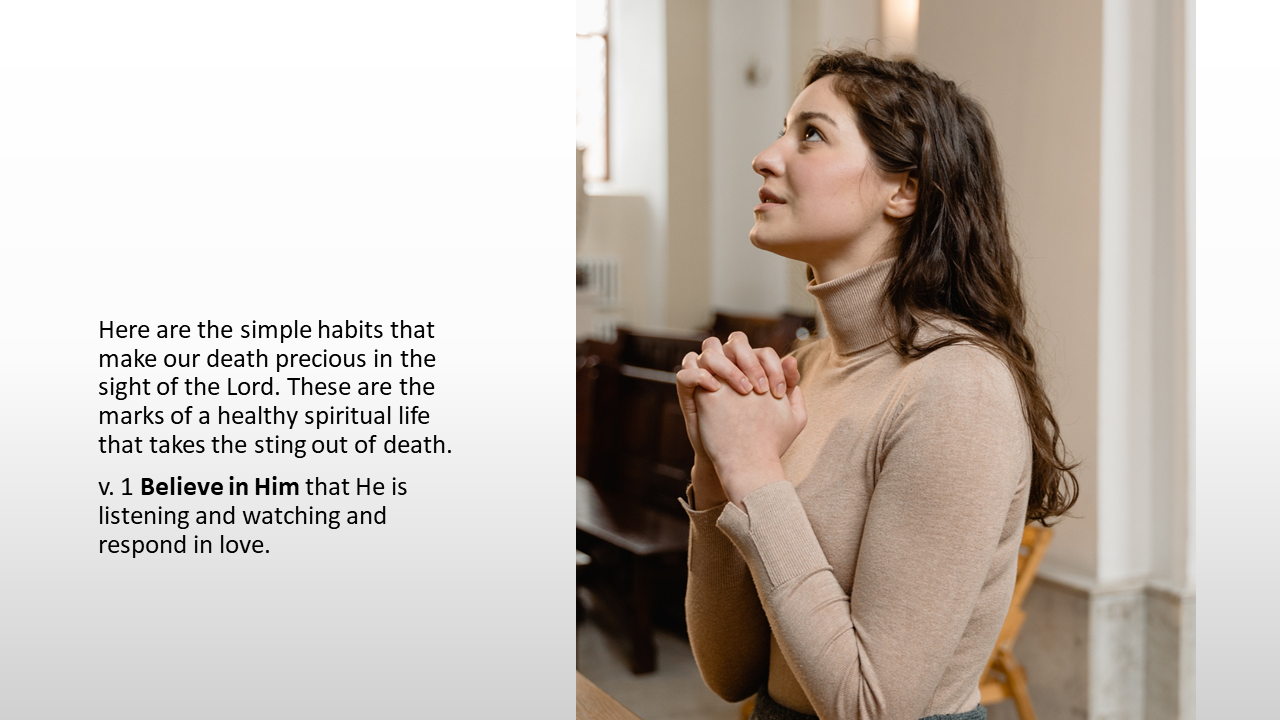
If you have a pen or pencil, you can just jot, I actually write these little words in my Bible because when you write something in your Bible, often when you come back to that passage at a later date, it reminds you of those events, and of what you learn or what it means in your life. And so, this is what I have written by verse 1 in my Bible. The first habit is believing or trusting in Him. You notice what he says? The first verse, I love the LORD because He is heard my voice, my supplication. You can’t love someone that you don’t trust that you believe that they’re really there. And so, the first thing is he is saying, my first habit is I’m going to believe in You. I’m going to believe You’re listening. I’m going to believe You’re watching, and I’m going to respond to You in love. And that really is what salvation is all about.
I was reading earlier, and I’m not going to stray off over there, but an earlier Psalm says that the lost or the wicked have death as their shepherd. The one that leads them through life is death. They’re just marching to the grave. But the Psalmist said, but that’s not me. The Lord is my shepherd. See a believer, the Lord is our shepherd, and He is leading us through life, and we believe in Him. So that’s the first habit. Believe in Him as a habit. Trust Him. Believe He is listening and watching and cares and respond to Him in love.
.jpg)
The second habit is in verse 2 and look what the Psalmist does, he says, because He inclined His ear to me, I will call on Him as long as I live. Not just once. As a habit, I am going to call. And so, I wrote down in my Bible, cry out to Him.
And we need to get used to talking to the Lord. We need to get used to pouring out our heart, our fears, our woes. We need to get used to sharing them with Him, not just when things go wrong, not just when we have a financial bump in the road or a physical problem in our life, or even death is eminent. All the time we need to get used to, by habit, crying out to the Lord, calling out to Him, bringing our problems, and our petitions, and our fears, and our woes to Him. So, habit number two, cry out to Him by verse 2.
.jpg)
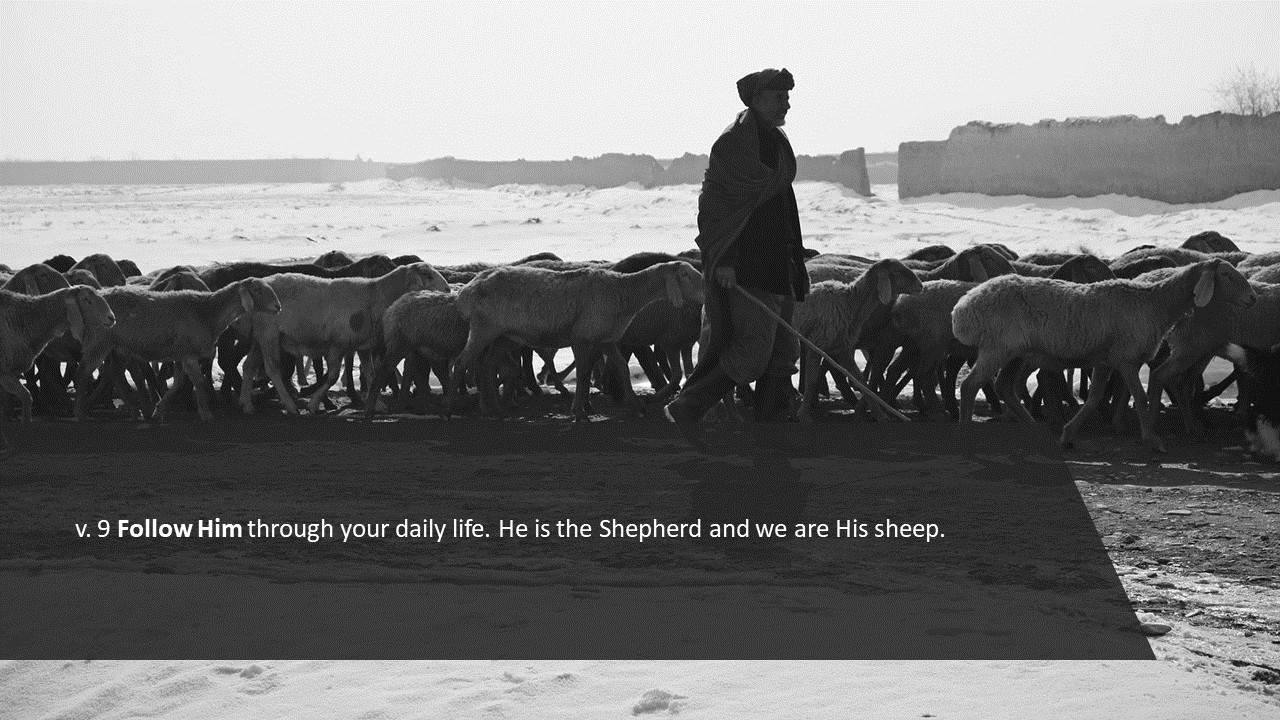
Now he continues onward talking about this but get down to verse 9 with me because this is a next habit he has in verse 9. He says, I will walk before the LORD in the land of the living. What he’s saying is that, that he wants to walk before the Lord. In other words, he wants the Lord to be the one who overshadows his life. He is walking in the shadow, as Psalm 91 says, of the Almighty. And what that distills down to is the Lord says we should have the habit of following Him. That He is the one that guides our life. So, I wrote in my Bible a third habit. Follow Him through your daily life. He is the shepherd. We are His sheep. We need to walk in His presence throughout our lives.
.jpg)
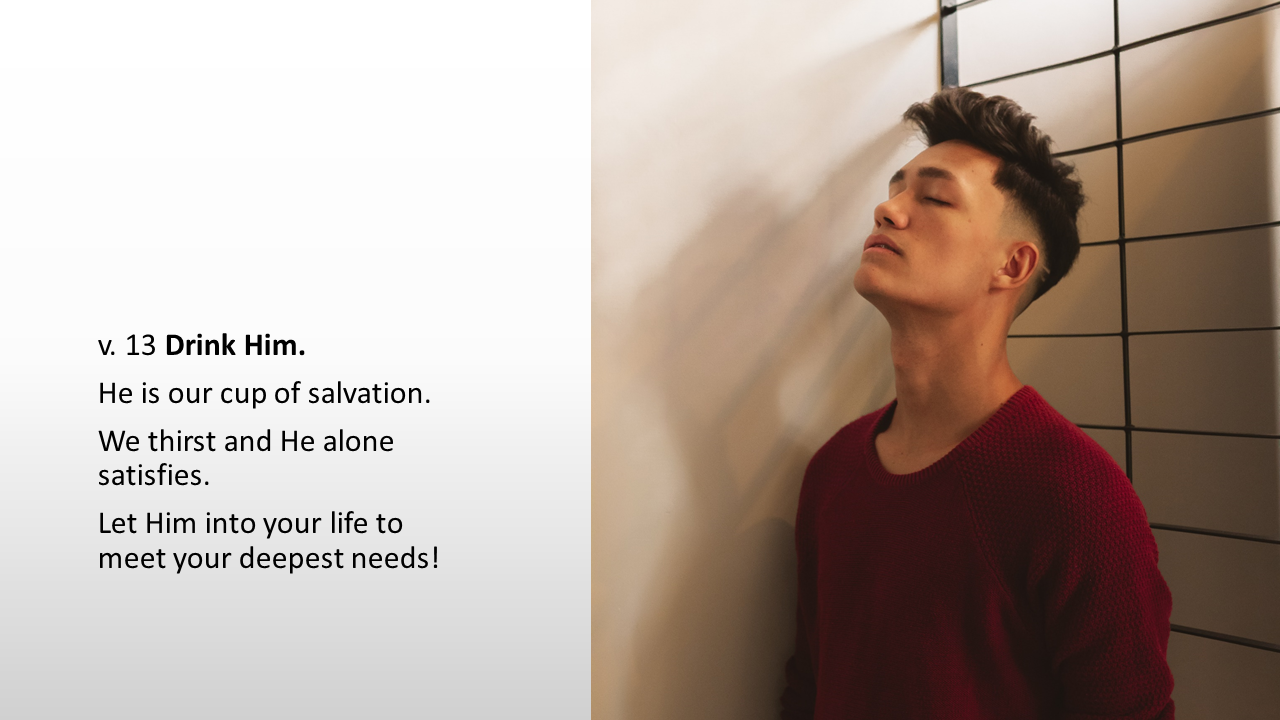
Verse 13 has another part of our habit that we need to have. The 13th verse says, I will take up the cup of salvation and call in the name of the LORD, and we need to drink Him. You say, what do you mean by that? Thirst is something that’s an internal deep need. I can be swimming in the greatest body of fresh water in the world, Lake Superior, and four, or five hundred, I don’t know how many hundred feet deep that place is, but I can die of thirst in the middle of the lake unless I drink it personally.
And see, that’s what a lot of people do. They’re dying of thirst in the midst of the water of life all around them. They go to church, but they never drank themselves. They never did, look what it says in the 13th verse, I, that’s me personally, will take up the cup of salvation. I’m going to personally partake of this, he says. It’s not a group deal. See, Israel’s worship in the time of the Psalms and the monarchy of Israel was a group experience. But God doesn’t save groups. He saves individuals. And so, we need to drink of Him. And a lot of people are not sure of their salvation because they’re not saved, because they thought it was a group event. Their family got saved or they were whatever, some spiritual, they were in a confirmation class, and they have never drank of Christ personally. And a habit we need to have is to call on the, look what it says in verse 13 at the end, call upon the name of the LORD. I always remember the time that a few months back I was called to a dying person’s side and my first question to them is I say, are you sure you’re going to Heaven right now? Are you absolutely sure? I looked him right in the eye and this man looked at me and said no, I’m not sure. I said, would you like to be sure? He says, I don’t know how to be, so I’ve gone to church my whole life. I’ve been baptized. I’ve been good, given my money. He says, how can you be sure? I took him right here. I said, because you have to personally take up the cup of salvation and you have to call in the name of the Lord. He said, what does that mean? I said, didn’t you just have an anniversary? He said, yeah, we just had our 50th anniversary. I said, what’d you do there? He says, I repeated my vows to my wife. I said, why don’t you repeat your vows to the Lord? He said, I don’t know how. And I said, right here it says, I will call the name of the Lord. I’ll take up the cup of salvation. I said, why don’t you just tell the Lord thank You. Thank You for dying in my place. Say it out loud. Thank You for taking my sin. You gave Yourself for me. Thank You for cleansing me of my sin. And we got down our knees and he started praying. Tears star run down his face and his dear wife’s face, and they held hands, and it was so precious, and he took the cup of salvation. He didn’t just hold it, he drank it. It met the internal need of his life. He was thirsting, dying of thirst, actually. Drink Him. That’s a fourth habit. So, we believe Him, cry out to Him, follow Him, drink Him.
.jpg)
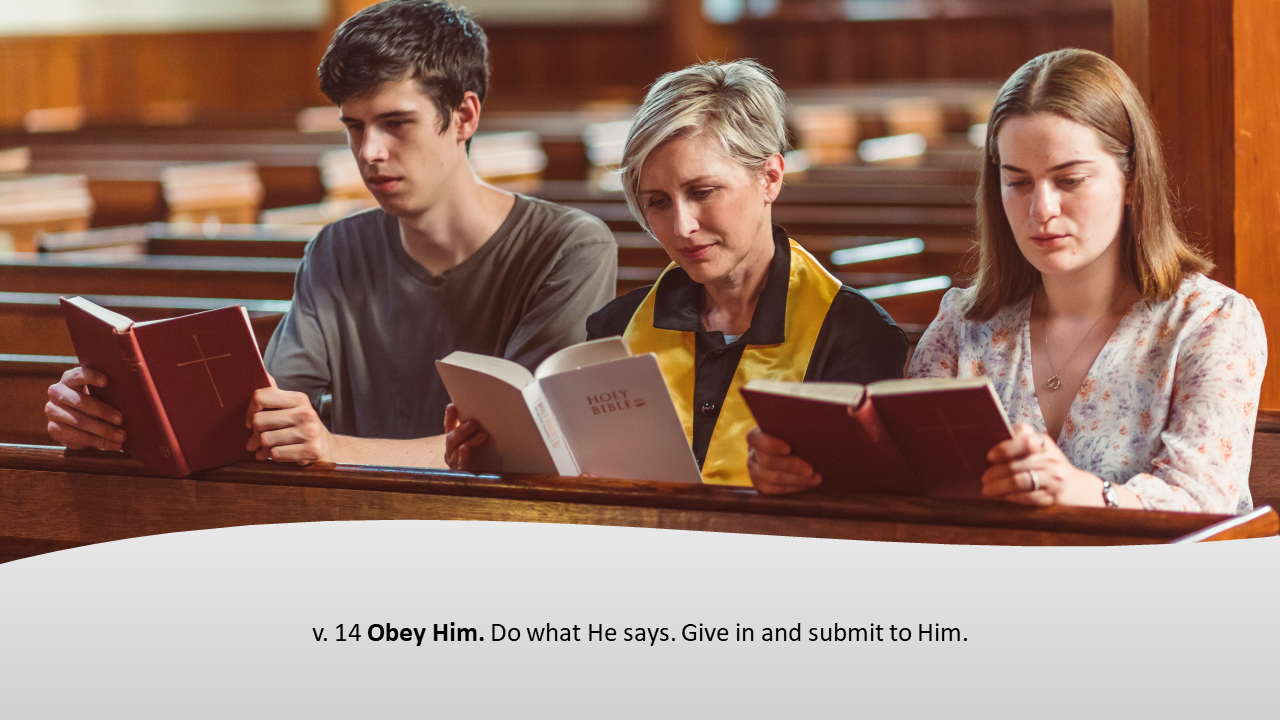
Look at the 14th verse. He changes our lives. The 14th verse says, I will pay my vows to the LORD. We should obey Him, do what He says. Give in and submit to Him. And so, as a habit, we should be in the habit of obeying Him.
.jpg)
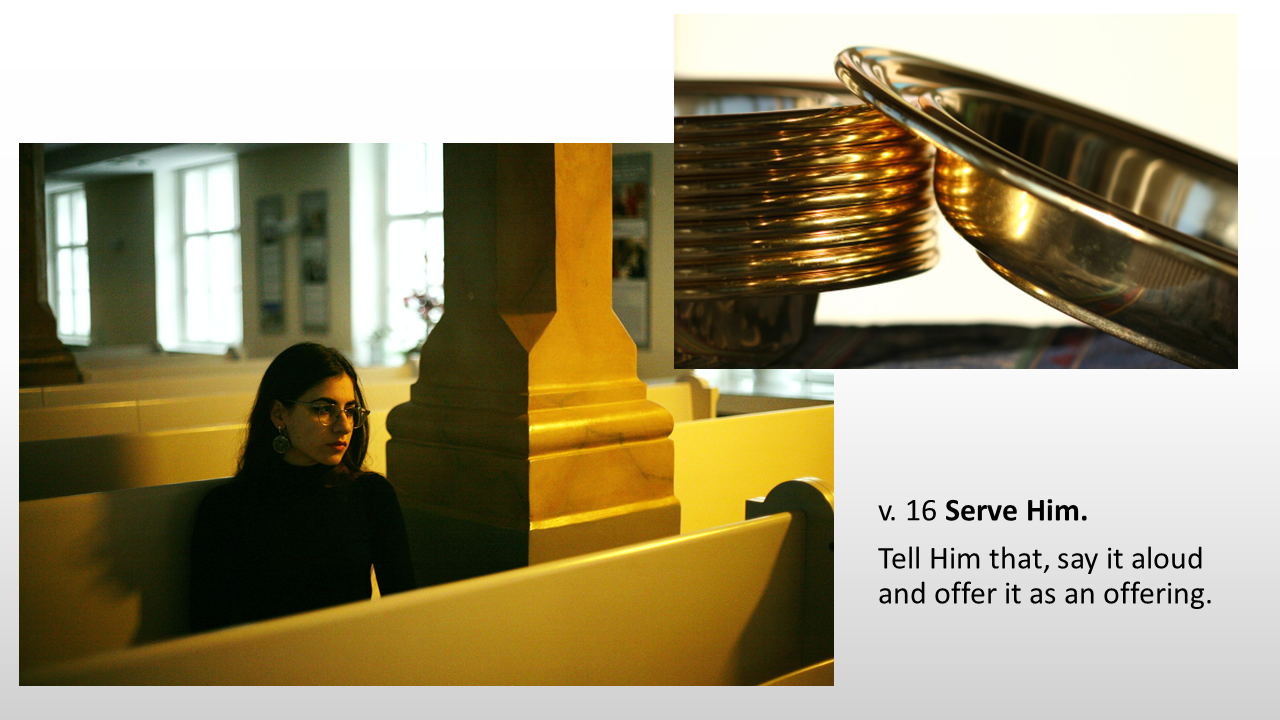
The 16th verse continues. It says, oh LORD, I am Your servant. And it’s almost like he stutters and says it again; I am Your servant. What? In Hebrew, they don’t have computers back then, and they didn’t have bold and big fonts. And so, what they did to emphasize stuff is they repeated it. That’s why one of the most important, the Trisagion, as it’s called holy, holy, holy. They’re not forgetting what they said. They’re emphasizing by the threefold repetition. This is a great emphasis in verse 16. The second most emphatic way of saying it, I am Your servant. I am Your servant! What he says is, I want to serve Him. That should be a habit. My habit of my life. I want to serve You. And so, I wrote my Bible. Serve Him. Make it a habit in your life that you want to serve the Lord. It. And what’s nice is tell that to the Lord. Say it out loud, offer it as an offering. Say, Lord, I want to serve You. In fact, every night, with our youngest child, I repeat the same little prayer with her. I say, dear Father in Heaven, she goes, dear Father in Heaven. And I say, I love You, Lord. She goes, I love You, Lord, and I want to, and I said, no. Repeat. Don’t launch off yourself. I love You. She said, I love You. And I say, I want to serve You. And she says, and I want to serve You, and I want to be a godly woman like mama. She always tries to get that in before I get through with a prayer. But you know what? We should say that with our lips. I am Your servant. Serve Him.
.jpg)
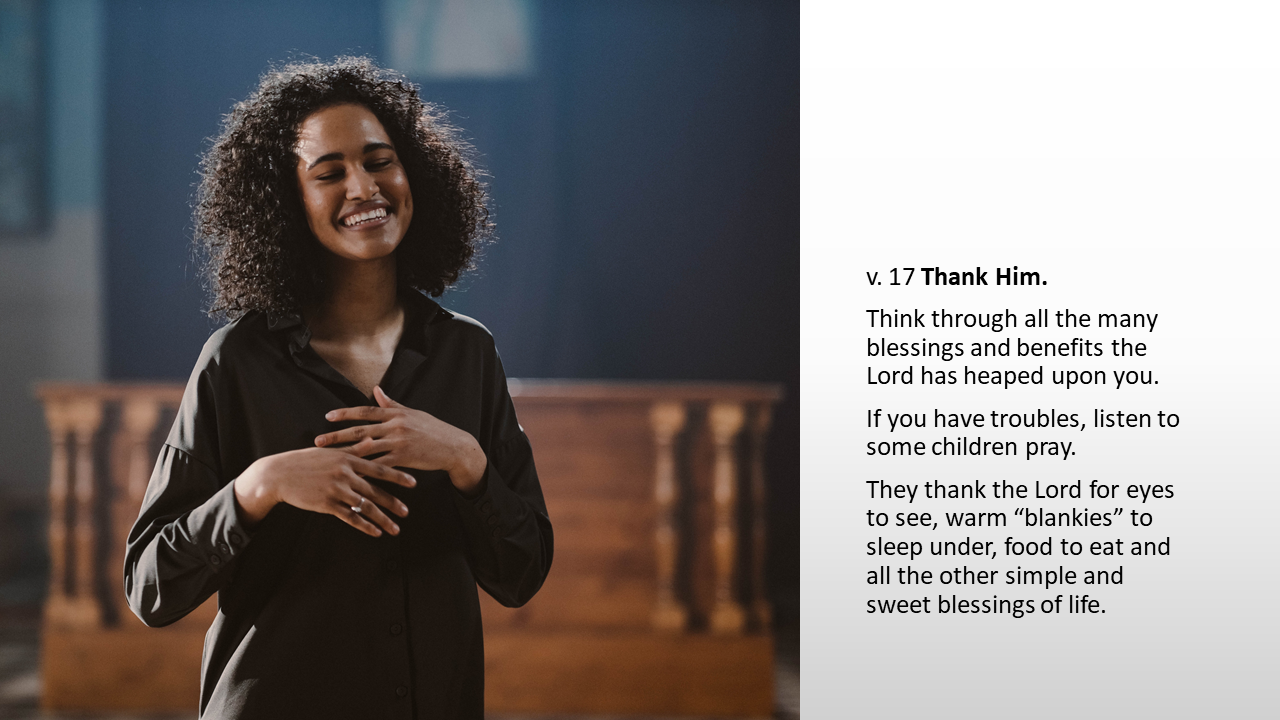
Now look at verse 17. Here’s another part of our habits of life. We should thank Him. Verse 17 says, I will offer to you the sacrifice of thanksgiving. As sacred as a Jew taking their little yearling, or the firstling of the flock, as sacred as that was, you and I can offer a similar sacrifice of thanksgiving. You know why a lot of people dread getting old and dying? Because they’ve lost the art of thanking God for His faithfulness throughout all the years. For His loading us up with blessings. If you’re having trouble knowing what to thank God for, get around some children.
My day starts, the earliest moment of the day when I’m up in my office. The first one that gets out of bed are usually the little kids and they come up and find me and we have good morning prayer time. I love to hear what they say. In fact, I wrote down yesterday’s prayers. Dear Lord, thank you for eyes to see. Now that’s a simple prayer and thank You for my warm blankie. When’s the last time you thanked the Lord you had a warm blankie? That’s a blanket in child language. Blankie. And also, thanks for food to eat. You know what? That’s a child. A child looks at life as, I can’t believe that I have a blanket, and I can’t believe I have food, and I can’t believe I have eyes. That’s thanking Him and you and I need to get used to offering the sacrifice of praise to the Lord, of thanksgiving.
.jpg)
And here’s the last habit, which I’ve written in my Bible right by verse 18. And that is that we need to have the habit of living for Him. It says in verse 18, I will pay my vows to the LORD in the presence of all His people, in the courts of the LORD’s House.
In the midst of You, he says, I am going to, as long as I have life, I’m going to live for You. I’m going to be hanging in Your courts. I’m going to be worshiping You in the presence; I’m going to testify in the presence of all the people. I’m going to fulfill my vows. I have said, Lord, I love You and I’ll serve You. So, in your Bible, what are these habits?
.jpg)
Verse 1, believe in Him. Verse 2, cry out to Him. Verse 9, follow Him all of your days. Verse 13, drink Him. Make sure you personally received and partaken of the water of salvation. Obey Him. Do what He says. That’s verse 14. Serve Him. That’s verse 16. Can you actually tell the Lord you want to be His servant?
Verse 17. Thank Him. And verse 18, live for Him. That’s what we should be doing in this new year as stewards. Why are we looking at this?
.jpg)
Let’s remember what we’re doing. Go back to 1 Timothy chapter 4, and I want to show you about six or seven verses in a row. So, try and stick with me. Look at 1 Timothy, that’s a New Testament near the end of your Bible, chapter 4, verse 7.
And this is where this whole series started. Actually, we started looking at this idea of the stewardship of our lives and what I began in 1 Timothy 4:7, this is what Paul said. He says at the end of the verse, exercise or discipline yourself toward godliness. And so, we began this progressive look at what encourages a godly life.
And our current study is what I’m entitling the disciplines of a godly life. First, we examine the discipline of Scripture. And looked at how the fact that Psalm 16:11 says, Thou will show me the path of life. In Your presence is fullness of joy, and at Your right hand are pleasures forevermore. And so, if we’ll get into this Book on a daily basis, God will show us what He wants us to do, the path of life. If we’re in this Book, then we are abiding in His presence, and we’ll have fullness of joy. And if we do what He says, we stay at His right hand, which means under His authority. And we have endless pleasures. It’s the best life there is. The discipline of Scriptures.
.jpg)
Then we went from there to John 7. If you want to back up to John’s Gospel, chapter 7, we looked at the discipline, the second discipline of a godly life, which is the discipline of a Spirit-filled life. And it’s the Holy Spirit as Jesus uses the image of a strong river flowing out of us. And it says in John 7, verse 37 through 39, on the last great day of the feast, Jesus stood and cried out and said, if you thirst… In other words, if you want to drink the cup of salvation, see the parallelism there. Let Him come to Me. We come to Him, believe in Him, trust in Him, receive Him and drink. And that’s a present active imperative now. Now, what is all this about? He continues. He who believes in Me, that’s John’s description of being born again, believing in Him, look at this, as the Scripture has said, faith comes by hearing, hearing by the Word of God. It’s so beautiful how all the Scripture relates together. Out of his heart will flow rivers of living water. What’s this? John continues. Look what he says, but this He spoke concerning the Spirit whom those who believe in Him would receive. For the Holy Spirit was not yet given.
What’s He talking about? When we’re born again, the Holy Spirit comes into our life, and that second discipline is the discipline of walking, of having a Spirit-filled life. And how do we do that? By not grieving the Holy Spirit, by not quenching. Remember I told you about one of the buddies turning the water off in our house and how everything just went down. And that’s what we have to discipline ourselves to not go anywhere, do anything, expose ourselves and participate in things that crank down the fullness of the Holy Spirit in our lives. The discipline of keeping full of the Holy Spirit.
.jpg)
And then last time we looked at the discipline of stewardship. And if you want to go to Romans 12, just so you understand where I’m headed in this concept of stewardship, Romans 12:1-2, Paul says, I beseech you therefore brethren, by the mercies of God that you present your body. He said, I want you to give yourself. In fact, really what we should do in the offering is walk around and have the ushers put a little plate on the floor and have everybody just step onto it because that’s what God really wants. A lot of people just put in a little money, but they don’t give themselves. God would rather have you than your money. If He has you, He has your money. If He has your money, He doesn’t necessarily have you. See, the idea is God wants us to first give ourselves, and that’s what we’re looking at right now. The stewardship of the discipline of being a steward. Stewardship is of our lives. It’s the stewardship of living. It’s a life given back to God as an offering. That’s what stewardship is about. Stewardship is not about money. It’s about life itself. It’s about me presented back to the Lord. It’s about me saying, I’m not my own. I’m bought with a price. It’s about me saying Romans 12:1-2, I want to present myself back to You.
A godly steward, we saw last time, knows that God owns him and everything he has. That’s what Romans 12:1-2 is about. What does that produce in our lives?
.jpg)
That makes us love the Lord because He gave Himself for us. It makes us obey the Lord. We saw in Luke that if we’re owned by the Lord, if He is our master, that He has the right of disposal. He can tell us what we do with our lives. Yield ourselves to Him and obey Him. We have to resist. We look last time at resisting the temptation to cheat Him by holding onto things He wants from us. And so, we obey the Lord and surrender to Him.
.jpg)
Now look at the next book. We’re in Romans. Look at 1 Corinthians chapter 4, because I want to show you just about three verses to continue this idea of stewardship.
If we have this lifelong habit of believing and following and calling on the Lord that I talked about in Psalm 116, it really ties together with 1 Corinthians 4:7 because it helps us confess that all we have came from the Lord our master. This is what Paul wrote to these people in verse 7. For who makes you to differ from another? How come you’re one way and your friends or neighbors or whoever is different from you? And what do you have, you didn’t receive? I’ve been to the hospital often. I’ve never seen a baby holding anything in their hands when they’re born, they don’t have title deeds, they don’t have cars, they don’t have degrees, they don’t have education, they don’t have anything. They come in with nothing in their hands. And so, everything in life we receive. We didn’t have it. It came and here we find where it came from. What do you have you did not receive. The Lord says it came from Me. Remember, every good and perfect thing is from above; it comes down from the Father of lights. From Him.
But look at this. Now, if you did indeed receive it, everything, your spiritual giftedness, your eternal life, even your life’s breath, why do you boast as if you did not receive it? This is such a humbling verse. As stewards, we realize that everything in our life comes from the Lord. Even my life’s breath.
Remember what Daniel 5? Remember Daniel was confronting the King of Babylon, and he says to him, the God in whose hand is your life’s breath. He says, God’s holding your breath, your heartbeat, your life existence, He holds, and He can stop it in an instant if He wishes. So, what does that mean to us? We need to confess that all we have came from our master. In fact, that’s what 1 Corinthians 4:7’s all about. A godly steward is one who confesses that all they have came from their master, and if it came from Him, why do we act like it’s ours? Why do we glory in it? Why do we show it off? We say, all I have belongs to You for all I have, what? Has come from you.
.jpg)
What does God want us to do? I’m glad you asked that. Look at 2 Corinthians 9 because this is a great verse. Remember the Corinthian people were living in a culture very similar to ours. The 21st century, you and I are living in the wealthiest and most consumptive society in history. Us Americans use, for example, almost 55% of all the paper that’s used in the entire world. And we’re consumptive. We consume most of everything in the world, of just about everything, except maybe some exotic monkey brains that they eat in, in Indonesia or something, but we consume the most of everything.
What does God require of us that have so much? 2 Corinthians 9 tells us, he says this, verse 10. Now, may He who supplies seed to the sower and bread for food, supply and multiply the seed you have sown and increase the fruits of your righteousness. Now stop right there. So, what does God allow us to get enriched for?
How come we live in this prosperous world we live in, and this culture we live in, and the wealthiest society of the planet in history has ever had? Paul’s talking to a similar time when the Corinthians were like that, but how does he finish that sentence? The, if you watch prosperity television, what the preacher would say is God gives you that so you can be rich, and so you should give $5 to the church and God will give you $500. Have you ever heard him say all that stuff, that prosperity teaching? But that’s not how this verse ends. He doesn’t say so that we might live in wealth and show the world how much God blesses those who love Him.
Paul finishes verse 11 by saying this. He made you rich in every way, so you can be generous on every occasion. That’s why God makes us rich. That’s why He says everything comes from Me because He wants us to grow in our giving as generous people. Now keep going from 2 Corinthians to Galatians, Ephesians, Philippians.
Because I want to show you in chapter 4 of Philippians some of the most quoted verses in, in the New Testament. And I want to show you what’s between them. It reminds me of when my children, when they’re really little and they have a sandwich, a lot of times they take the bread off the top and eat what’s in the middle, and they leave the bread. You ever seen a child do that? Did you know that’s what happens with a lot of people’s lives? Only in Philippians 4 they eat the bread and leave out the sandwich, the middle. Because look at Philippians 4:13. How many of us have that marked in our Bible? I can do all things through Christ who strengthens me.
Now look at verse 19, and my God shall supply all your needs according to His riches and glory. There’s the two slices of bread, but we leave out the middle. You know what this is talking about. I can do everything, and we put our arm around people and say, oh, the Lord will give you strength to go through that. I can do all things through Christ who strengthens me. And we comfort him with that. And then others who are in need, we say, Philippians 4:19, my God will supply all your needs according to His riches and glory. What was He enriching them for in the beginning? Look at verse 14 of Philippians 4. Nevertheless, you have done well that you shared in my distress. That’s right after verse 13, verse 15. You Philippians know, at the beginning of the Gospel, when I departed Macedonia, no one shared with me, he’s talking about finances, concerning giving and receiving, except this church, you all. For even, verse 16, in Thessalonica, you sent aid once and again for my necessities, and he said in verse 17, not that I’m wanting more gifts, but I seek fruit that abounds to your account, because he said, the more you give, the more that God is blessing you with spiritual riches. Verse 18, I have all and abound. I am full. I have received from Epaphroditus the things from you, and those gifts were a sweet-smelling aroma, and an acceptable sacrifice, pleasing to God. Now, verse 19, and my God will supply all of your needs.
You see, these people, if you know anything about the story, gave so much that it caused them to be in need. And you know what he is saying, my God’s going to supply your needs because of your generosity. And he said, you don’t need to send anymore because you’re not supposed to be giving that much. But he said, it’s wonderful.
We know all about this, but we in our century, we think God is blessing us so we can be rich and be a testimony of the world of how great God blesses. Actually, God blesses us, so we’ll grow as givers. God wants us to be generous. We should be the most caring, the most sensitive, the most compassionate, the most giving, the most sacrificial, and the most abundantly willing to respond to needy people in the world. Jesus said that we should be doing good, and that’s what we’re to be stewards of. Not to amass this pile that we’re backing away from through life, but rather transfer the title of that pile to the Lord and go through life saying, Lord, the more you bless me, the more I want to be generous and give to your kingdom, and I want to be as Philippians 4 says at the end of verse 18, offering a sweet smelling aroma and an acceptable sacrifice that’s well pleasing to You. Well, a steward confesses 1 Corinthians 4:7, that all they have comes from their master, and secondly, seeks to grow as a giver.
.jpg)
But look back at Philippians 3:20. Here’s the last verse. Philippians 3:20. A steward finally seeks to point their life toward Heaven.
Now we’re going to pick up here next week and I’m going to talk about this concept of how dangerous it is not to make this transfer to the Lord. And by transfer I don’t mean, Jesus never called on everyone to sell everything, and give it up, and live in poverty. But He did call on everybody to give, if they were His servant, to give the disposition and the ownership of all they have in life to Him. And anything less than that, is not serving Him. But the reason He did that is look at Philippians 3:20, for our citizenship is in Heaven. From which we eagerly await the Savior, our Lord, who will transform us and conform us to Him and on he goes, that’s Christians. But look at verse 19. These are the lost people. Their end is destruction. Verse 19 of Philippians 3. Their god is their appetite. Their glory is in their shame.
Now, what is all that about? They set their mind on Earthly things. Now, back to where we began, if you lay up your treasure on Earth, verse 19 there, if you set your mind on Earthly things, then you will spend your whole life backing away from your treasure, and death will be loss. But if you say, I’m a citizen of Heaven, and God blesses me through life, my business, my pursuits, and my hard work and all that, for me to be growing as a generous steward of Heaven and to be giving on Earth, to lay up treasure in Heaven, then death for me, as Paul said, for me to live is Christ. I’m going to be giving like Christ did. But for me to die is gain because I, Jesus said, everything you give, you get a hundred-fold in Heaven. That’s immediate gain.
Is the passing of time causing you and me to despair or rejoice? God wants us to realize that if we spend our life moving toward our treasure, then our life, as Psalm 116 says, will be precious in God’s sight. It’ll be precious because our glory is not on this Earth, and we are not spending our time with our mindset on Earthly things. But we have said, Lord, for me to live is Christ, and I’m a citizen of Heaven. And my treasures are at Your disposal because I’m a steward, and You’re my master, and I want You to bless me, not so I can have more.
By the way, next week we’re going to find out the more you have, the more you leave behind, the more you have, the more you lose. The more you have, the more you have to worry about. The more you have, the more you have to have people take away from you. The more you have, the more you have to care for. But if everything belongs to the Lord, it frees us up to say, Lord, as your steward, what do you want me to do with all this time? These talents? These treasures? How do You want me to invest them for You? Takes the sting out of death. It makes death not dreadful, and it helps us to have a life that’s fruitful in every way.
.jpg)
Let’s bow before the Lord and ask Him to teach us His truth deeply into our hearts this day.
Father in Heaven, I thank You for your precious saints that have ears to hear, but I ask You this morning, for those who may be visiting with us, friends who came with open hearts and seeking, but they have not yet drank the cup of salvation. They are in a group setting, but You only save individuals. And so, I pray that in the privacy of their own will, that they would realize that You, oh Lord, wrote a love letter on a cross of wood, on a hillside in Galilee 2000 years ago. When You said that You so loved the world that you gave Your Son and He gave His life as a sacrifice to redeem those who would come in simple faith and receive that gift. So, for any who don’t know You, may they today call upon Your name. And whoever will call on Your name, You have promised us will be saved. And for us who are saved, may we be good stewards of our lives and may we cultivate habits that will make death not despair or dread, but delight as we head toward our citizenship in Heaven. In name of Jesus, we pray, and for His sake we ask it. Amen. And God bless you as you go.
This week I was driving my family across central Florida. The terrain of that area is pretty monotonous for a couple of hours between the coasts. As we topped one hill something new confronted all the pairs of eyes watching out the windows…acres and acres and acres of mobile homes were lined up as far as we could see. The fenced entrance said “Pre-owned Mobile Home Liquidators”.
One of the children said what does “Pre-owned Mobile Homes” mean? Bonnie quietly said, “It means that many of the senior citizens in Florida that lived in them have died and now they are for sale.” And they were – thousands of them as far as we could see.
Those acres of “previous owner deceased mobile homes” reminded me of one of the most amazing facets of pastoring Christ’s church. As a pastor I often get the joy of standing by people as they prepare to face death. For many it is a precious time of helping them get ready. And do you know where to turn to find one of the most practical places in all God’s Word for getting ready? Psalm 116. As you turn there may I take your minds with me back to Florida?
There are over 16 million people who live in Florida. Over 4 million are in their “Golden Years”. Over 170,000 died in 2002. How much did those 170,000 people leave behind? EVERYTHING.
Florida has over 9 million deeded pieces of property worth $1.1 Trillion dollars in 2002. About 40% of that property value is in the hands of those 55 and older (who make up 26% of the population). So 40% of $1.1 Trillion dollars divided by 2.2 million households means the average golden years property owner of Florida’s coastal properties has $12.5 million dollars of wealth! And this vast amount of wealth is owned by people who are getting older and older.
Here is the question before we read the 116th Psalm, how hard is it to die when you have so much wealth? Remember what we learned a few weeks ago?
o People who lay up treasures on earth spend their life backing away from their treasures. To them, death is loss.
o People who lay up treasures in heaven look forward to eternity; they are moving daily toward their treasures. To them, death is gain.
o Those who spend their life moving away from their treasures have more and more reasons to despair. Those who spend their life moving toward their treasures have more and more reasons to rejoice.
o Is the passing of time causing you and me to despair or rejoice? God’s ownership of everything is the reference point for all of us who serve the Lord.1
God’s Word teaches us 8 habits that can keep us spiritually healthy until death. Wouldn’t it be great to be in robust spiritual health, looking forward to Heaven. The habits recorded in this Psalm are not just for those who have one foot in the grave, they are actually good habits for all of our lives. Listen and learn the 8 habits that take the sting out of death and make us spiritually healthy to the last breath we take on earth.
Please stand with me as we read Psalm 116.
Here are the simple habits that make our death precious in the sight of the Lord. These are the marks of a healthy spiritual life that takes the sting out of death.
1. v. 1 Believe in Him that He is listening and watching and respond in love.
2. v. 2 Cry out to Him. Get used to talking to the Lord. Pour out your heart, your fears, your woes – share them with Him.
3. v. 9 Follow Him through your daily life. He is the Shepherd and we are His sheep.
4. v. 13 Drink Him. He is our cup of salvation. We thirst and He alone satisfies. Let Him into your life to meet your deepest needs!
5. v. 14 Obey Him. Do what He says. Give in and submit to Him.
6. v. 16 Serve Him. Tell Him that, say it aloud and offer it as an offering.
7. v. 17 Thank Him. Think through all the many blessings and benefits the Lord has heaped upon you. If you have troubles, listen to some children pray. They thank the Lord for eyes to see, warm “blankies” to sleep under, food to eat and all the other simple and sweet blessings of life.
8. v. 18-19 Live for Him. From now on live for His glory, talk of His blessings, come into His presence, worship and adore Him.
Now that we are in this New Year, do your plans and priorities for 2003 mirror what the Lord desires? His desires are clearly laid out in His Word.
Our key passage for this series is 1st Timothy 4.7. Paul says we are to discipline our selves towards godliness. What encourages a godly life? That is our current study which I call The Disciplines of a Godly Life.
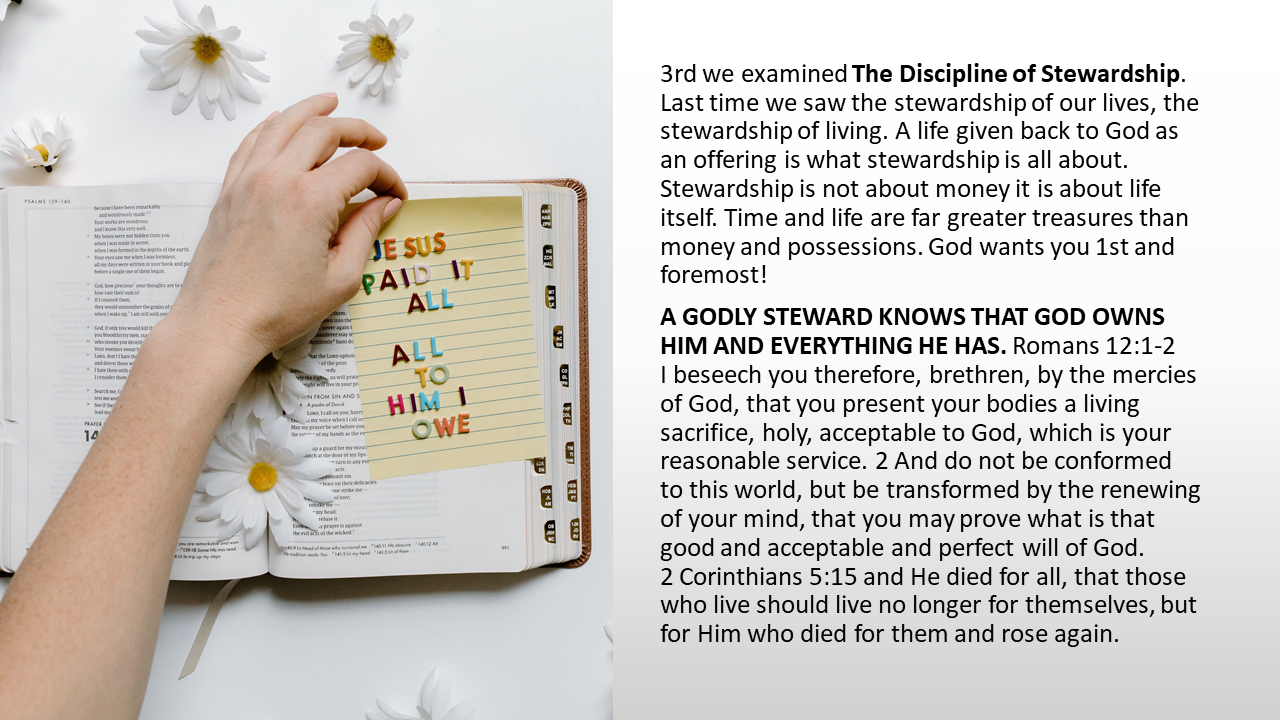
1. 1st we examined The Discipline of Scripture. Time alone with God in His Word, the Scriptures, is the great necessity of our spiritual lives. We need to be alone with God daily! We need to find times to get away alone. Psalm 16:11 You will show me the path of life; In Your presence is fullness of joy; At Your right hand are pleasures forevermore. The Lord God of the Universe wants to Arrange your life, and Accompany you trip through life, and authorize everything needed from now on. Wow, that is the best life there is. 2. 2nd we examined The Discipline of Spirit Filled Living. Jesus explained the Holy Spirit in our lives by using the image of a strong river of water flowing out of us. John 7.37-38. John 7:37-39 On the last day, that great day of the feast, Jesus stood and cried out, saying, “If anyone thirsts, let him come to Me and drink (present active imperative). He who believes in Me, as the Scripture has said, out of his heart will flow rivers of living water.” But this He spoke concerning the Spirit, whom those believing in Him would receive; for the Holy Spirit was not yet given, because Jesus was not yet glorified. Rivers of water is the way Jesus describes the normal life of believers, His children. 3. 3rd we examined The Discipline of Stewardship. Last time we saw the stewardship of our lives, the stewardship of living. A life given back to God as an offering is what stewardship is all about. Stewardship is not about money it is about life itself. Time and life are far greater treasures than money and possessions. God wants you 1st and foremost! A GODLY STEWARD KNOWS THAT GOD OWNS HIM AND EVERYTHING HE HAS. Romans 12:1-2 I beseech you therefore, brethren, by the mercies of God, that you present your bodies a living sacrifice, holy, acceptable to God, which is your reasonable service. 2 And do not be conformed to this world, but be transformed by the renewing of your mind, that you may prove what is that good and acceptable and perfect will of God. 2 Corinthians 5:15 and He died for all, that those who live should live no longer for themselves, but for Him who died for them and rose again.
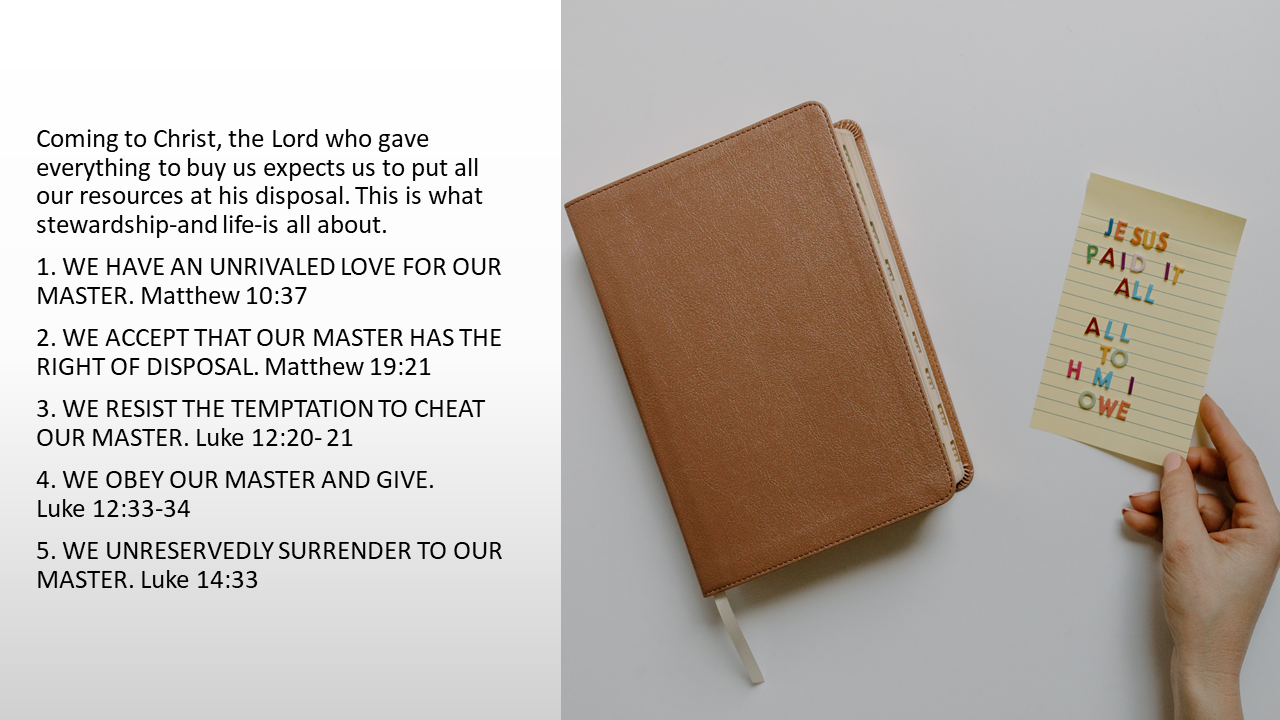
Coming to Christ, the Lord who gave everything to buy us expects us to put all our resources at his disposal. This is what stewardship-and life-is all about.
1. WE HAVE AN UNRIVALED LOVE FOR OUR MASTER. Matthew 10:37 “He who loves father or mother more than Me is not worthy of Me. And he who loves son or daughter more than Me is not worthy of Me. (NKJV) I like how Randy Alcorn describes this truth. God2 wants your heart.
2. WE ACCEPT THAT OUR MASTER HAS THE RIGHT OF DISPOSAL. Matthew 19:21 Jesus said to him, “If you want to be perfect, go, sell what you have and give to the poor, and you will have treasure in heaven; and come, follow Me.” (NKJV)
3. WE RESIST THE TEMPTATION TO CHEAT OUR MASTER. Luke 12:2021 “But God said to him, `You fool! This very night your life will be demanded from you. Then who will get what you have prepared for yourself?’ 21 “This is how it will be with anyone who stores up things for himself but is not rich toward God.” (NIV) Jesus teaches us that some hold on to things with grasping clenched fists and lose them. Stewardship means we are resisting SATAN’S STRATEGY. Since money is one of the essentials of the work of the Kingdom, it is not surprising that the great adversary does all in his power to prevent it from finding its way into God’s treasury, and for that he has many tricks in his bag.
4. WE OBEY OUR MASTER AND GIVE. Luke 12:33-34 Sell your possessions and give to the poor. Provide purses for yourselves that will not wear out, a treasure in heaven that will not be exhausted, where no thief comes near and no moth destroys. 34 For where your treasure is, there your heart will be also. (NIV)
5. WE UNRESERVEDLY SURRENDER TO OUR MASTER Luke 14:33 “So likewise, whoever of you does not forsake all that he has cannot be My disciple. (NKJV) THIS DEALS WITH PERSONAL POSSESSIONS!
6. WE CONFESS THAT ALL WE HAVE CAME FROM OUR MASTER 1 Corinthians 4:7 For who makes you differ from another? And what do you have that you did not receive? Now if you did indeed receive it, why do you boast as if you had not received it?
7. WE SEEK TO GROW AS GIVERS. 2 Corinthians 9:10-11 Now may He who supplies seed to the sower, and bread for food, supply and multiply the seed you have sown and increase the fruits of your righteousness, 11 while you are enriched in everything for all liberality, which causes thanksgiving through us to God. So that what? How3 will he finish this sentence? Prosperity theology would finish it, “so that we might live in wealth, showing the world how much God blesses those who love Him.” But that isn’t how Paul finishes it. He says, “You will be made rich in every way so that you can be generous on every occasion”. Do Phil 4.19
8. WE CHOOSE TO POINT OUR LIFE TOWARD HEAVEN. Philippians 3:20 For our citizenship is in heaven, from which we also eagerly wait for the Savior, the Lord Jesus Christ, Hebrews 11:13 These all died in faith, not having received the promises, but having seen them afar off were assured of them, embraced them and confessed that they were strangers and pilgrims on the earth. Hebrews 11:16 But now they desire a better, that is, a heavenly country. Therefore God is not ashamed to be called their God, for He has prepared a city for them. Probably the greatest deterrent to giving all we are and have to the Lord is this: the illusion that earth is our home.
The Lord wants us to realize that earth is a passing stop in our pilgrimage. Giving our moments and days back to the Lord means we finally4 understand. Nothing on this planet lasts, it all will pass away. At the end of each persons life is a landfill, a junkyard – the final resting place for the things in our lives. Sooner or later, everything we won ends up here. Christmas and birthday presents. Cars, boats, and hot tubs. Clothes, stereos, and barbecues. The treasures that children quarreled about, friendships were lost over, honesty was sacrificed for, and marriages broke up over – all end up here. (I recommend taking a family field trip to a junkyard. It’s a powerful object lesson.)”
9. WE INVEST OUR HEART IN HEAVEN. Turn to Hebrews 11.26. Moses left Egypt’s treasures “because he was looking ahead to his reward”. That is what God honors. That is the life of faith. That is what pleases the Lord.
God has given some very timely warnings to us at the beginning of the 21st Century, in the most wealthy and consumptive society that has ever existed on planet earth. Please turn with me to Ecclesiastes. There are 5 books that constitute the Wisdom Literature of Israel, these books give us some powerful guiding lights for every day living.
o God’s Instructions to us on Godly Suffering – Job;
o God’s Instructions to us on Godly Worshiping – Psalms;
o God’s Instructions to us on Godly Living – Proverbs;
o God’s Instructions to us on Godly Thinking about Life – Ecclesiastes; and
o God’s Instructions to us on Godly Loving – Song of Songs.
As I pondered Ecclesiastes, the 4th Wisdom book, I was deeply struck by a sermon one pastor presented on Ecclesiastes 5.10-15. Here were his5 points. See if they strike you like they struck me.
1. “Whoever loves money never has money enough” (v. 10). The more you have, the more you want
. 2. “Whoever loves wealth is never satisfied with his income” (v. 10). The more you have, the less you’re satisfied.
3. “As goods increase, so do those who consume them” (v.11). The more you have, the more people (including the government) will come after it.
4. “And what benefit are they to the owner except to feast his eyes on them?” (v. 11). The more you have, the more you realize it does you no good.
5. “The sleep of a laborer is sweet, whether he eats little or much, but the abundance of a rich man permits him no sleep” (v. 12). The more you have, the more you have to worry about.
6. “I have seen a grievous evil under the sun: wealth hoarded to the harm of its owner” (v. 13). The more you have, the more you can hurt yourself by holding on to it.
7. “Or wealth lost through some misfortune” (v.14). The more you have, the more you have to lose.
8. “Naked a man comes from his mother’s womb, and as he comes, so he departs. He takes nothing from his labor that he can carry in his hand” (v.15). The more you have, the more you’ll leave behind.
o He who lays up treasures on earth spends his life backing away from his treasures. To him, death is loss. He who lays up treasures in heaven looks forward to eternity; he’s moving daily toward his treasures. To him, death is gain. He who spends his life moving away from his treasures has reason to despair. He who spends his life moving toward his treasures has reason to rejoice.
o Is the passing of time causing you and me to despair or rejoice? God’s kingdom was the reference point for these men. They saw all else in light of the kingdom. They were compelled to live as they did not because they treasured no things, but because they treasured the right things.
o We often miss something in missionary martyr Jim Elliot’s famous words, “He is no fool who gives what he cannot keep to gain what he cannot lose.” We focus on his willingness to go to the mission field. That willingness started when he relinquished his hold on things as MINE!6
1 Adapted from Alcorn, Money, Treasures and Eternity, p.
2 Randy Alcorn, The Treasure Principle. Sisters, OR: Multnomah Publishers, Inc., 2001, p.43.
3 Randy Alcorn, The Treasure Principle. Sisters, OR: Multnomah Publishers, Inc., 2001, p.72-73.
4 Randy Alcorn, The Treasure Principle. Sisters, OR: Multnomah Publishers, Inc., 2001, p.47.
5 Randy Alcorn, The Treasure Principle. Sisters, OR: Multnomah Publishers, Inc., 2001, p.53-54.
6 Alcorn, Money, Treasures and Eternity, p.