If the video above is not available, here are two other ways to view:
GEW-04
EBG-33
Titus Two Women-04 Women Energized by Grace .doc
Titus Two Women-04: Women Energized by Grace Love Their Husbands
Titus 2:4
070527AM
We were saved by God’s grace; and we are kept by God’s grace; and we live in a way that pleases God and earns His rewards—energized by His grace.
These past few weeks we have been looking at God’s high calling for women in His Church, and sometimes it may seem that living that way is impossible—and that is the truth. Titus two women live a humanly impossible life. They must be energized by God’s grace to live that way!
So step back and survey the whole scope of Christ’s New Testament church and His plan for us. As believers this morning we are on the journey of new beginnings through Christ—energized each step of the way by grace.
Titus two is a road map for all who want their life to count. It is God’s pathway of disciplines to choose each day in the power of the Spirit of grace.
God’s plan to work in the world is His church[1]. Christ’s church may be described as a group of people, energized by grace, doing the impossible for the glory of God. A key insight into God’s plan to reach the world through Christ’s church is in Titus chapter two.
The verses of this chapter contain a call to First Century men and women energized by grace to live an extraordinary spiritual life in a very unspiritual culture.
When grace energizes us we want to deny ungodliness in any form we find it cropping up in our lives. When God’s grace energizes us we want to mortify lust in any form in our lives.
When we study this idea of the older-in-the-faith, godly, Titus two woman, we are describing a woman who has chosen to learn from God how to live her life day-by-day and step-by-step in a way that pleases God. Women energized by grace are useful to God.
When the Gospel of Jesus Christ entered the Roman world of the New Testament the landscape was very bleak. Christ’s church was born into a sin-warped, sin-darkened world of mixed-up marriages, sin-scarred lives, and confused families.
But men and women who were gloriously saved did not automatically become great wives and mothers, or husbands and fathers. When they came to Christ and were forgiven, God graciously gave them everything they needed to become godly wives, mothers, husbands, and fathers. But, they needed something else. They need worship services that taught them to believe correctly, and then they needed small group discipleship times to learn how to behave correctly. Correct behavior is behavior energized by grace.
Titus two describes how God works in the life of a believer. When we were saved and the gospel of grace began in our lives, the evidence is seen in the sanctification process. Grace always teaches genuine believers how to say no to sin in any form.
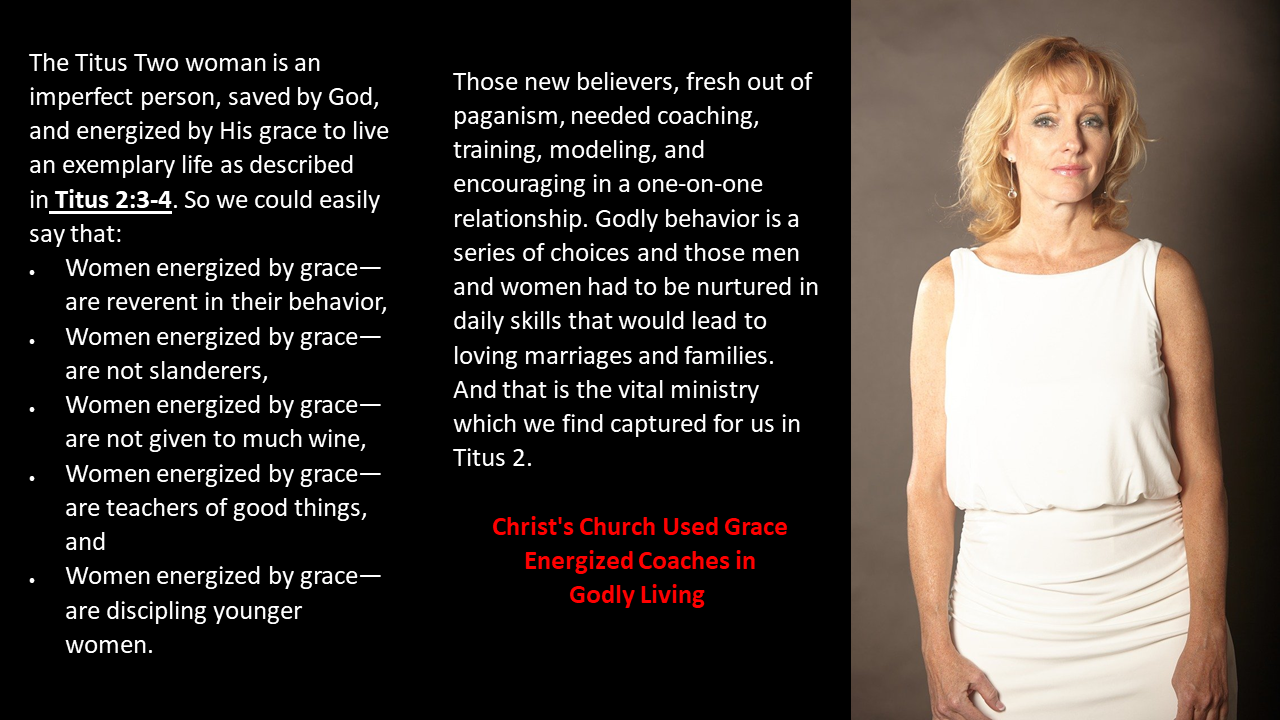
The Titus Two woman is an imperfect person, saved by God, and energized by His grace to live an exemplary life as described in Titus 2:3-4. So we could easily say that:
• Women energized by grace—are reverent in their behavior,
• Women energized by grace—are not slanderers,
• Women energized by grace—are not given to much wine,
• Women energized by grace—are teachers of good things, and
• Women energized by grace—are discipling younger women.
Those new believers, fresh out of paganism, needed coaching, training, modeling, and encouraging in a one-on-one relationship. Godly behavior is a series of choices and those men and women had to be nurtured in daily skills that would lead to loving marriages and families.
And that is the vital ministry which we find captured for us in Titus 2.
Christ’s Church Used Grace Energized Coaches in Godly Living
Just as important as the preaching and teaching of the doctrines of God’s Word was the modeling and nurturing of individual saints through practical hands-on lessons in godly living.
The building blocks of Christ’s church are Spirit-filled men and women whose lives are given daily as obedient servants of God.
God wants men and women that will mentor, nurture, and coach godly living for His church. These individuals believe that God has called them to touch one life at a time for His glory.
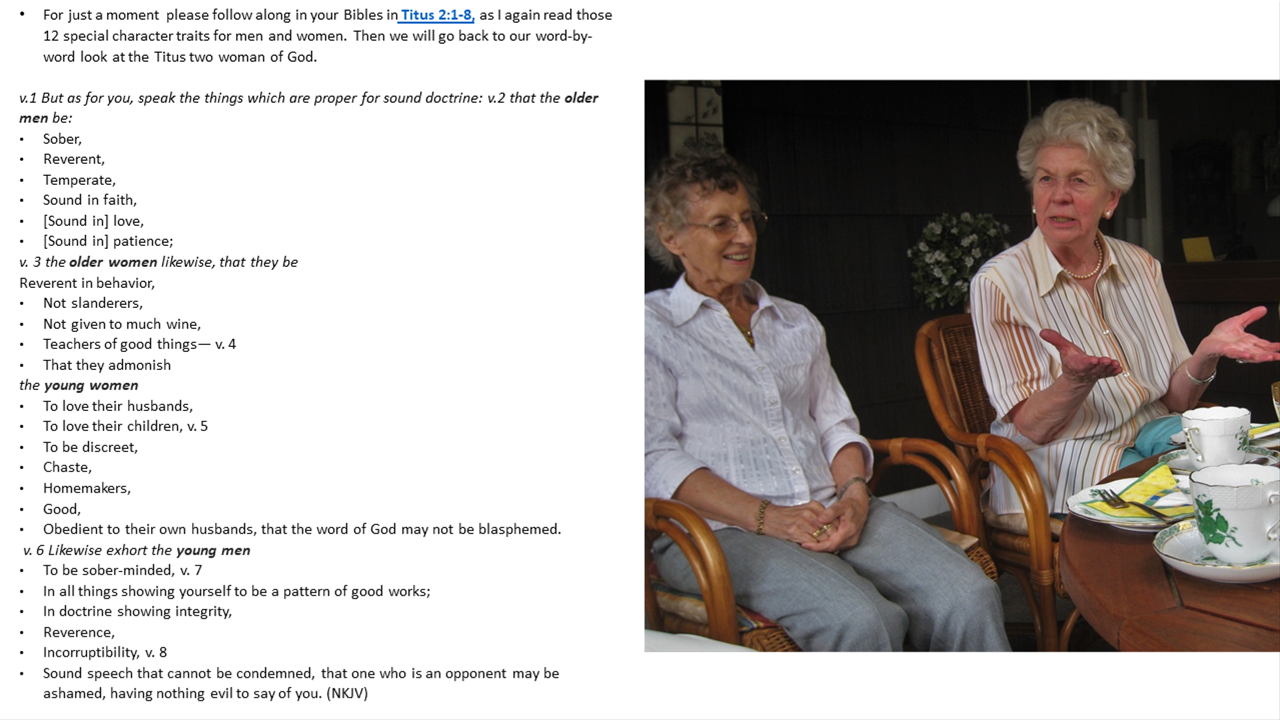
For just a moment please follow along in your Bibles in Titus 2:1-8, as I again read those special character traits for men and women.
v.1 But as for you, speak the things which are proper for sound doctrine: v.2 that the [grace energized] older men be:
• Sober,
• Reverent,
• Temperate,
• Sound in faith,
• [Sound in] love,
• [Sound in] patience;
v. 3 the [grace energized] older women likewise, that they be
• Reverent in behavior,
• Not slanderers,
• Not given to much wine,
• Teachers of good things v. 4
• That they admonish
the [grace energized] young women
• To love their husbands,
• To love their children, v. 5
• To be discreet,
• Chaste,
• Homemakers,
• Good,
• Obedient to their own husbands, that the word of God may not be blasphemed.
v. 6 Likewise exhort the [grace energized] young men
• To be sober-minded, v. 7
• In all things showing yourself to be a pattern of good works;
• In doctrine showing integrity,
• Reverence,
• Incorruptibility, v. 8
• Sound speech that cannot be condemned, that one who is an opponent may be ashamed, having nothing evil to say of you. (NKJV)
When God gets to pick the curriculum for His Church, what does He choose to be taught? He lays down 12 vital, godly character qualities for women and 12 vital, godly character qualities for men.
Women energized by grace who have these characteristics are highly useful to God. The long-term goal of their lives is geared towards being useful to God. Parents who want their children be useful for the Lord begin early on to point their children towards the high calling and great joy of being a Titus 2 woman and the Titus 2 man.
The whole goal of a Titus two woman is to train younger women in biblical, simple-to-measure, Spirit-empowered, love-based living.
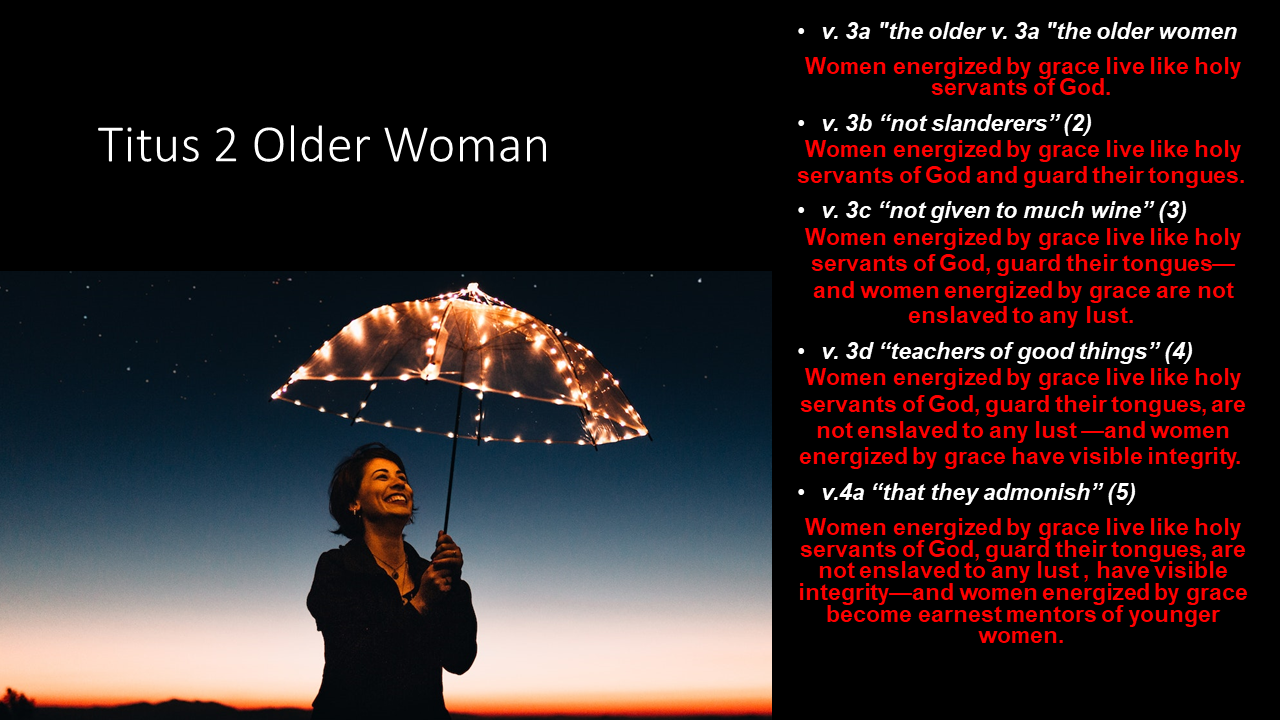
v. 3a “the older women likewise, that they be reverent in behavior” (1) Women energized by grace live like holy servants of God.
Paul starts first using the word translated “reverent” that conveys the idea of ‘acting as a representative of a god’. That is how Paul describes the devout and godly character of the Titus two woman. Older women are to live like holy priests serving in the presence of God. Their sacred, personal devotion to the Lord has slowly come to influence every aspect of their lives.
Godly older woman have simply taken Romans 12:1-2, 1 Corinthians 6:19-20, and Galatians 2:20seriously.
Bodies presented as living sacrifices, holy, acceptable to God, not conformed to this world, but with transformed and renewed minds, in bodies that are temples of the Holy Spirit glorifying God in your body and spirit, which are God’s; no longer living for me, but Christ living through me.
They have presented themselves to the Lord, they have begun to live life the way God asked them to live—as a walking temple of God, as a consecrated priest of God, as a living sacrifice, and as a bondservant of the Lord.
Women energized by grace live like holy servants of God.
v. 3b “not slanderers” (2) Women energized by grace guard their tongues.
Godly Titus two women never are to surrender their tongues to the devil. They are prompted by the Holy Spirit to make sure that what they say is absolutely true, honest, just, pure, lovely, and of good report before they say it—lest they discredit their ministry effectiveness as a godly Titus two woman.
They think first: before starting to say something, pause a few seconds and ask if these words are pleasing to God. They also talk less, making each a time to speak as Peter said, speaking as the oracles of God. And they start that practice now. Don’t waste your greatest tool.
Women energized by grace live like holy servants of God and guard their tongues.
v. 3c “not given to much wine” (3) Women energized by grace are not enslaved to anything but Christ.
Godly women are Spirit-controlled in every part of their life. They resist excess in any area of daily life. They are not slaves to any substance, to any amusement, to any fashion, or to any attitude that does not please their Master in Heaven.
Women energized by grace live like holy servants of God, guard their tongues—and women energized by grace are not enslaved to any lust.
v. 3d “teachers of good things” (4) Women energized by grace have visible integrity.
Titus Two women have spiritual integrity–godly women live what they teach. They train others in the pattern they have learned. Their walk speaks louder than their talk.
These godly older women were noble in everything and in the way they lived life they taught by their actions what is good!
Women energized by grace live like holy servants of God, guard their tongues, are not enslaved to any lust —and women energized by grace have visible integrity.
v.4a “that they admonish” (5) Women energized by grace are earnest mentors.
This one word is variously rendered into four different English words by the top four versions: “teach” (KJV); “admonish” (NKJV); “train” (NIV); and “encourage” (NAS). The context and the word imply that this was to be a process of teaching, explaining, encouraging, training, and holding the young wives to a standard that was unfamiliar to them and yet vital for the success of their marriages and families.
One of the strongest forces for spiritual ministry in the local church lies with the older believers. Those who are retired have time for service. It is vital that we mobilize and use these important people. In my own 30 years of pastoral ministry, I have been constantly helped and encouraged by godly older saints who knew how to pray, teach God’s Word, visit, troubleshoot, and help edify Christ’s church.
Women energized by grace live like holy servants of God, guard their tongues, are not enslaved to any lust , have visible integrity—and women energized by grace become earnest mentors of younger women.
v. 4b “the young women to love their husbands” (6) Women energized by grace love their husbands.
A Christian home in a pagan culture was a radically new thing.
Young women saved out of paganism needed to get accustomed to a whole new set of priorities and privileges; and those who had unsaved husbands would need special encouragement.
The Titus two models had the responsibility of training the younger women how to be successful wives, mothers, and housekeepers; and the younger women had the responsibility of listening and obeying.
Among the Bible-believing women of the first century, there was a big challenge in “loving” their husbands. For various reasons and in various degrees those women found themselves with either minimal or no “feelings of love” for their husbands.
Those believing wives in the early church, like those today, almost always want to obey the Lord, thus they submit and fulfill their responsibilities to their husbands—but often only dutifully and not lovingly. It’s not just that loving your husband is a virtue; Paul says that not loving him in a way that he can feel is a sin!
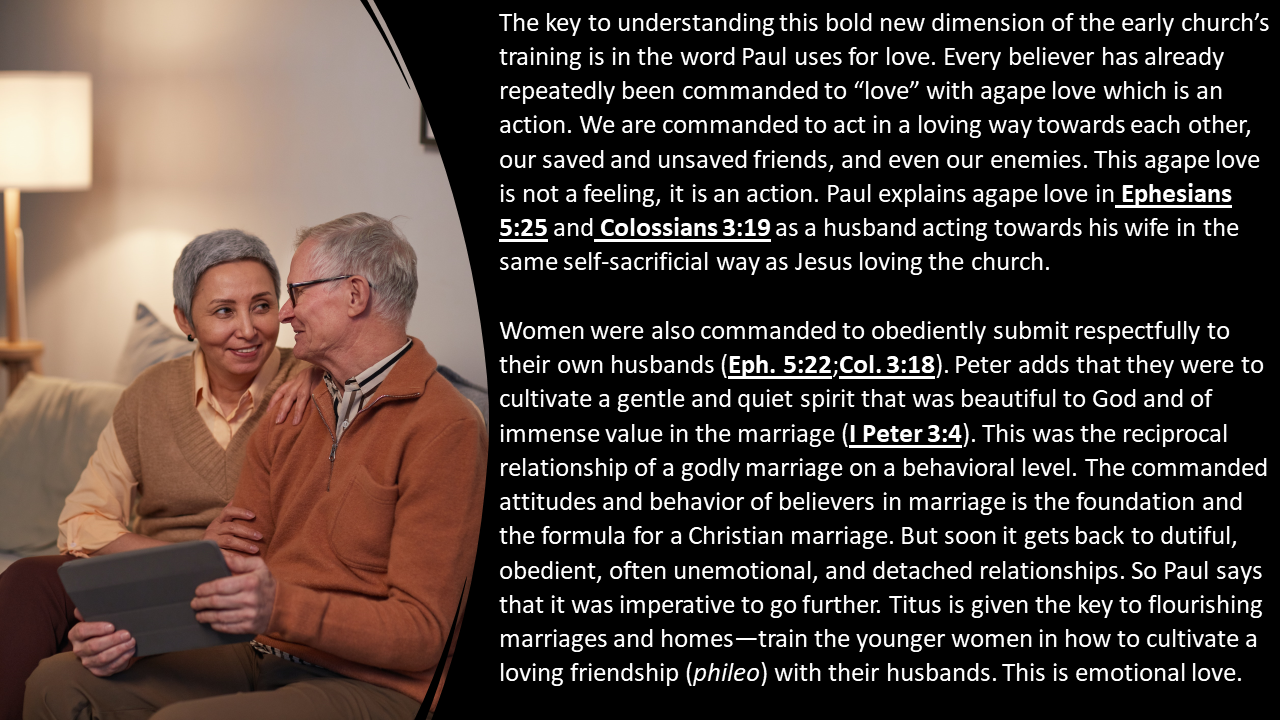
The key to understanding this bold new dimension of the early church’s training is in the word Paul uses for love. Every believer has already repeatedly been commanded to “love” with agape love which is an action. We are commanded to act in a loving way towards each other, our saved and unsaved friends, and even our enemies. This agape love is not a feeling, it is an action. Paul explains agape love in Ephesians 5:25 and Colossians 3:19 as a husband acting towards his wife in the same self-sacrificial way as Jesus loving the church.
Women were also commanded to obediently submit respectfully to their own husbands (Eph. 5:22;Col. 3:18). Peter adds that they were to cultivate a gentle and quiet spirit that was beautiful to God and of immense value in the marriage (I Peter 3:4). This was the reciprocal relationship of a godly marriage on a behavioral level. The commanded attitudes and behavior of believers in marriage is the foundation and the formula for a Christian marriage. But soon it gets back to dutiful, obedient, often unemotional, and detached relationships. So Paul says that it was imperative to go further. Titus is given the key to flourishing marriages and homes—train the younger women in how to cultivate a loving friendship (phileo) with their husbands. This is emotional love.
Agape love is never used in the Bible to describe sexual love or responsibility because emotional love can’t be commanded. The beautiful, intoxicating love that God designed for marriages to have sexually is emotional and those emotions can’t be commanded.
We can’t make someone feel a certain way; we can command them to “do” something but not “feel” a certain way. Genuine, Biblical, marital, sexual love is emotional intimacy in the highest degree. God commands willful, agape love; but the emotional phileo love of friendship and sexual intimacy can’t be commanded—it must be learned.
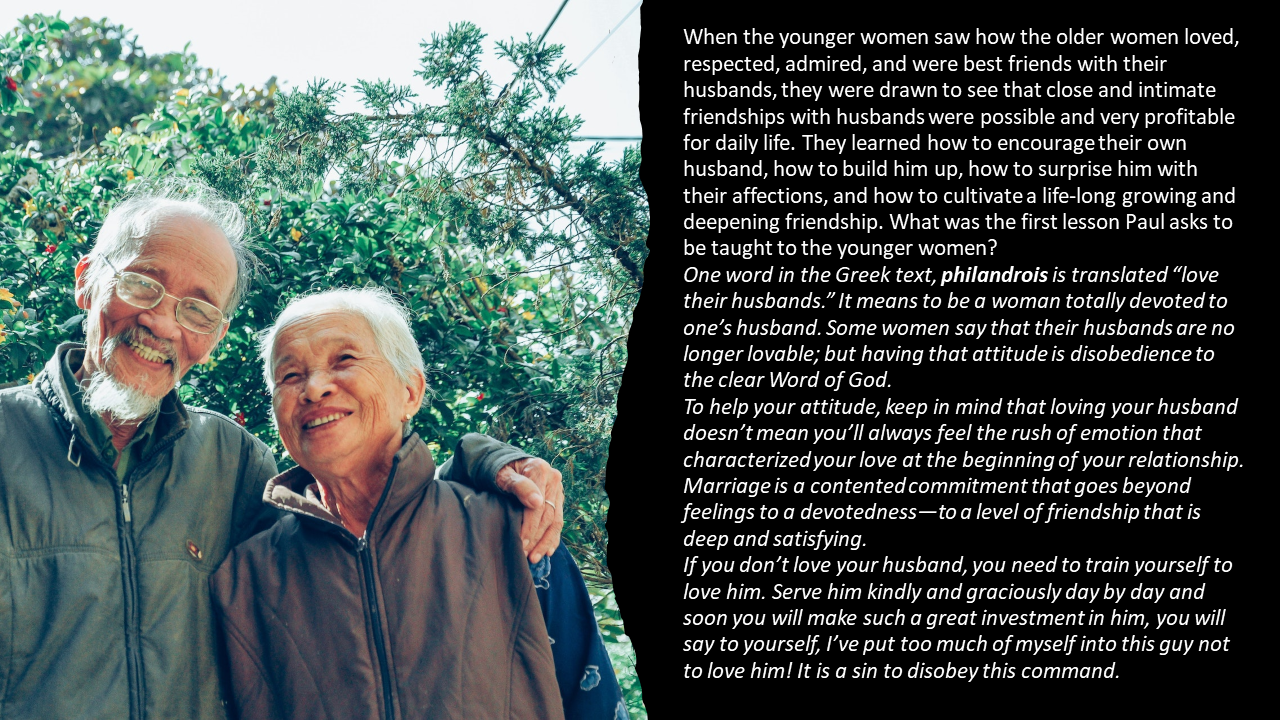
When the younger women saw how the older women loved, respected, admired, and were best friends with their husbands, they were drawn to see that close and intimate friendships with husbands were possible and very profitable for daily life. They learned how to encourage their own husband, how to build him up, how to surprise him with their affections, and how to cultivate a life-long growing and deepening friendship. What was the first lesson Paul asks to be taught to the younger women?
One word in the Greek text, philandrois is translated “love their husbands.” It means to be a woman totally devoted to one’s husband. Some women say that their husbands are no longer lovable; but having that attitude is disobedience to the clear Word of God.
To help your attitude, keep in mind that loving your husband doesn’t mean you’ll always feel the rush of emotion that characterized your love at the beginning of your relationship. Marriage is a contented commitment that goes beyond feelings to a devotedness—to a level of friendship that is deep and satisfying.
If you don’t love your husband, you need to train yourself to love him. Serve him kindly and graciously day by day and soon you will make such a great investment in him, you will say to yourself, I’ve put too much of myself into this guy not to love him! It is a sin to disobey this command.[2]
The best way to fill a home with joy and peace is to have a husband and wife who are best friends–intimately, emotionally, and spiritually.
In Paul’s day, men and women were saved out of a culture where romantic love usually did not exist in marriages. Wives were only seen as the trusted keepers of the home and bearers of the children. Emotional love, psychological needs, and sexual desires were satisfied outside of marriage by most husbands. The opportunities for illicit sex in the Roman world were endless.
For some women in the Roman world this was a relief as they did not have to “perform” sexually on a regular basis for their husbands. But the emotional and relational super-glue that the sexual dimension of the marital relationship produced was thus absent. God designed marriage in the Garden of Eden to cause a man to “cleave” to his wife, which literally means to be glued together.
Salvation stopped the immorality in most believing men’s lives back then, but salvation did not make them or their wives instantly close, intimate, and life-sharing friends and lovers.
Just as modern pre-marital moral laxity has scarred many young couples into a troubled, often superficial marital relationship, so were most of the marriages of the New Testament church. What was Paul’s Spirit prompted answer? What was to be the way to solve the distant, detached, and constantly tempted husband daily buffeted with the overpowering allurements of the flagrantly immoral Roman culture?
Christ led Paul to deploy a legion of older-in-the-faith, godly women energized by grace to go from house to house, become a close and trusted friend of those young wives, and train them in how to become their husband’s best, closest, dearest, and most intimate friends.
Physical or sexual love without romance is soon empty and meaningless; and as Solomon (who had a lot of experience) said, soon becomes “Like gravel in the mouth” (Proverbs 20:17). Paul knew that to protect those newly believing husbands and fathers from the tidal waves of temptation, they must have a vibrant, attractive, satisfying emotional and physical relationship with their wife.
Husbands who are drawn to think about and want to see their wife throughout a day away from home are protected from attraction and distraction by a wicked world about them. Paul told Titus that to fill the church with loving, caring, romantic wives who love their husbands in this Biblical way came through the example and training of the godly, older, grace energized women who faithfully taught and modeled that only God’s grace can enable these younger women to act consistently that way.
What are some practical steps a Titus two woman mentoring a younger woman in the faith would teach? Here are some simple habits that a godly older woman actually sat down and taught my own wife when we were newlyweds living in California.
First, this godly Titus two woman sat Bonnie down and said there are three specific choices that make a wonderful start:
• Decide that you will make your own husband your number one most important human relationship of life over all others including your parents, brothers, sisters, and friends.
• Start to seek your husband’s friendship and love ahead of all other human relationships, including your children.
• Begin examining your lifestyle and schedule to see if you are intentionally “spoiling your husband rotten” if you are doing so as a way of life, then you can be sure that you are his best friend and are truly “loving” your husband.
Then she said let me explain what you can do to maintain such a high calling from God to love your husband. I still have the actual notes Bonnie was given of simple but powerful ways to cultivate and grow her love for me.
These truths worked and they may also help each of you in your love for your own husband:
• Pray for your husband daily.
• Plan for him daily things like: special acts of kindness, special dinners, special times alone, special meals alone, early bedtimes for the children, going to bed at the same time.
• Prepare for him daily: prepare your heart with being clothed with God’s love; prepare the house; prepare your appearance; prepare your greeting; set the table; clear out all visitors; stay off the phone; pray for his arrival.
• Please him daily.
• Protect your time with him.
• Physically love him, let him know that you are available at any time that would please him.
• Positively respond to him.
• Praise him.
• Pray without ceasing.
One of my dear friends has a course he teaches to mentor couples in Biblical love and respect. He always reminds them that each time a wife acts this way there is a spiritual deposit in her account in the Bank of Heaven. Women are rewarded for such love poured out upon their own husbands[4].
God commands us in Proverbs to be intoxicated by the love of our partner (Proverbs 5:18-19). If you are married and not intoxicated by the love of your partner, you are missing the best marriage possible.
Go back and by God’s grace rekindle the blessing, edifying, sharing, and touching that always builds a strong, close, encouraging partnership for life. Be a beacon of Christ’s love reflecting to an empty and hopeless world that true love is possible and can be shared for as long as you live.
The greatest priority in a home should be love. If a wife loved her husband and her children, she was well on the way to making the marriage and the home a success. In our Western society, a man and a woman fall in love and then get married; but in the East, marriages were less romantic. Often the two got married and then had to learn to love each other. (Eph. 5:18-33 is probably the best Scripture for a husband and wife who really want to love each other in the will of God.)
Godly women live as a priest for God, with guarded tongues and no excesses, with visible integrity, as earnest mentors of–wives who are their husband’s best friend.
________________________________________
[1] Christ’s church has a mission that Paul summarized as pleasing God (I Thessalonians 4:1). This mission is accomplished by the proclamation of a message Paul summarized as the gospel of grace (Acts 20:24). The message of grace—that God did everything possible to be done and anyone can come to Him merely by faith seems impossible. But the most amazing part of all that the Lord is doing is His plan to do all this by a method is spelled out in Titus 2:11-14—Paul summarized as energized by God’s grace to live in a way that is otherwise impossible.
[2] John MacArthur, Different By Design, (Wheaton,: Victor Books) Marriage and Divorce (electronic edition), Logos.
[3] Adapted from Elizabeth George, A Woman after God’s Own Heart, Eugene, OR: Harvest House, 1997, chapters 7, 10, and 11.
[4] The classic book on Christian marriage by Ed Wheat summarized the marriage God wants us to have in 4 rules to be followed contained in the acronym BEST. For the best marriage possible live God’s way by a series of small choices: Blessings, Edifying, Sharing, Touching. Wheat defines these areas as: Blessing: means to speak well of your husband or wife, show kindness towards them, express gratitude and thankfulness for all they do, and pray for God’s richest blessings upon them. Edifying: means to build them up. A husband does this by praying his wife; and the wife does this by seeking to respond in a positive way towards her husband. Sharing: means always looking for how to do things together like—listening to each other, admiring each others accomplishments, learning more about each other’s likes and dislikes, investigating ways to please each other, and finally reporting on your day to each other so they share your life. Touching: means to just like to be as close to the one you love as is physically possible. Either remember what you were like when you were dating your wife, or notice some young couple headed towards marriage. They intentionally just can’t stay apart, they laugh, talk, look at each other, hold hands ever moment possible, sit as close together as possible, and so on. At that stage they can face any problem and go on because they are so strengthened by the warmth and depth of their love.
Transcript
GEW-04 – Grace-Energized Wives Love Their Husbands
Let’s open our Bibles to Titus 2. We’ve been looking through Titus 2. We’re going to continue to go through Titus 2. And as we go there, especially with the ending of this chapter in our minds, I want you to think about the motivation and empowerment to live the life that we’ve been looking at. The Titus 2 women could be defined as women energized by grace.
It’s impossible to live the way that the early church was called by Christ, through the apostles, to live. To go from where they were to where He called them to be was physically, humanly impossible. That’s why they were told that the grace of God that brought them salvation is the grace of God that would energize them to live that way.
We each were saved by God’s grace. That was impossible. It’s not humanly accomplishable. We are kept by God’s grace. We cannot hold on tight enough, do enough to keep ourselves to the end. It is God who keeps us secure and safe to the end. And we live in a way every day that pleases God and earns His rewards.
But that is only when we are energized by His grace as verses 11, 12, 13 and on talk about in this chapter. These past few weeks, we’ve been looking at God’s high calling for women. And in His church, the thought of living in that way was overwhelming in the first century. They were pagans, they were steeped in paganism, they thought like pagans, they look like pagans, and they came into Christ’s church, and they were told that they were to act like holy and reverent servants of God. That was impossible. And so, Paul began to teach them that though it may seem that living that way is impossible, it is the truth. It is impossible. But Titus 2 women live a humanly impossible life. They must be energized by God’s grace to live that way. So, for just a minute, I want you to step back and look at the bigger picture.
Look at the where the Titus 2 women fits within the context of all that God is doing in this world through salvation. The New Testament church that Jesus Christ left His plan for, that we as believers this morning are a part of, is defined as the life of new beginnings. It’s the life that not only are we a new creation in Christ, but we get that opportunity to have a fresh new start every day in Christ.
That’s just the foundation of this life that we have. We are energized each step of the way by the grace of God. And Titus 2, before us this morning, is a road map for all who want their life to count. If you have the new beginning, if you have the Spirit of God living within, if you have the grace of God teaching us how to live, then you want to, and I want to, follow the road map for all who want their life to count.
It’s God’s pathway of the disciplines that we consciously choose, every day, to follow. Energized by the Spirit of God, prompted and motivated by God’s grace. But it’s a choice we make. The Titus 2-person, man or woman, young man or young woman, does not become that way by just saying, it’s going to happen.
Kind of the pacifistic movement in Christianity, where they thought that they would let go and God would just do whatever He wanted to do. It doesn’t work that way. The New Testament talks about it being warfare, that we consciously take up armor. As the Apostle Paul said, we are like athletes that must discipline our bodies.
We must stay within our lane, or we get disqualified. It’s impossible to do that without God’s grace, but it will not happen without our choice to comply and to obey. So that’s what Paul was telling him. God’s plan to work in the world is in His church. And Christ’s church may be described as a group of people energized by grace, doing the impossible for the glory of God.
That’s who we are. Common ordinary people doing impossible things, energized through the power of God resident in us by His Spirit because of His grace. And all of it occurring for His glory, not ours. That’s what His church is all about. A key insight into God’s plan to reach this world through Christ’s church is in this chapter before us, Titus 2.
The verses of this chapter contain a call to a first century church, a group of men and women. Always remember the context of the Bible is this was not written to me, nor to you. It was written to someone else. But God’s Spirit applies that also to me. This was actually a literal letter to a literal group of people that were alive on planet Earth about 2,000 years ago on a little island out in the middle of the Mediterranean Sea. Because it was inspired by God’s Spirit, it went beyond them to us. But the first law of interpretation is you must understand, what did God mean to them? What did God call them to do? Because if we see that, it’s what He also calls us to do. So, let’s look at what He called them to do. He called them to live an extraordinary spiritual life in the midst of a very unspiritual culture.
A couple years ago, in April, I was invited by some group to come and lecture a group of ninety pastors on the island of Crete. They paid my way, and they flew me over there with Bonnie, and I lectured ninety pastors, taking them all around the island of Crete. I’d never been to Crete before. Of course, I had the material that God wrote to Crete. And the first lecture, I’ll never forget, I was standing in the midst of this Minoan civilization castle where the Minotaur and the labyrinth and all that stuff comes from. And I was standing there. And I stood up on my little deal I stood up on and all these ninety pastors were gathered around, and they had their recorders, and they had their notebooks, and they were looking at their cameras, and they were looking at me, and the first thing I said is, when Paul wrote to a pastor named Titus, who was serving on this island, and immediately out there, ninety clucks started going on. [Cluck, cluck, cluck, cluck.] They were all whispering to each other and finally when they raised their hand they said, how did you know that Paul wrote to Titus? How do you know that? I said this [Dr. Barnett refers to his Bible]. None of them actually brought one of these on the trip. This was a group of, and I won’t say the denomination, I didn’t know this when I volunteered to do it, but they don’t really use this. And from that point onward, for the next ten days, they hounded me at every meal. They said, you mean, Paul wrote the book of Philippians to the church in Philippi that we’re going to go to? I said, they said, how do you know that? I said, because it says it. But they said, why do you believe that? Because I said, I believe that God inspired the Bible. And they just, it was the most revolutionary thought to them. They never stopped. On the bus, they just asked me a million questions. Because they never, in their denomination, ever thought that the Bible meant what it says. It means something else. You’ve got to work all week long and read the newspaper and read poetry and find something to say. Because the Bible couldn’t possibly mean what it says. That’s the condition of America’s church today. That’s why they don’t use the Bible a lot, because they don’t even know what it’s for. They don’t know what it means. They don’t know what it was written for, who it was written to, who it was written by. And so, it was a great tour, and I told them standing there that day, I said, this was a very unspiritual culture.
In fact, behind me was the alleyway that led to where the human sacrifices were done. And I said, the Apostle Paul wrote to a young pastor named Titus who was living on this island, who were the ancestors, as I said last week, of the Philistines, David and Goliath, the horrible Philistine, anti-God, warring against God’s people, culture.
Those were people who sailed from the island of Crete, and I said, and it was no different in the time of Paul, a thousand years later, and I said, it was a very unspiritual culture. And God called them to live an extraordinary spiritual life in that very unspiritual culture. And when grace energizes us, we want to deny ungodliness in any form we find it cropping up in our lives.
And it will crop up in our lives. We were not eradicated. You know what eradication is? That’s the incorrect belief of some denominations of Christendom. And they believed that when they got saved, their old nature was cut out of them. That they are no longer having the flesh, and they are just a new creation in Christ.
And there’s no old nature. They were eradicated. It was stomped out. They squirted Roundup on it, and it withered up and died, and it never comes back. And some of the greatest proponents of that, when I was young, used to speak at Bible conferences. And I remember I would watch them sitting over in the corner, and they’d come up, and just before they would speak, they would pull out of their pocket their little mirror, and they would get all prepared to come up in the pulpit, and they’d put it away, men carrying mirrors, and I remember one time one of the other pastors asked one of those, combing his hair pastors, he says, do you still have any pride? And he says, no, I’m eradicated. And I thought how incredible it is to think of eradication because it is impossible for us to deny the fact that we are constantly besieged with desires that are not from God. And so, Paul tells them grace will energize you to deny those ungodly desires no matter where they crop up in your life. And when grace energizes us, we want to mortify. You know what mortify means? Kill. We don’t permanently kill the flesh that still is operative in us, but any manifestation that we are aware of, through the grace of God, by the power of the Spirit of God, through the weapons He gives us, and through disciplining, and as Paul puts it, mortifying our desires. And that’s what was going on in these people’s lives. They were mortifying lust in any form. And when we study this idea of the older in the faith godly Titus 2 woman, we are describing a woman who has chosen to learn from God how to live her life day by day and step by step in a way that pleases God.
She’s not perfect. She still has her flesh. She still struggles every day with some way that the flesh crops up in her life. But she is highly useful to God. Because she has learned how to consciously, willfully choose, energized by God’s grace, to say no to sin and yes to God. When the Gospel of Jesus Christ entered the Roman world of the New Testament, the landscape was very bleak.
Christ’s church was born into a sin warped and sin darkened world. And that world was made up of mixed-up marriages and sin scarred lives and confused families. Though they were saved, they still had the effects of paganism and the lost world around them. Men and women who were gloriously saved did not automatically, at the instant of their salvation, become great wives and mothers or husbands and fathers.
No, God said what they needed, and Paul, at the prompting of the Spirit of God, wrote down to Titus, which we receive in this chapter, a plan. Those who came to Christ and were forgiven and whom God graciously gave everything they needed by His grace to become godly wives and mothers, godly husbands and fathers, needed something else.
They were saved, but they didn’t know how to systematically become pleasing in a way that was useful to God in their marriages, in their home lives, in their personal lives. And so, the Word of God was to be taught in the group setting, the worship services, and then it was to be applied in a small, intimate setting.
And that’s what we find, the Titus 2 woman. The Titus 2 woman, described by God, is how God works in the life of a believer. When we are saved and the Gospel of grace begins in our lives, the evidence is seen in the sanctification process. Grace always teaches genuine believers how to say no to sin no matter what form it shows up in their lives.
That’s just the promise. It will always, grace, God’s grace will always show me and identify for me sin and the flesh and the, that which doesn’t please God and is unprofitable. In any form it takes up, grace will show me how to deny that. But God chose for that grace to be trained through grace energized people who have already learned that process.
So, we don’t spend a lifetime learning what someone else could teach us in a very short time. And a Titus 2 woman, which we’re going to read about in verses 3 and 4, is an imperfect person saved by God, energized by His grace to live an exemplary life. So, we could easily say, starting in verse 3, that women energized by grace are reverent in their behavior.
And if you are not reverent in your behavior, you are not energized by grace. It’s both sides of the equation is true. And women energized by grace are not slanderers. And so, if you’re a slanderer, you are not energized by grace. That’s the simple equation that God gives us. And women energized by grace are not given too much wine.
They have no enslavements in their life. And if they are enslaved in their life, they are not energized by grace. They are not allowing the grace of God to teach them to say no. They’re resisting. God saved, he wrote to them, these were saved people he was writing to and says, you need to not be enslaved by any excesses, any enslavements in your life.
Women energized by grace are teachers of good things. And if your life is not modeling and teaching good things, you are not energized by grace. And you need to repent and ask the Lord to change that, and you need to walk forward. Women energized by grace are discipling younger women. And if you have too many other things in your life that you don’t have time to disciple younger women and you’re an older woman in the faith, then you are not energized by grace.
You have wrong priorities. That’s the simple truth that Titus began teaching the New Testament Church. That it’s a package. That you have reverent behavior, you do not slander, you’re not given to much wine or excesses. You begin to model good things, but you don’t just do that in a vacuum, you find individuals to target, and you pour your life into them. And so those new believers, fresh out of paganism, began to be coached and trained and modeled and encouraged. And Christ’s church used grace to energize coaches in godly living. And those coaches, both men and women, are described in Titus 2. And once again, let’s read the first 8 verses.
And I’m going to read this and then we’re going to focus on the first element that the older women were to teach the younger women. And that’s how to love their husbands. Reading together, Titus 2 and verse 1. But as for you, again, he’s talking to Titus, speak the things which are proper for sound doctrine.
Verse 2. That the, and I’m adding this, the grace energized older men be sober, reverent, temperate, sound in faith, love, patience. Verse 3. The grace energized older women, likewise, that they be reverent in behavior, not slanders, not given to much wine, teachers of good things. Verse 4. That they may admonish the young women.
Now, we begin in this verse 4, the grace energized young women, first of all, love their husbands. First lesson, love your own man. That’s literally what it says in Greek. Love your own man, your husband. Let’s bow together. Father in Heaven, I pray that You would just open our hearts, as if we were sitting in the first century, and Titus was reading, unwrapping, and unrolling, and excitedly holding a parchment from his beloved father in the faith, and mentor, and teacher, and apostle, and friend, your servant, Paul.
Because that’s what happened. Paul wrote, Titus received, Titus read, and poured over it prayerfully, and then he delivered it to the saints on Crete. And I’m so glad that you took this inspired letter, preserved it, and protected it, and have given to us this day those very same inspired words. And I pray that we would be as receptive as the young women of Crete were to this message.
And that we would be as excited as the older women of Crete were to train in this way. And I pray that all of us would find, through the ministry of Your Spirit and our heart, where we, energized by Your grace, we need to respond to You, and may we be useful and pleasing You in all that we do, in the name of Jesus, and for His glory, it’s why we ask this. Amen.
Just quickly, when God gets to pick a curriculum for the church, this is what he picked. This is what he asked to be systematically taught in His church. Women energized by grace, having these characteristics, are highly useful to God. In verse 3, the women energized by grace have reverence in their behavior.
That means that they are holy as servants of God. They see themselves as God’s servants and they live that way. Secondly, women energized by grace, we saw in verse 3, guard their tongues. They’re not slanders. They never use their tongue for the devil. Thirdly, we saw, they are not, in verse 3, given to much wine.
Women energized by grace are not enslaved to anything but Christ. They don’t let anything else enslave them. Fourthly, we saw that they are, also in verse 3, teachers of good things. Women energized by grace have visible integrity. In other words, they teach by the way they act, and they teach also by the way they speak.
They live louder than they talk. They live in a way that teaches good things in every dimension of life. And then, in verse 4, These godly older women that they admonish the younger women. Women energized by grace are earnest mentors. As it says in the King James, they teach. New King James, they admonish.
The NIV, they train. The NAS, they encourage. But what’s their lesson plan? Second part of verse four. The young women to love their husbands. Women, energized by grace, love their husbands. In fact, the first priority, the first lesson, the one that if the others didn’t get done, had to get done in the early church, was not that the women carry a big study Bible.
It wasn’t that they get the attendance ribbon. The real essence of what would transform the Roman world in its dark culture is if the young women of the church systematically were trained to love their husbands. Now, for us, that wouldn’t be first, I don’t think. I don’t think if we sat down and had this whole list, if we just put them in, put them on the blackboard, and we decided we would prioritize them, we would not probably put that first, and that shows how different we are than God and His priorities. Because a Christian home in a pagan culture was a radically new thing. And the Apostle Paul knew, by the prompting of God’s Spirit that the skeptical Greco Roman world could listen all day long to speeches, and they did. But they could not resist a genuine, radically transformed element of everyday life.
The family. If they saw these transformed first marriages and then homes, they would just be stunned and they would question. Now maybe they wouldn’t get saved, but they would know that something had happened because it was so radically new. Young women saved out of paganism needed to get accustomed to a whole new set of priorities and privileges.
And those who had unsaved husbands would need special encouragement. So, a Titus 2 model had the responsibility of training the younger women how to successfully be wives, mothers, and housekeepers. And the younger women had the responsibility of listening and obeying. It was so simple in the New Testament church.
They just said it and the people did it. Nowadays, we have so many differing opinions and voices. In fact, this section I’m going into, especially homemakers, is the single most contested part of the epistles among the commentators. Because they say, it doesn’t apply to us today. Women should not be caused to, to think that’s God’s calling.
But the amazing thing is that Paul thought that, and Titus thought that, and the New Testament Church thought that. It’s just the 21st century church that really doesn’t like that, and several centuries in between. Among Bible believing women of the first century there was a big challenge in loving their husbands.
For various reasons and to various degrees, those women found themselves with either minimal or no feelings of love for their husbands. They weren’t raised to have feelings of love for their husbands. The culture didn’t promote feelings of love for their husbands. And those men’s behavior did not promote feelings of love from the wives.
And even though they were saved they just didn’t have those feelings of love for their husbands. And those believing wives in the early church, like those today, almost always want to obey the Lord. Thus, they submit, they fulfill the responsibilities they have to their husbands, but often only dutifully and not lovingly.
Now, pause and think about this. It’s not just that loving your husband is a virtue. Paul didn’t say that’s a virtue. Like Bill Bennett’s book of virtues, pick one you like and do it, I’m not, it wasn’t on the coffee table level. No, Paul says not loving him in a way he can feel is a sin.
Paul elevated this up to their priority. Those who read this saw a bold new dimension. And in the early church, Paul used a word for love that shocked them. Now, just for a minute, I’ll give you a little word study lesson. Every believer has already repeatedly been commanded to love with agape love, which is an action.
We all know that. We know the love chapter. We know the agape love. We’ve heard agape. We have agape coffee shops. We have agape everything. It’s on Bible covers and everything. This is not the word that’s used here. Paul does not use agape love, which is an action. We are commanded to act in a loving way toward each other.
Toward our saved and unsaved friends, even our enemies. We are to act. We are to do deeds that are prompted by love. It never says in the Bible, feel love to someone spitting at you and slapping you and beating you and killing you. Don’t feel. That is impossible to feel love. Act loving toward them. Turn the other cheek, don’t revile them.
Go and do whatever it takes. Go the second mile, et cetera, et cetera. That was clearly in the New Testament church. This agape love is not a feeling, it’s an action. Paul explains agape love in Ephesians 5:25, Colossians 3:19, as a husband acting toward his wife in the same self-sacrificing way as Christ acted toward the church.
So, it’s agape love. But that’s not the love that’s here. That’s not the word he uses. Women are also commanded to obediently submit respectfully to their own husbands, Ephesians 5:22, Colossians 3:18. Paul adds they are to cultivate a gentle and quiet spirit that’s beautiful in God’s sight and immensely valuable in marriage.
That’s 1 Peter 3:4. This was a reciprocal relationship of a godly marriage on a behavioral level. The commanded attitude and behavior of believers in marriages is foundational. But we’re not getting into that. We’re not getting into the ramifications of our behavior, our actions. Agape love. This is different.
Agape love, Paul says, is an imperative. But it’s an imperative to go further. Titus is given the key to a flourishing marriage and home. Train the younger women how to cultivate phileo. Whole different word. That’s the word of Titus 2. And right here, in verse 4. Phileo means a loving friendship. It’s an emotional love.
It is a feeling love, not a spirit prompted proper action. It is an emotional longing and friendship on a personal level with a dearest friend. That’s what they’re called to do. Agape love is never used in the Bible to describe sexual love or responsibility because emotional love cannot be commanded.
The beautiful intoxicating love that God designed, and if you ever want to read about it in Proverbs 5 and other places and the whole book of Song of Solomon that love that is intoxicating can’t be commanded. God designed it for marriages in order to have sexual emotional love that can’t be commanded and demanded.
It must be. It must be a choice. We can’t make someone feel a certain way. We can’t command them to do something but feel in a different way. Genuine Biblical marital sexual love is emotional intimacy of the highest degree. God commands willful agape love but the emotional phileo love of friendship. And if intimacy can’t be commanded, it must be learned.
And Titus didn’t get up in front of the church and say, Boom! Command all the women how to be. He said, No. No, I’ll tell you what God says, but the older, Spirit-filled, godly, grace energized women are going to come alongside of you and express to you and train you how they learned, by God’s grace, to love their husband in such a transforming way that they became best and closest friends. When the younger women saw how the older women loved, respected, admired, and were best friends with their husbands, they were drawn to see that close and intimate friendship with husbands, that it was possible and profitable. They learned how to encourage their own husbands, how to build them up, how to surprise them with their affection, how to cultivate a life growing and deepening friendship.
So, what was the first lesson Paul asked to be taught? What was the first, number one priority for the young women? One word in the Greek language. This chapter, chapter 2 verse 4, the young women to love their husbands. That’s just one word. And the word is philandros. Translated, love their husband. It means a woman totally devoted to her husband. Some women say their husbands are no longer lovable but having that attitude is disobedience to the clear word of God. To help your attitude, keep in mind that loving your husband doesn’t mean you’ll always feel the rush of emotions that characterize your love at the beginning of your relationship.
Marriage is a contented commitment that goes beyond feelings to a devotedness. A level of friendship that’s deep, enduring, satisfying. If you don’t love your husband, you need to train yourself to love him. Serve him kindly and graciously, day by day, and soon you’ll make it such a great investment in him that you’ll say to yourself, I’ve put so much of myself into this guy, how can I not help but love him? It’s a sin to disobey being best friends, emotionally, with your husband. The best way to fill a home with joy and peace is to have a husband and wife who are best friends. Intimately, emotionally, spiritually.
In Paul’s day, men and women were saved out of a culture where romantic love usually did not exist in marriages. Did you think about that? That’s a new thing in our day. It didn’t, romantic love in the world, the Greco Roman world, really didn’t exist. If you read the history, if you read the culture. Wives were only seen as the trusted keepers of the home, the bearers of children.
Emotional loves, psychological needs, and sexual desires were satisfied outside of marriage by the majority of husbands. That’s just how the culture was designed. You go on a tour of the ancient world, and you go to where the men were, and you go to the athletic area, and the recreational area, and the public spas, and right next to all that was the illicit sexual activity.
It was where the men were, and it was constantly available and constantly appropriated in the ancient world. The opportunities for illicit sexual behavior in the Roman world were endless. For some women in the Roman world, that was a relief, because they didn’t have to supply that need for their husband on a regular basis.
But the emotional and relational super glue that the sexual dimension of a marital relationship produced was also absent. That’s why there was no closeness back then. God designed marriage in the Garden of Eden to cause a man to cleave to his wife, which literally means to be glued together. To find this bond that cannot be broken, tightly knit, fitted together. Salvation stopped the immorality of the most of those believing men’s lives back then, but salvation did not make them or their wives instantly close or intimate or life sharing friends or lovers. Just as modern premarital moral laxity has scarred many young couples into a troubled, often superficial marital relationship, so were most of the marriages of the New Testament Church.
So, what was Paul’s spirit prompted answer to that problem? What was to be the way to solve the distant, detached, constantly tempted husbands who were saved but were daily buffeted with the overpowering allurements in a flagrantly immoral Roman society? What did Paul say was the device to help those men out there in the world, in the culture
that was so abysmal? Christ led Paul to deploy a legion of older in the faith godly women energized by grace to go from house to house, to become close and trusted friends of those young wives, and to train them how to become their husband’s best, closest, dearest, and most intimate friend. Physical love without romance is soon empty and meaningless.
As Solomon, who had a lot of experience, said, it becomes like gravel in the mouth, Proverbs 20. Paul knew that to protect those newly believing husbands and fathers from the tidal wave of temptations, they must have a vibrant, attractive, satisfying, emotional, and physical relationship with their wife.
Husbands who are drawn to think about and want to see their wife throughout a day away from home are protected from the attractions and distractions that a wicked world about them produces. Paul told Titus to fill the church with loving, caring, romantic wives who love their husbands in this Biblical way, who came through the example and training of godly, older, grace energized women who said, it works.
God changed me. God can change you. What are some practical steps that the Titus 2 woman, mentoring a younger woman of faith, would teach? For this section, I thought I would just take a page out of my wife’s notebook. In fact, I actually did. When Bonnie and I were married a godly older woman actually sat down and trained her, because she came from a pagan background.
Do you remember my wife? My wife was saved as a bartender. She was an alcoholic. Y’all remember that? I’ve told it so many times. Did she know how to live a godly, Spirit-energized life? But when she got saved, a godly, older woman sat down with her and said, this is God’s standard. And after we got married and moved to California, one of the women in the church sat down and she would bring young ladies to her home one by one, and Bonnie was one of them.
And so, I, while Bonnie’s away, I took this page out of her notebook. And I’m going to read it to you, okay? Don’t tell her I said that. But first of all, a godly Titus 2 woman, who sat Bonnie down and said to her, there are three specific choices that will give you a wonderful Biblical start. Number one, she said, decide that you will make your husband your number one most important human relationship in life over all others, including your parents, your brothers, your sisters, and your friends.
Decide. She said, you’ve got to make a choice. If you want to fulfill what Paul told Titus to tell the church that is speaking to you today, you have to decide that you are going to make your husband your number one friendship in life. Higher than your mom you chum around with, and your sisters that you’re so close to, and your brothers and your friends that you have cultivated all through life.
Your husband moves into the number one slot. Okay, that’s a decision. Now nothing’s happened. He doesn’t know anything about this. In fact, I didn’t even know about this until much later. And I said, Bonnie, where’d you learn all this stuff? And she said, don’t you remember when I used to go to tea over at Liz’s house and she would talk to me?
She said this is what she taught me. Number two, start to seek your husband’s friendship and love ahead of all other human relationships, including your children. Start seeking your husband’s friendship and love. You decided you’re going to do it, now start seeking it. Start seeking to be best friends.
Now, we all have friends. We know how we do that. This relationship is phileo. It’s not agape. It’s not self-sacrificing. It’s friendship. It’s emotion. It’s loving to be around them. Not doing what they tell you to do but wanting to see them happy and pleased and rejoicing as your friend. And finally, the third one was begin examining your lifestyle and schedule, to see if you are intentionally spoiling your husband rotten. That’s a quote. It’s right out of her notes. Spoiling your husband rotten. I know I’m rotten. I don’t know if she spoiled me. But I’m rotten to the core, right? All of us were born that way. But, you know what I mean by this. It means being really nice.
If you are doing so as a way of life, then you can be sure that you are his best friend in truly loving your husband. What she said is, you make this decision, decide he’s going to be first, then you start intentionally cultivating that friendship. And then you start looking at your schedule and seeing if you, by your choices, by your priorities, by your habits of your everyday life, whether you’re just saying that they’re best friends or whether you just can’t spend enough time together, because you really are.
Then she said, Bonnie, let me explain what you can do to maintain this high calling from God to love your husband. And I actually still have, I typed them, put them back. But I still have the actual notes Bonnie was given of simple, she said, here’s nine things that you need to do every day. And I looked at the page and it was all worn out.
I think that must have carried around in her Bible for a long time. These truths worked and they may help each of you in your love for your own husbands. Number one, pray for your husband daily. If you love someone, you don’t have to be reminded to pray for them. I remember early on, Bonnie used to ask me every morning, she said, tell me everything you’re doing today, because I’m going to pray for you all day long.
And I’d think, okay. And I’d try and think of stuff, and when I came home, she’d ask me about all these things, and I’d say, what are you talking about? She’d say, those are the things in the morning that you told me to pray for. And I said, you remembered them? He said, oh yeah. She’d say, I pray for you all day long.
And I thought, wow, I don’t pray for you all day long. I need to do that. Number two, plan for him daily things like special acts of kindness, special dinners, special times alone, special meals alone, early bedtime for the children, going to bed at the same time. Plan for him daily things. Isn’t that, that’s kind of, that’s nothing.
It’s big. If your best friend is planning special things for you, you’ll never forget that. That’s the whole idea of this, becoming best friends. Number three, prepare for him daily. Prepare your heart by being clothed with God’s love. Prepare your house. Prepare your appearance. Prepare your greeting when he gets home.
Set the table. Clear out all the visitors. Stay off the phone. Pray about his arrival. That was the third. That whole batch was the third thing. I remember when I used to come home. I remember that she actually appeared to be waiting for me. And when the kids got older, I can remember driving in and looking, and where I parked, there was a window, and it would be up, and I would see first one little head there, and then a few, two years later, two little heads there, and then two years later, three little heads there.
And I used to wonder, I asked for the longest time, I said, how come the kids are always looking out the window? And she said, because we prepare for you coming home. And, that little, tiny, you don’t have to have, don’t put a window in your house and put the kids heads in it. It’s not literally do that, it’s find ways to prepare for him daily.
If your best friends, when you see that best friend, they light up when they see you. They go, how are you? Oh, I can’t wait to, let’s catch up. Does that characterize your marriage or is it, huh, you’re late. That is not a best friend greeting, and that comes with a clothe yourself with love, because I was late many times.
Number four, please him daily. It’s not just praying and planning and preparing, it’s actually find a way to please your husband. Something that, that makes him stop and say, thank you, how did you think of that? Why, how did you know that that is my favorite whatever? Or I wanted to go there or do that or see this or whatever.
Number five, protect your time with him. I remember that Bonnie wouldn’t answer the phone when I came home. She said, I can talk all day long. I’m not going to talk. I’m going to protect my time with you. People came to the door. She didn’t even let them in. Opened the door. No, not right now. Protect the time with him.
It’s so short that we have time together. Number six, physically love him. Let him know that you are available at any time that would please him. Tell him you are his girlfriend. Isn’t it sad that the kids nowadays, that when they go to the mall, they’re glued to each other. When they’re driving in cars, young people are just, you just see one head in the car.
But when you see married couples, they’re even if they don’t have four children between them. They’re looking opposite ways. They aren’t even close enough if they stretched out to touch hands. It’s just, it’s like you go your separate ways. And you say, that’s just the way marriage is.
No, that’s the way you made it. That’s not the way God designed it. God designed it that you’d be cleaving, glued to one another. That you start developing a little crick because you’re always, having to walk so close to someone that you’re holding their hands and your wrist starts, bending and you get a little calcification there because you’re always holding hands.
That’s how God designed it to be. That you grow old wearing out in the best friendship of all. Number seven, positively respond to him. I used to remember, I’d come home, and I’d say, hey, honey, they just asked me if I’d go and speak in Argentina! She said, oh great! But she got the positive response. Oh, great! How long are you going to be gone? But positive response. A man is like a balloon, and if you, when he says something, if you poke him, [poof!] If you immediately have a negative, that’s a dumb idea. [poof!] Just like that, and it takes him a long time to share another big thought with you because you’re just poking.
I know on Facebook, poking is positive, but in, in real life, poking is not positive if it’s deflating and destroying him. Number eight, praise him. I know that’s really hard for some people, I, as I look back, every time I spoke, I would come out, and Bonnie would have her notes, and she’d have big stars on the top.
She’d say, oh, that was the best I’ve ever heard. And I said, honey, it wasn’t. I made some mistakes. No, it was the best. You know why? Because in her heart, she had decided that to obey, to be a grace energized woman, she would love her husband. It was a conscious choice. Not just in acts of self-sacrificing obedience, but with her emotions.
And that’s what Paul’s talking about. Number nine, pray without ceasing for him. I have a dear friend sitting right down here this morning, who teaches, as you heard advertised, Kirk’s class, Love and Respect. You ought to go to that class sometime. He has this ka-ching thing he does. And every time a woman responds to her husband, in a loving way and respecting him in his life, there is a reward God gives them in Heaven, because it is so impossible at times. It’s so against our culture to pray and plan and prepare and please and protect and physically love and positively respond and praise and pray for him without ceasing. But women are rewarded for such love poured out on their husbands. God commands us in Proverbs to be intoxicated by the love of our partner.
If you are married and not intoxicated by the love of your partner, you are missing the best marriage possible. Go back and by God’s grace rekindle the blessing, the edifying, the sharing, and the touching that always builds a strong, close, encouraging partnership. The greatest priority in a home should be love.
If a wife loved her husband and her children, she was well on the way to making her marriage and her home a success. In our Western society, a man and woman fall in love and then get married. But in the world Paul wrote to, to Titus, in the Eastern culture, marriages were less romantic. They got married and learned to love each other.
Probably the best Scripture for a godly marriage that is energized by grace is right here in Titus 2 verses 3 and 4. Godly women, energized by grace, live as a priest for God. They have guarded tongues, they have no enslavements, they have visible integrity, and they earnestly mentor wives who are their husband’s best friends.
That will change the world around you as they see Christ reflected in you, fulfilling God’s design for marriage. of being glued together as best friends. Let’s stand for a word of prayer. As you stand, two things I want to tell you about. I’m going to close in prayer, but I’ve primarily spoken to Christians, because this is impossible for non-Christians, but if you, number one, don’t feel like a Christian this morning, even though you are and you need to pray with someone, the pastoral staff is going to be across the front here and they would love to pray with you and help you.
Number two, if you are not a believer, and if what I said just went right by and all you caught was, it’s impossible and you don’t even know the Lord, then the grace of God that brings salvation has appeared to you. Jesus Christ offers himself to you this morning. He can change you from the inside out and give you internally the power to live this impossible life. The staff would love to pray with you and invite you to receive Christ this morning. Now, if you’re a guest, I want to define guest. If you are new enough that you’ve never come to one of these receptions. If you are new enough that, that I’ve never met you then even if it’s not your first week you can come through these doors and on your way the picnic come in and meet me and some of the elders and let us get to know you. The rest of you don’t cut through our reception. Go that way or that way and we’ll see you out where the smoke is, okay, where the hamburgers are, and we’ll have a great time.
Let’s bow together for a word of prayer. Father in Heaven, I thank You that You have called Your church, by Your grace, to live an impossible life, energized by Your Spirit because of Your grace. And You’ve called us to do all this for Your glory, and I pray that some women in this church this morning, your church, will be stirred by Your Spirit to begin deepening their friendship, their love, for their husbands and that some of the godly, mature, older women in the faith will be stirred to rearrange their priorities in life and make a space for a younger woman, and share with them how You, by Your grace, have trained them to love their own husband, as challenging as it may be, out of obedience, to earn Your reward and to please You. O Lord, I pray that we as a church will do what we hear, not merely be hearers, but doers. For the glorious purpose and name that is above every name, the name of Jesus, whom we love and serve, we pray. Amen. God bless you as you go.