GEW-06
EBG-35
Titus Two Women-06 Mothers Energized by Grace Love Their Children .doc
Women Energized by Grace Love Their Children
Titus 2:4
070610PM
Women energized by grace love their children. That is what Titus 2:4 says. We are going to see how to love children with love they can feel. But before we do that we need to ask why are we even here tonight? Why do we even sacrifice another hour-plus to gather in this building and study God’s Word? The answer is that we desire to be a faithful part of Christ’s church!
You see, you and I are part of something big, something grand, something that dwarfs all our broken down cars, lost jobs, bad health, work pressures, social problems, or even personal loneliness. This evening through Jesus Christ, you and I are a part of what God has chosen as His priority in the universe. We are in partnership with GOD. Think of that. You and I are equity holders in something that will never end, never fail, never decay–we are a vital part of Christ’s church!
God’s plan to work in the world is through His church. Why not remind yourself of that by looking at three passages of Scripture with me tonight. In fact you may even want to pencil in three words on the pages of your Bibles.
The first word is MISSION.
- Each of us in Christ’s church has a mission that Paul summarized as “Pleasing God” (I Thessalonians 4:1). “Finally then, brethren, we urge and exhort in the Lord Jesus that you should abound more and more, just as you received from us how you ought to walk and to please God” (NKJV).
- Our mission is accomplished by the proclamation of a message Paul summarized as “the Gospel of Grace” (Acts 20:24). “But none of these things move me; nor do I count my life dear to myself, so that I may finish my race with joy, and the ministry which I received from the Lord Jesus, to testify to the gospel of the grace of God (NKJV). This message of grace—that God did everything possible to be done and anyone can come to Him merely by faith seems impossible.
- But the most amazing part is that God’s plan to do all this through us is by a method spelled out in Titus 2. Paul summarized this plan as men and women energized by God’s grace to live in a way that is otherwise impossible.
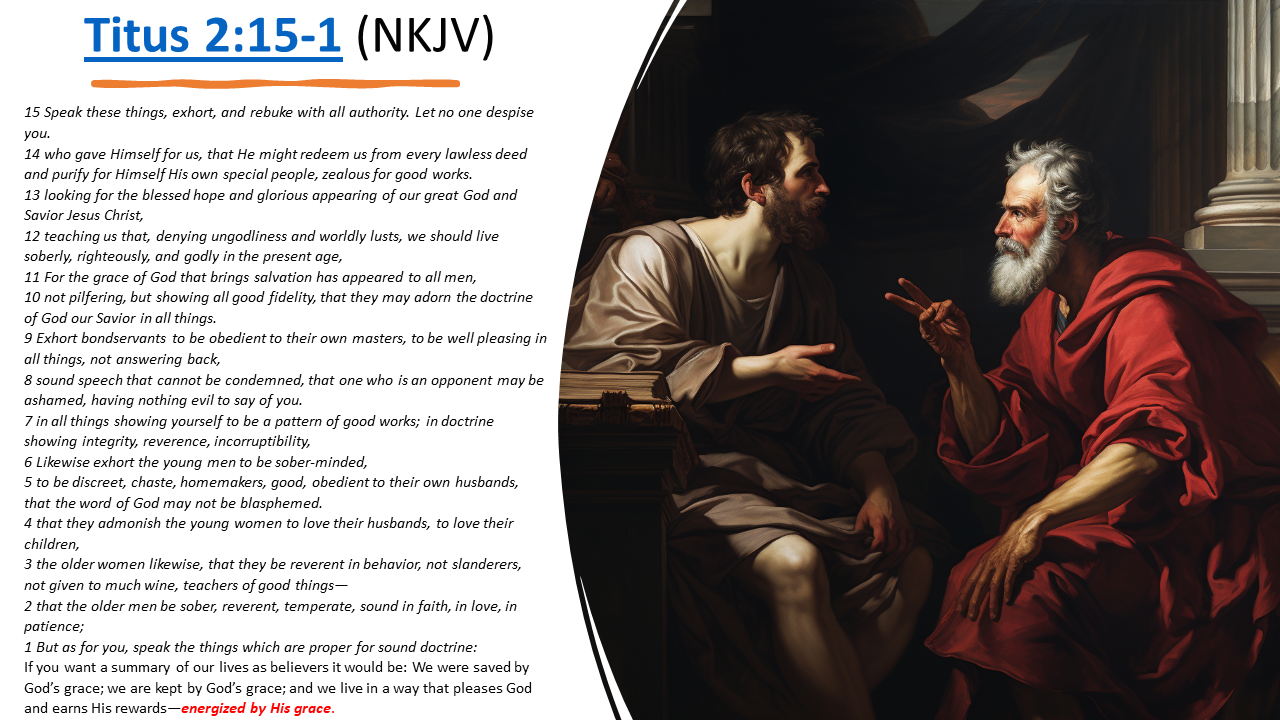
Titus 2:15-1 (NKJV)
15 Speak these things, exhort, and rebuke with all authority. Let no one despise you.
14 who gave Himself for us, that He might redeem us from every lawless deed and purify for Himself His own special people, zealous for good works.
13 looking for the blessed hope and glorious appearing of our great God and Savior Jesus Christ,
12 teaching us that, denying ungodliness and worldly lusts, we should live soberly, righteously, and godly in the present age,
11 For the grace of God that brings salvation has appeared to all men,
10 not pilfering, but showing all good fidelity, that they may adorn the doctrine of God our Savior in all things.
9 Exhort bondservants to be obedient to their own masters, to be well pleasing in all things, not answering back,
8 sound speech that cannot be condemned, that one who is an opponent may be ashamed, having nothing evil to say of you.
7 in all things showing yourself to be a pattern of good works; in doctrine showing integrity, reverence, incorruptibility,
6 Likewise exhort the young men to be sober-minded,
5 to be discreet, chaste, homemakers, good, obedient to their own husbands, that the word of God may not be blasphemed.
4 that they admonish the young women to love their husbands, to love their children,
3 the older women likewise, that they be reverent in behavior, not slanderers, not given to much wine, teachers of good things—
2 that the older men be sober, reverent, temperate, sound in faith, in love, in patience;
1 But as for you, speak the things which are proper for sound doctrine:
If you want a summary of our lives as believers it would be: We were saved by God’s grace; we are kept by God’s grace; and we live in a way that pleases God and earns His rewards—energized by His grace.
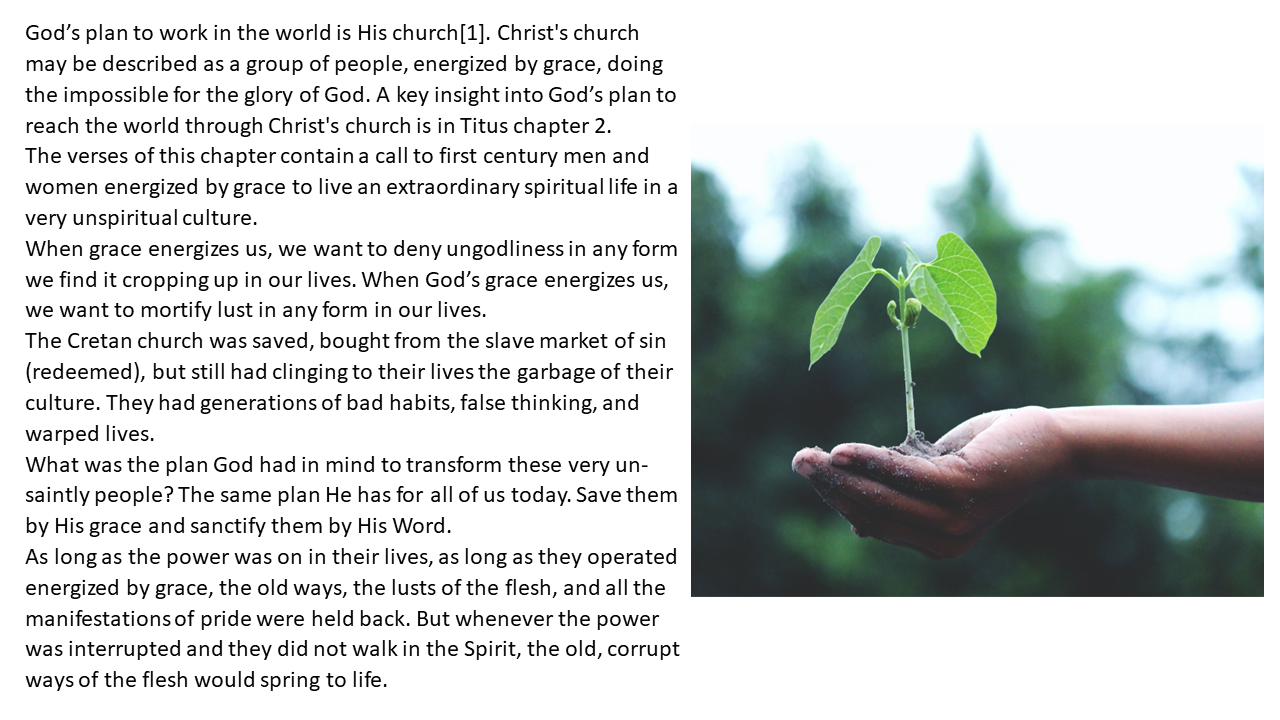
God’s plan to work in the world is His church[1]. Christ’s church may be described as a group of people, energized by grace, doing the impossible for the glory of God. A key insight into God’s plan to reach the world through Christ’s church is in Titus chapter 2.
The verses of this chapter contain a call to first century men and women energized by grace to live an extraordinary spiritual life in a very unspiritual culture.
When grace energizes us, we want to deny ungodliness in any form we find it cropping up in our lives. When God’s grace energizes us, we want to mortify lust in any form in our lives.
The Cretan church was saved, bought from the slave market of sin (redeemed), but still had clinging to their lives the garbage of their culture. They had generations of bad habits, false thinking, and warped lives.
What was the plan God had in mind to transform these very un-saintly people? The same plan He has for all of us today. Save them by His grace and sanctify them by His Word.
As long as the power was on in their lives, as long as they operated energized by grace, the old ways, the lusts of the flesh, and all the manifestations of pride were held back. But whenever the power was interrupted and they did not walk in the Spirit, the old, corrupt ways of the flesh would spring to life.
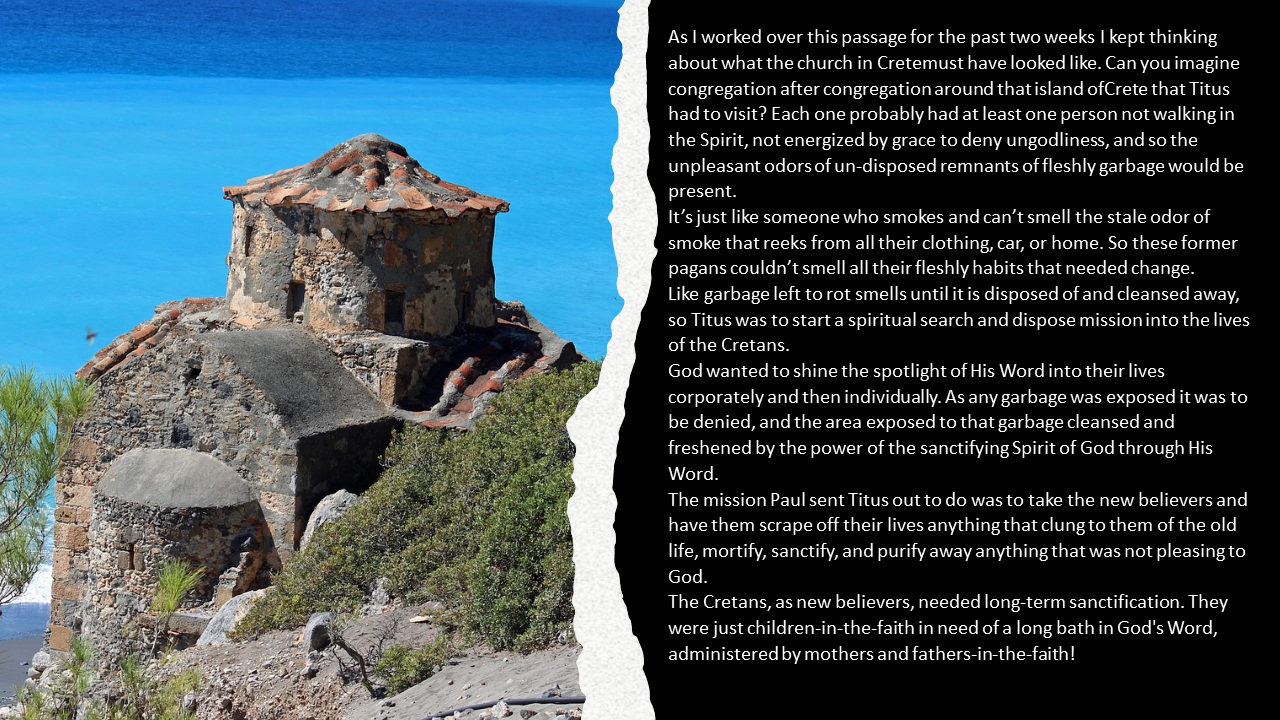
As I worked over this passage for the past two weeks I kept thinking about what the church in Cretemust have looked like. Can you imagine congregation after congregation around that island ofCrete that Titus had to visit? Each one probably had at least one person not walking in the Spirit, not energized by grace to deny ungodliness, and so the unpleasant odors of un-disposed remnants of fleshly garbage would be present.
It’s just like someone who smokes and can’t smell the stale odor of smoke that reeks from all their clothing, car, or home. So these former pagans couldn’t smell all their fleshly habits that needed change.
Like garbage left to rot smells until it is disposed of and cleansed away, so Titus was to start a spiritual search and dispose mission into the lives of the Cretans.
God wanted to shine the spotlight of His Word into their lives corporately and then individually. As any garbage was exposed it was to be denied, and the area exposed to that garbage cleansed and freshened by the power of the sanctifying Spirit of God through His Word.
The mission Paul sent Titus out to do was to take the new believers and have them scrape off their lives anything that clung to them of the old life, mortify, sanctify, and purify away anything that was not pleasing to God.
The Cretans, as new believers, needed long-term sanctification. They were just children-in-the-faith in need of a long bath in God’s Word, administered by mothers and fathers-in-the-faith!
This need for removing remnants of garbage that stinks confronted me on Thursday night. I walked into our house for the first time in ten days and it smelled like a dumpster. I prowled around looking for where that horrible smell was coming from. Trash cans, pantry potato bags, and fruit bowl were all checked, and came up clear. Then I saw a dark circle on the floor in front of the fridge. When I pulled open the door of that trusted 12-year-old appliance, there was the finest collection of colorful molds and layers of decay available anywhere in the city. Most of the refrigerant compressor had died, thus the temperature had risen, and all the microbes always lurking around food had sprung to life. Normally they are abated by the low temperatures and can’t grow or reproduce. But the moment that the coldness was limited, decay set in at warp speed; and the result was a stinking mess. But because I value that appliance, I had only one choice—to get rid of the garbage.
For the next six hours I bagged, hauled, washed, scraped, bleached, and scrubbed that trusty, white fridge in the kitchen until it was pure white again, and mold and stink-free. Refrigerators have no smell of their own; they just hold objects that begin to smell if allowed to. All it needed was to be washed and renewed and it would be back as good as new.
When Titus came to Crete to pastor Christ’s church, it was sometime in the early 60’s AD. As he arrived, the churches were filled with spiritual lives that smelled like a dumpster. The old, rotted flesh of their former ways stood in the way of their progress in Christ. They were bought and paid for but needed the washing of sanctification through God’s Word.
There were stinking lives, stinking marriages, and stinking families. Paul proposed to Titus a two-part plan: regular systematic teaching in the church gatherings and private one-on-one discipling sessions for focused applications of the sanctifying Word.
As believers we are on the journey of new beginnings through Christ—energized each step of the way by grace.
Titus two is a road map for all who want their life to count. It is God’s pathway of disciplines to choose each day in the power of the Spirit of grace.
Christ’s Church Used Grace Energized Coaches in Godly Living
The Titus Two woman is an imperfect person, saved by God, and energized by His grace to live an exemplary life, as described in Titus 2:3-4. So we could easily say that:
- Women energized by grace—are reverent in their behavior,
- Women energized by grace—are not slanderers,
- Women energized by grace—are not given to much wine,
- Women energized by grace—are teachers of good things, and
- Women energized by grace—are discipling younger women.
Those new believers, fresh out of paganism, needed coaching, training, modeling, and encouraging in a one-on-one relationship. Godly behavior is a series of choices, and those men and women had to be nurtured in daily skills that would lead to loving marriages and families.
- 4b “the young women to love their husbands” (6) Wives energized by grace love their husbands.
Wives energized by grace are first of all “lovers of their husbands.”
Titus two women understand that there are three specific life-long priorities that make a wonderful start:
- Decide that you will make your own husband your number one most important human relationship of life over all others, including your parents, brothers, sisters, and friends.
- Start to seek your husband’s friendship and love ahead of all other human relationships, including your children.
- Begin examining your lifestyle and schedule to see if you are intentionally “spoiling your husband rotten.” If you are doing so as a way of life, then you can be sure that you are his best friend and are truly “loving” your husband.
Wives energized by grace become a beacon of Christ’s love reflecting to an empty and hopeless world that true love is possible and can be shared for as long as you live.
- 4c “to love their children” (7) Mothers energized by grace love their children.
Mothers energized by grace are secondly “lovers of children.”
This characteristic is also one word in the Greek text, “philoteknos,” and it means to be a lover of children.
From time to time it becomes so very hard to take care of children that a mom of any century in history no longer “feels” positive feelings towards her children.
So how did God instruct Paul to prepare Christ’s church for these great social challenges and family pressures? Again, Titus 2 has the solution. God says that the way that tired, burned out, and depressed mothers get relief is from the faithful army of Titus 2 grace-energized role models.
The Bible clearly explains and illustrates this love that was modeled by Christ. This special phileo love is demonstrated by Jesus Himself. This type of close companionship and friendship, emotional love is how Christ’s relationship is described with Lazarus (John 11:3) and with “the disciple He loved” named John (John 20:2). This is also the word used in Revelation 3:19 for Christ’s love for true saints in His church.
Jesus demonstrated His love to Lazarus, and all who saw that friendship knew how close they were. The same was seen in Christ’s closeness to the Apostle John. That is how Jesus loves us and wants us to know He loves us, feeling His closeness, and enjoying His friendship.
And that phileo love that is emotional, close, and visible is what the Lord asks from grace-energized mothers towards their children.
Give the Priceless Gift of Love to Your Children
Do your loved ones in your family feel your love?
Just as many husbands think that their wives admire other men more than them as they relate how, “So-and-so’s husband does this and that with his children or for his wife.” Those men do not feel the respect and admiration of their wives.
Likewise, many wives feel that their husbands think other women are either better at caring for their husbands, prettier, or better at caring for their families than they are. Those women do not feel the love of their husbands.
But most importantly for Titus two mothers energized by grace, we need to consider that many kids hurt because they sense that their parents don’t even like them. Some ways a lack of love can harm your child.
- A struggling student watches his parents gloat about his sister’s straight A’s.
- A boy strikes out in a softball game and notices his father’s disappointment.
- An overweight daughter is told, “Stop snacking so much if you even care about your looks.”
This absence of loving approval can lead to untold pain; whereas loved ones who feel approval and love face the daily challenges in their world with eagerness and confidence. Look with me for a moment at how Paul cultivated this type of love with a needy young man named Timothy. The mighty pastor of the church at Ephesus was also a young man with many physical and emotional needs. Paul discipled Timothy with love that could be seen and felt.
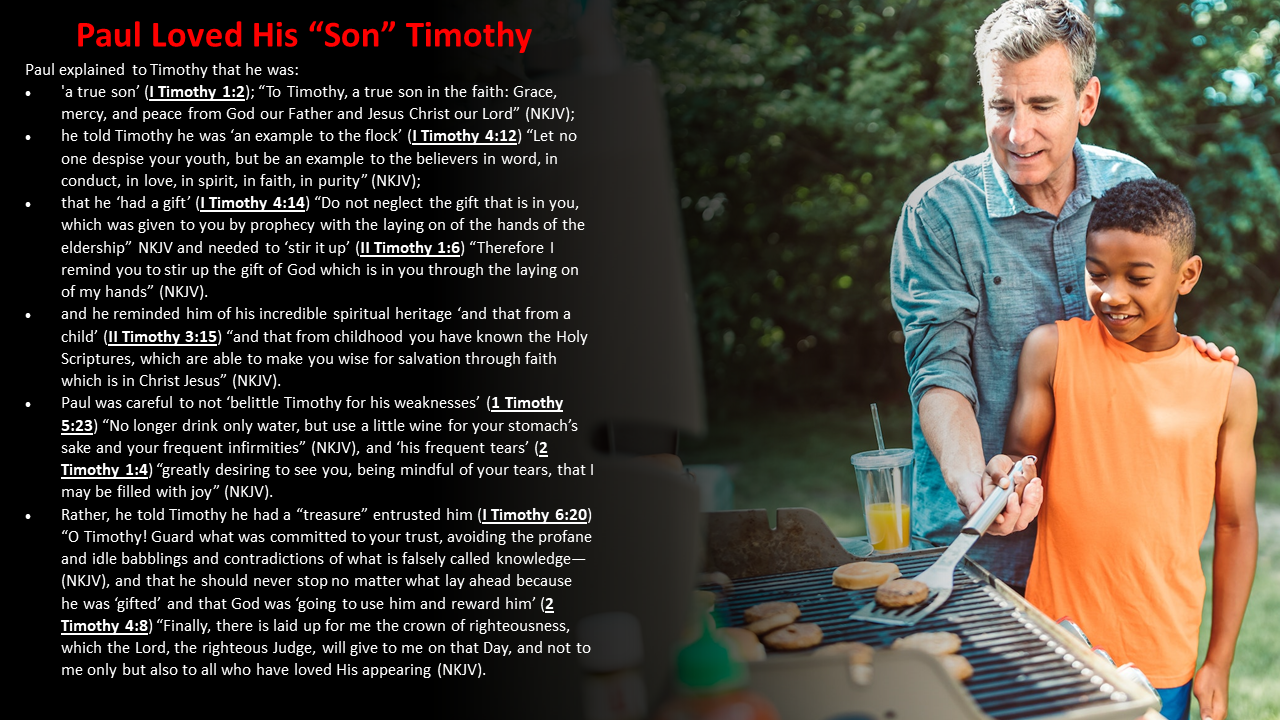
Paul Loved His “Son” Timothy
Paul loved his “son” in the faith. So as our example, how was his “love” for Timothy, his “son” in the faith expressed? One of the most beautiful testimonies to the power of encouragement (or affirmation) in the New Testament is in the life of the Apostle Paul. If you turn to I Timothy 1, listen as Paul explained to Timothy that he was:
- ‘a true son’ (I Timothy 1:2); “To Timothy, a true son in the faith: Grace, mercy, and peace from God our Father and Jesus Christ our Lord” (NKJV);
- he told Timothy he was ‘an example to the flock’ (I Timothy 4:12) “Let no one despise your youth, but be an example to the believers in word, in conduct, in love, in spirit, in faith, in purity” (NKJV);
- that he ‘had a gift’ (I Timothy 4:14) “Do not neglect the gift that is in you, which was given to you by prophecy with the laying on of the hands of the eldership” NKJV and needed to ‘stir it up’ (II Timothy 1:6) “Therefore I remind you to stir up the gift of God which is in you through the laying on of my hands” (NKJV).
- and he reminded him of his incredible spiritual heritage ‘and that from a child’ (II Timothy 3:15) “and that from childhood you have known the Holy Scriptures, which are able to make you wise for salvation through faith which is in Christ Jesus” (NKJV).
- Paul was careful to not ‘belittle Timothy for his weaknesses’ (1 Timothy 5:23) “No longer drink only water, but use a little wine for your stomach’s sake and your frequent infirmities” (NKJV), and ‘his frequent tears’ (2 Timothy 1:4) “greatly desiring to see you, being mindful of your tears, that I may be filled with joy” (NKJV).
- Rather, he told Timothy he had a “treasure” entrusted him (I Timothy 6:20) “O Timothy! Guard what was committed to your trust, avoiding the profane and idle babblings and contradictions of what is falsely called knowledge—(NKJV), and that he should never stop no matter what lay ahead because he was ‘gifted’ and that God was ‘going to use him and reward him’ (2 Timothy 4:8) “Finally, there is laid up for me the crown of righteousness, which the Lord, the righteous Judge, will give to me on that Day, and not to me only but also to all who have loved His appearing (NKJV).
So Paul loved Timothy with love he could feel. Paul “affirmed” Timothy, and used tender and encouraging words to help him as his son in the faith Timothy. These exhortations were tenderly given to a struggling man.
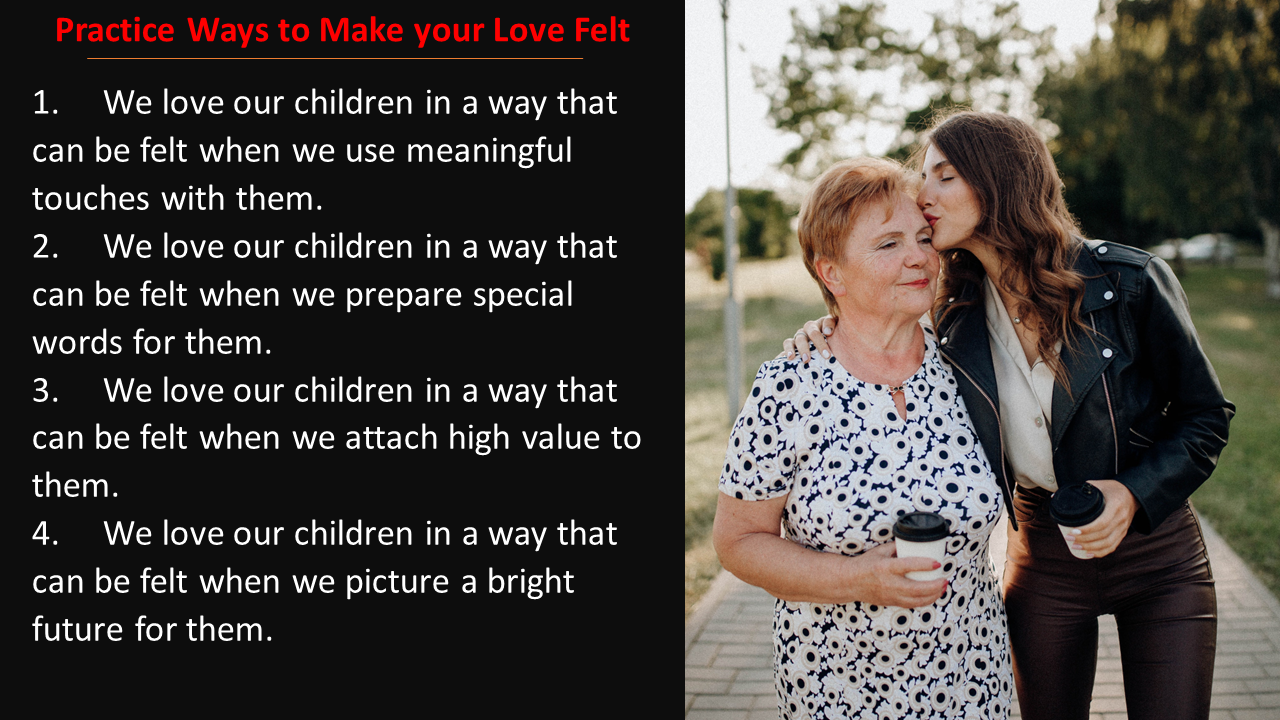
Practice Ways to Make your Love Felt
Make sure your loved ones in your family feel your love. To help them receive and be touched by your love, we can try to use those several key ingredients that we see in Paul’s ministry to Timothy. These small choices always help us to communicate affirmation and encouragement.
- We love our children in a way that can be felt when we use meaningful touches with them.
That is what Jesus did (Mark 10:16) when he blessed the children. He was always touching those He ministered to. He could have healed them with a word; eight times in Mark alone Jesus touched those He served. So should we! The act of touch is a key to communicating warmth and affirmation. It is even essential to physical health. Be generous with your hugs.
- We love our children in a way that can be felt when we prepare special words for them.
Remember how we saw that Paul used tender and encouraging words to help his son in the faith Timothy. He doesn’t belittle him for his weaknesses and tears. We should always remember that hugs aren’t enough.
Tell your children how you feel about them! Those who are left to fill in the blanks often feel worthless and insecure. At best, only confusion can come from silence. Far too many of us are really not that encouraging.
It’s not that we have a critical spirit. Rather, we just say nothing. Our loved ones are not mind readers. We can do better than just expecting them to know we are in their corner, loving and admiring them silently. They need to hear it! Make an effort to catch them doing something good, right, thoughtful, considerate, well done, etc. and point it out. Highlight it! “Hey, you really handled that situation very well.”
- We love our children in a way that can be felt when we attach high value to them.
Remember what we saw in Paul, how he told Timothy he had a “treasure” entrusted him; and that he was “gifted”; and that God was “going to use him.” So should we also tell the ones we love about the qualities you admire in them.
One of the best ways to do this with children is to liken them to a physical object (like calling your daughter a “pearl” or “precious jewel”).
With your husband this is communicated by saying your husband is such a “wonderful dad, husband, friend” or such a “faithful leader, provider, diligent, hard-working, thoughtful, etc.”.
With your wife this comes in the form of “you are so beautiful I think about you all day long; I can’t wait to see you; I know how hard you work all day and can’t wait to get home to help you; there are so many things I want to talk over with you; I’d rather spend an evening walking and talking with you than anything else, even sports, friends, golf, etc.”
- We love our children in a way that can be felt when we picture a bright future for them.
Paul told Timothy about a “crown” that was awaiting him as he ran the “race” set before him; and that the Lord was going to “reward” him. So we also should express what God can do with them as they follow Him in their life.
[1] Christ’s church has a mission that Paul summarized as pleasing God (I Thessalonians 4:1). This mission is accomplished by the proclamation of a message Paul summarized as the gospel of grace (Acts 20:24). The message of grace—that God did everything possible to be done and anyone can come to Him merely by faith seems impossible. But the most amazing part of all that the Lord is doing is His plan to do all this by a method is spelled out in Titus 2:11-14—Paul summarized as energized by God’s grace to live in a way that is otherwise impossible.
Transcript
Let’s go back to Titus chapter 2. We’re going to be looking at women energized by grace. And we’re going to be looking at how they love, as mothers they love their children. That’s what we’re going to study in verse 4. And we’re going to see how they can love their children with love that can be felt. And that’s what the Lord calls them to do.
But before we do that, we need to ask, what would be the motivation to look at Titus 2:4 and spend all this time? The answer is we desire to be a faithful part of Christ’s Church. And you say yeah, keep going. What is that? What are we talking about in Titus 2:4? You and I are part of something big. Something grand, something that dwarfs all of our broken down cars. You ever have your car break down and your world stops? All of our lost jobs, our bad health, the work pressures, our social problems, even personal loneliness that they say is one of the most acute pains that people can feel. There’s something that dwarfs all of those things. Through Jesus Christ, you and I are part of what God has chosen as His priority in this universe. Now think about that. What is most important to God?
And when you think about that, we are in partnership with God. Now that changes. Broken down car or not. Hard time at work or not. Strained social relationships or not. You and I are in partnership with God. Think of that. You and I are equity holders in something that will never end, never fail, never decay. You and I are a vital part of Christ’s Church. Now that’s God’s priority. That’s what God is doing.
And so, thinking about that, God’s plan to work in this world is through His Church. That’s just how God is operating right now. And you and I are a part of that. We’re a part of what God is doing, what is His priority, and what is the grandest and greatest thing in the universe, and it’s something that will never end. We’re owners. We’re equity holders in that. We have an inheritance. We are fellow heirs. We are partakers and possess God dwelling within us.
Why not remind yourself by looking at just three verses. I want you to look at three verses before we get to Titus 2, verse 4. The first one is 1 Thessalonians 4:1. And you might even want to if you haven’t yet, over the years I’ve mentioned this over and over, but 1 Thessalonians 4:1, if you have not yet marked in your Bible these three words, these are words I remind myself of regularly when I think about another time of the body of Christ’s gathering.
1 Thessalonians 4:1 is the first word, and it’s the word mission. You may want to even pencil that in to remind yourself when you’re flipping through your Bible, reading through it in a year or whatever. 1 Thessalonians 4:1 each of us in Christ’s Church has a mission. Paul summarized it as pleasing God.
1 Thessalonians 4:1 you can follow along in your Bibles. Finally then, brethren, we urge and exhort you in the Lord Jesus that you should abound more and more just as you receive from us how you ought to walk and to, what? Please God. Do you know what our personal mission as you go through life, whatever you do? I just met an engineer, or I’ve known him but got to know more about him, from Nordam. Did you know he works on something, I can’t even remember what it’s called. It’s what covers the engines on the airplane when you look out the window. Did you know that while he’s working on whatever that’s called that covers the engines on jet airplanes, did you know that he has a mission in life to please God? Did you know if you’re retired, or if you’re a student, or if you’re a homemaker, or if you are just a professional spend time running around going to garage sales and selling on an eBay person, doesn’t matter what we do, we have a mission, a personal mission, right here. It says, how you ought to walk and please God. Our purpose is to please God. That’s our personal mission. That is what we do wherever we are, at work, whether we’re at home, whether we’re alone, whether we’re in a group, whether we’re in our car. We have a personal mission in life. We want to be pleasing to God. Another way to say that is to glorify Him. Another way to say that is to magnify Him. Because He is pleased, He is glorified, He is magnified, as we yield ourselves to Him. So, the first word, mission. Each of us in Christ’s Church has a mission. Paul summarized that as pleasing God.
Secondly, and if you want to turn back to Acts 20, we also, in this mission in life of pleasing God, Acts chapter 20 and verse 24 tells us that we also accomplish our mission by proclaiming a message. Now, look at Acts 20:24, because our mission is accomplished by the proclamation of a message Paul summarized as the Gospel of grace.
This is what the 24th verse of the 20th chapter of Acts says, but none of these things move me, nor do I count my life dear to myself so that I may finish my race with joy, and the ministry which I receive from the Lord Jesus to testify to the Gospel of the grace of God. Wow. We have a message that we are supposed to proclaim. The Gospel of the grace of God. That God is willing and able and ready to completely forgive you of every sin you’ve ever committed past, present, and future. Free of charge. His gracious offer of salvation. And Paul said it was his life’s message to testify, not just the Gospel, the Gospel of the grace of God.
Think about what that means, the message of grace. That God did everything possible to be done and anyone can come to Him merely by faith with no personal works that they must accomplish attached to it to get to Heaven. Seems impossible, doesn’t it? But Paul said, this is the message that I proclaim. The Gospel of the grace of God. We have a mission. We’re supposed to please God. And while we’re doing that, no matter what circle or avenue or pathway of life we take, we have a message we’re supposed to be telling people.
But then, the last thing, let’s go now to our text, to Titus 2. There’s one last M. I have written in my Bible by 1 Thessalonians 4:1. my mission. And then I have by Acts 20, my message. But look at Titus chapter 2. Because all that I’m talking about encompasses the Church. And the most amazing part is God’s plan to do all this is by a method. Spelled out in Titus 2. How do you get people that are, that have as their entire life to be pleasing God and their entire output, the message, how do you get that to happen when people don’t even know God? The Lord has deployed a group of people. And God’s plan is to do this by a method spelled out in Titus 2. And Paul summarized that plan as men and women energized by God’s grace. They have a mission to please God. They have a message of His Gospel of grace. But the method is, God wants this to be accomplished by individuals who are energized by His grace to live out this impossible life on Earth and to show other individuals along the way, how to also follow Him.
And Titus 2 tells us what God wants to do. And what I want you to do with me is listen to me read the second chapter backwards. Now, you might think that’s a little funny. Sometimes, I’ve read the Bible so many times, when I read it backward my eyes have to go slower. I don’t mean every word backward. It’s not going to be jumble. Verse 15, then verse 14, then verse 13, like that. What we’re going to do is read through this backward and listen to this incredible chapter of what God wants to do. He wants to energize older men. He wants to energize older women. He wants to energize younger women and younger men. And then He wants to energize everybody that works. That’s the slaves thing. Those are employees. Those who are doing a job. And He says, I want to touch every person in society through you. Whether at work, whether in your marriage, whether in your home, in your personal life. I want My church, using this method, to energize and take the grace of God and dispense it into the lives of others by example and through My words.
Let’s read the second chapter. Verse 15. Speak these things, exhort and rebuke with all authority, let no one despise you. Who gave Himself for us, that He might redeem us from every lawless deed, and purify for Himself His own special people, zealous for good works, looking for the blessed hope, and the glorious appearing of our great God and Savior, Jesus Christ. Teaching us, that denying ungodliness and worldly lusts, we should live soberly, righteously, and godly in this present age. For the grace of God that brings salvation has appeared to all men. Verse 10, not pilfering, but showing all good fidelity, that they may adorn the doctrine of God our Savior in all things. Exhort bond servants to be obedient to their own masters, to be well pleasing in all things, not answering back.
Verse 8. Sound speech that cannot be condemned. That the one who is an opponent, may be ashamed, having nothing evil to say of you. In all things, showing yourself to be a pattern of good works. In doctrine, showing integrity, reverence, incorruptibility. Verse 6. Likewise, exhort the young men to be sober minded. Verse 5. To be discreet, chaste, homemakers, good, obedient to their own husbands, that the Word of God may not be blasphemed. That they admonish the young women to love their husbands, to love their children. The older women, likewise, that they be reverent in behavior, not slanders, not given to much wine, teachers of good things. That the older men be sober, reverent, temperate, sound in faith, in love, in patience. But as for you, speak the things which are proper for sound doctrine.
Isn’t it interesting, the first verse is almost parallel to the 15th verse? Speak the things which are proper for sound doctrine. If you want a summary of our lives as believers, it would be; we were saved by God’s grace and we are sanctified by God to be energized by His grace to live out His Word in this world and to use His method to make His Church be fully able to, as it says here, to be able to adorn the doctrine of God in everything. We’re ornaments. You’re an ornament of what a family should look like, of what a marriage should look like, of what a man should look like, of what a woman should look like, of what a worker should look like. You are adorning the doctrine of God. I wonder what the world sees when they look at us ornaments. I hope they see God’s grace. Let’s bow before Him.
Father in Heaven, I thank you for Titus, for the challenge he took, for the empowering that he allowed You to give to Him to faithfully proclaim Your Word in that very dark and warped island of Crete. Thank you that Your Word has been preserved and delivered to us this very day so we can actually hear Your voice through the Apostle Paul. And I pray that we would hear Your voice, and that we wouldn’t merely be hearers of Your voice, but doers of Your will. Because You’ve clearly told us what Your will is, what Your method is. What we should be doing is our mission in life, pleasing You, proclaiming the message of the Gospel of grace, and living energized by that grace, adorning Your doctrine oh God. Show us more how to do that. For Your glory we pray. In the name of Jesus, amen.
God’spast two plan to work in the world is His Church. Christ’s Church, I’ve described it before as a group of people that are energized by grace doing the impossible for the glory of God. And a key insight to how we do the impossible is in this second chapter. It isn’t impossible superhuman feats. It’s the impossible life we live, energized by the grace of God, starkly standing in contrast to the world that is godless and without His power. When grace energizes us, we want to deny ungodliness in any form. That in itself is so strange. That’s why they think it’s strange about us that we don’t live like we used to live. Our unsaved friends, even those that have known us for a long time since we’ve been saved, they know that we’re changing, that we are changed from glory to glory, more and more, into the image of Christ and they just think we’re so strange. But when God’s grace energizes, we want to mortify lust in any form in our lives.
That brings us to Titus 2 and verse 4. The Cretan church was saved. They had been bought by Christ from the slave market of sin, which is redemption. But they still had clinging to their lives little bits of who they used to be. All of us are products of our upbringing and of our culture and most of all of our fallenness and sinfulness. We have little vestiges of that just comes out in our lives. The plan that God had in mind was to transform these very unsaintly people. They were to be walking in the power of the Spirit of God. And as long as they were walking in the power of the Spirit of God, the Spirit of God, as we walk in the Spirit, is constantly at work suppressing the old nature, our flesh. Suppressing the lusts of the flesh. Paul calls it the mortification. The sanctifying work of the Spirit is mortifying our old us so there’s less and less of that visible. That’s when the power is on. That’s when we’re walking in the Spirit. But you know, sometimes the power goes off. That’s called grieving the Holy Spirit, quenching the Holy Spirit. Not being in the Word on a regular basis, not communing with God in prayer, not finding Him more than our necessary food. When that happens, the power diminishes. And when the power diminishes, the fleshliness increases. In fact, you can tell in a person’s life whether they’re walking in the Spirit, and the Spirit of God is mortifying their fleshliness, or whether they are not walking in the Spirit, and it is rising and more and more evident.
In the Cretan church, as long as the power was on in their lives, as long as they operated and energized by grace, their old ways, the lust of the flesh, and all the manifestations of pride were held back and restrained. But whenever the power was interrupted, and they didn’t walk in the Spirit, their old corrupt ways of the flesh just sprang back to life. And so, they needed help in this long term sanctification. And that’s what Titus 2 method is all about. They needed someone to come alongside of them in every realm of life. Wherever they were, as a young person, as a young married, as an older person. They needed someone to come alongside of them and not lecture them. But walk them through life, hand in hand, with the Word of God. Not forever. The whole idea is just like you see Philip with the Ethiopian eunuch. He took him as far as he was supposed to take him, and the Ethiopian eunuch went on his way rejoicing. This is not a lifelong contract we sign with someone, like we marry them for life. It is just a help along the way. And I think of the people that have built into my life, some of them have built in for a year, some of them have built in for a day or a week or a month. But God uses those who are further along the path to help us, and that’s the concept here.
As I worked over this passage the last two weeks, I kept thinking about what the church in Crete must have looked like. Can you imagine what it was like for Titus to come into these congregations, and to find in every congregation at least one person who wasn’t walking in the Spirit, and the old unpleasant odors of their former lives started coming out in the churches. That’s what you see all the way through this book. Paul telling Titus how to deal with these manifestations of the flesh as they’re coming out in these people’s lives. Just like someone who smokes, they can’t smell the stale odor of smoke that reeks from their clothing, their car, their home. So, these former pagans couldn’t smell all their fleshly habits that needed changing. People walking in the flesh, not in the Spirit, they aren’t even aware of the odor of the self and flesh in their life. But when they are sanctified, all of a sudden, they start being able to smell the flesh around them. And that’s what was needed. Like garbage left to rot smells until it’s disposed of and cleansed away, so Titus was to start a spiritual search and dispose mission in the lives of the Cretans.
God wanted them to have the spotlight of His Word brought on. Not only in the public group setting like this, and they had public teaching services and worship services like this. But also on a smaller basis, on a smaller group level, to have the spotlight of the Word search out to show what needed to be disposed of. God wanted to shine the spotlight of His Word through His Spirit onto their lives. And any garbage that was exposed, He wanted it to be denied. That’s what it says. Denying. Look at verse 12. Denying ungodliness. Until they even know, through the work of the Spirit, through the light of the Word, and through the help of a Titus 2 mentor. All of those are tools to show them what is ungodly in their life. It could be that they’re so callous that they aren’t even aware. And the Spirit of God’s still small voice, they don’t even sense through the Word, because they’re not even in the Word. What is wrong in their life and they don’t even feel that conviction at times, because they’ve desensitized themselves. And so that’s why he said rebuke them sharply, so that they will learn to deny the areas of their life.
And then after seeing them, Paul wanted them to scrape off anything that clung to them of their old life. That’s mortification, sanctification, purification, so that they would please God. Paul takes them through a series, and we’re walking through these, one by one. And he shows them the areas that he wanted the Spirit of God and the Word of God to address in their lives. And these Cretans, as new believers, needed this sanctification, they were just children in the faith, and they needed to learn to take their bath in the Word and through the Spirit.
You know how children are? They don’t like to take baths. They want to keep playing, and they get so dirty. And finally, the mother or father says, you know what? It’s time to come in and take the bath. They enjoy it so much afterward but they don’t enjoy getting there. And that’s this whole paideuō idea of teaching them to deny ungodliness. Teaching them as a child.
That need for removing remnants of garbage that stink really confronted me. I had worked on this for two weeks, and I got home before the whole family, and I was getting the house ready. And I walked in the house, and I turned the lock of the door, hadn’t been in for ten days, and I went, Oh! I thought the fish had died. Three fish we have. And so, I went right away… it just, the whole house was stinking. I thought, dead fish. And I looked, no, they were still playing around in there. I thought, oh the fruit bowl rotted. So, I went over, nope. Bonnie had cleaned it out. I thought, I forgot to empty the garbage. Checked. No. And I was at a loss. The whole house smelled like a dumpster. Go out back of a restaurant and find their dumpster and stand in it. That is exactly what it smelled like. I could not figure it out. I walked all around and I thought, what did I do wrong? I was supposed to have the house all ready when Bonnie got home.
And finally, I was standing in front of the refrigerator and I saw this dark circle right in front of the door. I thought, what is that? And I opened the doors. The electricity was still on, the lights came on, and I saw the most colorful display of mold and decay I’ve ever seen in my life. I told Bonnie, I was describing, I said, did you know that eggs mold this color, butter molds this color, milk in a carton expands ready to explode, and it’s a different color? And I said, and cheeses all have different colors of mold! There was even mold on the sides of the refrigerator growing up, especially in the freezer side. It was really something.
Do you know what had happened? The compressor, the refrigerant, half of it had died so that only the bottom 8 inches of the refrigerator and freezer were still cold. And everything above 8 inches was hot, just stinky. Did you know refrigerators don’t have any smell? It’s only what’s in them that smells. And if what’s in them is not continuously, the growth of bacteria retarded by the coldness, that if that doesn’t happen, that the bacteria that’s on all the food… in fact, I told Bonnie, even inside of things like closed jars of food, it was totally moldy inside. Nothing had permeated it. It had just been sitting there. It was already there. And at just the right temperature, it just grew. In fact, I could have started a microbiology class. I had just thought about my old scientific days, and I wanted to save all that stuff because of all the different colors.
But the spiritual truth is this. It was that stuff left without the power of that coolant keeping, suppressing all of that bacteria and all those microbes that are always on that food. And without that suppression, without that power holding down that growth of bacteria, when that was removed, it just exponentially began growing until it actually coated the sides of the refrigerator and freezer. It took me about six hours to bag, haul, wash, scrape, bleach, and scrub that trusty white refrigerator. When I got all done, you know what? It smelled like Clorox. It was beautiful. It was pure white again. And it was all gone, but it wasn’t going to stay well until the repairman came and got the refrigerant going again. In a very similar way, Paul was teaching Titus that if these Cretans did not keep the sanctifying work of walking in the Spirit, going in the lives of these congregants, that old flesh was going to multiply, and it was going to become foul in their lives, just like my refrigerator. So, he systematically takes them through.
And we’ve already looked at women energized by grace are reverent in their behavior. If they’re not walking in the Spirit, they’re not reverent. If they are walking in the Spirit, they are reverent. Women energized by grace are not slanders. If they’re walking in the Spirit, their tongue is guarded. If they’re not walking in the Spirit, their tongue is loose and bedeviled, as the word is he used. Women energized by grace are not given too much wine. They just don’t do excessive things. Women energized by grace are teachers of good things. Women energized by grace are discipling younger women. And as we saw last time, women and especially wives energized by grace, love their husbands. They just decide to make their husband their number one priority. They start seeking his friendship, and they examine their lifestyle to be focused on him.
But then, look at verse 4. Those mothers, women who are mothers, energized by grace, love their children. And I showed you that it says in verse 4 that they are to be philoteknos. They are to be, and the literal word is, close friendship, enjoying friendship. Just like Jesus and Lazarus, and Jesus and John, and Jesus and His Church. They are supposed to be enjoying a close friendship, emotional relationship with their children. That phileō love that is emotional and close and visible is what the Lord asked from grace energized mothers. And so, what I’d like to do is talk about how to give the priceless gift of love to your children.
And let me just share a collection of 30 years of thought. And I look back in these last weeks doing Titus, over everything. Because I take notes on everything I do, I’ve looked over everything that I’ve ever learned and studied about this, and I just rambled it together. Let me show you a collection of things from the Scriptures.
Do your loved ones in your family feel your love? That’s a question we all need to ask. Do they feel your love? Not, do you have agape, dutiful, sacrificial love, but do you have phileō, emotional, felt? That’s a question that we all need to ask. Just as many husbands think that their wives admire other men more than they are loved and admired, because a wife will say, so and so’s husband does this and that with his children and his wife, and immediately those husbands don’t feel the love and admiration of their wife. They feel that she thinks more highly of someone else than them because they’re compared. And likewise, many wives feel their husbands think other women are either better at caring for their husbands or prettier or better at caring for their families than they are. Those women do not feel the love of their husbands. But most importantly for Titus 2 mothers, energized by grace, we need to consider that many children hurt because they sense their parents don’t even like them. They have this feeling.
Some ways that a lack of love can harm children where they feel it is, when a struggling student watches their parents gloat about their brother or sister’s good grades. They immediately feel less because of the comparison. Or maybe a boy in some athletic event doesn’t do so well and looks up and immediately notices his father’s disappointment because the father is the great athlete and he’s hoping his son will be the great athlete that he wants him to be. They don’t feel love. The absence of loving approval can lead to a lot of pain, whereas those who are loved and face their daily challenges in the world that they live in, they face it with the strength and confidence of someone loving them.
You say, are you sure? Aren’t we just supposed to slug it out and be good soldiers and not worry about that stuff? I thought about that a long time, especially in our culture it seems like we’re never supposed to talk about anything that has to do with emotions and how people feel and all that, we’re just supposed to tough it out.
I want to show you someone that had a lot of problems. His name was Timothy. Look at 1 Timothy 1. And I want to take you to show you how Paul loved his son Timothy. You know what’s so funny? If we show all this in a biblical context, no one gets uncomfortable. But if we talk about it from the studies of many people that have analyzed other people, people get uncomfortable. So let me show you, they both come to the same place. The love that can be felt is a priceless gift that is very biblical to give. And we can see that modeled by the Apostle Paul.
Paul loved his son in the faith. So as our example, how was Paul’s love for Timothy, his son in the faith, expressed? How did Paul express Who picked up young Timothy on his missionary journeys. How did Paul express to that young man, whom he called his son in the faith, his love? It’s one of the most beautiful testimonies to the power of encouragement or affirmation in the New Testament. And it’s from the life of Paul.
In 1 Timothy 1:2, and let me just give you a quick list. If we looked at Paul’s relationship with Timothy, the first thing we’d see is that Paul affirmed him in many ways. Now, if you know anything about Timothy, he seemed to be weak in constitution. He was often infirm. People looked down on him. Let no man despise thy youth. He also was one who cried a lot. Paul said I’m aware of your tears, and it wasn’t like it was a onetime occasion. So, it seems like Timothy had people picking on him, he was a weakling or sickling or something, and he cried a lot. And also, he was a mama’s boy. We never hear about his dad. We only hear about his mother and his grandmother. And so, you put that together and you could get a lot of mileage out of that at school. You know, someone, they probably played jump rope with the girls instead of playing tree climbing with the boys. And so, whatever was going on, Timothy needed something and Paul gave it to him.
The first thing he says, look what he says in verse 2. To Timothy, a true son in the faith. Now that is a magnificent encouragement. Paul said, you’re a true son. Keep going, look at chapter 4 in verse 12. He told Timothy he was, 1 Timothy 4:12, an example to the flock. He says, let no one despise your youth, but be an example to the believers in word and conduct and love and Spirit and faith and purity. He says, Timothy, you’re a true son. Timothy, you’re an example to the flock, the way you live. And I’m sure Timothy thought about that.
Verse 14, same chapter. He told Timothy he had a gift. He says, Timothy, 1 Timothy 4:1, do not neglect the gift that is in you, which was given to you by prophecy, with the laying on of the hands of the eldership. In fact, he says in 2 Timothy 1:6, you need to stir it up. He says, you’re gifted. You have a gift. God gave you a gift. You know what the scriptures say? We all have a gift. We all, if we’re saved, are true sons in the faith. We all are an example to someone, either a good or a bad. You see, what Paul was saying, we can say, and how encouraging it is. He reminded him in 2 Timothy 3:15 of his incredible spiritual heritage, and that from a child you have known the Holy Scriptures, which are able to make you wise for salvation. He reminded him of his spiritual heritage that he had from his youth.
1 Timothy 5:23 though, Paul was careful not to belittle Timothy for his weaknesses. A lot of times people use humor, what they think is funny, when the person’s not laughing it’s not a joke, it’s harmful to them. So Paul, you notice in 1 Timothy 5:23, he doesn’t belittle Timothy for his weaknesses. In fact, he says, no longer only drink water use a little wine for your stomachs sake and your frequent infirmities. In fact, in 2 Timothy 1:4, he had frequent tears, not just frequent infirmities. 2 Timothy 1:4, greatly desiring to see you being mindful of your tears. Paul says, I remember your tears and when I see you, I’m going to be filled with joy.
Paul never belittled him. Rather, he told him, 1 Timothy 6:20, that he had a treasure entrusted to him. Oh, Timothy, guard what was committed to your trust. He says, you have a treasure, and that God is going to use you and reward you. 2 Timothy 4:8. There is laid up for me a crown of righteousness. The Lord, the righteous Judge is going to give me, and not me only, but also to all who love His appearing. He was saying, Timothy, you have this giftedness and even though you’re struggling with your weakness, he says, I’m not going to make fun of that. I’m going to say this; that you should stir up that gift, and you should guard the treasure, the Gospel call that you’ve been given.
So, Paul loved Timothy with the love that he could feel. Paul affirmed Timothy. He used tender and encouraging words. And if you read 1 and 2 Timothy you find one of the most tenderest, loving expressions of a father to a son, to help him and his faith. These exhortations were tenderly given to a struggling young man.
But to make sure your family, your children especially, feel your love, we need to use several key biblically modeled ways to do it. Now, turn back, and this is just a list, and we’ll pick up on them next time. Look at Mark 10 and verse 16. I want to show you, when Jesus was demonstrating love, and we’ll alternate between Jesus and Paul. In Mark 10:16, and from this verse I give you a premise. We can love our children in a way that can be felt when we use meaningful touches with them.
We live in a culture that’s backing away from touching. In fact, we now in the public schools have, the good touch bad touch lessons. How to tell good touch bad touch. And all that’s great, and there are bad touches. But what it’s done is our culture’s moved away from touch. They’ve gotten stiff and distant. And look what Jesus did in Mark 10, in verse 16. Jesus is showing His love and His care for people. And there’s a group of children around. And He says in verse 16, and He took them up in His arms, laid His hands on them, and blessed them. It’s interesting what Jesus could have done. He could have just gone like this… Or… and there’s a lot of ways. He could have sent a flock of doves down, dive bombed them, or something like that. Do you know what He did? He modeled for us. He gathered.
Isn’t that a picture that’s in all the children’s storybooks? Of all the children gathered around Jesus, and they’re all sitting on His lap, and He’s got His arms around them and He’s just looking down. Do you think that is just there by chance? Jesus was showing that children feel love when we touch them in a meaningful way. Jesus always touched those He ministered to. The Gospel by Mark, nine different times Jesus touches people. He touches the lepers. He touches the blind. He touches the lame. He touches those that are dead and they’re coughing. He puts his hand on there and they come forth to life. He touches people when He ministers to them. He could have healed them with a word. But in Mark, He touches those He serves, so should we.
The act of touch is a key communicating warmth and affection. It’s even essential to physical health. They find that they need to hire people to walk through the nursing homes and the children’s hospitals to touch those who are healing, just because there’s something about humans needing to be touched. I remember 12 years ago, so none of you will know who this is, but I remember 12 years ago. I was walking on the right hand side of the old auditorium. And I saw someone, and I went up to them, and I shook their hand, put my hand on their shoulder, and talked to them. And they just looked at me, and they said, you know what? I never see people or talk to people all week long. And I come to church just to have someone talk to me and touch me. And I thought, I was just walking down that aisle. And it just came out like a torrent. And I thought, we don’t even know how isolated and alone and needy the people are around us, and especially those closest to us, if we don’t use meaningful touch.
Secondly, we love our children, not only when we use meaningful touch, but when we prepare special words for them. Paul sat down and thoughtfully wrote out under the inspiration of God’s Spirit, but it was God’s Spirit working through Paul, and Paul picked out items from his years of ministry alongside of Timothy. And he wrote down specific words that would encourage his son in the faith that was struggling in this huge pastorate in Ephesus. We should realize, Paul used tender and encouraging words to help his son in the faith, Timothy. He doesn’t belittle him for his weaknesses and tears.
We should always remember that hugs aren’t enough. Tell your children how you feel about them. Those who are left to fill in the blanks often feel worthless and insecure. At best, only confusion can come from silence. Far too many of us are really not that encouraging. It’s not that we have a critical spirit, it’s just we don’t say anything. Our loved ones are not mind readers. We can do better than just expecting them to know that they’re loved and admired and sought out by us. Instead of making them guess, they need to hear it. Make an effort to catch them doing something good, something right, something thoughtful, something considerate, something well done, and point it out, highlight it. And say, that was really wonderful.
So how do we show love that can be felt? We show it by meaningful touches. We show it when we prepare special words. We show it when we attach high value to them. My true son in the faith, stir up that gift. Don’t you remember when we laid hands on you? Just that high value Paul put on Timothy. And when we picture a bright future for them… How did Paul motivate Timothy? He says, Timothy, I’m going ahead. I’m going to be there before you, but on that day, the righteous Judge is going to give me a crown, but not just me only, but also, he was pointing right back at Timothy. He painted for him a bright future if he kept following the Lord.
And [there are] many other things I could say, but grace energized mothers love their children with love that can be felt. Love that encourages, that affirms. Love that calls them to stir up the work of God in their life. Let’s bow before our Lord and think of Him gathering us up in His arms and then let us likewise do the same in our lives.
Father in Heaven, we bow before You. Thank you that You let us call You Father. That You let us approach You without fear. That we have the invitation to come boldly because of the sacrifice of Your Son. Thank you as we were reminded of earlier that we can come knowing that You feel all of our weaknesses and our infirmities, and You have compassion upon us. You are a great High Priest that is touched with the feeling of our infirmities. You feel. You have compassion. And we, as believers, are to be sympatheō. We are to be feeling together with those we love. And I pray that we might, energized by Your grace, love those that are around us in our family, love our partners that You’ve given us to walk through life with, and to love those who are struggling in the faith. And come alongside of them, because there’s always someone that we’re further down the road than they are and we can lead them, and we can encourage them as we’re energized by Your grace. And I pray that we might. And that You would be glorified. With Thanksgiving we offer ourselves to You. In the name of Jesus, and all God’s people said, amen.
Slides