If the video above is not available, here are two other ways to view:
140330AM
ESH-11
Following & Making.docx
Biblical Exercises for Spiritual Health & Fitness in 2014 Series
The Discipline of Disciple-Making:
“Disciples: Follow Christ & Make Disciples”
Matthew 28:16-20
Transcript

Let’s open our Bibles to Matthew 28 on the screen. We’re looking at the discipline of disciple-making. The context of where we are is that the Apostle Paul is in prison. He knows he’s soon going to be off the scene with the Lord. He’s training his true son of faith, Timothy, who is actually a prototype and example of all future pastors. That’s why 1 & 2 Timothy and Titus are called the pastoral epistles. They’re the guidelines for the continuity of the Church that Jesus Christ established. Right in the middle of that, we’re going to see in a moment, Paul looks at Timothy through this impassioned written set of disciplines, and he says, I want you to command and teach everyone these things and that’s hearkening back to where we are right here in Matthew 28. Jesus said, teach them all things that I commanded. See, command and teach. Everything that I’ve commanded, remind them of, and teach them how to do that. Paul just reiterates. That’s what disciple-making is: commanding people to come to faith in Christ the way Jesus Christ described it and then, teaching them how that life is to be lived.

But while we’re on that topic, it brings us to this: this morning if it wasn’t an ambulance that was packed outside like there was earlier, if it was a TV truck and they had a microphone and they were putting it in our faces and asking us to describe what we are, the people that go to this church, most of us would probably say we’re Christians. That’s probably the most common, or people would say that I’m born again, or maybe I’m a Believer. Few people would probably say I’m a Saint because that isn’t in vogue. So, Christians, saved, born-again Believer. But what’s interesting is if you do a study of the 27 books of the New Testament, what does God call us? If you do that study, you find, depending on how you divide them, there are maybe over a hundred or very close to a hundred different terms to describe Christians.
Now, most of them are very obscure: Pilgrims and Strangers. Now, that’s either one or two. We’re called Pilgrims and Strangers, or we’re called Pilgrims and Strangers. So, that’s one or two terms. We’re called a Kingdom of Priests. We’re called a Holy Nation. Believers have many different descriptors and descriptions in the Scriptures.

But just for our benefit, let me give you what I would call the top seven. Let’s just think about what God calls us in the Scriptures. I’m going to do them in reverse order. I’m going to do the seventh place first. Seventh place in the Scriptures is what we most often use, that’s Christians. It occurs three times, twice in Acts, once in 1 Peter 4. So, that’s seventh place. Now, all the others that make up the hundred are used either three, two, or one time. So, they’re all just multiple lists, and it’s a fascinating study that would be fun to do sometime.
In sixth place, in the book of Acts, Christians are called Followers of the Way, with emphasis on the Way. They would say that they’re of the way or whatever, and that’s in Acts 9, five times. So, that’s the next to the least.
The fifth place would be Witnesses. Now, we’re getting into a higher incidence, 27 times. Believers, most frequently in the book of Luke, are called Witnesses. Now, the Greek word for witnesses, martyrian, and that has become synonymous with martyr, because those who witnessed to Christ heavily in the 1st century, as the Roman Empire leaned on them harder and harder, became real Witnesses, which were martyrians, martyrs. So, if the television truck was here this morning and they gave a microphone, a few of us would say, I’m a Witness because we would think of what Jehovah’s Witnesses, right? Actually, they’re Jehovah’s False Witnesses, but you know, we would think of that term. So, Witnesses is not common, but it’s very common, 27 times, nine times more common than Christian.
So, if we’re looking at five times the Way Followers, three times Christians, and 27 times Witnesses, in fourth place are Saints. That’s 62 times. Now, as we go through this list, they’re almost exponentially increasing in their frequency in the New Testament. People are called Saints more than any other term, other than the three that are to follow, more than Witnesses, more than Followers of the Way, more than Christians, more than Pilgrims and Strangers, and Abraham’s seed, and all this stuff. It’s very much that people were called Saints. Now, can you imagine the truck and the microphone coming out from a local news station, they say, and what do you call the people here at Calvary? Oh, Saints. That is what we are, but it isn’t what we are comfortable calling ourselves.
In third place, those who are following Christ. When Jesus said follow Me, the people who did were following Him, and they were described as Followers, and that term is used very often. The Followers and following are used over a hundred times, depending on whether every time Jesus turns and the crowds follow Him, depending on how you measure it, but it’s around a hundred times that we’re called Followers and those who are following Him.
Second place is one that we know quite well, Believers and believing. Those who were believing in Him, who were believing in Him, are described as Believers. That is used very often, 266 times we’re called Believers.
But as we are going to see in chapter 28 of Matthew, the most frequent term, description of, title of those who are going to be forever around the throne worshiping God are called Disciples. Isn’t that interesting? I doubt if all of us had a microphone brought to us, if any of us would claim, if the correspondent from the news station said, what are you this morning? Few people would say, I’m one of Christ’s Disciples because it would seem like we’re saying we’re what? One of the 12, and that is just a tragedy that we have so equated the Apostles with the term, although it’s true. The 11 at the Mount, look at chapter 28, we’re going to be in verse 16 in a moment.
But those who were commissioned by Christ, Jesus Christ, commissioned His Church right where we’re going in chapter 28, verses 16 to 20, to make Disciples. But it wasn’t to make Apostles with capital A, all of us are little a apostles. That means we’re sent. Apostolo means a sent one, one who is sent with a message. So, in the sense we’re all a little letter, small case A, we’re all sent, go into all the world and preach the Gospel. Few of us, only those 12 were the capital A, the Apostles, but all of us, if we’re going to be in Heaven, are Disciples. And anyone who is not a disciple, Jesus said, will have a very bad ending and will not end up in the place that He’s prepared for them.
So, we really need to understand the term disciple if we’re going to do what Jesus did. He commissioned us to make Disciples. And if you don’t know what you’re making, you’re going to have a problem with the output. I think that confusion has caused the Church of the 21st century to not be exceptionally good at making Disciples because there’s just confusion about what we are doing. Does that mean getting people into a class? No. Making Disciples is evangelizing pagan, lost, doomed sinners to become Followers, Saints, Christians, Believers, Witnesses who are Disciples of Jesus Christ. The instant in the New Testament that someone called on the name of the Lord, they were considered a disciple of Christ.
It wasn’t a two-stage deal. That’s a real tragedy, too. We have in Christendom today, epoxy, you have the two, you’ve got to get them together there, and you can squirt one or the other. But when they get together, you have something really strong. A lot of people look at a two-part salvation. You pray this prayer sometime in your life, and you just go forward, and something happens. Then you can live like the Devil if you want, and be into drugs and drinking, immorality. Then sometimes you surrender to the Lord, but you’ve been saved the whole time. You surrender and all of a sudden, and I hear this all the time, because after 35 years I’ve baptized so many of these people that prayed a prayer when they were four and when they were about 21 they had this radical transformation in their life, and they repented of their sins and their eyes were opened and all of a sudden they understood the Bible and they loved the Lord and tears streamed on their face and they wanted to love and serve and follow Him all their life. Everybody in the Church says we’re so glad you came back to the Lord.
The question we need to look at is, did they ever begin? Because Jesus said, you are not My disciple if you aren’t doing My will. Now, we don’t do it perfectly. That’s why if we confess our sins, He is faithful and just to forgive us. But at the core, see, we’re defining here. We’re not looking at individuals. We’re defining terms. People who respond to the Gospel at the instant of their response are called a hundred different things. Most frequently and clearly, they’re called Disciples, and a Disciple of Jesus Christ, Jesus defines, and that’s what we’re going to look at.
But chapter 28. Jesus Himself sums up all these various ways of naming and describing us into one overarching term, which is Disciples. That is why the most frequent term for us in the New Testament and the clearest target for all of our lives is to be focused upon making Disciples. And all the promises of the Old Testament may be seen as finding their fulfillment in and through the crucified and risen Lord Jesus Christ, who stood on this mountain in Matthew 28:16 in Galilee and commissioned His apostles. So, the summation of everything up until Matthew 28, all the 39 books of the Old Testament, are totally pointing at Jesus Christ. Now, the fulfillment of all the promises of God stands there and said, now I am telling you your marching orders, your job description, your hire letter. I want you to spend the rest of your life focusing as much of your time, and your energy, and your resources, and your desires on making more like you- more Disciples, Followers, Witnesses, Christians, Saints, Believers. Make more of them, but I’m calling them Disciples.
So, Jesus, all of His teachings in all four Gospels of our Lord Jesus Christ, may be seen as distilled and crystallized in these powerful words. Jesus says everything, all My three and a half years of public ministry, that’s what I want you to teach those who become My Followers. I want you to teach them how to be Disciples, and all the truths, by the way, of God that are taught through the New Testament scriptures, which happened to be either through apostles or associates of apostles, except for the two brothers of our Lord who happened to get books in there. But all the rest are tightly associated with apostles and their extensions of those apostles. So, everything we have, all the truths of God taught in the New Testament scriptures inspired by God from Acts through Revelation, is merely an outflow of this amazing declaration by God the Son in Matthew 28. It’s really such a crucial central juncture in the Bible.
Let’s listen to what Jesus says and actually invite Him to teach us this morning about the wonder of what He’s called us to do. So, Matthew 28:16-20, let’s stand together with your Bibles open. I just want you to notice a couple of things as I’m reading in verse 17 at the end, the men who are standing there are not perfect. Some of them are doubting, doubting. They walked with Him for three and a half years. They’ve touched Him. Yeah, they saw Him risen. They’ve held onto Him, and they’re still doubting. So, that’s very comforting. After three and a half years and actually touching Him, you still have doubts.
Then, in verse 19, one of the fantastic things is that verse 19 is the single most Trinitarian verse in the Bible. Anybody who is going to be around the throne of God, all of us who are part of the Redeemed, are to be those who declare that we are saved in the name of the Father, who is the author, the one who sent the Son. The Father sent the Son to be the savior of the world, the Son who is the atoning sacrifice, and the Spirit who is the one who applies. How much more shall the blood of Christ, who through the eternal Spirit, offered Himself to God, purge you? So, all three members. Believers are to be baptized as a mark that they agree with the Father, Son, and Holy Spirit, the triunity of God. This is a phenomenal passage.
But let’s listen to it starting from verse 16. Then the 11 Disciples went away into Galilee to the mountain which Jesus had appointed for them. When they saw Him, they worshiped Him, but some doubted. Jesus came and spoke to them, saying, all authority has been given to Me in Heaven and on Earth. Go therefore, and make Disciples of all the nations, baptizing them in the name of the Father and of the Son, and of the Holy Spirit, teaching them to observe all things that I have commanded you. And, lo, I’m with you always, even to the end of the age. Amen.
Let’s bow together. Father, I pray that we would hear and respond, that the eyes of our understanding would be opened by Your Spirit, that from this day forward there’d be no doubt in our minds who Disciples are, and what Disciples are, and what Disciples do, and that we would have that settled assurance that we are Your Disciples. We are following You, and we are choosing to make adjustments in our lives so that our life truly accomplishes what You left us here to do, and that is to make Disciples. Help us to really lay hold on this truth and to guard it and to start getting rid of whatever stands in the way of us being disciple-making Followers of You, oh Christ. And we ask that in the name of Jesus and for His glory. Amen. You may be seated.
As you’re seated, what we can say is for us on this side of the cross, there is no doubt what we’re here on Earth to do. Jesus Christ said this: He said, Disciples are those who follow Christ, and Disciples are those who know why they’re here. They’re here to make Disciples. So, this morning, we need to define Disciples. Who is a disciple? What is a disciple? And then we need to look at, and we’ll just touch on this, what a disciple learns to do. In your mind, you should be doing a little checklist. Have I been trained? Do I know and understand? Have I been taught to observe what Jesus taught all Disciples are to observe? It’s written down. You don’t have to buy a manual. You don’t need a video. You don’t need a tape. You don’t need a course. You don’t need to go somewhere. It’s completely written down. You understand that the people who heard this did this. They didn’t have the internet, and they didn’t have smartphones. They heard Jesus say, what I just trained you in for three and a half years, take to the ends of the Earth and amplify it, and multiply it, and deepen it, but do it. They did, and it’s amazing.
So, we, as Disciples, are to follow Christ, to make Disciples, and that’s it. Everything else is tied to that simple statement. Worshipping God, biblical ministry, glorifying God, everything flows from God’s purpose to show the world. He is a savior. A savior who so loved the world that He sent His beloved Son. As John says, for the Father sent the Son to be the savior of the world, and that’s what glorifies Him. The more people understand and respond and become those who are his Followers.
This is a study of the central theme of our earthly lives. We glorify, please, and serve God to the degree we’re part of what He has so clearly asked us to do. You know how, after you’re at a job for so many months, they do a review and tell you how you’re doing, or you get a bonus or something like that. Did you know that God has a job description and He regularly looks to see whether or not we’re doing what He called us to do? Do you know what Revelation 2 & 3 are about? Jesus came to the Church, seven of them, and said, you’re not doing what I left you to do. You’re not doing what I left you to do. You’re not doing what I left you to do. You’re not, you’re not, you’re not. Only one was clearly doing what they were left to do, and the other one was commended for suffering, for being the Witness part at least. They were martyrian. There are no negative things said to them, Smyrna, but to the other five, negative things are said.
Only one, only the Philadelphia church does Jesus commend. Why? Because they were going everywhere, making Disciples. See, He doesn’t care about the size of the building or the size of the ministry. He’s looking at the output, the product. Are we following Christ? That’s vital, and if we’re following Him truly, we’re doing what He left us to do, and that’s making other Followers of Christ, which is evangelism. You don’t have to have the gift of evangelism. We have the command to evangelize. Some people do it, hearing Natalie sing, it just looks like it’s easy. Those are the gifted ones. The rest of us labor. Kind of like some of the people I was sitting around in the service, I could tell that they shouldn’t be in the choir. You know what I mean? But that’s what we have some that are gifted, and it just seems easy, but all of us are commanded to make Disciples.

So, this morning. We’re looking at the fifth of the biblical exercises for spiritual health and fitness. Turn back with me to 1 Timothy 4 because I always want to center your attention on how we got here. Because Paul is just doing what Christ left us all to do. Now, he was a capital A Apostle, sent one, and he was writing inspired Word, but everything Paul is teaching is syncing, it’s completely congruent with what Jesus left all of us to do. Paul isn’t launching off on his own version, starting his own thing. Paul is just continuing and perpetuating and reinforcing and explaining and enlarging upon under the inspiration of God’s Spirit, what Christ left all of us to do.
Now, look at verse 11, because we’ve gone through the other disciplines or training or exercises, truth and devotion, time, and integrity. But in verse 11, we come to the discipline of disciple making, where we explain to others what knowing Jesus is all about and what following Jesus is all about. Note how short and sweet, and to the point verse 11 is. These things command and teach. Now, wait a minute. You just read it. Go into all the world and make Disciples of all the nations, baptizing them in the name of the Father, Son, and Holy Spirit, teaching them to observe all things I have commanded.
Okay, now I’ll give you a quiz, okay. First, like they’re doing nowadays in school. You know how the teachers tell you what’s going to be on the test so you can do better? I’m going to tell you what’s going to be on the test. We’re going to do a quiz right now. Jesus says, teaching them to observe all things that I commanded. What were the two components that Jesus said the ongoing ministry was to be? First of all, the component of teaching everything that He commanded.
Now, look down at verse 11. These things, command and teach. Do you see? Do you see that Paul is just in sync with the Great Commission of disciple-making? Basically, our purpose as Believers, Disciples who follow Christ, is to continue reaffirming Christ’s commands. That’s the command part of verse 11. We’re to reaffirm. I don’t tell you to do this, Christ commands you. I don’t tell you to do this, Christ commands you. I don’t say that marriage is between a man and a woman; Christ does. You understand? Isn’t it nice? A Christian organization this week made a bad decision and flipped to make a retraction of their bad decision when there’s no question what Christ said. You understand?
Do you know why we’re in such a mess in the world and not making Disciples? Because billion-dollar Christian organizations don’t even know what Christ said, but they get a billion dollars from Christians. It’s amazing where we’re living nowadays. And they form doctrine on public opinion, not on Scriptures. Jesus said, get people, reaffirm to them what Christ taught, His commands. Then follow up by explaining to them how to do what He said. That’s the teaching part of verse 11. It isn’t just enough to say, do it. It’s teach them how and why, and where, and how to make this possible, what it looks like in your life. Command and teach. That’s the discipline of disciple-making; command people everywhere to repent and turn in faith to Jesus Christ. Command them what Christ said and then teach them how to live that way and how to follow Him.
What are the commands that Christ taught, and how are we to continue in His steps? Making Disciples and teaching them what He wants to teach them is what we’re looking at. To understand the elements of making Disciples, we have to first look at what Jesus did and what His Disciples taught. So, to understand what’s going on in the New Testament, what we do is we look at this text. These things, command and teach. We understand that we’re supposed to be exercising ourselves in making Disciples, and then the most powerful effect on our lives is when we go back and look at what Jesus taught Himself and what the Apostles heard. See, that’s why I want to go through with you. I want you to be reminded that Jesus is the ultimate one who frames what a disciple is. The Disciples who heard Him, who were apostles, how did they describe it? Those elements are fundamental. Who is a disciple? What does the disciple do?
So, turn back with me to Matthew chapter 4, and we’re going to start on a jet tour of the Gospels. We’ll go through all four Gospels and then the Book of Acts this morning. What we’re looking for is how Jesus describes who a disciple is. In chapter 4, we’re coming to Christ’s first public words in ministry. He’s already gone through the baptism and the temptation, but now He’s ministering. He’s baptized and finished and conquered the temptation. Now, He’s out with public people and He’s proclaiming the Gospel. So, chapter 4, verse 17.
By the way, what I’m going to do with you is fascinating. Some people have spent their whole life taking the Gospels and putting them in chronological order and lining up everything Jesus said that’s mentioned by all four of the Gospel writers, and only three, and only two, and only one, and it’s called a harmony. What they do is they put all the events in chronological order. We know how long Jesus ministered; if you look at the Passovers, that’s how we get three plus years. So, they know the timeframe, and then we look at where He is going and what happens and where the Passover is in relationship. We can chart year one of His ministry, year two of His ministry, and year three of His ministry. And then the run up to the cross, which is at Passover of the three and a half year mark of His ministry.
With that, if you look at a harmony of the Gospel, this one is in year one, and why I’m telling you that is I want to show you that Jesus not only didn’t diminish the call, but the wider He gave it, the stronger and harder He described it. It’s interesting. Year one. From that time on, this is Christ’s first publicly recorded Words in Matthew, repent, for the Kingdom of Heaven is at hand. By the way, what does repent mean? It’s a change of mind that leads to a change of behavior. Change begins in the mind. You begin by changing your mind about what God says, about what God expects, what God demands, and believing that causes, if it’s a genuine belief, a change in behavior.
Now, the sportsman’s way of saying it is God catches fish, then He cleans them. A lot of people think they have to clean up their lives to get saved. God saves you, and instantly, He’s the best cleaner-upper, by the way. We’re not very good at it. He cleans us. Repenting is, we believe, when He catches us, and that belief leads to a change in behavior. That’s Him cleaning us, that’s sanctification.
So, He says, you need to believe Me and have a genuine belief that I come in and grant repentance, and I change your behavior. Then look what He says in verse 18. Jesus is now going to apply this. He walks by the sea of Galilee, sees two brothers, Simon, called Peter, and Andrew, his brother, casting their net. They were fishermen. He said to them, Follow Me. So, Jesus is saying to them as Disciples, by the way, they’ve already gotten saved in John chapter 1, verse 43, but we’re not doing John right now. So, now they’re learning that a disciple is one who not only believes in Him, but is one who follows Jesus Christ, and they begin following Jesus through life right here. So, that’s year one. That kind of sounds pretty good.
Now, go to Mark chapter 8. A whole year has gone by. Jesus has preached up and down, and He’s had these preaching campaigns, and people are mushrooming. We’re talking about the tens of thousands of people that are hanging on Christ’s Words, and He is preaching and healing and feeding and doing astounding signs. Now, year two. When He had called the people to Himself. So, all these people that were associated with Him and His Disciples, also, everyone who truly in faith had embraced Him and were following Him. He said to them, if anybody else wants to come after Me, that’s whoever desires to come after Me. This is what a disciple is: Let him deny himself, take up his cross and follow Me.
Do you know what a tragedy is? If you read the commentators, and I have hundreds of commentaries, and I read, and read, and read. It’s tragic that what they say is that this is a second level. Salvation is two-part. You just believe something and pray something, and you believe the facts about the Gospel. Then you just live in this whatever state until finally you decide that you’re going to follow Jesus Christ. It’s interesting. Jesus didn’t know His message had two parts. Look! He said to His Disciples, whoever desires to come after Me, if you want to be one of My Disciples, you’ve got to deny yourself. You’ve got to take up your cross. You’ve got to follow Me. What is this? Denying self is my way is not right. My way is going the wrong way. God’s way is right. So, it’s renouncing my way for God’s way. That’s the repent. A change of mind that leads to a change of behavior. You’ve got to deny your way of mind that is according to the god of this world, the prince of the power of the air, the spirit that now works, and the sons of disobedience, as Paul amplifies on this, and take up your cross. What is that?
Some people think that if their car doesn’t work, that’s my cross to bear. I have an old car. Or I’m not very healthy, that’s my cross to bear. No. Paul said, I’m crucified with Christ. Did that mean he had a bad car or health? No, it meant he was denying the flesh. I want to deny the way I am because I want to be Christlike, and my flesh is so driven by its own desires and self-centered and selfish, and I want to die to that. I die daily, Paul said, I’m crucified with Christ; nevertheless, I live. I’m going to live Christ’s life, not my own. That’s what Crucifixion is about. That’s the self-denial and taking up his cross. The following Me is the evidence. If I really deny myself and don’t want my own way, I turn, I am turned. God does all of this, but what he’s describing is what genuine salvation is all about. So, that’s year two, and I don’t want to go too long on it.
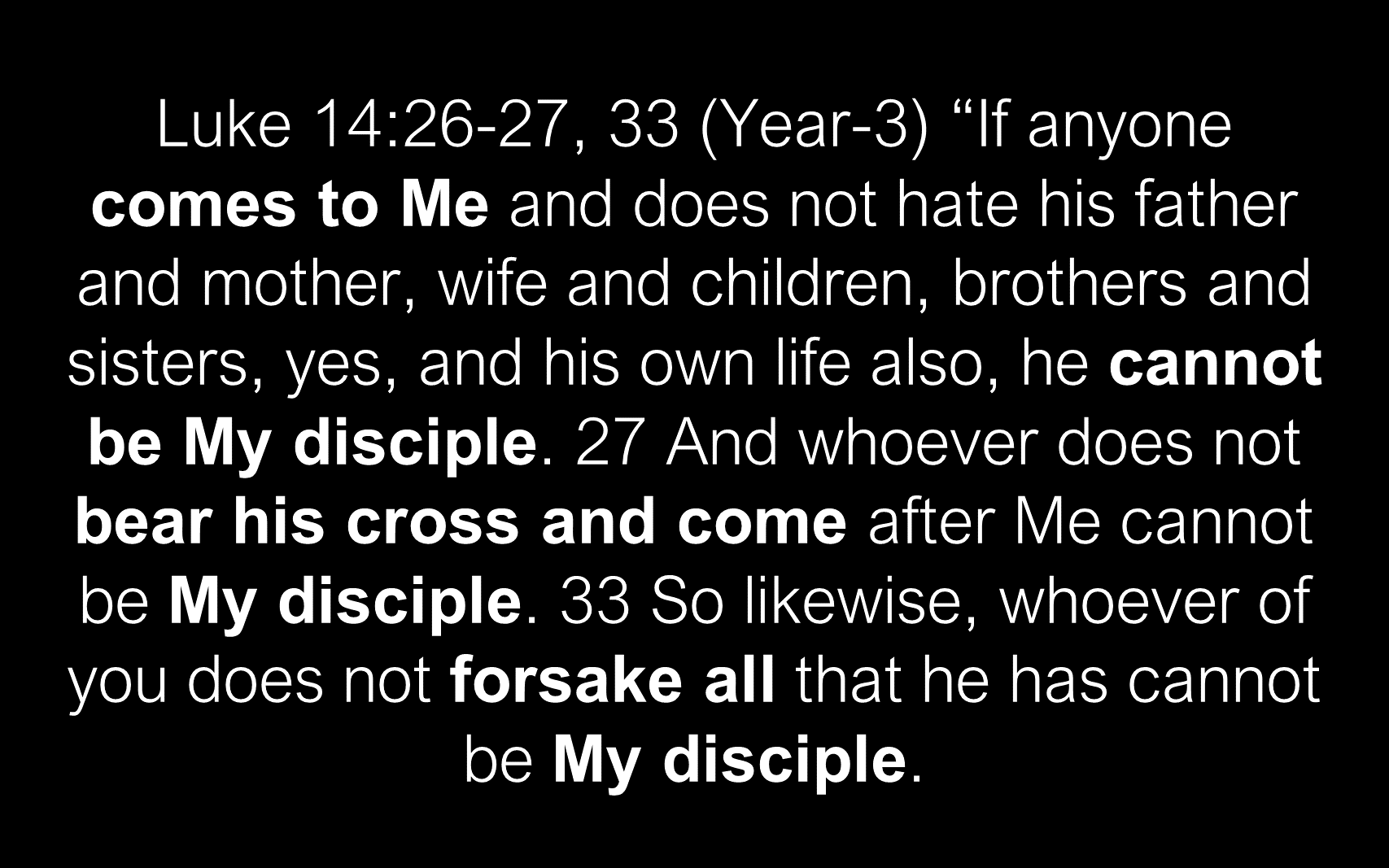
Now, go to Luke 14. What I’m showing you is that Jesus doesn’t lighten up. He heavies up. In fact, really what’s happening is we aren’t hearing everything He’s saying. I think he was heavy all the time. It’s just, it appears that this message seems to get more confrontive to the crowds. Now, in Luke 14, year three, this is just for Lazarus, by the way. I mean, we can almost see the cross from Luke 14 in the chronological harmony of the Gospels. Jesus says, if anyone comes to Me. So, if you want to be one, if you want to be a Saint, a Believer, a Follower of the Way a Christian, if you want to be a Witness, if you want to come to me, if you want salvation and you don’t love me more than your father and mother and children and wife and brothers and sisters, even your own life, that’s what hate is talking about. Comparing the love for Christ with the love for everything else, the love for everything else gets so low, and the love for Christ is so high, the gulf between them makes the love look like the other one is hate. Even though it is an affection and a love, but it is so less than the supremacy of love for Christ. That’s what He’s calling them to. He’s not calling them to beat them up, and starve them, and thrash them. He’s saying, you love Me supremely. If you want to come after Me, I’ve got to be most in your life. Or look at the end of verse 26. You can’t be My disciple. Do you see now why there’s this two-step program?
If you want to go out and have great results for your ministry, you can’t tell people what Jesus said because people don’t like it. They say it’s too hard. Who would want to do that? I want to live my life my own way, and I don’t want to be one of those. It’s dull, and there are so many things that God says are wrong. I don’t want that. Jesus says, if you’re not willing to do My will, you’re not My disciple. If you don’t love Me more than anything else, you can’t be My disciple. I’m glad He said it.
Look at verse 27, and whoever does not, there’s the cross thing, bear his cross and come after Me. What that means is the continuous life of self-sacrifice. You can’t be My disciple. Look at verse 33, likewise, whoever doesn’t forsake all that he has. See, that’s another thing. Disciples surrendered the ownership of their time, of their material treasures, everything they were given in life, their time, their talents, their treasures, everything was laid at Christ’s feet. You say, that’s impossible. Yes. Salvation is impossible.
Did you know that when the Disciples heard Jesus present the Gospel, they said, who can be saved? How is that possible? And Jesus said, with men, it’s impossible. But this is the supernatural work God does. If you get saved, Christ becomes the core of your life. He becomes to each of us who know Him more important and more beloved and supreme overall else. Now, we don’t always act like that. That’s what we struggle with throughout life, but it doesn’t change the operating system. See, they’re talking about the packaging. They’re not talking about the operating system. God establishes the operating system, and this is what it is. He says, if you don’t forsake all, if you don’t bear your cross, and if you don’t come to me with a supreme love, you cannot, cannot, cannot be My disciple.
Hence, we have the two-part system nowadays, which is producing a lot of people who are going to someday do what Matthew 7 says. They’re going to say, Lord, here I am! I was in. He says, nah, I didn’t ever know you depart from Me. Because of their two-part, imperfect, inaccurate understanding of what salvation was, it was a miracle only God could do.
Well, by the way, let’s go to John 6, because Jesus had quite a fallout because He did preach like this all the time. Look at John chapter 6 in verse 66. There’s a 6, 6, 6. People get excited about that. There’s a 6, 6, 6, okay. John 6:66. From that time, many of His disciples went back and walked with Him no more. Wow. Then Jesus said to the 12, do you also want to go away? Peter said, Lord, to whom shall we go? You have the words of eternal life, and there’s that great confession. This was the turning point of Christ’s ministry, by the way, in John 6:66. The crowds crescendoed until this moment, and then they diminished.
Why? Because Jesus laid it out. Jesus taught them, who are Disciples? Disciples are true Believers. Disciples are those who truly know and follow Jesus Christ. Jesus explains to them the Gospel of salvation. Jesus tells them that, in fact, keep going in John chapter 8 and look at verse 32. I’ll just show you a few more because we could spend all day on this.
Go back to 31, John 8:31, and Jesus said to those Jews who believed in Him, if you abide in My Word, then are you My Disciples. It doesn’t matter that you say you want to follow Me. It doesn’t matter that you tell people you follow Me. It’s only if you abide, if you continue. Theologically, we call this the perseverance of the Saints. True Believers never stop believing. They struggle. They doubt like the Apostles did at the Mount of Commissioning, but they abide and they’re kept, actually, the Scriptures tell us. If you abide in My words, you’re My Disciples indeed. You know the truth, verse 32, and the truth makes you free.
Keep going to chapter 13. He keeps laying it on. He says that a true Believer has supernatural love. That’s another evidence. He says it’s a love that humans can’t generate themselves. A new commandment, verse 34, I give to you that you love one another as I’ve loved you, love one another. Verse 35, by this, by the way, this is the 11th commandment. We hear people all worried about the 10 Commandments. There’s actually 11. Jesus said, I give you a new one. This is the 11th commandment. And He says, by this, we’ll all know that you are My Disciples if you have love for one another. It’s a divine, supernatural love.
Keep going to chapter 15. Look at verse 8. Jesus says something else that clarifies salvation. By this, My Father is glorified, John 15:8, that you bear much fruit, so you’ll be My Disciples. Disciples bear fruit. So, if you’re not bearing fruit, if you don’t have the fruit of repentance, if you don’t have the fruit of faith, if you don’t have the fruit of the new heart and operating system, you’re not My Disciple. He said, fruit is produced by the work of God within us. It’s divine. It isn’t something we conjure up. It isn’t something we, I’m going to make fruit. No, God, through His Spirit produces it, but only when we’re connected to Him.
Okay, so the question is, what about people who got saved after the Gospels? What are they called? So, let’s turn to the book of Acts real quickly. I told you we’d cover all the Gospels and Acts, and I just want to show you. The most common term for what we call Christians in the book of Acts is Disciples. Acts 1:15, in those days, Peter stood up in the midst of the Disciples and the number of the names was about 120. So, where was he standing? He was standing in the assembled, gathered group of Believers. Now, there were more than this. We know from 1 Corinthians 15 that there were 500 individual Believers Jesus had met with after the resurrection. Here’s a fourth of them in one place in Jerusalem.
Now keep going to chapter 6 because this group is going to mushroom in size. Acts chapter 6. In those days, the number of the Disciples was multiplying, so it started to go up. Look at verse 7 of chapter 6, and the Word of God spread, and the number of Disciples multiplied greatly. It’s just exponentially growing, but everyone who repents and in faith alone comes to Christ, is called a disciple. The instant that happens, not when they make some surrender move later in life. They are Disciples from birth, the new birth in Christ.
Now, look at chapter 9 because who does Paul take off, or Saul, take off after? In chapter 9, verse 1, Saul was still breathing threats and murders against the Disciples. Now, some who don’t like Believers to be called Disciples, would say, oh, that’s the 11 or including Matthias 12. No, that’s talking about all the Believers are Disciples because look at verse 10. There was a certain disciple at Damascus named Ananias. He’s not one of the 12, if you know your apostles. Okay? So, there you go. There is a person outside of Jerusalem who believes and is called a Disciple.
If you keep going, look at verse 19. When he, that’s Paul, had received food, he was strengthened, and Saul spent some days with the Disciples at Damascus. That doesn’t mean that the 12 went up to Damascus. That meant the Believers, the Christians, they’re called Disciples, and you can see the same thing in verse 26. He tried to join the Disciples in Jerusalem, and they were afraid of him. That wasn’t the 12, because we know that he met with them. They did instruct and listen to him. Look at verse 36, same chapter. There’s a certain disciple named Tabitha, and then in verse 38, the Disciples. So, who are Disciples? Disciples are people who believe in the Lord Jesus Christ.
Now, let me show you one more. As long as you’re in Acts chapter 14, then we’ll wind up because it’s almost time to go. Look at chapter 14, verse 21. Paul, starting in verse 19, is out in the pagan Roman empire. He’s between Lystra and Derbe. He escapes from Lystra to Derbe, and in verse 19, they stone him and drag him out. So, he gets out in verse 20 and goes to Derbe and starts preaching again in verse 21. Look at this, and when they had preached the Gospel to that city.
Now, look up and think about it. Here’s the great commission. Go into all the world and preach the Gospel. As you go and preach the Gospel, that’s the evangelism. What do you call people who are evangelized? Look at the next part of verse 21, and made many Disciples. Pagans, who believe in the Lord Jesus Christ and are saved, are called at that moment Disciples. God makes them Disciples. When we tell them what He commands, and we’re supposed to teach them once they become a Disciple, what God expects from a Disciple.
And real quickly, what did Jesus? This is where it gets all fuzzy. People say, oh, our discipleship method is this, our discipleship manual is that. Did you know that these people didn’t have the benefit of the internet to look up and the Christian bookstores, and everything else? What exactly do you think they went out to teach? What it says, everything Jesus taught them to teach.
So, this is where we’re going to pick up next week, but I’ll get you started. Go with me to Matthew chapter 5, because I want to actually 4:17. I want to show you what would’ve been lodged in the minds of the Disciples when Jesus told them to go and do what He had done with them; what came to their mind because that’s the primary interpretation of all Scripture. If you want to know what it means to make Disciples, it’s not to look up what’s the newest and greatest and latest and most whatever discipleship method. It’s what did it mean then to the first recipients of the Great Commission? What would’ve immediately come to their mind? And we know because of what they do. If you look at everything in the epistles, it all connects back so clearly to what Jesus taught.
Starting in chapter 4. What Jesus does, basic number one, is salvation. The Sermon on the Mount is all about salvation. It starts in chapter 4, verse 17, with repentance. But then, what Jesus says in verses 1-5 is what the repentant look like. And what do they look like, in Matthew 5:1-5? Verse 3, they’re poor in spirit. That means they’re beggars. They’re totally unable to save themselves, and they’re mourning, verse 4. They’re very aware of they are sinners, and they don’t like their sin. They hate their sin. They want to turn from their sin by God’s grace. Verse 5, they’re meek. That means they’re humbly willing to follow Christ. Jesus actually opens the Sermon on the Mount with a beautiful description of what a Believer is like.
And He continues, and He says, they begin to hunger and thirst for righteousness, verse 6. Don’t you hear echoes of that in Peter? As newborn babes desire the sincere milk of the Word. That’s what a truly born-again person is. They become hungry and thirsty for Christ’s righteousness, and He fills them and they’re merciful. All of a sudden, their whole paradigm for life changes, and they’re pure in heart. They want to deny ungodliness, and the Spirit of God begins working and sanctifying them, and they become peacemakers. That’s a description of a Believer. The supernatural work of salvation.
You know what? Jesus was quite a good teacher. He begins the sermon and ends the sermon by describing who’s really a Disciple. Look at chapter 7, starting in verse 13. What Jesus says is, if you want to know if you’re a real Disciple, make sure you’ve entered the right gate. Straight is the gate. Difficult is the way. Make sure you’re on the right road. Don’t be on the broad road, the easy road. Make sure you’ve come to obey the right Lord. By the time we get to verse 21, not everyone who says to Me Lord, Lord, enters the kingdom of Heaven. Many will say to Me, 22, Lord, we were really involved. In verse 23, He declares to them I didn’t know you.
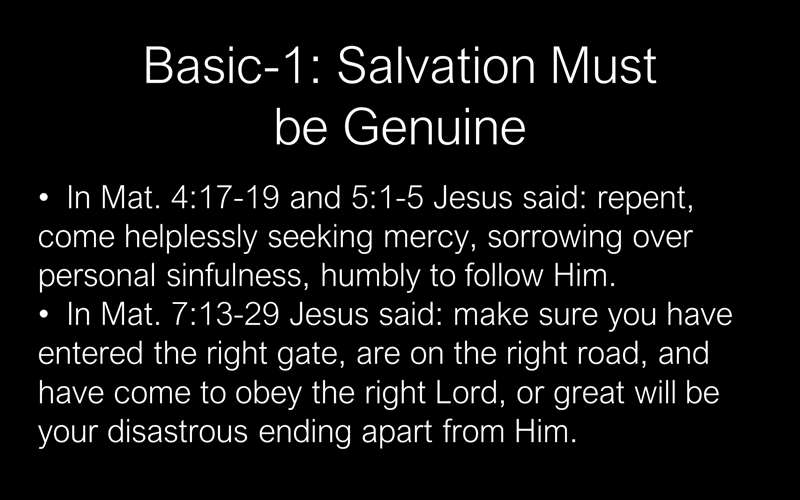
What’s so important about knowing Him? Because those who know Him, verse 23 says, depart from lawlessness. But if you practice lawlessness, if you’ve never had a new operating system, if you have not had a new heart and a new spirit put within you, if you have never had the Holy Spirit of God move inside so that from the very center, like a nuclear reactor radiating out of the core of our being. If there is no presence and power of God, then Jesus said, I didn’t know you. You’re not real. So, He opens chapter 5 and closes in chapter 7, with salvation must be genuine. And what are most of the epistles about? Genuine salvation.
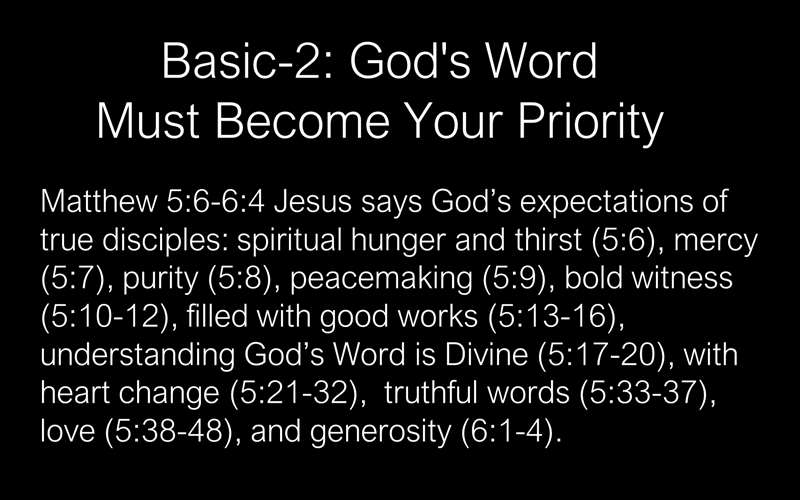
Then Jesus goes on to say, God’s Word becomes your priority. He starts saying, this is what God expects from you. You don’t read the Bible to get it over with. You read the Bible to find out what God expects, and that internal operating system responds to the Word of God. That’s how we know and do His will through His Word. That’s the second lesson. Jesus spends a lot of the Sermon on the Mount on that.
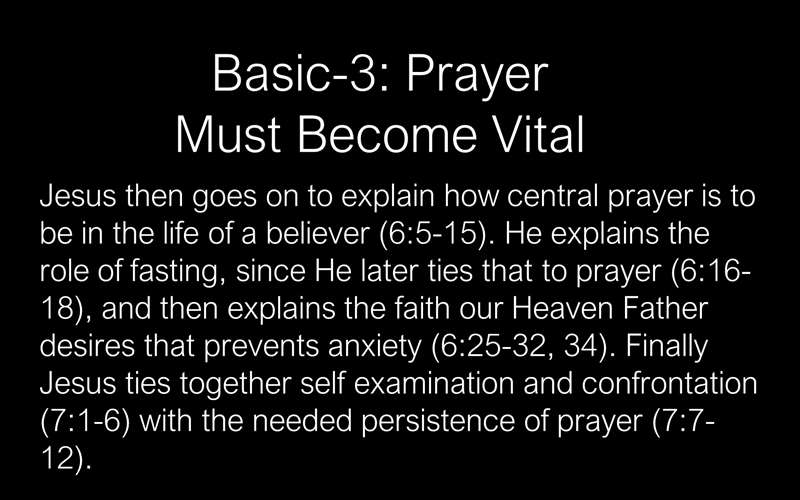
Then prayer is right in the middle of chapter 6, and it’s huge. Prayer becomes vital, and Christ explains that prayer is central to our lives. He even talks about self-examination as a part. The Lord won’t even hear us, and we need to persist in prayer.
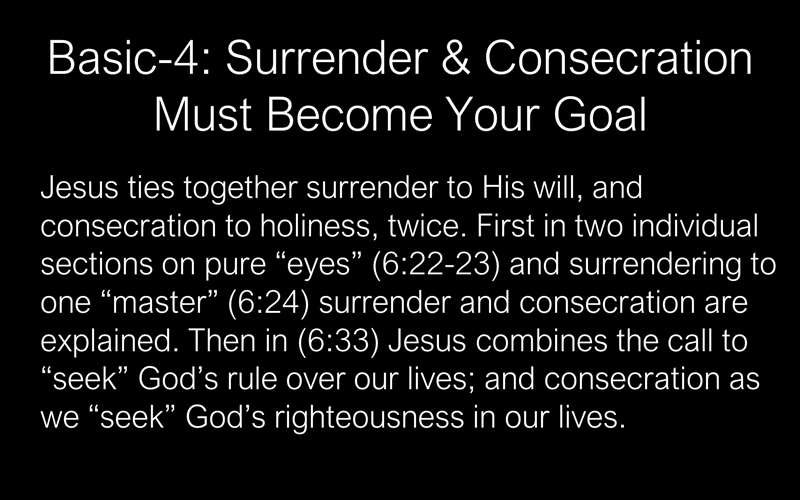
Then fourthly, Jesus rounds out discipleship in the Sermon on the Mount, talking about seeking first the kingdom of God. You have to have eyes that are pure and seeking His righteousness, and you have to have Him as your master. That’s the idea of consecration and surrender, and it becomes our goal. Then the Gospel by John gives that last huge lesson.
Now, Matthew, Mark, and Luke have, but not like John does, and he records how much Jesus says about the Holy Spirit. You need to stay filled and in step with the Holy Spirit, and the Spirit is to energize us and overflow our lives and reveal Christ.
Now, next week, Lord willing, when we pick up, we’re going to look at how those simple basics; genuine salvation, the role of the Word of God, the role of prayer, the role of surrender and consecration, and the role of the Holy Spirit become the core of everything that Paul, and Peter, and John, and James, and Jude write about in their epistles. So, basically, the discipline of disciple making is to say, Disciples are those who follow Christ. Once you follow Christ, you have this internal longing to know how to follow Him in such a way that He taught us. That’s teaching them to observe everything that He commanded. So, Paul reduced it down to this: these things Christ commanded, command. And those things that Christ has taught are elements in the life of a Believer, teach them how to do that. That’s our job description if we’re truly a Disciple of Christ.
Let’s bow for a word of prayer this morning. I thank You, dear Lord, for clarifying what You want from us, for simplifying it, for actually doing it. You discipled Your Disciples. So, we don’t have to invent anything. We just have to teach everyone to observe the things You commanded. Lord, how wonderful it is to know why we’re here and what we’re supposed to be doing. I pray that all of us would rejoice that at the very center of our being is You, oh God. You live within. You want to flow out through our life, and You flow everywhere that’s surrendered to You. So, I pray there’d be much surrender to seek first Your rule in our lives and Your righteousness, and then everything else gets added in after those things are settled. Thank You for Your Word. I pray that You would draw to Yourself anyone who this morning doesn’t know You or isn’t walking the way You want them to walk. May they either where they’re sitting right now, surrender to You, cry out to You, ask You to begin that good work, or to continue and to renew what You have started in each of us. Lord, if they need someone to talk to, how I pray that at the end of the service, either one of the Elders or one of our Titus 2 Godly women, that they will open their needs and be led in prayer with one of these Godly servants, because we want to be Your Disciples for Your glory. In the name of Jesus, we pray, and all God’s people said Amen. God bless you as you go.
Notes
Today, if asked, most of us would describe ourselves as “Christians”, some maybe as “Born-again”, others that we are “Saved”. Those are all good, valid, and proper terms; but, what is amazing is how far we have moved from what the New Testament called those who were saints and headed to Heaven.
If you just read and note the descriptions as you proceed through the books of the New Testament, you would assemble a list of the:
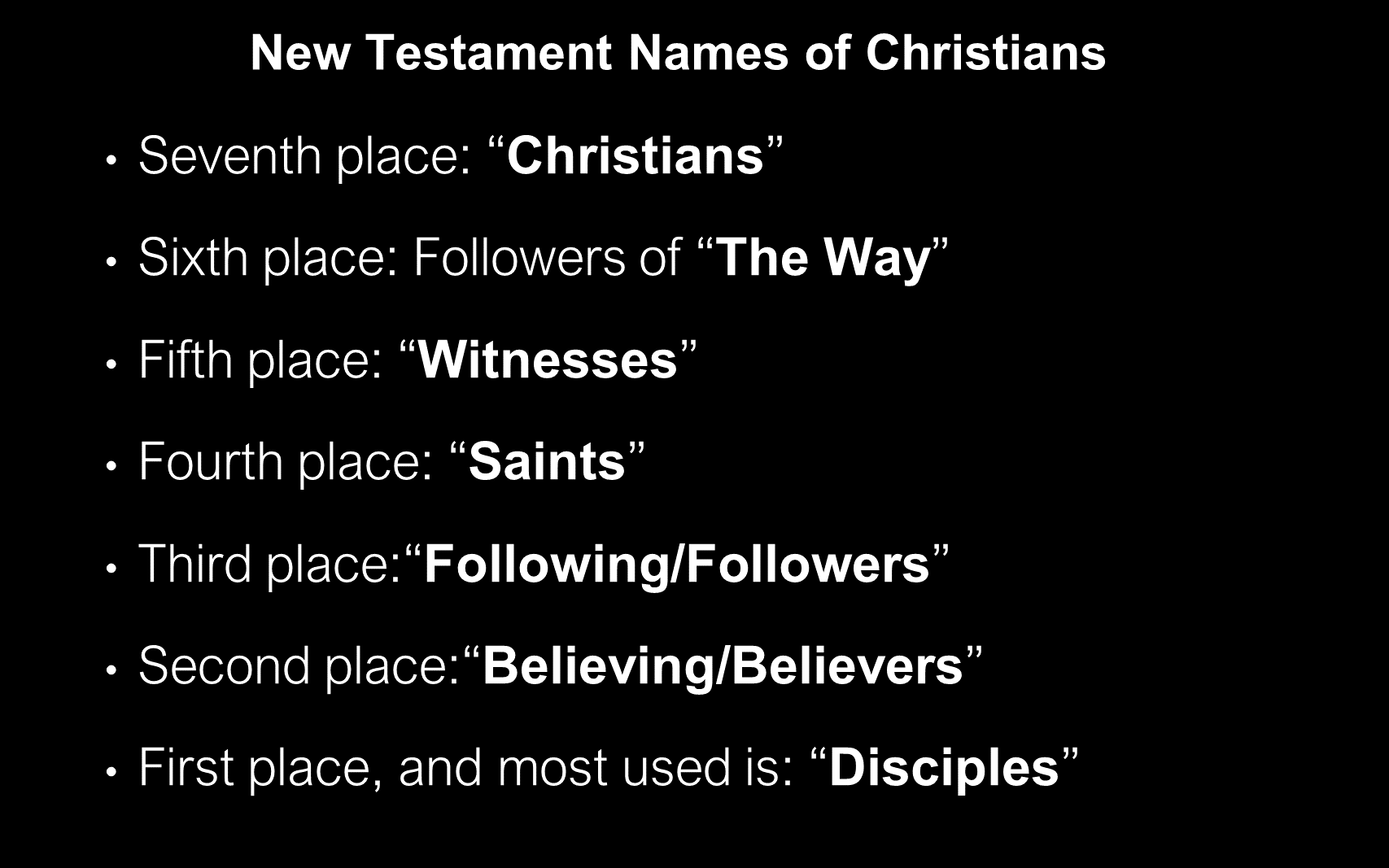
New Testament Names of Christians
Those who are part of God’s family are called by an amazing galaxy of terms in the New Testament. Most of us have heard of the top seven, but all together there are almost 100 different ways that born-again believers are named in the New Testament.
Beyond the top seven there are many different combinations of words used one, two, three times like aliens and strangers” (1 Peter 1:1, 17; 2:11); “kingdom of priests” (Rev. 1:5-6; 5:10); and “chosen people” (1 Pet. 2:9).
Here is a brief summary that may surprise you. Let me give you the top seven in reverse order:
Seventh place: “Christians” = 3x (Acts 11:26; 26:28; 1 Pet. 4:16);
Sixth place: Followers of “The Way” = 5x (Acts 9:1-2; 19:9, 23; 22:4; 23:14; 24:22);
Fifth place: “Witnesses” = c. 27x (Luke 1:2; 24:48; Acts 1:8, 22; 2:32; 3:15; 5:32; 10:39, 41; 13:31; 26:16; 1 Pet. 5:1; 2 Pet. 1:16-18);
Fourth place: “Saints” = 62x;
Third place: Those Jesus asked and they were “Following/Followers” = c.100x;
Second place: Those who were “Believing/believers” = 266x;
First place, and most used is: “Disciples” = 274x (John 13:35 ; Acts 6:1-2 ; 11:26 ; 14:21-22 ; 18:27).
That’s why we refer so often to the truth that:
Jesus Christ Commissioned His Church to Make Disciples
Jesus Himself sums all of those various ways of naming and describing us into one overarching term: “disciples”. That is why it is the most frequent term for us in the New Testament, and the clearest target for all of our lives to be focused upon in “making disciples”.
All the promises of the Old Testament may be seen as finding their fulfillment in and through the Crucified and Risen Lord Jesus Christ, who stood on a mountaintop in Galilee and commissioned His Apostles.
All of the teachings of our Lord Jesus Christ in the four Gospels may be seen as distilled and crystallized in those powerful words of Matthew 28:18-20.
All of the truths of God taught through the New Testament Scriptures from Acts to Revelation may be seen as an outflow of that amazing declaration by God the Son that we know as the Great Commission.
The clarity and scope of those words demand our attention. Please join me listening again to Him challenging them and now us with these wonderful words:
Matthew 28:16-20 (NKJV) Then the eleven disciples went away into Galilee, to the mountain which Jesus had appointed for them. 17 When they saw Him, they worshiped Him; but some doubted. 18 And Jesus came and spoke to them, saying, “All authority has been given to Me in heaven and on earth. 19 Go therefore and make disciples of all the nations, baptizing them in the name of the Father and of the Son and of the Holy Spirit, 20 teaching them to observe all things that I have commanded you; and lo, I am with you always, even to the end of the age.” Amen.
For us on this side of the Cross, what Christ said is so simple: Disciples Follow Christ & Make Disciples. That’s it. Everything else is tied to that simple statement: worshipping God, Biblical ministry, and glorifying God all flow from God’s purpose to show the world that He is a Savior, Who so loved the world that He sent His Beloved Son to be the Savior of the world.
Welcome to a study of the central theme of our earthly lives. We glorify, please, and serve God to the degree that we are a part of what He has so clearly asked us to do and to be for Him. That takes us back to how we got here, in 1 Timothy 4, Paul is training Timothy in how to keep the church on target through the centuries. Paul gives Timothy a set of exercises that if done in the power of the Spirit, would keep Timothy and his church members he served, spiritually healthy. We have been looking at these as:
Biblical Exercises for Spiritual Health & Fitness in 2014
- The Discipline of Truth (our source is in God’s Word of Truth v. 1-6a) leads us to >
- The Discipline of Devotion (we love of God’s Word that feeds us v. 6b) leads us to >
- The Discipline of Time (we invest our lives in the eternal not the worthless v. 7a) leads us to >
- The Discipline of Integrity (we actually personally pursue godliness v. 7b-10) leads to >
- The Discipline of Disciple-Making (we explain to others what knowing & following Jesus is all about) v. 11. Note how short, sweet, and to the point Paul gets, here in 1 Tim. 4:11:
1 Timothy 4:11 (NKJV) These things command and teach.
Our purpose as believers, disciples who follow Christ, is to continue reaffirming Christ’s commands (that is the “command” part of v. 11), and following up with explaining how to do what He said (that is the “teach” part of v. 11).
What are the “commands” that Christ taught, and how are we to continue in His steps, making disciples and teaching them what He wants us to teach them? To understand the elements of the “making disciples” command, we will first look at what Jesus did, and then what His Apostles taught from what they learned.
What Jesus Christ Taught & His Apostles Heard
First, we need to trace how Christ actually described “Who is a disciple?” That is making disciples. Since Jesus Christ actually did what He left us to do, this study is the heart of what we need to know.
Second, when those closest to Christ obeyed the command to “make disciples”, how did they explain: “What does a disciple do”? That is teaching them to observe all things. How did they do so themselves, and what did they write down for us to see as the process that we are to follow. Throughout all the centuries since the Great Commission, we have had the record of what Christ did in the Four Gospels; and we have in Acts & the Epistles, the Divinely inspired explanation by those closest to Him, and sent by Him: actually doing and recording what they did in obedience to His call.
Who are Disciples: Disciples Follow Christ
Trace with me Christ’s explaining what following Him as a disciple really means, starting in Matthew 4:19. The next three passages we will look at are each almost exactly a year apart if you use the standard harmony of the Gospels that has Christ’s three and a half year ministry starting near the end of AD 26, and the Cross being early in AD 30.
Watch how over three years of recorded ministry, Christ’s call to His disciples is also used for others who want to follow Him. Jesus begins to use His distinct call of those He wanted as disciples by asking them to “Follow”. Christ goes on to repeat this call 22x in the Gospels[1]. Read along with me starting there in Matthew and heading towards the Gospel by John.
Note the instructive nature that Matthew’s record of Christ’s first spoken words in ministry about were a call to “repent”; and His second recorded words were the call to “follow”.
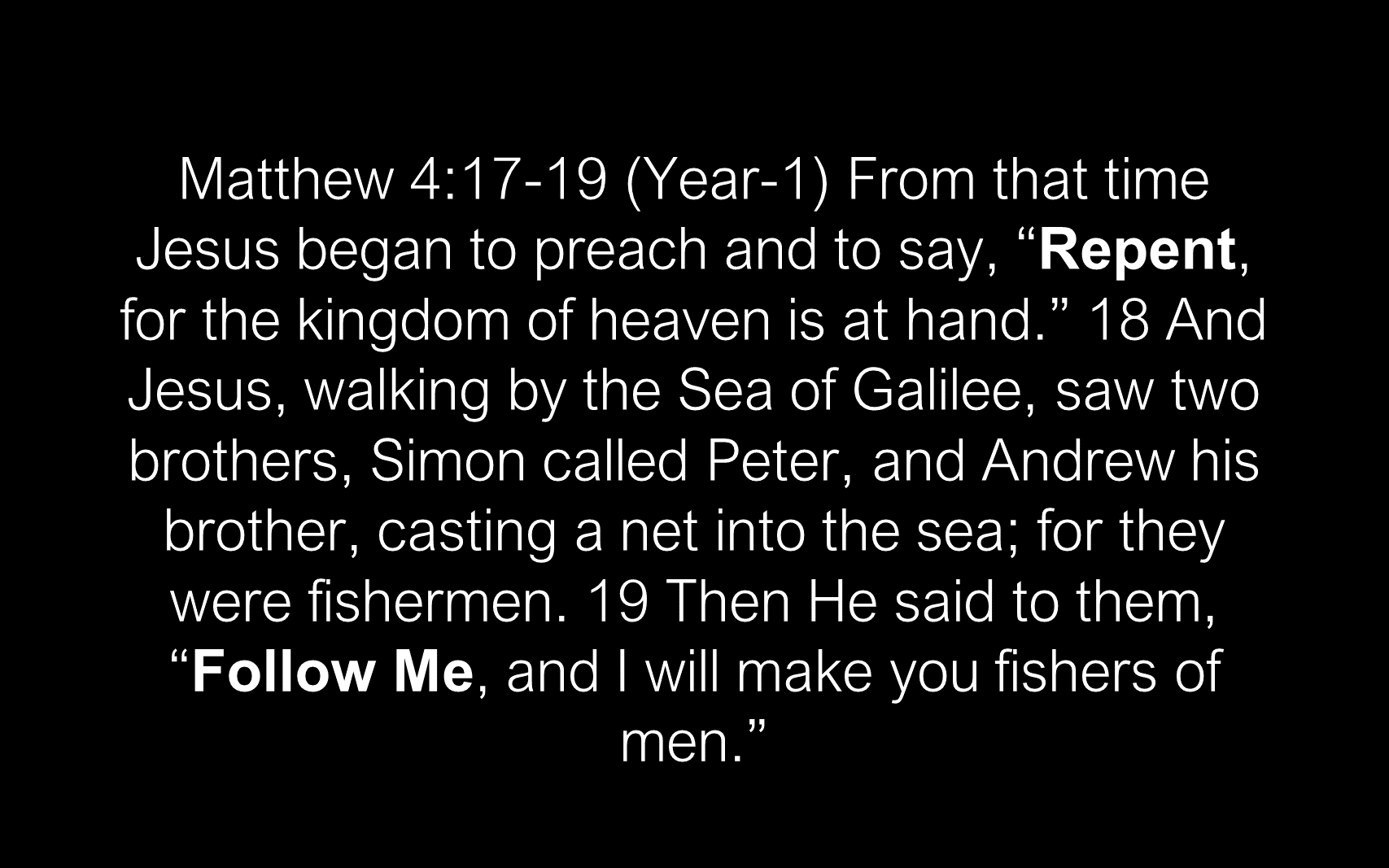
Matthew 4:17-19 (NKJV) From that time Jesus began to preach and to say, “Repent, for the kingdom of heaven is at hand.” 18 And Jesus, walking by the Sea of Galilee, saw two brothers, Simon called Peter, and Andrew his brother, casting a net into the sea; for they were fishermen. 19 Then He said to them, “Follow Me, and I will make you fishers of men.”
Now move onward in the sequence of Christ’s ministry, one year later to halfway through AD 29, as we turn to Mark 8:34, and see the continued explanation by Christ of discipleship.
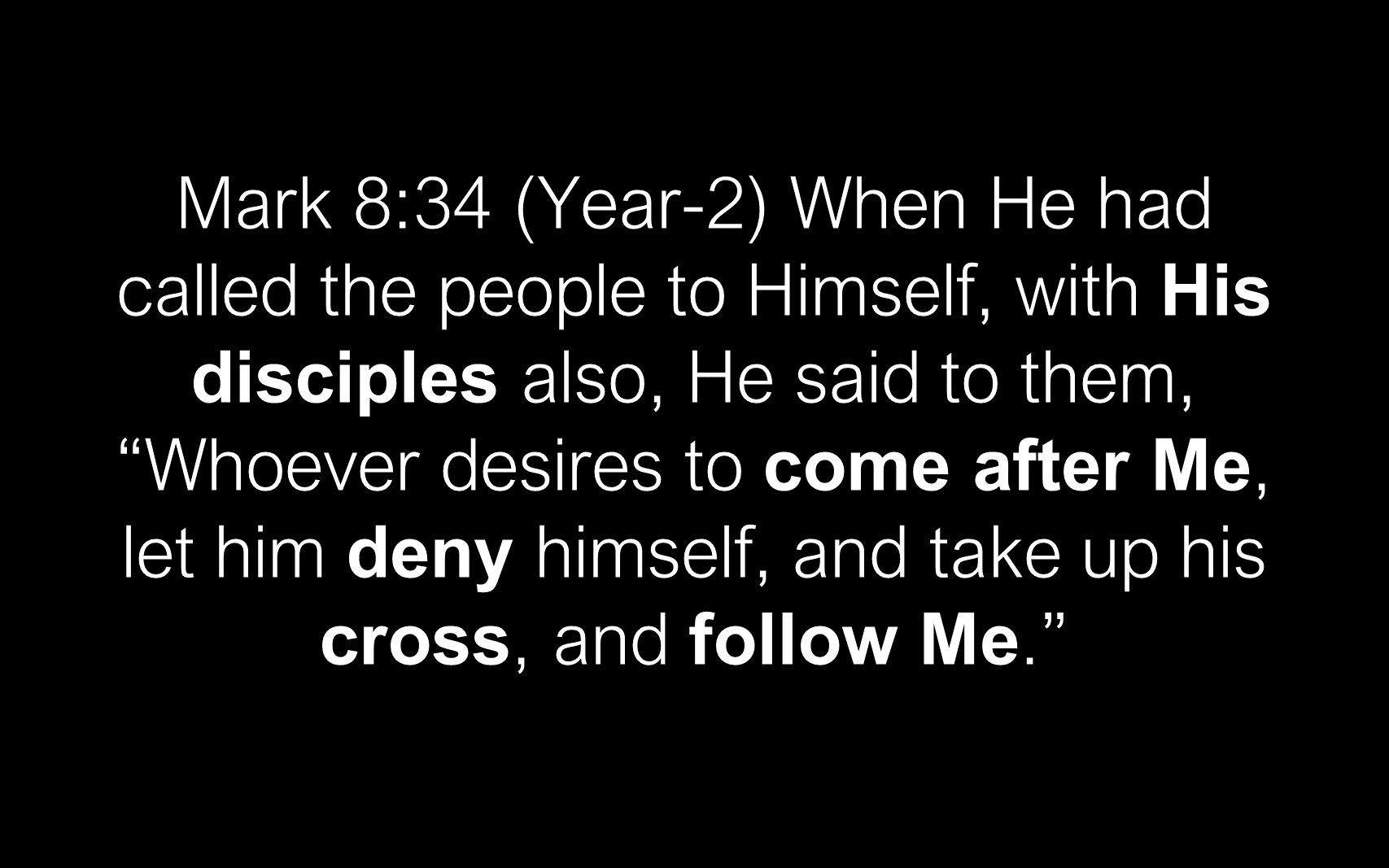
Mark 8:34 (NKJV) When He had called the people to Himself, with His disciples also, He said to them, “Whoever desires to come after Me, let him deny himself, and take up his cross, and follow Me.”
Then in Luke 14:26-33, we are in the events just prior to the raising of Lazarus, we are into AD 30, just before Christ’s final week. So we are near the end of Christ’s public teachings, and we see another enlargement of the call to following Christ that the disciples heard Jesus present in ministry.
Luke 14:26-27, 33 (NKJV) “If anyone comes to Me and does not hate his father and mother, wife and children, brothers and sisters, yes, and his own life also, he cannot be My disciple. 27 And whoever does not bear his cross and come after Me cannot be My disciple. 33 So likewise, whoever of you does not forsake all that he has cannot be My disciple.
Now turn to the Gospel by John where we find the most complete treatment of the word disciple, since John uses that word “disciple” (81x) as well as “follow” (7x) more times than any other Gospel.[2] First in John 1 we see that disciples believe on Christ and follow Him.
John 1:37 (NKJV) The two disciples heard him speak, and they followed Jesus.
John 2:11 (NKJV) This beginning of signs Jesus did in Cana of Galilee, and manifested His glory; and His disciples believed in Him.
John 6:66 (NKJV) From that time many of His disciples went back and walked with Him no more.
John 8:31 (NKJV) Then Jesus said to those Jews who believed Him, “If you abide in My word, you are My disciples indeed. 32 And you shall know the truth, and the truth shall make you free.”
John 13:35 (NKJV) By this all will know that you are My disciples, if you have love for one another.”
John 15:8 (NKJV) By this My Father is glorified, that you bear much fruit; so you will be My disciples.
Who are Disciples: Disciples Are True Believers
Now to make the big connection, look at the Book of Acts and note that when those who followed Christ in His ministry are merged with those who after the Cross get saved, who respond to the Gospel, and who enter the Church: what are they called? They are called disciples! Look at the first nine chapters of Acts:
Acts 1:15 (NKJV) And in those days Peter stood up in the midst of the disciples (altogether the number of names was about a hundred and twenty), and said,
Acts 6:1-7 (NKJV) Now in those days, when the number of the disciples was multiplying, there arose a complaint against the Hebrews by the Hellenists, because their widows were neglected in the daily distribution. 7 Then the word of God spread, and the number of the disciples multiplied greatly in Jerusalem, and a great many of the priests were obedient to the faith.
Acts 9:1,10,19,25-26,36, 38 (NKJV) Then Saul, still breathing threats and murder against the disciples of the Lord, went to the high priest 10 Now there was a certain disciple at Damascus named Ananias; and to him the Lord said in a vision, “Ananias.” And he said, “Here I am, Lord.”19 So when he had received food, he was strengthened. Then Saul spent some days with the disciples at Damascus. 25 Then the disciples took him by night and let him down through the wall in a large basket. 26 And when Saul had come to Jerusalem, he tried to join the disciples; but they were all afraid of him, and did not believe that he was a disciple. 36 At Joppa there was a certain disciple named Tabitha, which is translated Dorcas. This woman was full of good works and charitable deeds, which she did. 37 But it happened in those days that she became sick and died. When they had washed her, they laid her in an upper room. 38 And since Lydda was near Joppa, and the disciples had heard that Peter was there, they sent two men to him, imploring him not to delay in coming to them.
Who are Disciples: People Who Get Saved Are Disciples
Now notice a summary of what Paul did as an Apostle sent out by Christ into ministry in Acts 14:
Acts 14:21 (NKJV) And when they had preached the gospel to that city and made many disciples, they returned to Lystra, Iconium, and Antioch,
Finally, we see the very last time the word “disciple is used in Acts 21:16. From then on believers are called by many other terms, but God’s Word has identified them as disciples who follow Jesus Christ in obedience to His Word.
Acts 21:16 (NKJV) Also some of the disciples from Caesarea went with us and brought with them a certain Mnason of Cyprus, an early disciple, with whom we were to lodge.
Now, remember where we started?
Teach Disciples What Christ Taught
We have just traced what Christ actually taught about what it meant to be a disciple. Next, we need to know: what did Jesus teach disciples they need to do, to be properly observing all that He commanded them?
One of the best places to sart is to just analyze Christ’s longest sermon. We call this three chapter long sermon the Sermon of the Mount; and it is in Matthew 5-7. From this passage we can actually see the teachings of Christ on the basics for all believers, all followers, and all disciples. Join me back in Matthew 5-7 as we see those “basics” that all believers need to be taught.
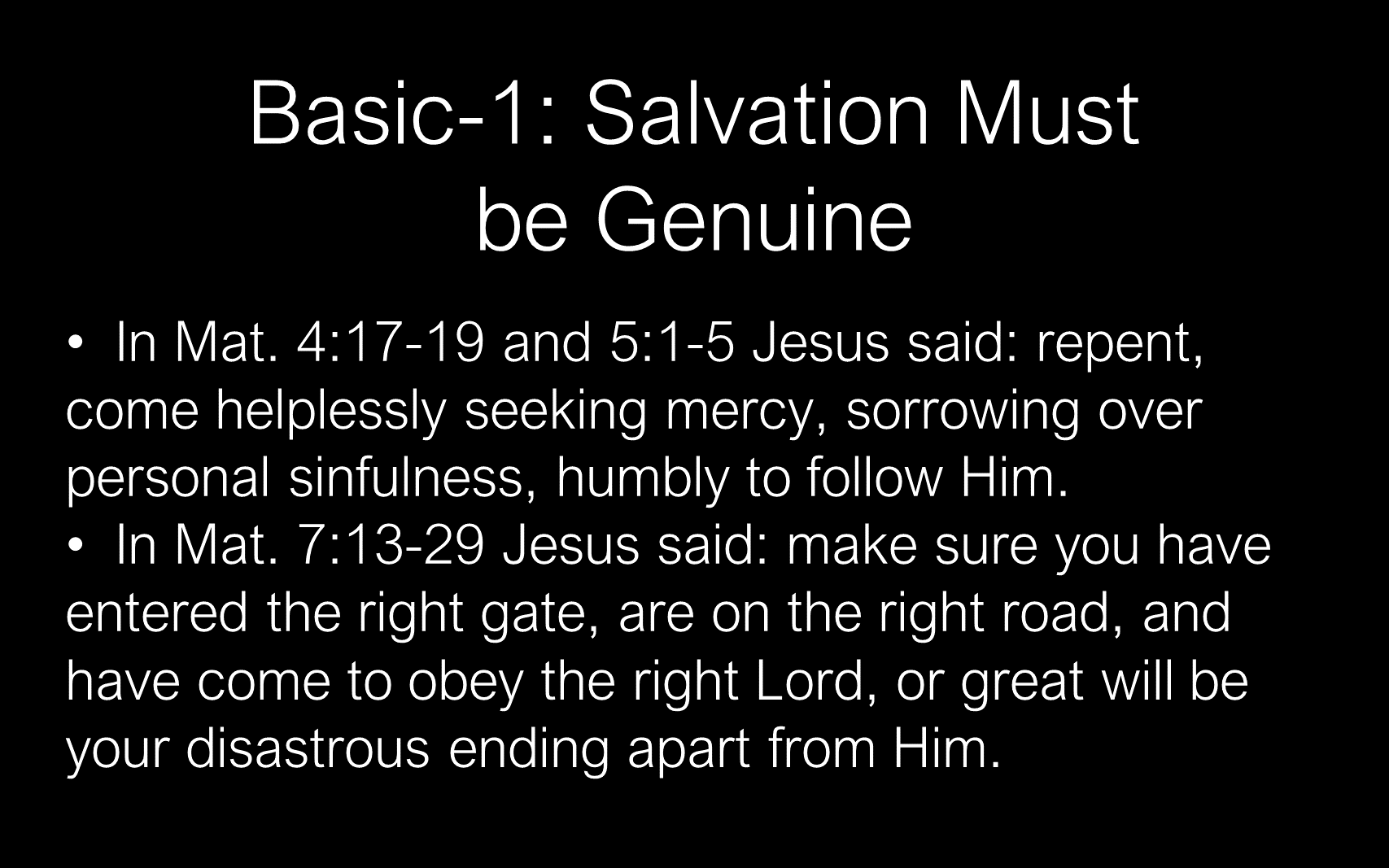
Basic-1: Salvation must be genuine
Basic-1 is Salvation: First Jesus explains what it means to be saved. He used His very first words in public ministry (Mt. 4:17-19) to say “repent”, but here in Matthew 5:1-4 He begins to enlarge upon salvation and talks about the elements of coming to God as an absolutely helpless beggar (“poor in spirit”) with contrition or sorrow for sin (“mourn”).
Then Christ ends the sermon with those stern warnings that a decision is not enough, saying all the right things without a life-transformation is deadly. That is Mat. 7:13-29.
So Jesus opens and closes this message for “disciples” in Matthew 5-7 with the Plan of Salvation. So the first element disciples need to know, understand, and be taught is what it really means to be saved:
- In Mat. 4:17-19 and 5:1-5 Jesus said: repent, come helplessly seeking mercy, sorrowing over personal sinfulness, humbly to follow Him.
- In Mat. 7:13-29 Jesus said: make sure you have entered the right gate, are on the right road, and have come to obey the right Lord, or great will be your disastrous ending apart from Him.
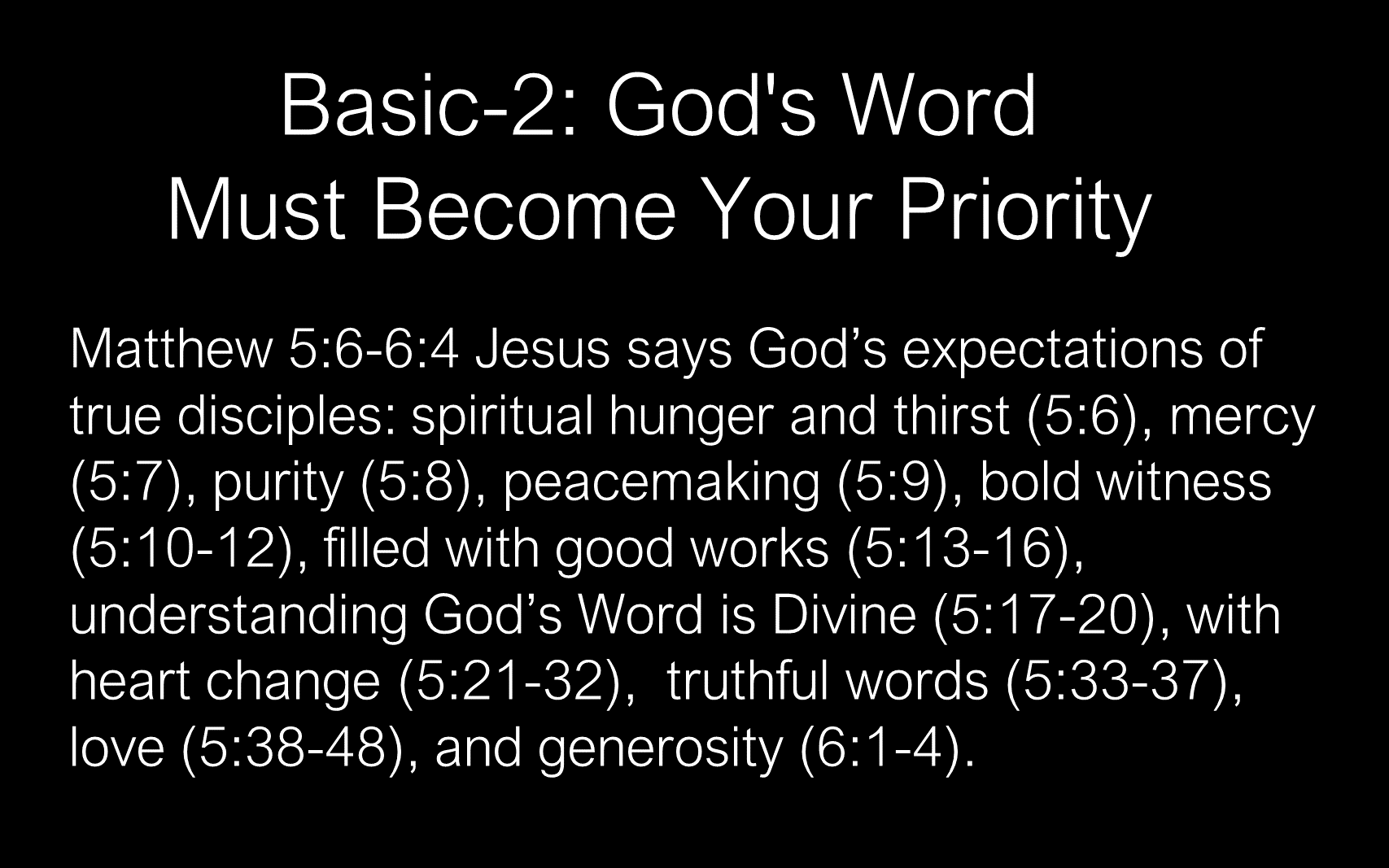
Basic-2: God’s Word Must Become Your Priority
Basic-2 is God’s Word: Next, in the Sermon on the Mount Jesus explains to His disciples the vital place that the Word of God has in the life of a disciple for: nurture of our spiritual lives, protection of our spiritual lives, and directions for lives of pleasing God.
In chapter 4 Jesus stated that we need to “live” by feeding upon every part of God’s Word. Then Jesus showed the way we are to use God’s Word as our weapon in spiritual warfare.
Starting in Matthew 5:6 and extending all the way to Matthew 6:4 were elements of what God expects to see growing in the lives of true disciples: spiritual hunger and thirst (5:6), mercy (5:7), purity (5:8), peacemakers (5:9), bold witnesses (5:10-12), filled with good works (5:13-16), understanding God’s Word is Divine (5:17-20), with heart change (5:21-32), truthful words (5:33-37), love (5:38-48), and generosity (6:1-4).
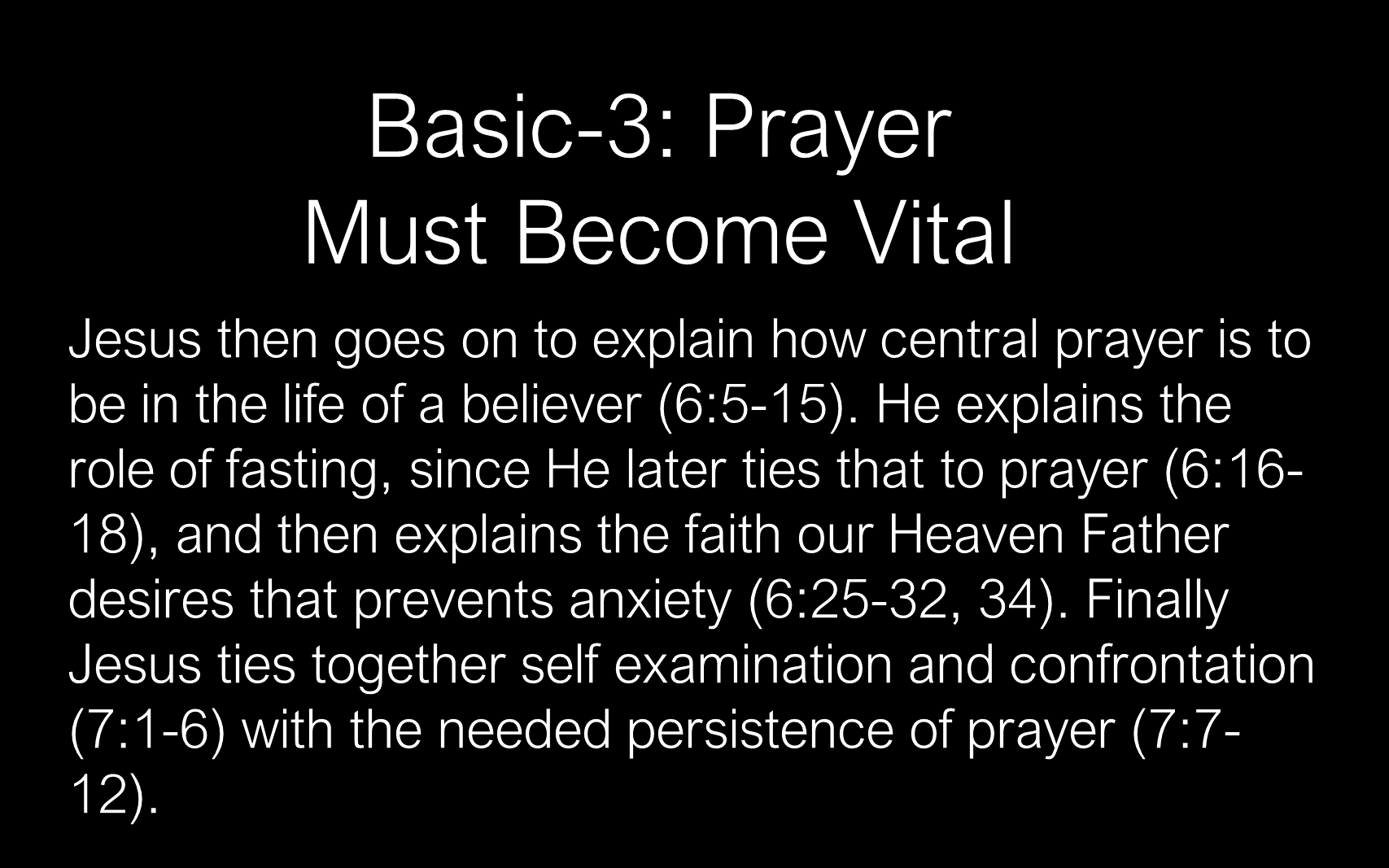
Basic-3: Prayer Must Become Vital
Basic-3 is Prayer: Jesus then goes on to explain how central prayer is to be in the life of a believer (6:5-15). He explains the role of fasting, since He later ties that to prayer (6:16-18), and then explains the faith our Heaven Father desires that prevents anxiety (6:25-32, 34). Finally Jesus ties together self examination and confrontation (7:1-6) with the needed persistence of prayer (7:7-12).
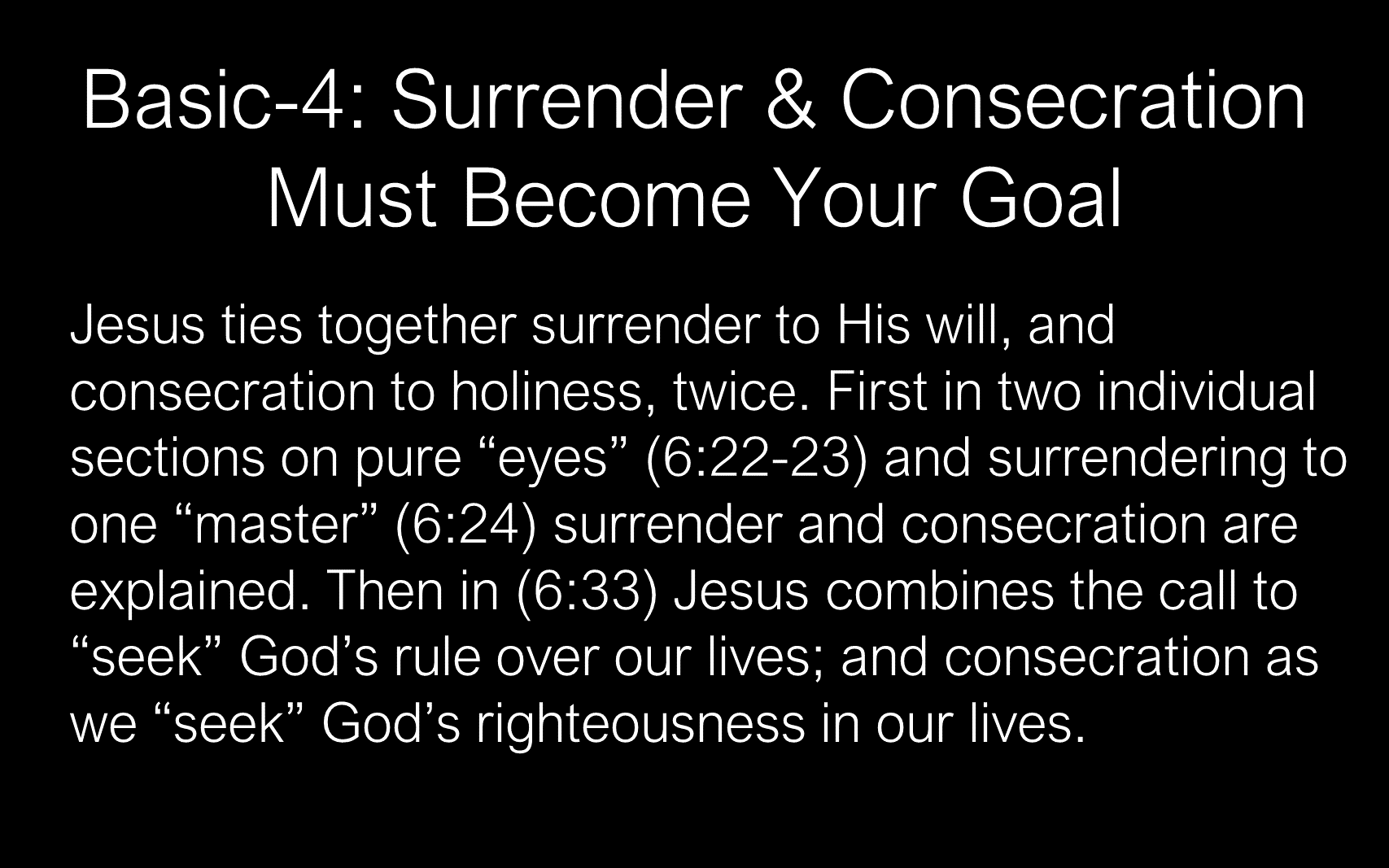
Basic-4: Surrender & Consecration Must Become Your Goal
Basic-4 is Surrender & Consecration: Jesus ties together surrender to His will, and consecration to holiness twice. First in two individual sections on pure “eyes” (6:22-23) and surrendering to one “master” (6:24) the twin concepts of surrender and consecration are explained. Then in one verse (6:33) Jesus combines surrender into the call to “seek” God’s rule over our lives; and consecration as we “seek” God’s righteousness in our lives.
Basic-5: Stay Filled & In Step With The Holy Spirit
Basic-5 is the Work of the Spirit: Jesus taught that: the Spirit of God is to energize us to a lifestyle of worship (Jn. 4:21-24); the Spirit of God gives us an overflowing life of joy (John 7:37-38); the Spirit of God reveals Christ more and more to us (John 16:13-15).
So, in just a simple look, we can see these “basics” that Jesus Christ taught to those who were His disciples. They are still the framework for us today. They also are seen enlarged and explained, all the way through the Epistles as those closest to Christ understand the command to “make disciples” meant.
The Discipline of Disciple-Making:
“Disciples: Follow Christ & Make Disciples”
For us on this side of the Cross, what Christ said is so simple: Disciples Follow Christ & Make Disciples. That’s it. Everything else is tied to that simple statement: worshipping God, Biblical ministry, and glorifying God all flow from God’s purpose to show the world that He is a Savior, Who so loved the world that He sent His Beloved Son to be the Savior of the world.
How did they “make disciples”? What is the process that we are to follow, that they followed? That is what we find in the rest of the New Testament.
Throughout all the centuries since the Great Commission, we have had the Scripture record of what Christ did in the Four Gospels; and we have had the explanation by those closest to Him, and sent by Him, actually doing and recording what they did in obedience to His call.
Disciple-Making In The Epistles
Here is a quick summary of what Jesus told the Apostles to do, and how they obeyed.
- In Matthew 28:18-20 Christ explains that “making disciples” means: those who follow of Christ. Or, a truly saved church.
- In Acts 1:8 Luke explains that “making disciples” means: those who share the Gospel. Or, a truly evangelistic church.
- In Acts 6:4 the Apostles explain that “making disciples” means: those who are stuck to prayer. Or, a truly praying church.
- In Romans 12:1-2 Paul explains that “making disciples” means: those who surrender to God. Or, a truly consecrated church.
- In 1 Cor. 10:31 Paul explains that “making disciples” means: those who want to feel the weight (glory) of God on everything they do. Or, a truly glorifying God church.
- In 2 Timothy 2:2 Paul explains that “making disciples” means: those who explain how to follow Christ to others. Or, a truly discipling church.
- In 1 Peter 2:2 Peter explains that “making disciples” means: those who are actually using God’s Word. Or, a truly healthy church.
So, the simple lessons we see that Christ gave, and we are to pass on are lessons about: salvation, witnessing, praying, surrendering to God, glorifying God, training others, and staying healthy through the Word of God.
I actually teach these as seven simple sessions with any believer wanting to get started in the right direction.
Discipleship Lessons In The Basics
- Salvation, Assurance, Confession & Soul winning: Mark the Romans Road starting in Romans 3:10; and discuss 1 John 1:9; John 10.
- Devotional Bible Study Methods: Summary, Lessons & Application from Mt. 4:4; Jer. 15:16.
- Daily Spirit-Filled Living: Galatians 5: 16-23; Ephesians 4:22-5:18; Colossians 3:1-17; Romans 8
- Sacrifice, Surrender & Consecration: Galatians 2:20; Romans 12:1-2; Mt. 6:33; Rom 12:1-2; Gal 6:7-8.
- Lifelong disciplines of Scripture Memory & Meditation for Spiritual Warfare: Joshua 1:8-9; Eph. 6:10-17; 1 Peter 5:6-9.
- Stewardship of Time, Treasures & Talents in Christ’s Church: 28:18-20; 1 Cor. 3:13-15; 2 Cor. 5:10.
- Lifelong Disciplines of Prayer & Following God’s Will: 3:5-6; 1 Th. 5:17
[1] Matthew (six times) 4:19; 8:22; 9:9; 16:24; 19:21, 28; Mark (four times) 1:17; 2:14; 8:34; 10:21; Luke (five times) 5:27; 9:23, 59; 18:22; John (seven times) 1 :43; 8:12; 10:27; 12:26; 13:36; 21:19, 22.
[2] “Disciple” is used 74x Matthew; 46x in Mark; 38x in Luke; 81x in John; and 30x in Acts. “Follow Me” is used 6x in Matthew; 4x in Mark; 5x in Luke; and 7x in John.