
LHC-46 TAB-04
991205PM
Seven Keys to the Heart of God
Pathway to the Most High – From the Tabernacle to God’s Throne
This is a journey into the presence of God. We enter God’s presence by way of His Tabernacle, God’s tent of Meeting. As we examine this incredible structure, we will see how every point of God’s Tabernacle points to Jesus.
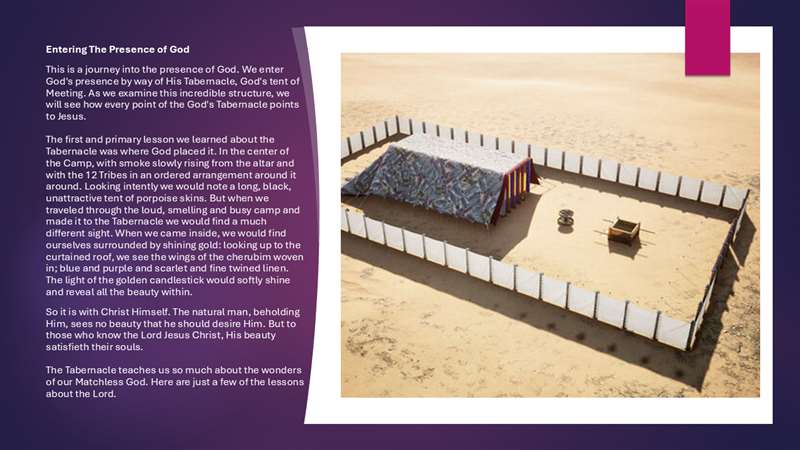
The first and primary lesson we learned about the Tabernacle was where God placed it. In the center of the Camp, with smoke slowly rising from the altar, and with the 12 Tribes in an ordered arrangement around it. Looking intently, we would note a long, black, unattractive tent of porpoise skins. But when we traveled through the loud, smelly, and busy camp and made it to the Tabernacle, we would find a much different sight. When we came inside, we would find ourselves surrounded by shining gold: looking up to the curtained roof, we see the wings of the cherubim woven in; blue and purple and scarlet and fine twined linen. The light of the golden candlestick would softly shine, revealing all the beauty within.
So it is with Christ Himself. The natural man, beholding Him, sees no beauty that he should desire Him. But to those who know the Lord Jesus Christ, His beauty satisfieth their souls.
The Tabernacle teaches us so much about the wonders of our Matchless God. Here are just a few of the lessons about the Lord.
Transcript
We are looking at God the Seeker. God is presented in the Bible as being the One who seeks those who are lost, and God is the One who’s presented in the Bible as seeking our worship. And if we look closely in the Scripture, we find some very wonderful truths that tell us the keys to the heart of God. And Psalm 63 says, God, You are my God; early will I seek You: my soul thirsts for You, my flesh longs for You in a dry and thirsty land, where there is no water. I don’t know if you’ve thought about this lately, but we live in a world where it seems like we have lots of everything except that which brings real happiness, real meaning, real peace, and real enduring satisfaction.
Someone sent me something recently and I’ve read it over and over again, and I want to read it to you. Some of you might have also gotten it. The title of the article was “Perhaps We All Need to Slow Down and Reflect,” and then it distills down in about 12 lines American society. And when I get done reading this, we’re going to read the 62nd Psalm, but I want you to think about the predicament we’ve gotten into. And I, after reading this, I distilled it down to one line. We can on the screens of our computer call up the universe to our screens. You can get the latest satellite photos, the Mars photos, you can get cam shots of different active volcanoes. You can instantly see what’s going on. So, we can bring the universe to our screens, but the God of the universe hardly is able to bring us to our knees. We can bring everything to our screen instantly, but we’re so slow to drop to our knees and worship God.
Listen to this critique of our society. The paradox of our time in history is that we have taller buildings but shorter tempers. We have wider freeways but narrower viewpoints. We spend more, but we have less. We buy more; we enjoy it less. We have bigger houses but smaller families. We have more conveniences but less time. We have more degrees but less sense. We have more knowledge but less judgment. We have more experts but more problems, more medicines but less wellness. We drink too much, smoke too much, spend too recklessly, laugh too little, drive too fast, get too angry too quickly, stay up too late, get up too tired, read too little, watch television too much, and pray too seldom. By the way, I don’t think the author of this was a Christian because none of you smoke, chew, or drive fast, I don’t think. So, you have to understand this is a secular viewpoint.

We have multiplied our possessions, but we have reduced our values. We talk too much, love too seldom, and hate too often. We have learned how to make a living but not how to have a life. [We’ve added years to life not life to years. We’ve been all the way to the moon and] back, but we have trouble crossing the street to meet a new neighbor. We have conquered outer space but not the inner space of our souls. We have done larger things but not better things. We’ve cleaned the air, but we’ve polluted our souls. We’ve split the atom but not our prejudice. We write more but learn less. We plan more but accomplish less. We’ve learned to rush but not to wait. We have higher incomes and lower morals. We have more food but less satisfaction. We build more computers to hold more information to produce more copies than ever, but we have less communication between individuals. We become long on quantity and short on quality.

These are the times of fast foods and slow digestion, tall men and short character, steep profits and shallow relationships. These are the times we talk of world peace, but there’s domestic warfare. We have more leisure, less fun, more kinds of food, less nutrition. These are the days of two incomes but more divorce, of fancier houses but broken homes. These are the days of quick trips, disposable diapers, throwaway morality, one-night stands, overweight bodies, and pills that do everything from cheer us, to quiet us, to kill us. It’s a time when there is much in the show window, nothing in the stock room. A time when technology can bring the universe to our screens, but the God of the universe can’t bring us to our knees.
Psalm 62, and as we read this, we’re going to listen to the resolve of the psalmist. As David said, he wanted more than anything else to know, to love, to seek, to adore, and to enter into the presence of God. And tonight, as I present to you in the next few moments The Seven Keys to the Heart of God, I hope that it will be all of our prayers that if there’s something that we do in late 1999 and early 2000, it will be that we sharpen our focus on becoming worshipers of God, and we linger along in His presence, and we just back out of the presence of the Lord like you leave something you wish you didn’t have to leave, and you keep looking at it and wishing you were there, like a family reunion that you have to leave early from. And that’s what worship ought to be to all of us: something we wish we didn’t have to detach ourselves from.
Psalm 62, let’s stand together, remain standing for prayer. I’m going to read the first seven verses, first eight verses of Psalm 62 before we pray, and you underline this in your heart as I read it to you. Truly my soul silently waits for God. And a lot of people don’t like silence and it’s hard to be quiet, hard to find a spot that the tunes aren’t going, there isn’t noise, but we have to wait silently for God. From Him comes my salvation. He only is my rock and my salvation; He is my defense; I shall not be greatly moved. How long will you attack a man? You shall be slain, all of you, like a leaning wall and a tottering fence. They only consult to cast him down from his high position; they delight in lies; they bless with their mouth, but they curse inwardly. Selah. Of course, David is writing this always with his enemies in mind. Verse 5, he repeats, my soul, wait silently for God alone, for my expectation is from Him. And then he repeats verse 2 in verse 6. He only is my rock and my salvation; He is my defense; I shall not be moved. In God is my salvation and my glory; the rock of my strength, and my refuge is in God. Verse 8, trust in Him at all times, you people; pour out your heart before Him; God is a refuge for us. And then selah, which means stop and think about it in English. Okay?
Let’s do that as we bow in prayer. We do bow in prayer before You, mighty God. It seems like even right here in our own town, we’re just widening every road so we can get more rapidly where we want to go. We’re throwing rings of concrete around the city so we can zip from one end to the other. And yet, with all of that, we seem to labor to find time in our lives for You more than just a moment. To find an extended period of time is almost impossible. Father, I pray that we would measure what we’re here for, our lives, what we’re going to do forever, and that we would make little choices at this end of the year about wanting to grow as worshipers of our Almighty God. We want to experience and cultivate intimacy with You, O God, And I pray that tonight as we look at Your Word, that more than looking, we would hear the voice of Your Spirit speaking through Your Spirit-breathed out words that are recorded in this Book, and that we would hear with our hearts, and that we would start making conscious little plans about what we can change in our lives to slow down, and to still our hearts, and to be able to know that You are our God intimately, personally, deeply, worshipfully. And I also pray as leaders in our homes that we would find ways that we can stop the deflation of our worship. It seems like on Sunday we are close and worshiping, and then we jump right back into the world, and it just deflates everything that You have begun in our hearts. So, help us as leaders to protect and guard the worship of our homes, of our families, as couples. And Lord, I pray that tonight we will have grown as worshipers of You, our God. We ask this for Jesus’ sake, amen.
And you may be seated. As you’re seated, I’d like you to turn back with me to Exodus 25. Remember, we’re in the midst of Exodus 25 onward, looking at the tabernacle. Perhaps you’ve joined us tonight, or maybe your week is so full you can’t remember last week. I understand that, but we’re looking at the tabernacle, which God instructed Moses to construct as a powerful, visible, present-in-front-of-them portrait as a guide for all the children of Israel to deepen their fellowship, and their worship, and their seeking after God. He put this black tent in the center of the camp, as we saw last week, for them to focus on God, and so when they would go to the tabernacle, they were going in a journey of entering into the presence of God. And everything about the tabernacle, I sketched it last week, there’s only one doorway in. Jesus said, I’m the door. When you come into the door, the first thing is the great altar of burnt offering, and Jesus said that He was the Lamb that was sacrificed for us. When you get past that, there’s that constant reminder of cleansing needed in the laver. When you get beyond that, you get into His presence, and every element inside that tent was a pointing at Christ. But this journey into the presence of God is an entering into God’s presence by way of His tabernacle. Now, we saw that last week that John 1:14 says, Jesus is the ultimate tabernacle of God. He is the tent. He tented among us, and He has revealed God to us. And as we examine the tent in the desert 3,500 years ago, which was an incredible structure, we will see how every point of that tent was pointing to Jesus. And what we learned if we were to distill down all of last week was that the tabernacle was right in the center of the camp because that’s where God wanted it. And there in the center of the camp, with its smoke slowly rising from the altar and the 12 tribes orderly arranged around that tent, they looked intently and noted though there was a black, unattractive, ugly tent. They noticed that was a very important place to God. Yeah, and if they would enter into that tent, and if they would bring their sacrifices through the priests in there, they had the privilege of coming into the very presence of God, so it is with Christ tonight. When we were unsaved, unconverted, natural men and women, we would look at Him, and we saw nothing that was beautiful that we should desire Him. But when we were born from above, when we received a new heart, a new spirit, our eyes were open, and we were turned from darkness to light, we find Him the joy and the rejoicing of our hearts. His beauty satisfies our souls. The tabernacle we saw last week teaches us so much about the wonders of our matchless God.
Let me just underline them for you as we went through. In fact, last week and turn over to that with me. Let’s see. Where were we? We were in chapter, let me get to it, 36. And if you haven’t marked these, I’m just going to read them off. In verse 8 of chapter 36, Jesus wants to meet with me. That’s why He built the tabernacle. Chapter 37, the first 5 verses, Jesus keeps His promises to me. That’s why He built the ark of the testimony. Starting in verse 6 down through 9 of 37, Jesus intercedes for me. That’s why He had him build this mercy seat because He is the One who ever liveth to make intercession for us, Hebrews 7:25 says. Starting in verse 10, Jesus feeds me. That’s why He had that table of showbread, as we celebrate at the Lord’s table this morning. Starting in verse 17 of chapter 37, Jesus leads me. That’s why the golden lampstand was there, which is a reminder of Psalm 23 that He is my Shepherd. He wants to lead me, and He, as that light in the lamp is guiding, so He wants to lead me. Starting in verse 25, the altar of incense reminds us that Jesus listens to me. In fact, Revelation 8:3 says He collects every prayer we’ve ever prayed and puts them in a bowl and holds onto them. He listens to me. Starting in chapter 38 verse 1, the altar of the burnt offering reminds me that Jesus paid for me. Revelation 1:5 says, He is the One who loved us, who loosed us from our sins. He gave Himself for me, the Apostle Paul, that was his testimony. Verse 8 of chapter 38, the bronze laver reminds us that Jesus washes me. And it says in Hebrews 9:14, how much more will Christ’s blood He shed for us who through the Eternal Spirit offered Himself spotlessly to God, purge us from dead work? So, we can boldly, Hebrews 10:22, come before Him. And then finally in verse 9 of chapter 38, this whole court of the tabernacle, all the hangings, down through verse 20, Jesus opens the way for me. He is the One who ever lives to open the way to God, and He wants us to come boldly into His presence.
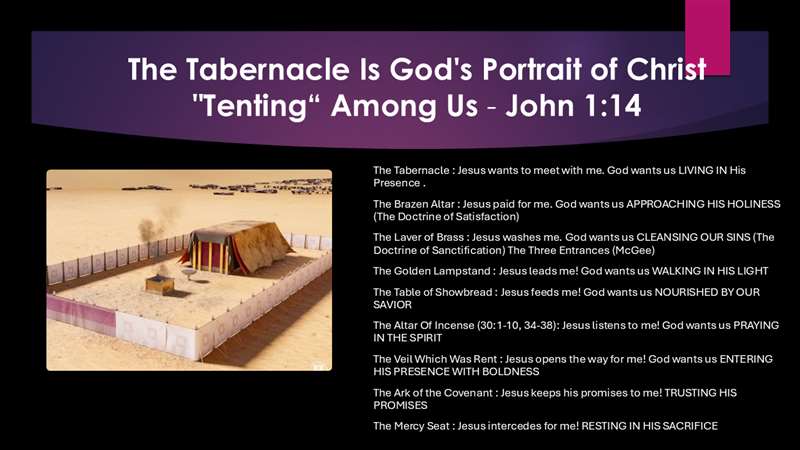
But let’s go back to chapter 25 for tonight because the tabernacle is God’s portrait of Christ tenting among us. And Jesus who wants to meet with me, and pay for me, and washes me, and leads me, He who feeds me, and listens to me, and opens the way, and keeps His promises, and intercedes for me has told us, starting in chapter 25 verse 22, some wonderful truths that I think are going to enhance all of our worship in the year to come. Because when we come to worship, whether it’s corporate worship right here, or whether it’s small group worship, you might be involved with another group of people in your home, or whether it’s your family worship time, or whether it’s you’re off at some special event like the wonderful services a few weeks ago we had in Israel, there is an overarching principle. And that’s in chapter 25 verse 22, and that is… that God is the God who seeks to meet with us.
He wants to meet with us. He’s looking to meet with us, like He’s walking around and just waiting to jump into our lives. He’s just dying to get a foot in the door, as it were, spiritually to meet with us. Look at this, Exodus 25 and verse 22, and this is God introducing this whole idea of the tabernacle, and this is what He says. And there in that tent, I, God says, will meet with you, and I will speak with you from above the mercy seat, from between the two cherubim which are on the ark of the Testimony, about everything I will give you in commandment to the children of Israel. God says, I want to meet with you. I do. He says, I’ll be there waiting for you. Just come.
Look at chapter 29, same book, Exodus 29 with me. Verse 42, great two verses, 42 and 43. He says, this shall be a continual burnt offering throughout your generations at the door of the tabernacle of meeting (the tent I meet with you in) before the Lord. Look at this. Where I will meet you to speak with you. Now, let me ask you if somebody famous called, someone you deeply admire and love, and said, I’m coming through town tomorrow, and I will meet you at whatever at this time. And if you deeply love them, you would stand on your head to change your life around to see them and meet with them, and that’s what this is like. Moses was told by God in verses 42 and 43, there I will speak to you. Verse 43, there I will meet with the children of Israel, and the tabernacle shall be sanctified by My glory. He says, I want to meet with you. Will you come and meet with Me?
Now, here’s what the New Testament says in 2 Corinthians 5:19. Now, don’t lose Exodus, but I’m going to give you a New Testament reference for each one of these. 2 Corinthians 5:19, because the God who would meet with them in that old black smokey tent in the Old Testament now meets with us in Jesus Christ. Not in that tent, but anywhere, anytime and He’s set up an open door, and this is what He says in 2 Corinthians 5:19: that is, that God was in Christ reconciling the world to Himself, not imputing their trespasses to them, and has committed to us the word of reconciliation. He says, what I’ve done is I’ve, now Christ has opened the way so He can meet with any of us anywhere, anytime, and He’s waiting, and He wants us to come to Him. The first key to the heart of God is to remember that God desires to meet with us.
Now, let’s go back to Exodus 29 this time, and we’re going to go all the way through these Old Testament verses. And if you don’t want to get lost, just jot down the New Testament one and I’ll read it to you, but we’re going to plod through the Old Testament. The second key to the heart of God is in Exodus 29:46 and it says this, 29:46 of Exodus, and they shall know that I am the LORD their God, who brought them up out of the land of Egypt, that I may dwell among them. I am the LORD their God. Not only does God want to meet with us, but this 46 verse says, God desires to not just casually meet. I remember when I met President Reagan; I remember that very clearly. He spoke in the chapel at Bob Jones, and I remember that Reagan and his wife Nancy were walking out the side door, and I worked for the school, so I got to be there, and I just stick out my hand and shook his hand. You know what? I don’t know him. I never really got to know him. I met him, but you know what God says? I don’t want you just to see Me float by like some great dignitary, the King of the universe. He says, look what verse 46 says. He says, that I may dwell among them. God wants to reveal Himself to us. He wants to open Himself to us. He wants us to know Him. He wants to reveal His secrets to us. He wants to show us of Himself. It’s a lifelong process to grow in the grace and the knowledge of the Lord.
The second key to the heart of God is not only does God desire to meet with us; He desires to reveal Himself to us. And the Scriptures say, now He doesn’t hang out in a tent to reveal Himself to us. Now He reveals himself in Jesus. And this is what Jesus said in John 14:7-9, if you had known Me, then you would’ve known My Father also; and from now on you know Him and have seen Him. Jesus said, have you seen Me? You’ve seen God. And Philip said, Lord, show us the Father, and it will be sufficient. And Jesus said, have I been so long with you, you have not known me, Philip? He who has seen Me has seen the Father; how can you say, show me the Father? See, Jesus says, I reveal God to you. You know what Hebrews 1:3 says? Says, Jesus is the brightness of God’s glory and the express image of His person. The only God you’ll ever see is Jesus. There aren’t three people walking around up in Heaven, that there are going to be three Gods up there. God the Father is an invisible spirit. God the Spirit is an invisible spirit. The Eternal Son is the One that’s going to be in a corporeal form, a body, for us to see. And He, God the Son, is the One we will see. And the Jews always say, oh, you guys have three Gods. We have one God eternally existing in three persons, and we worship them as one God. We don’t have three Gods; we have one God always existing in three persons. You say, I don’t get it. The Bible doesn’t explain it. It’s incomprehensible, but God says, if you want to see Me, look at the Son, my Son, the Lord Jesus.
Okay, Exodus 25 and verse 8. Exodus 25 and verse 8 says this. First key, God desires to meet with us, Exodus 25:22. Second key, God desires to reveal Himself to us, Exodus 29:46. Third key, Exodus 25 and verse 8, God desires not only to meet and reveal Himself to us; He desires to dwell with us. Now, what does it mean dwell with us? Well, listen to verse 8, and let them make Me a sanctuary, Exodus 25:8, that I may dwell among them. Now turn over to 29:45 and 46, we already read, but I want to get the idea out of that, the same idea. Exodus 29:45 and 46, I will dwell among them. I will be their God. And they will know as I dwell among them, I am the LORD their God, verse 46. So, God says, I not only desire to meet with you and reveal yourself; I want to be at home with you. I want to dwell with you. And you know what? We don’t have to go to the tent anymore because now He dwells in us through Jesus. In fact, at Christmastime, Matthew 1:23, behold the virgin shall be with child and shall bear a Son and they shall call His name Immanuel, which translated is what? God with us, God dwelling with us. That’s Jesus. John 14:23, Jesus answered and said to him, if anyone loves Me, he’ll keep My word; and My Father will love him, and We will come to him and make Our home with him. Are you living and acting like God dwells with you? Is there room in your house for Him? Is there room in your schedule for Him? Is there room in your life? You know the invitational hymn. Have you any room for Jesus, He who bore your load of sin? As He knocks and asks admission, sinner, will you let Him in? Room for Jesus, King of Glory! Hasten now, His Word obey. Swing the heart’s door widely open; bid Him enter while you may. Jesus wants to dwell with us, and not just for our salvation, but He wants to dwell with us that we might know Him and love Him.
Back to Exodus 29. Let’s look at verse 42. The fourth key to the heart of God is God desires to speak with us. He wants to meet with us, reveal Himself to us, and dwell with us. But He wants to speak to us, and it says in Exodus 29:42, this shall be a continual burnt offering throughout your generations at the door of the tabernacle of meeting before the LORD, where I will meet you to speak with you. Now go to Leviticus. That’s a kind of a neglected book sometimes. Exodus, and then it’s over, and then Leviticus starts. Look at the first verse of Leviticus. Leviticus 1 and verse 1. Just a few pages over to the right. This is what it says in Leviticus 1:1, now the LORD called to Moses and spoke to him from the tabernacle of meeting, saying. In fact, the book of Leviticus is almost entirely dictated. It’s just, and the LORD said [Sound Effect], and the LORD said [Sound Effect]. Inspiration is every word is superintendent by the Holy Spirit to come to us exactly, flawlessly as the Word of God. But some of the Bible is inspired as Paul writing letters and the Spirit guided him, but some parts of the Bible are actual and God said [Sound Effect], and God said [Sound Effect], like that, and it’s just dictated blocks of words. The book of Leviticus is almost all that. And you know what? Most of us don’t like that book. It’s all about skinning animals and burning fat and stuff like that. And we don’t like all that because it’s boring and gory, but it’s so important because God says, I’m showing you how much it takes to come into My presence.
We don’t need to go to that tent anymore. Now He speaks to us through the Word of the Lord Jesus Christ. And this is what it says in John 1:1, in the beginning was the Word. The Word was with God. The Word was God. Jesus is the Word of God. Jesus is God speaking to us. It says in John 8:43, why do you not understand my speech? Because you’re not able to listen to My Word. Verse 47, he who is of God hears God’s words; therefore, you do not hear, because you are not of God. What He’s saying is if you don’t understand what I’m saying, you’re not in My family. That’s a dangerous thing. There are people nowadays that say, I don’t get the Bible. I don’t like it. I can’t read. I can’t stay. I don’t understand it. You know what they’re saying? They’re saying, I’m sick, or I’m not in the family, because God desires to speak to us. He has put everything He can into this Book to reveal Himself to us, and He wants to talk to us. I think of another hymn. I come to the garden alone, while the dew is still on the roses; and the voice I hear, falling on my ear, the Son of God discloses. And He walks with me, and He talks with me, and He tells me I am His own, and the joy we share as we tarry there. That’s someone talking about their time of fellowship with the Lord. That’s what He offers to us. Here’s one more verse, Hebrews 1:2, about God desiring to speak with us. Hebrews 1:2 says, God, who at sundry times and in divers manners spake in time past unto the fathers by the prophets. Verse 2, has in these last days spoken to us by His Son. God has given us His final Word. He’s spoken to us by His Son. He desires to speak with us.
As long as you’re in Leviticus, look at verse 4 of chapter 1, Leviticus 1 and verse 4. Here’s the fifth key to the heart of God. God desires to meet with us, Exodus 25:22. God desires to reveal Himself to us, Exodus 29 and verse 46. God desires to dwell with us, 25:8 of Exodus. God desires to speak with us, Exodus 29:42. But look at Leviticus 1:4, God desires to accept us, to let us come before Him and know we’re accepted. And this is what Leviticus 1:4 says, then he shall put his hand on the head of the burnt offering; and it will be accepted on his behalf to make atonement for him. You know what? If you read the book of Leviticus, that little phrase is repeated often, all the way through. In fact, Leviticus 3:2, lay his hand on the head of the offering. Leviticus 3:8, lay his hand on the head of the offering. Leviticus 3:13, lay his hand on the head of the offering. Chapter 4 verse 15, lay their hands on the head of the bull. Verse 29, lay their hand on the head of the sin offering. What He’s saying is, if you’ll come and if you’ll lay your hands on the sacrifice and acknowledge that you must have a substitute to take away your sin, if you’ll do that, He said, I’ll accept you. That’s the whole idea of the substitutionary atonement, identifying with another who, we cannot save ourselves. We cannot do enough to please God. We can’t do enough to merit His favor, and so what we do is we say, I am unable, and so I substitute this, the best lamb, perfect lamb I could find as just a picture of the perfect Lamb of God coming. That’s what they were doing in the Old Testament. They were saying, that lamb, until the perfect Lamb comes. You know what? God desires to accept us, and they did it by putting their hands on animals, but now He accepts us in Christ. And Ephesians 1:6 says this, and Paul, he just, he was so excited, he said, to the praise of the glory of His grace, by which He has made us accepted in the beloved. How? Because God desires to accept us. He wants us to worship Him. He wants us to come to Him. He wants to talk to us. He wants to meet with us. He wants to dwell with us. And He says, I’ve opened up the whole way to you, and I let you come, as Hebrews 4:[16] says, boldly into My presence through the Lord Jesus Christ.
Look at Leviticus 4:20 with me. Here’s another thought. The sixth key to the heart of God is the God who desires to accept us also desires to forgive us. Verse 20, and he shall do with the bull as he did with the bull as a sin offering, thus he shall do with it. And the priest shall make atonement for them. And what’s the end of verse 20 say? And it shall be forgiven them. Look at verse 26. He shall burn all its fat on the altar, and the fat of the sacrifice of the peace offering. So, the priest shall make atonement for him concerning his sin. What does the last line of verse 26 say? And it shall be forgiven him. Verse 31, he shall remove all its fat, and the fat removed from the sacrifice of the peace offering; and the priest shall burn it on the altar as a sweet aroma to the LORD. And the priest shall make atonement for him. What does the end of verse 31 say? And it shall be forgiven him. Look at verse 35, he shall remove all its fat, as the fat of the lamb is removed from the sacrifice of the peace offering. Then the priest shall burn it on the altar, according to the offering made by fire to the LORD. So, the priest shall make atonement for his sin that he committed, and it shall be forgiven him. Do you get the idea? God desires to forgive us. God does not want us to die in our sins. God does not want us bearing our sins. He does not want us immersed in our sins. He wants to bear them away. He wants them on Christ. We don’t have to take fat of offerings and burn it. Now He forgives us through the sacrifice of Christ. Ephesians 1:7, the Apostle Paul continues, he says, in Him we have redemption through His blood, the forgiveness of sins, according to the riches of His grace. And he was so excited. Paul knew all that rigamarole. He had done it his whole lifetime. He had taken the animals; he had shorn his head. He had followed all the rules and regimens of the Levitical offerings, and he had done all that. And when he saw Christ as the perfect sacrifice, he just couldn’t stop talking about it.
Here’s the last one, back to chapter 23 of Exodus, and here’s the last key to the heart of God, and then I’m going to briefly apply these with you. Exodus 23 verse 15. The God who desires to meet with us, that’s key number one. Desires to reveal Himself, that’s the second key to worshiping Him. The third one is He wants to dwell with us. The fourth one is He wants to speak with us. The fifth one is He desires to accept us. The sixth one is He desires to forgive us. And finally, the seventh one in verse 15 of chapter 23, the seventh one, God desires to receive worship from us. And that’s why I want to talk about how we do that tonight. But look at verse 15 of Exodus 23, you shall keep, the LORD said to the Jews, the Feast of Unleavened Bread (you shall eat unleavened bread seven days, as I commanded you, at the time appointed in the month of Abib, for in it you came out of Egypt; none shall appear before Me empty). Ooh. Now, think about it. God says, you’re going to come to worship Me at these appointed feasts. There were three main feasts; there were four minor feasts, as it were. And the three main feasts every year, all the men of Israel were to bring their families to Jerusalem to worship God, and so they were commanded to come to these feasts and to come and bring to the Lord something. And look what the end of verse 15 says: for none shall appear before Me empty. Now, just for a moment, think about this. When you came this morning to the morning service to worship God, did you come empty? Were you so wiped out, and tired, and worn out, and blitzed out of your mind by all the wild things you saw Saturday and Friday night? Were you so physically sapped? Were you so cold spiritually? Did you come in this morning empty? Look what worship’s all about. God desires to receive worship from us, but the end of verse 15, none shall appear before Me empty. Those people that came to Jerusalem had to come bringing something with them. So, that means if they lived in the north, they came for days walking, and they brought their gift. And you know what they thought about? They thought about what they were coming there for. They were coming to meet with God. They were coming to give Him something. And so, they spent the whole period of time walking to Jerusalem, preparing for that climactic moment when they would walk up to the priest, and the father would stand there, and the whole family would be there with him, and he would lead this little lamb. And he would take that lamb and the priest would, and it’s really, they had these little posts and they’d tie a little string around the lamb’s neck, and it would just stand there, and the family would stand and watch, and the father would take and put his hands on the head of that little lamb that was tied to the little hitching post. And the family would gather around, and those little kids, you can see them looking around their father’s legs as he put his hands on them. And the priest would accept that offering from him. And then the priest would take a little bowl, and he would slit the throat of that lamb while it stood there. You know what sheep do? They just stand there. Cut their throat, they just stand in there. That’s what it means, like a lamb before her shearers is dumb. He opened not his mouth. When Jesus died in our place, He was like a harmless lamb, and that priest collected the blood and would take it in and offer it, and then of course they’d skin and do everything else. But that was the coming before the Lord not empty. They came prepared with their sacrifice, and that’s what God wants from us.
If you look at chapter 28, same thing it says in verse 38, it shall be on Aaron’s forehead, that Aaron might bear the iniquity of the holy things, which the children of Israel hallow by their gifts; it shall be always on his forehead, that it may be accepted before the LORD. Even when Aaron, what Exodus 28:38 says, even when Aaron came into the LORD’s presence, he couldn’t come in empty-handed. He had to come in with these gifts, and there was this miter on the top of his hat that said, holiness to the LORD, so even then, he had to have on his forehead the gift and brought the holy gifts to the people. We don’t need to bring a lamb and walk the length of Israel. Now God receives our worship in Jesus. But listen what it says in Hebrews 13:15. Therefore, in fact, let’s turn there. We’re going to leave the Old Testament and go to Hebrews. Okay, let’s turn to Hebrews. That’s near the end of your New Testament, go to the right. Chapter 13, last chapter of Hebrews, verse 15, and in the New Testament, the book of Hebrews talks about how to apply all this Old Testament stuff to our lives. But look at this. He says, in the Old Testament, you walked the length of Israel, and you were carrying all these animals, and you were carrying the firstfruits, and you were carrying your trespass offerings and all these other things, your firstfruits, you were doing all that. But now Hebrews 13:15, therefore by Him let us continually offer the sacrifice of praise to God. Don’t come empty, come full. So, it just, so we don’t have to spend the first half hour cranking you up, trying to get you warmed up enough so something. You ought to come totally ready to worship God every time we meet here and that, as we’re going to talk about for a few minutes tonight, takes a reordering of our life so that we can be continuously, verse 15 of Hebrews 13, offering the sacrifice of praise to God, that is, the fruit of our lips, giving thanks to His name.
Now, very quickly, what are some steps that we can take to grow into worshiping Jesus all the time? And this is, I’m going to go by this fast, but I want to underline these in your minds, and you just listen and grab, from this list I’m going to give you, some ideas maybe you can incorporate in your family. Because there’s some simple steps that we can take that will help each of us individually to not come to the Lord empty. It’s a sad thing to think that we, on the first day of the week, set aside the first day, Sunday, and the first big event of the week to be gathering together corporately. And the purpose we come is not to get anything, but to give something, and it would be tragic if we would come in here empty, not ready. Can you imagine having an appointment with God, and He’s standing there, and He’s saying, yes, I’m here. What do you have for Me? You go, oh, I don’t, I wasn’t ready. I didn’t bring anything. How do we get ready? Here we go. First, worship has to become a daily habit. You can’t crank it up on Sunday. You got to do it every day. We need to learn to practice noticing God’s presence sometime every day. Okay, so you got to set aside a little worship time every day. How do you do that? Turn back to 1 Thessalonians, and I’m going to give you lots of verses. Here’s the first one, 1 Thessalonians 5:17. Number one, ask God to enable you to follow the Scriptures. And 1 Thessalonians 5:17 says this: pray without ceasing. How do we learn to practice God’s presence every day? Ask Him to make 1 Thessalonians 5:17 true in our lives. Help me to pray without ceasing. Help me to always be able to be in communion and talking to You. Number one is ask God to enable you to follow 1 Thessalonians 5:17.
Number two, punctuate every moment with the inward whisperings to God of adoration, praise, and thanksgiving. You say, what’s that? Psalm 55, you might want to write that down, verse 17. This is what the psalmist said. Evening morning and at noon I will pour out my voice to You, and You will hear. You know what God said? He’s like people that are in love. You ever seen a couple that’s in love? They can be on the phone for hours. It looks like it’s grown into their head, and their ears are all flattened and red. They just talk on the phone for hours. What do they talk about? You ever listen to them? Dumb stuff. How are you doing? I’m doing great. Oh, you looked so nice today. Oh, you looked nice today too. Oh, and you just… What is that? That is two people that love each other so much they love every word each other says. You know what God says? I love every word. I want you to talk to Me. I will hear your voice. We need to punctuate every moment with adoring Him, praising Him, thanksgiving to Him.
Thirdly, if we’re going to learn to practice noticing His presence sometime each day, we need to schedule times of personal worship, and confession, and Bible study, and attentiveness to Christ our ever-present Teacher. If you lived in a home with, if you love computers and you lived in a home where you had as a guest this guru of computing. And they said, you know what? I’m just going to be here for a week and anytime you want to stop in and talk to me, I will teach you stuff you never could imagine about the computer. Wouldn’t you just be looking for times in your schedule to say, can I have another lesson? Can you teach me something? If you had somebody that was the master woodworker, and you’ve always tried to make certain things work, and they were staying with you for a week. And they said, you know what? Anytime you want, I’ll teach you some tricks of the trade. But look at Colossians 3. If you’re in 1 Thessalonians, back up to Colossians 3. This is what Christ says. Schedule personal times of worship with Me, the ever-present Teacher. Paul put it this way, Colossians 3:16, let the Word of Christ richly dwell within you. Wow! Let it be at home in your heart. Let the Word of God fill your life. Schedule times to get in this Book, and when we schedule times to get in this Book, the Teacher, our personal Teacher, the God of the universe, is waiting to open this Book to us. That’s what your time with Him is all about. That’s why it is the most wonderful thing in the world to schedule an appointment with the Lord, to look forward to it, and on your way to it to say, God, I’m coming for my time in Your Word. I can’t wait to meet with You. I want You to open Your Word to me. That’s how we do it, by learning to practice noticing God’s presence every day.
And then back to Psalm 42, back up to the middle of your Bible. I want to show you 42:1 and 2 because how do we learn to practice noticing God’s presence every day? How do we do that? Psalm 42, the first two verses, say this: as the deer pants for the water brooks, so pants my soul for You, O God. Verse 2, my soul thirsts for God, for the living God. When shall I come and appear before God? Now, here’s the key. If we will bring this atmosphere of scheduled personal times, of punctuating every moment with adoration, and of asking God to help us pray without ceasing, if we will just have that buzzing.
Reminds me of last summer I was being Mr. Beekeeper before my bees died, and I was doing something. The spray killed them; I hear that’s what killed them, all the bug spray. But I was in there working away and finding my queen and everything, wearing my outfit, my netting and everything, and I was so excited. I brought something and I walked up to the house to see it, and I saw that Bonnie ran in and shut the door. Do you know why? I brought with me the atmosphere of bees. They were surrounding me just like a cloud like this, and you just forget about them. You’re just, they’re there and you don’t, they don’t bother you and you don’t bother them. And here I was coming, and I was bringing the atmosphere of beekeeping toward the house, and everybody just evacuated and went inside and were looking out the window at me and pointing at all the bees. They didn’t want them in the house.
Do you know what? If you are meeting alone with the Lord, and praying without ceasing, and having appointments with Him, and scheduling time, and panting after Him, then Psalm 42 says, when am I going to come and appear before God? What we will do is we’ll bring this atmosphere into our public worship so that our gathered experience of worship will just become a continuation of, and also an intensification, of what we have been trying to do all week long. You understand? You bring the bees in with you. You’ve already spent the whole week getting to know the Lord and seeking after Him, and then when you come here on Sunday, it just builds. We’ve already started. That’s number one. Worship has to become a daily habit.
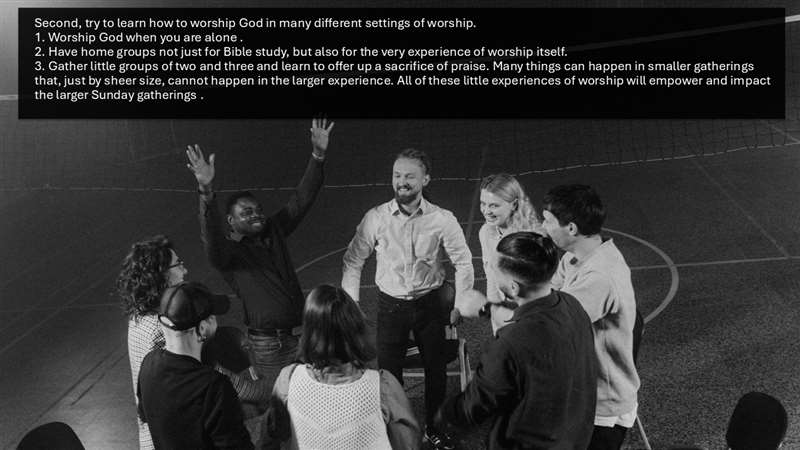
Number two, we need to learn how to worship God in many different settings. We need to worship God when we’re alone. We need to worship Him in home groups, not just study the Bible, but for the very experience of worshiping, we need to gather little groups of two or three to learn to offer up a sacrifice of praise. Many things happen in small gatherings that by sheer size can’t happen here, and all of these little experiences of worship will empower and impact the larger Sunday gathering. If you want to be in the concert, you should be practicing at home, musically speaking. And if you want to be good in the tournament, you practice at home. You practice on your own. And so, we need to try to learn how to worship God in many different settings.
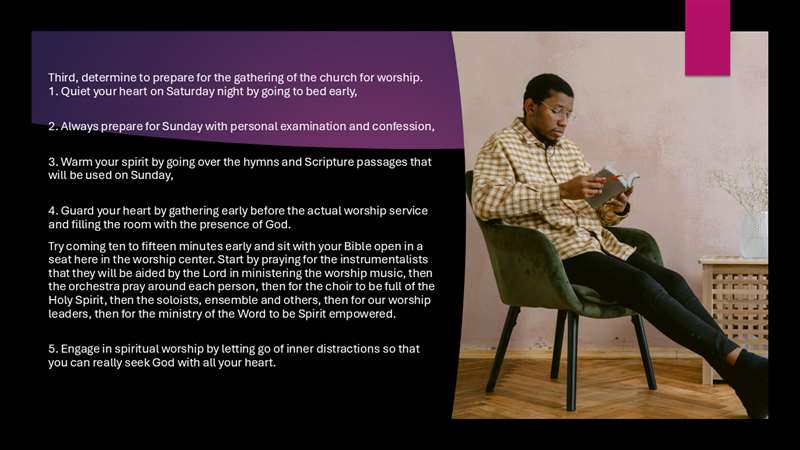
Thirdly, and this is where we get to the critical point, we need to determine to prepare for the gathering of the church for worship. How? Number one, we need to quiet our heart on Saturday night by going to bed early. It’s the funniest thing. I meet people that are having a big interview. They changed their whole life around. They say, I’ve got to get my rest. I want to look good for my interview. No, I can’t do that. I got my interview. People that are going to audition, I, oh, they’ve got to quiet their life down. They don’t want anything to bother them. They just don’t want to forget their music or whatever, and they quiet their life down. And yet we go raring up until the wee hours of the morning and drop dead into bed and then get up almost with a hangover. We come in here on Sunday morning and say, I didn’t get anything out of it. You know why? We did not stop and prepare ourselves for coming here! Did you know? We teach in our family that Sunday morning is the greatest, and Sunday is the greatest day of the week. It’s the most important day of the week, and so we start getting ready on Saturday night for the most important. It’s just a whole production line of getting ready, and it’s quieting ourselves down, and it’s a rare thing to rev up on Saturday night. Why? Because if we’re going to come into the presence of God, we’ve got to prepare ourselves and quiet our hearts before Him. We always need to also not only quiet down on Saturday night by going to bed early and cutting out all the junk that will dissipate our spiritual energy.
But secondly, we should always prepare for Sundays by having a time of personal examination and confession. It says in 2 Corinthians 5, it says, don’t bring in the old leaven to the fellowship. We’re supposed to be purging ourselves. We’re supposed to be, 2 Corinthians 7:1, examining ourselves to purge out any filthiness of the flesh or the spirit. We should not, it’s just like when you come to the table, most families say, okay, everybody wash their hands and come to the table. Can you imagine someone’s out cleaning a horse pen, they come in and they’re passing the, breaking their roll off and passing the bread to you and they got all that stuff on their hands? Can you imagine somebody else that is playing with their reptiles that they love and all that slime stuff and they’re breaking something off the food and handing it to you? You wouldn’t want to eat! And God says, don’t come into this fellowship without purging, and cleansing, and examining, and making sure you’re clean before My presence.
Thirdly, we need to warm our spirit. A great way to do that is go over the hymns and Scriptures that we’ll be using here on Sunday. You can get a bulletin and come and sit quietly and just start making a quiet spot all over, and people come up, and you go, I’m reading right now. I just, and you just start setting a pattern of quiet. Now, we’re not Puritans, and maybe it would be nice if we were, but we’re not, and we don’t go around in black and don’t talk. But you know what we need to sometime in our life quiet down, and Sunday morning’s a good time.
Another one, we need to guard our heart. We need to gather early before actual worship service. We need to fill this room with the presence of God, and here’s a way you could have one of the most vital ministries in Tulsa Bible Church. Come 10 to 15 minutes early, sit with your Bible open in a seat here in our Worship Center, and start praying for everyone—the instrumentalists, that they’ll be aided by the Lord in ministering the worship, for those who are performing other music for the orchestra. Pray around each of them, that the choir will be full of the Holy Spirit, that the soloists and ensembles and others will point at Christ and not at themselves, and that our worship leaders, and then for the ministry of the Word, that the Spirit will empower it. And we can guard our time of worship. We can actually participate in that. There’s a lot you can do on Sunday for God as well as every other day of the week.
And finally, and we’ll end here and pick up next time. We need to engage in our worship here by letting go of all the inner distractions so that we can really seek God with all of our heart. I want to conclude by reading Psalm 42 verses 1 and 2 once more because this should be the way you and I approach the heart of God. As a deer pants for water brooks, so pants my soul for You, O God. My soul thirsts for God, for the living God. When shall I come and appear before God? You and I should have a continuous longing, anticipation, excitement, expectancy alone all throughout the week of getting alone with God in our personal time with Him. And then after we’ve practiced that for six days, we come with our worship guide tucked under our arm, filling and overflowing our heart, and we come here expectant to see what will happen when we get the privilege of corporately meeting with God.
Let’s bow before our Lord and thank Him for giving us the privilege of coming into His presence. Father in Heaven, I thank You for these keys to Your heart. I thank You that You desire to meet with us, and speak to us, and dwell with us, and forgive us. You desire to reveal Yourself to us, and You don’t want us to come before You empty. If anyone came today empty, I pray that You will begin working in their heart, that they will practice this week Your presence, that they will practice intimacy with You so that they might come in at our next time of public worship overflowing and spreading the power of Your Spirit radiating out from their life into the life of all of those assembled in this place as we join our hearts and with one voice and one mind, magnify Your name. We thank You, Lord Jesus. In Your precious name we pray, amen.
Perhaps we all need to slow down and reflect on the following…
The paradox of our time in history is that we have taller buildings, but shorter tempers; wider freeways, but narrower viewpoints; we spend more, but have less; we buy more, but enjoy it less.
We have bigger houses and smaller families; more conveniences, but less time; we have more degrees, but less sense; more knowledge, but less judgment; more experts, but more problems; more medicine, but less wellness.
We drink too much, smoke too much, spend too recklessly, laugh too little, drive too fast, get too angry too quickly, stay up too late, get up too tired, read too little, watch TV too much, and pray too seldom.
We have multiplied our possessions, but reduced our values. We talk too much, love too seldom, and hate too often. We’ve learned how to make a living, but not a life; we’ve added years to life, not life to years.
We’ve been all the way to the moon and back, but have trouble crossing the street to meet the new neighbor. We’ve conquered outer space, but not inner space; we’ve done larger things, but not better things;
We’ve cleaned up the air, but polluted the soul; we’ve split the atom, but not our prejudice; we write more, but learn less; we plan more, but accomplish less.
We’ve learned to rush, but not to wait; we have higher incomes, but lower morals; we have more food, but less appeasement; we build more computers to hold more information to produce more copies than ever, but have less communication; we’ve become long on quantity, but short on quality.
These are the times of fast foods and slow digestion; tall men, and short character; steep profits, and shallow relationships. These are the times of world peace (?), but domestic warfare; more leisure, but less fun; more kinds of food, but less nutrition.
These are days of two incomes, but more divorce; of fancier houses, but broken homes.
These are days of quick trips, disposable diapers, throw away morality, one-night stands, overweight bodies, and pills that do everything from cheer, to quiet, to kill.
It is a time when there is much in the show window and nothing in the stockroom; a time when technology can bring the universe to our screens but the God of the Universe can’t bring us to our knees . . .
The tabernacle, which God instructed Moses to construct, is a powerful lesson to guide us in our pursuit of deepening our fellowship with the Lord.
Entering The Presence of God
This is a journey into the presence of God. We enter God’s presence by way of His Tabernacle, God’s tent of Meeting. As we examine this incredible structure, we will see how every point of the God’s Tabernacle points to Jesus.
The first and primary lesson we learned about the Tabernacle was where God placed it. In the center of the Camp, with smoke slowly rising from the altar and with the 12 Tribes in an ordered arrangement around it around. Looking intently we would note a long, black, unattractive tent of porpoise skins. But when we traveled through the loud, smelling and busy camp and made it to the Tabernacle we would find a much different sight. When we came inside, we would find ourselves surrounded by shining gold: looking up to the curtained roof, we see the wings of the cherubim woven in; blue and purple and scarlet and fine twined linen. The light of the golden candlestick would softly shine and reveal all the beauty within.
So it is with Christ Himself. The natural man, beholding Him, sees no beauty that he should desire Him. But to those who know the Lord Jesus Christ, His beauty satisfieth their souls.
The Tabernacle teaches us so much about the wonders of our Matchless God. Here are just a few of the lessons about the Lord.
The Tabernacle Is God’s Portrait of Christ “Tenting” John 1:14 Among Us
1. The Tabernacle : jesus wants to meet with me. God wants us LIVING IN His Presence .
2. The Brazen Altar : jesus paid for me. God wants us APPROACHING HIS HOLINESS (The Doctrine of Satisfaction)
3. The Laver of Brass : jesus washes me. God wants us CLEANSING OUR SINS (The Doctrine of Sanctification) The Three Entrances (McGee)
4. The Golden Lampstand : jesus leads me! God wants us WALKING IN HIS LIGHT
5. The Table of Showbread : jesus feeds me! God wants us NOURISHED BY OUR SAVIOR
6. The Altar Of Incense (30:1-10, 34-38): jesus listens to me! God wants us PRAYING IN THE SPIRIT
7. The Veil Which Was Rent : Jesus opens the way for me! God wants us ENTERING HIS PRESENCE WITH BOLDNESS
8. The Ark of the Covenant : jesus keeps his promises to me! TRUSTING HIS PROMISES
9. The Mercy Seat : jesus intercedes for me! RESTING IN HIS SACRIFICE
Now, for our lesson on entering the Presence of God, I call these –
Seven Keys To The Heart of God
• God desires to meet with us . Exodus 25:22 “And there I will meet with you, and I will speak with you from above the mercy seat, from between the two cherubim which are on the ark of the Testimony, about everything which I will give you in commandment to the children of Israel. Exodus 29:42-43 “This shall be a continual burnt offering throughout your generations at the door of the tabernacle of meeting before the Lord, where I will meet you to speak with you.43 “And there I will meet with the children of Israel, and the tabernacle shall be sanctified by My glory. Now He meets us in Jesus 2 Corinthians 5:19 that is, that God was in Christ reconciling the world to Himself, not imputing their trespasses to them, and has committed to us the word of reconciliation.
• God desires to reveal himself to us . Exodus 29:46 “And they shall know that I am the Lord their God, who brought them up out of the land of Egypt, that I may dwell among them. I am the Lord their God. Now HE REVEALS himself in Jesus John 14:7-9 “If you had known Me, you would have known My Father also; and from now on you know Him and have seen Him.”8 Philip said to Him, “Lord, show us the Father, and it is sufficient for us.”9 Jesus said to him, “Have I been with you so long, and yet you have not known Me, Philip? He who has seen Me has seen the Father; so how can you say, ‘Show us the Father’?
• God desires to dwell with us . Exodus 25:8 “And let them make Me a sanctuary, that I may dwell among them. Exodus 29:45-46 “I will dwell among the children of Israel and will be their God.46 “And they shall know that I am the Lord their God, who brought them up out of the land of Egypt, that I may dwell among them. I am the Lord their God. Now He dwells in us through Jesus Matthew 1:23 “Behold, the virgin shall be with child, and bear a Son, and they shall call His name Immanuel,” which is translated, “God with us.” John 14:23 Jesus answered and said to him, “If anyone loves Me, he will keep My word; and My Father will love him, and We will come to him and make Our home with him.
• God desires to speak with us . Exodus 29:42 “This shall be a continual burnt offering throughout your generations at the door of the tabernacle of meeting before the Lord, where I will meet you to speak with you. Leviticus 1:1Now the Lord called to Moses, and spoke to him from the tabernacle of meeting, saying, Now He speaks to us through the word of Jesus John 1:1In the beginning was the Word, and the Word was with God, and the Word was God. John 8:43 “Why do you not understand My speech? Because you are not able to listen to My word. 47 “He who is of God hears God’s words; therefore you do not hear, because you are not of God.” Hebrews 1:2 has in these last days spoken to us by His Son, whom He has appointed heir of all things, through whom also He made the worlds;
• God desires to accept us . Leviticus 1:4 ‘Then he shall put his hand on the head of the burnt offering, and it will be accepted on his behalf to make atonement for him. Now he accepts us in Jesus . Ephesians 1:6 to the praise of the glory of His grace, by which He has made us accepted in the Beloved.
• God desires to forgive us . Leviticus 4:20 ‘And he shall do with the bull as he did with the bull as a sin offering; thus he shall do with it. So the priest shall make atonement for them, and it shall be forgiven them. 26 ‘And he shall burn all its fat on the altar, like the fat of the sacrifice of the peace offering. So the priest shall make atonement for him concerning his sin, and it shall be forgiven him. 31 ‘He shall remove all its fat, as fat is removed from the sacrifice of the peace offering; and the priest shall burn it on the altar for a sweet aroma to the Lord. So the priest shall make atonement for him, and it shall be forgiven him. 35 ‘He shall remove all its fat, as the fat of the lamb is removed from the sacrifice of the peace offering. Then the priest shall burn it on the altar, according to the offerings made by fire to the Lord. So the priest shall make atonement for his sin that he has committed, and it shall be forgiven him. Now he forgives us through the sacrifice of Jesus . Ephesians 1:7 In Him we have redemption through His blood, the forgiveness of sins, according to the riches of His grace
• God desires to receive worship from us . Exodus 23:15 “You shall keep the Feast of Unleavened Bread (you shall eat unleavened bread seven days, as I commanded you, at the time appointed in the month of Abib, for in it you came out of Egypt; none shall appear before Me empty); Exodus 28:38 “So it shall be on Aaron’s forehead, that Aaron may bear the iniquity of the holy things which the children of Israel hallow in all their holy gifts; and it shall always be on his forehead, that they may be accepted before the Lord. Now he receives our worship in Jesus. Hebrews 13:15 Therefore by Him let us continually offer the sacrifice of praise to God, that is, the fruit of our lips, giving thanks to His name.
Steps To Grow Into Worshiping Jesus All The Time
Listen to what one man (1) who spent years meditating on worship has written: Worship is something we do. Studying the theology of worship and debating the forms of worship are all good, but by themselves they are inadequate. In the final analysis we learn to worship by worshiping. Let me give a few simple steps that I hope will help in the experience of worship.
First worship must become a daily habit.
learn to practice noticing God’s presence sometime each day .
1. Ask God to enable you to follow Paul’s words,
“Pray without ceasing” (1 Thess. 5:17).
2. Punctuate every moment with inward whisperings of adoration, praise, and thanksgiving.
Psalm 55:17 Evening and morning and at noon, I will complain and murmur, And He will hear my voice. NASB
3. Schedule times of personal worship and confession and Bible study and attentiveness to Christ, your always-present Teacher.
Colossians 3:16 Let the word of Christ richly dwell within you, with all wisdom teaching and admonishing one another with psalms and hymns and spiritual songs, singing with thankfulness in your hearts to God. NASB
Joshua 1:8 “This Book of the Law shall not depart from your mouth, but you shall meditate in it day and night, that you may observe to do according to all that is written in it. For then you will make your way prosperous, and then you will have good success. NKJV
4. Bring this atmosphere to our public worship so that our gathered experience of worship just becomes a continuation and an intensification of what you have been trying to do all week long.
Psalm 42:1-2 As the deer pants for the water brooks, So pants my soul for You, O God.2 My soul thirsts for God, for the living God. When shall I come and appear before God? NKJV
Second, try to learn how to worship God in many different settings of worship.
1. Worship God when you are alone .
2. Have home groups not just for Bible study, but also for the very experience of worship itself.
3. Gather little groups of two and three and learn to offer up a sacrifice of praise. Many things can happen in smaller gatherings that, just by sheer size, cannot happen in the larger experience. All of these little experiences of worship will empower and impact the larger Sunday gatherings .
Third, determine to prepare for the gathering of the church for worship.
1. Quiet your heart on Saturday night by going to bed early,
2. Always prepare for Sunday with personal examination and confession,
3. Warm your spirit by going over the hymns and Scripture passages that will be used on Sunday,
4. Guard your heart by gathering early before the actual worship service and filling the room with the presence of God. Here is how you can have one of the most vital ministries at Tulsa Bible Church – Try coming ten to fifteen minutes early and sit with your Bible open in a seat here in the worship center. Start by praying for the instrumentalists that they will be aided by the Lord in ministering the worship music, then the orchestra pray around each person, then for the choir to be full of the Holy Spirit, then the soloists, ensemble and others, then for our worship leaders, then for the ministry of the Word to be Spirit empowered.
5. Engage in spiritual worship by letting go of inner distractions so that you can really seek God with all your heart.
Fourth, willingly offer yourself to the Lord as an instrument for worship .
1. Mortify your pride by learning to let go of my agenda, of my concern, of my being blessed, of my hearing the word of God.
2. Use the language of the gathered fellowship is not “I,” but “we.”
3. Offer your submission to the ways of God, and your submission to one another in the Christian fellowship.
4. Desire for God’s presence to rise up in the group, not just within the individual. This is what it means to become of one mind, of one accord.
5. Cultivate a life of complete spiritual dependency. Dependency means we completely dependent upon God for anything significant to happen. The work is God’s and not yours.
Fifth, guard yourself from exposure to harmful habits that deadens worship .
1. Guard your soul : there is no better way to erase worship than to turn on the TV when you walk in the house after church. Sunday afternoon football, and sports in general, with the incessant beer commercials and inane chatter, is a sure-fire way to flatten out-one’s spiritual brain waves.
2. Encourage your family : or the whole family will suffer – “You want daddy to look at your Sunday school paper? In a moment, son. . . at half-time maybe.”
3. Seek God completely : Men, if you’re the kind who sits in church fretting because you’ve already missed the 1st quarter of the game and wonder when the preacher is going to end, you will rarely get anything out of the service!
4. Purge your spirit : Have you ever tried dieting your spirit? Stay away from any “Junk food” of the soul, cancer causing agents, high worldly cholesterol that hardens your spiritual arteries?
5. Avoid over exposure : Some of us are in the high skin cancer risk category. So what do we do? We stay away from exposure to those deadly UV rays. Well, all of us are prone to soul cancer that eats away at our worship so we should avoid very much exposure to TV rays. They distract, deaden and deflate the welling up of our souls in worship to God!
6. Do a self examination : If you can’t fast from TV, web surfing, video games, newspapers and magazines for a week then you are very weak and at risk spiritually.
Sixth, drown all distractions with overflowing prayers of gratefulness to GOD.
1. If there is noise or distraction, rather than fussing and fuming about it, learn to take it in and conquer it.
2. If little children are running about, bless them. Thank God that they are alive and that they have energy.
3. Become willing to relax with distractions-they may be a message from the Lord. When I am preaching, I love to have babies and little children in the congregation because sometimes they are the only ones that I can be sure are alive! Learn simply to receive whatever happens in a gathered worship experience, rather than feeling that distractions somehow deter you from worshiping God.
Seventh, practice offering actual sacrifices of worship to GOD.
1. Don’t give up : Many times you will not “feel” like worship. Perhaps you have had so many disappointing experiences in the past that you think it is hardly worth it. There is such a low sense of the power of God, Few people are adequately prepared. But you need to go anyway.
2. Confess inadequacy : You need to offer a sacrifice of worship. You need to be with the people of God and say,
“These are my people. As stiffnecked and hard-hearted and sinful as we may be, together we come to God.” Many times I do not feel like worshiping and I have to kneel down and say, “Lord, I don’t feel like worshiping, but I desire to give you this time. It belongs to you. I will waste this time for you.”
3. Enjoy God’s people : Isaac Pennington says that when people are gathered for genuine worship,
“They are like a heap of fresh and burning coals warming one another as a great strength and freshness and vigor of life flows into all.”” One log by itself cannot burn for very long, but when many logs are put together, even if they are poor logs, they can make quite a fire. Remember the coun sel of Proverbs 27:17 that “Iron sharpens iron,” and even rather dull lives can help each other if they are willing to try.
So go, even if you don’t feel like it.
Go, even if worship has been discouraging and dry before.
Go, praying.
Go, expecting.
Go, looking for God to do a new and living work among you.
What Are The Fruits of Worship?
OBEDIENCE: Just as worship begins in holy expectancy, it ends in holy obedience. If worship does not propel us into greater obedi ence, it has not been worship. To stand before the Holy One of eternity is to change.
• Philippians 3:3 For we are the circumcision, who worship God in the Spirit, rejoice in Christ Jesus, and have no confidence in the flesh, NKJV
REPENTENCE: Resentments cannot be held with the same tenacity when we enter his gracious light. As Jesus says, we need to leave our gift at the altar and go set the matter straight (Matt. 5:23, 24). In worship an increased power steals its way into the heart sanctuary, an increased compassion grows in the soul. To worship is to change.
• Matthew 5:23-24 “Therefore if you bring your gift to the altar, and there remember that your brother has something against you,24 “leave your gift there before the altar, and go your way. First be reconciled to your brother, and then come and offer your gift. NKJV
MINISTRY: Holy obedience saves worship from becoming an opiate, an escape from the pressing needs of modern life. Worship enables us to hear the call to service clearly so that we respond, ‘Here am I! Send me”.
• Isaiah 6:1-8 In the year that King Uzziah died, I saw the Lord sitting on a throne, high and lifted up, and the train of His robe filled the temple.2 Above it stood seraphim; each one had six wings: with two he covered his face, with two he covered his feet, and with two he flew.3 And one cried to another and said: “Holy, holy, holy is the Lord of hosts; The whole earth is full of His glory!” 4 And the posts of the door were shaken by the voice of him who cried out, and the house was filled with smoke. 5 So I said: “Woe is me, for I am undone! Because I am a man of unclean lips, And I dwell in the midst of a people of unclean lips; For my eyes have seen the King, The Lord of hosts.” 6 Then one of the seraphim flew to me, having in his hand a live coal which he had taken with the tongs from the altar.7 And he touched my mouth with it, and said: “Behold, this has touched your lips; Your iniquity is taken away, And your sin purged.” 8 Also I heard the voice of the Lord, saying: “Whom shall I send, And who will go for Us?” Then I said, “Here am I! Send me.” NKJV
So that is what God desires. How did He make a way possible for sinners like us to Stay in His presence?
1. Richard Foster, Celebration of Discipline, p. 171-73.
2. A.M. Hodgkins, CHRIST IN ALL THE SCRIPTURES, p. 20-23.
3. Numbers 1:50 “but you shall appoint the Levites over the tabernacle of the Testimony, over all its furnishings, and over all things that belong to it; they shall carry the tabernacle and all its furnishings; they shall attend to it and camp around the tabernacle.
4. Thirty-one different Greek words are found in Acts for Christian verbal communication, and altogether they are used about 160 times. Of these, the words evangelize of preach the Gospel represent less than a third of all the usages of speaking words. The other terms are teach…
5. John F. MacArthur, Jr., The MacArthur Study Bible , (Dallas: Word Publishing) 1997.
6. John F. MacArthur, Jr., The MacArthur Study Bible , (Dallas: Word Publishing) 1997.
7. Richards, Lawrence O., The Teacher’s Commentary , (Wheaton, IL: Victor Books) 1987.
8. Quoted from R. Kent Hughes, ACTS.
9. Hughes, R. Kent, Preaching the Word: Acts-The Church Afire , (Westchester, IL: Crossway Books) 1998, c1996.
10. Mears, What the Bible is all about, p. 36-37.
11. John Davis, Moses and the God’s of Egypt , p. 87
12. Davis, p.94ff.
13. Davis, p. 109.
14. Davis, pp. 128-130.
15. Mears, What the Bible is all about, p. 36-37.
16. A.M. Hodgkins, CHRIST IN ALL THE SCRIPTURES, p. 20-23.
17. Davis, p. 109.
18. Davis, pp. 128-130.
19. Mears, What the Bible is all about, p. 36-37.