
If the video above is not available, here are two other ways to view:
David – Lessons on Depression
900218PM
DAV-08 DSS-32 WFL-40 ZNA-379
Transcript
.jpg)
You know there’s sometimes when we can’t feel like praising the Lord isn’t there? And all of us go through those times and I think it’s very fitting in the book of Psalms for us to find those expressions of the heart as penned by the man after God’s own heart. When you find life very hard to praise the Lord for, and we mustn’t be so foolish as to not admit that there are difficult times. I was reflecting on the words of some wise men who, and women, who had lived far longer than I, and I was listening to them this week and one of them said yes when I was growing up we heard often the message that just gets saved and everything will be great from then on, but that’s not always true, is it? Because saved people get cancer. Saved people get in car accidents. Saved people go bankrupt. Saved people have broken families. Saved people are depressed at times. And I think that it’s important for us to look at the fact that the Scriptures talk about those times.
.jpg)
And I’d like to share with you some confessions of a caveman. And I’m going to be alternating between Psalm 34 and 142 and a lot of other places. So, you don’t need to really be anywhere for a little while. But I’ll lead you through this special time tonight as we look at this special personage.
.jpg)
I wonder if you ever felt prehistoric, and I know if you’ve watched television very much, you’ve seen the renditions of what cavemen look like for them. Life is reduced to just grunts and groans, and life is an endless pursuit of nothingness at times. I like the way Edna St. Vincent Malay put it a few years ago. She said, life must go on. I just can’t remember why. That’s what I’m talking about, a caveman sort of existence. A life when a vicious swirl has taken place. It’s a swirl of getting up, going to work out of the home or in the home. If you’re a mom, dropping in bed, exhausted at the end of the day only to find out after an entire month has gone by. That you’re falling behind instead of getting ahead. That’s the kind of life I’m talking about, and it’s not foreign to most of us. We know what it’s like when it’s hard.
.jpg)
Well, let’s meet someone who went through that ahead of us. He lived 3000 years ago. He lived in the Middle East when life was just as much of a swirl and a blur and a troublesome time. And of course, his name is David. We’ve learned that David was from humble origins. He didn’t have any special way of growing up. He was very devout to his God, and he was chosen as God’s man. And after he was chosen as God’s man, he was resolute in following that choosing. Yet he was so human that he committed some of the greatest sins that are recorded in the Scripture. He’s a fellow we can relate to. His repentance though was so great that he received great forgiveness. And in a few weeks we’re going to look at that and look into the confessions of a broken heart, and also through all of this humble origin and some of the great exaltations that he knew.
We find a man that leads us into incomparable worship. David aptly described in the Scriptures as being after God’s own heart. Why? I want to remind you where we’ve been because I don’t want you ever to forget why he was after God’s own heart and the Scriptures teach that lineup upon line will learn stuff.
.jpg)
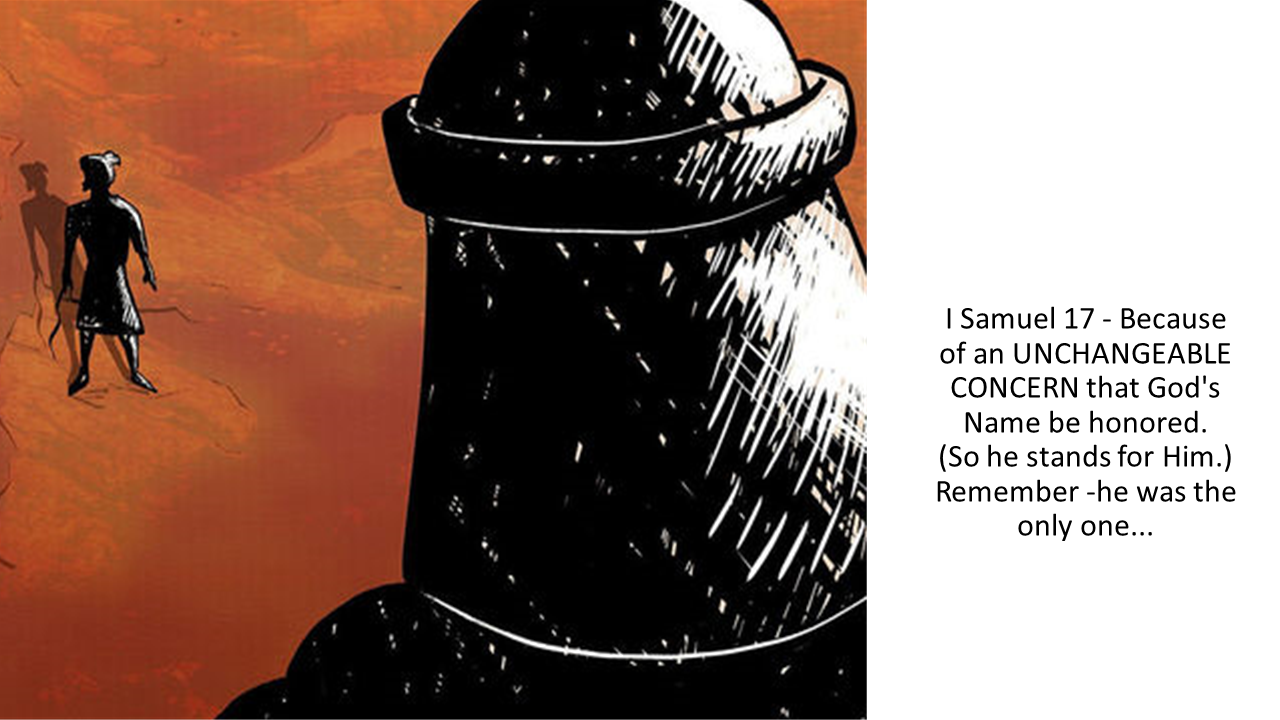
And so, we learned many days ago that in 1 Samuel 17, David was after God’s own heart because he had an unchangeable concern that God’s name be honored. He had a concern that didn’t change whether he was on the battlefield or whether he was at his little sheep fold with that little flock as his brother reminded him so cruelly of it didn’t change if he was in the court of a king or if he was presiding over the court as king, it didn’t matter. He had an unchanging and unchangeable concern that God’s name be honored, and so he stands up for God.
And he stood up for God before a Goliath and he stood up for God before a wicked soul. And he stood up for God before a pagan nation that was reviling God’s name. And he stood up for God before a whole nation. And David had that concern for God’s name to be honored. And remember, there were times when he was the only one that had that concern because in that valley, that day, as he looked across the valley and saw a 10-foot-tall giant, he saw a bunch of cowering soldiers behind him. And as he looked at that giant, he was the only one that saw the picture that day, and he was going to stand up for God’s honor. Even if he was the only one in Israel or in North Kingstown High School, or at college, or at Electric Boat. It didn’t matter whether he would’ve been the only one. He was concerned for God’s honor, and he stood up for His name.
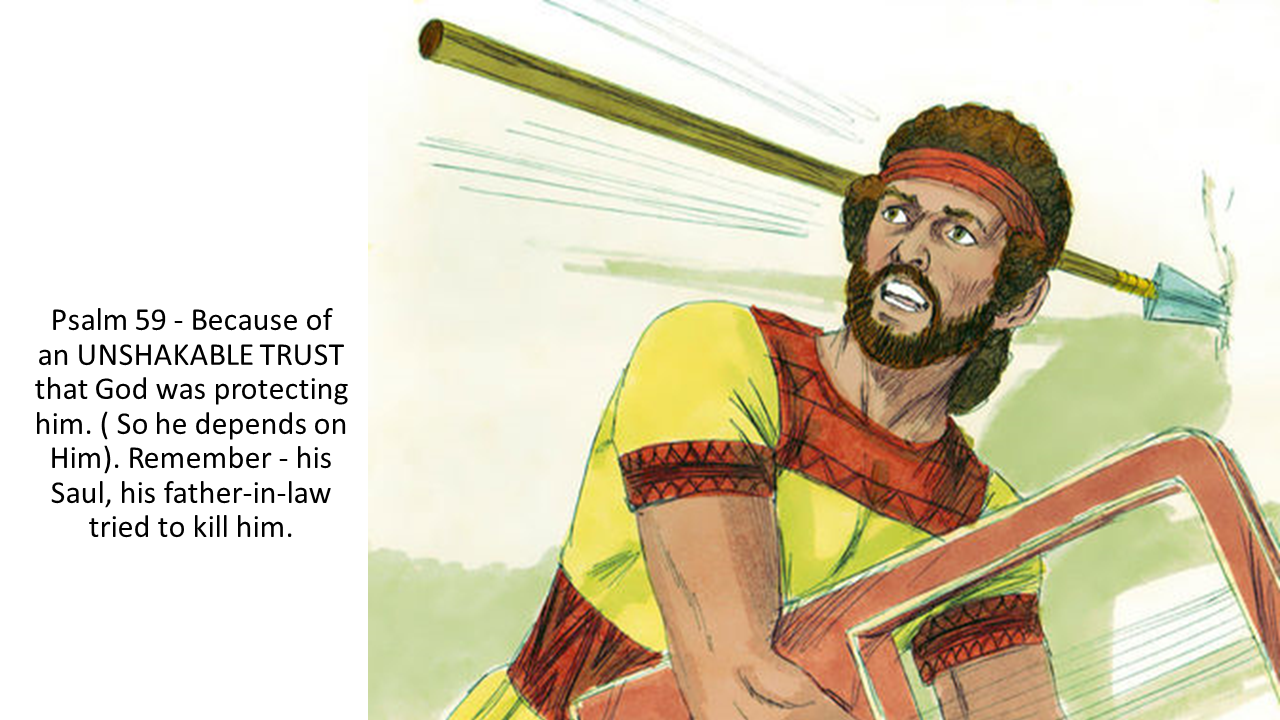
And there’s something to be learned from that. We saw also in Psalm 59 because he had an unshakable trust that God was protecting him. He had an unshakable trust that no matter what happened, even though he was the target of an assassination plot by his own father-in-law, can you imagine having that many family difficulties that not only do they not like you, but they want to get rid of you. That’s what poor David was going through. And he had this unshakeable trust that God was protecting him.
.jpg)
And so, we see in Psalm 59 that he depends on God. If you believe right, you’ll behave right. If you have the right doctrine behind you, then we will have the right obedience in front of us, and that’s why it’s so important to know and to understand, if you believe right, you’ll behave right. And he had the unshakable trust. He believed that God was protecting him. And so, the right response in that situation is to depend on God and he does.
.jpg)
And turn to Psalm 34 because David had an unwavering hope and in an unwavering hope that God was watching him. He hoped in God and he feared God. And the essence of fearing God is that God is watching him, that God is always looking on in every situation. And because of that, and because that never wavered in his life, he magnified God. As he watched Him, and we’re going to see this I want you to see this in Psalm 34 and mine is all marked up because every time I read this Psalm, it just jumps out at me.
Twenty-two specific times in this Psalm, one for every verse, David notes the fact that God is watching and personally involved in his life, and that is why he is so laid out in Scriptures as the man that’s after God’s own heart. He knew that God was watching him. And because he knew that God was watching him, and just like a child that knows their parents are watching them, and if they love their parents, they act in a special way to acknowledge that before their parents. And just like that, a dear son before his Father in Heaven. David, in every part of his life was magnifying God.
.jpg)
Let’s look at it. Psalm 34. You remember the setting for this Psalm. But let’s just get an insight of how David looked at it when he found himself confronted with a great deal of trouble and he was in the courts of the great warlord of the Philistines, and he wanted to get out of there. And so, he wrote this to tell us how he felt as he acknowledged that God was watching him. And God took him out of this. He said, I will bless the Lord at all times. His praise will continually be in my mouth. My soul shall make us boast in the Lord. The humble shall hear it and rejoice. And here’s his theme, remember God’s watching. So, what does he want to do? He said, as you watch God watching me, why don’t you magnify the Lord with me and let us exalt his name together?
So, let’s look as David can records for us, God watching him and how he responded in a difficult situation and be exalting the Lord together. How can we exalt the Lord together by acknowledging that he’s watching us in a similar way to the way David did?
.jpg)
Let’s begin the 22 specific times. I’ll just note them for you starting in verse 4. He said, I sought the Lord. Boy. We all do, don’t we? At various times. But notice what he says after that, and he answered me. He was asking something and he was waiting. He sought the Lord and he didn’t just drop it there. He said, and He answered me. He always sought God in fearful times, and he always waited for an answer.
It’s like an echo. You don’t ever hear an echo if you don’t wait to listen for it. And that’s how prayer is. God is going to answer. He’s going to answer with silence. He is going to answer with no, or he is going to answer with yes, but he’s going to answer. He hears us, we are his children. And David says, I sought the Lord and he answered me.
He said, he’s watching me and I’m going to magnify him. He said, not only that, but he delivered me. God’s watching. He’s super intending all this and David comes and he says, Lord. And the Lord answered, and the Lord answered by delivering him from all his fears. He still went through the trouble. He still went through the distress. He still went through the fears, but God delivered him from them. There’s nothing wrong with fearing. It is wonderful when your children fear and they run into your arms and throw their arms around you and just hold on tight. That’s what it’s all about. That’s being delivered out of our fears.
Look at the third one. It’s beautiful and they look to Him and were radiant. You see? He said, I know you’re watching me, so I’m going to look at you. I’m going to look at you, and I’m going to be radiant in my times of distress, I’m going to magnify you. Because when it gets hot, when it gets hard, when it gets difficult, I’m going to look up. I’m going to acknowledge who’s in control. And he says their faces will never be ashamed. Here’s another one. This poor man cried, and what does he say? And the Lord hurt him. And the Lord said that He said, blessed are the poor in spirit. Same idea here. He had a proper view of himself. This poor man cried. And what? The Lord heard him another one that’s beautiful and saved him out of all his troubles. You see how he keeps putting the emphasis on magnifying the Lord? He says, I know you see me and I want everybody else to know that you see me, so you save me out of my troubles where’s he always putting the focus off from himself, off from his fears, off from his troubles, and he’s swinging it up and magnifying the Lord.
Verse 7, another acknowledgement that God is watching the angels of the Lord and camps around those who acknowledge He’s watching. That’s those who fear Him. Those who respond in their life by acting differently because God is watching those kind of people. Angel of the Lord is encamping around about them. Do you see the magnification of God? Acknowledging that the Lord is encamping around us and rescues them. Isn’t that beautiful? Oh Lord, I want to magnify you. You’re encamping around me and you’re going to rescue me. Now, sometimes this rescue might be just taking us out of the situation. Sometimes it’s delivering us through the situation, and sometimes it’s letting the situation grind us right down to a pulp so we’ll not be self-sufficient. But he’s going to deliver us out of that situation.
.jpg)
And then he talks next to magnify the Lord and to acknowledge that the Lord is watching. He talks about the personal experiencing of God and this marvelous, look at verse 8, oh, taste and see that the Lord is good. And he said, God, you’re watching. And so, I’m going to tell people that they should taste and see that you’re good because I’ve experienced that and I want them to too. How blessed is a man who takes refuge in Him. Marvelous David takes refuge in God. He’s talking again about the fact that God is watching and if God is watching at the appropriate moment, when a refuge is needed, refuge will be there and refuge will be found.
What’s another one? Verse 9, fear the Lord. He was practicing the presence of God. He was saying, I know Your presence is with me, and I’m going to acknowledge that he just keeps emphasizing this. For those who fear Him, there’s no want. Important concept, fearing God, lovingly acknowledging that thou God sees me. The young lions do lack and suffer hunger, but they who seek the Lord. He’s watching seek him. He wants to be a part of our life. He wants to be involved. He wants to impact things for us. Seek Him.
It’s like, having the Goodyear Blimp, flying over you all the time, scouting out for you and He’s there. He knows that it’s there and God is far removed from a blimp, but I remember from the Olympics when they were taking the torch up to the Coliseum in ’84 because the blimp was following it so the television cameras could have it. And it was always indelibly in my mind, that blimp. And I thought about the fact that God is just watching over us all the time and in tune with us and how that runner could have known that the whole world was watching Him because that television camera was on Him.
Did you know God is watching us? And He just says, seek Me. And you’ll not want any good thing. I’m standing there. I’m offering my grace like the waves of the sea, and a river, my peace can come to you.
.jpg)
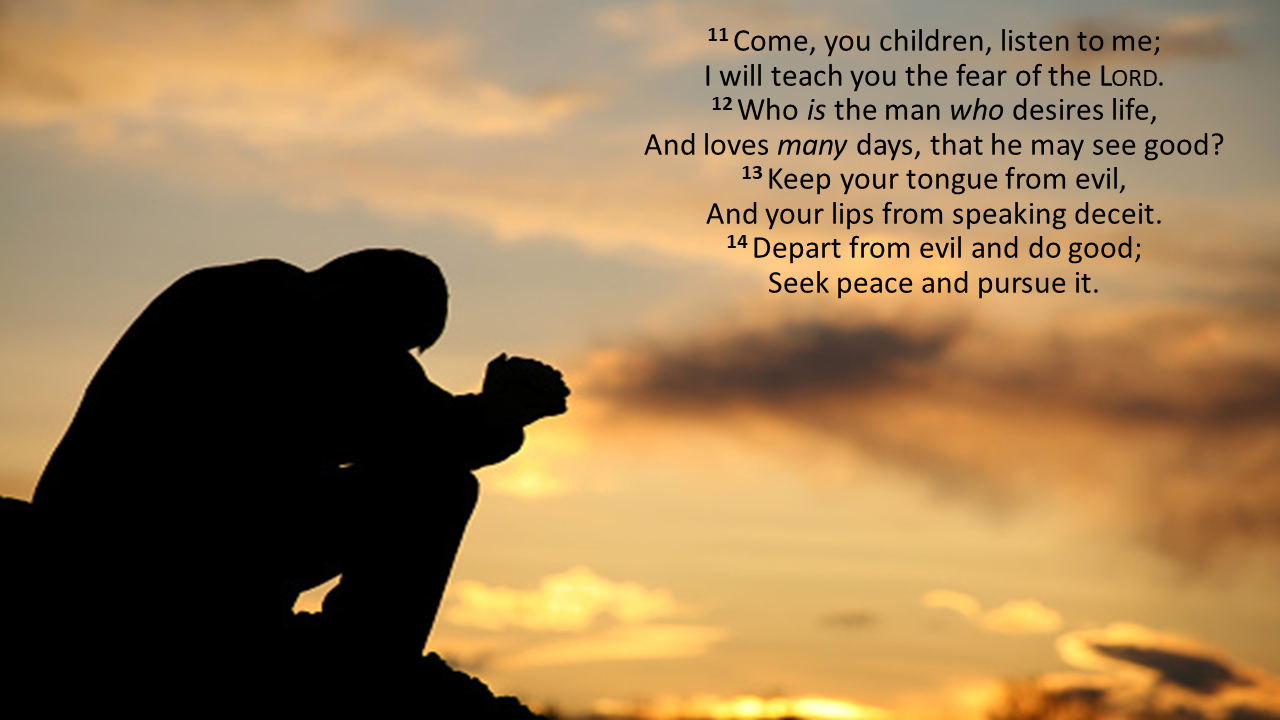
And then David continues. He says, come my children. Listen. I will teach you the fear of the Lord. He thinks it’s so important. He emphasizes it. He says, God is watching. David said, I want to magnify him.
.jpg)
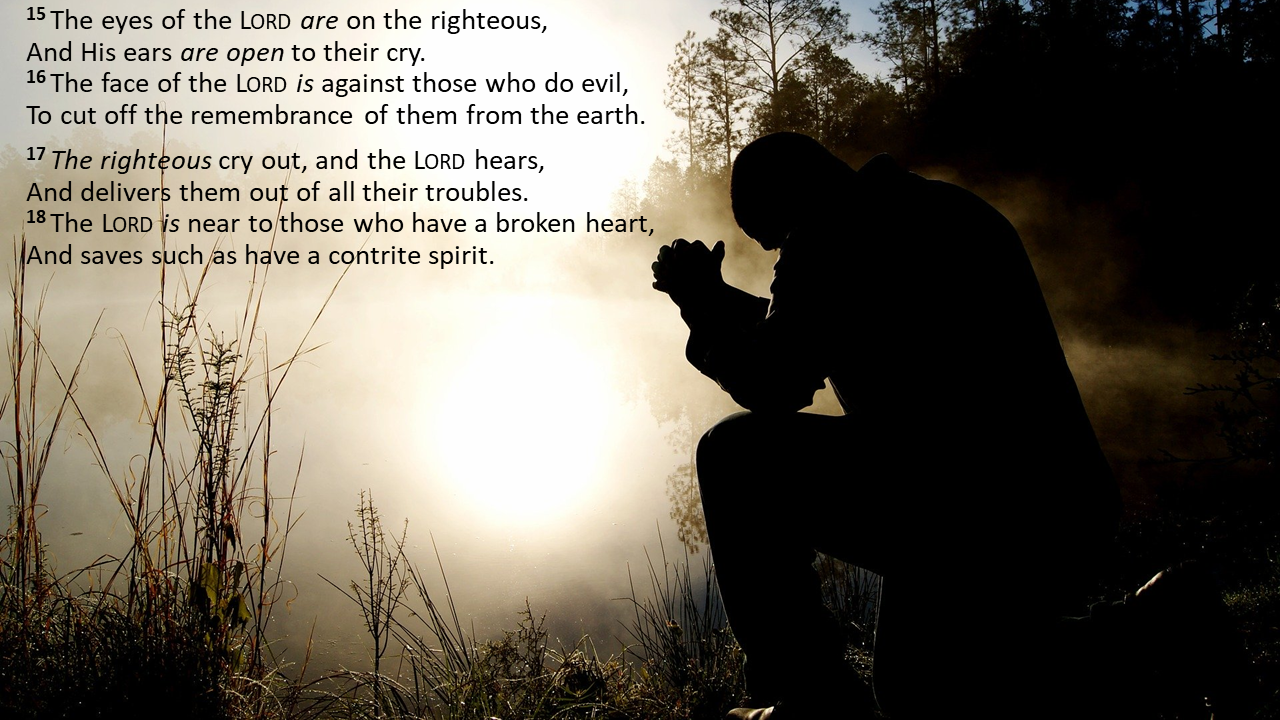
Here’s another one. Look at verse 15. The eyes of the Lord are toward the righteous. He is magnifying the Lord. He says, I want you to know He’s watching. I am acknowledging that. Won’t you exalt His name by acknowledging that His eyes are toward us?
He knew he was in touch with God. An old saint wants put it this way. He said, you and God make a majority, but sometimes we need to be like Elija’s servant who was so scared of all the people that were those enemy troops around Dothan in 2 King 6 that he started looking at the enemies. And so, he said, Lord, open his eyes so we can see the real picture. And the servant looks all around and he saw that the armies of the Lord were encamped roundabout. You know what he said right here? The eyes of the Lord are toward the righteous. David knew he was in touch; his ears are open.
There’s another one. He’s now, is he watching? He’s listening. Verse 16, he emphasizes some more. The face of the Lord is against the evil doers and who can stand when God is against you. That’s why the Lord’s days vengeance is mine sayeth the Lord. I will recompense. We don’t have to. We don’t have to get even. We don’t have to go after anyone. We don’t need to, we protract the agony. God will recompense. God will vindicate. His face will be against the evil doers to the extent that He’ll cut off their memory from the Earth. The righteous cry and the Lord hears. You see how he’s cycling through this? He’s magnifying the fact that God is watching and is directly involved, and he’s giving us every possible opportunity to understand that because the Lord hears and when he hears.
Verse 17 continues, he delivers them out of their trouble. Why? Verse 18, the Lord is near. You want to magnify God, acknowledge that he’s near, acknowledge that he is the unseen companion, the un often acknowledged partner in every single thing we do, and therefore, if we want to exalt his name, we just have to acknowledge Him. That sure resolves a lot of things that we have questions about. The Lord is near to the brokenhearted. He’s near. He’s watching. He’s present. His presence is with us. He wants us to be in touch with that. He saves those who are crushed in spirit.
.jpg)
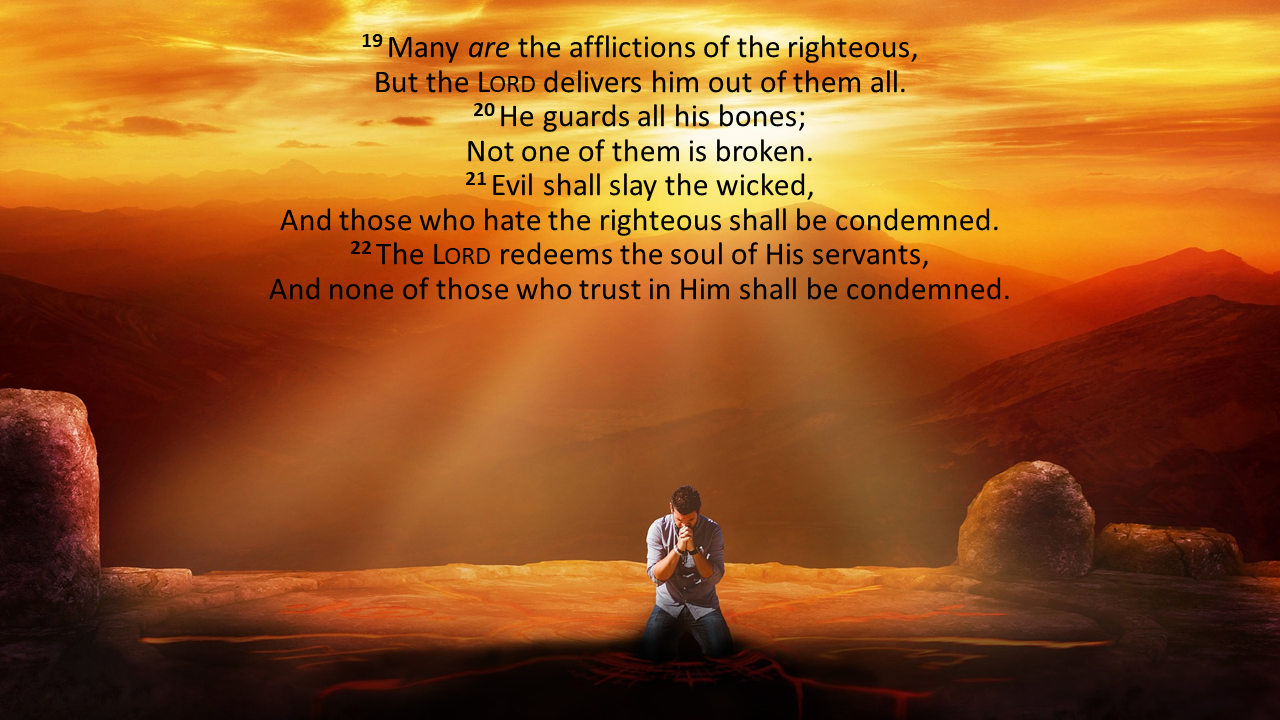
Verse 19, he delivers them. Verse 20, He keeps them. Verse 22, he redeems the soul of His servants. And then here’s the ultimate and final expression, and none of those who take refuge in Him will be condemned.
David is saying in this whole Psalm, through a great time of distress in his life, God is watching. God is very much a part of everything I do, and I just want to magnify Him because I have ultimately taken refuge in Him. So out of a difficult time, out of a time when He was running for His life, acting crazy like a madman before a Philistine warlord, David is saying, I’m taking refuge in God.
.jpg)
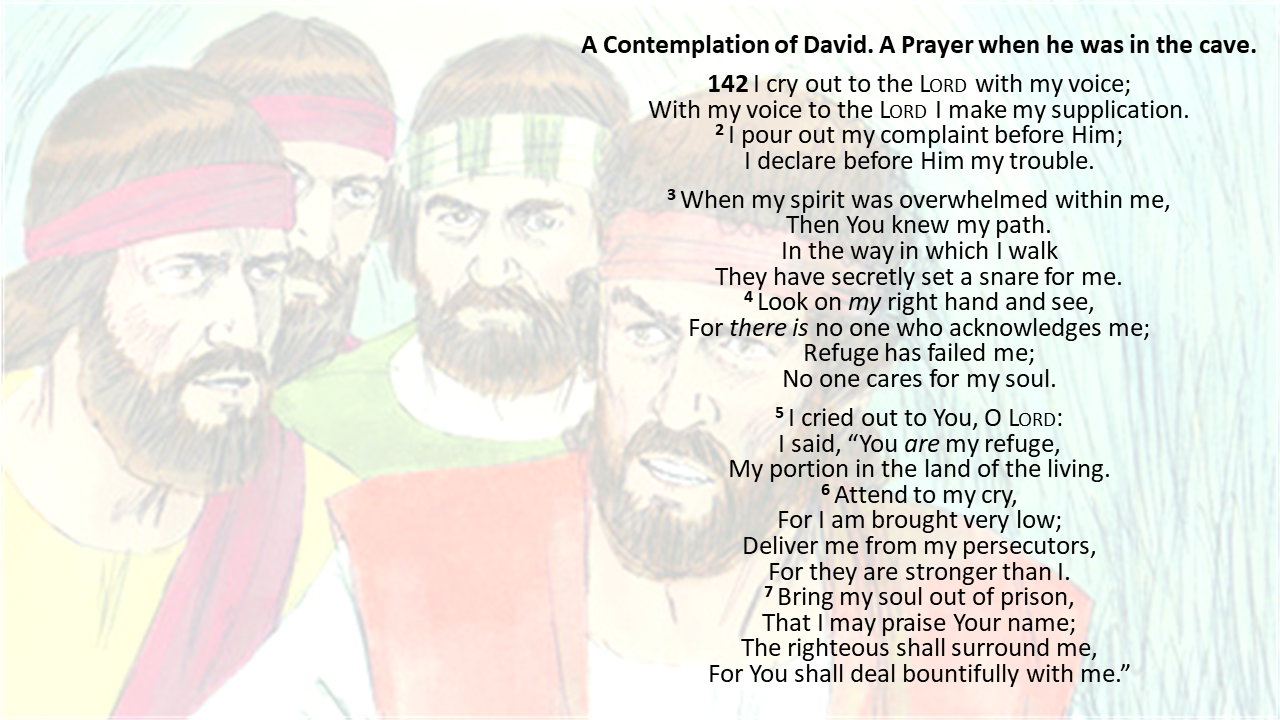
Let’s turn over to Psalm 142, and that’s really our focus. And let’s look at the fact that because of his unmistakable awareness that God was hearing him, he calls on God because he not only knew that God saw him. He not only had a great concern that God’s name be honored, he not only trusted that God was going to protect him, but David in this Psalm demonstrates in a mighty way that God was listening to his cry. And when you go out of here, why don’t you remember one thing from Psalm 142 that when we cry, God hears that when you cry, God hears. And then when you go through difficult times, when you go through hard times, when you feel like life is just getting into a cycle, when you feel like that there is trouble at every hand.
Listen to David’s emphasis seven times. He says it in his Psalm. He expresses the fact that he had this incredible unmistakable awareness that God was hearing him. And when you know that God is hearing us, then we’ll call on him. Just like when we know he’s watching us, we’ll magnify him. And just like we, when we know his name is to be honored, we’ll stand up for him. And just like we know that when we’re supposed to trust in him, we’ll depend on him. Do you see how when you know the right thing, you have the right response? And that’s why we have to keep emphasizing it, that God wants His name honored. So, we should stand up for Him. That God wants us to trust in Him, so we should depend on Him that God wants us to know that he’s watching us.
So, we should magnify Him in every action in our life. And God wants us to know He hears us, so we should call on Him and talk to Him. And that’s what David does here in Psalm 142. Listen.
.jpg)
I cry aloud with my voice. He really meant that. There’s something to praying out loud. Did you know that a bestseller of a generation or two ago, Hannah Whitall Smith wrote that little book, the Christian Secret to a Happier Victorious Life, something like that. She, you could distill that whole book down into the little phrase, Jesus saves me now and her whole teaching is to say that all the time. Jesus saves me now. Jesus saves me. Now Jesus saves me. Now Jesus saves me now even to the point of saying it out loud. Now, all the baggage that goes along with the deeper life movement don’t carry along with you, but that concept is excellent. Jesus does save us now and we need to cry aloud to Him.
The next part of verse 1, look at this. I make supplication with my voice to the Lord. He’s saying, He’s hearing us talk to Him. That’s why we emphasize prayer here. That’s why we have concerts of prayer and concerts of worship and praying in the morning. Praying the evening is so important to cry to the Lord. He hears us, right? What a blessing to speak and know someone’s listening. Every time I go to foreign country and see, I remember that giant Buddha, 70 feet tall, hollow, and all these people are in front and they’re just, whoa, whoa. You know what I thought? Nobody’s home. Nobody’s listening. There’s nobody there. You’re burning your incense and putting your food there, and there’s nobody listening. God is, I cry aloud. I make supplication.
Verse 2, look at this. I pour out my complaint before Him. He wants to hear it all. Tell it to Him. Remember that song? Tell it to Jesus. Tell it to Jesus. He is a friend. That’s so true. Pour out our complaint to him. Declare. He says, I declare my trouble. You get the flavor of his psalm. What do you do when you’re in trouble? You let it all go inward and get bitterness and ulcers and everything else? No, cry aloud to the Lord. Make supplication with our voices. Pour out our complaints. Declare my trouble. Look at verse 5, I cried out to the Lord. Again, in verse 5, I said to the Lord. And then in verse 7, the second line, so that I may give thanks to the Lord. He’s talking, he isn’t holding all this in, and that’s how he goes through these great times of difficulty.
.jpg)
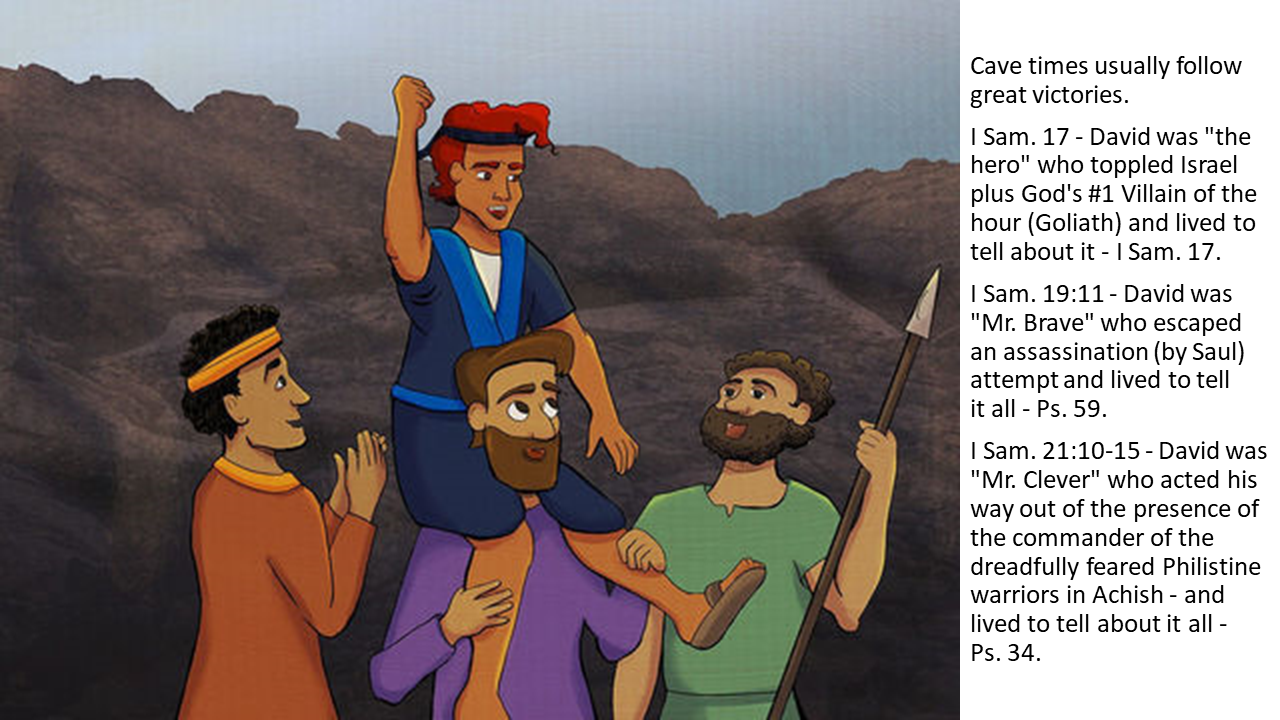
Let’s look at how David got into this fix, and I want to just introduce you to the 142 Psalm. Now that I’ve told you what it says. I’m going to show you the steps leading up to this 142 Psalm, and then I want to walk through it with you in four respects. The first thing is that usually cave times like this, like David’s in, he’s actually hiding in a cave. He’s actually, and we’re going to see that in just a second, but everything’s caving in on him. Usually, those kind of times follow great victories. So, if something wonderful is happening in your life, get ready. Get ready. The testing is coming and usually they follow and cave times and times like David’s in right now, literally hiding out in a cave or hiding out from his enemies usually follows great victories. And it did. Do you remember the great victories that preceded this time? We’ve looked at him for the last three weeks.
Number one, in 1 Samuel 17, David was the hero who had toppled Israel and God’s number one villain of the hour, Goliath and David lived to tell about it, and the whole nation started singing and clapping. If you ever heard the Jewish people sing and clap, it’s amazing. And I can just see them all running around through tambourine singing. Saul has killed his thousands, but David has killed his 10 thousands, and the whole nation knew about it. Usually these kind of times. I usually follow great victories for Samuel 19, which is recorded in Psalm 59, which we’ve already talked about.
David was Mr. Brave, who escaped an assassination attempt and lived to tell the whole world about it in Psalm 59, and that was another great victory. He escaped an assassination. He escaped the giant Goliath. Great victories. What we just talked about in Psalm 34, David was Mr. Clever, who acted his way out of the presence of the commander of the dreadfully feared Philistine warriors and lived to tell about it in Psalm 34. This guy is a hero in every sense of the word. He’s almost invincible in war. He can single handedly with a little tiny strap and a couple of rocks, knock out a tank Goliath. He can nearly survive anything. Even an assassination attempt in his own house by his own father-in-law with all the soldiers. He can even march right into the courtroom of the Philistine warriors and march back out unscathed. Great victories in his life.
.jpg)
But turn to 1 Samuel 22 because I want you to see what happened back to 1 Samuel 22 and you won’t understand Psalm 142. Unless you see 1 Samuel 22, those first two verses, and that’s what’s so important about really looking deeply into the background of some of these Psalms in David’s life, because it’s only when we see what he was going through, can we understand why he’s saying what he’s saying?
We have to understand, first of all, that these kind of times usually follow great victories in the life. It’s like God’s refining to make sure that we don’t think that those victories come from us. And in 1 Samuel 22, those first two verses introduced for us, Psalm 142 and also Psalm 57, Psalm 142 is introduced most aptly by these two verses. So, David departed from there. Where did depart from? If you notice that chapter 21, starting in verse 8, is all about going before Achish. Remember that Philistine warrior and David March is right in there for refuge? And all of a sudden, this court of this warrior say, wait a minute, isn’t this the guy that, that everybody in all the newspapers and on the radio and everybody’s singing, he’s killed 10,000 Philistines. We’re Philistines and ol’ Achish says, my this guy’s right here. And David got scared and he backs out.
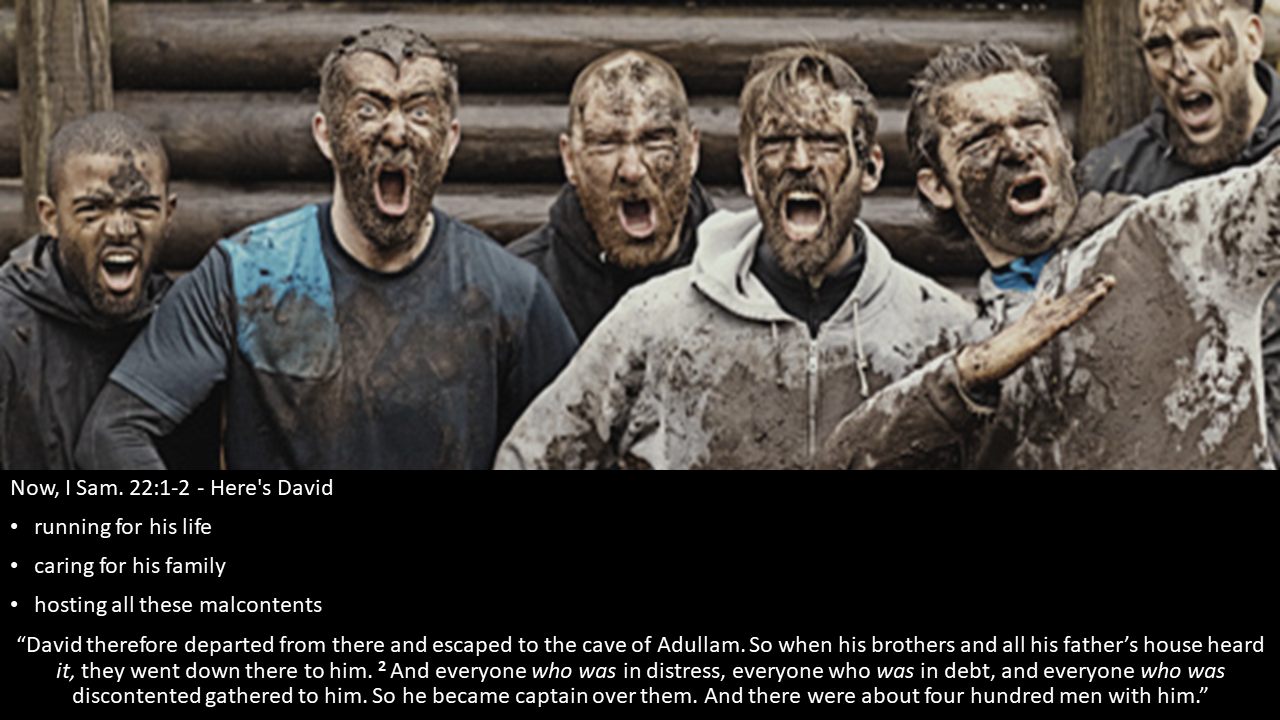
And after that great kind of exit, we find verse 1 of 1 Samuel 22. So, David departed from there, he departed from Philistia and escaped to the cave of Adullam just around Bethlehem out in the wilderness, out in the, what we would call desert the badlands. He sneaks from the coast, walks through over the hills, and comes to this very special cave, but he doesn’t come alone. When his brothers and all his father’s household heard of it, they went down there too, as if it wasn’t bad enough to be hiding out for your life, to have all the family come tromping along, you know you’re trying to hide. They all come in the cave, but they’re not enough.
Look at verse 2, and everyone who was in distress and everyone who was in debt. Isn’t that amazing? They ran up their MasterCards or whatever and they went running down to the cave, everyone who was discontented, and they gathered to him and he became captain over them. Now there were about 400 men with him. Can you imagine being in a cave with 400 malcontents? Family members, people that were in debt, people that were in distress, they were stressed out and they came down to you. That’s the setting of Psalm 142 and turn back there because we’re going to close by looking at three more points.
We saw first of all that Psalm 142 comes about because usually these kind of times of caving in or of hiding out, usually follow great victories, and now we find David in Psalm 142, running for his life, caring for his family, and hosting all of these male contents in a cave. What I’ve thought about is just what it must have smelled like in that cave. These people, if they were malcontent and in debt, they probably had no money to buy new clothes or Zest soap, or whatever the current soap was. So, I can just imagine hosting all these people. What an assignment!
.jpg)
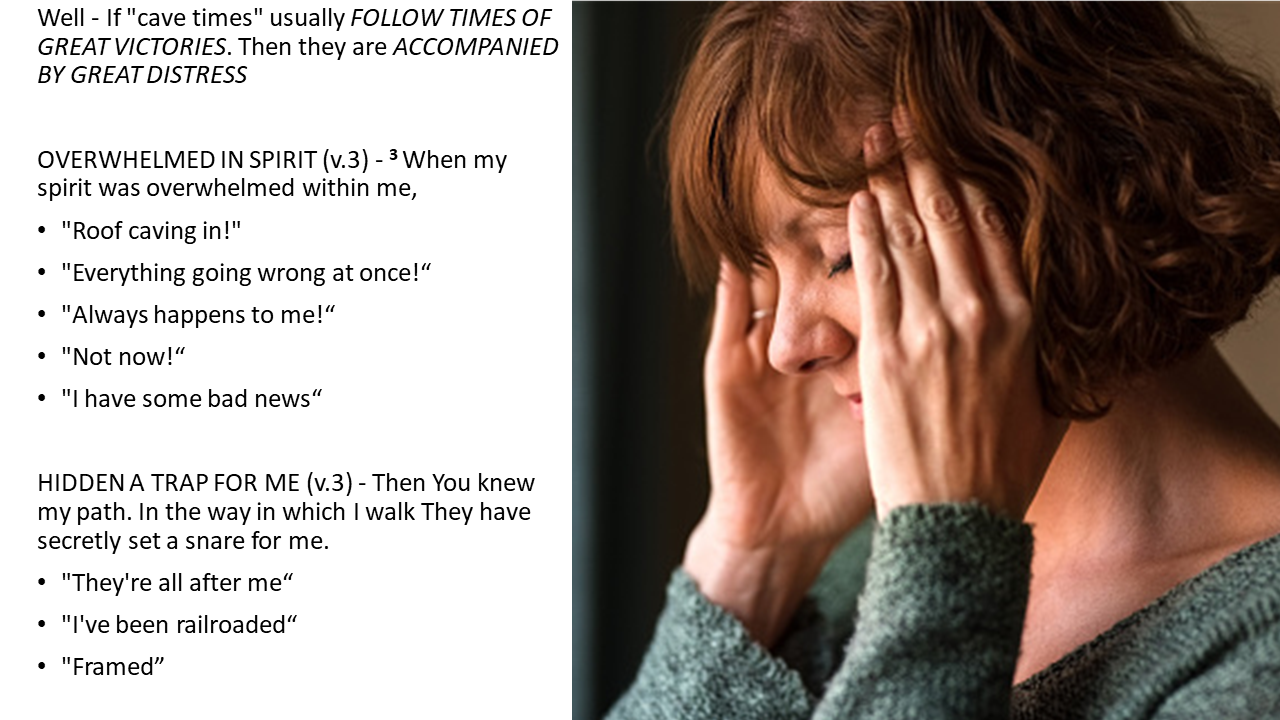
How’d he do? If cave times are usually following times of great victory, then they’re accompanied with great distress. I want to look at that with you in this Psalm. I want you to see as David records the incredible distress that was upon him as he was in this time in his life and see if you can relate to it. Verse 3 says, first of all, he was let me read it to you, verse 3, when my spirit was overwhelmed within me, how do you know if you’re getting into this time in life when you’re in a cave time in your life, you know when you’re hiding out, when all the malcontents are coming?
The first sign is your spirit is overwhelmed, kind of like you get too many circuits going in and it blows the fuse. Your spirit is overwhelmed. There are some expressions that go along with this overwhelming in spirit. People start saying, oh, the roof is caving in on me, or everything is going wrong at once. Or you hear people say, it always happens to me. Or here’s the familiar one, when the phone rings, they say, oh, not now, like your mother-in-law’s coming for a month or something like that. Or the doctor says, I have some bad news for you about your wife, or about your children, or about you. And there’s just that looming overwhelming in spirit. And that’s the first great distress that accompanied David in this time.
And then the next one is at the end of verse 3. It says, thou just know my path and the way where I walk. For, they have what? Hidden a trap for me. See what happens, you get into these times of great distress and your spirit gets overwhelmed and all of a sudden you start feel like feeling like they’ve hidden a trap for me. And you hear people saying these things like, they’re all against me now, or I’ve been railroaded, or the one we’ve all heard, I’ve been framed, they’re just setting me up for this. And we start getting that feeling like, like there’s a trap. And if I just take a wrong move, they’re going to get me.
.jpg)
But look at verse 4. because here’s the next great distress. Not only this overwhelming sense, our spirit dampened. And not only this weariness and fearfulness of the trap set but look at verse 4. No one regards me. Do you see that? Right in the middle? Look to the right and see. For, there is no one who regards me and I can just hear David saying this out the door of the cave, you’re all this rustling and moaning in the background. All the poor people and all the malcontents in his family and they’re pushing around in the cave.
And here’s David standing at the cave mouth looking out, wondering when Saul’s going to figure out where he is. And he says, I look to the right, I look to the left, I look all around and no one cares for me. Here I’ve delivered Israel from all their enemies that I could. I’ve slayed 10 thousands of Philistines, the dreadful scourge on Israel, and now I’m running for my life surrounded by this band of nobody’s. And he says, nobody regards me.
You ever get into that time in your life? Something goes wrong, and here’s the kind of phrases we say. Nobody even called you, ever said that. I didn’t even get a card. You’re getting into this time of life, or you say I guess I’m a nobody. Nobody recognized me. We start feeling poor me. We sit around and before long we say I’m all alone. It’s kind of like the Elijah Syndrome, isn’t it? Remember he goes trotting off out into the wilderness and he gets into the cave and he says, I’m all alone. And one woman was chasing him and the great mighty prophet that called on fire from Heaven runs and hides in a cave and he wouldn’t get out of that cave. You remember the story and the great wind goes by and the fire goes by, and finally a still small voice comes and says Elijah, don’t you know I’m with you? And also, there’s 7,000, they haven’t bowed their need of bail there with you. Why are you getting the poor me syndrome? I’m all alone.
David continues. He really mirrors all the needs of our heart because he says, no one regards me. We looked at that and there is no escape for me. Do you know that sinking feeling when you hear some words like these? I’m sorry, sir, you’re too old for that position. No escape. Or I’m sorry but the qualifications for this position require that you have and you realize that you’ll never be able to meet those qualifications, go back to school, get that degree. You all of a sudden realize you’re trapped and there’s no escape. And you get that sense that it’s a one-way trip to nowhere and you’re never going to get out of the mess, out of the debt, out of the swirl, and you start feeling like David did. He said, there’s no escape for me. I’m here. The whole nation must be against me at least all his soldiers are against me, the Philistines are against me, and I’ve got all these malcontents that are bugging me. And he said, here I am.
And here’s the bottom line. This is the conclusion of the accompanying great distress that comes in these kind of times in our life. The very last phrase of verse 4, no one cares for my soul. I want to tell you; this is a marvelous point to get to because wait till you see the transition. When the roof had fallen in, when everybody was against him, when he had thought through that he was all alone, that there was no escape, that nobody cared about him, that traps were out there. It was a minefield, and his spirit was overwhelmed. We now come to the third marvelous facet of going through these cave times in our lives.
The first one was remembering that they usually follow great victories. We immediately forget about the great victories, don’t we? We forget about the great blessings. We forget about that hither to the Lord has provided, and the Lord will provide. We just get down in the what Bunyan called the slow of despond despair, but something marvelous happens and the third facet of cave times is.
.jpg)
And in David’s life, it showed that cave times accomplished great discoveries about God. And if you haven’t ever thought about this loneliness and despair and this type of time coming into our life is a time when God takes everything else out of our life so that he can be the closest if we’ll let him.
You ever been lonesome? Do you realize that God took everybody out that you would recognize so that He could be the closest? Off in school or off a business trip or just sitting in your house and nobody calls. That’s when God says, I want to accomplish some great discoveries about myself through you.
And in verse 5, we have David and he sure finds an awful lot. In fact, he finds, I see seven specific discoveries about God that you can find when you’re in the cave. When you’ve got the malcontents behind you, when you’ve got the traps out in front, when no one cares for your soul, when there’s no way out, when your spirit is overwhelmed, God is saying, I want to accomplish some great things in your life, and let’s look at those in verse 5.
Let’s see the great discoveries that this cave testimony, the confessions of a cave man. What did he discover about God? He’s confessing for all time in this Psalm inspired by God’s Word. What did he find? Verse 5, I cried out to the Lord. I said, here’s the first one. Thou art my refuge. It wasn’t the cave that was protecting David. It wasn’t the 400 guys behind him that was protecting this fell. It wasn’t his great reputation. You know what he discovered in the cave? There’s no place he could hide except one. He said, Thou art my refuge, you’re the only true refuge. And he sure knew what it was to be on the spot. He said, God, You’re my refuge, Thou the eternal God art ever present my refuge.
All of us know a little bit of what that’s about because the ultimate refuge is the Cross of Jesus Christ. His blood is that ultimate covering so that we will never have the wrath of God on us. But do you realize that the same God, he the spared, not His own Son, but delivered them up for you? How shall we not freely with him give you all things, right? If we know the great refuge of salvation, we can know the refuge in the difficult times in our life, but he doesn’t stop there.
The second one is. My portion. My portion. Do you realize that God has a just a specific little package just for you of what you need right now? Your portion, right? You have children? I have children. I’m used to this. Estelle gets that many, John gets that many, bonnie gets that many and I get the rest. That’s how it is. And then James eats all mine up. That’s what I mean about a portion. As parents we know what they need. We know how much sleep they should get. We know how much food they should get.
You know how much excitement you should let them have so they won’t get too wound up. You know what, who knows better? And David made a great discovery about God. He said, You are my portion now. You’re just what I need. And God give us not His Spirit by measure, God gives us everything we need. He gives us our portion, and if it’s a big one, then we got it. It’s a little one. You’ve got it. He’s our portion for whatever depths we might be going through. Keep going. Give heed to my cry for I’m brought very low. Deliver me for my persecutor, for, they’re too strong for me.
Listen, here’s another one, the third one. This is beautiful. He said, God’s listening. He’s my listener. I like to put that whole sixth verse is Thou art my listener. Or you could say, Thou art listening. Because David already felt that nobody cared for him. He already felt that no one regarded him. He felt there was no escape. He was overwhelmed. And you know what he says in verse 6? He said, give heed to my cry. I’m brought very low. Deliver me for my persecutor, for they’re too strong for me. He said, You’re my listener. And if nobody’s on the phone, and if you can’t get through, and if the line is busy to everybody on Earth, remember that you have a listener. Remember Psalm 34, remind us of that. God is listening. God is watching and he’s bowing down His ear.
Here’s the next one, and the fourth one is in verse 7. Bring my soul out of prison. You know what he said? Thou my deliverer, you’re the only one that can lead me out in triumph. Isn’t that beautiful how it says, Paul said in the epistle to the Corinthians, he says, but thanks be to God who always leads us in triumph. He is leading us out as our deliverer. He is the one that takes us out of the prison that our soul gets in sometimes as we get shackled in by all these times in our life.
And then he continues in verse 7 and gives us the next one. He says, not only are You my refuge, not only are You my portion, not only are You the one that’s listening to me, not only are You the one that’s delivering me, but he said so that I may give thanks to Thy name. You know what he affirms here? He affirms his object or his focus of worship. He said in the cave, with everything going wrong, he said, I made a great discovery. He said, I can focus everything, my worship, my adoration, my all on You. We forget that we look down, we get like Peter and we look at the waves and we sink. But he said, I want to give thanks to Your name. I want to focus on You. The Lord’s loving kindness never cease. His compassion never fails. They are new every morning. Great is Thy faithfulness. The Lord is my portion. David echoes that.
.jpg)
And then finally he says this, verse 11, be exalted above the heavens, oh God. He said, out of my cave, out of my cave world, out of my darkness, he said, be exalted above the heavens. Let Thy glory be above all the Earth. He said, amen. I’m out of the cave. He said, even though I’m physically still here, he said, let thy glory be above the heavens. Let thy glory be above the Earth. And he said, and that’s much higher than my little cave. What were the confessions of a caveman? His confessions were that they usually, those times followed times of great victory. Usually, they were accompanied by very great distress. The whole world comes crashing in. Nobody cares about us, as he said, but they’re accompanied by the opportunity to make great discoveries about God.
Are you making any great discoveries about God? Or does He have to take us through the valleys to get our attention? Be gracious to me, oh God, be gracious. Be my refuge, oh God, be my refuge. Accomplish my deliverance, oh God, accomplish my deliverance. Save my soul, God, save my soul. Establish my heart. Make it steadfast. Oh God, establish my heart. Make me sing your praises, oh God, make me sing your praises. Make me thankful, oh God, make me thankful. Open for me an opportunity to praise I name to the nations. Be loyal and let me see your loyalty, oh God, your loving kindness. And then you will be exalted above the heavens and above all the Earth, but great lessons to learn from down times.
I hope that you’ll mark up and you, Psalm 57, in the Spirit of 2 Corinthians 1, where the apostle says this, that the comfort where with you have been comforted, you might also be able to comfort others. That’s why we learn God’s Word, that the way that he has mediated it to our hearts through His Spirit. We might use it in the lives of others.
.jpg)
Let’s bow for a word of prayer and thank God for His great blessing upon us. Oh Lord, we magnify Your name. We look above and beyond the difficulties of this life. Father, we look and see that even in our midst, that there is turmoil and unrest even in the cave, there are those who, because of whatever reason, because of difficulty, because of uncertainty, because of misinformation, because of whatever forces are preying upon them, our breathing fire, we pray that as all of us suffer together as a body, that we would know that this is a time to discover great things about You. This is a time for us to test the spirits and see if they’re from You, and then to not allow our focus to be constantly down here in the cave, but to exalt Your name above the Earth, above the heavens, and make some great, impactful discoveries about You.
I thank You that You have led me thusly. And that these times of distress are only refinements to even greater discoveries and awareness that this is Your place of choosing for us. Help us to minister with all of Your gracious, powerful compassion in this place. And may we together learn even through difficult times as we face as a Church to be able to say you’re. Faithfulness is above the Earth, it’s higher than the heavens, and we will magnify Your name for Jesus’ sake. Amen.
Notes
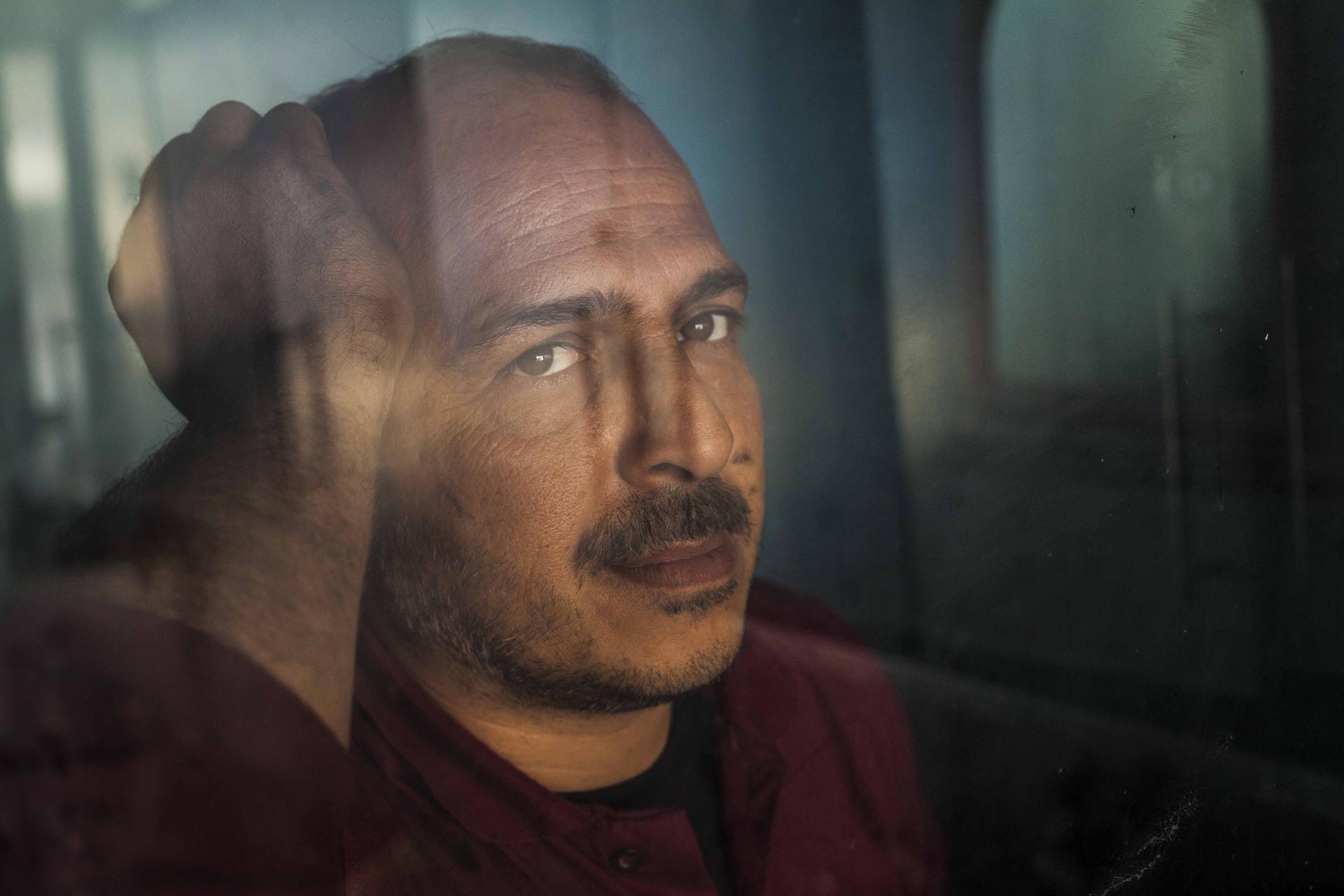 Ever felt prehistoric? A life reduced to grunts and groans? As one poet expressed it, “life must go on . . . I just can’t remember why”. A vicious swirl of getting up, going through the day and dropping into bed exhausted only to fall further behind instead of ahead? Trapped in a cave David babysat four hundred fellow fugitives. That’s his address in Psalm 142. From the cave of Adullam he looks up and discovers some great truths about God. So can we.
Cave times often slide in right after our victories as David discovered. As “the hero” David toppled the #1 Villain of the hour (Goliath) and lived to tell about it (I Samuel 17). As “Mr. Brave” David escaped an assassination attempt by Saul (I Samuel 19). As “Mr. Clever” David acted his way out of the presence of the dreadful commander of the Philistines ( I Samuel 21). In our text we meet David running for his life, caring for his family and hosting all these malcontents.
Cave life yields great discoveries about God. David sings them in Psalm 142. Listen to the confessions of this caveman:
- “Lord of Refuge, You are my Portion” ( v.5),
- “O Listening One, hear my cry and Rescue me (v.6).
- My God who Provides the righteous to gather about me, You are Sufficient” (v. 7).
How’s your world? Caving in? Why not look out of your need and find the courage needed in the One David found sufficient!
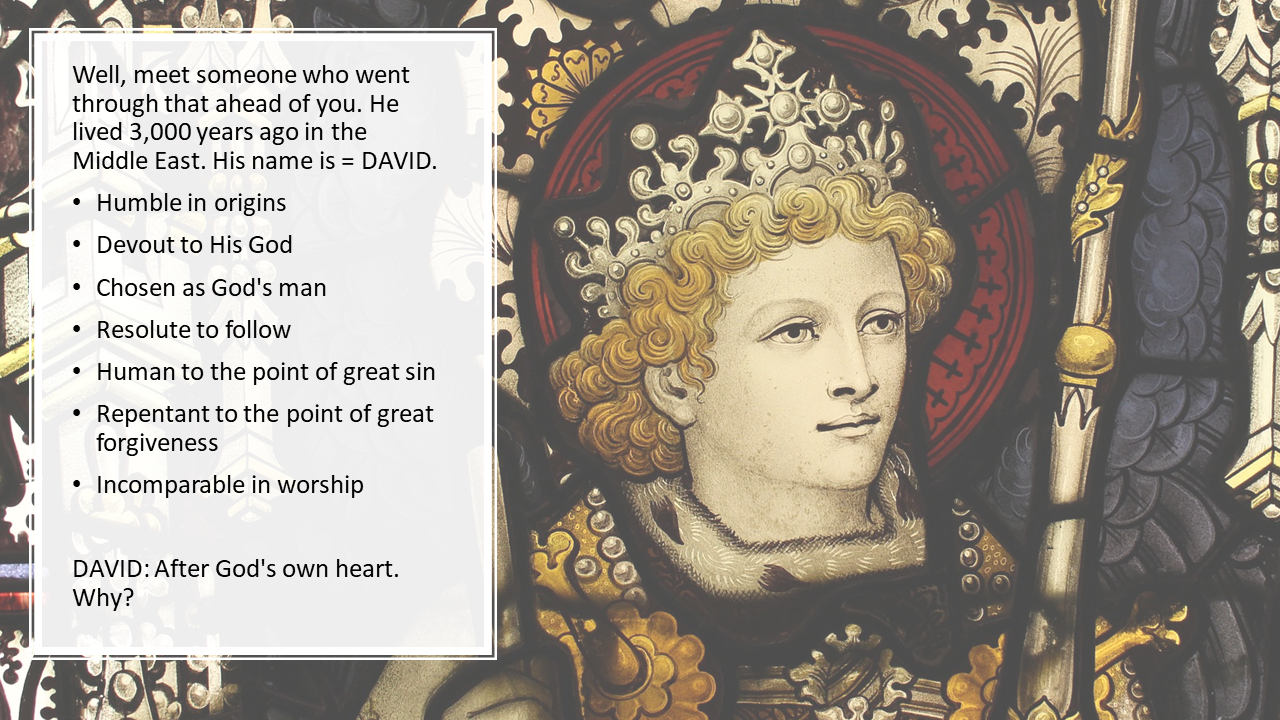
Well, meet someone who went through that ahead of you. He lived 3,000 years ago in the Middle East. His name is = DAVID.
DAVID – Humble in origins Devout to His God Chosen as God’s man Resolute to follow Human to the point of great sin Repentant to the point of great forgiveness Incomparable in worship
DAVID: After God’s own heart. Why?
1. I Samuel 17 – Because of an UNCHANGEABLE CONCERN that God’s Name be honored. (So he stands for Him.) Remember -he was the only one…
2. Psalm 59 – Because of an UNSHAKABLE TRUST that God was protecting him. ( So he depends on Him). Remember – his Saul, his father-in-law tried to kill him.
3. Psalm 34 – Because of an UNWAVERING HOPE that God was watching – so HE MAGNIFIED Him. (22 x David notes it!)
4. Finally in Psalm 142: David – a man after God’s own heart Because of his UNMISTAKABLE AWARENESS that God was hearing him… so He calls on him. (7 x David expresses THIS TRUTH). Look at Ps. 142.
Now how did David get in this fix? It was after some great days. Usually “cave times” are. They were for David!
(1) They usually follow great victories.
• I Sam. 17 – David was “the hero” who toppled Israel plus God’s #1 Villain of the hour (Goliath) and lived to tell about it – I Sam. 17.
• I Sam. 19:11 – David was “Mr. Brave” who escaped an assassination (by Saul) attempt and lived to tell it all – Ps. 59.
• I Sam. 21:10-15 – David was “Mr. Clever” who acted his way out of the presence of the commander of the dreadfully feared Philistine warriors in Achish – and lived to tell about it all – Ps. 34.
• Now, I Sam. 22:1-2 – Here’s David
• running for his life
• caring for his family
• hosting all these malcontents

WHAT AN ASSIGNMENT! HOW DID HE DO?
Well – If “cave times” usually (1) FOLLOW TIMES OF GREAT VICTORIES. Then they are – (2) ACCOMPANIED BY GREAT DISTRESS
• OVERWHELMED IN SPIRIT (v.3) “Roof caving in!”
“Everything going wrong at once!” “Always happens to me!” “Not now!” “I have some bad news”
• HIDDEN A TRAP FOR ME “They’re all after me” “I’ve been railroaded” “Framed”
• NO ONE REGARDS ME (v.4) “No one called…” “I’m a nobody” “Poor me…” “I’m all alone”
• NO ESCAPE FOR ME “One-way trip to nowhere” “You’re TOO old” “I’m sorry but the qualifications for this position…”
YES, NO ONE CARES FOR MY SOUL
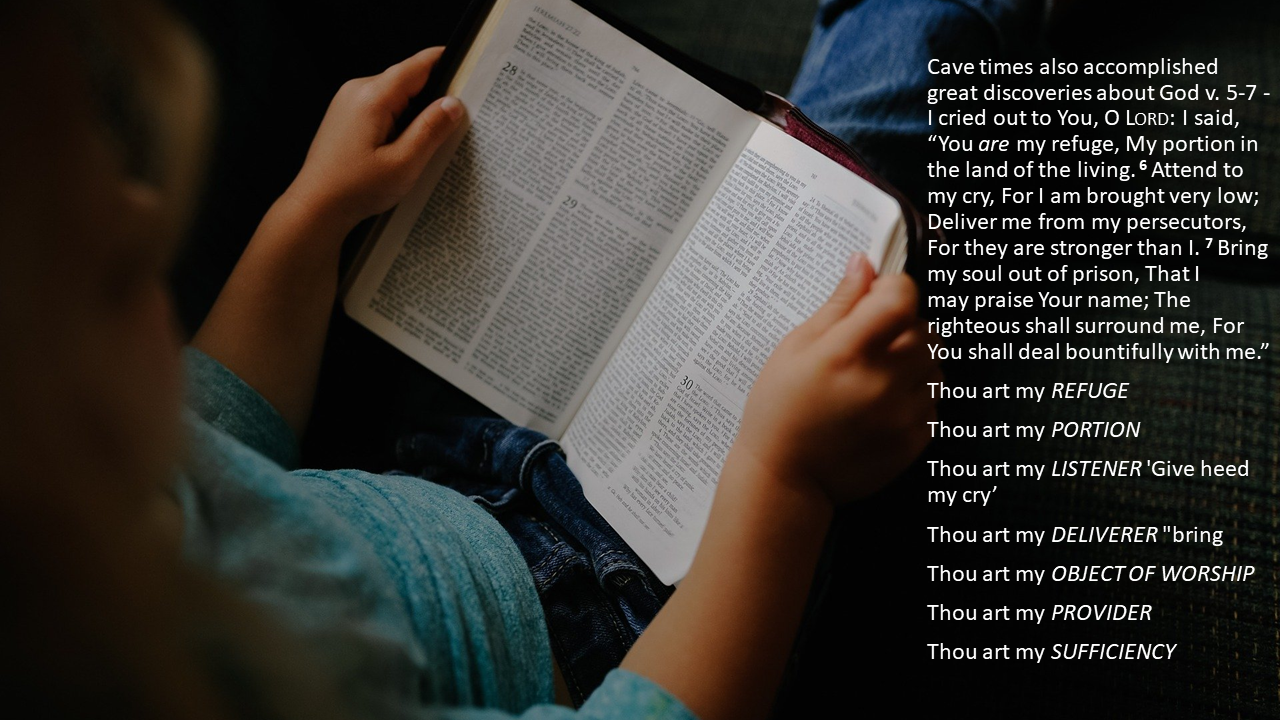
Cave times also – (3) Accomplished great discoveries about God v. 5
1. Thou art my REFUGE
2. Thou art my PORTION
3. Thou art my LISTENER ‘Give heed my cry’
4. Thou art my DELIVERER “bring
5. Thou art my OBJECT OF WORSHIP
6. Thou art my PROVIDER
7. Thou art my SUFFICIENCY
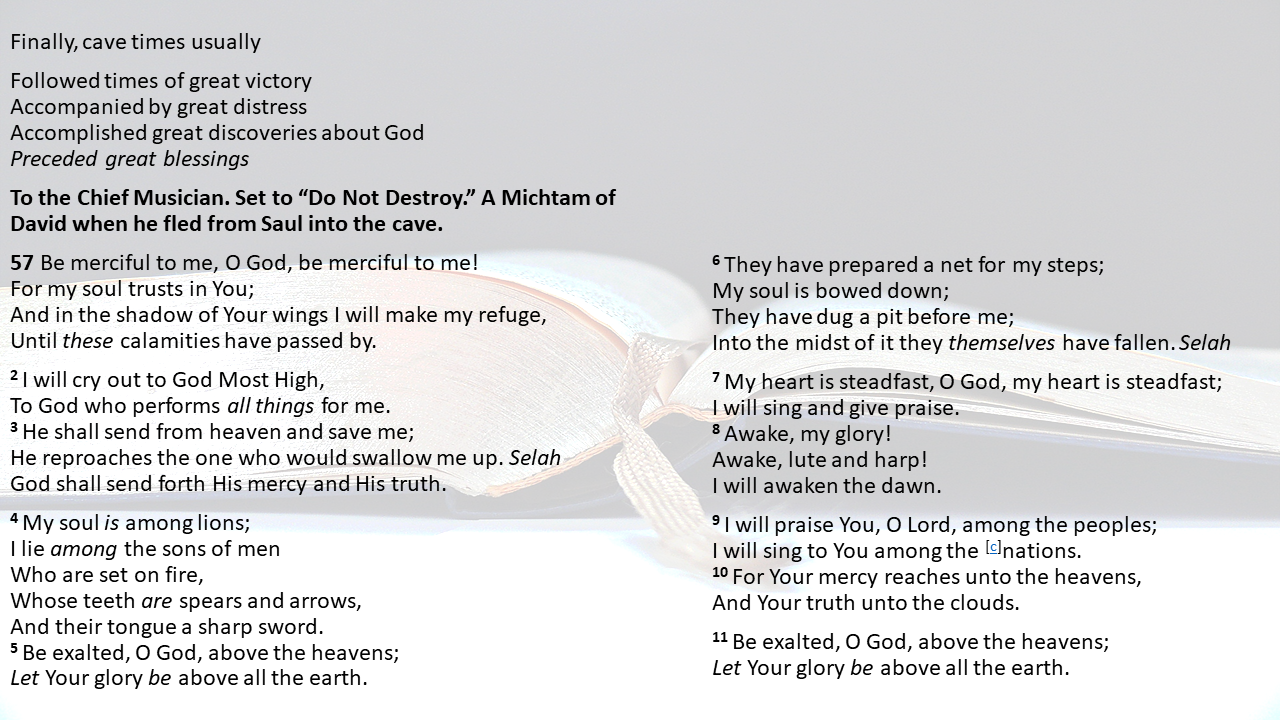
Finally, cave times usually (1) Followed times of great victory (2) Accompanied by great distress (3) Accomplished great discoveries about God (4) Preceded great blessings
Like what? Well, David went on to
• Vindication as just man
• Coronation as king
• Exaltation as warrior
• Immortalization as Psalmist
But let’s wait to next week and Ps. 57.
How’s your world?
Caving in?
 Look now and find
• FLEE TO YOUR REFUGE. Thou art my Refuge
• FEED ON YOUR PORTION. Thou art my Portion
• SPEAK TO YOUR MASTER. Thou art my Listener
• TRUST IN YOUR REDEEMER. Thou art my Deliverer
• ADORE YOUR LORD. Thou art my Object of Worship
• REST IN HIS SUFFICIENCY. Thou art my Provider, Thou art my Sufficiency
Slides





Check Out All The Sermons In The Series
You can find all the sermons and short clips from this series, David’s Spiritual Secret here.
Looking To Study The Bible Like Dr. Barnett?
Dr. Barnett has curated an Amazon page with a large collection of resources he uses in his study of God’s Word. You can check it out here.