
Christ the Key to Scripture
KGD-01 NR3-09 TAB-28 XAS-13
020407PM
Transcript
Let’s open our Bibles to chapter 24 of the book of Luke because there’s one source code that unlocks the windows of scripture. There’s one key that unlocks the door to seeing the message all the way through the pages of God’s word. That is identified for us in the book of Luke.
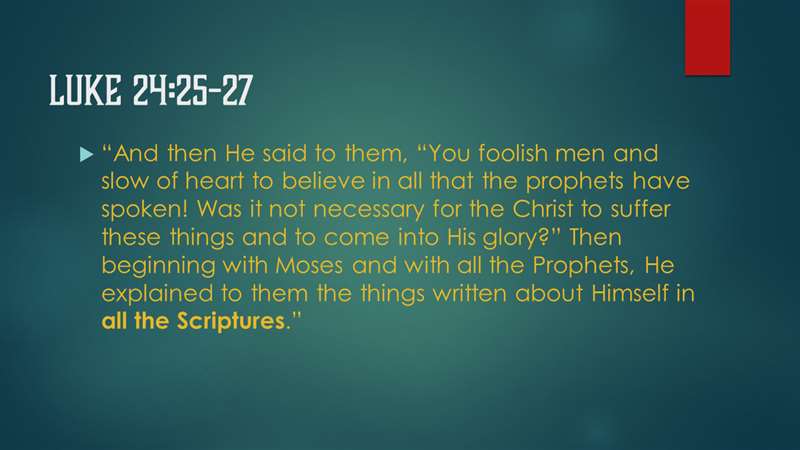
What it says in Luke 24, starting in verse 27, I want to repeat to you, Our Lord Jesus Christ, it says, began at Moses and all the prophets. He expounded to them in all the scriptures the things concerning Himself. Now, as far as we can tell, this is the only declared unifying theme of all the scriptures, so we are on a journey to get a strategic grasp of the Bible by looking at Christ in all the scriptures. Tonight, I ask you, have you seen Jesus in the bread and water? What I’m talking about is the manna and the water from the rock. So, let’s study that tonight in light of what it says in Luke.
Now, Luke continues and the next slide shows Luke 24 verse 25. He says you’re foolish and slow of heart to believe all that the prophets have spoken. Then he explains the suffering of Christ and the glory that would follow. Now, most of us would have trouble, other than Isaiah, really knowing where it talks about Christ’s suffering. Jesus is referring and alluding to the fact that the clearest pictures of Him are especially in the Pentateuch. They’re especially in the constant religious observance that the Jews went through. The next verse tells us that then beginning at Moses and all the prophets He expounded to them, and He opened to them. He expounded to them all the things in the scripture concerning Himself. Let’s do that this evening.
Let’s start in the book of Exodus, and what we’ll see in the book of Exodus if you want to turn there with me, see if your Bibles are marked, the book of Exodus. I’m going to go through again, this wonderful overview that I gave you of the whole book of Exodus. What I’m going to tie together, and I’ve added to it, starting in chapter three of the book of Exodus, I want you to see every one of these major scenes. Now I’m not going through all the potential types. There are people who find a type in everything. They find a type in the spoon and the angle of the spoon and everything else. I’m just talking about the New Testament described ones.
In the first 18 chapters, look what we find: Christ is in Exodus 1 through 18, first of all, in the burning bush. Now, what is the New Testament correlation to that? If you haven’t marked it yet, in the first six verses of chapter 3 we find Jesus as the voice saying I Am that I Am. Now, you say, wait a minute, I thought that was the covenant name of God, His eternal name. Yes, and Jesus is God the Son. The only New Testament personage to lay claim to the I Am statement was the Lord Jesus Christ and that’s what He said, as it says here in John 8:58, Jesus says, I Am. Before Abraham was, I Am. He claimed He was that voice in the burning bush.
Secondly, we see in the Passover, Jesus is, listen to this, He is not only the Passover lamb, He’s the unleavened bread of Passover. He’s all of it. He’s the shed blood on the doorway, He’s the lamb that shed the blood, and He’s the bread. All of that is covered in Exodus 12, 1 through 28. Christ is our Passover and that is declared in the New Testament because remember, the Old Testament is the New Testament concealed. The New Testament is the Old Testament revealed and we see it revealed in 1 Corinthians 5:7.
Thirdly, we looked at this the last few weeks, at the unleavened bread itself and that’s in Chapter 13, those seven verses. That is declared in 1 Corinthians 5:8, that our unleavened bread, that the unleavened bread, we are supposed to purge out the old leaven and Christ is our Passover. Then, at the actual Passover meal Jesus picked up the bread, the unleavened bread, held it up, and He said, this is My body. He said I am the bread of life. I am the unleavened bread of Passover, which we’ll look at even more fully as we encompass the feast.
Fourthly, we saw that Jesus was the rock that led them. I shared that with you in 1 Corinthians 10:4. Then after that, we saw that Jesus is portrayed in the Red Sea crossing and I’ll give you some verses on that. He is the one who brought them up out of the depths. Then we see that He is the manna. He is the Red Sea in Chapter 14. The whole idea, and I’ll read again to you the wonder of that celebration. That’s the celebration that they share at what we call Easter. It’s them coming up out of the depths of the sea. Then finally, Jesus is the manna and the water from the rock, which we’re going to study tonight. Then Christ is also seen in the law, and we won’t get into that very much. Finally, we will spend a long time on that last section, the Tabernacle. There is no clearer picture, declared in the New Testament and written down in the Old Testament, of Jesus Christ than we find in the Tabernacle in the temple. Unbelievable. You can never exhaust the wonders there.
Let’s get in tonight, to these pictures. First of all, do you see Him as the voice in the burning bush? In other words, do you realize He is the Great I Am? That should bring to your mind the 7 Great Statements. Remember the gospel by John was written by the same fellow that wrote the Revelation of Jesus Christ. The Book of Revelation is known for its sevens; seven seals, seven trumpets, seven bowls, and the seven this’ and that’s all the way through. In fact, there are dozens of them, even more than we realize, in the book of Revelation. Did you know the same author who wrote Revelation, who wrote John, built his whole book around seven signs, seven names, and seven discourses? There is a trinity of sevens in the book, the gospel by John. So those seven I Am’s should come to our mind right away.
Next, do you see Him as the Passover Lamb of God? Now if the burning bush reminded us that He is the Great I Am, then the Passover Lamb of God should remind us of His declaration. Because there’s a correspondence here to His seven I Am statements and what was Christ’s declaration? He said I’m the Good Shepherd, and the Good Shepherd what? Giveth what? His life. What’s the Passover? The giving of His life to keep the wrath of God from coming on us. So, there is a parallelism between the Old Testament picture, Christ our Passover, and the New Testament declaration that the Good Shepherd is the One who gives His life for His sheep. Jesus was not only the Lamb, but He was the Lamb who was the Good Shepherd of the Sheep, who sacrificed Himself in our place. So, there’s a wonderful correspondence. Do you see him as the Passover Lamb of God, the Good Shepherd? The pictures of Christ are Passover. Every time you see that Passover door with blood on the lintel and on the doorpost, you should see that as a beautiful picture of a cross. You should think of chapter 12, the Passover, always in light of chapter 6 in Exodus where God says I will redeem you with outstretched arms. Because that’s the picture of the Passover, of the redemption, of the outstretched arms of Christ on the cross.
Next, we see Christ in this question, do you see Him as the unleavened bread of communion? Do you remember that Jesus said in John 6, I Am the bread of life, I Am the bread of God come down from Heaven? He came down, non peccare as it says in Latin, without sin. He was impeccable, He never sinned because He was perfectly God in human flesh. So, He was the perfect unleavened bread because He was sinless and that’s why we should see Christ as our unleavened bread. Specifically, He’s described as the Bread of Life, He was the one who fed the Israelites in the wilderness with manna from Heaven. That’s what He wants to do for us and as I’ve said over and over again. I hope that whenever you celebrate communion you think of the fact that the Jewish matzo bread of Passover is such a picture with the pierced holes through it, with the stripes on it of Jesus Christ, who with His stripes we are healed. He was the one who was pierced for us.
Next, we studied, and I asked you, do you see Him as the rock in the wilderness that led them? In 1 Corinthians 10:4, He declared that I was the rock that led them. I was the One that got them safely out of Egypt, that I took them safely across the wilderness, and I’m the One that delivered them safely to the promised land. Now, what does that remind you of? I wrote it down. What did Jesus say? He says, If you will follow Me as the way, I’ll lead you safely home. See, the metaphor here is the rock. We don’t think of Christ too much as the rock. It says Thou art Peter, and upon this rock, I will build My church. That was one of Christ’s declarations of being a rock. But in the Old Testament, that’s a very large picture of our Lord, especially our Lord who relates to us most clearly, the Lord Jesus, as He said, I am your rock of refuge. I am your shelter. I am your exceeding high place you can go to. So, do you see Him as the rock in the wilderness that led them? What a great picture that is as Jesus being the way.
Then at the Red Sea crossing. I just want to remind you, someone asked me, they said, could you repeat it again, and I said okay, I will. There are three Hebrew festivals that are in the spring, there’s one in the summer, and there’s three that are in the fall. All seven of them are powerful pictures. You’ll hear about them so much you’ll know them. The first three in the spring are Passover, Unleavened Bread, and Firstfruits; P U F, if you want to think of it. A puff in the spring for your asthma medicine or something.
But think of Passover, that’s where Jesus Christ was our Lamb of God, who was crucified on Passover. He had to be buried before sundown on Passover because at sundown on Passover began the Feast of Unleavened Bread. The Unleavened Bread was when you put all the leaven hidden out of sight. So, Jesus, on the cross, became sin for us. He bore our sins and His body, bearing our sins, had to be put in the ground for the Feast of Unleavened Bread to keep the picture going. By the way, since God designed the picture, and since Jesus was the fulfillment of the picture, God exactly followed the Old Testament picture. So, at Passover Jesus came into Jerusalem the very day that everybody picked their little sacrificial lamb because remember, each dad had to buy a lamb for his family. Each dad had to bring the lamb to the temple. Each dad had to actually kill the sacrificial lamb with the knife given to him by the priest just like God the Father slew the Son with the knife of His righteousness, if you want to call it that. All the metaphors are there.
God was the great Heavenly Father sacrificing His Son. He did all that on Passover. That was Jesus, the Lamb of God, the Good Shepherd giving Himself. His body which became sin for us, 2 Corinthians 5:21, For He hath made Him to be sin for us who knew no sin, that we might be made the righteousness of God. That body had to be wrapped up and put and the grave to portray the Feast of Unleavened Bread which starts on the evening of Passover and goes for seven days. Now when we get to Leviticus, I’m not going to get ahead, but when we get to Leviticus 23 you’ll find out that it says in Leviticus 23, written 1,500 years before the crucifixion, says that the Feast of Firstfruits which speaks of resurrection has to be on the first Sunday following the Sabbath day following the Passover. So, it was predicted that Christ would rise from the dead in Leviticus 23, 1,500 years before the event, on Sunday. That’s the message of those first three feasts. That He, as our Passover, would be crucified on Passover, that He as our unleavened bread would be buried for the Feast of Unleavened Bread, and that He as our resurrection in life would rise at the Feast of Firstfruits.
Now, what is the Feast of First Fruits to the Jews? It commemorates the day that Israel went down into the depths of the Red Sea. In fact, if you talk to any observant Jew that really has studied all this they will talk to you about the great celebration. They came out on the other side. They marched into a watery grave. God raised them on the other bank. They went from being slaves to being a nation. In fact, that’s something to think about. I don’t know if you follow the news very much, but even this weekend the Washington Post of all places, quoted Hal Lindsey. It’s amazing that they would quote him. What Hal Lindsey said, and I’m not going to talk anything about Hal Lindsey’s moral life or anything else, but he’s a tremendous Bible scholar. Do you know what Hal Lindsay said? He said Israel is the only nation on Earth that has a title deed to their land. That happened because God took them through the sea, they were enslaved people, God released them, and God led them through that sea with the pillar of cloud and the pillar of fire. When they came up out of the sea on the other side, He established them as His people, and He made that covenant with them. They became the people of God and the nation of God so that’s what they celebrate. The Feast of Firstfruits is a foreshadowing of the work both of Good Friday, Passover, and of the Unleavened Bread, buried, and of Easter, resurrection, as it pictures the death, the burial, and the resurrection of Jesus.
That’s why I quoted to you last week 1 Corinthians 15:20 which says, And Jesus has become the first fruits. What did they celebrate? They celebrated the Red Sea crossing, coming up out of being buried in the water. Remember, they walked through with the water on both sides of them. As they walked through that channel of water it was almost like they were buried in it. When they walked up on the other side it was like they came out of the grave. It is such a picture. That’s why, if you’ve never done it, you ought to spend 25 dollars and buy the little book to learn how to read through these feasts with your family. Show them the beauty of Passover. The beauty of Unleavened Bread. Have them go around the house and purge out anything, not only figurative leaven but anything that might be defiling your home. See, that’s the whole idea of Unleavened Bread, to make sure there’s nothing in your home. No movie, no book, no music, no object that would defile your home. That’s the message where Christians can apply unleavened bread.
Well, Christ is our wonderful Firstfruits and what does that parallel? That parallels Jesus, the great I Am of the burning bush, is also the One who has said I am the resurrection and the life. I’m the One that will lead you through life, through death, through the watery grave. You can’t keep a Christian buried for very long, right? That’s the idea. A believer can’t stay buried long, right? Their body is going to be called up, as that song says, I know that my Redeemer lives. In my flesh, I’ll see God. See, that’s the message of Jesus saying, I’m the resurrection.
Let’s keep going. We looked at the sequence of events and I’m not going to explain each one of them again, but there are seven pictures: one in a row after another. This life is a struggle just like it was for them. Christ is our hope when we look to Him. Christ makes us fruitful, and that’s why this portrays the name, I am the vine and you’re the branches. These seven events here. Fourthly, the Christ who makes us fruitful will satisfy us all through life. That goes along with Psalm 91 and 92, that if we dwell with Him we will be fruitful more and more to the last of our life. The older you get, the more fruitful you should get.
Bonnie and I were observing the other day. We were talking about when we started out in ministry in California, there was a woman who was a very good friend of ours who adopted us. Her husband had been an elder at Grace and when she moved to California, she lived in a covered wagon. I didn’t know anybody was that old. I thought that was only on TV, but in the nice climate of California, when they moved, they bought an old, covered wagon and actually stayed there as they were getting established on their farm. I had no idea anybody was there. I thought the dinosaurs had died out by then. But this woman was old 20 years ago when we were at Grace. She’s still a friend of ours. She’s still quite alive. She’s in her late 80s now. You know what Bonnie said to me driving down the highway yesterday? She said, you know what? You’re young for a long time and you’re old for a long time. Aren’t there some people that seem to have been old forever? You’re surprised every year that you get a Christmas card. Are they still alive? Did you know old age goes a long time? 65 to 85, or 90 is 25 years. Are you ready to be more and more fruitful every day of your life? Are you planning on that? Just as much as there are joys of youth, there are greater joys, as it says in Psalm 92, of getting old in the house of God and being closer to Heaven. So, Christ satisfies us. Christ died once for our sins.
Sixthly, we are His soldiers. That’s the whole idea of the Amalek fight with the Amalekites. Finally, number 7, we saw His word is our guide. Specifically, with that, what we saw was Jethro coming on the scene, and he came with what we call the Jethro Principle. He was a wise man who advised Moses on how he could operate and organize the children of Israel. Do you know what’s neat? The Jethro Principle teaches us that God’s word is our guide. Now we have the sage advice and God’s wisdom revealed, through the word of God. We can actually have the benefit of Jethro’s guidance all the way through our life by looking at the wisdom of what God taught Abraham, and what God taught Jacob, and what God taught David, and what God taught us through Solomon. We can let His word be our guide. Yes, there will be great counselors through our life, but the ultimate Counselor you’re holding in your hands is the word of God. So that’s Exodus 15 through 18.
Now, very quickly the last 19 minutes it looks like on the clocks here, I’m going to show you some pictures of Christ in bread and water. Let’s start with this: Chapter 16 and turn there with me. If you’ve never marked these, we skimmed right through this when we did the feeding of the 5,000, but some of you might not have marked it down. I ask you the question, do you see Christ in the manna? I hope you do, especially after tonight.
Let’s begin by examining Jesus Christ. Jesus Christ is a beautiful picture we see in the manna. Let me just read these because this is a description, which you can’t see over there, but you can see over here, and I’ll read it to you. Here are some truths from chapter 16.
You could do a Bible study, a home Bible study, on chapter 16. Bonnie and I for years and years led home Bible studies and we taught people how to read the Bible and find things out of it. In fact, for years, our couches were always worn out by people; we had Bible studies multiple nights of the week. As we would study, people learned to discover truth from the Bible. All they had to bring was their Bible and a pen and we would study the Bible. By the end of the Bible study, I always ended it with the people that were in the Bible study becoming the teachers and going off and starting their own. Then we’d get another group. What’s a blessing about all that is, every year when we get Christmas cards, I would find out that those men, most of them, are elders in churches all across the country because they learned for the first time to lead in a home Bible study. I can’t extol enough the benefit of home Bible studies. In fact, in Discovery this morning, there was a man standing in the Discovery class who said that he was discipled at this church a quarter of a century ago or so, in home Bible study. He said that home Bible study in this church grew from a few to 70, and it split and both groups mushroomed in size again. He looks back in his spiritual life to that Bible study, where he learned to walk and grow in the Lord. Let’s act like we’re at a Bible study tonight.
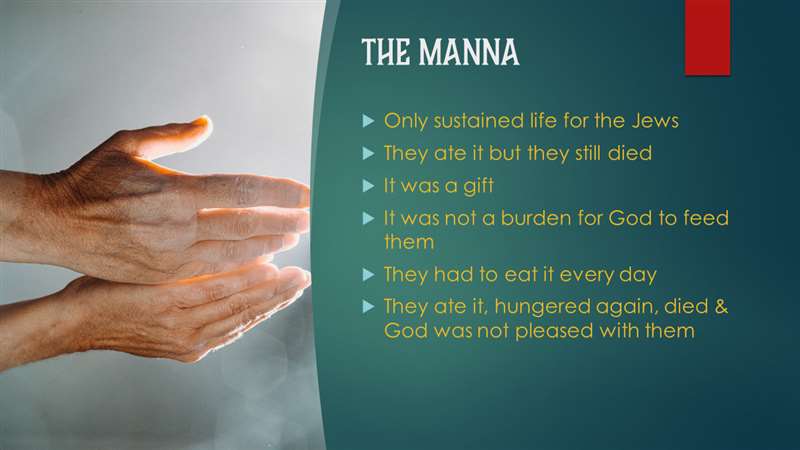
If we were going through this chapter, I would read it out loud and I would point these things out. First of all, the manna only sustained life for the Jews. This was not a supernatural food. They didn’t take one bite of it and go forty days like Elijah did in the wilderness. No. We’re talking about, this was daily bread. They had to have their little pot of manna for each day. It only sustained their life. It was just like us eating our food. Manna was not supernatural in its power; it was just supernatural in its arrival.
Secondly, the Jews ate the daily manna and even though they ate it, which God made that food, they still died. That might tell you a little bit about health food. Health food might increase your life span by a day or so. You know what I mean? So go ahead and eat all those funny things, and the rest of us will eat normal food. Do you know what I mean? I’m just teasing. But the Jews ate daily manna and they still died. It was just normal food.
Thirdly, when God gave them manna, He gave only a gift to them. He was helping them out. It was just a gift. It was just that God gave them food. That’s an observation we make.
Fourthly, there was no cost to God in sending the manna each day. God did not get weary, it was not a burden, it was not a great depth of His life. He just fed them like He feeds all the animals and the birds of the air and everything else.
Fifthly, the Jews had to eat the manna every day. God specified that. He says, don’t gather anything except for the Sabbath, but everything else is day by day. Finally, those who ate manna hungered again and died at last, and with many of those who ate manna, God was not pleased. In fact, it says in the book of Hebrews very graphically, Whose carcasses rotted in the wilderness. Now that’s not what we say. We say they were buried; they were laid to rest. God says they rotted. How do you like that? A graphic picture, their carcasses rotted because He was not pleased with them.
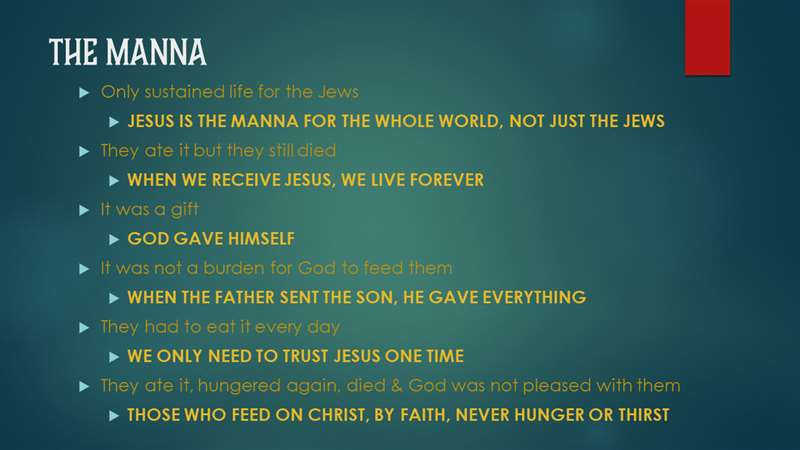
Now, what do we see about Christ? That’s pretty bleak. Let’s compare. Number 1, man only sustains life for the Jews, but Jesus gives His life for the whole world. So, Jesus is manna, only not just for the Jews. By the way, we’ll see when we get to the Feast of Pentecost in Leviticus, a couple of books from now, that’s the only feast they were allowed to have leaven. Isn’t that neat? You say, what’s neat about that? Leaven is a picture of the Gentiles, the pagans. At the Feast of Pentecost, what happened at Pentecost? The birth of the what? The church, which is us, who are Gentiles. It was prophesied 1,500 years in advance as happening at the Feast of Pentecost. Why? Because there were two Pentecosts. Do you want to know what the Feast of Pentecost or Shavuot is? It’s a loaf of unleavened bread sitting next to a loaf of leavened bread. That’s the picture of it to the Jews. Leavened and unleavened. Jews and what? Gentiles. When will that happen? Pentecost. When did it happen? Pentecost. It’s an amazing thought. Jesus gives His life for the whole world.
Secondly, the Jews ate daily mana and eventually died, but when you and I receive Jesus Christ within us, we live forever. Not someday, it starts now! The writer of Hebrews in chapter 7 says, the instant you and I are saved, we begin living after the power of an endless life. Life is different, for me, when I know I’m going to live forever. All of a sudden, life on earth becomes living in a tent. When I grew up, my dad was an expedition leader. I’ve told you that many times. He led groups of people far north into Canada, far beyond where the roads went. We had to carry everything; two weeks of food and all of our gear on backpacks and canoes. We would portage and build camps and go places where no humans had been, only a few Indians, no white people, only a few Indians had ever been. It was so remote. Trappers and the Indian guides were the only ones who were out there. And you know what? That was wonderful and that was incredible, but what it taught me was, it’s hard to live in a tent. Bugs, wet, cold, bumpy. We didn’t have air mattresses, we slept on the ground, and we didn’t have those new sleeping bags they have that are good to 30 below. We just had those cheap ones that they used to sell in the fifties, and it was hard and cold. It’s really adventurous and glamorous, but it was not very nice, like everything else that you can think about camping.
Do you know what? When we live with Christ and He lives with us, we know we’re going to live forever. All the comforts and all the joys and all the luxuries of this world, we forego if it helps us to be pilgrims and strangers on this earth. That’s what changes life. I don’t feel bad that I don’t live in the Hearst Castle. I don’t feel bad that I don’t have the latest whatever. I don’t feel bad that I cannot, walk around and act like these people that think they run the world. Do you know why? Because this world is not my home. I’m going to be a king and priest to my God somewhere else. It’s okay if I’m not one here and that changes your whole perspective on life when you know that as we receive Christ we’re going to live forever.
Thirdly, another picture with manna: when God gave manna, He only gave a gift, but when Jesus came, God gave Himself. See, that’s why Jesus said, that manna was just a little picture of Me, and God sending that bread was sending himself to those people. Fourthly, There was no cost to God in sending the manna, but when He gave His Son Jesus, He gave it all. It was a great cost. It cost Him everything. What a beautiful reminder. Fifthly, the Jews had to eat manna every day, but the sinner who trusts Christ once, not over and over again, not every time Mass is celebrated, once. One time, trust in Christ, and you are given eternal life. Finally, what a contrast. Whereas those who ate manna hungered again, died at last, and God wasn’t well pleased with them. Those who feed on Christ by faith, never hunger. Jesus said that if you eat what I give you, you’ll never hunger, and you’ll never what? Thirst. That’s the promise. We’ll never perish from hunger and thirst. Also, we’ll never die, and we’ll forever glorify God. I never have to worry that someday God’s going to cast me off and say, ah, you don’t please Me anymore. I don’t want you like an oriental monarch or despotic king. No. The Lord says once you believe in Me that Christ, number one gave His life to the whole world, number two when we receive Him, He lives within because He gave Himself at great cost. I trust in Him. He says you’ll never hunger. You’ll never die and you’re always going to be glorifying to Me. What a beautiful picture in the manna.
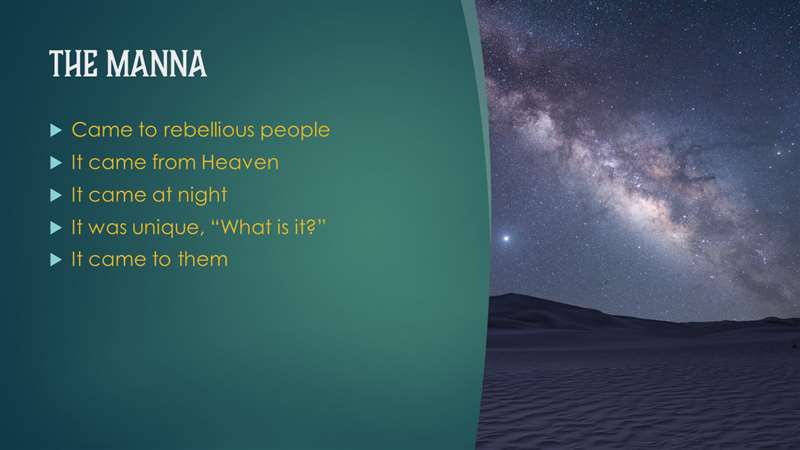
Let’s keep going because there’s something else about manna. It not only pictures Christ’s character, it pictures His coming. How does it picture His coming? First of all, how did manna come? Look at the first three verses. They journeyed, this is Exodus 16. Actually, look at verse 2. The whole congregation of the children of Israel, what? Complained. Boy, they had short memories. What did God just do? He made them walk through a watery grave. What did He do? He drowned Pharaoh’s army. What did He do? He took the wheels off Pharaoh’s chariots. What did He do? He put this pillar of fire on their side so they could see and the cloud on Pharaoh’s side so he was in the fog. God did all that. The next chapter, verse 2, what are they doing? Complaining. Seven times they rebelled against God. Actually, ten times you have seven clear passages and there are three others. So, manna came to rebellious people.
Secondly, manna was from out of this world. Look what it says in verse 4. We’re still in our little home Bible study. The Lord said, I will rain bread from where? Albertson’s, right? No. From the ovens of Egypt. No! From Heaven. Where did manna come from? It didn’t come from this world, it isn’t earthly. In fact, it says in the book of Psalms it’s what food? Angel food. So, angel food cake. A little like manna I guess.
Okay, next, third, in verse 13. If we’re in our home Bible study you should have your pencil out or pen, and it says, So it was that quails came up at evening and covered the camp, and in the morning, dew lay all around the camp and when the layer of dew lifted, verse 14, on the surface of the wilderness, there was a manna. So, when did it come? By inference from that verse, at night. Manna came at night.
Fourthly, what else about manna? Manna was unique. When it came look what the people said in verse 15. When this layer of dew and this small round thing was there, the people saw it. They said manna. Did you catch that? That’s a Hebrew word right there. It’s translated for you. They said to one another, what is it? That’s what manna means. So, all of you can speak Hebrew. Say manna. What is it? Go around, go to the restaurant and say, manna. That means, what is it? When your wife cooks something, say, manna. No, not really. That’s impolite, but it is Hebrew. What is it? So, manna was unique. They didn’t know what it was.
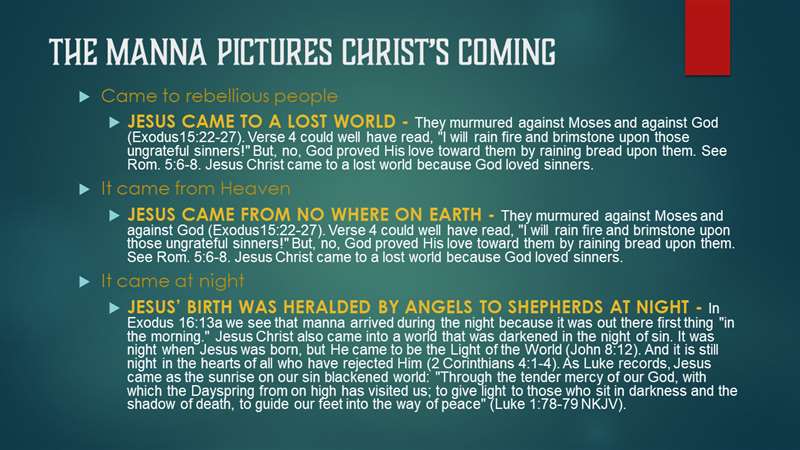
Finally, here’s the last one. The manna came to them. Look what it says, In the morning, at the end of verse 13, the dew lay all around the camp. The manna came right where they were. Now let’s look at what that pictures about Christ. Number one, Jesus came to a lost world. Manna came to a rebellious people. What did Jesus come to? He came to a world that was in rebellion, a lost world. He came to His own, but His own received Him not. Secondly, manna came from nowhere on Earth. Jesus Christ came from nowhere on Earth. He was virgin born because He, as Micah 5:2 says, His goings forth were from old, from everlasting. He wasn’t from this world. He was from out of this world. That’s why manna is such a beautiful picture of Christ. He came to a dark, or a rebellious world, and He came from out of this world. Thirdly, if manna came at night, Jesus came and was heralded by the shepherds as they were watching their flocks by what? Night. Jesus came, not only physically at night, but Jesus came to a world that spiritually was in the dark. In fact, the last two verses of Luke 1 say that He came as the sunrise to the sin blackened world. Just like manna came during the night, the bread of God come down from Heaven arrived at night.
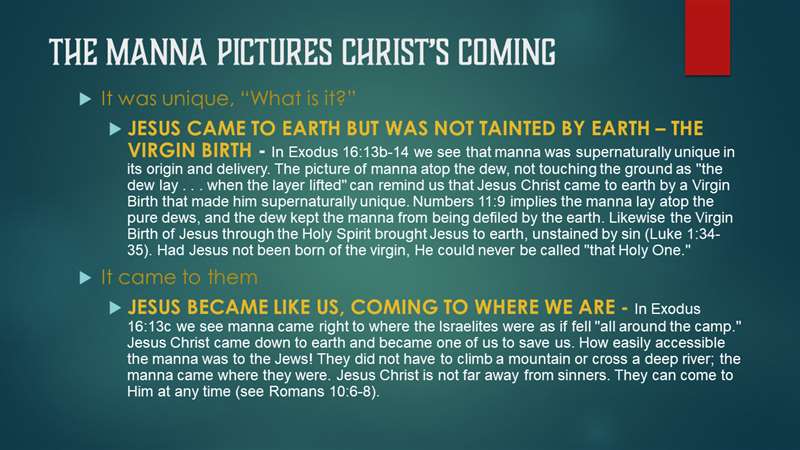
Fourthly, I’m sure you see all these are going to parallel. I love this, look at chapter 16 verse 13 at the end. It says, Dew lay all around the camp. So, what happened was, and I want you to think about this. The desert dirt, sand, rocks, Gila monsters, whatever was there, was there. That pictures the earth, above that came a layer of what? What does it say at the end of verse 13? A layer of what? Dew, okay? So, here’s the dirt, rocks, everything, and here’s a layer of what? Dew. What did God put on top of that? The manna. You say, what’s the big deal about that? Manna arrived in a unique way. It arrived almost insulated from the earth. It didn’t quite touch the earth. It was sitting on top of a layer of dew. You say, what’s the big deal about that? Manna was supernaturally unique in its origin and delivery. The picture of manna laying on top of a layer of dew, not touching the ground, reminds us that Jesus Christ came to Earth by a virgin birth that made Him supernaturally unique. Jesus came to this earth like no one else. He came to the earth, but He wasn’t tainted by the earth. There was a little layer that the virgin birth gave Him, a little layer. He did not have the sin of Adam attached to Him. What a beautiful picture. God even oversaw that little detail of the manna. He could have just dumped it in piles, but he laid it on this little insulated layer of dew.
Finally, the last truth. What I love about this, in Exodus 13, the last word says, or the last few words say it was all around the camp. I love this. The manna came right where the people were. They didn’t have to cross great valleys and gorges and climb mountains and they didn’t have to cross raging seas on rickety rope bridges. The manna came right to them. How easily accessible the manna was to the Jews. They did not have to go through any hiking. The manna came to right where they were. Jesus became like us. He came right up next to us. Jesus came to where we were. Jesus is not far away from sinners, as it says in Romans 10. It is not far away. It is nigh unto thee. Jesus came like manna right to where we are. He wants us to know that we can come to Him at any time.
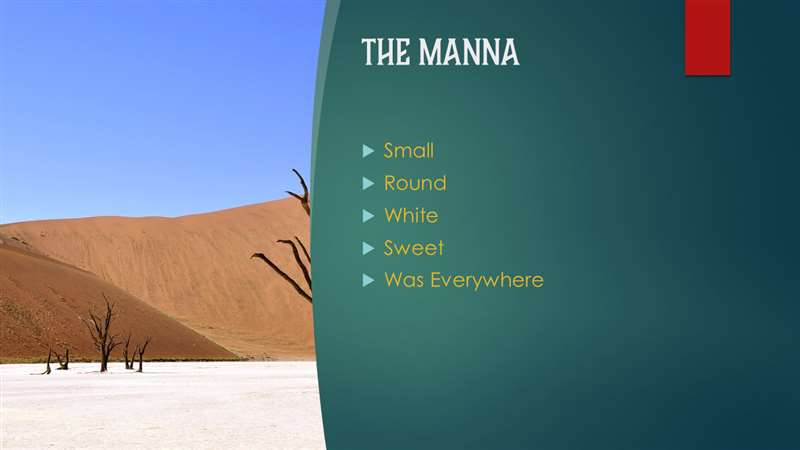
Real quickly, let me just show you one last thing about Christ’s character. And that’s this: manna of pictures in Exodus 16:14, look at this, it says, The layer of dew lifted on the surface, so the wilderness was a what? Small. Now I can imagine God could have dropped loaves of French bread. Have you ever been over there? I don’t know which store it is, but they’re in these paper bags and they’re warm, warm bread. Can you imagine going out in the morning and smelling warm bread? It’s kind of what I smell every day when Bonnie bakes the bread, and grinds it, and I can smell it baking. Can you imagine going out and seeing that? But that’s not the picture God wanted. He wanted the manna to be small.
That’s not all. The next part of verse 14 says not only was manna small, it was what? It says it was a small, round substance in verse 14. So, we would observe that in our Bible study. Thirdly, what else do we observe? It says in verse 31, it says that it was like white coriander seeds. So, manna was white. So, it was small and round and white. Fourthly, what else was it like? In verse 31, it says it tasted like honey. So, one thing about honey, it’s sweet. Next, it says in verse 35, let’s read that in our little study. And the children of Israel ate manna for forty years. By the way, what did they do for forty years? They walked around. So, the next observation we would make is manna was everywhere they went. When they made camp that night, they could be assured that God would make His delivery during the night to feed them. Okay, that’s what manna was like.
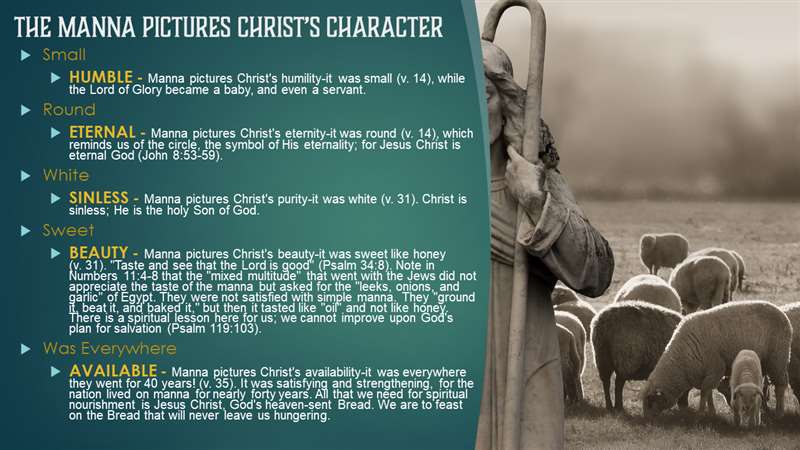
How can we apply that in our lives? Number one, if manna was small, that speaks of Christ’s humility. It says He humbled Himself, Philippians 2. It says in 1 Corinthians, that we let not the wise men glory as wisdom, or that’s Jeremiah 9. It says God hath not chosen the mighty things of this world, but the weak. That’s the lesson of Christ. Christ came not to a palace. He came to a stable. He came to the lowliest people, the outcasts, the shepherds, and to the pagans. The magi were not Israelites. He came to pagans and outcasts. That’s who He came to, in a humble way. Little manna.
Secondly, and I’m sure you can track this, roundness always speaks of eternity. In fact, I regularly stand up here, I’m going to stand up here in a couple weeks at another wedding. I always hold up the wedding ring and I say, I hold before you this ring, it’s made of gold because marriage is very precious. It’s made in a circle to remind us of the eternal nature of Christ’s love, that it never fails, and it’s made in a circle, which is endless. The circle reminds us of eternity, or infinity, or endlessness and Jesus Christ came in these little, round manna’s to remind us of His eternity, Micah 5:2.
Thirdly, and I’m sure you can figure this out, if it was white what does that speak of? The same thing as the white linen. In the tabernacle it speaks of purity and Jesus’ sinlessness. So, manna pictures Christ’s character. He was humble. He was meek and lowly, as it says in Matthew 11:28. He is meek, He is lowly. He humbled Himself and took upon Himself the form of a servant. He was from eternity, before Abraham was, I Am, He said. He was also pure. He said, which of you can accuse Me of sin? You can accuse Me all you want, but you can’t. When they tried to accuse Him, none of the witnesses could agree. One of them said I think He got angry when He was three years old and they said no, no, it was when He was four years old. Someone else said no, it was when He was five years old. They couldn’t even agree on anything Christ did wrong. They could never pin any charge to Him because He was perfect. And when they were angry, they couldn’t even talk to Him because it says He spoke like no one else spoke. Like manna; Christ’s purity, His holiness.
Number four, we see His beauty. I love this. The manna pictures Christ’s beauty. It was sweet like honey. It reminds me of Psalm 34:8, it says, all you have to do is taste and you’ll see that the Lord is good. What’s interesting is, do you remember what the Jews did? They started complaining about manna and it says they ground it, and they beat it, and they baked it. See, they didn’t like eating it the way God made it, so they ground it up, and they pounded it, and they baked it in their ovens. And you know what it says? When you ground it, or beat it, or baked it, it lost its taste. You know what that reminds me? You can’t improve on this. This is our manna. This is our bread of God. This is the word of Christ. I meet a lot of people; they just can’t take Bible reading. They want it ground up. They want it beaten down. They want the Reader’s Digest version because it’s too boring to read.
I just met with someone; they were in the hospital. They were a captive audience. I came in and sat down, pulled up my chair. They’re always busy. Boy, they couldn’t move. They were in the hospital. I said, what have you been getting out of your Bible? They said, oh, it’s real boring. I said, where have you been? They said, Leviticus. I said, what chapter? They said, oh, it’s that leprosy thing. I said, oh, did you read about the two birds? They went, oh yeah, that was really boring. I said, really? Was it? I was just waiting for him to tell me that. I said that’s a picture of Christ. The two birds, one was killed, and its blood poured out. The other one was put in the pot with it, the lid was put on, and then it was let go with blood on it. I said, do you know what that was? That’s a picture of Christ. Two birds; one dead, the other living. You can’t resurrect a bird, so they had to use two for the picture. Christ was crushed, and His blood was poured out. He was buried in a tomb, and then He rose on the third day. They threw in some cedar wood to remind them of the cross. That picture of the offering for lepers is a picture of the death, the burial, and the resurrection of Christ. The Bible is sweet if you come to it saying, You’re beautiful, Lord. You’re the key that unlocks this book. I want to know You. I want to see You in every page.
I tell you what, personal testimony, I discover something new about the Lord every time I read. I was just sitting over at the big park, the LaFortune Park, and all the buddies were running, skipping stones in the stream, and sliding down the things. I was busily there reading. I couldn’t believe it. I had found so many treasures. I had all my pens open at once, all my different colors, and I was marking and everything. They came up to me and says, oh, Dad, we love the park. I said, oh, keep playing. I’m finding so much good stuff. And I went back to my marking. Do you know what? Taste and see. The Lord is good.
Finally, Christ’s beauty. The last one is, manna reminds us of Christ’s availability. Manna came right where the Israelites were. It came all around the camp. Jesus Christ came down to Earth and became one of us to save us. It was satisfying and strengthening to those people. They lived on the manna for 40 years. All that we need for spiritual nourishment is Jesus Christ, God’s Heaven-sent bread. It’s available to us wherever we are.
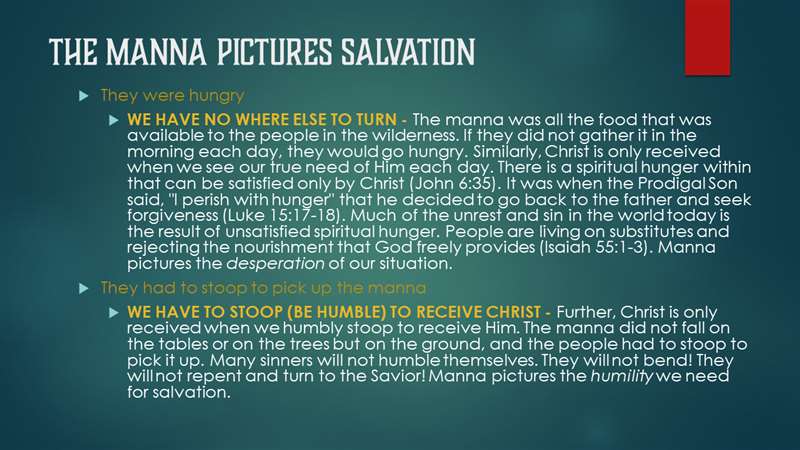
Let me just finish this off by one last thing. Manna pictures our salvation. I just want to go through this. Those people, why did they go out and get manna? Because they were hungry. How do we receive Christ? When we realize desperately that we don’t have anywhere else to turn. My wife, I told you about on Easter Sunday, she didn’t have anywhere else to turn. She tried everything. Me, as a little boy, my parents said, the only hope you have of going to Heaven, Johnny, is Jesus Christ. We come desperately to Christ.
Secondly, the second truth, how did they get manna? Where did it arrive? On the what? Ground. So how do you get it? You had to stoop. Manna didn’t fall on top of their tables. It didn’t come on the trees. It came on the ground. The people had to stoop down and pick it up. Many sinners will not humble themselves. They will not bend so they, by not repenting, they never turn to Christ.
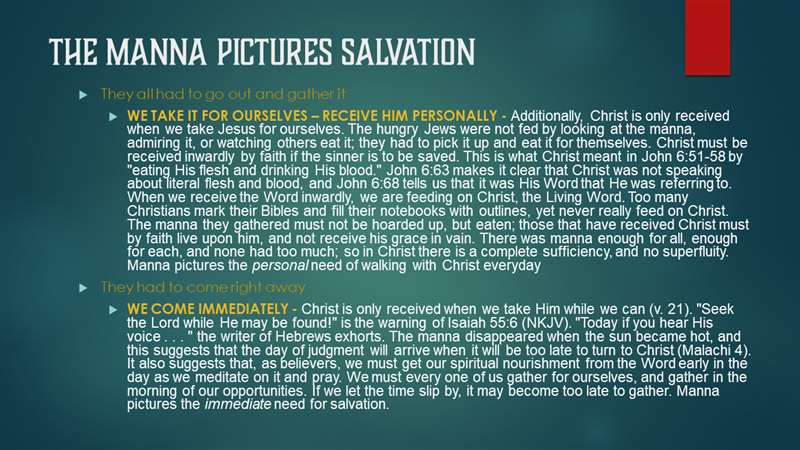
Thirdly, manna also pictures how we come to Christ personally. Christ is only received when we take Jesus for ourselves. The hungry Jews were not fed by looking at the manna. Admiring it, watching others eat it. They got it when they picked it up. You know what it says in the Bible? They all had to go out and gather it, all of them. You didn’t go to the manna supermarket. You went out and got your own manna. It’s amazing. We must eat His flesh and drink His blood, John 6:51-58. Christ was not speaking about his literal flesh and blood, but through His word, He was referring to the fact that we receive Him inwardly. We feed on Him. He is our living word. We are to gather Him. We are to come to Him. We are to apply Him to our souls. We come personally.
Fourthly, Christ is only received when we take Him while we can. We should come immediately. It says in the book of Hebrews, while you hear His voice, harden not your heart. Come immediately.
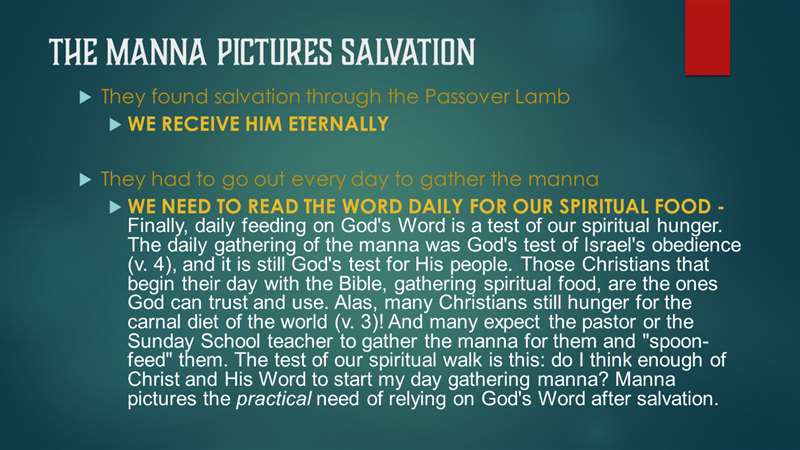
Fifthly, we receive Him eternally. When we receive Christ, we receive Him eternally. Just as the Jews fed on the Passover lamb and were saved, so all who come to Christ, the scriptures say, are saved to the uttermost.
Here’s the last one, number six. We come practically. Daily feeding on God’s word reminds us of manna. They had to go out every day and get their manna. Now think of this: the daily gathering of the manna was God’s test to their obedience. That’s what verse 4 of chapter 16 is all about. It’s still God’s test for us today. Those Christians that begin their day with the Bible gathering spiritual food are the ones that God can trust and use. Now I’m not giving you a fetish that if you read your Bible in the morning, it’s the only time it works, but I’ll tell you what, it is significant that Jesus met God a great while before day. It’s very significant that we find almost every major biography of every great Christian God has used for the last 19 centuries since the cross all had morning times with the Lord. And it’s interesting that the picture of us feeding on the Lord speaks of getting it before the sun rose and melted the manna. You had to gather it before the sun got up, and when it was warm, the manna melted back to dew.
Now with that in mind, it’s amazing that the test of our spiritual walk is this. Do I think enough of Christ and of His word to start my day practically gathering food from this book? If you meet the Lord before dawn, you’ll beat the Devil all day long, a great missionary once said, C. T. Studd. I’ll tell you the truth, we come to Christ desperately because we hunger. We come humbly. We bow before Him. We come personally eating for ourself. We come immediately when we hear His voice. When we come to Him, it’s eternal. Then we cultivate a lifelong practice of gathering manna from His word every day.
Let’s bow together and thank the Lord for this beautiful picture, Christ, our manna. Oh Lord, I pray that You would help us to see that the source code that unlocks the pages of Your word is that You are in all the scriptures. I pray that we would just have our eyes opened as we read this wonderful book to see You on every page, in every book, in every chapter, in each verse; beautiful pictures of you, O Christ, that we can feed upon. We have an anointing from Your Spirit. We don’t need anyone to give us some inside knowledge. All we have to do is pray and look and You will feed us. Evermore give us that bread we pray. Help us not to just be eating all the time, but as we grow in grace, to be bearing fruit, to serve others, to be those who speak for You, and those who serve You, those who sacrifice for You, those who go and tell everyone that You put in our life, that we once were starving to death and in our desperation we came in faith to You. Thank you, Lord Jesus. Teach us Your way and let us be fruitful for Your glory. In Jesus’ name we pray, Amen. God bless you as you go.

Christ the Key to Scripture
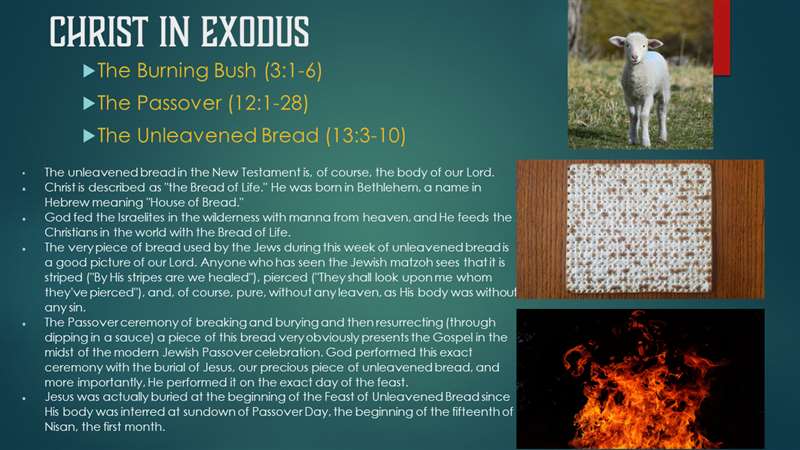
If you want to understand the Bible become a Christ tracker, one who sights and marks the trail for finding Him from cover to cover. That is what we are doing this evening as we continue this quest to get a strategic grasp on the Bible. We are finding Christ in Exodus. Let’s retrace our findings.
CHRIST IN EXODUS:
Exodus 33:17 He is the One greater than the deliverer, Moses – He is Christ in ALL the Scriptures! In Exodus we find Christ:
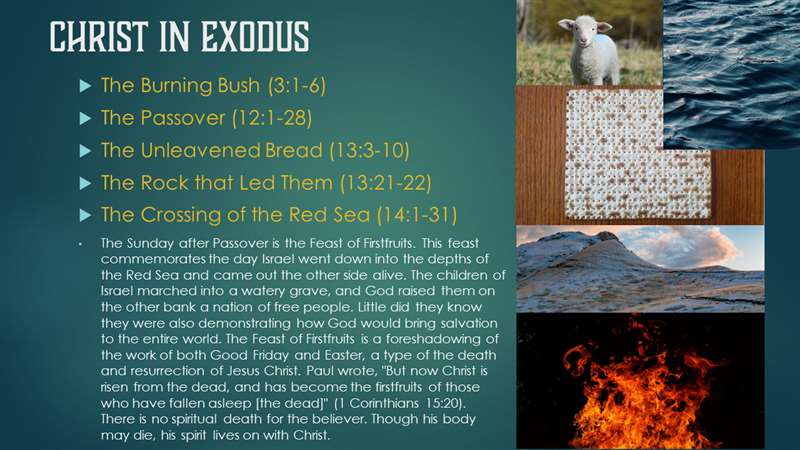
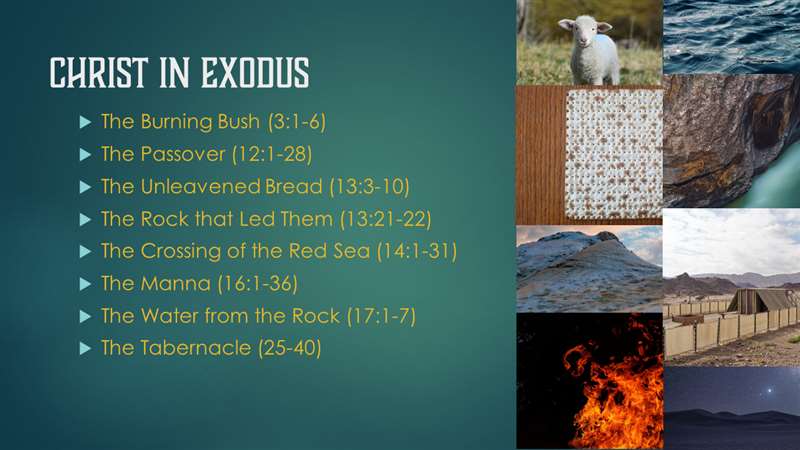
- The Voice in the Burning Bush (3.1-6)
- The Passover Lamb of God (12.1-28)
- The Unleavened Bread (13.3-10)
- The Rock/Pillar of Cloud and Fire leading them (13.21-22)
- The Red Sea Crossing (14.1-31)
- The Manna from Heaven (16.1-36)
- The Source of Living Water (17.1-7)
We can see Pictures of Christ in every section of Exodus.
Pictures of Christ: The Burning Bush (3:1-6)
Pictures of Christ: The Passover (12:1-28)
PICTURES OF CHRIST: THE UNLEAVENED BREAD (13:3-10)
The unleavened bread[1] in the New Testament is, of course, the body of our Lord.
- He is described as “the Bread of Life”. He was born in Bethlehem, in Hebrew “House of Bread”.
- God fed the Israelites in the wilderness with manna from heaven, and He feeds the Christians in the world on the Bread of Life.
- The very piece of bread used by the Jews during this week if Unleavened Bread is a good picture of our Lord. Anyone who has seen the Jewish matzoh sees that it is striped (“By His stripes are we healed”), pierced (“They shall look upon me whom they’ve pierced”), and, of course, pure, without any leaven, as His body was without any sin.
- he Passover ceremony of breaking and burying and then resurrecting a piece of this bread (the middle piece, as the Son in the Trinity) very obviously presents the Gospel in the midst of the modern Jewish Passover celebration. God performed this exact ceremony with the burial of Jesus, our precious piece of unleavened bread, and more importantly, He performed it on the exact day of the feast.
- e readily see from the Gospel that Jesus was buried at the beginning of the Feast of Unleavened Bread since His body was interred at sundown of Passover Day, the beginning of the fifteenth of Nisan, the first month.
PICTURES OF CHRIST: THE ROCK THAT LED THEM (13.21-22)
PICTURES OF CHRIST: THE CROSSING OF THE RED SEA (14.1-31)
THE SUNDAY AFTER PASSOVER IS THE FEAST OF FIRSTFRUITS.
This feast commemorates the day Israel went down into the depths of the Red Sea and came out the other side alive. The children of Israel marched into a watery grave and God raised them on the other bank a nation of free people. Little did they know they were also demonstrating how God would bring salvation to the entire world! The Feast of Firstfruits is a foreshadowing of the work of both Good Friday and Easter, a type of the death and resurrection of Jesus Christ. Paul wrote, “But now Christ is risen from the dead, and has become the Firstfruits of those who have fallen asleep (the dead)” (1 Cor. 15:20). There is no spiritual death for the believer. Though his body may die, his spirit lives on with Christ.
PICTURES OF CHRISTIAN LIFE IN THE SEQUENCE OF Exodus 15-18
Exodus 15-18 records Seven EXPERIENCES the Israelites had that correspond [2] to our Christian experience.
- THIS LIFE IS A STRUGGLE: The Wilderness of Shur was the spot of the Song of the Redeemed (15:1-22) this reminds us that we aren’t promised a bed of roses after our salvation/redemption.
- CHRIST IS OUR HOPE: At Marah, the Bitter Water was Sweetened by a Tree (15:23-26) which reminds us that Christ’s cross sweetens the bitter experiences of life with the hope of His presence, His Peace, and His Plan.
- CHRIST MAKES US FRUITFUL: The Oasis at Elim (15:27) with 12 wells and 70 palms reminds us of the promises He gives of a Fruitful Christian life.
- CHRIST SATISFIES US: In the Wilderness of Sin they were provided Manna and Quail (16.1-36) which reminds us that Christ is the Bread of Life who provides all we need.
- CHRIST DIED ONCE FOR OUR SINS: The Smitten Rock of Rephadim (17.1-7) reminds us that “that Rock Was Christ” and He was only to be smitten once.
- WE ARE HIS SOLDIERS: The fight with Amalek is a picture of our war with the Flesh (17:8-16) and the victory is the Lord’s and comes by prayer and His weapons. (Deut. 25:17-18);
- HIS WORD IS OUR GUIDE: In the scene with Jethro, Priest of Midian (18) we see the value of God’s Wisdom revealed over the emptiness of the wisdom of this world. We now have that wisdom in His Word.
PICTURES OF CHRIST: THE MANNA (16:1-36)
Exodus 16 should always be read in connection[3] with John 6, for the manna from heaven is a type of Jesus Christ, the Bread of Life. Jesus also noted that manna illustrates the written Word of God on which God’s pilgrim people feed from day to day (Matt. 4:4).
1st Jesus was greater than manna. When Jesus called Himself “the Living Bread,” He was not claiming to be exactly like the manna. He was claiming[4]to be even greater!
| Old Testament Manna | Jesus the Bread of Life |
|
|
|
|
|
|
|
|
|
|
|
|
1st Manna PICTURES Christ’s COMING
- In Exodus 16:1-3 we see that manna came to a rebellious people. They murmured against Moses and against God (Exodus15:22–27). Verse 4 could well have read, “I will rain fire and brimstone upon those ungrateful sinners!” But, no, God proved His love toward them by raining bread upon them. See Rom. 5:6–8. JESUS CHRIST CAME TO A LOST WORLD BECAUSE GOD SO LOVED HE GAVE.
- In Exodus 16: 4 we see manna was not from anywhere on earth, it came down from God above. JESUS CHRIST CAME FROM ABOVE(John 6:33) as the Father’s gift to hungry sinners.
- In Exodus 16:13a we see that manna arrived during the night because it was out there first thing “in the morning”. JESUS CHRIST CAME TO A SIN BLACKENED WORLD. It was night when Jesus was born, for He came to be the Light of the World (John 8:12). And it is still night in the hearts of all who have rejected Him (2 Cor. 4:1–4). Also as Luke records Jesus came as the sunrise on our sin blackened world Luke 1:78-79 Through the tender mercy of our God, With which the Dayspring from on high has visited us; 79 To give light to those who sit in darkness and the shadow of death, To guide our feet into the way of peace.” NKJV
- In Exodus 16:13b-14 we see that manna was supernaturally unique in its origin and delivery. The picture of manna atop the dew, not touching the ground as “the dew lay…when the layer lifted”. JESUS CHRIST CAME TO EARTH BY A VIRGIN BIRTH THAT MADE HIM SUPERNATURALLY UNIQUE. Numbers 11:9 implies the manna lay atop the pure dews, and the dew kept the manna from being defiled by the earth, so the Virgin birth of Jesus through the Holy Spirit brought Jesus to earth, unstained by sin (Luke 1:34–35). Had Jesus not been born of the virgin, He could never be called “that Holy One.”
- In Exodus 16:13c we see manna came right to where the Israelites were as if fell “all around the camp”. JESUS CHRIST CAME DOWN TO EARTH AND BECAME ONE OF US TO SAVE US. How easily accessible the manna was to the Jews! They did not have to climb a mountain or cross a deep river; the manna came where they were (see Rom. 10:6–8). Jesus Christ is not far away from sinners. They can come to Him at any time.
2nd manna PICTURES Christ’s CHARACTER
- MANNA PICTURES Christ’s HUMILITY — it was small (v. 14), the Lord of Glory became a baby, and even a servant.
- MANNA PICTURES Christ’s ETERNITY — it was round (v. 14), which reminds us of the circle, symbol of His eternality; for Jesus Christ is eternal God (John 8:53–59).
- MANNA PICTURES Christ’s PURITY — it was white (v. 31), He is sinless; He is the holy Son of God.
- MANNA PICTURES Christ’s BEAUTY — it was sweet like honey (v. 31). “Taste and see that the Lord is good” (Ps. 34:8). Note in Num. 11:4–8 that the “mixed multitude” that went with the Jews did not appreciate the taste of the manna but asked for the “leeks, onions, and garlic” of Egypt. They were not satisfied with simple manna. They “ground it, beat it, and baked it,” but then it tasted like “oil” and not like honey. There is a spiritual lesson here for us; we cannot improve upon the simple Word of God (Ps. 119:103).
- MANNA PICTURES Christ’s AVAILABILITY – it was everywhere they went for 40 years! (v. 35). It was satisfying and strengthening, for the nation lived on manna for nearly forty years. All that we need for spiritual nourishment is Jesus Christ, God’s heaven-sent Bread. We are to feast on the Bread that will never leave us hungering.
3RD Manna PICTURES OUR SALVATION
- DESPERATELY. CHRIST IS ONLY RECEIVED WHEN WE SEE OUR NEED. There is a spiritual hunger within that can be satisfied only by Christ (John 6:35). It was when the Prodigal Son said, “I perish with hunger” that he decided to go back to the father and seek forgiveness (Luke 15:17–18). Much of the unrest and sin in the world today is the result of unsatisfied spiritual hunger. People are living on substitutes and rejecting the nourishment that God freely provides (Isa. 55:1–3).
- HUMBLY. CHRIST IS ONLY RECEIVED WHEN WE HUMBLY STOOP TO RECEIVE HIM. The manna did not fall on the tables or on the trees but on the ground, and the people had to stoop to pick it up. Many sinners will not humble themselves. They will not bend! They will not repent and turn to the Savior!
- personally. CHRIST IS ONLY RECEIVED WHEN WE take jesus for OURselves. The hungry Jews were not fed by looking at the manna, admiring it, or watching others eat it; they had to pick it up and eat it themselves. Christ must be received inwardly by faith if the sinner is to be saved. This is what Christ meant in John 6:51–58 by “eating His flesh and drinking His blood.” John 6:63 makes it clear that Christ was not speaking about literal flesh and blood, and John 6:68 tells us that it was His Word that He was referring to. When we receive the Word inwardly, we are feeding on Christ, the Living Word. It is to be gathered; Christ in the word is to be applied to the soul, and the means of grace are to be used.
- IMMEDIATELY. CHRIST IS ONLY RECEIVED WHEN WE TAKE HIM WHILE WE can. (v. 21). “Seek the Lord while He may be found!” is the warning of Isa. 55:6 (nkjv). “Today if you hear His voice…” the writer of Hebrews exhorts. The manna disappeared when the sun became hot, and this suggests that the day of judgment will arrive when it will be too late to turn to Christ (Mal. 4). It also suggests that, as believers, we must get our spiritual nourishment from the Word early in the day as we meditate on it and pray. We must every one of us gather for ourselves, and gather in the morning of our opportunities, which if we let slip, it may be too late to gather.
- ETERNALLY. ONCE WE RECEIVE CHRIST AS SAVIOR, WE ARE SAVED ETERNALLY (John 10:27–29). It is important, however, that we feed on Christ to have the strength for our pilgrim journey, just as the Jews fed on the Passover lamb (Ex. 12:11ff). How do believers feed on Christ? By reading, studying, and meditating on His Word. God invites each of us to get up early in the day and gather from the Word the precious manna to nourish our souls. We cannot hoard God’s truth for another day (vv. 16–21); we must gather fresh food for each new day. Too many Christians mark their Bibles and fill their notebooks with outlines, yet never really feed on Christ. The manna they gathered must not be hoarded up, but eaten; those that have received Christ must by faith live upon him, and not receive his grace in vain. There was manna enough for all, enough for each, and none had too much; so in Christ there is a complete sufficiency, and no superfluity.
- PRACTICALLY. DAILY FEEDING ON GOD’S WORD IS A TEST OF OUR SPIRITUAL HUNGER. The daily gathering of the manna was God’s test of Israel’s obedience (v. 4), and it is still God’s test for His people. Those Christians that begin their day with the Bible, gathering spiritual food, are the ones God can trust and use. Alas, many Christians still hunger for the carnal diet of the world! (v. 3) And many expect the pastor or the Sunday School teacher to gather the manna for them and “spoon-feed” them. The test of our spiritual walk is this: do I think enough of Christ and His Word to start my day gathering manna?
Pictures of Christ: The Water from the Rock (17:1-7)
To understand the fullness of the water from the Rock it is often helpful to see the Jewish celebration attached to it. Since Jesus attended and participated in these celebrations it is even more imperative to know and understand why.
While water[5] was being sold to thirsty pilgrims, as they came to Jerusalem to observe the Feast of Tabernacles, our Lord stood in the Temple area and cried out, “If any man thirst, let him come unto me, and drink.”(John 7:37) To the woman from Sychar He said, “But whosoever drinks of the water that I shall give him shall never thirst; but the water that I shall give him shall be in him a well of water springing up into everlasting life.” (John 4:14)
The first real test for the children of Israel when they came out of Egypt was this very point. God had opened the waters of the Red Sea to let them out of Egypt. He then closed the same waters behind them to keep them from ever getting back into Egypt. They then sang the first song in the Bible, as they stood on the wilderness shore of the sea. Then they went three days in the wilderness, and found no water. …And the people murmured against Moses, saying, What shall we drink? (Exodus 15:22,24) In Egypt they could always look down to the Nile. That river, the longest in the world, had provided everything that they ever needed. The ancients used to say, and rightly so, “Egypt is the gift of the Nile.” But now, a mighty change ensues. These people, redeemed by blood and by power, find themselves in “the waste howling wilderness.”(Deut. 32:10)
Up until now, they had always looked down. From this time on, they were to look up. Their food came down from above. Their guidance came down from above. The desert would provide nothing. All that they were to need for the journey would be met out of a gracious God’s fullness. But, in spite of this, we have the record of seven times when they murmured. The fourth book of the Bible has not only been called the book of “Numbers.” It has also been called by some, “the book of Murmurs.” They murmured against God, they murmured against Moses, they murmured against Aaron. To murmur means, “to mutter, to grumble, to be discontented. In answer to their question, “What shall we drink?” God gave them water from a most unlikely source. ..a flinty rock! And the New Testament teaches that “they drank of that spiritual Rock that followed them, and that Rock was Christ.” (I Cor. 10:4)
The Water from the Rock in Exodus 17 is celebrated by the Jews at Tabernacles. This re-enactment of the Water from the Rock in Exodus 17 is known as Simcha Bet Ha-sho-evah (the Rejoicing of the House of Drawing Water).
- This special ritual prophetically illustrates the time when the Holy Spirit will be poured out upon Israel.
- It also illustrates the truth that Jesus Christ, the Giver of living water, probably was came to earth at Sukkot. So the Feast of Tabernacles “the Word became flesh and TABERNACLED among us” takes on a whole new meaning! Jesus told the Samaritan woman at the well, “If you knew the gift of God, and who it is who says to you, ‘Give Me a drink,’ you would have asked Him, and He would have given you living water. ..Whoever drinks of this water will thirst again, but whoever drinks of the water that I shall give him will never thirst. But the water that I shall give him will become in him a fountain of water springing up into everlasting life” (John 4:10, 13-14 NKJV).
We have seen[6] Christ’s ministry on the cross was vividly portrayed by the rituals surrounding Passover, Unleavened Bread, and First fruits. There’s one other image we need to get from the Temple celebrations. It is the one which commemorates the drawing of water from the rock at Horeb (Ex. 17:1-7). On the morning of the first day of the festival called Sukkot or Tabernacles, and every day thereafter, a priest carried a large golden ewer from the Temple mount down to the spring of Siloam. As he walked he was surrounded by jubilant worshipers who followed him as he drew water from the pool of Siloam.
The route back to the Temple led through the water gate, and into the inner court. There in that grand courtyard of Herod’s gigantic Temple, a huge cheering crowd always waited near the altar. As the water bearing priest approached the altar, the ceremonial silver trumpets were sounded. Then would come the priests chanting the words of Isaiah:
“Therefore with joy you will draw water from the wells of salvation” (12:3 NKJV).
Now here is the unforgettable significance of this moment. In Isaiah 12:3 the word for “salvation” in Hebrew is Yeshua. This is exactly the same word in Hebrew we translate as “Jesus.” With that in mind think again of the scene. On the first through the sixth days, the priest and his joyful processional circled the altar once, but on the seventh day, they circled the altar seven times! All those times a whole group of priests are loudly affirming that with joy all were to draw water from the wells of JESUS!
The highlight of the ceremony occurred when the priest stood and poured the water on the altar. While the water washed away the blood of the morning’s sacrifices, a long line of priests, all bearing willow branches, sang psalms of praise. The Talmud[7] describes the ceremony in detail, including a portrait of venerable sages juggling lighted torches and performing somersaults as part of the celebration. The experience[8] was one of intense and total joy, so much so that the Talmud says whoever has not been in Jerusalem for this ceremony has not experienced real joy!
Now get the scene in your hearts with me:
- Like all devout Jewish men, Jesus attended the Feast of Tabernacles in Jerusalem.
- On the last day of one Sukkot festival, He stood and cried out to the crowd: “If anyone thirsts, let him come to Me and drink. He who believes in Me, as the Scripture has said, out of his heart will flow rivers of living water” (John 7:37-38 NKJV). The apostle John goes on to explain that Jesus spoke about the Holy Spirit, which had not yet been given.
- Can’t you just see it? Jesus and His disciples had just attended the glorious celebration inside the Temple. They had sung psalms with the priests, had perhaps followed the golden ewer of water seven times around the altar as they chanted Isaiah 12:3 “draw water from YESHUA (Jesus)”.
- Then Jesus and His disciples watched the liquid stream over the altar, cleaning away the blood of goats and rams from the morning sacrifices. As the rustlings of a thousand palms filled the air, foreshadowing the palms that would be lifted to hail Him when He would enter Jerusalem to die at Passover, Jesus spoke in a commanding voice and explained the ritual the Jews had just witnessed.
- “If any thirst LET THEM COME TO ME! He was the Light of the World, the Living Water, the Word made flesh to dwell among them. He would soon be the Passover Lamb, the Bread Without Leaven, the First fruits. As our sinless High Priest, He would atone for sin once and for all.
- Hundreds in the Temple that day heard Him …but only those with understanding believed. Do you? For I will pour water on him who is thirsty, And floods on the dry ground; I will pour My Spirit on your descendants, And My blessing on your offspring. -Isaiah 44:3 NKJV
1 Cor 10:1-4; Deut 32:15 (Rock of Salvation); 2 Sam 22:2 (Lord is rock of his defense); Ps 95:1 (Rock of Salvation); Isa 32:2 (water from rock); Matt 16:18 (upon this rock)…
- Who is the rock? Jesus Christ. Mt 21:44 (shattered by it).
- The Rock was smitten; Isa 53:45.
- The water (Holy Spirit) does not come until the rock is smitten!
- Holy Spirit is “poured out” (Acts 2:18; John 7:37, 38, 39).
- The rod speaks of judgment.
[1] Zola Levitt, The Seven Feast of Israel. Dallas, Texas: Great Impressions Printing and Graphics, 1979, pgs 5-6:.
[2] J. Vernon McGee. (1991). Exodus (Chapters 1-18). Thomas Nelson Publishers, Nashville, TN.
[3] The manna points are adapted from Warren W. Wiersbe, Wiersbe’s Expository Outlines on the Old Testament, (Wheaton, IL: Victor Books) 1997.
[4] This chart was made reflecting comments drawn from Henry, Matthew, Matthew Henry’s Commentary on the Bible, (Peabody, MA: Hendrickson Publishers) 1997.
[5] Roy Gustafson, In His Land Seeing Is Believing. Minneapolis, Minnesota: World Wide Publications, 1980, p. 107-109.
[6] John Hagee, His Glory Revealed. Nashville, TN: Thomas Nelson Publishers, 1999, p. 151-155.
[7] Chumney, “ The Feast of Tabernacles” http://www.geocities.com/Heartland/2175/chap9.html
[8] Barney Kasdan, “Sukkot: The Feast of Tabernacles,” found at Web site www.umjc.org/documents/sukkot.html


Check Out All The Sermons In The Series
You can find all the sermons and short clips from this series, Christ in all the Scriptures here.
Looking To Study The Bible Like Dr. Barnett?
Dr. Barnett has curated an Amazon page with a large collection of resources he uses in his study of God’s Word. You can check it out here.