
If the video above is not available, here are two other ways to view:
David – A Forgiven Sinner
060723PM
DSS-27
PSALM 51
Transcript
.jpg)
Let’s turn to Psalm 51, after that note. As you’re turning there, David said, I’m guilty. I was wrong. I ask You to remove the just punishment that I deserve.
.jpg)
That’s how the 51st psalm opens, and that’s also how the greatest song about the love of God experienced by a most desperate man named David also opens. Remember, this is a psalm, this is a worship song that was an offering from the Levitical singers at the Temple to their God, inspired by the Spirit of God, written by David, and lifted up before God as a memorial to His great love that made Him able and willing to forgive such as David. David was overwhelmed as he began to sing this song. In a moment, he had gone from absolute gloom and heaviness of soul to the joy of his sins being lifted off, and that’s what he tells us about in this psalm. The weight that had grown heavier day after day was now lifted. Those spiritual scales that had clouded his eyes. He just couldn’t see God anymore. He couldn’t feel his closeness. He didn’t know the wonder. He didn’t see the light and the color of God’s beauty all around him. And those scales were removed, and suddenly his soul was now flooded with light and peace, and once again, he starts to drink deeply from the well of his salvation. His cold heart had been warmed. His tormented soul had been set free, and David was no longer trapped in that painfully chastened body that he had endured for nearly a year. He had fallen so far so fast, but the dullness of his soul was no longer spreading, no longer pressing him. And that weight that he thought was going to crush him, the Lord had lifted off. David had left the bottom, where he had stayed for almost a year, and had gotten back to God. What’s wonderful is for us that God’s Word gives us the pathway, the pattern, the paradigm you might call it, of just exactly what David discovered in that pathway back to God.
.jpg)
Coming back to God, that’s what the 51st psalm is all about, and that’s what we’re in the midst of looking at. And tonight, we’re going to look even more deeply at the inspired-by-God-through-David four stages of his coming back to God. If you didn’t mark them this morning, I’ll remind you of them. Number one, the first four verses of Psalm 51 say that we should understand that all sin is against God. Now, I showed you this morning, as we read it and reread it, that the whole structure of the psalm is pointing to God, God, God, God, against Thee, against Thee, against Thee. I’ve sinned, sinned, sinned, and David just keeps pointing to the fact that sin is ultimately an offense against a holy God. It’s not just my failure; it’s just not just my blowing it and something I need to learn to manage a little better, my temper, or my appetites, or whatever. It is an offense against God. And until we come to the place where we see every single sin as an offense against the holy God, we will never truly come back to God. We will keep finding ourselves debilitated, and defeated, and ultimately destroyed by our sins because the New Testament teaches us that there is sin unto death, and those are sins that are not repented of that God has to keep chastening. And you know that’s what 1 Corinthians 11, Revelation 2, and also 1 John 5, and somewhat James 5, talk about these sins that lead to death.
The second division of the 51st psalm, number one, verses 1 through 4, understand that all sin is against God. Number two, starting in verse 5, we have to take personal responsibility for my sin, and David does 35 times. We saw that this morning. If you’ve never done it, you can just circle those first-person personal pronouns. It’s, as David says, it is my sin. It was me. I did it. And that’s the second stage that we are studying. Take personal responsibility for your sin. Then in verse 10, believe only God can cleanse and restore us, and that’s down through verse 13. Then finally, the only thing that’s left is seek God and repent, and that rounds out verses 14 through 19. And as we look in depth at each of these, we learn the blessed reality of what God expects from us. That’s why He captured this. That’s why He recorded this forever settled in God and His Word. And this is why this psalm has become such a hope for believers throughout the centuries.
.jpg)
First of all, verse 1. David starts his song by singing, I am guilty. As we saw this morning, he sweeps by the culture of our day and his day, which tries to lessen a person’s feeling bad about what they’ve done, and David just swept all that aside, and he just says, I’m guilty. And by confessing he was guilty, David was coming back to God.
And as we saw in Luke 18 this morning, if you want a swift renewal of your right relationship with God, then say, I’m guilty. Don’t hem haw around. And don’t say that it’s because I’m tired. Don’t say that it’s because I have these needs no one understands, and don’t say that it’s because there’s such a struggle, or things are hard at work, or you don’t understand this person or that person in my life, or you don’t understand what I’m going through. When we sin, God does not want to hear from us a blame shift to someone else. And so, David starts out saying, I’m guilty, and God can’t resist this type of heart cry to Him. In fact, in Luke 18:13, the tax collector, the hero of Christ’s story about this Davidic type of confession and guilt acceptance. The tax collector and the, remember the publican the Pharisee, the tax collector and the self-righteous Pharisee would not so much as lift his eyes, but he kept on saying, God, be merciful to me a sinner! God can’t resist that type of an approach. Why can’t God resist that type of approach? I’d like you to just turn for a second with me to Colossians 2. One of the wonderful things is how this whole book that we’re holding is wonderfully engineered to all fit together.
A friend of mine still works on the Trident submarines. America’s still building those most amazing war machines in the world, a Trident sub. And all the parts for the Trident submarine come in from all over the country, and they’re fitted together with such precision. It’s just unbelievable how they’re made to spec. They’re actually signed by the different machinists that make them because they have to be responsible for their part of this huge, massive 600-foot-long underwater city that’s a Trident submarine. But he’s talking about how amazing that it is that with all these years of planning and engineering specs and communication, that it’s very rare that they get a piece that doesn’t work well. The amazing thing about this book is without any visible engineering specifications, no email, no plans sent all over the country. The 40 different authors that never met each other, most of them, that wrote it over 1600 years of time, those men made one completely unified message. So, what we see back here in Psalm 51 is exactly corresponded to by a different part.
And Colossians 2 and verse 6 is just one of those examples I’d like to show you because when David cried his acknowledgement of his sin, he was very humble. When the publican wouldn’t even lift up his head, and he stood far off, and wouldn’t rush before God, and he wouldn’t even lift up his head to say this prayer. He just said, God, be merciful to me. And he was showing such contrition. That approach that’s irresistible to God is very important. Look what Paul says in Colossians 2:6. He says, as you therefore received Christ Jesus the Lord. How did you receive Him? With great awareness of our unworthiness, with great contrition for our sinfulness, with great sorrow for our offenses. I could just go on just spinning off all the different ways that we could say that we humbly approached Him, aware that we needed His mercy, that we deserved punishment, that we are so unworthy of His gracious giving to us. As, look at verse 6, as you have therefore received Christ Jesus. In that humble, contrite, totally unworthy, totally overwhelmingly gracious offering from God. As you received Him. Look at this, the end of verse 6, so walk in Him. And now, the word received in Colossians 2:6 is that well-known word from John 1:12, but to as many as received Him, to them He gave the right the authority to become the sons of God. It’s talking about receiving salvation. So, what Paul is saying is the way you receive salvation, the way I receive salvation is the same way that I should walk through life. Now, think about that for a moment. The humble contrition that brought us salvation brings us back time after time when we sin. When we remember again how each of us came, how we came just like we were and humbly fell at Christ’s feet pleading for mercy, that’s the way we’re supposed to still walk through our Christian life. That humble approach is to be our humble, continuous approach to God. It isn’t just that you act that way when you get saved and everything changes.
Reminds me, this is wedding season. I just got to keep track of all these different couples where they are, and I met with one this morning, and another one’s coming up in two weeks. It’s just so many going on. But you know what, I always warn them when I spend those weeks praying with them, and discipling them, and counseling them? I say, now watch out that you work as hard to keep her as you did to get her. You ever seen these boys? They’re just real slouches until they meet that girl, and boy, everything changes. They start shaving, the hair goes, and they smell nice, and they dress nice. They just look like a brand-new person right out of a catalog. And then about three months after they’re married, the slouch potato is back! I go, what happened? Oh man, we’re married now. I don’t have to put on that. That’s dangerous. It’s common. It’s dangerous.
And what Paul is reminding us is what David is modeling for us, that the same humble, penitent approach to God is how we should walk through life: humbly coming before Him. That humble approach we need when we come to Jesus is captured for us in the story behind one of the most well-known hymns that we have. In fact, one person in America has popularized one hymn more than almost any other. In fact, if I just say the title of this one, you will immediately know what I’m talking about because for all of my growing up years from when I was old enough to hear and listen, I can remember hearing George Beverly Shea and Cliff Barrows start the great crusade audiences singing, just as I am, I come to Thee, without one plea, but that Thy blood was shed for me.
.jpg)
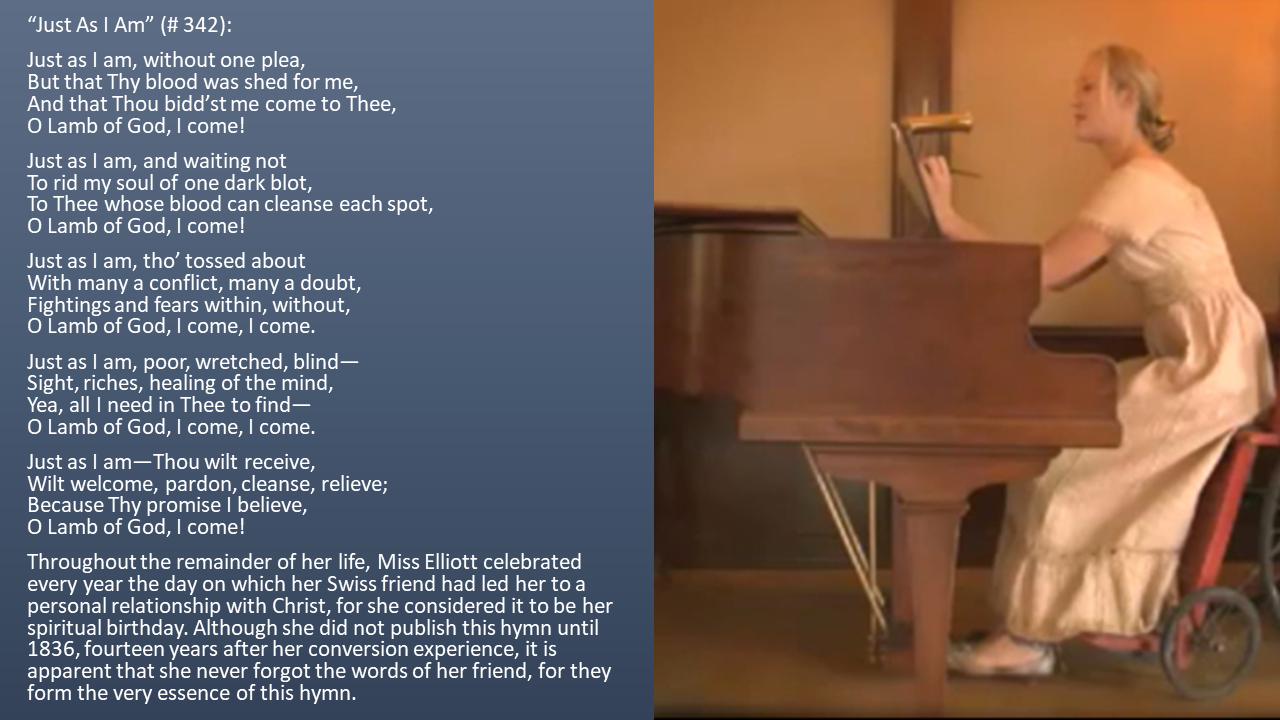
I love remembering the author. The author of that hymn was born on the year of the ratification of our Constitution in the United States, 1789. And the author of that hymn, “Just as I Am,” was one of the most proud musicians in England. And until they came humbly to Christ, they never got to know that His saving blood was shed for them. Let me just read you a little bit of this as you think about this as you received Christ, come to Him. Because the humble approach we need to come to Jesus and live for Jesus is seen in the story of Charlotte Elliott. In London, the year was 1822, she was at the height of her musical career back in 1822, and an evangelist visiting from the continent speaking in London, in her hometown, was invited by some well-meaning friends who wanted to target her, was invited to a concert, this evangelist was, where Charlotte Elliott was playing the piano and singing. She was very gifted, and as she came that night, in a large and very prominent home of London, she played and sang for the crowd who, like everyone else, was very odd. She was a young, carefree, very popular artist, musician, and writer. She seemed to have all the skills: she could write humorous poetry and verse for the press, she could write songs, she could play them, she could sing them. She was doing well. She had reached her peak at age 30, and just then her health began to fail rapidly. Soon she would become a bedridden invalid for decades of her life. But it was at just this moment, where at her peak, she was starting to worry about her health, that she performed that night in that home. She had great feelings of despondency from time to time, and so that night the noted Swiss evangelist, Dr. César Malan, proved to be the turning point in Charlotte’s life. She thrilled the audience with her singing and playing. When she finished, the evangelist threaded his way through the crowd of well-wishers gathered around her until he could stand face to face with the young musician. When he finally was allowed to speak to her and had her attention, he said, young lady, when you were singing there, I thought how tremendously the cause of Christ would be benefited if you would give yourself to the Lord. Now, that’s a direct approach! Just go right up there and say, you need to serve the Lord. But he added—now this is more direct, and we’ve all toned down a little bit—he added, you are as much a sinner, Charlotte, as the worst drunkard in the street or any harlot on Scarlet Street. Now, that is the direct approach of the Gospel. But I’m glad to tell you that the blood of Jesus Christ, God’s Son, will cleanse you from any and all sin if you’ll come to Him. In a very haughty manner, she turned her head aside and said to him, you are very insulting, sir. And as she started to walk away, the evangelist said, lady, I did not mean any offense, only a prayer that the Spirit of God will convict you. Just think of how often we can be used by the Spirit of God to speak to hearts. He was used because everyone went home, and that night, this young woman could not sleep. At two in the morning, she crawled from her bed, knelt at her bedside and cried out to Christ to be her Savior. And then Charlotte Elliott sat down at her writing table that night and wrote these words.
.jpg)
This is what she wrote at two in the morning in 1822: just as I am, without one plea, but that Thy blood was shed for me, and that Thou bid’st me come to Thee, O Lamb of God, I come. Just as I am, and waiting not to rid my soul of one dark blot, to Thee, whose blood can cleanse each spot, O Lamb of God, I come. You know what’s amazing to me is how much she knew about the Lord before she knew the Lord. It shows you the power of the church of England that she attended without regeneration for so many years. Just as I am, though tossed about with many a conflict, many a doubt, fighting’s within and fears without, O Lamb of God, I come. Just as I am, poor, wretched, blind; sight, riches, healing of the mind; yea all I need, in Thee I find, O Lamb of God, I come. And then the final stanza: just as I am, Thou wilt receive, wilt welcome, pardon, cleanse, relieve; because Thy promise I believe, O Lamb of God, I come.
That humble approach is the way we all must come to Christ. She just put it so beautifully into words. And throughout the remainder of her life, Miss Elliott celebrated every year on the day which her Swiss friend had led her to a personal relationship with Christ. She considered it to be her spiritual birthday. She published this hymn 14 years later in 1836. She kept it as her personal testimony that she kept in her Bible. Aren’t you glad that she published it finally and shared that with all of us? And it has never been forgotten, as her testimony is the very essence of this hymn, which reminds us that we’re guilty.
.jpg)
Look back in Psalm 51 because with that humble, contrite approach to God, I am guilty, as David said. In fact, you could just outline this 51st psalm with three successive statements. I am guilty. We’re on the second stanza now, or the second statement, wash me. And then the concluding statement we will see in days ahead where he says, use me, and the Lord does. But let’s look at the second main direction that David takes us in Psalm 51, the end of verse 1. He says, I need to be washed. He says this, he says, blot out my transgressions. Wash me, verse 2, thoroughly from my iniquity, and cleanse me from my sin. Three different verbs: blot, he says in verse 1; wash, he says in verse 2; cleanse, he says in verse 2. He is very, very concerned about the Lord, who alone can wash us clean. It’s very interesting what he says. He looks on sin in a way that sometimes we do not. As I said this morning, depending on how great or how much we see how great sin is or how little we see how horrible sin is, our response to it. David saw the horror of his sin.
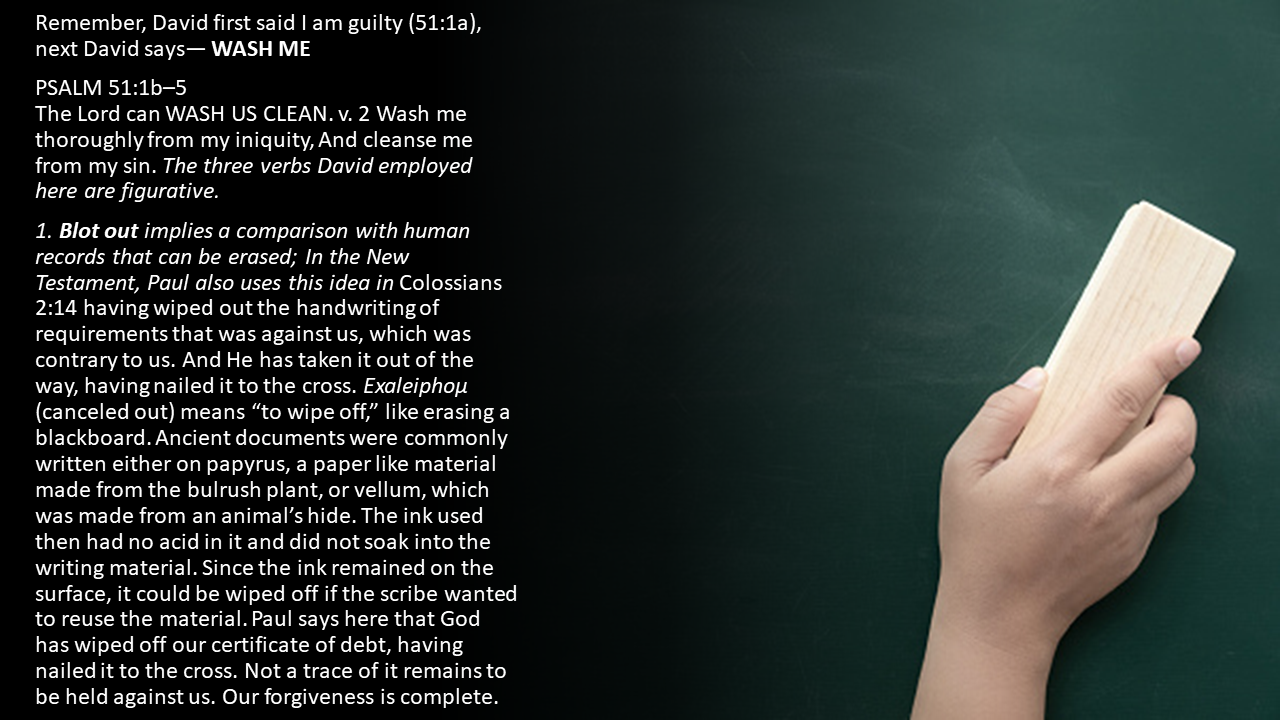
Blot out is implying a comparison of his sins to human records that should be erased. In fact, if we were still in Colossians 2, where we were a little while ago, the fourteenth verse of Colossians 2 says that the cross of Christ blotted out the handwriting of ordinances that was against us, and that’s exactly what David is seeing here. He’s saying, blot out, get rid of the record. I know that You’ve been recording all of these sins. Will You please blot out the record? Don’t make it permanent. Don’t let me face my sin. The word for blot out, canceled out, means to wipe off. It’s kind of like erasing a blackboard.
Now, when we think of writing, we don’t think of wiping it off because we have developed the means to make ink go into the paper. That is a more recent invention. Ancient documents were either written on papyrus or on vellum, which is animal hide. So, papyrus is the cross-laid pieces of reeds from riversides in Egypt, and vellum is the scraped and finished skin of an animal. So, those were their two choices. They didn’t quite know yet about parchment, and paper, and things like that. And so, the ink, which back then had no acid in it, would sit on the top of either the animal skin or the papyrus, and it would just sit there. And because of that, the ink could be wiped off if the scribes wanted to use it. That’s why they had to really guard their documents, because if they got wet at all, it would just come right off. Now with our documents, sometimes it runs a little bit, but we’ve developed ways to keep things from being destroyed by water because we’ve learned about acid making it go right down into the fiber. What he’s saying is, don’t let my sin go down in the fiber of Your records. Wipe it off, erase it, just remove it from me. And he said, You, God can wipe out this record. I want complete forgiveness. I want You to blot out. I don’t want You to keep a record of my sins.
.jpg)
Then he continues. He doesn’t just say, blot out. Look at the first part of verse 2. He says, wash me. He is talking about, uses the word actually for washing clothes.
Now, in the ancient world, and even today, clothes were seen as an extension of the person, and they really are a statement. Remember in James it says, if someone comes to your assembly with glowing clothes and their fingers covered with gold, and you treat them differently. If they’re extending themself, their wealth by showing it off, be careful. Clothing is always seen as an extension of a person. And in the biblical times, the Scriptures used our clothing as a picture, metaphorically and figuratively, of our heart. In fact, keep your finger here and look over at Isaiah. This is probably one of the most graphic of all the extensions of the heart into the clothing. Isaiah 64, almost the last chapter of that giant book. Isaiah 64 and verse 6 says this; it’s a well-known verse. It says, but we are all like an unclean thing, and all of our righteousness’s are like filthy rags; we all fade as a leaf, and our iniquities, like the wind, have taken us away. So, it’s like we’re wearing filthy rags. It’s like we’re wearing clothing that’s defiled because our sins, God sees clothing us. In fact, Ezekiel 31 says the same thing. It says that our sins are upon us like an avalanche, that our sins just cling to us. When God sees us… We don’t see sin. We see the effects of sin. We don’t see it. It’s not something that’s visible to us. Sin is visible to God, and when He looks down, He sees the sins of those who are not in Christ clinging to them, all of them.
We were at the baptismal site and the Jordan River a few weeks ago, and we had a big crowd. We baptized 25 maybe or more in those waters. And of course, two of us had to be there the whole time. And what no one told me is the Jordan River is full of leeches or bloodsuckers. Everyone was just walking out joyously singing and everything. And I looked down at my feet, and all those fat little things were just going away, getting the blood. And as soon as the alarm was raised, everyone’s checking their feet and their legs for bloodsuckers because all of a sudden, we became aware of them. And when we saw them, it was horrible to us. And I only had two or three. Can you imagine what it looks like when God sees the huge black, as it were, blots of our sin covering us? Much worse than seeing a leech, a bloodsucker. He says in Isaiah, we’re like an unclean thing. Verse 6, our righteousness, even trying to be good, is like filthy rags.
So, what do we do about that? Go back to Psalm 51. This is what he says: wash me. He uses the word for taking the clothes to the washing place by the river and working them, beating them, doing the entire process of making them pure and clean again. He says, I want to go to the cleaners. I want to get scrubbed. I want to be washed. I want to be made clean. In fact, the Bible ends with Jesus saying this in Revelation 1:5. It says, Him who loved us and washes us from our sins with His own blood. You see where the great hymns come from? What can wash away my sin? Nothing but the blood of Jesus. So, David is invoking, he is pleading with God. He’s saying, I want You to blot out. The record book is filled with all the record of my sins. Will You please erase that?
In fact, there is a [Greek] word for that where the manuscripts, when they erased them, they would turn them this way and write this way so that not only would the manuscript be wiped off, but you’d write in a different direction, exaleiphō. And there’s an entire group of manuscripts that we found, that now with x-rays, you can turn them and see both times they were written so that you can get double use out of those old manuscripts that have been wiped off. He’s saying, God, wipe me off and turn me sideways so that no one can ever see that, and then take me to the cleaners and wash me thoroughly. Notice he says, verse 2, wash me thoroughly, Psalm 51, thoroughly from my iniquity. Don’t leave any trace, any stain. I don’t want any of it remaining. Do you see the passion that David had for purity? Once he got back in touch, once he came back to God, he didn’t want anything to do with sin. He just wanted to go on.
Then he goes on in the end of verse 2 to say, and cleanse me. And these three verbs are repeated in reverse order later on. This is a big, remember I showed you how from 3-9 there was much mention of sin and little mention of God, and then from 10 on where there’s much mention of God in one mention of sin. This same structure I showed you goes all the way through, and he talks about blot, and cleanse, and wash. And then he says the same thing at the end because it’s so important for him to have his sins blotted out, to have his sins washed away. And in the end of verse 2, and cleanse me, he says at the end of verse 2, from my sin. This is drawn from, the word cleanse, in this second verse, is from the whole Temple ceremonial law in which someone is purified through the workings of the process of the offerings that were taking place in the Tabernacle, and then later in Psalms time, in the Temple. And so, what he’s saying is, he says, I want everything, he says, I want from the business world, I want my sins wiped out. From domestic life, I want them scrubbed away. And from the whole liturgical, ceremonial religious life, I want my sins cleansed. I want them on the surface wiped. I want them right down to the very fiber cleansed, and then I want them spiritually removed. He’s saying, in every realm, from just the surface, like wiping off a blackboard, I want that. I want to be put into the cleaners, and I want them spiritually, forever removed. See, he just totally wanted God to not have any roadblock in his life, no reason to not look on him with favor. So, this is just very thrilling. The way David shows his stress on a desire for God’s total forgiveness of his transgressions, of his iniquities, and of his sins.
Now, if you look back. I hate to keep repeating, but you see there’s so many levels here. It says, have mercy according to Your lovingkindness, verse 1. According to multitude of Your tender mercies. Now, first: blot out, wipe out, clean off the record of my transgressions. That’s a very specific… You know is so big to God? There are 15 different Hebrew words describing sin in the Old Testament, 15 different words translated sin. New Testament only has five. The big five, that are well known. If you listen to Pauline theology, you know those five. But in the Old Testament, sin is so much more graphically described, and he uses one of the big, in fact, there are three summary words for all sins. They all fall into these three, and David uses all three of them. The first one being transgressions, right there in verse 1. And then verse 2, iniquity; and then sin. So, he says, I want You to blot out my transgressions, to wash away my iniquities, and to cleanse my sins. So, he exhausts the whole vocabulary. He says, everything and anything I have done against You, I want it to be wiped out so it isn’t seen. I want it to be scrubbed out so it isn’t lurking in the fiber of my life, and I want it spiritually to be gone. What a heart attitude he had.
.jpg)
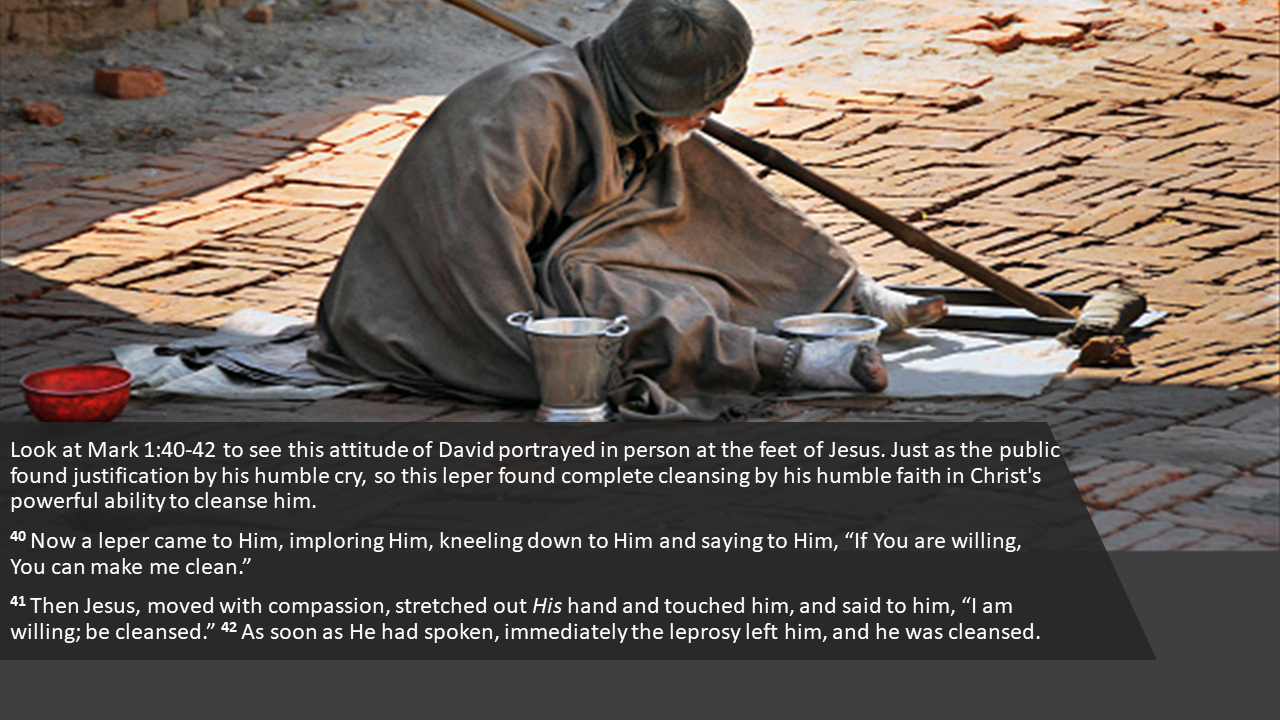
I think that heart attitude is beautifully reflected in the Gospels. And let’s turn there because I see how the New Testament beautifully portrays for us in Mark’s Gospel chapter 1, and let’s look at verse 40 because this, I’m guilty, have mercy on me, reminds me of so many of the events in Christ’s life that He pulls out for us. And remember, if everything Jesus had done were written down, the whole world couldn’t contain the books. Remember it says that in John’s Gospel? The ones that are written down are written for us to learn from, that we might know and rejoice in what we possess in Christ. And in Mark 1 and verse 42 is one of my favorites of all of the stories. In fact, this one is one that if you ever get anywhere in the Holy Land with me, I’m always pointing to this. This one is so graphic; I see this in my mind. But let’s just read in verse 40, now a leper came to Him. And He’s in Galilee, that’s verse 39. He’s going throughout Galilee. Leper came to Him. Remember, leprosy in Leviticus 13 and 14, that whole section is all about showing us what sin is. Leprosy is a disease that is such a graphic picture of sin, and leprosy is dealt with in the Old Testament much like sin is to be dealt with spiritually. And so, when David was saying, wipe it out, and I want You to scrub me, and I want You to cleanse me, he’s going from surface to spiritual just like leprosy. Leprosy is just a surface skin disease and an attacker of the nervous system, but it also implies something much deeper. The leprosy of our souls, we all have. So, this leper is much more than just someone afflicted with this terrible disease. This leper came to Him, verse 40, imploring Him, kneeling down to Him and saying to Him. And Dr. Luke, remember Luke 5 adds, he didn’t just have a little case of leprosy. It said he was full of leprosy. So, this guy is a really full-blown leper, and he kneels down. He actually, the word is he just falls before Christ. It’s not just up on the knees, it’s just, it’s proskyneō. It’s actually the word for worship. He just came down, kneeling down worshipfully, and saying to Him, if You are willing, You can make me clean. Luke adds, he actually put his face on the ground, so this man, full leprosy puts his face right down on the ground. Reminds you of the publican this morning, Luke 18:13? He doesn’t even think that he merits looking in the face of Jesus, just like the publican didn’t think he could look up at God when he made his request, and so this leper’s such a beautiful picture for us. Then Jesus, verse 41, moved with compassion—the most frequent emotion of Christ—stretched out His hand. Same word that’s used when Peter’s sinking in the water in the storm. Jesus stretched out His hand. There’s a lot of stretching out. It’s Jesus who is the Seeker; it’s God who is the Initiator in salvation. It’s always God who is coming toward us. And Jesus stretches out to this leper His hand and touched Him, and that’s the essence of salvation. For He hath made Him who knew no sin to become sin for us. Jesus took the contamination of this leper on Himself. The instant He touched him, every religious person within sight went [gasp] because Jesus immediately came in contact with that leprosy and was defiled, and was unclean, and that’s exactly what He did for us. He who knew no sin, never committed sin, non peccare, He was not a sinner, became sin because He touched us. And He didn’t just touch us; He reached out and took, actually stripped our sin off of us and put it on Himself. That is such a picture. You don’t see it here with this leprosy, but He stretched out His hand and touched him and said to him, verse 41, I am willing; be cleansed. And as soon as He had spoken, immediately the leprosy left him, and he was cleansed.
.jpg)
Back to Psalm 51. Okay, just turn back there. Remember how we started this evening? I told you that David couldn’t believe what happened in his life. He couldn’t believe because he was overwhelmed! He went from absolute gloom and heaviness of his soul to the joy of his sins being lifted off. That’s how God does it. Now look, I told you this morning, the consequences didn’t go away. Those followed David all the way to the end of his life, but the instantaneous removal of the sin, and the guilt, and the load, and the burden. That’s how God does it. I am not talking about emotional ooh! I’m talking about reality, knowing his sins were gone. Just as the publican found justification by his humble cry, so the leper of Mark 1:40-42 found complete cleansing by his humble faith in Christ’s powerful ability to cleanse him. So, what does all that say? That the Lord Jesus Christ, back in Psalm 51 verse 1, immediately, completely, instantaneously, absolutely wants to blot out our transgressions.
What are transgressions? I’m going to have to take another whole time. There’s so much just depth to the words that the Spirit of God directed David to use. It’s a complete hamartiology, the whole study of sin in just his choice of words and the words for forgiveness that he uses. And we’ll have to do that when I won’t talk so fast that you… I watch you guys! When I say something too fast, I see people leaning over and they’re trying to write it real fast, and finally I see them just give up. Can’t keep up. So, I don’t want to do that tonight.
But end of verse 1, blot out my transgressions. Blot out every time I’ve crawled over the walls You’ve put in my life, which is what transgression means. God’s put up all these walls, and He’s saying, don’t go there! Don’t go there! Don’t do that! And we just find a ladder and get over it, and we just won’t stop. We’ll tunnel underneath. We’ll just stop any barrier He puts up. That’s a transgression. And he says, I want You to just. I’ve just gone over all your barriers, most recently with this Bathsheba thing, but he says, boy, I’m going all the way back in my life. I just want You to blot all those out. And then he goes on in verse 2, wash me thoroughly.
Back, just briefly, we do have just a couple minutes. Let me show you how thoroughly David’s sins had bothered him. Look back at the 51st psalm because every part of David was affected by sin. Look at verse 3. First of all, in David’s prayer of confession, you can’t help but notice how his sins defiled every part of him. In verse 3, his eyes were defiled. You say, what do you mean his eyes were defiled? He says, my sin is always before me. That word, before me, is the same concept that we have in the showbread in the Tabernacle. It was emprosthen. It was in front of the eyes of, it’s before the eyes of. He says, my sin’s just always just right in front of me. I just can’t, he says. It’s kind of like when well-meaning people come up and they take a flash picture of you when you’re not ready for it, and you just walk around and those flash things are just, no matter where you look, there’s just these two glowing images that have been burned in your retina. He says, my sin is just burned into my eyes. He says, everywhere I look, all I see is my sin, my sin, my sin. His eyes were affected.
Look at verse 6. His mind is affected. He says, You desire truth. Because he says he’s begging for this wisdom that he needed in verse 6. He’s saying, make me to know wisdom. He says, my inner person has been affected. Look at verse 10. His mind has also affected his heart, which is part of his mind, his non-material part. He says, my heart and my spirit are out of fellowship with You. In verse 11 he says, don’t cast me out of Your presence, don’t take Your Holy Spirit from me. Verse 12, restore the joy of my salvation. In every way, he was out of fellowship with God, his heart and his Spirit. There was no joy. What an incredible mental struggle he went through. And by the way, taking away the Holy Spirit from him was not losing his salvation. It was the empowerment. It was the presence. It was the reality of God that he had known since he was a young shepherd boy. He says, don’t take away from me Your presence, Your Spirit. And what an amazing impact on his mind.
Keep going to verse 8. His ears were also affected. He says, make me to hear joy and gladness. He said, I’ve gotten deaf. He says it’s terrible. Sin affects our ears. He lost the sound of joy and gladness. Nothing sounds good for a person who’s out of fellowship with God. That’s what he’s saying. You ever notice that? When someone’s struggling with sin, you go, hey, how you doing? Oh, don’t talk to me. They don’t want, they just, everything sounds bad to them. They’re just. And he says, my ears have been affected, my mind has been affected, my eyes have been affected.
Keep going, verse 8. He also says his bones were affected. You talk about eyes, and ears, and minds, and even his bones. In verse 8 he says, that the bones You have broken may rejoice. Remember the sheep that wandered too much, what the shepherd would do? The loving shepherd would take the wandering sheep and break their leg and then carry them around after they splint it and get it ready to heal, to teach them to stay with the flock. The Great Shepherd and the Good Shepherd had taken His sheep, David, and broken his bones. Like a wandering lamb that had to be taught to stay with the shepherd, David said, I want the bones that You have broken to rejoice. He said, when I go through the consequences for my sin, I want to thank You that You saved me from even more dire circumstances.
His heart, in verse 10. Create in me a clean heart. He said, I had a dirty heart. In fact, verse 17, his heart was hard. He said he needed a broken and contrite heart, which is another way of saying he had a hard heart. His heart not only had become defiled; it had become hard. And when we harbor sin, it hardens our heart. Often those with consciences that are defiled are usually on the defensive, and they wonder what other people may know. Remember how the writer of Proverbs puts it? He says the wicked run when no one’s even pursuing them. They’re weighed down with their sins. So, every part of his being: his eyes verse 3, his mind verse 6, his ears verse 8, his bones verse 8, his heart verse 10. Keeping on going: his mouth in verse 13. His mouth got affected. He says, then I’ll teach transgressors the way. Deliver me from the guilt. Verse 14 at the end, my tongue will sing aloud. Even David’s lips were affected. He could no longer testify. He couldn’t witness. He couldn’t even sing God’s praises. Verse 15, he says, Lord, You’re going to have to open my lips so my mouth can show forth Your praise. He says, I’ve gotten paralyzed. All of me is affected. In verse 14, the last part of him that was affected were his hands. His hands were stained with Uriah’s blood. Deliver me from the guilt of bloodshed. He said, I just can’t forget what I did. That was David’s desire to the Lord summed up by 51 verse 1 and 2. Blot out those transgressions, wash me thoroughly from iniquity, cleanse me from my sin.
.jpg)
So, what’s a response to that? A response to that, like always, is a testimony of someone who knew sin deeply. And I thought as you close Psalm 51, you can open the testimony book in front of you, your hymn book, and turn to number 196. And I thought it would be great for us to sing a song we often only sing on communion Sundays, and to sing it just because we’re so glad that the Lord who loved us has blotted out and wiped out the record of our sins. And He’s taken us to the cleaners, and He’s getting the sin right out of the very fibers of our life. And then He has spiritually removed all of these spiritual ramifications of offending a holy God, because Jesus reached down and touched us in our leprosy of sin and sucked all that sin off of us and put it on Himself. And that’s all described in William Cowper’s testimony. Remember a couple weeks ago I told you that the greatest thing to know in all the world is that you’re forgiven. If you know that, you can have such peace, you don’t have to worry. Forgiven means even if you sin, they’re already forgiven once and for all if you understand the atoning work of Christ. Yes, we have to confess, and agree, and forsake, and flee, but we’re forgiven once and for all, and this is what Cowper’s talking about. At the end of our life, we’ll sing Thy power to save. We ought to be more bold about our salvation the older we get instead of quieting down.
Let’s close in prayer and then remain standing. We’re going to commission and send off, but let’s bow. Father in Heaven, thank You for the precious blood of Your Son the Lamb of God, who loved us and loosed us from our sins and took those sins upon Him and washed us whiter than snow and tells us that we will never be condemned for our sins. And for that, we sing of Your power to save, and we bless Your name, and we rejoice with David that our sins are gone. They’re blotted out. They’re scrubbed clean. They’re cleansed away from us. And for that, and Your great grace, and your marvelous mercy, we are so grateful. And all of God’s people said, in the name of Jesus we pray, amen.
Notes
I am guilty. I was wrong. I am sorry—please take from me the just punishment I deserve.

So begins the greatest song about the love of God experienced by a most desperate man named David.
David was overwhelmed. In a moment he went from absolute gloom and heaviness of soul to the joy of his sins lifted off. That weight that had grown heavier day after day was now lifted. The spiritual scales that had slowly taken the color and light from his life were removed.
His soul now flooded with light and peace began again to drink deeply from the wells of his salvation.
David had fallen so far, so fast—but the dullness of his soul spread to every inch of his spiritual life had pressed him harder and harder. But now that weight was lifted.
His cold heart was warmed; his tormented soul was set free. David was no longer trapped in a painfully chastened body.
David had left the bottom, where he had stayed there for almost a year.
How did David get back on the track? And even more pressing for each of us here this evening–how do we come back to God when we’ve sinned and grown cold and distant?
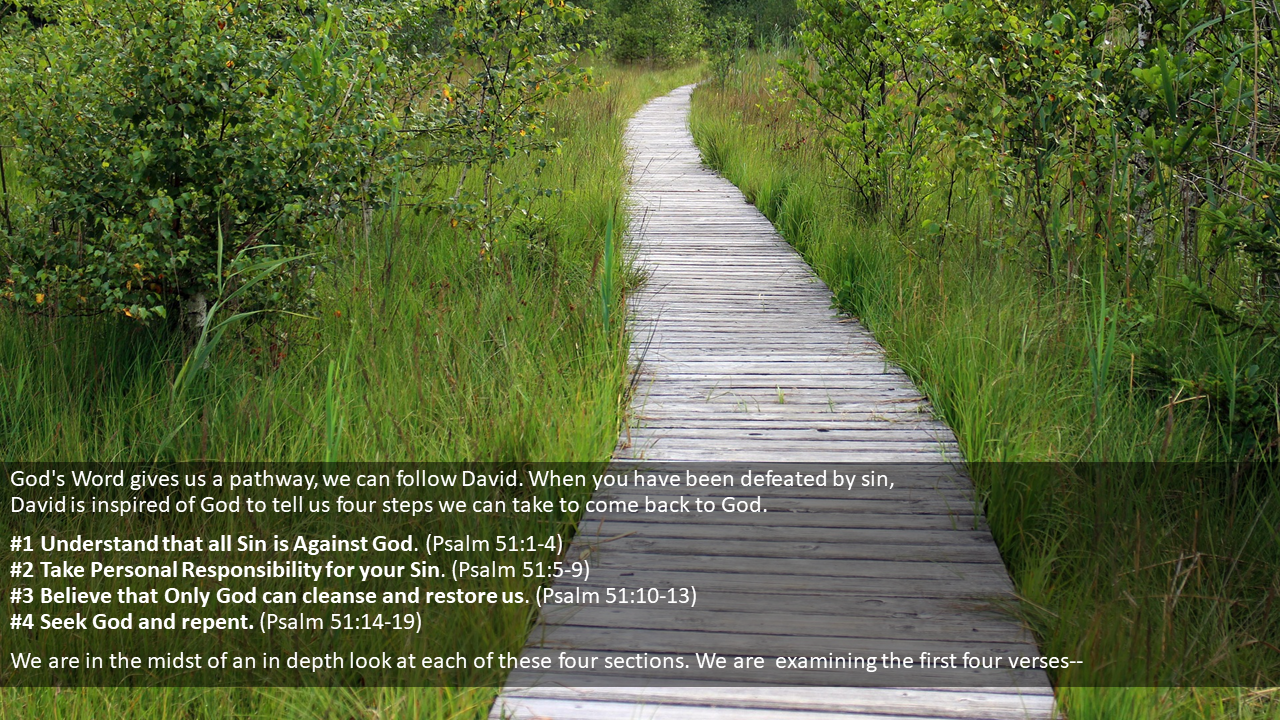
God’s Word gives us a pathway, we can follow David. When you have been defeated by sin, David is inspired of God to tell us four steps we can take to come back to God.
#1 Understand that all Sin is Against God. (Psalm 51:1-4)
#2 Take Personal Responsibility for your Sin. (Psalm 51:5-9)
#3 Believe that Only God can cleanse and restore us. (Psalm 51:10-13)
#4 Seek God and repent. (Psalm 51:14-19)
We are in the midst of an in depth look at each of these four sections. We are examining the first four verses– Understand that all Sin is Against God. (Psalm 51:1-4)
David starts this first section by saying—
I AM GUILTY
But David sweeps beyond all these human and moral considerations and looks straight at the Almighty and Holy God he had sinned against.
By confessing that he was guilty, David was coming back to God who alone can RENEW OUR RELATIONSHIP broken by sin. v. 1 Have mercy upon me, O God, According to Your loving kindness; According to the multitude of Your tender mercies, Blot out my transgressions.
We learned last time that if you want swift, immediate and relationship restoring help from God, start with that simple guilty plea. If you want to see a David type of response to God in the NT open with me to Luke 18:9-14.
We learned that God just can’t resist this type of heart cry to Him. The Greek tenses tell us that the publican couldn’t stop saying this; he was an ongoing longing on his heart.
Luke 18:13 “And the tax collector, standing afar off, would not so much as raise his eyes to heaven, but beat his breast, [kept on present active participle] saying, ‘God, be merciful to me a sinner!’
Like the publican who wouldn’t even lift his face towards God but just said God be merciful to me, we can also come back to God.
This cry of acknowledgment of our sin is very humbling. Paul reminds us of a secret in our lives as believers—the very way we started is how we are to continue.
Remember Colossians 2:6? “As you have therefore received Christ Jesus the Lord, so walk in Him”. The word received is the very same word for salvation as we find in John 1:12 “…as receive Him, to them He gave…”. That humble contrition that brought us salvation brings us back time after time when we sin. Remember again with me how each of us came, just as we were and humbly fell at His feet pleading for mercy.
JUST AS I AM

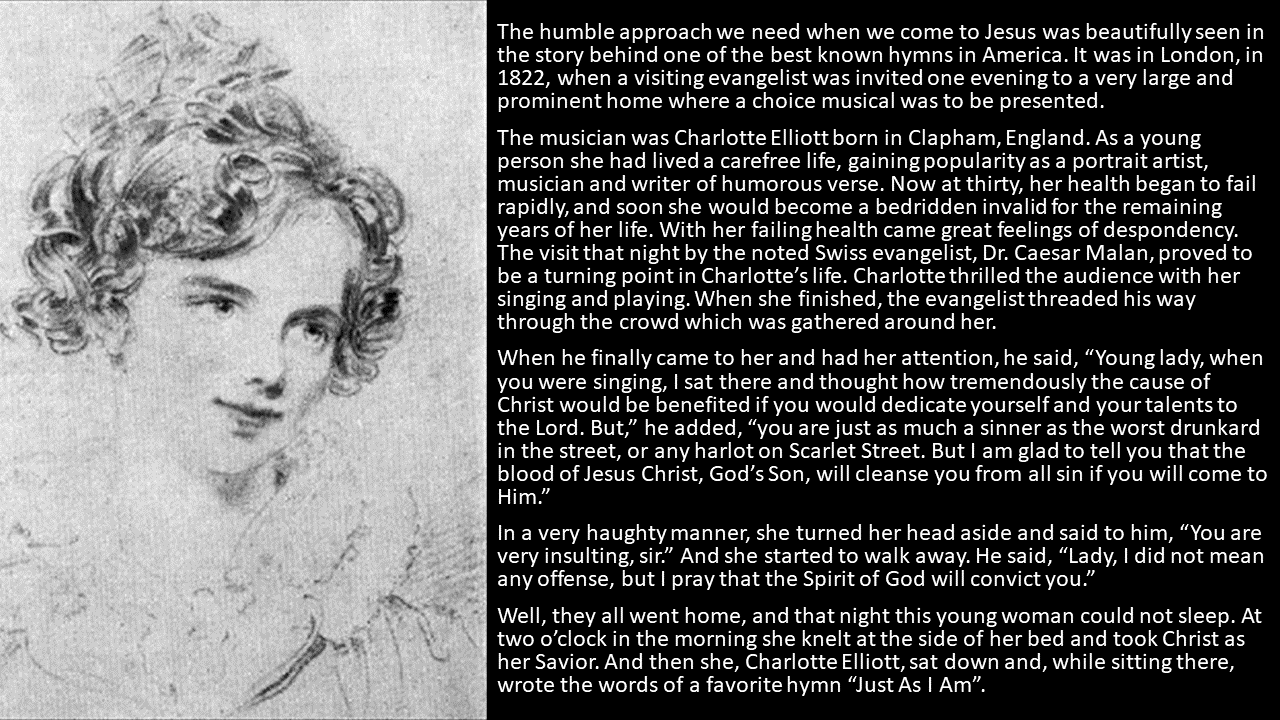
The humble approach we need when we come to Jesus was beautifully seen in the story behind one of the best known hymns in America. It was in London, in 1822, when a visiting evangelist was invited one evening to a very large and prominent home where a choice musical was to be presented.
The musician was Charlotte Elliott born in Clapham, England. As a young person she had lived a carefree life, gaining popularity as a portrait artist, musician and writer of humorous verse.
Now at thirty, her health began to fail rapidly, and soon she would become a bedridden invalid for the remaining years of her life. With her failing health came great feelings of despondency. The visit that night by the noted Swiss evangelist, Dr. Caesar Malan, proved to be a turning point in Charlotte’s life.1 Charlotte thrilled the audience with her singing and playing. When she finished, the evangelist threaded his way through the crowd which was gathered around her.
When he finally came to her and had her attention, he said, “Young lady, when you were singing, I sat there and thought how tremendously the cause of Christ would be benefited if you would dedicate yourself and your talents to the Lord.
But,” he added, “you are just as much a sinner as the worst drunkard in the street, or any harlot on Scarlet Street. But I am glad to tell you that the blood of Jesus Christ, God’s Son, will cleanse you from all sin if you will come to Him.”
In a very haughty manner, she turned her head aside and said to him, “You are very insulting, sir.” And she started to walk away. He said, “Lady, I did not mean any offense, but I pray that the Spirit of God will convict you.”
Well, they all went home, and that night this young woman could not sleep. At two o’clock in the morning she knelt at the side of her bed and took Christ as her Savior. And then she, Charlotte Elliott, sat down and, while sitting there, wrote the words of a favorite hymn “Just As I Am” (# 342):
Just as I am, without one plea, But that Thy blood was shed for me, And that Thou bidd’st me come to Thee, O Lamb of God, I come!
Just as I am, and waiting not To rid my soul of one dark blot, To Thee whose blood can cleanse each spot, O Lamb of God, I come!
Just as I am, tho’ tossed about With many a conflict, many a doubt, Fightings and fears within, without, O Lamb of God, I come, I come.
Just as I am, poor, wretched, blind— Sight, riches, healing of the mind, Yea, all I need in Thee to find—
O Lamb of God, I come, I come.
And then the final stanza: Just as I am—Thou wilt receive, Wilt welcome, pardon, cleanse, relieve; Because Thy promise I believe, O Lamb of God, I come!
And that this is the basis on which all of us must come to Christ.2 Throughout the remainder of her life, Miss Elliott celebrated every year the day on which her Swiss friend had led her to a personal relationship with Christ, for she considered it to be her spiritual birthday. Although she did not publish this hymn until 1836, fourteen years after her conversion experience, it is apparent that she never forgot the words of her friend, for they form the very essence of this hymn. 3
Remember, David first said I am guilty (51:1a), next David says—

WASH ME
PSALM 51:1b–5
The Lord can WASH US CLEAN. v. 2 Wash me thoroughly from my iniquity, And cleanse me from my sin. The three verbs David employed here are figurative.
1. Blot out implies a comparison with human records that can be erased; In the NT Paul also uses this idea in Colossians 2:14 having wiped out the handwriting of requirements that was against us, which was contrary to us. And He has taken it out of the way, having nailed it to the cross.
Exaleiphoμ (canceled out) means “to wipe off,” like erasing a blackboard. Ancient documents were commonly written either on papyrus, a paper like material made from the bulrush plant, or vellum, which was made from an animal’s hide. The ink used then had no acid in it and did not soak into the writing material. Since the ink remained on the surface, it could be wiped off if the scribe wanted to reuse the material. Paul says here that God has wiped off our certificate of debt, having nailed it to the cross. Not a trace of it remains to be held against us. Our forgiveness is complete.
2. wash away ( kaμb _as ) compares forgiveness with washing clothing (often viewed as an extension of a person),
Isaiah 64:6 But we are all like an unclean thing, And all our righteousnesses are like filthy rags; We all fade as a leaf, And our iniquities, like the wind, Have taken us away.
Revelation 1:5 and from Jesus Christ, the faithful witness, the firstborn from the dead, and the ruler over the kings of the earth. To Him who loved us and washed us from our sins in His own blood,
3. and cleanse is drawn from the liturgical ceremonial law in which one might be purified for temple participation. These requests (cf. vv. 7, 9) stressed David’s desire for God’s total forgiveness of his transgressions . . . iniquity, and sin. 4
The Lord can REMOVE THE ROADBLOCK as soon as we confess our sin. v. 3 For I acknowledge my transgressions, And my sin is always before me.
When you read Psalm 51, David’s prayer of confession, you can’t help but notice how his sins defiled every part of his being:
1. His eyes (v. 3), David’s eyes were also affected; all he could see were his sins.
2. His mind (v. 6), His mind was affected, for he begged for wisdom (v. 6). The inner person (heart and spirit, v. 10) was out of fellowship with God (v. 11), and there was no joy. God does not take away the Holy Spirit when we sin (John 14:16), but we do grieve the Spirit and thereby lose His fellowship and help (Eph. 4:30–32). May we never forget the high cost of committing sin!
3. His ears (v. 8), Sin also affected his ears, for he lost the sound of joy and gladness. Nothing sounds good to a person out of fellowship with God.
4. His bones (v. 8), like a wandering lamb that had to be taught to stay with the flock, David’s Good Shepherd broke his bones.
5. his heart (v. 10), Verse 17 suggests that David’s heart not only became defiled, but it also became hard. When we harbor sin, it hardens the heart. People with a dirty conscience are usually on the defensive, wondering what other people may know.
6. his mouth (vv. 13–15). Even David’s lips were affected, for he could no longer testify or witness, or even sing God’s praises (vv. 13–15). Nothing shuts a Christian’s mouth like unconfessed sin.
7. His hands were stained with Uriah’s blood (v. 14), and all he could do was throw himself on the mercy of God and cry out, “Wash me!” (vv. 2. 7)
That is because for us as believers sin always isolates and defiles. The Prophet Isaiah confessed that he was “a man of unclean lips” (Isa. 6:5), and then he spoke for all of us when he wrote, “But we are all as an unclean thing, and all our righteousnesses are as filthy rags” (64:6).
Whatever sin touches, it defiles; only the blood of Jesus Christ can wash away that defilement (1 Cor. 6:9–11; 1 John 1:7; Rev. 1:5). 5
1 Corinthians 6:9-11 Do you not know that the unrighteous will not inherit the kingdom of God? Do not be deceived. Neither fornicators, nor idolaters, nor adulterers, nor homosexuals, nor sodomites,10 nor thieves, nor covetous, nor drunkards, nor revilers, nor extortioners will inherit the kingdom of God.11 And such were some of you. But you were washed, but you were sanctified, but you were justified in the name of the Lord Jesus and by the Spirit of our God.
1 John 1:7 But if we walk in the light as He is in the light, we have fellowship with one another, and the blood of Jesus Christ His Son cleanses us from all sin.
Revelation 1:5 and from Jesus Christ, the faithful witness, the firstborn from the dead, and the ruler over the kings of the earth. To Him who loved us and washed us from our sins in His own blood,
Look at Mark 1:40-42 to see this attitude of David portrayed in person at the feet of Jesus. Just as the public found justification by his humble cry, so this leper found complete cleansing by his humble faith in Christ’s powerful ability to cleanse him.
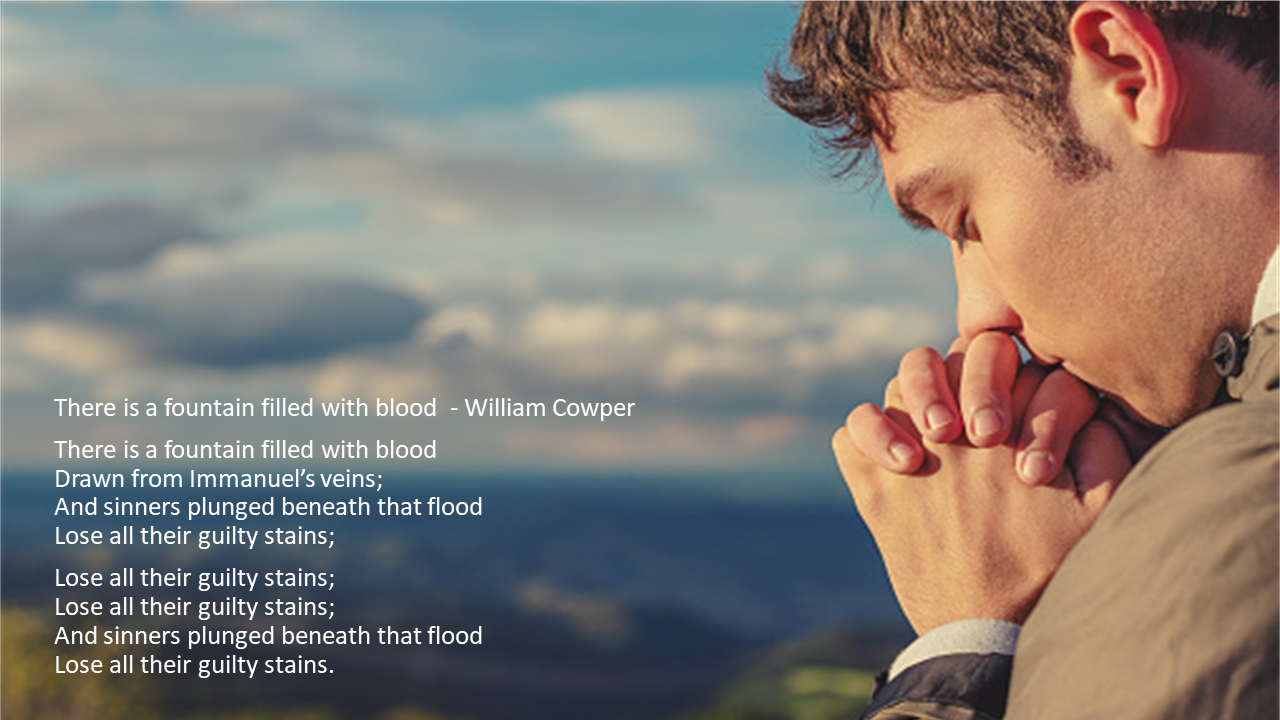
 The Lord can WASH US CLEAN v. 2 I like what William Cowper (#196) once wrote.
There is a fountain filled with blood Drawn from Immanuel’s veins; And sinners plunged beneath that flood Lose all their guilty stains; Lose all their guilty stains; Lose all their guilty stains; And sinners plunged beneath that flood Lose all their guilty stains.
1 Adapted from two different stories of this hymn. The first written by Osbeck, Kenneth W., 101 Hymn Stories, (Grand Rapids, MI: Kregel Publications) 1997.
2 Details of Charlotte Elliott’s conversion recorded by McGee, J. Vernon, Thru the Bible with J. Vernon McGee, (Nashville: Thomas Nelson Publishers) 2000, c1981.
3 Osbeck, Kenneth W., 101 Hymn Stories, (Grand Rapids, MI: Kregel Publications) 1997.
4 Walvoord, John F., and Zuck, Roy B., The Bible Knowledge Commentary, (Wheaton, Illinois: Scripture Press Publications, Inc.) 1983, 1985.
Slides


Check Out All The Sermons In The Series
You can find all the sermons and short clips from this series, David’s Spiritual Secret here.
Looking To Study The Bible Like Dr. Barnett?
Dr. Barnett has curated an Amazon page with a large collection of resources he uses in his study of God’s Word. You can check it out here.