
Long Obedience in Seeking God
DSS-46
061105AM
Transcript
.jpg)
I’d like you to open with me to the 18th psalm. The 18th psalm is the divinely inspired record of the last words of David, and we’re going to be looking, beginning this morning, at the long obedience that David had in his walk with the Lord, and especially in the 18th psalm surrounding his seeking of God. I hope that this psalm will become, perhaps for you, one of your favorites because these words God tells us were his last words, David’s last words, and God captured them for us, put them in this book, and actually records them twice. The 18th psalm also occurs in a little different format. In 2 Samuel 22, and at the end of that there’s a little addition that’s not in this psalm that says, these were the last words of David. So, in a real sense, this is a very thrilling psalm because it’s the finality of his life that we finally come to. But more than that, David summarizes his whole life. And from it we’ll see some wonderful, wonderful truths. We’ve watched David’s life for many months from his childhood, way back when we started with him as a shepherd boy, and all the struggles, the triumphs of the battlefield, the defeats of those unguarded moments, and all of those truths come to us through the inspired record.
.jpg)
The book you hold in your hand is so amazing because this is not merely David’s words or the apostles words, which could be just about anybody else’s words, but they are actually God’s words that came through them and were recorded by inspiration for us. And so, because of that we have the inspired record that God gave to us of David’s life. And the reason I’ve loved this study of David’s life is because David’s life, more visibly than I think any other life and that’s my personal belief, more than any other life in the scriptures, his life, because it’s the longest, has the longest and most complete testimony of God’s grace. And I want you to think of the implications of that because the grace that saves is the grace that forgives and so visibly in David’s life. It’s also the grace that kept giving him a new beginning. Remember all these psalms that we’ve looked at when David is struggling, when David is going through defeats, or he is going through despair, and then God gives him a brand new beginning. And he just cranks out that psalm and goes on and accomplishes something else, wonderful for the Lord. But especially as we gather around the tables celebrating Christ’s cross, the truth of God’s grace is closest and perhaps dearest when we think that He gave himself for me, for each of us individually. Grace says that God is committed to finishing what He started in my life. Jesus Christ says, I am going to keep cleansing you as often as needed. Jesus also tells us, I’m going to love you no matter what you do, and nothing can make Me love you any more or any less.
.jpg)
So that brings us to a conclusion. That means, like David, we should be seeking God when we’re imperfect. Now, let me just pause on that thought for a moment because David’s life declares it doesn’t take perfection to please God. Now, most people know that but some Christians aren’t aware of that yet, and they’re going through this endless lifelong struggle trying to finally get perfect by whoever’s standard, their own usually. And I don’t mean they’re trying to save themself; they’re trying to please God by perfecting themself. What’s so interesting is the Bible says, and the very God of peace is the one who’s going to perfect us. So, it’s almost disheartening when we’re trying to do, in our own strength, what God has already promised.
One of the reasons that we need to go so long through David’s life is it takes us, often as believers, so long to realize that God does not demand or expect perfection from us. You don’t have to be fearless to please God. David was often afraid and he had to flee to the Lord. Remember that next time you’re afraid. That isn’t something that’s horrible. It’s not something that short circuits everything God’s doing. David was often afraid and his psalms are all about him singing about fleeing to God when he faces fearful and fearsome situations. We don’t have to be perfect to please God.
David is often smitten by guilt and confesses his sins to the Lord. We should remember that next time we’re stained by sin. We don’t have to be perfect and sinless and we can’t be, and so we shouldn’t strive to keep ourselves sinless in our own strength thinking it will please God because now onto Him who is able to keep us from falling. It’s God’s work to keep us.
You don’t have to have a perfect marriage to please God. David had a marriage with a lot of problems if you have read the record. Remember that the next time you’re weeping inside or outside over the stress or pain that you feel at your partner, that God doesn’t demand a perfect marriage, a perfect life, a fearless life.
You don’t have to have perfect children to please God. David has no recorded children who followed the Lord to the end of their life. He had a lot of children. We don’t have a single record of one that made it all the way to the end seeking and loving the Lord. Remember that the next time you don’t like the harsh blast of disobedience or disrespect or in gratitude that your children may give you.
And you also don’t have to be constantly serene to please God, kind of live in this euphoria, a constant smile like the Pharaohs like when they just did that latest one and dug it out of the Valley of the Kings, Netjerikhet that smile painted right on the coffin. You don’t have to have one of those painted smiles, constantly serene, to please God. David was often depressed. He had to sometimes crawl on his face back to the Lord. That’s how distraught he was. Remember that next time you’re too discouraged, even go out of bed. You don’t want to go to work. You don’t even want to look someone else in the eye. You don’t have to be perfectly serene to please God.
But we do have to experience the grace of God to please God. And that’s what the 18th psalm is all about. We gather as Christ’s body to praise God for grace. And David’s life [that] is recorded in his last words are covered with grace. God looks on David not as he was, but always as he would be and that’s the same way he looks on us in our lives. David says, from start to finish God knows my heart. He knew my deepest desires, and he forgave all the rest. David was imperfect, sometimes failing, sometimes fearful, often sad, sometimes troubled, and through it all, and in spite of it all and in it all David says from start to finish, in his last words, we’re looking at those very first six words, I will love the Lord my strength. David loved the Lord with all of his heart and what an example he is.
.jpg)
When we stopped at David’s deathbed last time, we witnessed his hope and peace as he walked through the valley of death shadow and feared no evil. But God’s Word notes that Psalm 18 in the last recorded words of David give us his long term spiritual investment strategy. That’s how I look at this. David, at the end, says I want to show you my ledger, my pattern, the way that I invested my heart in the Lord. And he gives us so many dimensions of it. We’re going to look at those, the personal and the way he dealt with his problems. But as we look over David’s life and see these lifelong patterns that made him such a man that God used so much and loved. In fact, I see the difference between 2 Samuel 22, that’s the historical record, that’s the way that the psalm is presented in the Chronicles, the record books, but in Psalm 18, the one we’re looking at this morning it’s basically the exact same psalm but it’s not shown as historic it’s shown as personal. And it’s really an emphasis on David’s personal walk. Just look at those first words of Psalm 18. I will love You oh Lord. And then he starts into what we’re going to see later on, this list of how he looked on the Lord. He didn’t have God out at arm’s length. He said, I will love You oh Lord, my strength. And then he goes through this whole list of metaphors, he just piles them on because he knew the Lord so well.
.jpg)
These final words of David are his personal testimony of the love that drew him into a lifelong habit of seeking God. David begins, and his first words are where all of us should begin, a full hearted expression of love to Him, to God, who’s more than life. Who is more than all we need. God, who is a God who is enough for every part, every problem, every stress, every struggle, every disappointment of life. Hebrews 11 in the New Testament summarizes God’s saints by saying that God loves to reward those that diligently seek Him. The most diligent seeker of all, God put a little name on him and He calls him the man after My own heart, the man that’s chasing after Me, pursuing Me, wanting Me. David was that man who was after the heart of God. He wanted God, he wanted to seek Him. And we’re going to see in this wonderful psalm; he seeks Him like no one else does. No other recorded person in the scriptures sought God in the way that David is said to have sought God. He sought God while facing giant enemies, Goliath and others through protracted battles with foreign armies, and even fleeing his own son. And during all of his personal struggles and fears, one person never left David. Everybody else did. His family fled. His wives he had to put some places, and Michal (Saul’s daughter) fled him, and all kinds of problems he went through. But one person never left him, and that was the Lord. David always knew God’s love and His presence. And seeking the Lord and loving Him was a lifelong pursuit of David.
.jpg)
Psalm 18 contains his final words that distill his whole spiritual pilgrimage into one chapter. And the first line of this psalm summarizes his lifelong habit. And you know what David’s lifelong habit was? The first line tells us, embracing God. You say, where do you get that? It just says, I will love you, oh Lord. We get it from the word love. And for just a moment before we read the psalm, I want you to think about that. The word used by David for love is a rare verb form of a word group that expresses tender intimacy. It’s not the normal word for love that you just read everywhere else in the Bible. This is a rare word. It’s only used 46 times, 45 times for God, once by David for God. He’s the only man in the Bible or person or group that dares to say to the God who so often says this is how I love you, David said, and that’s how I’m going to love You back. It is a tender, intimate, embracing love. It’s much like Mary’s strong devotion on resurrection mourning. When she just wanted to hug Jesus in John 20, in verse 17, and Jesus said stop clinging to me, it’s the same concept. It’s a clinging, embracing, holding love that hugs and won’t let go.
In the Bible, this Hebrew word for love, rāḥam is the word, is always used in a positive sense about God and by God for His love of His people. The word speaks of love that draws someone close to them, hugs them. It’s a love that yearns for someone and when they see them, especially if you’re like at an airport, you notice that when you haven’t seen someone that you don’t just go, hi, good to see you. That means you’re a distant friend, but when you yearn for someone, you just can’t wait to see them. And as soon as you see them you embrace them, you hug them, you are drawn toward them. That’s the type of love. And here in Psalm 18, in the first verse is the sole time in the entire Bible this term for a hugging, embracing love is used by a person describing their love for God. And only David, in all the inspired record uses this word God uses to describe His love for His beloved people. David said, I will love You, oh Lord that way. That’s why God calls him the man after His own heart. David says, I love you so much Lord, that I’m drawn to You. I want to run and throw my arms around You. I want to express my love for You. That is embracing love, that is seeking love, and that is David’s heart after God. Psalm 18 records, David’s last words looking back over life, a recounting of the depth of love he confesses he felt for the Lord.
And what’s wonderful is we’ve gathered this morning as a group of imperfect people just like David. He didn’t be have to be perfect to have this kind of love for God. We’re a group of imperfect people who are all knit together by love for a perfect savior, Jesus Christ. Because we love this wonderful Lord this morning, I want you to hold your Bible open to Psalm 18. Now, follow along as I read.
.jpg)
I will love You, oh Lord, my strength. The Lord is my rock and my fortress and my deliverer, my God, my strength in whom I will trust, my shield and the horn, or the power, of my salvation, my stronghold. I will call upon the Lord who is worthy to be praised, so shall I be saved for my enemies. What enemies was he facing? He’s at the end of his life and he said the pangs of death surrounded me. The floods of ungodliness made me afraid. The sorrows of the Grave or Sheol surrounded me. The snares of death confronted me. So, he was struggling with that ultimate enemy. And then verse 6 says, in my distress, I called upon the Lord. I cried out to my God and He heard my voice from His temple. And my cry came before Him even to His ears.
.jpg)
Then the Earth shook and trembled the foundations of the hills also quaked and were shaken because He was angry and smoke went up from His nostrils and devouring fire from His mouth. Coals were kindled by it. He bowed the heavens also and came down. With darkness under His feet, and He rode upon a cherub and He flew. He flew upon the wings of the wind. He made darkness His secret place. His canopy around was dark waters and thick clouds of the skies from the brightness before Him, His thick clouds passed with hailstones and coals of fire. The Lord thundered from Heaven and the most high uttered His voice, hailstones and coals of fire. He sent out His arrows and scattered the foe lightnings in abundance and He vanquished them. Then the channels of the sea were seen. The foundations of the world were uncovered. At Your rebuke, Lord, at the blast of the breath of Your nostrils.
.jpg)
He sent from above. He took me. He drew me out of many waters. He delivered me from my strong enemy, from those who hated me. For they were too strong for me, they confronted me in the day of my calamity but the Lord was my support. He brought me out into a broad place. He delivered me because He delighted in me. The Lord rewarded me according to my righteousness, according to the cleanness of my hands, He recompense me. For I have kept the ways of the Lord and have not wickedly departed from my God. For all His judgments were before me, and I did not put away His statutes from me. I was also blameless before Him, and I kept myself from iniquity. Therefore, the Lord has recompensed me according to my righteousness, according to the cleanness of my hands in His sight.
.jpg)
With the merciful, You’ll show Yourself merciful. With a blameless man, You will show Yourself blameless. With the pure, You’ll show Yourself pure. And with the devious, You’ll show Yourself shrewd. You’ll save the humble people but will bring down haughty looks. For You will light my lamp. The Lord my God will enlighten my darkness. For by You, I can run against a troop. By my God, I can leap over a wall. As for God, His way is perfect. The Word of the Lord is proven. He is a shield to all who trust in Him. For who is God except the Lord and who is a rock except our God? It is God who arms me with strength and makes my way perfect. He makes my feet like the feet of deer and sets me on my high places. He teaches my hands to make war so that my arms can bend a bow of bronze.
.jpg)
You have also given me the shield of Your salvation. Your right hand has held me up. Your gentleness has made me great. You enlarge my path under me so my feet did not slip. I’ve pursued my enemies and overtaken them. Neither did I turn back again till they were destroyed. I’ve wounded them so they could not rise. They have fallen under my feet. For You have armed me with strength for the battle. You have subdued under me those who rose up against me. You also have given me the necks of my enemies so that I destroyed those who hated me. They cried out, but there is none to save even to the Lord, but He did not answer them. Then I beat them as fine as the dust before the wind. I cast them out like dirt in the streets. You have delivered me from the strivings of the people. You have made me the head of the nations. A people I have not known shall serve me. As soon as they hear of me, they obey me. The foreigners submit to me. The foreigners fade away and come frightened from their hideouts.
.jpg)
The Lord lives. Blessed be my Rock. Let the God of my salvation be exalted. It is God who avenges me and delivers the people under me. He delivers me for my enemies. You also lift me up above those who rise against me. You have delivered me from the violent man. Therefore, I will give thanks to You, oh Lord, among the Gentiles and sing praises to Your name. Great deliverance He gives to His king and shows mercy to His anointed, to David and his descendants forevermore.
Let’s bow before our Lord in prayer. Father in Heaven, I thank you for David. I thank you that he shows us forever, that we don’t have to be perfect to please You. And that we are rather recipients of Your grace which keeps on cleansing, keeps on giving us a new and fresh start, a new beginning, and allowing us to realize that Your love will never fail even when we do. And I pray that this morning as we celebrate the cross that delivers us from the power of sin and death and allows us to live like David covered by Your grace, I pray that we might so personally, so lovingly embrace You all of our days. In Your precious name, we ask this Lord Jesus. Amen.
.jpg)
Psalm 18 is one long testimony to God’s great faithfulness. As a shelter, you notice all the metaphors David uses, as a stronghold, a sure foundation, because David trusted in Him. I call this final aspect of his life, this psalm, his long obedience. He just goes through all the different, and we, actually, there are five stages in the psalm. And he’s talking about; he intersperses those lightnings and the Earth shaking. He’s talking about God revealing Himself in Moses time, and then all this enemy stuff was his military days. But he just keeps coming around and around when he keeps saying, but You Lord, You are the one that he sought for his life. He was seeking to build a life that God would reward. That’s what this 18th psalm is about. A life that God rewards is a life that personally seeks the Lord. That rāḥam, that Hebrew word that means embracing love and the love that’s just drawn toward and won’t let go. That is a personal seeking of the Lord. And a life that God greatly rewards is a life that has a long history of personal pursuing or seeking God.
Now what this 18th psalm comes down to is, it’s a record of the investments that David made in the Lord. That’s why it’s so personal. It’s his investment record recorded by God of the deposits of David’s account. We know from life, if you’re anywhere in your late forties and fifties you’re getting constantly besieged with the fact that if you haven’t yet started you need to start, you need to make preparations because the only investment strategy in American culture that is wise is a long term one. And so, if you know anything about money, money is like time it’s given for us not merely to spend, but to invest. It’s amazing, Jesus spent much of His public ministry talking about money. Of His 30 stories or parables more than half of them spoke about money. Money’s all around us. It drives the economy of our world. It motivates people and workers in this country. It’s a target most people use to measure their security. So, when you talk about money, everybody knows about investments. But one of the secrets though, that we should pull when we think of investing our time, is that a long term strategy is what is best. The 18th psalm shows David had a lifelong strategy of making deposits. That’s why he pauses between all those historical accounts in those 50 verses I read and keeps saying, and Lord You were my shield, Lord You were my fortress, and Lord I trust in You, and Lord, You delivered me. He’s talking about the fact he kept looking to the Lord all the way through his life.
.jpg)
One of the secrets of those who obtained great wealth, and they always talk about, is the power of long-term compounded investments. I’ll just tell you one quick story about us. We lived and served at a church in New England. We saw the reality of that long-term wealth, growing power. For six years, our little family got to live in this parsonage. A parsonage is a home built by a church for the pastor to live in. In 1988, we went there and we lived in a house built in the early 1800s just for the pastor of the Quidnessett Church. The family that donated the money was the E.I. DuPont family. Maybe you’ve seen a paint can with their name on it. They’ve been around for a long time and they were very, very wealthy. Even at the early 1800s. When they built the house, they gave the church one $25 share of the DuPont company, and they said, this share is for you to reinvest the dividends and maintain the house on the allocation made annually from the accounts value. So, that was 1828. So, they built a house, paid for it, gave Quidnessett Church one share and said, save the dividends, reinvest them once a year, take out a certain amount, and fix the house up. When we moved into that home, 160 years later in 1988, the house was lovely. The acre of grounds looked like a botanical garden, and the maintenance accounts was worth a million dollars from one $25 investment. The unbroken compounding of the dividend yield, stock splits and appreciation of each share through the ups and downs of the Civil War, World War I, The Great Depression, World War II, the Korean and Vietnam Wars, and onward turned $25 into a million dollars even after all the expenses were paid for that huge home. What amazing power there is in compounded investments in the long haul. Financial planners tell us real wealth is long term. In fact, in the Proverbs 3000 years ago, Solomon says that wealth hastily gained is elusive. It doesn’t stay around.
.jpg)
So, Psalm 18 is the investment record by God of the deposits in David’s account. The long term strategic investment. It was written after a lifetime of facing enemies at every turn. As you listened to, when I read it, first David faced the enemies in forms of the wolves and lions of his shepherding years. Then he had to face the Philistines, both in the Valley of Elah, Goliath nine plus feet tall, and those that surrounded him when he was on King Saul’s staff. So, for all those years before his marriage, enemies abounded. And then he gets married and as the king’s son-in-law the enemies grew greater because the king and the armies of Israel began to hunt David. You remember all those psalms we studied that in. Later when David became king, the enemies he faced were not any longer just the Philistines. Every nation that bordered on Israel, and even those beyond the borders, off beyond the river became his mortal enemies as the pagan nations tried to destroy the land of Israel. And finally, when older and nearing the end of his life, David faced not only the pagan nations, but they were joined by his own children who sought his throne and became his enemies and endangered his life.
So, what’s interesting, if you look back at the superscript, and I don’t know if your copy of the Bible has it, but the first verse in the Hebrew manuscript starts with to the Chief Musician, a Psalm of David. And what you find before the psalm is the longest introduction to any psalm in the Book of Psalms. And it’s interesting what that psalm says to… a Psalm of David, the servant of the Lord who spoke to the Lord the words of this song on the day the Lord delivered him from the hand of all of his enemies and from the hand of Saul. And he said… Now that’s all the super script, first verse of the Hebrew manuscript. Notice what it says from the hand of all his enemies. And what is the first thing he starts talking about in verse 4? The pangs of death. And what does 2 Samuel 22 and 23 tell us that these were his last words before his death. You know what this tells us? David faced enemies his entire life and, on his deathbed, as he is helpless and unable to move he said, now as I’m going into Your presence, You’ve delivered me from all of my enemies. You know what that tells us? Troubles, your enemies, adversities, your adversaries are going to follow you and me all of our lives. Either you’re just going to be coming out of a struggle or you’re going to be in the middle of one, or you’re just going to be headed into one. But it’s only when we get into His presence that we’re delivered from all of our enemies.
.jpg)
And so, in the midst of a hard life, a life of stress, a life of constant demands, a life on the run, a life of endless struggles, David chose to make regular long-term investments in seeking God. A long investment means making a pursuit of God personal. Look, starting at the end of verse 1, what he says. David is very personal in seeking of God. In fact, nine times right at the front of the psalm, he expresses his lifelong seeking God in terms of the use of the word, my. Now he peppers this through the rest, but he just does a volley of them right here at the front. And notice what he says. I will love You, oh Lord, my strength. The Lord is my rock. Verse 2. My fortress, my deliverer, my God, my strength, and whom I trust, my shield and the horn as in power of my salvation, my stronghold. When David described the Lord. He was very possessive. Now children are like that. Have you raised any children? When they’re little, they go mine. that’s one of the first words they learn. My. We’re not talking about that kind of possessive, we’re talking about my, just an adoring that he knew the Lord personally and expresses that. God was not distant to David. He is my God.
Then, after David tells the Lord he loves Him, that’s the very first six words and he tells Him he loves Him so much, he wants to hug Him. He goes on for 50 verses to exhaust the Hebrew language in attempt to explain all that God has been to David through his life. But most of those experiences surround one thing, and I want you to see that in verse 2. Four times in this psalm, David says the Lord was his rock. And what he says, verse 2, the Lord is my rock. And at the end of verse 2, my God my strength. Now, if you have a New King James it says strength, you might, if you have the New American, there’s a little letter there and it tells you to go look in the margin. Do you know what? That word strength, at the second part of verse 2, is not the normal word for strength. It literally is the Hebrew word for rock. So actually, the translators didn’t know how to do this because rock was mentioned so much, they just talked about how a rock is strong. But actually, he says in that second verse my God, my rock. So, he repeats himself, in whom I trust. And then look at verse 31, go down a little further for who is God except the Lord who is a rock, our God. So, he says it again. Then look at verse 46. The Lord lives, blessed be my rock. So, four times. Verse 2, the Lord is my rock. Verse 2 again, the Lord is my rock. Verse 31. Who is a rock except God? And then verse 46, blessed be my rock.
When David calls the Lord his rock, he was drawing from his life in the desert. If you’ve ever been in the desert, you know that the fragile life of the desert, the little things don’t exist just out in barren wastelands. They always cluster around the leeward or the shaded side of the rocks. And there you can find all kinds of incredible life in the desert, but it has to be in the shadow of a rock. In fact, if you travel through the desert, the only way that you make it, especially in long stretches, is to find some place where you can get out of the blazing heat of the sun in shade. Usually in, if it’s pure desert, you have to find rocks, outcroppings, cliffs somewhere where you can get out of the direct [sun.] And so, David, from his life in the desert, knew he couldn’t survive the heat of the desert sun without a place of shade to rest, to renew before going on. And so, he uses that as his confession. When he says rock, rock, rock, rock, he confessed that he had only made it through the dangerous deserts of his life by the shadow of God as his rock. God protected him. God shaded him. When David was fleeing from in his enemies, be it Saul, or the Philistines, or his own son Absalom, God was the rock he found refuge and safety in. And when everything around him was unstable, God was the rock solid foundation. That’s going to be the focus as we track through this historic record.
.jpg)
But what’s amazing, this concept of the rock inspired. One of the greatest hymns of Christendom that’s been loved for 300 years because in England, around the year 1763, when our Ben Franklin was busy flying his kites in thunderstorms, over here in Britain a young pastor was riding home from his circuit. His name was Augustus Toplady. He was traveling home when a violent thunderstorm struck and here is the recounting of the birth of the great hymn. Which you might know well, Rock of Ages. And that’s the concept that David says, oh Lord, my rock, that I can trust. This is what the hymn histories tell us.
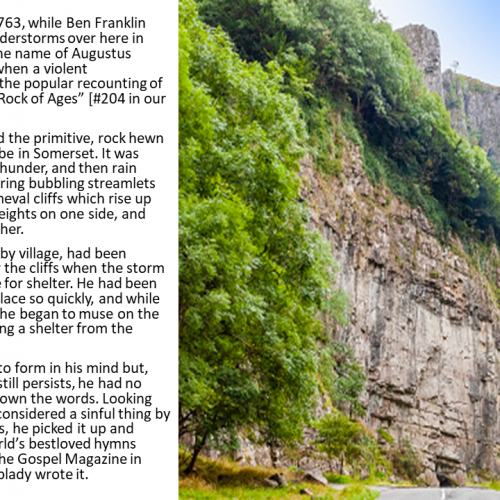
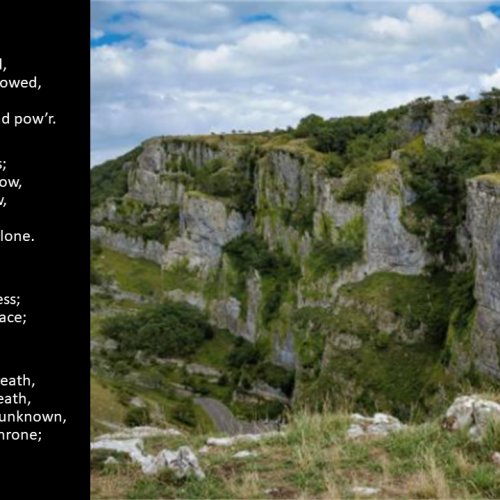
Lightning illuminated the rock hewn landscape of Somerset in England, followed by the deep growl of thunder. Then rain lashed mercilessly down, pouring rivers of water down the sides of the cliffs in the Cheddar Gorge. The curator of Blagdon of the nearby village, who is the hymn writer Augustus Toplady, had been traveling along the road by the cliffs when the storm struck. He dashed into a little cave in the cliff for shelter. He had been fortunate to find this hiding place so quickly and while waiting for the storm to pass he mused on the idea that he had been wrestling with. The idea of the rock of faith being a shelter from the storms of life. And so, the words to the hymn began to form in his mind but according to the record that we have, that still persists, he had no paper to write down the words. So, looking down, he saw that this cave was also a place where the local children played. And there on the ground was a playing card, which he considered a sinful thing as a young cleric. Nevertheless, he picked up this playing card, and it’s still in a museum over in England with Rock of Age written on it. He picked it up and began to write one of the world’s best loved hymns, which was first published in 1775, 12 years after he wrote it. And just for a moment, I want you to read this. It’s number 204, and if you don’t have a hymn book, just listen. But you’ve heard these words. And I want you to think about what David believed as he looked at the cross of Christ future and wrote about it four psalms later, Psalm 22. And what Augustus Toplady believed as he stood in that thunderstorm crashing all about him, but he was so secure because he was in that cleft of the rock. He said, this…
.jpg)
Rock of Ages, cleft for me, let me hide myself in Thee. Let the water and the blood from Thy riven side which flowed, be of sin the double cure, cleanse me from its guilt and power.
Not the labor of my hands can fulfill Thy law’s demands. Could my zeal no respite know, could my tears forever flow. All for sin could not atone. Thou must save and Thou alone.
Nothing in my hands I bring. Simply to Thy cross I cling. Naked, come to Thee, for dress, helpless, look to Thee for grace. Foul, I to the fountain fly, wash me, Savior, or I die.
And then like David at the end of his life.
While I draw this fleeting breath, when mine eyes shall close in death. When I soar to worlds unknown, see Thee on Thy judgment throne. Rock of Ages, cleft for me, let me hide myself in Thee.
.jpg)
Let’s bow before our rock. Why don’t you take a few moments to say, Lord, You’re my rock. I’m hiding in You. You are my redeemer. You gave Yourself; I’m trusting in Your blood to cleanse me. I am resting, secure in the God who said, you don’t have to be perfect. Jesus Christ was a perfect sacrifice made for imperfect people. Worship Him quietly.
Father, this morning, we love You. You can’t love us anymore. You’ll never love us any less. Your love is not dependent on our performance, but on Christ’s righteousness, we don’t please You by doing, but by being in Christ, recipients of His grace. And that grace teaches us how to systematically deny ungodliness in our lives, but You don’t love us any more, depending on how much we deny the ungodliness. You love us completely. We love You Lord. We thank You for loving us so much that You gave Yourself for us, so we celebrate that this morning. Receive our worship. In the name of Jesus we pray. Amen.
Notes
David – A Long Obedience in Seeking God
 As we open to Palm 18 this morning, I have been praying that maybe this Psalm will become the most meaningful and precious of all the Psalms we have studied. We walked through David’s life for many months; from his childhood and all its struggles, through the triumphs of the battle field to the defeats of those unguarded moments—all through the inspired record God gave to us.
The reason I have loved this study of David’s life is because of the way God’s grace is brought so visibly forward in David’s life–the grace that saves, the grace that forgives, the grace that gives new beginnings each day and every hour. Especially when we gather around the Table celebrating Christ’s Cross these truths are closest and dearest.
Grace says God is committed to finishing what He started in my life; Christ says I am going to keep cleansing you as often as needed; I am going to love you no matter what you do and nothing can make me love you any more or any less. That means all of us must be…
SEEKING GOD WHEN IMPERFECT
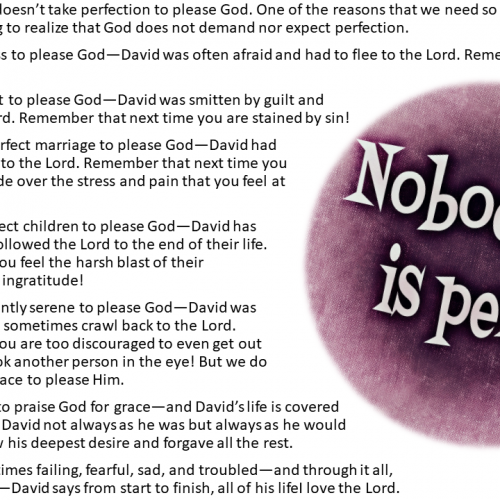
David’s life declares that it doesn’t take perfection to please God.
One of the reasons that we need so long to go through David’s life is that it takes us so long to realize that God does not demand nor expect perfection.
- You don’t have to be fearless to please God—David was often afraid and had to flee to the Lord. Remember that next time you are afraid!
- You don’t have to be perfect to please God—David was smitten by guilt and confessed his sins to the Lord. Remember that next time you are stained by sin!
- You don’t have to have a perfect marriage to please God—David had marriage problems he gave to the Lord. Remember that next time you are weeping inside or outside over the stress and pain that you feel at your partner!
- You don’t have to have perfect children to please God—David has no recorded children who followed the Lord to the end of their life. Remember that next time you feel the harsh blast of their disobedience, disrespect or ingratitude!
- You don’t have to be constantly serene to please God—David was often depressed and had to sometimes crawl back to the Lord. Remember that next time you are too discouraged to even get out of bed, or go to work, or look another person in the eye!
But we do have to experience God’s grace to please Him.
We gather as Christ’s Body to praise God for grace—and David’s life is covered with grace. God looks upon David not always as he was but always as he would be. God saw his heart, knew his deepest desire and forgave all the rest.
David was imperfect, sometimes failing, fearful, sad, and troubled—and through it all, in spite of it all, and in it all—David says from start to finish, all of his life–I love the Lord.
When we stopped at David’s deathbed, we witnessed his hope and peace as he walked through that valley of death’s shadow and feared no evil.
God’s Word notes that Psalm 18 contains the last recorded words of David. I hope that Psalm 18 will become a part of your long term spiritual investment strategy—a pattern for how to love the Lord, trust the Lord and seek the Lord for a long time of your life.
So stop with me and look back over David’s life and see the life long patterns that made him such a man that God used and loved.
This Psalm of praise to God is actually recorded twice in the Bible here and in II Samuel 22. It is repeated intentionally for emphasis. In II Samuel 22 it is set as the historical record of David’s final words. In Psalm 18 it is captured as the personal testimony of this life long, God seeking servant of the Lord.
Look with me at just the first six words of Psalm 18.
I will love You, O Lord, my strength.
These final words of David are his personal testimony of the love that drew him into a life long habit of seeking God.
David begins, and his first words are where we also should always begin–a full hearted expression of love to Him who is more than life to us.
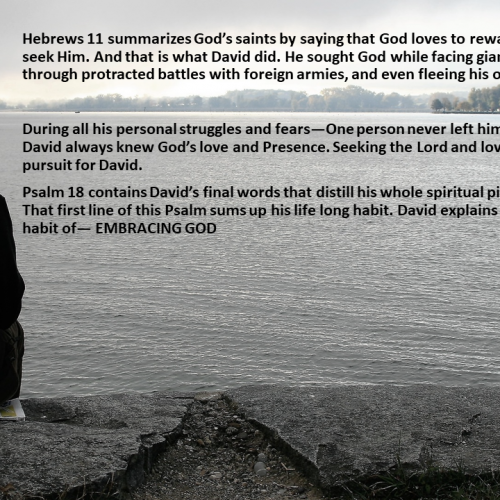
Hebrews 11 summarizes God’s saints by saying that God loves to reward those that diligently seek Him. And that is what David did. He sought God while facing giant enemies like Goliath, through protracted battles with foreign armies, and even fleeing his own son.
During all his personal struggles and fears—One person never left him and that was the Lord. David always knew God’s love and Presence. Seeking the Lord and loving Him was a life long pursuit for David.
Psalm 18 contains David’s final words that distill his whole spiritual pilgrimage into one chapter. That first line of this Psalm sums up his life long habit. David explains that he had a life long habit of—
 EMBRACING GOD
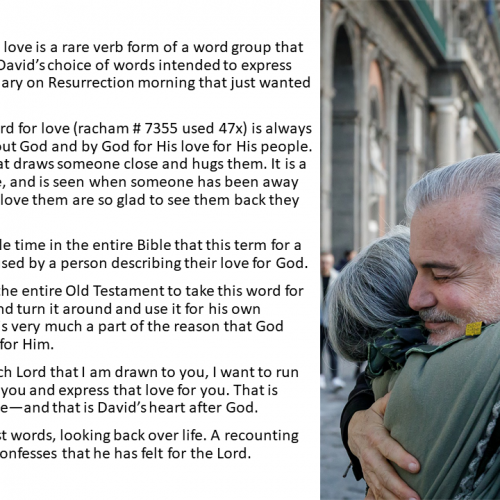
This word used by David for love is a rare verb form of a word group that expresses tender intimacy. David’s choice of words intended to express very strong devotion, like Mary on Resurrection morning that just wanted to hug Jesus (John 20:17).
In the Bible this Hebrew word for love (racham # 7355 used 47x) is always used in a positive sense about God and by God for His love for His people. This word speaks of love that draws someone close and hugs them. It is a love that years for someone, and is seen when someone has been away for a period and those who love them are so glad to see them back they hug them.
Here in Psalm 18:1 is the sole time in the entire Bible that this term for a hugging, embracing love–is used by a person describing their love for God.
David is the only person in the entire Old Testament to take this word for God’s love of His children and turn it around and use it for his own personal love for God. This is very much a part of the reason that God says that David had a heart for Him.
David says I love you so much Lord that I am drawn to you, I want to run and throw my arms around you and express that love for you. That is embracing love, seeking love—and that is David’s heart after God.
Psalm 18 records David’s last words, looking back over life. A recounting of the depth of love David confesses that he has felt for the Lord.
We have gathered this morning as a group of imperfect people, knit together by love for a perfect Savior, Jesus Christ.
Because we LOVE the Lord this morning, holding your Bible open to Psalm 18, would you stand with me and lift your heart, your face and your voice up to Him and sing that chorus “I Love You Lord” with me as a personal love gift of worship to Jesus?
With that preparation, follow along as we read this incredible chapter.
Read Psalm 18, Pray and then sing again “I Love You Lord”!
Psalm 18 is one long testimony to God’s great faithfulness as a shelter, a stronghold, and a sure foundation to all who would trust in Him. And I call this final aspect of David’s life his long obedience. That is what is most evident about David—he sought the Lord for almost all of his life. And–
SEEKING GOD BUILDS A LIFE GOD REWARDS
- A life that God rewards is a life that personally seeks the Lord.
- A life that God greatly rewards is a life that has a long history of personal pursuing or seeking God.
The sheer volume of information God has given to us about David offers us an incredible opportunity to sift through these chapters and see what a long obedience looks like, and should be like. This is perhaps the greatest way that David’s life can impact us—by calling us to walk in the power of the Spirit to also have a long obedience in seeking God.
Psalm 18 is an investment record, recorded by God, of the deposits in David’s account. We know from life that a long term investment strategy with our money is the best way to go. Money like time is given to us not merely to spend—but also to invest.
Jesus spent much of His public ministry talking about money. Of His 30+ parables, more than half speak about money. Money is all around us; it drives the economy of our world, motivates most of the workers of this country and is the target that most people use to measure their success and happiness.
One of the secrets that those who obtain great wealth always talk about is the power of long term, compounded investments.
When we lived and served at a church in New England we saw the reality of that long term wealth growing power.
 For six years we lived in a lovely New England parsonage. A house built in the early 1800’s specifically for the pastor of the Quidnessett Church. The family that donated the money to build that house were part of the E.I. DuPont family.
After the house was built they gave one $25 share of stock in the DuPont Company; they requested that the dividends be reinvested and that the house be maintained on an allocation made annually from that account’s value. That was sometime around 1828.
When we moved into that home 160 years later in 1988, the house was lovely, the acre of grounds looked like a botanical garden–and the maintenance account was worth nearly $1,000,000.00!
The unbroken compounding of the dividend yield, stock splits, and appreciation of each share through the ups and downs of the Civil War, World War I, the Great Depression, World War II, the Korean and Viet Nam Wars and onward–turned $25 into a million dollars, even after all the expenses were paid for that house.
What an amazing power there is in compounded investment in the long haul of American financial history. Financial planners tell us that the real wealth is long term. Even Proverbs said that 3,000 years ago when Solomon said that wealth “hastily gained” is elusive (Pr. 28:20)
So Psalm 18 is the investment record by God of the deposits in David’s account. It was written after a lifetime of facing enemies at every turn. First David had faced enemies in the form of the wolves and lions of those shepherding years. Then he had to face the Philistines of both the Valley of Elah (Goliath) and those that surrounded him when on King Saul’s staff. So for all those years before his marriage enemies abounded.
Then as the King’s sin-in-law the enemies grew greater as the King and the armies of Israel were hunting David to kill him. Later when David was crowned King, the enemies he faced were the Philistines plus the combined armies of all the pagan nations surrounded the Land of Israel.
Finally, when older and nearing the end of life all the pagan nations were joined by those of his own children who sought his throne and thus became his enemies and endangering his life. It seems that David never stopped facing enemies. At the end of his life he wrote this Psalm extolling the Faithful God who delivered him from murderous Saul, pagan armies and even wayward sons.
So in the midst of a hard life, a life of stress, a life of constant demands, a life on the run and a life of endless struggles—David chose to make regular, long term investments in seeking God. A long obedience in seeking God means–
SEEKING GOD THROUGH ALL OF LIFE
David compounded his investment in God. David cultivated a life long desire to seek the Lord in every avenue of life. So should we. A great way to start is to do what David did. Have you ever thought of where David was when he made on of his greatest discoveries about God? He was young, alone, and at work!
As a boy, David decided to seek God while at work each long day and night. From his earliest days on the hillsides as a shepherd David sought God. He looked at life, even a life as lonely, monotonous, and mundane as watching sheep—with such a God heartedness that just his reflections on seeking God as a shepherd are immortal.
Who could ever look on the lowliest job of the day (being a shepherd) in the same way as before once David showed how he viewed his job? To David the seeker of God, the Lord became his [my] shepherd. He looked at himself and saw that he was just like a weak, helpless and often confused lamb. And if he a mere human child could care for sheep and meet all of their earthly needs—how much more would the Lord be sure that David shall not want.
From the desolation and barrenness of the arid desert David could believe that he could have so much provision that he could lie down in green pastures. Instead of anxiously eating as if there would never be enough, he could quietly rest satisfied.
Facing the deadly thirst of the wilderness, David saw that seeking God meant that he would always be led by waters that are stilled and drink in peace and safety. As a boy he saw that an anxious sheep was prone to sickness and injury so he always made his sheep feel safe and secure so the Lord as he entrusted his life into His care restored his soul.
In the Psalm we just read David becomes the third and final person in the Old Testament to be described as “the servant of the Lord”.
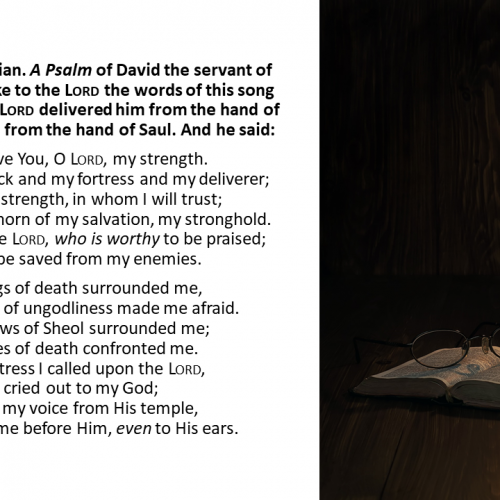
Psalm 18:1-2 To the Chief Musician. A Psalm of David the servant of the Lord, who spoke to the Lord the words of this song on the day that the Lord delivered him from the hand of all his enemies and from the hand of Saul. And he said:
We will consider that longest of all superscriptions this evening, but now look at this string of possessive statements. David’s relationship with the Lord is not theoretical, it was real and it was HIS and he knew it and said it—to the end!
David is very possessive in his description of his life long walk with the Lord. He describes his relationship by saying—the Lord is my…
David’s expressions, “My strength, my rock, my fortress, my deliverer, my shield, the horn of my salvation…” are a set of seven metaphors to describe God as He aided David in the military times as “Shield, Strength, and Horn”; and from David’s days on the run God was to him “Rock, Fortress, Deliverer, and Stronghold”. God is not distant if in your relationship with Him you–

MAKE IT PERSONAL
David was very personal in his seeking of God. Nine times in this Psalm he expresses his life long seeking the Lord in those terms using “my”:
1 I will love You, O Lord, my strength.
2 The Lord is my rock and my fortress and my deliverer;
My God, my strength, in whom I will trust; My shield and the horn [means ‘power’] of my salvation, my stronghold.
When David described the Lord, as we have seen he was possessive.
God wasn’t distant to David he is “my” God.
Then after David tells the Lord that he loves Him so much he wants to hug Him—he goes on in the 50 verses to exhaust the Hebrew language in an attempt to explain all that God has been to David throughout his life.
But most of those expressions surround the way David related to God as his “Rock”. Four times in this Psalm the Lord is My Rock, David declares.
- v. 2a The Lord is my rock and my fortress and my deliverer;
- v. 2b My God, my strength (Heb. Lit. ‘rock’), in whom I will trust; My shield and the horn of my salvation, my stronghold.
- v. 31 For who is God, except the Lord? And who is a rock, except our God?
- v. 46 The Lord lives! Blessed be my Rock! Let the God of my salvation be exalted.
When David calls the Lord his Rock it was drawn from the life of the desert when the fragile life of desert plants and animals was often clustered in the areas of shade around the rocks. Travelers also knew that to survive the heat of the desert Sun there must be places of shade to rest and renew before going on.
David confessed that he had only made it through the dangerous deserts of his life by the shadow of God as his Rock of protection and shade. When fleeing from enemies like Saul and Absalom, God was the Rock that he found refuge and safety. And when everything around him was unstable, God was the Rock solid foundation he could always feel beneath him.
In England around the year 1763, while Ben Franklin was busily flying kites in thunderstorms over here in America, a young pastor by the name of Augustus Toplady was traveling home when a violent thunderstorm struck. Here is the popular recounting of the birth of the great hymn “Rock of Ages” [#204 in our books].
LIGHTNING briefly illuminated the primitive, rock- hewn landscape of Burrington Combe in Somerset. It was followed by a deep growl of thunder, and then rain lashed mercilessly down, pouring bubbling streamlets down the craggy sides of primeval cliffs which rise up some 250ft. to the Mendip Heights on one side, and into Cheddar Gorge on the other.
The curate of Blagdon, a nearby village, had been travelling along the road near the cliffs when the storm struck and dashed into a cave for shelter. He had been fortunate to find this hiding-place so quickly, and while waiting for the storm to pass he began to muse on the idea of the “rock of faith” being a shelter from the “storms of life”.
The words for a hymn began to form in his mind but, according to the legend that still persists, he had no paper in his pocket to write down the words. Looking down he saw a playing card, considered a sinful thing by the young cleric. Nevertheless, he picked it up and began to write one of the world’s best-loved hymns which was first published in the Gospel Magazine in 1775, some 12 years after Toplady wrote it.[1]
 Rock of Ages, cleft for me,
Let me hide myself in thee;
Let the water and the blood,
From thy riven side which flowed,
Be of sin the double cure,
Cleanse me from its guilt and pow’r.
Not the labour of my hands
Can fulfil thy law’s demands;
Could my zeal no respite know,
Could my tears for ever flow,
All for sin could not atone;
Thou must save, and thou alone.
Nothing in my hand I bring,
Simply to thy Cross I cling;
Naked, come to thee for dress;
Helpless, look to thee for grace;
Foul, I to the fountain fly;
Wash me, Saviour, or I die.
While I draw this fleeting breath,
When my eyelids close in death,
When I soar through tracts unknown,
See thee on thy judgment throne;
Rock of Ages, cleft for me,
Let me hide myself in thee.
[1] http://www.ensignmessage.com/archives/rockofages.html
Slides

Check Out All The Sermons In The Series
You can find all the sermons and short clips from this series, David’s Spiritual Secret here.
Looking To Study The Bible Like Dr. Barnett?
Dr. Barnett has curated an Amazon page with a large collection of resources he uses in his study of God’s Word. You can check it out here.