
If the video above is not available, here are two other ways to view:
Long Obedience in Worshiping God
DSS-48
061112AM

This morning as we listen to his voice in Psalm 63—David is an old man, all alone, staying in the Judean Wilderness (code for the Dead Sea area) one of the most desolate spots on earth, and on the run from his own son Absalom. That is the context that God uses to write for us one of the most powerful invitations to a life of worship.
Psalm 63 shows us how David chose to turn his lonely hours into times of worshiping God. Loneliness was as real then, as it is today.
We have come to the place in human history when people are lonely—yet surrounded by crowds. Life in the 21st century is very lonely for many people.
Though there are more humans than ever before alive and around us—many find less fellowship, companionship, and fulfillment each year. We move past, around and by, more and more people each day—but know fewer and fewer.
We often move faster—but not closer. We often have more contact—but less touch. We have more and more relationships—but less and less depth. And all of this leads to that aching hollow of the soul known as loneliness.
This common condition links Adam in the Garden before God made Eve, Ruth the widow, Job sitting in the ashes of misery, Elijah in the desert (I Kings 19), the Apostle Paul in prison (II Timothy 4), and Christ from Gethsemane to the Cross—for all were painfully alone.
DAVID WAS OFTEN ALONE
This morning in Psalm 63, we find David in that state that often characterized his life—and what he did when he was alone reflects what was deepest within him.
Long and lonely hours are often reflected from the record God has given us of David’s life. Even when surrounded by a nation, an army, and his own family—David often feels alone. Most of his Psalms come from that reference point. Think of David’s greatest Psalms that we have walked through.
- Psalm 23: alone a shepherd boy;
- Psalm 9: alone facing Goliath;
- Psalm 132: alone in his home as a boy;
- Psalm 142: alone fleeing King Saul, and hiding in a cave;
- Psalm 34 & 56: alone as a prisoner at Gath;
- Psalm 101: alone on the Throne as he assumed the kingship of Israel;
- Psalm 31: alone on the battle field as he fled Absalom;
- Psalm 32 & 51: alone before God facing his own sinfulness.
Much of David’s life was spend alone. But, we must also never confuse solitude with loneliness. Solitude is a chosen state to stimulate contemplation and meditation; but loneliness is an un-welcomed, unsought, and undesired visitor.
One doctor has written: “Acute loneliness seems to be the most painful kind of anxiety which a human being can suffer”.[1]
Not much has changed in 3,000 years, has it? One of the sociological phenomenon’s of the 21st century is that the more the population increases, and travel and communication explode, conveniences and comforts abound, and the increasing freedom and security of financial independence multiplies—loneliness floods our world.
About the time of the Civil War, a noted American writer and philosopher named Henry David Thoreau (1817-1862), described cities as “places where people are lonely together.”
 THE LONELY PLANET
If Thoreau’s observation was true in the past, it has become increasingly true in the present, and the prediction is that it will become alarmingly more so in the near future. We live on a very lonely planet.
- In 1950 there were only seven cities in the world with more than five million people. Only two of these were in the Third World.
- Today there are 34 cities with more than five million people, 22 of which are in the Third World.
- And by the middle of the 21st century, there will be nearly 100 cities with at least five million people, with 80 of these in Africa, Asia, and Latin America. Most of the world’s population will be living in cities and the slums and squatter settlements of Third World countries[2].
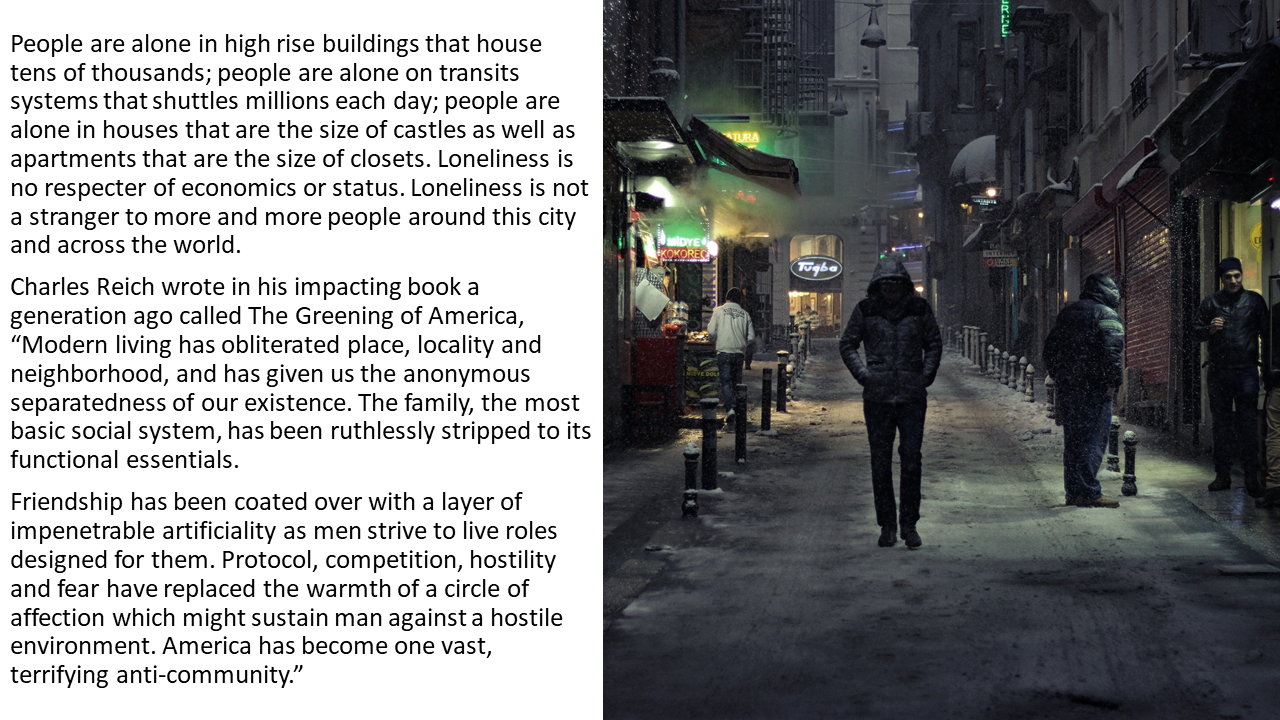
People are alone in high rise buildings that house tens of thousands; people are alone on transits systems that shuttles millions each day; people are alone in houses that are the size of castles as well as apartments that are the size of closets. Loneliness is no respecter of economics or status. Loneliness is not a stranger to more and more people around this city and across the world.
Charles Reich wrote in his impacting book a generation ago called The Greening of America, “Modern living has obliterated place, locality and neighborhood, and has given us the anonymous separatedness of our existence. The family, the most basic social system, has been ruthlessly stripped to its functional essentials.
Friendship has been coated over with a layer of impenetrable artificiality as men strive to live roles designed for them. Protocol, competition, hostility and fear have replaced the warmth of a circle of affection which might sustain man against a hostile environment. America has become one vast, terrifying anti-community.”[3]
So what are we to do the next time we see or feel the pangs of loneliness swirling around us? Think of the most described lonely person in God’s Word–his name was David, his discoveries about the Lord in the midst of piercing loneliness are recorded as testimonies in the book of Psalms. Let’s read one of the most powerful in Psalm 63.
Loneliness is a spiritual opportunity; when God allows all of my normal companions to be out of my life—He can become closest to me. This means that loneliness can be a tool in God’s hand, an opportunity for a right response by us His children. Don’t let loneliness abuse you, use it to draw close to the Lord!
LONELINESS IS AS OLD AS MANKIND
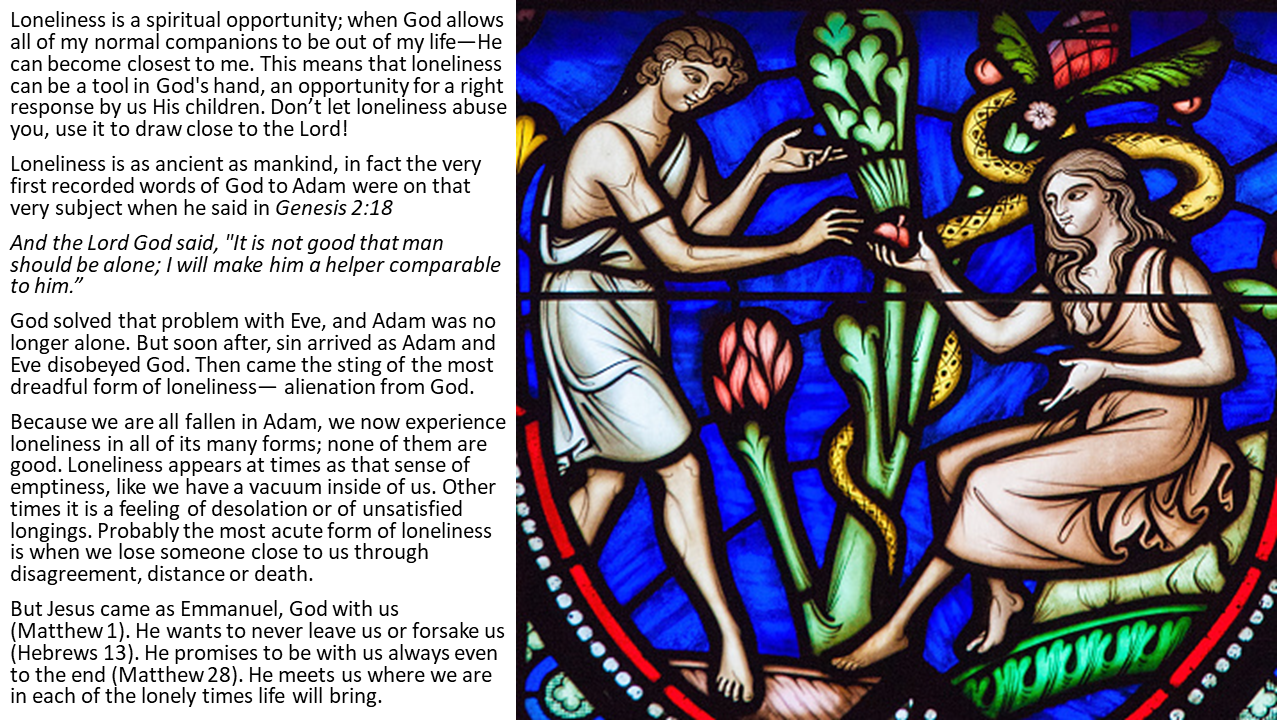
Loneliness is as ancient as mankind, in fact the very first recorded words of God to Adam were on that very subject when he said in Genesis 2:18
- And the Lord God said, “It is not good that man should be alone; I will make him a helper comparable to him.”
God solved that problem with Eve, and Adam was no longer alone. But soon after, sin arrived as Adam and Eve disobeyed God. Then came the sting of the most dreadful form of loneliness—alienation from God.
Because we are all fallen in Adam, we now experience loneliness in all of its many forms; none of them are good. Loneliness appears at times as that sense of emptiness, like we have a vacuum inside of us. Other times it is a feeling of desolation or of unsatisfied longings. Probably the most acute form of loneliness is when we lose someone close to us through disagreement, distance or death.
But Jesus came as Emmanuel, God with us (Matthew 1). He wants to never leave us or forsake us (Hebrews 13). He promises to be with us always even to the end (Matthew 28). He meets us where we are in each of the lonely times life will bring.
Loss of a life partner is a deep void; moving away from cherished places also cuts deeply. The loss of the comfortable and familiar can leave gaps in our hearts and painful voids. And as we see all around us, everyone involved in a divorce—the marriage partners, friends, family, and children—all are touched with an aching void and begin down a pathway of loneliness.
Loneliness is a tool to glorify God, turn to him in trust and triumph, and to make some great discoveries about God. In every phase of life there is loneliness; and in every phase of life find out what Jesus says is true— I am always with you!
Are you feeling the loneliness of youth? Are you feeling the loneliness of life facing family conflict and danger? Are you feeling the loneliness of job loss, and family separation? Are you feeling the loneliness of moving to a new location that is very foreign to you? Are you feeling the loneliness of living and working with a tough crowd? Are you feeling the loneliness of unemployment and unsettled home life? Are you feeling the loneliness of betrayal by friends? Are you feeling the loneliness of being wronged in a business deal? Are you feeling the loneliness of the complete loss of his family, friends, and finances? Are you feeling the loneliness of temptation and failure? Are you feeling the loneliness of chastisement and restoration? Are you feeling the loneliness of old age? Jesus says I am always with you!
Loneliness—if you ever feel it, know that Jesus felt it.
- If you ever suffer feeling friendless—know that Jesus is the friend who will stick closer than a brother.
- If you ever feel forsaken—remember Jesus said that He would never leave you or forsake you.
- If you feel alone—trust the One who said I am with you always, to the end! Like David shows us in Psalm 63.

DAVID SOUGHT GOD THROUGH HIS LONELINESS
Look with me at the first verse in Psalm 63. Alone in the bleak wilderness of Judea that we know as the Dead Sea region, David starts out by declaring he would pursue the Lord. “Seek” in Psalm 63 is an unusual verb that can be either rendered as ‘seek early’ [KJV/NKJV] or ‘seek earnestly’ [NIV/NASB].
Which ever way your Bible renders that word, the question remains—is that your heart?
God shows us in the lives of everyone from Moses and Joshua, through David and right down to the life of Jesus—the immense benefit of a regular, early, daily seeking after God. Do you have a desire like that for Him? Most of us probably can’t say that we always do. But as you sit and listen to God’s Word, isn’t that what we all want?
This attitude and desire for God is cultivated and part of spiritual disciplines. What ever we feed regularly grows. If we feed our body, it grows. If we feed our mind it grows, and if we feed our spirit with seeking after God times—we grow more and more to longingly seek Him. There is no better way to live a day for eternity than to start it with a personal, earnest seeking of God through His Word in personal Bible reading, study, meditation and devoted prayers.
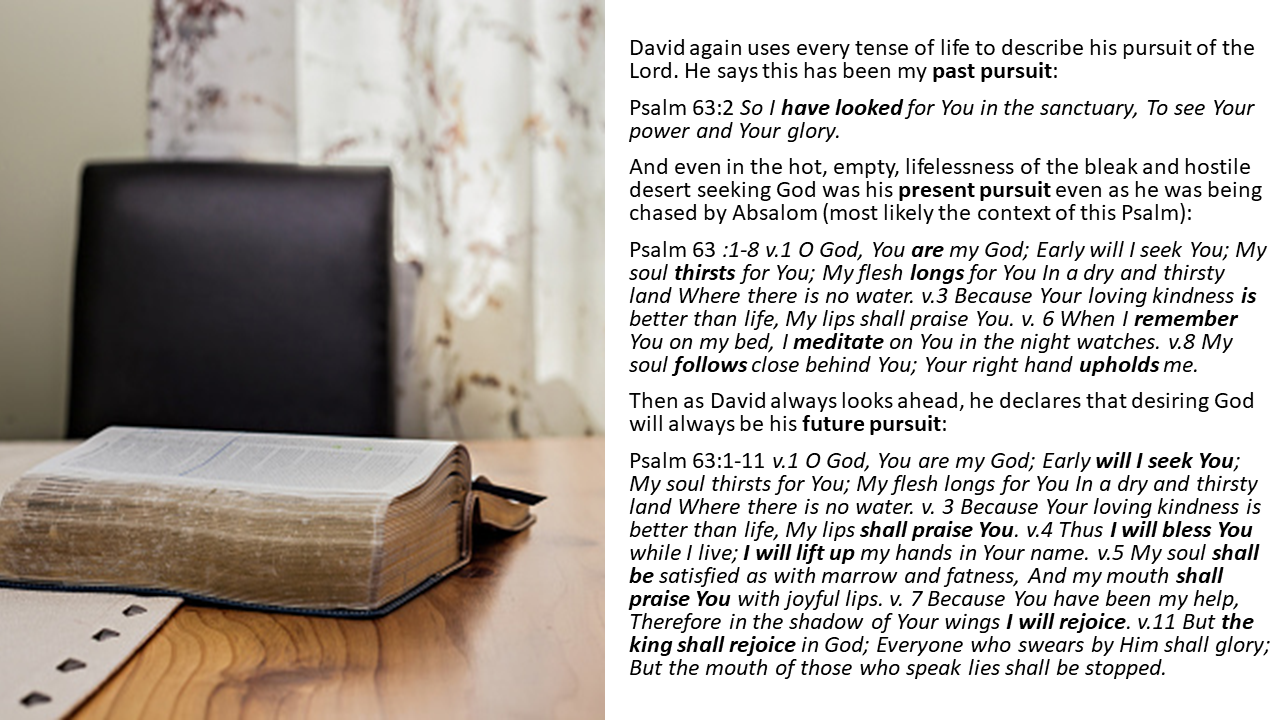
David again uses every tense of life to describe his pursuit of the Lord. He says this has been my past pursuit:
- Psalm 63:2So I have looked for You in the sanctuary, To see Your power and Your glory.
And even in the hot, empty, lifelessness of the bleak and hostile desert seeking God was his present pursuit even as he was being chased by Absalom (most likely the context of this Psalm):
- Psalm 63 :1-8 v.1 O God, You are my God; Early will I seek You; My soul thirsts for You; My flesh longs for You In a dry and thirsty land Where there is no water. v.3 Because Your loving kindness is better than life, My lips shall praise You. v. 6 When I remember You on my bed, I meditate on You in the night watches. v.8 My soul follows close behind You; Your right hand upholds me.
Then as David always looks ahead, he declares that desiring God will always be his future pursuit:
- Psalm 63:1-11v.1 O God, You are my God; Early will I seek You; My soul thirsts for You; My flesh longs for You In a dry and thirsty land Where there is no water. v. 3 Because Your loving kindness is better than life, My lips shall praise You. v.4 Thus I will bless You while I live; I will lift up my hands in Your name. v.5 My soul shall be satisfied as with marrow and fatness, And my mouth shall praise You with joyful lips. v. 7 Because You have been my help, Therefore in the shadow of Your wings I will rejoice. v.11 But the king shall rejoice in God; Everyone who swears by Him shall glory; But the mouth of those who speak lies shall be stopped.
DAVID USES EVERY MEANS HE HAD TO PURSUE GOD
Even a quick glance at this Psalm in your English Bible shows an ancient Hebrew pattern; David uses seven different means to praise and worship God (seven as in an complete set). Glance down and note with me each of them:
- First, David uses his lipsto speak of God’s love that is kind and true in v.3 “Because Your loving kindness is better than life, My lips shall praise You”.
- Second, he harnesses his tongueto bless the God he loves in v. 4a “Thus I will bless You while I live…”.
- Third, he uses his handsto point to the God he seeks and loves in v.4b “…I will lift up my hands in Your name.”
- Fourth, David uses his will to intentionally make a declaration of God worthiness in v.5a “ My soul shall be satisfied as with marrow and fatness…”.
- Fifth, he again speaks with his mouth to lift praises to the God he loves v.5b “…And my mouth shall praise You with joyful lips.”
- Sixth, David uses his mind to remember in v.6a “6 When I remember You on my bed…”.
- Seventh, he uses his intellect to meditate upon God’s character in v. 6b “… I meditate on You in the night watches.
David is saying I am using all the faculties that God gave me in seeking Him. Is that pursuit of God echoed in your heart this morning?
Since childhood we have been taught that we have far more capacity in our brains than we ever use. Most doctors say the average human barely uses 10% of their brain.
We are challenged by our culture to never stop learning to use a few extra percentage points through life; but in a vastly more strategic way, God is saying through David—why not start employing more and more of your capacity to worship God? Regularly use your lips, your tongue, your hands, your will, your mouth, your mind, and your intellect to the max in seeking to offer worship to God.

ONLY GOD CAN SATISFY
One of the most fundamental truths from this Psalm is that God can satisfy us to the very core of our existence and being. That is David’s 3,000 year old testimony. He was as human as anyone can get.
David reflects every virtue and every vice. He struggles with fear, depression and lust; yet he sings with abandon, worships with a passion, and meditates into the very Throne Room of God. We can each identify with his struggles—and we can each learn from his pursuit of God.
David is showing us the lifelong opportunity we can have of pursuing God. God is an exhaustless supply of new satisfaction; He is a well that never runs dry, a spring that always wells up with fresh and life giving waters. Every desire, even the deepest can be satisfied by Him. And as Augustine said those well remembered words 1600 years ago, “Our hearts are restless till they find rest in Thee.”[4]
David says that he is completely satisfied by God, with God, and in God. David experienced what God has offered and promises—God can’t hold Himself back from those who seek Him. God is always looking throughout the Earth for anyone who focuses their heart’s desires upon Him. God said He is found by those who seek Him with all their heart. And David says—yes, that is what I have experienced.
Look at v.3 again. Note what David says: Life is good; God is better!
- Psalm 63:3Because Your loving kindness is better than life, My lips shall praise You.
Now there is something all of us can relate to and decide upon. David states that life is good. Now most of us would agree. In reality life is so good that people cling to it with a tenacity that surpasses all other desires. We will do anything to save our self from death humanly speaking. At gun point we will give up every dollar we have to not be killed. With cancer we will agree to the most painful surgical and procedures to try to stave off cancer’s advance, to the point of amputation of parts of our body if that will give us hope of more days to live.
Satan’s assessment with Job reminds us that this is always the case with us humans.
- Job 2:4So Satan answered the Lord and said, “Skin for skin! Yes, all that a man has he will give for his life.
So for almost every person on this planet, their life is their most precious and treasured possession. But this verse tells us that life is good, God made it wonderful; but God is better. Why? Because no matter how carefully we guard our life, it can be lost.
Our body wears out or gets ravaged by some disease or trauma—and it dies. Life as good as it is, ends. But God never will end; His love never fades away or gets traumatized or diseased. David says God is better because of His loving kindness—that is His faithful, steady, and unwavering love. That is the love of God He has covenanted to us. It is safe, sure, and reliable. God’s love is inseparable from us who receive it.
Remember the great words of Paul? God has told us as clearly and forcefully as is possible in human language—nothing can remove His promised ‘better than life’ love!
- Romans 8:38-39For I am persuaded that neither death nor life, nor angels nor principalities nor powers, nor things present nor things to come,39 nor height nor depth, nor any other created thing, shall be able to separate us from the love of God which is in Christ Jesus our Lord.
When we stop and think about it, like we are at this moment—isn’t it hard to believe that we neglect and spend so little time cultivating something that is ‘better than life’—and spend the majority of all our time pursuing, protecting, and seeking to prolong what is a distant second?
ENJOYING GOD
God offers endless satisfaction, completion on a supreme level for each of us to enjoy and enlarge on a daily basis. Maybe this morning we need to pause and like David with our lips, tongue, mouth, mind and will express how much we want to just enjoy the Lord Himself right now.
One way I do that, when struck by thoughts like these, is to break right out in song; whether I am in the study before my open Bible, or riding in the car listening to the Dramatized Bible on my iPod, or walking and meditating on memorized verses—I just right then grab for that reality of endless joy in His Presence. I often sing:

More Precious Than Silver Words and Music by Lynn Deshazo © 1982 Integrity’s Hosanna! Music
Lord, You are more precious than silver.
Lord, You are more costly than gold.
Lord, You are more beautiful than diamonds,
And nothing I desire compares to You.
Lord, Your Love is higher than mountains.
Lord, Your Love is deeper than seas.
Lord, Your Love encompasses the nations,
And yet, You live right here inside of me!
Lord, You are more precious than silver.
Lord, You are more costly than gold.
Lord, You are more beautiful than diamonds,
And nothing I desire compares to You.
And nothing I desire compares to You.
Have you come to the place where you say, “…and nothing I desire compares with You…”?
[1] Dr. Paul Brand & Philip Yancey, Pain: The Gift Nobody Wants, (NY: Harper Collins, 1993), p. 164-165.
[2] Osbeck, Kenneth W., Amazing Grace—366 Inspiring Hymn Stories for Daily Devotions, (Grand Rapids, MI: Kregel Publications) 1997.
[3] Charles Reich, The Greening of America: The Coming of a New Consciousness and the Rebirth of a Future (NY: Bantam Books, 1971), p. 7.
[4] C.H. Spurgeon, The Treasury of David, vol. 2, Psalms 58-87 (Grand Rapids: Zondervan, 1968), p. 65.
Transcript
.jpg)
If you take your Bibles with me, please, open to Psalm 63, and as you open to the 63rd Psalm, I want you to listen to the voice that’s speaking.
.jpg)
It’s David in the 63rd Psalm. He’s an old man. He’s all alone. He’s staying in the Judean wilderness. That’s what it says in the little superscription, the little preface note, if your Bible contains that. The Judean wilderness is code for the Dead Sea region. We think Judean Wilderness, it means nothing to us. Think of Death Valley, California, or if you’ve been to Israel, think of the Dead Sea, and it’s just what it sounds like. It’s the most desolate spot on Earth. He’s on the run. That is David from his own son Absalom. That is the horrible context of this Psalm, and that’s the context that God uses to write for us one of the most powerful invitations to take the desperate and particularly the lonesome, lonely times of life and make them times to worship the Lord. That’s what God invites us to in the 63rd Psalm.
This Psalm shows us how David chose to turn his lonely hours into times of worshiping God. Loneliness was as real then as it is for many today. Sometimes we don’t think about that. We’ve come to the place in human history where people are lonely and yet surrounded by crowds. Life in the 21st century is very lonely for many people. Though we’ve come to the place also where there are more humans on this planet, all around us living and moving, many find less fellowship, less companionship, and less fulfillment every year. We move past, we move around, we move by more and more people every day, but we just know fewer and fewer of them.
We often are on the move faster, but never closer. We often have more contact, but less touch. We often have more and more relationships. In fact, I remember in California, the expression we lived out there that everyone had, dear friends, they were a mile wide and about a quarter inch thick. We have more and more relationships, but less and less depth. All this leads to that aching hollow of the soul that we know as loneliness.
Now, this is a common condition. It links together Adam in the garden before God made Eve. It links together Ruth the widow, as she was desolate and had nothing, and experienced loneliness. Job sitting in the ashes of his misery. Elijah in the desert. The Apostle Paul, in prison, when he says, everyone has forsaken me. I’m all alone. Just here. Most of all, Christ, our Lord, in Gethsemane. As He cried out and as He marched to the cross, the ultimate words of loneliness, He says, my God, my God, why have You forsaken me? The ultimate loneliness.
.jpg)
David was often alone. He was in that state. It characterized his life, and what he did when he was alone reflected what was deepest within his heart. In fact, what we revert to in our lonely times is what we really are because when all of the movement and activity and contact and friends are stripped away, all that’s left is really us. That shows the desperate condition of so many lives in this world. When all the sounds and sights and activities and amusements are gone, and they’re alone, it’s really desolate.
Long and lonely hours are often reflected in the record that God gave us of David’s life. Even when David was surrounded by the entire nation, all of his armies, and even his own family, he often felt alone. Most of his Psalms, of which he wrote almost half, he wrote 71 of the Psalms in the book you hold in your hand. Most of those Psalms come from that reference point of loneliness.
I want you just to think of the greatest Psalms of David that we’ve walked through in the months past. Do you remember the 23rd Psalm? He wrote that all alone as a shepherd boy. The 9th Psalm, if you remember, he wrote that all alone as he faced Goliath. The 132nd Psalm, which he wrote all alone in his hometown when he was a little boy, talks about a lonely life. The 142nd, David is all alone, fleeing King Saul, living and hiding in a cave. Psalm 34 and 56, he’s a prisoner of the Philistines, alone in Gath again. He writes 34 and 56. 101st Psalm, he’s all alone on the throne. He’s assumed the kingship of Israel, and in that leadership loneliness that all leaders have experienced, he writes the 101st Psalm.
More recently, we looked at the 31st Psalm as it was similar and parallel with the 63rd. He is alone, hiding from Absalom, his son, living out there in the desert as Absalom is coming to pursue him. Then, of course, you know the great Psalms 32 and 51. David was alone before God, facing his own sinfulness.
Much of David’s life was spent alone, but we must never confuse solitude with loneliness. Solitude is a chosen state. We choose to sequester, to isolate ourselves momentarily, briefly, for a period of time to stimulate our contemplation, our meditation, our seeking after God. Solitude is not loneliness. Loneliness is an unwelcome, unsought, undesired visitor in our lives. One doctor has written that acute loneliness seems to be the most painful kind of anxiety that a human being can suffer.
.jpg)
He goes on to describe how his patients describe the cutting and horrible internal pain they felt acutely alone. So not much has changed in 3000 years, has it? Because one of the sociological phenomena of the 21st century is that the more our population increases, travel and communications explode, conveniences and comforts abound, and increasing freedom, security, and financial independence multiply as all that happens, loneliness floods the world and the people around us.
About the time of the Civil War, a noted American writer and philosopher was looking at the change of the demographics, 130 or 140 years ago, that was going on in America. His name was Henry David Thoreau, and he described the growing cities of America in this way. I thought it was fascinating. He said, cities are places where people are lonely together. If Thoreau’s observations were true in the past, it’s become increasingly true in the present. It’s only going to become alarmingly more so in the near future because we live on a very lonely planet. In 1950, there were only seven cities on the whole planet that had more than 5 million people, and two of them were in what we call the third world outside of Western Europe, the English-speaking Western world. Today, there are 34 cities with more than 5 million people, and 22 of them are what we call the third world. By the middle of this century, there will be a hundred cities of more than 5 million people, and 80 of them, or 80%, will be outside of the Western world. So, that means that most of the world’s populations will be living in cities, slums, and squatter settlements, and quite alone and quite desolate.
.jpg)
People are alone in high-rise buildings that house tens of thousands. People are alone on transit systems that shuttle millions each day. People are alone in houses that are the size of castles, as well as apartments that are the size of closets. Loneliness is no respecter of economics or status. Loneliness is not a stranger to so many people around the world and across our very city.
One last note. I remember from an old book, which, when I read it this week again, I thought, how old I am. Charles Reich, in his impactful book of the last generation, which is called The Greening of America, was almost a prophet as he wrote late in the 60s and early in the 70s these words. Modern living has obliterated place, locality, and neighborhood and has given us the anonymous separation of our existence. Then he explains why. The family, the most basic social system, has been ruthlessly stripped to its functional essentials. In other words, a family now is just a group of people that share a common kitchen or a common living room or something, but they don’t really share life anymore. They don’t really do life together. They all go their separate ways, and they use it as an airport. If that was true in the seventies, it’s truer today, sadly enough, even in Christian homes.
Then he goes on to say, friendship has been coated over with a layer of impenetrable artificiality as people strive just to live out the roles designed for them, but all around them, protocol, competition, hostility, and fear have replaced the warmth of a circle of affection, which might sustain them against a hostile environment. Here’s his conclusion 35 years ago: America has become one vast, terrifying anti-community. So, people around us are lonely. If we honestly explained what we feel at times, you’d find in this room a great number who battle with the pain of feeling all alone in the world.
.jpg)
So, what are we to do the next time we see someone or feel the pangs of loneliness swirling around us? My suggestion and encouragement to you is think of the most described person in the Bible, the man about whom 141 chapters are devoted more than anybody else in the Bible, even Jesus Christ Himself. Think about the man who wrote the most Psalms, and that the context of the majority of them are written from the immense pain of his loneliness. Then see what he discovered about the Lord in the midst of his piercing loneliness as he records his testimony in the Psalms. So let’s read the most powerful of all those, the 63rd Psalm, and see what David invites us to discover when we’re the loneliest.
.jpg)
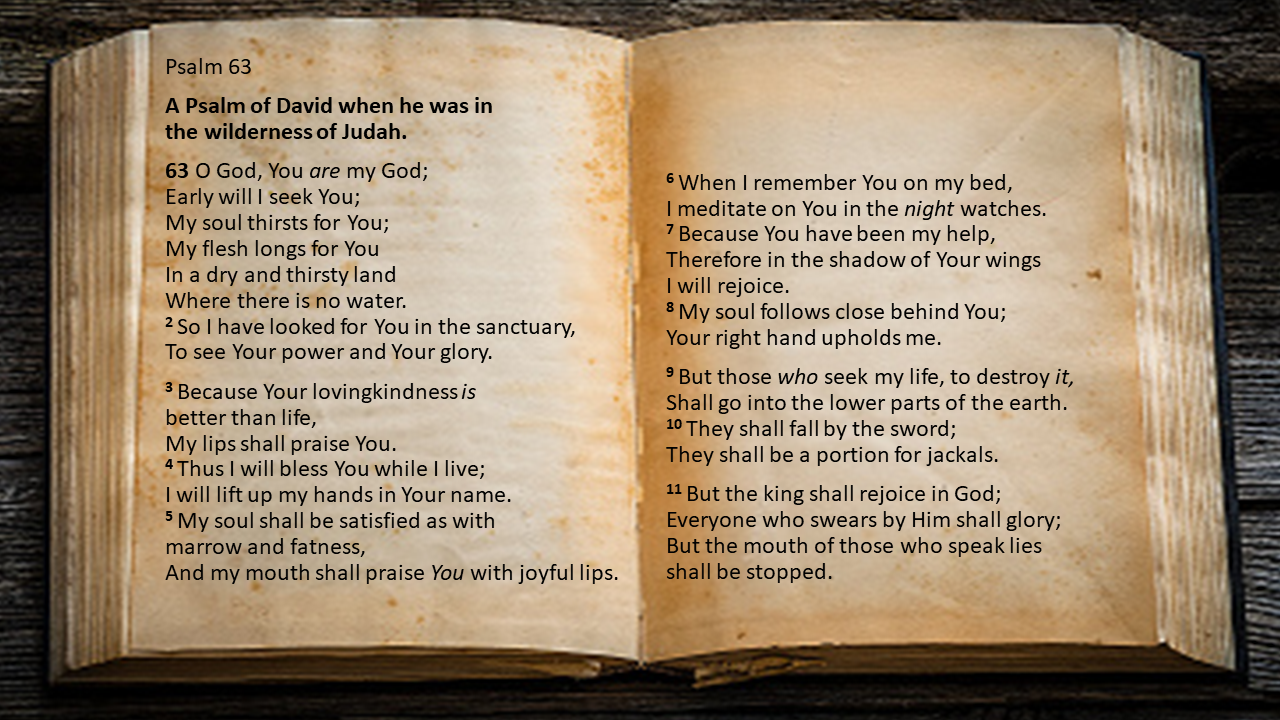
It starts with this little note, a Psalm of David when he was in the wilderness – code word, Dead Sea – in the desolation of Judah. First verse, oh God, You are my God. Early will I seek You. My soul thirsts for You. My flesh longs for You. In a dry and thirsty land where there is no water, so have I looked for You in the sanctuary to see Your power and Your glory because Your loving kindness is better than life. My lips shall praise You. Thus, I will bless You while I live. I will lift up my hands in Your name. My soul shall be satisfied as with marrow and fatness, and my mouth shall praise You with joyful lips. When I remember You on my bed, I meditate on You in the night watches because You have been my help. Therefore, in the shadow of Your wings, I will rejoice. My soul follows close behind You. Your right hand upholds me. But those who seek my life to destroy it shall go into the lower parts of the Earth. They shall fall by the sword. They shall be a portion for jackals, but the king shall rejoice in God. Everyone who swears by Him shall glory, but the mouth of those who speak lies shall be stopped.
Let’s bow together for prayer. Father, we’re so thankful that when David was most desperate, most desolate, aged, endangered, and lonely, he says that the reality of his relationship, Your loving kindness is better than life. Life is good. God is better. I pray we would come to the place where we would also confess that life is good. Friends and fellowship and homes and circles and community, but even if that and everything else is taken away from us, You God, are better. That’s a choice, that’s a discipline, and that’s what lonely times can precipitate in our lives, by the power of Your Spirit, if our focus is on You, oh Christ. I pray that it might be turned that way. We ask You to transport us from merely being spectators and merely being hearers to choosing, as we track with David through Your Word, to become doers, seekers, those who pursue You, God. I pray we are satisfied and find the supreme satisfaction that’s in God alone. That’s what You offer us, especially in lonely times, teach us. In the name of Jesus, we pray, Amen.
.jpg)
Loneliness is a spiritual opportunity, which is what I’m trying to tell you, because we’re all going to go through loneliness of one form or another, and I’ll describe many kinds this morning. But it’s a spiritual opportunity. It’s when God allows all of my normal companions to be out of my life, either for a long time, a brief time, or forever. In that time, He gets to move closest to me. That’s what loneliness becomes to us by God’s grace. This means that loneliness can be a tool in God’s hand, an opportunity for a right response by us as children. Don’t let loneliness abuse you. That’s what our culture says. We’re supposed to always live, constantly abused by something, either abused by the wealthier than us, or abused by somebody in our past, or abused by someone in our present, or tormented by whatever. Don’t get into the abuse thing. Let loneliness not abuse us, but drive us into the arms of the One who wants to draw close, and that’s the Lord.
Loneliness is as old as mankind. You don’t have to turn there, but I want to remind you that the very first recorded words of God to Adam, the first time God spoke to Adam, do you know what He said? The first time God talked to man. Do you remember what it is in Genesis? The first time God said anything to Adam, He said, Adam, it’s not good for a man to be, what? [audience responds] Alone. Ah, so it is ancient, isn’t it? The first time God talked to Adam, He said, even though you haven’t fallen, you’re not sinful, even though you’re perfect, even in your perfection, it’s not good for you to be what? Alone. Hey, if it’s not good when you’re perfect to be alone, it’s worse now that all of us are fallen.
So, the Lord God said, it is not good for man to be alone, Genesis 2:18. I will make him a helper comparable to him. Literally, the Hebrew word means corresponding, like the circle that’s torn in the jagged edge, and or the rings they sell that fit together, and they correspond to one another. They exactly fit. He says, there is a person in this world, Adam, that I’m going to make who exactly fits you, and you’ll no longer be alone. What a wonderful thing. That’s how God solved the problem with Eve. And Adam was no longer alone, but soon after sin arrived, Adam and Eve disobeyed God and thus became the sting of an even more dreadful form of loneliness, alienation from God.
So, people are compounded with the pre-fall perfection; even in that state, it’s not good to be alone. Now it’s multiplied and compounded by the fact that we are alienated from God. So, loneliness is very severe, and because we’re all fallen in Adam, we now experience loneliness in all of its many forms, and none of them are good. Loneliness appears at times as a sense of emptiness, like a vacuum inside of us. Other times, it’s a feeling of desolation, or perhaps it’s an unsatisfied longing, or maybe the most acute form of loneliness is when we lose someone close to us through disagreement, and can’t get along with them. Distance, we move, or they move, or death.
But Jesus came as we’re going to soon be studying as we head toward that Christmas season. Jesus came as Emmanuel. In fact, He came to remind us and to reveal to us that we who are distant and alienated from God, God came with us. That’s what Emanuel means in Matthew 1. Jesus said, I never want to leave you or forsake you, Hebrews 13. I promise to be with you always, even to the end, Matthew 28. He said He would meet us right where we are. So, the good news is, though we’re alienated from God, Emmanuel, God with us, came to meet us.
.jpg)
But still, we go through loneliness. The loss of a life partner is a deep void. Moving away from a cherished place cuts deeply. The loss of comfortable and familiar surroundings leaves gaps in our hearts, painful voids. As we all see around us, there’s another terrible loneliness factor, and that is everyone involved in a divorce. The marriage partners become lonely. Friends who mutually share them become lonely. Family, children, everyone is touched by an aching void and begins down that pathway of loneliness. So, that’s just life.
But loneliness is a tool to glorify God, to turn to Him, to triumph, to make some great discoveries about God. So, in every phase of life we are in, loneliness becomes a tool to actually get closer to the Lord if we choose that. Or it can become a tool to reveal what’s really inside of us. Empty, aching, self-ward desolation.
But this morning, if we’re feeling the loneliness of youth or the loneliness of life facing a family conflict and danger, or the loneliness of a job loss and a family separation or moving to a new location or living and working with tough people that you don’t relate to or unemployment and unsettled home life or betrayal by friends or any of a multitude of other things, that just bring us into that state when we just feel detached. If we ever feel loneliness, we should know that Jesus felt it. If you ever suffer from feeling friendless, know that Jesus is the friend who said He would stick closer than a brother to us. If we ever feel forsaken, remember Jesus said that He was forsaken, so we would know that He would never leave or forsake us. If we ever feel alone, we need to trust the one who said, I am always with you to the end. That’s what David shows us in the 63rd Psalm.
.jpg)
Let’s just track through this Psalm starting in verse 1. In the first verse of Psalm 63, David is alone in the bleak wilderness of Judea, which we know is a Dead Sea region. David starts out by declaring he would pursue the Lord. That’s the first thing he says. If you want to read the account, we covered it back when we were in Psalm 31. David has left town with his mighty men, and he’s walked up over the hill, and he looks back at Jerusalem. He has gone down the backside of the Mount of Olives. He’s descended into the Dead Sea region. Then they decide that they don’t want him to stay in the camp because if the camp is attacked, then he would be there and those arrows might get him. So, they separate him out, and he’s not staying with the rest of the soldiers. He is off protected, but he is alone, and that’s where we find him.
So, what’s his first decision? In verse 1, he says, God, You’re my God, early will I seek you. Now, it’s interesting. This word seek is an unusual verb. It can be taken one of two ways. It’s a fascinating word that can be rendered seek early, that’s what I just read. The New King James and the King James, or those of you who have NIV, NAS, it can mean seek earnestly. It really means seek early and earnestly. It’s really just which way the translators want to tilt in the way that they take the glosses of this word. So, they’re both true. I’m going to seek You early. I’m going to seek You earnestly. If I seek You earnestly, I’m going to seek You early. If I seek You early, I’m going to seek You earnestly. It’s the same thing, and that’s the first thing that comes out of his mouth.
Whichever way your Bible renders it, the question remains: Is that what we feel? Is that what you thought of the last time you felt alone? Oh God, I’m going to seek You now. Wow, got time. Nobody’s around to bother me. That’s not usually our response. God shows us in the lives of everyone from Moses and Joshua, through David, and right down to the life of Jesus, the immense benefit of a regular, early daily seeking after God. All David reverted to here is the normal habit and pattern of his life. When everyone got stripped away, all the support system, what did he do?
Loneliness just reveals what’s really inside of us. So, what was really inside of him? He earnestly early was a seeker of God. Do we have a desire like that for Him? Most of us would probably not say that we always do, but as we sit and listen to God’s Word, isn’t that what all of us want this morning? Isn’t that the ideal that the Scripture presents that we want to, by God’s grace, rise to? That’s why we have the 63rd Psalm. This attitude and desire for God are cultivated. It’s part of spiritual disciplines. Whatever we feed regularly grows, right? You think about that. You got your plant food and some of you had gargantuan back patio flowers that you fed, and of course, if you don’t bring them in, the frost is going to get them.
But whatever we feed grows, think about that. If we feed our bodies, it grows. Some feed it too much. If we feed our minds, our minds grow. If we feed our spirit with seeking after God, we grow more and more to lovingly longingly seek Him. There’s no better way to live a day for eternity than to start it, as David says in verse 1, with a personal, earnest, desiring pursuit. Longingly coming before God and say, as the hymn writer puts it, beyond the sacred page, I see the Lord. The goal is not to become walking Bible encyclopedias, that you can describe Achan’s great-grandfather’s name, and you know all about, every detail and minutia of the Bible. That is just the launching pad to the relationship with God.
I don’t know if David even had dragged along his scrolls with him, but what never left him was the relationship that he had with the Lord. That’s what was with him. That’s what the scrolls fed him for, and that’s what we should have too. We should live day to day, meditating, studying, and devoting our prayers to this pursuit of God.
.jpg)
Look at verse 2, because David uses every tense of life starting in verse 2, to describe his pursuit of the Lord. He says, number one in verse 2, this has been my past pursuit. Verse 1, he says, I’m going to pursue the Lord earnestly. I’m going to seek Him early. It’s the first most important thing. But in verse 2, he says, this was my past pursuit. Look what he says. He said, so I have, past tense, looked for You in the sanctuary to see Your power and Your glory. He says, this is what I’ve been doing in the past. When I could be in that tent, I went to the tent. When I could be surrounded by the ancient scrolls, I was surrounded by the ancient scrolls. That was my past pursuit.
But continue. Look at verse 3. Even in the hot, empty lifelessness of that bleak and hostile desert, seeking God was his present pursuit. Verse 2, it’s what I did in the past. Verse 3, it’s what I’m doing now. It’s my present pursuit. Even as he was being chased by Absalom. Most likely, that’s the context of this Psalm. By the way, you wonder, how do we know it was that? Because at the end of the Psalm, he says, the king. This can’t be when he was being pursued by Saul because he wasn’t king when he was pursued by Saul. He didn’t live out in the desert when he was pursued by anybody else. So, the only time he lived out in the desert, pursued by anybody, was by Absalom. So, that’s where that comes from if you ever wonder.
But look at the first verse of the present. Look at all of them. It starts, actually, in verse 1. He says, you are my God. He says in verse 1 also, early my soul thirsts for You. That’s a present pursuit. My flesh longs for You. That’s present. But look at verse 3, because Your loving kindness is better than life right now. Verse 6, he continues. He says, I remember You. He continues in verse 6, I meditate on You. These are all present pursuits. You can just chronicle those. Pursuing God is saying, verse 1, you are my God, saying my soul thirsts for You, saying my flesh longs for You. Verse 3, saying that what You are to me is better than life. Verse 6, I will remember You. I meditate on You. Now, look at verse 8, my soul, present tense, follows close behind You and Your right hand upholds. Present tense. Notice, it’s not just in the past. I saw You, verse 2. But all the way through the Psalm in the present, in his present condition, he had a present pursuit.
But David, who sought the Lord in the past, sought Him at that moment, is always looking ahead and looking at the future. David always looks ahead. He declares that desiring God will always be his future pursuit. In verse 1, he says it, early, will I seek you. He continues on down in verse 3, my lips shall praise You. Future. I will seek You in the future. Verse 3, I shall praise You in the future. Verse 4, I will bless You all the rest of the life You give me. Future tense. He’s making this commitment. He is promising God that I commit that I will bless You while I live. I will lift up my hands in Your name. He says that I’m not going to stop being actively involved in lifting my hands before You, which was so much a part of the Hebrew worship. They acknowledged two things: first, by lifting their hands, they’re saying that they’re clean, that they’re unstained, and I bring them before You. I acknowledge that all I have comes from You. I acknowledge that all that I have belongs to You, and I give all glory. It’s like being a beacon and a spotlight pointing at the Lord. That was his future desire. He says, to the end of my days, I am going to be one lifting up my hands, verse 4, in Your name.
Look at verse 5. My soul shall be satisfied. Wow. He said, I’m never going to stop being satisfied by You. He lived in a state of perpetual satisfaction by God. It’s a choice. It’s a choice because he says, I’m going to be that way in the future. I’m going to persist in whatever it takes to perpetually be satisfied by You, God. This is what I want. I will be satisfied. As with marrow and fatness. Look at verse 5. It continues. My mouth shall praise You with joyful lips. He says, I’m going to just keep on with this praising of Your name.
Do you ever read Pilgrim’s Progress? I just talked to someone this week who has just completely paralyzed. The lights have gone out, and they’re just [squishing sound], everything’s squashing them emotionally, spiritually, mentally. They’re just [flattening sound]. I said, do you ever read Pilgrim’s Progress? They said, mm-hmm. I said, do you remember the Castle of Gloom? I think it was called Giant Despair. I forgot all the terms. They’re so cute, but I can still see it in my mind. Do you remember? I don’t know if it was Faithful and Christian or Pilgrim; I don’t remember who it was, but the two of them were in there. They were all tied up, and the giant was beating on them and starving them and everything. They’re in this prison. It’s so dark and everything.
Finally, Hopeful or Christian or Faithful or Helpful or whoever said, I’m going to sing. The other one says, oh, I can’t sing. So, he starts singing. Do you remember what happened? Just right around him, the spotlight came on, and the light goes like this, and all of a sudden, Giant Despair and Gloom and his, I forget his fat wife’s name, came running behind him. They came, and as they sang more and more, the light went and it’s just, wow. It was really neat. Their chains fell off, and they walked out and were freed.
That’s Bunyan’s way of saying this. I will keep praising You. You know, sometimes when the lights go out, and you’re all squashed, you know what you need to do, even if you don’t feel like it, even if you don’t want to do it? You need to sing. You need to praise the Lord. He says, my mouth shall praise You with joyful lips, verse 7, because You’ve been my help. In the shadow of your wings, I will rejoice. Verse 7, I’m going to always rejoice. Verse 5, I’m going to always praise You. Then look at verse 11. The king shall rejoice in God. It’s just a future pursuit. He goes on later, everyone who swears by Him shall glory. He said, it’s good for you too. He says, and everybody who doesn’t praise the Lord, God’s going to stop their mouth in the future. So, you see, there’s a future tense to this relationship. In other words, David seeks God through his loneliness. That’s what he said. Past, present, future.
.jpg)
But even a quick glance at this Psalm in your English Bible shows an ancient Hebrew pattern. David uses seven different means to praise the Lord. I don’t know if you counted them as I was reading through it. Seven as in a complete set. Just glance down, I want to show you what I mean by this. Look at verse 3. First, David uses his lips to speak of God’s love that is kind and true. He says, because Your loving kindness is better than life, my lips shall praise You.
Secondly, in verse 4, he harnesses his tongue to bless God. He says, I will bless you while I live.
Thirdly, in verse 4, at the end, he says, his hands are going to be pointed to God that he seeks and loves. He says, I will lift up my hands. So, he’s got so far three different parts of his body.
Fourthly, he uses his will to intentionally make a declaration of God’s worthiness. He says, verse 5, my soul will be satisfied. He says I am choosing, even though everything around me isn’t something that promotes satisfaction, in my soul I’m making an internal conscious, willful choice that my soul will be satisfied.
Fifthly, he speaks with his mouth, and he praises God whom he loves. He says, my mouth, in verse 5 at the end, will praise You with joyful lips.
Sixth, David uses his mind to remember. He says, when I remember You on my bed. He says, I’m going to use my mind.
Seventhly, he uses his intellect to meditate. He says, I want to meditate on Your character at the end of verse 6. He says, I’m going to meditate on You in the night watches.
So, David is saying, I’m going to use every one of the faculties God gave me in seeking You. Is that where we are going? Are you going to use every faculty you have to seek the Lord? I see people using every faculty they have to seek other things. You want to see something interesting? Go down to Best Buy and watch the kids gathered around the new PlayStation. They are looking at that thing. Parents can walk in front of them, they can put their hands in front of them, and they are absolutely mesmerized. They’ve got every faculty, their body, their mind, their lips; they are so excited. Does that happen when you’re reading the Bible? Can someone walk in front of you and spill coffee, and you don’t even notice them? That’s how it was with David. It was a chosen state. Those kids are mesmerized because they choose to be. David chose.
.jpg)
Since childhood, we have been taught that we have far more capacity in our brains than we ever use. In fact, most doctors say the average human uses, at the most, 10% of their brain. Haven’t you heard that? Didn’t your teacher tell you that? You guys hardly use the 10%. You know, like that. We’re challenged by our culture to never stop learning. They say that the older we get, the more we can up the few percentage points through life by having continuing education, having stimulations, hobbies, and reading. But in a vastly more strategic way, God is saying through David, why not start employing more and more of your capacity to worship God? If we only use 10% of our mind just to go through life, we’ve got an awful lot of us that could harness more that never gets used for the worship of.
What I think is, I think David used a lot of his bandwidth in the pursuit and the worship of God. We should regularly use our lips, our tongue, our hands, our will, our mouth, our mind, and our intellect to the max in seeking to worship God. Why? Because only God can satisfy. Do you know what loneliness really is, precipitated by? This underlying dissatisfaction we have. When everything is not loud and spinning and running and going our way, all of a sudden, we come back to our unsatisfied longings. David had dealt with that because he knew only God could satisfy. One of the most fundamental truths from this Psalm is that God can satisfy us to the very core of our existence in being. That is David’s 3,000-year-old testimony. He was as human as anyone can get.
.jpg)
David reflects every virtue and every vice. He struggled with fear, depression, and lust, and yet he can sing with abandon and worship with passion and meditate in the very throne room of God. All of us can identify with the struggles that we can also learn from in our pursuit of God. See David’s struggles and his defeats and his terrible, horrible, murderous, lustful, all that stuff that’s in the Bible didn’t permanently keep him from this pursuit of God because only God can satisfy. David is showing us the lifelong opportunity we can have of pursuing God. God is an exhaustive supply of new satisfaction. He is a well that will never run dry. He is a spring that always wells up within us, fresh life-giving water. Every desire, even our deepest, can be satisfied by him.
Do you remember the 1,600-year-old words of St. Augustine or Augustine? It’s been quoted over and over again. Augustine said this: our hearts are restless till they find rest in Thee. Do you know what this Psalm says? Do you know what David is saying? David says, I am completely satisfied by God, with God, and in God. David says, I have experienced what God has offered and promised, and God cannot hold Himself back from anyone who will seek Him. Do you understand that the aggressor is God? He’s just looking for us to open our hearts. And the eyes of the Lord, remember, are running to and fro looking for one whose heart is toward Him. James put it this way, he says, draw near to God, that’s a one-time act, and He will continuously be drawing near to you. He said, if you just say, I want you, whoa. He comes because God desires to reveal Himself to us. God is found by those who seek Him with all their heart. David says, yes, that’s what I’ve experienced.
.jpg)
Look at verse 3 again, because I want you to see this. This is right at the front of this Psalm, but this is what David says. He says, life is good, God is better because Your loving kindness is better than life. Now, the comparative degree means that life is good, but God is better, but he doesn’t say life is bad. Life is good. Now, there’s something all of us can relate to and decide upon. David states life is good. Now, most of us would agree. In reality, life is so good that most people cling to it with a tenacity that surpasses every other desire. We’ll do anything to save ourselves from death, humanly speaking. At gunpoint, we give up every dollar we have to not be killed. With cancer, we’ll agree to the most painful surgical procedures to try and stave off cancer’s advance to the point of amputating parts of our body if that will give us hope of more days to live. Life is good. We’ll do anything to get a little more of it.
In fact, Satan’s assessment of Job reminds us that this has always been the case with humans. Job 2:4, Satan said to the Lord, skin for skin, all that a man has he’ll give for his life. That’s where we are. So, for almost every person on this planet, our life is our most precious and treasured possession. But this verse tells us, life is good. God made it wonderful, but God is better. Why? Because no matter how much we guard our lives, no matter how carefully we structure our diet and our exercise and our aerobic pursuits, we can’t hold on to life. Life is fleeting. But our body will wear out and get ravaged by a disease or trauma. Our life can be lost, and our body will die. Life, as good as it is, will end. But David said God will never end. His love will never fade or get traumatized or diseased. David says, God is better because of His loving kindness, verse 3. That means His faithful, steady, unwavering love is better than life, which is fleeting.
.jpg)
When we stop and think about it, isn’t it hard to believe that we neglect and spend so little time cultivating something that’s better than life? You can relate to how much we guard our own individual lives, but God is better. But we guard and spend the majority of our time pursuing, protecting, and seeking and prolonging that which is a distant second. I encourage you to decide, do you want to start enjoying God? God offers endless satisfaction and completion on a supreme level for each of us to enjoy and to enlarge on a daily basis. We need to pause and, like David with our lips, our tongue, our mouth, our mind, and will express how much we want to just enjoy the Lord Himself right now.
When I’m riding around or sitting in my study, sometimes I’m struck by thoughts like these. When I’m struck by thoughts like these, I often, it’s just so embarrassing, break out in the song. It’s amazing. Whether I’m in my study before my Bible or riding in the car, listening to the dramatized bible on my iPod, or walking and meditating on my verses, I just right then start singing. When I get to the point, when I think about how great God is, and I want to seek Him, and I want to train myself that I want to seek Him more than anything else.
.jpg)
Let’s pray to the Lord. Lord, there’s nothing we desire that compares with You. That’s going to have to be a choice we make incrementally, willfully. To harness all of our faculties that You’ve given us: our lips, our minds, our mouths, our will, our intellect, our body, and harness them to focus on You wherever we are, especially in lonely times. But we just want to tell You what we want You to begin in our lives. We want to tell You that because You saved and redeemed and called and cleansed and forgave us, that Your grace says that nothing we can do can make You love us any more or any less. Because we are secure in that love, surrounded by Your grace, our response is that we’re going to love You back and we’re going to seek You. There’s nothing by Your grace that we want to desire that equals our desire for You. And nothing I desire compares with You. May that be the heartbeat of our spiritual lives today. May we continuously remind ourselves of that and go through the mechanics of Bible reading, prayer, Scripture memory, and meditation to feed that desire for You. Then I pray as we look into the rest of the Psalm and more, when David shows us the simple habits he cultivated, that we would cultivate those habits. I pray that You would open Your Word in an unusual way to us. I pray that we would begin marking it and putting road signs up so that when loneliness or those feelings of emptiness flood over us, we’d say, oh Lord, I remember I’m to seek You earnestly when I’m in the desert regions of life. May that be our desire. In the precious name of Jesus, and all God’s people said, Amen. God bless you as you go.
Slides






Check Out All The Sermons In The Series
You can find all the sermons and short clips from this series, David’s Spiritual Secret here.
Looking To Study The Bible Like Dr. Barnett?
Dr. Barnett has curated an Amazon page with a large collection of resources he uses in his study of God’s Word. You can check it out here.