
If the video above is not available, here are two other ways to view:
Ending Well by Going to the House of the Lord
DSS-45
061022PM
Transcript
.jpg)
I’d like to talk to you about what direction your life is headed. Most of us look forward to things. And if you sit back and just go through in your mind, a little test, you’ll find out what you’re really looking forward to. If you talk to most people, they have this just out there a little ways thing they’re looking forward to, and then something they’re really looking forward to a little bit further out. But if you keep talking to them, most people never keep going to that ultimate, looking forward to Heaven. That’s the secret of what energized the Early Church. That’s the secret of what energized, what we call the Mighty Gallery of Old Testament Saints. These all died in faith, having seen the land that is far off. You see, they lived looking toward home. And that’s the best way to end. In fact, we’re going to look at David’s life ending well by heading towards home. David ended well because his whole life was built around heading toward his eternal home. And we can also build our lives with that same desire if we began looking through the sights… and what it is we’re looking forward to and just say, Uhhuh Uhhuh. But what’s after that? What’s after that? And if you’re a believer and you believe God’s Word and you trust what He’s written down in this book, then eventually you have to get on your sights what God says should be our ultimate goal.
.jpg)
To begin, I want to look at the last two verses of the Bible, just before the Read the Bible Through a Year chart in my Bible are the last two verses of Revelation 22. Because I would like to begin where every verse in the Bible ends, and that’s with Jesus Christ. The only way that we like David can end well by heading towards home is to clearly get in focus what home is. Who is the one we are looking for and what exactly is that target of our life? God’s Word ends with Jesus inviting us to join Him in Heaven. That’s the last two verses of the Bible.
Verse 20. He who testifies to these things says, surely, I’m coming quickly. Amen. Even so, come Lord Jesus, the grace of our Lord Jesus Christ, be with you all. Amen. The goal of our lives, the destination of our heart’s desire is home with one who loved us and gave Himself for us. Christ’s voice can be heard from creation as He spoke all things into existence. I was reminded of that a few weeks ago. A highly paid editor commented to me, that we’d paid a lot of money to edit this Revelation book and this editor, obviously only slightly involved with Christianity, said I found a mistake on page 500 and something. And I says, oh, what was it? And they said, you said Jesus created the world. And they said, in Sunday School, I learned that God did. I thought, how sweet. They had gone to Sunday School and they knew the first verse, In the beginning God created the Heaven and the Earth. I said, the problem is you have John 1 and you have 1 John 1, and you have Colossians 1. And they said, what does it say there? And it was such a blessing to share with them that Jesus Christ is the voice from creation that brought all things into existence. And then to the end of Revelation, Jesus delivering back the universe to God the Father, because Jesus is the Word of God. Jesus is the subject and the theme of the whole Bible. And so, if we truly want to get our hearts focused on heading home, heading towards home, heading toward Christ. We need to see that.
Let’s back up now to the Gospel by John chapter 5. We’re going to back through the Bible. We usually go forward, but this evening we’re backing up toward the Psalms. But John 5, in verse 39 says this, Jesus was speaking to some antagonists who were opposing His ministry and Jesus said, you search the scripture, John 5:39, for in them you think you have eternal life. And He was condemning the folly of mere Bible study and not actual intimate relationship with Christ. Because these, He was being accosted by, knew the Bible forward and backward. Like when I went to Michigan State University, my English language professor knew the Bible because it was part of Elizabethan Literature, because the King James Version was Elizabethan and he knew the Bible, he just didn’t know the Lord. And there are many people that know the Bible. In fact, I have thousands of dead writers books in my office, and a good number of them wrote incredible treatises on the Bible but didn’t know the Lord. It’s very, very possible to know all about the Bible and never intimately come to know Christ. And He says, you’re searching the Scripture. You think you have eternal life. But look what He says at the end of 39. And these, that’s the Scripture, are they which testify of Me. Jesus is the subject and the theme of the whole Bible. And so, the more we know about Him and the more we understand the Bible, the more it brings into crystal clear focus, that ultimate goal we have of getting home.
Now, back up. Go to the right to 1 Peter chapter 1. We’re going to skip around the Bible. 1 Peter. It goes 1 & 2 Timothy, Titus, Philemon, Hebrews, James, 1 Peter. So, it’s right after James. 1 Peter chapter 1 in verse 11 says this, because whenever we read God’s Word, always remember that the writers of the Bible… the writers of the Bible… and you’ll hear me allude to this all the time. I’ll say, as Jesus said, in the 23rd psalm. Editors out there that catch those words, they go, wait a minute. Isn’t that the Old Testament? Jesus is only in the New Testament. No, no, no, no. The underlying truth of the doctrine of inspiration is 1 Peter 1, and look, verse 11, 1 Peter 1:11. God’s Word tells us that the writers of the Bible were listening to the Spirit of Christ who is in them. Verse 11, searching what or what manner of time the Spirit of Christ who was in them was indicating when He testified beforehand the sufferings of Christ and the glory that should follow. Now who are we talking about? We’ll back up to verse 10. Of which salvation the prophets have inquired in search carefully. So, the Old Testament writers, those that were recording the two thirds of your Bible that are at the front end, when they were speaking, Peter the Apostle, the Chief of the Apostles on the inspiration of the Spirit of God, says that truly the Spirit of Christ is speaking through them. This shows the inter trinitarian relationship, this triunity of God, but the scriptures are clear.
Christ is the Creator, and Christ with the agency of the Holy Spirit. And Christ is also the voice of the Scriptures. John 5:39, they speak of Me. And Peter here says, it is the Spirit of Christ. Verse 11, who was in them indicating when He, that’s the Spirit of Christ, that’s Christ, testified beforehand. His sufferings and the glories that would follow. So, the Spirit of Christ was testifying the sufferings of Christ and the glory of Christ that would follow. So, when you read the Bible, you can be reading in Exodus and you can hear Christ’s voice. You can be reading in Leviticus, which is real rough reading and you can hear Christ’s voice. You can be reading in Ezekiel, which gets very complex and hard to understand, and Jeremiah, which is a very long book, has more Hebrew words than any other book in the Bible. It is so, sometimes, hard to slug through, but we can always hear Christ’s voice. Because 1 Peter 1:11 says, it’s the Spirit of Christ.
Now back up to John chapter 10. And I want to remind you of another truth about our Lord Jesus Christ tonight. From cover to cover in this book, Jesus is always the Good Shepherd. Now, again, I said this morning about David, David was looking forward to the Good Shepherd. He said, the Lord is my shepherd. The Good Shepherd is always Jesus Christ. Because Jesus introduces Himself in John chapter 10, verse 11. He said, I am the eternal, infinite, present God. He inhabits continuously the I Am. In fact, the Old Testament name for God, the sacred name, Yahweh or Jehovah, the word hāyâ is a conjugation of the verb to be, and it means God is. It’s one, it’s the most unique calling card of any deity that’s ever been presented in this world. Of course, He’s the only true living and true God, but even His name is unusual. All other Gods have names. His name is I Am and that is what Christ is reflecting here seven times. He said, I Am, in the Gospels. And He said here, I Am, verse 11 of chapter 10. I Am the Good Shepherd. The Good Shepherd gives His life for the sheep. Zipped down to verse 14, He repeats Himself, I am the Good Shepherd. I know My sheep, and I’m known by My own. So Jesus, from cover to cover is the Good Shepherd. Jesus is the Good Shepherd.
Now, if you want to go back to Genesis, I’ll show you what I mean by this. Look at Genesis 48. Genesis, first book of the Bible, 48th chapter. Because this is the truth that predates even David. David lived 1000 BC. Jacob that we’re looking at lives 1800 BC. So, he lives almost a thousand years before David. And look what Jacob says, because Jacob confesses that the Lord was his Shepherd and that was his only hope as he died. David reduced life to staying behind the Shepherd and just following the Shepherd through life, trusting the Shepherd enough to take him through the valley and get him home. That’s a thumbnail sketch of everything that David believed. Look what Jacob confessed almost a thousand years before David. Verse 15. It says, Jacob is the subject here. And he, that’s Jacob, blessed Joseph and said, and here’s Jacob’s testimony… The God before whom my father’s Abraham and Isaac walked the God. And here it is, who has been my Shepherd all my life. Now that’s New American Standard. The New King James says, has fed me, I think, what does it say? 48:15, I think it says fed me. In who has fed me all my life. Even in the New Testament, poimēn means to feed and to lead. And so, you just, that’s the word Shepherd, feeder and leader. And it’s the same idea here and the New American picks up this idea that He has been my Shepherd all my life to this day. So, we always see Jesus Christ. Not only as the Creator, not only as the Consummator of the universe, we see Jesus Christ also as the Good Shepherd from the beginning in Genesis, through the Psalms, all the way to the Gospels where He says, I am the Good shepherd.
.jpg)
So now turn with me the 23rd psalm right in the center of your Bible, Psalm chapter 23, 23rd psalm, verse 6, because David started as a boy singing about his Shepherd. David was a shepherd. He was serving his dad, shepherding his dad’s sheep. But his eyes went far beyond just the mundane, just the trouble it was to keep track of those wandering sheep, and he looked beyond that and saw his own life wandering like a little sheep. And he says, Lord, You be my Shepherd. I care and protect and make sure that [the sheep] are fed and watered, these sheep, I’m the one that’s always consciously guarding them. You who never slumber or sleep will You watch for me? Will You care for me? Make sure I’m fed; make sure I’m protected. And he began this relationship of looking on the Lord as his Shepherd.
He remembered that hope through all of his hard days. When David was struggling with all the struggles that he had, running for his life, fleeing with death threats from his own father-in-law, and all the enemies he faced he remembered the Lord was his Shepherd. And in the end, he never took his eyes off from the home that Jesus, his Good Shepherd, was going to purchase for him. So, David followed his Shepherd through life, and then as the night began to fall in his own life, look at verse 6 of the 23rd psalm, David says I want to go home with my Shepherd and dwell in His house. He said, this is my whole life, surely goodness and mercy shall follow me. I wouldn’t call goodness and mercy having giants after you, having armies after you, having father-in-law after you, having your own son trying to kill you. I wouldn’t call that goodness and mercy, but David was convinced, as even this week in this study, of the sovereignty of God that God is orchestrating all the things in our life so that everything that happened to him was part of God’s goodness and part of God’s mercy. But keep reading the verse.
Goodness and mercy shall follow me all the days of my life. And I will dwell, he said my life is headed towards home, and I will dwell in the house of the Lord forever. David began to follow Christ’s voice early in life. Jesus said in the Gospels, His sheep recognized His voice. John 10:27. My sheep hear My voice and I know them, and what they follow Me. That’s the blessing. I’m glad the Lord knows those who are His. Sometimes it’s hard for us to figure that out, but the Lord says the indicator is My sheep hear My voice. I know them. They follow Me. David knew his Good Shepherd, though he was but a youth, David pictured life as a long walk behind a Good Shepherd. Heading to spend the night with the Shepherd in, as verse 6 says, His house safe and secure forever.
The long portion of scripture I want to direct you toward is in Hebrews, so turn to Hebrews 11 because I think that’s the fullest statement of heading home. Hebrews chapter 11, and I want to read with you the first 16 verses, and I want to emphasize with you the universal, direction of all these heroes of the faith. And I want to encourage you this evening to decide also in your life that you want to end well, like David did, by heading home and having your hearts headed toward home and seeing off in the distance, as Isaiah calls it, the beautiful land that’s far off where the king is in His beauty. Hebrews chapter 11. Let’s read together those first 16 verses. You follow along. I’ll read Hebrews 11. And I’ll be emphasizing some of these great words.
.jpg)
Now, faith is the substance of things hoped for. It’s the evidence of things not seen. For by it the elders obtained a good testimony. By faith, we understand that the worlds were framed by the Word of God, so that the things which are seen were not made of things which are visible. By faith Abel offered to God a more excellent sacrifice than Cain, through which he obtained witness that he was righteous, God testifying of his gifts and through it he being dead still speaks. By faith Enoch was taken away so he did not see death and he was not found because God had taken him. For before he was taken, he had this testimony that he pleased God, but without faith it is impossible to please Him. For he who comes to God must believe that He is and that He is a rewarder of those who diligently seek Him. By faith Noah, being divinely warned of things not yet seen, moved with Godly fear, prepared an Ark to the saving of his household by which he condemned the world and became heir of the righteousness, which is according to faith. By faith Abraham obeyed when he was called to go out to a place which he would receive as an inheritance, and he went out not knowing where he was going. By faith, he dwelt in the land of Promise, as in a foreign country, dwelling in tents with Isaac and Jacob, the heirs with him of the same promise.
Now listen to verse 10, for he waited for the city which has foundation, whose builder and maker is God. Now, we don’t have any revelation about that in the Old Testament. We don’t remember God describing to him this home, this far off city. But Abraham believed God who revealed that to him. And verse 11, by faith, Sarah herself also received strength to conceive seed and she bore a child when she was past the age because she judged Him faithful who had promised. Therefore, as from one man, and him as good as dead, were born as many as the stars of the sky in multitude, innumerable as the sands, which are by the seashore. And in verse 13, summarizes and looks back and looks forward, and look what it says. These all died in faith not having received the promises but having seen them a far off were assured of them and embrace them and confess that they were strangers and pilgrims on the Earth. For those who say such things, declare plainly, they seek a homeland. The heroes of the faith were looking towards home and it wasn’t here. And truly, if they had called to mind that country from which they had come out, they would’ve had opportunity to return. Verse 16, but now they desire a better, that is a heavenly. Therefore, God is not ashamed to be called their God for He has prepared a city for them.
David ended well, as the heroes of the faith ended well because he was heading towards home. Let’s bow before the Lord, Father in Heaven, may we see You oh Christ, the theme of every page and chapter and verse of this book are the Good Shepherd that, like You led Jacob and like You led David, You want to lead us. But if we follow You, we’re heading home because that’s where You’re headed and that’s where You’re taking us. And life is best lived when lived the way that You planned it. And You plan that we see the land that’s far off and that we long for that place. And I pray that we would be stirred in our hearts to head our lives and our expectations and our plans and our hopes and build them around the fact that the ultimate goal, the real direction of our life, is Heaven where You are and where we want to be. In the precious name of Jesus, we ask this. Amen.
I could go through describing Heaven, we’ve described it many times, but the Bible describes Heaven as the joyous anticipation of all our hopes and desires and anticipations. It’s the best thing that God has for us. Images from Heaven just flow through the scripture. It’s called the Glorious Assembly, in Hebrews chapter 12. It’s where all of us are registered. It’s the place where we’re coming to this festival celebration, this gigantic gathering of all of the saints and all of those who are redeemed. But what I’d like to do this evening to really help us see that is to just track with Jesus as He was heading home. Jesus walked through His earthly life and as He drew to an end, as I mentioned this morning, He began a series of steps directing his pathway showing He was headed home. He started talking about it in John 14. He says, let not your hearts be trouble, you believe in God, believe also in Me and in My Father’s house are many mansions. That’s where I’m going. And if I’m going there, I’m going to come back and get you and I’m going to take you to be with Me. He just kept emphasizing that all through that last night.
.jpg)
And what’s amazing is, that even when Jesus was preparing to walk to Gethsemane, and that’s where I want to pick up next in Matthew chapter 26, because Jesus did something very interesting. I alluded to it this morning, but Matthew 26, the familiar passage 26:26 is about the Lord’s Supper. But after the Lord’s Supper, we get a little glimmer of what was going on during the Lord’s Supper. And what I want to show you is Matthew 26 in verse 30, because what did Jesus do? As he prepared, as He faced death and as He prepared for death. How did Jesus, the Perfect One, God in human flesh, how did Jesus prepare as He faced death?
It says in Matthew 26 and verse 30, that after the Passover it says, and when they had, and it’s just one Greek word, hymneō. In English it says, sung a hymn. But the Greek word sounds, it’s one of those transliterated words, remember many times I’ve told you that they don’t translate the words, they actually bring them into English. The word here is hymneō. And so, we just put a Y in there instead of a U. And we said hymn. It’s same exact word, just brought into the English language. So it says, and when they had hymneō, sung a hymn, they went out to The Mount of Olives, which is to Gethsemane. The word sung a hymn translates one Greek word, which means literally hymning. When you read, speaking to yourselves in psalms, hymns it’s the word again hymneō, it’s hymning. When you hear about Paul down in the Philippian Jail, after they’d beaten the tar out of him, what was he doing? He was. hymneō, he was hymning again. It’s very interesting.
This idea, this was the, what they’re coming out of, the Lord’s Supper, is what we call the Passover Seder. Remember we just celebrated earlier this year that special meal remembering the great deliverance out of the bondage of Egypt. We already know what the Jews did at the Passover. The Jewish people, because they always are so methodical, would sing a certain set of songs, which are the praise songs. And the word, you know the word for praise, it’s hallelujah. They call these the hallel songs, the praise songs. And those songs were always sung at the Passover. They were always two of them sung before you did the meal. The rest were interspersed throughout the meal. And finally, the last one was sung at the end when everything was over. So we know, we can track exactly in the Bible what Jesus was doing at that Last Supper, Passover. The Passover songs, the hallel or praise songs were recited at Passover. These are Psalms 113-118 and 136.
Those seven psalms 113, 114, 115, 116, 117, 118, and 136 are the ones that were always used during the Last Supper, Passover meal. God’s Word tells us that Jesus must have led the disciples right here in verse 30 in singing these songs because the word hymneō usually meant the whole group of seven. So, when they had sung the whole group of seven, they went to the Mount of Olives, they went to Gethsemane.
So, with that context, I’d like to talk to you about those seven psalms. If you think about it, seven, there’s 113, 114, 115, and then there’s 117, 118, 136. So, I only mentioned six. The middle one I left out. That’s the 116th. Now we don’t think this way, and I don’t want to get you bogged down. I don’t want you drifting off into space, but to the Jewish people, seven was very important because it was a complete set. And so, to the Jewish people, if you had seven, you had a complete set. But beyond that, they usually looked at sevens as climaxing with the center, with the fourth of the group of seven. And if you want to get something interesting read in the Old Testament, when there are lists of seven things, look at what the fourth one is. Usually, they even alter the order to emphasize that middle one because in their minds, the seventh one stands out. So, with that in mind, we know Jesus sang all seven of those psalms. But which one was emphasized?
.jpg)
Let’s go back to that psalm because it’s the 116th psalm. And what you find amazingly enough is, Jesus is even quoting this psalm at the Last Supper. When Jesus was talking about communion, He is quoting from this psalm that’s how important it was. During the evening, we know that they sang all seven, but instead of going through all of them let’s just pick the middle one, the 116th. Because I want to show you what Jesus was singing as He was preparing to walk to the cross.
As Jesus was preparing to die, He wanted to die gracefully because He wanted to show us, in all points He was tempted like as we are, and He wanted to show us how to do it. And so, Jesus walked peacefully to the cross for us, and He went out singing a hymn. One of the hymns He sang is right here in the 116th psalm, as David sang of the Good Shepherd walking him through the Valley of Death’s shadows, so the Good Shepherd sang of God’s power and grace as He also Himself headed off to die the death of deaths as the Lamb of God. There are many things we can learn from the 116th psalm and I just want to pack in as many as we can in the next few minutes.
.jpg)
The first one is, the first truth we can learn from what Jesus said and did the night of those pains of death is, it is a very personal time. If you look at the 116th psalm, what you find is that the psalmist refers to himself 37 times. Now, whenever you find in such a short little psalm these few verses, 19 verses, to talk about yourself 37 times is like twice in every verse. So, this is an intensely personal psalm. There’s a lot of first person pronouns in this psalm. It was only Jesus who couldn’t sleep as he faced death. The disciples couldn’t stay awake. Death is a very personal thing. If someone gets a kind of a bad report from the doctor other people they hear about, they go, oh boy, that’s terrible and they go right to sleep. The person that got the report, they can’t sleep at night. They’re thinking death is very personal because it’s me that’s dying, it’s not everybody else, it’s me. See, and that’s the first thing about this psalm, preparation for death. It’s very personal. The psalmist is talking about himself. He uses the Lord’s name 15 times.
But the second thing we see about this psalm is that death is a time when we must be very intentional. Now, let me show you what I mean. I’ll start reading and I want you to see the eight times that the psalmist says I will in the 116th psalm, and each one of them is an intentional preparation for what’s ahead. Psalm 116, I’ll read it to you. I love the Lord because He has heard my voice and my supplication. Verse 2, because He has inclined His ear to me, therefore, here’s the first one, it’s an intentional preparation for death. Therefore, I will call upon Him as long as I live. Here’s his first I will. I will call on the Lord as long as I live. Verse 3, the pains of death surrounded me and the pangs of Sheol laid hold of me. I found trouble and sorrow. Did you know Jesus quotes that verse in Gethsemane? If you read Matthew, Jesus said, My soul is exceedingly sorrowful even unto death. And that is a translation from the Hebrew to the Greek Septuagint into the Gospels of the 116th psalm and this third verse. Jesus was still processing this psalm and fulfilling it. This week I taught in the men and women’s study, Jeremiah 1:12. God says, I’m watching over my Word to fulfill it. Jesus was watching over the 116th psalm, and after He had sung it with His disciples, He is fulfilling it by quoting it in the Garden of Gethsemane. So he said, the pains of death and I have found trouble and sorrow.
Verse 4. Then I called upon the name of the Lord, oh Lord, I implore You, deliver my soul. And it says in Hebrews 5 that with strong crying in tears, He cried out to Him who was able to deliver Him. Again, Jesus is quoted as using this psalm. Verse 5. Gracious is the Lord and righteous. Yes, our God is merciful. The Lord preserves the simple. I was brought very low and He saved me. Return to your rest, oh my soul, for the Lord has dealt bountifully with you. For You have delivered my soul from death, my eyes from tears, and my feet from falling. That’s a beautiful section. But here’s the second I will, starting in verse 9, the second of eight. He says, I will walk before the Lord in the land of the living. He didn’t just shut down. That’s the second intentional part about death. We all are dying. We’re all headed toward death. Doesn’t matter if you’re 12 and you have a perfect blood pressure and perfect everything, all of your blood things are just exactly right. You’re headed toward death. We all start dying the moment we’re born. We’re headed toward death. We’re at different distances. But the first thing he says is, I’m going to call on the Lord as long as I’m alive. That’s a great intentional statement.
The second one is right here in verse 9. I will walk before the Lord in the land of living. I’m not going to shut down. I’m not going to say, oh nothing left to live for, I’m too old and decrepit, and I’m dying, and I’ve got that report, and I have three months left to live. He said, I’m just going to live for the Lord as long as I’m in the land of the living, I’m not shutting down. I hope that you make that choice because we’re all going to get something. They’re going to say, we’re going to have to put a stint in here, or you’re going to have to start carrying around an oxygen tank here, or you need chemo there. And people, a lot of them just shut down, they check out, they just go into this darkness. They just… I can’t do anything anymore.
Do everything. He says, I will walk before the Lord in the land of the living, even though I’m dying. Verse 10, I believe, therefore I spoke. I’m greatly afflicted. He says, it doesn’t take away the troubles and the pain, but I’m still going to walk for the Lord even if I’m greatly afflicted. And I said, in my haste, all men are liars. What thanks. What shall I render to the Lord for all of His benefits toward me? Verse 13, the third I will statement of this psalm, I will take up the cup of salvation. That’s what Jesus, that’s why in the Passover Seder the third cup is called the cup of salvation, and Jesus took up that cup at the Passover and said, he said, this cup is a new covenant that’s in My blood, do this as often as you drink it in remembrance to me. This is the cup of salvation. This is the cup you have to individually participate in, you have to personally know Me. And so, Jesus used this in the last Supper. And what I see the psalmist saying here is, I’m going to take up the cup of salvation, when I see death coming, I’m going to talk about my salvation. I’m going to use it as an opportunity.
I was reading about Dr. Brand and Yancy, the ones that wrote the fearfully, wonderfully made duo of books, and he told about how one of his patients used to love going to the cancer care treatment because everybody there is scared silly about whatever it is they have. And he’d sit there and the nurse would come in to give them the clipboard and they’re so polite, and they hand him the clipboard and they’d say, here you go sir. And he’d look up and say [cheerfully], did you know I have terminal cancer? And the nurse is just taken aback because it’s not usually cheerful. And he says, and I’m not afraid because I know where I’m going. And he just launched right into the Gospel. Yeah, that’s an example of taking up the cup of salvation. I am not afraid. I know where I’m going. I know why I’m here. I know who knows my length of days. I know who I’m following, and I know He’s taking me home. And so, I don’t have to worry about what’s between here and there. I’ll take up the cup of salvation, that’s what I’m going to think about.
Continuing in verse 13, he says, and I will call upon the name of the Lord, that Hebrew future tense is there again. He says, not only am I going to take up the cup of salvation, I’m going to call on the name of the Lord. That is my heart’s desire. I will call on His name. I’m going to call out to Him. One of the sweetest things during those early years of parenting is when you hear that little voice in the darkness. Maybe when the lights go out in a storm or maybe some sound occurs you hear, mommy, mommy, daddy. Don’t you love that they cry out because they need you? The Lord loves that. We cry out. He says, I’m going to call the name of the Lord. I’m going to call out to Him. I’m going to tell Him my troubles. I’m going to tell Him I need Him. I will call the name of the Lord. That’s the fourth I will.
Verse 15 has the fifth one. I will pay my vows to the Lord. Now, in the presence of all His people, he says, I’m going to do what I’ve committed to do. I’m going to fulfill what I have promised to do. I have said that I’m going to serve the Lord Thee, and I’m going to do that. He says, I will pay my vows to the Lord. Now, you notice this is all in the last lap. This psalm is all about dying. This is the death psalm. This is the most psalm about death there is in the Bible. And in the midst of that should be the greatest time of our life because it’s a time when we call upon Him as long as we live, when we walk before Him in the land of the living, when we take up the cup of salvation, when we call on His name, and when we verse 14, pay our vows to the Lord in the presence of all His people. Do you know what that does? That blesses other people. When they see that nothing can stop us, when they see that no matter what we’re struggling with as our bodies decline and the pain increases that we pay our vows.
And then here’s that verse I showed you this morning, look at verse 15. Precious in the sight of the Lord is the death of his saints. Oh Lord, truly, I am Your servant. I’m Your servant. The son of Your maid servant. You have loose my bonds.
Here’s the sixth I will. I will offer to You the sacrifice of Thanksgiving. You want to get out of discouragement? Start thanking the Lord. Start praising the Lord. These are called the hallel, the praise, the offering of praise filled thanksgiving to God. He says, I’m going to be characterized by offering to You the sacrifice of thanksgiving. That’s the badge of God’s saints, empowered by the Spirit, energized by the God of Glory. They just can’t stop thanking God; that He’s prepared a home for them, that He’s forgiven them of all their sins, that He’s walked them through life, He’s been their shepherd. Like Jacob said, I’ve followed You. He has redeemed me from destruction. He’s kept me all through my life. I, verse 17, will offer to You the sacrifice of Thanksgiving. That’s kind of what the Hebrews passage says, even the fruit of our lips giving thanks to His name is a sacrifice to the Lord, in Hebrews 13, that’s what we need to do.
Number seven is the next part of verse 17. I will call upon the name of the Lord. That’s the repeat of what’s in verse 13. Same exact construction. I’m going to call on the Lord. It’s so important. Call on the Lord as you receive the Lord. So, walk in Him. It says, whoever will call on the Lord will be saved. And that’s how we received Him, and calling on Him is how we’re to walk through life. Never stop calling upon the name of the Lord for help, for strength.
And finally, verse 18 is the last I will. I will pay my vows to the Lord, now in the presence of all His people. It’s a repeat of verse 14. Isn’t it interesting that they emphasize two things? Remembering our salvation by calling on the name of the Lord as we received Him, we just keep calling on Him. And fulfilling our vows to be a living sacrifice to serve Him all of our days. So, the 116th psalm shows us that we should be very intentional as our life begins to ebb.
.jpg)
The 116th psalm also reminds us of Christ’s favor that lasts for a lifetime. Note, the psalmist how he looks at life. Look at verse 1. It’s in the past. It says in verse 1, I love the Lord because He has heard my voice. He’s heard it in the past. He says the same thing in verse 4. But look at the present. He says, I love the Lord, now. He’s heard my voice in the past, but I love him now. That’s the present. And then look at the future in verse 2, he says there, because He has inclined His ear to me, therefore I will. I will. So, he says He’s heard my voice in the past, I love Him now, I will. See the Lord encompasses all parts of the psalmist life, past, present, and future.
.jpg)
Let’s just walk back through this psalm one more time because there’s some real lessons we can draw from this song that Jesus was singing as He headed towards death. And these lessons are for us and they can become a source of preparation. In fact, these are the ones I have written in my Bible and they’re just, every time I’ve read this, so many times I’ve read this with people dying that I finally decided I’d write them in my Bible so I wouldn’t forget them. And here’s the first one in verse 1. We’re not lonely at death if we always remember He hears us. I love the Lord because He has heard my voice. There is going to become a time, sometime in our life when we’re going to be all alone. Maybe it’s when they’re pushing us in that little hospital bed when your family, you’re going into surgery and the family all stands there and they go like this [wave and watch] and they say, are you okay? Yeah, don’t worry. But sooner or later, all of us are going to be alone, somewhere. And he says, I’m never alone even in death if I always remember He hears us. He believed the Lord heard him.
Secondly, in verse 2, we’re not alone at death if we pour out our fears and our needs. Look at verse 2. He’s inclined His ear to me; therefore, I’ll call to Him. He hears. And what I wrote in my Bible is, how do you take the sting out of death? Believe that He hears you. Verse 1. Verse 2, cry out to Him. I’ll call on Him as long as I live. God loves to hear us crying out to Him.
Thirdly, in verse 3, we should always remember that troubles and sorrows are neither wrong nor avoidable. Don’t think that because you get cancer, you did something wrong. Just because you can’t breathe, you did something wrong. All of us, because of sin, have a body that is cursed and is going back to dust. And so, Jesus said flesh and blood can’t inherit the kingdom of God. You got to shed this flesh and blood. You can’t get to Heaven with this body as it is now. And so, the majority of people has to die. And the minority are going to be changed in a moment, in the twinkling of an eye, and they’re going to be snatched out of this Earth. But remember, the Rapture is a group event, but death is a personal event with Jesus Christ. And I remember telling Willard Heck at the end of his life, he said, I wanted to go in the Rapture. I said, Willard, that’s a group thing. You get Jesus for your personal rapture. He’s going to rapture just you. He thought about that one for a while. Because we do have a blessed hope that Jesus is going to come and He is going to take us through the Valley of the Shadow of Death. And the pains of death, verse 3, surround me. The pains of Sheol laid a hold of me. And he says it’s just the sorrow. But every great saint since the Garden of Eden, except two, have died in pain of one form or another. The only two that didn’t are Enoch and Elijah, every other believer in the Lord have died in pain of one form or another. Jesus died most painfully. And is not wrong or sinful to have troubles and sorrows. It’s normal and it’s part of God’s plan.
Verse 4. Remember, that we’re supposed to seek the Lord’s aid when life hurts. I called upon the name of the Lord, verse 4 says. I implore You, deliver my soul. He didn’t ignore it. He didn’t say it’s wrong. He just sought the Lord in his pain. The Lord says, I am acquainted with your griefs and with your sorrows. And He says, I have suffered and been tempted just like you so that you can come to the throne of grace and mercy and find strength to help in your time of need. So, we should always remember to seek Him and to seek His aid when life hurts.
Verse 5. We should always remember if we praise Him for His mercy and goodness that’s followed us all the way through life that we will have the sting taken out of death. It says in verse 5, gracious is the Lord, God is merciful, and we at death need to praise Him for His mercy and goodness that have followed us all the way through life. That’s what David said in 23:6. He says, surely goodness and mercy shall follow me all the days of my life, and I’ll dwell in the house of the Lord, as he was headed toward Heaven. David was looking back and saying, Your goodness and mercy have followed me. That’s what the psalmist says in Psalm 116.
Verse 8 is another one. We can be prepared for death if we make it a habit to walk with God each day that we live. Did you catch that? It’s much easier to die if you’ve walked behind the Shepherd the whole way. These people that just, they know the Lord but they forget Him for so long, and then they just try and get back in line right at the end. He accepts that. It sure makes it a painful trip. It’s better to do what it says in verse 8. It says, make it a habit to walk with God every day that you live. For You have delivered my soul from death, my eyes from tears, my feet from falling. See he’s looking back. He says, You saved me. You’ve helped me through all my struggles, and all my pains, and all my sorrows, and all my slipping through life. I’ve made it a habit to walk with you every day that I live.
And then, verse 12. We can be prepared for death if we drink from the cup of salvation. I remember once, standing in a church in Eastern Europe, we delivered 1,800 Bibles to them and they were so happy. It was a church of 500 people. Secret church that met. And they all walked in different ways and they met in this warehouse. And they were having communion. They always had communion about seven o’clock in the morning and church went till noon. And it was unheated. It was a very exciting experience. But there communion was a fish bowl. Literally it was a fish bowl and that was the cup and all 500 people [drank from it]. And they’d hand the next person, take a little drink out of this fishbowl, and pass it around. Needless to say, it took a long time for communion. But you know what? Not one person passed that thing by. Because whatever reason, they don’t want to drink out of somebody else’s glass. They wanted to, look what this psalm says, therefore I will take up, verse 13, I will take up the cup of salvation and call on the name of the Lord. We need to constantly be drinking from that cup of salvation. Now the communion cup is just a picture. It’s a picture that to be saved. You have to have partaken of Christ personally. And every time we partake of communion and hold that little cup, what we’re saying is, I’m saved not because of that little cup but because I have personally received Christ. Same thing with the bread, I’ve personally eaten Him. We need to remember that we have personally received Him. And we prepare for death by drinking from the cup of salvation. Believers never die, just their bodies do. That’s what the promise of salvation is.
Verse 14. We’re prepared for death if we seek to obey Him during life, I will pay my vows to the Lord. The Lord says, the best preparation for ending life is living it the right way. It’s the constant appeal of Paul to the saints as he says, that you should look, he says our citizenship is in Heaven from whence also we look for the Savior. He says, that’s where the rules for your life should come from. Your citizenship is there. It’s best to obey the rules of the one that has called you, and they’re not grievous because they’re empowered by the Spirit and by grace, we want to obey. We’ll be ready for death if we seek Him during life.
Verse 15. We’re ready for death if we serve Him in life. Not just seek Him but serve Him. Oh Lord truly, verse 16, I am your servant. If we serve Him in life, it’s a great preparation for death.
And finally, the last one is in verses 17 to the end. We’re not lonely at death and we’re prepared for death if we thank Him all through life. That’s why Paul says, that in everything give thanks. In everything? Even in our decline, even in our weakness, even in our ill health and frailties, in everything? Give thanks and this is what he says, I’ll offer the sacrifice of thanksgiving. I’m going to thank You through life.
What we need to consider is that this is the way that the Lord wants us to prepare to go home. To be like Christ, to say those I wills, to say that I will do what You said. In verse 2, I will call on You. I will walk before You. I will take up the cup of salvation. Verse 13. I will call on Your name. I will pay my vows. I will offer to You thanksgiving. I will call on Your name. I will pay my vows. And then remember that He always hears us, troubles and sorrows aren’t wrong or avoidable. That He wants us to seek His help when life hurts. We need to always be looking back as David did and see mercy and goodness coming behind us. We need to make it a daily habit to walk with God. We need to regularly remember that we drink from the cup of salvation, that we have received Him. That we need to obey Him during life. Serve Him in life. Thank Him all the way through life. He said that’s the best way. Let’s get ready to go. Let’s bow for word of prayer and thank Him for our salvation.
.jpg)
Father in Heaven, I thank You for Your Word. I thank You for this psalm. I thank You that You sang it at the Last Supper as You walk toward the cross for us. And I pray that we would fulfill our vows, that we would offer You the sacrifice of thanksgiving, and that we would be Your servants wherever we are, all of our days. In the name of Jesus we pray. Amen.
Notes

David ended well because his whole life was built around heading towards his eternal home.
I would like to begin this evening where every verse in the Bible ends—with Jesus Christ. God’s Word ends with Jesus inviting us to join Him in Heaven.
- Revelation 22:20-21 He who testifies to these things says, “Surely I am coming quickly.” Amen. Even so, come, Lord Jesus!21 The grace of our Lord Jesus Christ be with you all. Amen.
His voice can be heard–from Creation, as He spoke all things into existence (Colossians 1)–to the end of Revelation, where He delivers back the Universe to God the Father (John 19)—because Jesus is the Word of God. Jesus is the subject and the theme of the Bible, just as He said in John 5:39.
- John 5:39 “You search the Scriptures, for in them you think you have eternal life; and these are they which testify of Me.
Whenever you read God’s Word always remember that the writers of the Bible were listening to the Spirit of Christ that was in them.
- 1 Peter 1:11 searching what, or what manner of time, the Spirit of Christ who was in them was indicating when He testified beforehand the sufferings of Christ and the glories that would follow.
So from cover to cover Jesus is the Good Shepherd.
- John 10:11-14 “I am the good shepherd. The good shepherd gives His life for the sheep. 14 “I am the good shepherd; and I know My sheep, and am known by My own.
Jacob confessed that the Lord was his Shepherd and that was his only hope as he died.
- Genesis 48:15 And he blessed Joseph, and said, “The God before whom my fathers Abraham and Isaac walked, The God who has been my shepherd all my life to this day,
David started as a boy singing about his Shepherd; he remembered that hope through all his hard days—and in the end he never took his eyes off from the home with Jesus he believed was his. So David followed his Shepherd through life and then as the night began to fall—he went home with Him to dwell in His House.
- Psalm 23:6 Surely goodness and mercy shall follow me All the days of my life; And I will dwell in the house of the Lord Forever.
David began to follow Christ’s voice early in life. Jesus said that His sheep recognize His voice.
- John 10:27 “My sheep hear My voice, and I know them, and they follow Me.
Though he was but a youth, David pictures life as a long walk behind a Good Shepherd heading to spend the night with the shepherd, in His house, safe and secure. Life is walking behind the Shepherd, the end of life is secured by the Shepherd, and eternity is spent with the Shepherd.
As we turn to Hebrews 11 this evening, we need to be sure that our life is pointed in the right direction and that we are truly heading towards our home. This is so beautifully explained in Hebrews and that is where we are going to read this evening.
- Hebrews 11:1-16 Now faith is the substance of things hoped for, the evidence of things not seen. 2 For by it the elders obtained a good testimony. 3 By faith we understand that the worlds were framed by the word of God, so that the things which are seen were not made of things which are visible. 4 By faith Abel offered to God a more excellent sacrifice than Cain, through which he obtained witness that he was righteous, God testifying of his gifts; and through it he being dead still speaks.5 By faith Enoch was taken away so that he did not see death, “and was not found, because God had taken him”; for before he was taken he had this testimony, that he pleased God.6 But without faith it is impossible to please Him, for he who comes to God must believe that He is, and that He is a rewarder of those who diligently seek Him.7 By faith Noah, being divinely warned of things not yet seen, moved with godly fear, prepared an ark for the saving of his household, by which he condemned the world and became heir of the righteousness which is according to faith. 8 By faith Abraham obeyed when he was called to go out to the place which he would receive as an inheritance. And he went out, not knowing where he was going.9 By faith he dwelt in the land of promise as in a foreign country, dwelling in tents with Isaac and Jacob, the heirs with him of the same promise;10 for he waited for the city which has foundations, whose builder and maker is God.11 By faith Sarah herself also received strength to conceive seed, and she bore a child when she was past the age, because she judged Him faithful who had promised.12 Therefore from one man, and him as good as dead, were born as many as the stars of the sky in multitude—innumerable as the sand which is by the seashore. 13 These all died in faith, not having received the promises, but having seen them afar off were assured of them, embraced them and confessed that they were strangers and pilgrims on the earth.14 For those who say such things declare plainly that they seek a homeland.15 And truly if they had called to mind that country from which they had come out, they would have had opportunity to return.16 But now they desire a better, that is, a heavenly country. Therefore God is not ashamed to be called their God, for He has prepared a city for them. NKJV
This morning we saw from David’s life that the way to die was looking forward to Heaven—that is also the best way to live.

How to Live: Looking Forward to Heaven
It is appointed … to die once, but after this the judgment. —Hebrews 9:27, emphasis added
None of us knows the exact date of our appointment with Jesus Christ to take us home to heaven, but we do know that what lies ahead is far superior to anything we could ever envision. Even now Jesus is preparing a mansion for us so that we can be with Him (John 14:2). What will it be like there?
Heaven will be a joyous and satisfying place! The joy of heaven’s inhabitants is pictured by the scenes of praise in the book of Revelation, the white-robed conquerors waving palm branches (Revelation 7:9), and the guests at a wedding supper (Revelation 19:1-9). This is buttressed by the imagery of some of Jesus’ parables where attaining heaven was compared to attending a banquet (Luke 14:15–24) or entering into the joy of one’s Master (Matthew 25:21, 23).
From the perspective of life in this world, heaven is the object of human longing and the goal of human existence. The book of Hebrews employs the imagery of quest to express this reality: “These all died in faith, not having received what was promised. … For people who speak thus make it clear that they are seeking a homeland” (see Hebrews 11:13–14).
In addition to being the goal of a quest, heaven is the reward for earthly toil, as in Paul’s picture of himself as having “finished the race” and looking forward to “the crown of righteousness” (2 Timothy 4:7–8). We see this imagery again in Peter’s vision of “the chief Shepherd” conferring “the unfading crown of glory” on those who have served faithfully (1 Peter 5:4). There is also the glorious picture of believers having come to“Mount Zion, to the heavenly Jerusalem, the city of the living God” where thousands upon thousands of angels are in joyful assembly (Hebrews 12:22 NIV).
Images of satisfaction emerge from the pictures in Revelation of saints being guided by a divine Shepherd to springs of living water (Revelation 7:17), and having access to “the tree of life with its twelve kinds of fruit, yielding its fruit each month” (see Revelation 22:2).
Heaven is also portrayed as a rest after labor: those who die in the Lord rest from their labors, for their deeds follow them (see Revelation 14:13). Similarly, “there remains a sabbath rest for the people of God,” which believers strive to enter (see Hebrews 4:9–11).
JESUS IS THE SON OF DAVID
David came to this hope by trusting and following the Good Shepherd. One of the first things we notice when we open to the New Testament is that Matthew 1:1 opens with a reference to David our subject of study for these many months.
- Matthew 1:1 The book of the genealogy of Jesus Christ, the Son of David, the Son of Abraham:
The “Son of David” later (Matthew 1:21), named Jesus–is Christ’s introduction in Matthew, which opens our New Testament. The parallels between David’s life and the Son of David—Christ the Lord’s life, are very striking.
We have often noted Christ’s last words were David’s (Psalm 31:5 and Luke 23:46).
- Luke 23:46 And when Jesus had cried out with a loud voice, He said, “Father, ‘into Your hands I commit My spirit.’ ” Having said this, He breathed His last.
- Psalm 31:5 Into Your hand I commit my spirit; You have redeemed me, O Lord God of truth.
And that Son of David who came to die for us uses the words of David as He prepared to die in our place. At the end of his life David said in 2 Samuel 22:5-6:
- ‘When the waves of death surrounded me, The floods of ungodliness made me afraid. 6 The sorrows of Sheol surrounded me; The snares of death confronted me.
Those very words are what Christ Jesus used in the description of His pathway to death in our place.
- Matthew 26:38 Then He said to them, “My soul is exceedingly sorrowful, even to death. Stay here and watch with Me.”
But, the lessons from Christ’s death do not stop there. Many of us miss a wonderful insight the Gospels capture. We actually know the last song that Jesus is recorded as having sung in preparation for His death. If you ever want to learn how to face death in a practical way—note the content, the lyrics of the songs that Jesus used as He marched to the Cross.

An open hymnal. Focus is on bottom line of words and music.
WHAT DID JESUS SING AS HE FACED DEATH?
First look at the Psalm songs mentioned in the Gospels by Matthew and Mark.
- Matthew 26:30 And when they had sung a hymn, they went out to the Mount of Olives.
- Mark 14:26 And when they had sung a hymn, they went out to the Mount of Olives.
This translates one Greek word which means, literally, “hymning.” But since this was the Seder, we can know the hymn being sung must have been one of the Hallel or (“praise”) Psalms recited at festivals, Psalms 113–118 or 136[1].
Throughout the Last Supper Passover Seder, God’s Word tells us that Jesus must have led the disciples in singing the seven Psalms (113-118 and 136) which the Jews of Christ’s day called the Halell which in Hebrew means “Praise God”.
Traditionally Psalms 113 and 114 were sung before the meal and the rest afterward. At different points of the Passover Feast these psalms were sung in sections; and at the very end there was sung The Great Hallel, which is Psalm 136. That was the hymn they sang before they went out to the Mount of Olives.
At Passover seven Psalms were sung in praise called the Halell. The fourth of the Hallel Psalms, or the middle of the seven (which is the place of importance in the Hebrew mind when listing seven items) is Psalm 116.
During the evening we know that they sang all seven. So one thing we know is, that they heard Jesus lead them in the middle one; the one that structurally is emphasized. So instead of going through them all, we will just focus on that middle Psalm, the 116thPsalm.
Ending well, fearing no evil means that we die gracefully—and no one died more gracefully than Jesus. What makes this insight about preparing to die even more special is that Jesus Christ Himself sang and filled with ultimate meaning to His very own disciples. That makes these words and truths even more powerful to us.
This word for ”singing” describing what Jesus and His disciples did as they headed out and began walking to Gethsemane–is the same word that Paul uses for singing from the depths of the jail in Philippi.
- Matthew 26:30 And when they had sung a hymn, they went out to the Mount of Olives.
- Acts 16:25 But at midnight Paul and Silas were praying and singing hymns to God, and the prisoners were listening to them.
- Hebrews 2:12 saying: “I will declare Your name to My brethren; In the midst of the assembly I will sing praise to You.”
Jesus sang as he walked to the cross, Paul and Silas sang as they suffered for the cross and Hebrews 2:12 says that Christ is present as we sing celebrating His death for us on the cross.
DYING GRACEFULLY PSALM 116
Now let’s go to Psalm 116 and find that Christ is our Refuge even for Death.
As David sang of the Good Shepherd walking him through the Valley of Death’s shadow in Psalm 23—so the Good Shepherd sang of God’s power and grace as He also Himself headed to die the death of deaths as the Lamb of God to take away the sin of the world.
The first truth we can learn from what Jesus said and did that night is that the pains of death are very personal. It was only Jesus who couldn’t sleep as He faced death—the disciples couldn’t stay awake. So we also notice in Psalm 116 is that it is a very personal Psalm; the 1st person pronoun is used 37x and the Lord’s Name 15x.
The second truth we find in Psalm 116 is that death is a time about which we must be very intentional. As David, and as Christ—we must intentionally choose to do and say what pleases God.
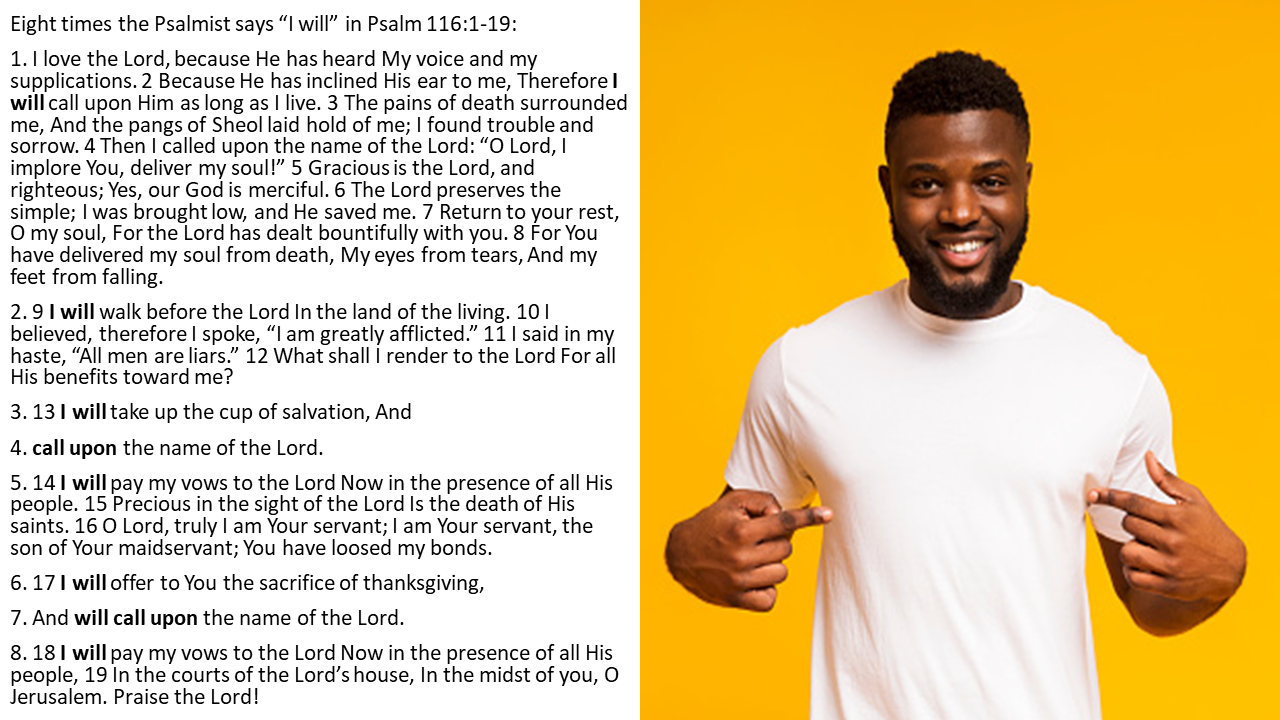
Eight times the Psalmist says “I will” in Psalm 116:1-19:
- I love the Lord, because He has heard My voice and my supplications. 2 Because He has inclined His ear to me, Therefore I will call upon Him as long as I live. 3 The pains of death surrounded me, And the pangs of Sheol laid hold of me; I found trouble and sorrow. 4 Then I called upon the name of the Lord: “O Lord, I implore You, deliver my soul!” 5 Gracious is the Lord, and righteous; Yes, our God is merciful. 6 The Lord preserves the simple; I was brought low, and He saved me. 7 Return to your rest, O my soul, For the Lord has dealt bountifully with you. 8 For You have delivered my soul from death, My eyes from tears, And my feet from falling.
- 9 I will walk before the Lord In the land of the living. 10 I believed, therefore I spoke, “I am greatly afflicted.” 11 I said in my haste, “All men are liars.” 12 What shall I render to the Lord For all His benefits toward me?
- 13 I will take up the cup of salvation, And
- call upon the name of the Lord.
- 14 I will pay my vows to the Lord Now in the presence of all His people. 15 Precious in the sight of the Lord Is the death of His saints. 16 O Lord, truly I am Your servant; I am Your servant, the son of Your maidservant; You have loosed my bonds.
- 17 I will offer to You the sacrifice of thanksgiving,
- And will call upon the name of the Lord.
- 18 I will pay my vows to the Lord Now in the presence of all His people, 19 In the courts of the Lord’s house, In the midst of you, O Jerusalem. Praise the Lord!
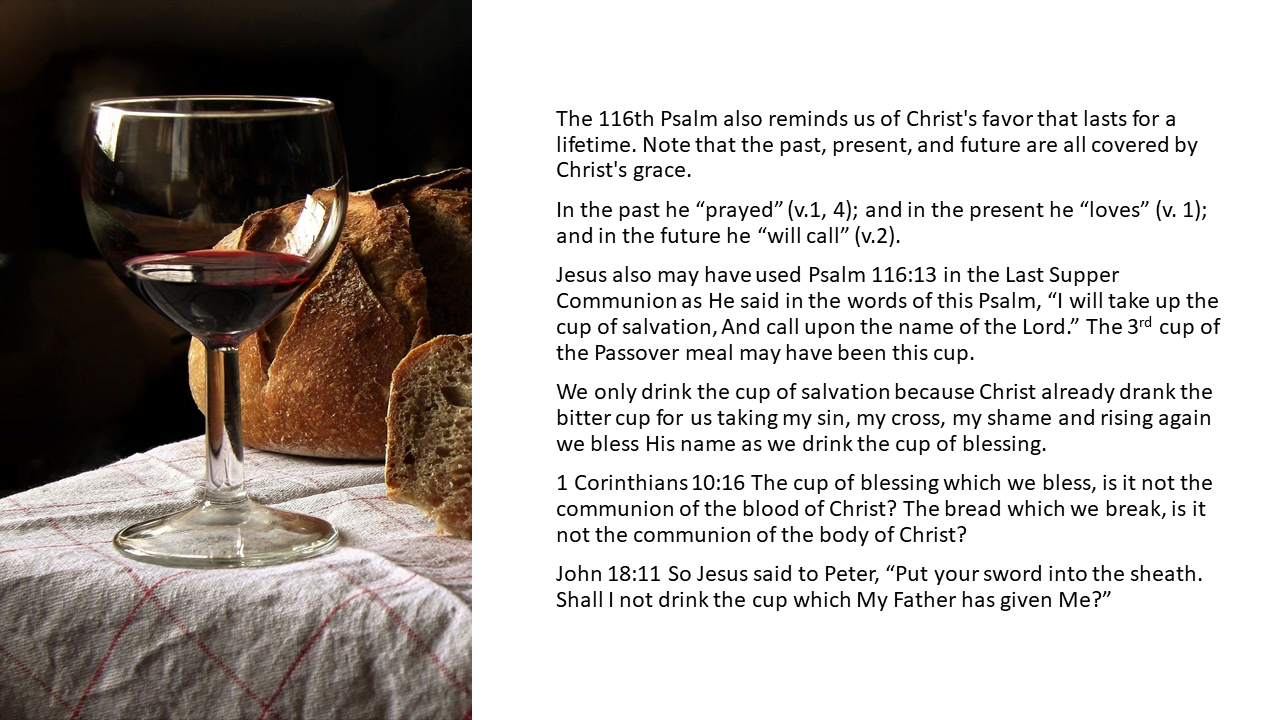
The 116th Psalm also reminds us of Christ’s favor that lasts for a lifetime. Note that the past, present, and future are all covered by Christ’s grace.
In the past he “prayed” (v.1, 4); and in the present he “loves” (v. 1); and in the future he “will call” (v.2).
Jesus also may have used Psalm 116:13 in the Last Supper Communion as He said in the words of this Psalm, “I will take up the cup of salvation, And call upon the name of the Lord.” The 3rd cup of the Passover meal may have been this cup.
We only drink the cup of salvation because Christ already drank the bitter cup for us taking my sin, my cross, my shame and rising again we bless His name as we drink the cup of blessing.
- 1 Corinthians 10:16 The cup of blessing which we bless, is it not the communion of the blood of Christ? The bread which we break, is it not the communion of the body of Christ?
- John 18:11 So Jesus said to Peter, “Put your sword into the sheath. Shall I not drink the cup which My Father has given Me?”
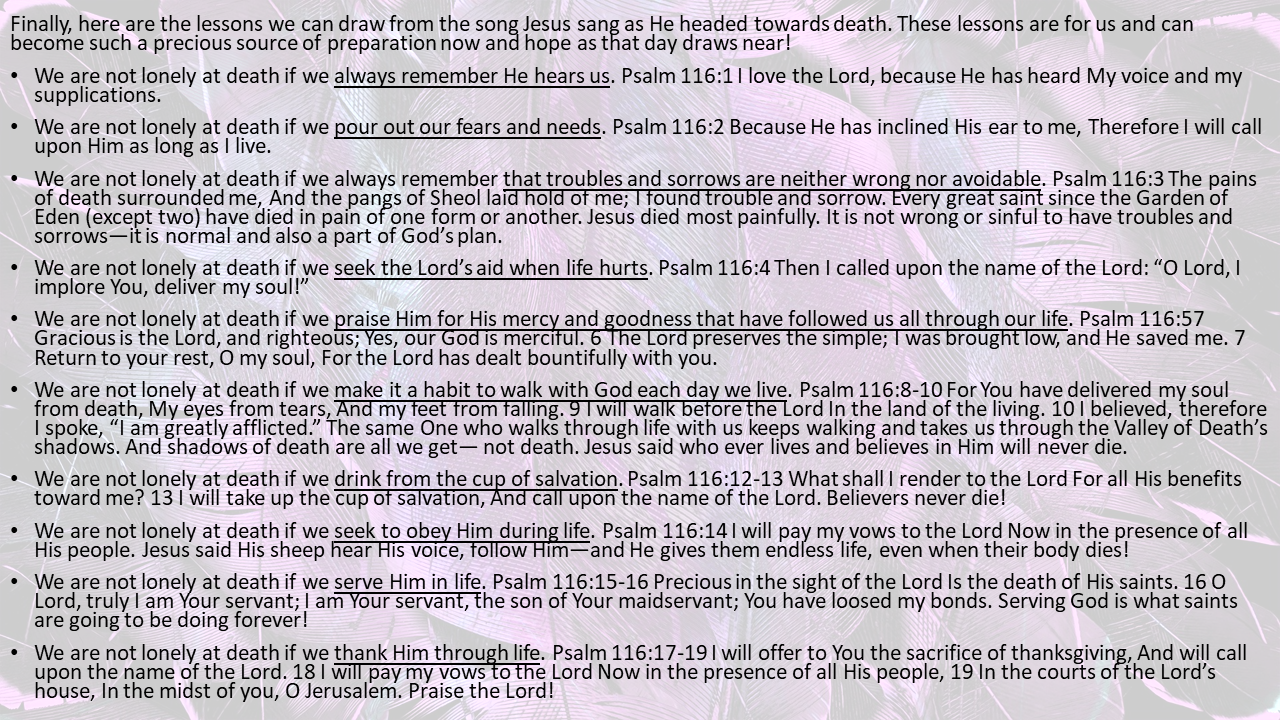
Finally, here are the lessons we can draw from the song Jesus sang as He headed towards death. These lessons are for us and can become such a precious source of preparation now and hope as that day draws near!
- We are not lonely at death if we always remember He hears us. Psalm 116:1 I love the Lord, because He has heard My voice and my supplications.
- We are not lonely at death if we pour out our fears and needs. Psalm 116:2Because He has inclined His ear to me, Therefore I will call upon Him as long as I live.
- We are not lonely at death if we always remember that troubles and sorrows are neither wrong nor avoidable. Psalm 116:3 The pains of death surrounded me, And the pangs of Sheol laid hold of me; I found trouble and sorrow. Every great saint since the Garden of Eden (except two) have died in pain of one form or another. Jesus died most painfully. It is not wrong or sinful to have troubles and sorrows—it is normal and also a part of God’s plan.
- We are not lonely at death if we seek the Lord’s aid when life hurts. Psalm 116:4 Then I called upon the name of the Lord: “O Lord, I implore You, deliver my soul!”
- We are not lonely at death if we praise Him for His mercy and goodness that have followed us all through our life. Psalm 116:5-7 Gracious is the Lord, and righteous; Yes, our God is merciful. 6 The Lord preserves the simple; I was brought low, and He saved me. 7 Return to your rest, O my soul, For the Lord has dealt bountifully with you.
- We are not lonely at death if we make it a habit to walk with God each day we live. Psalm 116:8-10 For You have delivered my soul from death, My eyes from tears, And my feet from falling. 9 I will walk before the Lord In the land of the living. 10 I believed, therefore I spoke, “I am greatly afflicted.” The same One who walks through life with us keeps walking and takes us through the Valley of Death’s shadows. And shadows of death are all we get—not death. Jesus said who ever lives and believes in Him will never die.
- We are not lonely at death if we drink from the cup of salvation. Psalm 116:12-13 What shall I render to the Lord For all His benefits toward me? 13 I will take up the cup of salvation, And call upon the name of the Lord. Believers never die!
- We are not lonely at death if we seek to obey Him during life. Psalm 116:14 I will pay my vows to the Lord Now in the presence of all His people. Jesus said His sheep hear His voice, follow Him—and He gives them endless life, even when their body dies!
- We are not lonely at death if we serve Him in life. Psalm 116:15-16 Precious in the sight of the Lord Is the death of His saints. 16 O Lord, truly I am Your servant; I am Your servant, the son of Your maidservant; You have loosed my bonds. Serving God is what saints are going to be doing forever!
- We are not lonely at death if we thank Him through life. Psalm 116:17-19 I will offer to You the sacrifice of thanksgiving, And will call upon the name of the Lord. 18 I will pay my vows to the Lord Now in the presence of all His people, 19 In the courts of the Lord’s house, In the midst of you, O Jerusalem. Praise the Lord!
One last area we need to consider and that is the question—does all this work? The answer resounds through the centuries, yes! This is the best way to live and the best way to die, is what we saw in Hebrews 11.

WHAT TO LOOK FOR AS WE PREPARE TO GO HOME
These all died in faith, not having received the promises, but having seen them afar off were assured of them, embraced them and confessed that they were strangers and pilgrims on the earth. —Hebrews 11:13, emphasis added
Remember the precious truth about the church at Smyrna—the saints who experienced martyrdom for Christ’s sake in Revelation 2? Their faithfulness unto death was such a sweet-smelling savor unto God. Unless Christ returns soon, all of us face the inevitability of death. Are you ready? Have you planned for the testimony you’d like your funeral to be?
By a few simple preparations, you can really bless your family and friends who stay behind after you’ve gone home to be with Jesus. If you have never done this, I encourage you to take out a sheet of paper and label it: “My Home Going Celebration.” Write out a brief description of how you came to Christ, and of your hope in His salvation. Then share some of your favorite verses, songs, and hymns—and even a word to bless those you leave behind. Do this and, like Abel, you will “speak” even after you’ve died (Hebrews 11:4). To further prepare, consider once more the seven godly examples in Scripture of how to die with grace.
Jacob looked for the Land of Promise to the end of his life. When he was close to death, Jacob called Joseph to his side and said, “Now if I have found favor in your sight, … deal kindly and truly with me. Please do not bury me in Egypt, but let me lie with my fathers …” (Genesis 47:29-30). When Jacob was a young man, God had promised that his people would someday have a Land of Promise, but Egypt was not that land. Jacob therefore asked to be laid to rest in the actual land God was giving to his descendants. He had followed his Shepherd all the way, and trusted his Redeemer to save him from his sins (Genesis 48:15-16). Have you thanked the Lord lately for His grace that is greater than all your sins?
Joseph died pointing to the faithfulness of God. He told his brethren, … “I am dying; but God will surely visit you, and bring you out of this land to the land of which He swore to Abraham, to Isaac, and to Jacob” (Genesis 50:24). In the ancient world, when someone was failing in health and was coming to the end of life, the family would gather around and listen to their last words. Inheritances were then divided up. Joseph died pointing his family to the Lord’s promises: “God will surely come to your aid, for He is faithful and will do what He said.”
David died exhorting his family to follow God. When he was about to die, David charged Solomon his son saying: “I am about to go the way of all the earth,” he said. “So be strong, show yourself a man, and observe what the Lord your God requires: Walk in his ways, and keep his decrees and commands, his laws and requirements, as written in the Law of Moses, so that you may prosper in all you do and wherever you go” (1 Kings 2:2-3, NIV). David earned the right to exhort his family spiritually because he had lived a godly life. Lot, however, did not. His family laughed and mocked him, saying that he was scoffing (Genesis 19:14). To make our last moments on earth really count, it is so important that we get ready to die by first living for Christ.
Stephen died praising God. While he was being stoned, he prayed, … “Lord Jesus, receive my spirit.” Then he fell on his knees and cried out, “Lord, do not hold this sin against them.” When he had said this, he fell asleep (Acts 7:59-60, NIV). What an incredible testimony of dying faith! Stephen was radiant, worshiping, and offering his spirit into the presence of the Lord!
Peter died reminding the saints about the Word of God. He said, “I will always remind you of these things, even though you … are firmly established in the truth you now have. … It is right to refresh your memory as long as I live in the tent of this body, because I know that I will soon put it aside … (2 Peter 1:12-14, NIV). Jesus had told Peter that some day his hands would be stretched out, and he would be crucified (John 21:18). History tells us that he was crucified upside down because Peter had declared that he was not worthy to die like Jesus did.
Paul died finishing the plan laid out for Him by God. When death was near, he said, … “I have fought the good fight, I have finished the race, I have kept the faith. Now there is in store for me the crown of righteousness, which the Lord … will award to me on that day—and … to all who have longed for his appearing” (2 Timothy 4:6-8, NIV). Paul faithfully followed the course that God had laid out for him. His last days were spent in the maximum security Mamertine Prison in Rome. He did not protest or try to get out; he placidly sat there and wrote letters, knowing that he had faithfully completed what God asked him to do, and was prepared to go to heaven.
Christ died pointing the way for another to come to God. Jesus told one of the criminals being crucified, “Today you will be with Me in Paradise” (Luke 23:43). Is Jesus your hope? If you died today, would you be with Him in paradise? Are you ready to die?
As we ponder the direction of our life and seek to point it towards our home in Heaven—you might regretfully say, “I wish I could do that over and start my life pointed the right way sooner.”
In Philippians 3:13-14, Paul said to forget what is behind and live for the Lord from today on.
- Philippians 3:13-143 Brethren, I do not count myself to have apprehended; but one thing I do, forgetting those things which are behind and reaching forward to those things which are ahead,14 I press toward the goal for the prize of the upward call of God in Christ Jesus. NKJV
If you have not been as faithful as you need to be, start now.
- Philippians 3:20 For our citizenship is in heaven, from which we also eagerly wait for the Savior, the Lord Jesus Christ,
Choose to like Paul (II Timothy 4:7-8) to finish the course Christ has laid out for you, and you will experience a great calm as you follow God’s will daily. This is the very best approach to being ready to go “home” any day—and not just when your “to do” list is complete. Consistently living like this is a wonderful way to die!
Remember that David ended well by heading towards home—and so should we. Then we can echo the words of John as he closes God’s Word when he says—
- Revelation 22:20-21 He who testifies to these things says, “Surely I am coming quickly.” Amen. Even so, come, Lord Jesus!21 The grace of our Lord Jesus Christ be with you all. Amen.
[1] The Jewish New Testament Commentary, (Clarksville, MD: Jewish New Testament Publications) 1996.
Slides

Check Out All The Sermons In The Series
You can find all the sermons and short clips from this series, David’s Spiritual Secret here.
Looking To Study The Bible Like Dr. Barnett?
Dr. Barnett has curated an Amazon page with a large collection of resources he uses in his study of God’s Word. You can check it out here.