
If the video above is not available, here are two other ways to view:
Enjoying the Benefits of Being Forgiven
060716AM
DSS-25
PSALM 32
Transcript
.jpg)
Let’s open our Bibles to the 32nd Psalm. As we turn to the 32nd Psalm. We’re looking at one truth this morning.
.jpg)
Forgiveness. Forgiveness matters more than anything else to anyone who has ever sinned. And God says, all have sinned. So, forgiveness is very important. Experiencing, knowing, possessing the reality of forgiveness. One moment before your last breath, one thing will matter more than anything else, whether you are dying forgiven or unforgiven. That state of being forgiven or forgiven transforms those days that lead up to that one moment before you die, to either serenity, knowing that you are forgiven, or the dread of knowing that you’re not.
I wonder this morning, with your current direction, which will be yours? Will you know the serenity, the absolute peace filled hope, knowing that every sin you ever committed is absolutely gone forever removed an eternal distance from you? The peace that you can have one moment before you die is available on a daily basis. The choices we make have everlasting consequences. If we understand what God did in Christ and choose to respond to that by faith, we can have, what I want to show you this morning, the Bible describes as the present tense of forgiveness. That means we know we are forgiven this very moment and forever shall be.
.jpg)
We’re progressing through the life of David. I remind you as you get to the 32nd Psalm before right after Psalm 32 and before the Psalm starts, the first little comment that’s actually the first verse of the Hebrew Bible is a Psalm of David. And David, as we know, is the most written about person in the Bible. 141 chapters devoted to his life, every facet of his life, and the Bible gives us more material on the reality of personal forgiveness and personal assurance of cleansing and personal peace in spite of sin and failure in the life of David more than anyone else in God’s Word. So, he’s a real goldmine of revelation about the present tense of forgiveness.
As we look at the song that David wrote for all the world to see, we note that he has a confident assurance that he had forgiveness in the present tense, not he hoped, he wished, maybe, perhaps, somewhere he might be able to get to the place that he could maybe be sure, but he says no, I know at this moment, a present personal assurance of his complete forgiveness. He knew his guilt was passed, he knew his peace was secure. And this morning, just those first five verses I want to read with you and I want you to note the present tense, his present possession of forgiveness.
Before we get to the first verse, you notice there’s one other thing. It says the Psalm of David, and then it says a contemplation. That’s New King James. Maybe yours says a, I’m not sure what little note you might have before there, but that is a very interesting note. It marks the first of a dozen of these Maskills that are so titled that word means a teaching or a lesson, something that was to be received and thought deeply about. There are 12 psalms that are titled this way, and this one is a lesson to be pondered about forgiveness, and forgiveness is spoken of as a present reality, as a present possession. The other of the dozen Maskills are Psalm 32 is the first, 42, 45, 52, 53, 54, 55, Psalm 74, 78, 88, 89, and the last lesson, Psalm last maskil is 142.
A lesson in how to emerge as we saw many weeks ago from the cave of gloom that David was in. It’s also, interestingly enough, the 32nd Psalm is the second of seven Psalms that talk about forgiveness. In the Book of Psalms, they’re 150. The longest, most chapter filled book of the Bible is the book of Psalms. David wrote most of them. The majority of them, and within them there are 12 of those contemplation or teaching or Maskills as they’re called in Hebrew, and there are seven that are completely about forgiveness. They’re called the penitential Psalms. It doesn’t say that in the Bible, but that’s what the Hebrews, the Jewish scholars over the years, have categorized the Psalms and they’re called the penitential or the Psalms that speak of sorrow over sin.
It’s interesting, these seven, the first one is Psalm 6. The second one is the one we’re looking at Psalm 32. And then Psalm 38, which is about David’s sin, probably with Bathsheba as Psalm 32 is the middle one. And by the way, to the Jewish thinkers, whenever they had a list of seven, they looked at the most important one being the center of the list. The fourth one, because it was like a pyramid going up like this, 1st and 7th and 2nd and 6th, and 3rd and 5th, and then the 4th one was right in the middle. And do you know what the middle penitential psalm is? The 51st Psalm, which we’re getting to next after this one. It’s perhaps the most influential Psalm about the theology of forgiveness.
And so, these seven penitential Psalms talk about the reality of forgiveness. Psalm 32, let’s read the first five verses. Would you stand with me for the reading of God’s Word? Remain standing and we’ll ask God’s blessing in prayer.
Follow along in your Bibles. Verse 1, blessed is he whose transgression is forgiven, whose sin is covered. Blessed is the man to whom the Lord does not impute iniquity, and in whose spirit there is no deceit. When I kept silent. My bones grew old through my groanings all day long for day and night. Your hand was heavy upon me. My vitality was turned into the drought of summer. Selah. I acknowledge my sin to You and my iniquity I’ve not hidden. I said, I will confess my transgression to the Lord, and You forgave the iniquity of my sin.
Let’s bow before our forgiving. God, thank You, Lord, for the present tense of forgiveness that those who are Yours who believe in You, who are in Christ, partake of a forgiveness that is present right now. Not just hoped for, and that is part of our salvation and not just looked back upon, but it is our present hope. Our present joy, the present reality that we are those who know that we are forgiven. I pray that we would be blessed as we understand the blessings that come from the realization and possession of the reality of forgiveness in the present tense. May we leave from here today knowing either that we are forgiven, are being so painfully aware that we are not, and may Your Spirit through Your convicting work make it so clear to those who have not yet come to faith in You, oh Christ, and the blessing of the present tense of being like David forgiven. We thank You. Teach us open our hearts and our eyes, and may we make those eternal choices to live through what you have done, oh Christ. In Your precious name we pray. Amen.
.jpg)
You may be seated. As you seated, David had just repented. Remember we were looking at 2 Samuel chapter 12, and Nathan was pointing at him and David is now just letting out all the pent-up grief that the horrible pit of sin that he’d been covering up for weeks and months. And that’s the location of David in Psalm 32. He’s just coming out of those pits. He’s proclaiming a song about what it means to return to God, to receive, and to experience, and to possess God’s forgiveness. And God alone is the one who can give forgiveness, and He gives that only through Christ and through His sacrifice.
David’s awareness of the pain that his personal sin brought to him was not shared just by David, it’s a common struggle we have in humanity. There is a constant awareness to varying degrees among all people of their sin. They might call it different things. They might call it their problems or their a lot in life or the misfortunes but our personal choices have consequences and many of those consequences are a result of sin. And mankind in general has struggled for thousands of years with the weight of their, when they would admit it, of their personal sins.
It wasn’t new to David. It’s something that the earliest written portions of the Bible, by the way, Job, the Book of Job, job was written. Remember historically, while Job was alive, he was seeing what we would title today, dinosaurs. He saw the Ice Age, so we’re talking about, he lived about 5,000 years ago and Job was so acutely aware of his own sin and his friends were it’s nothing new. It’s ancient. But the secular world has very moving insights. It’s not just the Bible that talks about what David was experienced, the secular world talks about the weight of sin. And for just a moment, I want to show you what I mean. And not very often I get to do this connect, the what people call the real world, the secular world with what we believe the spiritual world.
But look in the book of Acts with me all the way to the New Testament, other end of your Bible, chapter 18. For many years I was a history professor and I just can’t miss an opportunity to become a history professor. So, bear with me for about three minutes, okay? Because from the secular world, we have a very moving insight from the writings of someone who was contemporary with the Apostle Paul. Unsaved, unbeliever, secular pagan Roman, contemporaneous with the Apostle Paul. And I want to show you something fascinating as their paths intersect in Acts chapter 18. Starting in verse 11, Paul is standing, he continued there in Corinth is where we are in Acts 18:11. He continued there a year and 6 months, so 18 months of ministry in Corinth. He taught the Word of God among them.
Now look at verse 12. Now we have a historic figure. Someone you can look up in the Encyclopedia Britannica or Wikipedia or wherever you look for historical information. But when Gallo was Proconsul of Achaia, so that immediately dates when Paul was there in the early 50s, because that’s part of Roman record and history. But Gallo was Proconsul that was directly appointed by the emperor himself. So, this man was a high ranking Roman official. The Jews with one accord rose up against him and brought him to the judgment seat, and they give all these accusations and Gallo says in verse 15, if it’s a question of words and names of your own law, look at yourselves. I don’t want to be a judge of this.
And Gallo, verse 16, drove them from the judgment seat. The story and on and on. That man, Gallo is a fascinating historic person. He let me just tell you about him. He ruled there in Corinth, one of the most important Roman cities of the 1st century, but he was a part of a larger family.
And Gallo’s brother you may have heard of. From history, we know his older brother was one of the most brilliant philosophers and writers of the ancient Roman world. His name was Seneca, and so Gallo’s older brother was Seneca. Now that unless you’re a history buff, that probably doesn’t mean anything to you, but Seneca was the personal tutor of the Emperor Nero and stood by him all the way through his reign. Seneca lived from 3 BC to 65 AD. He outlived most of the apostolic time.
But now listen to this. Seneca wrote an essay while he was Emperor Nero’s tutor and his famous essay on despair. So, this is Gallo’s older brother. Dalio’s in the Bible, and you can read about him in history, but his older brother, Seneca, wrote this one line. I won’t read you the whole essay on despair, but this is how he concluded it. What humankind needs is a hand to lift them up to God. That was his conclusion, he was in despair as he looked at the moral decline of the Roman Empire, especially in his own emperor that he tutored. As you know, Nero just became such a wicked, perverted cruel person, murdering everybody around him and very wicked. But Seneca Gallo’s older brother said what I wish humanity could have is some hand that would lift them up so that they could be right with the gods. I’m not sure he was a monotheistic person, but to lift him upward to the gods, to find out how to get out of this morass and this sinking swamp of sin.
That’s interesting because right after chapter 18, look at chapter 19 of the Book of Acts you’re in. Because a contemporaneous with Paul was Gallo and Seneca, his brother, and Paul was in Corinth. And where does he go in chapter 19? He goes to Ephesus. And what did he teach publicly in Ephesus, and I’m sure he taught it in Corinth, but we pick it up in Ephesus.
.jpg)
In fact, turn back to Ephesians chapter 1, because I want to show you Paul’s answer to Seneca’s wish. Seneca was saying, I wish there was some way to lift people up to God. We are just, we’re down here, we’re just in the mere the muck of sin, or he didn’t call it sin, but just down there in despair. But look at Ephesians chapter 1 because Paul went to Ephesus in Acts 19, right after Corinth. And as we turned to the letter Paul wrote to the church at Ephesus, we remember that from the ancient times to the present times in Paul and all the way to today. Forgiveness and a hand to lift us back to God was a longing in many people’s hearts.
In fact, if you ever walk down the Apian Way in Rome, if you get lost and end up in Rome someday, walk down the Apian Way, and if you can read Latin, look at the monumental tombs that go all the way down and line the ancient Apian Way. Those wealthy people, almost every other tomb mirrors what Seneca said. They had a longing to somehow get lifted up. Up to God, gods. They weren’t monotheistic, but they just wanted to get out of this mess. It’s always been this longing, but this haunting desire in the lives of those who have not found forgiveness.
Paul answers. Look in Ephesians 1, in verse 7. He declares forgiveness has been offered, it is offered, and it is available. Do you see what Ephesians 1:7 says, in Him, that’s in Christ, we have notice the present tense, the possession, we have redemption through His blood. We have, it’s implied, the forgiveness of sins. It is a present tense. It is a present possession. But how did all that happen? According to the riches of His grace at the beginning of the seventh verse through His blood.
Now let’s go from Paul’s time up to the present. This week I was reading different accounts. In fact, I spent a long time this week. I got caught up in reading Chuck Colson’s memoirs of all of the dramatic conversions in the prisons of the United States that he has witnessed. And Royce was talking about the name of Jesus and we kept singing ensembles saying it, and we were all talking about that. Colson tells one story about how one of their evangelists walked into the maximum security to talk to a man on death row. The last person that got to talk to him before they did their thing and shaved him and greased him and strapped him in and killed him, executed him.
And this man, he said the prison evangelist walked into that cell and he said before he was 15 feet away from him, he could smell it. He said it was just smelled like a pit toilet. And he said there were cockroaches everywhere. This man would throw his food on the floor. He was unshaved, unwashed. He just didn’t use the facilities. He was just living like an animal. And the guy was kind of glazed and walking around in there, he almost looked like he was demon possessed.
And this evangelist, this prison fellowship evangelist came up to the bars and he started talking to this man. The man wouldn’t even look at him. He was glazed eyes and everything. And finally, this evangelist said, he just yelled to him, he said, say the name of Jesus. And the man froze. It’s just like he’d been hit and he lifted those that mangled tangle of hair, and he looked at the guy at the bars. And he said he just looked just like sin personified and there was a real struggle. And finally, he said the name of Jesus and he said he just, he kind of perked up a little bit and walked over and said, why did you say that to me? And that evangelist, then shared the Gospel went through and he left because his time got up.
He said when he came the next weekend, he said it was like a new place. This man had gotten a stay of his execution. He’d cleaned his cell. There were no cockroaches. It was no longer filthy dirty. And he said, could you tell me more? And he actually led him to the Lord in that cell. There is a haunting desire for a hand to lift literally out of the pig pen of sin that man was in and the Spirit of God’s conviction and that man’s listening and responding to the name of Jesus brought life.
I’ll read you another note that Colson wrote because in the same testimonial he said he was watching Albert Spear being interviewed. Now, this is 20 years ago, okay? Over 20 years ago, and you don’t even know who Albert Spear is. Albert Spear was Hitler’s technological guru. He kept all the Nazi factories running and humming. Albert Spear distinguished himself of the 24 Nazis that were tried at Nurenberg, he’s the only one that confessed. He was guilty. The other 23 said they didn’t do anything wrong. All of them from their gas Himler and the all of them Ikeman, everybody said we didn’t do anything wrong. Albert Spear said I was wrong and he served 20 years at spanned out prison.
And they were interviewing him on TV when he was released and Spear after his 20th year in prison, the interviewer, it was Good Morning, America was reading his book he wrote in prison. He said this, you said, Mr. Spear guilt can never be forgiven or shouldn’t be. Do you still feel that way? He wrote a book while in prison, so they interviewed him when he got out. Colson said he’ll never forget the look of pathos on Spear’s face. As he responded, he looked at the camera and Spear said this.
I served a sentence of 20 years and I could say I’m a free man, and my conscious has been cleared by serving the whole time as a personal punishment. But he continued, I can’t get rid of it. I wrote this book as a part of my personal atoning. I want to clear my conscience. The interviewer kept going and they pressed the point. They said, Mr. Spear, you really don’t think you’ll be able to clear your conscience totally. And Spear shook his head and he said, I don’t think it’s possible to be forgive. Colson said for 35 years, Spear had accepted his responsibility for his crime. His writings, his books were filled with contrition. He warned others to avoid moral sin. He desperately sought expiation, but to no avail.
Colson said I wanted to rush to Spear’s side to tell him about Jesus and His death on the Cross and of God’s forgiveness, but there wasn’t time. The ABC interview was the last public appearance of Albert Spear. He died shortly after. And the tragedy for Spear and for Seneca in Paul’s time that I just alluded to is there was, and there is a hand to lift them up. The complete forgiveness of sins that Jesus offers, they just didn’t know about it.
.jpg)
Let’s go back to Psalm 32. Because I want you to see that David did know about it. He knew what we can know. He knew what the Apostle Paul said, in Him we have redemption through His blood, the forgiveness of sins according to riches of His grace. Christ’s blood shed through His death and the Cross purchased our redemption. David looked forward to it. David believed that God was able to forgive his sins. He asked for God’s forgiveness. He believed that he could not forgive his own sins. He believed he had to ask. He said, I have sinned against thee and thee only as we’ll see in Psalm 51.
And look at the blessing he received. He said, I know my transgression is forgiven. I know, verse 1 at the end, my sin is covered. I know that I am a man to whom the Lord will not impute iniquity. He’s not going to write it down forever on my record. I don’t have to pay for it forever. I know that in my spirit, there’s no guy I’ll, no deed. He said, I’m not hiding anything. I have laid bare.
In fact, what’s interesting in the next verse. He says, when I kept silent, I suffered, verse 4, day and night, Your hand was on me. But look at verse 5. I acknowledge my sin to You. That word sin is a word that speaks not generally of sin en mass, but of specific sins. What David did when the burden and the conviction and the heavy hand of God that was on him finally had reached at its peak, he responded to God and he began pouring out his acknowledgement, not just of the Bathsheba thing, he just laid it all out. He laid out all of his sin, all of his pride, all of his deceit in guile. And he says in verse 5, when I acknowledge my sin to You, my iniquity, I didn’t hide from. I said, I will confess, I will agree with you about my transgressions, my terrible iniquities against you. All the times that I have gone against You, oh Lord, and You forgave all that. That’s the blessing of the present, tense of forgiveness.
Now, how do we experience that? Because from the Garden of Eden onward, God has offered to all who come to Him forgiveness. But how do we get that forgiveness? Let me show you a quick pathway starting in Mark chapter 10. I just want to show you three verses and then pull it together for you. Mark chapter 10. This is Jesus Christ speaking on this subject. Mark 10 and verse 45. Jesus said, I came, Mark 10:45, to give my life a ransom for many.
Is Jesus Christ as we’ll see when we get into Psalm 51, specifically the theology of forgiveness, how on Earth did God do that? Is he just this big, gracious grandfather that says, don’t worry about it? No. No way. He is so aware, so recording of every single instance of sin that God had to completely pay for every transgression against Him, and that could only be possible through a perfect sacrifice, which we’ll see in Psalm 51 was Christ, but Jesus came to give His life as a ransom.
.jpg)
Now keep turning to the right. Go to Hebrews 9. The book of Hebrews is the real theology of the atonement and how Jesus Christ did this wonderful work and we’ll have to motor through there a lot in Psalm 51. But look at Hebrews chapter 9. Just one part of the 12th verse of Hebrews 9 because it says, Jesus entered, Hebrews 9:12, the end there, the Most Holy Place once for all. Hebrews 9:12, once for all by His own blood, having obtained eternal redemption. See the redemption, the forgiveness we have in the present tense is only a possible through Jesus Christ, but the reason it’s in the present tense is that He has already accomplished the sacrifice. He’s already paid the price. He’s already paid the ransom that was due for our sin. As Hebrews 9 says, for He entered that holy place once for all.
I love that once for all. No continuing need for a sacrifice to be made by His own blood. He came personally and He personally obtained eternal redemption. He moved our sins in eternal distance from us and the penalty that accompanied those sins. Now, Peter, the next book, keep going, Hebrews and then James, and then 1 Peter. Go right by James and get to 1 Peter 1:18. Peter defines this down to us in 1 Peter 1:18, and he says, it was not with perishable things such as silver and gold that you were redeemed. No money could buy it from the empty way of life handed down to you from your fathers, your forefathers, but with the precious blood of Christ as of a lamb without blemish or defect. Now, what Peter is reminding us of is the tremendous cost of our redemption, our redemption costs God the very life of Christ. It was an astounding mystery which puzzled the Old Testament prophets.
In fact, you’re in verse 18, back up to verse 10 of the same chapter 1 Peter 1:10. It says, of this salvation, the prophets have inquired and search carefully who prophesied of the grace that would come to you. And they searched what or what manner of time the Spirit of Christ in Him was indicating when He testified beforehand the sufferings of Christ and the glories that would follow. See, the Old Testament prophets are all writing about the coming Christ. He’s the theme of the Old Testament and all their prophecies from all the myriad of intricacies of the first five books and the whole sacrificial system all the way through the major and minor prophets, they could not fully understand how this was going to work. And they were trying to understand, look what it says, what or what manner of time. Verse 11, the Spirit of Christ who was in them, Christ was in these prophets, telling them what was going to happen, indicating the sufferings of Christ. They didn’t understand how all this was going to connect together.
It concludes in verse 12 with saying which things, look at verse 12, the angels desire to look into, and this is such a mystery that the Old Testament prophets didn’t understand it, and the angels even wonder. They want to look into this because it’s so amazing that God sacrificed Christ for the sin of the world, amazing Christ’s death to pay the price of our sin is so wonderful that we, the redeemed of all the ages are going to be joined by the angels and together are going to sing forever a new song.
In fact, it says in the book of Revelation, if you want to turn back there, Revelation chapter 5 and you want to see one of the choruses we’re going to sing in Heaven. It says in Revelation 5, starting in verse 9, they sing a new song saying, You are worthy to take the scroll to open its seals. For You were slain and have redeemed us to God by Your blood. See forever, we’re going to still be in this cosmic wonder at what it costs God and how He purchased us. And we’re going to sing about it. You have redeemed us, the middle of verse 9, to God by your blood out of every tribe and tongue and people and nation. You have made us kings and priests to our God and we shall reign on the Earth. And I looked and I heard the voice of many angels around the throne, they join in and the living creatures and the elders, and the number of them was hundreds of millions. 10,000 times 10,000 and millions, thousands of thousands saying with a loud voice they join in, worthy is the Lamb who was slain. Remember that once for all, Hebrews 9:12, who was slain once for all to receive power and riches and wisdom, and strength and honor and glory and blessing, and every creature which is in Heaven, on the Earth, and under the Earth.
Verse 13 says, and such as are in the sea and all that were in them. I heard saying everyone has to get in on this blessing and honor and glory and power be to Him who sits on the throne and to the Lamb forever and ever, and the four living creatures said, Amen. I think that means they’re Baptist. I’m not sure. And the 24 elders fell down and worshipped him. And that means they’re a little more expressive than we are now, but we’re all going to limber up in Heaven. So don’t worry about it. Before Him who lives forever and ever. What is all that built around? The Lamb that was slain, His blood that purchased us, and the wonder of the present tense of forgiveness because of the sacrifice of Christ. God accomplished complete forgiveness of our sins through Christ’s sacrifice.
Now, the Scriptures give us one more amazing little point, and that’s where I want to end. Turn to Hebrews chapter 12 and last Sunday night we start on this and I want to finish it up briefly this morning. Hebrews chapter 12, and I’ll give you a running start. We’re going to be from verses 22 to 24, but I want you to see us in our final destination. And what is fascinating is the writer of Hebrews mixes two scenes. He mixes the present and the future, and he does that to tell us that we have a present possession of the completed forgiveness that Christ accomplished for us. And it has a profound effect in how we live today. And let me show you what I mean.
Look at verse 22, but you have come. Now, listen, Hebrews 12:22, that is right now. These are present possessions of the forgiven. You have come. The writer of Hebrews is saying, this is, you’ve come there. This is what’s yours. You have come by faith to Jesus Christ. You have received His sacrifice. This is your present possession. Verse 22, keep reading, you’ve come to Mount Zion, to the city of the Living God, to the heavenly Jerusalem, to an in renewable company of angels. Verse 23 to the General Assembly, the Church of the Firstborn who are registered in Heaven. Present tense again, to God, the judge of all, to the spirits of just men made perfect. Verse 24, to Jesus, the mediator of the New Covenant and to the blood of sprinkling that speaks right now. Present tense. It’s speaking now the blood of Jesus of better things than that of Abel.
What does all that mean? Look back at verse 22. Forgiveness means we’ll enter the city with foundations, those who have been completely forgiven and are present possessing that forgiveness in life and end life with that serenity, knowing that all sins are gone. Enter the city of God, the city of foundations, Mount Zion, the heavenly Jerusalem. The city of our living God. The longing of our hearts all through our earthly lives as pilgrims and strangers was that we were always waiting and looking for the city God was making for us. That’s what Hebrews 11 talks about. All the heroes of the faith died looking, longing for city that has foundations that couldn’t be shaken, something that would endure, and now it’s our present possession it’s our future hope. That’s what Paul said. We follow after we keep slogging through the trench warfare of life so we can arrive at the gold. It’s already ours. The upward call of God and Christ Jesus, that’s our present possession because we know we’re forgiven and all forgiven ones get to go to the city of the living God.
He continues. The writer of Hebrews continues and he says, we’ll see countless angels. You’ve come to thousands upon thousands of angels in joyful assembly. That’s what verse 22 of Hebrews 12 says, at last, as we saw last Sunday night, we get to meet those ministers of God, who watched over us as we went through life. Hebrews 1:14 says that they’re ministering spirits. The angels are that minister for us who are heirs of salvation. Before we get to that city, they’re ministering all along the way. God uses them to help us through this life.
.jpg)
Then it says, in the beginning of verse 23, to the general assembly and Church of the Firstborn. Forgiveness means that we will join the saints of all time. Those who are completely forgiven are part of the assembly of fellow believers of all times since the Garden of Eden through the end of the Millennium, there is a general assembly of all fellow believers, the Church of the Firstborn, whose names are written, registered in Heaven. Hebrews tells us in chapter 2 that Jesus is not ashamed to call us brothers and sisters. So, with Him, we’re sharing in the inheritance that God promised and it says we are fellow heirs with Him. In other words, we’re all the body of Christ. They’re waiting for us as we come one by one, escorted by Christ, one with Him. Brothers and sisters were united until His entire family is a safely arrived home. Then Christ can celebrate communion with us who are all safely home. It’s a wonderful passage of hope that we’re going to come to the festive assembly, the general assembly of those who are born again, those who are forgiven.
But He doesn’t stop there, keep reading. He says, not only the general assembly, those who are registered in Heaven, but it says that we will be with God, the judge of all. Forgiveness means we’ll be with our Almighty God. Those completely forgiven can be with God Almighty. The writer of Hebrews has already said that nothing’s hidden from His sight. All things Hebrews forces are naked and open before the eyes of him with whom we have to do what? Does He get blinded when we get there? No, He doesn’t see our sin because our sins are gone. That’s what complete forgiveness is all about, that God sees and records and remembers our sins and iniquities no more. So we can be with God, our God, who, the writer of Hebrews says, is a dreadful thing to fall into the hands of the living God. He is the judge. He is the one who is a consuming fire. But we need, not fear because we’re completely forgiven in the present tense, but what’s amazing is it tells us in the book of Revelation that we each one get introduced to God Almighty, the Father being led by the nails scarred hand of Jesus Christ. And there’s so much to look forward to.
I read a comment recently, someone says, we don’t think much about Heaven because we don’t understand it. We don’t think deeply about it. It says in Revelation. Chapter 3. Jesus said, I will confess them. Revelation 3:5, I will confess your name before My Father and before His angels. One moment, what will happen to us is that Jesus is going to bring us up and confess us and introduce us and present us to Almighty God the Father. Have you ever thought what that means? But Hebrews 12:23 when says, we’re going to be before the judge of all God Almighty.
.jpg)
Think about it for a moment to be taken by the hand of the Lord Jesus Christ, to be led up past the marshaled ranks of those hundreds of millions of angels to be led up, the golden boulevards of Heaven past the cherubim, past the seraphim, up to the very throne of God Himself.
And if that wasn’t enough, and if that wasn’t exciting enough to hear the Lord Jesus Christ, call us by name and present us to God as His well-beloved son and daughter. Then to hear the Father say, as we hear in the words of Christ, as He gave this parable of the lost son, he said, bring the best robe, put it on him. Think of it, a robe of white, bright as the day pure as the light that is presented to us. Revelation 2 and 3 tells us about all the benefits of being an overcomer, all those benefits of being a born, again redeemed, saved, regenerated, member of Christ’s family. And one is that we are presented to God and another is that we are clothed and we become a pillar and we’re given that name, that only we know in our access and that God knows to him we have this personal access. When Jesus was transfigured on the Mount, something happened not only to His countenance, but something happened to His clothes. Christ’s clothing became as white as light and so shall ours be. What a reward for all of us who have been completely forgiven to be introduced to God the Father, like that to have a robe like that draped around our shoulders, to be invited to walk in the shining ways of glory and to join the saints of all the ages home at last with our God.
.jpg)
I think we have two minutes for me to revert to one of my favorite things. Your hymn book. Okay. Grab it out of the pew and see if you can find 549. I don’t want you to miss this because Kerry Breck, we’re going to come back to the Bible in a second, but Kerry Breck wrote this way back in 1898. I think she got all excited about this like we should be, and she wrote her testimony of what she thought it was going to be like to at last, be introduced by Jesus Christ to God the Father, and to finally be home at last with the redeemed of all the ages and with the general assembly of the Firstborn whose names are registered in Heaven. And her poem was picked up by the Church and put to music. And I often remember singing this when I was a little boy. But I’ll just read it to you.
Face to face with Christ my savior, face to face. What will it be? When with Rapture, I behold Him, Jesus Christ, who died for me. Second stanza only faintly. Now, in this life, I see him with the darkling veil between such a struggle, as Royce mentioned this morning, so many distractions and everything. But a blessed day is coming. When His glory shall be seen. Third stanza. What rejoicing in his presence When our banished grief and pain, when the crooked ways are straightened and the dark things shall be plain. Last stanza face to face. O blissful moment, face to face to see and know face to face with my Redeemer, Jesus Christ, who loved and loves me. So, then the chorus. Face to face, I shall behold Him far beyond the starry sky face to face in all His glory. I shall see Him by and by. What a blessing.
.jpg)
That complete forgiveness brings us back to Hebrews chapter 12. You can put your hymn books away and get your Bibles back, but do you see why through the history of the Church, the hymn book and the Bible were always the two things? You always carried the Church they sang the Psalms and the hymns and they read the Scriptures. There just was that collection of the testimonies of the saints to say what we want to say, but they have the gift to say it in such a powerful way. Fifthly forgiveness means that we will at last be perfect.
We will be perfected. Look at what it says at the end of verse 23, and to the spirits of righteous ones made perfect. Righteous sons and daughters of Adam, righteous men and women made perfect. Finally, we’ll be perfect. We’re so aware, so painfully aware of our imperfection and our sin. Forgiveness means at last we’ll be perfected, and those completely forgiven ones come as saints to Heaven. They are the spirits of righteous ones made perfect. We join the assembly of the perfect ones, the justified ones, the sanctified, and now at last glorified ones. The hope and longing of all of our earthly struggle is realized. We are finally free from sin in its hideous power and presence. We’re finally fully living what the Scriptures say.
.jpg)
After the power of an endless life, we are endlessly able to live, perfected, glorified as servants of God. What we long to do now, and we do haltingly and imperfectly and incompletely, we’re able to do perfectly and completely and eternally. We, the forgiven ones, mean we’ll at last be perfected. Verse 24 of Hebrews, chapter 12 tells us that forgiveness means we’ll be with Jesus, our Savior. Those completely forgiven come to Jesus, our savior. It says to Jesus the mediator of a new covenant. The writer of Hebrews uses the name given to God, the Son of His birth. Remember what it said, thou shall call His name, what? Jesus. The name given to Him at His birth, He is seen in Hebrews, is the one who destroyed the devil that had the power of death. He is the one in Hebrews who was made like us and felt our temptation. It is Jesus in Hebrews chapter 4, who invites us to boldly come to the very throne of God and find His grace and mercy. It is Jesus through whom all things are promised to us. As Paul tells us all things are ours in Christ. It is through Him all is given to us, as Colossians says, He sustains all things.
So here in Hebrews 12:24, we at last get to fall before Jesus. Him who is our all and all. And we’ll be able to do just what the chorus we often sing, declared we find him to be true. It’s not very often we get to quote a hymn from someone in Oklahoma, but one of our own native sons.
It was written about 2,500 at current count choruses and songs. But Dennis Jernigan, in fact, I just read his testimony. He was over in Jerusalem while we were there, and they were selling in the lobby of his church that he was ministering at his testimony. And I read it. I had no idea of the horribly stained and wicked past. Maybe that’s why he has so many songs. He’s so aware of his forgiveness in Christ. But here’s one chorus he wrote. He said, you are my strength when I’m weak. You’re the treasure that I seek. You are my all in all, taking my sin, my cross, my shame. Rising again, I take Your name. You are my all in all. Isn’t that what we’re going to sing when we finally get to see Jesus? Jesus, you’re the Lamb of God. Holy is your name. Jesus. You’re the Lamb of God. Seeking you as a precious jewel, Lord, to give up, I’d be a fool. You are my all in all. When I fall down, because remember, we’re not perfect yet, You pick me up. When I’m dry, we’re not perfect yet. We’re not glorified. We fall. We’ll be dry, you fill my cup. You are my all in all Jesus. You’re the Lamb of God. Holy is your name. Jesus. You’re the Lamb of God. Holy is Your name.
.jpg)
Look back once more at Hebrews chapter 12 and verse 24. because the last part of this incredible description, the seventh element forgiveness means we will forever enjoy His complete forgiveness. This is what the blood of Jesus cries forever. Those completely forgiven come to eternal forgiveness because of Christ’s blood, the end of verse 24, and to the sprinkled blood that speaks a better word than the blood of Abel. Now you got to be an Old Testament reader to get that little picture.
What’s that? Do you remember when Cain slaughtered his own brother Abel and it said God confronted Cain about it and He said, Cain, your brother’s blood cries to Me from the ground. So, what’s Abel’s, blood crying revenge. Penalty needed murder done. Slaughter inflicted avenge vengeance. Who got, that’s the blood of Abel. Abel’s blood cried from the ground of the beautiful soil of Canaan or of Eden. It cried for God’s judgment. So, Abel’s blood cries judgment. Now look at Hebrews 12. What is Christ’s blood cry for? It cries for better words than the blood of Abel. The blood of Abel cried from the ground demanding vengeance. The blood of God the Son will forever proclaim. We are completely forgiven at an infinite price. We were bought by the love of God who gave His only Son to die in our place. The miracle of complete forgiveness in the present tense. Your choices have eternal consequences. You can know by faith in Christ the complete forever removal of the guilt and the stain and the penalty of sin through Jesus Christ and through His offering once and for all. As Hebrews 9:12 tells us, made for sin.
There is one more hymn and we still have two minutes. It’s number 201, and a few weeks ago I referred to this, but if you can find your hymn book again and you can close your Bible. Now I want to. Let you as was said earlier in the service. You have been listening, listening, listening. And in the greeting time you got to talk. Now in hymn 201, you get to testify. Okay? So, what we’re going to do is we’re going to say this to the Lord, hymn 201. Grace that is greater than all of our sin. If you find it, stand up with me and let’s say to the Lord, and I want you to say it with abandon.
I want you to say it with joyfulness. Think of what you would say when the nail scarred hand of Jesus Christ is walking you and me up, up, up until we’re finally standing and we finally get to see God and we look at hymn and Jesus Christ introduces us to him. And what is going to be on our hearts and mind then? The hymn writer puts some words in our mouth. Aren’t you glad? Sometimes you’re not sure what to say, and this is what he says. And let’s say that to the Lord before we go. Okay. Read it together with me in unison.
Marvelous grace of our loving Lord Grace that exceeds our sin and our guilt yonder on Calvary’s mount outpoured. There where the blood of the Lamb was spilt. Second, stanza sin and despair like the sea waves cold threaten the soul with infinite loss. Grace that is greater. Yes, grace untold points to the refuge, the mighty cross. Third stanza. Dark is the stain we cannot hide. What can avail to wash it away? Look, there is flowing a crimson tide whiter than snow you may be today. Marvelous, infinite matchless grace freely bestowed on all who believe you that are longing to see His face. Will you, this moment, His grace receive?
Now you’re going to have to answer that for yourself because Jesus Christ offers His forgiveness of sin. One of the saddest, little accounts in the Gospels, all those religious leaders were all standing around Jesus Christ. He just healed the man that they dropped in front of Him. And it says that the power of God was present to heal them. And they were so hard-hearted, they saw the Son of God in all of His glory standing in front of them, and they saw Him heal that guy and they saw Him forgive that guy, and they said, I don’t want that. And they will forever regret that terrible decision. Let’s say the chorus and then I’ll close. Grace. Grace. God’s grace. Grace that will pardon, and cleanse within. Grace. Grace. God’s grace. Grace that is greater than all our sin.
.jpg)
Let’s bow for word of prayer. Father in Heaven, we’ve been blessed to think of the forgiveness that You accomplished through Christ. I think of that death row inmate filthy in his own stench. What a picture of sin that he was immersed in, and that faithful prison worker, that evangelist, put his face to those bars and said the name of Jesus. That’s your only hope to receive that grace that is greater than all his sins. But that’s just a pretty story unless we too embrace You, Lord Jesus, whose grace is greater than all of our sins.
Lord Jesus, I pray that anyone here who’s just mouthing the words, who’s just a spectator this morning, that You would smite their heart with conviction by Your Spirit, and that they would acknowledge right where they stand, and they would cry out in their heart of hearts as that penitent one the publican not even able to raise his head to look at You. Oh God, he just said, God, be merciful to me the sinner. May anyone today who is not in the present possession of forgiveness, cry out to you and Lord Jesus, may they experience by faith grace that is greater than all their sin. Thank You for what You are doing for us who know You and what you can do for those who will embrace you in faith. In the name of Jesus, we pray, and all Gods people said, Amen.
Notes
 Forgiveness. Nothing matters more to any who have sinned—and God says all have sinned.
One moment before your last breath, one thing will matter more than anything else— whether you are dying forgiven or unforgiven.
That state (of being forgiven or unforgiven) transforms those days that lead up to that one moment before you die—to either the serenity knowing that you are forgiven or the dread of knowing that you aren’t.
THE CHOICE WITH AN EVERLASTING CONSEQUENCE
Which will be yours? The choices you make have everlasting consequences.
The peace you can have one moment before you die is available on a daily basis if you understand what God has done in Christ and if you choose to respond by faith to Him.
This morning we celebrate the forgiveness that is only in Christ. Through the life of a forgiven man named David we see the truth God has recorded for us in His Word.
We are progressing through the life of David. David is the most written about man in the Bible. David gives us more material on the reality of personal forgiveness, personal assurance of cleansing and personal peace in spite of sin and failure—than anyone else in God’s Word.
Open again to the song David wrote for all the world to see his confident assurance that he was forgiven! David had a present, personal assurance of his complete forgiveness— that his guilt was past and his peace was secure. This morning we will focus on the first five verses. Note the present tense of God’s forgiveness.
Psalm 32:1-5 A Psalm of David. A Contemplation. (This marks the first1 of a dozen of these maskils that are so titled because they give a ‘teaching’ or ‘lesson’ that need to be ‘pondered’ or ‘contemplated’). This is also the second of the seven penitential Psalms2 or Psalms that speak of sorrow over sin. The 4th or middle of the seven is of course the greatest and most well known—the 51st Psalm.
Blessed is he whose transgression is forgiven, Whose sin is covered. Blessed is the man to whom the Lord does not impute iniquity, And in whose spirit there is no deceit. When I kept silent, my bones grew old through my groaning all the day long. For day and night Your hand was heavy upon me; my vitality was turned into the drought of summer. Selah. I acknowledged my sin to You, And my iniquity I have not hidden. I said, “I will confess my transgressions to the LORD,” And You forgave the iniquity of my sin. Selah
Pray
David has just repented of the horrible pit of sin he had been covering up for weeks and months. That is where we find him in Psalm 32. He writes the song about what it means to return to God and receive and experience and to possess His forgiveness.
OUR SHARED STRUGGLE WITH SIN
David’s awareness of the pain or his personal sin has been a struggle mankind as always faced. One of the earliest written portions of the Bible is the book of Job that revolves around the grief that comes from being so aware of sin. From the secular world has a very moving insight from the writings of a man contemporary with the Apostle Paul. Listen to this historical connection as we turn to 1st Corinthians 18.11.
• When Paul stood in Acts 18.11-17, before the seat of the Roman proconsul of Achaia, his name was Gallio.
• From history we know that this Gallio’s older brother was a brilliant philosopher and writer named Seneca (3 BC to 65AD).
• History also records that Seneca, who was the Emperor Nero’s tutor, had written one famous essay about his despair with life with this concluding thought: What humankind needs is a hand to lift them up.
Just after Paul was in Corinth in Acts 18, he goes to Ephesus in Acts 19.
As we turn to the letter Paul wrote to the church at Ephesus remember that from ancient times to the present forgiveness and a hand to lift us back to God was a longing in many hearts. In modern times we see the same haunting desire in the lives of those who have not found forgiveness.
Yet as Ephesians 1:7 declares—that forgiveness is offered and it is available. Twenty plus years ago…
Charles Colson told of watching Albert Speer being interviewed on “Good Morning, America.” Speer was the Hitler confidant whose technological genius kept the Nazi factories running throughout World War II.
Speer was the only one of the twenty-four war criminals tried at Nuremburg to admit his guilt, and he had served twenty years in a Spandau prison.
The interviewer referred to a passage in one of Speer’s earlier writings: “You have said the guilt can never be forgiven or shouldn’t be. Do you still feel that way?”
Colson said he will never forget the look of pathos on Speer’s face as he responded, “I served a sentence of twenty years, and I could say, ‘I’m a free man, my conscience has been cleared by serving the whole time as punishment.’ But I can’t get rid of it. This new book is part of my atoning, of clearing my conscience.” The interviewer pressed the point: “You really don’t think you’ll be able to clear it totally?” Speer shook his head. “I don’t think it will be possible.”
Colson said: For thirty-five years Speer had accepted complete responsibility for his crime. His writings were filled with contrition and warnings to others to avoid his moral sin. He desperately sought expiation. All to no avail. I wanted to write Speer, to tell him about Jesus and his death on the cross, about God’s forgiveness. But there wasn’t time. The ABC interview was his last public statement; he died shortly after. The tragedy for both Seneca and Speer is that there was, and is, a hand to lift them up — complete forgiveness of sins — though they didn’t know it.3
From the Garden of Eden onward God has offered to all who come to Him—but how are we to get that forgiveness? Paul triumphantly declares that truth for us in Ephesians 1:7.
In Him we have redemption through His blood, the forgiveness of sins, according to the riches of His grace
 CHRIST PAID THE INFINITE PRICE OF SIN
Christ’s blood shed through His death on the cross purchased our redemption. Redemption was the payment of a price or ransom. For guilty sinners, the only price was Christ’s own blood, which He poured out on the Cross. All humanity is enslaved to sin and powerless to pay for their freedom, but Christ paid for all who would believe an infinite price as the Scriptures repeatedly attest: [Jesus came] “to give his life as a ransom for many.” (Mark 10:45) [Jesus] entered the Most Holy Place once for all by his own blood, having obtained eternal redemption. (Hebrews 9:12b) For you know that it was not with perishable things such as silver or gold that you were redeemed from the empty way of life handed down to you from your forefathers, but with the precious blood of Christ, a lamb without blemish or defect. (1 Peter 1:18, 19)
Our redemption cost God the very life of Christ, which was an astounding mystery which puzzled the Old Testament prophets and which angels “long to look into” (cf. 1 Peter 1:10–12).
Christ’s death to pay the price of our sin is so wonderful that we, the redeemed of all the ages will be joined by the angels so that together we may sing a new song, as Revelation records: And they sang a new song: “You are worthy to take the scroll and to open its seals, because you were slain, and with your blood you purchased men for God from every tribe and language and people and nation. You have made them to be a kingdom and priests to serve our God, and they will reign on the earth.” Then I looked and heard the voice of many angels, numbering thousands upon thousands, and ten thousand times ten thousand. They encircled the throne and the living creatures and the elders. In a loud voice they sang: “Worthy is the Lamb, who was slain, to receive power and wealth and wisdom and strength and honor and glory and praise!” (Revelation 5:9–12) So to see how God accomplished complete forgiveness of our sins through Christ’s sacrifice—turn with me to our final destination—heaven! The Christian life is lived in the present tense. We have today in Christ the benefits of His work on the cross.
We are forgiven, we are justified (Romans 3.24), we are redeemed, we are cleansed, we are kept
THE FUTURE OF THE FORGIVEN
What awaits all of us who have experienced God’s forgiveness? Hebrews 12 tells us these precious realities are all ours in the present tense. Look at how this passage begins.
HEBREWS 12:22-24 NKJV 22But you have come [that is right now, these are present possessions of the forgiven] to Mount Zion and to the city of the living God, the heavenly Jerusalem, to an innumerable company of angels, 23to the general assembly and church of the firstborn who are registered in heaven, to God the Judge of all, to the spirits of just men made perfect, 24to Jesus the Mediator of the new covenant, and to the blood of sprinkling that speaks better things than that of Abel.
1. FORGIVENESS MEANS THAT WE WILL ENTER THE CITY WITH FOUNDATIONS: those completely forgiven come to the city of God—“But you have come to Mount Zion, to the heavenly Jerusalem, the city of the living God” (v. 22a). The longing of our hearts as throughout our earthly lives we were pilgrims and strangers always waiting for and looking for this city God was preparing for us.
• So as Paul we follow after (keep going slogging through the trench warfare of life) so that we can arrive at the goal already ours through the upward call of Christ Jesus!
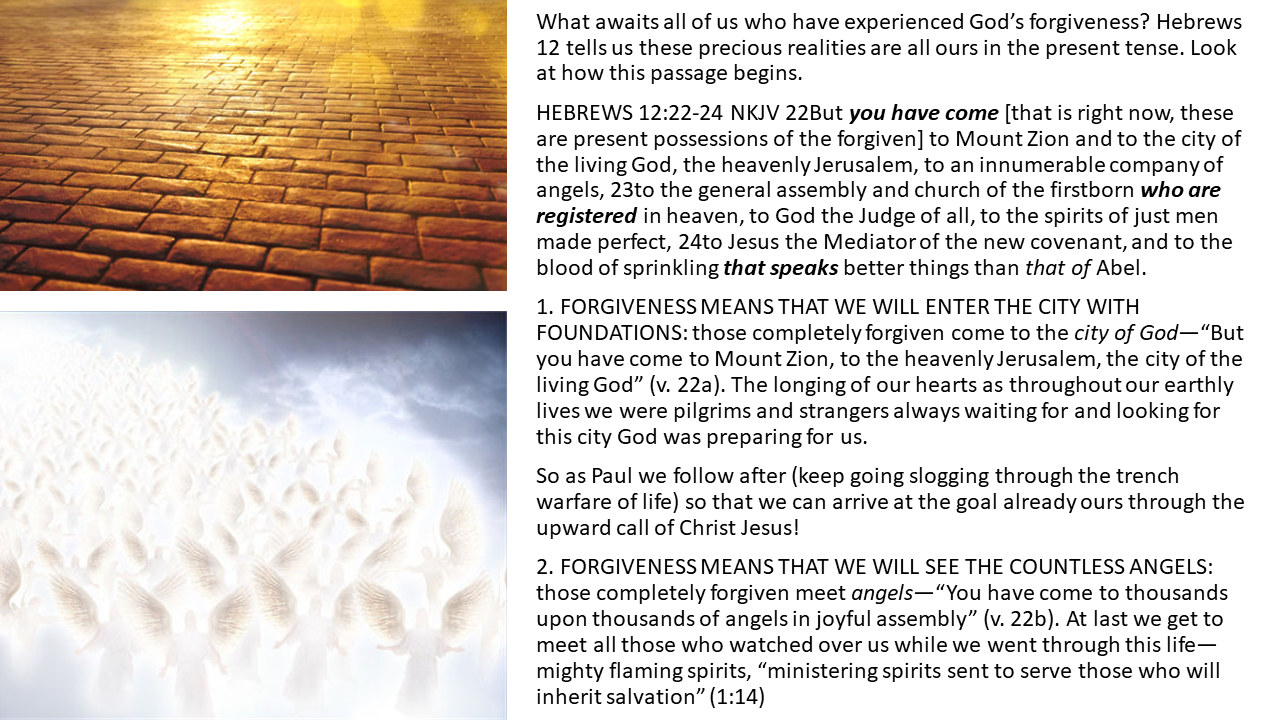
2. FORGIVENESS MEANS THAT WE WILL SEE THE COUNTLESS ANGELS: those completely forgiven meet angels—“You have come to thousands upon thousands of angels in joyful assembly” (v. 22b). At last we get to meet all those who watched over us while we went through this life—mighty flaming spirits, “ministering spirits sent to serve those who will inherit salvation” (1:14).
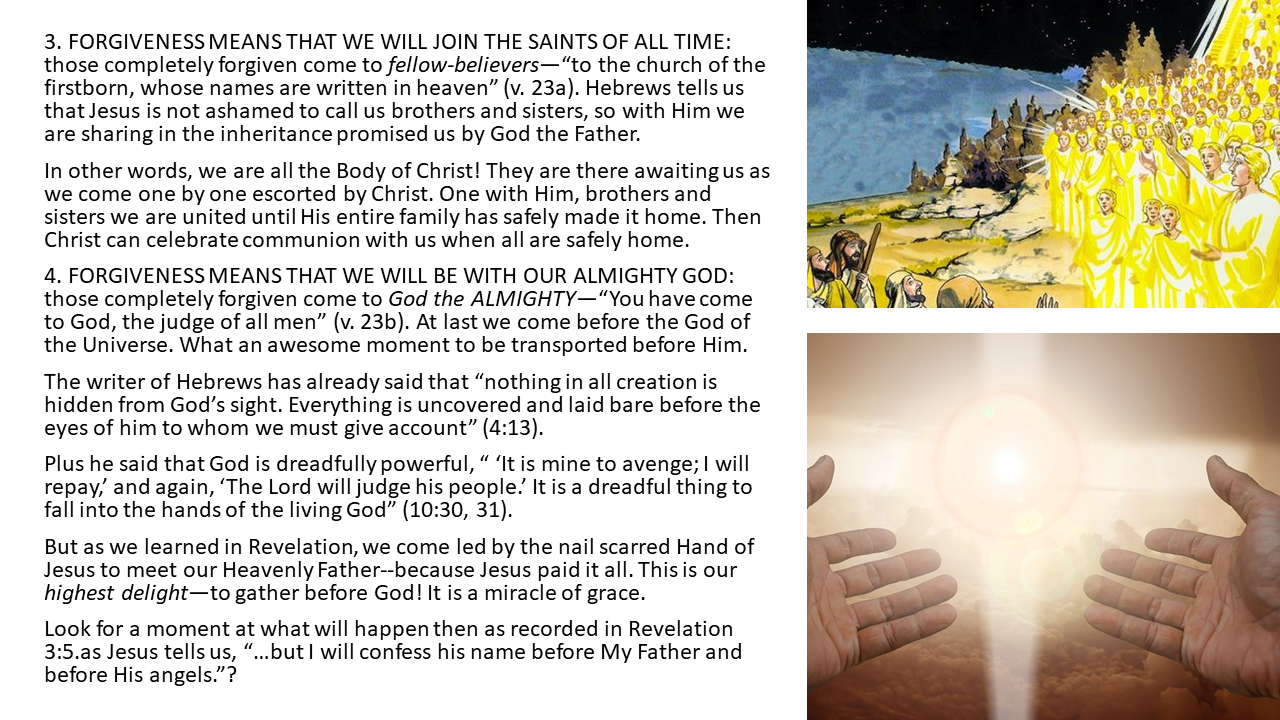
3. FORGIVENESS MEANS THAT WE WILL JOIN THE SAINTS OF ALL TIME: those completely forgiven come to fellow-believers—“to the church of the firstborn, whose names are written in heaven” (v. 23a). Hebrews tells us that Jesus is not ashamed to call us brothers and sisters, so with Him we are sharing in the inheritance promised us by God the Father.
• In other words, we are all the Body of Christ! They are there awaiting us as we come one by one escorted by Christ. One with Him, brothers and sisters we are united until His entire family has safely made it home. Then Christ can celebrate communion with us when all are safely home.
 4. FORGIVENESS MEANS THAT WE WILL BE WITH OUR ALMIGHTY GOD: those completely forgiven come to God the ALMIGHTY—“You have come to God, the judge of all men” (v. 23b). At last we come before the God of the Universe. What an awesome moment to be transported before Him.
• The writer of Hebrews has already said that “nothing in all creation is hidden from God’s sight. Everything is uncovered and laid bare before the eyes of him to whom we must give account” (4:13).
• Plus he said that God is dreadfully powerful, “ ‘It is mine to avenge; I will repay,’ and again, ‘The Lord will judge his people.’ It is a dreadful thing to fall into the hands of the living God” (10:30, 31).
• But as we learned in Revelation, we come led by the nail scarred Hand of Jesus to meet our Heavenly Father–because Jesus paid it all. This is our highest delight—to gather before God! It is a miracle of grace.
• Look for a moment at what will happen then as recorded in Revelation 3:5.as Jesus tells us, “…but I will confess his name before My Father and before His angels.”?
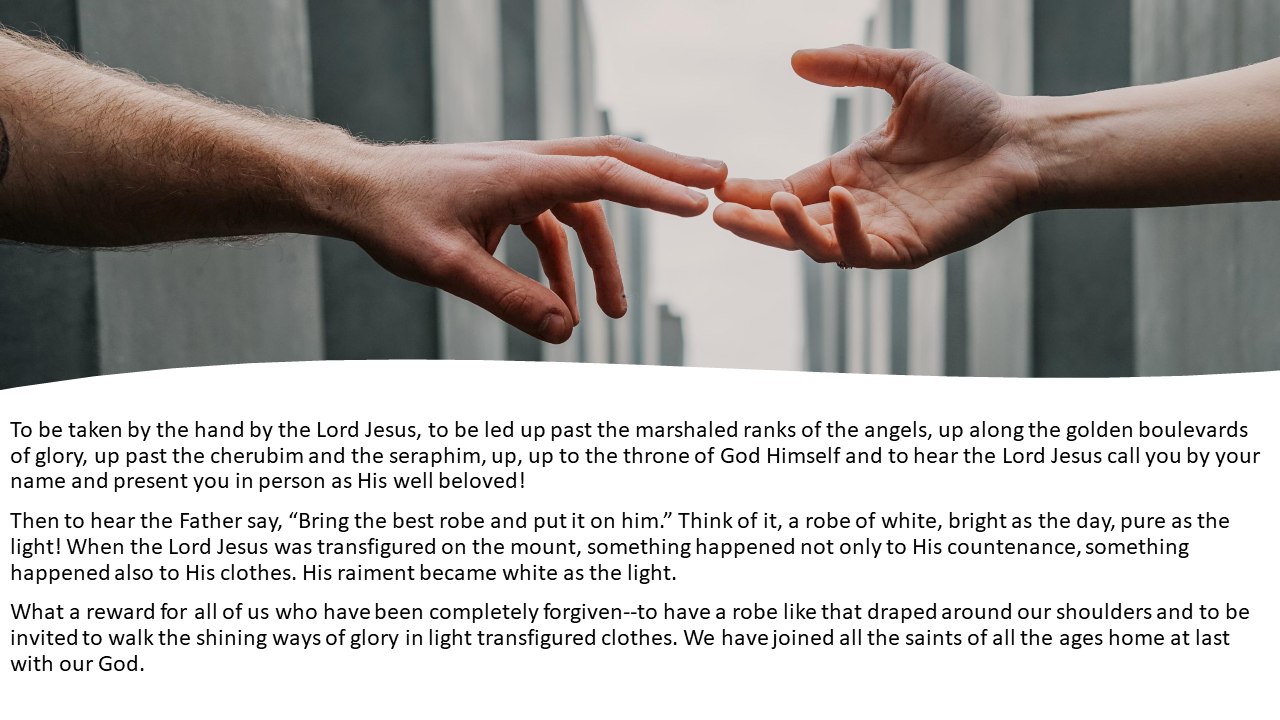
To be taken by the hand by the Lord Jesus, to be led up past the marshaled ranks of the angels, up along the golden boulevards of glory, up past the cherubim and the seraphim, up, up to the throne of God Himself and to hear the Lord Jesus call you by your name and present you in person as His well beloved!
Then to hear the Father say, “Bring the best robe and put it on him.” Think of it, a robe of white, bright as the day, pure as the light! When the Lord Jesus was transfigured on the mount, something happened not only to His countenance, something happened also to His clothes. His raiment became white as the light.
What a reward for all of us who have been completely forgiven–to have a robe like that draped around our shoulders and to be invited to walk the shining ways of glory in light transfigured clothes. We have joined all the saints of all the ages home at last with our God.
FACE TO FACE (#549) Carrie Breck (1855-1934) wrote these words in 1898
1. Face to face with Christ, my Savior, Face to face—what will it be, When with rapture I behold Him, Jesus Christ Who died for me?
2. Only faintly now I see Him, With the darkened veil between, But a blessed day is coming, When His glory shall be seen.
3. What rejoicing in His presence, When are banished grief and pain; When the crooked ways are straightened, And the dark things shall be plain.
4. Face to face—oh, blissful moment! Face to face—to see and know; Face to face with my Redeemer, Jesus Christ Who loves me so.
Chorus: Face to face I shall behold Him, Far beyond the starry sky; Face to face in all His glory, I shall see Him by and by!
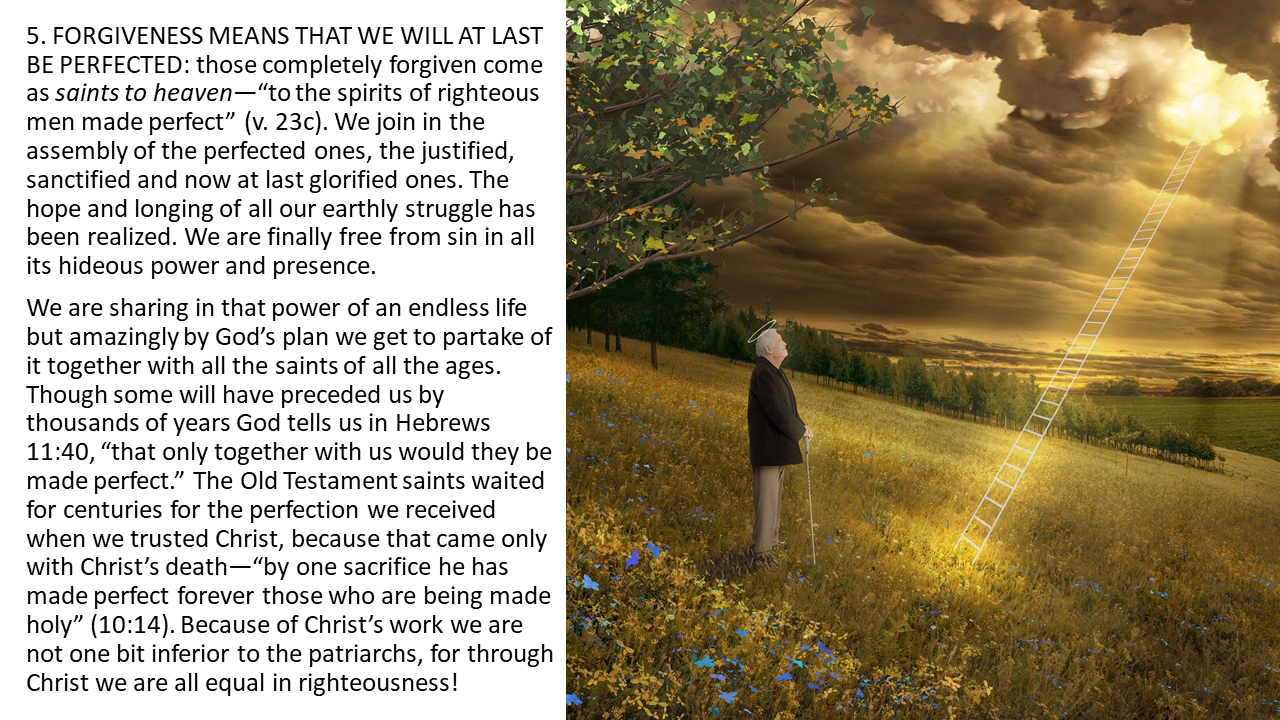
5. FORGIVENESS MEANS THAT WE WILL AT LAST BE PERFECTED: those completely forgiven come as saints to heaven—“to the spirits of righteous men made perfect” (v. 23c). We join in the assembly of the perfected ones, the justified, sanctified and now at last glorified ones. The hope and longing of all our earthly struggle has been realized. We are finally free from sin in all its hideous power and presence.
We are sharing in that power of an endless life but amazingly by God’s plan we get to partake of it together with all the saints of all the ages. Though some will have preceded us by thousands of years God tells us in Hebrews 11:40, “that only together with us would they be made perfect.” The Old Testament saints waited for centuries for the perfection we received when we trusted Christ, because that came only with Christ’s death—“by one sacrifice he has made perfect forever those who are being made holy” (10:14). Because of Christ’s work we are not one whit inferior to the patriarchs, for through Christ we are all equal in righteousness!
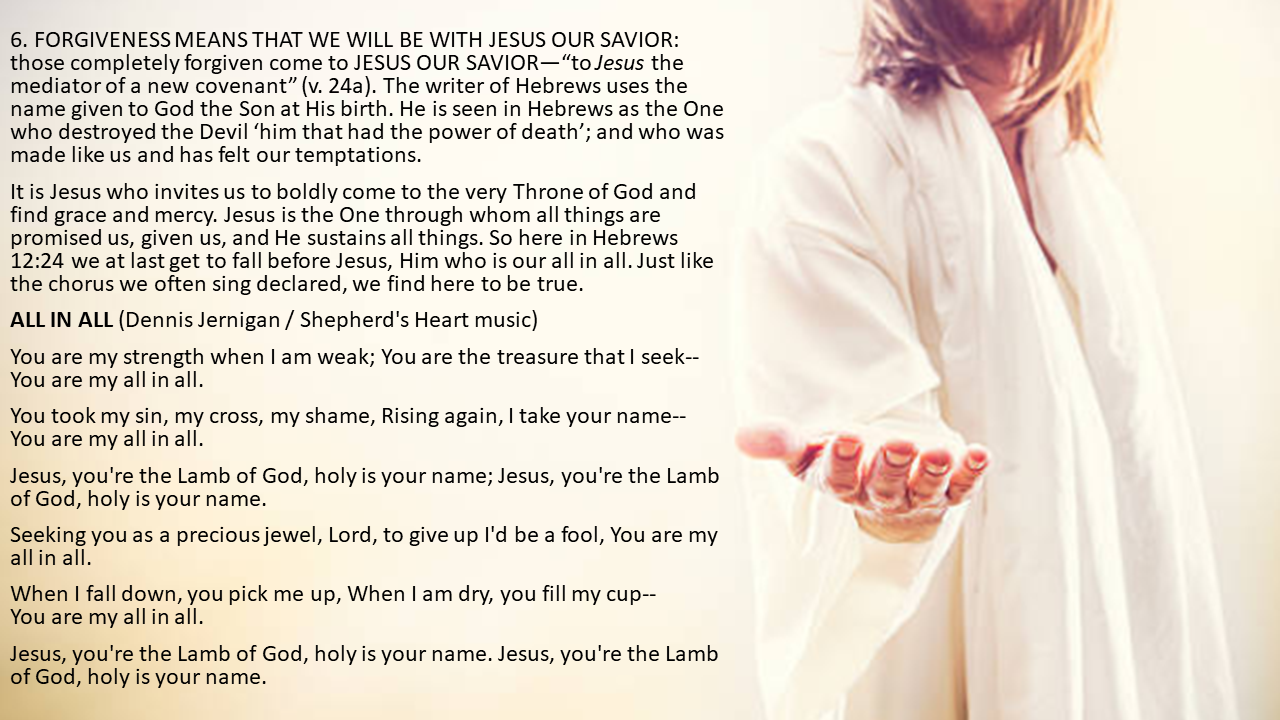
6. FORGIVENESS MEANS THAT WE WILL BE WITH JESUS OUR SAVIOR: those completely forgiven come to JESUS OUR SAVIOR—“to Jesus the mediator of a new covenant” (v. 24a). The writer of Hebrews uses the name given to God the Son at His birth. He is seen in Hebrews as the One who destroyed the Devil ‘him that had the power of death’; and who was made like us and has felt our temptations.
It is Jesus who invites us to boldly come to the very Throne of God and find grace and mercy. Jesus is the One through whom all things are promised us, given us, and He sustains all things.
So here in Hebrews 12:24 we at last get to fall before Jesus, Him who is our all in all. Just like the chorus we often sing declared, we find here to be true.
ALL IN ALL (Dennis Jernigan / Shepherd’s Heart music) You are my strength when I am weak; You are the treasure that I seek–You are my all in all. You took my sin, my cross, my shame, Rising again, I take your name–You are my all in all. Jesus, you’re the Lamb of God, holy is your name; Jesus, you’re the Lamb of God, holy is your name. Seeking you as a precious jewel, Lord, to give up I’d be a fool, You are my all in all. When I fall down, you pick me up, When I am dry, you fill my cup–You are my all in all. Jesus, you’re the Lamb of God, holy is your name. Jesus, you’re the Lamb of God, holy is your name.
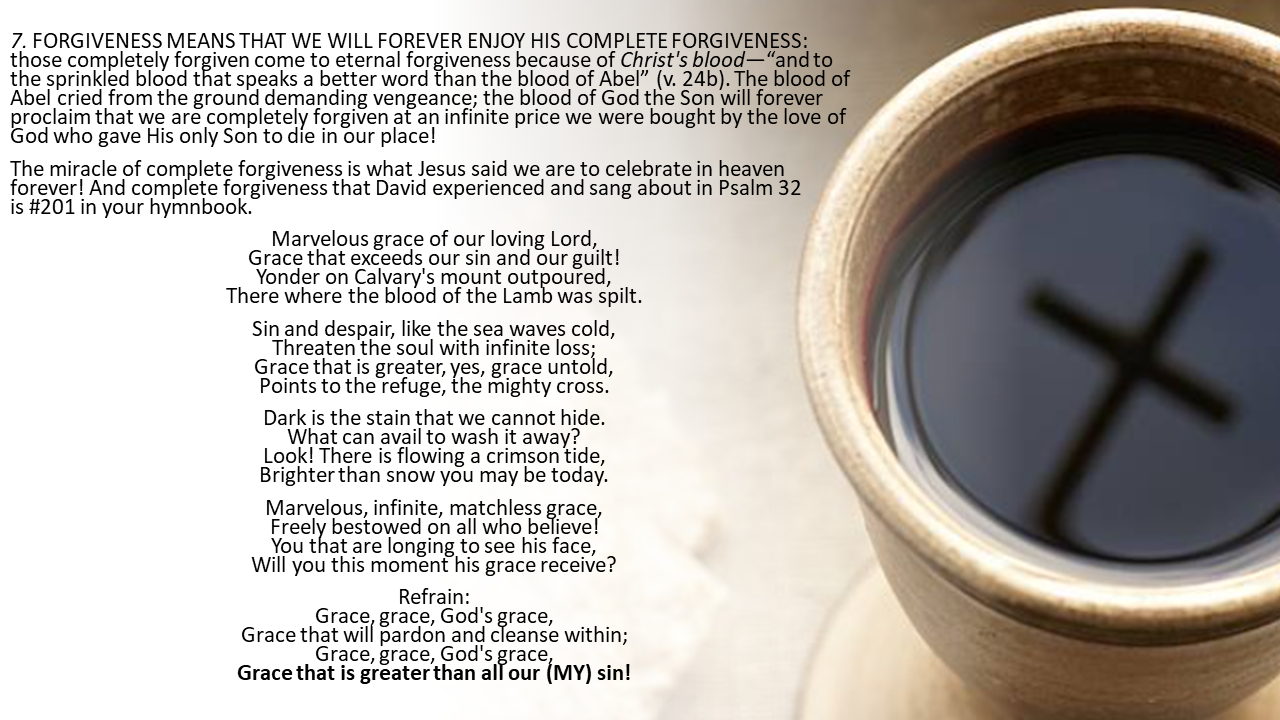
 7. FORGIVENESS MEANS THAT WE WILL FOREVER ENJOY HIS COMPLETE FORGIVENESS: those completely forgiven come to eternal forgiveness because of Christ’s blood—“and to the sprinkled blood that speaks a better word than the blood of Abel” (v. 24b). The blood of Abel cried from the ground demanding vengeance; the blood of God the Son will forever proclaim that we are completely forgiven at an infinite price we were bought by the love of God who gave His only Son to die in our place! The miracle of complete forgiveness is what Jesus said we are to celebrate in heaven forever! And complete forgiveness that David experienced and sang about in Psalm 32 is #201 in your hymnbook.
Marvelous grace of our loving Lord, Grace that exceeds our sin and our guilt! Yonder on Calvary’s mount outpoured, There where the blood of the Lamb was spilt.
Sin and despair, like the sea waves cold, Threaten the soul with infinite loss; Grace that is greater, yes, grace untold, Points to the refuge, the mighty cross. Dark is the stain that we cannot hide. What can avail to wash it away? Look! There is flowing a crimson tide, Brighter than snow you may be today.
Marvelous, infinite, matchless grace, Freely bestowed on all who believe! You that are longing to see his face, Will you this moment his grace receive?
Refrain: Grace, grace, God’s grace, Grace that will pardon and cleanse within; Grace, grace, God’s grace, Grace that is greater than all our (MY) sin!
So God’s Word tells us that those who come to Christ are completely forgiven. The writer of Hebrews says it is now our in Christ “you have come” (right now!) to these seven realities:
• To the City of God,
• To myriads of angels,
• To fellow-believers,
• To our awesome God,
• To at last be glorified,
• To Jesus our Savior,
• To complete forgiveness.
If this does not create a wellspring of thanksgiving in our hearts and make us want to march to Zion, what will?4
1 Maskil means ‘giving of instruction’. The twelve that bear this title are: Psalms 32; 42; 45; 52-55; 74; 78; 88-89; 142.
2 The Penetential Psalms are: Psalms 6; 32; 38; 51; 102; and 130.
3Hughes, R. Kent, Preaching the Word: Ephesians—The Mystery of the Body of Christ, (Wheaton, IL: Crossway Books) 1997.
4 Adapter from Hughes, R. Kent, Preaching the Word: Hebrews Vol 1&2—An Anchor for the Soul, (Westchester, IL: Crossway Books) 1998, c1993. electronic edition, in loc.
Slides
Check Out All The Sermons In The Series
You can find all the sermons and short clips from this series, David’s Spiritual Secret here.
Looking To Study The Bible Like Dr. Barnett?
Dr. Barnett has curated an Amazon page with a large collection of resources he uses in his study of God’s Word. You can check it out here.