
If the video above is not available, here are two other ways to view:
David – And I Shall Be Clean
060813PM
DSS-29
PSALM 51
Transcript
.jpg)
This evening we’re looking at the man who broke all the commandments. And tonight, as we look at David’s life, the man who was after God’s own heart, and turned his back on God, and sinned as greatly as it’s possible to sin on Earth, we see such a marvelous picture of God’s redeeming, and forgiving, and overflowing grace.
.jpg)
When David stood at the other end of Nathan’s bony finger, remember the prophet Nathan in 2 Samuel 12 in one of the most climactic moments of sacred history? Confronts the most powerful, undefeated, potentate monarch of the day, David. As far as we know, he was not even ever wounded in his confrontations with literally hundreds of thousands of soldiers, enemy combatants. But that fearsome man that was known as a lion later on in life, someone said, warning his son Absalom, the counselor Hushai said, your father is like a lion. But that lioness David sat in front of Nathan as Nathan pointed his finger in his face and said, you’re the man, and David knew he was. He knew he was guilty. David knew he had broken every law in the book, God’s book, and in reality, David had broken all ten of the Ten Commandments when he sinned against Bathsheba, but more truly sinned against God.
Some have asked, how had he broken them all? In two ways. First, by his actions, which I’ll share with you. But secondly, by God’s standard. Remember, God has an absolutely perfect standard. He doesn’t lower it a little bit. He doesn’t reconsider, and average, and have a mean score. God has a perfect standard, at that standard, by God’s standard, David broke all of the commandments. But literally he did. The first commandment, if you know from Exodus 20, is thou shalt have no other gods. David allowed his lust to be the god before which he bowed in obedience, so he broke the first commandment. He did have a god. It was his lust of the flesh. Thou shalt not take the name of the LORD thy God in vain, the second commandment, David took the holy name of God in vain as he said he was God’s man and proceeded to live like the devil. Thou shalt not make a graven image. David engraved the image of naked Bathsheba as she bathed so deeply in his lustful soul that he forgot even the God he loved for that moment of sin. Remember the Sabbath day. David didn’t keep the Sabbath day or any other day holy once he allowed sin to rule. Every day was unholy in his life from that time onward. The fifth commandment, honor thy father and mother. David so dishonored them, and not only his parents, all of his family, as he sank into such wicked and premeditated sin. The sixth commandment, thou shalt not kill. David sent the murder request to Joab, so it wasn’t David’s sword but the arrows of his enemies that David used to kill Uriah. But it was David who desired his death, so he did kill him. The seventh commandment is the easiest one to see. Thou shalt not commit adultery. That was the clearest of all David’s law breaking. He clearly committed adultery. The eighth commandment, which he also broke, thou shalt not steal. David stole the wife of his neighbor. David stole the life of his trusted friend, Uriah. And as Nathan clearly pointed out in the story of the ewe lamb, David stole from God what God would’ve provided for him. He took it for himself. The ninth commandment, thou shalt not lie. David’s false response was a lie. When the messenger came with the ghastly news of Uriah’s death, David acted so moved and was so deceitful. And even more, every day that David lived in sin was a lie that he deceptively was covering his sin. And finally, the last of the Ten Commandments, thou shalt not covet. David broke this law as he so coveted his neighbor’s wife that he would steal her and kill her husband in order to lie in sexual sin with her. So literally, David by his actions, broke all ten.
.jpg)
He broke them all, but not just because of that was David a guilty sinner. Not just because he broke all the commandments, but in reality, by God’s standard, because he had broken any, he had broken them all. For just a moment, turn with me to the New Testament book of James. It goes Hebrews, James, 1, 2 Peter, 1, 2, 3 John, Jude, Revelation. So, it’s real close to the end. Just back up about seven books from the very end. And I want to show you what the reality is because we all by God’s standards have become guilty of breaking all of God’s commandments. The very first New Testament letter written by the very first New Testament local church pastor, his name was James, contains this very shattering verse. In fact, I was getting the trip debriefing from my daughter. She came back from New York Go. And she told us sitting on a bench, and it was a very touching story of between two Muslim girls, one a believer that had converted to Christ and the other an unbeliever who had never received Christ. And as she spoke with her, the girl said, do you know anything about the Bible? And Julia said, yes, what do you want to know? And she asked her a question, and Julia brought her to this verse. And it says in James 2:10, for whoever shall keep the whole Law, and yet stumble in one point. In other words, at any part, if you stumble at any part, you can keep the whole Law and have all of your blocks piled up, but if just one gets out of place. Look what it says: he is guilty of all. God’s standard is so high that the good news is that since all have in some point failed and thus all are guilty of all, the good news is that Jesus Christ came to die in the place of guilty sinners, and that’s what David was. Jesus died for all of us who are guilty sinners.
.jpg)
And as we read the rest of this psalm, Psalm 51, we see how David cries out to God. And let’s turn to Psalm 51, where we were this morning. And in Psalm 51, I want to just point out one verse, the seventh verse, because here David, who confesses I’m guilty to God, asks for what only God can give. And the seventh verse recounts that. David asks for the sacrificial death of another to be counted for him. You say, where do you get that? Look at the seventh verse. David says, purge me with hyssop, and I shall be clean. He continues, the second part of verse 7, wash me, and I shall be whiter than snow. This was David asking for the death of another to be applied to him. Hyssop, as you know from the Scriptures, was very much in use in the sacrificial system, and we’ll look at that. But it’s a metaphor. It’s a picture. It’s a symbol. When he said, purge me with hyssop, God does not need that little plant of the Holy Land. He doesn’t need that little piece of the sacrificial system. What David was saying is I need the vicarious, substitutionary death of another in my place for my sins to be dealt with because I’m guilty. I am guilty of all. I have broken them all. I am guilty before You. I need the death of another. We can see through David’s response why Christ’s death for us sinners is so precious and so powerful because we are all guilty. Purge me, David says.
The first aspect of the seventh verse is, as sinners, we’re defiled internally. If you’d have looked at David, you could not have seen other than maybe the strain in his face, maybe his hair had gotten a little lighter from the strain, but you couldn’t see the sin. It wasn’t visible; it was internal. And as a sinner, David was saying, I’m defiled internally. I need God’s purging with hyssop. I don’t need what’s going on in the Tabernacle and later in the Temple. I don’t need a ceremony. I need a supernatural work on me. I need, my soul needs purging. My life needs cleansing. As sinners, we also need cleansing.
The purging with hyssop is another way of saying, sprinkle me with atoning blood. We would say, sprinkle me with Christ’s atoning blood. David looked forward to the cross. It wasn’t fully revealed, although he did say in the twenty-second psalm the wonder of the crucifixion, though perhaps as Peter said, he didn’t know what he was talking about. Remember Peter said that the Old Testament prophets, of which at that moment David joined them in giving the twenty-second psalm, searched for what, or what manner of time, the Spirit of Christ in them signified when He testified beforehand the suffering of Christ. So, as David testified in the twenty-second psalm a thousand years before the cross, as he testified of the details, the intimate details of the crucifixion, he probably didn’t know exactly what he was talking about. But he did know, by the seventh verse of the fifty-first psalm, his prayer of repentance, he did know he needed the sprinkled blood of One who would die in his place. In his mind, it was a lamb, but he knew from Moses that there was a perfect Lamb coming. And so, David was saying, sprinkle me. We add, with Christ’s atoning blood. David was saying, give me the reality which ceremonies only symbolize. Nothing but Christ’s blood can take away my bloodstains. Nothing but Christ’s cleansing can cleanse my sin. It’s what he was saying as he wrote this psalm.
This verse also, the seventh verse, could be read as the voice of faith. Look at it. As David said, purge me with hyssop, he was also acknowledging God could do it. Like the leper we saw last week, when the leper said, I know You’re willing. You can make me clean if You want to, but I know You can. That’s what David was saying, and David was saying that Thou wilt cleanse me and purge me with hyssop, and I shall be clean. He believed, he asked in faith. There’s such power in Christ’s sacrifice. He said, my sin will vanish away, and I’ll get accepted back into the assembly of God’s people, and by God’s gracious response, back into His holy presence. We saw that this morning when he was talking about being clean, and I told you that spoke of the ceremonial cleansing. Remember, if you were unclean, you had to stay outside of the camp for a period of time, or outside of the assembly, or outside of the tabernacle proper. There were all these levels of contamination. And David said, if You purge me, and not the ceremony, if You supernaturally purge me, I’ll be accepted back. I’ll be accepted back before You. I’ll be with Your people. That’s what he was asking for. Wash me, which continues the second half of verse 7, isn’t just wanting for him to be washed ceremonially clean, where they sprinkled water on him. He said, I need a real spiritual purification of my soul, of my spirit, of my deepest parts. He wanted that, as we looked at this morning, that washing that was a complete cleansing, that was a bleaching, that was a beating of the dirt right out. He says, I want every trace of my sin to be taken care of.
He concludes with, in verse 7, and I shall be whiter than snow. Now, that’s a very profound statement. Isaiah said, though your sins be as scarlet, they shall be as snow; though they be red like crimson, they’ll be like wool. But David is more precise here because he says, I need to be whiter than snow. If you know much about snow, you know that snow stays white only for a brief time. Soon, snow will gather dirt and dust, and after that it melts and disappears in a muddy mess. But David said, I want to be whiter than snow. David said, I want You and I take You up on Your offer of an endlessly kept purity. Because God has promised to save us, as the writer of Hebrews put it, to the uttermost. He’s able to save us to the uttermost, because He ever lives to make intercession for us. He’s ever living to cleanse us as we agree with Him about our sin.
Back in the Old Testament, this word hyssop, and if you look at that fourth word of the seventh verse, purge me with hyssop. Never quickly go over words. Because hyssop, if you take the time in your concordance to look up the incidences of this mentioned word, is a very powerful picture. It was used for three purposes. If you summarize all the times hyssop occurs in the Old Testament Scriptures, there’s three basic columns you would find. First of all, when God took the children of Israel out of Egypt, he said that there is one thing you have to do at Passover. Do you remember that? He said, if you want to survive the death angel’s night ride through Egypt, there’s one thing you have to do. You have to select the lamb, bring it into your house, keep it with your family, and then that lamb that has become a friend of your family, you must kill it, slit its throat, collect blood. But that wasn’t sufficient. The mere death was not sufficient. The death, symbolized by the shedding of blood, had to be applied. And it says, continuing in Exodus, after you slay the lamb, you must take its blood in a basin out the front door and use bunches of hyssop to apply the blood to the doorpost and the lintel. Now, those who do Sunday School literature, sometimes it shows the picture of painting each side of the door and painting the top like we’re painting the trim. But those who see Christ in all of the Scriptures see that probably that hyssop was dipped in. And because of the haste of the moment, the blood was taken, and both lintels were hit at the same time to quickly do it and then the top hit. And so literally, if you’d have watched the motion of the father as he was trying to protect his family, you would’ve seen him even 3500 years ago making a beautiful portrait of the cross of Jesus Christ, and that hyssop that was the applicator of the blood portrayed the application of Christ’s blood to shield from God’s wrath. For truly, the Passover was a picture of those who hide beneath the shadow of the atoning blood are passed over by the wrath of God. And so, hyssop portrayed in Exodus the application of Christ’s blood to shield them from God’s wrath.
The second time you’d find hyssop if you’re studying through that word in your concordance, was when God was giving instructions for the cleansing of a leper. If you read that in Leviticus, you find again another incredible use of hyssop but another incredible picture of Jesus Christ. Moses told about taking a live bird and brushing the bird with hyssop dipped in the blood of a slain bird. Brushing the living bird with hyssop, again dipped in blood of the one that was sacrificed. That slain bird that gave its blood and that blood was put on the live bird was allowed, if you remember, after it was put in the little clay pot, to fly away. And I’ve told you many times that’s a picture of Jesus Christ, as He was, from above put into a body like the clay vessel, shed His blood, the hyssop dipped on that live bird. But they didn’t have a means of resurrecting birds back then. That’s why they needed two birds for the ceremony, because one bird gave its life. The other bird flew out of the little clay pot streaked with blood. And that was a picture of Christ’s resurrection and with the power, the living power of His blood. And so, hyssop a second time portrays the death and resurrection of Christ in this cleansing of the leper incident that’s in Leviticus 13 and 14.
But thirdly, the third time if you’re studying hyssop, the third time it’s alluded to is when the children of Israel were in the wilderness march, and one of them sinned. They couldn’t stop and put up the Tabernacle to offer sacrifice, so the provision was made for the purification of sin by killing a red heifer, burning it along with hyssop, gathering the ashes, and taking those ashes along with the children of Israel in their wilderness march. Because remember, it was quite a big thing to set up the Tabernacle with all the silver sockets, and the bases, and the poles, and the screens, and that was just the outer court. And to set up all the inner part, and to get it all uncovered, and get it all functioning and fitted together, and to start the process and sanctify it was very difficult. And so, when a person sinned, the ashes were put in the water. And a third time hyssop was used to sprinkle them—those ashes—on that sinner. And what a tremendous message that also was because hyssop portrayed the reception of Christ’s sacrifice that brought forgiveness. So, in every way, hyssop is tied so closely in the Old Testament with Christ. It portrayed the application of His blood to shield from God’s wrath in the Exodus, it portrayed the death and resurrection of Christ in the cleansing of the leper, and it portrayed the reception of Christ’s sacrifice that brought forgiveness of the sinner who came seeking the deliverance from his sin.
.jpg)
But we really have to go to Calvary to find the ultimate explanation of David’s cry. In fact, if you want to turn to Matthew 27 with me for just a moment. And how I love the way that the Old is the New concealed and the New is the Old revealed, as we see the wonderful correspondence between the Old and New Testament. But in Matthew 27 and verse 46, on the cross, Jesus, God’s Son said, My God, My God, why have You forsaken Me? That’s the real definition of what this purge me with hyssop is all about. We have to ask ourselves as we look at that forty-sixth verse of Matthew’s account from the cross, why did Jesus say that? Why did Jesus say that to God? It’s to draw our attention to something.
God cannot by any means clear the guilty. God just does not erase and start over. That’s what children do. I like to listen, in the background, you can hear family life going on, and I’ve noted from time to time that when the game isn’t going well, like the chess game, and the little buddies are playing that one of them accidentally just shakes the whole thing and ruins it. Let’s just put them back. We’ll start over again because they don’t like the way the game’s going. We like to do that in life. We like to say, ugh, just throw in the cards. Let’s start, deal it over again. I don’t like the way it’s going. God can’t clear the guilty. He can’t just say, it’s okay, start over. He cannot, and He never will.
In verse 46 of Matthew 27, when the Lord Jesus Christ, who knew no sin, was made sin for us on the cross, when He was delivered up for our offenses that He might cause us to be made the righteousness of God in Him, God had to treat Him the way God has to treat sin. You understand? That’s what we’re seeing in verse 46. God was treating Jesus the way God must treat sin, and so as God cannot look upon sin, He wouldn’t look upon Jesus because He had become sin for us. That’s understanding the price. Remember that God spared Abraham’s son, but God did not spare His own Son when he had your sin and my sin upon Him. See, Abraham was allowed not to kill his son. God had to kill His because He truly had your sin and mine on Him. He had to slay Him because God cannot pardon the guilty. We must have that clear in our mind. God hates sin. God will punish sin. God never clears the guilty. God always pays the price for their guilt. That’s the only way it works.
And on the cross, Jesus said. If you want to keep going past that to Luke 23, let me show you another. And if you want a wonderful study, look at Christ’s seven statements from the cross. Some years back we went through those and looked at each one of them. But in Luke 23 and verse 34, we see another one of Christ’s words from the cross. And on the cross, Jesus also said in Luke 23 verse 34, Father, forgive them. That’s a very amazing message of Jesus Christ in these words from the cross as He said, Father, forgive them for they don’t know what they do. They say, Lord God, forget it. They didn’t know what they were doing. That wasn’t what He was saying. Jesus was asking for God to extend mercy.
But how can God forgive those at the foot of the cross? How can God extend mercy to thousands as it says in Exodus? Having mercy on thousands of those that God is merciful toward. How can He do that? That is a great, great study. How can God forgive iniquity? As we saw this morning, the warped twisting of His image even in those who belong to Him. How can He forgive that post-salvation iniquity as David committed? That is the lesson of salvation because the way God forgave David and the way He forgave you and me is very clear, and you can’t understand Luke 23:34 without understanding the defining element of forgiveness, and that’s in Ephesians 1.
So, keep going to the right and look at verse 7 with me because God always answers our questions about His wonderful work that He has revealed to us. In Ephesians 1:7, we find the answer to the question of how can God forgive? How can He extend mercy? How can He forgive iniquity? How can He forgive David after He broke them all? How can God forgive you and me, even though we have broken maybe less in His sight by His standard, we also have broken all? And the answer is so clear in Ephesians 1:7. Paul said this, in Him—that is in Christ, who God would not look at on the cross; in Christ, who was so forgiving on the cross; in Christ, who became sin on the cross, in Him—in Christ we have redemption—one and only one way—through His blood. And He amplifies it, and He says, the forgiveness of sins according to the riches of His grace.
Now, whenever you find forgiveness in the New Testament, you and I must always remember that Christ’s blood is responsible for that. There is no forgiveness without bloodshed. There is no freedom from guilt without the guilty penalty paid by someone else. Blood is always involved. God never forgives sin apart from the death of Jesus Christ. Never. There isn’t any way He did it in this dispensation a different way, He did it in that dispensation, or some people didn’t know this or that. God never forgives sin apart from blood and not the blood of animals. Only the blood of the perfect sacrifice, the spotless One, Jesus Christ. God is not forgiving sin because He’s big-hearted, because He is an old man sitting on a cloud. He forgives sin because Jesus Christ, His Son, completely paid the penalty for that sin, and that’s the only reason that He forgives. And that’s why now Jesus with open arms can say, I extend My mercy to you. And that’s why David could say, God, be merciful to me according to Your abundant mercy. Blot out, erase. Remember? Wipe them out, the list of my sins. Cleanse away the depth of my sin. Clean me so I don’t contaminate other people. All those are in Psalm 51, but David could ask for that, and God could do that because Jesus with open arms says, I have taken your place. I have become sin. I, through the shedding of My blood, perfectly satisfied God’s wrath against sin.
.jpg)
And let’s go back to Psalm 51 and verse 7. So, when David prays this prayer which we see him so eloquently praying in Psalm 51:7, and when he says, purge me with hyssop, he is actually crying out to God and saying, apply Christ’s sacrificial death on me. Though he knew not Christ’s name, he knew His promise coming. Though he knew not the exact fullness of what He would do, he was asking in advance for the perfect sacrifice that we know is once and for all complete. And David, as he looked forward, so we, as we look back, was saying, apply Christ’s blood to me. Purge me on the inside. Take away my stain. Take away the warped, contaminated internal filth, much like the publican of Luke 18. David was saying, God be merciful to me, like the thief on the cross who said, remember me. Because when David finished breaking all the commandments, just like all of us have, he was totally guilty before a holy God. And as James tells us, whoever shall keep the whole Law and yet stumble in one point is guilty of all, so David in God’s sight was a debtor who owed an impossible debt. His sins had run up against God. David was a guilty convict. He was legally convicted of having broken God’s Law. And since adulterers were supposed to be stoned, David was dead, as far as God was concerned, in his sin. So, David saw himself in Psalm 51 as God saw him: a guilty convicted sinner. And that’s why David, the man who broke all the commandments, found complete forgiveness. It was not because he says, I’ll let You just forgive this one, because God says, if I can’t forgive them all, I won’t forgive any of them. David said, I’m guilty. Forgive them all. I’m guilty of all. So, we are guilty of breaking all of God’s Law.
.jpg)
And the good news of the Gospel is exactly this truth, that Christ died for sinners. He died in the place of guilty sinners, and all who receive His gift through His Son will confess that God the Innocent died for me the guilty, and God the Offended died for me the offender, and God the Holy One died for me the sinful one, and God the Just died for me the unjust, and God the Perfect died for me the imperfect. That’s the message of the cross, and the message of salvation is that we also desperately need it. And those who realize that they are absolutely in God’s sight, truly, desperately lost, realize that we, like David, are guilty of breaking them all. When we see ourselves as worse than we think, rather than better, when we see Christ’s death as only for the guilty, only for the hopelessly stained, only for the helplessly lost. It is in that condition that we, like David, find what he said. Purge me, verse 7 with hyssop, and I’ll be clean; wash me, and I’ll be whiter than snow. And then verse 8, then I’ll hear joy and gladness, and the bones that You have broken will rejoice. And verse 9, You will hide Your face from my sins, and You will blot out all my iniquities.
I’ll summarize what David found. He found that because of his sin, he was a debtor, and Christ died to take the hopeless debt that we owe to God. And that’s the essence of what Paul teaches in Romans 8. He says, there’s no condemnation. Those who are condemned are condemned no more. And that’s why David so eloquently is saying in Psalm 32, blessed is he whose transgression is forgiven, whose sin is covered. Blessed is the man whom the LORD does not impute iniquity. Because of our sin, like David, we’re debtors, and God says, I completely remove your debt.
What should a fitting response to that be? I think of this, I think of the next time that you and I become painfully aware of our sin, we need to realize that the only way that sin we’re painfully aware of can be removed is not by us making some decision we don’t want to do it anymore, or us making some decision we want to try harder. But by us realizing that the guiltless One took the guilt for my sin, that the One who was perfect took my imperfection on Him, that Jesus Christ has to pay for that sin for me to be forgiven. And then after we think that, as my wife so clearly told me this week, she said, I heard you say last week, we’re supposed to preach the Gospel to ourselves. I said, yes. We have to remember that by one sacrifice in the past forever, Jesus Christ has forgiven and reconciled all of us who come to Him. He already paid it all. He’s already made the payment that David looked forward to, and so we can say, I know You can purge me with hyssop, with Your blood. I know that You can make me whiter than snow because when snow gets dirty, there’s no recourse. But God says, when you get dirty, I will keep on cleansing you, and I will save you to the uttermost.
.jpg)
I want to read, and then I’ll pray, these Civil War words, one of my favorite hymns. It’s not in our hymn book, so you can be saved a little trip to the hymn book. Too bad! It was a loss for the hymn book. They should have put this in, but I’ll read it to you. It was written in 1863 at the height of the Civil War, and it’s an incredible worship song that captures what the Lord does when He removes our sins and what an effect that should have on us. The effect should be that if you truly believe the Gospel, that even when we sin, where sin abounds, what? Grace much more abounds. And we see the effect of the sacrifice of Christ. And this is how the hymnwriter puts it: before the throne of God above I have a strong, a perfect plea: a great High Priest—Hebrews 7:24 and 25—whose name is Love, who ever lives and pleads for me. My name is graven on His hands—the same ones that have the nail prints—my name is written on His heart—the same one that was pierced through. I know that while in Heaven He stands no tongue—even the deceiver, the devil, the accuser—can bid me thence depart.
When Satan tempts me to despair, he tells me of my guilt within, upward I look—and say, I am guilty—and see Him there, who made an end of all my sin. The best part of the Gospel is that when Jesus died 2000 years ago, He saw all of my sins, to the very end of my life and all of yours, and He, by one sacrifice forever paid for them all. He made an end of all my sin. Because the sinless Savior died, my sinful soul is counted free, for God the just is satisfied. He doesn’t overlook it. He doesn’t forget it. He has it paid for, and then He removes it as far as the east is from the west, truly forgetting it instead of overlooking it. To look on Him—Christ—and pardon me.
Behold Him there, the risen Lamb, my perfect, spotless righteousness, the great unchangeable I Am, the King of glory and grace. One in Himself I cannot die; my soul is purchased by His blood. My life is hid with Christ on high, with Christ, my Savior and my God. Purge me with hyssop, David said, and I’ll be clean.
.jpg)
Let’s bow before our Lord. In fact, let’s stand together and bow before Him and thank Him for our great salvation. Lord, we thank You for the fifty-first psalm, which opens with David saying, I’m guilty, and closes with David saying that You have accomplished everything I need to be purged, to be cleansed, for my sins to be wiped out, for my innermost being to be so thoroughly cleansed that I can have Your righteousness, and You can bring me joy and gladness. I pray that we would experience that same joy this week as we go through life. And as Jesus, as You told Your disciples, although we’re totally clean, we still need our feet washed. And I pray that we would take those short accounts and keep clean and don’t grieve You, O Spirit of God, and preach the Gospel to ourselves that our name is written on Your hands and on Your heart, and You ever live to make intercession for us because by one sacrifice forever, Jesus, You paid it all. And I pray that we would triumphantly receive Your cleansing and in the power of your Spirit look upon You, O Christ, and please You more each day and be conformed more to Your image as we remember that the One who broke them all found complete forgiveness, and so can we. In the precious, forgiving name of Jesus, we pray, and all God’s people said, amen. God bless you as you go.
Notes
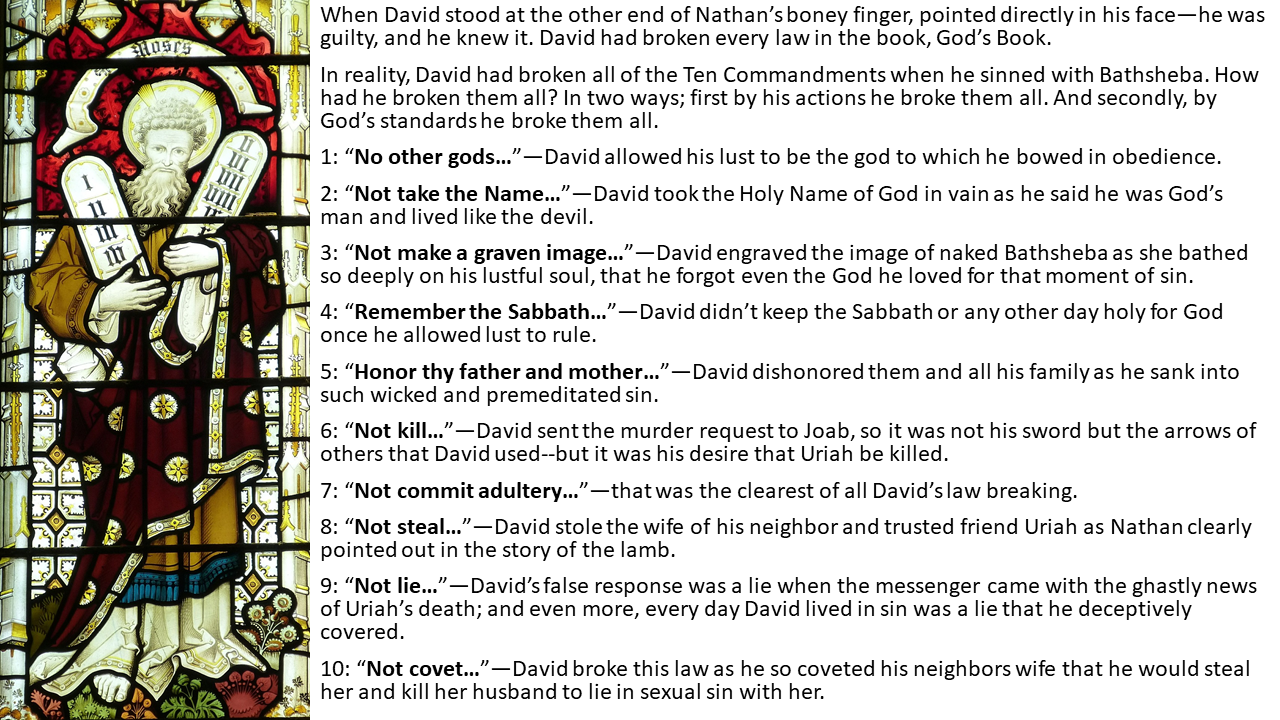
 When David stood at the other end of Nathan’s boney finger, pointed directly in his face—he was guilty, and he knew it. David had broken every law in the book, God’s Book.
DAVID BROKE ALL TEN
In reality, David had broken all of the Ten Commandments when he sinned with Bathsheba. How had he broken them all? In two ways; first by his actions he broke them all. And secondly, by God’s standards he broke them all.
1: “No other gods…”—David allowed his lust to be the god to which he bowed in obedience.
2: “Not take the Name…”—David took the Holy Name of God in vain as he said he was God’s man and lived like the devil.
3: “Not make a graven image…”—David engraved the image of naked Bathsheba as she bathed so deeply on his lustful soul, that he forgot even the God he loved for that moment of sin.
4: “Remember the Sabbath…”—David didn’t keep the Sabbath or any other day holy for God once he allowed lust to rule.
5: “Honor thy father and mother…”—David dishonored them and all his family as he sank into such wicked and premeditated sin.
6: “Not kill…”—David sent the murder request to Joab, so it was not his sword but the arrows of others that David used–but it was his desire that Uriah be killed.
7: “Not commit adultery…”—that was the clearest of all David’s law breaking.
8: “Not steal…”—David stole the wife of his neighbor and trusted friend Uriah as Nathan clearly pointed out in the story of the lamb.
9: “Not lie…”—David’s false response was a lie when the messenger came with the ghastly news of Uriah’s death; and even more, every day David lived in sin was a lie that he deceptively covered.
10: “Not covet…”—David broke this law as he so coveted his neighbors wife that he would steal her and kill her husband to lie in sexual sin with her.
SO HAVE WE
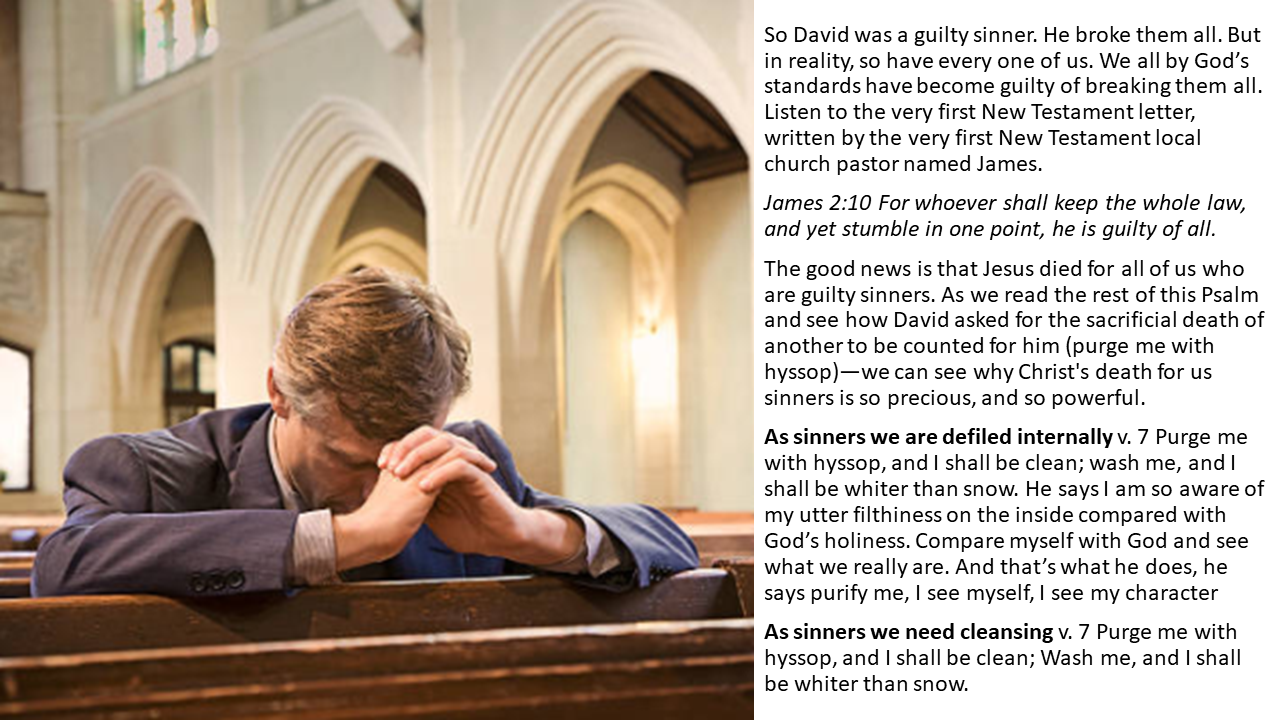
So David was a guilty sinner. He broke them all. But in reality, so have every one of us. We all by God’s standards have become guilty of breaking them all. Listen to the very first New Testament letter, written by the very first New Testament local church pastor named James.
James 2:10 For whoever shall keep the whole law, and yet stumble in one point, he is guilty of all.
The good news is that Jesus died for all of us who are guilty sinners. As we read the rest of this Psalm and see how David asked for the sacrificial death of another to be counted for him (purge me with hyssop)—we can see why Christ’s death for us sinners is so precious, and so powerful.
PURGE ME
As sinners we are defiled internally v. 7 Purge me with hyssop, and I shall be clean; wash me, and I shall be whiter than snow.
He says I am so aware of my utter filthiness on the inside compared with God’s holiness. Compare myself with God and see what we really are. And that’s what he does, he says purify me, I see myself, I see my character-
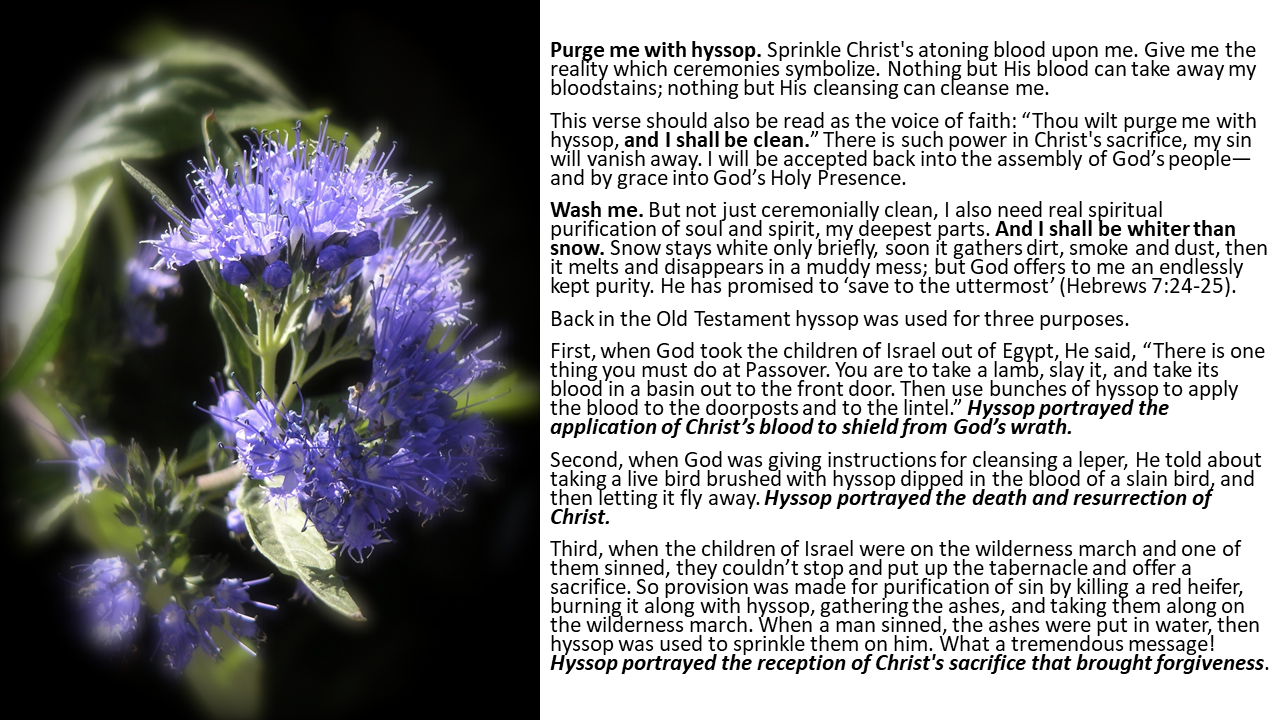
o As sinners we need cleansing v. 7 Purge me with hyssop, and I shall be clean; Wash me, and I shall be whiter than snow. Purge me with hyssop. Sprinkle Christ’s atoning blood upon me. Give me the reality which ceremonies symbolize. Nothing but His blood can take away my bloodstains; nothing but His cleansing can cleanse me.
This verse should also be read as the voice of faith: “Thou wilt purge me with hyssop, and I shall be clean.” There is such power in Christ’s sacrifice, my sin will vanish away. I will be accepted back into the assembly of God’s people—and by grace into God’s Holy Presence.
Wash me. But not just ceremonially clean, I also need real spiritual purification of soul and spirit, my deepest parts. And I shall be whiter than snow. Snow stays white only briefly, soon it gathers dirt, smoke and dust, then it melts and disappears in a muddy mess; but God offers to me an endlessly kept purity. He has promised to ‘save to the uttermost’ (Hebrews 7:24-25).
 Back in the Old Testament hyssop was used for three purposes
First, when God took the children of Israel out of Egypt, He said, “There is one thing you must do at Passover. You are to take a lamb, slay it, and take its blood in a basin out to the front door. Then use bunches of hyssop to apply the blood to the doorposts and to the lintel.” Hyssop portrayed the application of Christ’s blood to shield from God’s wrath.
Second, when God was giving instructions for cleansing a leper, He told about taking a live bird brushed with hyssop dipped in the blood of a slain bird, and then letting it fly away. Hyssop portrayed the death and resurrection of Christ.
Third, when the children of Israel were on the wilderness march and one of them sinned, they couldn’t stop and put up the tabernacle and offer a sacrifice. So provision was made for purification of sin by killing a red heifer, burning it along with hyssop, gathering the ashes, and taking them along on the wilderness march. When a man sinned, the ashes were put in water, then hyssop was used to sprinkle them on him. What a tremendous message! Hyssop portrayed the reception of Christ’s sacrifice that brought forgiveness.
You have to go to Calvary to find the explanation of David’s cry to ‘purge me with hyssop’.
On the cross the Son of God said, “My God, My God, why have You forsaken Me?” (Matthew 27:46). Why did He say that? Because God cannot by any means clear the guilty. He cannot. He never will. And when the Lord Jesus Christ, who knew no sin, was made sin for us on the cross—when He was delivered for our offenses that we might be made the righteousness of God in Him—God had to treat Him as He must treat sin.
Remember that God spared Abraham’s son, but God did not spare His own Son when He had my sin and your sin upon Him. He had to slay Him, because God cannot pardon the guilty. Let’s be clear on that. God hates sin and He will punish sin. By no means will He clear the guilty.
On the cross Jesus also said, “Father, forgive them” (Luke 23:34). How can He forgive them? How can He extend mercy to thousands? How can He forgive iniquity? How can He forgive David? And how can He forgive you and me? The Bible is clear on this: “In Him we have redemption through His blood, the forgiveness of sins, according to the riches of His grace” (Ephesians 1:7).
And every time you find forgiveness in the New Testament, the blood of Christ is responsible. God never forgives sin apart from the death of Christ. Never. God is not forgiving sin because He is a big-hearted old man sitting on a cloud. He forgives sin because His Son paid the penalty.
And now, with open arms, He can say to you, “I can extend mercy to you because My Son died in your place.” Oh, David knew the way into the heart of God1.
So when David said, “Purge me with hyssop,” he was crying out to God—apply Christ’s sacrificial death on me. Much like the publican of Luke 18, David was saying ‘God be merciful to me” and like the thief on the Cross ‘remember me’.
When David finished breaking all the commands (just like we all have) he was totally guilty before a Holy God (just like we all are). The Scriptures tell us that who ever breaks even one law of God—is guilty of all. (James 2:10)
James 2:10 For whoever shall keep the whole law, and yet stumble in one point, he is guilty of all.
- So David in God’s sight was a debtor owing an impossible debt his sins had run up against God.
- David was a guilty convict, he was legally convicted as having broken God’s law.
- Since adulterers were supposed to be stoned, David was dead as far as God was concerned in his sin.
David saw himself in Psalm 51 as God saw him—a guilty, convicted sinner. And that is why David, the man who broke all the commandments–found complete forgiveness.
We are also guilty and convicted sinners. We also have stumbled in at least one point— so we all are guilty of breaking all of God’s Law.
The good news of the Gospel is exactly this truth—Christ died for sinners. He died in the place of guilty sinners. And all who receive His gift, through His Son will confess that–
God the innocent died for me the guilty. God the offended died for me to offender. God the Holy died for me the sinful. God the Just died for me the unjust. God the perfect died for me the imperfect.
DO YOU KNOW YOUR CRITICAL NEED?
Like David, we need to see ourselves as God saw us. We like David are guilty of breaking them all. We should see ourselves as worst than we think, rather than better. Because Christ’s death is only for the guilty, only for the hopelessly stained, and only for the helplessly lost. It is in that condition—like David’s, that we find God’s grace.
All sinners (so that means all humans that have ever lived on planet earth except Jesus Christ) have seven basic Biblically described needs. Briefly summed up, a lost sinner needs forgiveness, justification, regeneration, reconciliation, adoption, redemption, and sanctification.
 FORGIVENESS—CRITICAL NEED #1
1. Because of our sin, like David–we are all debtors; so we need forgiveness.
So Christ died to take the hopeless debt we owe to God and pay with His own life our eternal death sin has caused us to be responsible to pay–that’s forgiveness. A Sinner stands before God as a debtor and that debt is forgotten by His payment.
Psalm 32:1-2 Blessed is he whose transgression is forgiven, Whose sin is covered. 2 Blessed is the man to whom the Lord does not impute iniquity, And in whose spirit there is no deceit. NKJV
Ephesians 1:7 In Him we have redemption through His blood, the forgiveness of sins, according to the riches of His grace NKJV
Romans 8:1 There is therefore now no condemnation to those who are in Christ Jesus, who do not walk according to the flesh, but according to the Spirit. NKJV
Have you like David, experienced the relief of knowing that all your sins, everyone of them—past, present, and future, are GONE? Your sins are paid for, and your eternal life is purchased—and you have the receipt in your hand, written in the very blood of the One who paid the price. Christ’s record of that payment is forever settled in this book the Bible!
JUSTIFICATION—CRITICAL NEED #2
2. Because of our sin, like David–we are all guilty convicts in God’s sight; so we need justification.
So Christ died to take guilty convicts and destroy any record that that ever committed a crime and takes their place in the punishment—that’s justification! A Sinner stands before God as accused and is declared righteous by His imputed righteousness.
Psalm 51:3-4 For I acknowledge my transgressions, And my sin is always before me. 4 Against You, You only, have I sinned, And done this evil in Your sight—That You may be found just when You speak, And blameless when You judge. NKJV
Isaiah 53:6 All we like sheep have gone astray; We have turned, every one, to his own way; And the Lord has laid on Him the iniquity of us all. NKJV
Romans 5:1 Therefore, having been justified by faith, we have peace with God through our Lord Jesus Christ, NKJV
Have you like David, experienced the peace of justification, all guilt removed, all punishment forever taken away from God’s sight?
REGENERATION—CRITICAL NEED #3
3. Because of our sin, like David–we are all dead in our trespasses and sin; so we need regeneration.
So Christ died to take dead and rotting spiritual corpses and make them vibrant, full of endless life and brand new—that’s regeneration!
Ephesians 2:1 And you He made alive, who were dead in trespasses and sins, NKJV
John 10:10 The thief does not come except to steal, and to kill, and to destroy. I have come that they may have life, and that they may have it more abundantly. NKJV
Hebrews 7:16b …but according to the power of an endless life. NKJV;
Have you like David, experienced the power of an endless life, and every day partaking of the powerful presence within of the very Lord God Almighty?
RECONCILIATION—CRITICAL NEED #4
4. Because of our sin, like David–we are all enemies of God; so we need reconciliation.
So Christ died to take enemies and make them friends—that’s reconciliation! A Sinner stands before God as an enemy and is made a friend by His peace.
Romans 8:7 Because the carnal mind is enmity against God; for it is not subject to the law of God, nor indeed can be. NKJV
Romans 5:10 For if when we were enemies we were reconciled to God through the death of His Son, much more, having been reconciled, we shall be saved by His life. NKJV; John 15:14 You are My friends if you do whatever I command you. NKJV
Have you like David, experienced the wonder of friendship with God?
ADOPTION—CRITICAL NEED #5
5. Because of our sin, like David–we are all strangers to God; so we need adoption.
So Christ died to take strangers and make them part of the family—that’s adoption! A Sinner stands before God as a stranger and is called a Son by His choice.
Ephesians 2:12 remember that you were at that time separate from Christ, excluded from the commonwealth of Israel, and strangers to the covenants of promise, having no hope and without God in the world. NASB
Galatians 4:4-6 But when the fullness of the time had come, God sent forth His Son, born of a woman, born under the law, 5 to redeem those who were under the law, that we might receive the adoption as sons. 6 And because you are sons, God has sent forth the Spirit of His Son into your hearts, crying out, “Abba, Father!” NKJV
Have you like David, experienced the joy of being adopted into Christ’s family?
 REDEMPTION—CRITICAL NEED #6
6. Because of our sin, like David–we are all slaves to unrighteousness; so we need redemption.
So Christ died to take slaves and make them freed forever—that’s redemption! A Sinner stands before God as a slave and is granted freedom by His ransom.
John 8:34 Jesus answered them, “Truly, truly, I say to you, everyone who commits sin is the slave of sin. NASB
John 8:36 Therefore if the Son makes you free, you shall be free indeed. NKJV
Have you like David, experienced the thrill of being liberated, set free, rescued by God forever?
SANCTIFICATION—CRITICAL NEED #7
7. Because of our sin, like David–we are all defiled; so we need sanctification.
So Christ died to take our soiled and spotted lives that always get wasted and make them clean, focused and fruitful—that’s sanctification! Just before we read Romans 6:13b, may I again remind you of the two sides of the coin of salvation. To best understand what God has done, let me contrast and explain justification and sanctification. Because we are saved (justified) this is how we should live (sanctified).
- Justification is what Christ did for me on the cross–sanctification is what Christ is doing in me because of the cross.
- Justification is immediate and was completely finished in me the instant I was saved—sanctification is an ongoing process never completed on earth until I meet Jesus face to face at death or His coming.
- Justification is activated the moment I trust in the Person of Christ Jesus and His finished sacrifice of the cross—sanctification grows with each obedient choice I make empowered by the Holy Spirit.
- Justification is my position declared right in God’s sight—sanctification is my practice made right by becoming more conformed to His image.
Romans 6:13b …but present yourselves to God as being alive from the dead, and your members as instruments of righteousness to God. NKJV
Romans 12:1-2 I beseech you therefore, brethren, by the mercies of God, that you present your bodies a living sacrifice, holy, acceptable to God, which is your reasonable service. 2 And do not be conformed to this world, but be transformed by the renewing of your mind, that you may prove what is that good and acceptable and perfect will of God. NKJV
1 Corinthians 6:19-20 Or do you not know that your body is the temple of the Holy Spirit who is in you, whom you have from God, and you are not your own? 20 For you were bought at a price; therefore glorify God in your body and in your spirit, which are God’s. NKJV
1 Thessalonians 5:23 Now may the God of peace Himself sanctify you completely; and may your whole spirit, soul, and body be preserved blameless at the coming of our Lord Jesus Christ. NKJV
Have you like David, experienced the stability of coming under new management? Do you know the thrill of looking at your life and sensing His control? Do you see your hands as extensions of His? Your voice as a channel for Him to speak? Your days as no longer belonging to you but to be lived unto Him who loved you and gave Himself for you?
So that is what David asked and received in Psalm 51. Mercy and grace from the Cross. Christ died to save sinners from their sins and to rescue them from death, destruction, despair and doom.
I am guilty; I have sinned against You alone.
Purge me by the cleansing power of Christ’s death—who gave Himself for me!
An incredible worship song that captures what the Lord does when He removed our sins was written during the Civil War years here in America by Charitie Bancroft. This great hymn has been set to new music and has seen a revival in recent days.
The message is so powerful to all of us who like David have had our sins “pulled off” by Christ’s work on the cross for us.
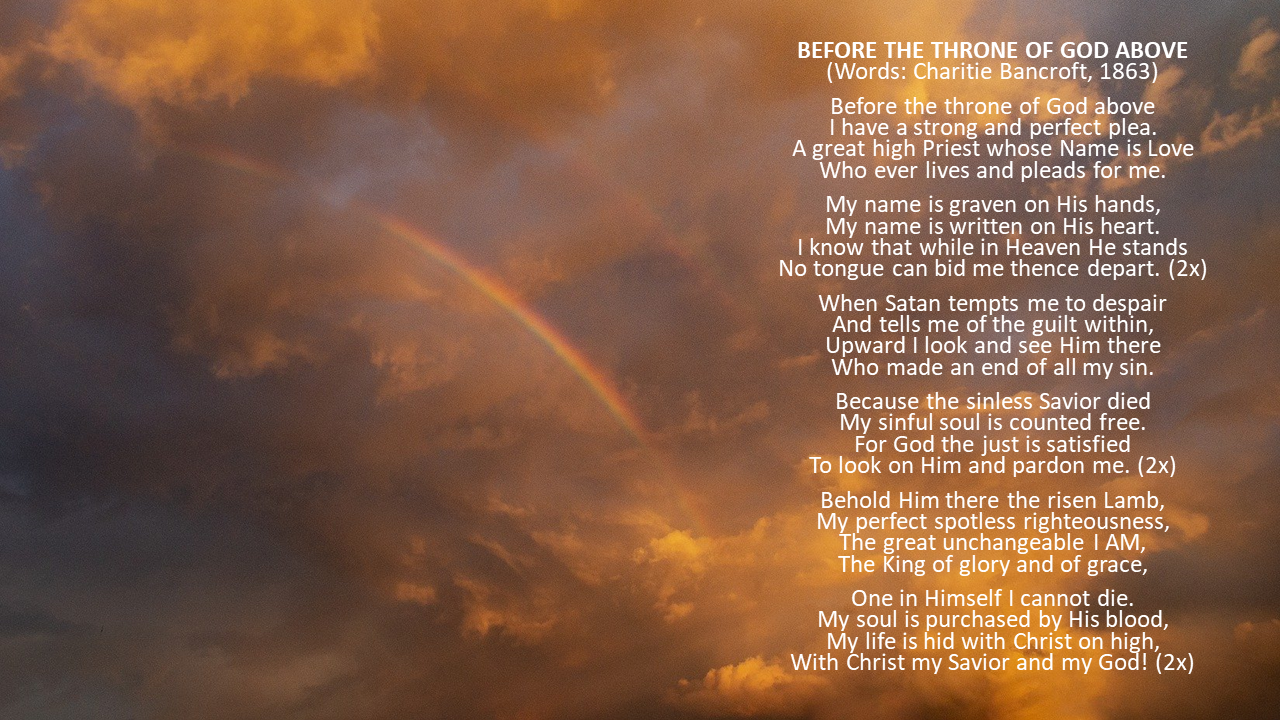
 BEFORE THE THRONE OF GOD ABOVE (Words: Charitie Bancroft, 1863)
Before the throne of God above I have a strong and perfect plea. A great high Priest whose Name is Love Who ever lives and pleads for me.
My name is graven on His hands, My name is written on His heart. I know that while in Heaven He stands No tongue can bid me thence depart. (2x)
When Satan tempts me to despair And tells me of the guilt within, Upward I look and see Him there Who made an end of all my sin.
Because the sinless Savior died My sinful soul is counted free. For God the just is satisfied To look on Him and pardon me. (2x)
Behold Him there the risen Lamb, My perfect spotless righteousness, The great unchangeable I AM, The King of glory and of grace,
One in Himself I cannot die. My soul is purchased by His blood, My life is hid with Christ on high, With Christ my Savior and my God! (2x)
1 McGee, J. Vernon, David: A Man After God’s Own Heart, (Nashville, TN: Thomas Nelson Inc.) 2001, c2000.
Slides

Check Out All The Sermons In The Series
You can find all the sermons and short clips from this series, David’s Spiritual Secret here.
Looking To Study The Bible Like Dr. Barnett?
Dr. Barnett has curated an Amazon page with a large collection of resources he uses in his study of God’s Word. You can check it out here.