
If the video above is not available, here are two other ways to view:
Handling Betrayal in a Godly Way
060827PM
DSS-37
Psalm 3
Transcript
.jpg)
Let’s open our Bibles to an interesting verse. It’s the fifth verse of the psalm we’re looking at, the third psalm and it talks about sleep. It’s very fascinating that in the midst of this most difficult, most dangerous, most vulnerable time. Verse 5 says, David laid himself down and slept.
.jpg)
Have you thought about sleep much lately? I shouldn’t say that because I actually watch you all and I know you do. But I’m talking about the bigger picture of sleep. Have you ever thought about the fact that we spend a third of our lives sleeping? Sometimes that just goes right by us. It’s almost like God is sovereign over all of life but some of the big parts we don’t even think about. For just a moment before we plunge into this third psalm, in the midst of the worst time of his life, the fifth verse says, David fell asleep. I just love those words. In the midst of one of the most dangerous situations David ever faced, he relaxed and slept. That is profound. He sang a song to the Lord and then he laid down completely confident that the Lord would protect him and he slept.
I wonder if you’ve ever thought about why we sleep as humans. In fact, have you considered why God designed it? That we would spend about a third of our life sleeping and that sleep is not an accident? God designed it and God promotes it. Sleep’s important. And if we step back for a moment and think about it becomes a spiritual source fountain and goldmine of wonderful, refreshing truth. God designed sleep for us as creatures, but why? There’s a profound lesson in every part of life. God designed everything in our lives, and if we step back and think about it there, there’s great truths to be drawn from it.
As believers, we look at life through the lens of God’s work. That’s what we’re supposed to do. We’re supposed to really look not like the unsaved people do. They just see everything as disconnected. We’re supposed to look at everything through the lens of God’s Word and see how God, as the designer, has purpose in everything. We need to see sleep and life as having the very signature of God written across it. And when God has designed something, it’s very special and it has a specific purpose that God wants us to know about.
.jpg)
So how can we gain some benefit thinking about sleep? Let me just list off, and you in your minds, think about this, what it means to sleep. Sleep means that work must stop. So it must be that God doesn’t want work to be endless. He wants there to be a stop. Sleep means that our day must end. Now, it used to be easy because the oil would run out or the campfire would die down, but now it’s like the 24-7-365 world we live on that’s a lost art. But God intended that the day end and sleep means that our strength has been to depleted and it has to be renewed kind of like your battery powered drill or whatever, and it goes, it’s time to pop the battery out, stick it in the charger, it’s done, it needs to be renewed.
And similarly, God wants us to know that sleep means that our minds have become weary and they have to be refreshed. Our bodies have gotten exhausted and they have to be restored. Our limitations are present and we must face them. That’s what sleep means. Sleep means we have to face on a regular basis that we have limitations. We cannot endlessly go on. We have to face that sleep means we have a dependence that must be acknowledged. And sleep means that we need to learn to deny self-sufficiency.
You know why? It’s only God that neither slumbers nor sleeps, all the rest of us have to. And it’s a daily, constant, very direct reminder that we are not God, we are creatures and we need Him. Some of the clearest reasons for sleep are to remind us and every human on this planet, and especially us as believers, that God is truly supreme and we are so weak. We are helpless, we’re limited, we’re dependent.
But that’s not all. Sleep can be one of the most beautiful reminders to us of even our relationship to God and how to enter into that relationship. In a few hours when it comes to be time to sleep, think of what you do. You have to plan to end everything. You just can’t leave the car running and the water running. You got to stop everything and turn off the lights and everything and find someplace that you feel safe, end your conversations, you even have to end your consciousness and lay the full weight of your body on something that will hold you up. And then you have to trust that something completely and fall asleep. That’s such a picture of pure faith.
So, look at verse 5 of chapter 3 of the third psalm. David laid down and slept in his most vulnerable hour. What a picture of faith that is. David ceased defending himself, protecting himself, watching out for himself, watching for enemies, and he just laid himself down and slept.
I wonder if you’re facing any dangers this week, and the adversaries, any uncertainties about the future, even perhaps the possibility of death because maybe the heart or the lungs or some system or some aggressive something is attacking you. Do you have dangers facing this week? Then David’s discovery in this third psalm are for you. David slept in the face of danger and even possible death, and so can we, if we understand what he understood and if we will believe what he believed.
.jpg)
It must have been amazing to have been traveling during this time. In fact, I think it would’ve been amazing to travel with David anytime. From Slingshot David to Fight the Philistines David to David fleeing for his life. It must have been amazing. As we saw last time, David was surrounded by a group of men that were always around him. He had an inner group called The 30 Mighty Men. He lists off their names. He tells what all of them did. You can read about that at the end of 2 Samuel. He had the wider group of 600 that are with him now, but just like Christ’s disciples, those near him had some pretty amazing memories.
I think this night, the night of leaving town, climbing the hill, going down, getting thrown, showered with rocks, and cursed and all the other things, that must have been an amazing day for one person. I just want to profile one for Joab. Remember Joab? The commander in chief of all the armed forces of Israel, million 100,000 soldiers, he was a big general this evening, must have been the most amazing. David had fled for his life. Absalom was mobilizing all of his troops. He was meeting with his rebel forces. They were poised to swoop down on David in his little band. That’s what 2 Samuel 15 says. David, in his entourage, walked from Jerusalem down Mount Zion crossed the Kidron, up Mount of Olives, paused. Remember that? And worshiped. That’s what Psalm 3 is all about.
.jpg)
Then onward, David trudges. After that brief worship stop has the insult added to injury with the Shimei, kicking David when he is down, spraying him with curses, dust, and stones. But onward, David trudges. The man after God’s own heart until at last, he’s safely across the Jordan River. Remember, and all the food arrived at exactly the right time. Now it’s time for camp to be made for the night. Now, David was a real person, just like us, and so sleep is necessary. Now, some people deny that, and I know there are just as there are eating disorders, there are sleeping disorders and every other kind of disorder. But for the vast majority, for about 99% of all the people in the world, as it says in Proverbs, after hard day’s work, you fall into bed and fall asleep. It is so normal to have that need.
Joab, the commander in chief of all David’s army is feverish in preparation, guards are posted, troops are stationed, concentric rings of defenses had to be planned and prepared so that at least those 600 seasoned soldiers, the ones that marched out of Jerusalem with David, that they could be arrayed to face any and every enemy that was going to come against the king that night. See, that was Joab’s job, protect the king. He’s just really into it and he’s tense. Joab is tense as he comes back to camp. He’s worried if a frontal assault by Absalom’s army came straight on in a point, they would overwhelm his perimeter. He’s wondering maybe he should take David deeper into the wilderness or find some other spot. His head is just spinning with all these thoughts as he approaches David. But for the first time in hours, Joab sees him all alone.
And in that moment, he realizes that something’s completely different about David. Gone are the red, swollen eyes of the morning back are the clear and bright eyes. He so remembered from all the years of fighting alongside this giant of a man. David was calm, peaceful. He’s actually joyous. He begins to tell Joab excitedly what the Lord had done in his heart. Incredulous Joab smiles, shakes his head and hurries off to check the defensive positions once more. Remember, there are just a very few miles from Jerusalem. If you look on the map where Bahurim and then on Mahanaim just across the Jordan River, they’re just so close.
And so, Joab comes back one more time to the center of camp, and this time he struck with an even more amazing sight. David is on the ground, he has an animal skin unrolled in front of him, and there with pen and ink in hand, he is busily writing. Just like Joab remembered from those days, the days at the cave of a doula. He watched David write Psalm 56, 142, 34, and on and on and. There David, just like when he was fleeing King Saul, when he wrote psalms or songs to the Lord. Joab thinks here he is, he’s at it again.
Finishing up, David holds the scroll up to the fading light of the evening. He reads it over one more time as he quietly sings it to a tune he had just made, and then he rolls it up and ties a chord about it and tucks it into his cloak. David just finished writing Psalm 3. He turns, unrolls his sleeping bag, lies down, and as soon sound asleep in the very presence of his enemies, in the middle of that camp that could be overrun at any moment. David sleeps and Joab marvels once again, as he looks down at that man that’s after God’s own heart.
.jpg)
We’ve turned there. Psalm 3. Please follow along as we listen to what David sang that night and why he was able to sleep. In the face of his enemies, in the face of the worst day of his life, what God had done for him. Let’s stand together for the reading of God’s Word, Psalm 3, and I’m going to read all eight verses and even the other verse that is in the Hebrew manuscript that should be at the beginning of yours.
Psalm 3 begins with these words, a Psalm of David when he fled from Absalom, his son, verse 1. Lord, how they have increased who trouble me. Many are they who rise up against me. Many are they who say of me, there is no help for him in God. And then the very first time this word occurs in the Book of Psalms, Selah. But you, oh Lord, are a shield for me, my glory. And the one who lifts up my head. I cried to the Lord with my voice and He heard me from His holy hill. And then it’s repeated. This little punctuation mark means lift up. It’s a crescendo probably musically. It means boom and hit the emphatic instruments in the worship time. And everyone stop and think about what I just said. So, he says it again, Selah. And then verse 5, I lay down and slept. I awoke for the Lord sustained me. I will not be afraid of 10,000 of people who have set themselves against me all around. Arise, oh Lord, save me. Oh my God, for you have struck all my enemies on the cheekbone, You have broken the teeth of the ungodly. Salvation belongs to the Lord. Your blessing is upon your people. Listen and think about that, which is what Selah means. What a psalm.
Let’s bow before the Lord in prayer. Father, I pray that in some way Your Spirit would communicate the powerful truths You have captured for us, preserved for us, and open for us as You, the author Yourself, are here with us of this psalm. You’re the one that breathed it out through David. You’re the one that’s kept it for 3,000 years and it’s in this book we carry around and I pray it would never be the same. I pray that we would learn from these three divisions of this psalm some wonderful truths, and then a few more from that little opening superscription. Oh Lord, how I pray that we will be those who can lay down and sleep even when 10,000s are arrayed against us because this, we know, that You, oh God, are for us a shield about us, You hear us, and You save us. And if You save us from our biggest problem, our sin and eternal destruction, You can certainly save us from everything else. Help us to trust You, believe in You, enough to quietly lay down and rest and acknowledge our dependence, our vulnerability, our weakness, our inability to make it ourself. We have to stop everything and go unconscious. We are so helpless. May tonight, when that happens to us again, just before we slip off, may we say to You, I am weak, but You are not. I am helpless, but You are not. So, I entrust my little world to You and as the little children pray, as I lay me down to sleep, I pray You, Lord, my soul to keep. Let us have childlike faith and beautiful dependence upon You like David. In Jesus’ name we pray. Amen.
.jpg)
As you’re seated, let me take you through the three divisions, because you remember David is at the bottom. He comes to his weakest point. He gets hit when he is down, and what does he do? He writes a song, a psalm, a worship psalm. He offers truth to God in worship that is to be shared by participation. It’s written as a psalm because he invites us to join in. Now, the Psalms have been recorded as the worship, the shared worship to God through all the different stages of life. You can find psalms about everything and so we have, and so we will see more. David invites us by God’s help and power to join in and participate in praising God for what he’s done. But this third psalm is especially amazing because it is so introductory to the whole Book of Psalms. Let me just show you what I’ve mentioned so you can see it, because if you step back and look at the Psalms, there are 150 of them.
But if you look at this psalm, you see some unique truths that are only here, number one. This is the first one that’s called a psalm. If you look back, there aren’t any, the Psalms, it is typed in by the printers in Psalm 1 and Psalm 2, but that’s not in the Hebrew text. It doesn’t have Psalm 1, Psalm 2. It just has a first little song, which is number one in our counting, and another one and the first one that says the word psalm is right here. It’s that little superscription a psalm. So, it’s the first mention of psalm. psalm comes from Mizmor. It means pruning or cutting something that is shortened down. And it came to mean in a kind of a distillation of a lesson in life that is committed to a psalm to be shared and worshiped to God. So here we go with the very first named psalm.
Secondly, this is the first psalm that’s attributed to David. You notice that it says, not only a psalm, but a Psalm of David. So, this is the first one that’s attributed to him. This is also the first psalm that gives a divinely written setting in the first verse of the Hebrew text. If you continue reading that little superscription, a Psalm of David, and then here’s the setting. When he fled from his son, Absalom. So, bingo. We know exactly where this fits as we’ve been looking in 2 Samuel 15 and 16.
It’s also the first psalm to use that divinely placed pause. The divinely placed pause. Now, what’s that? That’s that little word Selah. That means think about an important point. The pause. The Selah. Selah means pause and lift up. It can be freely rendered. What do you think of that? Look at that. There’s a lot. Stop. Look at that. It’s however you want to put it. It just, you’re going along like this and all of a sudden someone goes, oh, look at that. And you stop what you’re doing and you focus on one thing. And that’s what Selahs are for now. They only occur in the Book of Psalms and one other place, Habakkuk. Because right in the middle of the prophetic writings, remember that one? Though, the fig tree doesn’t bear figs and the alm tree doesn’t have almonds and there’s no cows in the barn, and da, da da. I’ll still praise the Lord. That’s a psalm at the end of Habakkuk 3. Those are the only two places right here in the Book of Psalms where Selah is very significant. It’s just scattered throughout the Psalms. In 16 of the psalms, it occurs once. In 15 of the psalms, it occurs twice. In seven psalms, like this one, it occurs three times now. It’s fascinating.
The third psalm is the first one that has three cahs in it, and it’s the beginning of seven successive psalms that have three divisions, three Selahs and you already know some of them like Psalm 32 that we spent so long in a while back and on through 66, 68, 77, 46, a mighty fortress psalm, and 140. So those psalms, but this is the first one that has these three for emphasis. Four Selahs occur in only one psalm, that’s Psalm 89. And of course, this is the introductory psalm, Psalm 3, and it’s the first occurrence of Selah. Selah in this psalm divides the psalm into three units of thought, and I just want to walk through those with you because this psalm is set in the context of battle.
.jpg)
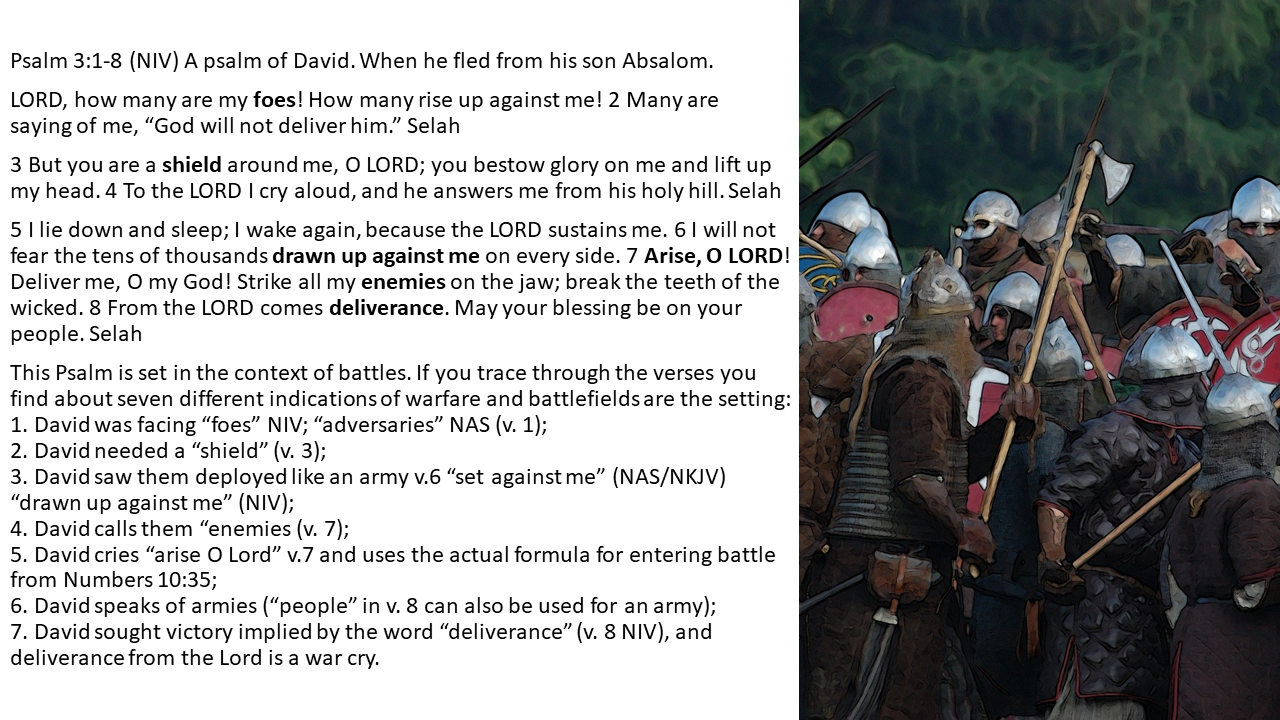
If you look down, look at verse 1. I want to trace with you through these verses about the indications of warfare and battlefields. This is just, this whole psalm is set in the setting of David facing an army. In a military setting, and he goes to sleep right in the middle of it. Just amazing. He’s facing foes, as it says in the NIV, the New American says adversaries. The new King James says those who trouble me. That could be generic, but if you look at the Hebrew word, the NAS and NIV both bring it out, foes and adversaries.
But look at verse 3, David needs a shield. Shield, that’s warfare oriented. Verse 6, it says they’re set against me. That word means deployed like an army. They’re marshaled against me. He said, my enemies don’t just come and go. They’ve all set up their little battlefield spots.
So, verse 6, they’re set against me. Drawn up against me, the NIV says. David calls them in verse 7, his enemies. This isn’t just casual stuff. These are focused enemies that are coming at him. He cries in verse 7 and says, arise, oh Lord. Now if you ever want to do a little jump in your Bible, go to numbers 10 and verse 35. And that is exactly the marching orders when Israel went into battle, they’re supposed to say, arise, oh Lord. In other words, You’re the one that’s going to go before us and fight this battle, not us. Remember when Israel conquered the Promised Land, there’s only one record of them being inflicted any casualties, as far as we know, just like David. Now I know you can say you can’t argue from silence, but the Bible has so many statistics, it never records any casualties in all of the battles Israel fought conquering the land and they faced entrenched walled city civilizations that were over a thousand years old. Had a long time to get ready for defensive preparations.
Israel never suffered loss as long as they went out. Numbers 10:35 and said, arise, oh Lord, and You go before us. And He didn’t. He threw hailstones down and it was just amazing. He just fought for them. And that’s what David cries out. It’s a battlefield idea. Verse 7, he speaks of verse 8 when he says people, it’s also the word that’s used for army. It’s one of those words that depending on the context can be used either way. And so probably with all the shield and set an array and adversaries and enemies and all that stuff it should be spoken of as armies. And also verse 8 has this idea of deliverance or salvation. And that in the context of Numbers 10:35 is still part of this war cry and asking God to win for them.
.jpg)
So, David is in this battle setting and then he puts in these Selahs, and I just want to kind of point them out to you because we can divide up the message of the third psalm. By looking at the little Selah, Selah, Selah, David uses this word, which means lift up or crescendo or boom it out, crank it up. He’s just saying, get loud and think about this, and pause. And he uses that to ask ourself, as we look at his life he says, stop and ask yourself, what do you think of that?
So let me show you the first two verses at the end of verse 2, he says this, many say there’s no help for him in God. Selah. So, you can just hit think of our timpani over here. Boom. And then that meant everybody stop and consider this. And he asks, what do you think of that? So, David does that. He didn’t just tell people what to do, he did it. He wasn’t just a thinker of the Word; he was a doer. He didn’t just write it, he did it. And so, he thought about it and he said, I have a lifetime of definite proof that God did care for me.
He just thought back. He thought about the lion and the bear when he was a little shepherd boy. And then he thought about Goliath and then he thought about how the Lord delivered him and all of his runnings from Saul, and he thought about all his decades of fighting everybody that bordered on Israel and how he never even got wounded, let alone injured or killed. And he thought about the tens of thousands of arrows that must have whizzed by him and all the spears that were thrown. Remember Saul even threw one, just bong right in the wall next to him, and he thought about that and he thought, wow, the Lord really has been a shield about me. So, he thought about that.
Then at the end of verse 4, look what he says. He answered me. Selah. Boom. Stop and consider this. What do you think of that? That’s what Selah means, and David reflected upon God’s steadfast love and he reflected upon the confident faith he had, that God always listened, God always responded to him. God has always rescued him in the past. He thought about it for a moment and he thought, and I bet He’ll just keep on doing that. He’s been faithful and He’ll remain faithful. That’s part of His name. He is the great in faithfulness God.
So, he goes on, look at the end of verse 8. It says, salvation is of the Lord. Selah. Boom, stop, consider this. What do you think of that? And David reflects on the truth that it is God who alone can save us from all and any of our deepest troubles. Any thought about that? And it was so powerful to him. That verse 5 says, he just unrolled a sleeping bag and says, this is so good, I’m just going to rest. And he just went to sleep with 10,000 a raid around him.
.jpg)
Let’s think of the message the first two verses tell us that David, we’re all going to face battles. Okay. Let’s think about what battlefields. I doubt if when you get to your subdivision tonight, you’re going to see trenches and the Hezbollah setting up their anti- tank missiles to shoot at you. We don’t have that. But what we need to remember as we look back this psalm, is that we’re all facing battles as we go through everyday life. How about something we’re all going to face soon? Work. Okay. Go into work. Think about the modern workplace. It’s cutthroat these days. Enduring personal attacks and abuse are the norm as more and more people compete for fewer and fewer jobs with less and less job security. Right?
I remember, my dad worked the same building for 46 years, made more money every year of his life, retired, and now he earns more than he ever earned any day he ever worked full time. That is like the dinosaurs that is gone. He had full everything coverage. He has full hearing coverage and eye coverage and teeth coverage and body coverage and every coverage and it with General Motors, and it’s just, they just ask him to come use it. That’s gone. Job Security’s gone. This prompts the workplace, prompts the use of weapons around you, like lying and slander, and gossip, misrepresentation, bribes, stealing, falsification, blame shifting. People do that to gain personal advancement. They try and undermine you and say, oh, I don’t know, just so they can get ahead. And that goes on all the time in the workplace. And I wonder how many enemies does it take to make someone’s life miserable? Just one persistent one.
Also, maybe it’s not the workplace. It becomes our battlefield. How about home? What about home? Maybe you and I’ll never face an army led by our son. You notice that it says in the Superscription by his son, Absolom, maybe our son will never seek to destroy us and take our throne like David was facing. But we may someday face the slander, the attack, and the abuse and the hatred of our children. We can face them betraying what we stand for, even seek to undermine our family or our role as parents. That’s what David was facing. Or we can face slander and attack and abuse like David faced in another way. How about the one closest on Earth to us, our husband or wife? What about if they turn against us with no warning, desert us seek to harm us, or just torment us by breaking their lasting promise? That they would, as we hear at every wedding till death, a stew part. I wonder if that’s the most lied about thing in our culture. Probably not, but it’s getting to be half and half of those that do make it to the end. Others can face their parents turning against them, abandoning them, slandering them, whatever it is. Life is hard, sin is horrible, and people seem to be able to harm us so easily.
That’s why David says at the end of verse 2, Selah. You know what he’s saying? Stop. Look around. I’m facing Absalom. What are you facing? What battle are you facing? He said, we all have battles. Stop and think about. It might not be Absalom, it might not be on the other side of the Jordan, but what battlefield are you in? Stop and think about it. That’s what this third psalm is constructed for us to do. Think about those who are saying to us as it says at the end of verse 2, there’s no help for him and God, you don’t have a breath of a chance. You don’t have any way you’re going to make it. That’s what the enemy say.
.jpg)
Secondly, not only like David do, we all have battles like David, we all are going to make choices. That’s what verses 3 and 4 are about. David. Pauses surveys the battlefield and goes to the second level of the psalm, and he makes a series of choices. David shows us what made him such a godly example. David turns his attention from his problems to, see, he made a choice. He’s been looking around, looking at the trenches, looking at the men, getting in their positions, thinking about, he fought so many times. He knew exactly how far he knew how far arrows could be shot. He knew how far a spear could be thrown. He’s seeing if the outer perimeter is enough to protect him from a bow shot, and the whole thing. He’s going through it all. Suddenly as he looks at God, and that’s the choice he made, everything gets back into proper proportion. David makes this marvelous transformation by holding tightly to a truth about God.
Notice what he says in verse 3. He looks up from the battlefield up at the Lord. In verse 3 says, You, oh Lord, are a shield for me. He affirms a truth he clung to and knew for certain about God. He held tight. God had been a shield in past days for David. That’s a truth. That was the focus of past praise he’d offered to the Lord. So, David says, You are a shield about me. And then he says, You’re my glory. You’re the one I want to please. You’re the one I want to live for. You’re worth living for. You’re worth praising. You’re worth honoring. That’s what glory means.
By the way, he says, You owe what You owe, Lord. Very careful in his picking of names. Use the name for God. That means God, the covenant keeping God. That’s what Jehovah, Yahweh is the God who makes and keeps covenants. An easier way to say that the God who keeps His Word. And so, David addresses God by the name Lord. The significance is that this is a name for God as the God who keeps His Word. So, David says, Lord, You who keep Your Word. You who brings to pass Your promises, Your covenants, You’ve made, You who keep Your Word, be a shield around me because You’ve promised to do that and You’ve always been that.
See, there’s, this is a very little choice that David made. He just said, let’s see, while I’m here in this terrible time, what do I remember about God? He’s the Lord. He keeps His Word, His covenants. He’s been a shield. I mean he, David, who writes the Scripture, he could have rattled off a hundred names of God. That’s how many different ones he uses in the Psalms. He only needed one. You don’t have to master, you don’t have to carry around, all the names of God by lot here. You just grab one and hold onto it. And he takes that and he says, you can be what you’ve always promised and always have been. I trust You. And this exposes a secret that kept David even through the darkest hours.
Just for a second, we have to look back at 1 Samuel 30 because this is one of my all-time favorite verses. Whenever I’m struggling and discouraged, I always go back and look at 1 Samuel 30 in verse 6. And you ought have this marked. If you haven’t got it marked already, get a pen out or something because this is so beautiful. David knew and trusted the Lord. And that trust in the Lord stayed with David since way before his rule as king. 1 Samuel 30:6, he reminds himself the Lord can be trusted and counted upon as the one who would lift up his head in the dark days when the Amalekites plundered David’s home, stole his property, and took his family hostage in 1 Samuel 30:1-6.
What did David do then? Now I alluded to it this morning. Remember David thought back about how all his kids have been hauled off and his wives and all his goods by these desert dwelling people, these terrorists of old and he faced that. And in, in 1 Samuel 30:1-6, the Amalekites take Ziklag and, verse 2, they take the women in those who were there from small to great. They didn’t kill anyone. They just carried him off. And so, verse 3, Dave and his men came to the city. And there was everything kind of like Gaither’s songs. My dreams turned to ashes, all their buildings turned to ashes, everything that they had was burned with fire. And their wives, their sons and their daughters were taken captive. And verse 4, David and the people with him lifted up their voices and wept. And they had until they had no more power to weep. They were just overcome. They were just wailing. It just was a horrific thing. These 600 men, David’s men, came marching back into town from an outing of their going out and fighting, and they crossed over the hill and came to the top, and they looked down. It’s just burned nothing. And they just cried until they couldn’t cry anymore.
Then, it says verse 5, and David’s two wives, the Henahan, the Sitis, and Abigail the widow of Nabal the Carmelite had been taken captive, and David, verse 6, was greatly distressed for the people spoke of stoning him because all the soul of the people was grieved. Every man for his sons and his daughters. It’s a really bad time. David lost everything. They lost everything. And they were so angry they were going to kill him, stone him to death.
And so, in this desperate moment, here’s the key to David’s life. But David, the end of verse 6, strengthened himself in the Lord, his God. Didn’t have a Bible, didn’t have a CD to pop in that worship music to kind of make me feel a little better, he didn’t have a little radio to listen to Charles Stanley and get an upbeat sermon to feel better. Didn’t have his study Bible, didn’t have his verse cards, didn’t have a fellowship to run to, get to the men’s Bible study. Look what he did, and this is really what it comes down to. It’s where we have to get to. But David strengthened himself in the Lord his God. That was the secret of his life when he faced fear and discouragement. The only true comfort comes from God. Remember, we started this whole thing saying, God is the only one that can affect us on the inside. Everybody else can affect the outside, God’s the only one that can change, bring comfort, strength, encouragement, healing to the inside. And that’s what David found.
.jpg)
Now back to Psalm 3:3-4. We’ll close; we’ll have to pick up here next time. But look at this. David strengthened himself in the Lord. That’s a little choice. We all make choices. The first one says, look at the battle. Look at your battlefield. I look at my battlefield. After you do that, pause and think about it, and then lift your eyes to the Lord. And start thinking about Him. And David thought about Him when David couldn’t go on, when he couldn’t even look up because he was so cast down at that moment. He felt the gentle hand of his loving Lord under his chin, lifting his head. That’s why he says, You, Lord, are the lifter of my head. It is the Lord who can truly encourage us. He’s the only one that can lift our heads when they’re cast down. David knew that he sought that. He wanted that, and he experienced that.
So now in his saddest hour, he declares by faith, by faith, nothing had changed. Absalom was still usurping the throne. Absalom still had the armies. David was still driven out of town. David was away from his family. David was all alone. David was in a vulnerable position. Nothing had changed. But in this saddest hour, he declares, in faith, You are the one who lifts up my head. You are the one who encourages and strengthens me. I remember, and I want you to do that again. I need your help now.
Now there’s a little choice we have to think about because sin always beats us down. God always lifts us up, and it should be that Christians are like God lifters not beaters down. He says, Lord, you always lift me up. Others may ignore us. God, you always answer me. And then he says, look at the end of verse 4, he says, You’re the one who always hears me from Your holy Hill. Verse 4, and there it comes again, Selah. Look at this. Think about this. Stop and think about that truth. Let it settle on your heart. God always lifts. God always shields. God always answers. I’m going to think about the God I can trust. And I’m going to stop looking at my battlefield. It’s a little choice he makes.
He goes in the first two verses and says, everybody’s against me. Everybody says no help for me. And he says, Hmm. And then he says, but You, oh Lord, and he lifts his heart, his eyes to the Lord. Anxiety is meditating on my problems, but peace is believing His promises, and that’s what David chooses.
.jpg)
In verse 5, we already covered this, we all need sleep, right? Look how it says in verse 5. I lay down in sleep in a few hours. When it comes to be your time to sleep, think of what you will do. Think of planning to end your activities, your conversations, and even your consciousness. And think of laying your full weight of your body on an object that hold you up, usually a bed. And as you lay down, you choose to completely trust that something else other than yourself to hold you up while you’re no longer able to take care of yourself. And every time you and I go to sleep, we are making a visible representation of what pure faith looks like. It’s one of the common experiences we all share. We have to absolutely entrust ourselves to that bed to keep us and hold us up. So, sleep is when we relax because we know longer need to take care of ourself and we’re held up by something else and we give in to sleep.
And here’s what one author writes so beautifully and in the same way throughout the night as you sleep, someone else is sustaining you and that is a picture of what it’s like to belong to Christ the same way that the bed holds us up. That is a picture of how Christ wants to hold us up if we’ll trust in Him. And that is exactly what David does in verse 5. He laid down, he slept, he woke up. The Lord had sustained him.
You facing something big? Some big problems, some danger, some threatening situations, some adversary, some enemy? Look around, we all have battlefields. And then look up and your whole perspective will change because you’ll see a faithful God that’s always been faithful. And if you let Him lift up your chin, see Him in your face, He’ll sustain you, and let you sleep trusting in Him.
.jpg)
Let’s bow for word of prayer and thank our great God for His being the God who keeps His Word. Father in Heaven, I thank You that You do keep Your covenants and Your promises, Your Word to us. You’ve promised that You’ll watch over Your Word to perform it. We’ll just believe You and trust You and rest in You. You will sustain us. May that be our experience this week as we sleep each night, may it be a reinforcement of the reality of our salvation of resting in Christ, in whose name we pray. Amen.
Notes
 In the midst of the worst time of his life David fell sound asleep. In the midst of one of the most dangerous situations David had ever faced he relaxed, sang a song to the Lord and laid down–completely confident that the Lord would protect him.
Have you ever really thought about why we sleep as humans? In fact, have you considered that every one of us will probably spend about 1/3rd of our life sleeping? And that sleep is not an accident—God is the designer and promoter of sleep?
Yes, God designed sleep for us His creatures. But why? As believers who look at life through the lens of God’s Word (just as we are to do with all the rest of life)—we need to see sleep and life as having the very signature of God written across it. When God has designed something it is very special and has specific purposes that God wants us to know about. So have you gained the benefits of knowing what God has to say about one-third of our lives?
EVER THOUGHT ABOUT SLEEP?
First just list off in your mind what sleep means:
- Sleep means that work must stop.
- Sleep means that a day must end.
- Sleep means that our strength has been depleted and must be renewed.
- Sleep means that our minds have become weary and must be refreshed.
- Sleep means that our bodies have gotten exhausted and must be restored.
- Sleep means that we have limitations that must be faced.
- Sleep means that we have a dependence that must be acknowledged.
- Sleep means that we must deny self-sufficiency. As Psalm 121 tells us:
So one of the clearest reasons for sleep is to remind every human on this planet, and especially us believers—that God is God and we are not. We are helpless, limited, and dependent. But that is not all. Sleep can also be one of the most beautiful reminders of what true saving faith looks like.
In a few hours when it comes to be your time to sleep, think of what you will do. You will plan to end activities, end conversations, and even end your consciousness of life around you and lay the full weight of your body on an object that can hold you up (usually a bed). Then as you lay down you must choose to completely trust that something else other than yourself will hold you up while you are no longer able to take care of yourself. That is pure faith. So David laid down and slept in Psalm 3:5 in his most vulnerable hour. Are you facing danger, adversaries, uncertainty about the future, even the possibility of death? Then David’s discoveries in this 3rd Psalm are for you. David slept in the face of danger and possible death—and so can we if we understand what he understood, and believe what he believed.
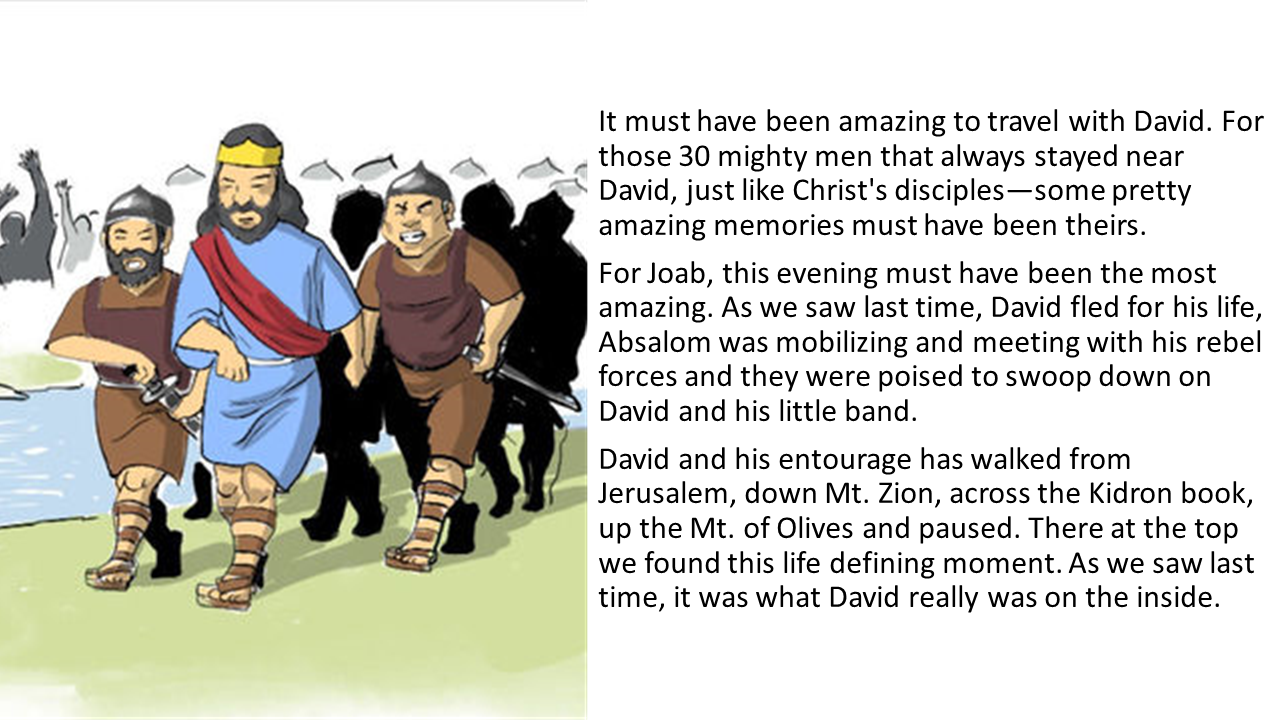
It must have been amazing to travel with David. For those 30 mighty men that always stayed near David, just like Christ’s disciples—some pretty amazing memories must have been their’s.
For Joab, this evening must have been the most amazing. As we saw last time, David fled for his life, Absalom was mobilizing and meeting with his rebel forces and they were poised to swoop down on David and his little band.
David and his entourage has walked from Jerusalem, down Mt. Zion, across the Kidron book, up the Mt. of Olives and paused. There at the top we found this life defining moment. As we saw last time, it was what David really was on the inside.
WORSHIP THROUGH TEARS
 When David was at his lowest moment of his life–he bows and worshipped and offered up a Psalm of praise to God—even through bitter tears of sorrow and grief.
2 Samuel 15:30, 32 So David went up by the Ascent of the Mount of Olives, and wept as he went up; and he had his head covered and went barefoot. And all the people who were with him covered their heads and went up, weeping as they went up. 32 Now it happened when David had come to the top of the mountain, where he worshiped God—there was Hushai the Archite coming to meet him with his robe torn and dust on his head. NKJV
God’s servants can continue in worship even when life is tough, difficult, and almost looking like it is impossible to go on. That is what we find in the exact record of the worship that flowed from David’s heart and onto paper as Psalm 3.
This song David shares is what can flow from us if we like him—bow in worship when the bitter tears of sorrow and grief fall across our lives.
David trusted God’s control. He relied upon it and prayed for it. Instead of fear he had faith and gave worship.
Onward David trudged after that brief worship stop. Soon insult was added to injury. Shimei kicks David when he is down. Spraying him with curses, dust, and stones. Onward trudges the man after God’s own heart until at last safely across the Jordan River and in the wilderness camp came be made for the night.
Joab, commander in chief of all David’s armies is feverish in preparation. Guards are posted, troops are stations. Concentric rings of defenses are planned and prepared so that the 600 seasons soldiers that marched out with David are arrayed to face any army and any enemy that would come on this very vulnerable night.
Joab is tense as he comes back to camp. He is worried that a frontal assault by Absalom’s army could overwhelm his perimeter. He wonders about taking David deeper into the wilderness or finding some other spot. With his head just spinning with all these thoughts he greets David.
For the first time in hours he sees him all alone and realizes that something is completely different about David. Gone are the red swollen eyes of the morning. Back are the clear and bright eyes he remembered from so many years of fighting alongside of this giant of a man. David was calm, peaceful and actually joyous. He begins to tell Joab what the Lord had done in his heart. Incredulous Joab smiles, shakes his head and hurries off to check the defensive positions one more time.
This time as Joab comes back he is struck with and even more amazing sight. David is on the ground, an animal skin unrolled in front of him, and with pen and ink in hand he is busily writing just like Joab remembered from those days in the Cave of Adullam as David wrote Psalm 56 and 142; just like he remembered in those days of fleeing from King Saul when David wrote Psalms or songs to the Lord. And here he is at it again.
Finishing up, David holds up the scroll to the fading light of the evening sky. Reads it over as he quietly sings it to a tune he had made and then rolls it up, ties a cord about it and tucks it into his cloak. David has just written Psalm 3. And then he turns, unrolls his sleeping bag, lies down and soon is sound asleep. In the very presence of his enemies, in the middle of the camp that could be over run at any moment—David sleeps. Joab marvels again at this man after God’s own heart.
TRUSTING GOD—NO MATTER WHAT
Please turn there with me to Psalm 3. And follow along as I read to you David’s song of trust in God.
Psalm 3:1-8 A Psalm of David, when he fled from Absalom his son. NKJV
- 1 Lord, how they have increased who trouble me! Many are they who rise up against me.
- 2 Many are they who say of me, “There is no help for him in God.” SELAH
- 3 But You, O Lord, are a shield for me, My glory and the One who lifts up my head.
- 4 I cried to the Lord with my voice, And He heard me from His holy hill. SELAH
- 5 I lay down and slept; I awoke, for the Lord sustained me.
- 6 I will not be afraid of ten thousands of people Who have set themselves against me all around.
- 7 Arise, O Lord; Save me, O my God! For You have struck all my enemies on the cheekbone; You have broken the teeth of the ungodly.
- 8 Salvation belongs to the Lord. Your blessing is upon Your people. SELAH
Pray.
When David is at the bottom, comes to his weakest point—and gets hit while he is down, what does he do?
 PSALMS ARE FROM GOD
He writes a Psalm. A Psalm is a worship song, truth offered to God in worship that is to be shared by participation. David invites us by God’s help and power to join in and participate in praising God for what He has done.
The 3rd Psalm is an amazing Psalm because it actually introduces us to this Book of Psalms.
If you stepped back and look at the Psalms, there are 150 of them. Now look at the superscription or first words of this Psalm. Here is what we observe:
- This is the first one that is called a Psalm, ‘A psalm of David. When he fled from his son Absalom.’
- This is also the first Psalm that is attributed to David. ‘A psalm of David. When he fled from his son Absalom.’
- This is the first Psalm that gives us a Divinely written setting in the first verse of the Hebrew text. ‘A psalm of David. When he fled from his son Absalom.’
- This is the first Psalm to use the Divinely placed pause to think about an important point. That pause we know as the Selah.
Selah: “to pause and lift up”; it can be freely rendered: “There! What do you think of that?”
- Occurs once (in 16 different Psalms): Psalms 7; 20; 21; 44; 47; 48; 50; 54; 60; 61; 75; 81; 82; 83; 85; 143;
- occurs twice (in 15 different Psalms): Psalms 4; 9; 24; 39; 49; 52; 55; 57; 59; 62; 67; 76; 84; 87; 88;
- occurs three times (in 7 different Psalms): Psalms 3; 32; 46; 66; 68; 77; 140;
- occurs four times (in only 1 Psalm): Psalm 89;
- And occurs first in Psalm 3 three times!
Psalm 3:1-8 (NIV) A psalm of David. When he fled from his son Absalom.
- LORD, how many are my foes! How many rise up against me! 2 Many are saying of me, “God will not deliver him.” Selah
- 3 But you are a shield around me, O LORD; you bestow glory on me and lift up my head. 4 To the LORD I cry aloud, and he answers me from his holy hill. Selah
- 5 I lie down and sleep; I wake again, because the LORD sustains me. 6 I will not fear the tens of thousands drawn up against me on every side. 7 Arise, O LORD! Deliver me, O my God! Strike all my enemies on the jaw; break the teeth of the wicked. 8 From the LORD comes deliverance. May your blessing be on your people. Selah
This Psalm is set in the context of battles. If you trace through the verses you find about seven different indications of warfare and battlefields are the setting:
1. David was facing “foes” NIV; “adversaries” NAS (v. 1);
2. David needed a “shield” (v. 3);
3. David saw them deployed like an army v.6 “set against me” (NAS/NKJV) “drawn up against me” (NIV);
4. David calls them “enemies (v. 7);
5. David cries “arise O Lord” v.7 and uses the actual formula for entering battle from Numbers 10:35;
6. David speaks of armies (“people” in v. 8 can also be used for an army);
7. David sought victory implied by the word “deliverance” (v. 8 NIV), and deliverance from the Lord is a war cry.
This Psalm divides up the message God is giving through David by the use of the word SELAH. As we have seen, Selah means ‘lift up’ and is a musical term for crescendo. It means boom it out, crank it up—punctuate that with emphasis. Then stop and ask yourself what do you think of that?
1. So at the end of verse two, ‘many say there is no help for him in God.’ Selah— boom! Stop and consider this. What do you think of that? And David pauses and thinks about that and he finds a lifetime of definite proof that God did care for him.
2. So at the end of verse four he says, ‘He answered me…’. Selah—boom! Stop and consider this. What do you think of that? And David reflects upon his steadfast hope, and confident faith that God has always listened, responded, and rescued him in the past and will continue to do so.
3. So at the end of verse eight he says, ‘Salvation is of the Lord’. Selah—boom! Stop and consider this. What do you think of that? And David reflects upon the truth that it is God who alone can save us from all and any of our deepest troubles.
These three uses of ‘Selah’ make three very clear divisions that are the message points of this Psalm.
 LIKE DAVID—WE ALL WILL FACE BATTLEFIELDS (v.1-2)
What we need to remember as we look at this Psalm is that we all are facing battles as we go through every day life. Think about the workplace—it is cutthroat these days. Enduring personal attacks and abuse are the norm as more and more people are competing for fewer and fewer good jobs with less and less job security.
This prompts the use of weapons such as lying, slander, gossip, misrepresentation, bribes, stealing, falsification and blame shifting—all to gain personal advancement. And how many enemies does it take to make life miserable? Just one that is persistent.
Also, it may not be the workplace that becomes our battlefield, it may be our home. Maybe you and I will never face an army led by our son seeking to destroy us and take our throne like David was facing—but we may someday face the slander, attack, and abuse through the hatred of our children. We may face them betraying what we stand for and even seeking to undermine our family unity, or discredit and destroy us as parents.
We can face slander, attack or abuse like David faced in another way—coming from the closest on earth to us our husband or wife when they turn against us with no warning, desert us, seek to harm us or just torment us by breaking the lasting promise they made in marriage.
Others may face parents that turn against them, abandon them, and are slanderous and abusive against their very own children. Life is hard, sin is horrible, and people seem to be able to harm other so easily. So that is why David says SELAH. He is saying stop, look around—and think about your battle.
LIKE DAVID—WE ALL WILL MAKE CHOICES (v.3-4)
But then David shows us what makes him such a godly example. David turns his attention from his problems to God. Suddenly everything gets back into proper proportion. David does this by holding tightly to a truth about God. God has been a shield in the past for David. That is a truth, that was the focus of past praise he offered to the Lord—so David says You are a shield about me! Then he says You are my glory, the One I want to please, the One I live for—You are worth living for, praising, and honoring.
He addresses God by the name Lord, that is Yahweh or Jehovah. The significance is that this is the name for God as the covenant keeping God. He is the God who keeps His Word. So David says Lord, You who keep your Word, You who brings to pass Your promises that You have made—be the shield around me that You have promised to be and have always been.
This exposes the secret that kept David even through his darkest hours. He know and trusted in the Lord. This trust in the Lord has stayed with David since way before his rule as King. He reminds himself that the Lord can be trusted and counted upon as the One who lifts up my head. Just as in the days when the Amalekites plundered David’s home, stole his property and took his family hostage in 1 Samuel 30:1-6. What did David do then?
1 Samuel 30:6 Moreover David was greatly distressed because the people spoke of stoning him, for all the people were embittered, each one because of his sons and his daughters. But David strengthened himself in the Lord his God.
When David couldn’t go on, he couldn’t even look up because he was so cast down—at that moment he felt the gentle hand of his loving Lord under his chin, lifting his head. It is the Lord alone who can truly encourage us. He is the only One that can lift our heads when they are cast down.
David knew that, sought that, wanted that—and experienced that. So now in this saddest of hours he declares in faith—You are the One who lifts my head. You are the One who encourages and strengthens me. I remember and I want you to do that again. I need You to help me now.
Sin always beats us down—God always lifts us up.
Others may ignore us, God always answers us. SELAH
See that? David says, SELAH—look at this, think about this, stop and let that truth settle down on your heart. God always lifts, God always answers. I am going to think about the God I can trust and stop looking at all my problems. Anxiety is meditating on problems; but peace is believing His promises. That is what David chooses.

LIKE DAVID—WE ALL NEED SLEEP (v.5-8)
Have you ever really thought about why we sleep as humans? In fact, have you considered that every one of us will probably spend about 1/3rd of our life sleeping? And that sleep is not an accident—God is the designer and promoter of sleep?
Yes, God designed sleep for us His creatures. But why? As believers who look at life through the lens of God’s Word (just as we are to do with all the rest of life)—we need to see sleep and life as having the very signature of God written across it. When God has designed something it is very special and has specific purposes that God wants us to know about. So have you gained the benefits of knowing what God has to say about one-third of our lives?
First just list off in your mind what sleep means:
- Sleep means that work must stop.
- Sleep means that a day must end.
- Sleep means that our strength has been depleted and must be renewed.
- Sleep means that our minds have become weary and must be refreshed.
- Sleep means that our bodies have gotten exhausted and must be restored.
- Sleep means that we have limitations that must be faced.
- Sleep means that we have a dependence that must be acknowledged.
- Sleep means that we must deny self-sufficiency. As Psalm 121 tells us:
So one of the clearest reasons for sleep is to remind every human on this planet, and especially us believers—that God is God and we are not. We are helpless, limited, and dependent. But that is not all. Sleep can also be one of the most beautiful reminders of what true saving faith looks like.
In a few hours when it comes to be your time to sleep, think of what you will do. You will plan to end activities, end conversations, and even end your consciousness of life around you and lay the full weight of your body on an object that can hold you up (usually a bed). Then as you lay down you must choose to completely trust that something else other than yourself will hold you up while you are no longer able to take care of yourself. That is pure faith.
So sleep is when we relax fully because we no longer need to take care of our self, and held up by something else, we give in to sleep.
As one author so beautifully states,
“And in the same way, throughout the night as you sleep, Someone else is sustaining you. This is a picture of what it’s like to belong to Christ.”1
For me it was in the fall of 1962 when as a child I believed the simple proclamation of the Gospel given me by my mother. I was a sinner, clearly unable to save myself, facing the penalty of God’s wrath for my sin. But in simple and true faith as a child I believed on the Lord Jesus Christ as my Savior and God performed the miracle of salvation inside of me. He took my sins and gave me His life. I began a walk of growing to trust Him more and more, and myself less and less.
Sleep is a gift from God for each of us to get all ready to start over again all refreshed and renewed, tomorrow. It is also a picture of how much we need God, and even more how we receive His salvation. Sleep should decimate any pride we have in our own power or might and humble us to think how weak and needy we really are.
Tonight as you crawl into your bed, pause to remember as you entrust your body to be held securely through the night—lift your heart in worship to God who holds your soul in the sweet comfort of laying secure in His arms. Tell the Lord you are also resting your life in Him. Whisper that you completely need Him, trust in His care—and ask Him to get rid of any pride you may have built up throughout the day.
That is the supreme peace that David felt as he lay down in the presence of his enemies and slept. So should we. Humbly, and in complete dependence upon our Lord!
 LIKE DAVID—WE ALL HAVE PROBLEMS (v. 10)
Did I mention that one word in this Psalm that weighs heaviest on David? It says in the attribution line, Psalm 3:1-8 (NIV) ‘A psalm of David. when he fled from his son Absalom.’
All of this painful abuse, unexpected attack, and life endangerment is because of his own son. What could ever lead to a son that rapes his own sister? Or what would ever incite a son that murders his own brother? Or as we see here, what could drive a son that tries to murder his own father? One word answers all three—sin! It was sin that led Amnon to rape Tamar, that prompted Absalom to murder Amnon, and drove Absalom to seek his father’s death.
But all of these reflect upon David as a father. David’s life situation we are studying opens another subject God’s Word explains to us. David is struggling through one of the greatest challenges in life–raising children.
After years of combing through every verse of the Bible dozens of times, I still haven’t found the perfect family—a family with a godly dad, a godly mom, and children who are submissive their entire time at home, and grow up to move on into godly marriages and homes. This just isn’t recorded in the Bible.
What we do find in God’s Word are some godly parents who have both godly and ungodly children; we also find some ungodly parents who have all ungodly children, while other ungodly parents end up with some godly children. There just doesn’t seem to be a parenting pattern that always works. So what is the answer for us as we parent? When God blesses us with children, He asks us to give them back to Him in dedication. That is what Christ’s parents did way back in Luke 2:22. That is also what godly parents have done through the centuries.
When we as parents present our children in dedication back to the Lord, we are declaring: “These children belong to You, Lord.” Dedication is our public acknowledgment of God’s ownership of them (Psalm 127:3). We can then rest in the joyful reality of being stewards of the promises of God’s Word.
But what happens when we dedicate them and they don’t turn out as we had hoped and planned?
The Bible repeatedly records godly men and women with less than godly children. That is because godliness is a choice; it is an obedient response to the Lord.
Godly children can not be made; nor can godliness be forced upon them. They grow that way, by God’s grace, with—or sometimes even without—godly parenting.
The bottom line of Scripture is that God never holds us responsible for how our children turn out—only for how we raised them.
So let me remind you again of the truths parents affirm when they hold up their precious children to the Lord in dedication of themselves to godly parenting as stewards of their children for the Lord:
I will raise the children God gives me for His glory;
I will surrender them back to Him;
I will have His peace when it is hard, and when they are making their own choices that will shape their future lives;
I will always pray for them, always love them, and no matter what happens—
I will have God’s peace because I gave them to Him—and raised them for Him as best as I knew how and could do.
What comfort is there for parents when this happens? When children do not follow the Lord and turn away from Him and sometimes even us? What hope can we have after all the years we loved them, earnestly prayed for them, read God’s Word to them, nurtured them in the ways of the Lord, and sought to guide them as best we could? Here are some truths that comfort our hearts—and the hearts of the many parents we have encouraged over the years:
Some lessons we can see in David’s life as we reflect upon Absalom’s Rebellion . . .
1. Absalom’s Rebellion was no surprise to God. Every day of our life (Psalm 139) was written in His book—even the darkest of days!
2. Absalom’s Rebellion was an opportunity for God to see David’s response. Our response is what matters to God most. He is watching and waiting for what we will do, to whom we will turn—and when we turn to Him, our Lord is glorified.
3. Absalom’s Rebellion must have driven David to pray for what he may have though impossible—Absalom’s return to the Lord and to David.
4. Absalom’s Rebellion opened to David a situation where only God can encourage him in times like that (I Samuel 30:6b)!
5. Absalom’s Rebellion filled David with hope as he remembered that God wasn’t ever through with him as long as he lived—and neither is He ever through with our wayward child.
6. Absalom’s Rebellion reminded David that he had a perfect heavenly Father as he see our own imperfections reflected by his son.
7. Absalom’s Rebellion must have humbled David as he remembered how often he also had failed his children (Psalm 130:3), and failed to respond correctly to his perfect Father.
8. Absalom’s Rebellion must have rebuked David because he expected so much obedience from his imperfect parenting, yet he gave his heavenly Father such imperfect obedience—even though God’s parenting was perfect!
9. Absalom’s Rebellion made David believe more and more each day what only God is able to do: touch their hearts, soften their hearts, and turn their hearts back to Him (Ezekiel 36:26-27)—and to us.
10. Absalom’s Rebellion showed David God’s never ending grace as each wave of fear and sorrow rolls over him, he found his feet firmly planted on the Solid Rock (Psalm 40:1-2)!
I hope that these truths will give you strength when the parenting path gets rough— whether for a moment, or a few weeks or months, or even for the rest of your life. Beloved, God is faithful, so never stop trusting Him—and never cease waiting upon Him! Remember: Faithful prayer, in step with God’s plan in His Word, is God’s most powerful key to unlock children’s hearts as we disciple them for Christ. The battle for our children’s souls is won “one prayer at a time”—“Is anything too hard for the Lord? . . . ” (Genesis 18:14a)
1 C.J. Mahaney, Humility: True Greatness, p. 85.
Slides

Check Out All The Sermons In The Series
You can find all the sermons and short clips from this series, David’s Spiritual Secret here.
Looking To Study The Bible Like Dr. Barnett?
Dr. Barnett has curated an Amazon page with a large collection of resources he uses in his study of God’s Word. You can check it out here.