
If the video above is not available, here are two other ways to view:
David – Living Deliberately
060910AM
DSS-39
Psalm 31
Transcript
.jpg)
Let’s open our Bibles to the 31st Psalm. As you’re turning there, the 31st Psalm confronts us with a very, very important question all of us need to ask. It’s about our spiritual lives, and the question is, are you deliberately living your spiritual life intentionally each day for the Lord, or are you just coasting spiritually this morning? That’s something we all need to think about. It’s so easy to coast.
Last week, before I spoke at that conference in northern Michigan, I had the four buddies for eight days, just me. I don’t even know how to put bows in hair. Bonnie’s done that all these years, and you should have seen me. The first time I spoke, one of the ladies said, it’s crooked. One of the ladies I didn’t even know at the conference said I put Elizabeth’s hair crooked, and I thought, oh, I’ll never learn this. But before we did the conference, I took the kids to a little island out in the middle of Lake Michigan, and we bicycled all the way around it. It was interesting to coast on the bike and to think about this message that I’m going to share with you this morning.
.jpg)
Many weeks ago, we began to look at David’s life. Remember reading the epitaph that God wrote about David in Acts 13? Nine words that God summarized his entire life. That’s where we began. His life is summarized by God as David had served God’s purpose in his own generation. Acts 13 and verse 36. Look at the first words of Psalm 31, because if God wrote an epitaph, David wrote a resolve. If God summarized his life in those nine words, David decided clearly that he wanted to be a man who was completely focused on God, and he says it right at the beginning. David’s personal resolve, which marked out why God thought so highly of him, is in the first verse of the 31st Psalm.
Notice what he says. In You, oh Lord, I put my trust. That’s backward for our thinking. What we would say if we were giving a testimony, we would say, I put my trust in the Lord. What do we, by nature, usually start with? I, me. This is what I’m doing, and there’s the Lord. But look at the carefully crafted order of the words of this first verse. David says, and he notes clearly by his words, that the Lord comes before him. He says in You, oh Lord. That’s the introduction. That’s the front. That’s what you see. Then he declares his resolve. I place or put my trust in You, oh Lord. That was his heart’s desire. David points to the Lord before he speaks of himself. God is the deliberate focus of the opening verses of this Psalm. And I might add, he’s also the deliberate focus of David’s life, and that’s why God thought so highly and spoke so highly of David.
.jpg)
Psalm 31 is David’s reflective song about the dangers and the painful consequences of coasting through our spiritual lives. While David was coasting one day, he crashed when he wasn’t careful. David crashed because he disengaged from following the Lord with his whole heart. David crashed into sin because he was just coasting along in his walk with the Lord. That’s one of the great dangers that mature, spiritual believers face constantly. It’s the danger of coming to the place where we think that we have achieved enough momentum, we have enough going on in our spiritual lives that we can just coast along for a while. Let the other people keep everything going and let the other people be doing all the disciplines of the spiritual life and all getting heavy-duty into this worship. We’ll just coast along for a while. It’s a real danger.
Coasting is when we slack up and seek the Lord with all of our hearts. Coasting is when we begin to feed our souls on yesterday’s blessing, last week’s devotions, and last month’s ministry. Coasting is when we stop engaging our whole mind in worship. David knew so much about that. David had lived for the Lord most of his life very carefully. He had earnestly, wholeheartedly, diligently, deliberately, and intentionally sought the Lord.
He had seen the hand of God with great clarity as a lad when he faced Goliath. David had felt the presence of God as a young man fleeing from King Saul and knowing God’s closeness and protection. David had felt the blessing of God as a man throughout all the years of leading the armies of Israel as their king. But somewhere along the way, David disengaged his heart. He stopped pedaling with his whole heart after the Lord, pursuing Him and seeking Him with all that he was. His heart was no longer fixed on the Lord but surrounded by so many blessings that David could just coast. He went through all the motions. He said all the same words. He just wasn’t careful anymore. He wasn’t guarding his heart any longer.
.jpg)
In those unguarded moments coasting through life, David crashed. Then everything in his spiritual life halted abruptly. As we saw last week, he stayed in neutral for about a year of his life, that year following his grievous sin against God involving Bathsheba.
But the good news is, after his repentance and restoration, David had changed, and that’s what the 32nd and the 51st Psalms recorded for us. He had learned in the spiritual woodshed of God’s chastening that sin always paid a heavy wage of consequences. His life would never be the same, but David’s life had not changed because he lost something; he had gained something. He had a whole new perspective on life. What he had seen was that he had to live life so much more deliberately than ever before because of his acute awareness that God’s forgiveness, God’s restoration, had given him a new beginning. It had given him a second chance to love and serve and live for the Lord.
.jpg)
The constant danger for us this morning is to disengage the engine of our hearts and just start coasting through our days spiritually. It all happens when we pass up worship, when we neglect the spiritual personal disciplines God instructs us to maintain, and we slowly begin to drift away from ministry. We don’t really feel a need to serve. We don’t really feel a need to give our hearts in worship. We don’t really feel a need to seek the Lord and feed upon Him and nurture our souls with His Word. We have just begun to coast. We should pause and ask ourselves this morning, am I just coasting today? Are you just coasting in your spiritual life? Or can you say, with my whole heart, I’m seeking you on every level, in every dimension, in every avenue possible. In my heart, at work, at home, at school, in the community, in private, is seeking You. If you’re not, you’re coasting.
David, in Psalm 31, examines for us how to live life deliberately. How to intentionally live each day in such a way that we live as much of it as possible for the glory and purpose of the Lord our God. With David in Psalm 31 this morning, we can examine our own lives. We can ask our own questions about whether we’re living our lives deliberately. We can learn with David how to avoid coasting. We can avoid the costly consequences of allowing those unguarded moments to derail us and make us crash. With David this morning, we can do those wonderful spiritual exercises.
.jpg)
David is writing the 31st Psalm after 1 Samuel 11, or 2 Samuel 11 and 12. In 2 Samuel 11 and 12 is the sin of Bathsheba. This Psalm reflects that it is in the past. It’s after the year of painful chastisement, that’s Psalm 32, that’s reflected in this Psalm. It’s after the magnificent prayer of repentance in return of Psalm 51. That’s also reflected in this Psalm. That’s how we figure out where this Psalm fits in David’s life. It’s because he’s alluding to so many eras that he has gone through spiritually. And it’s also after the painful dash into the wilderness by David as he fled his rebel son Absalom, as we studied last time in Psalm 3. So, Psalm 31 is a reflective Psalm that David wrote to capture his choice to return and deliberately live his life one day at a time for the Lord.
He shows us how. He builds upon the lessons he learned from both triumphs and failures. It’s such a powerful Psalm that this Psalm is set apart from the Old Testament Psalms because this Psalm is extensively quoted by the prophet Jeremiah. This is a Psalm that Jonah, the prophet, quotes when he is down there dealing with the stomach of the fish that he was in. But most of all, this Psalm contains the very last words Jesus ever spoke on this Earth during His earthly ministry. His parting words on the cross as he hung there are quoted from the fifth verse of this Psalm: into Thy hands I commit My spirit. So, Jesus knew this Psalm, the Old Testament prophets used this Psalm, the major prophets quoted this Psalm, and this Psalm is for us a marvelous, marvelous message of looking over life from David’s view, finding where he stopped seeking the Lord with his whole heart, reflecting on God’s hand in his life, and then resolving to once again take intentional choices, careful steps, and to clearly stop spiritually coasting.
.jpg)
Let’s read this Psalm together. Would you stand together with me as we read the 31st Psalm? This is David’s personal diary. This is the man after God’s own heart, telling us of his experiences. These are the lessons God wants us to learn, and let’s see how David wholeheartedly turns back to following the Lord. Psalm 31, in You, oh Lord, I put my trust. Let me never be ashamed. Deliver me in Your righteousness. Bow down Your ear to me. Deliver me speedily. Be my rock of refuge, a fortress of defense to save me, for You are my rock and my fortress. Therefore, for Your name’s sake, lead me and guide me. Pull me out of the net, which they have secretly laid for me, for You are my strength. Into Your hand I commit my spirit. You have redeemed me, oh Lord, God of truth. I have hated those who regarded useless idols, but I trust in the Lord. I’ll be glad and rejoice in Your mercy, for You have considered my trouble. You have known my soul in adversities and have not shut me up in the hand of the enemy. You have set my feet in a wide place.
Verse 9, have mercy on me, oh Lord, for I’m in trouble. My eye wastes away with grief. Yes, my soul and my body. By the way, this ninth verse starts with him looking back at his time of hiding his sin from God and from everyone else. That’s this eye wasting away, soul and body. Verse 10, for my life is spent with grief. My years with sighing, my strength fails because of my iniquity, and my bones waste away. Verse 11. I’m a reproach among all my enemies, but especially among my neighbors, and am repulsive to my acquaintances. Those who see me outside flee from me.
Verse 12, I’m forgotten like a dead man out of mind. I’m like a broken vessel. I hear the slander of many fears on every side. While they counseled together against me, they schemed to take away my life. Now, is the transition to the Absalom times of his life.
.jpg)
Verse 14, but as for me, I trust in You, oh Lord. I say, You are my God. My times are in Your hand. Deliver me from the hand of my enemies and from those who persecute me. Verse 16, make Your face shine upon Your servant. Save me for Your mercy’s sake, for I have called upon You. Let the wicked be ashamed. Let them be silent in the grave. Let the lying lips be put to silence, which speak insolent things proudly and contemptuously against the righteous.
Verse 19, Oh, how great is Your goodness, which You have laid up for those who fear You, which You have prepared for those who trust in You. In the presence of the sons of men, You shall hide them in the secret place of Your presence. From the plots of man, You shall keep them secretly in a pavilion from the strife of tongues. Blessed be the Lord, for He has shown me His marvelous kindness in a strong city. For I said in my haste, I’m cut off from before your eyes. Nevertheless, you heard the voice of my supplication when I cried to you. Verse 23, oh, love the Lord all you His saints. For the Lord preserves the faithful and fully repays the proud person. Be of good courage. He shall strengthen your heart, all you who hope in the Lord.
Let’s bow before the Lord in prayer. Father, thank You for this 31st Psalm. Thank You for this song of David, his personal worship diary of when he reflected on Your hand in his life. He made choices to live deliberately, to stop coasting, and to focus his entire life on You. I pray for someone this morning who loves You and knows You and has walked long with You, but for whatever reason has gotten into that coasting stage. It’s so dangerous. It’s so, so quick from coasting to crashing spiritually. I pray that You would deal with all of our hearts and help us decide to intentionally, deliberately seek and follow You. In the name of Jesus, we pray, Amen.
.jpg)
You may be seated. As you’re seated, I think of that little chorus we often sing because it reflects David’s heart. With all my heart, I want to love You, Lord, and live each day to know You more, serve You more. All that is in me is Yours completely. I’ll serve You always with all my heart. That’s what David is saying. He’s saying, Lord, I slowly got half-hearted and absent-minded in my walk, but with all my heart in You, oh Lord, I’m going to trust. What a confession.
After his crash, David was so careful that he began to guard his heart. He harnessed his moments. He was deliberate about his spiritual life. He wasn’t coasting. He had a brand new focus, and it was to live deliberately for God. He put up a sign that, along some of our highways, they always tell the truckers they’re supposed to engage their gears. They’re not supposed to let their truck just start coasting down the hills because it will pick up speed and they’ll get out of control. They say, hey, watch out. There’s a steep incline. Watch out. Don’t coast down there. Engage. It’s the sign David put up. He says, I’ve got a lot of momentum in my life. I’m at a great juncture. I’m at the king, and I’m at the prime of my life. No coasting is allowed. Don’t let your life get out of control. Engage your heart.
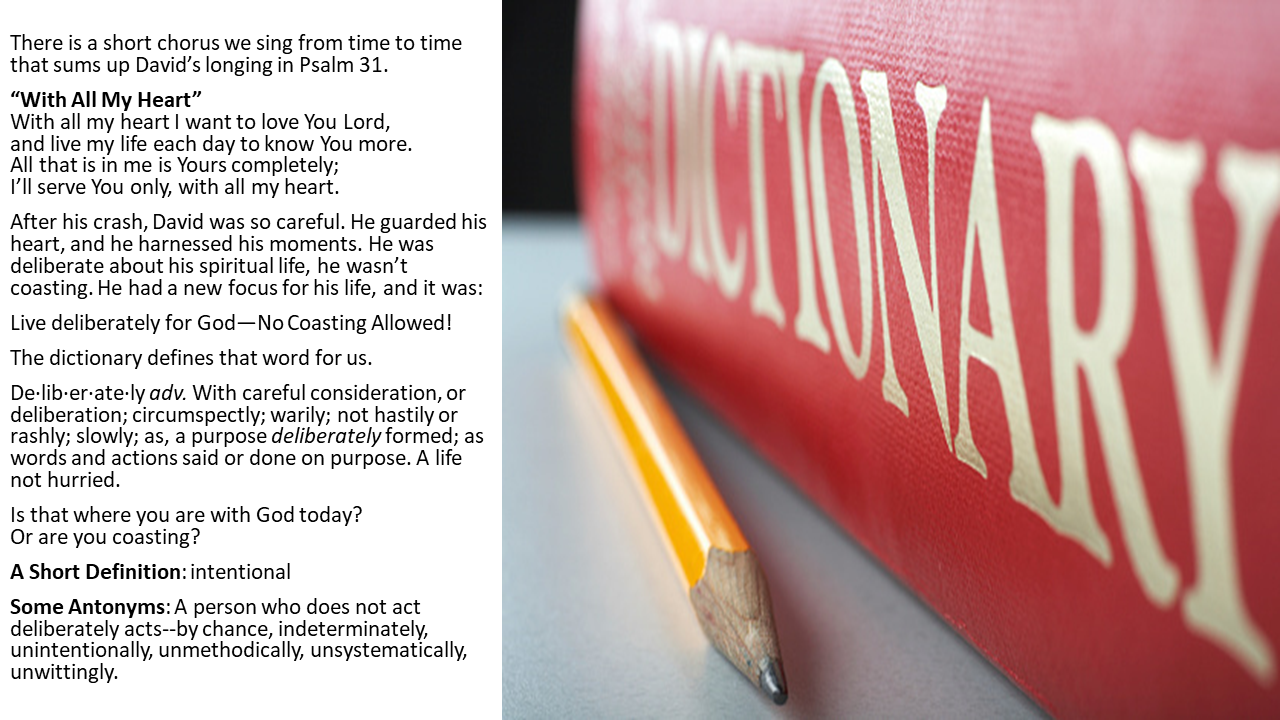
David did that. He did what the dictionary defines, and I’d like to read the definition of deliberately. I’ve thought about that all week long. Deliberately is an adverb. It means with careful consideration, circumspectly, wally, not hastily or rashly, slowly, as a purpose deliberately formed as words and actions said or done on purpose. Then the last line of the dictionary is a life not hurried. Now, I wonder, is that what you’re living this morning? Are you living deliberately for God? Thoughtfully, intentionally, carefully planned time, energy, resources, direction, and schedule for God. That’s what David wanted.
A short definition in the dictionary says intentional, and then it gives all the antonyms. Someone who is not deliberately living is a person who does not deliberately act. Rather, they act by chance, indeterminately, unintentionally, unmethodically, unsystematically, and unwittingly. Those are the things that characterize coasting in life. It’s just like it happens. It’s not planned. It’s not sought.
.jpg)
In Psalm 3, we saw how David learned to face abuse and danger and even go to sleep in the face of both peacefully. That was the first lesson, and that’s what rebellion taught him by God’s grace. This morning is the second lesson, the next lesson that God had for him. David learns that in a time of consequence, he must live deliberately, not spiritually coasting through life.
Now, what would David have thought about? He would’ve looked back at when he was coasting, when he wasn’t deliberate, and he would be thinking no more of this boredom stuff like the night I patted around out of bed in my slippers and peeked over the rooftop looking for something interesting. Remember, he found it, but he found the dregs of the consequences of sin and separation from fellowship with God. No more unplanned situations that he walked into defenseless. No more unguarded moments when, in an instant of passion, he caused a lifetime of heartache. No more, David says, I’m going to renew my walk with the Lord. This Psalm is all about what Romans 6 tells us. That we are to intentionally present ourself, our members, the portions of our life, our minds, and our bodies, our desires, we’re supposed to intentionally, Roman 6, present them as instruments of righteousness to the Lord. It’s an intentional presentation of my time, of my talents, of my treasures, of my desires, of my thoughts. That’s what David is doing.
Living deliberately for God means making choices to live by careful consideration. Counting the cost, as Jesus said. Remember in Luke 14? He says don’t do anything without first counting the cost. That’s a deliberate lifestyle. It’s living circumspectly, as Paul said in Ephesians 5:15. Circumspectly means you look around. You look before you leap. You consider before you go what that act or thought or word is going to cost you. We live wearily of the Devil as our prowling adversary, as Peter said in 1 Peter 5. We don’t live hastily or rashly, as James warned in James 1:19. We live deliberately.
.jpg)
So, living life intentionally, on purpose, or deliberately for God is the theme of the Psalm. Let me just show you the divisions again. I alluded to them while we were reading, but if you look down at this Psalm, you can trace in there that in the first 22 verses, David is talking to God. But then the last two verses, he abruptly changes gears, and he talks to us. So, it’s 22 verses of David talking to God, and then two verses of him saying, now those of you who have listened to me talk to God, you make a choice. It’s such a beautifully structured Psalm.
In the first eight verses David is reflecting on the lessons he learned during his running from Saul years. I’m going to go through this. He uses the same words we find in 1 Samuel, of all of the times he’s running and hiding from Saul, King Saul. So, if you look at the words of Psalm 31, you find that exact set of words is in 1 Samuel during those running years. So, it must have been on his mind the time when Saul was trying to kill him and pursuing him when he was running from Saul. That’s what those first eight verses reflect. Then verses 9, 10, and 11 reflect the lessons David learned when he wasn’t running from Bathsheba. During that year of the horrific chastisement of God, he reflects on that. The non-running time of his life. Then finally, in verses 12 to 22, David is reflecting on the current crisis of his life, his running from Absalom years. Let’s just walk through. This Psalm is so full and has so many truths in it. I’m just going to kind of skip from spot to spot.
.jpg)
In the first four verses, David seems to start this Psalm reflecting on some of the elements of his running from King Saul. He would go from one cave to another, from one fortress or a hilltop area where he could hide from Saul to another. That’s what this life was like for him. We see that by the words that, that David uses. The first thing he says in verse one is he says, I’m putting my trust in You, oh God. Now, that word trust, the Hebrew word means that I come to you as my refuge or fortress. Literally, the word chakah means to seek refuge or to find a place you trust. Kind of like a place you can finally rest and sleep, where you feel secure. He says in you, oh Lord, I found the place I can be secure. I found the place that’s the real refuge. So, that’s his first indication of this time.
But then, if you look, starting in verse 2, David uses four different nouns to describe the verb of trusting or finding refuge in God. He said, that’s what I’m doing now, let me tell you what it looks like. That’s what I love about David. He doesn’t just throw out concepts that you can’t quite grasp. He is very concrete. He’s not living in the abstract world. He is hands-on in how to do it, how to live, how to find, and how to have what God offers. So, he uses four different nouns to describe how he found the Lord as his place of safety. It’s through the usage of these four different words, multiplied times, that he sets this running from Saul, period, in the lessons he learned.
This is what he says. First, in verse 2, he says that You are my rock that I come to. It says verse 2, bow down your ear, deliver me speedily. There it is, be my rock. So, that’s the first word that, that word rock, māʿôz, is a fortress, a stronghold, or just strength. In fact, some of the other versions just say strong rock, but there are two different Hebrew words here. The first one, this one in the New King James, that is rock means a fortress or stronghold.
Then he continues on and says, look at verse 2 again, be my rock of refuge. The second word he uses, refuge, is a word that means cliff or rock walls. So, he’s seeing the topography, he’s seeing the geographic wilderness area that he was running from Saul in. He says, Lord, I am actively trusting in You, be my fortress, first word, be my cliff or rock wall that stands between my enemies and me. So, he’s very vivid in what he says.
Then he continues. Look at verse 2. Be my fortress of defense. Fortress of defense is how the New King James renders that last phrase of verse 2, to save me. Fortress of defense, Hebrew word, māṣûḏ. Now, all of you who pay attention to the Holy Land have heard that. The transliteration of that word into English is because it’s one of the most famous tourist sites in Israel. Māṣûḏ has been transliterated into English as Matsada, or we call it Masada. You know that hilltop fortress that the Jewish recruits into the Army have to hike up, and they quote that Masada will never fall again. Kind of like the war cry of the Israeli army. What it is was an impregnable fortress, and the word for it is right here at the end of verse 2, māṣûḏ. It means fortress, it means a place to flee, that is a complete refuge.
If you know anything about Masada, it had these huge cavernous cisterns. It had gigantic cavernous places where food was stored, and an army could stay up there for years and never have any trouble. They could even grow crops on the top of it. So, this māṣûḏ grew into meaning a place of complete provision where you could hide and be safe and cared for. That’s the word he uses. The same word is in verse 3. If you look there, it says, for You are my rock and my fortress māṣûḏ. It’s the very same Hebrew word that is the fortress of defense. It’s just translated into the New King James as fortress.
Then, look down in verse 3, it continues with a fourth word for You are my rock. That’s the word selaʿ, or it’s the same word that Petra comes from, the great rock fortress that’s over in Jordan today, where Esau was from. It’s the same word describing that. It’s a completely different Hebrew word, and it means a rock or a stronghold. So, in these two verses, David uses four different words, a total of six times, to describe his time running from Saul and his time that he was fleeing for his life, crying out to God. Every time Saul got close, he found another place to hide. The Lord always kept him just out of danger and harm’s way.
Now, David uses every word in the Hebrew language he could find for rocks, mountaintop fortresses, and strongholds in this song of the great security that God offered. He exhausts the Hebrew language. He uses every word for rock, all four of them, every word for fortress, for a place of refuge that he could use. Why? He wanted a graphic picture to symbolize the comfort and help he found in the Lord. In all those years of running from King Saul’s vastly superior army and weaponry was defeated by God’s provision of these little stronghold caves, fortresses that David always slipped into and Saul couldn’t get him.
.jpg)
As David looked back in the Psalm, he drew from that time of intense fear and shared that his hope rests firmly on the Lord. He says, I am going to run to the Lord instead of away from my problems. He said, I have two choices: either I can run to the Lord as the one I trust, and He’s my fortress and my rock, and my fortress of defense and the place of impregnable care, or I’m just going to run away on my own and try to get away from my problem. He said I have decided on the Lord.
David is so clear in the word order. Again, verse 1 says, in You, oh Lord, it precedes the, I put my trust. God is first, God is the source, God is the target, and the point of all that David is doing. When David stepped out all at once on his own, he looked back, he remembered, he fell flat on his face. When he was coasting and thought, I can make it without the Lord, I know what I’m doing, I’m a big boy now, he crashed and fell into sin. He said, I’m not going to do that anymore.
As I read this Psalm, I think in my own heart, at the center of my will, I have to ask myself, is the Lord first? Is He the one who engages my desires and my intentions and my will? Or am I just coasting through life and just doing whatever I want to do?
Even more specifically, it could be that David is reflecting on the one time when he thought he found a fortress. 1 Samuel 23, the first 13 verses have the account of the city called Keilah. Keilah was a Jewish city that was being besieged by marauding bands. While David was running for his life from King Saul, he heard that his fellow Jews that he was near in their area of the land of Israel were being attacked by a neighboring tribe of pagans. So, he left off his running from Saul, and he goes and says, Lord, do you want me to deliver Keilah? The Lord says, yes you can. So, David defeats their enemies. As he looks over the city, he thinks, hey, maybe I’ve finally found a place I can settle down and not be on the run. So, he moves into this city, this refuge city called Keilah. Then he says, Lord, do you want me to stay here? And God says, no, they’re going to turn you over to King Saul.
In that moment, David’s hope of finding at last a stronghold on Earth, a physical one, was dashed. It could be that he was reflecting on the fact that even when you think you found something that’s going to be what you’ve looked for, it will fail. Only the Lord never fails. That’s the lesson he comes to. So, David derived the greatest comfort and strength from God’s Word, as he says in these verses, You are my rock. You are the safe haven. You are the real refuge, the real fortress. I love how, if you look at verse 3, you see how he says, You are my rock? First, he describes the Lord as You are a rock. You are a fortress. You are a māṣûḏ. You are a selaʿ. Then he says right there in verse 2, be my rock and refuge.
.jpg)
Do you know, this is a great study we can do when we read God’s Word? First, we mine out what the Scriptures say that is true about God. The Lord is a redeemer. He is a shelter. He is a shepherd. He is our righteousness. He is all this. Then we go from the mere fact to the reality for our lives, and we say, You who are a rock, be my rock. You who are characterized by being a secure shelter, be my shelter. Do you see how David applies the Word of God? How he doesn’t just take the truth out there? He says, Lord, You’re a rock. Be my rock. You’re a strength. Be my strength. You’re a refuge. Be my refuge. You’re a fortress of defense. Be my fortress of defense. Every time you’re in this book, you can do the same thing. Actively engage with the Lord as you’re reading His Word.
Notice how David does this all the way through the Psalm. He talks about the Lord in verse 1 as Your righteousness, and you can just say Your my righteousness. Verse 2, bow down Your ear. Your ears are listening to me. See how we can personalize these? Verse 3, You are my rock and my fortress. Be my rock and my fortress. Verse 4 at the end, You are my strength. Be my strength right now in this time. Verse 7 in the middle, You’ve considered my troubles. You know my troubles. You’ve known my soul. Know my soul right now. He just goes through verse 14, You are my God, I trust in You. Verse 15, my times are in your hand. Lord, I entrust my life. It’s just a conscious giving, great comfort to our lives, and strength by applying the Scriptures to our hearts.
.jpg)
Look at verse 5 real quickly. I told you about this when we were reading. Verse 5 is probably the most famous in this whole chapter because it’s Christ’s final words. In Luke 23:46, Jesus, after He had spoken seven times on the cross or six times on the cross, His seventh word from the cross is, He pulls himself up on the spikes, and after six hours of enduring the weight of the sin of the world, He pulls himself up, and He cries one last cry. He says it is finished. Then Luke tells us, He says, into Your hands, I commit my spirit.
Look at verse 5. Because David’s words in Psalm 31:5 also became Christ’s final words. These words have found their way into the hearts and lips of many great saints of the past because they saw that David, as he was struggling with this time of fleeing for his life, said, Lord, I’m committing my spirit into Your hands. I cannot control the length of days. I can’t even keep myself alive, as it says in Psalm 22. We can’t even keep ourselves alive. We are all headed toward the dust. But You are the one that hold my spirit in Your hand, as Daniel 5 says. So, David says, into Your hands, I commit my spirit. It’s interesting. Many great saints have died saying these words.
In fact, one of the hymns in our hymn book, number 79, one of my favorites, is Jesus, the Very Thought of Thee by Saint Bernard of Clairvaux. Bernard, in the 11th century, as he died, lay in his fortress abbey where he led a whole group of monks, and his last words were into Thy hands I commit my spirit. Martin Luther, same thing. He wrote in his journal: blessed are those who die not only for the Lord as martyrs, not only in the Lord as believers, but likewise with the Lord by breathing forth their lives with these words, into Thy hands, I commend my spirit. So, on his deathbed, on February 18th, 1546, Martin Luther confidently left this world, faintly uttering these words in triumph. Those were his last words.
I love Jan Hus, the great martyr from the 14th century. He was burnt on the stake in Constance by the Roman Catholic Church because he simply believed you could only be justified by faith. In that period of time, anyone who believed that they burned at the stake. After he was condemned, the ceremony where he was going to be burned at the stake, the presiding Roman Catholic Bishop uttered this chilling condemnation to him. Those who knew Hus stood around and wrote this down. The bishop said, and now we commit thy soul to the Devil, as they put the fiery torch into the bottom of the wood. The bishop said, and now we commend your soul to the Devil and they stuck the torch into the pyre, burning and killing him. To which Jan Hus calmly, as he was chained against the stake, was heard to say by those who loved him and stood by, he said I commit my spirit into the hands of my Lord Jesus Christ. Unto thee, I commend my spirit, which Thou hast redeemed. He must have studied Psalm 31 because he was ready to die.
If you haven’t yet thought about what your last words may be, you should consider these because the Bible tells us we never know when we’re going to draw our last breath. We should plan on something like David and like Jesus and many other great saints have said, and plan on what your last words will be.
.jpg)
Let me slip to the end because David, starting in verse 6, says that You are the one I’ve trusted in, oh Lord. He trusted in the Lord all the way through his life. In fact, in verse 15, if you look at that, he says, my times are in Your hands. The times of his youth, the times of his career, and the times of his decline, every stage of life. He talks in verses 19 and 20 about the goodness of God. That is a whole subject in itself that only believers know fully because unsaved people can’t see the goodness of God, it’s often invisible in our lives. Although George Gallup did once say in his polling that those who are deliberately religious have far fewer divorces and far happier lives. So, maybe there is an outward display of God’s goodness, but it’s the answered prayer, the presence of the Lord, we know that is the dearest part of His goodness as we look forward to Heaven.
But I want to focus on verses 23 and 24 as we close this morning, and what we see is a succession of five little phrases. Now, I want to end with this because the last two verses are different. They’re not addressed to the Lord, but to those listening. It’s David’s exhortations. It’s like he’s telling us how not to coast, how to live deliberately. He says this, first of all, in verse 23, the beginning of Psalm 31, he says, love the Lord as I do. You notice he says that, oh, love the Lord all you His saints. He says that because the Lord knows our deepest desires, He searches our hearts. He says, love Him from your heart. That’s the first way to keep from coasting spiritually. Love the Lord. Whoever we love, we serve. Whoever we love, we pursue. Whoever we love, we invest in, we sacrifice for. He says, number one, love the Lord as I do.
Secondly, look at the next part of verse 23. He says, trust the Lord like I do. He says this, for the Lord preserves the faithful. Again, he says, God looks at our hearts, and the lord’s going to preserve the faithful, so trust Him. If you know God’s faithful, you’ll trust Him. You’ll always entrust your life to Him, he says. Then he continues at the end of verse 23. He says, fear the Lord like I do. This is what he says, because the Lord fully repays the proud person. David is saying, don’t mess with the Lord. He’s built into this universe the inescapable laws of the consequence engine. The Lord will always repay those who think they can live their own life, their own way. He says always fear the Lord like I do. So, verse 23, love the Lord as I do, trust the Lord as I do, fear the Lord like I do.
Then look at verse 24. He says, wait for the Lord as I do. At the beginning of verse 24, be of good courage, and He shall strengthen your heart. Fear is not the most repeated negative prohibition in God’s Word for no reason; God means it. Fear is the doorway, the avenue, the place that the Devil comes in and neutralizes us because if we fear, we don’t trust. Fear is the Devil’s playground. Fear disables us, debilitates us, and robs us of joy and peace. Ask for and receive God’s heart-strengthening treatments. As much as you would seek the cardiologist for blockages and for other problems in your heart, seek the great Physician to strengthen your heart spiritually so you can say, like verse 24, as David says, wait for the Lord, as I do. Be of good courage. He’ll strengthen your heart.
This is how he ends the Psalm. He says this at the end of verse 24, hope in the Lord as I will. He says, all of you who hope in the Lord. He says, I’m hoping in the Lord for the future. You hope in the Lord for the future. David tells us that by looking back across his life, unguarded lives, lives not lived deliberately, lives that coast, those lives are going to crash. He says, don’t coast. Engage your heart. Love the Lord with all your heart as I do, he said.
.jpg)
Let’s do that this morning as we bow before the Lord in prayer. Father, I thank You for David’s life so clearly recorded after 3,000 years flawlessly in Your book we hold this morning. I pray that we wouldn’t live on yesterday’s manna, last week’s blessings, last month’s victories. I pray that we would love You, oh Lord, as Your saints with all of our hearts today, and that we wouldn’t gradually drift away from worship and the disciplines of the spiritual life and ministry. But we would fear unguarded hearts, and we would say, no Lord, in You, oh Lord, I put my trust. I pray for someone this morning that Your Spirit is prompting and touching their heart and saying, that’s you. You think you’ve done enough. You think you’ve got enough momentum; you’re just going to sit back for a while. I pray that Your Spirit would convict them of the danger of that condition. That they would echo with Your Word, no Lord, with my whole heart, I’m going to seek You. We thank You for what You do in our lives as we live Your Word and hope and trust in You. In the name of Jesus Christ and all of God’s people said, Amen. God bless you as you go.
Notes

This morning Psalm 31 confronts all of us with a serious question—“Am I seeking the Lord deliberately with all my heart—or just coasting along spiritually”?
Many weeks ago when we began this look at David’s life we read God’s epitaph for David’s life. In nine words God summarizes all that David was on earth.
David … served God’s purpose in his own generation (Acts 13.36, NIV).
As we open to Psalm 31 we find David’s personal resolve that marked out why God thought so highly of him.
In You, O LORD, I put my trust (Psalm 31.1a, NKJV)
This Psalm opens with a carefully crafted order of words. Note the Lord comes before David.
David points to the Lord before he speaks of himself. God is the deliberate focus of this opening verse, this Psalm—and David’s life.
Psalm 31 is David’s reflective song about the dangers and painful consequences of coasting through our spiritual lives.
David crashed when he wasn’t careful. David crashed because he had disengaged from following the Lord with his whole heart. David crashed because he was just coasting along in his walk with the Lord.
One of the greatest dangers for a mature believer is to begin coasting spiritually.
Coasting is when we slack up on seeking the Lord with all our heart.
We begin to feed our souls on yesterday’s blessings, last week’s devotions, and last month’s ministry.
Coasting is when we stop engaging our whole mind in worship.
David had carefully lived for the Lord most of his life. He had seen the Hand of God so clearly as a lad facing Goliath. David had felt the Presence of God as a young man fleeing from King Saul. David had felt the blessings of God as a man through all the years of leading the armies of Israel as king.
But somewhere along the way David disengaged his heart.
His heart was no longer fixed on the Lord, but surrounded by so many blessings, he could just coast. He went through all the motions, said all the same words, but wasn’t careful to guard his heart.
In those unguarded moments coasting through life, he crashed.
Then everything in his spiritual life halted abruptly and stayed in neutral for that year following his grievous sin against God involving Bathsheba.
After his repentance and restoration—David had changed.
He had learned in the spiritual woodshed of God’s chastening, that sin paid a heavy wage of consequences. His life would never be the same. David realized you can’t live on yesterday’s manna or last month’s spiritual disciplines. He couldn’t just coast!
David was different not because he had lost something; he was changed because now David lived with an acute awareness that God’s forgiveness had given him a second chance. That caused him to live life so much more deliberately than ever before.
BEWARE OF COASTING

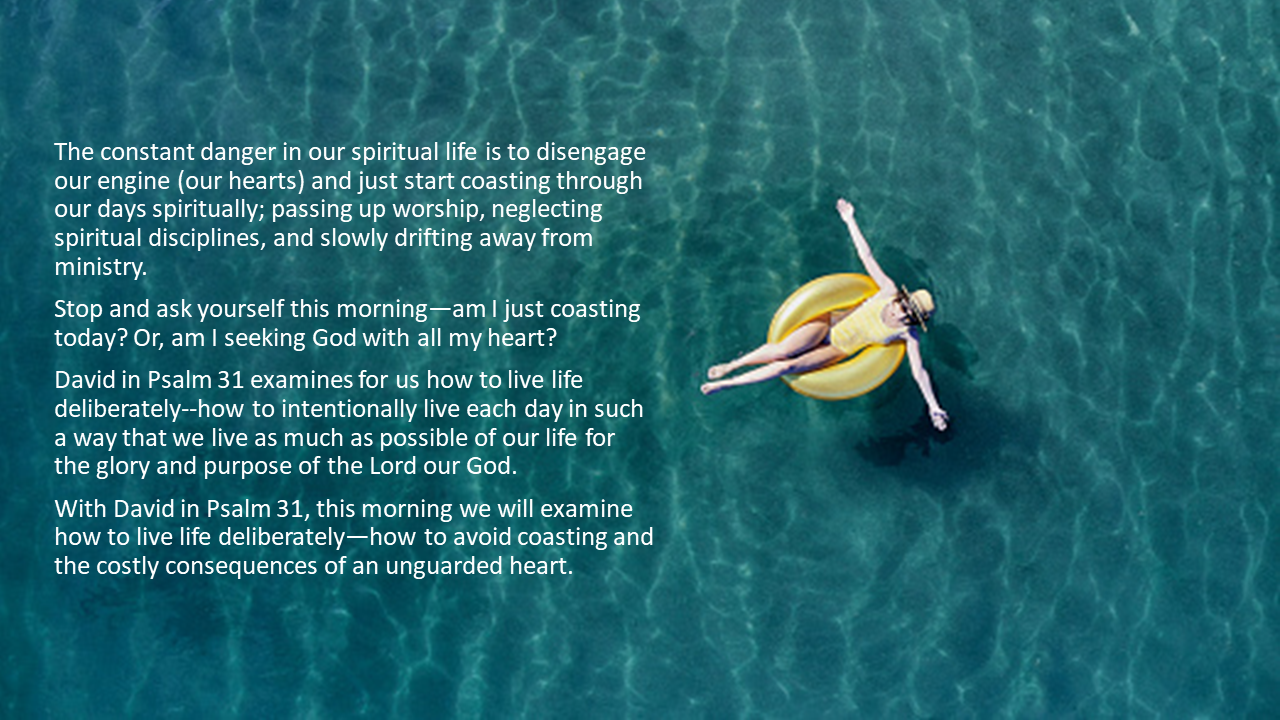
The constant danger in our spiritual life is to disengage our engine (our hearts) and just start coasting through our days spiritually; passing up worship, neglecting spiritual disciplines, and slowly drifting away from ministry.
Stop and ask yourself this morning—am I just coasting today? Or, am I seeking God with all my heart?
David in Psalm 31 examines for us how to live life deliberately–how to intentionally live each day in such a way that we live as much as possible of our life for the glory and purpose of the Lord our God.
With David in Psalm 31, this morning we will examine how to live life deliberately–how to avoid coasting and the costly consequences of an unguarded heart.
Scholars are divided as to who wrote this Psalm because it reflects such a kaleidoscope of settings. Most seem to think it was probably David reflecting back across the seasons of his life.
That is where I see this Psalm.
Psalm 31 is a Psalm written—
- after the events of I Samuel 11-12 (David’s sin and repentance),
- after the year of painful chastisement recorded in Psalm 32,
- after the magnificent prayer of repentance and return of Psalm 51, and also
- after the painful dash to the wilderness by David–away from his rebel son Absalom, recorded in Psalm 3.
Psalm 31 is a reflective Psalm that David wrote to capture his choice to return and deliberately live his life one day at a time; building upon the lessons he has learned in both triumphs and failures. This Psalm is quoted directly by Jesus, Jonah and Jeremiah.1
In Psalm 31 David looks back over his life and tries to find when he stopped seeking the Lord with his whole heart. He reflects upon God’s Hand in his life in the past. Then he resolved to once again make intentional choices, careful steps and measured responses to each event he faced.
We saw this so clearly in Psalm 3 in David’s initial response to Absalom’s rebellion. He wept and worshipped, fled and cried to God for help. All that he did was done very carefully.
As we have noted with each of David’s Psalms, they are the personal diary of the man God notes is after His heart. David’s Psalms are about the experiences of the man God emphasizes by writing more about him than anyone else who ever lived.
David learned a strong lesson from his failures and sins and all of that convinced him that he must spend the rest of his days living deliberately for God.
Turn with me to Psalm 31 as we stand and read David’s song about how to again wholeheartedly live each day of our life for God.
Pray

WITH ALL MY HEART
There is a short chorus we sing from time to time that sums up David’s longing in Psalm 31.
“With All My Heart” With all my heart I want to love You Lord, and live my life each day to know You more. All that is in me is Yours completely; I’ll serve You only, with all my heart.
After his crash, David was so careful. He guarded his heart, and he harnessed his moments. He was deliberate about his spiritual life, he wasn’t coasting. He had a new focus for his life, and it was:
Live deliberately for God—No Coasting Allowed!
The dictionary defines that word for us.
De·lib·er·ate·ly adv. With careful consideration, or deliberation; circumspectly; warily; not hastily or rashly; slowly; as, a purpose deliberately formed; as words and actions said or done on purpose. A life not hurried. Is that where you are with God today? Or are you coasting?
A Short Definition: intentional
Some Antonyms: A person who does not act deliberately acts–by chance, indeterminately, unintentionally, unmethodically, unsystematically, unwittingly.
In Psalm 3 we saw how David learned to face abuse and danger, and even go to sleep in the face of both—peacefully. That was the first lesson Absalom’s rebellion taught him by God’s grace.
Today we come to the next lesson God had for him. David learns in this time of consequence was that he must live deliberately. No spiritual coasting through life.
- No more of this boredom stuff like the night he padded out of bed in his slippers and peeked over the rooftops looking for something to interest him.
- No more unplanned situations he walks into defenselessly.
- No more unguarded moments where in an instant of passion he caused a lifetime of heart aches.
- No more! David says, I am renewing my walk with the Lord.
Living deliberately for God means I am going to deliberately plan to neglect anything that hinders my walk as Romans 6 commands.
Living deliberately for God means choices to live—
- by careful consideration as I count the cost as Jesus said in Luke 14.28;
- circumspectly as Paul said in Ephesians 5.15;
- warily of the devil my prowling adversary as Peter said in I Peter 5.8;
- not hastily or rashly as James warned in James 1.19.
So living life intentionally, on purpose, deliberately for God is the theme of Psalm 31, as we see David draw inspired lessons from three eras of his life.
Look down at them in your Bible, and trace them with me. Note that the first 22 verses are David talking to God about running, not running, and again running.
1. Psalm 31:1-8 reflects lessons David learned in his running from Saul years.
2. Psalm 31:9-11 reflects lessons David learned in his not running from Bathsheba year.
3. Psalm 31:12-22 reflects lessons David learned in his running from Absalom years.
Now, let’s walk through this Psalm section by section and see the ways that David learned from his troubles; lessons that helped him walk the rest of his days intentionally for the Lord.

First David explains to us the lessons he learned from all those years of running for his life from Saul. Look at Psalm 31:1-8 with me.
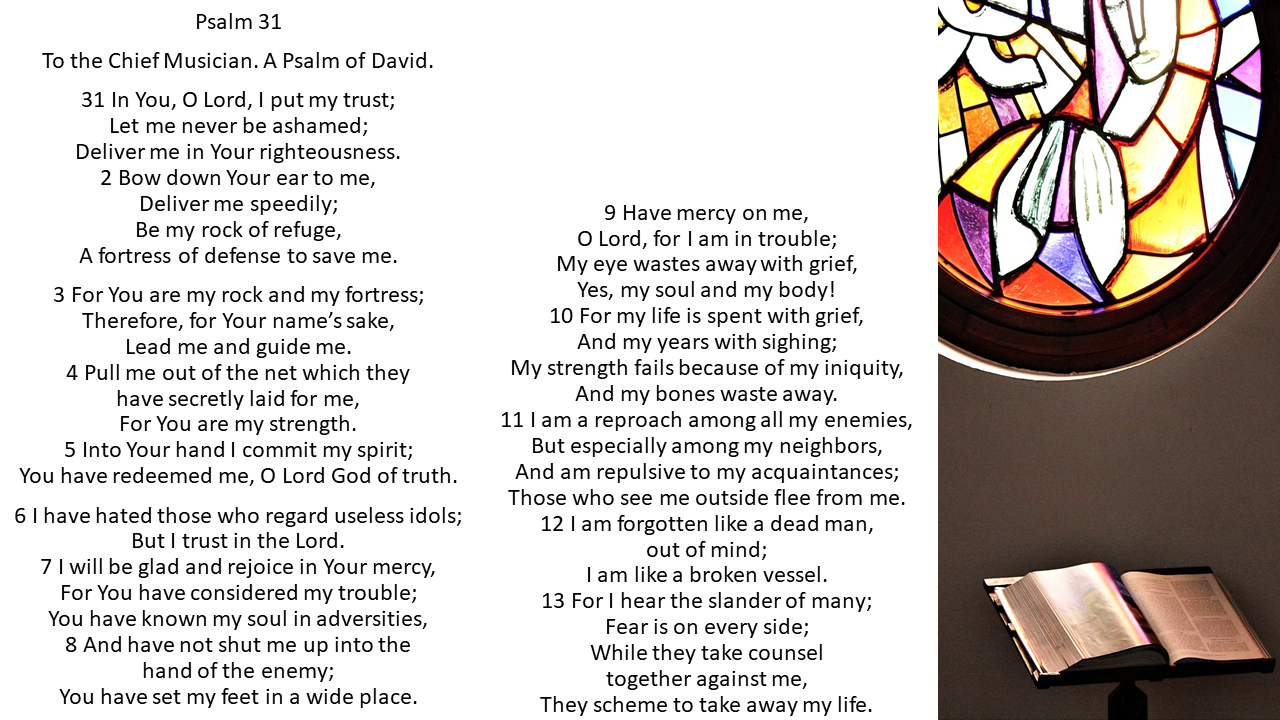
Psalm 31.1-4 In You, O Lord, I put my trust; Let me never be ashamed; Deliver me in Your righteousness. v. 2 Bow down Your ear to me, Deliver me speedily; Be my rock of refuge, A fortress of defense to save me. v.3 For You are my rock and my fortress; Therefore, for Your name’s sake, Lead me and guide me. v. 4 Pull me out of the net which they have secretly laid for me, For You are my strength. (NKJV)
David seems to start this Psalm by reflecting upon all his years on the run from King Saul, fleeing from one cave to another, from one wilderness fort to another.
That is where David found that God and God alone can be the place where we safely rest. In verse one David says I put my trust (chacah [2620] v. ‘to seek refuge; to trust’) Then he uses four different nouns to describe how he found the Lord as his place of safety. This security David finds in God is seen in the usage of
- Rock/Strength (NKJV 31.2,4 maowz [4581] ‘fortress, stronghold, strong’); o Refuge (NKJV 31.2 tsuwr [6697] ‘cliff, rock wall’);
- Fortress of Defense/Fortress (NKJV 31.2-3 matsuwd [4686] ‘fortress’ also word for Masada in Israel today, for any of you that have gone to the Land of the Book and seen that majestic refuge).
- Rock <different Hebrew word> (NKJV 31.3 sehlah [5553] ‘rock, stronghold’ as in Psalm 18).
So David uses every word in the Hebrew language he could find for rocks, mountain top fortresses, and strongholds to sing of God’s great security that was available. These graphic pictures symbolizing the comfort and help found by David in the Lord, come from his years of running from King Saul. In those years Saul’s vast superiority in both numbers and strength were blunted by David’s ability to hide in and out of the many caves, canyons, and rocks of the wilderness.
As he looks back he draws from that time of intense fear and shares his hope that rests firmly in the Lord. He is intentionally going to walk forward through this time of testing and consequence—not running from the problems.
Remember how David is so clear even in the word order. The “in You, O Lord” precedes the “I put my trust”. God is first, He is the source, the target and the point of all David is doing from now on.
When David stepped out once all on his own, he fell deep into sin with Bathsheba. No more, he is putting the Lord first. As we read this section, have you ever come to this deliberate moment in your life?
- Have you said in your heart and at the center of your will—Lord You are first?
- Have you said in your heart and at the center of your will—Lord You come ahead of me, my plans, my desires, my way?
- If not, as I read David’s words again, why not surrender to Him right now?
Even more specifically it seems that David was reflecting upon one of the darker days of those years. David had asked God if he should rescue the fellow Jews of Keilah a town in Judah, from attack by their enemies. David delivers them but as I Samuel 23.1-13 records, after rescuing them, they betray David to Saul and would have given him over to Saul’s murderous intentions.
David may have wanted to make the city of Keilah his safe fortress against Saul, but it turned out to be a false hope and a worthless refuge.
God wanted David to learn that as those natural outcroppings gave David a safe haven all those years–so the supernatural Presence of the Lord, who was always there and always able to protect, was the real Rock, Refuge, and Fortress.
David refers to the Lord in this way often in the Psalms (Psalm 18-19; 28; 61-62; and 71).
David fills the Psalm with statements to the Lord that “You are…”, afterward applying those in his time of need by saying to himself by faith—“…then be…”.
Why not try that in your life?
Carefully go through the Word and declare what God is as revealed by His Word.

Then in faith declare deliberately—
- God you are a Rock, then be my Rock.
- God you are Strength, then be my Strength.
- God you are a Refuge, then be my Refuge.
- God you are a Fortress of Defense, then be my Fortress of Defense.
And then each time you’re in the Word, stop when you find a truth about God. Repeat the truth back to God in the “You are” form. Pause and by faith say, “Then be…”
This is how we can derive the greatest comfort and strength from God’s Word. We open to the Lord in His Word and let Him declare that He is something. Then we believe Him enough to declare “You are…then be to me”… and apply what He is to our lives!
Drop down to the next verse. Here is another treasure. See if you recognize v. 5.
Psalm 31.5 “Into Your hand I commit my spirit; You have redeemed me, O LORD God of truth.(NKJV)
After three and one half years of public ministry, after six long hours of horrific suffering on the cross—Jesus lifts His head one last time, pulls Himself up on the spikes to let out His final words in Luke 23:46.
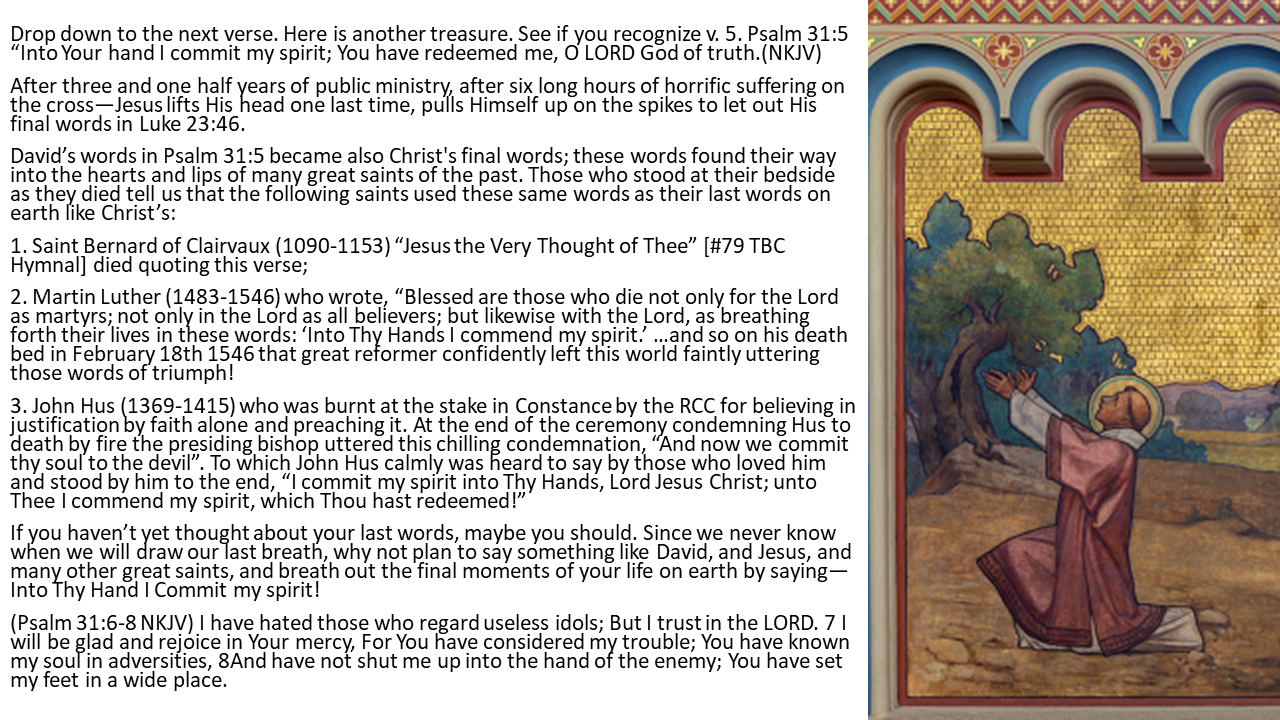
David’s words in Psalm 31:5 became also Christ’s final words; these words found their way into the hearts and lips of many great saints of the past. Those who stood at their bedside as they died tell us that the following saints used these same words as their last words on earth like Christ’s:
1. Saint Bernard of Clairvaux (1090-1153) “Jesus the Very Thought of Thee” [#79 TBC Hymnal] died quoting this verse;
2. John Hus (1369-1415) who was burnt at the stake in Constance by the RCC for believing in justification by faith alone and preaching it. At the end of the ceremony condemning Hus to death by fire the presiding bishop uttered this chilling condemnation, “And now we commit thy soul to the devil”. To which John Hus calmly was heard to say by those who loved him and stood by him to the end, “I commit my spirit into Thy Hands, Lord Jesus Christ; unto Thee I commend my spirit, which Thou hast redeemed!”
3. Martin Luther (1483-1546) who wrote, “Blessed are those who die not only for the Lord as martyrs; not only in the Lord as all believers; but likewise with the Lord, as breathing forth their lives in these words: ‘Into Thy Hands I commend my spirit.’ (J. J. Stewart Perowne, in loc.) and so on his death bed in February 18th 1546 that great reformer confidently left this world faintly uttering those words of triumph!
If you haven’t yet thought about your last words, maybe you should. Since we never know when we will draw our last breath, why not plan to say something like David, and Jesus, and many other great saints, and breath out the final moments of your life on earth by saying—Into Thy Hand I Commit my spirit! (Psalm 31.6-8 NKJV) I have hated those who regard useless idols; But I trust in the LORD. 7 I will be glad and rejoice in Your mercy, For You have considered my trouble; You have known my soul in adversities, 8And have not shut me up into the hand of the enemy; You have set my feet in a wide place.
Next, David expresses his trust in the Lord by affirming four truths2 that he held to in time of trouble:
1. David trusted in the fact that God was well aware of all his trouble (31.7a “I will be glad and rejoice in Your mercy, For You have considered my trouble”). God was aware and close by in every bit of his agony.
2. David trusted in the fact that God responded to his anguishing soul (31.7b “You have known my soul in adversities”). When God sees something we are struggling with it is not merely that He just notices it, He also responds and comes to help us in our time of need.
3. David trusted in the fact that God did not hand him over to his enemies (31.8a “8And have not shut me up into the hand of the enemy”). God will keep us from falling and is very near to us in time of need. He promises that we are more than conquerors through Him who loves us.
4. David trusted in the fact that God set his feet in a wide place (31.8b “You have set my feet in a wide place”). Since God is faithful, always had been—David knew that all he needed to do was trust in Him! The memory of a past deliverance can bear the fruit of a present confidence.

Next David explains to us the lessons he learned from those not running from Bathsheba year. Look at Psalm 31:9-11 with me.
(Psalm 31.9-11, NKJV) Have mercy on me, O Lord, for I am in trouble; My eye wastes away with grief, Yes, my soul and my body! 10 For my life is spent with grief, And my years with sighing; My strength fails because of my iniquity, And my bones waste away. 11 I am a reproach among all my enemies, But especially among my neighbors, And am repulsive to my acquaintances; Those who see me outside flee from me.
David moans in these verses that it was just not worth it—the moment of stolen pleasure was repaid with months of unbearable tortures. Look at how many different ways David describes all that he went through: trouble, wasting with grief, years of sighing, strength fails, bones waste away, reproach, repulsive, fled from.
None of these woes are recorded in either II Samuel or I Chronicles where David’s biography is written by God. It is only here in the Psalms, his personal diary. David was very aware of sin’s high cost. He wanted to avoid any more headlong plunges into sin– and so should we!
Next David explains to us the lessons he learned from those running from Absalom years. Look at Psalm 31:12-22 with me.
(Psalm 31.12-14, NKJV) I am forgotten like a dead man, out of mind; I am like a broken vessel. 13 For I hear the slander of many; Fear is on every side; While they take counsel together against me, They scheme to take away my life. 14 But as for me, I trust in You, O Lord; I say, “You are my God.”
The fearsome times of being chased and hunted to the death is described by David using a curious word in Hebrew. He says in Psalm 31.13 ‘fear is on every side’ which is the translation of the Hebrew words magor mishaviv. Jeremiah uses this same phase 6 times to describe those final days as Judah was besieged and destroyed by the relentless Babylonian armies (6.25; 20.3-4, 10; 46.5; 49.29; Lam. 2.22).
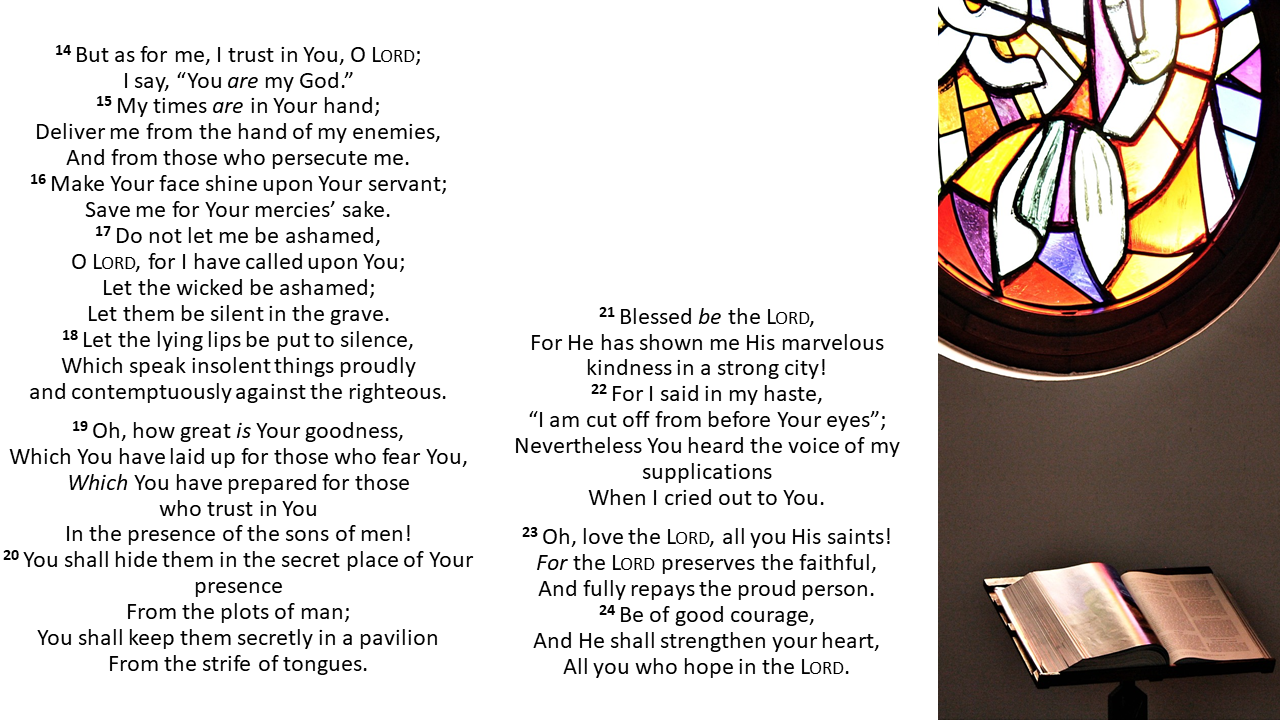
(Psalm 31.15-18, NKJV) My times are in Your hand; Deliver me from the hand of my enemies, And from those who persecute me. 16 Make Your face shine upon Your servant; Save me for Your mercies’ sake. 17 Do not let me be ashamed, O LORD, for I have called upon You; Let the wicked be ashamed; Let them be silent in the grave. 18 Let the lying lips be put to silence, Which speak insolent things proudly and contemptuously against the righteous.
31.15 “My times are in your hands”.
David was confident that every part of his life was held by God. This morning each of us, where ever we are on the path of life should affirm this same truth with David.
- This means that the times of our youth are in God’s hands—when others make decisions for us. He guides, He directs, He protects, and He works all things together for His good.
- This means that the times of our career are in God’s hands—every choice, every victory, every defeat, all our accomplishments, all our possessions, all our troubles and triumphs. He is guiding them, and if we will just let Him, He fashions all of our life for His glory.
- This means that the times of our decline are in God’s hands—when our days run out, when our starting of new projects ceases, even then God holds those days and wants to bless them with His presence and power. He cares for us and wants to make those final years the best of all (Psalm 92). Remember that God is never surprised; nothing gets past the boundaries of His good, acceptable and perfect will (Romans 12.2). We just need to see that in all things God works for our good (Romans 8.28) and wants us to be contents in all things He allows to come our way (Philippians 4.11).
(Psalm 31.19-22, NKJV) Oh, how great is Your goodness, Which You have laid up for those who fear You, Which You have prepared for those who trust in You In the presence of the sons of men! 20 You shall hide them in the secret place of Your presence From the plots of man; You shall keep them secretly in a pavilion From the strife of tongues. 21 Blessed be the Lord, For He has shown me His marvelous kindness in a strong city! 22 For I said in my haste, “I am cut off from before Your eyes”; Nevertheless You heard the voice of my supplications When I cried out to You. 31.19-20 The goodness of God.

George Gallup once found in his studies that “highly religiously motivated” people had a much higher quality of life, had fewer divorces, had less strife with others, and had more involvement helping others. But all those factors only give a tiny reading of what the goodness God gives brings to the lives of His children. Most of what God does is unseen by outsiders. His constant comfort in time of need is unknown to them. So is the indescribable rapture we find in those times we connect with God in worship and praise. Those outside Christ never know the assuring strength of His Presence we feel in the darkest of times and places. They never have felt the strength of seeing immediate and other times long awaited answers to prayer—when we are struck with the fact that God heard us and has responded. But all of this, great as it may seem is nothing compared to what is coming! As David said early on in life in Psalm 23.5-6, what we have now is wonderful, but what is coming is best. Alexander MacLaren (1826-1910) a Baptist pastor in Scotland once wrote these words as he preached on these very verses a century ago:
Here we see, sometimes, the messengers coming with the one cluster of grapes on the pole. There we shall live in the vineyard. Here we drink from the river as it flows; there we shall be at the fountain-head. Here we are in the vestibule of the King’s house, there we shall be in the throne room, and each chamber as we pass through it is richer and fairer than the one preceding. Heaven’s least goodness is more than earth’s greatest blessedness. All that life to come, all its conditions and everything about it, are so strange to us, so incapable of being bodied forth or conceived by us, and the thought of Eternity is, it seems to me, so overwhelmingly awful that I do not wonder at even good people finding little stimulus, or much that cheers, in the thought of passing thither. But if we do not know anything more—and we know very little more—let us be sure of this, that when God begins to compare His adjectives He does not stop till He gets to the superlative degree and that good begets better, and the better of earth ensures the best of Heaven. And so out of our poor little experience here, we may gather grounds of confidence that will carry our thoughts peacefully even into the great darkness, and may say, ‘What Thou didst work is much, what Thou hast laid up is more.’ And the contrast will continue for ever and ever; for all through that strange Eternity that which is wrought will be less than that which is laid up, and we shall never get to the end of God, nor to the end of His goodness.3
And then note that the last two verses are different; they are not addressed to the Lord but to all others. In verses 23-24 he is exhorting all who will listen. Up to Psalm 31:23 all 22 previous verses are spoken to the Lord—now David talks to us.
(Psalm 31.23-24, NKJV) Oh, love the LORD, all you His saints! For the LORD preserves the faithful, And fully repays the proud person. 24 Be of good courage, And He shall strengthen your heart, All you who hope in the LORD.
- He says love the Lord like I do “Oh, love the Lord, all you His saints!” (31.23a). The Lord knows our deepest desires and responds to them.
- He says trust the Lord like I do “For the Lord preserves the faithful” (31.23b). God always looks at our hearts.
- He says fear the Lord like I do because He “fully repays the proud person” (31.23c). Don’t mess with the Lord; He has built into this universe the inescapable laws of the consequence engine.
- He says wait for the Lord like I am “Be of good courage, and He shall strengthen your heart” (31.24a). Fear not is the most repeated negative prohibition in God’s Word and God means it. Fear is the Devil’s playground. Fear disables us, debilitates us, and robs us of joy and peace. Ask for and receive God’s heart strengthening treatments. As much as you would seek the cardiologist for blockages, seek the Great Physician for strength.
- He says hope in the Lord like I will “All you who hope in the Lord” (31.24b). Here David uses that great Hebrew word yachal which denotes ‘trusting hope’. This is the hope that Job, David, Ezra and Jeremiah all clung to, trusting God through the darkest days, longest nights, and most uncertain times. May I remind you of their trusting hope once again?
(Job 13.15 KJV) Though he slay me, yet will I trust in him: but I will maintain mine own ways before him.
(Psalm 42.5, 11; 43.5 KJV) Why art thou cast down, O my soul? and why art thou disquieted in me? hope thou in God: for I shall yet praise him for the help of his countenance. Why art thou cast down, O my soul? and why art thou disquieted within me? hope thou in God: for I shall yet praise him, who is the health of my countenance, and my God. Why art thou cast down, O my soul? and why art thou disquieted within me? hope in God: for I shall yet praise him, who is the health of my countenance, and my God.
(Psalm 71.14 KJV) But I will hope continually, and will yet praise thee more and more.
(Psalm 119.43, 49, 74, 81, 114, 147 KJV) And take not the word of truth utterly out of my mouth; for I have hoped in thy judgments. 49ZAIN. Remember the word unto thy servant, upon which thou hast caused me to hope. 74They that fear thee will be glad when they see me; because I have hoped in thy word. 81CAPH. My soul fainteth for thy salvation: but I hope in thy word. 114Thou art my hiding place and my shield: I hope in thy word. 147I prevented the dawning of the morning, and cried: I hoped in thy word.
(Lamentations 3.21, 24 KJV) This I recall to my mind, therefore have I hope. 22It is of the LORD’S mercies that we are not consumed, because his compassions fail not. 23They are new every morning: great is thy faithfulness. 24The LORD is my portion, saith my soul; therefore will I hope in him. 25The LORD is good unto them that wait for him, to the soul that seeketh him.
1 31.13 terror Jeremiah uses this phase magormisbib 6x (6.25; 20.3-4, 10; 46.5; 49.29; Lam. 2.22). Also Jonah quotes 31.6 in Jonah 2.6. David opens Psalm 71 with the same words. But most significantly, Jesus used Psalm 31.5 as His last words on earth in Luke 23.46.
2 James Boice, Psalms, vol. 1, Grand Rapids: Baker Books, p. 271.
3 http://www.ccel.org/ccel/maclaren/psalms.ii.xxi.html
Slides




Check Out All The Sermons In The Series
You can find all the sermons and short clips from this series, David’s Spiritual Secret here.
Looking To Study The Bible Like Dr. Barnett?
Dr. Barnett has curated an Amazon page with a large collection of resources he uses in his study of God’s Word. You can check it out here.