
If the video above is not available, here are two other ways to view:
David – Living Life Purposefully
061008PM
DSS-42
Psalm 71
Transcript
.jpg)
In order to finish the 71st psalm, let’s turn to 2 Corinthians 4 because in 2 Corinthians 4 we find a New Testament parallel to the lessons that David was learning. And I’m looking this evening from the perspective of life in the future tense. We saw this morning that David survived all of the difficulties and struggles of Psalm 71:1-13 by living in the present tense, saying that this is what the Lord is doing in my life now. But he faced the uncertainties of the future by making a series of resolves that were life in the future tense. And to help see how the Spirit of God works in our lives, 2 Corinthians chapter 4. And in just a moment we’re going to be looking at verses 7 onward.
.jpg)
But the older we get, and we’re talking about elder David speaking here about how to grow old in godliness. The older we get, the harder it is for us to hide our true feelings. You find out when you’re young, and you don’t like something, you can still smile and act like everything’s okay, but usually older people get right to the point, right away. They’re very direct. And so, it’s harder because we become more and more transparent with our feelings and fears, to hide them. And God has designed it that way so that our clay pot, and that’s what 2 Corinthians 4 tells us we live in, we live in a fragile clay pot, this body. And the more this pot weakens and starts to crack, the more what’s inside of us begins to show to those on the outside. The Apostle Paul says, the idea God had in designing us in this fragile, aging, weakening body is that he wanted the treasure of Jesus Christ to show more and more and more, the more we crack and wear out and weaken. And that’s the concept that living life in the future tense is all about. Letting His glory show.
Paul refers to this as he explains the struggles of life that he faced as an apostle, starting in verse 7. As he wrote to the church in Corinth, he says this, we have this treasure in earthen vessels. In fragile, very breakable clay pots. That the excellence of the power may be of God and not of us. God wants the treasure that’s within us to spill out and shine forth from our lives. That’s why he put them in such fragile containers, not for us to hold them tightly and keep it inside, but for us as our weaknesses and troubles in life buffet us, as we will see buffeted Paul for that treasure to show. It’s of course, humanly impossible for this to happen.
That’s why, as David in the Old Testament spoke at the end of his life, he said that it was the power of the Holy Spirit. In fact, one of the clearest descriptions of the Holy Spirit in the Old Testament is in David’s testimony, of how he made it to the end of life. He said that it was the Spirit of God within him, that worked through him. 2 Samuel 23:2. That’s the same thing that the Apostle Paul tells us here. Paul tells us it’s the precious Spirit of the Living God living within us. It’s God’s grace and power through His Spirit that is our only source of strength to live, in weakness, to die with the treasure showing for His glory.
.jpg)
Start looking at verse 8 with me because this is how hard life was. Even when life is rough, as rough as Paul’s explanation, we should let our treasure be evident. Verse 8. 2 Corinthians 4, on every side, being in tribulation, but not straitened, perplexed, but not in despair. Verse 9. Persecuted but not forsaken. Cast down but not destroyed. Verse 10, at all times, the dying of the Lord Jesus bearing about in this body that the life also of Jesus in our body may be manifested. Verse 11, for always are we who are living delivered up to death because of Jesus, that the life of Jesus also may be manifested in our dying flesh. Verse 12, so that the death indeed in us doth work and the life in You. Verse 13, and having the same Spirit of Faith according to that which has been written, I believed therefore I did speak. We also do believe, therefore also we do speak. Verse 14, knowing the He who did raise up the Lord Jesus, us also through Jesus shall raise up and shall present it with You. And verse 15, for all things are because of You that the grace having been multiplied because of the thanksgiving of the more, may abound to the glory of God. Verse 16, wherefore we faint not, but if also our outward man doth decay… another indication of the aging process. Continuing in verse 16, yet the inward is renewed day by day. And then in verse 17, Paul describes his whole ministry life and all the troubles I just listed off and read to you for the momentary light matter of our tribulation. Now there’s a divine perspective. Paul called 20 years on the run, beaten, stoned, imprisoned, floating out there in perils in the sea, and everything else, he calls that a momentary light matter of our tribulation. More and more exceedingly, and age during weight of glory does work out for us. Verse 18, for we are not looking to the things seen, that’s this moment, but to the things not seen. For the things seen are temporary, but the things not seen are age enduring.
Now, that was an old translation in 1862 by the same man that did the concordance. He also did an incredible word for word literal translation of the Greek New Testament, which you see the wording sounded backward because that’s how the Greek text is. But the idea is Paul is saying, I endure the present because I see the future, and that is really the essence of this life in the future tense.
.jpg)
Now let’s go to the 71st psalm, because I want to finish the second half of it. We just began the first half this morning, and this evening we’re going to look at the second half. And as we look at the second half, we’re looking at what Jesus reminds us we have to look forward to. We have to finish life in order to get His well done. We have to finish life well in order to get His, well done good and faithful servants. And so, Christ’s well done is what any of us would call ending well. And the second half of the 71st psalm is the key that the Apostle Paul was talking about in 2 Corinthians, that forward look, and that David describes in incredible detail. And I just want to take the time this evening to go through each of these future tense words that the Apostle Paul in the New Testament was living by and David in the Old Testament was affirming as his future resolves. If you weren’t here this morning I shared with you the first 13 verses, and I’ll just summarize them.
.jpg)
In Psalm 71, David, first of all, lists off the unending struggles he faced in the present. In fact, this whole series about David’s life, I call David’s Spiritual Secret: Facing Life’s Unending Struggles. A message about Christ that doesn’t say that life is a struggle, is a life that denies the text. Paul said that we are fellow struggles. He called the Christian life a sun-agōnizomai in Greek, agonizing is how we transliterate in English. He said, we agonize together through life. Life is an unending struggle. We are wrestling against principalities and powers and all the spiritual realm. We’re also wrestling against our own flesh. And those two cause life to be very difficult when you add in all the circumstances that we go through. And so, because of that, this is what David mentions in Psalm 71:1-2. David reminds us that as we get older, confusion increases. Now confusion, we’re confused for moments here and there through life, but the older we get confusion just increases more and more. That’s why the Apostle Paul said, put on that helmet. Keep your mind garrisoned because it’s so important, because confusion increases. Secondly, in verses 3 through 8, insecurity increases. Then we saw this morning in verse 9, our weakness increases in every realm, physically, mentally, emotionally, every realm. Verse 10, trouble increases. And finally, where we’re going to pick up this evening, David concludes with testifying in verses 11, 12, and 13 that aloneness increases.
And this morning I noted with you that David talks 23 times in the present tense in those first 13 verses. They’re all present tense and I emphasized them as we read through. Those verses and those present tenses flow from living each day aware that God is working out His plan through the struggles of life. He said, my life, yes, I have all the problems and pains and struggles and toils and difficulties, but he said that’s only one track of life. The other track is, he says, I have God’s presence. I have His promises. I have all of His plans for my life. And I have a choice of either always spending my time looking at all the problems I’m having or spend my time looking through those problems at what God is doing. And that two track way of life is what made David such a man after God’s own heart. He saw Absalom coming, but he says, God, Absalom’s coming and You’re my refuge. And so, as Absalom comes for me, I’m going to flee to You. And he just used his problems to experience the Lord more.
But here in Psalm 71, starting in verse 14, David shifts his focus away from the troubles of life that he’s having and had, and he does something very significant. He begins looking at the ones which lie ahead, and sometimes that’s a little scary for us. But he was realistic. He knew that his troubles were only going to increase, and he knew that his weakness was only going to decrease. And so, he could see laid out ahead of him a rough road ahead. And so, he talks so confidently as he turns the spotlight on the other track of life. He declares his intentions in a, from now on I will, a form of saying from now on I will do this, from now on I will do that. And I like to call these his resolves. His resolves to live life in the future tense, that I will as I face this, do this and that. He said God has been faithful in the past and for the future and for most of all in this present moment, and based on all that, I will do this and that. What a blessing to see David.
.jpg)
Let me just give you these resolves because I’m going to have to punctuate them and then we’ll read the whole text together. At the beginning of verse 14, he says this, I will hope continually. At the end of verse 14 he says, I will praise You yet more and more. Verse 15, my mouth shall tell of Your righteousness. At the beginning of verse 16, I will go in the strength of the Lord because my strength’s waning. At the end of verse 16, I will make mention of your righteousness of Yours only. Then, down in verse 18 in the middle, until I declare Your strength to this generation, Your power to everyone who is to come. And that was a future goal of his. Verse 19, right at the two thirds of the way through the 19th verse, he says this, oh God, who is like You? And then, in the 20th verse he says, talking about oh God he says, shall revive me again? He says, You oh God shall be continually reviving me. He says, every time I get discharged, you’ll recharge me. You’ll revive me by Your Spirit. Verse 21, You shall increase my greatness and comfort. Verse 22, I will praise You. Verse 22, again, I will sing with the harp. Verse 23, my lips shall greatly rejoice when I sing to You. And finally, he says in verse 24, my tongue also shall talk of Your righteousness all the day long. Oh, what a blessing. To learn to live this way. Let’s let those words sink in. As I read this entirety of the psalm.
Let’s stand together for the reading of God’s Word and then for a word of prayer. Starting, and you can follow along with me in verse 14. And as I read these words, let that future tense, life in the future tense, the resolve that no matter what is ahead, I’m going to live this way. Let those just soak into your soul. And then as I pray, you also say, Lord, that’s what I want by Your Spirit’s grace to do.
.jpg)
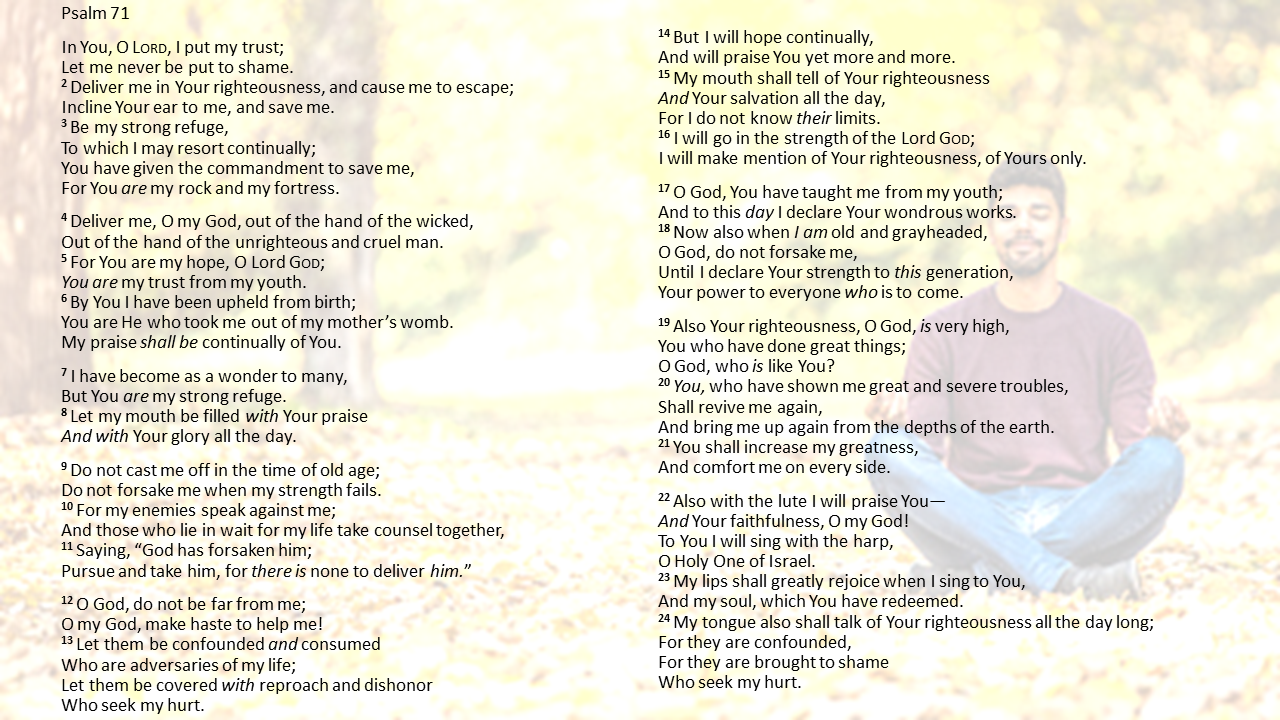
Verse 14. David says, but I will hope continually and will praise You yet more and more. My mouth shall tell of Your righteousness and Your salvation all the day. For I do not know their limits. I will go in the strength of the Lord God; I will make mention of Your righteousness of Yours only. Oh God, You have taught me from my youth and to this day, I declare Your wondrous works. Now also when I am old and gray headed, oh God, do not forsake me until I declare Your strength to this generation, Your power to everyone who is to come. Verse 19, also, Your righteousness, oh God, is very high. You who have done great things, oh God. Who is like You? Who have shown me great and severe troubles, as he’s looking at the other track of life and he says, I’m not denying that, and I’m not ignoring that, and I’m not oblivious to it. You’ve shown me great and severe troubles. Verse 20 continues, You shall revive me again and bring me up again from the depths of the Earth. You shall increase my greatness and comfort me on every side. Verse 22. Also, with the lute I will praise You and Your faithfulness. Oh my God, to You I will sing with the harp. Oh, Holy One of Israel, my lips shall greatly rejoice when I sing to You and my soul, which You have redeemed. My tongue also shall talk of Your righteousness all day long. For they are confounded, for they are brought to shame who seek my hurt.
Let’s bow before our Lord in prayer. And Father, right now, just Your living and abiding Word read publicly is enough. We can respond right now. Your Spirit can energize those words in our lives if we just ask. If we just seek. If we just come before You emptying our ourself out of the place of control of our lives and yielding a new and afresh to You and saying that’s what we want. We want to talk of You all the day long. We want to show Your righteousness. We want to be energized in our praise. We will, when You give us the strength and as opportunity affords itself, we will live this way. Life in the future tense. I will speak of Your greatness. I will talk of Your goodness. I will worship You with all my heart. That’s what David said, and I pray that’s what we would want. And more than that, I pray that that’s what we would do. And Father, tonight, may we not just hear this, but may we make choices on the inside, choices to not merely hear, but to do. In the name of Jesus we pray, amen.
.jpg)
You may be seated, and as you’re seated, I thought long and hard, how do you put a handle on these things? How do we do them? How do they just go from being another word that’s just floating out? They’re hanging out in space. How do we actually make this a part of our lives? Let’s just go through each of these little I wills and I’ll start back with you in verse 13 and get a running start into 14 because David learned and made a choice that he was going to be never giving up. In verse 14, after he talks about all these, we’re seeing his hurt, he says I will hope continually. And that’s where we ended this morning. But I want to start with that first, I will. And David learned to never give up even when he was alone, neglected, sick, ignored, rejected, maligned, and forgotten. Now most of us don’t have all those going at once. But most of us have tasted of one or the other at various times, and he decided that someone else’s departure from him, someone else’s harsh words, someone else’s ill treatment, was not going to keep him from, look back at verse 14, from praising You yet more and more.
Now I don’t usually put in advertisements, but my wife is the most profound living example of this. The first thing that I recognized about her spiritual life is that she praised the Lord in every circumstance. Now I tell you, and I know that I do so jokingly, but often I wake up at night and I look over to see if her wings are showing because I’ve never seen anybody that so completely lives out this continuous praise of God. But all she’s doing is what we’re supposed to do. I guess I should say that she is the most obedient person in this area, I know, because he says I want to, verse 14, praise You more and more. I want more and more and more for me to see the rail of my life, that is all my problems and my struggles and my difficulties and my weaknesses and failures, and I want to see that in light of Your faithfulness, Your mercy, Your grace, Your power, and Your plan for my life. And I want to see that so clearly that I will, like David, praise You more and more. And that’s what David learned. He learned that he could be rejected, maligned, and forgotten by everyone in the world, but not by God. God was never leaving him alone, was never maligning him, would never reject him, would never abandon him. And he, even when in Psalm 13 we saw many months ago, felt abandoned. Even though he felt abandoned by God, his feelings, yet he knew that God would be with him to the end. The first thing he says is, I’m never going to give up.
Look at verse 15. The second thing he says is, I’m never going to stop finding ways to bring God into my conversations. We need to be less concerned about my own little world and start thinking about what God’s plan is for us and how we’re supposed to be involved. Now, look what he says. My mouth shall tell of Your righteousness and Your salvation all day long. What was David? At times he was a shepherd. At other times he was a musician. At other time he was a poet and writer. Another time he was a military attaché to the king, and then he was a commander of a little commando group, and then he was General of the whole army. And of course he was king of the whole country. So, what we could say is he didn’t have a lot of free time or spare time, but at the end of his life, as he looked back at God’s faithfulness and he said, you know what lesson I’ve learned from this? Right there in verse 15, my mouth shall tell of Your righteousness and Your salvation all the day because I don’t know the limits. His love has no limit. His grace has no measure. His power has anything that I can limit and know? No, to me it’s unlimited power, unlimited grace, unlimited love. And he says, I don’t know the limit. As Paul said, the height, the depth of length, the breadth, there’s no limit. And he says, I’m going to talk about that all day long. David was saying, I will learn to never stop finding a way to bring God into the conversation. Let’s talk about that for a minute.
When’s the last time that you intentionally brought God into a conversation where He wasn’t there? That is a constant opportunity. I was sitting at my dad’s 91st birthday dinner on Wednesday night and just sitting there. And we had prayer meeting and everything. They were sitting afterward and we were sitting at this meal and I’m flanked by all people in the ministry. My sister, pastor’s wife, my brother-in-law, wonderful pastor and my dad a zealous soul winner. And they were all sitting there talking and the waitress came up and I could see them all fingering their tracts. And it was like, who’s going to be first to talk to her? And so, I decided, since I was paying the bill, I looked up at her and I said, are you absolutely sure all of your sins are forgiven? And she looked at me. She said, people give me tracts all the time. She said, nobody asked me questions like that. She said, no, I’m not absolutely sure. And then I gave her my tract and I said, you can be. And you see, it was bringing God into the conversation, maybe in a way that would help her to think about it a little more. But when is the last time that you intentionally redirected a conversation? Maybe abruptly like that or maybe coming in around like you heard John and Lacey talk about with their mother and the rotten apple and all those things, that you bring God into the conversation.
What David is saying here is that genuine Spirit prompted communication is focused upon doing that. When the Spirit of God energizes us, it’s [like when] I was at the state fair and I met someone from the church and they went like this. Hi, have you heard? And they were holding their hand out. I said, heard what? I knew what it was. They had recently been engaged, but they just had to bring that up. They just couldn’t stop telling everybody they met at the fair. Have you heard? Have you heard? That love that a newly engaged person has for that one that they’re going to marry and they want to show you is the same love we should have because we are engaged to Jesus Christ and we are anticipating our marriage to Him. And we should want to tell everyone and bring Him into the conversation. So that’s what David does. He learned in verse 15 to never stop finding ways to bring God into the conversation. He said, from now to the future, my mouth shall tell it. It’s my goal in the future from this point onward that my mouth is going to be used to keep introducing You into the conversation. Now tonight, if you miss everything else, there’s one you ought to think about. There’s one that, that you and I can do. You can do it either for evangelism or you can do it for edification. If you hear someone bewailing, say, you know what? Yep. We all have those problems, but you know what? You can flee to the Lord and you can praise Him. And you can find Him your refuge. That’s just a simple way to bring him in to the conversation.
.jpg)
Look at verse 16, because David learned to humbly depend on the Lord. He said this in verse 16, I will go in the strength of the Lord. He says, I’m going to go in your strength. I need You. I can’t do it alone. That’s humility. Do you know what Paul says in Colossians 3? He says that we are supposed to clothe ourselves with humility. We are supposed to consciously put on humility. How do we do that? That’s an abstract thought. Right here in the 16th verse. I will only grow in the strength of the Lord. Tonight, when you go to sleep, do you remember me talking about sleep and what it pictures? Sleep is a time when we lose consciousness of our world around us. It’s a time where we’re totally vulnerable. It’s a time when we acknowledge our weakness. We acknowledge we can’t go on in our own strength. We have to be renewed. It’s a time where we just say, we can’t go on. We are so weak and so unable. That’s a time when we should remember the Lord and say, Lord, as I can no longer go in physical strength, help me not to live a moment in my own spiritual strength because I don’t really have any. I can try, but the arm of the flesh will always fail. When we get up in the morning it’s the same time. You’re coming right out of that unconsciousness, out of that in needed sleep, and when you start the morning you say, Lord, I need You. I can only go in Your strength. I can’t make it on my own. And that is learning to humbly depend on the Lord. But what would keep us from doing this?
Just for a moment, I want you to think about how we would fail to live like David. Here are some attitudes that steal this future tense, humble dependence on the Lord. Number one, we won’t end well unless we resist the attitude of exceptionalism.
Do you know what exception is? That’s when I think that my life, or my situation, or my current struggle is an exception to God’s Word. And when I have exception, I can hear the Word of God preached, I can hear the Word of God shared, but what I say is I excuse myself from doing anything for Heaven because you don’t understand my past or you don’t understand the pain I’m in right now, or you don’t understand my poverty, or I have a poor self-image, so I can’t do that. The problem of exception can erase Christ’s well done because Jesus didn’t say that My strength is sufficient in your weakness except for that weakness, or My grace is sufficient to carry you through except for that problem. Or He says, I can totally give you a life in new beginnings except for that past. He says, My grace is made perfect in whatever your weakness is. Don’t allow the attitude, that flaming dart of the evil one, to enter your mind, that you’re an exception to the rule, that you’re an exception to God’s Word. He said, no. You’re not an exception. I’m not either.
Secondly, we won’t end well unless we resist the habit of assuming our own superiority. This is when we constantly think that we’re more right than anyone else. And that is not having this I will go in the strength of the Lord, verse 16, attitude. It’s not humble dependence. There’s an element of pride of always thinking I am right. It’s when we have the habit of thinking that we are going to build ourself up by tearing down someone else. And there’s, as Paul calls it, he says, watch out for the debaters. There’s some people, they have to be right on everything. They’ll debate about store coupons. They’ll debate about stuff they don’t even know about because there’s this internal attitude of superiority. And that militates against God’s grace because God will not tolerate any habits we maintain of building up ourselves by tearing others down and thinking we’re superior. We won’t end well unless we resist the constant impulse to promote ourselves just as God resists the proud. So, he resists any tendency that we have to take credit for things that were really the idea or work of others, and most of all, that were for God’s glory. The Lord says, My glory I’ll share with no one and I’ll resist you if you proudly want the credit. If you proudly are just waiting to hear some acknowledgement of yourself in the equation, God says, I want you out of the equation. I want you to decrease so that I may increase. Remember John the Baptist? John 3 is, he said he must increase, I must decrease. That concept of us decreasing and Christ increasing is this clothing ourselves with humility.
We won’t end well unless we resist the ease with which we hold a grudge over the slights that we’ve been guilty of committing ourselves. Do you hold a grudge because someone slighted you and yet you’re so upset that someone else won’t forgive you for doing the same thing to them? The Lord says, if we don’t forgive others we face the tormentors. Read sometime, Matthew 18. It’s a little lesson in the consequence engine here on Earth. There is a consequence to having an unforgiving spirit. It quenches the Spirit, grieves the Spirit, and brings about an anguish in our lives, and we need to not hold grudges.
We won’t end well unless we resist our uncanny ability to rationalize. In verse 16, David said, I’ll only go in the future in the strength of the Lord, but sometimes we don’t want to go in the strength of the Lord. We justify and excuse what we do. And the same time, while others do the same things, even over the same issues, were unsympathetic and judgmental with them. We say, it’s okay for me, but then when they do it, we point it out. And we’re so prone to do that. We rationalize our own weaknesses and point out everyone else’s. And that is not this humble, strength of the Lord, prompted life.
And of course, all this means we won’t end well unless we resist all the un mortified pockets of pride in our life. Last week on our Fellowship Sunday. I said that it’s terrible to come out of a church un-edified, un-energized, and un-mortified. What do pockets of pride look like in our lives? It’s when we’re proud of our intellect, when we secretly enjoy the wonderful way that we can command whatever we’re good at. We’re proud of our achievements. We’re proud of our giftedness. We’re even proud of our goodness. Remember the Publican and the Pharisee? And the Pharisee says, I’m glad I’m not as bad as him, or I’m not even like him. I’m not, I don’t do all those things. That’s pride of goodness, which God hates. He calls it filthy rags, our own righteousness. We must not have pockets of pride in our life because it erases Christ saying, well done.
.jpg)
Look at verse 17, because David not only had to learn to humbly depend on the Lord. In verse 17, he says, oh God, You’ve taught me from my youth and to this day, I declare Your wondrous works. David learned to have a lifetime commitment to the Lord. I mentioned it this morning, he said to this day and from now on and he just looked at it as not a part of his life belonged to the Lord and maybe a part here and a part there, he just looked it at as one continuum that his life was a lifelong commitment to the Lord. And I think we need to start looking at life for the Lord that way. It’s not, I’m going to do this heavy duty now but then I’m going to do something later. It is a growing, more and more, commitment of my life. I want the Lord to have, I have all of the Lord but he doesn’t have all of me, and I want Him to have a growing share in everything I do the older I get instead of a lessening share. Have you noticed that some people that kind of check out, just veg? They kind of get to that point where all they do is watch television, or whatever, or amuse themselves. There should be this growing, as he says, You’ve taught me for my youth and to this day I’m going to declare Your wondrous works. I have a lifetime commitment. This is something that I see going to the end. I will do this to the very end.
And he continues that, look in verse 18. He says, and when I’m old and gray headed don’t forsake me. He learned to serve God even when he was out of season. When he was past his prime. When he was old and gray he found as he says here, until I declare Your strength to this generation. He says I’m going to find younger people to keep investing my life in. I’m going to find this generation. I’m going to find those I can pour my life into even when I’m old and weak. That’s when Your strength is made perfect in my life. I know a few people that try this, but those that do never cease to find the joys that God brings when you intentionally seek out young people and try and influence them. One of our veteran missionaries here at TBC is a living example of this, Bill Eddie. If you get his little monthly newsletters, Bill Eddie, his little black and white, front and back, little newsletters he sends out, every month has a picture of him with his arm around someone that’s about 70 years younger than him, or sixty years younger, or he’s in front of a group of them. And what he says at the bottom, if you read it, is I just had the chance to speak about Christ in the elementary school. I just spoke at this mission. I just went to this college campus. I just… You know what he’s doing? He’s doing verse 18. When I’m old and gray headed, don’t forsake me because I am declaring Your strength to this generation, Your power to everyone who is to come. I’m going to keep finding young people to invest my life into. That’s an amazing thought. I think of that every time I walk through Awana and see the older people that risk their lives with all those whirling bodies in Awana so that they can listen to verses, so that they can teach in some section of Awana. Do you know why? They have gotten the message. That’s why it should be that our nurseries are filled with older people. Do you know how much power there is in having a little one that doesn’t have anything else to do but have you talked to them for a whole hour? Do you know what immense reward there is, that God says you never lose? If you passing out cups of water and don’t even talk gets rewarded, can you imagine what talking, encouraging a child with a verse, encouraging a child to enjoy coming to the house of God. Can you imagine what merit that has? David said, I have a lifelong desire to be around young people and to serve them.
.jpg)
Continuing look at verse 19. David learned to never stop experiencing God daily. He said, Your righteousness is very high. You have done great things. Who’s like You? He says I am constantly on the prowl to experience You, oh God every day. It’s not life in the past tense. It’s not like I’ve experienced that. Ah-huh. It was a constant new experiencing God every day. A new relationship growing every day. If I just depended on those old days in college with Bonnie, it would really be a stale marriage. It is a new, fresh, vital learning about each other every day. How much more of the God of the universe, is what David is saying.
I always think of Howard Smith, a man I buried in California, who died at age 96. Howard was one of the most vibrant believers I’d ever met. He was still learning a verse a week as he had committed to do when he got saved in his late sixties. He got saved in his late sixties, felt he was a little behind, and so for 30 years he committed to this habit he had of reading the Bible. Finding once a week, he’d find a good verse and he’d memorize it and add it to all the verses he learned in the past weeks. Do you know how many weeks there are in 30 years? He had learned almost a fourth of the New Testament by heart. The sight I have of him is that he was laying there in bed in a coma, mouth open, just barely gasping at home back when people used to die at home without all the tubes and everything. And there he was dying at home and his precious wife was standing next to him and she says, why didn’t you read from his Bible? And so, she handed me this absolutely falling apart, pages just loose Bible, and I looked at that and I said, what are those check marks? Oh, she said, Howard checks all the verses he finds that he wants to memorize. And I went like this [fanned through the pages] and I barely found a page in the whole Bible that didn’t have blue check marks on it somewhere. And so, I opened to one that he had checked the whole column and I stood next to, comatose, Howard Smith. I started reading out loud so he could hear me. In you, oh Lord I put my trust. And it was so interesting, I watched him and his mouth started moving in sequence with what I was reading. His wife said he knows that part. I said, okay. I kept reading and I skipped a verse. He went, [reacted] I don’t know where he was, but I know something was working because he noticed when I skipped parts of what he had memorized.
I came back because she said he was going to die that day. Howard was. I don’t know how she knew, but I came back. He was still in bed like that. And I read the 23rd psalm to him. He just moved his mouth the whole time and then we went out to have a little cup of tea. She said, don’t go too far. She said, Howard’s going today. I said, okay, I won’t go too far. And all of a sudden, I was standing in the doorway and Howard sat straight up in bed, put both arms out, toothless, they’d taken his dentures out I guess, so he wouldn’t choke on them or something. And he went, Hallelujah. Wham, fell straightforward. I thought, what a way to go, in the strength of the Lord, filled with God’s Word because he had made the choice that he would as verse 19 says, talk about Your righteousness. It’s very high. You have done great things oh God, and there’s nobody like You.
Real quickly, let me go through the rest of them. Verse 20. David learned to see affliction as a blessing. He shown me, he said, you have shown me great, severe troubles. See, he was looking through the lens of God and His Word and His promises that all of his life he looked at it that way and he says, You have shown me these great troubles. And he says, You shall revive me again and bring me up from the depths of the Earth.
.jpg)
Verse 21. David learned to let the Lord be in charge of his life. He says, You shall increase my greatness. You’ll comfort me on every side. You’re in charge of my life. You’re in charge of what You do with me. You’re in charge with comforting me in my weakness, in my troubles.
Verse 22, David learned to never stop using music in his personal worship. Verse 22. I hope that you catch that. In fact, John Piper had a little thing that was mailed around this week about this I’ll comment on. But look what David said, he said, with the lute I will praise You, Your faithfulness, oh my God. To you I will sing with the harp, oh Holy One of Israel. We sometimes fail to realize how powerful music is. John Piper, this week, tells of a demon possessed person that was associated with his church, that he was called out in the middle of the night to go to their home. He took one of the other pastors. And this person was thrashing and violent, knocking the Bible out of their hands, pushing them around, just being horrible. And Piper, after exhausting every verse he could think of, looked at them and started singing a worship chorus about the name of Jesus. And if you read his little letter this week, unbelievable. The person drops to the floor, starts writhing around and begging him to stop. And they sang all the more, until finally the person just laid their limp and didn’t even remember a thing that had happened. Now, I don’t know what your theology of demons is, but as great a theologian as John Piper, he said we should learn to use singing to battle the devil. David learned to praise You in the hardest times, he learned to let the Holy Spirit energize him to sing worship to God. Piper concludes with this, he says, if you’ve read Dick Eastman’s book The Hour that Changes the World. Which I would commend to you too. Everybody, when I went to the Master Seminary, had to read that book and pray an hour a day as one class in the Master Seminary. And if they didn’t, it was a pass, fail course, if you didn’t learn to pray an hour a day, you failed. And if you failed that class, you failed seminary. It was one of the greatest classes. All you had to do is pray one hour, the only assignment, one hour a day for a semester. And it couldn’t be in five minute pieces, it had to be one concurrent, joined together, 60 minutes in that book. He talks about Mary Slesser who worked in China, and she used to say, I sing the doxology to dismiss the devil. And Amy Carmichael of India said, I believe Satan can’t endure singing, so he slips out of the room when there’s true Spirit-filled song. Are you struggling with the ravages of old age? Sing for the Lord, like David.
.jpg)
Just two more. Verse 23. David chose to stay enthusiastic for the Lord. He says, my lips shall greatly rejoice. He was no ho hum, half-hearted. He says to the end, I’m going to be, I’m going to be like Tim Terrific Moore. You ever heard Tim Moore, terrific all the time. Even when he’s sick, even when he doesn’t feel well, we should be enthusiastic for the Lord. And in verse 24, David learned to let God invade all of his life. He said, my tongue shall talk of your righteousness all the day long. God, you’re going to be in every part of my day.
.jpg)
So, looking forward to Christ’s well done means pointing my life, that ending well, it means living purposefully with some holy habits. What are they? I’ll list them all and then we can go. Here are the resolves found in both halves of Psalm 71. David is saying,
- I will flee to God for hope before my troubles drown me.
- I will cry out to God for help before I give into temptations.
- I will trust God’s Word more than my fears before I get paralyzed by them.
- I will seek the Lord over my hurts before I get bitter.
- I will keep reminding myself God is faithful all of my life, to this moment and into the future.
- Number six, I will seek God’s plan for my life every day.
- Number seven, I’ll use my mouth so often to praise God, no room will be left to complain.
- Number eight, I’ll trust the Lord’s ability to rescue me more than EMS the doctors or calling 911.
- Number nine, I’ll never give up even when I’m alone forgotten by most, and out of circulation for the rest of my days.
- Number 10, I’ll never stop looking for people to share a testimony of God’s goodness in my life.
- Number 11, I will humbly go in the strength of the Lord dependent on Him.
- Number 12, I will seek out younger people, and if you read the bulletin, there are a lot of younger people in need of seeking out these days and pass on to them my testimony of God’s goodness and great faithfulness.
- Number 13, I will never stop pursuing God in a deepening experience of knowing Him daily.
- Number 14, I will welcome pain and suffering as God’s perfect tools to shape my life.
- Number 15, I will forsake the stereotypes of the uselessness of old timers. He says, even when I’m old and gray headed, he says, I’m just going to sing and praise and speak for God.
- And finally, I’m going to let God invade my whole day. Not just the start, not just the finish, but all of it. That’s a great way to live in the future tense.
And David says, that’s what I will do. I hope in your heart you’ll grab one of those verses. We looked at one of those concepts attached for that verse. You say, Lord, by Your grace in the power of Your Spirit, I will do that.
.jpg)
Let’s bow for word of prayer. Father, thank you that with David we can say that You are faithful. You who brought us from our mother’s womb will take us safely home to dwell in the house of You, oh Lord, forever. And in between everything that we need we have in You. Let us take it by faith and the power of Your Spirit. In the name of Jesus we pray. And all God’s people said, amen. And God bless you as you go.
Notes

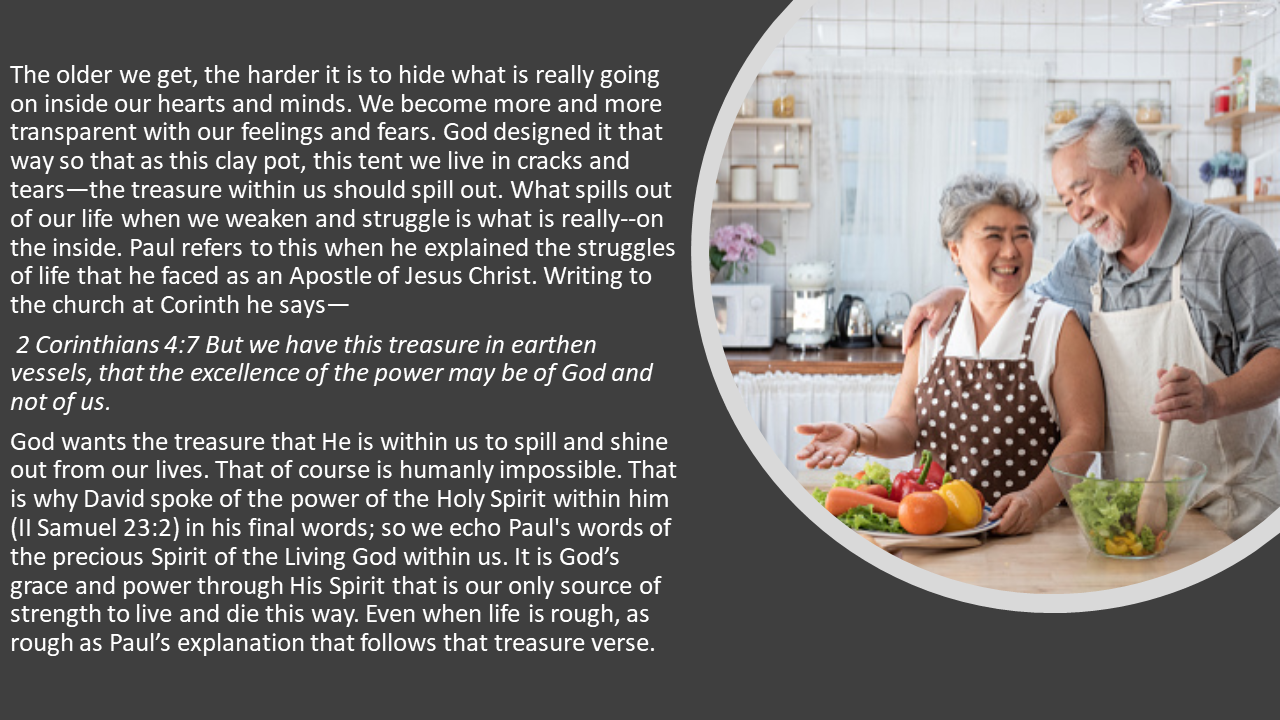
The older we get, the harder it is to hide what is really going on inside our hearts and minds. We become more and more transparent with our feelings and fears. God designed it that way so that as this clay pot, this tent we live in cracks and tears—the treasure within us should spill out. What spills out of our life when we weaken and struggle is what is really–on the inside. Paul refers to this when he explained the struggles of life that he faced as an Apostle of Jesus Christ. Writing to the church at Corinth he says—
2 Corinthians 4:7 But we have this treasure in earthen vessels, that the excellence of the
power may be of God and not of us.
God wants the treasure that He is within us to spill and shine out from our lives. That of course is humanly impossible. That is why David spoke of the power of the Holy Spirit within him (II Samuel 23:2) in his final words; so we echo Paul’s words of the precious Spirit of the Living God within us. It is God’s grace and power through His Spirit that is our only source of strength to live and die this way. Even when life is rough, as rough as Paul’s explanation that follows that treasure verse.
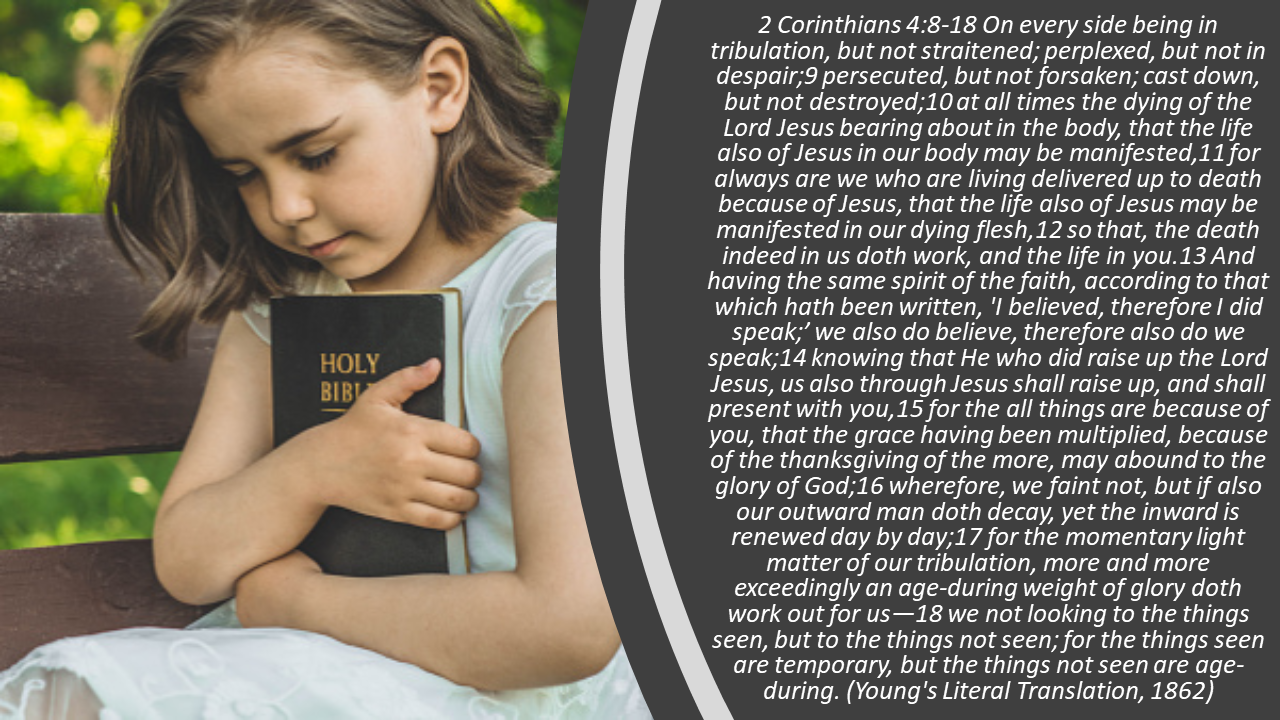
2 Corinthians 4:8-18 On every side being in tribulation, but not straitened; perplexed, but not in despair;9 persecuted, but not forsaken; cast down, but not destroyed;10 at all times the dying of the Lord Jesus bearing about in the body, that the life also of Jesus in our body may be manifested,11 for always are we who are living delivered up to death because of Jesus, that the life also of Jesus may be manifested in our dying flesh,12 so that, the death indeed in us doth work, and the life in you.13 And having the same spirit of the faith, according to that which hath been written, ‘I believed, therefore I did speak;’ we also do believe, therefore also do we speak;14 knowing that He who did raise up the Lord Jesus, us also through Jesus shall raise up, and shall present with you,15 for the all things are because of you, that the grace having been multiplied, because of the thanksgiving of the more, may abound to the glory of God;16 wherefore, we faint not, but if also our outward man doth decay, yet the inward is renewed day by day;17 for the momentary light matter of our tribulation, more and more exceedingly an age-during weight of glory doth work out for us—18 we not looking to the things seen, but to the
things not seen; for the things seen are temporary, but the things not seen are age-during. (Young’s Literal Translation, 1862)
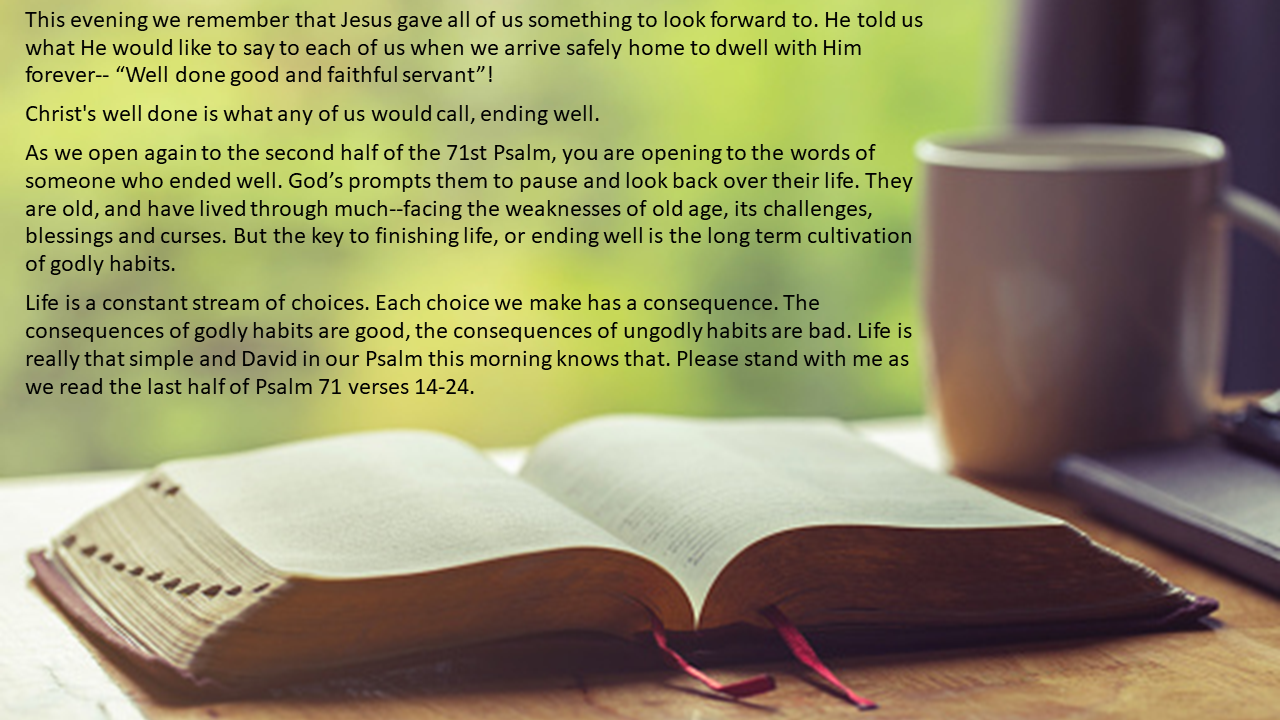
This evening we remember that Jesus gave all of us something to look forward to. He told us what He would like to say to each of us when we arrive safely home to dwell with Him forever– “Well done good and faithful servant”!
Christ’s well done is what any of us would call, ending well.
As we open again to the second half of the 71st Psalm, you are opening to the words of someone who ended well. God’s prompts them to pause and look back over their life. They are old, and have lived through much–facing the weaknesses of old age, its challenges, blessings and curses. But the key to finishing life, or ending well is the long term cultivation of godly habits.
Life is a constant stream of choices. Each choice we make has a consequence. The consequences of godly habits are good, the consequences of ungodly habits are bad. Life is really that simple and David in our Psalm this morning knows that. Please stand with me as we read the last half of Psalm 71 verses 14-24.
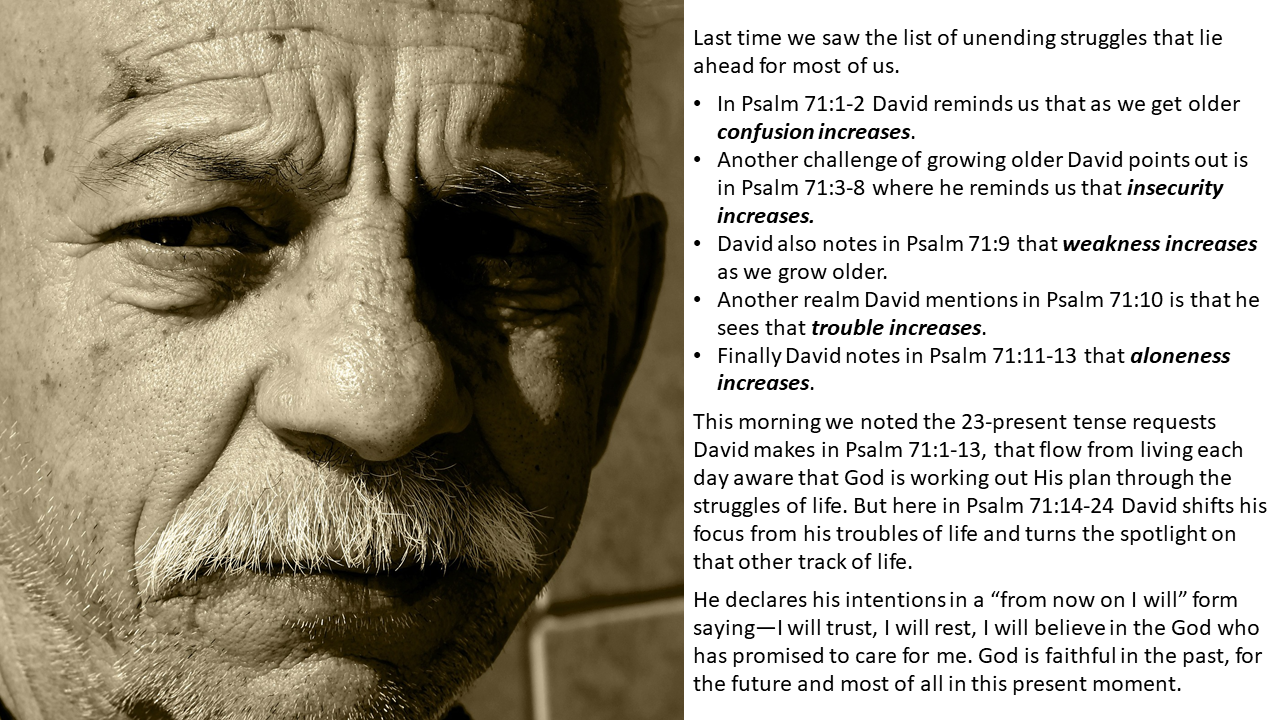
Last time we saw the list of unending struggles that lie ahead for most of us.
- In Psalm 71:1-2 David reminds us that as we get older confusion increases.
- Another challenge of growing older David points out is in Psalm 71:3-8 where he reminds us that insecurity increases.
- David also notes in Psalm 71:9 that weakness increases as we grow older.
- Another realm David mentions in Psalm 71:10 is that he sees that trouble increases.
- Finally David notes in Psalm 71:11-13 that aloneness increases.
This morning we noted the 23-present tense requests David makes in Psalm 71:1-13, that flow from living each day aware that God is working out His plan through the struggles of life. But here in Psalm 71:14-24 David shifts his focus from his troubles of life and turns the spotlight on that other track of life.
He declares his intentions in a “from now on I will” form saying—I will trust, I will rest, I will believe in the God who has promised to care for me. God is faithful in the past, for the future and most of all in this present moment.

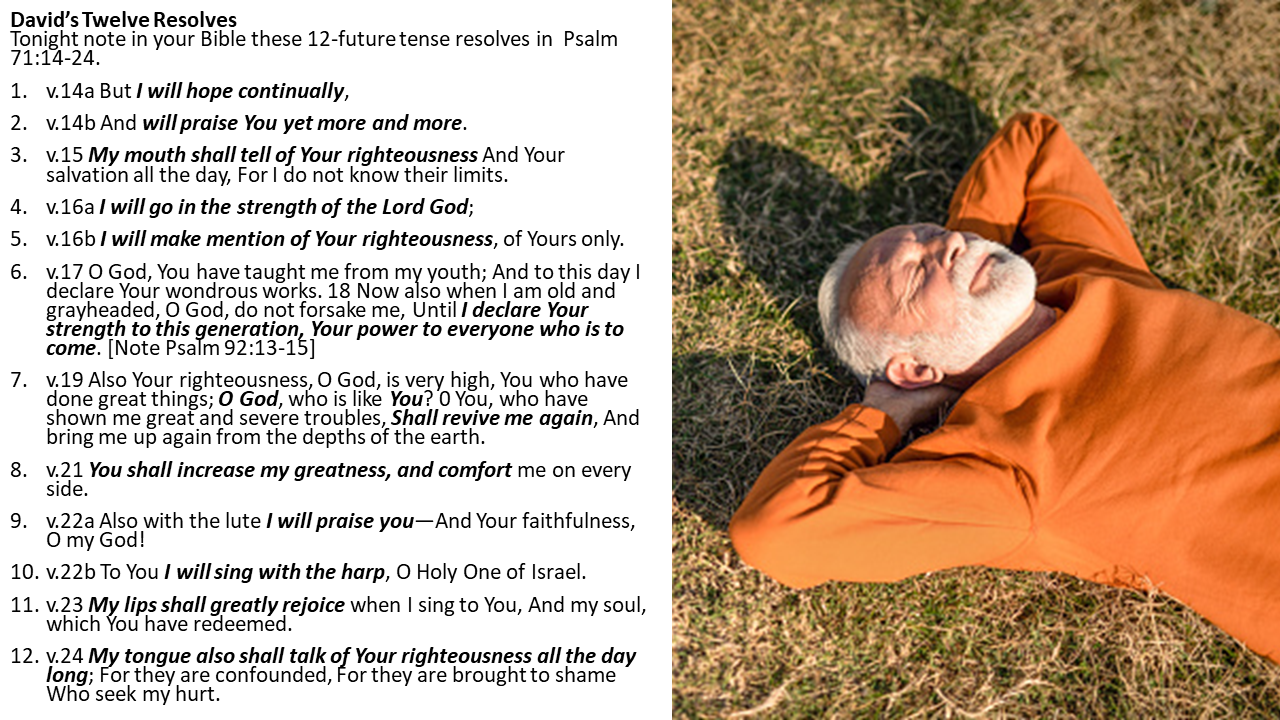
David’s Twelve Resolves
Tonight note in your Bible these 12-future tense resolves in Psalm 71:14-24.
1. v.14a But I will hope continually,
2. v.14b And will praise You yet more and more.
3. v.15 My mouth shall tell of Your righteousness And Your salvation all the day, For I do not know their limits.
4. v.16a I will go in the strength of the Lord God;
5. v.16b I will make mention of Your righteousness, of Yours only.
6. v.17 O God, You have taught me from my youth; And to this day I declare Your wondrous works. 18 Now also when I am old and gray headed, O God, do not forsake me, Until I declare Your strength to this generation, Your power to everyone who is to come. [Note Psalm 92:13-15]
7. v.19 Also Your righteousness, O God, is very high, You who have done great things; O God, who is like You? 0 You, who have shown me great and severe troubles, Shall revive me again, And bring me up again from the depths of the earth.
8. v.21 You shall increase my greatness, and comfort me on every side.
9. v.22a Also with the lute I will praise you—And Your faithfulness, O my God!
10. v.22b To You I will sing with the harp, O Holy One of Israel.
11. v.23 My lips shall greatly rejoice when I sing to You, And my soul, which You have redeemed.
12. v.24 My tongue also shall talk of Your righteousness all the day long; For they are confounded, For they are brought to shame Who seek my hurt.
Okay, how do you get a handle on all those truths? How about by just taking them one at a time and making them action statements to grab hold of and not merely hear—but start by God’s grace to DO!
David had learned to never give up – even when alone, neglected, sick, ignored, rejected, maligned, and forgotten by everyone in the world —– EXCEPT GOD!
Psalm 71:13 Let them be confounded and consumed Who are adversaries of my life; Let them be covered with reproach and dishonor Who seek my hurt. 14 But I will hope continually, And will praise You yet more and more.
David had learned to never stop finding ways to bring God into the conversation.
Psalm 71:15 My mouth shall tell of Your righteousness And Your salvation all the day, For I do not know their limits.
When is the last time you brought up the subject of the things of God–into a conversation? That is what genuine Spirit prompted fellowship is focused upon doing!
David had learned to humbly depend on the Lord.
Psalm 71:16 I will go in the strength of the Lord God; I will make mention of Your righteousness, of Yours only.
What would keep us from living purposefully like David and ending well? Here are some attitudes that steal our fruitfulness and rob us of rewards:
We won’t end well unless we resist the attitude of exceptionism. This is when I think my life, my situation, my current struggles are an exception to God’s Word. Thus I can excuse myself from doing anything for Heaven because of my past, or my pain, or my poverty, or my poor self-image. The problem of exceptionism can erase Christ’s well done.
We won’t end well unless we resist the habit of assuming our own superiority. This is when we constantly think that we are more right than anyone else. God will not tolerate any habits we maintain of building up ourselves by tearing others down.
We won’t end well unless we resist the constant impulses to promote ourselves. Just as God must resist the proud, so He resists our tendency to take credit for things that were really the ideas or the work of others—and most of all were for God’s Glory and not ours!
We won’t end well unless we resist the ease with which we hold a grudge over slights that we’ve been guilty of committing ourselves.
We won’t end well unless we resist our uncanny ability to rationalize, justify, and excuse what we do and say while at the same time, and even over the same issues, being unsympathetic and judgmental with others.
We won’t end well unless we resist the all the un-mortified pockets of pride in our lives. What do pockets of pride look like? They are when I am proud of my intellect, or proud of my achievements, or proud of my giftedness, or even proud of my goodness.
Pockets of pride in my life can erase Christ’s well done. Remember Lot who was righteous yet lost it all because he thought he could stand and he fell into sin. [3]
David had learned to have a lifetime commitment to the Lord!
Psalm 71:17 O God, You have taught me from my youth; And to this day I declare Your wondrous works.
David had learned to serve God even when he was out of season, past his prime, and old and gray–by finding young people to invest his life into.
Psalm 71:18 Now also when I am old and gray headed, O God, do not forsake me, Until I declare Your strength to this generation, Your power to everyone who is to come.
I know of few people that try this, but those that do never cease to find the joys that God brings when you intentionally seek out young people and try to influence them to seek and follow the Lord. Just like one of our dearest veteran missionaries here at TBC named Bill Eddy!
David had learned to never stop experiencing God daily.
Psalm 71:19 Also Your righteousness, O God, is very high, You who have done great things; O God, who is like You?
Just like Howard Smith at 96 and still learning a new verse each week as he had since the Lord got a hold of him in his late sixties!
David had learned to see affliction as a blessing.
Psalm 71:20 You, who have shown me great and severe troubles, Shall revive me again, And bring me up again from the depths of the earth.
Just like Ezra, Job, Joni Erikson Tada, Phillip Yancey, and many sweet saints suffering this morning!
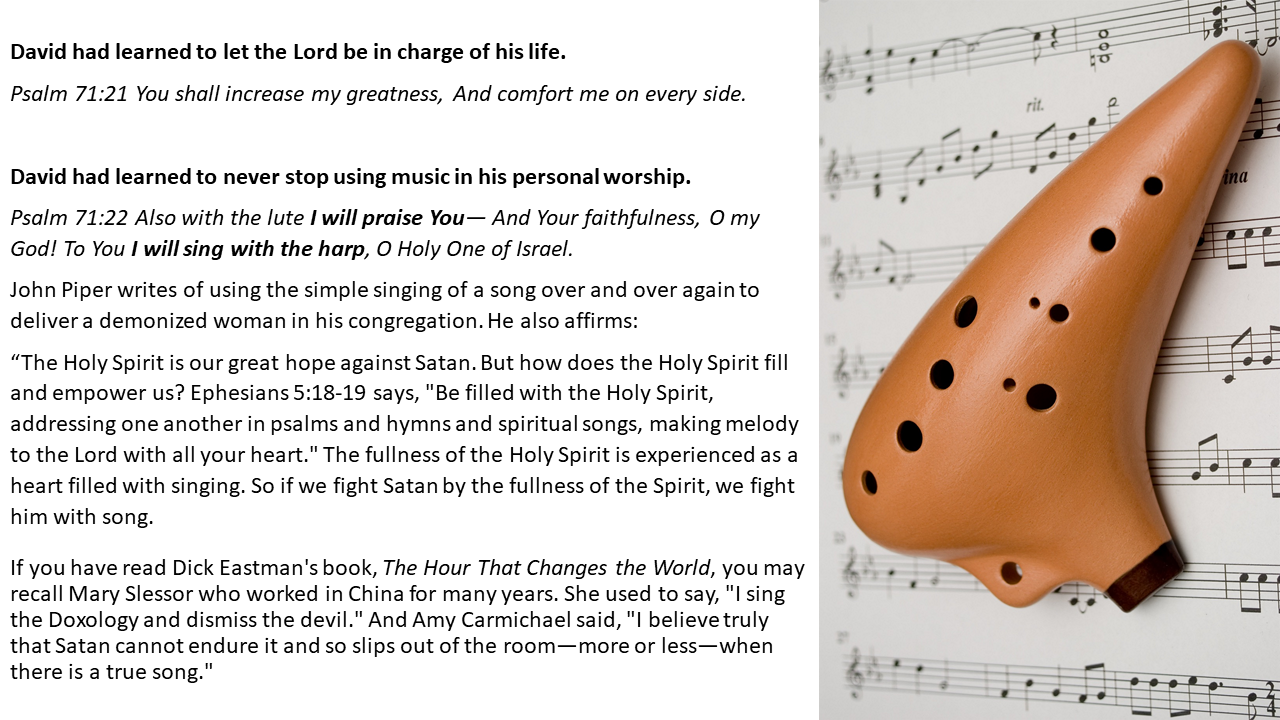
David had learned to let the Lord be in charge of his life.
Psalm 71:21 You shall increase my greatness, And comfort me on every side.
David had learned to never stop using music in his personal worship.
Psalm 71:22 Also with the lute I will praise You— And Your faithfulness, O my God! To You I will sing with the harp, O Holy One of Israel.
John Piper writes of using the simple singing of a song over and over again to deliver a demonized woman in his congregation. He also affirms:
“The Holy Spirit is our great hope against Satan. But how does the Holy Spirit fill and empower us? Ephesians 5:18-19 says, “Be filled with the Holy Spirit, addressing one another in psalms and hymns and spiritual songs, making melody to the Lord with all your heart.” The fullness of the Holy Spirit is experienced as a heart filled with singing. So if we fight Satan by the fullness of the Spirit, we fight him with song.
If you have read Dick Eastman’s book, The Hour That Changes the World, you may recall Mary Slessor who worked in China for many years. She used to say, “I sing the Doxology and dismiss the devil.” And Amy Carmichael said, “I believe truly that Satan cannot endure it and so slips out of the room—more or less—when there is a true song.”[4]

David chose to stay enthusiastic for the Lord.
Psalm 71:23 My lips shall greatly rejoice when I sing to You, And my soul, which You have redeemed.
David had learned to let God invade all of his life.
Psalm 71:24 My tongue also shall talk (hagah = meditate) of Your righteousness all the day long; For they are confounded, For they are brought to shame Who seek my hurt.
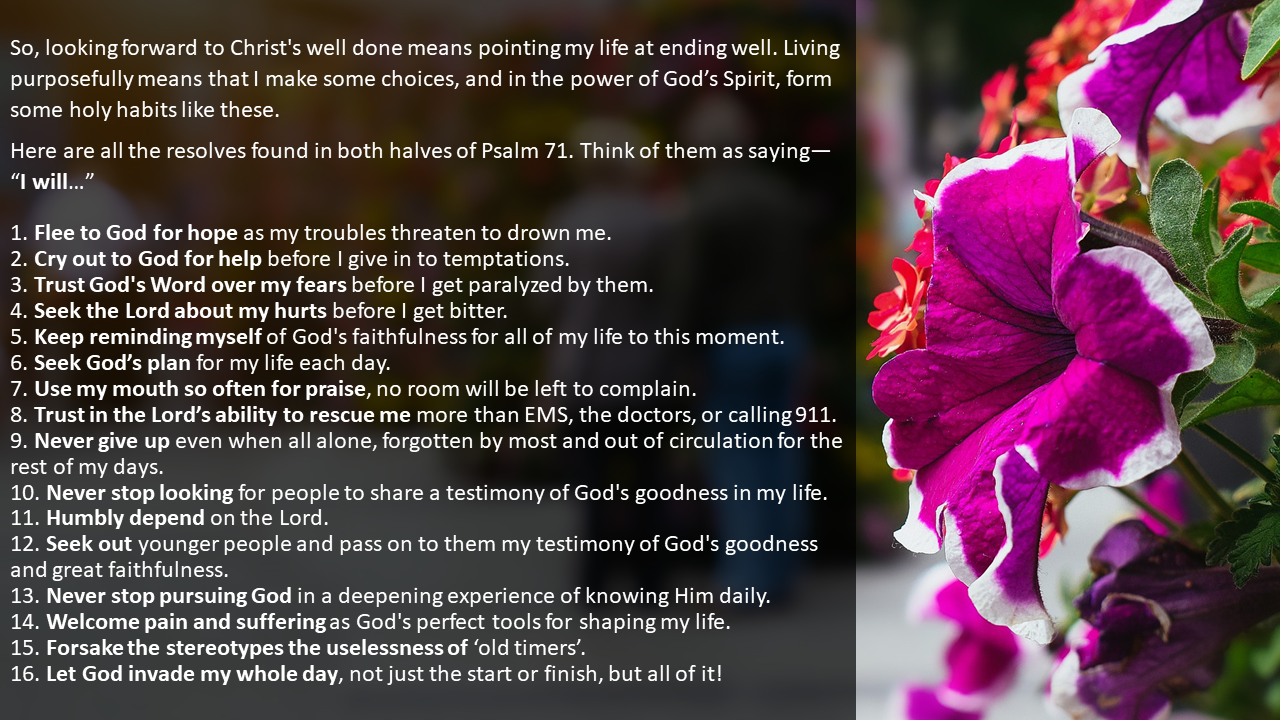
So, looking forward to Christ’s well done means pointing my life at ending well. Living purposefully means that I make some choices, and in the power of God’s Spirit, form some holy habits like these.
Here are all the resolves found in both halves of Psalm 71. Think of them as saying—“I will…”
- Flee to God for hope as my troubles threaten to drown me.
2. Cry out to God for help before I give in to temptations.
3. Trust God’s Word over my fears before I get paralyzed by them.
4. Seek the Lord about my hurts before I get bitter.
5. Keep reminding myself of God’s faithfulness for all of my life to this moment.
6. Seek God’s plan for my life each day.
7. Use my mouth so often for praise, no room will be left to complain.
8. Trust in the Lord’s ability to rescue me more than EMS, the doctors, or calling 911.
9. Never give up even when all alone, forgotten by most and out of circulation for the rest of my days.
10. Never stop looking for people to share a testimony of God’s goodness in my life.
11. Humbly depend on the Lord.
12. Seek out younger people and pass on to them my testimony of God’s goodness and great faithfulness.
13. Never stop pursuing God in a deepening experience of knowing Him daily.
14. Welcome pain and suffering as God’s perfect tools for shaping my life.
15. Forsake the stereotypes the uselessness of ‘old timers’.
16. Let God invade my whole day, not just the start or finish, but all of it!
As I have often told you a pastor from the last century by the name of Thomas Obadiah Chisholm wrote two of my all time favorite hymns. The first in 1917 while unemployed and struggling to find work at age 51 he wrote out a hymn he sang as he plodded along selling things door to door to stay alive. That hymn is in our hymnbooks and is entitled “Living for Jesus”. I love those works of they man who was weak in body but mighty in spirit. But I love it even more because this hymn has a sequel. After writing these words, unemployed, sick and at the bottom when age 51–
Living for Jesus a life that is true, striving to please Him in all that I do, yielding
allegiance, glad-hearted and free—this is the pathway of blessing for me.
Living for Jesus who died in my place, bearing on Calv’ry my sin and disgrace—such
love constrains me to answer His call, follow His leading and give Him my all.
Living for Jesus thru earth’s little while, my dearest treasure the light of His smile,
seeking the lost ones He died to redeem, bringing the weary to find rest in Him.
Chorus: O Jesus, Lord and Savior, I give myself to Thee, for Thou in Thine atonement didst give Thyself for me. I own no other Master—my heart shall be Thy throne: My life I give, henceforth to live, O Christ, for Thee alone.
Thomas Obadiah Chisholm wrote hymn # 43 six years later.
I like to say that the conclusion to Living for Jesus a life that is true is to be able to tell everyone that we meet for the rest of life, “Great is Thy Faithfulness O God my Father”! Would you join me by turning to #372 and reading the refrain and then singing #43 as a start for each of us.
[1] This poem then later appeared in the Christmas edition of “Beacon House News,” a magazine of the Northern Ireland Mental Health Association by Phyllis McCormack.
[2] Osbeck, Kenneth W., Amazing Grace—366 Inspiring Hymn Stories for Daily Devotions, (Grand Rapids, MI: Kregel Publications) 1997.
[3] Adapted from Jan David Hettinga, Follow Me: Experience The Loving Leadership of Jesus, (Colorado Springs, Co: NavPress, 1996, Pages 191-192.
[4] http://www.desiringgod.org/ResourceLibrary/Sermons/ByDate/1985/474_Ambushing_Satan_with_Song
Slides

Check Out All The Sermons In The Series
You can find all the sermons and short clips from this series, David’s Spiritual Secret here.
Looking To Study The Bible Like Dr. Barnett?
Dr. Barnett has curated an Amazon page with a large collection of resources he uses in his study of God’s Word. You can check it out here.