
If the video above is not available, here are two other ways to view:
David – Standing Alone for God
060129AM
DSS-05
1st Samuel 17
Transcript
.jpg)
Let’s open our Bibles to the chapter that is monumental in David’s life. 1 Samuel 17. There’s something about David. We’ve been looking at his life. We’ve seen that David was God’s servant, but because he was God’s servant, and we looked at the end of his life and how he was the wealthiest man, probably by anyone’s measure that’s ever lived, as far as the sheer amount of the world’s wealth he possessed at one time. But that was at the end of his life.
.jpg)
Now, we’re going back to the beginning of his life, and in 1 Samuel 17, we’re seeing another element of what I call David’s spiritual secret. David’s spiritual secret. First of all, he was God’s servant. We’ve been looking and looking and looking at that. Secondly, as God’s servant, David was not only servant-hearted. He had a heart that wanted to stand for God. In other words, I’m calling this: David was willing to stand all alone for God. Not only willing to stand all alone for God, but he would stand all alone for God, even when everyone else was unwilling to stand for God. That is an amazing characteristic of such a young man, and I want to examine that with you.
In fact, in a little while, we’re going to read this huge chapter, 58 verses. It might be the longest one we’ve ever read out loud. But this morning, the record of David and Goliath in chapter 17 is from God’s perspective and what God gives us in this God’s eye view. We’ve heard of a bird’s eye view, but God’s eye as He looks down on it. It is focusing on the fact that David, in every way imaginable, every way that you could calculate, was the only one who saw what was going on, and the only one willing to stand up for God who was being maligned and dishonored. He is in touch with God and stood for the name of the Lord that day.
Remember, David is a person we know more about from God’s perspective than any other human who’s ever lived. Let that sink in. We know more about him from God’s perspective than anyone else who’s ever lived. That’s just the record of the Bible. We have more words written by God about him than anybody else in the Bible. That’s just the way it is. So, we have to start thinking about that.
Why is it that God wrote more words about him? David’s life has been given to us by God to demonstrate just how he lived a life for God’s purposes. We all get to live our lives, but whose purposes, whose agenda, whose plan are we following? And we see how David, at the end of his life, with all of his failures, God would say he fulfilled My purposes. What hope it gives us who want to serve God like that but are often so painfully aware of how we don’t. David is an example for us.
As we have found, David’s first spiritual secret was a heart to serve. David wanted to serve the Lord. He was under God’s command. If God said it, he wanted to do it. That was just his heart. He did what the Lord asked him to do. He was willing to be unseen. He was willing to be obscure. He was willing to do whatever it took, but he just wanted to serve God. A simpler way to say it is that David was God’s servant all of his days.
But this second element in chapter 17 of 1 Samuel about David’s life is that he had a heart to stand. He wanted to identify with the One he served. He wanted to protect, he wanted to honor, he wanted to be known and identified with God. That was what was on his heart. David was willing to serve God even if he was the only one at any particular moment doing so. Just as all of us need to be lifelong servants of God, we also need to decide that we, too, like David, will stand all alone for the Lord.
Now, most of us will never be in the no man’s land between the armies of Israel and the armies of the most advanced technological people of the day, the Philistines. Most of us will never run from the security of one side across the bottom of the valley and go uphill to face an impossible enemy and face them almost basically alone and unarmed. None of us will probably ever do that. In fact, the Philistines are extinct, and so it couldn’t happen. But all of us get the privilege of standing alone for God wherever we live, wherever we work, wherever we go to school. God wants us to stand alone for God. There are many ways we can do that. We can stand alone for God by denying ungodliness.
Before we get into David, 3,000 years ago, how about into our lives tomorrow? We can stand alone for God when we need to deny ungodliness at work, at school, or at home. When the conversation or the entertainment or the activities begin to dishonor the name of the Lord, will we stand for the Lord against it? We’re called, Titus 2:11-13, to deny ungodliness, to not when it touches our lives in any way, whether visually or verbally or just by the circumstances that are starting to coalesce around us. We have to identify clearly with God and not with the ungodliness.
Do you stand alone for God when things start getting bad, when He starts getting dishonored, when it is not something that pleases Him, do you depart? Let everyone who names the name of Christ depart from iniquity. We’re told to do that. When ungodliness in any form touches our lives, we should deny it.
.jpg)
We stand alone for God also, not only by denying ungodliness, but by hungering for the Lord Himself. It’s something about God’s servants. They stand alone by reading God’s Word when they travel, by reading God’s Word and thinking about Him when they’re alone, not just when you’re in the group, not just when you’re in the Bible study, not just when you’re getting ready for your Sunday school lesson or Bible study or coming to church on Sunday. But we stand alone for God when our whole culture is minimizing and trying to ignore Him and saying He’s insignificant, the Lord and the Lord Jesus Christ and His Word, by standing against them, by saying no. As Jesus said, I can’t live by bread alone, but what? By every Word of God.
So, you stand alone for God, not just by denying ungodliness, but by, in a positive sense, sacrificing time. The world doesn’t see any value in seeking God. For example, instead of putting your mind to sleep with all the endless drivel from the television set, how about feeding your spirit and mind by memorizing God’s Word? Why not be up on the latest with God? You know some people, they know everything that’s happening in the farthest corners of the world and know nothing new in their hearts about God.
If you have a relationship with someone, you’re always keeping up with them. One of the ways we stand alone is when the whole world is on the broad way with their back to God and marching as fast as they can against Him, for us to show we stand for God with our faces toward Him, going in a different direction. They say, what is wrong with you? And you say, I am a servant of God. I am not going that way. My life is not an endless amusement, pleasure-filled, merry-go-round life. I am seeking, as Jesus said, not to live by bread alone.
Our world believes Jesus is unimportant and that we are the reason that we live, not Him. The only way to counter that horrible lie is to show that Jesus is what He said. He is the bread we live by. He is the one we live for. David was willing to deny ungodliness.
.jpg)
He was willing to stand for God all alone, and there were a few more lonely spots in all the history of the universe than 1 Samuel 17. David was on the hillside in the Valley of Elah in the no man’s land between the armies of Israel and the armies of the Philistines.
As I’ve read this chapter over and over, I thought it wouldn’t have been something to have been able to have been there that day as a neutral observer and to really just soak it all in. Maybe if you could have had some kind of a camera so that you wouldn’t have gotten hit with a spear or an arrow or something, or one of David’s rocks, and just have been able to hear and see that whole thing. It would make a great, great movie. But just think about the Titanic confrontation between David and Goliath. That’s a scene from Biblical history that stands out as one of the greatest moments that God ever captured for us in the Bible.
It started in the crisp, cool air of a Middle Eastern morning 3,000 years ago. David. A little boy, a youngster by anybody’s measure. As his two little calloused feet slipped quietly out from under the warmth of his wool fleece and into his sandals, carefully next to his wooden cot. In the twilight of the early morning, pre-dawn darkness, possibly this redheaded, possibly teenage boy crept carefully out of the stone house where he lived somewhere on the outskirts of Bethlehem. He was going at his father’s bidding to see his brothers, and with the confidence of integrity, with the joy of purity, young David was on his way to a moment that will never fade from the pages of history.
He walked excitedly on the rocky paths up and down the hills of Judah. The young shepherd boy was headed to the Valley of Elah, just eight miles from his house. Arriving before breakfast, young David eagerly surveyed the eastern rim of the valley. He could see the campfires and tents as they dotted the hillsides. He looked at the army of God’s people, Israel, with a thrill in his heart. And then, with a heart filled with gratitude and wonder, David began striding up between the tents and asking if anyone knew where his brothers from Bethlehem were camping. The special provisions his dad had sent them needed to be delivered, but that was only a part of David’s purpose in coming that morning.
.jpg)
Suddenly, David’s search for his brothers abruptly ended. A loud voice, brimming with evil, began to rumble up the hillsides of that valley. For David longed to see the people who stood for God, but even more, David so loved the God of Israel that He wanted to see Him at work. David had sung to his God on the long vigils of the hills of Bethlehem, caring for his father’s sheep. In fact, his favorite song from the hills where he sat day after day as a shepherd boy was the one he sang to the Lord as his Shepherd. And so, as he heard Goliath’s voice with his Psalm 23 heart, David was God’s man for the most climactic moment of sacred history for David.
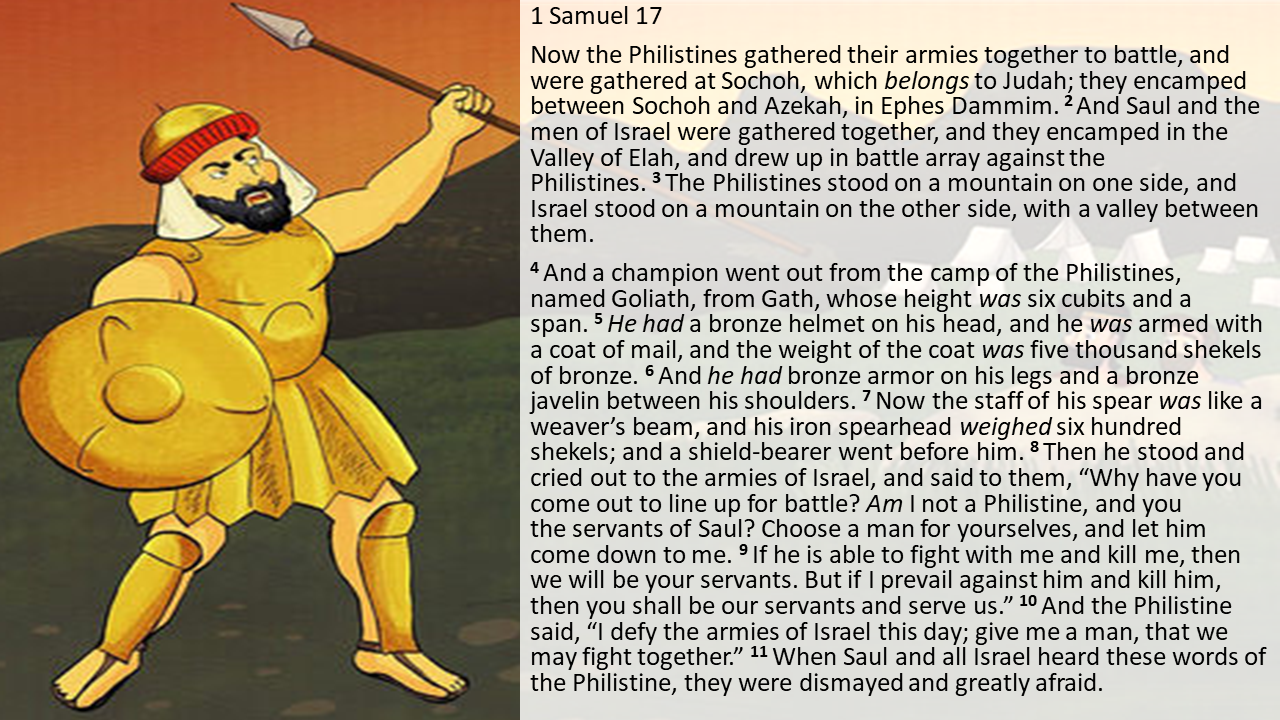
That evil voice rumbling up the hillsides of the valley was coming in the distance from a pillar of armor that encased God’s enemy, Goliath, as he sprayed the venom of the ancient serpent from Eden across the faithless and frightened people of God. Goliath. Goliath, as the King James English puts it, covered with scale armor, almost like the serpent of old, was standing there in defiance, not of Israel, but of their God. David heard that. Goliath, a full three feet taller than Michael Jordan, the basketball player, Goliath easily weighed over 400 pounds, dressed in layers of shining armor that weighed another 150 pounds. At the end of his eight-foot-long pole was a metal spearpoint that weighed almost 20 pounds. Goliath, equipped with the latest military weaponry, was a fearsome sight.
But David. David was shocked and grieved and angered not for himself, but for the One he served, and as he stood there hearing for the first time this irreverent pagan as he reviled the God of Heaven, instantly David wanted to stand for the honor of God at all costs. As we know so well, he did. Unafraid with no concern for himself, he embodies what God can do with all who think only of the Lord and not at all of themselves. With that brief insight, let’s read God’s eyewitness on-the-spot account of the greatest moment. The unseen by all, but David, God defeats the most visible representation of all that God is not, Goliath. That’s 1 Samuel 17.
.jpg)
Let’s stand together for the reading of God’s Word, and then we’ll pray. Now, the Philistines gathered their armies together to battle and were gathered at Sochoh, which belongs to Judah. They encamped between Sochoh and Azekah in Ephes Dammim. And Saul and the men of Israel were gathered together, and they encamped in the valley of Elah and drew up in battle array against the Philistines. The Philistines stood on the mountain on one side, the western side. Israel stood on the mountain on the other side, the eastern side, with a valley between them. And a champion went out from the camp of the Philistines named Goliath from Gath, whose height was six cubits and a span. He had a bronze helmet on his head. He was armed with a coat of mail, and the weight of the coat was 5,000 shekels of bronze. He had bronze armor on his legs and a bronze javelin between his shoulders, and the staff of his spear was like a weaver’s beam, and his iron spearhead weighed 600 shekels, and a shield bearer went before him.
Then he stood and cried out to the armies of Israel and said to them, why have you come to line up for battle? Am I not a Philistine and you, the servants of Saul? Choose a man for yourselves and let him come down to me. If he can fight with me and kill me, then we will be your servants. But if I prevail against him and kill him, then you shall be our servants and serve us. The Philistine said, I defy the armies of Israel this day. Give me a man that we may fight together. When Saul, the tallest, the biggest, and the best fighter in all of Israel, head and shoulders above everybody else, and all Israel heard these things, the words of the Philistines, they were dismayed and greatly afraid. Because Saul knew that, actually, Goliath was asking him to come out, and he didn’t want to.
.jpg)
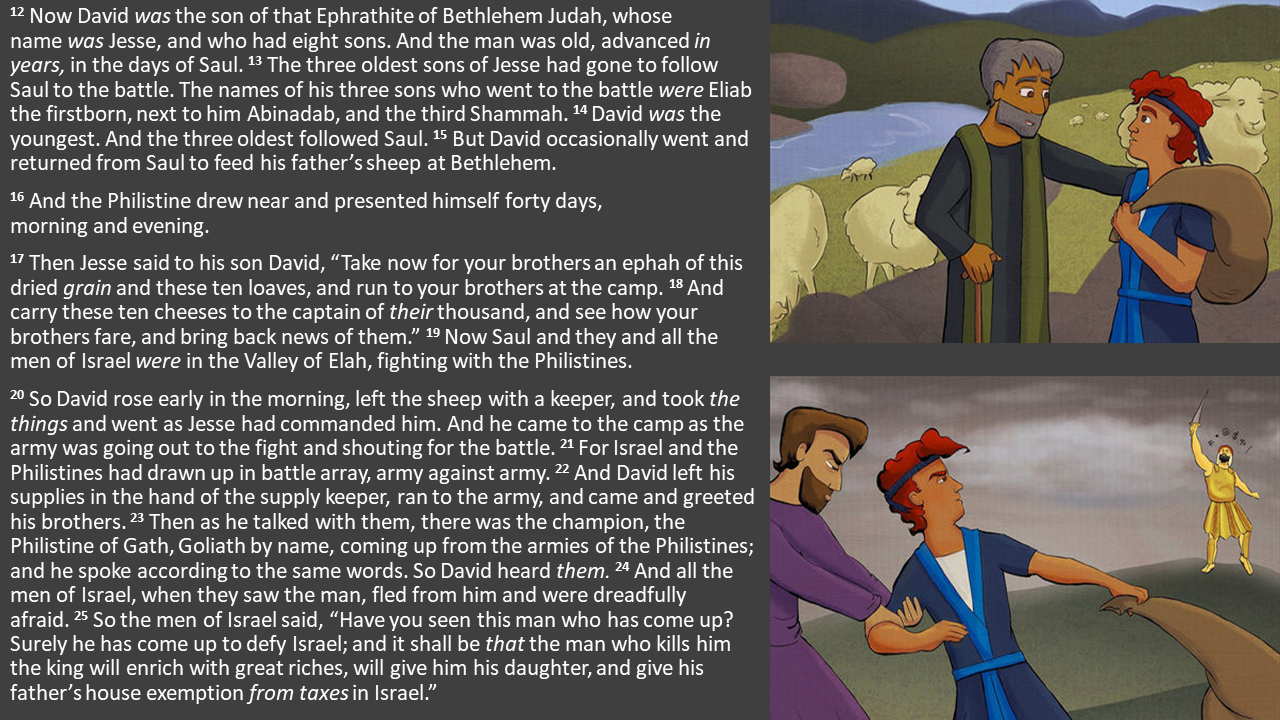
Okay. Verse 12. So, David, the son of that Ephrathite of Bethlehem, Judah, whose name was Jesse, who had eight sons, and the man was old, advanced in years in the days of Saul. And the three oldest sons of Jesse had gone to follow Saul to battle. The names of the three sons who went to the battle were Eliab, the firstborn, next to him Abinadab, and the third Shammah. David was the youngest, and the three oldest followed Saul. But David occasionally went and returned from Saul to feed his father’s sheep at Bethlehem.
And the Philistine drew near and presented himself 40 days. Remember, it’s the number of tests. 40 years in the wilderness and 40 days of Christ with the Devil. 40 is always the number of testing. 40 days, morning and evening. Jesse said to his son, David, take now for your brothers an ephah of this dried grain and 10 loaves and run to your brothers at the camp. And carry these 10 cheeses to the captain of their thousand and see how your brothers fare and bring back news. And so, Saul and all the men of Israel were in the Valley of Elah fighting the Philistines.
Verse 20. So, David rose early. He was disciplined. Remember? In the morning, he left the sheep. Remember, he entrusted them to someone else’s care, with a keeper. He took the things and went as Jesse had commanded him, very obediently. And he came to the camp, and the army was going out to the fight and shouting for the battle. Israel and the Philistines had drawn up in battle array, army against army. And David left the supplies in the hands of the supply keeper, very responsible. He ran to the army. He’s just very enthusiastic, and he came and greeted his brothers. Then, as he talked with them, there was the champion, the Philistine of Gath, Goliath by name, coming up from the armies of the Philistines, and he spoke according to the same words, so David heard them. Obviously, on all of his trips back and forth, he had never heard this before. It was God’s timing today.
Verse 24, and all the men of Israel, when they saw the man, fled from him and were dreadfully afraid, and the men of Israel said, have you seen this man who’s come up? Surely, he has come to defy Israel. And it shall be that the man who kills him, the king will enrich with great riches and give him his daughter and his father’s house, exemption from taxes in Israel.
.jpg)
Then David spoke to all the men who stood by him, saying, what shall be done for the man who kills this Philistine and takes away the reproach from Israel. He’s the only one who saw the real problem here. Clearly, God was being mocked. For who is this uncircumcised Philistine that he should defy the armies not of Saul, but of the living God? And the people answered him in the same manner and said, so it shall be done for the man who kills him. They were only thinking of financial gain. David was thinking of God’s glory.
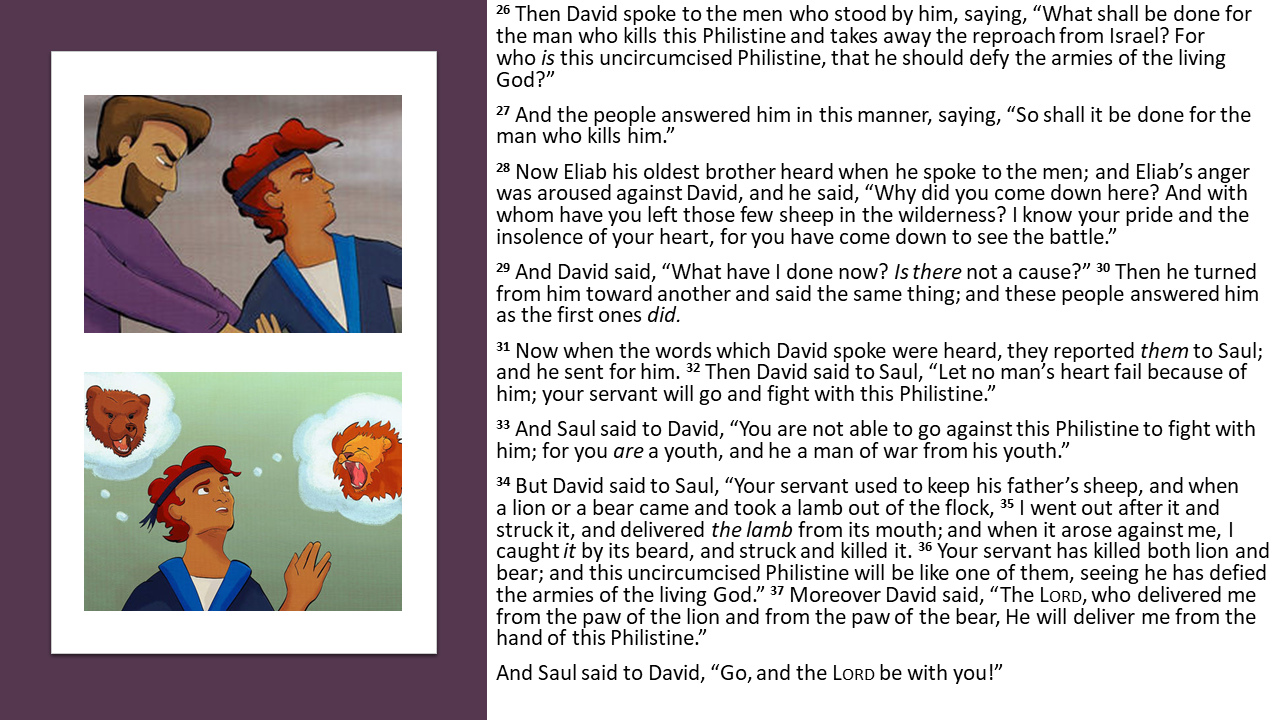
Now Eliab, the oldest brother, heard when he spoke to the man, and Eliab’s anger was aroused against David. He said, why did you come down here, and with whom did you leave those few sheep in the wilderness? I know your pride and the insolence of your heart, for you have come down to see the battle. His first obstacle. David said, what have I done now? Sounds like a younger brother. Is there not a cause? And he turned from him toward another and said the same thing. He was just unstoppable. And the people answered him, as the first ones did.
Verse 31. Now, when the words that David spoke were heard, they reported them to Saul, and he sent for him. Then David said to Saul, let no man’s heart fail because of him. Your servant will go and fight this Philistine. Saul said to David, here’s the second obstacle, you’re not able to go into the Philistine to fight him. You’re just a youth, and he’s a man of war from his youth. David said to Saul, your servant used to keep his father’s sheep, and when a lion or bear came and took a lamb out of the flock, I went after it and struck it and delivered the lamb from its mouth. He was willing to risk his life for one lamb. He says, I’m not afraid. When it arose against me, I caught it by the beard and struck and killed it. Your servant has killed both lion and bear. And if this uncircumcised Philistine will be like one of them, seeing he has defied the armies of the living God. He kept coming back to his master. Amazing, constant desire for God’s honor.
Verse 37. Moreover, David said, the Lord who delivered me from the paw of the lion, not because I’m a great shepherd, but because the Lord is with me, and from the paw of the bear, not because I’m so brave, but because God is with me, He will deliver me from the hand of this Philistine. And Saul said to David, go, and the Lord be with you.
.jpg)
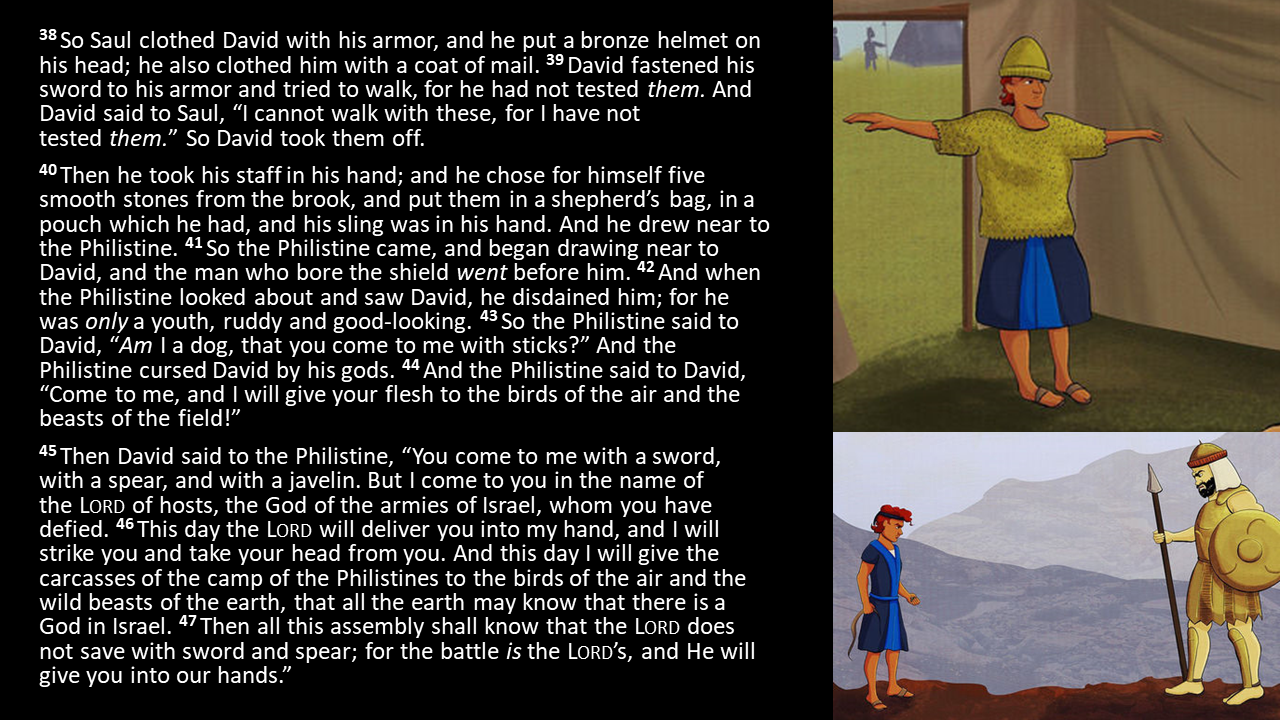
So, Saul clothed David with his armor and put a bronze helmet on his head. He also clothed him with a coat of mail. David fastened the sword to his armor and tried to walk, but he had not tested them. And David said to Saul, I cannot walk with these, for I have not tested them. So, David took them off.
Then he took his staff in his hand. He chose for himself five smooth stones from the brook that happened to be in the center of the valley at the bottom. So, he was already on his way. He went to that brook that divided the two armies. Five smooth stones from the brook, and put them in a shepherd’s bag, in a pouch he had, and his sling was in his hand, and he drew near to the Philistine. So, he’s going uphill now toward the enemy lines.
And the Philistine came and began drawing near to David. The man who bore his shield went before him. When the Philistine looked about and saw David, he disdained him, for he was only a youth, ruddy. That means red, either red-faced or red-haired, or both, who knows? And good looking. So, the Philistine said to David, am I a dog that you come to me with sticks? And this Philistine cursed David by his gods. And the Philistine said to David, come to me, and I will give your flesh to the birds of the air and the beasts of the field. Then David said to the Philistine, you come to me with a sword, a spear, and a javelin. I come to you in the name of the Lord of hosts, the God of the armies of Israel, whom you have defied. This day the Lord will deliver you into my hand, and I will strike you and take your head from you. This day I will give the carcasses of the camp of the Philistines to the birds of the air and the wild beasts of the Earth. Now look at this, that all the Earth may know that there’s a God in Israel. He seemed to be, at that moment, the only one standing for God in the whole nation.
.jpg)
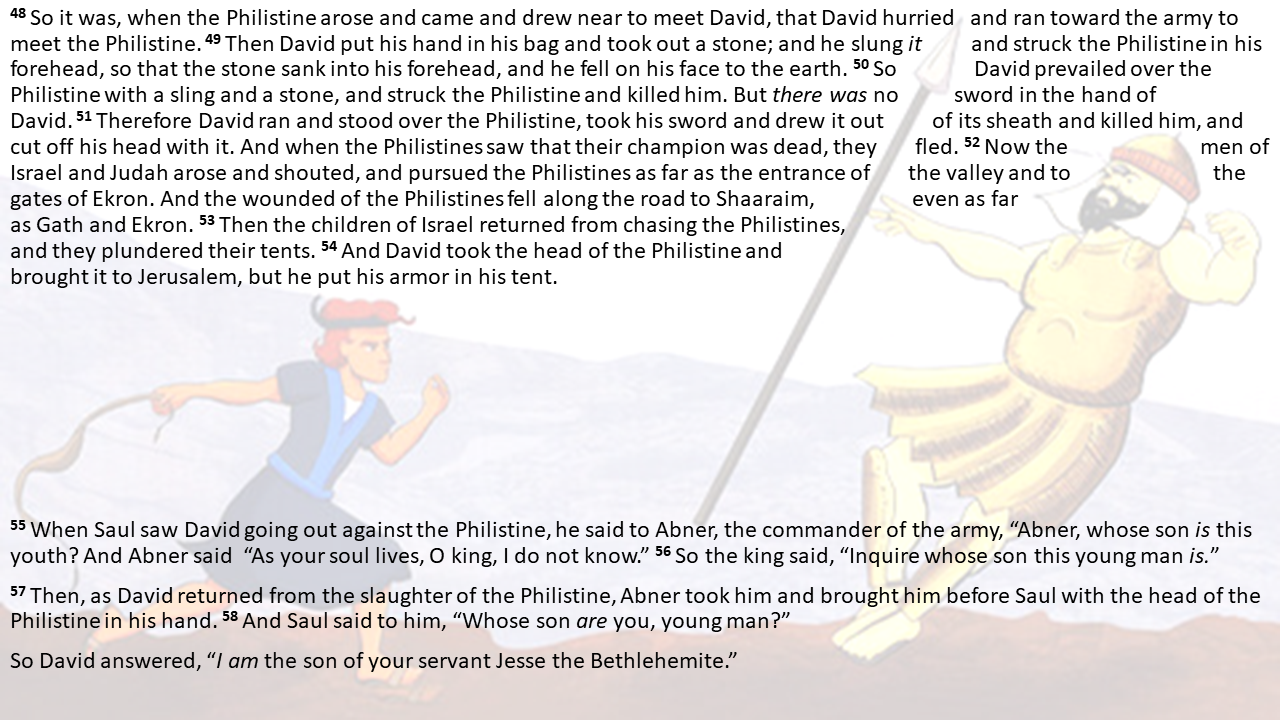
Then David put his hand in his bag, took out a stone, slung it, and struck the Philistine on his forehead so the stone sank into his forehead, and he fell on his face to the Earth. So, David prevailed over the Philistine with a sling and a stone, and struck the Philistine and killed him, and there was no sword in the hand of David. Therefore, David ran and stood over the Philistine, took his sword, drew it out of the sheath, killed him, and cut off his head with it. When the Philistines saw that their champion was dead, they fled.
Now, the men of Israel and Judah rose and shouted and pursued the Philistines as far as the entrance of the valley and to the gates of Ekron. The wounded of the Philistines fell along the road to Shaaraim, as far as Gath and Ekron. Then the children of Israel returned from chasing the Philistines, and they plundered their tents. And while they’re all greedy for gain, David took the head of the Philistine, brought it to Jerusalem, but put his armor in his tent. Remember, in chapter 21, it ends up in the Tabernacle of the Lord.
When Saul saw David going out against the Philistine, he said to Abner, the commander of his army, Abner, whose son is this youth? And Abner said, as your soul lives, oh king, I don’t know. So, the king said, inquire whose son this young man is. Then, as David returned from the slaughter of the Philistine, Abner took him and brought him before Saul with the head of the Philistine in his hand. And Saul said to him, whose son are you, young man? And David answered, I’m the son of your servant, Jesse, the Bethlehemite.
Let’s bow together. Father, thank You for giving us this inspired account of one of the most beautiful and dramatic moments in all of sacred history. Thank You for letting us see what You saw. You saw no one willing to stand up for You, so You took the weakest and most insignificant and the most unknown, and You and they made a majority. Thank You that David saw You. He didn’t go alone. You went beside him. He faced the greatest enemy of the day and defeated that enemy because You defeated that enemy. I pray we’d see that. We can stand alone for You, not in our own strength, not because we’re clever or gifted or talented, but because You are with us always to the end. And You with us are always a majority, always more than conquerors if we will, but only see You and respond to You. Help us to learn to stand all alone for You, oh God. In the name of Jesus, we pray. Amen.
.jpg)
You may be seated. As you’re seated, most people observing what I just read to you saw only two people out there facing one another, but David saw one more person. David saw the Lord, and that made all the difference. He felt that there were three of them out there, and that made him invincible. Just as he had found on the lonely hillsides as a shepherd boy, David learned to fear no evil. Why? For Thou art with me. Thy rod and thy staff, they comfort me as the 23rd Psalm says. See, David went out with the 23rd Psalm heart. He knew that the Lord was with him. He knew that the Lord went before him and protected him, and that’s how he made it through this moment. David believed and thought and sang to the Lord, and what he believed and thought and said was true in his life. God was as real to confident David as the fearsome giant Goliath was to all the quaking Israelite army. David knew the battle was the Lord’s. That’s the first key to standing alone. David, to stand alone, the first choice we see in his life is God-consciousness. David acted just like all of God’s servants who have had great triumphs, have acted.
Look at verse 47, then all this assembly shall know the Lord does not save with sword or spear, for the battle is the Lord’s. That’s what David said. That’s God-consciousness. As David went into the situation, he went into it conscious that this was God’s battle because David was God’s servant. What happened in David’s life was God’s business because he had surrendered himself and his life to the Lord, and his time and everything about himself were in God’s hands. That’s what God-consciousness is all about.
Most people practice a comfortable compartmentalization of their lives. They compartmentalize God into the Sunday and Bible study and devotion time, and everything else is their life. They have to go out alone, and they have to face all their problems, and they wrestle with them, and it causes great physical turmoil in their bodies because they face most things alone. But David said no, verse 47, the battle is the Lord’s. David acted just like Joseph had acted 800 years before David’s time. 800 years before David and Goliath, Joseph was alive. You remember Joseph from Genesis? He predates David by 800 years. 800 years before, Joseph, facing Potiphar’s wife, blurted out, how can I do this evil in God’s sight? What was it that made Joseph a great man? God-consciousness. Joseph knew God was there. David, in the Valley of Elah, facing the giant, knew something no one else knew. God was there. God-consciousness.
A servant of God who stands alone resists finding pleasures in sin. 400 years before David, there was a similar servant named Moses. Moses lived 400 years before David; Joseph lived 800 years before David. Moses turned away from the glittering pleasures of Egypt and stood alone for God because he saw God, who was invisible. That’s what God likes, and that’s what Hebrews 11:25-27 reports about Moses, that he endured and resisted all the pleasures of Egypt because he saw God, who was invisible to those who have no faith. Moses had faith. He saw God. Joseph had faith. He saw God. David had faith. He saw God everywhere he went.
So, David, Moses, and Joseph all had God-consciousness. They saw that God was watching them. That changed everything. It made their battles not theirs alone, but God’s. The question we need to ask ourselves is, do we fight all of our battles alone? There’s nothing in our lives that God does not want to invade and inhabit and be a part of. Whether it’s struggling with a job, or struggling with a school, or struggling at home, or struggling with your health, it doesn’t matter what we’re facing. God says, don’t face it alone. Be aware of My presence. God-consciousness is the first way we stand alone.
David did and believed that the battle was the Lord’s. He did seek God. He did believe the battle was the Lord’s, and that’s why God wants us to remember him. He stood all alone for God, as verse 47 says of 1 Samuel 17. David entrusted each battle to God’s hand, and God delivered him.
.jpg)
The events of that day are indelibly sketched in our hearts. The shepherd lad, a handful of stones, a homemade weapon, plus God, made an unbeatable army of one. David defeated the giant and became an instant and enduring hero of all ages. But why? Why could God use him?
If you think back over all the past few weeks in our previous studies, we examined David in his youth. We found that he lived the early days of his life in a way that God shaped his heart. He was a young man who had the list of qualities that we saw in 1 Samuel 16, plus the resolves of youth that we studied in Psalm 132. Those are all part of the spiritual makeup of this man that God could use. His abhorrence of sin, his longing for God’s presence, his disciplining of his flesh, his God-consciousness, all these little things that he chose as a young man, caused David to thirst to serve God when he was young.
.jpg)
The second choice David made, standing alone for God, is in verse 28. Not only was he God-conscious, but he was unstoppably persevering. Look at verse 28 of 1 Samuel 17, because what’s amazing about David is how he stood alone despite the obstacles. In verse 28, we see that his oldest brother abused David. Mercilessly verbally abused him. Then King Saul tried to discourage him in verse 33. Finally, the giant Goliath cursed him in verse 43. Yet, he didn’t stop. He was standing alone for God, which means you stand alone for God, because you see him. No matter what obstacles come, no matter what form they take, no matter how deeply they try and wound you, you will not stop because it’s God who is prompting you going forward. Just read the verses with me.
Verse 28. Now, Eliab, his oldest brother, heard when he spoke to the man, and Eliab’s anger was aroused against David. He never did like him. You know, that little brother and whatever his beef against him was, and he said, why did you come down here, and with whom have you left those few sheep? You notice the emphasis on few. You’re insignificant, David, you’re nothing. You’re a little kid. You’re a runt. Get out of here. This is the big men’s battle. I am here fighting. Of course, he would run with everybody else, but I’m here, and it’s just such an amazing obstacle. But David wouldn’t be defeated by unfounded criticism.
You see, there’s a confidence that comes with integrity. David knew he wasn’t proud of his sheep. He knew he never boasted that he had a huge flock. He never said he could do things he couldn’t do. In fact, whenever he said what he did, he said the Lord did it so David wouldn’t be defeated by unfounded criticism. Remember, the righteous are as bold as a lion, but the wicked run when no one’s even chasing them. Yeah, David was righteous. He was bold.
.jpg)
Keep going down to verse 33. Then Saul said, you’re not able to go against this Philistine to fight with him. Boy, that’s encouraging. The guy who should have been out there tells the guy who wants to go out there that you shouldn’t go out there. I’m not going, and you shouldn’t go. This is just an amazing obstacle. But David wouldn’t be defeated by unfounded fears. See, Saul says you’re not going to make it. He’s trying to make David afraid, so he wouldn’t go out there. His older brother was trying to criticize him, trying to defeat him, trying to wound him, and get him to be hurt and quit. Saul was trying to scare him, and David wouldn’t be stopped. When you are willing to stand alone for God, criticism doesn’t stop you. Fear doesn’t stop you.
Then, look at verse 43. So, the Philistine said to David, am I a dog that you have come to me with sticks? And the Philistine curses David by his gods. So, David certainly would not be defeated by an unholy God defying Pagan. In the face of his critics, even those in his own family, David stood alone. In the presence of his own king and the one for whom he was offering to risk his life, that king was discouraging him. Even in his presence, David continues to stand alone. Then, as he faced the very enemy of God who is calling down the Devil’s legions with his curses, David stood. But never was he really alone, for God stood with him, beside him, in front of him, and David knew that God was with him because God was for him. Doesn’t that sound like some of David’s Psalms? He has beset me before and behind, and underneath and above. David thought this about God, and he sang this about God, and he believed this about God.
.jpg)
A third choice, having first of all God-consciousness, and secondly, perseverance. But a third choice that David made for standing alone was having what I call a divine perspective. What I mean by that is when David walked in, everyone else saw two armies, and everyone else saw the Israelites and the Philistines, and everybody else saw they were measuring who had the best swords. And by the way, the Philistines had iron, and the Israelites didn’t. That was really, on a human level, the difference between these two armies. The Israelites had inferior weapons. Their weapons, the bronze, were easily broken by the iron. So, their weapons, if you went into a sword fight and you held your sword out, when one of those Philistines came, he’d break your sword right off. So, that’s why they were so afraid of them. So, we could humanly just see that. But that’s not what David saw.
David saw things from a divine perspective. To David, Goliath represented more than a formidable military challenge. He represented evil. His armor is described as having scales. I’m sure that David would’ve thought of him like the snake Satan, embodied while tempting Adam and Eve. David recognized the true nature of Goliath’s challenge. The true nature of Goliath’s challenge was that Goliath was challenging God, and he was pointing his curses at God.
Joshua saw that at the crossing of the Jordan River as the children of Israel were facing a far more formidable foe. Do you know what Joshua said there in Joshua 4:24? He said, we’re crossing this river that all the world may know that there’s a God in Heaven. Every time a climactic moment comes, it comes to those who see things from a divine perspective, someone who sees what God sees in the situation, not just what man sees.
The same thing happened with Hezekiah. Hezekiah, as he was looking out at the incredible 185,000 soldier army camped at his doorstep in Jerusalem, says this in 2 Kings: Now, therefore, oh Lord, I pray, save us from their hand that all the kingdoms of the Earth may know that You are the Lord God. You and You alone.
What did David see? Verse 46 of 1 Samuel 17. Look down at it. It’s the very same words in the Hebrew that Joshua said, and that Hezekiah said, and all three of them experienced incredible military victories. Joshua, the walls fell down. Hezekiah, the angel of the Lord, killed 185,000 sleeping soldiers in one instant. For David, one little stone defeated the most militarily advanced soldier of the day, but all three of them went forward for one purpose, verse 46, that all the Earth, right at the end, may know there is a God in Heaven. That’s what God’s looking for. He’s looking for those who see things from a divine perspective.
Even what’s shaping up in the world right now. I could talk to you, and it’s one of my hobbies. I could tell you all about what’s going on in the Muslim world, and how fast Pakistan’s atomic weaponry [is advancing], now Iran’s atomic weaponry, and everything else. That’s just the human perspective.
Do you know what’s really happening right now? Israel, in their unbelief right now, still stands for the true and living God, Yahweh. They stand for Him. Their prophets spoke of Him. Whether they believe it or not, that’s what they stand for. The Muslims stand for a different God. The real test of what’s going on today in our world is who is the true and living God? The God of the world, and the God of the Muslims, or the God of those few Jewish people perched on their little strand of sand that they’re getting pushed into the ocean? That’s how the world is going to end, deciding who is God? When everything gets really dark, and Israel gets right down to the last man, almost, God shows up. He says that all the world may know who God is.
So, you’re living in the time that’s more talked about in the Bible than any other time in history, even more than while Jesus walked the shores of the Sea of Galilee. We’re living in a time when the whole world is looking at who God is. The neat thing is we know who God is.
.jpg)
By the way, the iron thing, do you remember what happened with David? After David had conquered Goliath and after David had served Saul, Saul turned on him and started trying to kill David and his family and all of his friends. So, where did David flee to? He flees to live with Achish, king of Gath. When David left Israel to hide with Achish, the king of Gath, Israel did not have any iron weapons. When David becomes king a few years later, Israel is in possession of iron, and they defeat the Philistines in every battle. Now, I know the Lord was with them, and that’s why, but there is one other thing. The text tells us they had iron.
What’s fascinating about that is it’s very possible that David or one of his men uncovered the Philistine secret of iron technology while they lived in Gath. See, God can even use our disasters in life. David had to leave home and be a fugitive in the Philistine land, and while he was there, it’s very possible that David or his contingent of men with him stood there and finally understood, and someone, in history, we believe it to be David, brought iron technology into the nation of Israel.
.jpg)
Just some truths for us before we go, truths God can use in our lives. Number one, God often uses people who seem to have little to accomplish His purposes. Think about David standing in the valley of Elah. When we seek to accomplish God’s work, our motivation, our faith in God, is far more significant than our talents or our resources. David was young. He had little or nothing to offer, but he acted as God’s representative. He used his training in primitive tools. What was his weaponry? A homemade slingshot and a free stone from the ground. He used his primitive tools in order to reveal that God, the God of the world, used simple, humble means to accomplish His purposes so that God would get all the credit.
David used a sling to throw a stone at a man who had the best military technology that the most advanced cultures could afford, and he triumphed because God was with him. So, number one, God uses people that don’t seem to have the necessary whatever it takes to do it, because God, as 1 Corinthians 1:30 says, likes to use the humble, the weak, the insignificant, so He’ll get all the credit. So, if you seemingly don’t have all the resources or all the talents, or all the intellect, or all the backing to accomplish something, as long as you have God, that’s what matters. That’s what David found.
Number two, God seeks each of us to have our particular gifts and talents used to influence our world for Him. David did what God had qualified and gifted him to do. And because David was motivated by God’s name, he made a powerful impact on his world. David didn’t say, I’m going to have to go learn sword fighting. I’m going to have to go learn javelin throwing. I’m going to have to go learn something else. David used what God had given him, and he impacted his world.
I think of all the people who are always going to serve God someday. Someday, when they have enough money, when they finally can retire, or when they finally close that final, final, final, final deal, they’re going to serve God. You know what God wants? He wants us to serve Him today with what we have. He will keep leading us where else, and how else, and how wide He wants us to serve.
And one last thing. God wants us to use every resource, including the tools and technology of our culture, like iron. Humanly speaking, the greatest thing David did for Israel, humanly speaking, was bringing iron into the Jewish culture so they could defeat the Philistines. Now, spiritually, we know the greater thing was that he fulfilled God’s purposes, but humanly, David influenced Israel by using the technology of the day and harnessing it for God’s people. That’s an interesting thought for us.
The Israelites achieved a decisive victory over the Philistines when David killed Goliath. Unfortunately, the Philistines were superior for quite a while afterward. All the way to chapter 31, the Philistines were defeating the Israelites on the battlefield. But only when the Israelites, under the reign of their faithful and godly king David, harnessed them to serve God and brought them the technology of iron making, did God allow the Philistines to be utterly defeated and to pass off the scene.
.jpg)
What happened when David stood alone? We know already. 1 Kings 15:5 says, David did what was right in the eyes of the Lord. Acts 13 says he served God’s purposes. God wants us, like David, to stand alone. So, how do you apply David and Goliath? Do you go out and practice slingshot-ing? No. You say I’m going to stand alone for God in my world. If you go to school, you ought to be aware that God is in school with you. If you go to work, you ought to be aware that God is at work with you. If you travel, you ought to be aware that God is with you.
One of the greatest days of my life in preparation was when I was a corporate salesman and living on the road for American Home Products, flying and staying in hotels constantly. Do you know why it was the greatest time of my life? I don’t ever remember in those years that I traveled, I made a conscious effort, and I don’t remember ever breaking it. I don’t think I ever watched television except once, when I watched Princess Diana’s wedding. That’s the only event I watched in those times that I was a corporate sales, I wanted to see this wedding. I never turned on the TV. I read the Bible and memorized it.
Do you know how much time and how much growth you’d have spiritually if you chose not to sedate your mind with the best the Devil has to offer? Instead, stand alone when everyone else is basically anesthetized by the world. You say, God, I want my mind to be steeled. I want my soul to be fed. I want my eyes to be clear. I want to have Your Word written on my heart. I want to know what You’re doing. I want to have a divine perspective. You can stand alone for God in your hotel room, in your dorm room. You can stand alone for God in your home by saying, God, I’m going to deny ungodliness, and I’m going to hunger after You. So, few in our world are. The Lord wants us, like David, to stand alone.
.jpg)
Let’s close with a word of prayer before we go this morning. Dear Father, what I talk about from your Word starts in that verse. The grace of God that brings salvation teaches us that we can be Your servant. I pray this morning not only for Your dear servants who are here, that those who know you will stand alone, but I pray for those who don’t, who have never experienced Your grace, and it has never brought them salvation. It would be impossible for them to ever stand-alone because they don’t even have You. They don’t even have Your forgiveness, Your cleansing, and Your strength, Your Spirit living within, and even a purpose to live. So, Father, this morning, I pray for those who know You not, that Your Spirit would convict, that Your Spirit would draw, that Your love, oh Christ, would so shine upon their souls that they would be drawn to You and confess that apart from You there is no hope, no salvation, no life, no forgiveness, that they would embrace You. And for us who have embraced You, may we, as Your servants, want to stand alone even when no one else is standing with us, but You. I pray we would be Your good and faithful servants like David, empowered by Your Spirit of Christ. For Your glory we pray. Amen.
NOTES
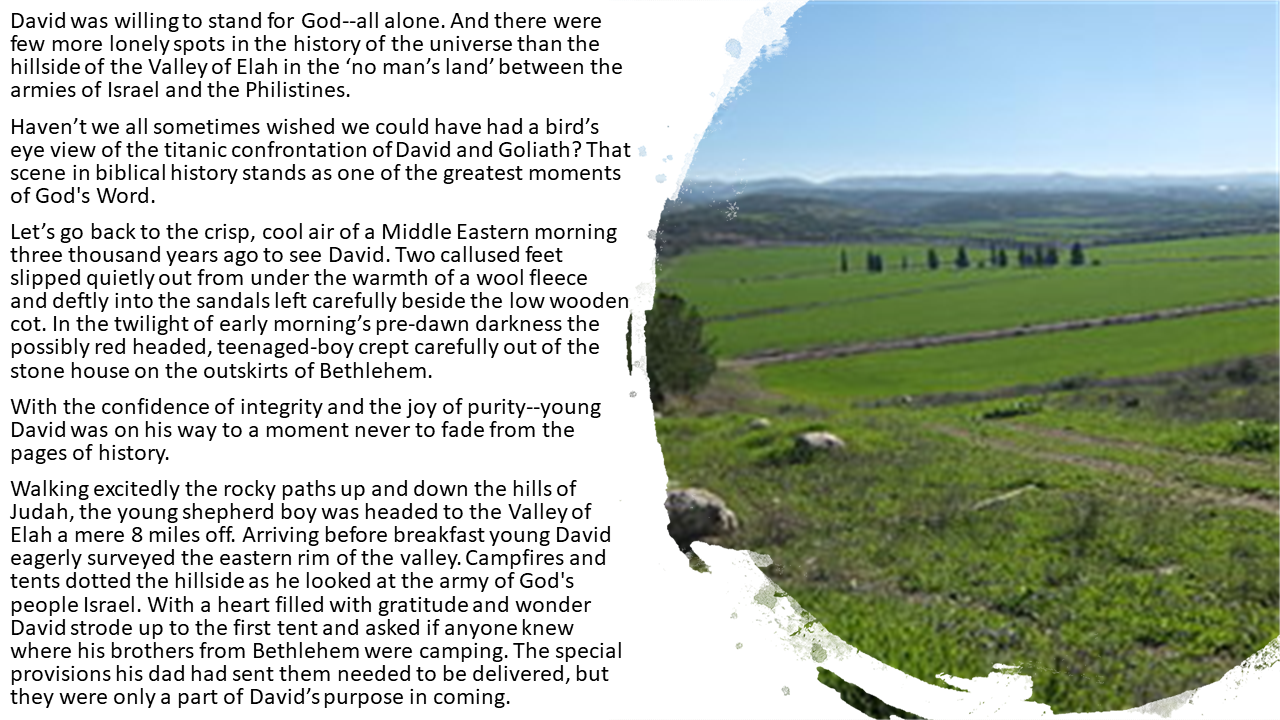
David was willing to stand for God–all alone. And there were few more lonely spots in the history of the universe than the hillside of the Valley of Elah in the ‘no man’s land’ between the armies of Israel and the Philistines.
Haven’t we all sometimes wished we could have had a bird’s eye view of the titanic confrontation of David and Goliath? That scene in biblical history stands as one of the greatest moments of God’s Word.
Let’s go back to the crisp, cool air of a Middle Eastern morning three thousand years ago to see David. Two callused feet slipped quietly out from under the warmth of a wool fleece and deftly into the sandals left carefully beside the low wooden cot. In the twilight of early morning’s pre-dawn darkness the possibly red headed, teenaged-boy crept carefully out of the stone house on the outskirts of Bethlehem.
With the confidence of integrity and the joy of purity–young David was on his way to a moment never to fade from the pages of history.
Walking excitedly the rocky paths up and down the hills of Judah, the young shepherd boy was headed to the Valley of Elah a mere 8 miles off. Arriving before breakfast young David eagerly surveyed the eastern rim of the valley. Campfires and tents dotted the hillside as he looked at the army of God’s people Israel. With a heart filled with gratitude and wonder David strode up to the first tent and asked if anyone knew where his brothers from Bethlehem were camping. The special provisions his dad had sent them needed to be delivered, but they were only a part of David’s purpose in coming.
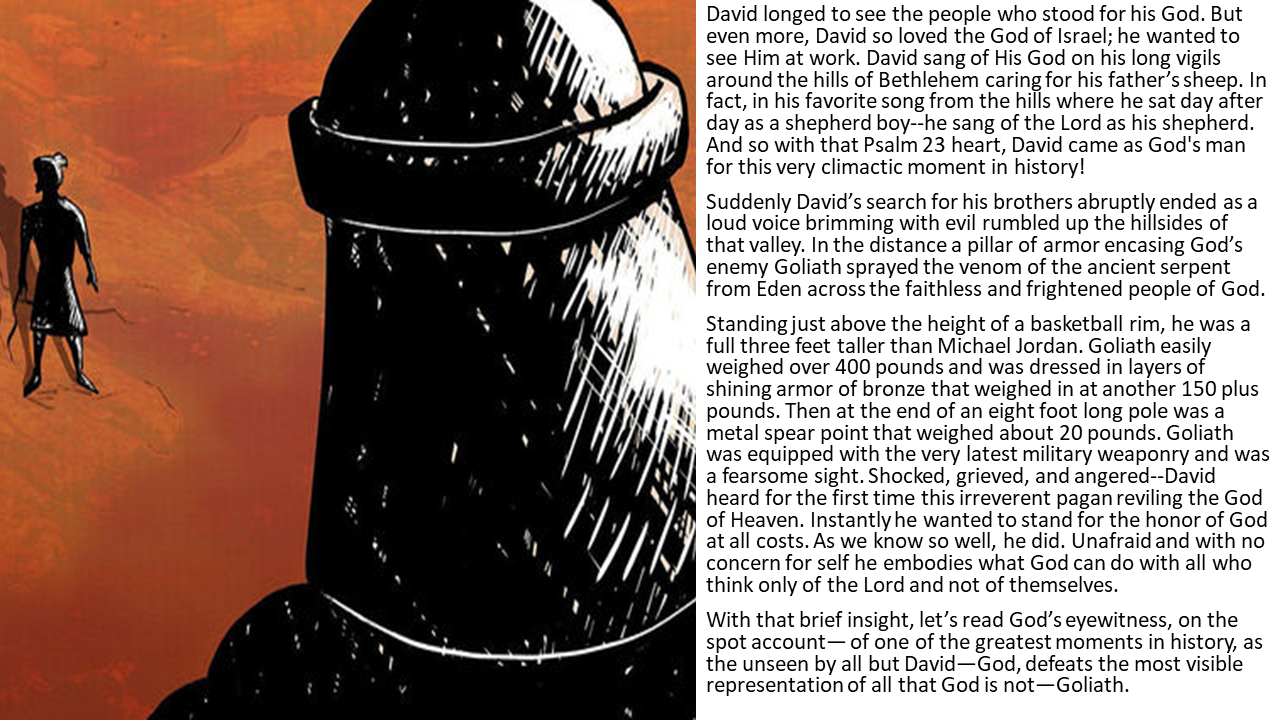
David longed to see the people who stood for his God. But even more, David so loved the God of Israel; he wanted to see Him at work. David sang of His God on his long vigils around the hills of Bethlehem caring for his father’s sheep. In fact, in his favorite song from the hills where he sat day after day as a shepherd boy–he sang of the Lord as his shepherd. And so with that Psalm 23 heart, David came as God’s man for this very climactic moment in history!
Suddenly David’s search for his brothers abruptly ended as a loud voice brimming with evil rumbled up the hillsides of that valley. In the distance a pillar of armor encasing God’s enemy Goliath sprayed the venom of the ancient serpent from Eden across the faithless and frightened people of God.
Standing just above the height of a basketball rim, he was a full three feet taller than Michael Jordan. Goliath easily weighed over 400 pounds and was dressed in layers of shining armor of bronze that weighed in at another 150 plus pounds. Then at the end of an eight foot long pole was a metal spear point that weighed about 20 pounds. Goliath was equipped with the very latest military weaponry and was a fearsome sight.
Shocked, grieved, and angered–David heard for the first time this irreverent pagan reviling the God of Heaven. Instantly he wanted to stand for the honor of God at all costs. As we know so well, he did. Unafraid and with no concern for self he embodies what God can do with all who think only of the Lord and not of themselves.
With that brief insight, let’s read God’s eyewitness, on the spot account—
- of one of the greatest moments in history,
- as the unseen by all but David—God,
- defeats the most visible representation of all that God is not—Goliath.
Read 1st Samuel 17 and pray.
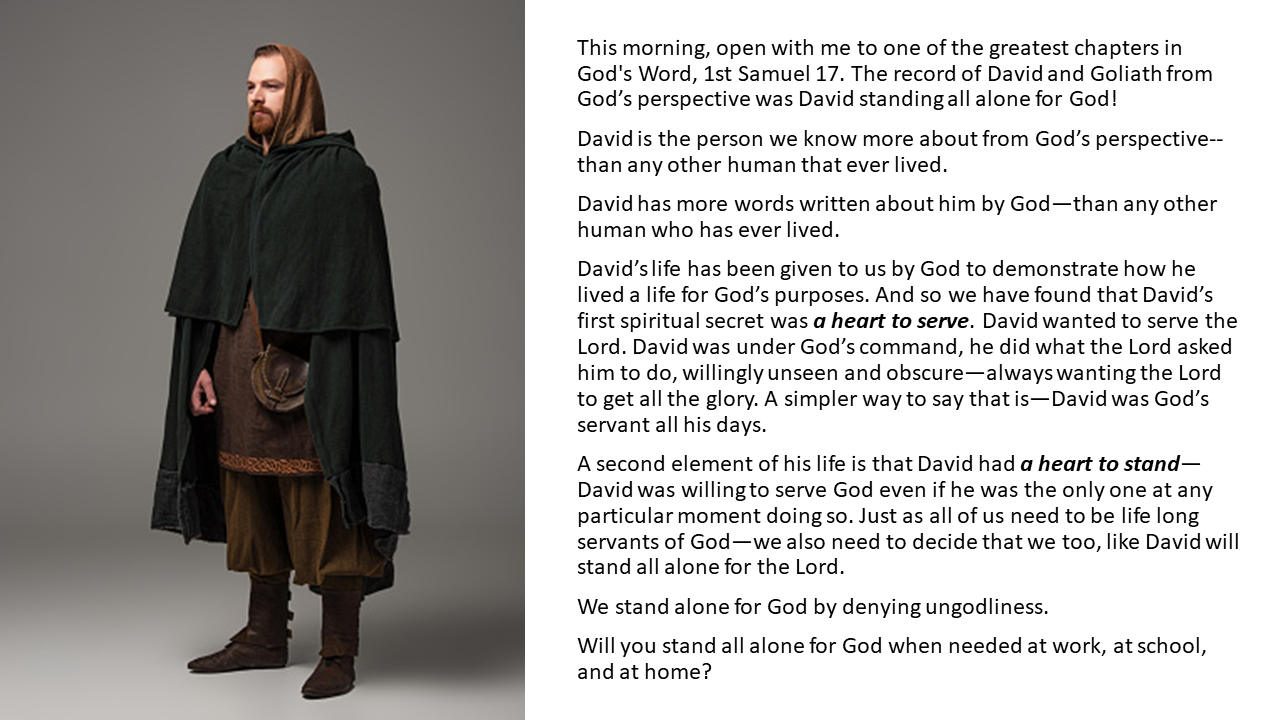
This morning, open with me to one of the greatest chapters in God’s Word, 1st Samuel 17. The record of David and Goliath from God’s perspective was David standing all alone for God!
David is the person we know more about from God’s perspective–than any other human that ever lived.
David has more words written about him by God—than any other human who has ever lived.
David’s life has been given to us by God to demonstrate how he lived a life for God’s purposes. And so we have found that David’s first spiritual secret was a heart to serve. David wanted to serve the Lord. David was under God’s command, he did what the Lord asked him to do, willingly unseen and obscure—always wanting the Lord to get all the glory. A simpler way to say that is—David was God’s servant all his days.
A second element of his life is that David had a heart to stand—David was willing to serve God even if he was the only one at any particular moment doing so. Just as all of us need to be life long servants of God—we also need to decide that we too, like David will stand all alone for the Lord.
We stand alone for God by denying ungodliness.
Will you stand all alone for God when needed at work, at school, and at home?
When the conversation, entertainment, or activities begin to dishonor the Name of the Lord—will you stand all alone for the Lord against it? We are called to deny ungodliness in any form that touches our lives. Titus 2:11-13 For the grace of God that brings salvation has appeared to all men, 12 teaching us that, denying ungodliness and worldly lusts, we should live soberly, righteously, and godly in the present age, 13 looking for the blessed hope and glorious appearing of our great God and Savior Jesus Christ, NKJV
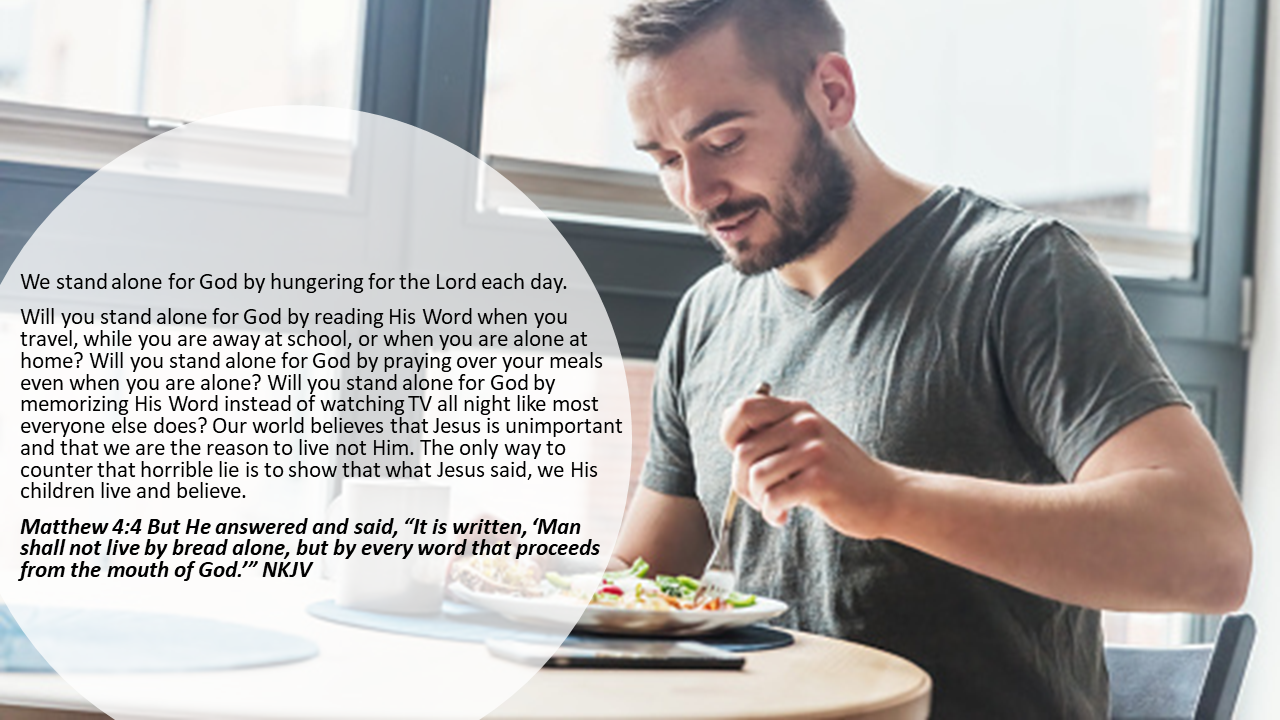
We stand alone for God by hungering for the Lord each day.

Will you stand alone for God by reading His Word when you travel, while you are away at school, or when you are alone at home? Will you stand alone for God by praying over your meals even when you are alone? Will you stand alone for God by memorizing His Word instead of watching TV all night like most everyone else does? Our world believes that Jesus is unimportant and that we are the reason to live not Him. The only way to counter that horrible lie is to show that what Jesus said, we His children live and believe. Matthew 4:4 But He answered and said, “It is written, ‘Man shall not live by bread alone, but by every word that proceeds from the mouth of God.’” NKJV
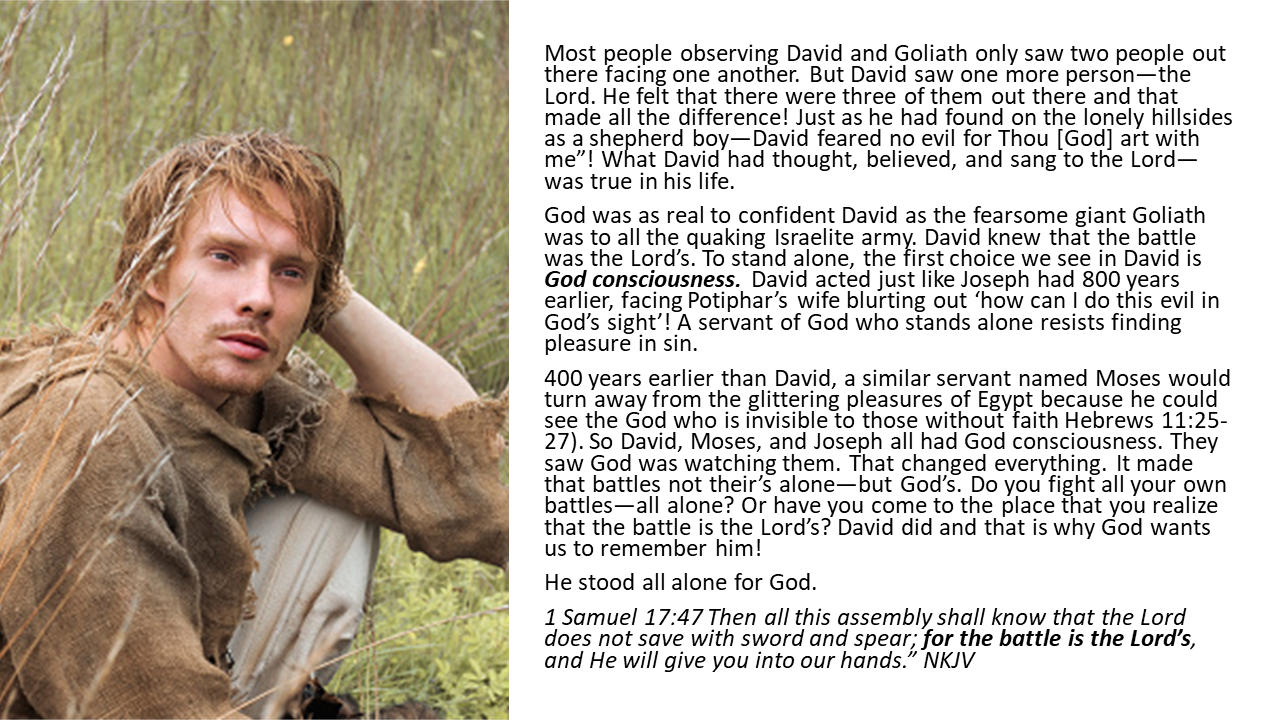
Most people observing David and Goliath only saw two people out there facing one another. But David saw one more person—the Lord. He felt that there were three of them out there and that made all the difference! Just as he had found on the lonely hillsides as a shepherd boy—David feared no evil for Thou [God] art with me”! What David had thought, believed, and sang to the Lord—was true in his life.
God was as real to confident David as the fearsome giant Goliath was to all the quaking Israelite army. David knew that the battle was the Lord’s.
To stand alone, the first choice we see in David is God consciousness. David acted just like Joseph had 800 years earlier, facing Potiphar’s wife blurting out ‘how can I do this evil in God’s sight’! A servant of God who stands alone resists finding pleasure in sin. 400 years earlier than David, a similar servant named Moses would turn away from the glittering pleasures of Egypt because he could see the God who is invisible to those without faith Hebrews 11:25-27).
So David, Moses, and Joseph all had God consciousness. They saw God was watching them. That changed everything. It made that battles not their’s alone—but God’s. Do you fight all your own battles—all alone? Or have you come to the place that you realize that the battle is the Lord’s? David did and that is why God wants us to remember him! He stood all alone for God. 1 Samuel 17:47 Then all this assembly shall know that the Lord does not save with sword and spear; for the battle is the Lord’s, and He will give you into our hands.” NKJV
The events of that day are indelibly sketched on our hearts. The shepherd lad, a handful of stones, a homemade weapon plus God–made an unbeatable army of one. David defeated the giant and became and instant and enduring hero of all the ages. Why? In our previous studies we went back and examined David in his youth and found what he lived for in those early days that made him great. That was the list of qualities God captured for us in 1st Samuel 16 plus the resolves of his youth that David made in Psalm 132. They are all part of David’s Spiritual Secret. David thirsted to serve God when he was young!
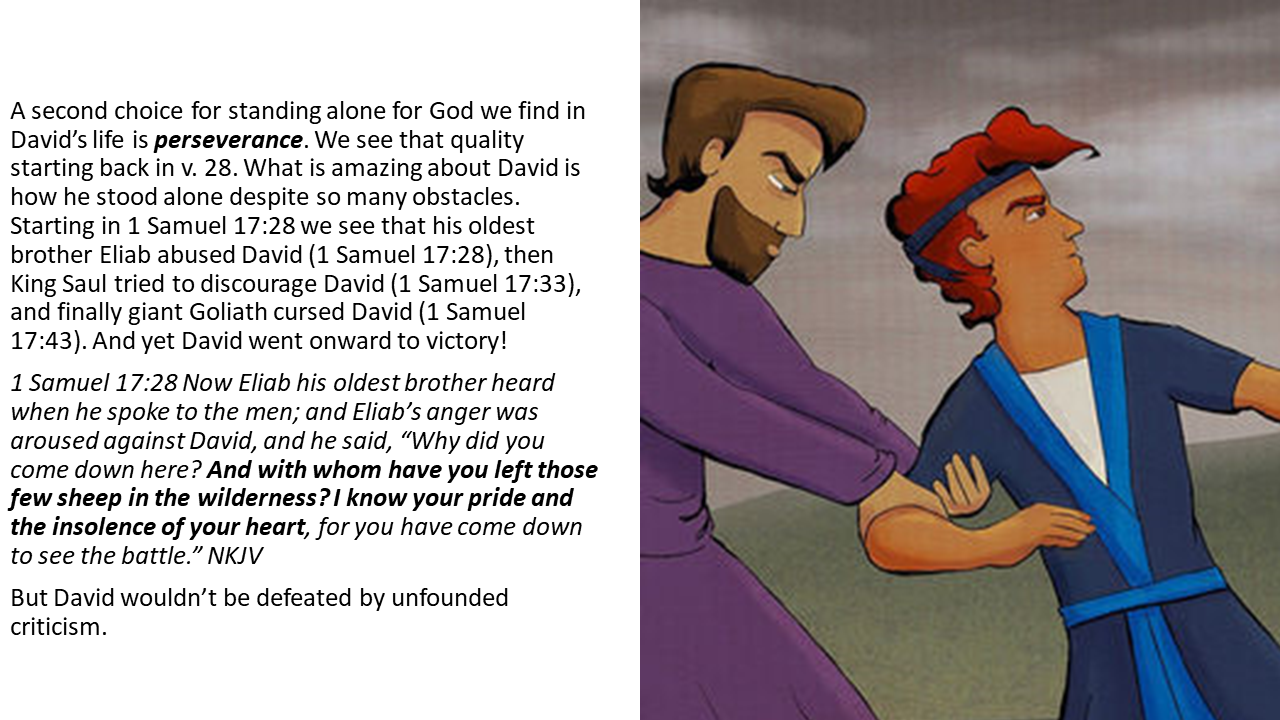
A second choice for standing alone for God we find in David’s life is perseverance. We see that quality starting back in v. 28. What is amazing about David is how he stood alone despite so many obstacles. Starting in 1st Samuel 17:28 we see that his oldest brother Eliab abused David (1st Samuel 17:28), then King Saul tried to discourage David (1st Samuel 17:33), and finally giant Goliath cursed David (1st Samuel 17:43). And yet David went onward to victory!
1 Samuel 17:28 Now Eliab his oldest brother heard when he spoke to the men; and Eliab’s anger was aroused against David, and he said, “Why did you come down here? And with whom have you left those few sheep in the wilderness? I know your pride and the insolence of your heart, for you have come down to see the battle.” NKJV
But David wouldn’t be defeated by unfounded criticism.
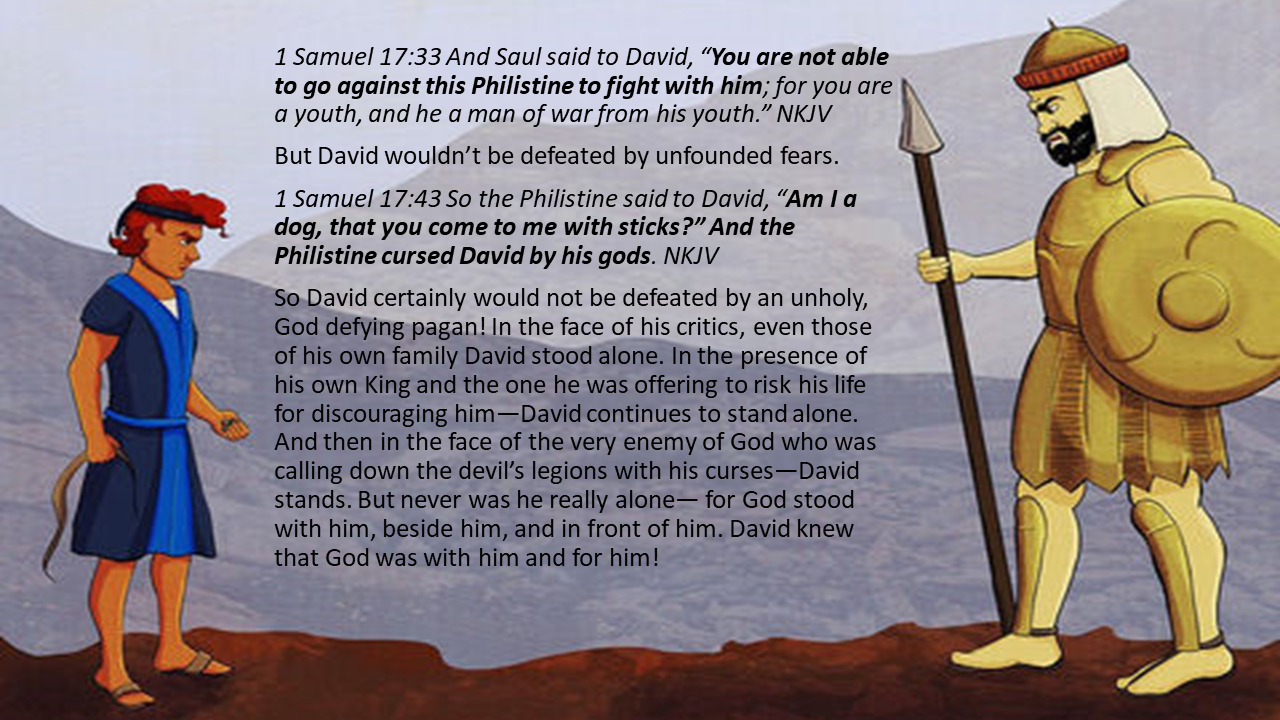
1 Samuel 17:33 And Saul said to David, “You are not able to go against this Philistine to fight with him; for you are a youth, and he a man of war from his youth.” NKJV
But David wouldn’t be defeated by unfounded fears.
1 Samuel 17:43 So the Philistine said to David, “Am I a dog, that you come to me with sticks?” And the Philistine cursed David by his gods. NKJV
So David certainly would not be defeated by an unholy, God defying pagan!
In the face of his critics, even those of his own family David stood alone. In the presence of his own King and the one he was offering to risk his life for discouraging him—David continues to stand alone. And then in the face of the very enemy of God who was calling down the devil’s legions with his curses—David stands. But never was he really alone— for God stood with him, beside him, and in front of him. David knew that God was with him and for him!
A third choice for standing alone is having a divine perspective. Goliath represented more than a formidable military challenge. He represented evil. His armor is described as having “scales” like the snake Satan embodied while tempting Adam and Eve. David recognized the true nature of Goliath’s challenge and accepted it with the correct underlying motive so that the world would “know that there is a God in Israel.”
Joshua saw God at the crossing of the dried up Jordan River–Joshua 4:24 that all the peoples of the earth may know the hand of the Lord, that it is mighty, that you may fear the Lord your God forever.” NKJV
David saw God at Elah–1 Samuel 17:46 This day the Lord will deliver you into my hand, and I will strike you and take your head from you. And this day I will give the carcasses of the camp of the Philistines to the birds of the air and the wild beasts of the earth, that all the earth may know that there is a God in Israel. NKJV
Solomon saw God at the Temple–1 Kings 8:46, 60 “When they sin against You (for there is no one who does not sin), and You become angry with them and deliver them to the enemy, and they take them captive to the land of the enemy, far or near; 60 that all the peoples of the earth may know that the Lord is God; there is no other. NKJV
Hezekiah saw God at the threat of Assyria–2 Kings 19:19 Now therefore, O Lord our God, I pray, save us from his hand, that all the kingdoms of the earth may know that You are the Lord God, You alone.” NKJV
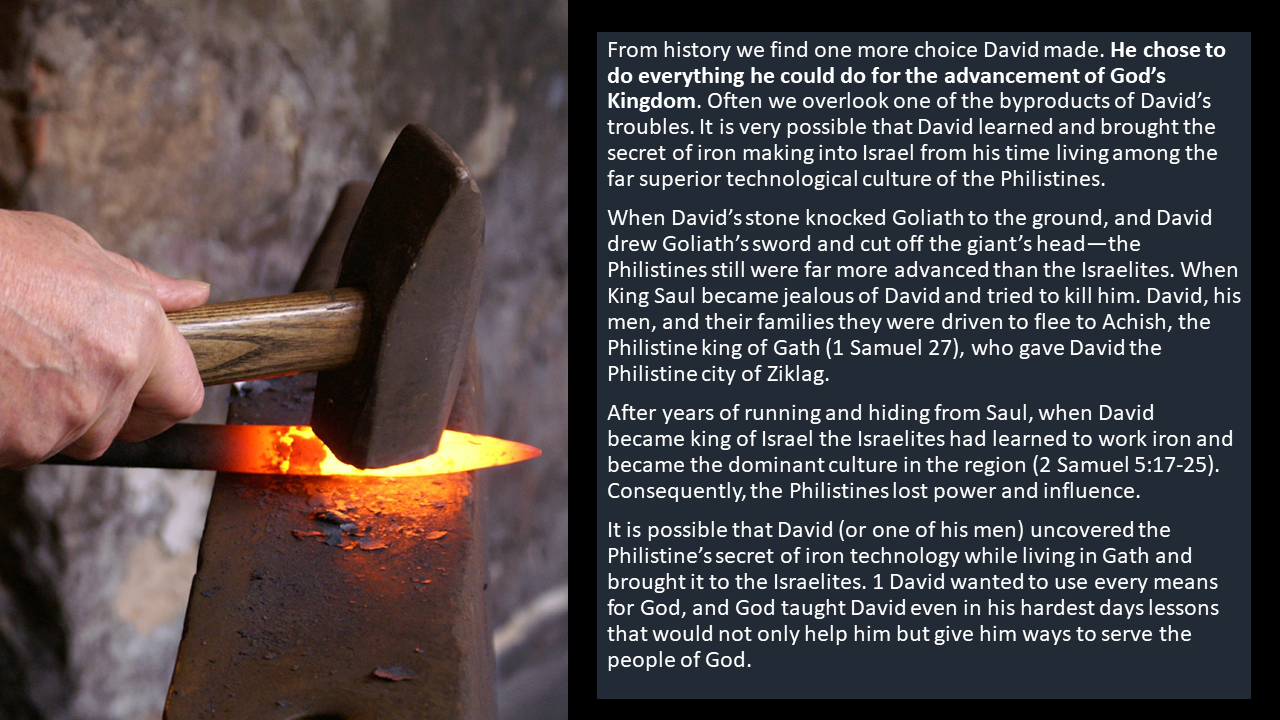
From history we find one more choice David made. He chose to do everything he could do for the advancement of God’s Kingdom. Often we overlook one of the byproducts of David’s troubles. It is very possible that David learned and brought the secret of iron making into Israel from his time living among the far superior technological culture of the Philistines.
When David’s stone knocked Goliath to the ground, and David drew Goliath’s sword and cut off the giant’s head—the Philistines still were far more advanced than the Israelites. When King Saul became jealous of David and tried to kill him. David, his men, and their families they were driven to flee to Achish, the Philistine king of Gath (1 Samuel 27), who gave David the Philistine city of Ziklag.
After years of running and hiding from Saul, when David became king of Israel the Israelites had learned to work iron and became the dominant culture in the region (2 Samuel 5:17-25). Consequently, the Philistines lost power and influence.
It is possible that David (or one of his men) uncovered the Philistine’s secret of iron technology while living in Gath and brought it to the Israelites.
1 David wanted to use every means for God, and God taught David even in his hardest days lessons that would not only help him but give him ways to serve the people of God.
Truths God can use in our lives. For those who are willing to stand alone in God’s power, for His glory– purposes. When we seek to accomplish God’s work, our motivation and faith in God is far more significant than our talent or resources. David, for example, we a young shepherd who appeared to have little to offer, but he acted as God’s representative. He used his training and primitive tools in order to reveal the God of Israel to the world of his day. He used a simple sling to throw a stone at a man who had the best military technology an advanced culture could offer and he triumphed because God honored his throw.
2. God seeks each of us to use our particular gifts and talents to influence our culture for Him. David did what God had qualified and gifted him to do and because David was motivated by righteousness, he made a powerful impact on his culture. Likewise, we don’t have to be anything other than the people God has created us to be in order to accomplish His purposes. Who He has made us to be is good enough. We need only to express the gifts and talents He has given us.
3. God wants us to use every resource, including the tools and technology of our culture its “iron” to accomplish His purposes. The Israelites achieved a decisive victory over the Philistines when David killed Goliath. Unfortunately, the Philistines remained the superior culture for quite a while afterward (1 Samuel 31). Only when the Israelites, under the reign of faithful King David, harnessed the Philistines’ advanced iron technology and used it for God’s purposes did they become a great influence and power. Today, Christians who hold a Bible-based value system and are able to shape and control the “iron” of their society will greatly impact their culture.2
And what happened when David stood alone? Because of this divine perspective on life David did what was impossible—and the Lord got all the glory. David will forever be remembered by God as His servant who did all God’s will.
1 Kings 15:5 because David did what was right in the eyes of the Lord, and had not turned aside from anything that He commanded him all the days of his life, except in the matter of Uriah the Hittite. NKJV
Acts 13:36 “For when David had served God’s purpose in his own generation, he fell asleep; he was buried with his fathers and his body decayed. NIV
We stand alone for God by denying ungodliness.
Will you stand all alone for God when needed at work, at school, and at home? When the conversation, entertainment, or activities begin to dishonor the Name of the Lord—will you stand all alone for the Lord against it? We are called to deny ungodliness in any form that touches our lives. Titus 2:11-13 For the grace of God that brings salvation has appeared to all men, 12 teaching us that, denying ungodliness and worldly lusts, we should live soberly, righteously, and godly in the present age, 13 looking for the blessed hope and glorious appearing of our great God and Savior Jesus Christ, NKJV
We stand alone for God by hungering for the Lord each day.
Will you stand alone for God by reading His Word when you travel, while you are away at school, or when you are alone at home? Will you stand alone for God by praying over your meals even when you are alone? Will you stand alone for God by memorizing His Word instead of watching TV all night like most everyone else does? Our world believes that Jesus is unimportant and that we are the reason to live not Him. The only way to counter that horrible lie is to show that what Jesus said, we His children live and believe. Matthew 4:4 But He answered and said, “It is written, ‘Man shall not live by bread alone, but by every word that proceeds from the mouth of God.’” NKJV
David had a lifetime of situations after Goliath, where he stood all alone for God. Did David ever quit these simple choices? Did he grow out of simply being God’s servant? No—he stayed that way to the end. That is why he is such a vivid example of serving God!
What does God do when we choose to stand for Him when all around us others do not? Join me as we see one other battle David had to face. Later in life David faces enemies fiercer than Philistines—some of his own family and friends turn against him. David’s response? Again, as God’s servant the battle is always the Lord’s. And again we have a pattern of what we as God’s servants should also do!
David portrays a life entrusted to God’s care. He gives each care to the Lord. Watch him as David allows the Lord to guide, direct, and take care of every details of his life.
God’s inspires others to come to our aid when we are His servants.
2 Samuel 15:19-21 Then the king said to Ittai the Gittite, “Why are you also going with us? Return and remain with the king. For you are a foreigner and also an exile from your own place. 20 In fact, you came only yesterday. Should I make you wander up and down with us today, since I go I know not where? Return, and take your brethren back. Mercy and truth be with you.” 21 But Ittai answered the king and said, “As the Lord lives, and as my lord the king lives, surely in whatever place my lord the king shall be, whether in death or life, even there also your servant will be.” NKJV
David did not take his own personal safety into his own hands—he trusts the Lord waits for His protection.
2 Samuel 15:25 Then the king said to Zadok, “Carry the ark of God back into the city. If I find favor in the eyes of the Lord, He will bring me back and show me both it and His dwelling place. NKJV
David left his burdens with the Lord so he didn’t have to take matters into his own hands.
David bows and worshipped and offered up a Psalm of praise to God—even as he wept bitter tears of sorrow and grief.
2 Samuel 15:30, 32 So David went up by the Ascent of the Mount of Olives, and wept as he went up; and he had his head covered and went barefoot. And all the people who were with him covered their heads and went up, weeping as they went up. 32 Now it happened when David had come to the top of the mountain, where he worshiped God—there was Hushai the Archite coming to meet him with his robe torn and dust on his head. NKJV
God’s servants can continue in worship even when life is tough, difficult, and almost looking like it is impossible to go on. Turn with me to the exact record of the worship that flowed from David. This is what can flow from us if we like David—bow in worship when the bitter tears of sorrow and grief fall across our lives.
Psalm 3:1-8 A Psalm of David, when he fled from Absalom his son.
1 Lord, how they have increased who trouble me! Many are they who rise up against me.
2 Many are they who say of me, “There is no help for him in God.”
3 But You, O Lord, are a shield for me, My glory and the One who lifts up my head.
4 I cried to the Lord with my voice, And He heard me from His holy hill.
5 I lay down and slept; I awoke, for the Lord sustained me.
6 I will not be afraid of ten thousands of people Who have set themselves against me all around.
7 Arise, O Lord; Save me, O my God! For You have struck all my enemies on the cheekbone; You have broken the teeth of the ungodly.
8 Salvation belongs to the Lord. Your blessing is upon Your people. NKJV
David trusted God’s control. He relied upon it and prayed for it. Instead of fear he had faith and gave worship.
David entrusts all the uncontrollable circumstances of his life to the Lord.
2 Samuel 15:31 Then someone told David, saying, “Ahithophel is among the conspirators with Absalom.” And David said, “O Lord, I pray, turn the counsel of Ahithophel into foolishness!” NKJV
People often share reports that can either lead us to fear or prompt us to prayer. David lifts his heart in prayer to the Lord at this evil report!
David realized that God allows adversaries to reveal what is really in our hearts. So he entrusts his personal adversaries to the Lord.
2 Samuel 16:9-11 Then Abishai the son of Zeruiah said to the king, “Why should this dead dog curse my lord the king? Please, let me go over and take off his head!” 10 But the king said, “What have I to do with you, you sons of Zeruiah? So let him curse, because the Lord has said to him, ‘Curse David.’ Who then shall say, ‘Why have you done so?’ ” 11 And David said to Abishai and all his servants, “See how my son who came from my own body seeks my life. How much more now may this Benjamite? Let him alone, and let him curse; for so the Lord has ordered him. NKJV
David knew that God raises up and puts down. He knew adversaries were allowed by God—and he wanted to respond correctly!
David fled to the Lord when suffering affliction. He always entrusted his personal sufferings to the Lord.
2 Samuel 16:12 It may be that the Lord will look on my affliction, and that the Lord will repay me with good for his cursing this day.” NKJV
David knew God cared, he knew God saw his troubles. He knew that the Lord can cause all things to work together for good.
David’s situation was being managed by the Lord. When we let God take care of us, and when we entrust our personal vengeance to the Lord—the Lord can do what we never could to remedy the situation.
Second Samuel 17:14 And Absalom and all the men of Israel said, The counsel of Hushai the Archite [is] better than the counsel of Ahithophel. For the LORD had appointed to defeat the good counsel of Ahithophel, to the intent that the LORD might bring evil upon Absalom. (KJV)
‘Vengeance is mine saith the Lord’ (Hebrews ). Allow the Lord to recompense your enemies. David had many enemies and adversaries, but he let the Lord deal with them all.
David’s needs are met by the Lord. God works behind the scenes in the hearts of people to provide just what David needed to continue on. So a servant of the Lord must always entrust his personal needs to the Lord.
2 Samuel 17:27-29 Now it happened, when David had come to Mahanaim, that Shobi the son of Nahash from Rabbah of the people of Ammon, Machir the son of Ammiel from Lo Debar, and Barzillai the Gileadite from Rogelim, 28 brought beds and basins, earthen vessels and wheat, barley and flour, parched grain and beans, lentils and parched seeds, 29 honey and curds, sheep and cheese of the herd, for David and the people who were with him to eat. For they said, “The people are hungry and weary and thirsty in the wilderness.” NKJV
So David was God’s servant. And his life is recorded as an example to us of how to serve the Lord. In similar fashion, Saul’s life was recorded as a warning of how not to serve the Lord which we will see next time!
1. God often use people who seem to have little to offer to accomplish His 1 Ray Vander Laan, with Stephen and Amanda Sorenson, Faith Lessons on the Promised Land Leader’s Guide. Grand Rapids, Michigan: Zondervan Publishing House, 1999, Pg. 140-41.
2 Ray Vander Laan, with Stephen and Amanda Sorenson, Faith Lessons on the Promised Land Leader’s Guide. Grand Rapids, Michigan: Zondervan Publishing House, 1999, Pg. 140-41.
Slides


Check Out All The Sermons In The Series
You can find all the sermons and short clips from this series, David’s Spiritual Secret here.
Looking To Study The Bible Like Dr. Barnett?
Dr. Barnett has curated an Amazon page with a large collection of resources he uses in his study of God’s Word. You can check it out here.