
If the video above is not available, here are two other ways to view:
The Joy of Complete Forgiveness
060701PM
DSS-24
PSALM 32
Transcript
.jpg)
Let’s open our Bibles again to the thirty-second psalm. As you’re turning there, we’re looking at the miracle of complete forgiveness.
.jpg)
I’d like to begin, what is one of the foundational studies from this portion of David’s life, and that is a study of how did God do that? How did God accomplish the miracle of complete forgiveness? How did God, whose perfect justice had to be satisfied, completely forgive us so imperfect and so wicked sinners? That lesson is a wonderful reaffirmation of what we believe. As we look at our salvation and how God accomplished the perfect sacrifice of Jesus Christ, we need to start with the result. And that was the forgiveness that David experienced.
And David nicely summarizes what God did for him in this psalm, and he uses an emphasis word. Now, when you read the psalms, you see that little word Selah. It’s right at the end of verse 4, at the end of verse 5, the end of verse 7. You see that Selah? There are a lot of different ideas: it’s a musical rest, and it’s an emphasis, and all that. But if we were to put it in modern English, it means, hey, look at this. It’s a pause for us to think of what was spoken and to focus on that. And so, David does that. The first four verses, as we read them, he’s going to pause at the end of verse 4 and say, hey, look at this. God convicted me and forgave me, and he wants us to think about that. Then when we read verse 5, he says, hey, look at this. God heard my confession, and He forgave me. See, it’s all about this forgiveness. And then at the end of verse 7 he says, hey, look at this. God offers me the refuge of His forgiveness, that this is a lifelong He is never going to let go of me. And what a wonder the thirty-second Psalm is.
.jpg)
Let’s enjoy it together as David sings it to us. You follow along in your copy of God’s Word and let me read it to you and pause like David instructs us to before we pray. Before the first verse it says, a Psalm of David. A contemplation. And then the first verse, blessed is he whose transgression is forgiven, whose sin is covered. Blessed is the man to whom the LORD does not impute iniquity, and in whose spirit there is no deceit. When I kept silent, my bones grew old through my groaning all the day long. For day and night Your hand was heavy upon me; my vitality was turned into the drought of summer. Selah, hey, look at this, he says, God convicted me and forgave me. Verse 5, I acknowledged my sin to You, and my iniquity I have not hidden. I said, I will confess my transgressions to the LORD, and You forgave the iniquity of my sin. Selah, and again he says, look at this. God heard my confession and forgave me.
He doesn’t give the whole confession to us, by the way, the emphasis of this is that he chronicled specific sins. The psalm only gives generalities, four of the fifteen words for sin in the Hebrew Old Testament, but David was listing off to God all of the ramifications of his sin, which is what John tells us we should be doing if we are constantly confessing, constantly saying, we know what You have seen, and we agree with You, O God, how we have failed You and sinned against You. He has once and for all already forgiven us, but we don’t enjoy the benefit of that unless we’re constantly cleansed. And so, David, after the fifth verse says, hey, look at this. God heard all of those confessions. He had a whole year of agony, and he just poured it out. And when we get to the fifty-first psalm, you’ll see even more of that deluge of his confession. But God forgave me.
Verse 6. After this pause, he tells us, for this cause everyone who is godly shall pray to You in a time when You may be found—which implies there are times when God won’t be found if we’re not careful, that we will perhaps cause His chastening hand which is very severe. So, he says you pray while He may be found; surely in a flood of great waters they shall not come near him. You are my hiding place; You shall preserve me from trouble; You shall surround me with songs of deliverance. And again, Selah, and he says, hey, look at this. When you’re going through the flood, and the turmoil, and the trouble, God offers me a refuge in His forgiveness. Even when the years went by of all the consequences of David’s sin, you’ll notice a different David when those consequences came, and we’re going to study that. He writes Psalm 3, for example, when his own son tried to kill him, Absalom. And David was a meek, humble, triumphant, obedient servant of the LORD because of what it says in verses 6 and 7. You preserve me from trouble, even the trouble I’ve caused by my own sin, even the consequences of my horrific decisions that You have to bring about. You surround me with songs of deliverance. So, even when we suffer the consequences of our sins and that consequence engine keeps going through our lives, we can still rejoice because we’re delivered, what we’ll experience in Heaven.
Verse 8 onward. After that pause, he says, I will instruct you and teach you in the way you should go. The Lord is telling us if we are going to walk His way, He’ll show us. I will guide you with My eye. Do not be like the horse—who has to always be held back—or like the mule—that always has to be beaten forward. Don’t be running ahead of the Lord and don’t be dragging behind. They don’t have any understanding, they have to be harnessed with bit and bridle, else they’ll not come near you. Verse 10, many sorrows will be to the wicked; but he who trusts in the LORD, mercy shall surround him. Can you hear reflections of his childhood psalm, the twenty-third? Surely goodness and mercy will follow me all the days of my life. And see, he’s come full circle back. And he says, many sorrows shall be to the wicked. And boy, I experienced that for a whole year of all the that I went through. But he who trusts the LORD, mercy shall surround him. Verse 11, be glad in the LORD and rejoice, you righteous; shout for joy, you upright in heart! And he’s saying, hey, look at this. God’s going to keep me to the end, even when I go through my just deserts. David was the man whose transgression was forgiven, whose sin was hidden, who knew that God cast it behind His back.
Let’s bow before the Lord in prayer. I pray, O Lord, that we would relate with David because Your servant Paul did when he was trying to find a way to express the inexpressible wonder of salvation and of Your incredible satisfaction through the sacrifice of Christ. He just quoted, in Romans 4, these two verses from Psalm 32, and he said that it truly is a blessing to have our sins taken care of by You, O God. I pray that we would know the delight, the wonder, the blessing tonight. As we begin to reinforce in our hearts, and in our minds, and in our lives what You have accomplished through Jesus Christ, Your Son and our Savior’s death on the cross as He gave Himself for me. Bless us. Teach us. Help us to not merely hear this but to believe in this righteousness that we have by faith in Jesus. In Your precious name we pray, amen.
Psalm 32 is a wonderful declaration by David. It’s a wonderful declaration that God cast his sin like a millstone into the depths of the sea. He says in Psalm 32, his iniquity, his perversion will not be imputed to his account. It won’t be recorded on God’s ledger. His guile, the deceitful, desperately wicked heart he had, has been annihilated by God. It’s emptied of the sin—his heart was—that had filled it in that moment of his yielding to his crooked, deceitful heart, and his desperately wicked heart was emptied and filled with God’s righteousness. And he said, I’m so happy! David experienced all this because God has revealed Himself all the way through the Bible, all the way through His Word in what theologians call a glorious harmony, that He is a God of forgiveness. In fact, Titus tells us that He is God our Savior. God is a saving God, a forgiving God.
Just to note a few great verses, turn back with me to Exodus 34. We’re going to do a little quick look at the forgiving heart of God starting in Exodus 34. God was giving His testimony, once. It’s a neat thing to hear God talking out loud through the ears of Moses. Moses got to hear God affirming His character, His nature, His infinite being. And that great servant that knew the LORD face to face, Moses, is in the rock. And that’s where we get the great hymn, he hideth my soul in the cleft of the rock that shadows a dry, weary land. It’s this context of Exodus 34, but look what He says in verses 6 and 7. God, as He describes Himself to Moses, He says that He is the LORD, the LORD God, compassionate and gracious, slow to anger, abounding in lovingkindness and truth, who keeps lovingkindness for thousands—here it is—who forgives iniquity, transgression, and sin. That’s God’s testimony. God is by nature a forgiving God. But God is not a benevolent, old grandfatherly type that just says, ah, it’s okay. God’s justice has to be satisfied, and that’s the whole message of the Scripture. God from the beginning has promised, and prepared, and presented the perfect sacrifice.
If you keep turning to Psalm 86, look at another way that David talks about God the Forgiver. As we’re looking at this character of God the Forgiver, Psalm 86 is a declaration from David in verse 5 of God’s nature. He says, for Thou, Lord, are good and ready to forgive. God is again, not like the injured person that isn’t sure they want to forgive you, and they’re going to wait till you cook for a while in your misery. It says here in Psalm 86:5 something that should gladden our hearts. God is ready to forgive. He is eager to forgive. He is abundant in lovingkindness… abundance is He’s overflowing; the cup is full to all who call upon Thee. Wow. An eager, forgiving God to all. He’s just waiting for that request, that calling out to Him.
If we keep going in Psalm 103, just verses 3 and 12 of this great psalm. It’s a reminder that God pardons all our iniquities. Psalm 103:3, who forgives all your iniquities, who heals all your diseases. And by the way, the Scriptures describe us, this is not merely talking about physical diseases. The Scriptures describe us as from head to toe filled with the disease of sin. And so, in that sense, we are completely infected with the disease of sin. It’s affected our minds, our eyes, our mouths, what we hear. We hear selectively. We speak, as the psalms say, with the poison of serpents on our tongue. It’s affected our hearts. Jeremiah says in Jeremiah 17 that they’re deceitfully wicked. It’s affected even our appetites, as the Scripture talk about that, that whose god is their stomach or their belly, whose glory is in their shame. Our appetites have been diseased, and even our feet are swift to run toward doing what is against God’s will. And so, we’re shown to be from the top of our heads to the soles of our feet, ill with sin. And verse 3 says, He’ll heal all our diseases. That’s the blessing of salvation, that God utterly transforms us so that we become an instrument of righteousness, that every part of us is harnessed for His righteous purposes. Verse 12, this is the classic explanation of the character of God: as far as the east is from the west, so far has He—that’s our forgiving God—removed our transgressions from us. Wow! God is a forgiving God.
Keep going to Daniel. Daniel sums it all up in Daniel chapter 9 and verse 9. Daniel is praying along, if you remember, as an intercessor for his own people, his own nation. He’s praying for God to fulfill His Word. And right in the middle of this great confession, which from Daniel 9 comes the great A-C-T-S model of prayer: adoration, confession, thanksgiving and supplication. It’s the place that A-C-T-S ACTS model is drawn from. But look at verse 9. He says, O Lord, to us belong shame of face, to our kings, our princes, our fathers, because we have sinned against You. That’s verse 8, but look at verse 9. This buildup, he says, because to us is shame of face. But verse 9, to the Lord our God belong mercy and forgiveness, though we’ve rebelled against Him. He says, God, You own it. That’s Your domain. You are the God of mercy. You are a forgiving God.
And then finally, Micah. It’s Daniel, Hosea, Joel, Amos, keep going to the right. Amos, Obadiah, Jonah, Micah. There it is. Micah chapter 7. One of those little minor prophets that’s so rich and in truth. Micah extols the LORD and says in Micah chapter 7 verse 18, who is a God like You, pardoning iniquity, passing over the transgression of the remnant of His heritage? He does not retain His anger forever—look at this—because He delights, Micah says, He delights in mercy. Verse 19, He will again have compassion on us and will subdue our iniquities. You will cast all our sins into the depths of the sea.
Now, I want you just to step back with that theology of God’s character. God is a forgiving God. And in all these verses, Moses says, You’re compassionate, slow to anger, You forgive iniquity. David declared, You’re ready to forgive, You’re eager to forgive. David again says, You remove our transgressions an eternal distance from us. They’re never going to come back to us. Daniel says, it belongs to You, compassion and forgiveness. Micah says, You cast all our sins. All. That’s where the chorus, my sins are gone and shall not be remembered. God in mercy tenderly forgives. He never will, they’re all cast into the sea of His forgetfulness.
.jpg)
But no matter how severe the sin, God declares in the nineteenth verse there that He can forgive it all. In fact, Jesus said in Mark 3, probably the greatest words in the New Testament, all sin is forgivable. And right after that He says, except the unforgivable sin, which is one of those great paradoxical portions of the Scripture. But I love the declaration that God is a God who can forgive all sin for all who come to Him.
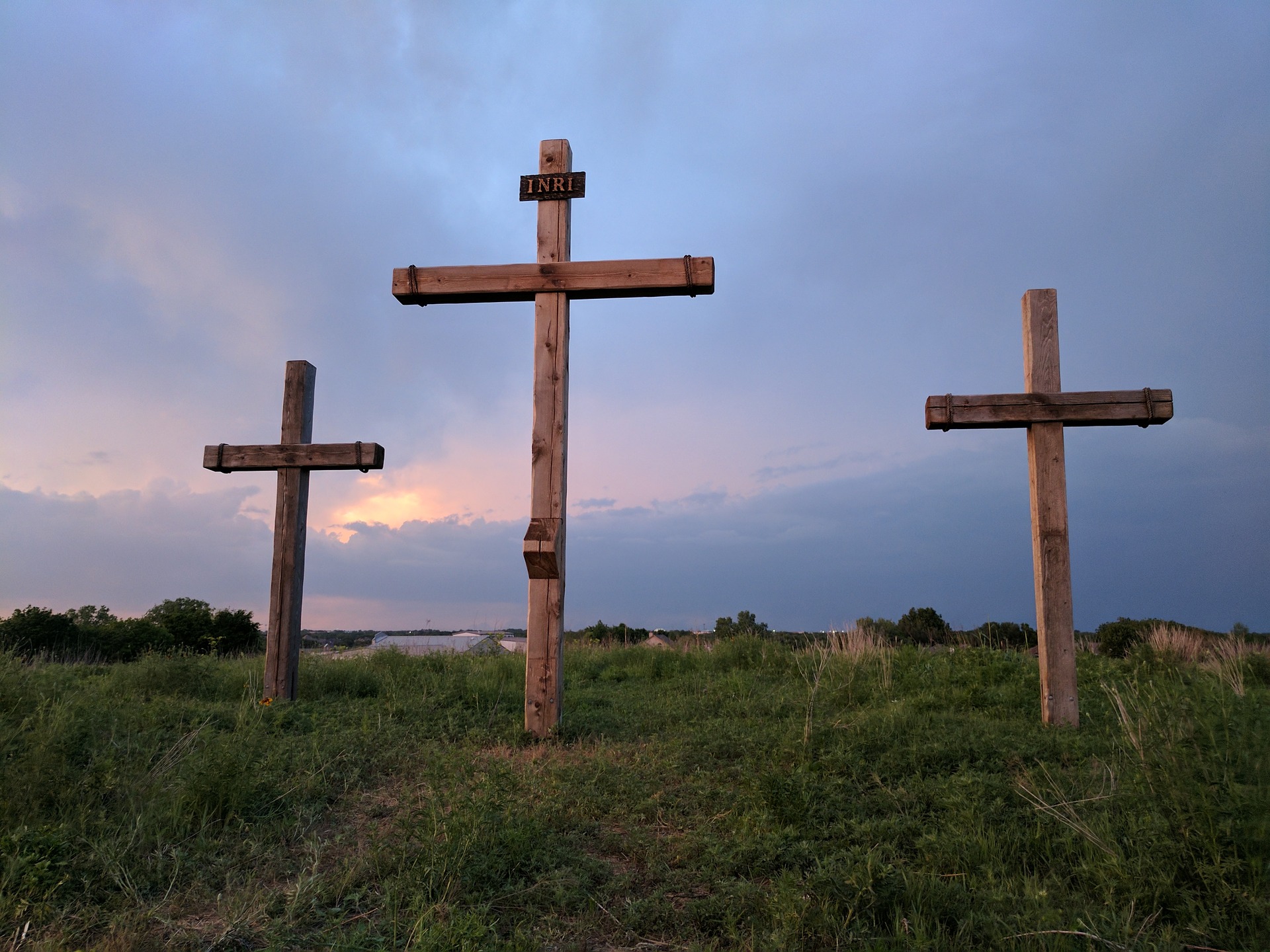
But the worst conceivable sin, if we could categorize them, would be to kill God the Son, and to kill Him while He was here on Earth for the very purpose of providing salvation from sin and the way to everlasting life. Nothing could possibly be more heinous than that to kill Jesus on His way to becoming the Savior of the world. Wouldn’t that be the ultimate sin? That would be the ultimate, vicious, wicked sin. Of course, killing Him is exactly what we did to God the Son. As the song says, it was I that caused His pain. I am the one that caused Him to die. It was my sin. So, while hanging on the cross about to die, turn to Luke 23. I want to show you, Luke 23, right at the end of Luke 23, I want to show you what Jesus said while the worst possible sin was being committed, killing the Savior, God the Son, as He’s trying to pay the price. And in the process of paying the price for the sin of the world, while He is doing that, probably the worst sin would be while He is being the Lamb of God and the loving sacrifice, to be the one killing Him. But look what He says from that spot. This is a very precious verse. As He’s hanging on the cross in Luke 23 and verse 34, about to die, Jesus prayed and affirmed, there on the cross, His forgiving mercy, which He was extending to His executioners themselves. So, if there is an ultimate sin right there that you could think of, a vicious, heinous, horrible sin, it would be the executioners of the only sinless and perfect Person being executed, innocent as He was. And look what He says to God, verse 34, Father, forgive them, for they do not know what they’re doing. That is the express image of God. Remember, Jesus is the exact representation of God the Father. That’s what it says in Hebrews 1:3. He is, if you want to see God, look at Jesus, and if you want to see the forgiving God, look at Jesus Christ hanging on the cross, looking down, lifting His eyes from those executioners up to His Father and saying, Father, forgive them. They don’t know what they’re doing. So, that teaches us something. The degree of sin does not forfeit forgiveness because even killing the Son of God was forgivable. So, no matter what degree of sin you and I ever commit, it’s forgivable because the ultimate, the zenith was killing the Son of God.
Nor does the volume of sin and the possibility of God’s forgiveness. A 70-year-old profligate who has lived a life of debauchery, stealing, lying, profanity, blasphemy, and immorality is just as forgivable as a 7-year-old church kid who has done nothing worse than normal childhood naughtiness. You understand that? It’s not the volume. You can’t exhaust the volume of the character of the God of forgiveness. And that’s why, as we sang this morning at communion, the dying thief rejoiced to see that fountain in his day; and there may I, though vile as he… Not with the same volume, but still with the same one sin that’s enough to deserve God’s wrath forever.
Nor does, neither the degree, nor the volume, nor does the particular kind of sin cancel His ability to forgive. In the Word of God, if you study it, you find God forgiving any type of sin that you and I could conceive of. The kinds of sin God forgives: idolatry, murder, gluttony, fornication, adultery, cheating, lying, homosexuality, covenant breaking, blasphemy, drunkenness, extortion, and every other kind of sin imaginable. God even forgives self-righteousness, which is a deceiving sin of thinking that we don’t even have sin. He even forgives the sin of rejecting Christ. Otherwise, no one would be saved because all of us rejected Him to a greater or lesser degree. So, He even forgives that because we realize that there is no forgiveness even of the smallest sin unless it is confessed and repented of. It’s the only limiter. Just like the only limit of the atonement is belief. The only limit of forgiveness is whether or not it’s confessed, forsaken in repentance. There is forgiveness of even the greatest sin if those divine conditions are met: confession and repentance.
So, how did God do that? That’s what He did, and that’s what David was thinking about. How did He do it? I think the best way, what I started with and worked all week long on, was just going through all the incredible words for redemption and forgiveness in the book of Romans. But I thought, that’s the normal way. I thought, why not go the back door, and why not start in Heaven and see what forgiveness looks like in Heaven with all who are there and then back in to how they got there? And so, let’s go to Heaven, and let’s look at the beautiful, complete forgiveness of our sins through Christ’s sacrifice when we get to our final destination of Heaven. And where would we find that? Of course, when you’re studying Heaven, where do we always go? We always turn to Revelation. Yes! But instead of Revelation, how about Hebrews chapter 12? Because the most complete description of the end product of our complete forgiveness is summed up, better than anywhere else in the Bible, in the book of Hebrews chapter 12. And I want you to turn there with me because I want you to see, in about verse 20 of Hebrews 12, one of the most beautiful pictures. It’s like looking at a glorious trip.
.jpg)
Right now, at home, we’re watching an hour a night of the films that Johnny took of our trip in Israel, and it’s just a wonderful. I’m seeing it in a completely different way. I’m seeing the Holy Land like I’ve never seen it because I’m seeing it through the eyes of everyone else, because I’m always so busy, and it’s just so neat to see what it was like. That’s what Hebrew 12 is, starting in, actually, it starts in verse 18. It is a view of our final destination, the wonderful city that we’re headed towards, and what awaits all of us who’ve experienced the miracle of complete forgiveness. And we find in these few verses the precious realities of what God’s complete forgiveness is based on. And what is the final word? In fact, you’ll find out when we get to the end of this little section that the last thing that’s mentioned is the blood that cries forgiveness. We in Heaven are never going to be able to forget that we’re forgiven. And I think that’s why the Lord said those great words that he that has been forgiven little loves little, and the one who’s been forgiven much loves much. We are never going to forget how much we’ve been forgiven of.
Let’s go through this, what we’re going to have, and I’ll start reading in verse 18 of Hebrews 12. But you have not come to the mountain that may be touched and that burned with fire, and to blackness and darkness and tempest, verse 18. Verse 19, and to the sound of a trumpet. And he is talking about the giving of the Ten Commandments on Mount Sinai in Exodus. And to the sound of the trumpet and the voice of words, so that those who heard it begged that the word should not be spoken to them anymore. (For they could not endure that was commanded: and if so much as a beast touches the mountain, it shall be stoned or shot with an arrow. Verse 21, and so terrifying was the sight that Moses said, I am exceedingly afraid and trembling.) So, that’s Sinai. That’s 3,500 years ago.
Now he fast-forwards. the writer of Hebrews fast-forwards, and we get to verse 22. Now imagine, just think the context of what we’re reading. This is the writer of Hebrews inspired by the Spirit of God to write to us, the Church, and be given this Word from God, and this is the most amazing description of what the recipients of God’s complete forgiveness get to experience and they get to possess. And it’s just wonderful. I’m going to try and zip through it, but there’s so much here. These are the precious realities. Number one, finally, we, the forgiven, will enter the city we’ve been looking for with foundations. That’s what it says in verse 22. But you have come to Mount Zion, the heavenly Jerusalem, the city of the living God. Those who are completely forgiven get to come to the city of the living God. The longing of our hearts, as throughout our earthly lives we were pilgrims and strangers, always waiting and looking for the city that God was preparing for us, finally is our reality.
That’s interesting what he calls it. You have come to Mount Zion. Now, 46 of us just a couple weeks ago were on Mount Zion, but he is not talking about the earthly one. Mount Zion was the location of the city, remember, of Melchizedek. That’s Genesis 14. That’s where his city was. It was also the place called Mount Moriah that Abraham came to in chapter 21 and 22 of Genesis, the sacrifice of Isaac. It’s also the Jebusite stronghold that David captured. And when David brought the Ark of the Covenant to the place he made in Jerusalem, that became the spiritual center of God’s kingdom. And when that Ark of the Covenant came there, Jerusalem became the hub that all of God’s people looked to for their fellowship with God, the place where God’s presence with His people would be. Later, Solomon built a temple there on Mount Zion and installed the Ark, and Zion in Jerusalem became representative of where God dwelled. And remember, His glory cloud, the Shekinah would be over, and at the dedication to the Temple, that glory filled the place. And all the way through Ezekiel, we see that glory cloud hovering there.
And as believers, we realize that though that was an earthly representation of God’s presence, that there was a heavenly reality because by the time we get to Philippians 3:20, Paul reminds us that we, while we walk on Earth, are already citizens of the heavenly city. We’re citizens of Heaven. So, while we’re here on Earth and Americans or whatever citizenship people hold, we have dual citizenship, and we’re citizens of Heaven. And that this Temple/Tabernacle time of the Old Testament was just an earthly picture of a reality in Heaven that those who, by faith, believe in God have their citizenship there. And so, Paul tells us the privileges of our citizenship in Heaven are already ours. That’s Philippians 3:20.
He goes beyond that in Ephesians. Not only are we citizens of Heaven in Philippians 3:20, but Ephesians, this is what Paul says. As believers, we’re already citizens of the heavenly Jerusalem, and we are those who have already been seated, as it were, at the banquet table with Jesus because our position with Him is so complete. That’s Ephesians 2:7 and 6 where it says we’re raised up with Jesus, seated with Him in the heavenly realms in Christ Jesus. And it goes through that incredible description of our positions. So, when he says right here in verse 22 of Hebrews 12, that you have come to Mount Zion. The Mount Zion of Melchizedek and Abraham and David and Solomon was just an earthly representation of the heavenly city where we’re in God’s presence, and we are already there. Paul tells us we’re already seated at the banquet table. So, Paul, as we follow after and keep slogging through life, as hard as it is through the trenches, he says we’re following after the reason we were apprehended, and we’re pressing toward the goal. And the goal is to be with Him and to enjoy His presence forever.
.jpg)
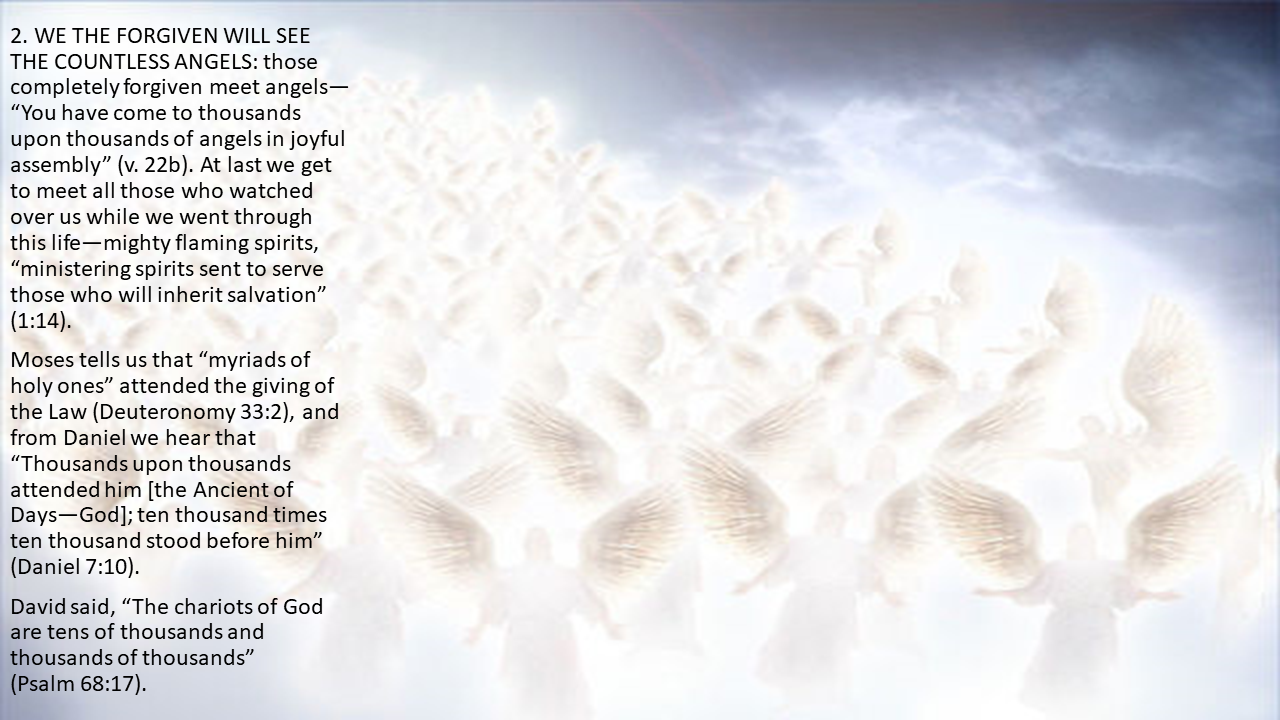
And so, the first thing we see in Hebrews 12 is that we, like Paul, who have followed after, arrive at our goal through the upward call of Jesus Christ. And it says, you have come. That doesn’t say will. It says you have. Hebrews 12. It’s just, if you look closely the words of Hebrews 12:22, it is such a blessing to think about. He says, you have. You’re already there. Now, it’s the reality we’re anticipating by faith. But all the work has been done, all the paperwork. It’s signed, and sealed, and delivered. It’s paid for. It’s our reality. So finally, we, the forgiven, will get to enter the city with foundations that we’ve longed for, but keep reading the ending of verse 22. Finally, we, the forgiven, will see the countless angels. We don’t even think about this. Those completely forgiven get to meet the angels. It says, you have come to thousands upon thousands of angels in joyful assembly. At last, we get to meet those who watched over us while we were going through this life. Who are they? They’re mighty flaming spirits. They’re ministering spirits sent to minister to us. You know what it says in Hebrews 1:14? It says, are they not all ministering spirits sent forth to minister for those who shall be heirs of salvation? You and I. Now, I know there’s this guardian angel stuff, and people talk about their little guardian angel, and they wear and keep little angels, and I’m not talking about that. I’m talking about mighty flaming spirit beings. The Hebrews 1:14 says, are the ministering spirits that minister for all of us who are heirs of salvation. Now, we don’t think about that very much, and the Bible doesn’t talk about it very much, but it is a reality, and we get to meet those myriads of angels.
Moses tells us that myriads of the holy ones attended the giving of the Law. That’s what he says in Deuteronomy 33 and verse 2. So, when he was getting those tablets written by the finger of God and he was carrying them down Mount Sinai back to the people, he’s talking about it in Deuteronomy 33, and he says that myriads of holy ones attended that. From Daniel, we find that thousands upon thousands attend the Ancient of Days. In fact, Daniel goes on to say 10,000 times 10,000 are always standing before Him. So, there are hundreds of millions that don’t do anything but stand in reverence before God, and they’re just unbelievable, uncountable numbers of these ministering spirits, these flaming spirits. That’s Daniel 7:10. David said, the chariots of God are ten thousands and thousands of thousands in Psalm 68.
.jpg)
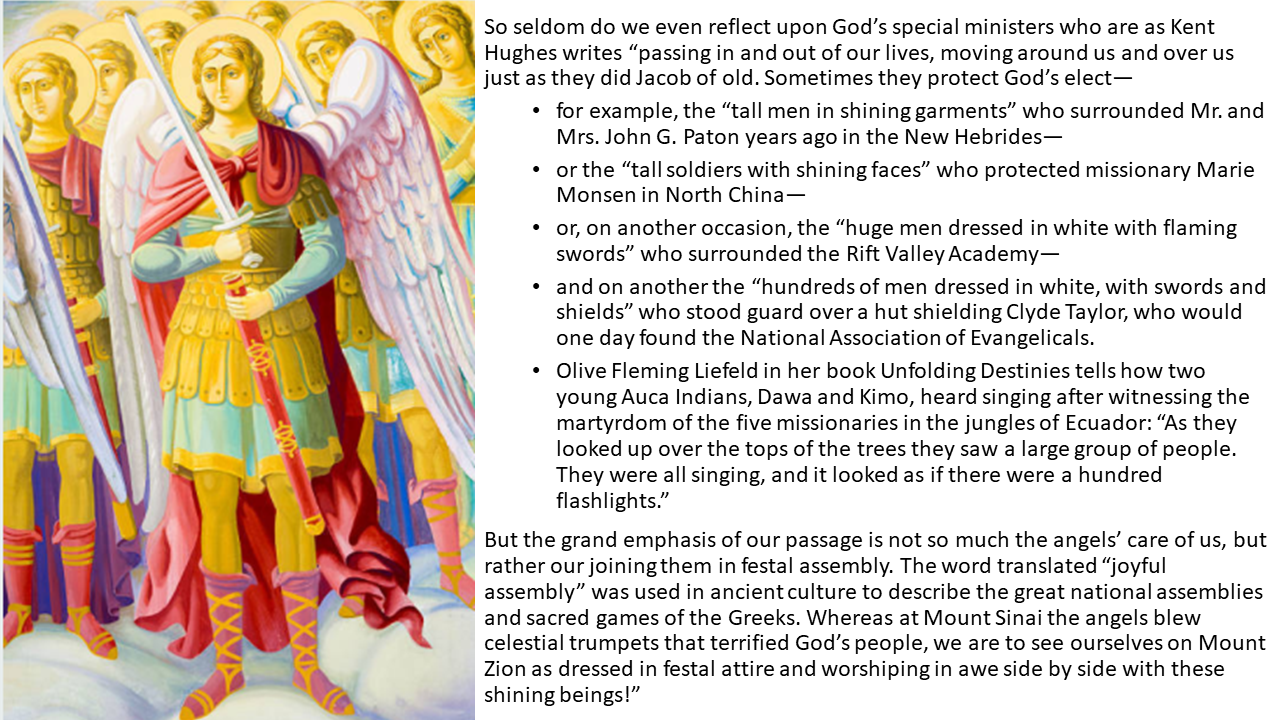
But we seldom reflect on what these ministers of God do for God. I’ll just read a few from Church History that great saints have recorded the interactions they’ve had with angels. In fact, one commentator wrote, passing in and out of our lives, they move around us and over us. Just as Jacob of old saw when he saw that ladder and the angels of God coming and going. Sometimes they protect us, God’s chosen ones. For example, John Paton, remember the great missionary of 150 years ago that was out in New Hebrides at Vanuatu Island? This is what he wrote in his journal: the tall men in shining garments surrounded Mr. and Mrs. John Paton, and that’s why they weren’t eaten by the cannibals because God wanted them to preach the Gospel. And Paton said he didn’t see them, but later he asked the natives that came to Christ and repented of their cannibalism and their evil works of darkness. And he says, how come you guys didn’t come crack our heads open and boil us? And they said, in his journal he said, the tall men in shining garments that always surrounded your hut, they came with you. And Paton, in later life, the great Presbyterian missionary said those were the angels, the ministering spirits, the Hebrews 1:14 team.
Others, Marie Monsen in Northern China back in the forties before the communist takeover was protected by tall soldiers with shining faces. The people, in what we would call unreached people groups that she reached, after their conversion, said that they asked where the other ones were, the soldiers that had accompanied her to their village that had the shining faces that she never saw. Or on another occasion at the Great Rift Valley Academy that has a long and happy history for the Lord, it’s recorded in their journal that huge men dressed in white with flaming swords surrounded the Rift Valley Academy during an uprising where all the missionary children were. And those who came in from their war rampage in the city and were coming to kill the missionaries’ children saw, and this is what one of them who later came to Christ said, that huge men dressed in white with flaming swords had surrounded the academy.
Or on another occasions, Clyde Taylor, who later became the founder of the NAE, the National Association of Evangelicals, when he was a missionary, he said that hundreds of men dressed in white with swords and shields stood guard over his hut. That’s what he was told when he left the field after a long successful career in a primitive tribal area. And when he asked those who came to Christ as he was leaving, he says, what was it that kept you from killing us? And they said that. Olive Fleming Liefeld wrote this about the Auca Indians, Dawä and Kimo, after the execution, the martyrdom of the five missionaries in the jungle of Ecuador. This is what these two told her. They said while the faithful Jim Elliot, and Nate Saint, and all them were being killed, as the Aucas looked up over the tops of the trees, they saw a large group of people all singing, and it looked as if there were hundreds of flashlights. Just that the angels that were there attending the martyrdom of these saints.
But the emphasis of this passage that we’re looking at, verse 22, is not so much the angels’ care of us but that we get to join them at last. We’re in this festive assembly. In the ancient cultures, the word that’s in verse 22 to this festive assembly, literally the general assembly, that’s actually the first part of verse 23, this general assembly is this idea of a national assembly, and it’s the word used for the Olympic Games when they would all gather together to have this joyful time of the Olympic Games in Greek culture. And God’s people are gathered together, and we are finally with those flaming spirits, the angels who minister to us, almost unknown to us, who were heirs of salvation, and we get to meet them. I think that they’re invisible because we’re not supposed to honor them. We’re not supposed to focus on them, but they’re there, and they’re always surrounding us and accomplishing God’s purposes.
.jpg)
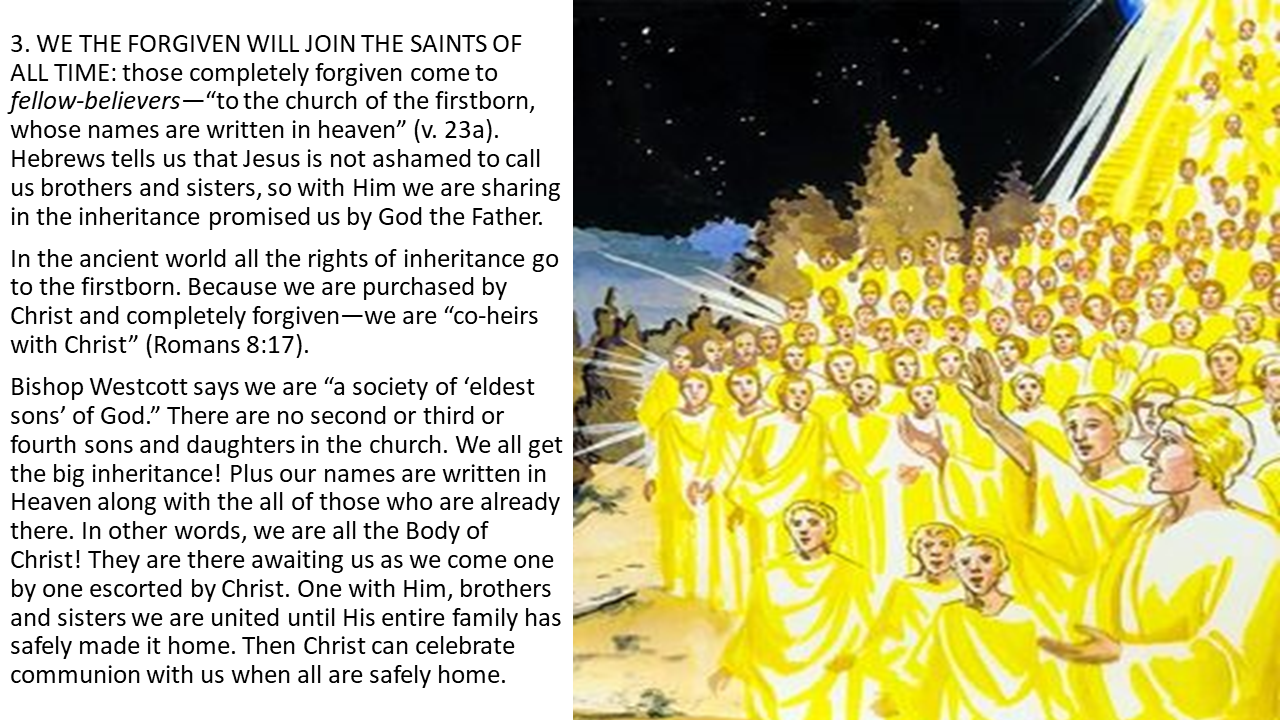
One more. Look at the continuation of verse 23, to the general assembly and the Church of the Firstborn—look what it says—whose names are written in Heaven. Thirdly, we get to join, we the forgiven get to join the saints of all the ages. Now, I don’t want you to miss this because what we’re looking at is the result of our complete forgiveness, and what God does is He gets us to the heavenly city that we’ve always longed for. He gets us finally surrounded by all these flaming spirits that have ministered to us to get us there safe and sound, and then we get to join. Look what he says. We get to join the Church of the Firstborn whose names are written in Heaven. Hebrews tells us that Jesus is not ashamed to call us brothers and sisters. So, with Him, we are sharing in the inheritance promised by God the Father. The saints of all the time, all the ages, we get to join them with Christ. Now, think about that. In the ancient world, all the rights of inheritance went to the firstborn alone. The firstborn got the inheritance rights. That’s why Jacob was deceiving to get them from Esau. But Jesus Christ, because He completely forgave us, allows us to be what Paul says in Romans 8:17, co-heirs with Christ. All of us. It’s not like Paul was a co-heir and we’re a sixth level or thirty-sixth level down when they divide the inheritance out. In a will they give this part, and this part, and this part, and this part, and the big parts go and then there are the little parts left. No, we’re all co-heirs with Christ. Do you understand what that means? God the Father has given to Jesus an inheritance, and Jesus doesn’t pass on to us as sub-heirs. He says that we are co-heirs with Christ. It’s an amazing thought to think what that means, the extent to which His complete forgiveness has elevated us. The British commentator, Bishop Westcott said that we are all a society of eldest sons of God. We all get the oldest son inheritance because of the work of Christ. There are no second, or third, or fourth sons and daughters in the Church. We all get the big inheritance. Our names are written in Heaven, along with all of those who are already there. In other words, we’re all the body of Christ. They’re all awaiting us. We come one by one, escorted by Christ. We are one with Him. We are brothers and sisters who are united with our entire family that has safely made it home.
.jpg)
Jesus said, I’ll not share communion again. I’ll not celebrate communion again until I celebrate it with you in My Father’s kingdom. What He was saying is I am going to wait till I get all of you safely home. Until you are, look at Hebrews 12:22 and 23, until you come to Mount Zion. Until you and I come to the city of the Living God, the heavenly Jerusalem; until we get to meet that innumerable company of angels, those flaming spirits that have ministered to us; and until we become the festive, joyous general assembly, the Church of the Firstborn who are registered in Heaven.
Now, the question is, do you have your reservation? Are you registered in Heaven? You wouldn’t think of walking in high season to some hotel during the Olympics and go to Beijing and say, hey, I want a room. There isn’t going to be a room during the Olympics in ’08. Try and go during the World Cup. There’s no room in those hotels. You’ve got to get a reservation. And what he’s saying here is that all who get there are those who are registered in Heaven. Now, those are just the first three. He goes through four more results of our complete forgiveness. But finally, the forgiven will join the saints of all times, the forgiven, those whose names are written in Heaven will join with Jesus.
.jpg)
Let’s bow before Him and thank Him for His great salvation. Father in Heaven, I thank You that we can look forward to this day when we get to the city we’ve longed for, the only city that has foundations, whose Builder and Maker is God. Thank You that we’ll finally get to see those flaming spirits that have ministered to us, often unseen. But we’re so excited to someday see all of our brothers and sisters from all the ages, all of those who are registered in Heaven, and we long for that day to see what You have accomplished. And how You accomplished it, as we’ll see as we march through these verses, because of the sacrifice of Christ. And I pray that this evening there’d be no one who isn’t registered in Heaven. There’s no one who is going to try and crash it like those unprepared brides who had not the oil in their lamps and were rejected at the door. I pray that we would have our names registered in Heaven by faith, by calling out to You for your complete forgiveness and receiving the righteousness, which is by faith. In Your precious name, Lord Jesus, we rejoice and thank You, amen.
Notes
 The Miracle of Complete Forgiveness is wonderful, but how did God do such a thing?
This evening we will start a look at our salvation and how God accomplished the once and for all sacrifice of Christ for our sins. But we will do it in a way that is very unusual. We will look in Heaven and see what the final results of our salvation will be. But first look at the grand song of David.
HEY—LOOK AT THIS
Psalm 32 is his personal testimony. David nicely summarizes what God did for him in this Psalm with the use of an emphasis word SELAH. In today’s language it means, “Hey, look at this!” Let’s look at what God did.
Psalm 32:1-11 A Psalm of David. A Contemplation.
Psalm 32:1-4 Blessed is he whose transgression is forgiven, Whose sin is covered. Blessed is the man to whom the Lord does not impute iniquity, And in whose spirit there is no deceit. When I kept silent, my bones grew old through my groaning all the day long. For day and night Your hand was heavy upon me; my vitality was turned into the drought of summer. Selah [Look at this–God convicted me and forgave me]
Psalm 32:5 I acknowledged my sin to You, and my iniquity I have not hidden. I said, “I will confess my transgressions to the Lord,” and You forgave the iniquity of my sin. Selah [Look at this–God heard my confession and forgave me]
Psalm 32:6-7 For this cause everyone who is godly shall pray to You In a time when You may be found; Surely in a flood of great waters They shall not come near him. You are my hiding place; You shall preserve me from trouble; You shall surround me with songs of deliverance. Selah [Look at this–God offers me refuge in His forgiveness]
Psalm 32:8-11 I will instruct you and teach you in the way you should go; I will guide you with My eye. 9 Do not be like the horse or like the mule, Which have no understanding, Which must be harnessed with bit and bridle, Else they will not come near you. 10 Many sorrows shall be to the wicked; But he who trusts in the Lord, mercy shall surround him. 11 Be glad in the Lord and rejoice, you righteous; And shout for joy, all you upright in heart! NKJV [Look at this–God will keep me]
David was the man whose transgression is forgiven; whose sin is hidden, God having cast it as a millstone into the depths of the sea; whose iniquity and perversion is not reckoned to his account; and whose guile, the deceitful and desperately wicked heart, is annihilated, being emptied of sin and filled with righteousness, is necessarily a happy man.
David experienced all this because by nature God is forgiving. The Old Testament abounds with teachings about His forgiveness.
• God described Himself to Moses as, “the Lord, the Lord God, compassionate and gracious, slow to anger, and abounding in lovingkindness and truth; who keeps lovingkindness for thousands, who forgives iniquity, transgression and sin” (Ex. 34:6–7).
• David declared, “For Thou, Lord, art good, and ready to forgive, and abundant in lovingkindness to all who call upon Thee” (Ps. 86:5).
• In another psalm he reminds us that God pardons all our iniquities. Psalm 103:3,12 Who forgives all your iniquities, Who heals all your diseases; 12 As far as the east is from the west, So far has He removed our transgressions from us.
• Daniel said, “To the Lord our God belong compassion and forgiveness” (Dan. 9:9).
• Micah extolled the Lord, saying, Micah 7:18–19 Who is a God like You, Pardoning iniquity And passing over the transgression of the remnant of His heritage? He does not retain His anger forever, Because He delights in mercy. 19 He will again have compassion on us, And will subdue our iniquities. You will cast all our sins Into the depths of the sea.
 ALL SINS ARE FORGIVABLE
No matter how severe the sin, God can forgive it. The worst conceivable sin would be to kill God’s own Son—and that while He was on earth for the very purpose of providing salvation from sin and the way to everlasting life. Nothing could possibly be more heinous, vicious, and wicked than that. And, of course, killing Him is exactly what men did to the Son of God. Yet, while hanging on the cross and about to die, Jesus prayed and affirmed the forgiving mercy available to His executioners, “Father, forgive them; for they do not know what they are doing” (Luke 23:34).
• The degree of sin does not forfeit forgiveness, because even killing the Son of God was forgivable.
• Nor does the volume of sin end the possibility of mercy. A seventy-year-old profligate who has lived a life of debauchery, stealing, lying, profanity, blasphemy, and immorality is just as forgivable as a seven-year-old who has done nothing worse than normal childhood naughtiness.
• Nor does the particular kind of sin cancel grace. In Scripture we find God forgiving idolatry, murder, gluttony, fornication, adultery, cheating, lying, homosexuality, covenant breaking, blasphemy, drunkenness, extortion, and every other kind of sin imaginable. He forgives self-righteousness, which is the deceiving sin of thinking that one has no sin. He even forgives the sin of rejecting Christ; otherwise no one could be saved, because before salvation everyone, to some degree, is a Christ rejecter. There is no forgiveness of even the smallest sin unless it is confessed and repented of; but there is forgiveness of even the greatest sin if those divine conditions are met.1
So to see how God accomplished complete forgiveness of our sins through Christ’s sacrifice—turn with me to our final destination—heaven!
Where would we find that? Most of us would turn to Revelation, but an even clearer picture of that wonderful city we are headed towards is actually in Hebrews 12. Please open there with me!
THE FUTURE OF THE FORGIVEN
What awaits all of us who have experienced the Miracle of Complete Forgiveness? Hebrews 12 tells us these precious realities.
1. WE THE FORGIVEN WILL ENTER THE CITY WITH FOUNDATIONS: those completely forgiven come to the city of God—“But you have come to Mount Zion, to the heavenly Jerusalem, the city of the living God” (v. 22a). The longing of our hearts as throughout our earthly lives we were pilgrims and strangers always waiting for and looking for this city God was preparing for us.
• Mount Zion was the location of the city of Melchizedek, the site of Abraham’s offering of Isaac and the later Jebusite stronghold that David captured. When David brought the Ark of the Covenant to this place he made Jerusalem the spiritual center of his kingdom—the place of God’s presence with his people.
• Later as Solomon built the Temple and installed the Ark, Zion/Jerusalem became representative of the earthly dwelling-place of God.
• As believers we are already citizens of the heavenly Jerusalem and have all the privileges of that heavenly citizenship. Remember what Paul wrote, “But our citizenship is in heaven. And we eagerly await a Savior from there, the Lord Jesus Christ” (Philippians 3:20).
• As believers we are already seated at the banquet table with Jesus because of our position in Him as Paul wrote, for “God raised us up with Christ and seated us with him in the heavenly realms in Christ Jesus” (Ephesians 2:6).
• So as Paul we follow after (keep going slogging through the trench warfare of life) so that we can arrive at the goal already ours through the upward call of Christ Jesus!
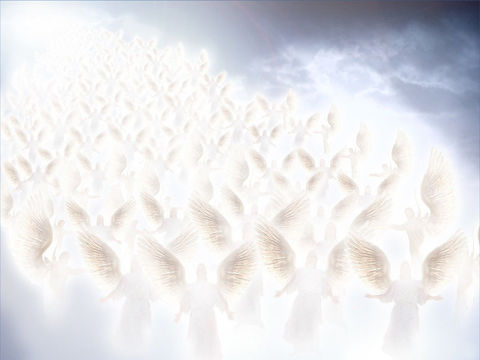 2. WE THE FORGIVEN WILL SEE THE COUNTLESS ANGELS: those completely forgiven meet angels—“You have come to thousands upon thousands of angels in joyful assembly” (v. 22b). At last we get to meet all those who watched over us while we went through this life—mighty flaming spirits, “ministering spirits sent to serve those who will inherit salvation” (1:14).
• Moses tells us that “myriads of holy ones” attended the giving of the Law (Deuteronomy 33:2), and from Daniel we hear that “Thousands upon thousands attended him [the Ancient of Days—God]; ten thousand times ten thousand stood before him” (Daniel 7:10).
• David said, “The chariots of God are tens of thousands and thousands of thousands” (Psalm 68:17).
• So seldom do we even reflect upon God’s special ministers who are as Kent Hughes writes “passing in and out of our lives, moving around us and over us just as they did Jacob of old. Sometimes they protect God’s elect— (i) for example, the “tall men in shining garments” who surrounded Mr. and Mrs. John G. Paton years ago in the New Hebrides— (ii) or the “tall soldiers with shining faces” who protected missionary Marie Monsen in North China— (iii) or, on another occasion, the “huge men dressed in white with flaming swords” who surrounded the Rift Valley Academy— (iv) and on another the “hundreds of men dressed in white, with swords and shields” who stood guard over a hut shielding Clyde Taylor, who would one day found the National Association of Evangelicals. (v) Olive Fleming Liefeld in her book Unfolding Destinies tells how two young Auca Indians, Dawa and Kimo, heard singing after witnessing the martyrdom of the five missionaries in the jungles of Ecuador: “As they looked up over the tops of the trees they saw a large group of people. They were all singing, and it looked as if there were a hundred flashlights.” (vi) But the grand emphasis of our passage is not so much the angels’ care of us, but rather our joining them in festal assembly. The word translated “joyful assembly” was used in ancient culture to describe the great national assemblies and sacred games of the Greeks. Whereas at Mount Sinai the angels blew celestial trumpets that terrified God’s people, we are to see ourselves on Mount Zion as dressed in festal attire and worshiping in awe side by side with these shining beings!” 2
3. WE THE FORGIVEN WILL JOIN THE SAINTS OF ALL TIME: those completely forgiven come to fellow-believers—“to the church of the firstborn, whose names are written in heaven” (v. 23a). Hebrews tells us that Jesus is not ashamed to call us brothers and sisters, so with Him we are sharing in the inheritance promised us by God the Father.
• In the ancient world all the rights of inheritance go to the firstborn. Because we are purchased by Christ and completely forgiven—we are “co-heirs with Christ” (Romans 8:17). • Bishop Westcott says we are “a society of ‘eldest sons’ of God.” There are no second or third or fourth sons and daughters in the church. We all get the big inheritance! Plus our names are written in Heaven along with the all of those who are already there. In other words, we are all the Body of Christ! They are there awaiting us as we come one by one escorted by Christ. One with Him, brothers and sisters we are united until His entire family has safely made it home. Then Christ can celebrate communion with us when all are safely home.
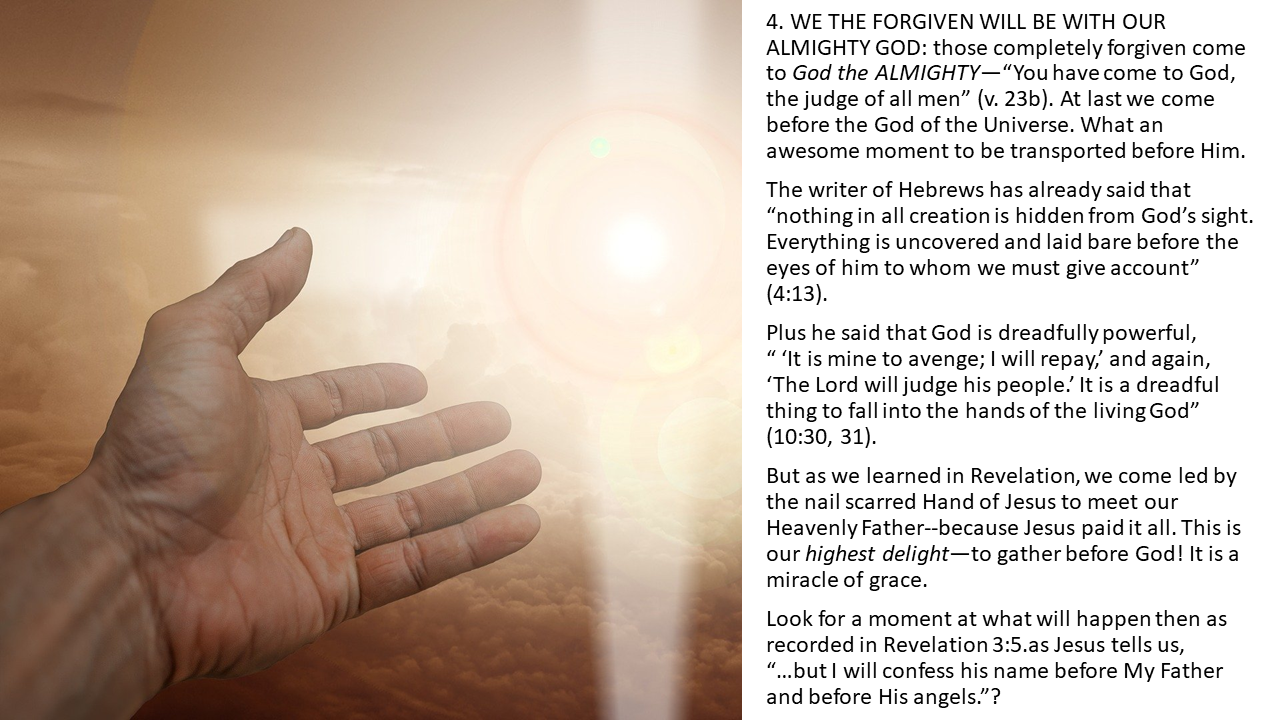
4. WE THE FORGIVEN WILL BE WITH OUR ALMIGHTY GOD: those completely forgiven come to God the ALMIGHTY—“You have come to God, the judge of all men” (v. 23b). At last we come before the God of the Universe. What an awesome moment to be transported before Him.
• The writer of Hebrews has already said that “nothing in all creation is hidden from God’s sight. Everything is uncovered and laid bare before the eyes of him to whom we must give account” (4:13).
• Plus he said that God is dreadfully powerful, “ ‘It is mine to avenge; I will repay,’ and again, ‘The Lord will judge his people.’ It is a dreadful thing to fall into the hands of the living God” (10:30, 31). • But as we learned in Revelation, we come led by the nail scarred Hand of Jesus to meet our Heavenly Father–because Jesus paid it all. This is our highest delight—to gather before God! It is a miracle of grace.
• Look for a moment at what will happen then as recorded in Revelation 3:5.as Jesus tells us, “…but I will confess his name before My Father and before His angels.”?
 FACE TO FACE WITH JESUS
To be taken by the hand by the Lord Jesus, to be led up past the marshaled ranks of the angels, up along the golden boulevards of glory, up past the cherubim and the seraphim, up, up to the throne of God Himself and to hear the Lord Jesus call you by your name and present you in person as His well beloved!
Then to hear the Father say, “Bring the best robe and put it on him.” Think of it, a robe of white, bright as the day, pure as the light! When the Lord Jesus was transfigured on the mount, something happened not only to His countenance, something happened also to His clothes. His raiment became white as the light.
What a reward for all of us who have been completely forgiven–to have a robe like that draped around our shoulders and to be invited to walk the shining ways of glory in light transfigured clothes. We have joined all the saints of all the ages home at last with our God.
FACE TO FACE (#549)
Face to face with Christ, my Savior, Face to face—what will it be, When with rapture I behold Him, Jesus Christ Who died for me?
Face to face I shall behold Him, Far beyond the starry sky; Face to face in all His glory, I shall see Him by and by!
Only faintly now I see Him, With the darkened veil between, But a blessed day is coming, When His glory shall be seen.
Face to face I shall behold Him, Far beyond the starry sky; Face to face in all His glory, I shall see Him by and by!
What rejoicing in His presence, When are banished grief and pain; When the crooked ways are straightened, And the dark things shall be plain.
Face to face I shall behold Him, Far beyond the starry sky; Face to face in all His glory, I shall see Him by and by!
Face to face—oh, blissful moment! Face to face—to see and know; Face to face with my Redeemer, Jesus Christ Who loves me so.
Face to face I shall behold Him, Far beyond the starry sky; Face to face in all His glory, I shall see Him by and by!
PERFECT AT LAST!
5. WE THE FORGIVEN WILL ATLAST BE PERFECTED: those completely forgiven come as saints to heaven—“to the spirits of righteous men made perfect” (v. 23c). We join in the assembly of the perfected ones, the justified, sanctified and now at last glorified ones. The hope and longing of all our earthly struggle has been realized. We are finally free from sin in all its hideous power and presence.
• We are sharing in that power of an endless life but amazingly by God’s plan we get to partake of it together with all the saints of all the ages. Though some will have preceded us by thousands of years God tells us in Hebrews 11:40, “that only together with us would they be made perfect.” The Old Testament saints waited for centuries for the perfection we received when we trusted Christ, because that came only with Christ’s death—“by one sacrifice he has made perfect forever those who are being made holy” (10:14). Because of Christ’s work we are not one whit inferior to the patriarchs, for through Christ we are all equal in righteousness!
6. WE THE FORGIVEN WILL BE WITH JESUS OUR SAVIOR: those completely forgiven come to JESUS OUR SAVIOR—“to Jesus the mediator of a new covenant” (v. 24a). The writer of Hebrews uses the name given to God the Son at His birth. He is seen in Hebrews as the One who destroyed the Devil ‘him that had the power of death’; and who was made like us and has felt our temptations. He is Jesus who invites us to boldly come to the very Throne of God and find grace and mercy. Jesus is the One through whom all things are promised us, given us, and He sustains all things. So here we come to Him who is our all in all. Just like the chorus we often sing declared, we find here to be true.
ALL IN ALL (D. Jernigan / Shepherd’s Heart music) You are my strength when I am weak; You are the treasure that I seek–You are my all in all. You took my sin, my cross, my shame, Rising again, I take your name–You are my all in all. Jesus, you’re the Lamb of God, holy is your name; Jesus, you’re the Lamb of God, holy is your name. Seeking you as a precious jewel, Lord, to give up I’d be a fool, You are my all in all. When I fall down, you pick me up, When I am dry, you fill my cup–You are my all in all. Jesus, you’re the Lamb of God, holy is your name. Jesus, you’re the Lamb of God, holy is your name.
7. FINALLY WE THE FORGIVEN WILL ENJOY HIS COMPLETE FORGIVENESS: those completely forgiven come to eternal forgiveness because of Christ’s blood—“and to the sprinkled blood that speaks a better word than the blood of Abel” (v. 24b). The blood of Abel cried from the ground demanding vengeance; the blood of God the Son will forever proclaim that we are completely forgiven at an infinite price we were bought by the love of God who gave His only Son to die in our place!
The miracle of complete forgiveness is what Jesus said we are to celebrate in heaven forever! And complete forgiveness that David experienced and sang about in Psalm 32 is #201 in your hymnbook.
Marvelous grace of our loving Lord, Grace that exceeds our sin and our guilt! Yonder on Calvary’s mount outpoured, There where the blood of the Lamb was spilt.
Sin and despair, like the sea waves cold, Threaten the soul with infinite loss; Grace that is greater, yes, grace untold, Points to the refuge, the mighty cross. Dark is the stain that we cannot hide. What can avail to wash it away? Look! There is flowing a crimson tide, Brighter than snow you may be today.
Marvelous, infinite, matchless grace, Freely bestowed on all who believe! You that are longing to see his face, Will you this moment his grace receive?
Refrain: Grace, grace, God’s grace, Grace that will pardon and cleanse within; Grace, grace, God’s grace, Grace that is greater than all our (MY) sin!
So God’s Word tells us that those who come to Christ are completely forgiven. The writer of Hebrews says it is now our in Christ “you have come” (right now!) to these seven realities:
 • To the City of God,
• To myriads of angels,
• To fellow-believers,
• To our awesome God,
• To at last be glorified,
• To Jesus our Savior,
• To complete forgiveness.
If this does not create a wellspring of thanksgiving in our hearts and make us want to march to Zion, what will?3
1 These three paragraphs are quoted from MacArthur, J. 2000. The Murder of Jesus : A study of how Jesus died. Includes index. Word Pub.: Nashville, TN
2 Hughes, R. Kent, Preaching the Word: Hebrews Vol 1&2—An Anchor for the Soul, (Westchester, IL: Crossway Books) 1998, c1993. electronic edition, in loc.
3 Adapter from Hughes, R. Kent, Preaching the Word: Hebrews Vol 1&2—An Anchor for the Soul, (Westchester, IL: Crossway Books) 1998, c1993. electronic edition, in loc.
Slides

Check Out All The Sermons In The Series
You can find all the sermons and short clips from this series, David’s Spiritual Secret here.
Looking To Study The Bible Like Dr. Barnett?
Dr. Barnett has curated an Amazon page with a large collection of resources he uses in his study of God’s Word. You can check it out here.