
If the video above is not available, here are two other ways to view:
David’s Purpose – God’s Glory
900121PM
DAV-05 DSS-30 WFL-39
1st Samuel
Transcript
.jpg)
1 Samuel chapter 13, and I just want to start introducing our focus this evening with verse 14. And of course, Saul was, as always, getting in trouble and we won’t even detail his life. He was truly the man after man’s own heart, but in the darkness of the hour with all the difficulties arising from his disobedience.
.jpg)
We find Samuel the prophet saying this in verse 14, but now your kingdom shall not endure. The Lord has sought out for Himself a man after His own heart. What a beautiful phrase. We’ve all heard that thought about that describe David thusly, but what a beautiful thing that the oracle or very mouthpiece of God, the prophet of God, Samuel, would look that king, the first king, that fearfully, powerful and yet incredibly weak man, Saul right in the eye and say, your kingdom’s falling apart, friend, because God isn’t looking for someone after man’s own heart, but the Lord is appointed a ruler of His people. Because you have not kept what the Lord commanded you.
What does that entail? What caused God to say such a thing about a normal man that was normal? In fact, even so manly and so human that we know perhaps often as much about his failures as we do about his successes. What constitutes, what elements together comprise a man that God would assess as being after His own heart? And I’d like to consider this just in three areas.
.jpg)
First of all, where does David fit in the scope of the Scriptures as they portray God’s servants? And I was fascinated with this. I was spending some time and I loved biographies. I could preach every week on biographies because I just really see the Scripture as a hall of profiles of how God used normal people. And it’s very inspiring to me to see that, that He can pick a shepherd that’s rough and very unlettered as Amos from Tekoa was, and he took an old burley fisherman that had a foot shaped mouth as Peter was, and he took this fella who was a very handsome and striking man, probably had red hair as the Jewish people thought. That would be unusual for a Jewish person to have red hair, but it said he was ruddy, so whatever that means.
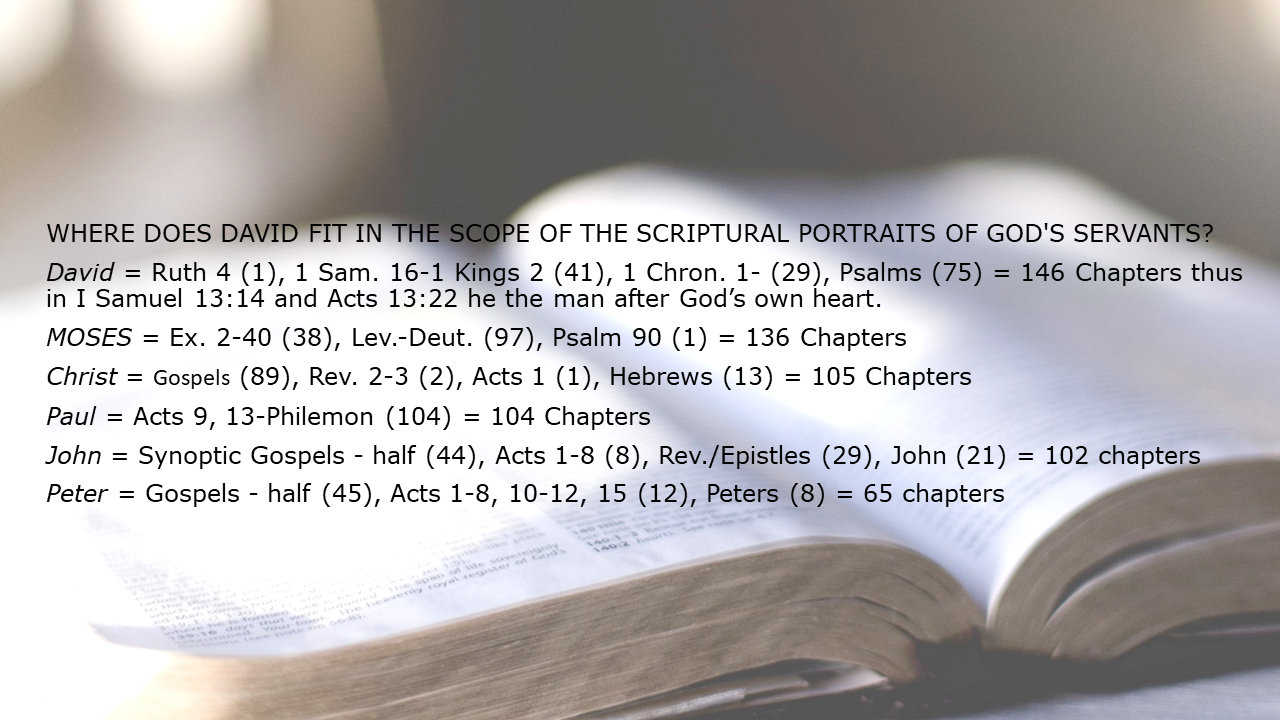
But why did God use him? And what’s amazing when we come to David and see that he’s after God’s own heart, if we were to chronicle the top six people in the Bible that have chapters written about them, they would come out thusly. David in the Scriptures has 146 chapters that biographically describe him. Now, I’m not talking about the Psalms. I’m talking about biographical chapters from the Scriptures that talk about their life, their coming into the world, how they live their life, and how they went out. There are 146 chapters in the Scriptures that chronicle that. One chapter in Ruth, 41 chapters between 1 Samuel 16 and 1 Kings 2, 29 chapters in 1 Chronicles, in 75 of the Psalms talk about insights into David’s life. Not just everything he wrote, but everything that was written about him.
The second most noteworthy or notable, or written about man in the scriptures is Moses 136 chapters are written about his life and he comes in right next to David. And then of course, although the entire Bible tells us about the Lord Jesus Christ. There are 105 chapters that give us an intimate glimpse into His earthly life, so He would come in third place for chapters in the Bible. The Apostle Paul is fourth 104, and of all humans, of all men in the New Testament, we know more about Paul than any other 1st century New Testament personage. We know him backward and forward, in and out. He is an amazing man whose life has just been thrown open for us to see.
After David and Moses and our Lord Jesus Christ and Paul. The next most written about fella, interestingly enough is John the beloved apostle, about 102 chapters cover his life, of course, many of them in the Gospels. And then finally Peter, who has about 65 chapters that either he has written eight himself, 12 chapters in the Gospels, and then about half of the New Testament chronicles his life as he was foremost of the apostles. And so, we see that where David fits into the scope of Scripture is that he is the most written about man in the Scriptures, the most written about life in the Scriptures.
He’s the man that God said is after my own heart, and then he writes and chronicles and details on the inspiration of God’s Spirit, so much of his life that we can draw from.
.jpg)
Of course, David’s greatest service, if we were to ponder it, would be the composition of the Psalms. If we were to look at his lasting impact, not only his life that he lived, but what he did with that life, and no less than 73 of the Psalms are ascribed to him.
And if it was possible to take the highlights of those, they would possibly sound like this. And I just want to read to you from about 15 of the Psalms, the most well-known lines for you to think about the heritage that David has in our lives, because many of these words are often on our lips and our meditations and our prayers and our pursuit of the Lord. Oh Lord, our Lord. How excellent is Thy name in all the Earth. Bless the Lord, oh my soul, and all that is within me. Bless His holy name. The lines have fallen unto us in pleasant places. The Lord has not dealt with us after our sins, nor rewarded us after our iniquities against thee. Thee only have I sinned and done that, which is evil in thy sight, have mercy upon us. So, God, according to thy loving kindnesses, according to the multitude of thy tender mercies, blot out our transgressions.
Create also in us a clean heart, oh God, and renew right spirits within us. And now, Lord, what wait before our hope is in Thee. With Thee is the fountain of life. In Thy light, we see light lift thou up the light of Thy countenance upon us. We commit our way onto thee. We cast our burdens upon Thee. Keep us as the apple of Thy eye. Hide us under the shadow of Thy wings. Make us to know our end and measure of our days. What is it then that we may know how frail that we are? Into Thy hands we commend our spirits. Redeem us, oh thou God of truth. Blessed be the Lord God, the God of Israel, who only does wondrous things, and blessed be His glorious name forever and let the whole Earth be filled with His glory. Amen and amen.
A cross section of the Psalms. So first of all, David fits into the scriptural portrait as being one of God’s most intimately revealed servants, and we will learn from an intimate look at his life. Secondly, this evening, let’s look into his personal life because this is where the reality of a relationship with God is most evidenced by what goes on not so much in our public life when people are scrutinizing and when they can give their commendations or condemnations. But what was he like in his secret time, in his personal, his private life?
.jpg)
Let’s start in the Book of Ruth, go back to Joshua, Judge. Ruth, just before 1 Samuel, where you are, back a few chapters and look at the last chapter of Ruth. And what we want to see is starting in verse 18 at the concluding section there of the book of Ruth. We see that David had a very special family line. This kind of answers the question, who was this guy? Who was he? He was interesting. He had an unusual pedigree. It says, these are the generations of Perez to Perez was born Hezron, and Hezron Ram, and Ram, Amminadab was born. Nahshon, Salmon. Salmon, Boaz. Boaz, Obed. And the Obed was born Jesse. And to Jesse David.
What’s amazing about these Old Testament lists is they rarely mention a woman’s name. If we compare this list, of course, to the first chapter of the New Testament, we find out that behind all these amazing men, there were some very amazing women. The women that were in the line of David, who were in the line of Christ.
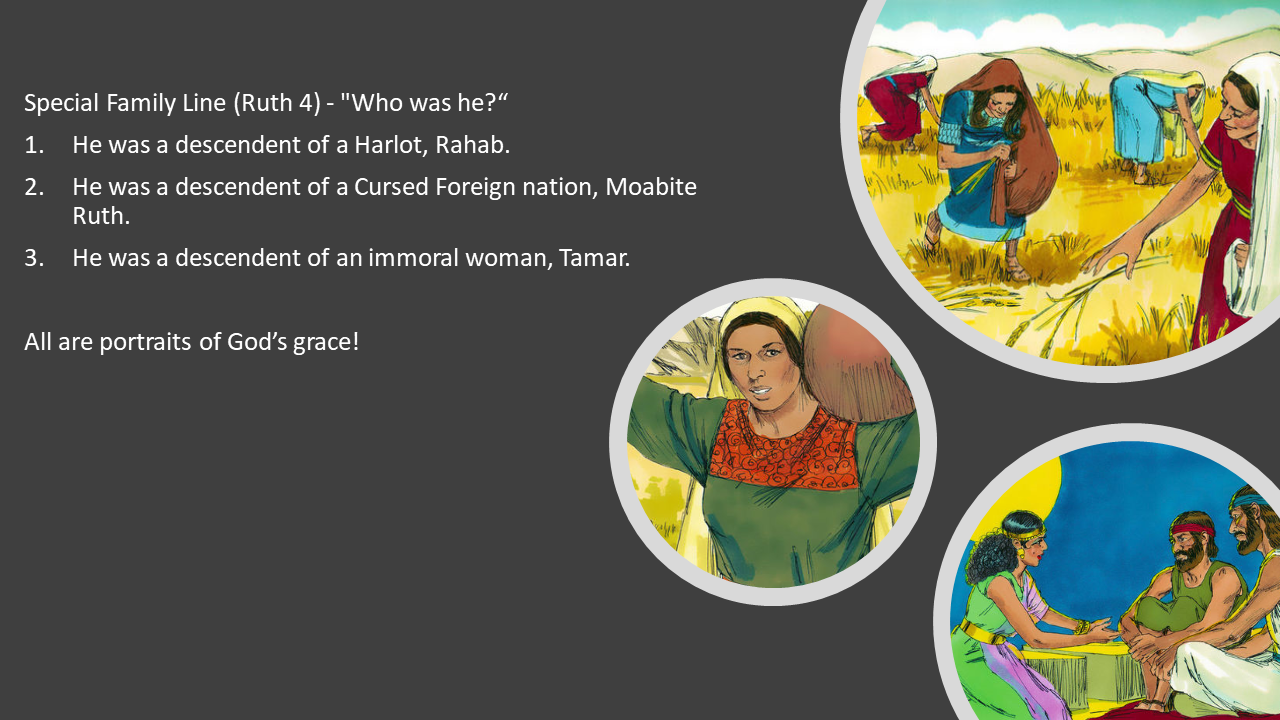
And when you think about David, you think about a fella who had an awful lot of strikes in his pedigree against him. He had a great, great, great-something grandmother who was a harlot, and that’s what she’s come down through history known to us as Rahab, a harlot. That was one of his foremothers. He had a mother foremother, a great, great grandmother of some sort that this whole book is about that we looked at in Ruth. She was a Moabite. We’ve already talked about the curse that was attached to them. She was in his pedigree. We had Tamar. In fact, that’s where we get this Perez fella from. And his mother conceived this child through an illicit incestuous union with her own father-in-law. Tamar was her name.
But each one of these are a marvelous aspect of his personal life because he had a special family line and his special family line had little cameos, little portraits of grace, all through them. Isn’t that the way that God works? He takes those who are despised and who are afflicted and who are stained and uses them as a portrait of His grace to show how wonderful is His love.
.jpg)
But now turn over to 1 Samuel 16 because the second aspect of his personal life. His private life that we want to look at is in chapter 16 of 1 Samuel. And we see something very interesting about him. Not only did he have a special family pedigree with all these little cameos, these little snapshots of grace attached to his family tree but also, he had a special family position. Maybe we could answer the question, how was he doing in his family? And he had it hard. I know a lot of young people think they have it hard sometimes in their families, or perhaps you grew up in a difficult situation. I would say that David had an extremely difficult situation. In fact, an author of a generation or two ago wrote a book called The Psalms in Daily [Human] Life. His name was Prothero and what he did is he showed us that the Psalms mirror nearly every conceivable human emotion. And then he showed how those Psalms that David wrote, half of them intersected with the lives of some of the greatest personages from history. It’s a very fascinating book, and one of the intersections is that David had a somewhat difficult family life.
Let’s look at it starting in verse 11, and Samuel said to Jesse. Are these all the children? Do you remember the story? God sent Samuel off to anoint the next king of Israel, the second king, and he went to Bethlehem. And as he was there, God directed him to the house of Jesse. And he told Jesse he wanted to see all his sons. Now, do you want to get a little glimmer of how David was looked on in his family? If you ever think you’re insignificant, here comes the mightiest man of Israel, the renowned prophet of God, the only guy that seemed to have any touch with God during a dark era for the Word of the Lord was scarce. And here comes a man who made kings and people quake. In fact, they were scared if you read the story here, when he came into Bethlehem, they said what are you doing? Have we done something wrong? Like when you walk in with the paddle in your hand, your kids say, have we done something wrong? Kind of know that something’s up.
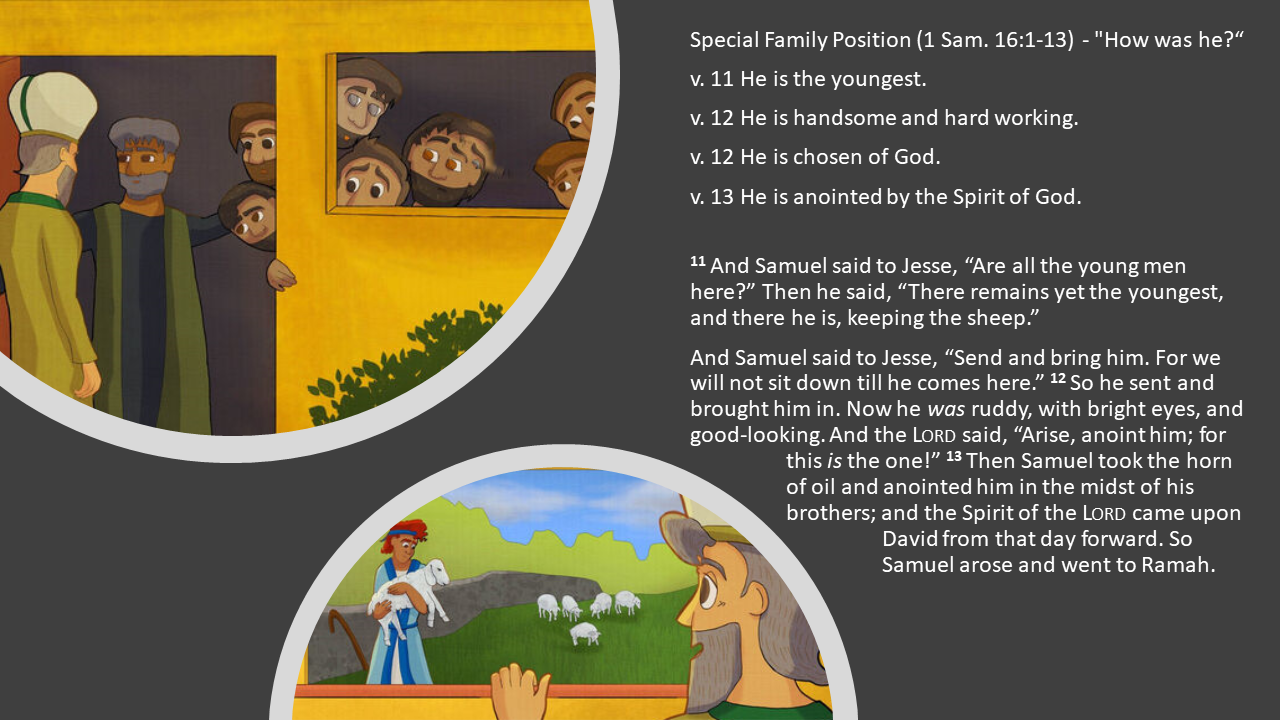
Samuel walked into town. Jesse said, here’s my family. And he ran seven boys in front of Samuel and Samuel says in verse 11, are these all the children? David was so insignificant his father didn’t even bother to invite him in the house to meet the prophet. Maybe that shows a little bit how he was looked on in his family. Maybe a little bit of jealousy, maybe a little bit of rivalry there among the children. Maybe a little bit of, I got too many kids. I can’t keep track of them. I don’t know what the problem was, but he was a little bit overlooked. And we meet him here in verse 11 as the youngest, and it says at the end of verse 11, there remains at the youngest and behold, he is tending the sheep. There’s eight boys and they pick the littlest one. The youngest one to go out and take care of one of the most mundane and smelly and difficult jobs.
And here’s David off being tutored by God, taking care of the sheep. And so, Samuel said to Jesse, send down, bring him for, we will not sit down until he comes here. We see that he was hardworking because it says in verse 12, so he sent and brought him and he was ruddy. Whatever that means. Maybe a red head, who knows? With beautiful eyes. Isn’t that interesting? That’s what the New American renders those words as, and handsome appearance. No wonder they were all jealous. The guy’s hardworking, he’s willing to do behind the scenes kind of work. He’s good looking. He’s a little distinct. And the Lord said, isn’t that interesting? Samuel’s in touch with God. He had a transceiver there and God said to him, right on the spot, arise, anoint him for this is he.
Now you remember that we already started with chapter 13, verse 14, where Samuel had already spoken prophetically to the king and said, you have failed Saul. God’s got somebody after his heart, and I’m sure from chapter 13, the chapter 16, he was looking, where would this fella be. He shows up now, and of course, as always, when God works, it’s not at all what we would suspect. You remember how Saul was chosen? Saul was chosen because he was the biggest, strongest head and shoulders above everybody else in Israel kind of fella. He’s the guy that everyone would pick to be on the team. He’s the guy that would be the president of everything. And though he had a huge physical stature, he had a very minuscule spiritual anything. And when things got tough, remember he was hiding in the baggage shows what kind of character he had. But here we go to a fellow that it doesn’t say anything about his size. In fact, if he’d have been, huge and muscular, probably would’ve said that. It told us about his eyes and his complexion and everything else, but I think David was just a pretty basic fella and God said, this is the guy. And so, we noticed that he’s young, overlooked. He’s good looking. He’s hardworking. But he’s chosen by God.
I want you to see something else that’s real important because it’s in the next verse. Verse 13, then, Samuel took the horn of oil and anointed him in the midst of his brothers. Now try and picture this. I don’t know about you, but I see in pictures and I can see these guys, I can see them all in their wraparound robes and their old smelly sandals standing around. Perhaps they lived in tents. Who knows? And this old prophet, all crickety is there and he’s carrying this, an oil vessel. And he came in and he’s not willing to sit down until he anoints this guy. And dad brings in the whole clan, and from Eli all the way through, from the number one big guy all the way through to the seventh. They all walked by and I’m sure Samuel was very deliberate and he just looked at him. Mm-hmm. Mm-hmm. And they were piling up on this side. He knew they were supposed to be there.
And he says, where’s the other one? Isn’t there anybody else? And he says, yes. And so, they go and they run him in from the field. And who knows what he looked like coming in from the smelly sheep. But he gets there and there’s seven brothers and dad watching. And this man who made a whole nation quake in their shoes looks at this fella. He says, you are the one. And they hear that. Now just remember that put, tuck that away in the back of your mind and it says, Samuel took that horn of oil and anointed him in the midst of his brothers. They’re all looking on, I’m sure it was quite a big thing. They were all watching and here comes this oil on his head.
But listen, and the Spirit of the Lord came mightily upon David from that day forward. Wow. Now I remember God’s Spirit came and departed from different personages. But David had the privilege from at this young age forward, and by the time we get to Psalm 51, he’d gotten so acquainted with walking with God’s Spirit. He says, don’t take your Spirit from me. He loved God’s Spirit upon him. And Samuel rose went to Rama. That’s his family position, overlooked, insignificant, and a little sliced out of family life.
.jpg)
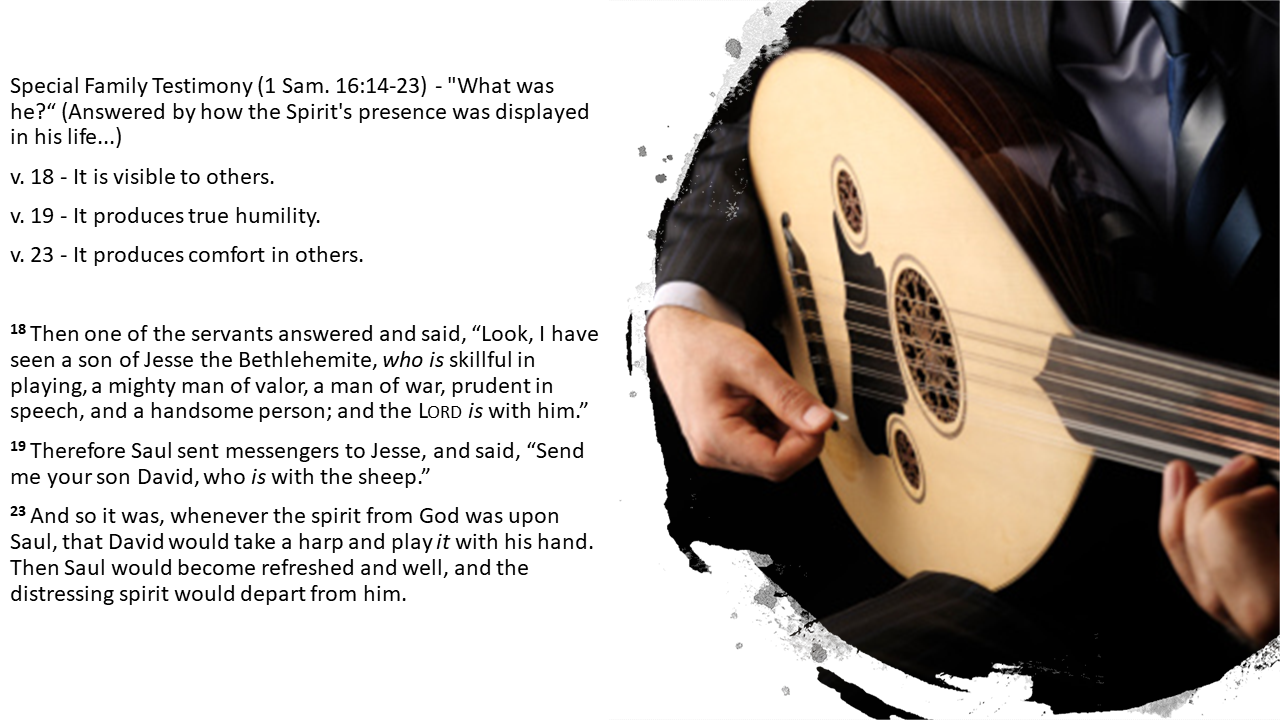
Now let’s look at his family testimony. Turn over to verse 18. In the same chapter, I want to show you what happens here because his brothers didn’t think very much of him, but things start, get going here and Saul got a little depressed. And verse 14, and an evil spirit, in verse 15, is terrorizing him. In verse 16, that they were looking for a skillful player to drive away the evil spirit. And so, in verse 17, Saul says to a servant, provide for me now a man who can play the music for me. And you say, what does that have to do? There’s something in the Old Testament under prophecy or with the spirit world, that there was something to do with music. If you remember when some prophets prophesied, they had to have someone playing the harp, and all of a sudden, the Spirit of the Lord would come on him and they would prophesy. And maybe sometime when we talk about music, it’s important to remember that music is associated with spiritual things, both positive and negative. A little word that music is not amoral. It definitely can influence both positively and negatively.
But verse 18, this is great because not only did David’s family have a distinct impression of him, oh brother, there he comes, you know, the runt. That was the family testimony. But he has a totally different public testimony as far as people outside of his family looking onto his private life. Because look at verse 18, then one of the young men answered and said, behold, I have seen a son of Jesse, the Bethlehemite, who is a skillful musician.
Now listen to this. This is one of Saul’s servants, no relative of David’s, just a fellow that ventures in a desperate moment as the king is demon possessed and all in trouble. He ventures this tip, he says, I know a son of Jesse can’t even remember his name at the moment, but this guy is a skillful musician. He’s a mighty man of valor. Now, David’s brothers thought the only thing to do is watch sheep. He’s a mighty man of valor, a warrior, one prudent in speech, and a handsome man.
But here’s his top qualification, and the Lord is with him. How would you like to have people look on you that way? Wouldn’t that be great? I wouldn’t mind that. I wouldn’t mind people thinking that I was a skillful musician, even though I have no manual skills. I can’t even type. A mighty man of valor, a warrior, a prudent man in speech. He was careful what he said and a handsome man, but most of all an outsider to say the Lord is really with that fella. And the Lord wasn’t with very many people in that year and he stood out. So, we see that others testified to the fact that his life had a testimony visible to others. And this kind of answers the question now that we’re looking at, what was he? Why did God say he was after His heart? We see one thing is that he had a testimony that was visible to others.
There’s another very interesting element in verse 19 because I’ll tell you right now, David was a humble fella. See if you can catch the picture. In verse 12 and 13, Samuel the prophet, the most well-known guy, next to Saul, comes to town. Everybody knows that he comes to Jesse’s house. Everybody saw that he comes in front of Jesse’s kids. Everybody noticed that he picks out one of those kids. He dumps oil on his head. He’s got all this stuff dripping down his face and he says, you are going to be the next king of Israel. And you know what? Look at verse 19, if this isn’t the ultimate in humility. So, Saul sent messengers to Jesse and said, send me your son, David.
What? Who’s with the flock? Can you imagine the humility of a guy that was anointed to be the next king and he goes back to the flock? I think most people would’ve gone immediately down to the sign shop and had a great big sign to put over the door of their bedroom, The Future King Lives Here. And they would’ve stayed in there resting, getting ready for being the king of Israel after the prophet got him anointed. But you know what David’s character shows through so mightily here, he’s still with the flock. And Jesse took a donkey and loaded some bread and a jug of wine and the young goat, and he sent them to Saul by David, his son. And David came to Saul and attended him. And Saul loved him greatly and he became his armor bearer.
And of course, you know that when things got bad, verse 23, whenever the evil spirit from God came to Saul, David would take his harp, play it with his hands, and Saul would be refreshed and be well, and the evil spirit would depart from him. That tells us a lot about David. He produced comfort in others.
.jpg)
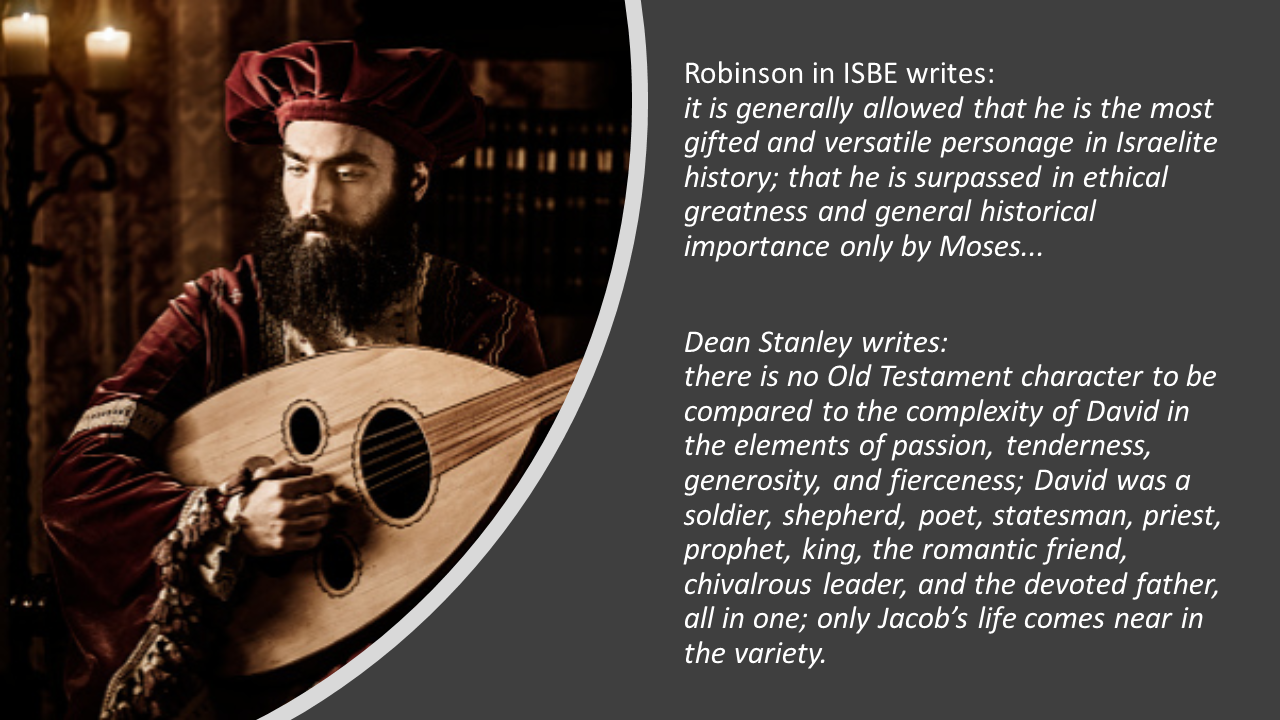
God’s Spirit within him produced true humility, and he had a testimony that others could see. In fact, I was reading what Robinson said in the International Standard Bible Encyclopedia, and this is what he wrote about this fella. In this time in his life, it’s generally allowed that David was the most gifted and versatile person in Israelite history. He is surpassed an ethical greatness and in general historical importance only by Moses. He completed though what Moses began. He created out of Israel a nation and raised it to its highest eminence. And in spite of all his human frailties, he was a genuinely pious man, an ideal ruler, a lover of righteousness and peace, and the only man of his age who appreciated Israel’s religious destiny.
I like that Dean Stanley wrote these words. There is no other character in the Old Testament to compared with David. In the complexity of his elements, his passion, his tenderness, his generosity, his fierceness. David was a soldier, a shepherd, a poet, a statesman, a priest, a prophet, a king, a romantic friend, a chivalrous leader, and devoted father all in one. Only Jacob comes near him in the variety of the elements that are included in his life. And then Murray wrote this, his authentic writings the Psalms will hand him down to all future times as the world’s greatest master of Lyric song. He has entered closest to the heart of nature. He has caught as none other its manifold expression. And listen, he has soared nearest Heaven and lifted mankind toward divinity. And I round out these comments by reading what Cornhill said. He said this made him one of the most lovable characters in the Old Testament, the most luminous figure in the most gifted personage in all the history of Israel. On and on and on.
.jpg)
Okay, you say, a great man, but what about 2 Samuel 11? Y’all know it’s there. You know you need to turn there. It’s one of the blackest chapters in the Bible. David and Bathsheba. How can we say all these marvelous things about David? How can we say he was humble? How can we say he lifted us closer to Heaven than anybody else? How can we say that he embodied worship as no one else has ever put pen to paper to record? He was an adulterer. He was a murderer. He was a hypocrite. He was a gross sinner. But the reality is he was willing to confess it. And Psalm 51 is his confession. He was willing to repent and he is willing to thank God for cleansing in Psalm 32, of course is his marvelous thanks to God for cleansing again.
Isaac Walton wrote these words, though the prophet David was guilty of murder and adultery and many other of the most deadly sins. Yet he was said to be a man after God’s own heart because he abounded more and more with thankfulness than any other that is mentioned in the holy scriptures. You ever thought about that? Thanksgiving is more on his lips than any other recorded personage in the Bible. In all 939 Old Testament chapters, David stands up above all else, head and shoulders above, so thankful to God. Perhaps, as our Lord said, to whom much has been forgiven, much will be their thanksgiving and much had been forgiven him. And as a Scottish version of the Bible translates Psalm 103:1 Bless oh my soul, the Lord thy God and not forgetful be, of all his gracious benefits he hath bestowed on thee. And that was David’s testimony.
.jpg)
But what was the foundation that life was built on? And that’s where we hasten to this evening to conclude, and let’s find it in his public life, because we’ve looked at his portrait in the Scripture and it’s massive. We’ve glimpsed briefly into his personal life and it’s special. But now let’s finally see the essence of what really made David and that’s going to show up in his public life. And now we turn to chapter 17 and David’s public life stretches right here from chapter 17 of 1 Samuel, all the way through to 2 Samuel 24 where he dies. And in this chapter, I believe we find what is the most vital characteristic of his life and something that if you were to ever emulate a man’s personality, this would be something I think that all of us would do well to emulate. You say, oh, really? Yes, because David did something here that most people don’t even catch because the only thing they think 1 Samuel 17 is about is what?
What’s it about? What’s this whole chapter about? All the kids know that David and Goliath, and sometimes everything gets obscured because we’re looking at Goliath and we’re looking at the stones and the sling and everything else, and in the midst of all that, we don’t see what was really happening that day. David is recorded in Scripture as being the only person in all of Israel on that day that saw what was really going on. The only one. The only one that realized what was really the problem, it wasn’t the Philistines, it wasn’t the Giants, it wasn’t the fear of Israel’s army, it wasn’t the incompetence of the soldiers, and it wasn’t the jealousy of his brothers. It wasn’t any of those things. And it wasn’t little stones and slings and brooks and the Valley of Elah. That’s not what the story is about. And if we’ll just look at it from a divine perspective, we can distill out David’s purpose in life.
.jpg)
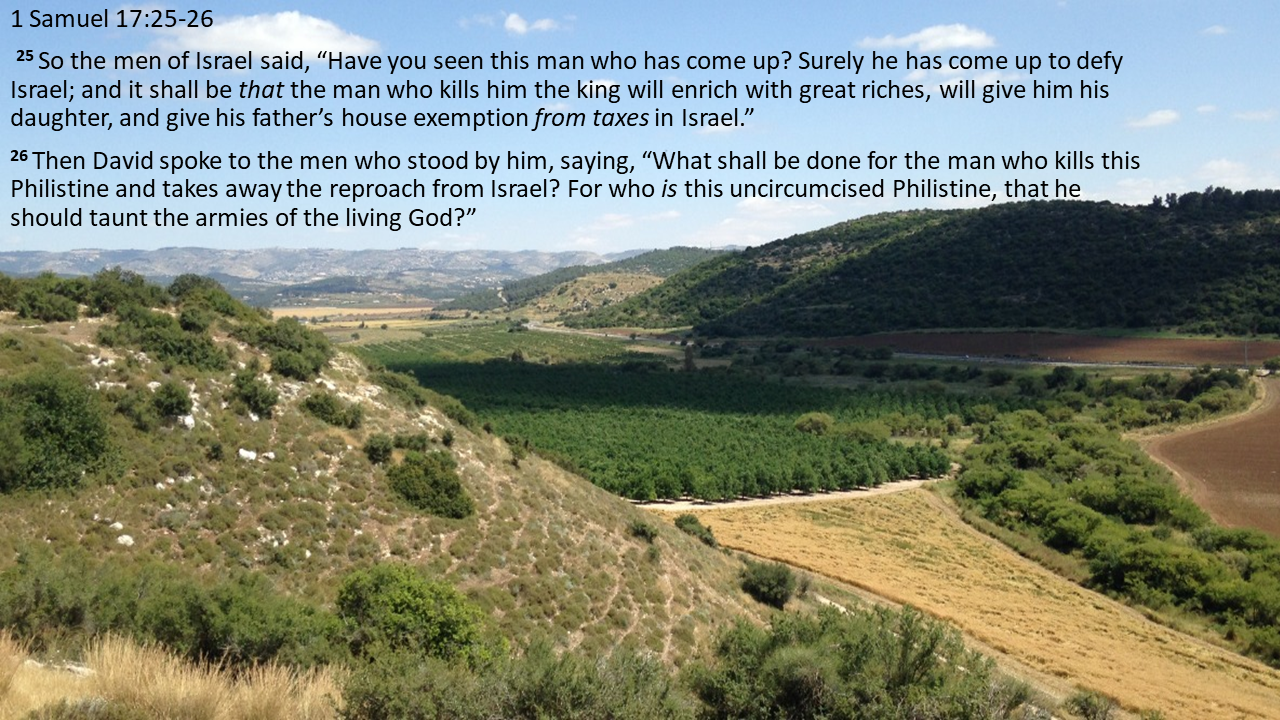
Let’s look first of all at the divine perspective, verses 25 and 26, and then we’ll zip through the story because side by side in verse 25 and verse 26, and I love to preach this chapter standing down in that valley. If you can just imagine that the Valley of Elah is a broad plane and then a steep hill going up on both sides. It’s about a quarter mile wide at the bottom, and then it stretches up on both sides and down the middle runs a crick. And that’s southern for a very small little stream, going right down the middle. And up one side, just like sheep grazing, were the armies of the Philistines massive.
And up the other side, like cowering fearful little ants, was the Israelite army. And in the middle was the battlefield, and everyone was focusing on the event that took place there. And as you know, for 40 days, it says in verse 16, morning and evening, the Philistines would, the Philistine Goliath would come forward and take his stand. And so, everybody had been thinking about this for 40 days and it had gone on and on and on. And we come to verse 25 and we see side by side in contrast how the spiritual and the unspiritual look at this event.
It says in verse 25, and the men of Israel said, and David, remember, came, and got involved at his father’s request in this whole scene. And David comes trotting up all full of enthusiasm and all full of anticipation and he runs up and the men of Israel said, have you seen this man who is coming up? Surely, he is coming up to defy Israel. That’s a human perspective. They said, look at that guy. Of course, they kept a comfortable quarter mile distance from him. They said, look at that guy. He’s defying us.
And then listen to their human motivation. It says in it will be that the king will enrich the man who kills him with great riches and will give him his daughter and make his father’s house tax free in Israel. I’m sure that was the plumb of the whole thing. No taxes. That’s the human perspective. In fact, it’d be very easy just to have that be the story, the bully, and the little fella. And the little fella kills the bully and he wins. But David, verse 26, gets to the heart of the matter. And if you’ve never seen this before, I hope that it embeds itself in your heart because there’s the human wisdom. He’s defying Israel.
And here’s the divine perspective, verse 26. And David spoke to the men who were standing by him saying. What will be done for the man who kills this Philistine and takes away the reproach from Israel? Now listen, one guy in the whole place saw what was really going on for, who is this uncircumcised, that means not a partaker in the covenant Philistine that he should taunt, not Israel. He looked way beyond and he saw it from divine perspective, that he should taunt the armies of the living God. Oh, did you catch that? Here they are cowering. Here they are standing there on their hillside, looking down at this 10-foot-high monster. They’re saying he’s defying Israel. And David, little David, little boy David teenager, comes down and says, what’s going to be done about this guy who is defying God? And in the whole nation, Israel, one person, one person was offended, not for themself, but for God. And if we were to distill David’s entire purpose and motivation for life, it shows up here. It’s going to show up over and over again. David was utterly concerned with God’s honor, not his own.
There’s a little phrase in the Bible if you’re reading through maybe this year, if you’d like to find something it’s one I chase all over the Old Testament. It’s a little phrase that all the world may know that there’s a God in Israel. And it shows up here and it shows up in Daniel and it shows up in various places all through Israel’s history because God is looking to and fro as the chronicler records for us all through the Earth, looking for one that he can show himself strong through because God is looking for people that are more concerned about His honor than their own, that are more concerned about his name than theirs. They’re more concerned about magnifying God in a world where he is belittled. If God wasn’t belittled in this situation, he’ll never be belittled. These people, representatives of the covenant, representatives of the redeemed representatives of God’s very name were cowering in front of an uncircumcised pagan idol, worshiping nobody, and they represented God.
And they were more concerned about how much you were going to get if you killed that guy. And they were all calculating how many spears and how many whatevers they’d need and how many chariots to run the guy over and perhaps get between his big armor and how much they would gain in tax free status.
And they missed the whole idea that God was being derided. Let’s look now at. David’s purpose in verse 46. because it’s restated because in the height of this entire setup, I’ll start in verse 45, David’s invincible Motivation shows up. And I’ll tell you a little secret, if you want a little secret of life, if you’re concerned for God’s honor, there’s hardly anything you won’t be able to accomplish in this world because there’s so few that are really concerned about His honor. There’s so few that in every given situation they say, what would God do in this situation? What would magnify His name in this situation? Not what would keep me or keep my but would keep Him.
.jpg)
Verse 45, and David said to the Philistine, and this is the confrontation and what a thrill to stand in that very spot and to read these words. And David said to the Philistine, this little, short kid looking up 10 feet, it’s like looking up at the backboard. And you’re just a little tyke and you can’t even get the ball off the ground. Here’s little David looking up 10 feet in the air at the hoop and the huge Philistine that filled that space, and he said, you come to me with a sword, a spear and a javelin, and this guy had gigantic.
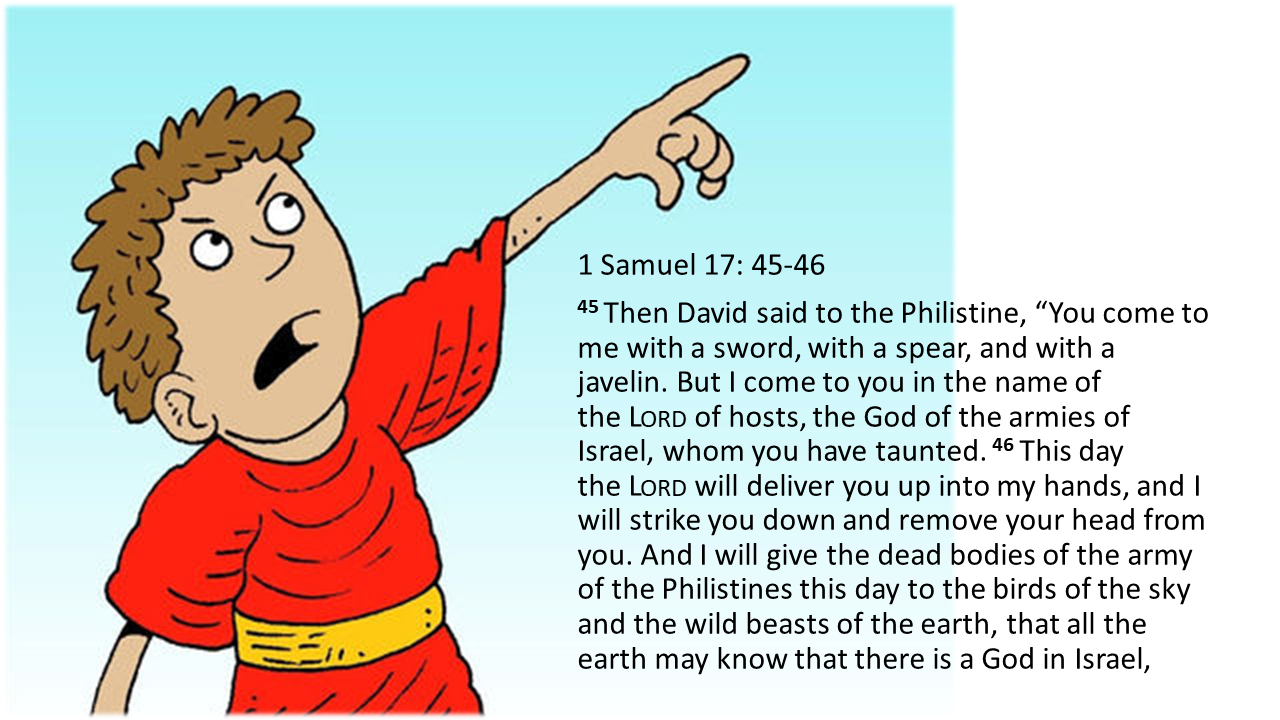
You can read about it. It’s huge. But I come to you in the name of the Lord of hosts. The God of the armies of Israel, whom you have taunted. He said, I don’t care if you’ve taunted the Israelites, they’re forgetting who they belong to and where they’re standing. He said, if nobody else is concerned about God’s name, I’ll be. Why do you think God so vindicated that boy that day? There’s nobody else in the Earth in the whole world. That understood what was going on in the Valley of Elah except one little shepherd boy that came in at the last moment in verse 46, he said this day, the Lord will deliver you up in my hand. And I will strike you down. I’ll remove your head from you and I will give your dead body or the dead bodies of the army, the Philistines this day, to the birds of the sky and the wild beasts of the Earth.
Uhoh, here’s that little phrase I told you about. That all the Earth may know that there is a God in Israel. Wow. And that all this assembly may know that the Lord does not deliver by sword or by spear for the battle is the Lord’s, and He will give you into our hands. He really had command of the situation and that little shepherd boy strode down that valley, he looked up into that giant’s face fearless. And the guy had on bulletproof armor. He was almost like a tank standing there. And he had his weavers beam and it, he had a head on that thing that weighed about 16 pounds on the top of that spear. And David looks up at him and he said, I want the whole world to know that Israel has a living in true God. And God can’t resist situations like that. And you all know the story.
.jpg)
Let’s back up and look at his personal life and see some elements that come along with a concern for God’s honor. And then let’s focus on that honor and then make our way home, because right alongside of this motivation for God’s Honor comes in verse 15, his humility starkly showing. Look at verse 15. But David went back and forth from Saul to tend his father’s flock in Bethlehem. Do you know why God could use this guy? It never went to his head. Never. Here’s the anointed one that was going to be the future king, and he doesn’t put up signs and bells and whistles. He just goes back to the sheep.
Now he gets the secondary role. He becomes the personal attaché to the king. Not only is he going to be the next king, but this guy is one of the most intimate with the king who’s in his chamber, playing him music when he is depressed. Now, talk about a springboard for a high political office. David had it all wound up there. He was the most vital man to King Saul. Not only was he going to be the next king, but he had the most intimate position. Remember, whoever had the king’s ear had it made, but yet when Saul got done with him. David would go back and forth, contend his father’s flock at Bethlehem, that is just unabashed humility. It’s amazing.
The Philistine came forward, verse 16 morning and evening for 40 days and took his stand. Now, if that doesn’t ring bells. 40 days. 40 days. 40 nights. 40 days, 40 nights. Remember testing, and while God is refining this humble little servant, totally unaware of David must have not known about this because he comes into the situation and just gets all riled up on the spot. So, nobody must have been telling him what was going on. He was going back and forth, and he couldn’t figure out why Saul was so depressed. How would you like to be the king of an army? And not be willing to lead them. You catch the picture. Who was supposed to go out and meet Goliath? Who do you think? Saul, he was the tallest guy in Israel. He was the king. He was sitting in his temp, taking valium by way of a heart to calm his nerves. And then David comes, look at verse 20, because another element of his life.
Not only was he humble. Yeah, but in verse 20, we see he was disciplined. Those two things sometimes and often go hand in hand from his dad and he didn’t sleep in and say, listen, this is the personal assistant to the king, I’m going to sleep in. I really had a hard life. But David arose early in the morning. Another interesting element. Look what it says in verse 20. He left the flock with a keeper. He didn’t have any oversized view of himself. He didn’t say I’m doing the king’s business. Somebody else take care of the little details. He left the flock with a keeper. He looked on the sheep as a very viable assignment. Here was the guy that was going to shepherd God’s flock, Israel. He learned how to take care of a little group of dirty sheep, and he took the supplies and went as Jesse commanded him.
And then in verse 23, we find the first time he gets exposed to this blasphemy. And while he was talking with them, because see he took the baggage and passed it out and got everything taken care of, like his discipline life did. And while he was talking with them, it happened to be the time of the day that old big shot came out to yell from the valley floor upward. And like a natural amphitheater, his voice would go right up to where the Israelites were. And this 10-foot-high megaphone started yelling. And the Philistine from Gath named Goliath was coming up from the army of the Philistines. And he spoke these same words and David heard them. And look, this is, I can just, this would make a great video because when all the men of Israel saw the man, they fled from him and were greatly afraid.
And there’s David just standing there listening and he can’t believe his ears. And then of course, he sees things from God’s perspective. But look at verse 28. because I want you to see the price that you have to pay for humility. And I was telling you he had a hard time in his family. It really comes clear right here. Verse 28. Now Eli, his older brother, heard that he spoke to the man. Remember what David said? David said, how can this guy talk like that to the armies of the living God? That’s a blunt statement. And his older brother, it was just cut to the heart. He was so jealous of David and he spoke to the men, and David stood up for God and he lives anger burned against David.
And isn’t that the way? It’s even like that in the Church. Someone will get up and they’ll say something in great enthusiasm for the Lord, and instead of everybody saying, that’s right, they go too spiritual or whatever, and they burned against David. His anger burned and he said, why have you come down here and with whom have you left? Now listen to this. This is the typical cutting words. Remember Ephesians 4:29, let no cutting or corrupt communication proceed out of your mouth. Listen to the daggers of this older brother and with whom have you left those few sheep in the wilderness. Not only are you a shepherd, you only have a few. Anybody could do that. I know your insolence. And the wickedness of your heart for you have come down in order to see the battle. Now that makes me chuckle. What battle? They’re all hiding and they’re all afraid to death of one guy. And David said, now this is so sweet. No anger, no vengeance, humility, and you just ask, what have I done now? You ever been the youngest? I was the youngest. What have I done now? Sisters go running off. Ah, what have I done now? Was it not a just question? And then I love this resolute undaunted, verse 30. And he turned away from him, his brother, he just looked and he said, what have I done now? I haven’t done anything wrong. And he was undaunted and he turned to another and said the same thing, and the people answered the same thing as before. Real quickly.
.jpg)
Finally, David gets up in verse 32 to Saul and he said, let no man’s heart fail on account of him. Your servant will go and fight with this listing. And that’s what’s so amazing about somebody that, that God has their attention. If they see something that needs to be done, they know God can do it and they know they can’t. And so, it’s a perfect situation for God to show his power strong. And David just said, whew, if this guy’s condemning and speaking against God, I’m going to go if no one else will go. And of course, his heart was burdened and he was a man.
God chose, and Saul said to David, verse 32, you’re not able to go against this Philistine to fight with him. You are but a youth. He has been a warrior from his youth. And David said to Saul, and by the way, David wasn’t old enough to fight in the Army yet, so we know he was less than 20. Remember you, you couldn’t be a priest till you’re 25. You couldn’t fight in the Army until you’re 20 and you couldn’t be up there. You couldn’t be a Levite till you’re 25 and you couldn’t even be a priest till you were 30. So, David was a youngster, a teenager here at a little fella, and David said to Saul, and here’s the next element of his life. Remember, he was humble in verse 15, he was disciplined in verse 20.
He saw things from God’s perspective in verse 26. And I would exhort all of you to think about any situation, whether it be here in the Church or anywhere else from God’s perspective. And then he was willing to pay a price in verse 28 for his servant hood. And that, of course, is criticism. And then of course, he wasn’t angry. He wasn’t full of vengeance in verse 29, and he was undaunted for God’s name in verse 30.
He was an encourager. In verse 32, he says, come on Saul, don’t get discouraged, but look at verse 34, because another critical element of his life shows up. He magnified God’s hand in his life. In other words, he was vitally, lovingly aware of God’s unceasing hand in his life. Moving and shaping and transforming him. And David said to solve verse 34, your servant was tending his father’s sheep. Ring, ring, ring. Humble, humble, humble. Doesn’t even say my sheep. He doesn’t lay claim. You notice this guy? He is the perfect example of humility. He doesn’t lay hold of anything. All the accolades that come at him he has no sticky fingers. They go right by him even in the most bland way. He’s just, he’s humble. Your servant was tending his father’s sheep. When a lion or bear came and took a lamb from the flock, I went out after him attacked him and rescued it from his mouth, and when he rose up against me. Now talk about fearlessness. I can’t imagine this. I took him by his beard, struck him, and killed him. Your servant has killed both the lion and the bear. And now listen. What a transition. What a beautiful illustration that just gripped Saul’s mind. I’m sure Saul had never fought hand-to-hand combat with a lion.
And here’s David, and he’s telling this great story and all of a sudden Saul’s probably ready to give him the purple heart metal. And he immediately changes into the whole purpose that he said this, and he said this. Your servant killed both Lion and Bear. Verse 36, and this uncircumcised Philistine will be like one of them since he has taunted the armies of the living God.
You see that he comes right back. He said the same thing up there in verse 26. If he have, David had a one-track mind. He said, I don’t care about myself. I don’t care about what my brothers think about me. I don’t care if I have the most menial job in the world. He said, I am concerned about God’s name, God’s honor. And David said, and he’s magnifying God, I don’t think God had been mentioned lately around there. They were talking about the Philistines. They were all in the negative mode and everything was imploding, not exploding as God conquered falling in on him. And David said the Lord. Who delivered me from the paw of the lion and from the paw of the bear, he will deliver me from the hand of this Philistine. He must have been convincing because look at what Saul said and Saul said to David, go, and it’s a strange thing to hear this coming out of his mouth. May the Lord be with you. I’m sure he was startled because he didn’t usually talk too much about the Lord. In fact, when he really got into a bind, he went to see a demonic medium. That’s where his strength lay.
.jpg)
Verse 38, and Saul clothed David with his garments and put a bronze helmet on his head and clothed him with arm. And David girded up his sword over his arm and tried to walk. Isn’t that cute for? He had not tested them. And David said to Saul, I can’t go out with these. I haven’t tested them. In other words, he says, I can’t even make it. It’s too much. It’s clumsy, it’s in the way. And David took them off and he took his stick in his hand. And he chose for himself five smooth stones from the brook.
And just a humorous aside, the Israeli government comes on a weekly basis with a dump truck, and then the brook in the valley of Elah, they dump an entire dump truck load of smooth stones and all week-long tour buses of pilgrims stop by and everyone takes home to America five smooth stones. Every trip, I’ve always brought my children five smooth stones. And every time I go there, there’s always more smooth stones. That’s just one of the things. I hope it doesn’t diminish your love for the Holy Land.
But I will tell you that in this time there were real, genuine smooth stones. And David reached down, he took five of them from the brook. He put them in his shepherd’s bag, which he had even his pouch, and his sling was in his hand, and he approached the Philistines. And the sling was a long cord with a little pocket in it. Just a long apparatus that wasn’t any one of these kind of shooting things. And he took that thing and he had often been probably standing out and practicing while he was watching his sheep. And it says that in this era that they could sling these stones within a hair’s breadth when, and they would go and they’d actually knock down city walls with slingshots because they would just keep whacking the wall with a high powered, high velocity rock. And if they kept hitting and pummeling that wall, they would break it down. As we saw in some of the events in the book of Judges. But David took his little stones, his little sling in his little pouch, and here comes the meeting and then the Philistine came on and approached David with the shield bear in front of him.
Now one little kid is coming out and here comes the tank with an escort no less with his shield bearer because Goliath was too big to carry his shield. He had all of his other equipment. And he was walking along missing, see him ambling down. And here’s this shield bear in front of him. And the Philistine looked and saw David. He disdained him for he was but a youth. And on top of that, he was ruddy. How would you like to be ruddy? With a handsome appearance. And the Philistine said to David, am I a dog that you come to me with sticks? Here’s David with a shepherd staff, in his little bulging little pocket with five little stones in it and his little leather sling.
And the Philistine said to David, come to me and I will give your flesh to the birds of the sky and to the beast of the field. And then of course, David’s invincible motivation clicks in and he looks up at that guy and he said, you can come, Mr. Tank, with your sword and your shield and your javelin and your spear. But I’m coming to you in the name of the Lord of hosts, the God of the armies of Israel, and that’s what I’m concerned about because you’ve taunted Him. And I’m not going to let you do that anymore because this day the Lord will deliver you into my hands and I’m going to wipe you out. I’m going to cut your head off and the armies that follow you for one reason.
Yeah, because David’s singular motivation was, he wanted to magnify God’s name in all the Earth. He wanted everybody to know everywhere. That in the midst of all the confusion and all the false gods and all the fearful followers of the true God, that God was still alive, even if he wasn’t showing up too much that way in the lives of his people and all the assembly would know that the Lord doesn’t deliver by sword or by spear for the battle is the Lords, and he will give you into his hands.
.jpg)
What’s the secret of being after God’s own heart? I think it’s very easily distilled into one little thought. It’s being entirely motivated and concerned and consumed with God’s honor. In fact, if you want to check that up. Read sometime what Nathan said when he confronted David at his darkest hour. Nathan didn’t say you murderer. He didn’t say you adulterer. You know what he said? He said, you’ve caused the enemies of the Lord to reproach God. You have made people not honor God because David’s whole life was involved consequently with honoring God’s name.
Just ask you one closing question, what motivates you? What is the consuming passion of our lives? What in the world are we living for?
Notes
A Man after God’s own heart

I. WHERE DOES DAVID FIT IN THE SCOPE OF THE SCRIPTURAL PORTRAITS OF GOD’S SERVANTS?
A. David = Ruth 4 (1), 1 Sam. 16-1 Kings 2 (41), 1 Chron. 1- (29), Psalms (75) = 146 Chapters thus in I Samuel 13:14 and Acts 13:22 he the man after God’s own heart.
B. MOSES = Ex. 2-40 (38), Lev.-Deut. (97), Psalm 90 (1) = 136 Chapters
C. Christ = Gospels (89), Rev. 2-3 (2), Acts 1 (1), Hebrews (13) = 105 Chapters
D. Paul = Acts 9, 13-Philemon (104) = 104 Chapters
E. John = Synoptic Gospels – half (44), Acts 1-8 (8), Rev./Epistles (29), John (21) = 102 chapters
F. Peter = Gospels – half (45), Acts 1-8, 10-12, 15 (12), Peters (8) = 65 chapters

II. DAVID’S PERSONAL LIFE:
A. Special Family Line (Ruth 4) – “Who was he?”
- 1. He was a descendent of a Harlot, Rahab.
- 2. He was a descendent of a Cursed Foreign nation, Moabite Ruth.
- 3. He was a descendent of an immoral woman, Tamar. All are portraits of God’s grace!
B. Special Family Position (1 Sam. 16:1-13) – “How was he?”
- 1. v. 11 He is the youngest.
- 2. v. 12 He is handsome and hard working.
- 3. v. 12 He is chosen of God.
- 4. v. 13 He is anointed by the Spirit of God.
C. Special Family Testimony (1 Sam. 16:14-23) – “What was he?” (Answered by how the Spirit’s presence was displayed in his life…)
- 1. v. 18 – It is visible to others
- 2. v. 19 – It produces true humility
- 3. v. 23 – It produces comfort in others.
Robinson in ISBE1 writes: it is generally allowed that he is the most gifted and versatile personage in Israelite history; that he is surpassed in ethical greatness and general historical importance only by Moses…Dean Stanley writes, there is no OT character to be compared to the complexity of David in the elements of passion, tenderness, generosity, and fierceness; David was a soldier, shepherd, poet, statesman, priest, prophet, king, the romantic friend, chivalrous leader, and the devoted father, all in one; only Jacob’s life comes near in the variety.
Okay, so we have a great man. But what about II Samuel 11 and his adultery. Sin, murder, adultery and hypocrisy? Yes, but he was willing to confess in Psalm 51 and repent and thank God for cleansing in Psalm 32.
What was the foundation such a life of blessing was built upon? We can find it in David’s Public Life. we have seen his: Portrait is massive in scripture His Personal life is special in private. But now, let’s see the essence DAVID’S PUBLIC LIFE
 III. DAVID’S PUBLIC LIFE (1 Sam. 17-2 Sam. 24) – The key to all the blessing upon David’s life and ministry can be found in the longest chapter of the historical books, 1 Sam. 17.
Concern for God’s Name to be Honored (1 Sam. 17) is hidden in the story of Goliath.
David’s personal life:
- v. 15 David is HUMBLE
- v. 20 David is DISCIPLINED
- vs. 25, 26 – Divine perspective (also vs. 36, 45).
- v. 36-37 David MAGNIFIES God’s hand in his life.
- v. 45-46 David has as his purpose in life, GOD”S GLORY.
- v. 46 – David’s purpose is revealed in the details.
- v. 54 David is DEDICATED wholly to the Lord.
Concern for God’s Name to be Praised
In every trial he leans upon God and demonstrates faith. Compare 1 Sam. 19:11-18/Psalm 59: David TURNS to God when in greatest danger. He TRUSTS in God. He TRIUMPHS through God’s power.
So, what is the secret of being after God’s own heart? It is concern for God’s honor. In fact that was the worst part of David’s adultery; it made the enemies of the Lord reproach His name.
May we have such a consuming passion!
Breathe on Me # 87
1 ISBE, David, paragraph #11 An estimate of David.
Slides




Check Out All The Sermons In The Series
You can find all the sermons and short clips from this series, David’s Spiritual Secret here.
Looking To Study The Bible Like Dr. Barnett?
Dr. Barnett has curated an Amazon page with a large collection of resources he uses in his study of God’s Word. You can check it out here.