
See Christ in Exodus
KGD-26 NR3-08 TAB-08 XAS-12
020331PM
TONIGHT WE SEE THAT THE PASSOVER SEASON WAS PROPHETIC The Gospels record that Christ fulfilled the three prophecies of the Passover season.
- The Feast of Passover prophesied redemption. Jesus the Messiah, the Passover Lamb, was slain for us.
- The Feast of Unleavened Bread prophesied sanctification. He was set apart. His body would not decay in the grave. Jesus was buried at the beginning of the Feast of Unleavened Bread since His body was interred at sundown of Passover Day, the start of the fifteenth of Nisan, the first month.
- The Feast of Firstfruits prophesied resurrection. Death could not hold her Foe. On the third day, Jesus rose triumphantly from the grave. Tonight we remember these truths.
Transcript
If you want to turn somewhere in the Bible, you can turn to 1 Corinthians chapter 10. We are going to be taking a little journey to the book of Exodus, because for all of us who are believers in the Lord Jesus Christ, followers of the Lord Jesus Christ, and have been born again, we need practice in doing what the Early Church was so good at. They knew the Old Testament. Ever since the terrible times of St. Augustine, when St. Augustine as in St. Augustine, declared that the Church had taken Israel’s place, and that God had no place for the Jews. They were a cursed people, and He was done with them. Which, by the way, Martin Luther picked up and is why the Roman Catholic Church promoted the Holocaust. It’s why all of the terrible persecutions and martyrdom of the Jews occurred. It’s all because of a church council when St. Augustine said, the Church replaces Israel. So ever since then, we, who are heirs to the Church of Jesus Christ and our forebears, have gradually eroded our foundation which is the Jewish people, the Jewish Old Testament Scriptures, and all that they teach about Christ.
Let’s begin tonight with our strategic grasp of the Bible. My question for you is this: Do you see Christ in the book of Exodus? This is our fourth time going through this study. I hope that tonight if you haven’t yet grabbed your pen or pencil, especially when I get to Exodus 15, 16, 17, and 18, I hope you’ll jot these down. Because every year, if you listen and mark your Bible, every time you read through the Bible in a year it will stick with you more because you remember what we’ve learned.
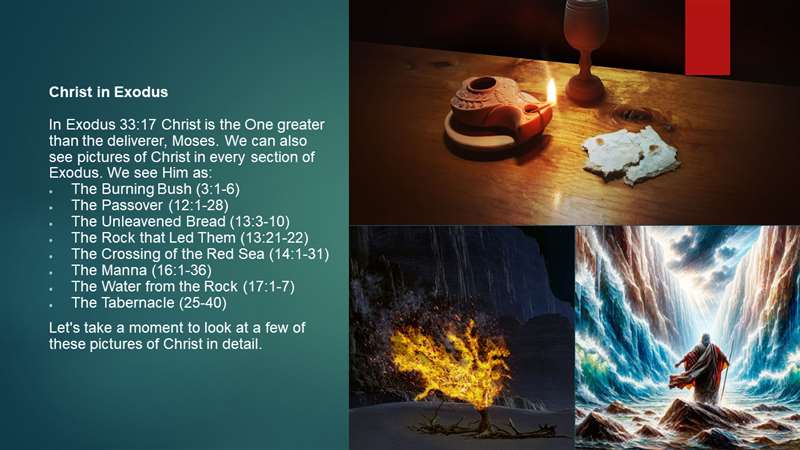
First of all, let’s look at this. Let’s look at the whole book of Exodus, and that’s what I gave you in this overview chart. The book of Exodus is divided into three main parts. First of all, we see Christ very clearly in the first 18 chapters. Number one, we see Him as the voice in the burning bush. We’re going to examine this. In John 8:58, Jesus declared, I Am. He used that great identifier of the eternal God, Yahweh of the Old Testament, as His personal name. In fact, He said once in the garden in chapter 18 of John’s Gospel, He asked them, whom seek ye? They said, Jesus of Nazareth. He said I Am, and flattened them. He used that great name.
Secondly, we see Him as the central focus of the Passover occurrence and event. In fact, 1 Corinthians 5:7 is our theme verse for that. It says in 1 Corinthians 5:7, Christ is our Passover. I was studying this afternoon about the Biblical types. If you at all believe that the New Testament scriptures say Christ is our Passover, that is a meaningless statement unless it is tied to what the Passover means. So, there is a whole group that believes you should just carry your New Testament. They totally have detached the roots of the New Testament from the pictures of the Old Testament. So, you can’t fully understand 1 Corinthians 5 unless you understand Exodus 12, and that’s what we covered last time.
Thirdly, we see Christ in the unleavened bread. That’s what it says in 1 Corinthians 5:8. Next we see Christ in a beautiful way in the rock that led them. We also see Christ in the Red Sea crossing. You say, what do you mean by that? The whole opening up of the sea and the children of Israel walking through on dry land, Paul says is a picture of our salvation. It says we were baptized in Christ as they were baptized with Moses in the Red Sea. You go, what is that? Is that some kind of baptismal regeneration? No, it’s a beautiful picture and I’ll share that with you tonight.
Next, we see Christ in the manna and that one is pretty easy to see, 1 Corinthians 10:3. Then we see Christ in the water from the rock at Rephidim. Then we see Christ very clearly in the law and He fulfills it all. In fact, it says in Galatians that the law is a schoolmaster that leads us to Christ. Then finally at the end of the book, we can see Christ in every facet of the tabernacle. He is a beautiful picture. As Hebrews, 9:11 says, He is the true Tabernacle. What Moses constructed was the one made with hands, but it wasn’t as beautiful and perfect as the one made without hands, which is Christ.
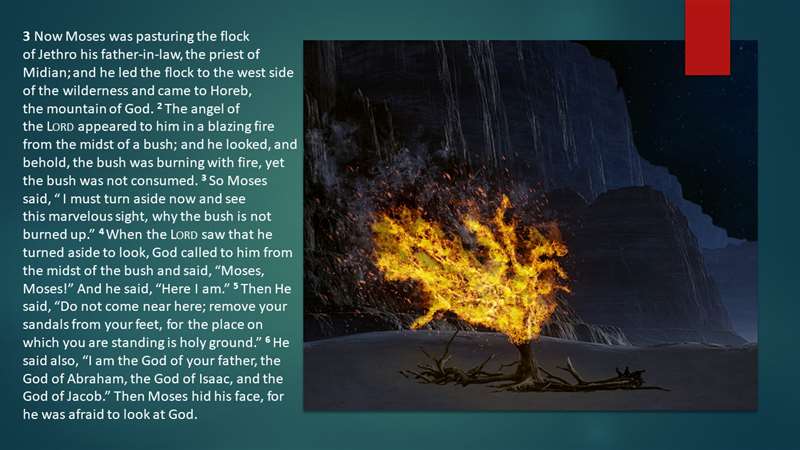
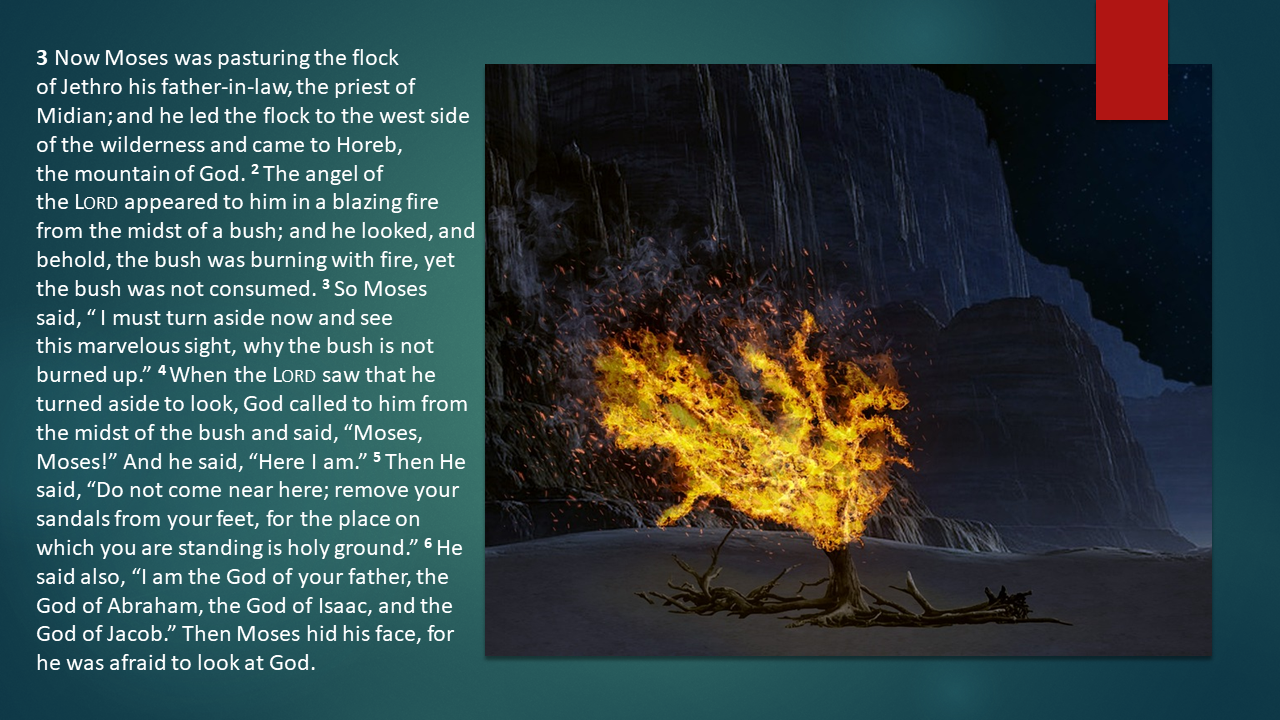
Let’s first of all ask ourselves the question, do you see Christ in the burning bush? Let’s turn back now to Exodus 3. We’ll get to 1 Corinthians in a minute, but if you haven’t marked these yet, and some of you maybe weren’t ready last time, the first six verses of Exodus give us the beautiful picture of Christ as the voice in the burning bush. Every time you read this, if you mark it, you will think of the great I Am passages in John’s Gospel.
So, it says in chapter 3 of the book of Exodus, that Moses was tending the flock of Jethro’s father-in-law, the priest of Midian, and led the flock to the back of the desert and came to Horeb, the mountain of God. This gives us a little glimmer of where the mountain of God and all this was going on. It’s in Midian, which is modern-day Saudi Arabia. It’s very possible that Sinai is not at St. Catherine’s in the middle of the Sinai Peninsula, which is a modern thing. It’s very possible that it’s on the other side of the straits over in Saudi Arabia. I’m sure that some of you have heard some of the differing views on that. But He spoke to him, it says in verse 2. The angel of the Lord appeared to him in a flame of fire from the midst of a bush. We looked at flame speaking of consuming and the bush, a picture of the thorn bush, the Acacia of sin. And he looked and behold, the bush was burning, but the bush wasn’t consumed. This is a perfect picture of God’s mercy that He doesn’t consume us instantaneously because of our sins. So, we saw Christ and He is the voice of the great I Am. He is in the burning bush. That parallels, as you see, John 8:58 where Jesus said, I Am. I ask you tonight, do you see Him as the voice of the great I Am in the burning bush?
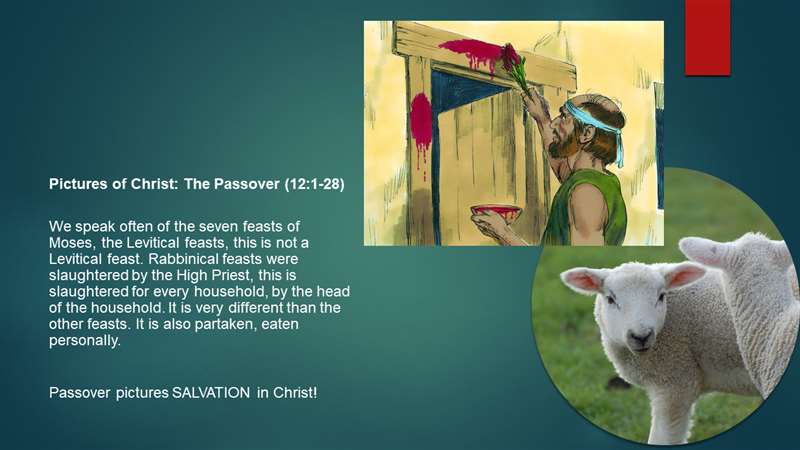
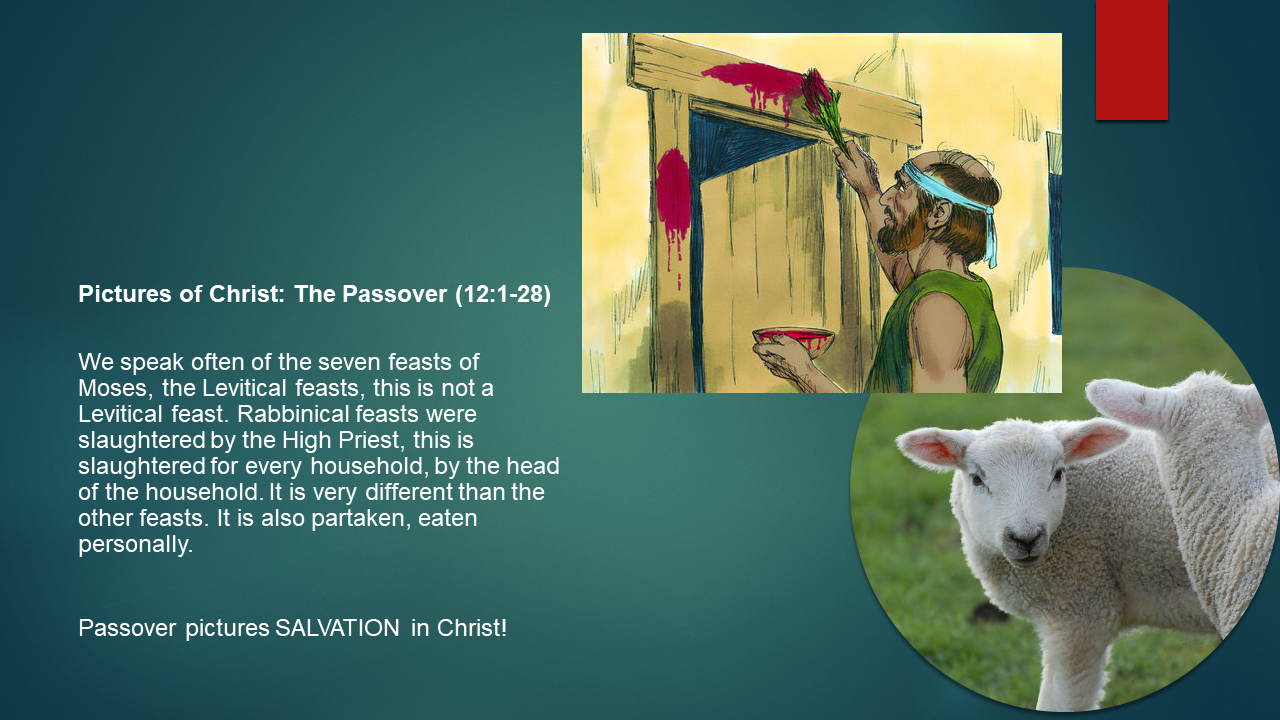
The next picture is, do you see Christ as our Passover Lamb of God? If you turn to Exodus chapter 12 in your copy of God’s word, this whole beautiful passage gives us a lot of pictures of Christ. It was a substitutionary offering. It was an offering that was a specific offering, you couldn’t offer just anything, you had to offer a lamb. It had to be the blood spilled and slain, its life given, and you had to paint the blood on the doorpost. All those beautiful pictures give us this, the next slide is what I think of whenever I think of the Passover. There is a cross over the door of every house in Egypt where they hid beneath the blood. It’s a picture of them taking their hyssop and hitting the top of the doorpost and then both sides and in that motion, they’re actually making a beautiful picture. That’s why Paul says in 1 Corinthians 5:7 that Christ, our Passover Lamb, has been sacrificed for us. Many have come to me and said after Thursday night, that the Passover will never be the same to them. I hope that’s true. I hope that you will constantly be in awe and wonder. When we speak of the seven feasts of Moses, of which Passover is the only one that is written in the book of Leviticus 23, it’s very clear that Passover is different than all of them. The head of the household had to kill the lamb for his family. Then that family had to eat that lamb personally for it to benefit them. That’s such a picture of salvation.
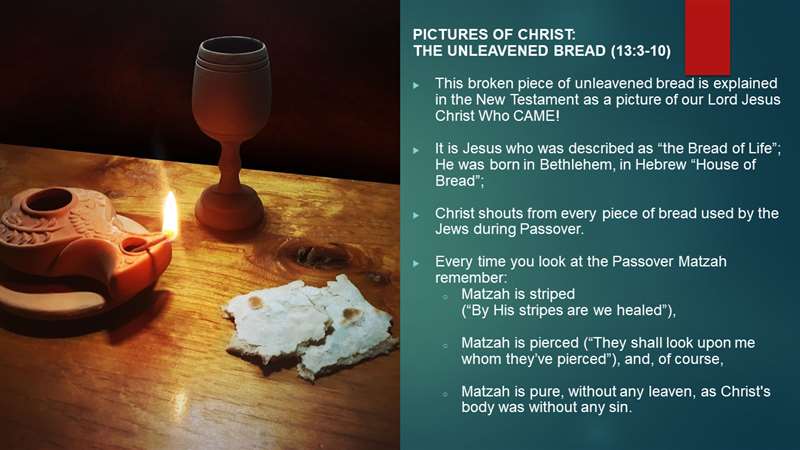
Next, we saw Christ as our unleavened bread. I ask you tonight as you turn to chapter 13 of Exodus, do you see Him, that’s Christ, as the unleavened bread? It says in verse 3, and we went into great detail last week, Moses said to the people, remember this day in which you came out of Egypt, out of the house of bondage. For by strength of hand of the Lord brought you out of this place. No leavened bread shall be eaten. There is this conjunction or joining together of unleavened bread with this exodus event. The reason for that is that the unleavened bread is such a picture.
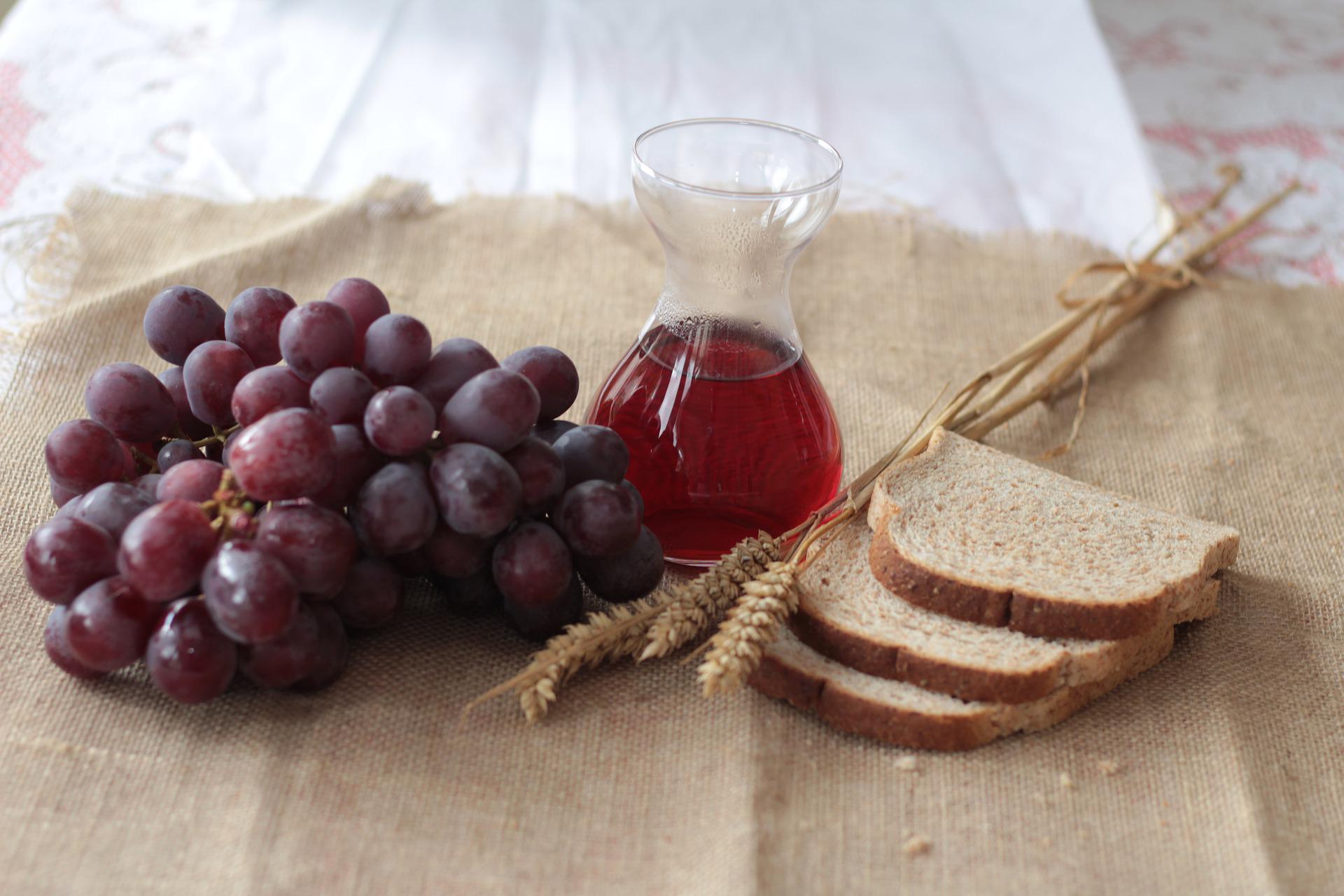
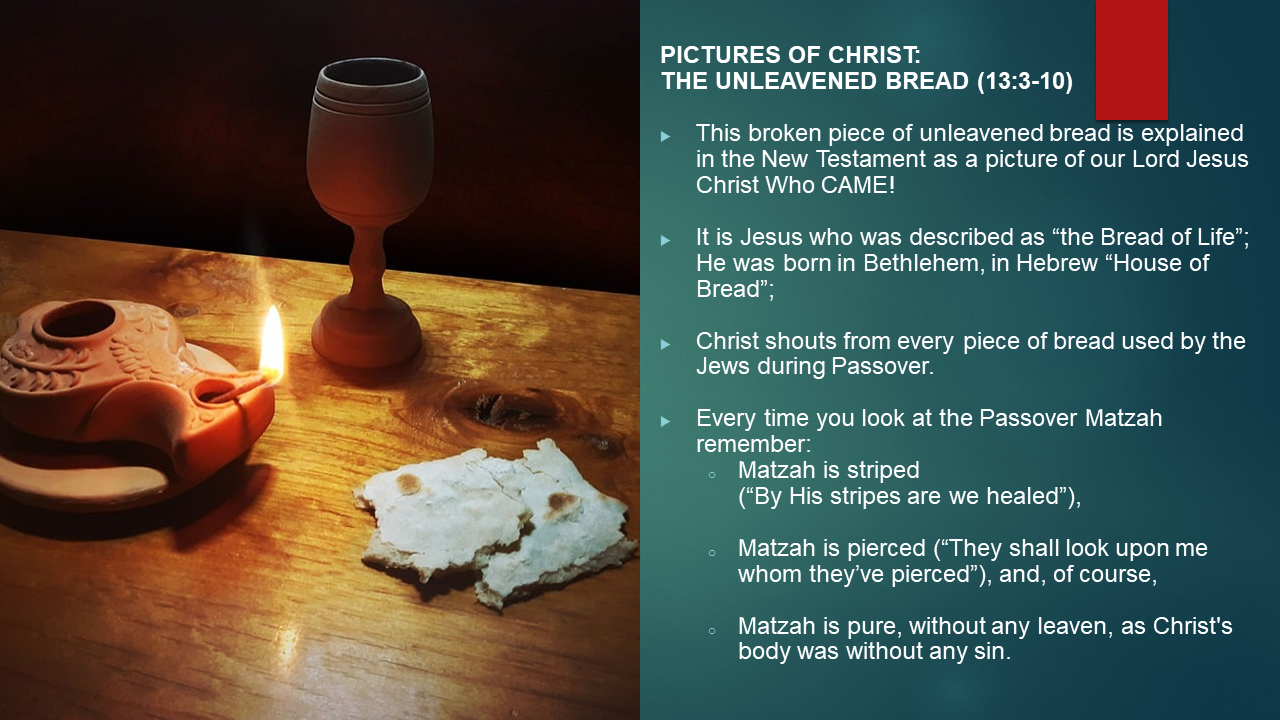
Now let’s just examine for a moment, what is unleavened bread a picture of? Unleavened bread, first of all, especially as captured in the Passover Seder, is a beautiful picture. The broken piece of unleavened bread is explained in the New Testament as a picture of our Lord Jesus Christ, who came. It says in 1 Corinthians 5 that He is our Passover and that we should purge our lives of leaven. Why is that? Because Jesus Christ was described as the Bread of Life. He was born in Bethlehem, which is the house of bread. He shouts from every piece of bread. Every time you look at the Passover unleavened bread, you always should think of three things. In fact, we are starting to use matzah-ish bread in our communions so that it will remind us when we see the holes and the stripes of three things.
Every time you hold the Passover bread in your hand you think, number one, it’s striped. It says in chapter 53 of Isaiah, By His stripes, we are healed. Someone asked me, how did all of that Christ-focused material get into the Passover? If you read the book of Acts, after the resurrection, after the day of Pentecost, it says that a great number of the priests became faithful to the faith. They become faithful to Christ. They become followers of The Way. Also, some Pharisees. We know of two Pharisees who came to Christ. We know of Nicodemus, the Pharisee, and also Joseph of Arimathea. There were others. These men, with some of the scribes, were the custodians of the teachings of Israel. When these were saved, they began working on the writing of the Passover Seder, especially after the fall of the temple and the destruction of the temple in Jerusalem in A.D. 70. When the Jews had to struggle with the absence of the lamb bone because there is no lamb slain in Jerusalem for Passover anymore, they put in this unleavened bread. This whole ceremony of breaking the middle of the three pieces that we’ve studied, taking that middle piece, wrapping it in a cloth, and burying it. All of that process became a very subtle and very powerful picture of Christ.
So, Christ is striped and secondly, He’s not only striped, the scriptures say He’s pierced. It says in Zechariah 12, They will look on me whom they have pierced. Every time you look at a Passover matzah you remember that it is striped because He was striped. He bore His body, the stripes, the payment of our sin. It’s pierced through. He was pierced through for our iniquities. Someday the Jewish people are going to look on the One whom they pierced and they’re going to mourn for Him and they’re going to call out for Him to come and save them. Everything that’s going on right now is just the beginning of what the Jewish people are going to go through. Just the beginning. It’s going to come to a point where the Jewish people, collectively as a nation, are finally going to be just a breath away from total annihilation. Hitler didn’t do that. There were still millions of them all over the world, not just the ones in Europe. So, Hitler wasn’t able to totally annihilate them. They came close in the time of Queen Esther when Haman issued the edict nationwide, but there’s going to be a time in the Tribulation hour when they’re finally surrounded. In a supernatural deliverance, God is going to make a way for them to escape, hiding them in the wilderness. We know all that from our study of Revelation. Finally, the last thing about Christ being our Passover unleavened bread is that as matzah bread is pure without any leaven, so Christ’s body was without any sin.
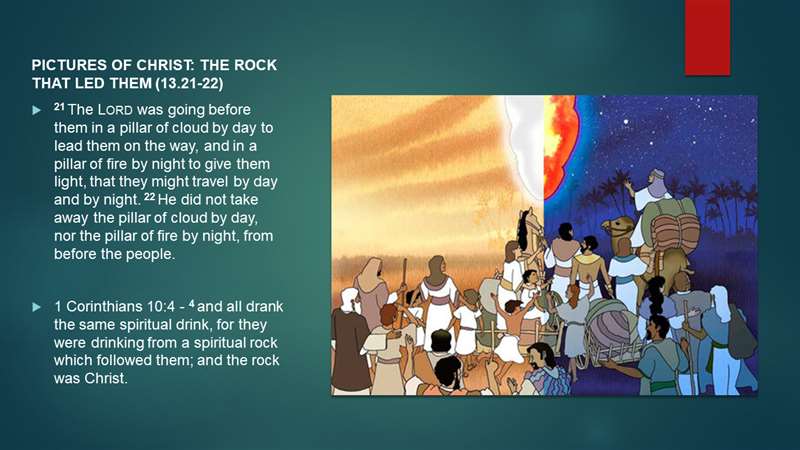
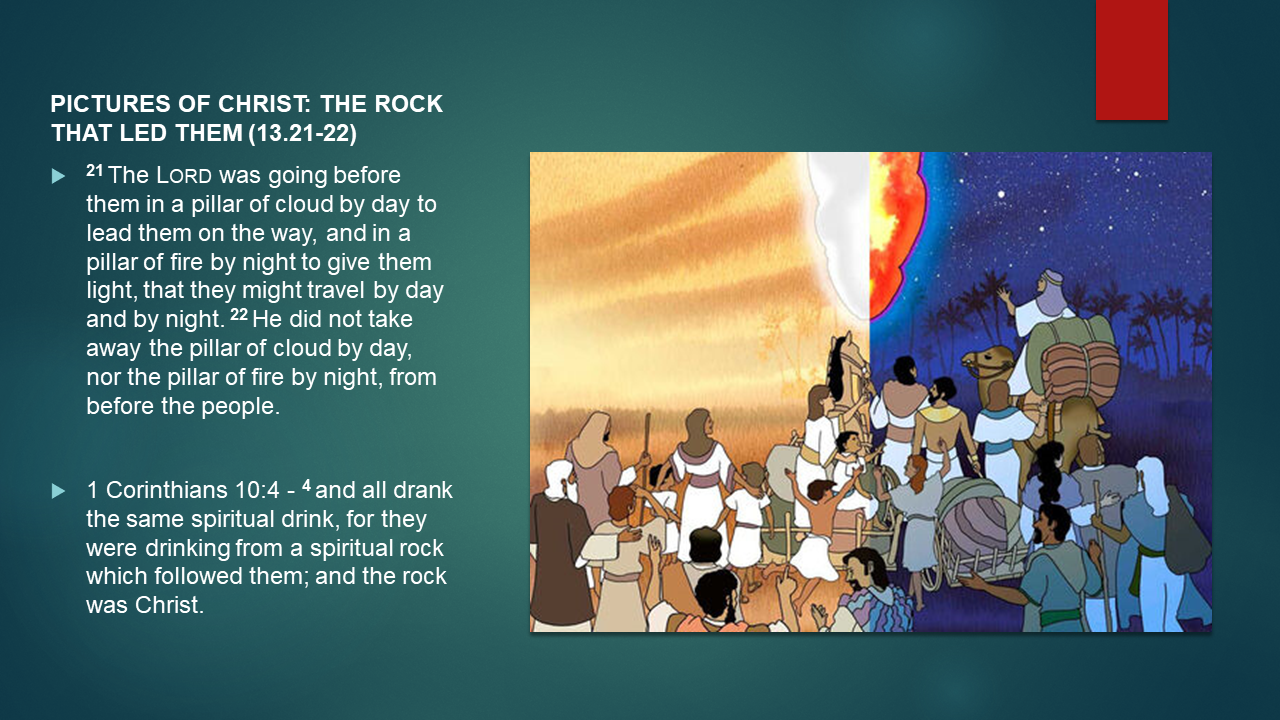
Let’s look at the next one. Look at Exodus 13:21-22 in your Bibles, because I want to show you a brand new one tonight. It says in Exodus 13 verse 21, And the Lord went before them by day in a pillar of cloud to lead the way, and by night in a pillar of fire to give them light, so as to go by day and night. Verse 22 says He did not take away the pillar of cloud by day or the pillar of fire by night from before the people. Now when you’re reading that in the book of Exodus, you’d say oh, I don’t really see anything there. What is going on there that is significant?
Now, look at 1 Corinthians 10 in verse 4. Remember where I told you to turn initially? 1 Corinthians 10. If you want to, you might want to mark something because I have actually jotted in my Bible so every time I come to 1 Corinthians 10 I see this. Each of the verses, all the way down for the first 10 verses of 1 Corinthians 10, each verse points to a chapter of the Old Testament. It alludes to it. It’s one of the most replete, one of the fullest pictures of Christ in all the scriptures anywhere in the Bible. It’s just unbelievable. 1 Corinthians 10 says this, especially looking at verse 4. It says, They all drank, 1 Corinthians 10:4, of that same spiritual drink, for they drank of that spiritual rock that followed them, and that rock was Christ. They drank of that rock that followed them. When is that?
Do you remember when Pharaoh was on their heels and God told Moses to lift up his rod and he did and the sea split? It says that the cloud went from before them to behind them. In that time the cloud began to follow them from the rear. It became a separation between the Egyptians, who were charging up in their chariots, and the poor, weak, old, children, and all that of Israel that couldn’t move along very fast through that Red Sea experience. So, the cloud was behind them as a protector. Paul alludes to that following them. Rocks don’t usually follow anybody, but it was Christ in the cloud, in the fire that was behind them, it was Christ that was in the rock that gave them the water, it was Christ that was their sheltering cloud, all these things. Now, what is that all about?
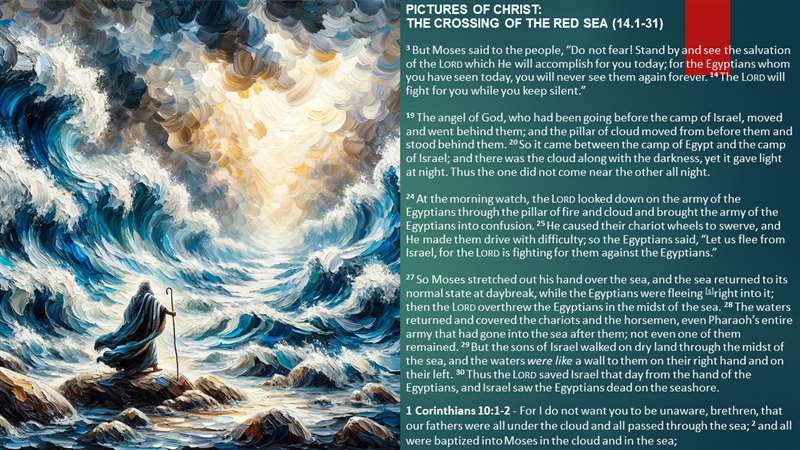
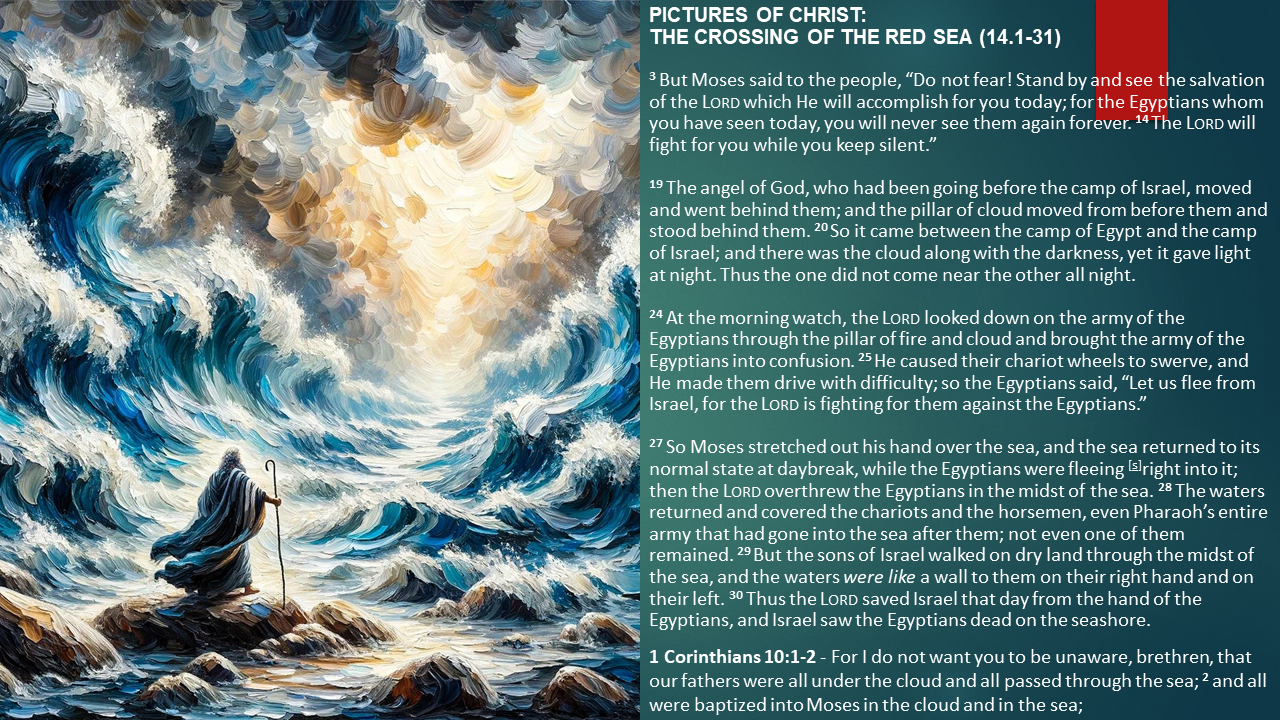
Now turn back with me to chapter 14. I want to show you the next truth because these are tied together. In chapter 14, if the rock that was following them was Christ, He helped them to get through the Red Sea. Now do you remember Exodus 14, the Red Sea crossing? It is the most unbelievable event, this Red Sea crossing. For us, we have just that they just crossed the Red Sea. Do you realize that the same day that they crossed the Red Sea is the day that they celebrate First Fruits, which is the same day that Christ rose from the dead? Isn’t that a coincidence? In our minds, the crossing of the Red Sea has nothing to do with what’s going on.
Look at the event. The Lord said in verse 1 of chapter 14, The Lord spoke to Moses saying, speak to the children of Israel. They have these camps at Pi Hahiroth, and Migdol, the sea, opposite Baal-zephon. You shall camp by the sea. Pharaoh came, in verse 4, and God hardened his heart. The Egyptians, he said, are going to know that I’m the Lord. In verse 5, the king of Egypt, when it was told to him that they had fled, he had a little remorse, and he changed his mind. You remember they came charging up. Look at verse 13 of Exodus 14. Moses said to the people, do not be afraid. I want to emphasize the most often repeated command in the Bible, a negative prohibition, fear not. Do not be afraid. We’re like sheep. What are sheep always doing? They’re afraid. They get paralyzed. So, we’re like sheep, God says, don’t be afraid, trust me, your Shepherd, your rock, your fortress.
Stand still, and see the salvation of the Lord, which He will accomplish for you today. For the Egyptians, whom today, you shall see again no more, forever. The Lord will fight for you, and you shall hold your peace. Then, in verse 19, look at this, the angel of God, which is a code name for Christ, a theophany, a Christophany, the angel of the Lord. The angel of God, that’s Christ, that’s the rock that followed them, who went before the camp of Israel, verse 19 says, moved. Here it is, He went behind them and the pillar and cloud went from before them and stood behind them. So, it came between the camp of the Egyptians and the camp of Israel. This was a cloud and darkness to the one, that’s Pharaoh. They couldn’t see anything. It was blockading them. Remember that wreck they just had? The hundred and some cars in the fog? Can you imagine the chariot problem they had when it was foggy and dark out there? They just ground to a halt. That’s the Lord’s plan. On the other side, it gave light by night to the others so that the one did not come near the other all that night.
Moses stretched out his hand, you know that. Verse 22 says the children of Israel went through the midst. The waters were a wall to them on the right hand and their left. You remember that the Egyptians pursued them at the end of verse 24. The Lord troubled them, verse 25, He took off the wheels of their chariots so they drove with difficulty, to say the least. Then it struck them. God was fighting for them. Then look at this, verse 27, So Moses stretched out his hand over the sea, and when the morning appeared, the sea returned to its full depth with the Egyptians, while they were fleeing into it. So, the Lord overthrew the Egyptians in the midst of the sea. Then the waters returned and covered the chariots, the horsemen, and all the army of Pharaoh that came into the sea after them. Not so much as one of them remained.
Now, there’s a lot of little codes, little clues in here that should really stick out to us. God fought for them, they were to stand still. They didn’t do anything except obey and not one of the pursuers remained. Not one. See, the details, every detail of the word of God is so important. At the end of 28, not so much as one of them remained, and the children of Israel had walked on dry land in the midst of the sea, which was a miracle in itself. Verse 30, So the Lord saved Israel that day out of the hand of the Egyptians. Israel saw the Egyptians dead on the seashore and they saw the great work which the Lord had done. You say, boy, all that’s great, but what’s that about?
Now turn back to 1 Corinthians 10. Okay, I’m sorry I have to make you flip-flop. You’ll need to go to get some tabs in your Bible. I want you to see this because the crossing of the Red Sea is part of the sequence of these events that are detailed in the Book of Exodus that the New Testament fills full of life. Look at chapter 10. It says in verse 2, Remember I said, moreover brethren, I don’t want you to be unaware that our fathers were all under the cloud. Remember? The cloud that shaded them by day and this pillar of fire that lit them and perhaps warmed them by night. They were under the cloud, and all passed through the sea, and all were baptized into Moses in the cloud and the sea. You go, what? Baptized? What’s going on here? What does Paul know that we don’t know? He knows what God did in the Red Sea crossing. Now I want you to think about it. Because the Jews made this at God’s direction in Leviticus 23, their Feast of First Fruits. That happens to be today. Isn’t that amazing? Actually, from sundown last night, the Feast of First Fruits.
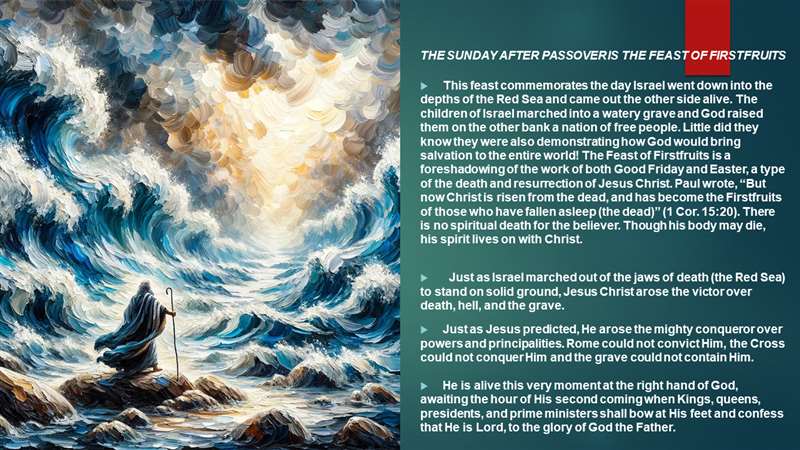
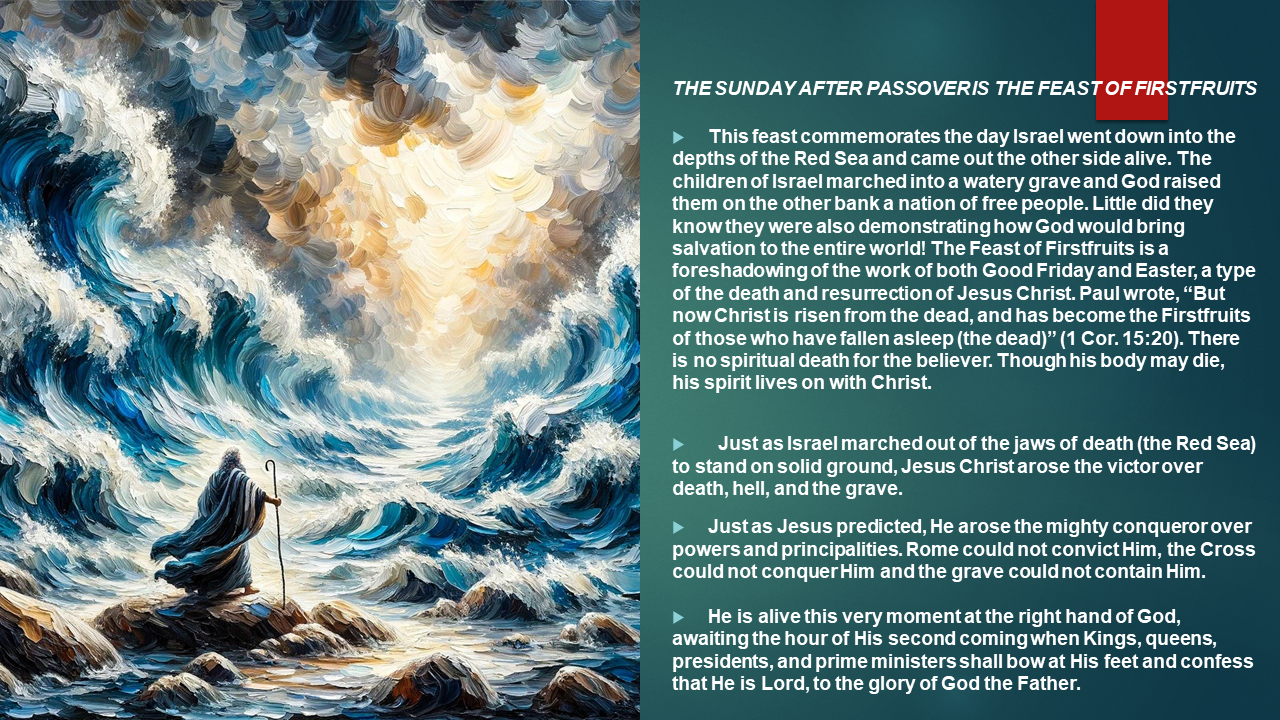
Let me describe it for you. The Feast of First Fruits commemorates the day that Israel went down into the depths of the Red Sea and came out the other side alive. They went down, as it were, into death and came up almost like resurrection life. The children of Israel marched into a watery grave and God raised them on the other bank, on the other side, alive. They were a nation of free people. Little did they know that they were demonstrating how God would bring salvation to the entire world. The Feast of First Fruits is a foreshadowing of the work of the Passover event of Christ’s death and burial, the Unleavened Bread of His body in the tomb, and the First Fruits of His resurrection. So, they didn’t even know that their Feast of First Fruits would foreshadow both Good Friday and Easter. A type of the death and the resurrection of Christ. That’s why Paul wrote, But now Christ is risen from the dead and has become the First Fruits of those who have fallen asleep. Look at that.
Look at 1 Corinthians 15:20. You might need to mark that in your Bible. I bet you never noticed it said that before in this context. 1 Corinthians 15 verse 20 links together these two ideas that we never do as believers. I hope tonight that maybe you’ll have a little inkling that you ought to follow these concepts a little more closely. We’re well-adjusted readers in America as Christians. We read the Bible, we read something we don’t know, it doesn’t even bother us, we keep reading. Don’t ever be a careful, adjusted reader again. Stop if you don’t understand something. Look at verse 20 of 1 Corinthians 15. But now Christ is risen from the dead and has become the First Fruits of those who have fallen asleep. First Fruits? What does that word mean? We don’t talk in those terms anymore.
Did you know there’s an entire Jewish festival called First Fruits? That festival commemorates, look back at chapter 10, in 1 Corinthians 10 verses 1 and 2, when all of Israel passed through the sea, all of them were under the cloud, all were baptized into Moses in the cloud and the sea. What is that talking about? It’s talking just like we know about Christ. Did you know Jesus Christ died for all the world? That’s what the Bible says repeatedly. But is everyone going to Heaven? No. It isn’t enough to know about the event. It wasn’t enough for the Israelites to just follow Moses on that little land bridge through the sea and to safety and get on the other side. What happened when they got on the other side? We’re going to find out that God kills all of them except for two: Caleb and Joshua. Everybody else got killed, who were adults, that came out of Egypt. Why? Because not all that came out of Egypt believed. They wanted a Savior, they didn’t want a Lord. They wanted to get out of Egypt, but they didn’t want to obey Him. God wasted them for their disobedience.
All of them identified with Moses. It says in the book of Hebrews, and I’m not going to do an exposition on Hebrews, but it says that it wasn’t mixed with faith. They just wanted to get rid of it. They didn’t want the problems in Egypt, so they left, but they didn’t embrace the Savior. The picture is this: all who come to Christ, and identify as the children of Israel, went through the Red Sea and came up on the other side. All those who identified with the Lord as the One who saved them, who delivered them, believed in Him and became true worshippers of Him. So Paul says this, All were baptized unto Moses in the cloud and the sea, and all ate the same spiritual food. Then he goes through and condemns them because, v. 11 of 1 Corinthians 10 says, These were examples that were written for our admonition upon whom the ends of the age have come. Let him that thinks he stands take heed lest he fall. These people are an example to us. They had all these pictures, they had the cloud, they had the fire, they had the split sea, they had the Passover Lamb behind them, they had the dead Egyptians on the seashore, and they were baptized with Moses through the Red Sea, but that event wasn’t mixed with faith. Kind of a sobering warning to us.
Did you know that already, those of you who have sat in a church like this, or others where the Bible is taught every week, you already know about 2 or 3 times, or 4 or 5 or 10 times more than the average Christian around the world? Because those people don’t get to go to Christian services like this. They don’t have big thick study Bibles. They don’t have all kinds of resources. The Bible says you better be careful, that it’s mixed with faith. That you live it and appropriate it.
What is the picture? Let me describe it really quickly, this baptism in Moses in the cloud and the sea. Just as Israel marched out of the jaws of death, the Red Sea, to stand on solid ground, Jesus arose the victor over death, Hell, and the grave. So, Israel came up out of the Red Sea, just like Jesus came up out of the grave.
Secondly, just as Jesus predicted, He arose the mighty conqueror over the powers and principalities. Rome couldn’t convict Him, the cross couldn’t conquer Him, and the grave couldn’t contain Him. So, Jesus is our great conqueror. Just like Egypt couldn’t hold them, Pharaoh couldn’t stop them, and the Red Sea could not keep them under its watery grave. So Christ, the picture between what He did to Israel and what Jesus did at the resurrection is so profound. Both of them are pictures of the conquest over death.
Finally, Jesus is alive, which is this moment we celebrate today waiting for the hour of His Second Coming when kings and queens and presidents and prime ministers will bow at His feet and confess that He’s Lord of glory, to the Glory of God the Father. What does it have to do with us if we identify with Him? If we follow Him and say yes, my sins were on Christ on the cross, yes my sins were buried with Him in the tomb, my sins are gone, and yes when Jesus stepped out of the tomb I am now walking in newness, resurrection life. I am identifying with His death for me, His burial for me, and His resurrection for me. Then we are identifying with Christ, which sadly most of Israel didn’t identify with their Redeemer from the Red Sea.
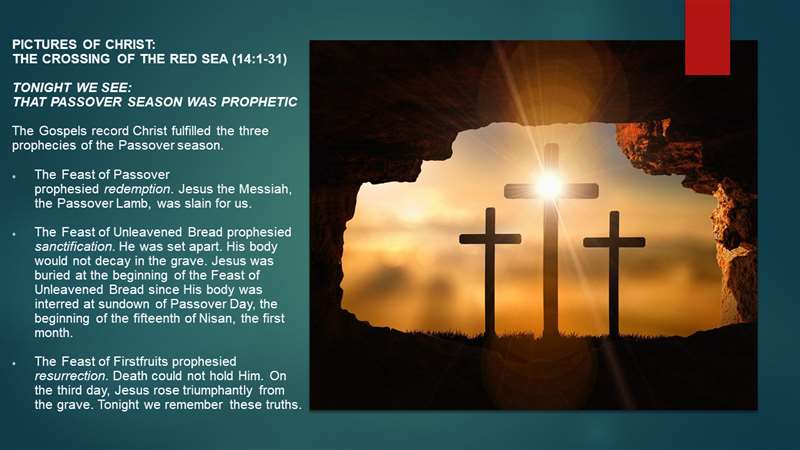
What is all this? Let me just give you the crossing of the Red Sea in our little slide here. There are three points to it. The Gospels record that Christ fulfilled the three prophecies of the Passover season. Number one, the Feast of Passover prophesied redemption. The Messiah, the Passover Lamb, was slain in place of those who would trust in Him just like the Passover Lamb was the blood on the door.
Secondly, the Feast of Unleavened Bread prophesied sanctification. Jesus was set apart. His body would not decay in the grave. Jesus was buried at the beginning of the Feast of Unleavened Bread since His body was interred at sundown on Passover day, the beginning of the 15th of Nisan, the first month. So, what we see is that Jesus Christ’s death was in line with Passover. He was the Passover Lamb. They had to hustle to get Him in the grave before sundown. That’s why there was such a big ruckus. That’s why Nicodemus and Joseph of Arimathea went to Pilate, and Pilate didn’t even know he died yet. He said, is He already dead? He sent to make sure, and the centurion said, yes, we put a spear in Him, He’s sure dead. He said, okay, you can take Him down, before sundown so he could be buried at the beginning of the Feast of Unleavened Bread. That’s prophetic. It’s prophetic of our sanctification. Jesus Christ took our sins to the grave with Him. He bore them on the cross and He buried them, as the hymn says, in the sea of God’s forgetfulness.
The last element is the Feast of First Fruits which is today. The third piece is the beautiful picture, it prophesies resurrection. Death can’t hold her foe. On the third day, Jesus rose. We remember this truth. We remember that Jesus, on the day that the Jews came up out of the Red Sea, Jesus came up out of the grave. That’s why God planned that in advance. The feasts of the Jews, they’re actually called the Feasts of God, are a roadmap of what God’s doing. He sent Jesus as our Passover lamb, and he died on Passover. He buried Jesus as our unleavened bread at the Feast of Unleavened Bread. He raised Jesus from the dead on the Feast of First Fruits on the first Sunday after the Saturday following Passover. That’s exactly what it says in Leviticus. That’s how we knew in the Old Testament Jesus would rise again on Sunday. Because it says specifically in Leviticus 23 that the First Fruits is the first Sunday after the Sabbath day after Passover. It has to be a Sunday, just like Pentecost does. I already covered this when we did our sequence many months ago on the feast, but I just wanted to remind you of that.
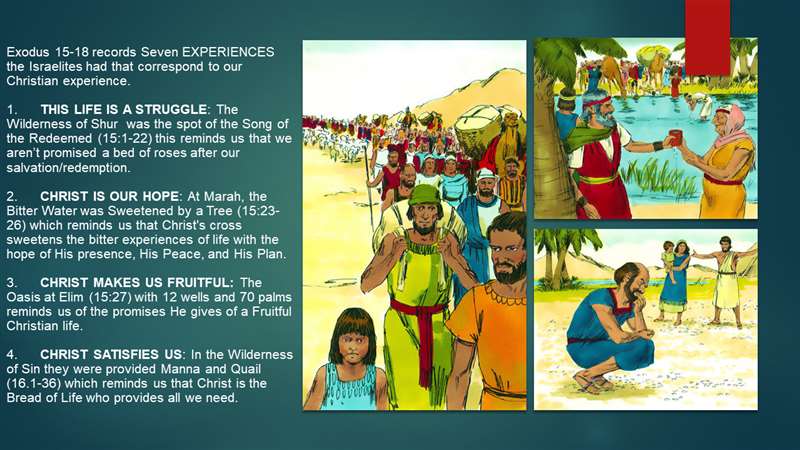
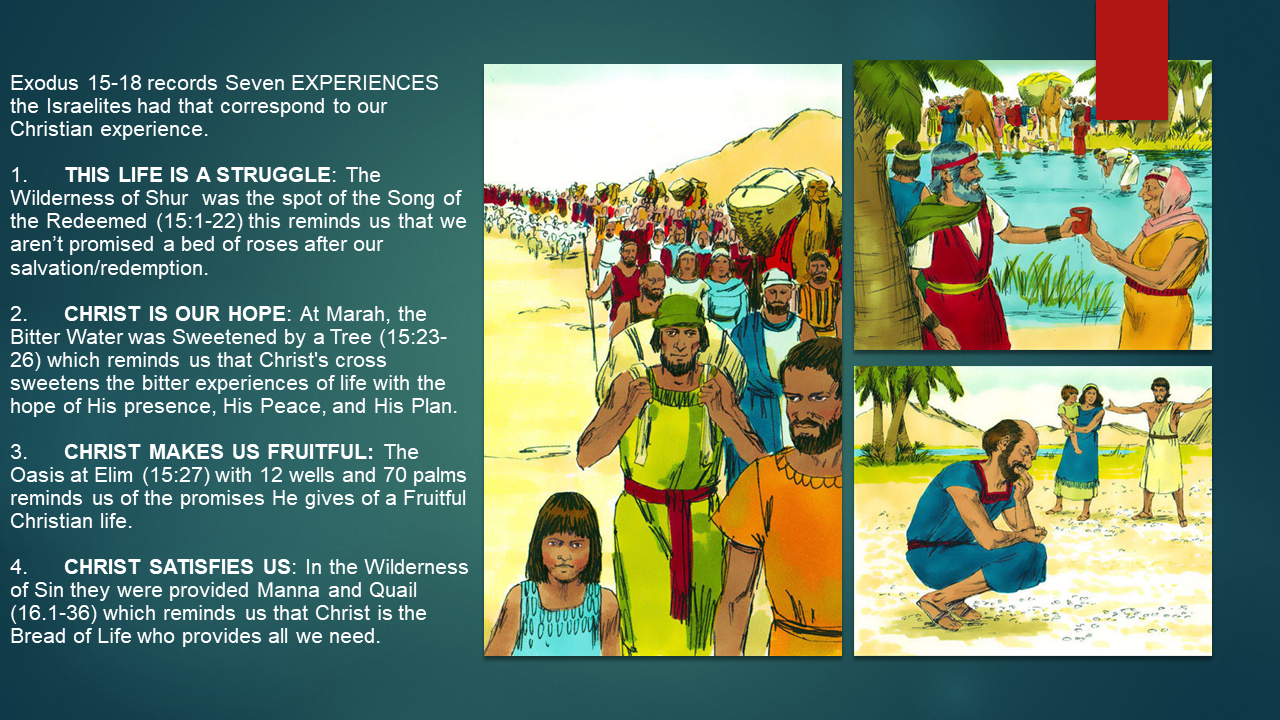
Let’s look at the next slide. Do you see Christ, let’s turn back to Exodus 15, in the sequence of events? This is where you really need your pen. I’m going to zip through these for you because this is usually the boring part of the Bible and people don’t really harvest a lot of good stuff out of this. Some of these events just go by you when you’re reading Exodus, and you miss them. Let me show them to you really quickly. Here they are, the Exodus 15 events. There are seven experiences that the Israelites went through that correspond to our Christian experience, number one in Exodus 15:1-22. Let me show you this. It says, Then Moses and the children of Israel sang this song to the Lord. Where were they? They were on the other side of the Red Sea, and they were actually in the place which in the scripture is called the Wilderness of Shur, S H U R. You can read that as you read this 15th chapter, the first 22 verses.
What was the Wilderness of Shur? It was a bleak, desolate, dry, rocky, barren, hard place to live. They sang this song of triumph when they came up out of the water with a wall of water on each side. They had been delivered in the crossing of the Red Sea. When they came up out, Miriam led them in this song of praise. What is that? This life is a struggle. These people were not living in a bed of roses after they were saved out of Egypt. They didn’t go to this paradise place. They didn’t go to a place of green grass like a golf course. They didn’t go to a place where they could just eat huge navel oranges and squeeze the fruit out of the great oasis. They went to a wilderness. Do you know what? The Christian life is much like that. What I want to show you tonight is their experiences parallel our experience in Christ.
Secondly, starting in verse 23, look what happens in Exodus 15:23. It says, And when they came to Marah, they could not drink the waters of Marah, for they were bitter. Therefore, the name of it was called Marah. The people complained against Moses and said, what shall we drink? So, he cried out to the Lord, and the Lord showed him a tree. Did you know that when the apostles write about the crucifixion of Christ, they don’t say that Christ was crucified on a cross? What does Paul call it every time in the book of Acts? A tree. He was crucified on a tree. On a tree. Why is that? Why do they do that? Because they realize the pictures.
Look again. It says in verse 25, So the Lord showed him a tree, and when he cast it, that’s the tree, in the waters which formerly were bitter, were made sweet. There He made a statute and an ordinance for them, and there He tested them. What’s the second lesson? Christ is our hope. At Marah, the bitter water was sweetened by a tree. This reminds us that Christ’s cross sweetens the bitter experiences of our life. We hope in His presence, His peace, and His plan. See, when we get saved, life is not a bed of roses. They got saved out of Egypt, and what’d they get? They got the wilderness. But you know what they got to sweeten their life? They got a great picture of the provision, the tree, the offering, and the sacrifice for them. Christ is our hope. He sweetens all of life.
Thirdly, look at what happens in verse 27. I love this. By the way, verse 26 has the great Jehovah Rapha. Verse 26, I’ll read that before 27. If you diligently heed the voice of the Lord your God, and do what is right in His sight, and give ear to His commandments, and keep all the statutes, I will put none of the diseases on you which I have brought on the Egyptians. There’s a famous book on this. I’m not an advocate of all this stuff, but I’ll tell you what, when they studied the mummies in Egypt, they found the mummies of Egypt had cirrhosis of the liver, they had hardening of the arteries, they had all kinds of physical problems when they look at all these preserved corpses from four thousand years ago. These people had kidney disease, they had heart disease, they had respiratory problems. They know that because they saved all their organs in these canopic jars. Do you know what? If you study carefully their lifestyle, what they ate, and how they lived, it was totally different from how God directed the Jews to live and eat. He says, if you follow what I say, you’ll not have the health problems that the Egyptians had. Which is fascinating. I’m so glad we don’t have to follow the Jewish dietary laws, but I’ll tell you what, if we did, we’d be a lot healthier. Okay? We don’t have to, but if we did, we’d be a lot healthier. Okay? I won’t even comment on that. Okay?
Look at verse 27. Then they came to Elim, where there were twelve wells of water and seventy palm trees, and they camped there by the waters. What’s this? How many? Seventy palm trees. What did they teach you about the palm tree? The palm tree only grows in pure soil, it grows from the inside out, it grows straight with no branches, and all the fruit is at the top. The palm tree is always a picture of flourishing life. Do you know what? Our Christian experience patterns Exodus 15 to 18. When we’re saved, it’s a struggle. A lot of times our family turns against us, our friends turn against us, and it’s difficult. But Christ is our hope through all that, and He brings fruitfulness to our life just like when they got to this spring of Elim.
Okay, let’s look at the next one because in 16:1-36 we find the manna. We’re going to study that in-depth next time, but the manna is a picture that Christ satisfies us. Those people were in the Wilderness of Sin after they left the oasis at Elim. There they were provided manna and quail, which remind us that Christ is the bread of life and He’ll provide all we need. I’ll add this. Do you remember our studies when we went through Jesus feeding the 5,000? When we went through the whole picture of manna? When we went through the whole vine and the branches? In my life, I never had studied that before. I never had studied the 7 I Am’s, the 7 signs, and the 7 miracles. This section, Christ satisfies us, is such a powerful part of our Christian life. God wants us to be fruitful. He wants to prune us. He wants to work in our lives. He wants us to be satisfied in Christ. The book of Exodus is such a beautiful picture of that.
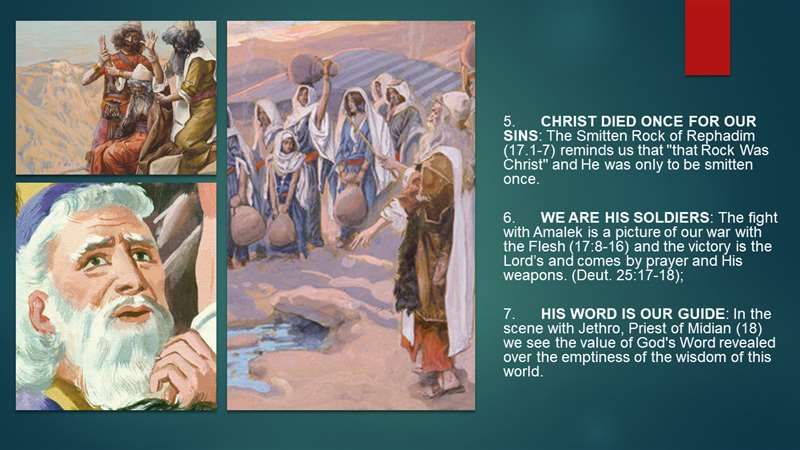
Fifthly, look down at chapter 17, the first seven verses. We’re going to study this water from the rock, and its significance in the New Testament. But what happened was, Christ died once for sin, which is pictured there. How do we know that? It’s because God got so upset when Moses hit the rock the second time. The writer of Hebrews says he was offered once. The writer of Hebrews is always tracking these Old Testament things. But the smitten rock of Rephidim and the first seven verses remind us that the rock in the wilderness was Christ. How do we know that? 1 Corinthians 10 says that. 1 Corinthians 10 says that the rock that followed them was Christ and He was only supposed to be struck once. When He was struck once, the water of life came out of Him. The second time they needed water, what were they supposed to do? Speak to it. See, when we talk to Christ, and when we ask, He says will I not freely give you all things? I will pour out upon you My Spirit. We don’t have to strike Him and sacrifice Him over and over again, which is a picture, of course, of the error of Romanism. Christ died once for sin, that’s the message of Rephidim.
Next, in verse 8, look at the second part of chapter 17, verse 8. This is what it says, Now Amalek came and fought Israel and Rephidim. What is this? We’re Christ’s soldiers. This is the whole battlefield. A lot of Christians aren’t even aware of this. In fact, I think we ought to go through that whole armor of God thing that we went through several years ago because I see so many Christians who are paralyzed when they go into spiritual warfare. The Bible says you’re supposed to take all the armor of God, every single piece. Most people don’t even know the pieces, let alone the implications of taking them. This is a picture of what the Christian life is like. We are in warfare. Amalek came, which is a picture of the flesh, and fought with Israel in Rephidim. And Moses said to Joshua, choose some men and go out and fight him. Watch this, Tomorrow I will stand on the top of the hill with the rod of God in my hand. So, Joshua did as Moses said to him, and fought with Amalek. Moses, verse 10, and Aaron and Hur went up to the top of the hill. So, it was when Moses held up his hand that Israel prevailed. And when he let his hand down, Amalek prevailed. Have you ever read that story? Isn’t that a cute thing? Up, they’re winning. Down, they’re losing. Up, they’re winning. Down, they’re losing. What is that about? What’s the big deal? It’s a picture. What does 1 Corinthians 10 say? All these things happen for our admonition. All scripture is profitable for doctrine, for reproof, for correction, for instruction, and righteousness. This is a correction of our lack of knowledge about spiritual warfare.
So how do you keep winning? In verse 12, Moses’ hands became heavy. Remember what the picture to the Jewish people is? What does Paul say in his letter to Timothy? I would that all men everywhere prayed with holy hands, lifted up. Prayer and lifting up hands is a picture. So, these hands were like a picture of prayer. He was holding up his hands with this rod speaking of prayer, and Moses’ hands became heavy, like we often are prayerless. So, they took a stone and put it under him, and he sat on it. Aaron and Hur supported his hands, one on one side and the other on the other side, and his hands were steady until the going down of the sun, so Joshua defeated Amalek and his people with the edge of the sword. This was a big event, verse 14, So the Lord said to Moses, write for a memorial in the book and recount in the hearing of Joshua that I will utterly blot out the remembrance of Amalek from under Heaven. And Moses built an altar and called it by name, it is the Lord my banner. He said because the Lord has sworn, and the Lord will have war with Amalek from generation to generation. That was a big event.
What’s that event about? That we are His soldiers, that we only conquer in His power, and that the last piece of armor is praying always, with all prayer and supplication, for apart from Him we can do nothing. We can do nothing unless we are, as pictured by Moses’ hands held up by Aaron and Hur, supporting everything we do in prayer. Our missionaries, that we show you their pictures at every service; you saw that picture of Bill Eddy a while back, and Steve Dupuy the week before, and Vladimir the week before. Unless we’re holding them up in prayer, unless the prayer corps is holding up every activity, every event, and every service, unless we pray for our EE teams and the community evangelism teams, unless we pray for our Sunday school teachers, it’s all in vain. Nothing happens. Especially when we’re involved in spiritual warfare, if we don’t take all the armor, we fail.
Let’s look at the last one, chapter 18. The whole 18th chapter is about the Jethro principle. This is a curious little passage about Jethro, the priest, the most high God from Midian, Moses’ father-in-law. This shows us, in a real sense, the fact that God wants to guide us. We don’t have any old Jethro’s from Midian to come to our aid anymore. So, you know what we have? We have the ancient, changeless wisdom of the Ancient of Days. I have many copies of it. I have over 60 different Bibles in my office. Most of you have multiples around. We collect them. We have them on our coffee tables. We talk about them, but God wants us to read them. Let His word be our guide.
So, what does Exodus 15 through 18 show us? It shows us that our Christian life is a struggle. That’s the whole time in the wilderness of Shur. Christ is our hope, and that’s the beautiful picture of the people coming to Christ in Marah with that tree that portrayed His cross sweetening their lives. Christ makes us fruitful. We are to be like palm trees flourishing in the desert. He satisfies us. He wants to feed us if we spend time with Him intimately. He died once for our sins. He was the smitten rock that followed them. We are His soldiers. The fight with Amalek is a picture of our war with our flesh. The victory is the Lord’s. It comes through prayer and using His weapons. Finally, His word is our guide. In the scene with Jethro, the priest of Midian in chapter 18, we see the value of God’s word revealed over the emptiness of the wisdom of this world.
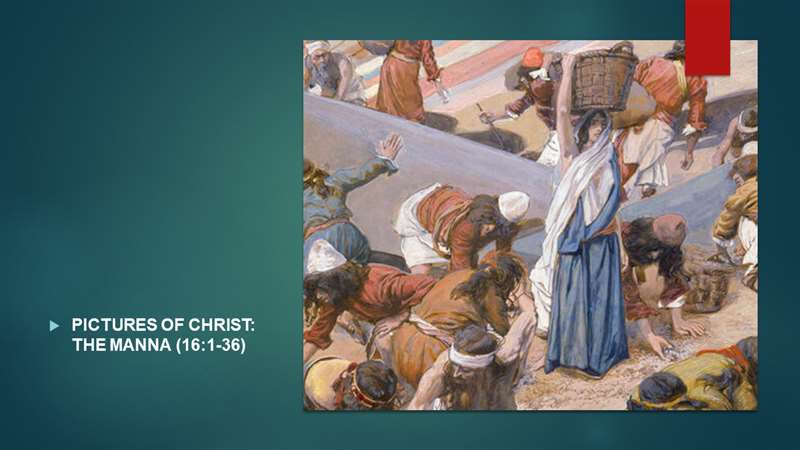
What’s next? This is where we’re going to pick up next week. This next slide, if it’s there. I ask you, do you see Him in the manna? Do you see this book that you hold in your hand as the manna of God, the bread of God? Do you feast on it every day? That’s what He wants. Do you see Christ in Exodus? I see Him in every page. I even see a beautiful picture of our Christian pilgrimage. I hope tonight that Christ will sweeten the bitterness of your life, that He’ll be your hope, that you’ll conquer through Him, that He’ll satisfy you. That you’ll see that the Christian life is hard but glorious when it’s lived in the power of the Spirit and through intercession and prayer.
Let’s bow together before our Lord and worship Him tonight. Let’s bow our hearts before Him and ask Him to minister deeply to us. Lord Jesus, thank You for letting us see a little bit of what You must have taught on the road to Emmaus as you began at Moses and pointed out to those disciples how You’re in every part of this book. There’s no greater study than to find that one thread that links together every part of Your word. And that thread is finding Christ in all the scriptures. Thank You for letting us go on this journey together. I pray our hearts would be strengthened, our minds would be attuned, and that we would want to mine out the treasures of Your word, see them, find them, believe them, and feast upon them. O Christ, thank You for making us conquerors, satisfying us, and giving us hope in all of our days. We thank You in the name of Jesus and for His glory we pray, amen. God bless you as you go.
Do You See Christ – in Exodus?
TONIGHT WE SEE THAT PASSOVER SEASON WAS PROPHETIC
The Gospels record Christ fulfilled the three prophecies of the Passover season.
- The Feast of Passover[1] prophesied redemption. Jesus the Messiah, the Passover Lamb, was slain for us.
- The Feast of Unleavened Bread prophesied sanctification. He was set apart. His body would not decay in the grave. Jesus was buried at the beginning of the Feast of Unleavened Bread since His body was interred at sundown of Passover Day, the beginning of the fifteenth of Nisan, the first month.
- The Feast of Firstfruits prophesied resurrection. Death could not hold her Foe. On the third day, Jesus rose triumphantly from the grave. Tonight we remember these truths.
DO YOU SEE CHRIST IN EXODUS:
According to Luke 24:27, 44–45 Christ is found in “all the Scriptures.” Exodus 33:17 He is the One greater than the deliverer, Moses – He is Christ in ALL the Scriptures! In Exodus we find Christ:
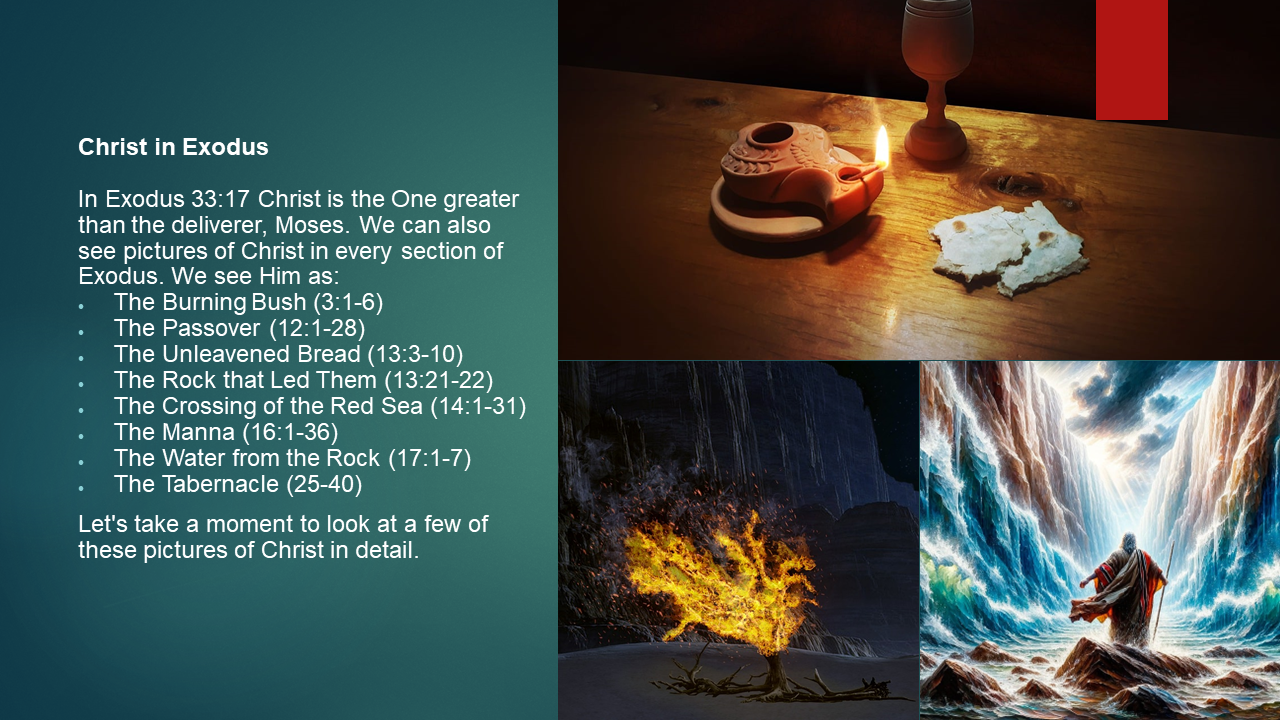
- The Voice in the Burning Bush (3.1-6)
- The Passover Lamb of God (12.1-28)
- The Unleavened Bread (13.3-10)
- The Rock/Pillar of Cloud and Fire leading them (13.21-22)
- The Red Sea Crossing (14.1-31)
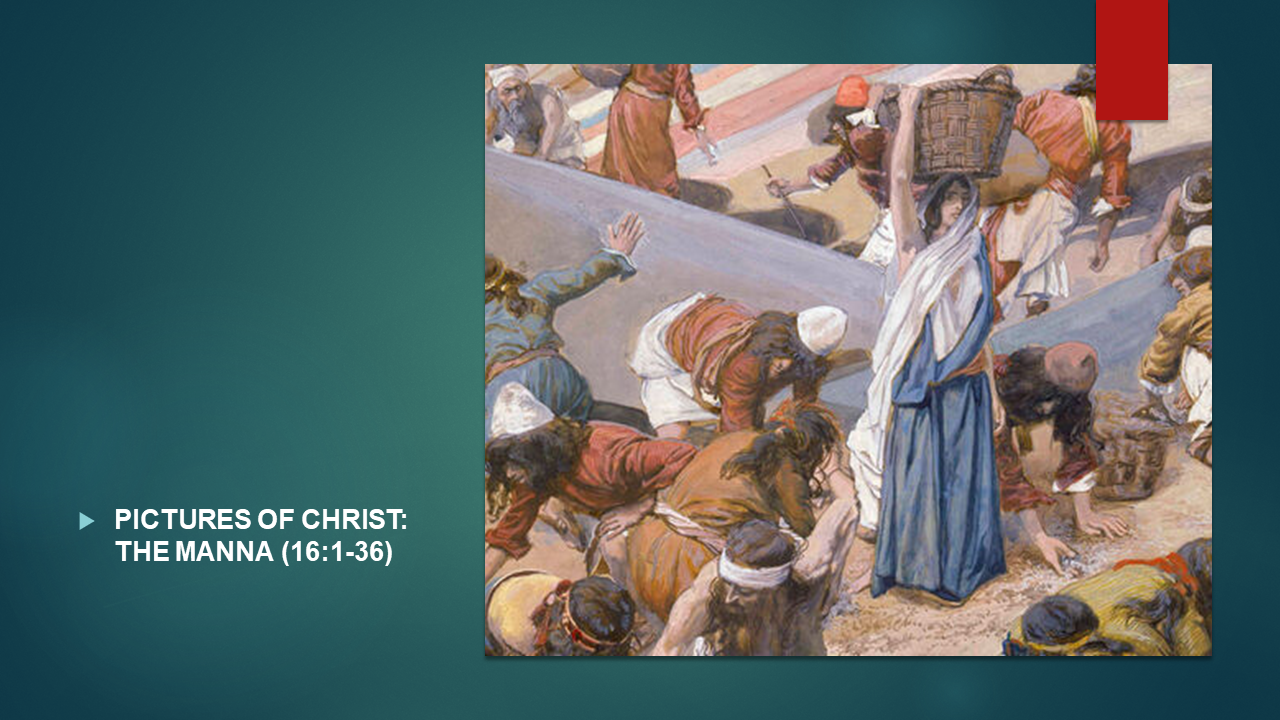
- The Manna from Heaven (16.1-36)
- The Source of Living Water (17.1-7)
We can see Pictures of Christ in every section of Exodus.
Pictures of Christ: The Burning Bush (3:1-6)
The Burning Bush has some very interesting symbolism. Fire is always symbolic of judgment (in the Scripture); brass was always used in the Tabernacle for vessels which needed to hold fire, so brass speaks of fire and thus judgment. (Num 21:5-20 and the brazen serpent). Heb 12:29 “our God is a consuming fire”; Heb 1:13 notes that He cannot even look upon evil.
Pictures of Christ: The Passover (12:1-28)
We speak often of the seven feasts of Moses, the Levitical feasts, this is not a Levitical feast. Rabbinical feasts were slaughtered by the High Priest, this is slaughtered for every household, by the head of the household. It is very different than the other feasts. It is also partaken, eaten personally.
Passover pictures SALVATION in Christ!
PICTURES OF CHRIST: THE UNLEAVENED BREAD (13:3-10)
- This broken piece of unleavened bread is explained in the New Testament as a picture of our Lord Jesus Christ Who CAME!
- It is Jesus who was described as “the Bread of Life”; He was born in Bethlehem, in Hebrew “House of Bread”;
- Christ shouts from every piece of bread used by the Jews during Passover.
- Every time you look at the Passover Matzah remember:
- Matzah is striped (“By His stripes are we healed”),
- Matzah is pierced (“They shall look upon me whom they’ve pierced”), and, of course,
- Matzah is pure, without any leaven, as Christ’s body was without any sin.
PICTURES OF CHRIST: THE ROCK THAT LED THEM (13.21-22)
PICTURES OF CHRIST: THE CROSSING OF THE RED SEA (14.1-31)
TONIGHT WE SEE THAT PASSOVER SEASON WAS PROPHETIC
The Gospels record Christ fulfilled the three prophecies of the Passover season.
- The Feast of Passover[2] prophesied redemption. Jesus the Messiah, the Passover Lamb, was slain for us.
- The Feast of Unleavened Bread prophesied sanctification. He was set apart. His body would not decay in the grave. Jesus was buried at the beginning of the Feast of Unleavened Bread since His body was interred at sundown of Passover Day, the beginning of the fifteenth of Nisan, the first month.
- The Feast of Firstfruits prophesied resurrection. Death could not hold her Foe. On the third day, Jesus rose triumphantly from the grave. Tonight we remember these truths.
THE SUNDAY AFTER PASSOVER IS THE FEAST OF FIRSTFRUITS
This feast commemorates the day Israel went down into the depths of the Red Sea and came out the other side alive. The children of Israel marched into a watery grave and God raised them on the other bank a nation of free people. Little did they know they were also demonstrating how God would bring salvation to the entire world! The Feast of Firstfruits is a foreshadowing of the work of both Good Friday and Easter, a type of the death and resurrection of Jesus Christ. Paul wrote, “But now Christ is risen from the dead, and has become the Firstfruits of those who have fallen asleep (the dead)” (1 Cor. 15:20). There is no spiritual death for the believer. Though his body may die, his spirit lives on with Christ.
§ Just as Israel marched out of the jaws of death (the Red Sea) to stand on solid ground, Jesus Christ arose the victor over death, hell, and the grave.
§ Just as Jesus predicted, He arose the mighty conqueror over powers and principalities. Rome could not convict Him, the Cross could not conquer Him and the grave could not contain Him.
§ He is alive this very moment at the right hand of God, awaiting the hour of His second coming when Kings, queens, presidents, and prime ministers shall bow at His feet and confess that He is Lord, to the glory of God the Father.
PICTURES OF CHRISTIAN LIFE IN THE SEQUENCE OF Exodus 15-18
Exodus 15-18 records Seven EXPERIENCES the Israelites had that correspond [3] to our Christian experience.
- THIS LIFE IS A STRUGGLE: The Wilderness of Shur was the spot of the Song of the Redeemed (15:1-22) this reminds us that we aren’t promised a bed of roses after our salvation/redemption.
- CHRIST IS OUR HOPE: At Marah, the Bitter Water was Sweetened by a Tree (15:23-26) which reminds us that Christ’s cross sweetens the bitter experiences of life with the hope of His presence, His Peace, and His Plan.
- CHRIST MAKES US FRUITFUL: The Oasis at Elim (15:27) with 12 wells and 70 palms reminds us of the promises He gives of a Fruitful Christian life.
- CHRIST SATISFIES US: In the Wilderness of Sin they were provided Manna and Quail (16.1-36) which reminds us that Christ is the Bread of Life who provides all we need.
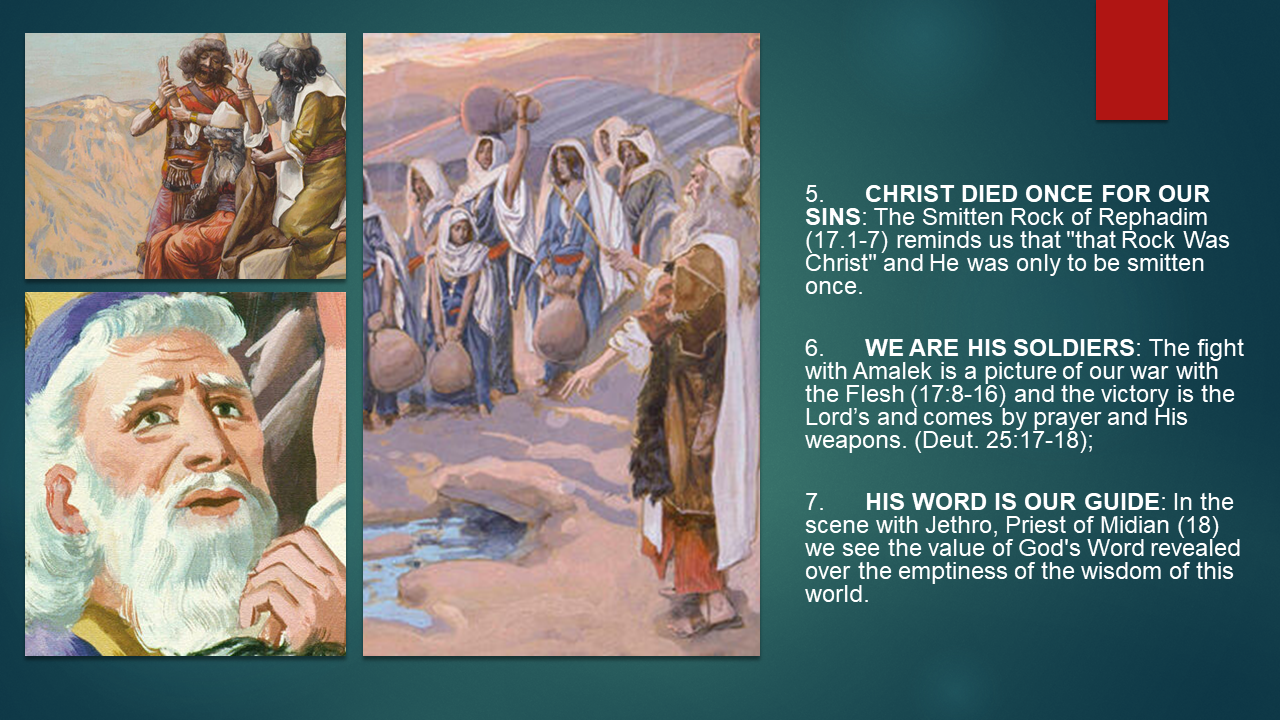
- CHRIST DIED ONCE FOR OUR SINS: The Smitten Rock of Rephadim (17.1-7) reminds us that “that Rock Was Christ” and He was only to be smitten once.
- WE ARE HIS SOLDIERS: The fight with Amalek is a picture of our war with the Flesh (17:8-16) and the victory is the Lord’s and comes by prayer and His weapons. (Deut. 25:17-18);
- HIS WORD IS OUR GUIDE: In the scene with Jethro, Priest of Midian (18) we see the value of God’s Word revealed over the emptiness of the wisdom of this world.
PICTURES OF CHRIST: THE MANNA (16:1-36)
The unleavened bread[4] in the New Testament is, of course, the body of our Lord.
- He is described as “the Bread of Life”. He was born in Bethlehem, in Hebrew “House of Bread”.
- God fed the Israelites in the wilderness with manna from heaven, and He feeds the Christians in the world on the Bread of Life.
- The very piece of bread used by the Jews during this week if Unleavened Bread is a good picture of our Lord. Anyone who has seen the Jewish matzoh sees that it is striped (“By His stripes are we healed”), pierced (“They shall look upon me whom they’ve pierced”), and, of course, pure, without any leaven, as His body was without any sin.
- The Passover ceremony of breaking and burying and then resurrecting a piece of this bread (the middle piece, as the Son in the Trinity) very obviously presents the Gospel in the midst of the modern Jewish Passover celebration. God performed this exact ceremony with the burial of Jesus, our precious piece of unleavened bread, and more importantly, He performed it on the exact day of the feast.
- We readily see from the Gospel that Jesus was buried at the beginning of the Feast of Unleavened Bread since His body was interred at sundown of Passover Day, the beginning of the fifteenth of Nisan, the first month. Our “kernel of wheat” was indeed placed into the ground, and at the appropriate moment. It was to rise again, of course, and again in accordance with the schedule of the feasts, as we shall se. One cannot permanently bury a Christian.
I AM THE BREAD OF LIFE (6:35) When jeus called himself the bread of god from heaven he was saying that The Manna Explains Who he Is. please turn with me to Exodus 16
Exodus 16 should always be read in connection[5] with John 6, for the manna from heaven is a type of Jesus Christ, the Bread of Life. Jesus also noted that manna illustrates the written Word of God on which God’s pilgrim people feed from day to day (Matt. 4:4).
1st Jesus was greater than manna. When Jesus called Himself “the Living Bread,” He was not claiming to be exactly like the manna. He was claiming to be even greater!
| Old Testament Manna | Jesus the Bread of Life |
|
|
|
|
|
|
|
|
|
|
|
|
Check Out All The Sermons In The Series
You can find all the sermons and short clips from this series, Christ in all the Scriptures here.
Looking To Study The Bible Like Dr. Barnett?
Dr. Barnett has curated an Amazon page with a large collection of resources he uses in his study of God’s Word. You can check it out here.