
If the video above is not available, here are two other ways to view:
David – Coming Back to God
060723AM
DSS-26
PSALM 51
Transcript
.jpg)
But as you open there to Psalm 51, you’re opening to a portion of the Word of God that was written by an Israeli. In fact, every book in that Bible that you hold was written, except for two books and one chapter, were written by what we would call today, Israelis, written by Jewish people, the people that God made an eternal covenant with, not a temporary one. In fact, if we are born-again this morning, it is through the New Covenant that is an unbreakable covenant that God did not make with the Church; He made with Israel. And the New Covenant was extended to us by Jesus Christ in the New Testament but not taken away from them.
.jpg)
Sometimes when we listen to news, we have this disconnect. It’s like those people over there in the Middle East are going through all this, are just like the people in Ghana or in Fiji, and it’s so sad that they’re going through it, but who cares? But those are actually the people, the chosen people of God from the Bible. Do you realize that? They are living in great disobedience, but when they pray at the wailing wall, they’re praying to the God that’s defined in this book, and the people on the other end of the conflict are praying to a god who is not defined in this book. Do you realize how big this is? This is the God of the Bible being attacked by the god not of the Bible and trying to erase the people of God, of promise. That’s what’s going on for 12 days over in the Middle East. But beyond all that, did you know that there are literally 25,000 born-again Messianic Jews? Five thousand of them live in Haifa, and there are rockets coming down. We had three of their pastors at our conference last month, and there are rockets coming down on born-again Christians in their neighborhoods. And can you imagine what their church services are like today? We’re wondering, will it be hot today or not? How would you like to be sitting in here and wondering what’s going to come through the ceiling? That’s what’s going on. I hope that you’re praying for both sides of the border. There are also tens of thousands of born-again Christians that are under the terror of Muslim, Hezbollah horrors that’s going on, on the other side of the border. So, don’t detach from the news, and also don’t think that just because the nation Israel is living in unbelief right now, that they have lost their status that God forever gave to them, that they are the chosen people of promise that belong to God.
It’s not, I was talking with someone this morning. It’s not as bad as it’s going to get because America, for their own wise choice are helping Israel. God says, I’ll bless anybody that helps them, but the day is coming when no one will help Israel. And so, we are getting close to the end. In fact, I wrote down the Bible says that the world ends, Earth’s history ends when Russia, Iran, and Syria together come against Israel. It sounds ominously close to that right now. Especially today, the news said that Russia has been quietly supplying Syria and Iran with what they need to offset America’s help to Israel, so it’s just lining up. So, if you’re a prophecy buff, I hope you’ll study the Bible. If you’re not a prophecy buff, I hope you’ll pray for the peace of Jerusalem. When you pray that, you pray for the end of the world and for Jesus Christ to return because that’s the only way there will be peace in Jerusalem because God has staked His name on the Jewish people.
.jpg)
Psalm 51. Psalm 51 is about David, who fell so far so fast. He didn’t even realize it until the dullness of his soul spread to every inch of his spiritual life. That is David’s condition before he wrote this psalm. Soon, David’s cold heart was combined with his tormented soul, and it was trapped inside a painfully chastened body. That’s what happened to David because of his sin. David was at the bottom, and he stayed there for almost one year. In fact, if you have a study Bible, most Bible commentators agree that it was almost an entire year that David stayed in this detached, cold, distant, chastened condition away from God, almost a year. Does that length of time strike you? It strikes me.
Think of who we’re talking about! David, who fell so far away from God that he passionately loved and served. It was David. David, a man that God talked to directly. David was inspired to write a great deal of the Bible. God directly, through His Holy Spirit, spoke to and through David, a man who knew the indwelling presence of God the Spirit, a man who had a direct line to God’s throne by way of a succession of prophets. David was a man who could enter the very tent of God. We see it in our Sunday School material. He went in it, built to the exact specifications God had left. In fact, David probably held in his own hands the very scrolls that Moses had written as he copied them to make his copy as king, his personal copy of the first five books. David was a man who may have seen the stone tablets of the Law that were kept in the Ark.
David was a man who had seen God’s supernatural protection month after month as he went through hand-to-hand combat. Remember, David was never, ever defeated on the battlefield. In fact, we don’t even have a record. We have most of his battles recorded in the Scriptures. We don’t even have a record he was ever even wounded. And if you think about it, as far as we know, never did one arrow, or sword, or spear, or slingstone, and there were tens of thousands, if not hundreds of thousands, if not millions of them in the hands of the myriads of enemies that David faced on every front and defeated. And not one of those countless deadly projectiles pointed at him and held by those who hated him and wanted him dead, ever seemed to have ever hit their mark. David really knew God in a very special way.
.jpg)
But when we get to Psalm 51, that man who knew God, who experienced God’s presence, who loved God, who sang scores of songs inspired by God, who wrote chapter after chapter of the eternal Word of God, that man lost touch with God for almost a year. Just let that sink in for a moment because if we think about ourselves, David knew the same God that we know. David wrote the same Bible we read. David sang the same songs that we sing. David felt the same closeness we feel, probably even more than many of us have ever felt, he felt the closeness of God, yet David stayed away from God for almost a whole year. Maybe we shouldn’t give up on people so fast. Maybe we shouldn’t stop praying for some people so easily. Maybe we shouldn’t be so quick to write them off and erase them from the group. David spent as much as a year in absolute misery.
What’s amazing is that David hid this sin so well. David went through all the motions of being the king. He was God’s leader. He was God’s king. He was still the sweet psalmist of Israel in most people’s minds. He still had the family line that would never end. He was still the one through whom the Christ would come, but all of those blessings and benefits God had given him meant nothing. David was like an engine without fuel. He was like an electronic device with no power. David had walked away from God, and he stayed away from God for a long time. If you were just a casual observer, though, it would look like David had gotten by with it. If you’d have known what he did and had watched him for that year, it would almost, outwardly, it would’ve looked like he had gotten by with it, but we always have to remember one thing. David was really God’s man, and it was God who wouldn’t let David get away with it. See, we might, or we might think that God was letting him, but God says, I won’t be mocked. What you sow, you’re going to reap. Remember the eternal running consequence engine that God says cannot be stopped? David was reaping.
During the interval that year when he was quiet, he had a tormented soul. We saw in the past weeks in Psalm 32 what really went on in his heart. David said in Psalm 32, when I kept silence, my bones waxed old through my roaring all the day long. If we would’ve visited the court of David during that nearly year of hidden sin, we would’ve literally seen David aging before our eyes. Literally, he was waxing old rapidly. In fact, his self-inflicted stress of those months was completely debilitating him. The fourth verse of the thirty-second psalm that we studied last week, it says, for day and night around the clock 24/7, Your hand was squashing me heavy on me. My moisture was turned to the drought of summer. That’s how he described that interval away from God.
.jpg)
A hymnwriter once wrote what David must have felt as he was enduring the heavy hand of God’s chastisement and conviction, and then what David felt when he repented and came back to God. We’re going to look at it at the end of the service, but I just want to read you the words that William Kirkpatrick wrote at the turn of the century in 1898. The title of the hymn is, “Lord, I’m Coming Home.” And this is so beautifully phrased, what David expresses in the fifty-first psalm. I’m coming back to God. This is what Kirkpatrick wrote: I’ve wandered far away from God, but now I’m coming home; the paths of sin too long I’ve trod, Lord, I’m coming home. I’ve wasted many precious years. David could say many precious months. Now I’m coming home. I now repent with bitter tears, Lord, I’m coming home. I’m tired of sin and straying, Lord, now I’m coming home. I’ll trust Thy love, believe Thy Word, Lord, I’m coming home. My soul is sick, my heart is sore, but now I’m coming home; my strength renew, my hope restore, Lord, I’m coming home. I need Thy cleansing blood I know, now I’m coming home; oh, wash me whiter than the snow, Lord, I’m coming home. And then the refrain. Coming home, coming home, never more to roam; open wide Thine arms of love, Lord, I’m coming home.
.jpg)
This morning, if you’ve ever felt away from God, then you can relate to David. If you’ve ever sinned deeply and paid a heavy price for that sin, then you can relate to David. And if you’re here this morning in body only, because that’s how David was for almost a year; he was there in body only. And your heart like David’s has become cold, dull, burdened, and distant, then you can relate to David. Psalm 51 is all about David, who went so far away, and then he came back to God. And this morning, I’d like to examine with you coming back to God. The fifty-first psalm is a paradigm of prayers for forgiveness for sins, and throughout the centuries, believers have been comforted by the fact that since David’s sins were completely forgiven, theirs can be also. That’s why this is in God’s Word. The fifty-first psalm is a divinely inspired roadmap. It’s clearer than any other map in the world. It’s the way back to God. And David tells us how he found his way back from a cold, distant, and tormented heart to immediate joy, relief, peace, and security. By the way, only God offers and provides such a blessing, and the Scriptures tell us the power of God is present today, to heal you today from a sin, sick, sore, dull, cold, distant, lifeless heart, if, like David, you come back to God.
Let’s stand and listen to His Word. Psalm 51. I’m going to read all 19 of these verses. It’s the fourth penitential psalm. It’s David laying bare his soul and explaining how he came back to God. And as I read these 327 words, I counted them, I want you to notice 35 of them. Okay? Because 35 times David says, I did it, it’s me, it’s me, I did it. He’s talking about his personal responsibility for his sin, and then he says repeatedly, it’s against You, God. It’s You, it’s You, it’s Your name, it’s Your presence, it’s Your glory, it’s Your honor that I sinned against. That’s the beautiful two-part message of this psalm. Acknowledge that every sin is against a holy God. It’s not a personal defeat or failure alone. I can manage my personal defeats and failure. I go out, and with the edger yesterday, I was messing up, and it’ll grow back. But personal defeats and failures that are manageable is not what we talk about when we talk about sin. It’s not just a personal defeat and a failure. It is a sin against a holy, infinite God that demands a payment for every single sin that’s committed. And the first thing David said is, You are a holy God. I sinned against You and against You only. He doesn’t even mention Bathsheba or Uriah. It’s God. And then he said, I did it, and he says, I’m guilty.
.jpg)
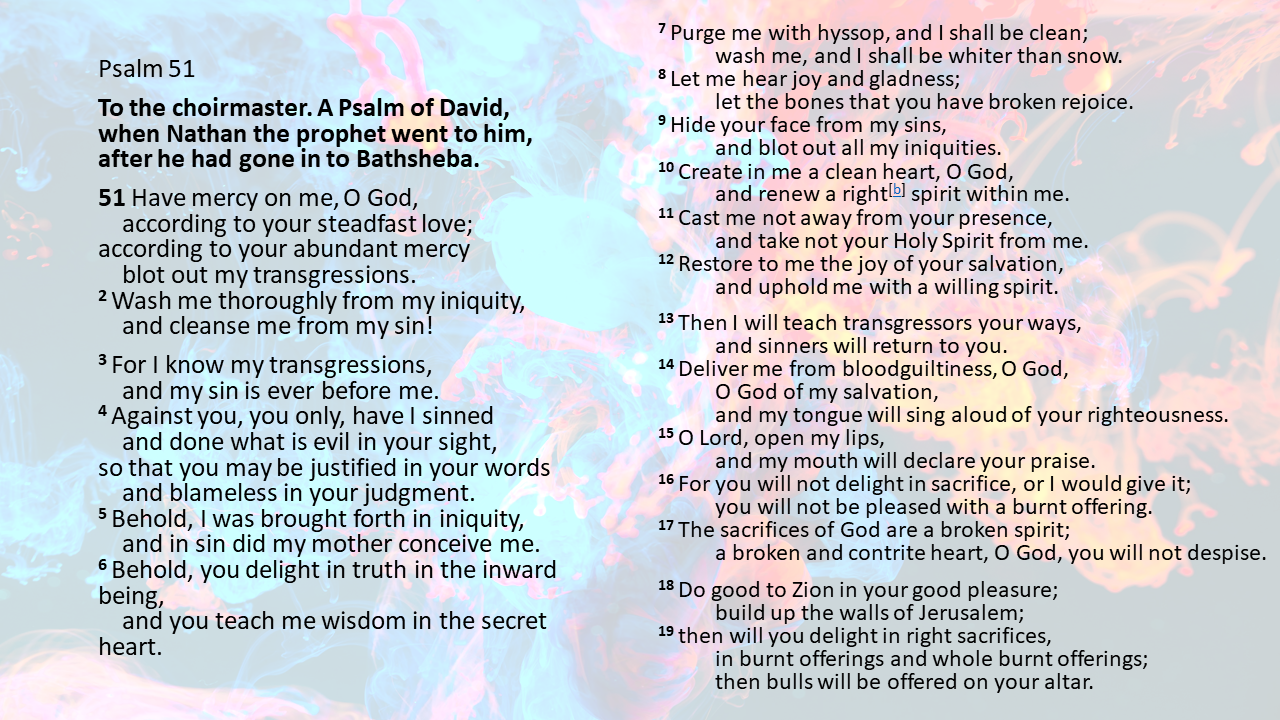
Let’s follow along as he tells us this. Psalm 51, the superscription, which is part of the Hebrew manuscript inspired by God, says, to the Chief Musician. A Psalm of David when Nathan the prophet went to him, after he had gone in to Bathsheba. Now the first verse, have mercy upon me, O God, according to Your lovingkindness; according to the multitude of Your tender mercies, blot out my transgressions. Verse 2, wash me thoroughly from my iniquity, and cleanse me from my sin. Verse 3, for I acknowledge my transgressions, and my sin is always before me. Verse 4, against You, You only, have I sinned, and done this evil in Your sight, that You may be found just when You speak, and blameless when You judge. Verse 5, for behold, I was brought forth in iniquity, and in sin my mother conceived me. Behold, You desire truth and inward parts, and in the hidden parts You will make me to know wisdom. Verse 7, purge me with hyssop, and I shall be clean; wash me, and I shall be whiter than snow. Make me hear joy and gladness, that the bones You have broken may rejoice. Hide Your face from my sins and blot out all my iniquities. Verse 10, create in me a clean heart, O God, and renew a steadfast spirit within me. Do not cast me away from Your presence, do not take Your Holy Spirit from me. Restore to me the joy of Your salvation and uphold me by Your generous Spirit. Then I will teach transgressors Your ways, and sinners will be converted to You. Deliver me from the guilt of bloodshed, O God, the God of my salvation, and my tongue shall sing aloud of Your righteousness. O Lord, open my lips, and my mouth shall show forth Your praise. For You do not desire sacrifice, or else I would give it; You do not delight in burnt offering. The sacrifices of God are a broken spirit, a broken and a contrite heart. These, O God, You will not despise. Do good in Your good pleasure to Zion; build the walls of Jerusalem. Then You shall be pleased with the sacrifices of righteousness, with burnt offerings and whole burnt offerings; then they will offer bulls on Your altar.
Let’s bow before the Lord. Father in Heaven, as we ponder these words originally penned as a public prayer that was read, and chanted, and sung aloud, may those words that people who didn’t have a copy to read but just heard, may those words be in our minds as we hear them as You wrote them through Your servant David. And may we this morning, never forget that if we’re going to get right and stay right, if we’re going to come back to You and stay with You, we have to realize that every time we sin, no matter how small, no matter how insignificant, no matter how unnoticed by anyone, even sometimes us, that it’s a sin against You, a holy, infinite, righteous God. And that the only way to deal with it is for us to take personal responsibility and to say to You, entering the guilty plea, and saying, it’s against You and You alone that I have sinned. Help us to remember how David came back to You and help us to come back and to hate sin so much that we stay back with You, not wandering away week after week, month after month like David did. In Your precious name, we pray, Lord Jesus, amen.
.jpg)
You may be seated. The lesson of this psalm and the lesson that will change our direction away from sin and toward God is number one, that all sin is always against God. In fact, theologically, and I spent a long time reading all the arguments. Many theologians say, no, sin is really against any person because sin is defined by breaking God’s law. So, we can say with a small letter s, that we sin, and if that means we hurt other people and dishonor them or cheat them here and there, but really that’s all defined by the holiness of God. And that’s why we increasingly live in a culture that is repulsed by this idea of sin because there’s no law of God that they even recognize. And that’s why the Bible says that as the world spirals away from God and out of control, and as things gather toward the end, that there will be absolute lawlessness, godlessness because there’s no recognition of God. But it doesn’t mean that He’s not counting this sin. It’s just meaning that people don’t care. But the lesson of this psalm is that sin is not merely a personal defeat. If you only think sin is a defeat you experience, then sin becomes manageable. It’s just something you learn to live with. But David saw that his sin, look at verse 4, was against God and God alone, and David took personal responsibility for his sin. In fact, 35 times, if you count it, if you mark them, if you highlight them in your Bible, as I have gone through this week and done, you’ll find that 35 times he repeats, it’s me and I am guilty. And that is David taking God’s perspective. Why? Because God says, we’re all sinners. We all have sinned, and we are sinful by nature, and by choice, and by divine decree through our father Adam. But when the Church has a superficial view of sin, which is increasingly happening.
I remember when I was doing my first master’s thesis, I was interviewing television preachers back then. I remember writing the same letter to all of them and said, do you believe in sin? Do you believe in Hell? And a couple other things. And some of the most widely listened to, in fact, I still have one letter from one smiling television personality who said, if I believed in sin, you would hear me mention it on my broadcast, and if I believed in Hell, you would also hear me mention that. And then he added, if I believed in the virgin birth, I’d mention that too. He says, of course I don’t believe in those things. And I thought, how many born-again Christians’ living rooms are graced by that angel of light, Satan masquerading as one of God’s emissaries? But we won’t get into that.
If men and women are basically good and not sinners under the wrath of God, then why would we ever preach the Gospel? Why would we send out missionaries for that matter? Why would Jesus have to die? If people are good, then all they need is counseling and consoling, not convicting. We should give them encouragement, not evangelism. But of course, we know that’s false because God, who is the last Word, says we are all sinners.
So, Psalm 51, there’s two truths. I hope they’re planted in your mind. I’ll say them repeatedly. I’m a descendant of Peter, who said, I want to stir you up by way of reminder, not just telling you once but reemphasizing it. All sin is against God. We must take personal responsibility for sin.
.jpg)
Psalm 51 was designed primarily to be a public-read book in worship. That’s how God had David inspired to write it. And he presented it to the collection of the sacred songs, the psalms that were kept in the Tabernacle then, and then later the Temple, and then distributed to all believers. And we have the joy now of having a printed copy. But remember, printing didn’t start till the sixteenth century, and so most people never had the luxury of what we have today. So, they just heard it, and as they heard it, the fifty-first psalm is written for the most effective public assembly communication.
In fact, go back through it with me. I just want to show you two, and this is just a little, if you remember, do you remember going through English Lit and all that? Do you remember how they’d point out the author, and you’d sit there in class, and you go, wow, I never saw that? Sometimes we don’t use those skills to actually see the way that God structured the Bible. And I’ll just give you a quick what the people that study Hebrew poetry just relish. Now, I’ll just give you a little bit because most people are bored by structure of poetry, but this is a blessing. Number one, look from verses 3-9. I’m going to read them to you again. But David’s responsibility for sin is emphasized in this first half of the psalm because sin and sinner occur eight times, and God occurs not at all. Okay? Do you understand that? God in the first eight verses is not even mentioned. But sin and sinner, I’m talking about 3, 4, 5, 6, 7, 8. After David shoots out this, I’m guilty, in verses 1 and 2, then he starts going into the description and notice what he does. Verse 3, my transgressions and my sin is before me. Verse 4, I have sinned and done this evil in Your sight. Verse 5, I was brought forth in iniquity, and in sin my mother conceived me. Ongoing, down, verse 9, hide your face from my sins, and blot out my iniquity. So, eight times in the first nine verses David talks about me, the sinner, and never mentions God by name. Now, for the psalm listeners, they’d be sitting there in the service listening along, and God for 3, 4, 5, 6, 7, 8, and 9, for all those verses isn’t mentioned. And so, they who don’t have a written copy of this would be in their mind mentally thinking, God is absent, and that’s what our sin does. That’s a basic description of almost a year of David’s life. He was feeling far, cold, dull, away from God.
.jpg)
Now, look what happens in verse 10. The holy God, against whom David’s sinned is emphasized in the second half, but sin and sinner are only mentioned one time. You see the structure here? The first half from 3-9 is sin, sin, sin, sin. And David’s saying, I’m responsible, I’m responsible, I’m responsible. The second half is God, God, God, God, God, God, and sin and sinner is only mentioned once. So, it’s for those hearers to see two distinct messages. Take personal responsibility for your sin, and all sin is against a holy God. And so, it’s structured right into the psalm.
Second half. Let me start reading in verse 10. Look at the 20 times God is alluded to starting in verse 10. Create in me a clean heart, O God. There’s number one. Verse 11, don’t cast me away from Your presence. That’s the second reference. Don’t take your Holy Spirit, that’s the third reference, from me. Verse 12, restore to me the joy of Your salvation, uphold me by Your generous Spirit. Verse 13, I’ll teach transgressors Your ways, and sinners (right in the middle there; that’s the only reference to sinners, just one) and sinners shall be converted to You. That’s the seventh time God’s mentioned. Verse 14, deliver me from the guilt of bloodshed, O God. There’s the eighth. God of my salvation. There’s the ninth. My tongue will sing aloud of Your righteousness. Number ten. O Lord. Number 11. Open my lips, my mouth shall show forth Your praise. God is mentioned a twelfth time. Verse 16, You. There’s another time. Or else I would give it to You. That’s the fourteenth time God’s mentioned. Verse 17, the sacrifices of God. There’s another reference. Are a broken spirit, a broken and contrite heart. These, O God. There’s the sixteenth time He’s mentioned. You (seventeenth time) will not despise. Verse 18, do good in Your good pleasure to Zion (another allusion to God) build the walls of Jerusalem. Verse 19, then You shall be pleased (and that’s all that matters; that’s the nineteenth time God’s mentioned) with the sacrifices of righteousness, with burnt offerings and whole burnt offerings; they shall offer bulls on Your altar. It’s all about God.
All sin is first and foremost against a holy God, and we must realize that. Don’t make your sin manageable so you can keep it. It’s like the grass. You just keep mowing it. You don’t let it get out of hand. You edge it now and then, but you just leave it alone. That’s not how sin should be treated. Every instance, occurrence, and choice to sin is always and only against a holy God. How do we get back on the track if we’ve sinned? How do we come back to God? This whole psalm is a pathway that God had David write down to tell us how he came back to God. And so, we can see by believing God and trusting in what He has said, we also can come back to God. So, this psalm is huge. This psalm not only talks about the mechanics; this psalm talks about the theology. In fact, this psalm summarizes all the Old Testament sacrificial system, purge me with hyssop and all this, and points forward to what we know is complete in Christ. So, it’s a big psalm. There’s a lot to learn here.
.jpg)
But let me just show you the pathway when we’ve been defeated by sin that David was inspired by God to tell us about. Because there are four distinct divisions of this psalm, and I’ll show them to you. The first four verses are primarily telling us that all sin is against God. It ends with that fourth verse. Against You, and You only, have I sinned and done this evil in Your sight. So, verses 1-4 is just a declaration, structurally and literally by the words, that we need to understand all sin is against God. So, that’s the first point.
Number two, starting in verse 5, we need to take personal responsibility for sin. And I already showed you that. Starting in verse 5, I was brought forth, my sin. Verse 6 ends, make me to know wisdom. Verse 7, purge me, and I will be clean. And we can just go all the way through. We need truthfulness, verse 6. We need cleansing, verse 7. We need joyfulness because it’s gone when we sin, in verse 8. And verse 9 says, we need fellowship with God. And so, all of that is the second lesson, the second factor of this wonderful psalm. Verses 1-4, understand all sins against God. Verses 5-9, take personal responsibility for sin.
Then starting in verse 10, David kind of gets to the heart of what we really need to do. It’s academic to know all sin is and understand it’s against God and to admit and confess that I’ve sinned. But nothing has happened until verse 10, believe only God can cleanse and restore us. Verse 10, God washes our hearts. Verse 11, God restores our walk in the Spirit. Verse 12, God renews the fruit of the Spirit in our lives. That joy and gladness is from the Spirit of God, not from us. It’s not because we turn over a new leaf or start some new self-help program. It’s a product of the Holy Spirit. It’s the renewing of the fruit of the Spirit, verse 12. And it is God who prepares us for further ministry. That’s what verse 13 is about. So, we need to thirdly, believe only God can cleanse and restore us. That’s where all the social workers and psychotherapists in the world can’t help people permanently. They temporarily help them. They feel better, but only God can restore and renew. Only God can forgive and cleanse. Only God can take away the sin and the guilt and so believe that only God can cleanse and restore us. That’s the message of 10 through 13. So, if you’re a Bible marker, verses 1-4, or a note taker, understand all sin is against God. Those four verses tell us our relationship’s broken, verse 1. We need to be washed clean, verse 2. We have roadblocks, verse 3. And only the Lord can utterly forgive. It’s the Lord that sin is against. Then secondly, verses 5-9, take personal responsibility for your sin. And then thirdly, verses 10 through 13, believe that only God can cleanse and restore us.
And then finally, he ends with verses 14 through 19. It’s so simple: seek God and repent. It’s so simple! You see the progression? Understand sin is against God, take first responsibility, believe God can cleanse and restore us, and then seek God and repent. That’s a summary of all 327 [words], and that’s what David tells us in verse 14. Call sin what it is. He says he murdered Uriah. He talks about his blood guiltiness. You just have to call sin what it is. Verse 15, you have to talk to God. You notice in verse 15, O Lord, open my lips. He says, I’ve been holding this in. And we find in Psalm 32 what he tells us he did is he says he started confessing all of his sins. He didn’t just say, okay, You got me in the corner. I did the Uriah and Bathsheba thing. He just started seeing sin everywhere in his life, and that’s why David just goes through such a monumental change in his life. The pain goes on. To the end of his life, he’s still dealing with the ramifications of this. After David’s death, his elder son is trying to kill his younger son and take the throne, Adonijah and Solomon. And Adonijah’s trying to take Abishag, the whole deal. The sword will never depart from your house, God said. So, the consequence of sin didn’t go away, but the guilt, and the pain, and the fear, and the distance, and the coldness and all of that God gone out of his life was removed. And God returned, and all the guilt, and pain, and coldness left. But he learned to talk to God in verse 15. He experienced true contrition, not just externalism. That’s what verses 16 and 17 are about. Remember, it says in 2 Corinthians 7 verses 9 through 10, that godly sorrow works repentance. Not to be repented of, not merely, he wasn’t just going through a bunch of woe is me. He was truly smitten on the inside. And then verses 18 and 19, when he sought God and repented, he began zealous worship anew and afresh.
.jpg)
That’s basically the 51st psalm, but let’s just walk through a little more slowly because I want to show you the mechanics of forgiveness, the mechanics of how God does all this, how the work of Jesus Christ relates to this. In fact, how the whole Old Testament sacrificial system that he talks about this purge with hyssop, and I’ll be whiter than snow, how all that just meshes with what Jesus did on the cross. But we’ll start with David saying in verse 1 these simple words, I am guilty. Now you can hardly get a guilty plea in court these days unless there’s a plea bargain and there’s some deal worked out in advance. I don’t think anybody’s ever done anything, at least their lawyer tells them not to say they have until they’ve worked out how they’re going to get the best deal. David just said, I am guilty, have mercy on me. What he’s saying when he said, have mercy, he’s saying, don’t give me what I deserve. That’s what mercy is, not getting what we deserve. Grace is getting what we don’t deserve. But David deserves something, and when he said have mercy, he’s saying, I deserve Your wrath. I deserve punishment. I am what? Guilty.
Now, David begins at quite a different reference point from that of modern social workers, and psychoanalysts, and psychotherapists today. They usually begin with this, and I picked one up and wrote down, our inner experience needs to be mended. I invite you to try to face up to your moral problem and recognize how your misdeeds might affect society for worse and how you possibly have broken society’s norms. Now, that’s a standard social worker way of talking to someone who’s done a terrible misdeed, and they start with them on the inside and say, you need to think about this and possibly see that you might have some connection with it. Perhaps you don’t. You see why nothing gets done? There’s no I’m guilty of doing something wrong. They don’t even think they did something wrong. And they’re aided and abetted by the modern people who don’t believe in the law of God. But David sweeps beyond all these human immoral considerations. He looks straight at the almighty and holy God, and he looks up at Him and he says, I’m guilty. And that’s amazing.
I told you last week about Chuck Colson, one of his troops going into prison to this death row guy who was living like an animal just in his own waist. And this guy looked up through his glazed eyes at this prison fellowship guy, and the prison fellowship said, say the name of Jesus. And when the guy repeated the name, which means the One who will save you from your sins, and listened to the Gospel message, he acknowledged that he was guilty. In fact, before they executed him, he confessed. He said, I did it all. He was a radiant executed guy because he just, it was amazing! To the whole world he says, I did it, and he was radiant, and he totally changed because he was forgiven because he said, I’m guilty.
By confessing that he was guilty, David was coming back to God, who alone can renew our relationship broken by sin. Look at verse 1. He says, have mercy on me, God, I’m guilty, against You, O God. That’s what mercy means. And according to Your lovingkindness, according to the multitude of Your tender mercies, blot out my transgression. Now, there’s so much in those few words. David appeals in verse 1 to God’s love and compassion, to the character of God, and he talks to the Lord and asks Him to forgive him by grace and cleanse him from his sin. I always remember mercy is when we don’t get what we deserve, and David was saying, don’t give me what I deserve. I’m guilty, and I deserve it, but because of Your lovingkindness and grace, don’t give it to me. And grace is when we get what we don’t deserve. Mercy withholds, and grace outpours. He mentions God’s attribute of unfailing love. This is one of the great words of the Old Testament. The word in Hebrew, ḥeseḏ, and it means God’s unfailing love for His servant, His compassion for the helpless. These were the basis for David’s appeal for mercy. Even the verb, have mercy, in this verse was a prayer for God to act in accord with His nature. David was saying, I want You to be what You are. I want You to respond to me according to Your character. See why something happens when we come to God this way? When we say, I’m guilty and You’re a God of mercy, we see God act according to His changeless character because God says, if you will confess your sin, I will forgive it. But if you won’t, you’ll pay for it forever. And God cannot change. He is immutable.
.jpg)
David also recognized he didn’t deserve forgiveness, and God’s forgiveness is in and by His grace alone. And what’s amazing is if you want a swift, immediate, and a relationship-restoring help from God, start with that simple guilty plea. Don’t flubberate around the courtroom saying, it’s my wife’s fault, and I just haven’t slept enough. You don’t know how I was mistreated when I was younger. God just doesn’t accept any of that stuff. Just walk into the courtroom. In fact, let’s turn to Luke 18 because there’s actually a scene Jesus describes. If you want to see how God can’t resist your prayers, look at Luke 18 because God resists a lot of prayers. If you want to have an irresistible, swift, immediate relationship-restoring help from God, then you need to see a David type of response to God, and that’s in Luke 18 starting in verse 9. Because when we read Luke 18 starting in verse 9, you can see something God just can’t resist. It’s the type of heart that the cries go straight to Him and He just responds right away. In fact, as we go through this, when we get to verse 13, the Greek tenses tell us that this publican couldn’t stop saying this. It was the ongoing longing of his heart. But I’ll start reading verse 9, then He (that’s Jesus) spoke this parable to some who trusted in themselves that they were righteous. In other words, the I’m not guilty society, warped me, I’ve been abused and you don’t know what I’ve been through. Those type of people that say, I didn’t do that. It’s not my fault. They think that they’re righteous and despised others. Verse 10, two men went up to the Temple (this is Jesus speaking) to pray, one a Pharisee, the other a tax collector. Verse 11, the Pharisee stood and prayed thus with himself. I love it. Prayed with himself. It’s kind of like he was enjoying it so much. He was enjoying himself, enjoying himself. He is just, he’s praying with himself. It’s like a stereo prayer. He’s just so enjoying it. He’s praying with himself. God, I thank You I am not like other men (and I’m sure he was looking around at people) extortioners, unjust, adulterers. And then he specifically turned and looked at the guy next to him who he could tell, or perhaps he had paid taxes to him. Who knows? But he just looked at him, and he says, or even as this tax collector. And then he told God why God should think he’s great. I fast twice a week; I give tithes of all I possess. And Jesus has already said that he was like a whitewashed sepulcher and all that. But then look, here’s the good part of the story. Verse 13, and the tax collector, standing afar off. I think the Pharisee probably hurried right up as close as you could get to the holy place. And he was just right up there telling God it was really good that He had him, and he’s going to really give Him some good prayers this day. And the publican, he was way off. He was standing afar off. And it doesn’t just say he was standing at a distance; look what it says: and would not so much as raise his eyes to Heaven, but he beat his breast, and he said—and this word he said is a present active participle. He kept on saying, God, be merciful to me a sinner! And he couldn’t look up, and he was pounding his chest, and he’s thinking within him dwells no good thing. And he was so aware of his sin, and he just kept saying, God, don’t give me what I deserve. I’m a sinner. So, Jesus’ analysis of these two prayers, verse 14, I tell you, this man went down to his house justified. Justified. That’s a big word we’re going to study when we get deep into Psalm 51. Make sure you’re justified by God. It’s the only way that you won’t pay for your own sin forever. This man went away justified, and Jesus continues, rather than the other; for everyone who exalts himself will be humbled, and he who humbles himself will be exalted. Like the publican, who wouldn’t even lift his face toward God, but just said, God, be merciful to me, we can also come back to God.
.jpg)
I told you we’d look at this. The hymnwriter wrote, and you can close your Bibles and get your hymn books, and I want you to actually see what I read to you because he wrote 341. And I want you to think about these words in your heart this morning because a hymnwriter once wrote what David must have felt as he responded to God’s heavy hand of chastisement and conviction, and repented of his sin and came back to God. And this morning, if you’ve ever felt far away from God, you can come back to God just like David did. And if you have ever sinned deeply and paid a heavy price, you can come back to God just like David did. And if this morning you’re here in body only, and your heart is just like David’s, it’s cold, and dull, and burdened, and distant, you can come back to God just like David. Okay? Let’s stand up with our hymn books, and I’d like you just to be like you’re standing in the Temple like Luke 18. Don’t think about everyone else. Don’t wonder about everybody else. Every one of us in this room, whether we acknowledge it or not, have personally sinned against the holy God of the universe. And every one of us in this room can say these words because your wandering far from God isn’t compared to how far other people have gone; it’s compared to God. And sin in the light of others’ sins doesn’t look very bad, but sin in the light of God’s holiness is infinitely bad. But we’re just going to read these words and then we’re going to stand quietly. And just in the quietness of this morning, if you need to come back to the Lord, then I invite you to. It’s not us you come back to; it’s not the Church you come back to. It is God you come back to, and you can come back right here, right now where you stand. And if you need more than that, if you need someone to actually help you, we’re here. If you need to do something while we read these words, if you need to do something, we don’t make a big deal out of invitations, but if you need to do something, and I commend you. I grew up in that tradition. Every decision I ever made, I went forward and made it. Maybe you did too. But if you need to literally come back to God, the reason we spent thousands of dollars to rebuild this platform was to make beautiful steps all the way around so that they could be prayed on. So, while we’re reading these words, if you need to just come up and just get on your knees and pray, just to put a post on you, do that, and you can go back to your seat. If you need to talk to someone, just stay up here, and at the end of the service, we’ll talk to you. But whatever the Lord lays on your heart, I hope you can say to Him, Lord, I’m coming home, and I’m staying home. Okay, let’s not wander.
Let’s read these words to Lord. If God works in your heart, come pray. Pray in your seat. If you need to talk to someone, come and stay and we’ll talk to you. But let’s read these before we go together. I’ve wandered far away from God, now I’m coming home; the paths of sin too long I’ve trod, Lord, I’m coming home. Second stanza: I’ve wasted many precious years, now I’m coming home; I now repent with bitter tears, Lord, I’m coming home. I’m tired of sin and straying, Lord, now I’m coming home; I’ll trust Thy love, believe Thy Word, Lord, I’m coming home. My soul is sick, my heart is sore, now I’m coming home; my strength renew, my hope restore, Lord, I’m coming home. Now the refrain: coming home, coming home, never more to roam; open now Thine arms of love, Lord, I’m coming home.
.jpg)
Let’s bow before our Lord. Your arms are open right now widely. And if we, like the publican, will have the attitude of David and say, be merciful to me. I deserve it. I’m guilty. You can’t resist that heart attitude, and I pray that we will go from here justified because of our humble, contrite, repentant hearts in response to Your grace that David experienced and that we would be assured of Your mercy and of Your lovingkindness. If David could fall so far so fast and didn’t even know it till the cold dullness throbbed throughout his body, how I pray that we would also be so utterly hating sin that we don’t play with it, that we don’t make light of it and sport with it, but that we stay as far away from sin as it’s possible on this Earth to be while still called to be a friend of publicans and sinners. Lord, may we experience the joy of coming home to You, and we’ll thank You for what You do in our hearts and our lives. And especially tonight, as we examine how David looked at sin and how, with You, when we look at sin that way, there is abundant pardon. O fill us with the joy of our salvation as we go through this priceless treasure of this psalm. In the name of Jesus, we pray, and all God’s people said, amen.
Notes

David fell so far, so fast—he didn’t even realize it until the dullness of his soul spread to every inch of his spiritual life.
Soon his cold heart was combined with his tormented soul and trapped in a painfully chastened body.
David was at the bottom, and he stayed there for almost a year.
Almost a year—did that length of time strike you?
AT THE BOTTOM
Think of who we are talking about, that fell so far away from the God he so passionately loved and served.
• A man that God talked to directly by way of inspiration;
• a man who knew the indwelling Presence of God the Spirit;
• a man who had the direct line to God’s Throne by way of prophets;
• a man who could enter the very tent of God built to the specs God left;
• a man who had held perhaps the very scrolls Moses had written down;
• a man who may have seen the stone tablets of the law that were kept in the ark;
• a man who had seen God’s supernatural protection month after month in hand to hand combat as David was never defeated on the battlefield—and as far as we know, never even wounded by arrow, sword, spear or sling stone, though there had been tens of thousands pointed at him and held by those who hated him and wanted him dead.
That man who knew God, experienced God’s presence, loved God, sang scores of songs inspired by God, wrote chapters of the eternal Word of God—that man seemed to lose touch with God for a YEAR!
Now, think about yourself. David knew the same God we know. David wrote the same Bible we read. David sang the same songs we sing. David felt the same closeness we feel and probably even more so that many of us have ever felt. Yet he stayed away from God for almost a whole year.
Maybe we shouldn’t give up on people so fast. Maybe we shouldn’t stop praying so easily. Maybe we shouldn’t be so quick to write them off and erase them from the group. David spent as much as a year in absolute misery.
What is amazing is that David hid this so well. He went through the motions of being the king. He was God’s leader, he was God’s king. He was still the sweet psalmist of Israel. He still had the family line that would never end. He was still the one through whom the Christ would come.
But all those blessings and benefits meant nothing, like an engine without fuel, an electronic device with no power—David had walked away from God and stayed away for a long time.
But if you were just a casual observer, it looked as if David had gotten by with it.
But always remember one thing: David was God’s man, and God would not let David get by with it. In reality, during the interval when he kept quiet, he was a tormented man. In Psalm 32 we saw what really went on in his heart. David says this: “When I kept silence, my bones waxed old through my roaring all the day long” (Ps. 32:3). If we could have visited the court of David during that nearly year of hidden sin—we would have literally seen David aging before our eyes. The self-inflicted stress of those months was completely debilitating. “For day and night thy hand was heavy upon me: my moisture is turned into the drought of summer” (Ps. 32:4). This describes his feelings during that interval.
COMING BACK TO GOD
 A hymn writer once wrote what David must have felt as he responded to God’s heavy hand of chastisement and conviction and repented of his sin and came back to God.
Lord, I’m Coming Home (1898) #341 William Kirkpatrick (1838-1921)
I’ve wandered far away from God, Now I’m coming home; The paths of sin too long I’ve trod, Lord, I’m coming home.
I’ve wasted many precious years, Now I’m coming home; I now repent with bitter tears, Lord, I’m coming home.
I’m tired of sin and straying, Lord, Now I’m coming home; I’ll trust Thy love, believe Thy Word, Lord, I’m coming home.
My soul is sick, my heart is sore, Now I’m coming home;
My strength renew, my hope restore, Lord, I’m coming home.
I need His cleansing blood, I know, Now I’m coming home; O wash me whiter than the snow, Lord, I’m coming home.
Refrain
Coming home, coming home, Nevermore to roam, Open wide Thine arms of love, Lord, I’m coming home.
This morning, if you have ever felt far away from God—you can relate to David.
If you have ever sinned deeply and paid a heavy price—you can relate to David.
If you are here this morning in body only, and your heart like David’s had been, is cold, dull, burdened, and distant—then you can relate to David.
So now as we turn to Psalm 51 we find that it is all about David who went so far away-Coming Back to God.
Psalm 51 stands as a paradigm of prayers for forgiveness of sins. Believers have been comforted by the fact that since David’s sins were forgiven theirs can be too.
The 51st Psalm is a divinely inspired roadmap, clearer than any other map in the world, on the way back to God. David tells us how he found his way back from a cold, distant and tormented heart to immediate joy, relief, peace, and security. Only God offers and provides such a blessing. The power of God is present today to heal you today, if you will like David—come back to God.
To understand that way back to God, turn with me to the 4th Penitential Psalm, the 51st Psalm, and listen as David lays bare his soul and explains how he came back to God.
Just before I read this Psalm and you follow along, I want you to notice the 35 words that I will emphasize while reading this Psalm. Out of the 327 words in these 19 verses there are 35 that all say the same thing. David says “I, me, my” those many times to show that he is personally responsible for his sin.

ALL SIN IS AGAINST GOD
In fact the lesson of this Psalm and the lesson that will change your direction away from sin and towards God is that ALL SIN is AGAINST GOD, not merely a personal defeat. If you only think that sin is just a defeat you experienced–then sin is manageable, it is just something you learn to live with.
But David saw that sin was against God (v. 4) and David took personal responsibility for his sin (35 times he repeats that it is me, I am guilty)! That is David taking God’s perspective. God says we are sinners.
But when the church has a superficial view of sin, this attitude affects everything the church believes and does. If men and women are basically good and not sinners under the wrath of God, then why preach the Gospel? Why send out missionaries? For that matter, why did Jesus even die on the cross? If people are good, then what they need is counseling and consoling, not convicting; we should give them encouragement, not evangelism. 1
So as we read, get those two truths firmly planted in your mind.
All sin is against God. Take personal responsibility for sin.
Read Psalm 51 and pray.
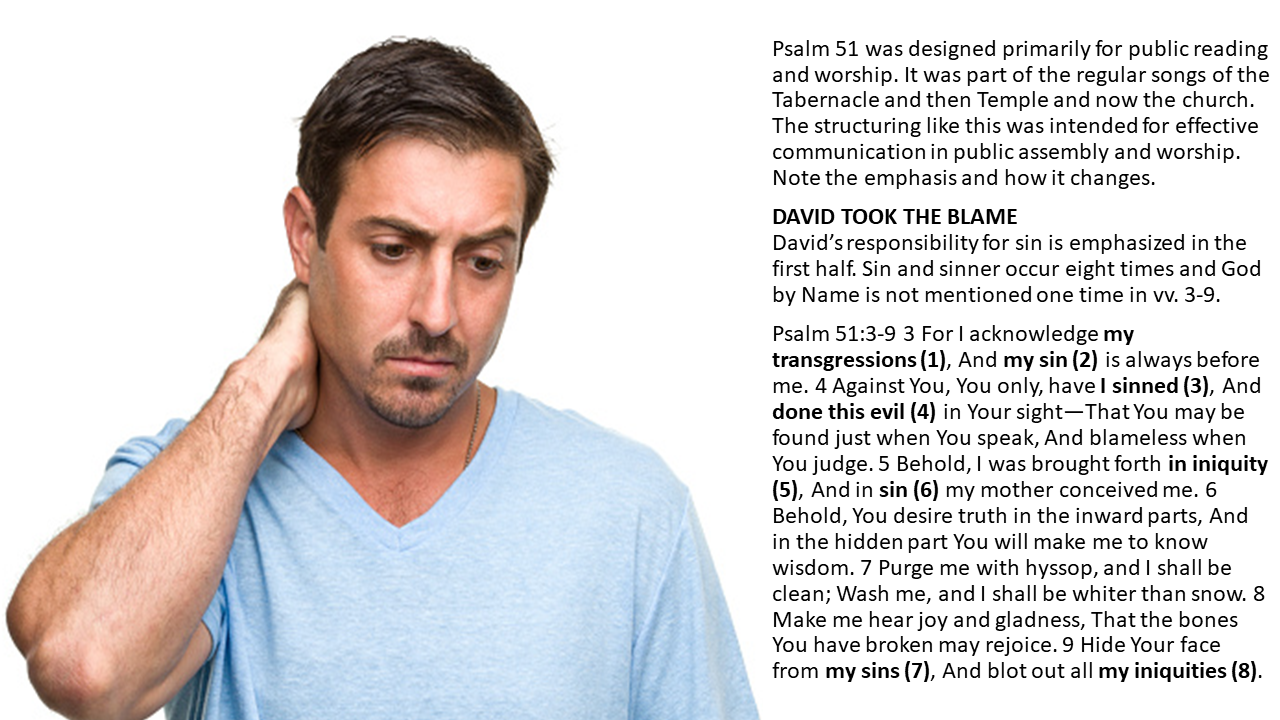
Psalm 51 was designed primarily for public reading and worship. It was part of the regular songs of the Tabernacle and then Temple and now the church. The structuring like this was intended for effective communication in public assembly and worship. Note the emphasis and how it changes.
DAVID TOOK THE BLAME
David’s responsibility for sin is emphasized in the first half. Sin and sinner occur eight times and God by Name is not mentioned one time in vv. 3-9.
Psalm 51:3-9 3 For I acknowledge my transgressions (1), And my sin (2) is always before me. 4 Against You, You only, have I sinned (3), And done this evil (4) in Your sight—That You may be found just when You speak, And blameless when You judge. 5 Behold, I was brought forth in iniquity (5), And in sin (6) my mother conceived me. 6 Behold, You desire truth in the inward parts, And in the hidden part You will make me to know wisdom. 7 Purge me with hyssop, and I shall be clean; Wash me, and I shall be whiter than snow. 8 Make me hear joy and gladness, That the bones You have broken may rejoice. 9 Hide Your face from my sins (7), And blot out all my iniquities (8).
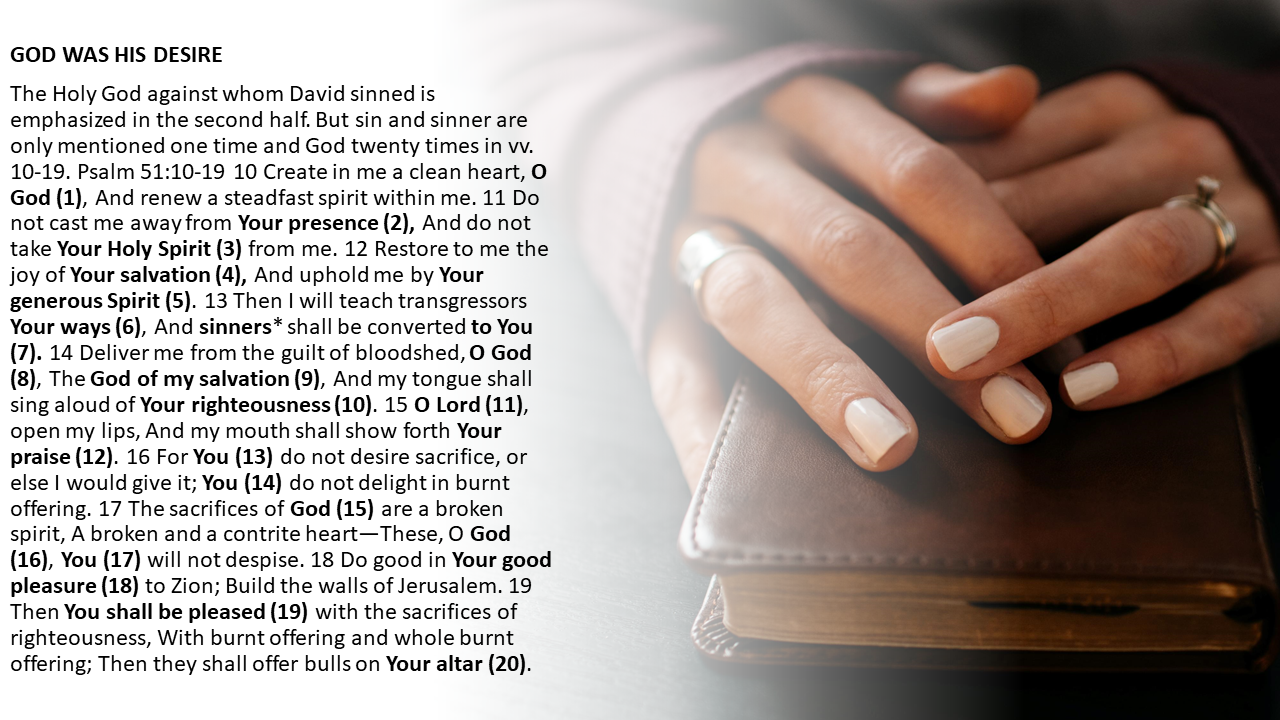
GOD WAS HIS DESIRE
The Holy God against whom David sinned is emphasized in the second half. But sin and sinner are only mentioned one time and God twenty times in vv. 10-19.
Psalm 51:10-19 10 Create in me a clean heart, O God (1), And renew a steadfast spirit within me. 11 Do not cast me away from Your presence (2), And do not take Your Holy Spirit (3) from me. 12 Restore to me the joy of Your salvation (4), And uphold me by Your generous Spirit (5). 13 Then I will teach transgressors Your ways (6), And sinners* shall be converted to You (7). 14
Deliver me from the guilt of bloodshed, O God (8), The God of my salvation (9), And my tongue shall sing aloud of Your righteousness (10). 15 O Lord (11), open my lips, And my mouth shall show forth Your praise (12). 16 For You (13) do not desire sacrifice, or else I would give it; You (14) do not delight in burnt offering. 17 The sacrifices of God (15) are a broken spirit, A broken and a contrite heart—These, O God (16), You (17) will not despise. 18 Do good in Your good pleasure (18) to Zion; Build the walls of Jerusalem. 19 Then You shall be pleased (19) with the sacrifices of righteousness, With burnt offering and whole burnt offering; Then they shall offer bulls on Your altar (20).
How do we get back on the track? How do we come back to God?
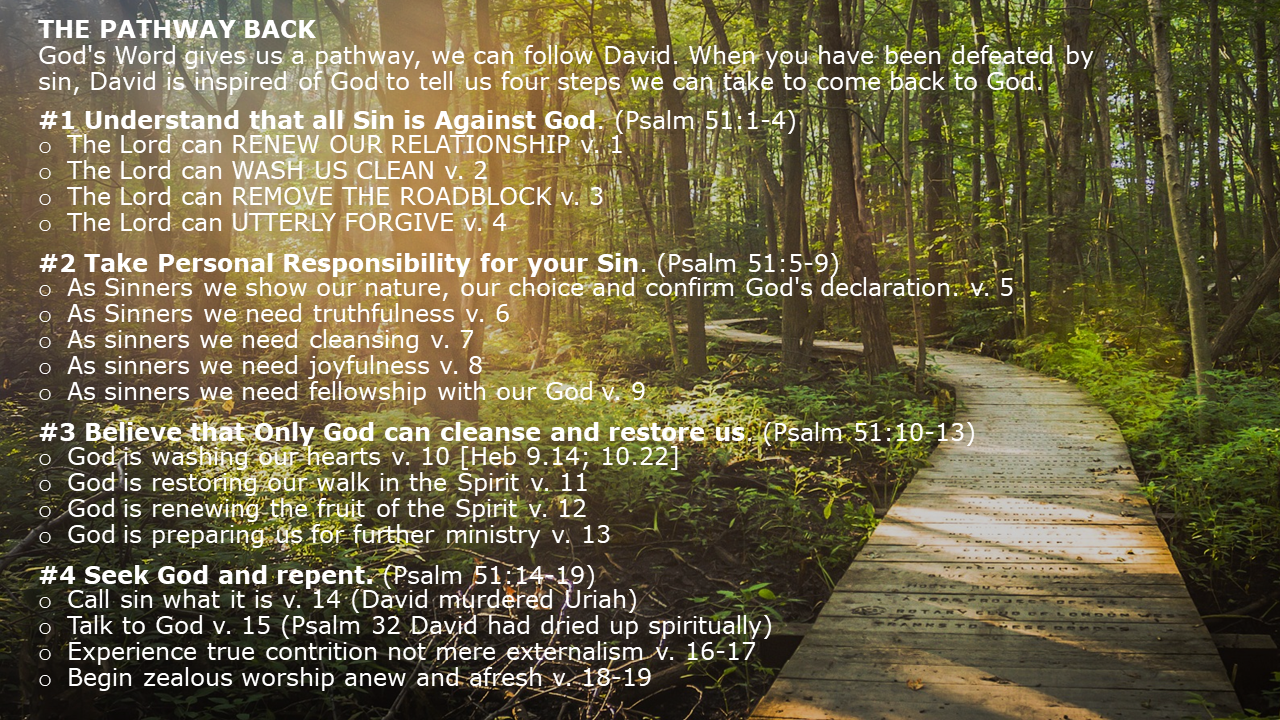
 THE PATHWAY BACK
God’s Word gives us a pathway, we can follow David. When you have been defeated by sin, David is inspired of God to tell us four steps we can take to come back to God.
#1 Understand that all Sin is Against God. (Psalm 51:1-4)
o The Lord can RENEW OUR RELATIONSHIP v. 1
o The Lord can WASH US CLEAN v. 2
o The Lord can REMOVE THE ROADBLOCK v. 3
o The Lord can UTTERLY FORGIVE v. 4
#2 Take Personal Responsibility for your Sin. (Psalm 51:5-9)
o As Sinners we show our nature, our choice and confirm God’s declaration. v. 5
o As Sinners we need truthfulness v. 6
o As sinners we need cleansing v. 7
o As sinners we need joyfulness v. 8
o As sinners we need fellowship with our God v. 9
#3 Believe that Only God can cleanse and restore us. (Psalm 51:10-13)
o God is washing our hearts v. 10 [Heb 9.14; 10.22]
o God is restoring our walk in the Spirit v. 11
o God is renewing the fruit of the Spirit v. 12
o God is preparing us for further ministry v. 13
#4 Seek God and repent. (Psalm 51:14-19)
o Call sin what it is v. 14 (David murdered Uriah)
o Talk to God v. 15 (Psalm 32 David had dried up spiritually)
o Experience true contrition not mere externalism v. 16-17
o Begin zealous worship anew and afresh v. 18-19
Now let’s begin an in depth look at each of these four sections. First we need to–
Understand that all Sin is Against God. (Psalm 51:1-4)
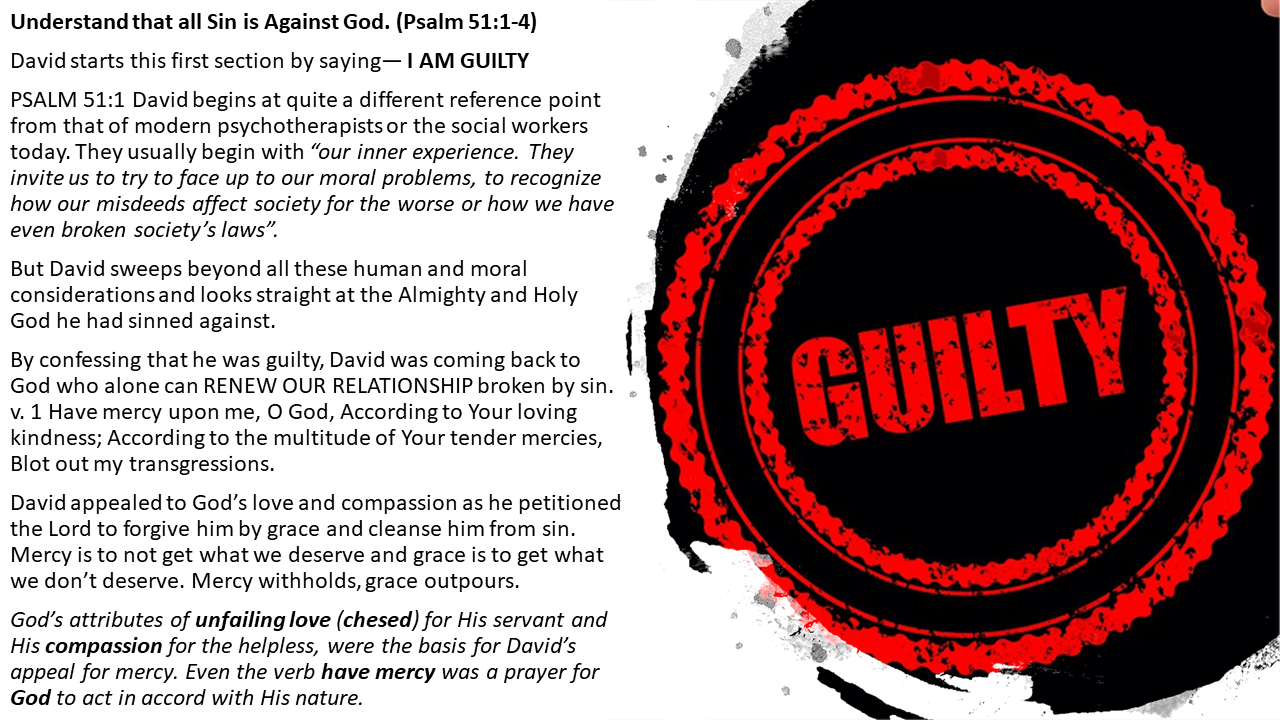
David starts this first section by saying— I AM GUILTY
PSALM 51:1 David begins at quite a different reference point from that of modern psychotherapists or the social workers today. They usually begin with “our inner experience. They invite us to try to face up to our moral problems, to recognize how our misdeeds affect society for the worse or how we have even broken society’s laws”.2
But David sweeps beyond all these human and moral considerations and looks straight at the Almighty and Holy God he had sinned against.
By confessing that he was guilty, David was coming back to God who alone can RENEW OUR RELATIONSHIP broken by sin. v. 1 Have mercy upon me, O God, According to Your loving kindness; According to the multitude of Your tender mercies, Blot out my transgressions.
David appealed to God’s love and compassion as he petitioned the Lord to forgive him by grace and cleanse him from sin. Mercy is to not get what we deserve and grace is to get what we don’t deserve. Mercy withholds, grace outpours.
God’s attributes of unfailing love (chesed) for His servant and His compassion for the helpless, were the basis for David’s appeal for mercy. Even the verb have mercy was a prayer for God to act in accord with His nature. It is also a recognition that David did not deserve forgiveness. God’s forgiveness is by His grace alone. 3
 If you want swift, immediate and relationship restoring help from God, start with that simple guilty plea. If you want to see a David type of response to God in the NT open with me to Luke 18:9-14.
Do you know what God just can’t resist? This type of heart cry to Him. The Greek tenses tell us that the publican couldn’t stop saying this, he was an ongoing longing on his heart.
Luke 18:13 “And the tax collector, standing afar off, would not so much as raise his eyes to heaven, but beat his breast, [kept on present active participle] saying, ‘God, be merciful to me a sinner!’
Like the publican who wouldn’t even lift his face towards God but just said God be merciful to me, we can also come back to God.
A hymn writer once wrote what David must have felt as he responded to God’s heavy hand of chastisement and conviction and repented of his sin and came back to God.
Lord, I’m Coming Home (1898) #341 William Kirkpatrick (1838-1921)
I’ve wandered far away from God, Now I’m coming home; The paths of sin too long I’ve trod, Lord, I’m coming home.
I’ve wasted many precious years, Now I’m coming home; I now repent with bitter tears, Lord, I’m coming home.
I’m tired of sin and straying, Lord, Now I’m coming home; I’ll trust Thy love, believe Thy Word, Lord, I’m coming home.
My soul is sick, my heart is sore, Now I’m coming home; My strength renew, my hope restore, Lord, I’m coming home.
I need His cleansing blood, I know, Now I’m coming home; O wash me whiter than the snow, Lord, I’m coming home.
Refrain
Coming home, coming home, Nevermore to roam, Open wide Thine arms of love, Lord, I’m coming home.
This morning, if you have ever felt far away from God—you can come back to God just like David.
If you have ever sinned deeply and paid a heavy price— you can come back to God just like David.
If you are here this morning in body only, and your heart like David’s had been, is cold, dull, burdened, and distant— you can come back to God just like David.
1Warren W. Wiersbe, Be Holy, (Wheaton, IL: Victor Books) 1994.
2 Knight, George A. F., Daily Study Bible Series: Psalms, Volume 1, (Louisville, KY: Westminster John Knox Press) 2001, c1984.
3 Walvoord, John F., and Zuck, Roy B., The Bible Knowledge Commentary, (Wheaton, Illinois: Scripture Press Publications, Inc.) 1983, 1985.
Slides



Check Out All The Sermons In The Series
You can find all the sermons and short clips from this series, David’s Spiritual Secret here.
Looking To Study The Bible Like Dr. Barnett?
Dr. Barnett has curated an Amazon page with a large collection of resources he uses in his study of God’s Word. You can check it out here.