
Entering God’s Presence
991128PM
TAPE # 2
NR3-17 TAB-02 XAS-36
Transcript
As we look to the year ahead, probably the most wonderful pursuit we could have is to look for the Lord in every corner of this Book. And this evening, I’d like to just show you how fruitful the Old Testament can be. And what we’re going to do is worship the Lord all the way through some of the major parts of the Old Testament. And if you would like to join me in Exodus, we’re going to start in verse [chapter] 37, and I just want to encourage you to write a few things if they’re not yet in your Bible because the tabernacle, which God instructed Moses to construct, was a powerful lesson, and it is for us now.
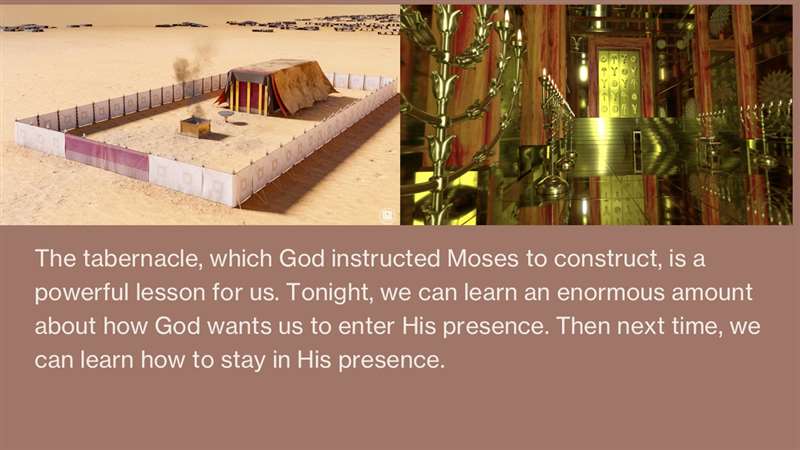
It was a powerful lesson to the people that looked out, and this is just a little sketch of the tent in the wilderness, and we’ll see it from a lot of different artists’ perspectives. But this evening, we can learn an enormous amount about what God wants from us as we enter into His presence, and we can learn about how to enter into God’s presence regularly.
One of the things about this tent that we’re going to look at is that God laid it out in a very special way. If you start on the far right over there, that’s the east side. God set each of the elements in a special place. You had to go by the altar of burnt offering, the brazen altar. Then you had to go by the brass laver. Then, after you went into the actual tent, the priests only, on their left would be the golden candlestick. On their right would be the table of showbread; in the center would be the altar of incense, and in the back would be the ark of the covenant. We’re going to look at each of those elements. Those elements are variously portrayed here as out of the NIV Study Bible, the ark of the covenant with the winged cherubim on the top; next to it on the right, the brazen laver; next to that is what the altar of burn offering looked like; then the golden lampstand, which is the same idea of Revelation 2 and 3. Actually, in 1, John sees Jesus walking among the golden lampstands, so this would’ve been a menorah is what they call them today. Then the table of showbread with the 12 loaves stacked up. Actually, showbread, it’s really the bread of the face. That’s literally what it’s called. And it’s God’s face, and the priest would stand on this side facing it, and it was like God was on the other side, which has been brought into the New Testament when we have the communion table here. We all, myself included, would be on that side, and God would be on this side. That’s the idea of the bread of the face that you come to eat with God. And then finally, on the far right over there, the four-horned altar of incense.
Now, just for you to think about how important this is, God put it at the heart of the camp. You can’t see this very well, but on the north side, in the center there of this cross shape is the tabernacle of meeting. To the north would be Dan, Asher, Naphtali, and the total would be 157,000 different tribal members. To the south, Reuben, Simeon, Gad, and 151,000 on the south. To the left, Ephraim, Manasseh, and Benjamin 108. And then Judah, Issachar, and Zebulun on the right. If you look at that, it shows that the top and bottom are longer than the sides, and if you look here at the cross in front of us up there, that would be much of what it would look like if you took a[n] aerial view of the camp and looked down in the land of Israel, or the camp of Israel, when they were camping. I was trying to figure out how big of an area it was. If the east end of the camp was at Elm or 161st Street East in Broken Arrow, then the west extremity would be at Lewis. Okay, so those of you from Tulsa, you know how wide that is. If the northernmost tent of the tribe of Dan was at the furthest extremity, it would be at Admiral, and the tribe of Gad would be at 91st Street. The entire area of this tent was 80, or of the tenting campground, was 81 square miles. That’s how big the camp of Israel was back then.
And God put the tabernacle at the very heart of the camp. He wanted everyone to pitch their tents toward the tabernacle on the east side, where the entrance gate was. He put the tribe of Judah right in front of the doorway and then Issachar behind them and Zebulun behind them. He wanted everyone to orient themselves toward the tent of the meeting.
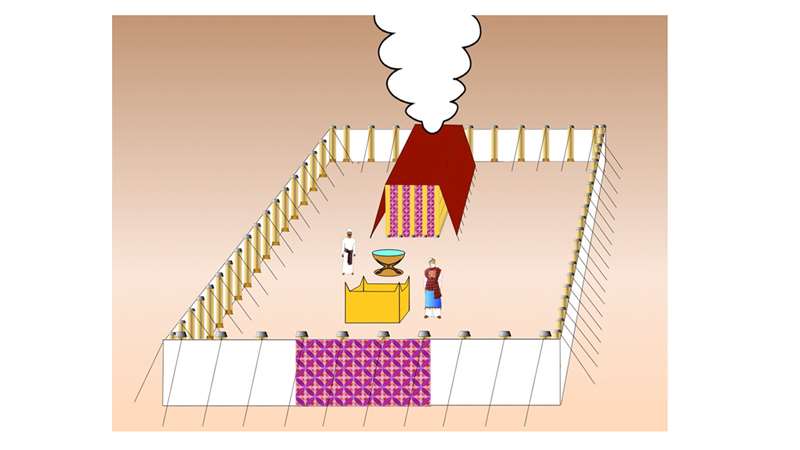
He wanted everything in their life, when they got up in the morning, walked out of their tent, the first thing they would see would be the rising Shekinah cloud coming up from that tent. And the artists have put it a little bit like this. And what you see there is, now that’s not quite the scale, but you see the thing that looks like the oil well spouting out of the roof. That is the representation of the Shekinah glory. You can see the front curtain right there, the dark spot. That’s the entrance way. And by the way, the only way you could get in was to lift it up, and you had to lift it up, and you went underneath it, and it dropped behind you. That’s the only way you got in the tabernacle. So, either you were in or you were out. In America, if you go through a doorway, you can stand with one foot on either side and be half in and half out. There, you lifted it, and you walked in, and it fell behind you. So, either you’re in or you’re out. It’s kind of like salvation. Either you are or you’re not, and a lot of people like to stand in the doorway, check it out, but it’s a picture of Christ. And you can see the brazen altar there with the smoke rising. You can see the laver and then you can see beyond that, the holy place, and that had the two compartments.
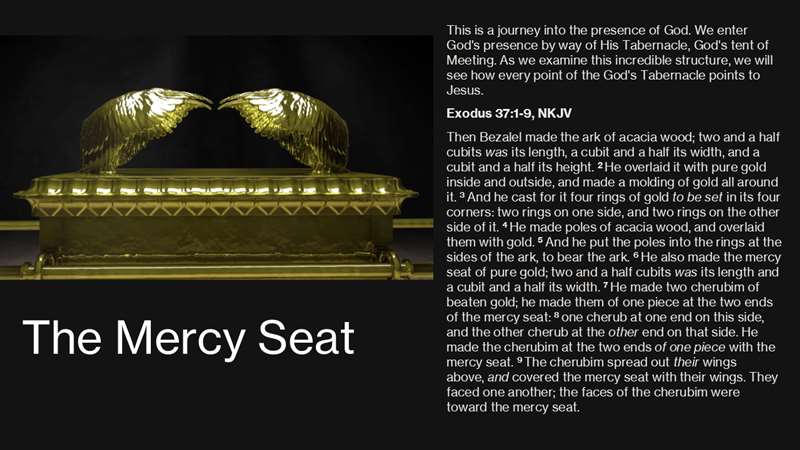
But just briefly, I would like to take you on a journey into the presence of God. In the Old Testament, entering God’s presence was by way of this tent, this sacred meeting tent called the tabernacle, God’s tent of meeting. And as we examine this structure piece by piece, we will see how every point of God’s tabernacle points to Jesus. And that’s why it’s so important as we go through these pieces in chapter 37 of Exodus that you note what each one of them are saying because what God is saying is I want you to get to know Me. If you’ve never marked these in your Bible, I’d like to go over them with you this evening. We’re going to spend more than this week on it, but I’ll give you an overview of the whole time. Starting in Chapter 37, the first five verses are about the ark of the testimony, and what I have written in my Bible is that Jesus keeps His promises to me. That’s what the ark of the testimony is all about. And that ark, we’ll see it a little bit later when we look at it, but that ark had within it the two tablets of the Law, which was a reminder to the people that God’s Word is so important that He actually put a portion of it inside of that because He keeps His Word. He watches over His Word to perform it. Starting in verse 6, it says, He also made the mercy seat. This is Exodus 37 and verse 6. That is a reminder that Jesus intercedes for me. Remember, it says in chapter 7 of Hebrews, He ever lives to make intercessions, and that mercy seat, in the hymns that we sing. Arise, my soul, arise, cast off thy guilty fears. The bleeding sacrifice in thy behalf appears. Forgive them, O forgive, it cries. Forgive them, O forgive, it cries, nor let that ransomed sinner die. What it’s saying is Jesus intercedes for me, and that’s what the mercy seat is all about. We’re going to look at that and that’s verses 6 through 9.
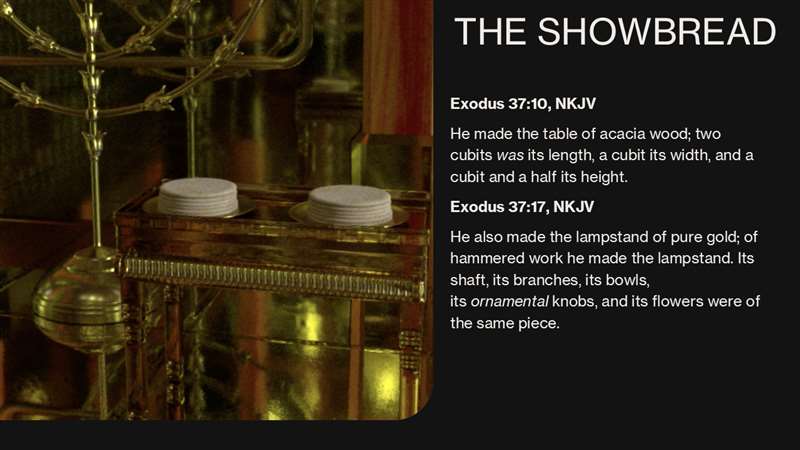
Starting in verse 10, if you’re a Bible writer, you ought to write, Jesus feeds me, by verse 10 because that’s the table of the showbread. That’s the first object on the right when you go into that little tent structure there. In fact, I’ll back up to keep you where I am. That would be the bottom middle there. And in the schematic, you see it on the right on the top, on the north side of the tent there. Table of showbread it’s called. But that’s right there in verse 10, and that’s a lesson that Jesus feeds me. He’s the One that wants to feed us with Himself, and the Lord’s table is a reminder that once we’re born again, He’ll continually nourish and sustain us.
Verse 17 of chapter 37 is the fourth element. You should have in the first five verses Jesus keeps His promises to me, in verses 6 through 9 Jesus intercedes for me, verses 10 down through 16 Jesus feeds me. Starting in verse 17 Jesus leads me. Now, you know the hymn for that. He leadeth me: O blessed thought! O words with heavenly comfort fraught! Whate’er betide [I do, where’er I be], I know that He leadeth me. That’s the blessing: Jesus leads me. That has to do with that bottom of the south side of the tent object you see there, the golden candlesticks. Jesus wants to illumine our path. He wants to, by the way, if you ask Him every time you open this Book, He’ll help you understand it. See, the Author. I loved what my dear old friend Lehman Strauss used to do. When he would come up to Bible conference, he was here, I think just once, and ministered to us. He used to have a curious way of opening his service. He’d say, I want you to know that the greatest Interpreter of the Holy Scriptures is here tonight. People started, right away everyone thinks, oh man, the guy is intoxicated with himself. He says, yes, he says, the greatest Bible Teacher of all time is here at your church tonight. And he’d just play it up and play it up and play it up. And finally, he’d say, yes, the Author of the Book is present tonight, and He wants to open your heart to understand this Book.
That’s what starting in verse 17 is all about. The golden lampstand is the illumination. This tent deal here had no windows inside of it. It was totally black as night inside of there except for the illumination of that golden candlestick. And when the golden candlestick was illumined, you could see, if you’d have been inside, embroidered right into the tapestry of the ceiling were beautiful gold cherubim that were put in there, but you couldn’t ever see them without that golden candlestick lit and illuminating the interior of that tent. And that’s how it is with this Book. You can casually read the Bible all of your life, but if you don’t ever. Psalm 119 verse 18, which is a verse that is a prayer, and the 18th verse in the 119th Psalm says, open my eyes that I may behold wonderful things out of Your Book. When you pray that, it’s almost like the golden candlestick comes on, and you can start seeing the outlines of the cherubim and everything else, the wonders of God’s Word. So, in your Bibles, if you’re a Bible marker, Jesus leads me. He wants to lead us into His Word, and His Word, as I mentioned this morning, is the revealed will of God. And so, if He leads you into His Word, then you know what you’re supposed to do. The Bible says that the righteous are as bold as a lion. They walk around confidently knowing where they’re going, and what they’re doing, and what life is about, and why they’re here, and what God expects from them. And they don’t have to go to the Christian bookstore and wait for the newest book to come out for them to read it so they can be sure they’re doing the right thing. They can be absolutely confident right now. The 119th Psalm says that through Thy law, I have more understanding than all my teachers. If you just know the Bible, you know more than all the teachers know, and that’s what Jesus wants to lead us into that kind of lifestyle of confidence. That’s through verse 24.
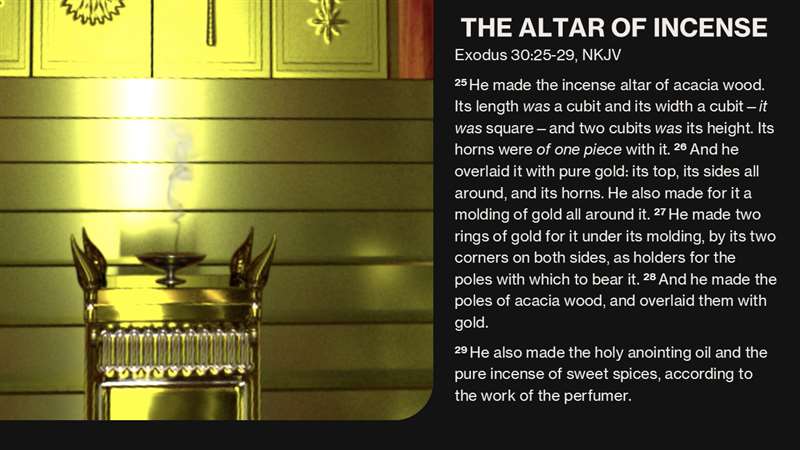
Then right up at the top there before the holy place, you see the little arrow that says altar of incense. And the altar of incense is reminding us that Jesus listens to me. That has to do with our prayers, and that altar of incense showed the incense cloud of smoke was ever arising in front of the holy of holies. And what Jesus wanted was for the intercessory prayers of the saints to ever be rising, and Jesus listens to us. In fact, He listens so much, He keeps all of our prayers. I don’t know about you, but when my mom started cleaning out a few years ago, she started bringing these boxes of things; she kept everything. She had all my, first she gave me the kindergarten papers, and the first-grade papers, and the second-grade papers. And then she gave me all the locks of hair, and now I understand why I don’t have any left. She was always cutting off locks of hair! Terrible stuff. But she gave me all that stuff, and I thought, if a mother collects that stuff that’s worthless, what, how much more God, who wants the fragrance of our prayers to rise up! And He grabs them, and He puts them into bowls, and He keeps them, and He has all of our prayers. And all that altar of incense is from verse 25 down through verse 29, and that reminds us, and I have written in my Bible, Jesus listens to me.
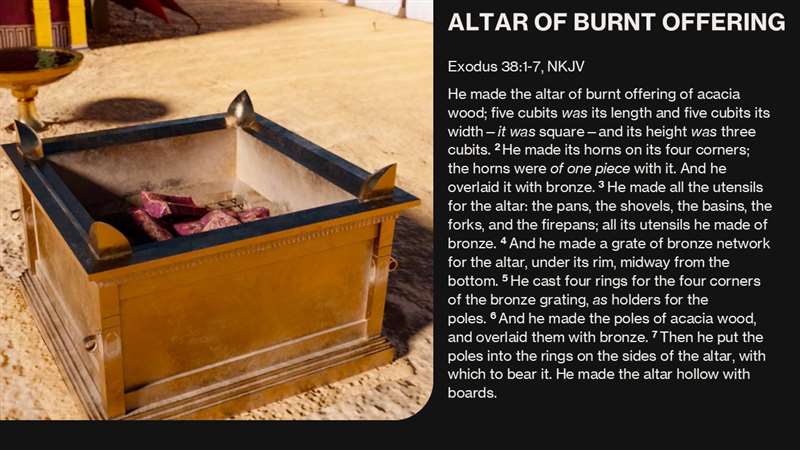
Then if you look down starting in verse 1 of chapter 38, he made the altar of burnt offering. That’s moving back out, the brazen altar that’s in the far east side of that tic-tac-toe board there on your overhead that you can see there. And that reminds us, Jesus paid for me. There’s another hymn. Jesus paid it all. All to Him I owe. Sin had left a crimson stain. He washed it white as snow. Lots of hymns talk about that He bought me. He loved me so much, He bought me. And because all to Jesus, I surrender. All to Him I freely give. Because He’s bought me, I give myself back to Him. And the altar of burnt offering, which is verses 1 down through 7, reminds me that Jesus paid for me, and that’s a wonderful thought. In fact, Revelation 1:5 says, unto Him that loved us and loosed us from our sins. When He paid the payment, He loosed us from our sins.
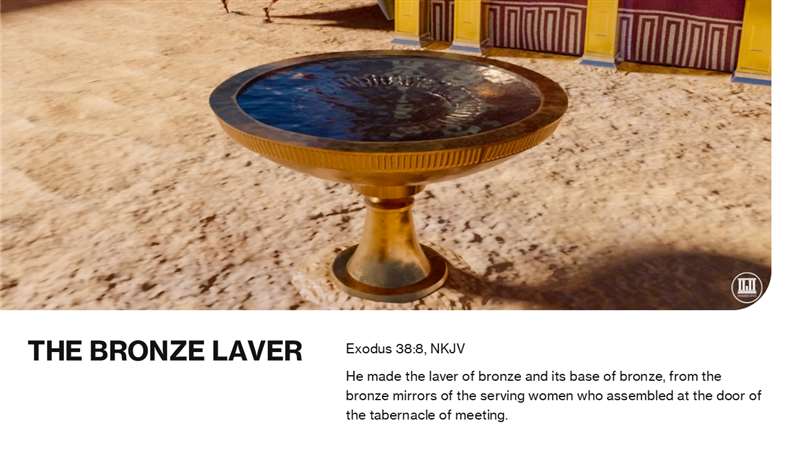
Then in verse 8, it’s interesting, only one verse is that little round thing right there. The little, it looks like a washer. It’s the brazen laver. It’s a little like a round bird bath kind of thing that they would wash themselves with ceremonially on their way into the holy place. And then starting in verse 9. And by the way, that speaks of Jesus washing me, and we’ll look at that also. And then verse 9, it’s talking about the whole court of the tabernacle and all the details about that. And as I mentioned to you in the picture, and let’s get down to the picture, every part of the tabernacle spoke of Christ. The gateway, which was actually a curtain, you had to go through the curtain. So, the only way to salvation is through Christ. Each of the boards that held up the outside curtain there were fit into sockets of solid silver, and those sockets of solid silver were built from the redemption money that everyone had to pay because God owned the firstborn. And so, if you didn’t want to be killed, your firstborn child killed by the Lord, you gave a ransom money to buy them back. And then all that redemption money was used in the building of those sockets. And so that’s the idea that the entrance into God’s presence is totally grounded upon the foundation of the redemption of Jesus Christ in whom we have redemption through His blood unto Him that loved us. He redeemed us from our sins, so that’s what all those little pillars were for that go all the way around there. Also, this whole courtyard was accessible only by one door, and that’s what this whole section is all about.
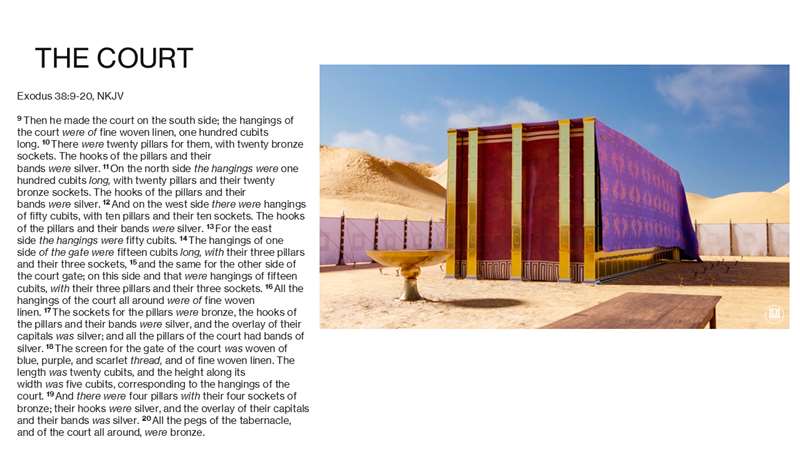
Starting in verse 9, the court of the tabernacle. There were not many ways to God, and there still aren’t. There’s just one way, and it’s through the door. And Jesus said, I am the what? Door. Remember that? He says, and I’m the Way too, but He said, I’m the Door of the sheep fold. He’s also the door of the tabernacle, and that’s the way into His presence. And so, what I have written in my Bible by verse 9 is Jesus opens for me the way to God. And so, if you’ve marked your Bible, 37:1-5, Jesus keeps His promises to me; 37:6-9, Jesus intercedes for me; 37 :10 down through 15, Jesus feeds me; 37:17-24, Jesus leads me (O precious thought); verse 25 down to the end of the chapter, Jesus listens to me. And a lot of people in this world feel no one else listens to them, and Jesus said, I’ll listen to you. Just open your heart and pray to Me. Verse 1 of chapter 38 down through 7, Jesus paid for me. And if that does not give you great sense of the wonder of redemption, nothing can. Verse 8, Jesus washes me, and He can wash away every sin. And finally, verse 9 on, Jesus opens for me the way to God.
You might be asking a question. If we’re going back into this, what possible importance could this old dusty animal skin tent in the middle of these wandering, migrating people who went across the desert 3,500 years ago, what possible effect could that have in my life today? A lot. And if we listen to God’s Word tonight, we’ll see that. Because if we were to go inside of this tent this evening, we’d find ourselves surrounded by shining gold. Looking up, as I said on that curtained roof, we would see the wings of the cherubim woven into the tapestry of the ceiling of blue, and purple, and scarlet, and fine twined linen, every color of the tabernacle speaking of Christ, of His high priestly, kingly, and redemptive offices for us. The light of the golden candlestick would softly shine, revealing all the beauty within, and that’s how it is with Jesus Christ Himself. To someone looking at that tent from the outside, they would just see black animal skins, and they’d say, huh, nothing big there, just an old smoky tent. Can you imagine, with all the smoke of the incense always in there, it was kind of like an old New England smoking barn. I remember we used to cure our hams and do our bacon in a smokehouse in New England that had been operating since 1640. There was smoke as thick as mud on the walls. That must have been, that was only 300 and some years, and the tabernacle existed longer than that. You can imagine the caked-up smoke inside that place. But to the natural man looking at Jesus Christ, they see no beauty, as Isaiah 53 says, that they should desire Him. But to those that know Jesus Christ, His beauty is like being inside that tent with the candlestick on. It’s nothing but gold and fine tapestry, and those that are in Christ, they find His beauty satisfies their soul and is everything they want.
If we were standing outside, if we were to draw a straight line from the tabernacle’s gate, right there where those people are walking up, and went straight through, you would have to go through that brazen altar, through the laver, you would cut right through the incense altar to get to the holy of holies, and that is a picture of salvation. You go through the altar, through the laver, through the door, you pass the table of showbread on your right, the golden lampstand on your left, through the altar of incense, through the veil, to the ark, covered by the mercy seat in the holy of holies. This is the true Pilgrim’s Progress from the camp outside, out there where those people are standing, through the doorway, through the sacrifice of Christ, through His cleansing, and into fellowship with Him. Truly, the Lord put in the center of the camp of Israel a picture of Christ. The Old Testament worship centered on the tabernacle, and then later on the temple. It was a divinely designed liturgy. It was carried on for 1500 nearly unbroken years, just as Moses had told them to do it, and they did the worship of God, and they followed this prescribed plan.
And of course, the epicenter of that worship was the holy place. In the front half of it stood the altar of incense, and I’ll back up to remind you of that as you look at it. In that holy place, in that altar of incense, and also the golden lampstand, the table of showbread. And there was a curtain that divided the room right between the outer part, which is called—the right-hand half of that inner box—it’s called the holy place. The left-hand half, to the west there, is the holy of holies. Between that, there was a small curtain in the tabernacle. By the time of Christ, that curtain had grown to be four to six inches thick, and it towered 60 feet high and spread 40 feet wide, so it was like a solid wall. And that massive finely woven curtain was a rug four inches, or Josephus says, the width of a hand’s width thick, six stories high, four stories wide, massive towering and declaring to everyone that you couldn’t come into God’s presence. That’s why that curtain was there, and the curtain was to say one thing: stay out. Get out. You can’t go through here.
And only once a year could the high priest go in there. Even the light of the everlasting, or the continuously burning golden candlestick did not get in there. The holy of holies was absolutely without any natural light. Nothing was in there, but in the time of Moses, it glowed with a supernatural glow of the Shekinah glory of God. And it was probably the brightest spot on the planet during the good days of their following, Israel, because God’s holy presence hovered over the mercy seat. And so, when that high priest went in there once a year with a swirl of the smoke of incense, as he had a little pot in one hand, in his other hand he had the bowl of blood. When he walked in and that curtain was lifted and he went in there, he went into a dazzlingly bright inner room that embodied the very presence of God. And of course, he sprinkled the blood on the mercy seat. The Shekinah glory of God’s presence made the holy of holies behind that veil brighter than noonday. And all of Israel’s history, probably no more than 50 ever got to go into that inner sanctum, both of the tabernacle and later of the temple. Fifty men in 1500 years, max, ever went into that place. It was a very hallowed spot. In fact, most of the people you know about in the Bible never went in. David never went in. Daniel never went in. Jeremiah never went in. Only the high priest went in, and then he only went in once a year. There were about 1500 trips into that place by 50 different men, about over 1500 years.
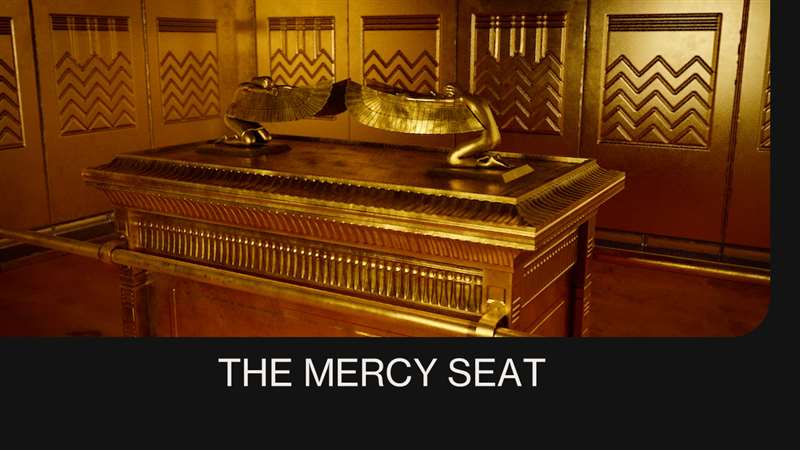
Inside that room was a box covered with gold. It contained the stone tablets of the Law. It had a pot of manna. It had Aaron’s rod that had budded. Above the ark of the covenant stood two golden cherubim, their wings shielding the mercy seat, their faces gazing downward, always focusing on the blood. It’s an interesting thought. Those cherubim looked down, those, holding out their wings they’d look down at the spot where the blood was poured, and that blood would stay there until it evaporated, and it was just caked up on that mercy seat. And they were always looking at the blood. And the purpose of it was that blood shielded the Law of God, which was the tablets of the Law underneath it, from God holding the Law against the sins of the people. And it’s a picture of what happens with us. God says, when I see the blood, I’ll pass over you, and God says, if you’ll sprinkle that blood annually, I will not pour out My wrath on the children of Israel. It was such a beautiful picture.
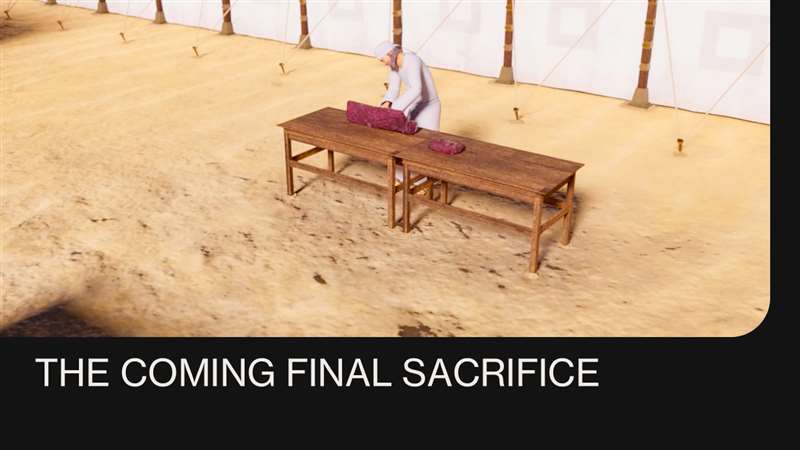
When the high priest, on the day of the sacrifice that Christ died on the cross, when the high priest went in to offer the renewal of the incense because they had to keep at that altar of incense, they had to keep refilling it. On the day that Christ died, that curtain was shut, and that incense altar needed to be refilled. And at the right moment when the lamb was being slain outside on that brazen altar, the tic-tac-toe board thing, at the very same time, they had to change the altar of incense because it was the third hour. And in the third hour of the afternoon, they had to be in there changing the incense while they were slaying the Passover lamb out there. And at the instant that they blew the shofar horn to slay the lamb, to put it on the brazen altar is the exact instant that Jesus Christ cried from the cross, it is finished. And when He cried that from the cross, remember He reached across, and He tore open that veil that was between the holy place and the holy of holies. So, there was a man fiddling around cleaning the ashes off this giant incense altar, and as he was fiddling around cleaning it all off, the fire was burning, he was dumping more stuff on doing his job. And he heard [Trumpet Sound] outside, which was the shofar blowing, and then that curtain ripped open. Now, I want you to think about that because on the day Christ died, if you can imagine the scene of those officiating priests as they trimmed the lamps, as they poured more incense over the fire in the altar, as they changed the bread on the table of the showbread, at the very moment, Christ touched that veil. And with an unearthly sound, that massive curtain was violently torn from top to bottom. And aghast, as for the first time in over 1500 years, common people looked at the ark, at the mercy seat, and at the throne of grace. And what God was saying was another message from the temple and the tabernacle. Formerly, He said, stay out. At the cross of Christ, when Jesus finished the payment, He tore open the barrier and He said, come on in. You’re welcome. As Hebrews 4:16 says, let us come boldly unto the throne of grace, that we may obtain mercy and find grace to help in time of need. What a blessing it is to live on this side of Calvary.
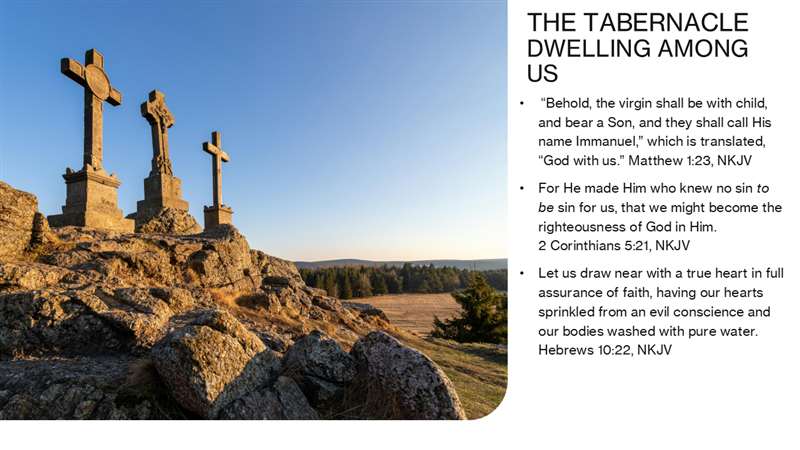
Let’s take a few moments to worship the Lord, and I want to just remind you of each of these, and we’re going to read a verse. The gateway to the tabernacle, going in through that gate means God wants us to be living in His presence, and that is a verse that I’d like you to read with me. We’re going to read about eight or nine verses in unison tonight as we worship the Lord. The gate of the tabernacle reminds us that God opened a door for us to come in. Immanuel is God with us. And so, that gate of the tabernacle was a doorway that God made. He did not make the tabernacle with no entrance. He made an entrance, and He says, I want you to enter. And then He put the tabernacle right in the very center of the camp and He says, I want to have you living in My presence, and I want you to live in My presence, and I want you to come into My presence. And that’s because one of the great promises of the Bible in the Old Testament and repeated all the way through the New Testament is God, we don’t understand why, but God wants to be with us, and God, even more than wanting to be with us, wants us to be with Him forever.
Let’s read this verse to the Lord and let the Word of God bless your heart. Matthew 1:23, behold, a virgin shall be with child, and shall bring forth a son, and they shall call His name Immanuel, which being interpreted is God with us. So, the gateway reminds us that God wants us to live in His presence. And remember the gateway right here on the east side by that altar of burnt offering is a reminder God wants us to come into His presence. Let me just show you some pictures. There’s the altar of incense. There’s what the brazen altar may have looked like. By the way, the Jews have carefully rebuilt models of these, and at the Temple Institute in Jerusalem, you can see all of these objects that they have made. This is the laver as they think it looks, and that’s what the, on the right, they think the ark of the covenant looks like, and those angels are the cherubim over the mercy seat. And that kind of glow there is their representation of the Shekinah.
The brazen altar is the next object you would’ve seen if you’d have been coming into the tabernacle, and the brazen altar is a reminder to us that God says, I want to make you righteous. God wants to make me righteous in His sight. God wants me to be righteous. You say, where does it say that in the Bible? Here’s another verse that we can read as we worship the Lord tonight, and let’s read it together in unison. Second Corinthians 5:21, for He has made Him to be sin for us who knew no sin, that we might be made the righteousness of God in Him. So, what is it that the brazen altar wants to remind us of? God wants to make me righteous. He wants so badly to make me righteous that this verse says that He made Christ, who was sinless, who never sinned, who never knew sin, who never experienced the rebellion and the independence from God that sin is, as we saw this morning, He made Christ to become sin. Jesus didn’t commit sins. He became sin. He bore our sins to Calvary. He didn’t do it; He just bore it. It was imputed, is the word, and that process is that we might be made the righteousness of God in Him.
Now, I’ve told you this many times, but I’ll remind you again. Our redemption, our salvation, our justification has two parts. One is Jesus was the perfect substitute. He took all of our sins on Himself. That’s the negative side. The positive side is He also credited His perfect life to our account. You have to have both. We were devoid of any righteousness, and we were loaded with sin as we see from the Scriptures. We were of our father, the devil, and so to take care of our sins, Jesus took all of them away. To take care of our righteousness, Jesus laid upon Himself, His life, He laid it onto us and applied His righteousness to us just as all of our sins were dumped on Him. And that brazen altar is a reminder of the fact that God wants to make me righteous as 2 Corinthians 5:21 says. This laver is another reminder of what God wants to do, and the laver tells us God wants to make me clean. And the devil wants us to feel unclean, and the devil wants us to feel hopelessly unforgivable. And God says, no, I want to make you clean. And there’s a great verse about that, that we can read together from the book of Hebrews. And by the way, the book of Hebrews is the application of the tabernacle and the temple. And the book of Hebrews, and by the way, also the book of Revelation strongly use the tabernacle and temple visual image as pictures of what God has done for us, and let’s read this verse together. Hebrews 10:22, let us draw near with a true heart in full assurance of faith, having our hearts sprinkled from an evil conscience and our bodies washed with pure water. That’s what the laver reminds us of, that God wants to make me clean.
Next, we had the menorah, the golden lampstand. It’s a picture of spiritual illumination. The menorah also, or the lampstand, has a lesson for us. God wants to lead me. He doesn’t want me going through life wondering what I’m supposed to do, where I’m supposed to be, how I’m supposed to act. He wants to lead me. He wants me to know His way. He wants me to know His mind. It’s interesting the Scriptures say, but we have the mind of Christ. What an interesting thought. We have the very thoughts of God. We have the very revelation. We have God telling us exactly what it is He wants from us. Have you ever worked for someone, and you always wondered if you were doing what they expected? You ever always hoped that you could please them and yet you just felt like you were in the fog and watching fireworks in the fog. You don’t see it. What? What’s going on? God says, you aren’t in a fog; I have revealed. There’s nothing that God doesn’t want us to do that He has not revealed here, and there’s nothing He does want us to do that He has not revealed here. And what religion has done over the years is built a whole structure around this Book that doesn’t have anything to do with this Book. This is the revelation of God’s will, and whatever this Book implies or directly states is sin, and whatever this book commands is what righteous obedience is all about, and there isn’t anything else. There’s no appendices that are going to be added. There aren’t supplemental volumes. There isn’t the Key of Knowledge, or the Book of Mormon, or the Corpus Magisterium, as the Roman Catholics have. This is it, and you have it, and Christians throughout the centuries never got to have one of these. There are many Christians that paid with their lives just to have a part of the Bible, and you’ve got it all. In fact, if you’re like our house, you have many. We have stacks of Bibles in our house, and yet familiarity sometimes breeds not a contempt, but a neglect.
And God says, I want to lead you. I want to lead you. I want to illumine you, and a verse about that is the fact that God wants us to spiritually understand the Bible, and let’s quote this 1 Corinthians 2:14 verse together. First Corinthians 2:14, but the natural man receiveth not the things of the Spirit of God: for they are foolishness unto him: neither can he know them, because they are spiritually discerned. Now, what’s he talking about there? He’s talking about the Word of God. And to an unsaved person, this Book is foolish. They don’t understand it. They say, eh, it’s dry, it’s boring. And whenever we’re operating like unsaved people, like natural, we’re operating in the flesh, this Book doesn’t make any sense. You can do a little test. You know how you can do these little tests at home to see if you have your blood sugars wrong, or you can do all these tests nowadays, a little secret AIDS test and all these things, pregnancy tests? Did you know you can do a spiritual test? Open this thing up, and if it just grips you, and if you just can’t put it down, and if you’re finding yourself, you just keep reading far beyond the little check mark in your box that you were planning to do, then you’re healthy. If you open it up and it is pure labor, and it’s an uphill drag to get out, then you’re unhealthy. You’re in the flesh because to the person operating in the flesh, this thing is foolish, and they’d rather have video extravaganza, but to those who are spiritually discerned, this is more important than food. That’s the test, and you can check yourself. You don’t even have to poke yourself and get any blood. You can just open the Bible and see what happens. Because that’s what God says, I want to illumine you.
The table of the showbread, or the table of bread, has to do with fellowship. That speaks to the fact that God wants to feed me. It’s not a sterile thing. This fellowship is Him feeding us. He wants to nurture us. He wants to open us with the sweetness of His presence, and here’s a verse that we can read together. It’s the last verse of the 81st Psalm, and you can read the rest of the 81st Psalm. The LORD, it’s a pathetic Psalm. He’s saying, this is everything I wanted to do for you, but you wouldn’t let Me. But, in a positive sense, we can agree with this. Let’s read this verse together. Psalm 81:16, He should have fed them also with the finest of the wheat: and with honey out of the rock should I have satisfied thee. Again, that’s speaking of God. He wanted to give them the bread of life and the sweetness out of the rock, Christ Jesus, both of which are being served up constantly in this Book. And the children of Israel were not interested, not interested at all. And how the Lord wants to satisfy us, and we’re looking in all the wrong places. We’re looking everywhere except to where He wants to feed and satisfy us.
Real quickly, the altar of incense, it looks something like that with the four horns and the little carrying poles. The lesson the altar of incense and our prayers is God wants to hear me. We have many voices in our home, and we have a rule. Only one talks at a time because they’re so important, and we don’t want to miss anything. And you know what? Sometimes though, there’s so many at one time, and they’re all talking that after a while you kind of don’t hear them. And so, there’s this little, tiny voice you’ll hear it say, are you listening to me, Daddy? I go, no, I’m sorry. Say it again. What? What was that? You know what? You never get that from God. You don’t have to go, are you listening to me? Huh, are you listening? No, He’s saying, I want to listen to you. God wants to hear me; He wants to hear everything. And the Scriptures that talk about that is that’s how we worship Him. As we pray, as we speak, as we commune with Him, and there’s a great verse about that. Our Lord Jesus Christ declared, and let’s read that together. John 4:[23-]24, but the hour cometh, and now is, when the true worshipers shall worship the Father in spirit and in truth: for the Father seeketh such to worship Him. God is a Spirit: and they that worship Him must worship Him in spirit and in truth. And you know what? The truth is that we have access open to Him right now, and in spirit is that we are in touch with Him all the time. All the time. I mean, you can just wing one up at all times. You can just fax Him; you can email Him. You can just offer constant rising up from your spirit worship to Him. Worship and prayer all just connect together. Worship is offering to God, and the vehicle, the line it goes through, is prayer. And so, we are just prayerfully offering ourselves, prayerfully offering our words, prayerfully offering the adoration of our heart. And God says that we are the true worshipers of Him, and He wants that from us. And that’s what that altar of incense speaks of, that God wants to hear me.
Couple more. The ark of the covenant speaks of our eternal redemption. And that’s the whole thing is called the ark of the covenant, but basically the bottom part below those two angels is the box part. That is the actual ark, and the ark speaks that God wants to be trusted. He wants me to trust Him. And here’s a verse that talks about that, that God says, I want you to trust Me. I want you to know that I keep My Word and that keeping My Word is called that we are to believe Him and have faith in Him that He’s going to keep His Word. You remember He promised to Abraham that He would make His descendants as numerous as the sand of the seashore, and it says, Abraham believed God. God wants to be trusted, and as soon as we trust Him, it causes Him to respond. And so, a great verse about that is Hebrews 11:6, and let’s read that together. Hebrews 11:6, but without faith it is impossible to please Him: for he that cometh to God must believe that He is, and that He is a Rewarder of them that diligently seek Him. And God wants to be trusted, and God loves it when we trust Him.
The mercy seat, that’s the part above the box where the glow is. And right beneath those cherubim who were looking down was the mercy seat, was the little indentation where the blood was poured, and they were ever looking down at that blood. And that mercy seat also speaks to us, and it tells us that God wants me to be assured. He wants me to be very much aware of the fact that my sins are gone. And there’s another verse about that, and this is our last verse for this evening, and let’s read that together as we worship the Lord. Hebrews 7:24 and 25, but this Man, because He continueth ever, hath an unchangeable priesthood. Wherefore He is able also to save them to the uttermost that come unto God by Him, seeing He ever liveth to make intercession for them. And the whole scene in Heaven is that Satan is accusing us. In fact, that’s what Satan means: he’s our adversary, the devil, the accuser. He is the one who’s pointing out everything we do wrong, kind of like an older or younger brother or sister. Oh, did you see what they did? Did you see what they did? And Satan’s going around pointing out all of our evil, and Jesus ever liveth to make intercession for us. He said, Satan points out our sin; He says, I paid for that. Satan points out another one; He says, I paid for that one too. Satan points out another one; He says, I paid for that one too. And so, Jesus just neutralizes every one of those. Now, the time’s coming when He’s throwing him out of Heaven, and he’s not going to get to do that, chapter 12 of Revelation. But right now, Jesus is able to save us to the uttermost. That means there is no sin that He will not forgive us of. Now if we persist in sin, He will chasten us, make us sick, weak, and even take us home—kill us—but there is no sin that is unforgivable.
You say, oh, what about the unpardonable sin? In the context of the Bible, the unpardonable sin, there are two, two types. One is denying the deity of Christ while He was living and walking on Earth, Jesus said, that will never be forgiven you. They said, what You’re doing is not through the Holy Spirit; it’s through the devil. And the other unpardonable sin would be rejecting Jesus Christ because you’re eternally in Hell if you reject Him. But there is no other sin. And I meet people that have had abortions, and they say, the Lord will never forgive me for that. The Lord says, if you hate your brother, you’re a murderer. An abortionist is a murderer, so it’s forgivable. Many other sins like that.
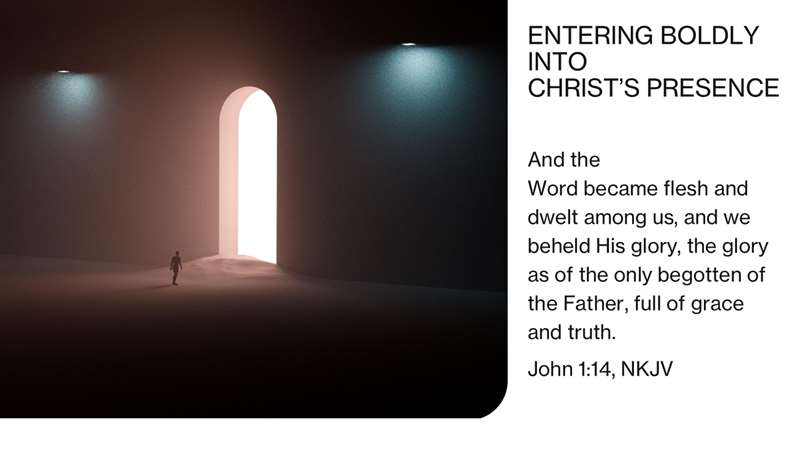
How can we enter boldly into Christ’s presence? And I just want to conclude with John chapter 1. So, in your mind, you can get this, this week. Look at John 1 and verse 14. It says, and the Word became flesh and, verse 14 of the Gospel by John says, and dwelt among us. That word is literally skenoo. It’s the word tabernacled, and Jesus tabernacled among us. That means He wants us to live in His presence. As the brazen altar tells us, He wants us approaching His holiness. As the laver of brass says, He wants us to be cleansing our sin. The golden lampstand, He wants us walking in His light so He can lead us. The table of showbread, He wants to nourish us, He wants to feed us. The altar of incense, He wants us praying because He wants to hear us. And the ark of the covenant, He wants us trusting His promises. And the mercy seat, He wants us to be resting assured in Him. And so, as John 1:14 says, and the Word became flesh, and dwelt in a tent among us, (and we beheld His glory, the glory as of the only begotten of the Father,) full of grace and truth.
My heart’s desire is that if the Lord gives you the year 2000, that it’ll be a year that you see the grace, and the truth, and the mercy, and the beauty of the Lord Jesus Christ in every corner of this book. I hope you’ll make as many plans about getting through this Book as you make about your vacation, your financial endeavors, your educational endeavors, your career choices, everything else, when you’re going to plant your flowers, and when you’re going to do this and that to your house. I hope you plan into your schedule this Book and let Jesus dwell richly in you by letting His Word richly dwell on you.
Let’s bow together and thank Him for this evening of worshiping and seeking Him that we’ve had. Father in Heaven, I am just, am blessed. I’m blessed for the receptivity of Your dear saints here, and we’re all blessed even more that You want us to be in Your presence, and You want us to enjoy Your presence forever, and You give us a taste of it here and now. And I pray that we would be increasingly making those little choices today, and tomorrow, and the next day to spend much time with You alone. The hymn writer put it, take time to be holy, speak oft with thy Lord; spend much time in secret with Jesus alone. Then looking to Jesus, like him thou shalt be; thy friends—thy wife, thy husband, thy children, coworkers, schoolmates, neighbors—His likeness will see. I pray that will be true in our lives. In the name of Jesus, we ask this, amen. And God bless you as you go.
Entering God’s Presence
Tab THE TABERNACLE “ENTERING GOD’S PRESENCE”
The tabernacle, which God instructed Moses to construct, is a powerful lesson for us. Tonight we can learn an enormous amount about how God wants us to enter His presence. Then next time, we can learn how to stay in His presence. So ENTERING THE PRESENCE OF GOD
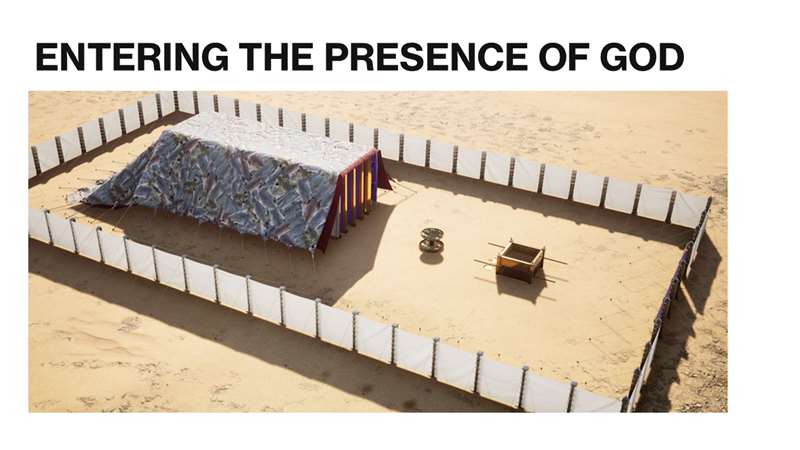
This is a journey into the presence of God. We enter God’s presence by way of His Tabernacle, God’s tent of Meeting. As we examine this incredible structure, we will see how every point of the God’s Tabernacle points to Jesus.
Of what possible importance could an old, dusty animal skin tent in the midst of a Nomadic, wandering migration of people camping across the Sinai’s trackless desert have in this ultra modern 21st century life in which we live? Can a tent constructed 35 dim centuries ago give any light to the dark, sin-stained path we often must tread? Join me as we look at the tent and its meaning and find strength in Christ for our lives today. Stretching in Tulsa terms from 161st Street East (Elm) to Lewis Avenue west (9miles) and from Admiral on the north to 91st Street on the south the camp of Israel was at least 81 square miles just for 600,000 fighting men and their families! The Exodus march at 5 people wide would have stretched 225 miles long. If they traveled 50 wide they would have been 22.5 miles. For a missions note, our world of 6 billion would be @ 100 wide 45,000 miles long!
If we were to top a hill in the Wilderness of the Sinai peninsula 3,400 years ago we would first see one of the largest encampments of people ever on the planet. There were 600,000 families who came out of Egypt. With 5 per family that is 3 million folks. With just a normal campsite it would take 81 square miles of territory for this many people. That would equal from Lewis on the West to Elm on the East, from 31st on the North to 121st on the South. So on a lookout spot we would see a huge encampment.
Then we would see it, the Tabernacle. In the center of the Camp, with smoke slowly rising from the altar and with the 12 Tribes in an ordered arrangement around it around. Looking intently we would note a long, black, unattractive tent of porpoise skins. But when we traveled through the loud, smelling and busy camp and made it to the Tabernacle we would find a much different sight.
When we came inside, we would find ourselves surrounded by shining gold:
looking up to the curtained roof, we see the wings of the cherubim woven in; blue and purple and scarlet and fine twined linen.
The light of the golden candlestick would softly shine and reveal all the beauty within.
So it is with Christ Himself. The natural man, beholding Him, sees no beauty that he should desire Him. But to those who know the Lord Jesus Christ, His beauty satisfieth their souls.
Going back outside, if we were to draw a straight line from the center of the Tabernacle’s Gate of Entrance to the Mercy Seat in the center of the Holy of Holies, we would see a picture of salvation and God’s wonderful plan for us. You go through the Altar, through the Laver, through the Door; you pass the Table of Showbread on your right hand and the Golden Lampstand on your left; through the Altar of Incense, through the Veil, to the Ark, covered by the Mercy Seat, in the Holy of Holies. This is the true Pilgrim’s Progress from the camp outside to the immediate presence of God.
Old Testament Worship centered on the Tabernacle and then the Temple. Divinely designed liturgy was carried on for 1,500 nearly unbroken years in the way Moses was told by God to do it on Mt. Sinai.
The epicenter of that worship was the Holy Place. In the front half of it stood the Altar of Incense, Golden Lampstand and Table of Showbread. A curtain divided the room. This curtain was actually a finely woven rug 4 inches thick, 60 feet high and 40 feet wide. Massive and towering and declaring one clear message STAY OUT. No natural light ever penetrated its dark depths. Even the light of the ever-burning Lampstand never reached behind the veil.
In better times the Shekinah Glory of the Presence of God made the Holiest of Holies behind the veil brighter than noonday. In all of Israel’s history probably no more than 50 men had ever gone into the holy of Holies. David never went in, Daniel and Jeremiah never went in. Only the High Priest and then only once a year.
Inside that room was a box covered with gold, containing the stone tablets of the Law, a pot of manna and Aaron’s Rod that budded. Above that Ark of the Covenant stood two golden cherubim with wings shielding the mercy seat. Their faces gazing downward forever focus upon the blood. When that day came for the High Priest to pass behind that veil. He was wearing bells on the hem of his garment to let the other priests know he was still alive as he was inside; garbed carefully in the God directed robes and priestly garments. With trembling hands cradling a basin of blood, veiled by a cloud of smoking incense burning in a pot he carried – the High Priest would enter. Sprinkling the blood on that mercy seat on behalf of all the people of God and hastening out. Why? The only purpose of the Veil was to keep people out of the Holy Presence of God. God was saying I AM HOLY. YOU ARE NOT. STAY OUT!
On the day Christ died can you imagine the scene those officiating priests must have beheld? They came in to trim the lamps, pour a handful of incense over the fire on the altar and change the bread on the Table. Then perhaps at that very moment Christ touched the Veil.
With an unearthly sound that massive curtain was violently torn from top to bottom. Aghast, as for the first time in nearly 1,500 years common people looked upon the ark and the mercy seat and God’s throne of grace and mercy. As God said ANYONE WHO WISHES MAY COME IN NOW. YOU ARE WELCOME ANYTIME. Hebrews 4:16 Let us therefore come boldly unto the throne of grace, that we may obtain mercy, and find grace to help in time of need. (KJV) Aren’t you glad we live on this side of Calvary? HOW CAN WE ENTER BOLDLY? BECAUSE OF JESUS!
Stand with me to read John 1:14-18
The Tabernacle teaches us so much about the wonders of our Matchless God. Here are just a few of the lessons about the Lord. THE TABERNACLE IS GOD’S PORTRAIT OF CHRIST “TENTING” JOHN 1:14 AMONG US
1. THE TABERNACLE: GOD WANTS US LIVING IN HIS PRESENCE.
2. THE BRAZEN ALTAR: GOD WANTS US APPROACHING HIS HOLINESS (The Doctrine of Satisfaction)
3. THE LAVER OF BRASS: GOD WANTS US CLEANSING OUR SINS (The Doctrine of Sanctification) The Three Entrances (McGee)
4. THE GOLDEN LAMPSTAND: GOD WANTS US WALKING IN HIS LIGHT
5. THE TABLE OF SHOWBREAD: GOD WANTS US NOURISHED BY OUR SAVIOR
6. THE ALTAR OF INCENSE (30:1-10, 34-38) : GOD WANTS US PRAYING IN THE SPIRIT
7. THE VEIL WHICH WAS RENT: GOD WANTS US ENTERING HIS PRESENCE WITH BOLDNESS
8. THE ARK OF THE COVENANT: TRUSTING HIS PROMISES 9. THE MERCY SEAT: RESTING IN HIS SACRIFICE
Now, for our lesson on entering the Presence of God this morning, I call these –
EXPERIENCE THE 9 STEPS INTO GOD’S INTIMATE PRESENCE
1. DISCOVERING THE TABERNACLE: GOD WANTS US LIVING IN HIS PRESENCE.
2. DISCOVERING THE BRAZEN ALTAR: GOD WANTS US APPROACHING HIS HOLINESS (The Doctrine of Satisfaction)
3. DISCOVERING THE LAVER OF BRASS: GOD WANTS US CLEANSING OUR SINS (The Doctrine of Sanctification)
4. DISCOVERING THE GOLDEN LAMPSTAND: GOD WANTS US WALKING IN HIS LIGHT
5. DISCOVERING THE TABLE OF SHOWBREAD: GOD WANTS US NOURISHED BY OUR SAVIOR
6. DISCOVERING THE ALTAR OF INCENSE (30:1-10, 34-38) : GOD WANTS US PRAYING IN THE SPIRIT
7. DISCOVERING THE VEIL WHICH WAS RENT: GOD WANTS US ENTERING HIS PRESENCE WITH BOLDNESS
8. DISCOVERING THE ARK OF THE COVENANT: TRUSTING HIS PROMISES
9. THE MERCY SEAT: RESTING IN HIS SACRIFICE
Check Out All The Sermons In The Series
You can find all the sermons and short clips from this series, Christ in all the Scriptures here.
Looking To Study The Bible Like Dr. Barnett?
Dr. Barnett has curated an Amazon page with a large collection of resources he uses in his study of God’s Word. You can check it out here.