If the video above is not available, here are two other ways to view:
140216AM
ESH-06
Nourished Souls .docx
Biblical Exercises for Spiritual Health & Fitness in 2014 Series
The Discipline of Devotion:
“Nourishing Our Souls in the Word”
1 Timothy 4:6
Transcript
Open in your Bibles with me, please, to 1 Timothy chapter 4. We have come today to the second exercise, or discipline, or training technique that Paul assigned to Timothy, and that’s what chapter 4 is. The whole thing is predicated around verse 7 that we’re going to look at in just a moment. And what these exercises, or trainings, or disciplines, depending on what version of the Bible you have, is the same Greek word translated. These are each about how we are to focus our lives on the things that please God, and the first one was the discipline of truth, and we studied that for three weeks. We looked at what the discipline of truth is and applied it to how we would measure truth in our society and speak the truth in love to our society.
But this morning, Paul’s hope for the future growth and health of Christ’s Church rested with individuals, who Timothy would train first to guard the truth by the discipline of truth. And secondly, to nurture their own souls personally, which is a reflection of our devotion to the Lord. Now, everywhere I go, I was telling my children this week, everywhere I go I meet people, and they always ask a question. I can be walking with Bonnie through the grocery store pushing the cart, and people will stop and say, I wanted, I didn’t go up to the microphone on Sunday night, but I wanted to ask this question, and I say, oh, sure. And everywhere I go, even waiting in line to, this week, to buy something at a store, the person behind me introduced themself and said, I have a question. And I said, where do you sit? So, I could figure out who they were.
But after I said that in the car, I heard from the backseat, I have a question. They said, the person in the backseat, one of my children said, could you explain eternal life to us? What does that mean? You just get something how, what is? And I said, okay. The best illustration is this: everything we know of, right down to our electronic devices, need a connection to keep them alive. They have to be powered up. Now you can get this giant battery pack, but that will only prolong the shortness of life a little bit longer, and even the battery pack needs to be plugged in. Even the largest energy source that we know of isn’t really a source; it’s a depleting supply. Even galaxies, quasars, even the biggest stars in the universe are all gradually running down. The physicists call it heat death. We’re going down to, energy is just slowing down, the speed, the heat, everything; it’s just going down to eventual heat death. Our universe, there’s only one source of life, energy, power, anything. It’s God, everything else draws its life from Him. Now, He flung out the universe and gave it all an amount, a duration of how long each little piece is going to last before it goes to nothingness.
Now we’re the most fragile of all—humans. If we don’t have the right gravity, the right light, the right air, the right amount of water, and everything functioning inside, we’re gone. You know what eternal life is? God invites the whole world, but so few will respond, to come and to live in His presence forever. He’s the Source of life, endless life, and anything that is near Him will have endless life, and anything that is not near Him has endless death. That’s just the simple mechanics of the universe. And so, salvation is when you and I are invited by God to do a little bit of what Moses did. You remember when Moses went up in the mountain? For 40 days and 40 nights, he didn’t eat or drink. That’s humanly impossible. The eating part you could go through, but the drinking part you couldn’t. And he got up there, but he didn’t just barely make it. He came back radiating so much energy that he had to cover his face. He glowed from being close to God for 40 days. Can you imagine? We have been invited someday to always be close to Him. Can you imagine having endless supply of life radiated into our being? That’s nice to think about.
But what about today? All of us aren’t around the throne, and we’re like our cell phone. If you don’t charge this thing, it’s not going to work in a number of hours or days, depending on your consumption. Did you know the charger, the dock, the plugin that connects us to God before we get to Heaven is right here. This is the way that we plug in, get charged up, and it’s also the cable through which we download truth about God. That’s what the discipline of devotion is, that we constantly plug our souls in to be recharged by God through His Word. That’s what we’re talking about. That’s what is in verse 6. In 1 Timothy 4:6, Paul explains what a good servant or a minister looks like, a servant that God can use. In fact, the word in verse 6 for minister is diakonos. We get the word deacon from it. Those are faithful servants of the church that do things quietly behind the scenes. God says, if you want to be one of my good and faithful servants. Does that ring a bell? Jesus says, well done, good and faithful servants. Almost everybody that knows anything about the Lord wants someday to hear that from the Lord. You know what this text says? This is how you go through life being a good, useful servant that pleases God: you stay connected to the charger, you nourish, you draw from God through His Word what you need and what I need for my soul.
And so, Paul is here instructing the second spiritual exercise, or discipline, that gives us the connection to God we need. The first one is you’ve got to identify what truth is, and it’s God’s Word, and He is the Author and the Source of truth, and you’ve got to be stuck on that truth. And then you’ve got to not just know it’s there, but you got to connect to it and nurture, and that’s what we’re looking at this morning.

In fact, these are timeless and powerful principles. We’re actually almost to the middle of the chapter. This entire chapter is about these disciplines or exercises and look how Paul describes them. If you have a new King James, in verse 7, he says, these are exercises. Now you’ve all heard, someone told me I’ve replaced my hunting stories with my therapy stories. I said, I just think in pictures. But whenever I think of exercises, I think of the ridiculous things the therapist made me do, but they worked. To recover the use of certain muscles, you have to do the strangest things to stretch, and exercise, and cause them to come back to their strength. Do you know what the Lord says? We must exercise ourselves, in New King James, or train ourselves, the ESV says, or discipline ourselves. All of those words mean something to us. These are athletic images in the ongoing present tense that God commands us to be engaged in.
And the first one is, He says, engage yourself in truth, knowing and defending truth. That’s number one.
Number two is engage, train, exercise, discipline yourself in nourishing, making sure every day that your soul, and my soul, is nourished. To use a far more easily understood, plugged in, connected to God. And see, if we connect to God just as radically as our devices are powered to do what they were designed to do, you and I do what we were designed to do if we’re connected to God.
So, this morning, the discipline of devotion is learning ongoingly. What’s amazing, this is an ongoing activity. We are, it’s not, I did that 20 years ago, 30 years ago, last year, last month. We are to constantly be nourished. As much as we have to keep feeding our body to keep it going, as much as we have to keep charging our devices or have ones that are direct line plugged in to work, so our souls only function the way God designed them if they’re connected to the Lord, and that process is devotion.
We realize the Source of everything we need, we’re devoted to that Source, and we connect, and that’s the nurturing. I can plug in my charger all the time, the phone, but when I do, I always look down in the corner to see if that little plus sign is there, because it could be, the other end isn’t even plugged into the wall of the charger. It isn’t enough to just stick it in; it’s to make sure it’s hooked to the power source. It’s not enough just to run your eyes over the paper of either the ink that has acid in it that’s in the paper or it’s the electronic version. It isn’t enough just to run the eyes over. It’s to make sure it’s connected, the other side of it’s connected to God, and this side is ingesting, and downloading, and being nurtured and nourished. So that is the discipline of devotion.
Verse 6, you got it? First Timothy 4:6. Let’s all stand, and I want you to think about as I read this that this is an actual letter that was written by an actual person named Apostle Paul to a real person named Timothy, who was a young, weak, struggling pastor of the largest church of the ancient world, and Paul wrote this letter to him, and Timothy shared this letter with us and the Church, starting with his congregation. Imagine as he, as the congregation says, oh, you heard from Paul, our founding pastor. What’d he say? And Timothy said, let me read this one to you. Verse 6, if you instruct the brethren in these things, you will be a good minister of Jesus Christ, nourished in the words of faith and of the good doctrine which you have carefully followed.
Let’s bow together. Father, I pray You’d teach us this morning wherever we are in our spiritual lives that our souls need daily recharges, daily nourishing, and there’s only one means that You have given us. Everything is focused on your Word, that Your Word is where You reveal Yourself to us, where You communicate with us, where You show us Your will, where You feed our souls, where You give us the weaponry to defend ourselves, where You give us the medicine to be healed from all the terrible wounds that we get in life. So, I pray more than anything else this morning that we as Your people will understand how to apply the discipline of devotion to nourish our hearts by Your Word, O God. In Jesus’ name we’re asking, amen.
You may be seated. As you’re seated, have you ever thought about what happens if we don’t do this? It’s just like what happens when you don’t put gas in your car. I was just talking to a friend of mine, and they told me that they were busily going to do something, and they were so excited about what they were doing that they were zipping along I think I-94, and all of a sudden, their car just stopped. They had forgotten one vital thing. They were so excited. What did they forget? Gas. Cars cannot endlessly power themselves. They need an outside charge of some kind. Either electrical, or biodiesel, or propane, or normal gasoline. Did you know, we can go through life, but if we are not nourishing our souls, what happens is there’s evidence that shows up just as evidently as a car out of gas along I-94, is what happens in a lot of believers.
And basically, it’s this, a malnourished life becomes weak. With Christ, we have all the power of an endless life. It says in Hebrews chapter 7, you and I live after the power of an endless life, and we are going through life around people that are withering, and dying, and are hopeless, and we are supposed to be going through life empowered by the endless life of God Himself, who lives like a reactor inside of us. But all of a sudden, we get weak. We become aimless. We’re the ones that have God inside of us telling us, this is the way, walk ye in it, and we can’t hear His voice.
Often, we’re defeated in our spiritual lives, and what really shows is the vital byproducts of a nourished soul become absent in our life. Now, what are some of those byproducts? In your Bible if you just open it right to the middle, it should open to the Psalms. Mine opened to Jeremiah, but open to the Psalms, okay, and the 119th Psalm. Let me just show you a few of the byproducts, how you know that you’re plugged in, okay. These are the evidences of being connected to God, that you have the charger cord connected, one end to God and the other end to your soul, and something’s coming through the wire, okay. This is how we know.
And basically what Ezra says is that daily cleansing is lost when we neglect the Word. And the exact wording is this: how can a young man cleanse his way? How can we keep the way clean and not get clogged up, and gunked up, and just totally non-functioning? How can we do it? By taking heed according to Your Word. That’s why Jesus, we’ll see in a moment Matthew 4:4 says that just like we need bread to live on a daily basis, so we need the Word of God. Why? Because it cleanses us.
Now, all of us have been out. They’re putting this caustic agent on the roads in order to keep us from slipping and sliding and all that. As it melts, it gets thrown up by the car in front of us, and pretty soon it gets on our windshield, and if you don’t have a functioning cleansing system, pretty soon you can’t see out the front window, and you’re like this. You can’t read the signs, and the brake lights are muted. And so, we have to pull off and get one of those little squeegee things, and we work on our windows and buy one of those blue jugs and dump it in. Why do they sell such big ones when you only need a little bit? You get it, and you get cleaning again, and then you can see. You know what the Lord says? We’re going through a storm in life, and there’s all kinds of stuff that’s just splatting on us. And if we’re not daily in the Word and it’s not cleansing our life, we’re going to gradually get so fogged up, so unable to see.

Ezra goes on; here’s another one. Look at 105, same chapter, Psalm 119. Look at 105. Here’s the second byproduct of, now remember, as we are learning on Sunday nights that the first primary interpretation of every Scripture is, what did it mean to the people that heard it when God spoke directly as a message that was from Him to them? We’re secondary. God wrote this to His people, and it’s been passed down for generations, but the first understanding of the interpretation is what did it mean to them. And look what he says in 105. Your Word is like a lamp to my feet and a light to my path. Now, I came in late Friday night here to get something out of the office, and our parking lot lights were so bright. We must have replaced all the bulbs or something. I don’t know. But you could see snowflakes, individual ones, it was just. Who needs a light for your path with all of our streetlights?
In the first century, they didn’t have streetlights. In fact, if you know anything about Israel, it’s treacherous in the dark, jagged rocks. The whole country is filled with rocks, and they’re not just nice ones like on Lake Michigan and Huron, those nice smoothie ones, they’re just, they’re very sharp, and there are thistles, and there are all kinds of poisonous things. And so, you’re walking around, and if you have to go from the house to the outhouse at night, you don’t just dare it. You took your lamp, and you would hold it, and it would throw a circle of light, first of all, to show you your steps, what you’re stepping on and what you don’t want to step on, and the holes you don’t want to go in. But secondly, so you can follow the path, because it would just show you enough light to see anything that you need to avoid and what you need to stay on.
Now, what happens when believers go out in the darkness of this world without the light? Their guidance, their ability to know where they are, what they’re doing, why they’re here, what’s going on, how to go through life is lost. That’s the byproduct. Ezra says, guidance is lost if you neglect the Word! The Word is the little oil lamp on the chain, on the tray, that you hold, and it lights exactly where you’re supposed to go in life. You meet people; they don’t know, they just, they’re so confused. They don’t know why they’re here. They don’t know where they’re going. They don’t know what’s going on. It’s just like someone wearing a blindfold being boxed. They go through life like that. They’re just getting hit from every direction. They can’t tell what is going on. One of the reasons for that is either there’s not cleansing going on and their whole windshield in life is so cloudy, or they’re not carrying around the light, which comes by daily times connected to the Lord. He lights our path. He shows us the steps of a righteous man ordered by the Lord, and He wants to show us that.
But it doesn’t stop there. Keep going to the right from Psalms, Proverbs, Ecclesiastes, Song of Solomon, Isaiah, Jeremiah. Look at Jeremiah 15:16, and as you’re turning to Jeremiah, what I love about the Bible is these are real people. They lived in real places, and they had real problems. You know what Jeremiah’s problem was? He wrote 52 chapters, the longest book in the Bible in word count. There are more Hebrew words in Jeremiah than any other book in the Old Testament, longer than any book in the Bible. So, he had the longest writing assignment, and he was one of the saddest of all God servants. Why was Jeremiah so sad? He was from a great family. God told him when He called him to be a prophet, He says, I’m never going to allow you to be married. He said, you will never have a wife, you’ll never have a family. You’ll never have someone at home when you come home. You’ll never have one looking out for you when you’re sick. You’re going to be all alone. When you’re heavy-hearted, no one’s going to cheer you up. You are going to go through life absolutely alone. You may never get married, and Jeremiah was called the weeping prophet because he not only was subjected to lifetime singleness and loneliness, but no one listened to him, and even his family didn’t like him. And so, he was a real case. He just was very sorrowful through life.
But look at chapter 15, what happened to him? He said, Your words were found. I didn’t get a wife. I don’t have this effective ministry. Nobody’s listening to me. Everybody hates me. In fact, they’re scheming against me, but guess what I have that no one can take away from me. Your words were found, and I ate them. He said, I didn’t carry them around, I didn’t just have those scrolls up in the temple somewhere. He says, I nourish, I connected to You, and I began downloading the benefit of Your words, O God. Your words were found. I ate them, and this is how I know that something was coming through the cord. Your Word was to me the joy and rejoicing of my heart. Why? What are you rejoicing about? Nobody’s listening to you. Everybody hates you. You’re not married. You come home to a dark house, never had anybody care for you on a personal level in your whole life. What’s going on? What is happy in your life? I am called by Your name, O LORD God of hosts. He had the one thing you can never lose, can never be taken away from you. They put him in a pit, remember, up to his armpits in mud. Stinking blackness down in a pit, starving him to death. You know what he says? Hey, you can take away the light. You can take away my food. You can take away my freedom. You can take away everything you want, but I am called by Your name, O LORD God of hosts, and I have joy and rejoicing in my heart. Wow, that’s just one of the byproducts of being connected to God. See why the discipline of devotion is so good? You can go through life like Jeremiah with everything against you, but Jeremiah says, joy is lost by neglecting the Word. So, if cleansing is gone in our life and we’re just filthy, if our guidance system is off, if our joy level is nil, there’s something wrong. Make sure that the cord is plugged in to God. See, that’s what He’s saying.
Now, let’s go to the New Testament. On your way to Hebrews, stop at Matthew 4:4, and then we’re going to go to Hebrews. I want to show you something because by the time we get to the New Testament, we find that nearly every element of the life of a believer flows from allowing God into our lives through His living, Spirit-empowered Word, and Jesus starts by saying in Matthew 4:4 that spiritual life is only fed by God’s Word. Jesus answered, in Matthew 4:4, the devil himself and said, it is written, man shall not live by bread alone, but by every word that proceeds from the mouth of God. Spiritual life is fed by the Word of God. That’s what Jesus said. Now, that’s nice, but He didn’t need it. Right? Because he was God. No.
Keep going to Hebrews now. I want to show you what Hebrews chapter 2 says. Jesus was, and I think sometimes we neglect this side. We talk so much about His deity, and divinity, and godhood, and all that. Yes, Jesus was one hundred percent God the Son. He was also equally one hundred percent human, and this is what the writer of Hebrews says about Jesus’ complete humanity. The writer of Hebrews goes to great lengths to remind us that God assures us Jesus felt what we feel, struggled as we struggle, and had to endure what we endure. You understand, that’s the message. Hebrews 2:14, inasmuch as the children, that’s us, partake of flesh and blood, that means we’re human, He Himself, that’s Jesus, likewise shared in the same. Wow! Look at verse 15, to release us who [through] fear of death were all our lifetime subject to bondage. Jesus shows us how to make it with all the difficulties life brings. Look down at verse 18, in that He has suffered, being tempted, He is able, chapter 2 verse 18, to aid those who are tempted.
How can He aid us who are tempted? He’s also been tempted. You say, no, no, not like I am. Yes. You say, oh, I just am desperate to have those potato chips, and I’m not supposed to eat them. I’m on this diet, and I just, I can’t imagine Jesus wanting eat a potato chip. No, that’s a form, but there’s form and substance. If you know anything about understanding truth, there’s substance, the truth, and it takes different forms, but it’s all the same substance. It’s the essence of that truth. The truth is, Jesus was tempted to fulfill legitimate desires, eating potato chips, it’s legitimate to hunger, in an illegitimate way. How is He tempted? To turn rocks into bread. The devil said, do your magic, make that bread, that stone into a bread. Jesus said, no, and Jesus resisted the temptation to fulfill a legitimate desire. And you can put that legitimate desire, anything you want, happiness, joy, ecstasy, security. Any desire we have, physical, emotional, sexual. Any desire that’s legitimate, we have a choice of fulfilling it in an illegitimate way or a legitimate way, and Jesus was tempted the same way. So, look back at verse 18. Jesus was tempted, and He suffered being tempted, and He’s able to aid those who are tempted. He says, I know what you’re going through now.
Keep going to chapter 4; look at verse 15. For we don’t have, Hebrews 4:15, a High Priest, Jesus is our Great High Priest, who can’t sympathize. What is sympathy? Sym, in Greek it’s sympatheo. Sym means with; patheo means to feel. We don’t have someone who can’t feel with us. Jesus can sympathize; He can feel what we’re feeling. So, we don’t have a High Priest who can’t sympathize. In other words, we do have a High Priest who can feel with our weaknesses. Why? He was in all points tempted as we are, 4:15 says. If you didn’t get it in chapter 2, it’s repeated. He was tempted in every way we are, yet without sin. You say, yeah, because He is God. He defeated sin as a human. He defeated sin by resisting with the same tools we have. It’s just He completely deployed those tools, and we incompletely and hesitantly and because of our flesh being our enemy within, which Jesus did not have this internal sin nature that we have, but He was a hundred percent human. And he felt those temptations, even though He never succumbed to them.
But look at the result in verse 16. He says, therefore come boldly to Him. He’s sitting on that throne of grace and mercy, and you can find grace to help at every time you have a need because He’s already experienced that need, and He has exactly the resource that’s needed, which brings us to this point. What was the example of Christ-nurtured human life? Have you ever thought about what Jesus was able to do as a hundred percent human? Jesus lived a human life just like ours. He lived in a whirlwind of activity. He was constantly eating, walking, talking, sleeping with 12 men who never seemed to leave Him alone, if you read the Gospels. Beyond that, vast crowds of desperate individuals sought Him out. Plus, He was chided, rebuked, scoffed at by His own family. Jesus was the personal target of Satan who came in person to tempt Him and tried to derail Him, and then Satan would enter people and drive them to try and destroy Jesus. That’s going on, and then Jesus was attacked by every demon that could be rounded up to scream at Him, or to thrash around in front of Him, or seek to bother Him. And then beyond that are the civil and religious authorities that are always plotting to catch Him and take him off to punishment and execution. So, His life was so full of people in ministry and attacks, He didn’t even have a moment sometimes to stop and eat.
So, that’s how the Gospels describe Jesus, His setting. Yet, in the midst of all that, what was He? Jesus was peaceful, calm, focused, and confidently following God’s will. How did He do that with that schedule and with that aura around him? If we follow Him, we can find His secret. We can never be sinless this side of Heaven, but we can learn to follow His pattern of a life that’s in step nurtured by God, that’s receiving the benefit of being connected to God. That’s what He patterned for us: how to live that life in all the storm anchored, connected, tied to the Lord.
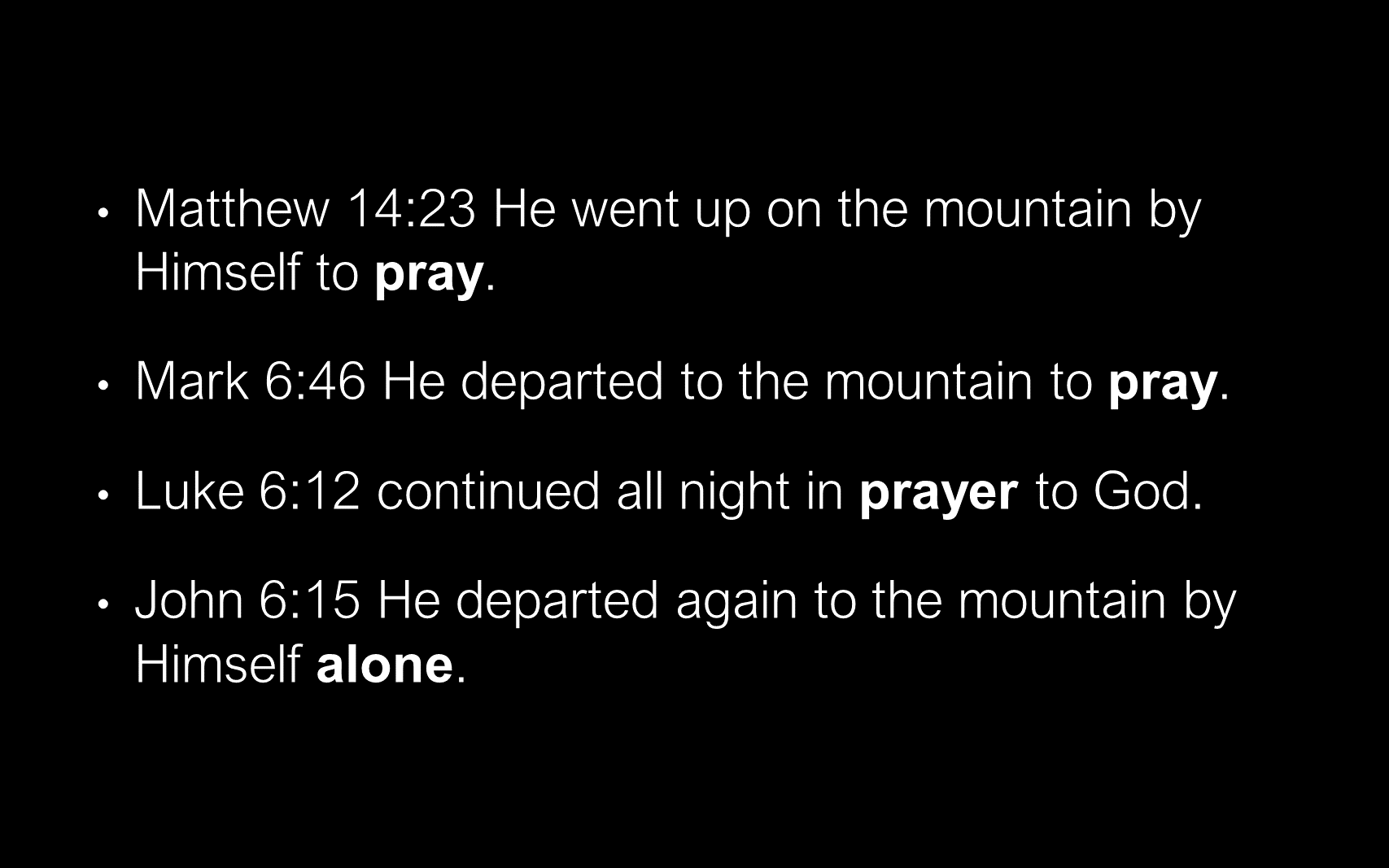
Let me just show you what happens. When we meet with God, we’re nourished. Look at Jesus’ example, and I’m just pulling out four because that’s all that would fit in the slide. He went up in the mountain by Himself to pray. Here’s people milling around by the thousands. He’s just fed them. He gets alone with God. He was God. Why did he need to get alone? To give us an example. He needed, humanly, to connect with God, to be restored, renewed, and refreshed, and nurtured for His human life. Mark 6, He departed in the mountain to pray. Luke 6, He continued all night in prayer. If we were facing a major event in our life, would we stay up all night praying? No, we need good rest, good sleep, go to bed early. Or we’d study! Pray? But see, we don’t really fully understand that power that comes of spending time in God’s presence. In John 6, He departed again on the mountain by Himself to pray. Now, I want you to think with me. Jesus Christ, who lived out the life we each can have, nourished His life by spending time alone with God, and Jesus goes on to teach us, in His ministry, some of the New Testament byproducts.
You know what some of the New Testament byproducts of being nourished by God are? You’re in Hebrews; back up to John chapter 10. Okay, John 10. Let me just show you about three from the Book of John. Okay, Gospel by John chapter 10, and these are fascinating how Jesus explains them to us. First of all, Jesus said that listening to God’s voice, connecting with God, hearing His voice brings us security. He said, My sheep hear My voice, I know them, they follow Me. You know what Jesus said? You know what the surefire test, people all the time are wondering if they’re really a Christian, here’s the test, the Lord said. Plug in the charger, the cable, and see if anything happens. Do you know what happens if you listen and are a believer? My sheep, look at 10:27, hear My voice. The Bible goes from just being any other book. That’s how I know whether people have made connection. If you can read the magazine, and the online news, and every other book, and fiction, and just, oh, and then you have a Bible, that means you have no idea what you have. It’s all the same. As soon as you realize this is the only connector, the only cord, the only charge station for what we are—an endlessly living being created in God’s image as His servant. Then all of a sudden, this book is not like any other book, and you can’t get enough nourishment. You hunger, like a newborn baby, for the Word of God. And what does it do? Sometimes you feel far away from the Lord. To get right back into closeness, He designed a way for us to hear His voice, to get reassured. It’s like a mother’s voice to a troubled child. In the dark, when they’re troubled, if they hear mom’s voice, they know she’s there. The Lord said, you feel in the dark and troubled? You can hear My voice anytime you want to hear it. This is my Word; you hear My voice. We just open our hearts by faith. We go into His Word in obedience and listen.
But back up to chapter 8, because that’s not all. Listening to God’s voice brings us victory. What are we plagued with as humans? We’re studying on Wednesday night, our biggest temptation of all is not what we think. You know what it is? It’s fear. Most of us, our biggest temptation is to fear, to fear that God really means, that He’s really in control, that He’s really knows what’s going on, that we’re going to make it, and that, we just have these constant fears. Jesus said this in John 8:32. If you listen to My voice, it can bring You victory. You’ll know the truth, and the truth will make you free. Each of us struggle, and those struggles slowly enslave us. We get defeated by the powerful just temptations that ravage us, but we can have those temptations defeated by the Word of Christ. Fear, despair, doubt, and confusion, each one can surround and defeat us, or each one can be surrounded and disarmed by the Lord.

Now, let me just give you a little example. Let’s take for example, a struggling believer, okay? And just in one week’s time, number one, he loses his job, and that’s enough to think about. But as he’s driving home from his last day of work, his car is totaled, and he lost his job. But when he finally gets into the house after someone, friend, picks him up, and he looks on the table and there’s a pile of mail because he’s been so concerned about his job and now the car wreck. He goes through the pile of mail, and there just happens to be a letter from the hospital with his biopsy, and the biopsy says, yes, that tumor is malignant, and you indeed do have cancer. All of a sudden, we’re tempted to fear, fear God’s off duty. He’s watching out for everybody else; He’s not watching out for us. And we start being troubled.
What does a nurtured, connected to the Lord, how did Jesus? Jesus had all those problems. Worse than cancer, He got nailed. Worse than job loss, He was rejected. Think about a car wreck, He was, they were trying to stone Him! How did He just go through all that? He anguished, He cried and made loud groanings and crying. Yeah, says that in Hebrew 5, in the Garden of Gethsemane, He was sweating drops of blood and agonizing. So, He didn’t just go, oh, it doesn’t hurt at all. But how did Jesus do it? A soul that’s nurtured on God listens to God’s voice, and when you listen to that voice, like the child in the dark, when they hear mom’s voice, they turn in the direction of that sound because they trust mom. When we have job loss, car wreck, cancer, we turn in the direction of the voice, and we say, I trust You, but we don’t just blindly trust Him. We start realizing that God’s truth has put a little guard around us, little walls around us. So, when into our life come the job loss, and the car wreck, and the cancer, what that makes us do is start listening to what the Lord says. And one of the first things the Lord says is that the Lord is good. He is good! His mercy endures is forever. The Lord is good. And what does good mean? It means everything God does is good, and kind, and helpful for us as His children. Everything. So, God is good. Number two, God is wise. That means He chooses the best way, the right thing, and the best means to accomplish everything in our lives. He is the One that is orchestrating life.
On Friday night, Bonnie and I were on this very romantic Valentine’s date, and we were all alone with hundreds of other people over at Portage Central and watching the Sound of Music and Natalie singing, and the mother, I forget her name, is also from our church, the Mother Superior, but they were singing their hearts out. And they pointed out to us that the Portage Central orchestra was so massive they couldn’t fit them in the orchestra pit, and there was a screen on the back wall where if you looked up, you could see the director, and she was directing this very impressive orchestra. And as she moved her hand, everything was happening in the music score, and we could hear it. Did you know that’s what you do when all the disasters come? All you do is look at the Conductor, and you see Him up there, the Lord, and He’s saying, everything I’m doing is good. I’ll never hurt you. I’ll never harm you. It might hurt, but I’ll never harm you. You know the difference between hurt and harm is if you get a splinter, it hurts to pull it out, but the person that pulls it out is not harming you. They’re actually helping you even though it hurts.
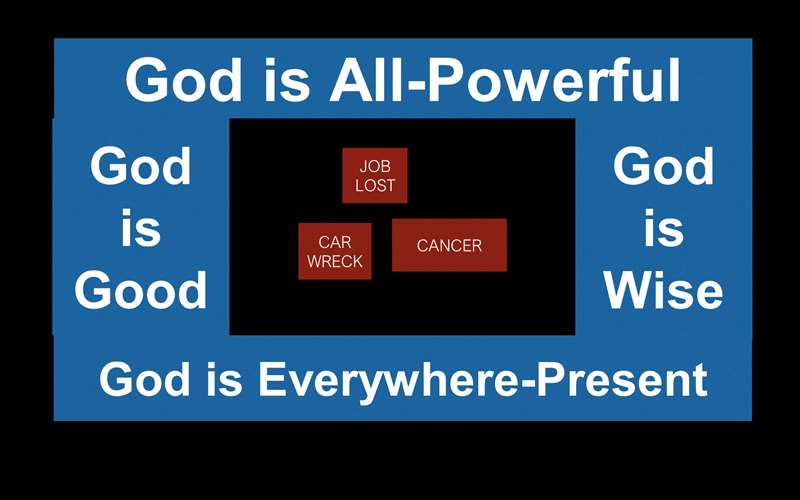
So, God says, I’m good. I’ll never harm you. What you’re going through—the wreck, and the cancer, and the job—might hurt, but it’s not harmful because I’m all-wise, and everything I bring into your life is because of My wisdom. But that’s not all, I am also all-powerful. Nothing can stop, hinder, or thwart My plan. Nothing gets into the box of your life by Me that I don’t allow because I am, Romans 8:28, causing; God is actively causing all things in our box to work together for good. Oh, whose good? His good, which we should agree with. See, that’s part of the problem. We think life should be run a different way than the Lord when we, we don’t have the guidance system going, and we can’t see, and we’ve lost the joy, and we aren’t aware of what all He’s doing.
And then the Lord tells us one more thing: by the way, because I’m everywhere present, I’m totally with you all the time. I’ve never left! You ever, you know that pretty little poem and picture of the footsteps in the sand thing. That’s a great illustration of the fact that God is with us in the car wreck, and the job loss, and the cancer. He hasn’t, He’s not absent. And so, someone who’s nourishing their souls in the truth is aware that God is good, and that He’s wise, and He’s all powerful.

We have to learn to put our problems into perspective. By the way, if you’re in the Wednesday night class, this is a preview of where we’re going. This is what we’re studying Wednesday night—fear. And so, you can stay home. You’ve gotten half of it and watch the rest online. But basically, what we have to see is that our life, it’s not just out there hanging, that there are some definite restraints around the goodness, and wisdom, and power, and presence of God that are absolutes. And all of a sudden it puts our problems into perspective.
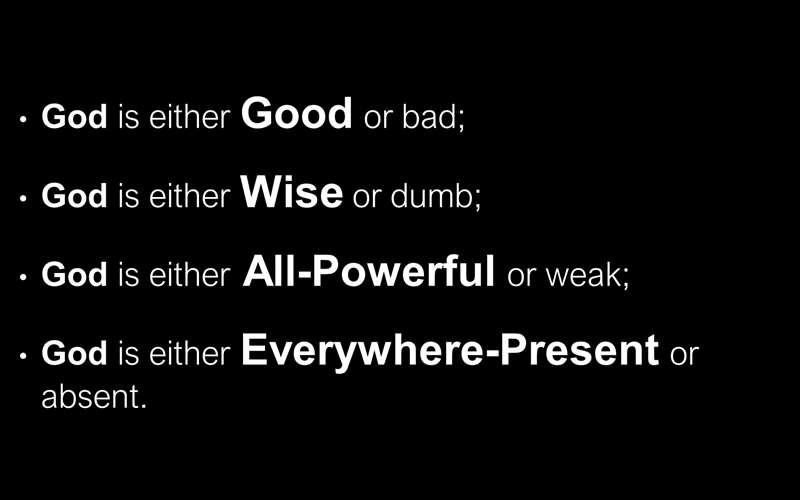
Let me just give you an example of what that means. When something, a disaster, comes in our life, either we say, and believe, and know because we’re connected that God is good, or all of a sudden, we think He’s bad, that the Lord is being, He’s harming me by that sickness, by that disaster. Either we say God is wise, or we say He is dumb. What do we call someone that’s just totally don’t know what they’re doing? They say they’re dumb. That’s not very polite. But by our reaction either we say, You know the best means, and You’re putting everything, every possible thing that is dumped in my life, You, in Your wisdom, are using all those horrible things for something that’s wonderful, and that puts it into perspective. Or what we say is either He is all powerful, or He is weak. Either we doubt, and fear, and deny the very character of God is good, and wise, and powerful, or we believe it. And finally, we say either He’s everywhere present, or He’s just absent from my life. He can be, lo, I’m with everybody else always, but not with you. That’s what happens. Basically, the way we respond to trials, troubles, and disasters is a testimony to everyone who sees us, as to what we really believe about God. You want to know what you really believe? Get in a car accident. You want to know what you really believe? Lose your job. You want to know what you really believe? Get cancer. Becomes very clear whether you believe that God is good, and wise, and all powerful, and everywhere present.
One last, I told you three, look at John 17. Because did you know what? We are imperfect and struggling. And so, what God wants to do is if we will listen to His voice, if we’ll plug in the charger, if we’ll nourish our soul, it is an invitation for God to change us. Now, watch what the Lord says in John 17 verse 17. This is Christ’s final words to His disciples. In chapter 18, He’s caught in the Garden of Gethsemane. So, chapter 17 He’s praying this prayer, and He’s teaching them. And He says in 17:17, sanctify them by Your truth. Your Word is truth. Spiritual growth takes place when we spend time alone with God, when we confess our fears, when we ask Him to make us feel His presence, when we ask Him to explain our fears so we can remember He’s with us. See, we look in His Word and explains that we’re weak and frail and we’re the most delicate creatures in the universe, and we need Him more than anything else. We need Him, and we need to acknowledge His presence, and spiritual growth takes place as we spend that time with God.
It reminds us, if you go on to chapter 20, look at 20:25. Do you remember the scene of Thomas? Chapter 20 is the Thomas scene. We’re like Thomas, who doubted Jesus Christ, and Jesus knows we’re struggling. And instead of rebuking Thomas for doubting and telling Thomas he just should have listened more during the three and a half years Jesus taught him and walked around with him. Instead, look at Jesus’ compassion in verse 25. Do you remember what happened? Thomas wasn’t present on the first occasion when Jesus appeared to His disciples after the resurrection. The others told him about it, but he wasn’t there. And so, he replies in verse 25, unless I see the nail marks, unless I put my finger in the nail holes and put my hand into His side, I will not believe. And you know what? Thomas is our pattern. That’s why this story is in there. He reflects a part of us because we all struggle and doubt. Yet Christ understands, and He always meets us at the point of that struggle. That’s what He did with Thomas. He met him exactly a week later in the same spot, and Jesus scares everybody, walks through the wall. He says, Thomas, I heard that you didn’t really think I rose. I’m here, feel. You want to put your hand on my side? Be not faithless, doubting, but believe. That, Jesus did not rebuke him, that was the most tender restoration possible.
And look at verse 28. And Thomas answered and said, my Lord and my God! Jesus offered to fulfill the conditions of Thomas’ test. Stick, he said, I got to stick my hands in, but the mere sight of Christ was enough, and he just fell at His feet and worshiped. A lot of people have all kinds of doubts, and fears, and struggles, and all they need to do is just fall in front of the Lord and say, I need to hear Your voice.
I tell you what, you always get something out of the Word of God. If you come with that attitude of devotion and say, I need to be charged, I need to be connected, I need to have You nourish my soul, I can’t make it without You. The Lord says, if you seek Me, you’ll find Me. When you seek for Me with all of your heart. We all need to nourish our souls, and nourishing our souls is getting into God’s presence, believing His Word, and believing enough to invite Him to be at work in our lives through it. And we bring Him our lack of faith and our doubts, and with our hand of faith, we reach out, and when we do, we always touch Him.
Now to close, there’s, and you can close your Bibles, and let’s open our hymn books, the green books, and let’s go to number 497; 497 was written by a person who had lost some of their children with diphtheria. That’s the DPT. It’s just become an initial; it’s not even a problem to us anymore. But in 1903, it was a killer, and people were losing their children, and this guy lost his children. This McClain, or what is his name? McAfee, and he was reeling with, whoa, who’s in charge here? And he pauses, and God is good and God is wise, and God could have kept my kids from getting diphtheria, and the Lord’s here, and he wrote a little poem about it. Now it’s a hymn, there is a place of quiet rest—when all the disasters, and job loss, and cancer—but it’s near to the heart of God. It’s a place where sin cannot molest, near to the heart of God. Oh, Jesus blessed Redeemer, sent from the heart of God. Hold us who wait before Thee near to the heart of God. You know what he was saying? I need to be charged; I need to be plugged in. Hold me till I get nourished, until I can see life that You’re good, wise, all powerful, and You never leave. You’re right here with me as I’m burying my children, or as I am lining up to get another chemo, You’re here and that is what’s best for me.
Notes
Everything in the Universe needs recharging except God; only God is self-existent. Of all creatures, we are most fragile, and most need to be renewed by God.
Today we come to the second exercise Paul assigns to Timothy. We first saw that Paul’s hope for the future growth and health of Christ’s church rested with individuals who could guard against false doctrines and false teachers.
But now, in 1 Timothy 4:6 Paul explains what a good servant “minister” looks like. A servant that God can use, that is one of those “good and faithful” servants that He rewards is a person like Timothy. In this verse we see what makes us good, useful servants of the Lord: it is keeping up our spiritual health by nourishing our souls in God’s Word.
This is now the second of the spiritual exercises or disciplines that God gives to us through Paul’s letter to Timothy. Do you remember how each of these ten exercises is framed? They come to us as:
Timeless & Powerful Disciplines
They are as powerful as they were in the glittering temptations of the Roman World, Century One. They have trained generation after generation of God’s servants, and now, they are ours to use or neglect. This year, we will be most useful for the Lord when we follow the words of v. 7:
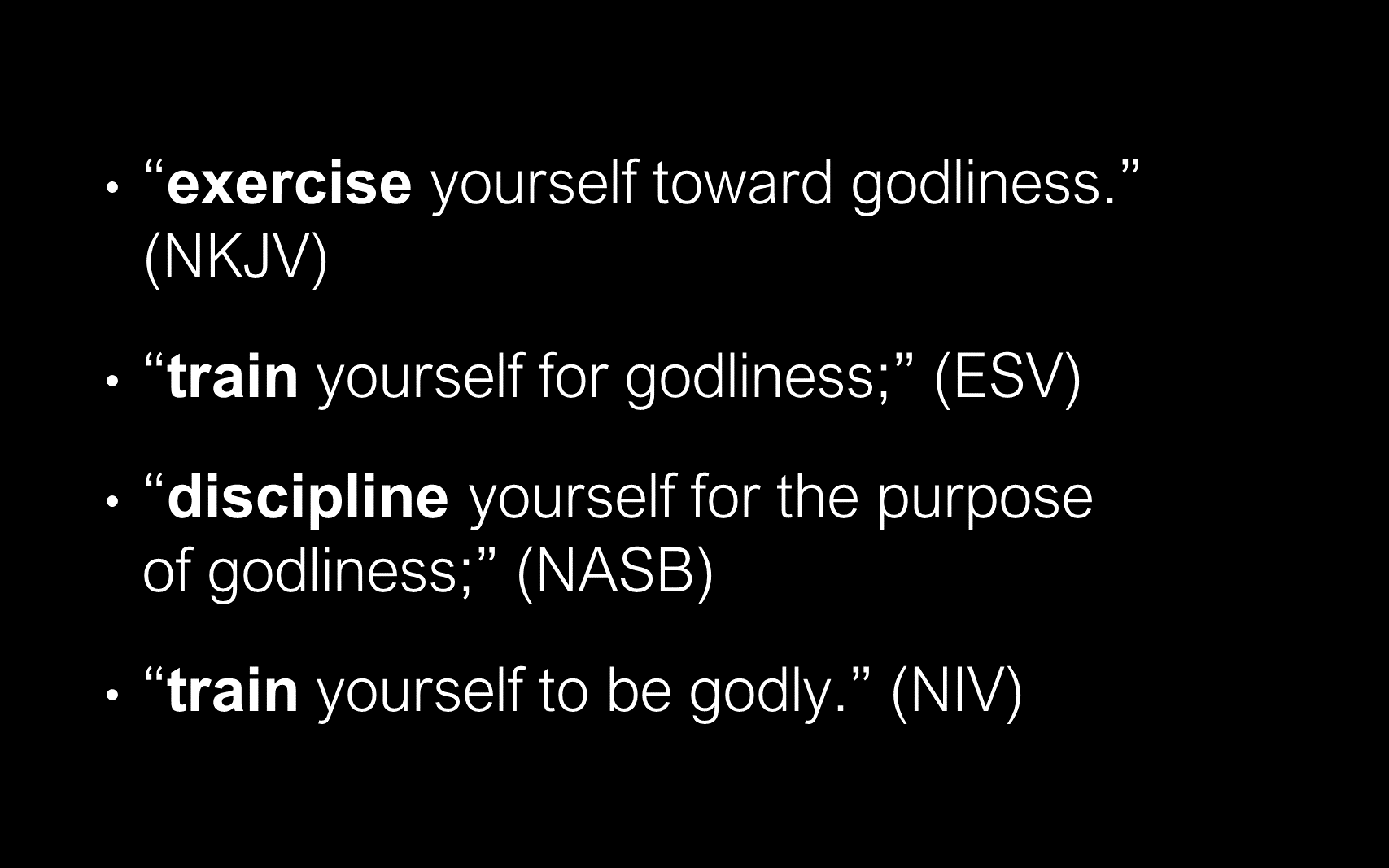
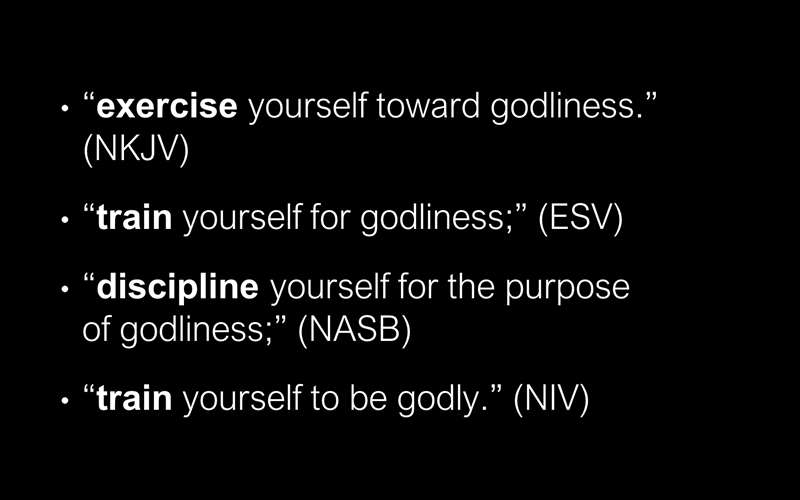
“exercise yourself toward godliness.” (NKJV)
“train yourself for godliness;” (ESV)
“discipline yourself for the purpose of godliness;” (NASB)
“train yourself to be godly.” (NIV)
Paul packages these spiritual truths in the form of present tense, or ongoing athletic “exercises”, or “disciplines”, or “training sessions”, as the various translations of the Bible render v. 7. So now as we read the Scriptures, listen and then ask God to speak to each of our hearts, and help us to listen and respond to:
The Discipline of Devotion: Nourishing Our Souls in the Word
Please stand and follow along in your Bibles as we hear God speaking through the Apostle Paul.
1 Timothy 4:6 (NKJV) If you instruct the brethren in these things, you will be a good minister of Jesus Christ, nourished in the words of faith and of the good doctrine which you have carefully followed.
Pray
The heart of v. 6 is found in those words “nourished in the words”. That leads us to one simple question we should ask ourselves today: “Am I nourished by God’s Word on a daily basis?”
Dangers of Spiritual Malnutrition
Spiritual malnutrition is one of the great dangers of 21st Century life. A malnourished life is a weak, aimless, and often defeated spiritual life. The vital byproducts of a nourished soul are absent.
If we are not disciplining, training, and exercising ourselves in good spiritual nutrition, so much of what God has offered us is missed.
Nurturing our lives on God’s Word produces strong, healthy, and focused lives!
Ezra says that daily CLEANSING is lost by neglect of the Word: “How can a young man cleanse his way? By taking heed according to Your word.” (Psalm 119:9, NKJV)
Ezra also says that GUIDANCE is lost by neglect of the Word, so we walk in the dark through life without regular times in God’s Word: “Your word is a lamp to my feet and a light to my path.” (Ps. 119:105, NKJV)
Jeremiah says JOY is lost by neglect of the Word: “Your words were found, and I ate them, and Your word was to me the joy and rejoicing of my heart; For I am called by Your name, O Lord God of hosts.” (Jeremiah 15:16, NKJV).
By the time we get to the New Testament we find that nearly every element of the life of a believer flows from allowing God into our lives through His living, Spirit-empowered Word.
Jesus starts by saying that spiritual LIFE is fed by God’s Word: “But He answered and said, “It is written, ‘Man shall not live by bread alone, but by every word that proceeds from the mouth of God.’” (Matthew 4:4, NKJV)
Then our Lord Jesus Christ models the nourished life. Remember, hard as it may be, that Jesus Christ was 100% human. He came and lived among us to show us how completely He understood and felt all of our struggles.
Jesus Was Completely Human
Turn back to the book of Hebrews to see the great lengths God has gone to assure us that Jesus felt what we feel, struggled as we struggled, and had to endure what we endure.
Hebrews 2:14-18 (NKJV) Inasmuch then as the children have partaken of flesh and blood, He Himself likewise shared in the same, that through death He might destroy him who had the power of death, that is, the devil, 15 and release those who through fear of death were all their lifetime subject to bondage. 16 For indeed He does not give aid to angels, but He does give aid to the seed of Abraham. 17 Therefore, in all things He had to be made like His brethren, that He might be a merciful and faithful High Priest in things pertaining to God, to make propitiation for the sins of the people. 18 For in that He Himself has suffered, being tempted, He is able to aid those who are tempted.
Hebrews 4:15-16 (NKJV) For we do not have a High Priest who cannot sympathize with our weaknesses, but was in all points tempted as we are, yet without sin. 16 Let us therefore come boldly to the throne of grace, that we may obtain mercy and find grace to help in time of need.
Jesus Christ, lived out before us to see, in the Gospels, the life we can each have: a life that is nourished by spending time alone with God through His Word,
The Example of Christ’s Nurtured Human Life
Jesus lived the perfect human life.
He lived in a whirlwind of activity.
He was constantly eating, walking, talking, and sleeping with twelve men who never seemed to leave Him alone.
Vast crowds, and desperate individuals sought him out.
He was chided, rebuked, and even scoffed at by His own family.
He was the personal target of Satan who tempted Him, Satan who tried to derail Him, and Satan entering people to drive them to destroy Jesus.
He was attacked by every demon that could be rounded up to scream at Him, thrash around in front of Him, and seek to bother Him.
Civil and religious authorities always plotting to catch Him, and take Him off for punishment and execution hounded him.
His life was so full of people and ministry he didn’t even have a moment to stop and eat.
Yet in the midst of all that, what was He?
Peaceful, calm, focused, and confidently following God’s will.
How did He do that?
If we follow Him, we can find His secret. Though we can never be sinless, we can learn and follow His pattern for a life in step with God’s will.
So Jesus lived a super full, ultra busy, demanding life. But every time He was seen in the Scriptures He is quiet, composed and led by the Spirit.
He was God, yet as man was living human life the way wants it lived. What did that perfect life on earth have to keep it so strong? What was the secret? The secret is the times Jesus spent alone nurturing His soul with God, time in secret away from everything and everyone else.
We are Nourished When we Meet with God
Jesus had to be alone with God, and Jesus wanted to be alone with God; and Jesus found times no matter what was going on and places no matter where He was, to be nourished by time alone with God His Father.
Mark 1:35 “Very early in the morning, while it was still dark, Jesus got up, left the house, and went off to a solitary place, where he prayed.”
Jesus had cultivated the discipline of getting alone with God. He had learned the secret of waiting on God. And as our perfect example, He calls each of us to do the same. We must learn to seek and find a solitary place in our life to regularly get alone with God.
Was this regular in Christ’s life? Yes, from start to finish. Notice with me:
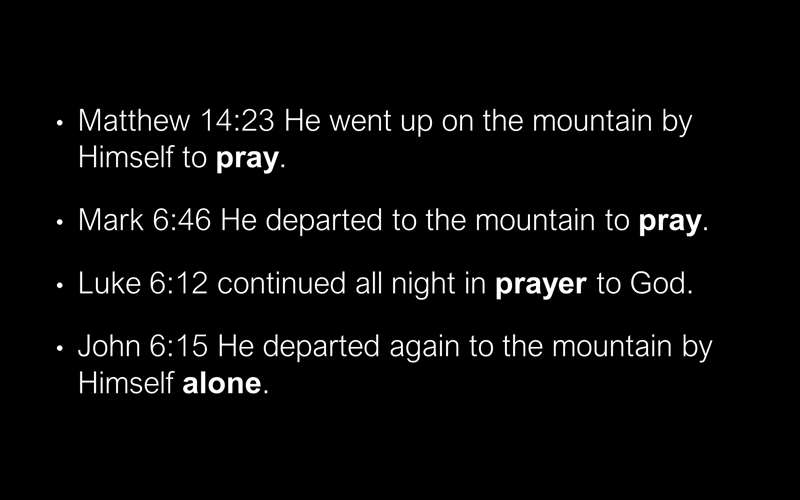
Matthew 14:23 And when He had sent the multitudes away, He went up on the mountain by Himself to pray. Now when evening came, He was alone there.
Mark 6:46 And when He had sent them away, He departed to the mountain to pray.
Luke 6:12 Now it came to pass in those days that He went out to the mountain to pray, and continued all night in prayer to God.
John 6:15 Therefore when Jesus perceived that they were about to come and take Him by force to make Him king, He departed again to the mountain by Himself alone.
Jesus Christ, who lived out the life we can each have, nourished by spending time alone with God through His Word, goes on to teach us that a life NOURISHED by God has the:
Listening to God’s Voice Brings Security
John 10:27 (NKJV) My sheep hear My voice, and I know them, and they follow Me.
Do you sometimes feel far away from the Lord? To get right back into that closeness He designed a way for us to hear His voice and get reassured. Like a mother’s voice to a troubled child, or a dad’s voice to a struggling son: we can hear our Good Shepherd’s voice any time we want to. We just open our heart by faith, go to His Word in obedience, and listen.
Listening to God’s Voice Brings Victory
John 8:32 (NKJV) And you shall know the truth, and the truth shall make you free.”
Each of our struggles, that can slowly enslave us, are defeated by the powerful Word of Christ. Fear, despair, doubt, and confusion each can be surrounded and disarmed by the truth of God’s Word.
For example, take a struggling believer who is going through a storm of emotions, fears, and doubts because of three quick blows to their life.
One: they just lost their job;
Two: they had a car accident that totaled their car on the way home from their last day of work;
Three: when they finally made it home, they opened a letter from the hospital, in the pile of mail, that reports that their biopsy was malignant, and they do indeed have cancer.
Listening to God’s Voice Means Trusting God
So, how would a life nourished on the Word of God handle that series of terrible events? By trusting God. What does that mean?
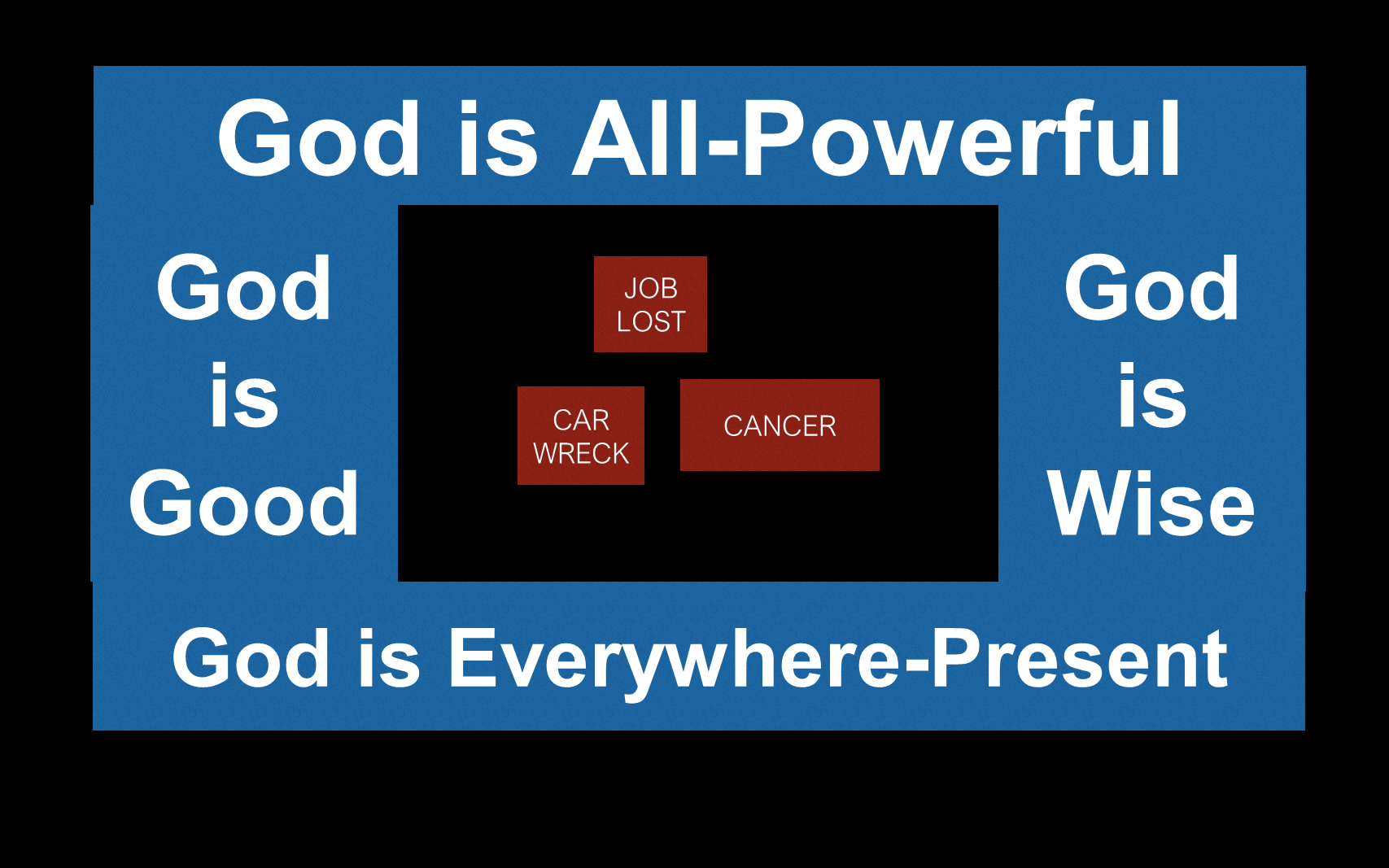
First, God is Good: that means everything He does is good, kind, and helpful. Second, God is Wise: that means that He chooses the best way, the right timing, and the best means to accomplish everything in our lives.
Third, God is All-Powerful: that means nothing can stop, hinder, thwart, or disrupt His plan.
Finally, God is Everywhere-Present: that means He is totally everywhere we are at all times.
So what does it mean to trust a Good, Wise, All-Powerful, and Everywhere-Present God in the situation above, just described?
To help us apply the truths of God to everyday life, just use these four truths to make a box, or a containing wall around those three disasters:
Putting Problems into Perspective
So we can conclude each time our nourished souls apply the Doctrines of God to life:
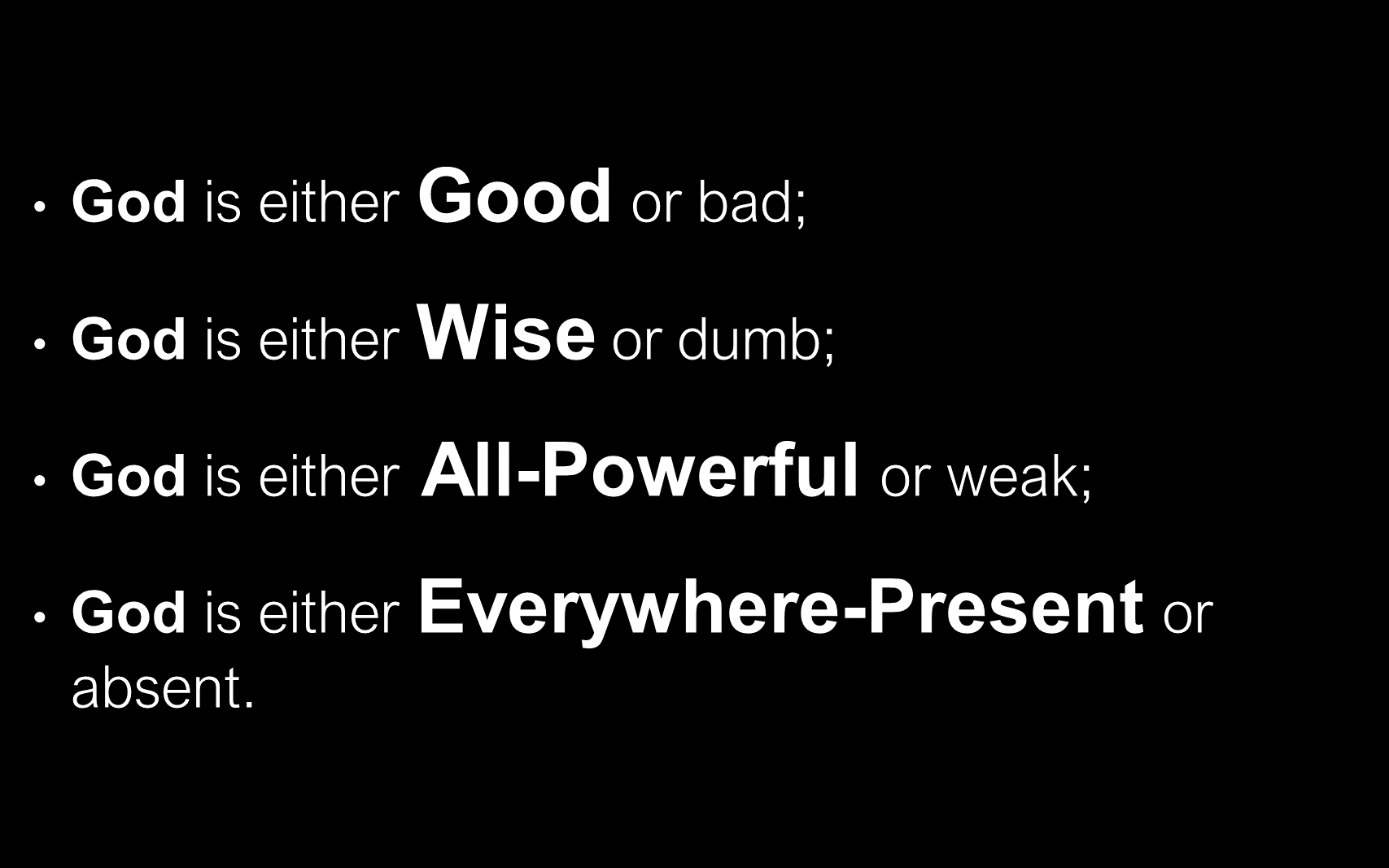
God is either Good or bad;
God is either Wise or dumb;
God is either All-Powerful or weak;
God is either Everywhere-Present or absent.
The way we respond to trials, troubles, and disasters is a testimony to all who see us about what we believe about God.
Listening to God’s Voice Invites Him to Change Us
John 17:17 (NKJV) Sanctify them by Your truth. Your word is truth.
Spiritual growth takes place as we spend time alone with God and confess our fears, and ask for Him to make us feel His Presence. God most often explains that when we fear we just need to remember that He is with us.
Spiritual growth takes place as we spend time alone with God and confess our doubts, and ask Him to increase our faith. Like Thomas who doubted, Jesus Christ knows that we are struggling. Instead of rebuking Thomas for doubting and telling him that he should have paid attention better for those three plus years of walking around with Jesus as one of His disciples, look instead at Christ’s compassion:
And Thomas answered and said to Him, “My Lord and my God!” (John 20:28)
Thomas was not present on the first occasion when Jesus appeared to His disciples after His Resurrection. The others told him about it afterward, but he replied, “Unless I see the nail marks in his hands and put my finger where the nails were, and put my hand into his side, I will not believe it” (John 20:25 NIV).
Thomas is our pattern; he reflects a part of us because we also struggle and doubt. Yet Christ understands and will meet us at that point of struggle: as He did for Thomas by appearing again a week later when he was present.
Although Jesus offered to fulfill the conditions of Thomas’ test, the mere sight of Him was enough; he fell at Christ’s feet and worshiped.
Today the hand of a gracious God the Son offers the assurance we can trust Him with all our troubles. He asks each of us to look closely at His hand, for it is a wounded hand, one bearing the print of the nail received when He died for our salvation. By faith you may put out your hand and touch that wound, which is irrefutable evidence of God’s great love for you.
The One extending that hand died for you. Allow Him to enclose your hand, to enclose you, and to bring you into that great company of those who possess eternal life and who shall never perish[1].
Nourishing our souls is getting into God’s Presence, believing His Word, and inviting Him to be at work in our lives!
Bring your lack of faith and your doubts to Him.
With the hand of faith, reach out and touch Him today!
For wherever you are, God is there.
Nourish Your Soul in God
This morning you can revitalize your walk in this old world by starting or restarting a habit of cultivating time alone with God. Time in the Word and time in prayer, alone with God. The songwriter captures this solitude in secret with God:
There is a place of quiet rest, near to the heart of God, a place where sin cannot molest, near to the heart of God.
There is a place of comfort sweet, near to the heart of God, a place where we our Savior meet, near to the heart of God.
There is a place of full release, near to the heart of God, a place where all is joy and peace, near to the heart of God.
Chorus: O Jesus, blest Redeemer, sent from the heart of God, hold us who wait before Thee near to the heart of God.[2]
[1] Adapted from James Montgomery Boice, John Volume 3: Those Who Received Him, John 9-12 (Grand Rapids: Baker Books, 1999), pp. 785ff.
[2] Near to the Heart of God, Hymn #497, Cleland B. McAfee, 1903