Biblical Exercises for Spiritual Health & Fitness in 2014 Series
The Discipline of Time:
“Rejecting Profane & Empty Living”
1 Timothy 4:7a
Transcript
Let’s open our Bibles to 1 Timothy chapter 4. As you’re turning there, we’re looking at the progression that the Apostle Paul has given to us in 1 Timothy chapter 4. The whole chapter is about the disciplines that God’s Word instructs us to make it through the world in which we live. And each of these is building upon one another. The discipline of truth is coming to the place where we believe that this is the source of truth from God for our lives. Then, as we saw last week, that leads to us having a devotion to that truth, that we want to be connected to it, that we want to know and live and speak and defend and guard that truth that nurtures our soul.
This morning, when we get to the seventh verse, we’re finding the third discipline. When you have the truth and when you have a devotion to the truth, it only connects if you spend the time to let that truth transform you. And this verse that we’re going to look at, only the first half of it actually has the discipline in it, tells us that we should be rejecting. And if you look down at what it says in verse 7, but reject profane and old wives’ fables. And so, it says reject, profane, and these mythos, these myths, fables, that they’re just empty of truth, reject those things, but it’s not a harsh rejection. It’s a very interesting word. What it means is there’s something so much better, so much greater, we actually, literally, the Greek word means to beg it off and say, oh, I can’t. Something is surpassing; there’s something I’m devoted to; that’s the previous discipline. There’s something that I believe is my source of truth and profane, which are godless, and empty, which are these myths, these fables, those don’t even match up to what I have. So, that’s just for you in your mind to look at where we’re going. The discipline of truth leads to the discipline of devotion; last week, leads to this discipline of time. Neglecting other things to truly know what God wants us to know.
So, this morning I have a question for you because one of the greatest dangers we face every day as believers is slowly allowing God’s influence that He wants to have through the truth and through our devotion to that truth, to slowly wane. And this condition makes God weightless in our lives. God, when He no longer weighs upon every thought, every choice, and every action of our day, is marginalized from our lives, and basically God becomes weightless. He doesn’t exert a profound impact on our lives. And that’s a very serious condition. I wonder how many of us this morning really think that the title of this message is for us? Our time is being disciplined. Do we need to reject profane and empty living? And that’s because of what I call the great disconnect.

And perhaps we should do a little test this morning. First, think of what the title was for today’s message: The Discipline of Time: Rejecting Profane and Empty Living. We think, I’m not sure I’m involved in anything with profane, whatever that is. You know what I mean? You just process that, or I don’t think I’m living an empty life, so that means I don’t really have to think much about the next 45 minutes. Isn’t that the test that we go through? And that’s the exercise that takes place almost unconsciously across America in Bible teaching churches each week. People sit there, people notice the topic, people do a quick assessment, and people tune their thoughts to something other than the message.
But now we need to go on and do the test to determine whether God has become weightless in our lives, and the test is simple. It’s basically this: How much do God and His Word directly challenge me into changing the way I think and live on a daily basis? Not occasionally. How much does God weigh in to challenge the way I think and the way I behave, and the way I process life on a daily basis? And you can measure your growth in disciplining yourself for godliness, the other half of verse 7. In context with this concept, how much of my daily life does God weigh in on? And do I allow Him to influence directly what I’m going to say, what my patterns of thoughts are, and the actions that I take, that’s the real measurement in our life.
So, that brings us to this question: Is God weightless in your life this morning? I’m not talking about how you’re here, but I’m talking about in the overview of where your and my life is going, is God weightless this morning? A believer that’s not actively engaged in exercising the discipline of time by consciously rejecting profane and empty living that verse 7 talks about will slowly become amused and carried along and will be floating with the current of this world and going away from God. Unless we aggressively choose to engage in going against everything that is around us, that’s of this world, if we’re not pushing forward and pressing toward the mark, as Paul put it, we’re carried back by the current. We’re on a river of life. The current is going away from God. He has called us to follow Him and to, as it were, paddle upstream. Every day we don’t paddle, we begin to float backward.
And Paul said these disciplines are to engage in paddling. That doesn’t mean that as a believer, we immediately go against God when we’re floating. Rather, it’s a slow process. And what happens is the Lord has less and less influence over my time, over my priorities, over the direction, over those little choices that gradually make up the fabric of my life. God has less and less influence over parts of my life if He’s becoming weightless.
Recently, a theologian, whose name is David Wells, has been very gifted. He’s one of the two founders of, if you’ve ever heard of, the Alliance of Confessing Evangelicals. He was one of the triggers that started that alliance. But he wrote an article that expressed this condition as well, and what he said was fascinating to me. Now, this is a man, he used to be at Trinity, and now he’s at Gordon Conwell, and he is one of the people who thinks stratospheric. In fact, a lot of times you have to read over and over what he says because it’s so profound that you can’t take a big bite. It’s like a bite of steak too big. You have to cut it smaller and smaller so that you can get it in.
But this is what he said. I want to read it to you. It is one of the defining marks of our culture that God has now become weightless. I do not mean that God is ethereal, but rather that God has become unimportant. He rests upon our world, so inconsequentially as to not even be noticed. God has lost his saliency for human life. Now, he’s broad-brushing, but he’s doing well. Wells goes on to say that those who assure the pollsters here in America that their belief in God’s existence is sound may nonetheless demonstrate by their habits and believe these truths.
And I typed them out for you. I’ll read them to you, but I typed them out so you can think about them. Number one, God is less interesting than television. Now, what he’s talking about is the pollsters go out and say, are you a Christian? Yes. Then they poll them as to where the Bible fits in relation to their media consumption. And what you find is, no matter though, they say they’re a Christian, God is less interesting than television. God’s commands contained in His Word are less authoritative than their appetites for affluence and influence. Affluence, I want more material things to influence. I don’t want to be out of touch with my culture. I want them to accept me, and I want to be in there as a part of the influence rather than being a follower of God’s authoritative Word.
Thirdly, God’s judgments are no more awe-inspiring than the evening news. How did he come up with that? That people are more drawn to watching over and over again, as the news cycle goes, whatever’s going on right now in the Ukraine or previous to that at the Olympics, before it was interrupted, or what’s starting to erupt in Venezuela or the old news, which is Syria. God’s Word is no more awe-inspiring. It doesn’t like a magnet grip us than the evening news. In fact, the evening news often wins over God.
And finally, he said, God’s truth is less compelling than the advertiser’s sweet fog of flattery and lies. That’s weightlessness. It’s a condition we have assigned God to after having nudged Him out to the periphery of our secularized lives. See, we were called to have God centric lives. But God has been nudged out as the core of our lives becomes secularized. Do you know what that means? That means that we see a difference between our church life and our real-world life. But for a believer, there’s no difference between the sacred and the secular. It’s all merged together into one life we live for the glory of God.
Weightlessness tells us nothing about God, but everything about ourselves. Therefore, we need to realize that we must not exclude God from our reality.
Now, what are we going to do? We’re going to learn in our text and look down, and we’re going to read in just a moment, verse 7. We need to battle profane and empty living. And Paul wrote down as God’s Spirit moved him to write these disciplines. The first one, discipline of truth. The second one, the discipline of devotion. Now, in verse 7, the discipline of our time. If we were in the 1st century, this would’ve jumped off the page to us. For most of us, in fact, I was just listening to my son telling us, he’s studying in Argentina and he’s in an immersion Spanish course a yearlong to become fluent in Spanish at a missionary training center. And he said, I’m learning more English grammar learning Spanish than I learned in America. Because he says, you have to understand the grammar to understand the language. And he said, and so all of this is tied to English grammar. Most of us, unless you’re one of those English buffs, just kind of let it go by. That wasn’t how it was in the 1st century.
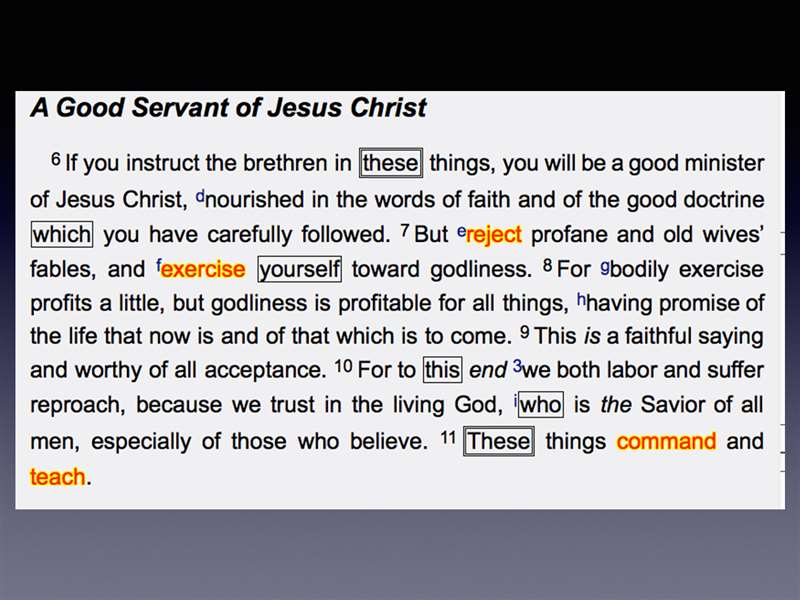
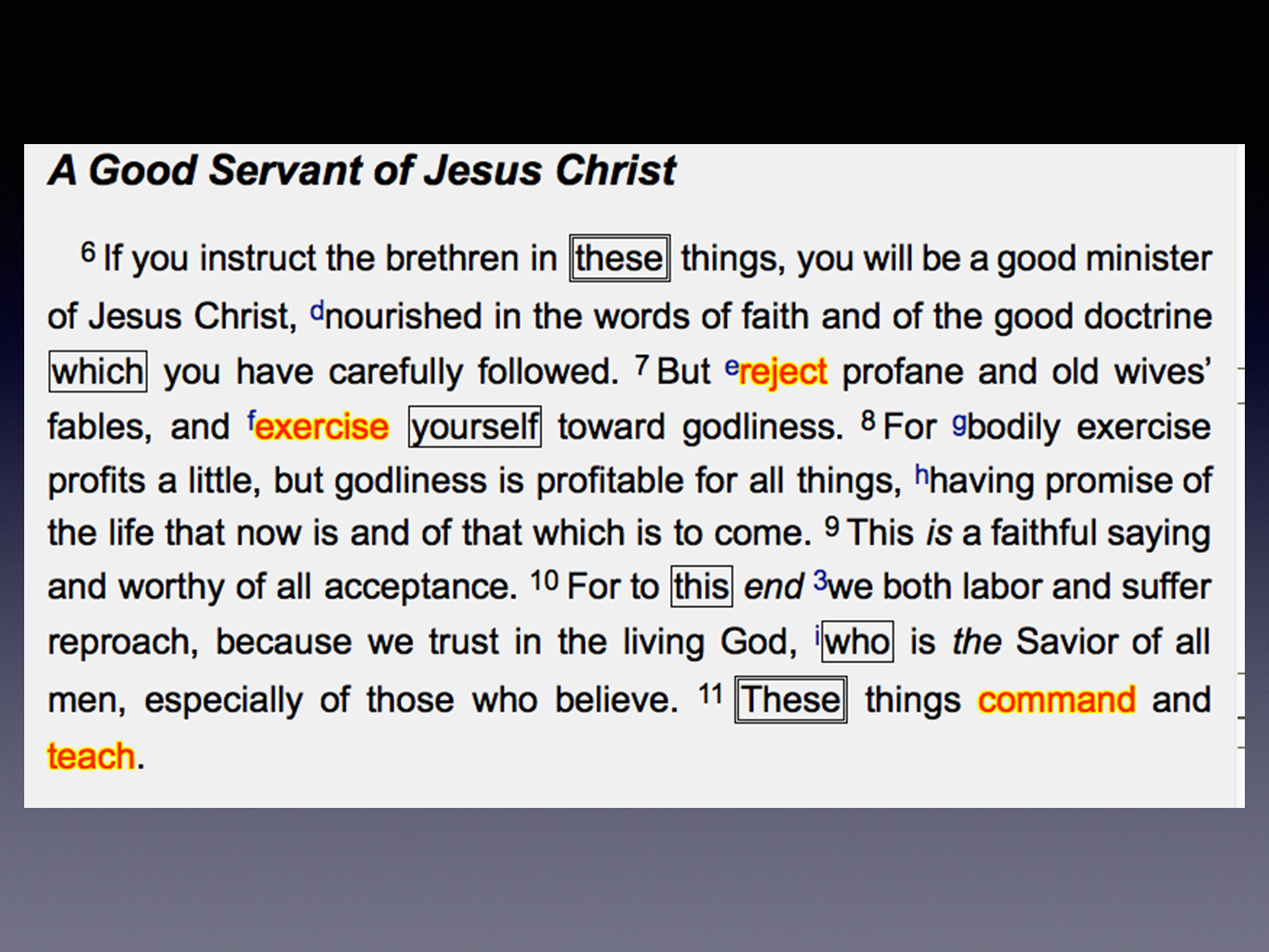
In fact, I want to show you our text. I’m going to put it up on a screen for you. I colored the imperatives for you. Do you see anything that’s a different color on the page of the normal letters? That’s how this text would’ve looked when in the 1st century it arrived from Paul to Timothy. You see, the grammar of the imperative is an ending that jumps off the page, and so I put it into flame orange, fluorescent orange. And what’s amazing is that Paul has written six solid verses of truths about these disciplines. But when he comes to this third discipline, all of a sudden, he frames it in the pay attention mode, the imperative mode, the form of the language that emphasizes, and those who received it would’ve instantly seen. This is what the text looks like.
Remember, in the Greek language, there’s a built-in method for showing what is emphasized. By use of grammatical form, statements can be bolded and highlighted for emphasis, and that emphasis is called the imperative mood. And in verse 7, we bump right into the first of 12 words between verse 7 and the end of the chapter that Paul is underscoring and saying, don’t let this go by you. Don’t fail to notice this truth.
So, basically, these emphasized truths are what the Lord wants us to give our attention to. If God could have used any greater method to bunch together a dozen requests, I can’t think of it. So, these words, reject and exercise, jump off the page in verse 7. God designed it that way. That’s exactly what He wants us to notice. The proximity suggests a contrast. Reject the profane and old wives’ fables, but exercise yourself toward the godly, the true, what matters forever. God is explaining that to get the best results from our exercises or disciplines, we must pay attention. So, basically, in our text, we’re looking at two separate pieces.
First, he says, I want you to reject the profane. The profane is whatever is associated with godless things, anything that distracts our minds. A godless thing is something that bumps God into the margin, and it does it by deadening our minds. It does it by distracting our minds. It does it by numbing our minds, by filling our minds with things that grieve the Spirit of God. Any of those things is profane.
Secondly, he says watch out for these old wives’ tales. These mythos, myths, and fables are just that, they’re thoughts and activities that are untrue, that are unprofitable, that we shouldn’t invest our most precious resource of time in. And they’re the most vital activity of thinking deeply shouldn’t be focused on this. And by the way again, we’re thinking, how does this relate to me? Do you know, in the 1st century, what myths were? Most of the myths, the mythology of the 1st century, were about superheroes. Zeus, king of the Gods, Apollo, and Hercules, all of these different, what we call Greek mythology, are what captivated people’s minds. And he says, don’t let your minds be captivated by myths. Do you know where our entertainment culture’s going? Where’s it going? To comic books and people wait in line and can’t wait for the next installment of fables, of myths of science fiction, of fictitious characters, where they actually, people begin to live in a world of fables. Paul says biblical exercises for spiritual health and fitness are for us today.
So, 1 Timothy chapter 4, and we’re going to read together verse 7. Let’s stand together for the reading of God’s Word, and with these concepts in our heart let’s listen to the verse and then let’s bow before the Lord and say, Lord, if You want this to jump off the page, and if You wrote it that way, then I’m inviting You to jump off the page into my heart. And I’m going to invite You to weigh on my life. I don’t want You to be weightless, God. I want You to weigh in so I can learn what it is You’re asking me to do in verse 7. This is what the Apostle Paul wrote, 1 Timothy 4:7, but reject profane and old wives’ fables and exercise yourself toward godliness.
Let’s bow together. Father in Heaven, I pray that we would learn this morning by Your Spirit, this biblical exercise, so that we can be spiritually healthy and fit in this year that’s before us. It’s a choice we make. It’s a choice of our diet, whether we’re going to be in your Word. It’s a choice of exercise, whether we’re going to train and exercise and discipline ourselves the way You have told us toward Your truth, toward devoting ourselves to be connected to You every day. Not just letting these words be words but seeing them as a way to know You personally. And Lord, I pray that we would come to the point where we would begin to reject, we would beg off and say, yeah, I don’t want to do that. It distracts me, it deadens me to hearing God’s voice. And I want to discipline my time and not fill my mind with what is profane and not fill my mind with what is empty, false, myths, and fables. I want to be an expert in truth, not in fables. Oh Lord, may we discipline our time, examine our hearts, and let You weigh into our lives moment by moment. In the name of Jesus, we ask this, Amen. You may be seated.
As you’re seated, I want you to think about what God is asking. God is saying, I want your mind surrendered to My control. Now remember, everything is based on our minds. Our body gradually follows where our mind has already been. We are led and driven, and most influenced by our minds. And the Lord says, I want you to have a mind surrendered to My control. And God is looking for godly and mature believers who will make it a lifelong goal to resist the temptation of self-absorption. See, when we get distracted, when God becomes out there ethereally, weightless, it’s because we’ve been absorbed in ourselves and our own thoughts and plans and amusements and what pleases us and what we enjoy, just basically our default settings. After all, our flesh is the default. If we’re not aggressively yielding and surrendering to the Spirit, we default to the flesh, and it just looks us downward, and we don’t look up.
People at Paul’s day, by the way, were immersed in a self-seeking and a lust feeding culture. That’s just saying it mildly. When they came to Christ, they had to go on living in the world, though, and to make it through life without getting neutralized and defeated and sidelined, Paul said that the key to godly living is right here. What he’s saying in this seventh verse is that we are learning and avoiding what displeases God. You see, the discipline of truth tells us what is true and what matters. The discipline of devotion says, God, you’re more important than anything else. I want to stay connected to You. And the discipline of time is that, therefore, I’m going to avoid anything that’s profane or that is a fable that displeases You. See, it’s just interconnected. It’s amazing.
These exercises from God are to train us into regularly seeking out what pleases Him. In the world in which the New Testament was written, saints learned they had to avoid the overpowering culture of amusements. Most Roman citizens were drawn to the gaming world of spectacles in the arena. In fact, we all know the history of Rome, the decline, Gibbons’ [The History of the] Decline and Fall of the Roman Empire. It started in the heart of Rome itself, not the empire, but the city of Rome, where the people, the masses, had to be entertained. And once they started entertaining them in those huge events, the entertainment’s wow factor began to diminish. And so, they had to up the entertainment level, and they had to up the wow factor. Finally, it wasn’t enough to just see chariot races; you had to have a chariot race with knives on it so that the people who got defeated would be cut up. And pretty soon, bloodshed became involved, but it wasn’t passive. Pretty soon, it had to be active bloodshed where everybody was in there fighting to the death, and they just kept upping to keep the crowd, and that’s the world in which they lived.
It was a nonstop calendar of events that began in the capital city of Rome and then extended to the furthest flung provinces of ever increasingly exciting spectacles. Live gladiatorial fights to the death, and then men versus ravenous beasts, and then beasts fighting other beasts, and then duals, and bloody deaths, and shocking sight and intense visual stimulation. And soon the roar of the crowds became so intoxicating that no one wanted to miss an event. And these events would go for days at a time. Can you imagine what it would feel like if you were in your shop working and you’d heard in the arena this loud roar, and you’d think, what did I miss? And everyone was just slowly drawn to not miss anything. That’s why Paul the Apostle wrote to a church nearby, Ephesus.
By the way, the letter of Timothy goes to Timothy as he’s pastoring in Ephesus. That’s why it’s called a pastoral epistle. Titus was working on Crete, Timothy was working in Ephesus, but Paul wrote this about the year 62 or so AD, the book of 1 Timothy. But just before that, about a year and a half, he had written a letter to a little city that’s just a hundred miles from Ephesus, it’s called Colossi. It’s interesting to read the New Testament books and to think about when Paul wrote them and who he wrote them to, and what place he was in his ministry. But I want you to think for a minute about when Paul the apostle wrote to a church near Ephesus, where Timothy was serving. Paul wrote, two years before 1 Timothy, a hundred miles away to the city of Colossi, and Colossi was also in the very same Roven province. It was facing the very same distractions that Ephesus was facing, which Paul was writing to Timothy about, and how to train the people of Ephesus.
Paul wrote to believers in Asia Minor, where both Ephesus and Colossi were, and he wrote to believers being doused with everything that the Roman world offered. Even today, the arenas, the amphitheaters, the theaters, the huge horse race tracks, all of those things are dotting this region, and tourists go to see them. But what did Paul write? He said, and let’s turn to Colossians. Turn back from 1 Timothy to Colossians, because these were words Paul wrote exactly two years before 1 Timothy 4. But they’re coming from the same general contractor and engineer, which is the Holy Spirit. The Holy Spirit contracted 40 different men to write down His message. And He was putting a message through Paul to the Colossians, and then He put another form of the same message through Paul to Ephesus by way of Timothy.
But look at the same message that these people are hearing, and these two epistles are just two years apart. What the Lord says is, point your mind toward Me. Paul had a very simple command in Colossians 3, and it’s basically this: Choose where you park your mind and you’ll choose your destiny. Wherever you have comfortably lodged your mind, whether it’s above, Colossians 3:1-2, or whether it’s below, which is the rest of that chapter describing, he said, that’s going to determine where you’re headed spiritually in life. These sobering words were breathed out by the Spirit of God through Paul, God’s faithful servant.
Look at verse 1 of Colossians 3. If then you were raised with Christ, and the construction is literally because it’s true, since you were raised with Christ, seek those things which are above. Because you’re a believer, seek those things which are above. What’s up there? It’s where Christ is sitting at the right hand of God. It’s like last week’s discipline of devotion, connecting to the source that will fill our lives. So, he says, focus on what’s above with Christ.
Now look at verse 2. Set your minds on things above. That’s the park. He says, you’ve got to point your mind in the direction you want to go. Do you remember driver’s ed? I took driver’s ed in Haslett back in about 19, oh, what, 71, in Haslett, Michigan. And I remember that the shop, I think he was the shop class teacher, was also the driver’s ed teacher. And what he said is, he said, wherever you point that thing is where it’s going to go. He said, so make sure you’re looking straight and pointing at that car. Remember, they only had that little pedal on the right, and they were always grabbing the wheel. Have you ever ridden in the backseat with some of those crazy drivers and thinking you’re going to die? Because the driver’s ed teacher only had a break and could grab that wheel.
But what he kept saying is, the car is going to go wherever you’re pointing it. And if you turn that thing, it’s going to go that way. Paul’s saying the same thing. Look at verse 2. Set your mind. Point your life on things above. Don’t point them at things on Earth. Why? That sounds crazy. Why would I live for what I can’t see when I can see all this, and it looks so enticing?
Look at the end of verse 3, for you died and your life is hidden with Christ in God. Verse 4. And when Christ, where our life is hidden, He’s our life. When He appears, then will appear with Him in glory. What he was saying is that the overpowering gladiatorial gaming culture of the 1st century that troubled, tempted, and weakened the Early Church could be overcome. And those temptations Paul said could be seen to be of lesser value if you realize and point, and park, as it were, as verses 1 and 2 say, on things above.
What’s amazing is all the temptations of the Roman 1st century have morphed into an even more alluring 21st century form. At least you couldn’t sit in your shop and see what was going on in the gladiatorial games. You had to work and just wished you could go because you had the roar. Nowadays, whatever is going on in any gladiatorial event globally, we can have right with us, even mobilely. Even wherever we are. See, it’s morphed in the 21st century into an irresistible and almost inescapable culture that even unsaved people around us are sitting up and sounding a warning cry.
So, what’s their warning cry? We need to beware of the ultimate temptation. Have you ever thought, what is the ultimate temptation? As I say that something different will probably register in your minds if you’re still tracking with these thoughts. What’s the ultimate temptation? For some people, it’s a car. For some people, it’s clothing, or it’s a look, or it’s an experience. For some people, it’s a substance. For some people, it’s an activity, but all of us have ultimate temptations. It’s something that kind of smolders in the background, and we have to ask for God’s grace to overcome because it always is drawing us.
Well, what biblically is the ultimate temptation? The ultimate temptation is anything that distracts us from God. You see, the Devil, remember the Screwtape Letters with Uncle Screwtape writing to the little demon? He says, you don’t have to get them to do fantastic sins. The only goal is to get believers not to set their hearts on things above, and it can work with anything. It can work with food; it can work with good things that aren’t sin. But they become the ultimate temptation that pulls us away from God. We are to love Him most, we are to seek Him first, and we are to program God as the destination of life. We are to set Him as the startup page of our day.
Did you know that on your computer, if you turn it off and then turn it back on, it has a homepage? Most people never turn it off, so they rarely see it. But when you do, it comes to a homepage when it starts back up. What’s the homepage of your mind and heart, and life? Wednesday night, we studied the discipline of sleep in the counseling and discipleship class. When you go to sleep and you wake up for a new day, what’s the homepage? What’s the starting place of your day? That’s what God wants to be. He wants us to make Him the startup page of our day, and He wants us to tune our minds to listen to Him. When you turn on the radio or tune in to iTunes Radio, you turn it to what you want to hear, and you focus it on a spot. It’s almost a reflexive act that, when you get in the car, it’s on the wrong station. You turn it to the new one, the one that is yours. God says, what are you turning the station of your life to?
All of these choices come back to our minds. Anything that can even slightly pull our minds regularly away from God is a temptation. And today we live in seemingly the strongest and most unrivaled temptation period since the days of Noah. Have you stepped back and seen where the entire culture of both America and the world is heading? If you haven’t stepped back and looked at it, the sociologists are, and there’s a guy named Adam J. Cox. He writes for the New Atlantis Magazine. That means that he’s not a real theologian at all. He writes for Harper’s and all those different magazines and for the New York Times, but he’s a clinical psychologist, and this is a journal article he wrote about the universal contact with electronic stimuli that we’re raising young people in.
I was reading this article, and Bonnie and I were out eating, and we were watching some people with little children at their table, and it was interesting. They had about a one and a half or 2-year-old, and they had about a 4-year-old, or so, and then the couple. As soon as they got them all pushed up to the table, the mother reached into her purse and pulled out an iPhone for each of them. And even the almost 2-year-old boom, boom, boom, boom, and was right in and just going away, and I don’t know what they were doing. And they enjoyed a meal, the couple did, because of the complete distraction that their children had entered into.
This is what the sociologist is saying. He’s saying this universal contact with electronic stimuli is having an influence. And he writes this: 50 years ago, the onset of boredom might have followed two hours of nothing to do. In contrast, young people today can feel bored after 30 seconds with nothing to do, 30 seconds. Can you imagine if you get programmed as a young person, that you start feeling this awful feeling after 30 seconds of not being totally gripped by something? He continues, the ubiquitous barrage of battery-powered stimuli delivered by phones, computers, and games makes the chaos of constant connection and addictive electronic narcotic. Now, this is a clinical psychologist in New York City who’s examining young people, whose parents are bringing them in, who don’t know what to do with them. And he’s saying they have an addictive electronic narcotic.
He continues, as continuous stimulation becomes the new normal, the gaps between moments of heightened stimulation are disappearing. Amusement has squeezed the boredom out of life. For the hyper-stimulated, the synaptic mindscape of daily life becomes all peaks and no valleys. What he’s saying is that normal people go like this, they go like this, and they stay here for a while, then they go up here, and then they come back. But he said this new generation has to be, they can’t come down here. It’s too painful to come down to the real world where it’s not flashing before their eyes, and everything they want, and it’s very hard for them to come out of that is what he’s saying.
He continues to say, Cox worries about the deficits and the communication abilities of young males for whom a womb of all-encompassing stimulation induces a pleasant trance from which they do not care to be awakened. You understand in America that we have more and more 20-somethings who are living at home and can’t seem to find their place doing anything, and they’re in this womb of self-absorption from which they don’t want to be awakened. He continues, self-absorption, particularly among young males, may be the greatest danger of immersion in the bath of digital amusement. Not only does that young male withdraw into electronic worlds and enabling them to bypass the confusion and pain of trying to give their emotions some coherence, it also helps them avoid the reality of being a flawed, vulnerable, ordinary human being because they’re living in a world that they can manipulate at will, and they don’t realize how hard life really is.
He concludes by saying the stratospheric increase in diagnosed learning and attention deficits is correlated with the advent of the electronic playground. When so many Americans meet the diagnostic criteria for attention deficit hyperactivity disorder, it is arguably no longer a disorder at all. It’s just the way we are. He says, yes, we. It’s not just boys, but adults of both sexes that are insatiably hungry for handheld devices that deliver them limitless distractions. He concludes with this: Neuroscience has demonstrated that our brain is not a finished product. Our neural networks can be rewired by intense and prolonged experience. That’s the ultimate distraction. It can take any form. But it becomes more attention-grabbing than God.
So, what do we do about it? It’s the discipline of time. We need to learn to reject, profane, and empty living. That’s what it’s saying in Colossians 3. That’s what it’s saying in 1 Timothy 4. The universal application is that God wants all of us to be serious about spiritual things, and God wants us all restoring others. We’re supposed to go into all the world and make disciples. We’re supposed to be teaching people how to focus on God. We have to learn how to focus on God. We have to see Him as the source of truth. We have to be devoted to Him and want to be connected constantly to Him. And then we have to guard our time, so we keep nurturing ourselves.
So, what’s the vital first step? When Paul addressed the Church of the 1st century, he was talking to a world so much like ours. God wants believers who don’t succumb to all the intoxicating idols that dull their minds. Things as harmless as comfort, and convenience, and security, and work, and sports, and amusements, unrestrained by God’s grace, become as deadly and powerful as addictions to alcohol, drugs, and sexual immorality. Why?
Because God becomes weightless when we’re drowning out the Holy Spirit’s voice. If the homepage of our life doesn’t open up with us needing to hear the voice of God as we read the Word of God, something is drowning out His voice. If we can’t start our day without the weather, but we can start our day without the voice of God, which is more important? The One who created the weather or the one who just narrates it to us?
See, every part of life, the news, God is the author of the news. He’s the one who’s directing. Is it more important to just see what is happening or talk to the Director? Is it more important to just try and figure out what is going on in the world or focus the homepage of my life on the source? We are drowning out the Holy Spirit’s voice. And the way we do this, and I’ll just read some of these, is God doesn’t shout. God doesn’t push. He whispers.
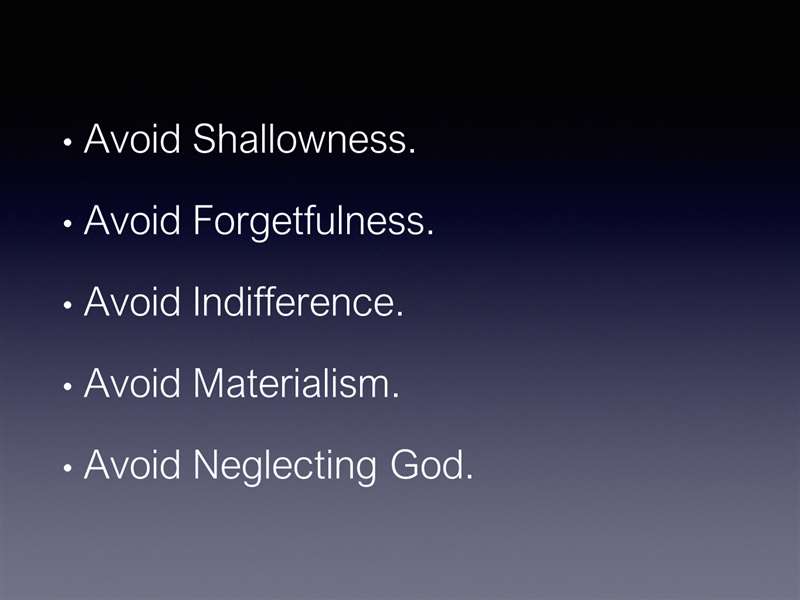
So, we should avoid shallowness. That’s when we struggle to find time to think about God’s Word long enough to apply it. Yet we have time to read the news and email and check our financials and the sports. That’s a danger sign for God becoming weightless. We’ve become shallow. We are not allowing His truth into our lives.
We need to avoid forgetfulness. When we forget quickly what we read in the Word and can’t think of a way to apply it in our life, yet we’re able to describe our vacations and our sports events and our favorite movies to the nth degree, God has become weightless. When we’re reading the Bible, we’re just doing that to get it done if we’re even doing it, and we’re not allowing Him to weigh in. We have to avoid indifference. If our job, our finances, or finding a girl or boyfriend or doing well in school is more important than the Lord, we’re indifferent to Him and He’s weightless. Do you do your homework and excel at everything but your spiritual life? That means God’s weightless.
We need to avoid materialism. We’re carefully devising our financial stability plans and security plans, but we never quite have enough time to get into the Word and get it into our lives every day. That means God’s weightless. And do you know what the Lord does in times like that? He rocks our boats, and we have these disastrous times.
To discipline my time by rejecting profane and empty living, I must reverse the erosion. How do we reverse the erosion?
Look down at Colossians. You should still be there. It’s a choice. Verse 1, seek those things which are above. You just honestly say to the Lord, Lord, everything seems to be more important than you. I want to reverse this erosion. I want to today, Colossians 3:1, to seek those things which are above. In verse 2, set your mind on things above, not on things of the Earth. So, first, reverse the erosion.
Number two, look down at Colossians verse 5; chapter 3, verse 5, put to death your members. He says, starve your flesh. Don’t feed it. Don’t say, I’m going to do whatever I want to do. Say, I’m going to say no. I’m going to put to death my members that are on the Earth. I’m going to seek first to park my mind with You.
Then, look down at verses 15 and 16, let the peace of God rule, in verse 16 of Colossians 3, let the Word of Christ dwell in you richly. I’m going to saturate myself with the Word.
That is the discipline of time. I’m going to reject anything, no matter how good and how not bad it is, if it distracts me from God. And the real key is how much God in His Word directly challenges me into changing the way I think and act on a daily basis? It’s not enough to just open. It’s only enough until I open, I hear in my heart what God has said. And I pause before Him and I say, Lord, I want You to change the way I respond to my problems, the way I respond to my coworkers, the way I look at the purpose of my life, because You’re weighing on me today. The discipline of time, rejecting profane, godless things that are myths, all that entertainment stuff that’s not even real, and inviting God to weigh down on my life, on my time, and say, God, I don’t want You to be weightless anymore in my life and schedule.
Let’s bow for a word of prayer before we go this morning. Oh Lord, I pray that we would choose not to think that this message is for someone else. Every one of us is wired to be so easily distracted. That’s why the Apostle Paul, by Your Spirit, said we have to make a conscious choice to set our minds on things above. Now, right here, while we’re sitting, before we forget, I pray that bowed before You, from our heart of hearts, that we would offer a prayer to You saying, Lord, I want to seek You first. I want You to be the homepage of my life. I want to park my mind on things above. I want to go through life without being distracted by things that aren’t necessarily bad, but they’re my ultimate temptation because they push You to the margin. And Lord, I pray that right here, that we would begin the discipline of time so that Your truth can be the devotion of our heart, because we choose to say, no, I don’t want to do that right now. I want to set my affection, my desires, my attention on things above.
And Lord, I pray for anybody that’s here this morning. Maybe they’re just starting their new life in Christ, maybe they’ve never started, or maybe they’re in the ditch as someone wrote me last week and need a complete overhaul. Lord, wherever we are, You are here. We can cry out to You, but also at the end of the service, the Elders and our godly Titus 2 women of the Word are here, and they would like to pray with anyone. Lord, I pray that You would draw to Yourself those who need to know Your salvation and are those who need a new start in making You the homepage, and making You have a weight on every part of life. We’ll ask You to do this now for the glory of Jesus Christ, and in His precious name we pray. And all of God’s people said Amen. God bless you as you go.
Notes
One of the greatest dangers we face each day as believers is slowly allowing God’s influence over our lives to wane. This condition makes God weightless in our lives. He no longer weighs upon every thought, every choice, and every action of our day.
I wonder how many of us this morning really think that this message is for us. Before we dive in, perhaps we should do a little test for what may be called:
The Great Disconnect
First we think, what is the title of today’s message? The Discipline of Time: “Rejecting Profane & Empty Living” (1 Timothy 4:7a)
“Hmmm”, we think, “not sure that I am involved in anything profane (whatever that is), or that I am living in any way that is empty”.
So, that means I don’t have to really think much about the next 45 minutes. Right?
That is the exercise that takes place, almost unconsciously across America in Bible teaching churches each week. People sit there, notice the topic, do a quick assessment, and tune to other thoughts while they sit through the message.
But now, we need to go on and do the test to determine whether God has become “weightless” in our lives. This test is simple:
How much do God and His Word, directly challenge me,
into changing the way I think and act on a daily basis?
Is God Weightless in Your Life?
A believer, not actively engaged in exercising The Discipline of Time, by “Rejecting Profane & Empty Living”: will slowly become amused, carried along, floating with the current of the world, and going away from God.
This doesn’t mean that a believer immediately goes against God; rather, it is a slow process of the Lord having less and less influence over the priorities of life.
Recently David Wells, a gifted theologian and one of the two founders of the current Alliance of Confessing Evangelicals, expressed this condition well as he said:
It is one of the defining marks of our culture that God is now weightless. I do not mean by this that God is ethereal, but rather that God has become unimportant.
He rests upon the world so inconsequentially as not to be noticeable. He has lost his saliency for human life.
Those who assure the pollsters of their belief in God’s existence may nonetheless demonstrate by their habits and beliefs that:
God is less interesting than television,
God’s commands are less authoritative than their appetites for affluence and influence,
God’s judgments are no more awe-inspiring than the evening news; and
God’s truth is less compelling than the advertisers’ sweet fog of flattery and lies.
That is weightlessness. It is a condition we have assigned God to, after having nudged him out to the periphery of our secularized life.
Weightlessness tells us nothing about God but everything about ourselves, about our condition, about our psychological disposition to exclude God from our reality[1].”
As we open to 1 Timothy, we are opening to a set of exercises prescribed by God to maintain the health of individual members of Christ’s Church throughout all the ages: from the Cross until His Return. These are God’s instructions for us in:
Battling Profane & Empty Living
Paul wrote down what God’s Spirit moved him to write.
We have already seen the first two: the Discipline of Truth, and the Discipline of Devotion.
Now we come to the third in verse 7, but this one would have jumped off the page for everyone in the First Century; but not so much for us.
For a moment, let me show you a screen shot of this text God sent through Paul, but with the parts God wanted emphasized shown in a bright fluorescent orange so that we English speakers and readers can see what those who received Paul’s letter in their native language would have instantly seen. Here is what the text looks like:
1 Timothy 4:7 (NKJV) But reject profane and old wives’ fables, and exercise yourself toward godliness.
Remember that the Greek language has a built in method of showing what is emphasized, by use of a grammatical form statements can be bolded and highlighted for emphasis. That emphasis is called the Imperative Mood. As we enter into v. 7 we bump right into the first of twelve in a row, of these emphasized truths, before we finish the chapter.
If the Lord wanted our attention, He could have used no greater method than to bunch together these dozen requests for us to decide upon, that we see in this chapter.
See how those two words “reject” and “exercise” just jump off the page? God designed it that way. Now what exactly does He want us to notice? The proximity suggests a contrast: reject distractions and pursue attractions is one way we could express this.
A quick study of definitions gives us this insight:
“Profane” is associated with godless things that distract our minds; and
“Fables” are just that: thoughts and activities that are untrue and unprofitable to invest our most precious resource of time and our most vital activity of thinking deeply.
God is explaining that to get the best results from our exercises, disciplines, or training (the second half of v. 7), we need to first respond to His call to reject, avoid, pass by anything that makes God “weightless”, which Paul writes are profane and foolish things.
Welcome to the next installment of:
Biblical Exercises for Spiritual Health & Fitness in 2014
Please stand and follow along in your Bibles as we hear God speaking through the Apostle Paul.
1 Timothy 4:7 (NKJV) But reject profane and old wives’ fables, and exercise yourself toward godliness.
God is asking us to give our mind surrendered to His control.
God is looking for godly, mature believers who will make it a life-long goal to resist the temptation of self-absorption in all the activities of life and instead begin to seek what God desires for their lives.
People of Paul’s day were immersed in a self-seeking, lust-feeding culture.
When they came to Christ they had to go on living in that world. To make it through life without getting neutralized, defeated, and sidelined, Paul starts with the key to godly living, which is:
Avoiding what Displeases God
These exercises from God are to train ourselves in regularly seeking out what pleases Him. In the world that the New Testament was written, saints learned that they had to avoid the overpowering culture of amusements. Most Roman citizens were drawn into the gaming world of spectacles in the arenas.
A non-stop calendar of events began in the capital city of Rome and soon went to the furthest flung provinces, of ever increasingly exciting spectacles: live gladiatorial fights to the death; and men vs. ravenous beasts; and beasts vs. beasts fighting to the death; duels, bloody deaths, shocking sights, and intense visual stimulation. The roar of the crowds became intoxicating and no one wanted to miss the events that often ran all day long for days at a time.
That is why Paul the Apostle wrote to a church nearby Ephesus, where Timothy was serving. Just 100 miles from where 1 Timothy was sent, Colosse was also in the middle of the most Roman province of all. Paul wrote believers in Asia Minor where both Ephesus and Colosse were being doused with everything the Roman Empire had to offer.
Pointing Your Mind Towards God
Paul had a very simple command in chapter 3: choose where you will park your mind, and you choose your destiny. Listen to his sobering words breathed out by the Spirit of God through Paul God’s faithful servant:
Colossians 3:1-4 (NKJV) If then you were raised with Christ, seek those things which are above, where Christ is, sitting at the right hand of God. 2 Set your mind on things above, not on things on the earth. 3 For you died, and your life is hidden with Christ in God. 4 When Christ who is our life appears, then you also will appear with Him in glory.
The overpowering Gladiatorial gaming culture of the 1st Century that troubled, tempted, and weakened the early church has morphed into an even more alluring 21st century, irresistible, and almost inescapable culture, that even the lost world is sitting up and sounding a warning cry about. We need to:
Beware of the Ultimate Temptation
The ultimate temptation is anything that can distract us from God. We are to love Him most, seek Him first, program Him as our destination in life, set Him as the start-up page of our day, and tune our minds to listen Him.
All of those choices come back to our minds. Anything that can even slightly pull our minds regularly away from God is a temptation. Today we live with seemingly the strongest and most universal temptation since the days of Noah.
Have you stepped back and seen where the entire culture of both America and the world are heading?
Almost four years ago, Adam J. Cox is a clinical psychologist wrote a journal article describing the effect on young people, of today’s nearly universal contact with electronic stimuli. Here is a summary of his article in the New Atlantis Journal[2]:
“Fifty years ago, the onset of boredom might have followed a two-hour stretch of nothing to do. In contrast, boys today can feel bored after thirty seconds with nothing specific to do.”
The ubiquitous barrage of battery-powered stimuli delivered by phones, computers, and games makes “the chaos of constant connection” an addictive electronic narcotic.
As continuous stimulation becomes the new normal, “gaps between moments of heightened stimulation” are disappearing; amusement “has squeezed the boredom out of life.” For the hyper-stimulated, “the synaptic mindscape of daily life” becomes all peaks and no valleys.
Cox worries about the deficits in the communication abilities of young males for whom a “womb of all-encompassing stimulation” induces “a pleasant trance from which they do not care to be awakened.”
Self-absorption, particularly among young males, may be the greatest danger of immersion in the bath of digital amusement: “Not only does withdrawal into electronica enable them to bypass the confusion and pain of trying to give their emotions some coherence; it also helps them avoid the realities of being a flawed, vulnerable, ordinary human being.”
Cox doubts it is a mere coincidence that “the stratospheric increase in diagnosed learning and attention deficits” has correlated with “the advent of the electronic playground.” When so many Americans meet the diagnostic criteria for attention-deficit/hyperactivity disorder, it “is arguably no longer a disorder at all—it’s just the way we are.”
Yes, “we.” Not just boys but adults of both sexes, too, seem insatiably hungry for handheld devices that deliver limitless distractions.
Neuroscience demonstrates that the brain is not a finished product; neural networks can be rewired by intense and prolonged experiences.”
The Discipline of Time: “Rejecting Profane & Empty Living”
To the culture so much like ours today, Paul wrote two thousand years ago. But unlike the unsaved and uninspired Adam J. Cox, Paul spoke the supra-cultural, timeless, and divinely empowered words of the Scriptures in Colossians 3 and 1 Timothy 4.
Paul says harness your wandering minds, look in your sights above, tune your souls to Heaven not Earth.
The universal application is that God wants all of us to be: serious about spiritual things; and God Wants all of us restoring others to serious spiritual living.
The Vital First Step
When Paul addressed the church of the first century, he was talking to a world so much like our own.
God wants believers who do not succumb to worldly influences that dull their mind. Any desire, unrestrained by God’s grace can become an intoxicating idol.
Things as harmless as: comfort, convenience, security, work, sports, and amusements—unrestrained by God’s grace, can become as deadly and powerful as addictions to alcohol, drugs, and sex. God becomes weightless because we are:
Drowning Out the Holy Spirit’s Voice
God speaks to us through His Word in what the Bible describes as a ‘still small voice’.
God doesn’t shout, nor does He push. He whispers and waits.
Avoid Shallowness. Do you struggle to find time to think about God’s Word long enough to apply it? Yet you have time for reading the news, emailing, checking financials, and sports? That is the danger sign of God becoming weightless in our life.
Avoid Forgetfulness. Do you forget quickly what you read in the Word, and can’t think of a way to apply it in your life, yet you are able to describe vacations, sports events, and your favorite movies? That is the danger sign of God becoming weightless in our life.
Avoid Indifference. Is your job, your finances, finding a girl or boy friend, or doing well in school more important that the Lord? Do you go to work, do your homework and excel at everything but your spiritual life? That is the danger sign of God becoming weightless in our life.
Avoid Materialism. Are you on a carefully devised financial stability and security plan, yet you always seem to never quite have enough time to let the Word into your life each day? That is the danger sign of God becoming weightless in our life.
Avoid Neglecting God. What do you do first each day: check the news, read your emails, check your Facebook or get into the Word? If it’s not God’s Word first then that is the danger sign of a mind not surrendered to God, and He is becoming weightless.
To Discipline my Time by Rejecting Profane & Empty Living I must: Reverse the Erosion
To be useful God wants a reverent mind and life. The only way to cultivate a reverent mind is to feel the weight of obedience to God’s command that we first reset our minds Godward, as Colossians 3:1-2 exhorts us:
If then you were raised with Christ, seek those things which are above, where Christ is, sitting at the right hand of God. 2 Set your mind on things above, not on things on the earth. (NKJV)
Then with God as our homepage and target, we decide that it is our responsibility to throttle, weaken, and by God’s grace: mortify our lusts, as Colossians 3:5, 8 tells us.
Therefore put to death your members which are on the earth: fornication, uncleanness, passion, evil desire, and covetousness, which is idolatry. 8 But now you yourselves are to put off all these: anger, wrath, malice, blasphemy, filthy language out of your mouth. (NKJV)
To mortify means “to throttle sin and crush it in our lives, sapping it of its strength, rooting it out, and depriving it of its influence.” Mortification involves the cultivation of new habits of godliness, combined with the elimination of old sinful habits from our behavior.
The only way to recover from the irreverence of an eroded mind, a mind that has gotten neutralized, where evil seeps in a bit more each day, is to purse personal sanctification:
To Discipline my Time by Rejecting Profane & Empty Living I must: Starve My Flesh
Romans 13:14 But put on the Lord Jesus Christ, and make no provision for the flesh, to fulfill its lusts. NKJV
Cut all supply routes. If there are magazines, videos, games, social media, and so on, that are less than Christ-like, then I must disable them. Do whatever it takes to starve the influences that make God weightless in your life, and in of your family.
Put on Christ & Starve my flesh!
To Discipline my Time by Rejecting Profane & Empty Living I must: Saturate Myself With the Word
After you read and ponder, work on memorizing key Scriptures that can help you have greater victory over sin, and then regularly meditate upon those verses. Meditate day and night!
Joshua 1:8 “This Book of the Law shall not depart from your mouth, but you shall meditate in it day and night, that you may observe to do according to all that is written in it. For then you will make your way prosperous, and then you will have good success. NKJV
Colossians 3:16 Let the word of Christ dwell in you richly in all wisdom, teaching and admonishing one another in psalms and hymns and spiritual songs, singing with grace in your hearts to the Lord. NKJV
Today, God asks for every believer in Christ’s Church to make daily choices to regain and maintain a mind surrendered to God’s gracious sanctifying power. Resist any weightlessness of God in your life.
How much do God and His Word directly challenge me: into changing the way I think and act on a daily basis. That is:
The Discipline of Time: “Rejecting Profane & Empty Living”
The choice is yours.
May the Mind
May the mind of Christ, my Savior, Live in me from day to day,
By His love and power controlling All I do and say.
May the Word of God dwell richly In my heart from hour to hour,
So that all may see I triumph Only through His power.
May the peace of God my Father Rule my life in everything,
That I may be calm to comfort Sick and sorrowing.
May the love of Jesus fill me As the waters fill the sea;
Him exalting, self abasing, This is victory.
May I run the race before me, Strong and brave to face the foe,
Looking only unto Jesus As I onward go.
May His beauty rest upon me, As I seek the lost to win,
And may they forget the channel, Seeing only Him.
[1] David Wells, God in the Wasteland: The Reality of Truth in a world of fading dreams (Grand Rapids, MI: Eerdmans, 1994), 88, 90.
[2] The costs of ‘the chaos of constant connection.’ George F. Will, August 14, 2010 http://www.newsweek.com/2010/08/14/will-boredom-and-the-costs-of-constant-connection.html [272 words]
Slides