If the video above is not available, here are two other ways to view:
140302AM
ESH-08
Discipline of Integrity.docx
Biblical Exercises for Spiritual Health & Fitness in 2014 Series
The Discipline of Integrity:
“Pursuing Personal Godliness”
1 Timothy 4:7-10
Transcript
But let’s open our Bibles to 1 Timothy chapter 4, and as we’re turning there, we’re looking at the disciplines that Paul lays down for Timothy, and this morning we’ve come to one of the amazing of the disciplines. I think they’re all wonderful, but this one is probably the one that amazes me most at how much people don’t understand the discipline of integrity. That we must be pursuing, we must be making conscious individual choices to pursue godliness.
I was thinking after first service of, because I think in pictures, and I was thinking of how can I portray grace as God offers it? And I started thinking of all my vast sports knowledge. I remember when I was inner tubing once, I don’t know if that’s a sport or not, but when you slid all the way to the bottom of the hill they had this tow rope deal, and it was just operating like a mat, and you would come down to the bottom, and if you sat on your little inner tube and did what you’re supposed to do, it would pull you to the top, but you could sit there all day long. And if you didn’t reach out and grab onto that rope, and it would jerk you because it was going pretty fast, and if you didn’t do that you’d never get pulled up. It’s very much like the grace of God that brought us salvation is there’s a tow rope sitting next to us every day, and this discipline is the integrity to do what we’re called to do and to grab onto and to engage with that grace to pull us.
Another way I remember, if you’ve ever been like out water skiing. You sit there, and if you let go of that little handle that you’re supposed to hold on to, you just keep sitting there. But if you hold on tight and do everything you’re supposed to, lean back and don’t do all the things, you will begin going. But as soon as you take your eyes off the goal, let go or start doing funny things, like jumping the waves, you’ll go tumbling until you get re-engaged. Did you know that the disciplines Paul’s talking about here is that God is like that powerful pulling rope. He wants to get us upward in our spiritual lives, to grow in godliness, but we have to know and do what He asks us to do and hold on by faith.
So, what Paul is doing here is he’s saying, God wants to know how serious we are about following Him. And in 1 Timothy 4, starting in verse 7, God’s Word explains to us we have an appointment, a workout. Paul uses, in this text, the gymnasium, and what he’s comparing the Christian life to is learning the sports of the ancient world. And Paul actually lists three of them that he specifically talks about. Most of all, it’s foot races, but also, he talks about wrestling and boxing, but primarily Paul’s athletic metaphor. In fact, to the end of his life, you all know how Paul, in 2 Timothy 4, ends his writings. He says, I fought a good fight. Now, we think, that’s not boxing. That’s agon, the good agony, which means he’s done a long-distance endurance race. I have finished my course, stadion, which was the racetrack, and I am looking forward, henceforth is laid up for me a crown. And he exactly, to the end of his life, showed his Christian life was like being on a racecourse, running the laps until the final lap. And the whole way, he was looking at the end of the line, in the Greek games was the laurel, kind of a little twisted branch of leaves that was tied together, and the victor would have that placed on their head by the judge, but the judges would put that up on a pillar at the finish line. And it’s like every time they were running, it was seven laps around the stadion, and every lap they were looking at that, and they were looking where they were, and they were making sure they were staying in their lane. But when that final lap came, they were straining toward the prize. Now you catch, that’s Philippians 3. I am reaching forth toward the prize and the upward call of God in Christ Jesus. So, all of Paul’s life he saw himself as an athlete, and he saw the Christian life as being disciplined in a sport, following the rules, working out, training, learning, endurance, and disciplining very heavily his body to do what it’s supposed to do to get him to that mark.
And so, Paul, it says we’re each invited by the Lord to spend time every day working out, and this workout is illustrated by Paul with scenes from the culture of his day. In fact, you can’t read the epistles of Paul without looking at front page events from his culture. And Paul is illustrating for these people, he’s saying, what you look at every day as you see those toned and totally disciplined bodies of the athletes, that’s what you should be in God’s sight spiritually. And he’s using those metaphors and those illustrations well.
The bottom line is Paul says, healthy believers are like spiritual athletes. Just like an athlete will focus, as we’ve just seen with the Winter Olympics. They will focus years of preparation to completely hone their bodies and minds into a short, impactful preparation.
Did you know if you don’t maintain that rigorous schedule, you get totally out of shape? You get totally unable to do if you don’t keep up that rigor, but yet they will do what it takes for years for that short burst of competition that is temporal. Paul says, look at their focus, look at their intensity, look at their discipline, and apply that to what’s going to last forever. They apply it to what is short compared to eternity. You apply it to your whole existence, eternally worshiping God. So basically, in the Greek world, there were many games. There were the great Isthmian games at Corinth. Paul would’ve seen those. He was there a year and a half. There were the great Panionian games in Ephesus. Paul was there three years; he would’ve seen those. And from those huge crowds, where most likely Paul was sharing the Gospel and evangelizing, but he was also tracking and watching and would’ve seen the athletes. He draws the language of the athletics, and he draws the spiritual application that every one of his readers would’ve immediately picked up on, and he says that those disciplines that those athletes have is a way to tie together the elements of sanctification that he’s written about in all of his letters.
And so, with that in mind, 1 Timothy chapter 4, and we’re going to read verses 7 through 10, and what we’re going to hear from Paul is a call to the discipline of integrity. And what he’s saying is, are you personally pursuing spiritual disciplines that lead you toward godliness? Are you personally pursuing, are you doing what we’re called to do? Or do you just know you’re called to do it, and you’re sitting on your inner tube, and the rope’s going by every day, and you are not grabbing onto it by faith and allowing God to pull you into greater and greater godliness and Godlikeness in your life? That’s what he’s saying. Starting in verse 7, let’s stand together for the reading of God’s Word, remain standing for prayer, and let’s listen to the Lord through the Apostle Paul as he says this in verse 7. But reject profane and old wives’ fables and exercise yourself toward godliness. For bodily exercise profits a little, but godliness is profitable for all things, having the promise of the life that now is and of that which is to come. This is a faithful saying and worthy of all acceptance. For to this end, we both labor and suffer reproach, because we trust in the living God, who is the Savior of all men, especially of those who believe. And Paul says, I want you to deny those, verse 7, the bad things to your diet that are going to wreck your health, and I want you to commit to exercising yourself toward what will lead to godliness.
Let’s bow before the Lord in prayer. Father, I pray that this morning as we examine the truth of Your Word, as we see these pictures that were so vivid in Paul’s mind and the longing of his heart to communicate Your truth in a way that people would grab onto. And then as we approach communion at the end of this service, I pray that it would be a time where believers in this body that are hearing Your Word would be drawn, and convicted, and moved by Your Spirit, that it’s time to get engaged in pursuing You and disciplining schedule, and life, and appetites, and habits, and planning to make sure that You are the goal. That pleasing You is the essence of how we schedule our days, and our weeks, and our budgets, and our plans, and that they will be engaged in holding the rope of grace and being pulled into greater and greater Christlikeness. And I pray that we would get the heartbeat of Paul and, through your Spirit, change interior each this day. In the name of Jesus, we ask this, amen.

You may be seated, and as you’re seated I want you to look with me at these, what Paul has already given. I call them eternally beneficial training tips, and this is a whole series of what would be called exercises or disciplines. But this is the heart of them as Paul talks about this in verse 7, but what we’ve already seen are these other disciplines. The first one we started out with many weeks ago is the discipline of truth, and basically, it’s the idea that this is the truth of God, that this is the healthy teaching of God. And we hold up the doctrine of the Word of God so that we can identify false doctrines—by holding up to truth, and comparing, and seeing where they’re deficient or inaccurate—and false teachers. It’s not just the doctrines; it’s the teachers who don’t match up even with the character that a teacher must have to be listened to. And so, Paul says, you need to know the discipline of truth. You need to discipline yourself in truth so that you can expose false doctrine teachers.
And secondly, we saw, if you look down at verse 6 of chapter 4, the second discipline is the discipline of devotion. It’s the idea of being connected to God. It’s the idea that we need to connect to Him until our own soul is nourished spiritually. It’s not whether you have the food, it’s not whether you have the cooking pans, it’s not whether you have all the recipes, it’s whether the food is consumed. And many people go through their life, and they’re assembling this vast amount, they just buy every book, and every tape, and every CD, and they get every resource. The problem is it never nourishes their soul because they don’t have time to allow it to be digested and to actually, just like food after 24 hours comes to the very cellular level, so truth, when it’s nourished, actually comes into our very souls. It transforms us from the inside out, and that’s the discipline of devotion because we love the Lord so much, we want to be nourished by Him.
And then last week we saw the discipline of time. We reject, because God is so important. It’s almost like if you have limited time. In fact, I’m so old I remember when you had phones that had cords on them connected to a box connected to the wall, and you couldn’t go anywhere. You just had to stand however the length of the cord was. But when you talk to someone special, like I remember when I used to talk to Bonnie in New York and I was here in Michigan. My parent says, okay, you have exactly however many minutes we could afford because it was so much per minute. Oh, we got down to business, and I’d say, how are you doing? What’s this? And have you made this plan? How are you doing there? How do you feel? Where are you going? Can I see you? And I’m going to come visit. There was no frivolity there. We were very focused. And what Paul is saying, once you get realizing how important your time is on Earth, you reject anything that’s profane, that displeases God, and anything that’s empty and worthless. When you realize how quickly life is going by, you say, Lord, I only have this one life to give to You. I want to give as much of it as possible to You, so I am not going to allow my life to be consumed with what’s empty and what is profane and doesn’t please You. And that was last week.
But this week it’s the discipline of integrity. Integrity is saying that I want to live out the personal pursuit of godliness. I don’t just want to talk about it. Integrity means what I talk about, I’m doing. I’m not trying to live up to what I have taught. I want to teach what I’m living. I want to have integrity in my life that if I say I belong to the Lord, I do. If I say that You bought me with the price, I want to glorify You, I am, and that’s what that personal engagement, holding on to the powerful grace of God that wants to transform us.
And so, what Paul does is he begins to give the elements of what it means to live in the arena, that’s the sports arena, that’s focused on eternity. And what he said is, I’m living my whole life in the arena with everyone watching me, and I am living it running toward the finish line of pleasing Jesus Christ, and so he goes through a succession of explanations. Paul always shined the light of eternity across the temporary diversions of human life. Paul was so aware that life was brief and eternity was not. And Paul said, my priorities are tied to where I’m going, and he says, every day when I orient my day, he says, I look toward the upward call, that’s Philippians 3:14, of God in Christ Jesus. I realized when I was saved, I was called with a holy calling. That’s where I’m going, and I want everything in my life to line up and to be fitting on the pathway that leads toward pleasing God. Do you see how focused he was? Even when he was looking at the races he was saying, boy, the way that they prepare is how I want to prepare for Heaven. The way they’re straining toward the finish line is how I want to strain toward the finish line of Heaven, and basically, the Apostle Paul is using all of the elements of the gymnasium to say that’s how we should live.
Let me show you an example. Paul used the elements of the sport of boxing. You say, really? Yeah, in 1 Corinthians 9. He uses the word hypopiazo, and that was a word. In fact, I grew up in a boxing family. Both my father and my older brother won different fights in the Golden Gloves tournament. They were big boxers. From my earliest days, my dad was always saying, you got to keep this one back, and keep this one up always protecting, and you’re always dancing around. And I said, I’d rather read a book. But he would constantly do that, he’d do all of his things and make me punch at him and everything, and I didn’t ever like it. But I remember once when I was on the playground, someone did something, and I didn’t even think. I went like this, and I went, wham! Oh, and their blood, and they fell over. I said, I never want to do that again. Then the principal said, and you won’t ever do that again. And that was the end of my boxing career.
But what Paul said is we’re supposed to be hypopiazo-ing ourself. See, that’s when my dad taught me that there was a little spot, and I missed it, I got the nose. I was trying to knock them out, and I actually bloodied their nose. But he said, if you hit that spot, you’ll knock them right out. Paul said, spiritually we’re supposed to be boxing ourselves so that our flesh does not impede us from following Christ. We have an enemy within; it’s our flesh, and our flesh lives for this world that doesn’t live for Heaven. And if we are not denying ungodliness and giving ourselves, buffeting our body, that’s what Paul says in 1 Corinthians 9. A lot of people buffet their body. Paul said, buffet it, and be beating it down, and if we don’t do that, then our flesh trips us up.
Secondly, Paul used the elements of the sport of wrestling. That’s Ephesians 6, for we wrestle not against flesh and blood. And what he’s saying is in wrestling, you’re always being cautious because you make a wrong move, and they start pulling your arm in, and twisting you around, and getting you so you’re headed toward being pinned. You don’t want that, and you’ve got to be constantly on guard. And that’s what that whole spiritual armor is, that we never allow any chinks in our defense because we’re in this constant hand-to-hand, face-to-face, agonizing wrestling match with the forces of darkness.
And finally, Paul’s favorite is that last one. Paul used elements from the sport of foot races to describe how we live every day of the Christian life. Staying in our lane, focusing on the goal, running for the prize, keeping our eye on that prize and the Judge who awards that prize. All those are metaphors.
So, basically what Paul is doing, and if you look where we’ve been so far, he said, the discipline of truth is we find God’s Word as our Source that leads us to the discipline of devotion. We love God with all of our heart, and we want to be devoted to Him and connected to Him, and that leads us to the discipline of time. We don’t want anything that doesn’t please Him. We reject profane and empty things because the higher goal, that pleasing God is our goal, and that leads us to this morning, the discipline of integrity. That we’re going to pursue personal godliness, the way God says that it’s attained, and that’s through the means of grace that He has ordained.
And basically, what we’re talking about is, what we would call the discipline of integrity is really personal sanctification. See, personal sanctification is when I choose to hook onto the tow line. God’s grace is going to tow me against the current of this world and against the gravity and uphill and toward growing in Christ’s likeness. But if I neglect that discipline of engaging with that tow line of His grace, I’ll be sliding down the hill. I will never make to where He wants me to be to accomplish His plan, and personal sanctification is vital to understand. If you don’t understand the concept of what God’s goal is, then we won’t really live in that arena. We were saved only by the accomplishment of Christ’s sacrifice on the cross. That’s what justification is all about, that it’s only what He did that opens the door for His continued work in our life as we, by faith, embrace it.
So, let’s just do a quick survey of the differences between, because a lot of people get mixed up with justification and sanctification. Justification is totally what God does. Sanctification is totally what God wants me to cooperate with Him doing. I have to connect; I have to get involved. So, justification is what Christ did for me on the cross, but sanctification is what Christ is doing in me because of the cross. So, Christ wants to do something in me. But secondly, justification is immediate. It was completely finished the instant I was saved. But sanctification is an ongoing process. It’s never completed on Earth until I meet Jesus face to face at death or His coming. So, that’s why we call it progressive sanctification, which leads to ultimate sanctification when we are perfected in His image. But the process here on Earth is a progression, Paul says, from glory to glory, that we’re changed into His image.
Thirdly, justification is activated the moment I trust in the personal, in Christ Jesus and His finished sacrifice on the cross. But sanctification grows, listen to this, with each obedient choice I make empowered by the Holy Spirit. Every time I click on to His grace that wants to pull me forward, every time I discipline myself, every time I exercise and allow Him to train me, I am agreeing with what He wants to do. That obedient choice, empowered by the Holy Spirit, grows my progress and sanctification. I can just, because I see in pictures, I see a lot of people sitting on their inner tubes. The tow rope’s just going by, and they’re just sitting there. They’re going, man, I don’t understand, I’m just like I was 30 years ago. I’m just as unsanctified as ever. What’s the problem? The problem is not making those obedient choices.
And the last slide, justification is my position declared right in God’s sight, but sanctification is my practice made right by becoming more conformed to His image. God wants me to begin progressing toward what I already am because of Christ’s finished work. What I’m going to be forever, I’m seated in heavenly places with Christ. That’s my perfection in Christ. But boy, this Earth is far from that. How do we get from here today to there? The Lord says, you hook on the tow rope of My grace by your obedient, conscious, active, obedient choices to discipline yourself for the purpose of godliness, and that’s His plan.
Basically, the doctrine of sanctification is all about our walk. Paul is speaking of salvation in two parts. Part one, we receive Christ. Part two, we walk in Christ. Receiving Christ is justification by faith. Walking in Christ is sanctification by faith. The words in Colossians 2, as you received Christ—that’s justification—so walk in Him—that’s sanctification. It’s all connected. These two doctrines are joined like two sides of one coin. The justified ones go toward becoming the sanctified ones. As we were saved only by the accomplishment of Christ’s death on the cross, so we live each day by the same faith by which we were saved. We’re always dependent on Christ’s gracious death on the cross that saves and keeps us, but the sanctification part, described by God, from our perspective is a chosen daily spiritual workout.
Do you think the athletes we recently saw on television in the Olympics, do you think they just got up from the couch where they’ve been eating potato chips and watching television 16 hours a day and just went to the competition and excelled? No way. They had a trainer, and they had a schedule, and they had a coach, and they had a team, and they had to report. In fact, when I was in East Lansing, we had a figure skater that was, I don’t know if she ever made the Olympics, but she was in the Olympic qualifications, and I remember going to school with her. She always had a red nose and red face every day in school, and it’s because she was at the skating rink at 4:00 AM, and she skated three hours before school every day. Now, that is the focused discipline for a temporal prize. And Paul says, why don’t you decide you want the same for an eternal benefit, for pleasing Christ?
So basically, and it was 11 years ago that there was a speaker where I’m, tonight Bonnie and I are driving Chicago, we’re going to Shepherd’s conference. But there was a bald-headed speaker. Boy, I like those bald-headed ones. His name was C.J. Mahaney, and this is what he taught 11 years ago. I typed it out for you. Sanctification is a process. It is the process of becoming more like Christ, of growing in holiness. This process begins the instant you’re converted, and it will not end until you meet Jesus face to face. Through the work of His Spirit, through the power of His Word and the fellowship with other believers, God peels away our desires for sin. Notice who’s doing it. Sanctification is me cooperating with God peeling away the layers of my desires for sin. It doesn’t stop there. God renews our minds, and God changes our lives. Sanctification is about our own choices and behavior. It involves work. Empowered by God’s Spirit, we strive, we fight sin, we study the Scriptures and pray even when we don’t feel like it, we flee temptation, we press on, we run hard in the pursuit of holiness.
Now look down at your text, and I want to show you how Paul, he has two parts to his message starting in verse 7. He says in 7, we’re supposed to reject the wrong diet that will lead to spiritual ill health; that’s anything profane and empty. And we’re supposed to pursue this exercise program toward godliness.
Now look in verse 8, his first point, there are temporal benefits for physical exercise. And what he says here is, for bodily exercise profits a little, and what he’s saying is Paul is describing the discipline of integrity by comparing it to the effective but temporary bodily exercise. Paul agrees we need to take care of our bodies. Exercise is part of that care. We’re God’s temple, and the best way to keep God’s temple operating, and useful, and usable by God is to keep our bodies in shape. We want our bodies fit as we present them as instruments God can use for His service. But the key Paul is bringing up is bodily exercise only benefits us during this life. It’s temporal.
I always remember, and I’ve told this story many times, but it’s so vivid in my mind. Bonnie and I sat down to breakfast in Los Angeles in 1984, and across the table from us was the premier weightlifter of the day, Mr. Universe himself, Arnold Schwarzenegger. And I bumped her, and I said, honey, we’re sitting with Arnie. Bonnie said, Arnie who? He looks up at us, and he was just finishing, and as he pushed his chair back and stood up, his legs were that big around. They look like a Greek statue. And do you think he still looks like that? The Los Angeles Times recently caught him out on the beach. I mean he, all of those muscles have gone south, and he’s just, he looks like actually like a hippopotamus with layer after layer of skin because he had bulked up this big, and he has lost all that mass, and it was just layers of ridges. And I thought, if you don’t keep it up, you lose the benefit. It’s very temporary. So, that’s the first point Paul makes.
But look at this. He goes on to say, but godliness, in verse 8, is profitable for everything. It has the promise of life that is now. It’s the best life that you could live in the short time we’re on Earth, and it’s the best of that which is to come. He says godliness benefits forever. He’s saying there are eternal benefits for exercising spiritually. Now, he begins telling us, and turn back with me to 1 Corinthians 9, and we will have to pick up with this later.
I want to show you the three workouts, but here’s just the first one. Okay, 1 Corinthians 9, and what he’s talking about is learning to run, learning how to run the race. And the Apostle Paul, in fact if you take all of the metaphors that he puts into this passage, he’s saying that we need to learn to run, and that means looking ahead toward the Bema Seat of Christ. And what he does is he makes the whole picture of the foot race, and he applies all of that to our spiritual lives with Christ as the Judge, with our crown and reward in Heaven as what’s hanging at the finish line, and us as the athlete running the race.
And basically, if you merged in all of the words that Paul gives, in 1 Corinthians 9:24 he says, do you not know that those running in a racecourse, and he uses the actual word stadion for the racetrack. All run indeed, but only one gets the prize. Now he applies it to us, run that you may win. Everyone who contends, and there he uses the word for, agonizomai means to be in the agon, that was the name of the race. It was agonizing. It was an endurance race. And he says, everyone who contends, or agonizes, is self-disciplined in everything that they might win the perishable stephanos, that’s the branch. They practice for four years, the original Olympians, and they didn’t get a gold, silver, or bronze medal that they could sell on eBay or sell for gold. They got a stick that was bent in a circle that had leaves on it that dried out and became brittle and went to powder very quickly. And he says, they do it for this perishable victor’s crown, but we for an imperishable. Therefore, I run, Paul says, that’s the word trecho. Trek, trekking, that’s a Greek word. Trekking was opposed to peripateo, which is walking one foot another. A trecho was fast putting one foot in front of another. So, he says, I’m running, I’m trekking, not as uncertainly. But I box, not as shadow boxing. I punch, that’s the hypopiazo word, my body and enslave it. That word bring it into subjection means to enslave. He says, I am learning how to connect so often to the tow rope of God’s grace that my body is enslaved to go His way. I want it that way. I want to enslave my life to God’s plan, not to the world, the flesh, the devil, and the temporal. And then he says, lest perhaps having proclaimed to others, look at verse 27, I should become a failure. The New King James says, disqualified, that’s exactly from the races.
There was a judge who stood up overlooking, in fact, there were several of them. They watched every inch of the track, and they watched to make sure you stayed in your lane, you didn’t cut corners, you didn’t do anything that the rules said you could not do. And if you ever did it, at the end of the race, they would let you keep racing, but at the end of the race, no matter where you came in, they would call out, runner number three is disqualified. Now a lot of people, Arminian types, think that means you lose your salvation. That’s because they don’t understand the games. Only citizens could compete in the games. Slaves could not compete in the Olympic games, only citizens. If you were disqualified from the games, you didn’t lose your citizenship; you only couldn’t win the crown. It was all about rewards, and what Paul said is, I am learning to run, which means I’m looking ahead toward the Bema Seat of Christ. He is not only the Referee, the Judge, He’s the one that hands out the rewards, and He says, I want as much of my life as possible to be staying in the lane, following the course He planned for me, and finishing the race to hear His well done. That’s the discipline of integrity that I don’t just know this, but I’m personally pursuing personal godliness.
Notes
Today God wants to know how serious we are about following Him, as we open to 1 Timothy 4:7-10. God’s Word is explaining to us that we have an appointment for a workout in the gym. God Himself wants to train us in how to live, walk, and grow in Christ. The Discipline of Integrity means we choose to do what God’s Word says we are supposed to do.
As Paul continues to relay God’s message to each of us, we remember from last time Paul used the highest level of emphasis that is possible to convey in the Greek language. Remember those bright colored words that stand for the emphasis God placed on them grammatically?
We are each invited by The Lord to spend time each day: working out. This workout, is illustrated by Paul, with scenes from the culture of his day. Guided by the Spirit of God, Paul uses the examples of the three most well known sports from the gymnasium, and applies them to the life of every believer.
Just as our world has recently witnessed the modern Olympics, so Paul’s world also had witnessed the ancient and original Olympics for hundreds of years. Paul was so focused upon God that he could even see spiritual illustrations in those huge sports events. Paul says that:
Healthy Believers are Spiritual Athletes
In the Greek world there were the great Isthmian Games at Corinth; and the great Pan-Ionian Games at Ephesus. These led to what was the greatest of all the games, the Olympics held every four years.
After three years of ministry in Ephesus and one and a half years of ministry in Corinth, we can see the impact Paul’s exposure to these games had on his ministry. So, using athletic metaphors, Paul explains the pathway to long-term spiritual health for believers. Once we are saved, God wants us to be growing in Christ-likeness, that is what spiritual health is all about: reflecting Christ from more and more areas of my life.
Paul now explains these disciplines in a way that ties together elements from many of his other letters. Paul uses the pictures from every day life around the first century believers: The world of the gymnasium in 1 Tim. 4:7-10. Please stand and follow along in your Bibles as we hear God speaking through the Apostle Paul.
1 Timothy 4:7-10 (NKJV) But reject profane and old wives’ fables, and exercise yourself toward godliness. 8 For bodily exercise profits a little, but godliness is profitable for all things, having promise of the life that now is and of that which is to come. 9 This is a faithful saying and worthy of all acceptance. 10 For to this end we both labor and suffer reproach, because we trust in the living God, who is the Savior of all men, especially of those who believe.
Eternally Beneficial Training Tips from God
Nestled right here in this chapter: we have genuine, spiritual, life-coaching, poured out from the heart of Paul. What did Paul say were “the disciplines” to practice?
The Discipline of Truth: Expose False Doctrines & Teachers (4:1-6a)
The Discipline of Devotion: Nourish your own Soul spiritually (6:6b)
The Discipline of Time: Reject all forms of profane & empty living (4:7a)
The Discipline of Integrity: Pursuing personal Godliness (4:7b-10)
Paul fills his writings with metaphors, images, and illustrations pulled right off from the front pages of his life. He talks about believers as “temples”, giving our bodies back to God like “slaves”, and that we wear “armor”, enduring hardness as “good soldiers”, all the while running the “race” of life. Right there we see just a small sampling of the culturally vivid communication Paul displayed as he was guided to record the Word of God.
But above nearly every other image, illustration, and metaphor, it was the whole realm of the athletic competition of the Roman world, that Paul most loved to use. Even to his last words he reminded us that to him life was a racecourse that he was finishing, and that God Himself was the trainer, referee, and judge for every event of life.
Living Life in the Arena of Eternity
Paul always shined the light of eternity across all the temporary diversions of human life. He was so aware that life was brief, and eternity was not. Paul’s priorities were rooted deeply in the place where he was headed, and he wanted ours to be also. The Discipline of Integrity means we choose to do what God’s Word says we are supposed to do.
Most likely Paul was sharing the Gospel when the crowds filled these cities; but there was something else about these athletic contests, which found a place in the heart of Paul. He saw a picture God could use to help believers understand daily life. From the gymnasium Paul chose to use three sports to illustrate disciplines in our lives as followers of Christ.
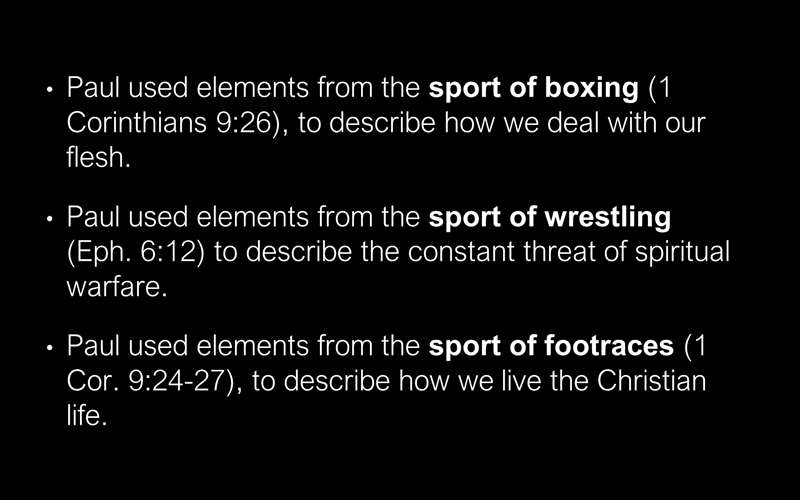
Paul used elements from the sport of boxing (1 Corinthians 9:26), to describe how we deal with our flesh.
Paul used elements from the sport of wrestling (Eph. 6:12) to describe the constant threat of spiritual warfare.
Paul used elements from the sport of footraces (1 Cor. 9:24-27), to describe how we live the Christian life. He used the most famous of all the competitions, referring to the herald that summoned racers to the starting line (1 Corinthians 9:27), and describing runners straining towards the finish line (Philippians 3:14).
Then, Paul captures the scenes of judges awarding prizes at the end of the games (2 Timothy 4:8). Paul refers to the laurel crown of the winner (1 Corinthians 9:24; Philippians 4:1). Paul uses the focused training every athlete had to choose, and the strict rules that had to be observed (1 Timothy 4:7, 8; 2 Timothy 2:5).
That whole process of training and staying in the race is called sanctification. Paul lays down the elements of personal sanctification in 1 Timothy 4. These elements are each what we can see as a set of disciplines:
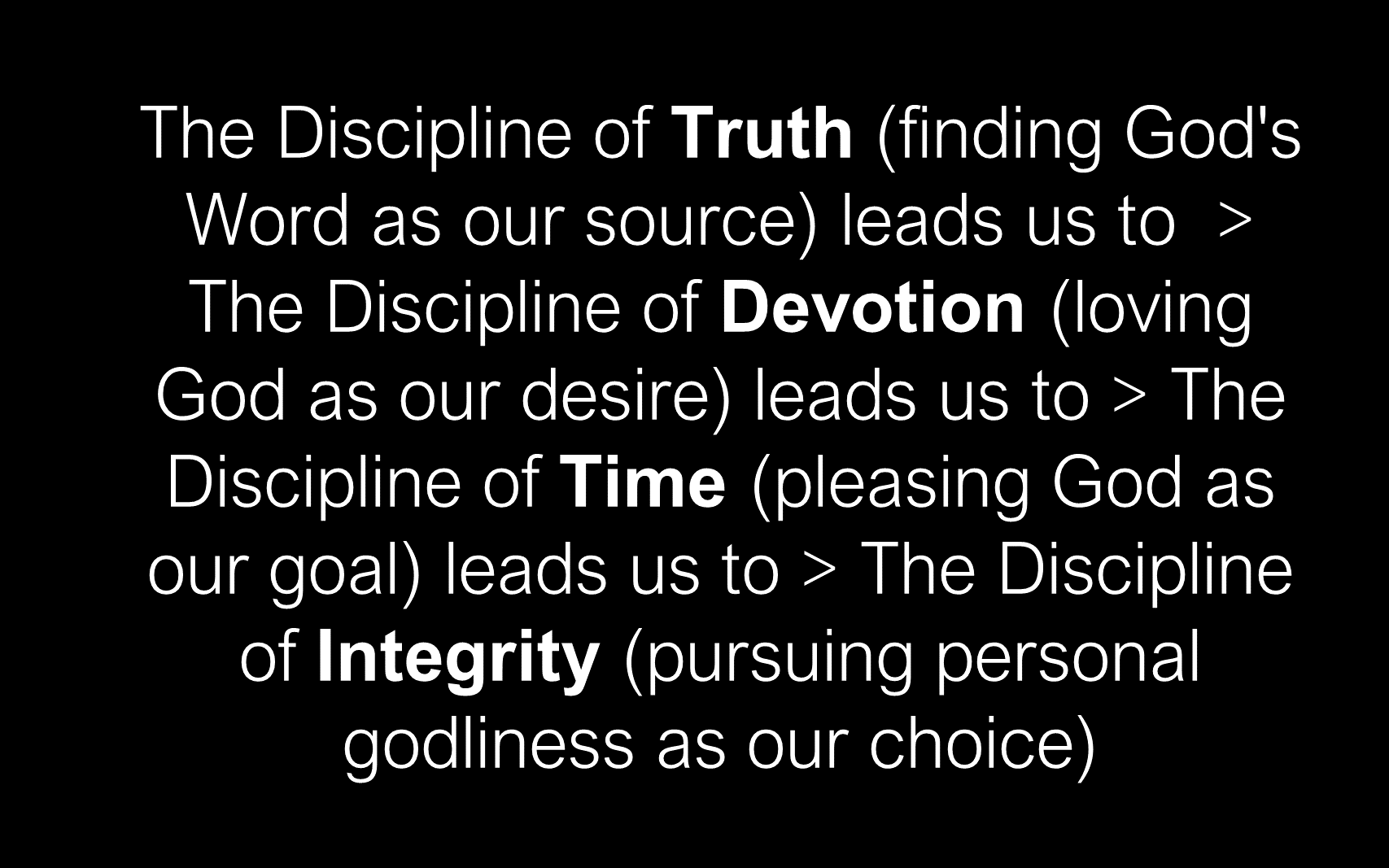
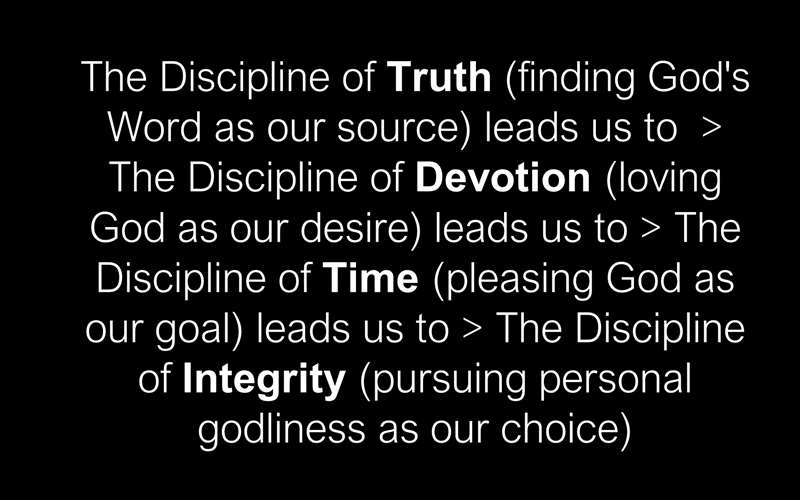
The Discipline of Truth (finding God’s Word is our source) leads us to >
The Discipline of Devotion (loving God is our desire) leads us to >
The Discipline of Time (pleasing God is our goal) leads us to >
The Discipline of Integrity (pursuing personal godliness as our choice)
The Discipline of Integrity is Personal Sanctification
As we were saved only by the accomplishment of Christ’s sacrifice on the cross—so we live each day ‘by faith’ (the same faith by which we were saved). We are always dependent upon Christ’s gracious death upon the cross that saves and keeps us!
There are two sides of the coin of salvation. We could call those two sides faith and works as James does. Another way would be to use Paul’s words from Romans—justification and sanctification. To best understand what Paul is asking us to do here in 1 Timothy is to contrast and explain justification and sanctification.
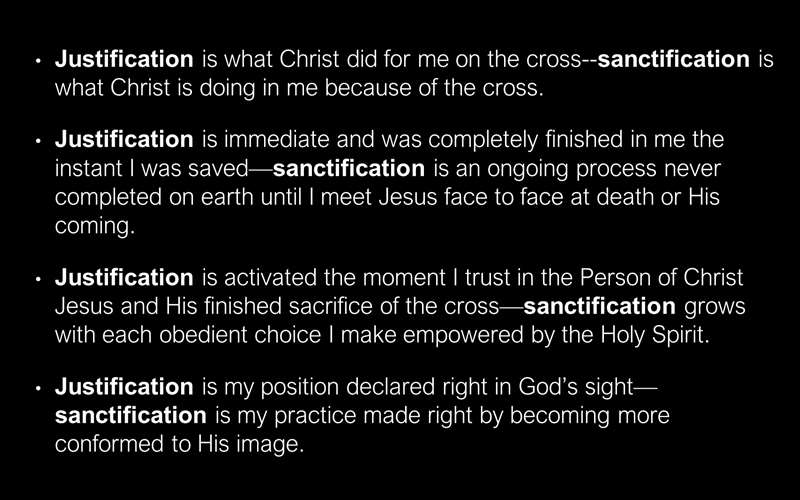
Justification is what Christ did for me on the cross–sanctification is what Christ is doing in me because of the cross.
Justification is immediate and was completely finished in me the instant I was saved—sanctification is an ongoing process never completed on earth until I meet Jesus face to face at death or His coming.
Justification is activated the moment I trust in the Person of Christ Jesus and His finished sacrifice of the cross—sanctification grows with each obedient choice I make empowered by the Holy Spirit.
Justification is my position declared right in God’s sight—sanctification is my practice made right by becoming more conformed to His image.
The Doctrine of Sanctification is Our Walk
Again, Paul speaks of salvation in two parts: receiving Christ & walking is Christ.
Receiving Christ is Justification by faith. Walking in Christ is Sanctification by faith. The words “as you received Christ, so walk in Him” of Col. 2:6, joins these two doctrines as the two sides of one coin. The justified ones go on towards becoming the sanctified ones.
As we were saved only by the accomplishment of Christ’s sacrifice on the cross—so we live each day ‘by faith’ (the same faith by which we were saved). We are always dependent upon Christ’s gracious death upon the cross that saves and keeps us! But, sanctification from our perspective is described by God as a:
Chosen Daily Spiritual Workout
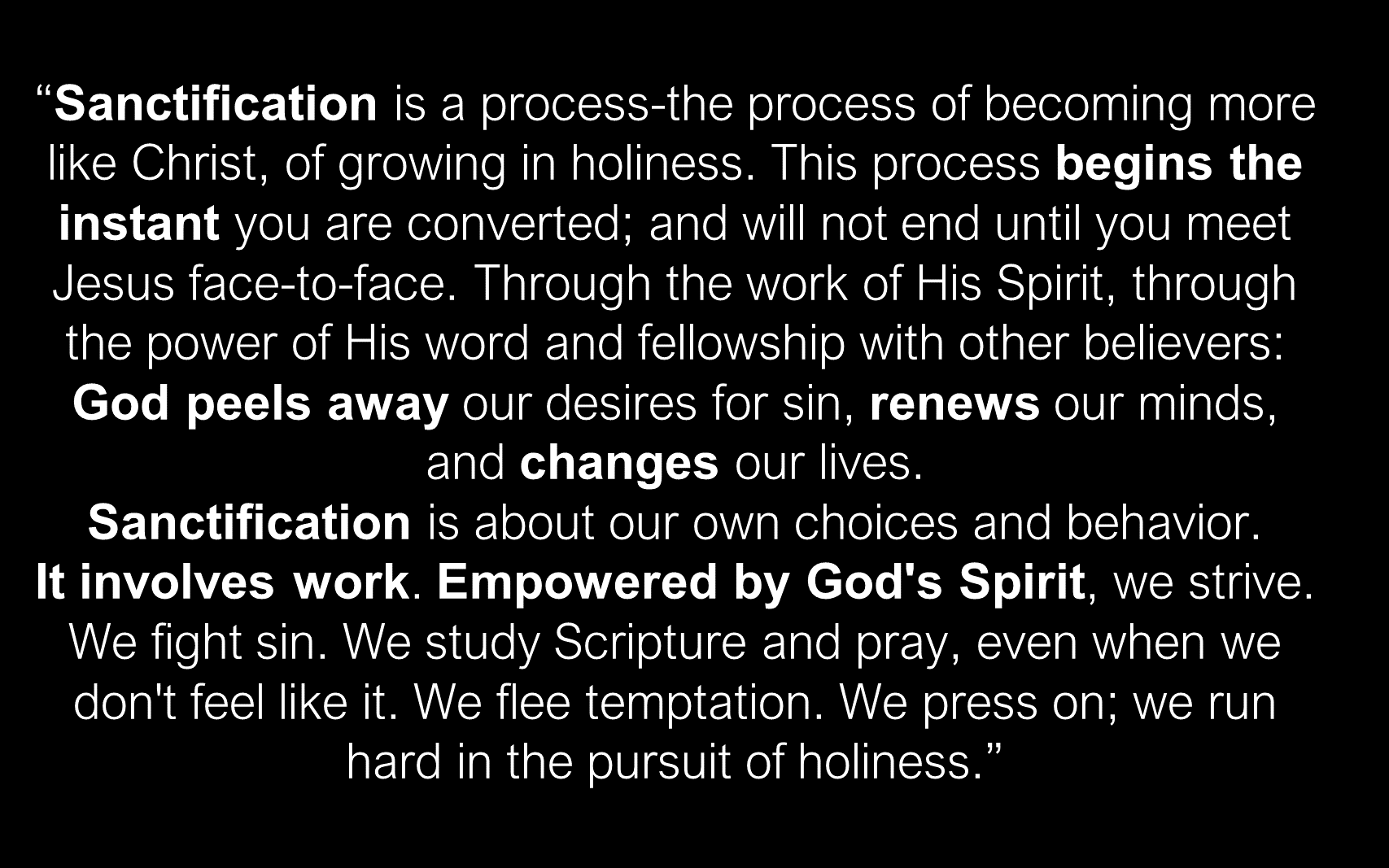
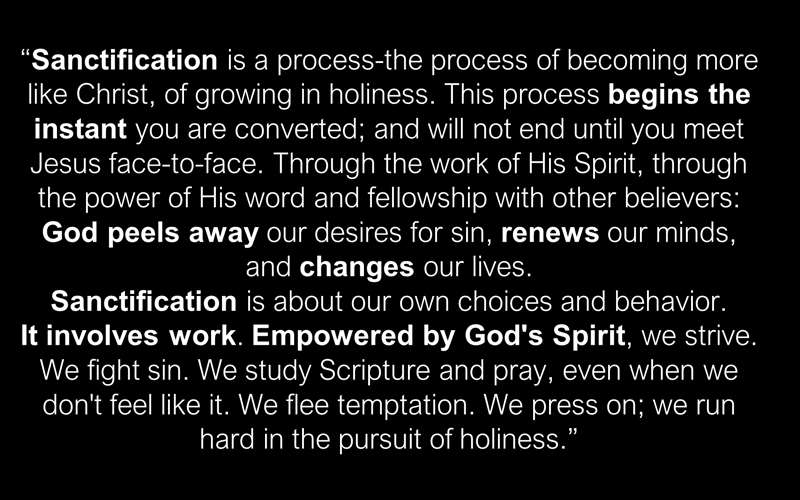
“Sanctification is a process-the process of becoming more like Christ, of growing in holiness. This process begins the instant you are converted and will not end until you meet Jesus face-to-face.
Through the work of His Spirit, through the power of His word and fellowship with other believers, God peels away our desires for sin, renews our minds, and changes our lives. Sanctification is about our own choices and behavior. It involves work. Empowered by God’s Spirit, we strive. We fight sin. We study Scripture and pray, even when we don’t feel like it. We flee temptation. We press on; we run hard in the pursuit of holiness. (C. J. Mahaney, The Cross Centered Life, Sisters, OR: Multnomah Publishers, 2002, p. 31-34.)[1]
As we look at the words of 1 Tim. 4:8, Paul first declares:
The Temporal Benefits of Physical Exercise
First, Paul describes the discipline of integrity by comparing it to the effective but temporal—“bodily exercise” (vv. 7–8). Paul is agreeing that we need to care for our bodies, and exercise is a part of that care. As God’s Temple, we care for our bodies, so they can be used for His glory (1 Cor. 6:19–20). We also want our bodies fit when we present them as instruments God can use in His service (Rom. 12:1–2).
The key issue Paul brings up is that bodily exercise can only benefit us during our earthly life; but every godly discipline is both profitable for daily life as well as eternal life. Paul is not advocating “either-or”, but “both”; and he underscores that our greater emphasis should be on pursuing godliness.
As we have seen from the start of this series, the English word Discipline in our Bibles comes from the Gk. gumnazō, from which also we get the English words “gymnasium” and “gymnastics”. The Greek dictionary defines gumnazo as: the rigorous, strenuous, self-sacrificing training an athlete undergoes.
Every Greek city had its gymnasium, and young people spent much of their time from ages sixteen to eighteen in physical training. Roman culture emphasized physical training and the glory of winning athletic events.
By guiding Paul to use gumnazō, God’s Spirit was illustrating from Greek culture the truths of the spiritual realm. Greek culture strongly emphasized personal athletic exercises, so Paul called Timothy to discipline his life for personal exercises in godliness.
By using a verb in the present tense, God was guiding Paul to tell Timothy that this was to be a constant, daily routine that stimulated a godly lifestyle.
Paul used athletic images in his letter to the Corinthians (1 Cor. 9:24–27), also emphasizing the discipline God prescribes for godly living. Just as athletes train their body to obey the rules, so believers must make their bodies submit to pleasing God. Each time we see any athlete, we can be reminded that there are spiritual exercises that we should be doing (Heb. 5:14). These exercises are the basics: praying, meditating, fellowshipping, serving, sacrificing, submitting, witnessing—all of these, assisted by the Spirit, shape us into godly people.
Spiritual exercises are never easy; and believers must “labor and suffer reproach” (1 Tim. 4:10a, NKJV). In other translations that say: “For this we labor and strive” (NIV), we see the sense of the athletic imagery, as “strive” comes from the Gk. word that sounds exactly like the English word agonize. Paul was explaining that to excel as a believer, God calls us to labor by His grace, and to strive for His glory. Like athletes that struggle and strain in the training and competition (called agonidzomai), so the normal life of following Christ is likewise to be an agonizing struggle of faith, empowered by grace.
Physical exercise has great benefits, but only for a very limited time. Spiritual exercise has an even greater benefit both for daily living, and for all eternity. This truth of the present and eternal benefit of spiritual disciplines or exercises is so important, Paul says in v. 9 it a trustworthy statement deserving full acceptance. Paul is saying that believers, diligent about their spiritual exercises, reap such eternal value, that everyone recognizes that truth.
The Eternal Benefits of Spiritual Exercise
Next, in 1Tim. 4:8 Paul contrasts the benefits that are only temporary with those that can be eternal. He says the eternal benefit we should exercise for is godliness in v. 8b. Godly living and Christ-like character is vastly more important than golf trophies or home-run records. True believers can have both. But, Paul here challenged Timothy, and us today, to be as devoted to seeking godliness: as an athlete is to his sport. We are to be living each day aware that we are laboring for eternity.
The Gk. Word eusebeia is translated godliness, and it expresses life when reverence for God fills our lives. As we saw last time, we feel the weight of God upon every part of life. We need to ask God to train us in how to respond to Him as our true Creator. We need the sacred reality that we are temples where God actually lives. That means there is a respect from us that is due to God. That is our highest calling in life.
A life of respect for God, is: a life of godliness. This word is repeated three times in 1 Tim. 6, and teaches us that: godliness is the heart of truth (6:3); and godliness must be pursued by believers (6:11); and godliness with contentment brings great gain (6:6). Peter adds that when we live for Heaven, we live for godliness (2 Pet. 3:11).
The lack of cultivating these spiritual disciplines that promote godliness is the primary reason so many believers fall into sin. If we neglect the time investment needed, we don’t cultivate the very means of grace God has provided to nurture our lives.
God has chosen to dispense His grace by means of: time in the Word, time in prayer, and time in self-sacrificial ministry to others. Believers who choose to pursue these disciplines of godliness, instead of worldly success (1 Tim. 1:5; 2:8; 6:11; 2 Tim. 2:1, 21–22), will one day hear the Lord say to them, “Well done, good and faithful slave” (Matt. 25:21).
Three Workouts for Life
Of the different games the New Testament mentions three: racing, boxing, and wrestling. The race is mentioned most frequently. In each of the three pictures of athletic life as employed in the New Testament there is prominent a special view-point of the spiritual life and effort.
Workout-1: Learning to Run means Looking Ahead towards the Bema Seat of Christ.
The verb “reaching forth” in Philippians 3:13 literally means “stretching as in a race.” The Gk. trecho, lit. run) translated as the race looks forward to the heavenly goal, our “high calling” from God in Christ, to live for the realm above (Phil. 3:14). This is the meaning of Philippians 2:12–13: “Work out your own salvation… for it is God which works in you.” God gives each Christian a lane to run down during the race of our human life. We each were designed by God (Eph. 2:10) with a goal to achieve for God (His will for us). If we reach that goal, we receive His reward. If we fail, we lose His reward (1 Cor. 3:15), but we do not lose our citizenship in Heaven (salvation).
Paul says in Philippians 3:13 “forgetting those things which are behind”. It is an impossible[2] feat of mental and psychological gymnastics to try to erase the sins and mistakes of the past. That is not what Paul asks; rather he explains that we break the power of the past by living for the future. Apart from senility, hypnosis, or a brain malfunction, no mature person can forget what has happened in the past. We may wish that we could erase certain bad memories, but we cannot.
“To forget” in the Bible means “no longer to be influenced by or affected by.” When God promises, “And their sins and iniquities will I remember no more” (Heb. 10:17), He is not suggesting that He will conveniently have a bad memory! This is impossible with God. What God is saying is, “I will no longer hold their sins against them. Their sins can no longer affect their standing with Me or influence My attitude toward them.”
Workout-2: Learning to Box means Looking Within at our disloyal flesh wanting to hinder us in the race.
Follow along in 1 Cor. 9:24-27 as I point out the all the Roman cultural metaphors in these verses: “Do you not know that those running in a race-course (stadion) all run indeed, but one attains the prize. Run thus, that you may win. Everyone who contends (agonidzomenos) is self-disciplined in everything, that they indeed might win a perishable victor’s crown (stephanos), but we an imperishable. Therefore I run (trecho) thus, not as if uncertainly; I box (pukteuon) thus, not as if shadow-boxing; but I punch (hupopiadzon) my body and I enslave it (dulagogeo), lest perhaps having proclaimed to others, I myself should become a failure (adokimos)” (1 Cor. 9:24–27). This Gk. word adokimos meant “disapproved, disqualified.” The disqualified Greek athlete did not lose his citizenship, only his opportunity to win a prize. The whole emphasis is on rewards, and Paul did not want to lose his reward”[3].
Any contestant found breaking the training rules was automatically disqualified. In recent years, Evangelical Christians have rediscovered the relationship between a disciplined body and a Spirit-filled life. We must, of course, avoid extremes. On the one hand, religious asceticism is unhealthy and of no value spiritually (Col. 2:18–23). But on the other hand, there is something to be said for disciplined eating, exercising, and resting, and a Spirit-directed balanced life. The Discipline of Integrity means we choose to do what God’s Word says we are supposed to do.
We smugly congratulate ourselves that we do not smoke or abuse alcohol, but what about our overeating and being overweight?
We loudly proclaim our liberty in Christ and yet we are so bound by our stress overloaded lives that many Christians cannot discipline their time so as to have a consistent devotional life or Bible-study program[4].
Workout-3: Wrestling means struggling against the powers of darkness by learning we always need Christ’s armor.
This refers to our fight with the powers of darkness around and beneath us. Thus Paul says: “Our wrestling (Gk. pale) is against the principalities, against the powers, against the world-rulers of this darkness: (Eph. 6:12). Only wearing the armor of being clothed in Christ protects us from those snares.
The Result is Spiritual Strength
The New Testament epistles call us to personal purity or holiness, and are built around dozens of imperatives (or requests). Remember that God never asks me to do what He hasn’t already given me the grace to accomplish by faith through His Spirit!
“Our participation in the process of sanctification comes only after we’ve been totally accepted and made right before God through faith in Jesus. So yes:
We work hard at obeying God’s word.
We read our Bibles.
We pray.
We memorize and meditate on Scripture.
We share the gospel.
We serve in our church.
We fast.
God commands us in His Word to do many things; and our obedience is both pleasing to Him and brings His blessing to our lives. But not one adds to our justification, our standing before God, our eternal life. Only grace sustains lasting change and sanctification. Through the cross we overcome not only the guilt of sin, but the power of sin as well (C. J. Mahaney, The Cross Centered Life, Sisters, OR: Multnomah Publishers, 2002, p. 31-34.)[5].
Make Your Choice Today
Sanctification is like being healthy spiritually. Just like our body needs proper nutrients combined with exercise, so our souls need regular intake of the Word mixed with choices to obey.
These two elements: the Word and active obedience to the Word is how the Holy Spirit works. He uses the power of His Word and fellowship with other believers, to peel away our desires for sin, renews our minds, and changes our lives.
Each day Christ calls us to renew our desire to respond with these 4 choices to renew our sanctifying habits:
I want to: Listen to God DAILY through His Word.
I want to: Respond to God throughout the day in prayer.
I want to: Make sacred vows to obey His plan for my life.
I want to: Share my burdens with another believer so they can encourage me.
The Discipline of Integrity means we choose to do what God’s Word says we are supposed to do. Make those your offerings of obedience to God today!
[1] C. J. Mahaney, The Cross Centered Life, Sisters, OR: Multnomah Publishers, 2002, p. 31-34.
[2] Adapted from Wiersbe, Warren W., The Bible Exposition Commentary: Philippians, (Wheaton, IL: Victor Books) 1997.
[3] Wiersbe.
[4] These paragraphs quoted, adapted, and paraphrased from Wiersbe, Philippians 3 Commentary.
[5] C. J. Mahaney, The Cross Centered Life, Sisters, OR: Multnomah Publishers, 2002, p. 31-34.