If the video above is not available, here are two other ways to view:
140413AM
ESH-13
Palm Sunday Lessons Discipleship.docx
Biblical Exercises for Spiritual Health & Fitness in 2014 Series
Learning To Follow Our Master’s
Palm Sunday Lessons For His Disciples
John 12:12-26
Transcript
If you want to turn somewhere in your Bibles, we’re going to end up reading in Matthew 21, but I want you to think about what we’re doing this morning. Jesus never stopped discipling His disciples. I want you to think about, when we think about discipleship, it’s not a book, or a program, or a mission organization; it’s what Jesus did. Jesus never stopped discipling His disciples, and that’s especially true on Palm Sunday that we’re celebrating the launch of the Palm Sunday events today. So, right in the midst of all that, we have been looking at these, as you see on the screen, these exercises for biblical health. So, we’re in an ongoing study of the biblical exercises for spiritual health and fitness, which are the disciplines that a disciple follows, and is trained, and taught, and understands are commanded. And Paul told Timothy that for all the generations of believers to come, in order to stay close to Christ, command and teach them what Jesus commanded and taught.
It’s so interesting how the Gospel writers looked on the Gospels. You don’t have to turn there, but the first book of, or the first verse in the book of Acts. You know the book of Acts? Do you know what the first verse says? All that this book contains, all that Jesus both began to do and to teach. The early Church thought of themselves as a continuation of what Jesus did, His example, and what He taught, His direct verbal Word of God commands. So, Jesus is discipling by what He did and what He said, and Paul said, that’s the method. Command, repeat what He commanded; and teach, train them in how to model what Christ did. And so, before us in the New Testament, we have Jesus Himself teaching us by His words, and we’re going to look this morning. In fact, when we finally get there from Matthew 21, we’re going to get all the way to John 12, and we’re going to see how Jesus taught the message of Palm Sunday, and I hope that it will deeply impact you as it has me.
But what Jesus was doing is He was telling the disciples they need to learn to follow these lessons, and so that’s what we’re going to learn this morning. We’re going to learn to follow our Master’s Palm Sunday lessons for His disciples. And the first one we’re going to see is in John, but we’re going to actually dip in a little sooner than that. From Christ’s actions and words, from the week that launch Palm Sunday, we can see some of the most vital elements of a true follower of Christ. Now remember, a disciple is a follower of Christ who is a believer, who is following the Way, who is called a saint, and finally almost last but not least, a Christian, and in the process, it’s explained that the new birth takes place. But all of those things are the same, in the New Testament at least, not in churches and not in a lot of literature, but in the New Testament, they’re all the same. It’s the same group of people with a growing understanding through the Lord Jesus Christ Himself, that they truly were His sheep, they were following Him, they were His learning disciples who wanted to go through life following Him. What a way to go through life, following Christ! And that’s the ultimate life.
And so, disciples are taught to observe what Christ taught. Disciples are keenly desiring to know what Jesus Christ expects from them since the disciple is following Him, since the disciple hears His voice, and His voice speaks through His Word. It is so powerful to know that you can actually check in and know each day what you’re supposed to do by listening to the Lord through His Word.
And so, we are going to be looking in the time in Christ’s life that we remember and celebrate as Palm Sunday. Now, Palm Sunday actually might have been Palm Monday. We only call it Palm Sunday because it’s in the Church calendar. In the sequence of events, it’s very possible this happened on Monday, but I’m not into the chronology this morning. Palm Sunday’s events are among the few events that jump off the page of the Scripture. Remember, there are 89 chapters in the four Gospels. Three of the Gospels—Matthew, Mark, and Luke—are called synoptic. Syn is a preposition in Greek, “with,” and optic is to see. So, they see together, is what synoptic means, they’re seeing with each other. And so, if you go through Matthew, Mark, and Luke, it’s almost like you don’t know which book you’re in, other than it’s some stylistic things, but they’re pretty much all hovering like a little trio following Christ. John, you wonder where he was! He doesn’t even cover the same stuff. It’s almost, wow. He was like in a jet or something! I don’t know. He saw other stuff. But those together make the portrait that God wants us to see, and it’s a fascinating study to harmonize the Gospel accounts and look at what events are in all four. And there aren’t very many, and this is one of them. There are very few events in the life of Christ that all four Gospel writers record, and when you bump into one, it’s like if everywhere you go, every television set, in every restaurant you’re in, if every channel is having the same broadcast, it’s like you better stop. It’s like a tsunami or something is happening, if everybody is looking at it. When all four of the Gospels align and look at the same event, it is a major learning time, and that’s what we’re at this morning. So, what we’re going to do is, and this is just for those of you that like a challenge or maybe jump to an opportunity to really maximize the time. These four references are the launching of the greatest week, as Phil said, of the history of the universe. This is when Jesus comes as the promised Lamb of God, who presents Himself as the King, which He is, not only of the universe, but of Israel, and comes into town on the time period when the Passover lamb was selected to be slain exactly when Christ was crucified. So, He actually, and other years I’ve taught about this, He actually came into town with the lambs in order to present Himself as the Lamb of God.
And so, starting in chapter 21 we have the countdown to the greatest week, and it goes all the way to 28. Starting in Mark 11, we have the countdown to the cross, and it goes all the way to 16, chapter 16. Starting in Luke 19, goes all the way through 24. You understand? This is the central focus of all the Gospels, and they devote the largest portion of their coverage to this week. And then in John 12, all the way to 21. It’s just this continuous countdown. So, what I’m saying is this, to read 21 on in Matthew, 11 on in Mark, 19 on in Luke, and 12 on in John takes less than 110 minutes or 127 minutes. Do you know how long that is? That’s the runtime of most movies. I’m amazed, every time a new comic book, movie comes out, I hear the buzz. When are you going? I’m going to go, are you going to go stand in line? Do you want to be in the premier opening? We want; do you want to go? And they’re instantly able to find two hours, or more, of time and change their whole schedule to not miss that event. Guess what? The greatest event in history, it launches today in the chronology of the Scriptures, and if you could just give God the same level that a new movie coming out has that you carve out of your life two hours, you could actually read this week from Matthew 21 on, Mark 11 on, Luke 19 on, and John 12 on, and have next Sunday, if the Lord gives it to us, the most astounding celebration of Christ’s death, burial, and resurrection because you’ve carved out of your life, above and beyond everything else that life fills with, a carefully, prayerfully readthrough of these events.
But let’s just start. Look at Matthew 21 with me. I want you to see what’s happening in verse 1. They drew near Jerusalem, it says, and we’re not going to read together until we get to John, so don’t worry. They drew near Jerusalem, Bethphage, Mount of Olives; these are all geographic marker points on the map. Jesus sent two disciples. Verse 2, He said, go into the village opposite you, immediately you’ll find a donkey tied and a colt with her. Now, just think what that means. It’s kind of like a parked car, a donkey tied! Jesus said, go look for a vehicle of conveyance, okay. So, just put it into 21st century, okay. And loose them and bring them to Me. Steal the car. That’s actually what’s going on, and look at verse 3, and if anyone says anything to you, like, what are you doing taking my vehicle? Say, the Lord has need of them, and immediately he’ll send them. And so, Matthew devotes the next 22 verses from 1-22 to this event.
Now, turn over to Mark 11 with me. And this is just a get your feet wet in how exciting it is to read this. But in Mark 11, they drew into Jerusalem in verse 1. In verse 2, He says, go into the village, the same thing, and there’ll be this colt there. And then look at verse 3 of chapter 11. If anyone says to you, what are you doing? Say the Lord has need of it, and immediately he’ll send it here. And Mark here devotes 26 verses to the Palm Sunday events.
Now, go to Luke 19. You notice they’re very similar, don’t you? See why they’re called synoptics. Now look at Luke 19 and starting in verse 28, and when He had said this, He went on ahead going up to Jerusalem. Verse 29, and it came to pass as He drew near to Bethphage and Bethany, there’s, and the mountain called Olivet, same geographic pins on the map. He sent to His disciples, same little detail. Verse 30, go into the village opposite you. As you enter, you’ll find a colt tied, no one’s ever sat, loose it and bring it here. And look at verse 31. If anyone says, what are you doing? You say to them, the Lord has need of it. And Luke devotes 21 verses to the Palm Sunday event.
Now, turn to John 12. How completely different John, now remember, he’s the last one. Probably Matthew was the first of the Gospels, maybe Mark. Luke, we know, wrote Luke and Acts as a group because he was writing that as part of Paul’s trial going before Caesar, and they had to have a complete kind of like the pre-trial paperwork that went in for the case stuff. So, that’s why Luke is written like it’s written, Luke and Acts merged together. But after about 30 years, John comes back, and he sees completely, amazingly different but the same, and starting in chapter 12, look at verse 12. It says, the next day, a great multitude had come to the feast, and when they heard Jesus was coming to Jerusalem. Look at verse 13, this is a completely different; they take branches of palm trees, and they went out to meet Him, and they cry out Hosanna, like we were talking about this morning, blessed is He who comes in the name of the Lord! The King of Israel! No donkey, no borrowing, no if they’re worried it’s okay. Completely different.
Now, why am I saying all this? Because this is written for us to see the discipleship lessons. In this event, Palm Sunday, Jesus teaches perhaps some of the most profound. Maybe the only more profound lessons are what we’ll see, Lord willing, on Good Friday and Easter Sunday, resurrection morning. Jesus actually preached a sermon from the cross. That was probably the most important words He ever spoke, and there’s not very many of them. But second to that would be these, and these are profound lessons. And often we look at the chanting multitudes waving their palm branches, and the Passover sequence of events, a million plus people, and the amazing details of the donkey, and then what follows—the temple cleansing. That’s a part of this, and we don’t even sometimes think of that. What is that for? And cursing a fig tree? That was part of this too. Jesus didn’t come to judge in His first coming. He came to bless and to save. He’s coming the second time to incinerate with fire. What’s He cursing a fig tree, and is there a moral obligation that Jesus was condemning in a tree, that it didn’t bear fruit? Why did He curse it? See, all of these are discipleship lessons, and they’re some of the most powerful ones in the Gospels, and they’re just amazing. We’ll only get to see a couple of them this morning.
But Palm Sunday’s week was like every other week and every other event in Christ’s life on Earth. It was used by God to teach us. Now remember what Paul said, all Scripture—from Genesis all the way through, all those genealogies and sacrifices and everything, all the way through the parts we like, to the end—all Scripture is inspired by God and is profitable in our lives. And Paul says, all Scripture was given for the purpose to show us what is right, what is wrong, how we are to get right, and how we stay right, and that’s 2 Timothy chapter 3 verses 16 and 17. So, each of the Gospel accounts explain the elements, not only of what Jesus did. Sometimes that’s all we see; when He borrows a donkey, rides in, does all this. But the Gospel accounts also are there to show us why He did all those things. And I think sometimes that’s what we need to slow down, back up, and look, and say why did He do what He did? And why did God decide that out of everything? Now, have you ever thought about this?
And I’m, tonight I’m going to be talking about Heaven because the little boy that went to Heaven from the operating room movie’s coming out, and everybody’s all alarmed about whether that’s true or not. And I thought about something; the Bible tells us, at the end of the Gospel by John, that if everything Jesus said and did was written down, the whole world couldn’t hold the books of everything that Jesus said and did. But what God wants us to think about, concentrate on, learn, study, discuss, and live by, He wrote down. Do you understand? It’s so human. If I said, nobody peek behind that black curtain behind me. Do you know what would happen? People would be, they would not think for the rest; as soon as possible they’d want to go see what’s behind the curtain. That’s what got Eve in trouble in the Garden of Eden. Okay, that’s not a positive thing when it comes to spiritual things. Did you know most people that are racing off to see the latest movie don’t often know what the Bible says? They’re more curious about what Hollywood says Noah’s like, or what some very gifted imaginative father and son think Heaven is rather than what the God of the universe who said, if everything Jesus said and did was written down, the world couldn’t contain the books, but I’m telling you what is most important and what I want you to fix your heart, and mind, and know on. But most people are more curious about what God didn’t write down. And see, that’s why discipleship is waning, because it’s based on adhering to what God says, as we’ll see this morning.
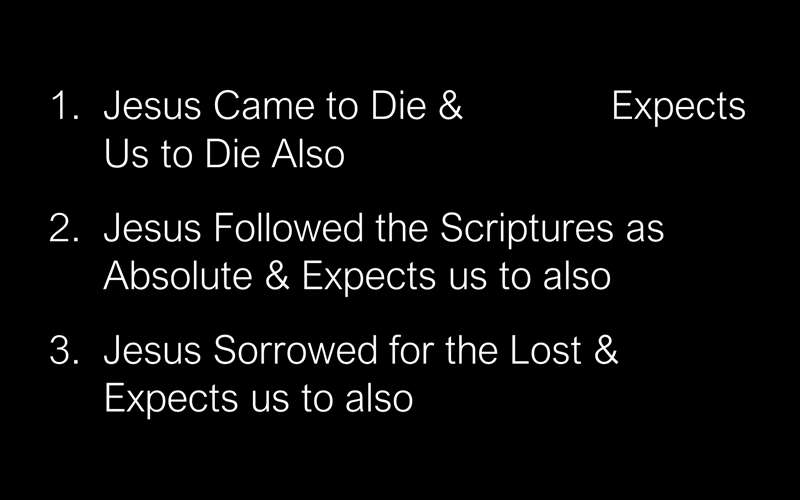
What can we learn from the Palm Sunday event? We’ll only get through the first two of these. There are actually seven huge lessons, but two this morning. Jesus came to die, and that’s what we’re going to see in John 12. Bang! Before He got into town in Mark 10:33, before He gets there in 11:1, He says, the Son of Man is coming to die, and He’s going to be crucified, and horribly treated, and die. And the disciples said, what? What are You talking about? See, they were off script; they were not aware of what was going on. Jesus came to die, but all the way through His ministry, He kept saying, if you’re going to follow Me, you’ve got to take up your cross. If you’re going to follow Me, you’ve got to die daily to what you want. Jesus came on Palm Sunday for the singular purpose to die on that cross as a Lamb. And you know what He says singular in our life should be? We need to live dying daily. And secondly, Jesus followed the Scriptures as absolute, and He expects us to do so also.
So, with this thought, number one, lesson one, Jesus came to die and expects us to die also. This is our text we’re going to read together, John 12 verses 23 to 26, and I’ve highlighted for you; this is what Jesus says right here on Palm Sunday. What He did and what He said are the two things we’re looking at. This is what He said, and notice the repeated death: unless a grain of wheat falls the ground and dies, but if it dies. And then look at the next: hates his life in this world, which is parallel with dying; serves Me, follow Me, parallel with dying; serves Me. See, what the Lord says, you’ve got to die to all of your plans, and all of your aspirations, and all of your goals and desires, and let Me reprogram you with Mine. That’s the only way the Christian life works. He said, I am your Shepherd, I am your Master, I’m out front, and you’re following Me. Do you know what most Christian lives look like in the 21st century? If you look at Christendom as a whole, Jesus is walking, and it’s like someone walking their dog that has their leash behind them, and that dog is like this, and they are…, and the collar’s pulling their head. That’s what Christianity has gotten to. People are not in sync with the Savior, and He says, you know how you get in sync with Me? Don’t have your own agenda, have Mine, and it starts right here in John 12.
So, let’s stand together for the reading of God’s Word, and remain standing for prayer. And let’s read it together and ask and invite the Lord to teach us this first lesson. The paradox of following Christ is we get to live, but we’re dying every day that we live. It’s a paradox. Here we go, together. But Jesus answered them, saying, the hour has come that the Son of Man should be glorified. Most assuredly, I say to you, unless a grain of wheat falls into the ground and dies, it remains alone; but if it dies, it produces much grain. He who loves his life will lose it, and he who hates his life in this world will keep it for eternal life. If anyone serves Me, let him follow Me; and where I am, there my servant will be also. If anyone serves Me, him My Father will honor.
Let’s bow for a word of prayer. Father, I pray that the truth of your Word will speak to our hearts, that we will open our hearts and say, Lord, I want to hear You, I want to follow You, I want my life to be fruitful and pleasing to You. And if You say that the only way for that to happen is for me to deny myself, and take up this cross, and become a living sacrifice crucified with You, yoked to You, not going my own way, then that’s what I want. And Lord, that’s what Your disciples are, Your followers are, that’s what believing Christians that are born again, that are saints headed to Heaven, You said that’s what we are. And so, we’re just asking You to reset us to the original settings when You saved us, that we would follow You every day that way, and that You would be glorified as we do. In the precious name of Jesus we pray, amen. And you may be seated.
Let’s talk about, real quickly, the paradox of following Christ. Do you remember? Jesus said, if you’re going to follow Me, you got to deny yourself, and the disciples were processing that. He said, if you’re going to follow Me, you have got to take up your cross. And someone asked me a couple weeks ago, they said, but would they have known what a cross was? You bet they did. Did you know, the Jewish people have always been a little bit independent, and the Romans didn’t like independence. They like people to bow and obey under the iron heel of Rome, and so the different Roman governors had different methods. And during the time of Christ and leading up to it when they had rebellions in Galilee, they crucified 10,000 at a time and lined the roads, every main road of Galilee, with crucified aunts, uncles, nephews, brothers, fathers. The people saw it, and they didn’t crucify them on high hills; they crucified them by the road at eye level. So, when Jesus said that, it was very offensive to say take up your cross. Their uncle, or aunt, or people they knew had been crucified. It’s horrible. And the Romans, by the way, left them there until they rotted and fell off. In the rebellion they did that. That was just, you would get it if you took them down and buried them. It was offensive. And so, it was a paradox.
Jesus was very controversial, and this Christ-centered life of the cross is a collection of paradoxes. If you just look at what Jesus said in His earthly ministry, He said, to really live, you’ve got to die. If you really want to rule, you have to serve. Do you remember when it’s talking about the most senior leaders of the Church in 1 Peter 5? Peter heard Jesus say this, by the way, and when Peter recounted how Jesus said the elders were to lead the Church, he said they are to strap on the apron of a slave. See, Peter heard that. To really rule, we must serve. To really win, if you really want to be a winner in life, you have to lose. Jesus said, the one who gains the whole world will end up losing his own soul; but whoever loses, for My sake, gains forever. That is an antinomy; it’s a paradox to us. We say it doesn’t sound right. To really win, we have to lose. To really be rich, we’re supposed to give our possessions away. Jesus said, whatever you die clutching in the end and held to the end, you lose, and whatever you freely gave away before that time lasts forever and is multiplied ten thousand percent. Now, that is not what we normally hear. That’s why Jesus, the longer people listen to Him, the more they said, this Guy’s crazy. We’re, remember John 6:66? Most of them stopped following Him. And finally, to really get ahead, Jesus said, go the back of the line. That is, when’s the last time that’s been taught in school? We teach knock everybody out of the line and pull yourself in the front, by all means. Kick, and drag, and climb to the top of the ladder no matter who you have to climb over. Jesus said, no, actually, if you really want to get ahead, stand at the bottom of the ladder. Think about it. That is what He said, and people didn’t like it. So, basically, what Jesus said to really live, Jesus said, we have to die.
Look right where you are in John chapter 12. Understand, this is Jesus applying the Palm Sunday event, and in 12:24 He says the hour’s come, or 23, the hour has come, the Son of Man should be glorified. He’s talking about Palm Sunday is He’s coming to die; the glorification is Jesus being the atoning sacrifice for the sin of the world. And He said, most assuredly, verse 24, I say unto you unless the grain of wheat falls in the ground and dies, it remains alone. But if it dies, it produces much grain. Jesus is telling them, to really live, Jesus said, I’m showing you, to really live, you’ve got to die because for Me to unleash all that God has for us. Palm Sunday offers us lessons from the Master to His disciples. The first discipleship lesson for us today is the life that Christ called all of His disciples to follow throughout all the centuries is a paradox of living while dying. Jesus repeatedly said to follow Him, we must take up our cross and follow Him. But that abstract thought was distressingly vivid to the disciples. Jesus added over and over again, I am going to die. I’m going to be killed. They’re going to despitefully treat Me.
To really live, Jesus said, you have to die to self. Without death, we’re unable to unleash all the vast workings of God in our life. We’re like the dragged puppy. Do you think that the master dragging the puppy behind it is really unleashing all the potential? Why don’t we just say, hey, I want Your way. See, that’s what He’s talking about. This dying daily is a daily surrender, a daily renewal of not my will but Thine be done. That’s the only way. Death to self is the key that unlocks the doorway to all that God has planned for us. The earlier we learn this, the more fruitful our lives become.
How well each of us remember the words of Romans 12:1-2 when they first penetrated our hearts. Think about what Paul said. He says, we are to offer our bodies as a living sacrifice. What’s a sacrifice? It’s something that is, not today, but then a sacrifice was something that was offered completely, and it was given up in the temple, either to be burned on the altar or to be offered, and it became part of the subsistence of the priesthood, but you lost it. It was a sacrifice that you lost complete control of. It was dead to you as far as you were concerned for any benefit from then on. And Jesus said, I want you to be a living sacrifice. You’re still alive, but you have totally given up your control. It’s like you’re dead. And how well we remember when we understood Paul saying this transforms us, so we’ll be no longer conformed to the world’s powers, and that’s the pathway of blessing.
When we really understand these words, if you really understand daily sacrifice, we begin a daily renewal of offering ourselves to God. Paul says that dying, if you look at Romans 12, it’s right at the beginning of the most applicable, practical part of the book of Romans, and he said, this dying is the daily prerequisite. You want to be spiritually vital like Romans 12 talks about, and ministering to one another in the Church, and praying, and rejoicing, and all that? The prerequisite of all of disciple life for the Lord, being a disciple and living for the Lord, is dying on a daily basis, and that produces our spiritual vitality. And every time we feel stagnant spiritually, like we’re being dragged through life and don’t know what’s going on, it’s just a warning we need to release again the directing of our lives back to the Lord.
Did you know that when the Lord leads, our life is not stagnant, it’s not empty, it’s not hopeless, and purposeless, and wearying, and just troubled. When the Lord’s leading, it’s not that way. Now, we have troubles, but we see why we have them and His purpose. And so, when we feel stagnant, it’s a time to release, to surrender, to die, to take up our cross and give our life back to the Lord. And actually, this becomes a way of life.
And something to think about: do you start every day bowing before the Lord, and surrendering, and taking up His cross, and just saying, Lord, I want to deny myself today. I don’t want to control my plans, my goals, and my desires. I really put them on the altar, burn them off if You want. Give me whatever’s left, or give me Yours, or I just don’t want my own way.
One of my heroes growing up was George Müller. I read every version of his, George Müller of Bristol, of his life. He lived from 1805 to 1898. He was an amazing discipler. I admire him. Most people think of him as an orphan rescuer. Yeah, but you haven’t read the journals. That was a front; he was getting all those orphans off the streets of London so that he could feed, and clothe, and educate, and disciple them, and he did. He said, as for me and my house, if you’re going to live in my house, you’re going to serve the Lord. And if you’re going to be fed at my orphan tables, all 5,000 of you, you’re going to learn these disciplines, learn this work ethic, and you’re going to meet my God, and I’m going to talk to you about Him every day. And they learned verses, and they memorized, and they learned the Gospel, and he launched wave after wave of those 5,000 orphans that were living in his homes into British society. Why do you think England surrounded the world with the Gospel? Where do you, those orphans rescued by a godly man who poured his life into them. What a view of their heavenly Father, how they wanted to love and serve! But someone, he had such a thing going, he became worldwide famous, and someone asked him, what was the secret of your life? Usually when you’re old and it looks like you’re turning out, people ask you that. And George Müller hung his head and said, there was a day when I died, and then he bent his head lower and said, I died to George Müller. I died to his opinions, his preferences, his tastes, his will. I died to the world, its approval or censure. I died even to the approval or blame, even my brethren and friends. He said, what I did is I just died, and I said, Lord, for me to live is Christ. I would like Your agenda, Your plans, Your goals for my life.
How clearly we see that’s what Jesus modeled. That’s what Jesus taught right here in verse 24 of chapter 12. It’s what Jesus believed as the way to win was to die, and that’s why He left us these words. Jesus came to die, and He expects the same from us. We’re to die daily as living sacrifices. We’re to resist the pattern of the world that we’re to live for ourself, and we’re to accept the yoke of Christ. Remember what Jesus said? Come unto Me, all you that labor and are heavy laden, I’ll give you rest. Take My what upon you? Yoke. What’s a yoke? It’s an ox yoke. It’s an inflexible wooden beam. But Jesus said, take My yoke upon you. That means Jesus is in one side of the yoke, and He wants us to stick our head through and to walk beside Him through life. Did you know, that’s how we follow Him. We’re following His lead as He is yoked to us and we to Him. And can you imagine how hard it is for Him when we’re pushing or saying, I don’t want to go that way, pulling the yoke around our neck that’s yoked to Him, and He’s walking the right way, and we’re going, I want to go this way. See that’s, George Müller said, mm-mm, I die to wanting to go that way, and I want every day to say, Lord, I want to go Your way. I’m yoked to You, so You lead. I don’t know where we’re headed.
How do we apply Christ’s command? In fact, better yet, how did those who were closest to the situation apply it? See, that’s what the Gospel writers had the record of Christ’s life, and we can read it, but the epistles are those that most-knew Christ and what He said, and Jesus told them how to apply everything He commanded, and taught, and did, and that’s what they wrote down in the epistles. So, how do we see this applied in the epistles? I have for you to look at, in fact, I want you to read it with me. The two most well-known applications: it’s Paul’s Romans 12:1-2, and it’s Paul’s 1 Corinthians 6:19-20. Most of us, Romans 12 and 1 Corinthians 6 are about, quite a few chapters apart and so, actually 10 chapters apart, and so they don’t usually get read together. And so, what I did is I brought them together. And then I merged them like this because they’re actually a sequence that totally harmonize with Christ’s call that we deny ourself, take up His cross, and follow Him.
So, you don’t have to stand up; you can just sit. This is a fun read, and let’s read these, and I want you to notice what it’s talking about. Present your bodies. I put it in bold. Your body is My temple; you’re not your own, you’re bought at a price. So, I want your body and your spirit harmonized with what I’m doing. Do you see how it all ties together? This is the daily dying to my plans and living to Christ.
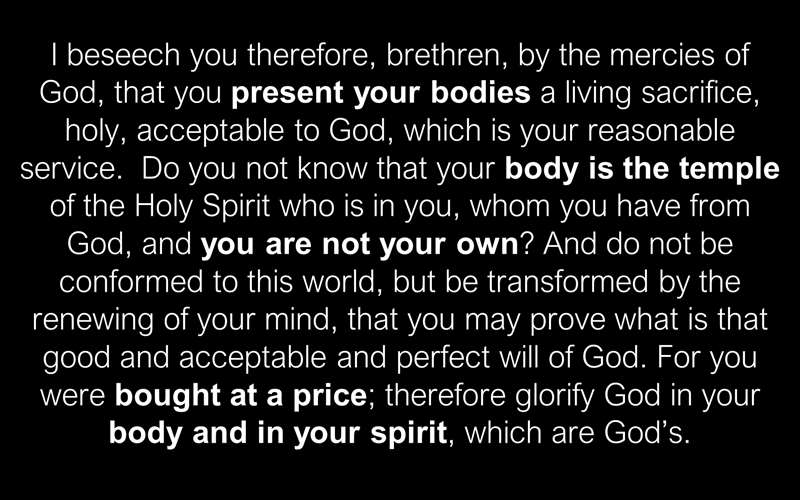
So, let’s just read it. Okay? Together. I beseech you therefore, brethren, by the mercies of God, that you present your bodies a living sacrifice, holy, acceptable to God, which is your reasonable service. Do you not know that your body is the temple of the Holy Spirit who is in you, whom you have from God, and you are not your own? And do not be conformed to this world, but be transformed by the renewing of your mind, that you may prove what is that good and acceptable and perfect will of God. For you were bought at a price; therefore, glorify God in your body and in your spirit, which are God’s.
Now, that’s an amazing thought, and most of us have heard this. In fact, when you think about it, most of us at some time or another have, maybe at youth camp, maybe at a retreat somewhere. We have Romans 12:1-2, we have surrendered to the Lord. And you know what Jesus is asking before we lose this thought of dying to self that He brought up on Palm Sunday? And before losing the thought of how those closest to him applied it? They said, it’s a daily living. I live every day sacrificed to Christ. Now, before we lose those concepts, I want to ask you something on Palm Sunday. I want you in a moment, not right now, don’t want anybody to get out of touch with what we’re doing. But in a moment, we’re going to bow our heads and close our eyes, and I want you to think about who uttered those words that are right in front of you. Paul wrote them down. Who said them? Those are the very words of God, the Almighty Lord and Master of the universe. That’s who thought this up. Paul didn’t think this up. This was inspired.
And I’d like to ask each of you to think about if at some time in your life up through today, you have made that personal surrender and dedication to Christ. I remember standing at Camp Barakel in the old side, holding onto the pew, hearing that speaker speak, and he said, Romans 12:1-2, and you got infected. I think it was Carl Huerta, come to think of it, Steve Harrington’s uncle or something. Isn’t it a small world? But I remember, the fire’s going, and going down front. And I bet all of you have some time you remember, whether it was watching Billy Graham, or at a youth retreat, or throwing a stick on a fire, or at some couple’s deal where you finally, or maybe you’re all alone reading the Bible, you finally said, I just want to, you looked around and make sure nobody was listening. Lord, I just want to surrender and dedicate my life. I don’t even know what that means, I don’t know what You’re going to do, but I want to do that. So, if you have ever done that in your life, do you know what the Lord says? That is supposed to become a daily renewed occurrence. That’s what a living sacrifice. It’s not a dead memory. It’s alive, it’s renewed. Take up your cross, Jesus said, daily and follow Me. Okay?
Now you can listen with your eyes closed. Let’s all bow our heads, and I want each of you, with heads bowed and eyes closed, I want you to think about when you made that personal surrender and dedication to Christ and presented yourself to Him. And if at some time in your life you have done that, I would like to invite you on this Palm Sunday 2014 to make a renewal of that surrender today. And the way you do it is, with heads bowed and eyes closed, quietly stand right where you are, and if you are offering yourself to the Lord for the first time, you can also stand and surrender to Him. So, as you stand right now, I want you to do something in your heart. I want you to repeat to the Lord that you are renewing your surrender and dedication to Him as you stand and say, I want to right here today, as I stand before You quietly. I want to renew that You bought me at a price; I’m supposed to glorify You. I’m presenting my body again. It’s what I did back when I was a kid, or last month at a retreat. And your [my] body is my [Your] temple, and I want You to transform me. So, as you stand, in your heart, tell the Lord you’re renewing your surrender and dedication, and when you’re all done telling Him that, quietly you can just be seated. Amen.
Now, I want you to think about something. Why not do that every day? Have you ever thought about that? That is what we’re supposed to be doing. I want to tell you a little secret. Bonnie will probably be embarrassed if I tell you this, but when we were starting out, we were newlyweds and we went out to Grace Community Church. I was a brand-new pastor. We had nothing. Only Bonnie had a car; all I had was my books. What a pair we were, and we didn’t even have enough money to rent an apartment out there. You didn’t get paid for six weeks, so we lived in a church member’s basement on the floor with a Goodwill mattress with no, we couldn’t even afford the metal stuff underneath; it was just the mattress. And so, the people at Grace felt so sorry for us starting out that our class bought us this plantation bed. It’s almost like bungee jumping to get off of it, it’s so tall. It’s one of those big poster beds, hardly, you have to have a taller ceiling to get it in there. And over the years, the older I get, the more I get to the edge, and then I take the plunge down. But you know what? It’s a little secret, and most of you wouldn’t have seen that. It’s in the dark early in the morning. As soon as I [Brief Loss of Audio], and I’m aware, I’m still alive breathing, thinking, I’m still on Earth and awake. That’s what I do. I say, give me another day to live. You bought me. I’m not my own. This is Your body. I’m Your temple for the day, as long as You give me. I want to renew that surrender, that consecration. I don’t want my plans, my goals, my ambitions. I put them on Your altar as a living sacrifice. I would like, I’d like You to tighten up the yoke, and I’d like to walk through life with You.
You could remember many things from Palm Sunday. Do you know what one thing would be? It doesn’t matter if you have one of those, they’re not popular anymore, those squishy water beds, or if you’ve got one of those little pallet things, you’re on a futon, or if you’ve got the one you can control with the air in it and everything, or you just have a normal one, you don’t even know what it is. If you wake up tomorrow, as you’re sliding those feet, most of us put our feet on the floor some form or another. As soon as you’re conscious that you’re still alive, you know what would be nice to do? You want to have the greatest day in your life? Pause before you tweet, and poke, and twit, and whatever else, all those things. People sleep with their phones nowadays, which I’m a terrible proponent to that is not wholesome for the Christian life. But before you even touch that thing, just say, Lord, You are living inside. I am Your servant. I want to live this life for You and renew every day. Why not renew? Jesus came to die and expects us to also.
And we don’t have time today. The second lesson is that He came to follow Scripture, we’ll do this another Palm Sunday. And followers of Jesus follow Scripture. But what I want to close with is right here in Matthew 11:28. The life of dying daily and surrendering to the Lord, the life of surrendering and renewing that dedication to Him, Jesus described this way, and I put it on the screen for you. Come to Me, all you who labor and are heavy laden. This is one of the most beautiful, this is Jesus’ arms open wide. This is one of the most beautiful Gospel offerings Christ made in the Scriptures. He says, you’re laboring through life, don’t know what you’re here for, and you’re heavy laden in your sins. Come to Me, and I’ll give you rest. I’ll give you rest from guilt; I’ll give you rest from everything, from all the fears and all the horrors that life has. If you come to Me for salvation, I’ll give you rest. But here’s what salvation is. It’s not adding Jesus to your life. It’s taking My yoke on you. You see, people that want a Savior but not a Lord want forgiveness without the yoke. See, that’s salvation. Salvation is hearing and following Christ. And He says, the way you follow Me is you take My yoke upon you and go through life learning from Me. I am gentle and lowly in heart, and when you learn from Me, you find rest for your souls. And He says, guess what? My yoke is easy. My burden’s light. He said, it takes all the stress out of life to know you’re connected to Christ. An ox yoke, remember, two circles. You had the veteran ox that knew where they were going that would walk straight, and you had the learner who got put in and acted like the puppy for a while, and all of a sudden learned it went easier if he walked in step, in time, the same direction as the wise, leading ox. We’ll go from agriculture to Christianity. Jesus said, I’m on this side; you’re on that side. When I saved you, I want you to put this yoke on, and I want you to walk through life with Me.
And by the way, when we walk through life with Christ, do you know what we look like? That’s what Wednesday night, remember I said, I’m speaking 12 times this week. One of them is Wednesday night. We’re talking about, in biblical counseling, discipleship, what the fruit of the Spirit is. It’s when Christ’s personality is transplanted in me, when I become like Him in the way I respond in life. How do I do that? I’m connected to Him. I’m going, He is facing the same things in life that I am, and I learn as I’m yoked to Him how to respond. And it’s the easiest way to live because Jesus said, what I came to do in life is the will of Him that sent Me, and that’s what you should want too. So, this Palm Sunday, I challenge you to try and remember today until tomorrow morning, whenever that is for you, and when you get to the edge of whatever, you go unconscious on every night and you become conscious again, sit up, and get to the edge however far it is, and when you’re standing, say, checking in, I’m Yours. I renew my surrender to You. If you start doing that every day of your life, I can promise you your life will radically change because you’ll start walking in that yoke through more and more of life.
Let’s all stand together, and as we stand, I’m going to close in prayer. And as at every service here at Calvary, at the end of the service, there’ll be godly elders and Titus 2 women with their Bibles. And if you, maybe today, maybe when you stood for the quiet, head-bowed standing, it was the first time you ever stood in your life, and you might want to come and talk to someone. Or maybe you don’t even know what we’re talking about. You think this is crazy in your heart, that you don’t have rest for your soul, and the idea of Jesus’ arms out sounds appealing. They’re still out. While you’re alive and hear His voice, the invitation is open. He’s saying, don’t harden your heart. And they’d love to talk to you about how to meet Christ. He actually is here today.
But let’s bow for a word of prayer. Father in Heaven, I thank You for the lessons for Your disciples from Palm Sunday. They are transformational: learning to die daily, submitting to Your Word, doing Your will, being yoked to You, and they even get better when You start preaching from the cross and can’t say more than two or three words at once. It’s very powerful. I pray that we would learn to follow You and to do Your will as we’re yoked to You through life. And I pray that You would work in all of our hearts, that we would not soon forget that You want us to take up that cross every day, and may we start a habit whether when we jump out of bed, or whenever, to be yoked to You. And in the name of Jesus, we pray and may You be glorified in our lives is our desire, and all of God’s people said, amen. And God bless you as you go.
Notes
Jesus constantly discipled His disciples; and Palm Sunday was no exception.
Welcome to our ongoing study of Biblical exercises for spiritual health & fitness in 2014. Paul told Timothy, and all the generations of believers to come, stay close to Christ: command and teach the church to be all Christ taught us to be. That is what we have before us in the New Testament. We are to command in the sense that “God says this”, and we are to follow up with teaching them “how to” observe what Christ wants from us who please Him by our lives.
Jesus Himself taught by words (those are the written commands); and by actions (those are Christ’s examples recorded by the Gospel writers). In fact, the Book of Acts opens with the very first verse saying that the Gospels were a record of all that Jesus began to “do and to teach”. His disciples saw and heard so much. Both Christ’s words and His actions have been written down; but not all of them, just those that God wanted us to hear and see.
Disciples: Taught to Observe What Christ Taught
From Christ’s actions and words from the week launched by Palm Sunday we can see some of the most vital elements of a true follower of Christ’s life. Join me at the kickoff event for the Death, Burial & Resurrection of Jesus Christ. This day starts a week of events that ends with Jesus crucified, buried, and Risen. What a powerful week, and what powerful elements about following Jesus, that He wants us to see, and hear, and do.
As we open to John 12 this morning, we have come to a time in Christ’s life we also remember and celebrate today. Palm Sunday may have been actually Monday, but we call it Palm Sunday as a part of the calendar of celebrations, just like Christmas is also not an exact date. But, Palm Sunday’s events are among those few events of Christ’s Life recorded in all For of the Gospels, it is also one of the key teaching times for Christ’s disciples then and now. Open with me to Matthew 21 as we begin trace this moment across the Four Gospel writer’s accounts of Christ.
Matthew 21:1-3 (NKJV) Now when they drew near Jerusalem, and came to Bethphage, at the Mount of Olives, then Jesus sent two disciples, 2 saying to them, “Go into the village opposite you, and immediately you will find a donkey tied, and a colt with her. Loose them and bring them to Me. 3 And if anyone says anything to you, you shall say, ‘The Lord has need of them,’ and immediately he will send them.” (Matthew devotes 22 verses , 21:1-22, to this event.)
Mark 11:1-3 (NKJV) Now when they drew near Jerusalem, to Bethphage and Bethany, at the Mount of Olives, He sent two of His disciples; 2 and He said to them, “Go into the village opposite you; and as soon as you have entered it you will find a colt tied, on which no one has sat. Loose it and bring it. 3 And if anyone says to you, ‘Why are you doing this?’ say, ‘The Lord has need of it,’ and immediately he will send it here.” (Mark devotes 26 verses, 11:1-26, to this event.)
Luke 19:28-31 (NKJV) When He had said this, He went on ahead, going up to Jerusalem. 29 And it came to pass, when He drew near to Bethphage and Bethany, at the mountain called Olivet, that He sent two of His disciples, 30 saying, “Go into the village opposite you, where as you enter you will find a colt tied, on which no one has ever sat. Loose it and bring it here. 31 And if anyone asks you, ‘Why are you loosing it?’ thus you shall say to him, ‘Because the Lord has need of it.’” (Luke devotes 21 verses, or 19:28-48 to this event.)
John 12:12-23 (NKJV) The next day a great multitude that had come to the feast, when they heard that Jesus was coming to Jerusalem, 13 took branches of palm trees and went out to meet Him, and cried out: “Hosanna! ‘Blessed is He who comes in the name of the Lord!’ The King of Israel!” (John devotes 15 verses, 12:12-26, to this event.)
Seeing the Discipleship Lessons in this Event
Often we look at the chanting multitudes, the Passover season events, and the amazing details of the donkey, the Temple cleansing, and the cursed fig–tree. But each of those elements is only the blackboard, the canvas, or the screen that portrays a deeper message.
Palm Sunday’s week, like every other event in Christ’s life on Earth, was used by God to teach us. Because all Scripture was given for that purpose: to show us what is right, what is wrong, how to get right and how to stay right as 2 Tim. 3:16-17 explains: so that we can be completely equipped for serving God.
Each of the Gospel accounts explain elements of not only “what” Jesus did, but even more vitally: “why” Jesus did what He did. That is what we will focus on today. Here are three of the elements of discipleship that we can each draw from Christ’s example, so vividly portrayed before us today.
- Jesus Came to Die & Expects Us to Die Also
- Jesus Followed the Scriptures as Absolute & Expects us to also
- Jesus Sorrowed for the Lost & Expects us to also
In the unforgettable setting of Palm Sunday, in the relentless countdown to the Cross, with hundreds of thousands thronging around Him, Jesus Christ continues to train His twelve in the Way they are to follow their Master; and as He does so He shows us: the elements of a disciple’s life that He modeled, and what He wants and expects us to also model as we follow Him!
First we see in John 12:20-26:
Jesus Came to Die & Expects Us to Die Also
The first truth that can forever impact our lives from the Palm Sunday event is that Christ came into Jerusalem to die. He said that in the days leading up to this event, that is one of the few that finds a place in all Four Gospels. But, especially listen to how He ends this event, from the Gospel by John’s account, as we stand and hear His voice:
John 12:23-26 (NKJV) But Jesus answered them, saying, “The hour has come that the Son of Man should be glorified. 24 Most assuredly, I say to you, unless a grain of wheat falls into the ground and dies, it remains alone; but if it dies, it produces much grain. 25 He who loves his life will lose it, and he who hates his life in this world will keep it for eternal life. 26 If anyone serves Me, let him follow Me; and where I am, there My servant will be also. If anyone serves Me, him My Father will honor.
Pray
The Paradox of Following Christ
Palm Sunday offers us lessons from the Master to His disciples. The first discipleship lesson for us today is: that the life that Christ called all His disciples to follow, throughout all the centuries is a paradox of living while dying.
Jesus repeatedly said that to follow Him one must take up their cross as they follow Him. But that abstract thought became distressingly vivid to the disciples as Jesus added for the third time that He was literally going to die soon. Listen to the final time Jesus explained the coming crucifixion[1], and the disciples were puzzled:
Mark 10:33-34 (NKJV) “Behold, we are going up to Jerusalem, and the Son of Man will be betrayed to the chief priests and to the scribes; and they will condemn Him to death and deliver Him to the Gentiles; 34 and they will mock Him, and scourge Him, and spit on Him, and kill Him. And the third day He will rise again.”
Now, it is just days from the Cross, and Jesus makes a vivid application. Jesus repeatedly said that following Him meant taking up a daily death to self (as a living sacrifice) and following Him.
This Christ-centered life of the cross is a collection of paradoxes: To really live we must die, to really rule we must serve, to really win we must lose, to really be rich we must give possessions away, and to really get ahead we must go to the back of the line.
Such spiritual paradoxes fill the Scriptures. As Paul said God’s power is perfected through our many weaknesses. (2 Cor. 12:9). And that is why Jesus ends His amazing Palm Sunday event with these astounding words:
“I tell you the truth, unless a kernel of wheat falls to the ground and dies, it remains only a single seed” (v. 24).
To Really Live Jesus Said We Must Die to Self
Without death we are unable to unleash all the vast working of God in our life. We are our biggest hindrance. Death to self is the key that unlocks the doorway to all that God has planned for us. The earlier we learn this, the more fruitful our lives can become.
How well each of us remember when the words of Romans 12:1-2 first penetrated our understanding. Paul said to offer our bodies as a “living sacrifice”. Alive; but always dying. Transformed; and no longer conformed to the world’s pattern. That is the pathway of blessing that God has laid out for us.
When we really understand these words we begin a daily renewal of this offering of ourselves to God. Paul states that dying is the daily pre-requisite for spiritual vitality. Each time we feel stagnant spiritually it is a warning of we need to release again the directing of our life back to God.
One of my spiritual heroes growing up was George Muller of Bristol (1805-1898), who was used greatly by the Lord to nurture and disciple thousands in England and around the world. During his greatest years of widespread ministry and fame, he was asked what his “secret” was. Listen to his response:
When someone asked him, “What has been the secret of your life?” Müller hung his head and said, “There was a day when I died.” Then he bent lower and said, “Died to George Müller, his opinions, preferences, tastes, and will; died to the world, its approval or censure; died to the approval or blame even of brethren or friends.”[2]
How clearly we see that Jesus modeled what He taught. He believed that the way to win was to die, and for us He left these words.
Jesus came to die and He expects the same from us.
We are to die daily as living sacrifices, resisting the patterns of the world and accepting the yoke of Christ.
Pause right now and ask yourself:
Am I starting each day by bowing before my Lord and My God, surrendering to Him, and taking up His cross to denying myself the control of my plans, my goals, and my desires?
Applying Christ’s Command
Here is Paul’s version of Christ’s call, merged together two of his strongest appeals[3]. Please read these words that frame Christ’s call to take up our cross each day and following Him as His disciples:
I beseech you therefore, brethren, by the mercies of God, that you present your bodies a living sacrifice, holy, acceptable to God, which is your reasonable service. Do you not know that your body is the temple of the Holy Spirit who is in you, whom you have from God, and you are not your own? And do not be conformed to this world, but be transformed by the renewing of your mind, that you may prove what is that good and acceptable and perfect will of God. For you were bought at a price; therefore glorify God in your body and in your spirit, which are God’s.
Now, before we lose that thought, let me ask you to do something on this Palm Sunday. Please bow your head, and close your eyes: and think about who uttered those words we just read.
God did, and they are the inspired commands of your Lord & Master.
I’d like to ask each of you to think about if at some time in your life you have made that personal surrender and dedication to Christ, and have presented yourself to Him?
If so I would invite you to make a renewal of that surrender today, by quietly standing where you are.
If you are offering yourself for the first time, you may also stand and surrender to Him.
As you stand, in your heart tell the Lord that you are renewing your surrender and dedication.
Then quietly be seated. Pause.
Why Not Surrender & Give Yourself to God Each Day
What you just did would be the best way to start each day, renewing that surrender and then asking God to show you through His Word, by His Spirit, what He wants you to do that day.
That is the way a disciple of Christ lives each day “following Jesus”. It is that simple: Surrender. Renew. Follow.
Lesson one: Jesus Came to Die & Expects Us to Die Also
As we continue, the second reason why Jesus came to Jerusalem on Palm Sunday was not only to die, but also to fulfill Scripture. Open with me back to Matthew 21. Look again at those opening words that frame each of the Synoptic accounts. They all point with Matthew to an entry on a borrowed, but carefully chosen donkey. Why? And here comes the very vital lesson for each follower of Christ today. Because:
Jesus Followed the Scriptures as Absolute & Expects us to also
One of the hardest things for us to understand is that the Almighty God the Son considered Himself bound by Scriptures.
The Omnipotent God the Son was bound by God’s will. To do God’s will He wanted to follow, obey, and keep God’s Word.
Jesus considered the Scriptures to be: the infallible expression of the will of God the Father. All through Christ’s ministry He said that things He did fulfilled what was written. The same was true now on Palm Sunday.
Five centuries before Jesus entered Jerusalem, a prophet declared God’s infallible will. When Zechariah 9:9 described Christ’s entrance into Jerusalem, that became God’s will for Jesus; and He followed each detail precisely: timing, mode of entry, and even the first public spectacle.
Jesus, who withdrew from the crowds, here promotes them.
Jesus was acting on purpose to fulfill God’s plan.
A carefully chosen donkey was to declare to the world that the promised One was coming just as God’s Word had said He would:
Zechariah 9:9 (NKJV) “Rejoice greatly, O daughter of Zion! Shout, O daughter of Jerusalem! Behold, your King is coming to you; He is just and having salvation, Lowly and riding on a donkey, A colt, the foal of a donkey.
Note Zechariah’s inspired description of this King who would ride into Jerusalem, headed to the Cross: He would be “lowly”.
Jesus came humbly, and peacefully. He would conquer not with a sword but with love. He came to bring peace that would never end. Prior to this ride He had said that all who come to Him would receive endless peace for their souls.
Matthew 11:28-30 (NKJV) Come to Me, all you who labor and are heavy laden, and I will give you rest. 29 Take My yoke upon you and learn from Me, for I am gentle and lowly in heart, and you will find rest for your souls. 30 For My yoke is easy and My burden is light.”
What brought such peace, and what were His disciples to do? Take His “yoke”. What was that? It is what Jesus modeled. Jesus submitted His life to the infallible expression of God’s will found in the Scriptures.
Jesus came that day unlike any other King. He slowly came, humbly to die, yet through death to triumph.
Jesus was actually in control of every detail because He was in harmony with His Father’s infallible expression of His will.
The Scriptures were the “yoke” of Christ’s life.
Followers of Jesus Follow the Scriptures
He said, I always do the will of My Father, and so should we. Turn back there to John 4:34 with me, listen to what our Master said about His plan for walking through life:
John 4:34 (NKJV) Jesus said to them, “My food is to do the will of Him who sent Me, and to finish His work.
So Jesus came in submission to God’s will as the most unique King ever to cross the pages of history. Listen to this amazing reminder from Charles Ross Weed, who captured this idea beautifully in his poem “Christ and Alexander.”
Jesus and Alexander died at thirty-three,
One died in Babylon and one on Calvary.
One gained all for self, and one himself he gave.
One conquered every throne, the other every grave.
When died the Greek, forever fell his throne of swords,
But Jesus died to live forever Lord of lords.
Jesus and Alexander died at thirty-three.
The Greek made all men slaves, the Jew made all men free.
One built a throne on blood, the other built on love.
The One was born of earth, the other from above.
One won all this earth to lose all earth and Heaven.
The other gave up all that all to him be given.
The Greek forever died, the Jew forever lives.
He loses all who gets, and wins all things who gives.
Jerusalem rejected their King that day.
Have you opened your heart and life to Christ the King?
Have you invited Him to live out through you His love, joy, peace, gentleness, and humility?
If not, He is still waiting for that response today.
Lesson one: Jesus Came to Die & Expects Us to Die Also
Lesson two: Jesus Followed the Scriptures as Absolute & Expects Us to Also
Next we turn onward to Luke’s account in Luke 19:41, where we can find the next element from Palm Sunday week that Jesus taught His disciples, which was:
Jesus Sorrowed for the Lost & Expects us to also
In Luke 19 we find perhaps the most shocking element of Palm Sunday, an element that usually gets lost in the noises of the crowd and the emphasis upon Palm branches and Hosannas. Here it is in v. 41: Jesus wailed aloud for sorrow. This is not the Greek word for seeing tears rolling down ones cheeks, as Jesus did when He wept for Lazarus in Jn. 11:35. This is not a weeping that was seen; it is a wailing that was heard. It was loud, it was jolting, and right there in the midst of the jubilation of palm branches, Hosannas, and coats carpeting Christ’s pathway: the donkey abruptly stops.
Jesus caught sight of Jerusalem and halted; and to the amazement of the crowds they begin to hear Him wailing. Soon they all pause, listening to that sound, and then the wailing stops and a lamentation starts. That dirge of sorrow over the people of Jerusalem is written down by Luke, and fills the next three verses (v. 42-44). The King of the Universe wails over the people He sees being judged for their hardened and impenitent hearts.
Jesus Christ, the Son of God could see the future vividly clear. The city of Jerusalem destroyed. The tumbled stones, drenched with the blood of His chosen people of promise who had rejected their King. Listen to His sorrow:
Luke 19:41-44 (NKJV) Now as He drew near, He saw the city and wept over it, 42 saying, “If you had known, even you, especially in this your day, the things that make for your peace! But now they are hidden from your eyes. 43 For days will come upon you when your enemies will build an embankment around you, surround you and close you in on every side, 44 and level you, and your children within you, to the ground; and they will not leave in you one stone upon another, because you did not know the time of your visitation.”
Everything Jesus saw and wailed over, happened just 40 years later in AD 70. The Roman General Titus oversaw such a horrific slaughter that as he rode around looking at the perhaps as many as 1,000,000 dead bodies, he uttered these words preserved in the historian Flavius Josephus’ account[4]:
“When Titus, going his rounds, beheld these valleys choked with dead, … he groaned and raising his hands to heaven, called God to witness that this was not his doing. Such was the situation of the city.”
Jesus could see that future scene as God the Son, and wailed in sorrow for the doom coming upon His people. Christ’s wailing were such an insight into His 100% humanity as a “man of sorrow and acquainted with grief” as Isaiah 53 reminds us.
But because Jesus was not only 100% human, but also 100% God we can assuredly say that Christ’s wailing also show us the very heart of God the Father, God the Son, and God the Holy Spirit as they grieve and sorrow over mankind’s sinful hearts that miss their “day” and the “peace” that repentant faith would have brought to their lives.
What Does Jesus See in Your Future?
Pause and ask yourself this day, as Jesus stops and looks, what does He see in your future? A place prepared for you in His Father’s House or judgment, ruins, and desolation? Christ’s tears reflect the infinite value of your eternal destiny. Jesus wailed over Jerusalem as He wails over every unrepentant heart today.
Lesson one: Jesus Came to Die & Expects Us to Die Also;
Lesson two: Jesus Followed the Scriptures as Absolute & Expects Us to Also;
Lesson three: Jesus Sorrowed for the Lost & Expects us to also.
Matthew 11:28-30 (NKJV) Come to Me, all you who labor and are heavy laden, and I will give you rest. 29 Take My yoke upon you and learn from Me, for I am gentle and lowly in heart, and you will find rest for your souls. 30 For My yoke is easy and My burden is light.”
If you have never come to Christ, today, as we remember Him coming to Jerusalem:
He waits for you with open arms.
[1] Three times Jesus predicted His cross: first in Mark 8:21-33/Mat. 16:21-28/ Lk. 9:22-27; second in Mk. 9:30-32 / Mat. 17:22-23 / Lk. 9:43-45; and thirdly in Mk. 10:32-34 / Mt. 20:17-19 / Lk. 18:31-34. In John 12:7 Jesus continues saying the anointing He received was for His “burial”.
[2] Hughes, R. K. (1999). John: that you may believe (pp. 301–302). Wheaton, IL: Crossway Books.
[3] 1 Cor. 6:19-20 + Romans 12:1-2
[4] Josephus, Jewish War, V. 12, 4.