140601AM
ESH-17
Believers Baptism.docx
Biblical Exercises for Spiritual Health & Fitness in 2014 Series
The Discipline of Disciple-Making:
“Making Disciples & Baptizing Them”
Acts 2-19
Transcript
Let’s open our Bibles to chapter 28, the last chapter of the book of Matthew. And what we’re looking at is this little phrase in Matthew 28, actually, in verse 19. Between those two, it says two things. That we’re supposed to go into all the world. Go into all the world and make disciples, that’s the main verb. It’s the predicate of the entire long clause that’s there. And that’s evangelism, we’ve talked about that in the past. But make disciples. And then it says, baptizing them in the name of the Father, Son, and Holy Spirit. So, this morning I’d like to talk about making disciples and baptizing them. What does that mean? That’s about as foundational as you can get. That is what we as a Church are all, as individual members, called to be doing. And yet even on the simplest, most foundational truth of the Church there is such disagreement and confusion.
So, what I thought we’d do this morning is look at a doctrine. This doctrine, the baptizing them, is part of a larger doctrine that goes all the way through from the Gospels through the epistles. And so, what I thought would be fun this morning is, take something that’s introduced by Christ in the Gospels, baptize them, that is illustrated all the way through the Book of Acts. Nine baptism accounts. There are nine separate events where believers are baptized in the book of Acts. And then it’s all discussed in the epistles. And so, we’re going to, this morning, look at the Gospels. Right here, Matthew 28 :18-20. Then we’re going to look at all nine of those accounts and see what happened. And then we’re going to look at what it meant and why they were supposed to baptize.
But before we do that, what’s the doctrine? I’ll tell you in advance. God’s Word teaches us a doctrine. It’s called Believers Baptism. And this is what I’m sharing with you this morning. Jesus said, go into all the world, make Disciples. A Disciple is a follower of Christ. We would call it… that’s probably the most repeated word for a Christian. Christian is the least repeated word, designation in the Bible for what we are. It’s most used nowadays, but back in the day of the Bible, believers were called Disciples, followers of Christ, learners of Christ. So, go and evangelize. That’s a good way to put it. The go into all the world and evangelize, that’s making disciples. And when they get evangelized, baptism them. Now what does that mean?
God has only designed baptism. God has only designed. He invented baptism for Christ Church to be applied to believers. Now, isn’t that interesting? Just me saying that causes some people’s hair to start standing up on the back of their neck because they were brought up Episcopalian, Methodist, Presbyterian, Lutheran, Roman Catholic, whatever, and were raised in a setup where their parents dressed them up and got this long outfit on and they came to the front and they did something. And they will fight to the last breath that they were baptized and something did happen to them. But it’s not baptism because the Bible defines… See, we have to have doctrines that are anchored to the Bible. And did you know why we’re having a slippage and each generation it appears that there are more and more young people that kind of depart.
Remember Ken Ham wrote the book “Already Gone” a few years back. Do you know what they found, one of the key elements for the slippage of young people? That they’re seeing in the lives of believers, in the lives of their parents, in the lives of their church, they don’t see anchored lives to the Bible. They see traditions. They see opinions. They see, if you’re not sure, speak louder, you know that old adage. They don’t see anchored lives to the doctrines of the Word of God.
So, this morning, let’s do a little anchoring. Jesus basically left a plan for His Church. And that plan is simple. You ever heard of simple Church? Jesus was into simple Church. He said, I want everybody in the Church going. I want them to focus on making disciples, which is evangelism. When people get saved you say, do you realize what happened to you? God has given you a new heart. God has given you a new spirit. God has given you a fresh new beginning. That you have the end of all guilt and there’s nothing left to fear the rest of your life. If you know that, then you need to declare that publicly and identify that God owns you. That’s what baptism is. That’s a real problem we have nowadays.
If baptism is supposed to be the declaration, I’ve already been saved and you baptize people that’s not… a person that’s not saved, they go through their life thinking they’re saved. And hoping that whoever baptized them did it right. That is a vast majority of people alive today in Christendom. And I won’t go through the Church History; I could bore you on why that happened. But then, they’re supposed to be trained.
And so, this is what, in English this is what we now call discipleship. This training part. God called this making disciples, what we call evangelism today. The going is that everybody in the Church is mobilized, not just the paid people, not just the missionaries, not just the professionals, not just the seminary people, or those that are really into it. Everybody is to be involved in the process of seeing people get saved. Whether you’re praying for it, planting seeds, sharing the Gospel at work.
In fact, the most effective evangelism is not cold in your face at the laundromat when they’re standing in front of the dryer. That is one method, but that’s not the most effective. The most effective is someone that watches you. And they watch you go through life and the job loss and cancer and struggling with your children and you have something they don’t have. And you tell them what that missing piece is. And then, because you have been saved you say, yeah, when I was baptized I declared to everyone that I have a new heart and a new spirit. And God has given me a brand new fresh beginning, and everything the baptism means.
And then after they’re saved and baptized, you take them through the process that everybody in the Church is either training someone or being trained. If you’re not training someone or being trained, then you’re not following the simple plan. It’s so simple. Go, evangelize, baptize, train. And you’re all, we all, are to be going. We all are to be evangelizing. We all are to be making sure that people understand they need to be baptized after their saved, and we need to ask them where they are in the training process. You can only train so far until you’re handed off to train someone else.
Now, this is not rhetorical. I’m actually saying as you sit here this morning, that’s God’s simple plan for the Church. Is that what you’re focused on? Or are you just focused on coming because there’s good friends and you love to catch up with them and have a little coffee and plan the next event, but we hope someone else is doing all that. That’s what we’re called to do. That’s the plan. Jesus left the plan for His Church. That’s the great commission. That is God’s plan for Christ’s Church. It’s stated twice. It’s here in Matthew 28. It’s in Mark 16:16. It’s illustrated all the way through the Book of Acts in 28 chapters. It’s what God expects out of Christ’s Church and each individual member. He expects us to be doing that. So, we could say our job, when we became a Christian, is to make disciples. Evangelism. And our motivation is to do that, and everything else in life, for the glory of God. And so, simple job. Make disciples. Simple motivation. For God’s glory and a simple reading of the commission of Christ and the record of the response to that commission by His disciples in the Early Church would lead us to conclude something simple. That baptism was part of the plan. From the beginning Believers baptism was all they practiced you understand that?
It’s us over the centuries that have started to allow, in the Church, practices that are not anchored in the Bible. They’re anchored in our traditions. They’re anchored in our history. They’re anchored in our culture. They’re anchored in, we’ve always done it that way. But they’re not anchored in the scriptures. And that’s a dangerous place to be.
Baptism for the New Testament Church had its origin in the command of Christ to make disciples and baptize them. That’s verse 19 of Matthew 28. That’s right in front of you. There was a particular order Jesus established it. And what he said, and if you notice in the text, He said that first the disciples are made, then they’re baptized. It’s a very simple order. It isn’t baptism, hoping they’ll become disciples when they’re 13 and they finally understand enough, they all agree with it, and you stand them up in front of everybody and they go, I do agree. How confusing to give them the badge, baptism is the badge, of being a part of the body of Christ, a public identifiable… what we call an ordinance. But it was an event where they were affirmed that they’re really in. You give them that before they’re in, how confusing. The order established by what the Bible says in Christ command is first people become disciples, then those disciples get baptized, and then they get taught.
So, we’re going to actually read this, but I want you to see the four elements. Go, right there. Evangelize, right there. Baptize them after they’re evangelized, right there. And then the Titus 2, what we call discipleship, teach them. Now, that’s simple Church. That’s right in front of you. And we should regularly do a reset. And anything in the Church that is not helping everybody go, everybody evangelize, everybody identify publicly with Christ that get evangelized, get saved, and everybody get trained we should maybe phase out.
I pastored in Los Angeles. I pastored in a church that regularly had over 10,000 people. Every Sunday, probably 20,000 or more different people cycled through that place. We had at the height, 60 pastors on staff, 600 deacons. It was a unbelievable place, but it wasn’t big for California. There were much larger churches. And they had bowling alleys, and exercise centers, and they had juice bars, and they had [it] all, they had every type of athletic endeavor. And they had meditation places and diet centers. And they had everything. And they had hundreds of millions of dollars of campuses and people got mixed up what were they there for. For juicing to lose weight? For stress relief? Or to go lead people to Christ, have them publicly profess Christ after they’re saved, and train them in how to follow Christ. See, that’s simple Church, and that’s why everybody in the 1st century kind of knew what they were doing. They didn’t have a campus and a juice bar. They just were saved. And they knew they were training others, leading others to Christ, and they were doing what Christ left them to do.
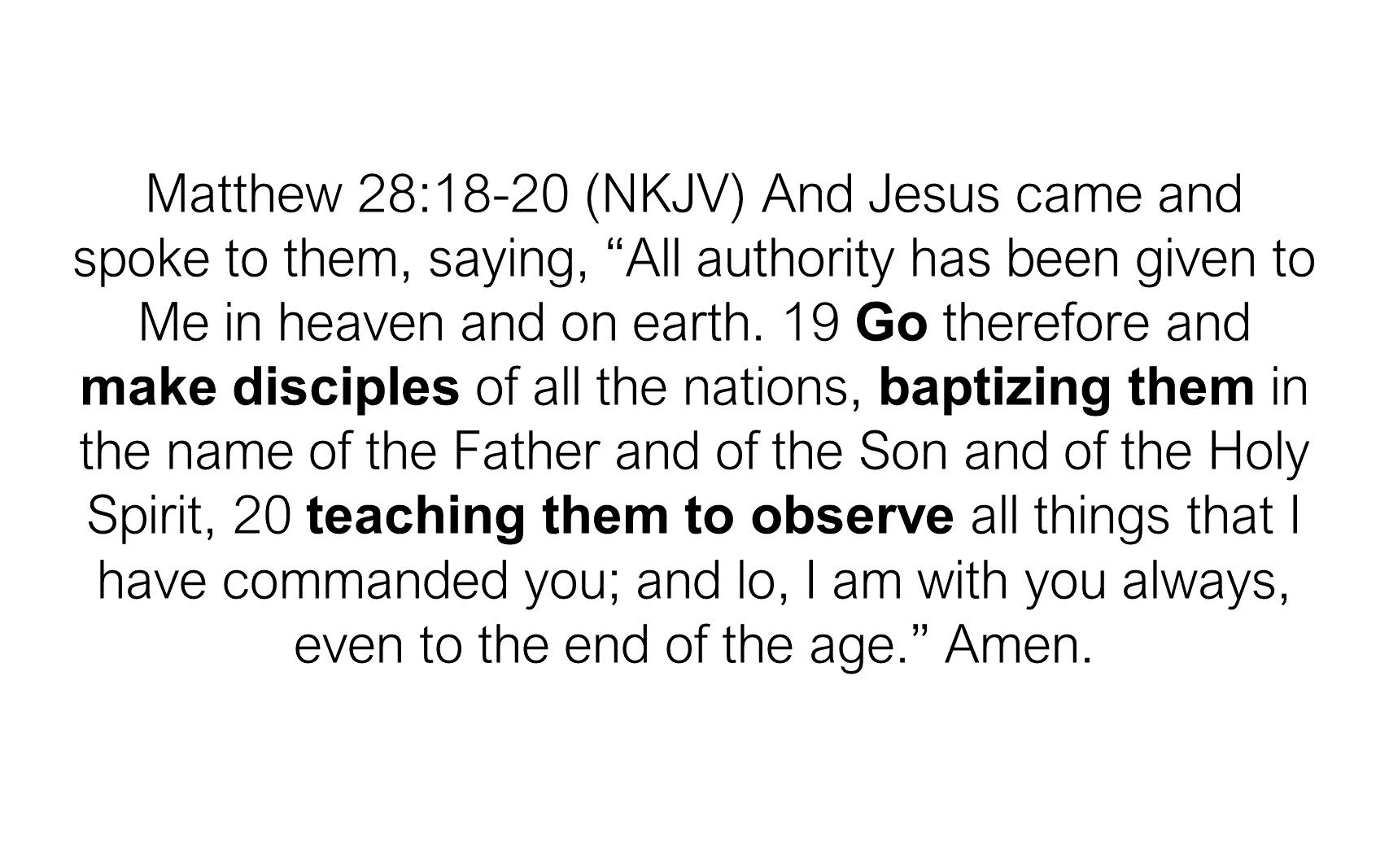
So, let’s all stand together. We’re going to read our text together and then we’re going to actually look at the illustration of it and see if it’s actually what it says. You can read, you have your own Bible, but so that we all can say the same words we’ll just read this together starting in verse 18. And Jesus came and spoke to them saying, all authority has been given to Me, in Heaven and on Earth. Go therefore, and make disciples of all the nations, baptizing them in the name of the Father and of the Son and of the Holy Spirit. Teaching them to observe all things that I have commanded you. And lo, I am with you always, even to the end of the age. Amen.
Let’s bow together. Father, I thank you for a very clear plan, very simple plan. A job description. So, every day when we get up, we can decide if we are going to be involved in what our Master left us to do. Everything else is ancillary. It’s secondary. It’s supportive. We have to work to eat and we have to eat to live, but we don’t spend our lives here on what will pass away. We were bought at a price. And so, we want to be as closely anchored to Your Word, to Your will, to Your way for us in life as we can be. And I pray that You would stir our hearts this morning, to make sure that we are wanting to go, wanting to evangelize, wanting to see people that we have led to You publicly declare their allegiance to You. And then train them. The greatest joy in life is a collection of people we have trained for You. Not a collection of cars or coins or pictures or albums or trinkets or gizmos or earthly honors, but that we actually while we were alive and breathing on Earth, we actually did what You desired and called and planned for us to simply do for You. Teach us, I pray. Stir our hearts. May You be glorified in our responses. In the name of Jesus, we ask it. Amen.
And you may be seated. As you’re seated, we could just map. In those four words, what Jesus is saying in this great commission. Now, turn over the book of Acts because what’s interesting to do is, and I used to be a sales trainer and a salesman in [the] corporate world. And we used to have seminars and we would train the salespeople to do something. And then we’d let them go do it. And it was fascinating to see what they learned or what they thought they learned. What we have here in the book of Acts is the people that Jesus directly told them the plan, this plan. Jesus said, I want you going, evangelizing, baptizing, and training, and teaching them. What did they do? See that? How did they interpret, how did they embrace what He told them to do? That’s why we have the book of Acts. And what we have is, if you just summarize the book of Acts, baptism was expected in the 1st century. An unbaptized believer, unless they’re crucified next to Christ, is not known in the New Testament. Did you understand that there were no believers who were not baptized other than the thief on the cross that we have recorded in the New Testament? Isn’t that interesting? Boy, do we have a lot nowadays, which shows you how unanchored we are. How confused it can be.
The great commission pattern is carried out in the Book of Acts. But before we look in depth at every passage that records a baptism we could summarize everything about baptism in the book of Acts like this, and I’m going to do it for you real quick. Okay? There are nine of them. And if I was to record them for you, I would point out there is something fascinating about every account.
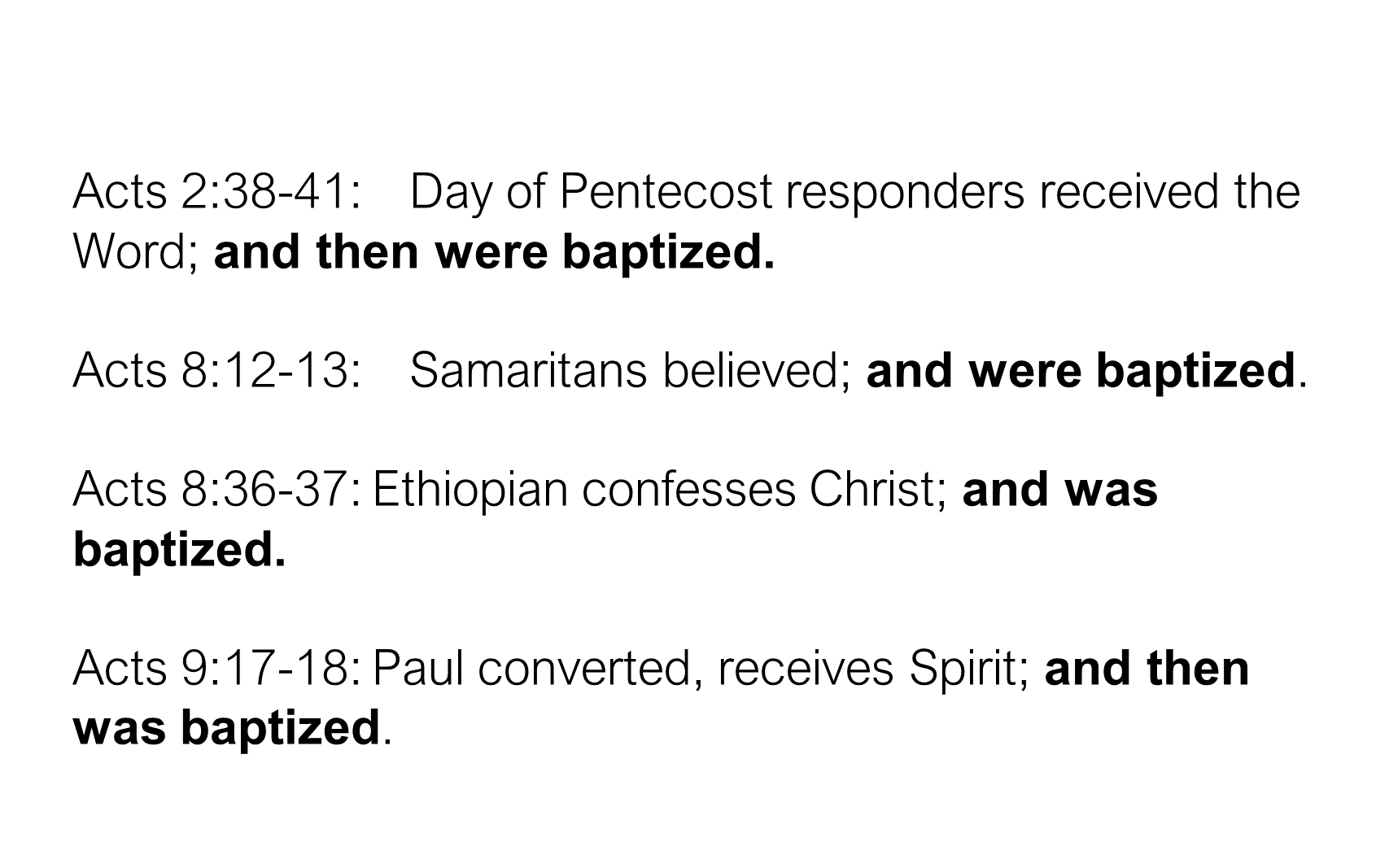
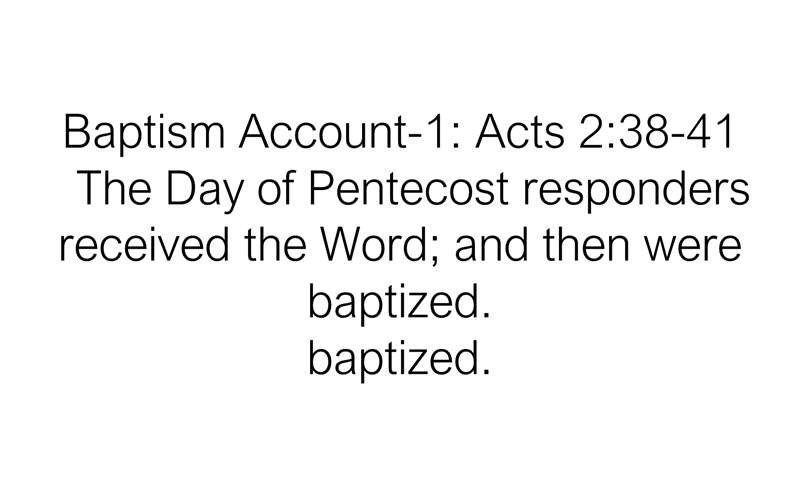
Okay. Acts 2:38, the day of Pentecost. Responders received the Word and they were baptized. That’s interesting.
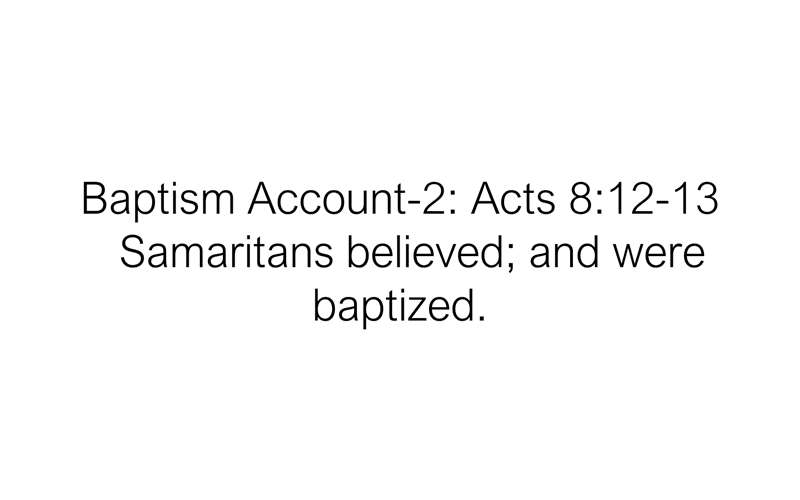
Acts 8, Samaritans believed and they were what? Baptized. Okay.
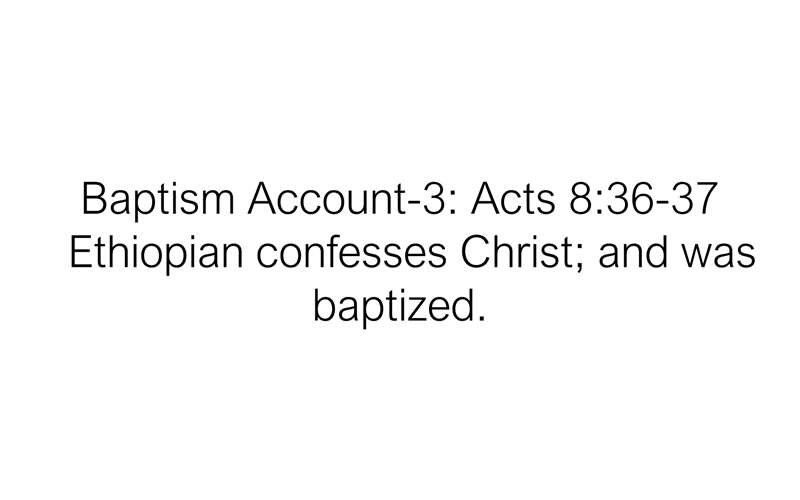
The Ethiopian confesses Christ and was what? Baptized. Yeah, after he confessed Christ.
Paul himself, the apostle was converted. He receives the Holy Spirit. By the way, big flakes like scales fell off of his eyes and he was baptized. Isn’t that interesting? Paul had to follow through with this.
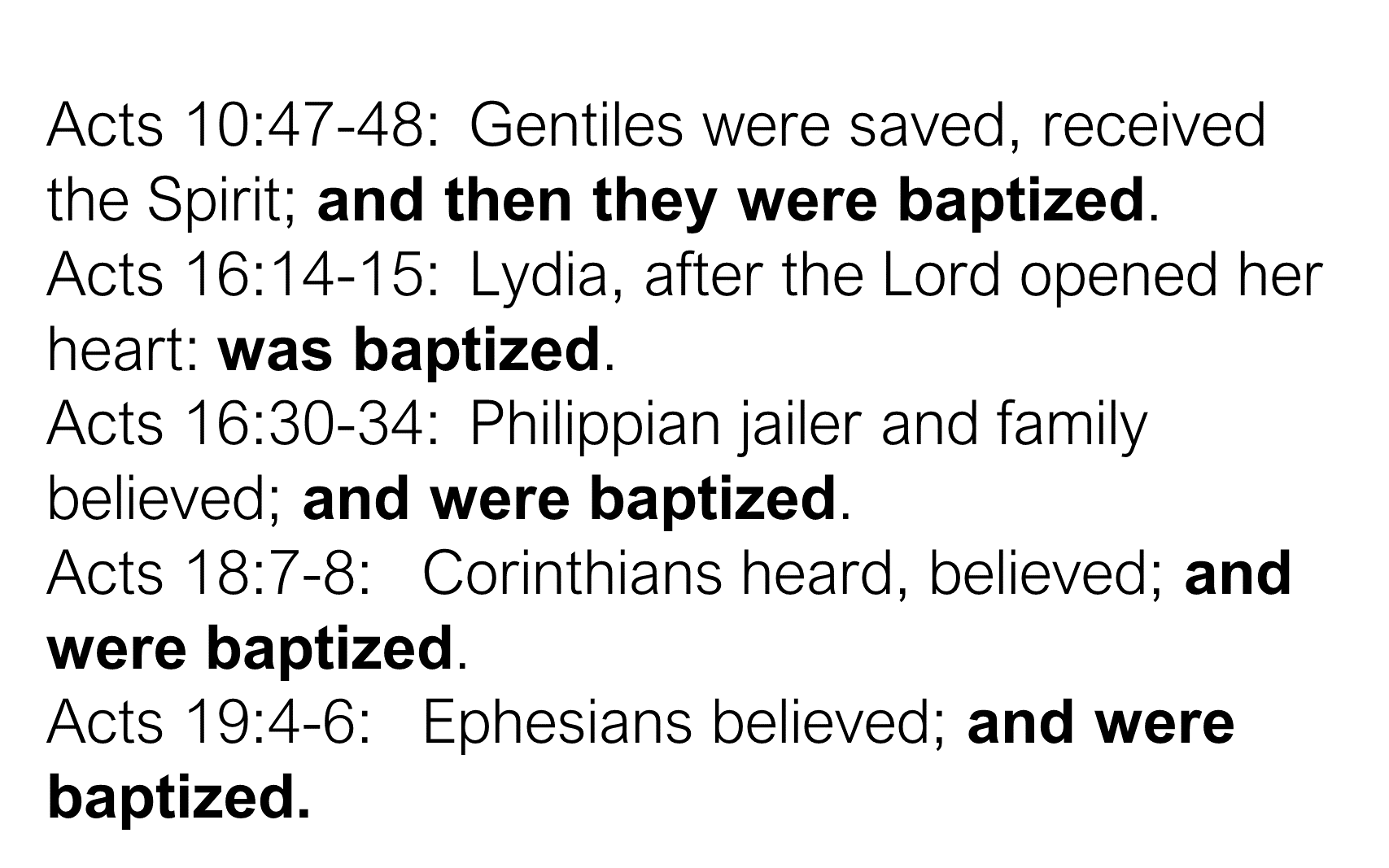
In Acts 10, the Gentiles were saved. They received the Spirit, and they were what? Baptized.
Acts 16, Lydia. That’s an interesting way to describe salvation. The Lord opened her heart. In fact, after first service, I had a great visit with someone from Sault Sainte Marie that were visiting. I thought, wow, you drove a long way. But it was a blessing to talk to him. And we were talking about how, actually no one that gets saved, gets saved without the Lord opening our heart. Actually, what they were talking to me about in first service was the theological term ordo salutis, the order of salvation. What comes first? What comes second? What comes third? And I said, I have 1,600 page theology books and they spent dozens of pages talking about this, but if the Lord doesn’t open their heart they’re not saved. People can’t save themselves and they don’t get saved by osmosis or association. It’s a supernatural work of the Lord. But after the Lord did it, what happened? She was baptized.
Acts 16, the Philippian jailer. Remember one of the most well-known. Believe on the Lord Jesus Christ, thou shall be saved. He and his family believed. Now, this is a classic one here. People say his house was filled with babies and they baptized all of them. No, really? If you talk about the baby baptizers, it’s right there. His house was… there were just children in every corner and they all got baptized. We will look at that. Do you know what it says? Everyone that got baptized, before they got baptized, they believed. [It] Actually says that in that passage and every other passage.
And Acts 18, Crispus, the synagogue fella. He heard, he believed with other Corinthians. And after they heard and believed they were baptized.
And finally, what we would call these Old Testament saints -the followers of John the Baptist, they believed in Ephesus in chapter 19 and they were baptized.
So, that’s something just to say, believers baptism. Now, let me define believers baptism. That baptism is only for believers and it’s only after they believe. And that is the consistent cover to cover New Testament model. You say where did infant baptism come from? I wish you hadn’t asked me that because it will take time.
But do you remember that Israel had a sign, circumcision? Circumcision was an outward sign of an inward relationship as a covenant loving, loyal follower of God, and because babies were circumcised on the eighth day the reformers said, baptism becomes the circumcision of the believer. And so, they are going to, as an infant, be baptized. So that’s… Okay, that’s a nice… I can see that.
Now, look what happened with Old Testament Israel. Those people were circumcised but not saved. Did you know that? All those people coming out of Egypt, the Lord destroyed them in the wilderness because they were rebels and they didn’t want to follow Him. And the Lord says, oh that you would render your hearts and not your garments. And oh, that you got your heart circumcised and not your body. The Lord says, I’m not into outward things. Baptism doesn’t save anybody any more than circumcision saved Jews. So, what we have [is] New Testament churches that are following Israel’s example and they say that baptism of infants equals salvation. But let me tell you, if you’re going to use the Old Testament model, it didn’t equal it in the Old Testament and it doesn’t equal it in the New.
Now we have a new problem, nowadays by the way. We’ve gone well past… most people understand baptism regeneration is wrong, now we have… I prayed a prayer, so I’m saved. I went forward, so I’m saved. I had this experience, so I’m saved. And you know what the Lord says? Nope. Nope. Nope. If I don’t open your heart, if you are not supernaturally born again, not make a decision or join something, you’re not saved. But I’m glad that you didn’t ask me that, because that would’ve taken a long time on it.
Let’s go through these accounts. Okay? And there are nine of them. I’m just going to just run right through them. Baptism account number one is in Acts 2. You can start working through your Bibles in verse 37. We’re just going to chug right through the Book of Acts. It says, they said in verse 37, the last four words, what shall we do? And Peter said, verse 38, repent. And let every one of you be baptized in the name of Jesus for the remission of your sins.
Oh, that has caused a lot of problems. That’s where we get the Church of Christ and all the baptismal regenerationist. Let me just illustrate that with a poster. If you were in the Wild West in the 1880s and you saw this Jesse James picture and it said wanted for murder. Remember Jesse James, the hooligan? Does that mean that they were advertising to hire him to murder someone? Is that what wanted for murder means? Now think about baptized for the remission of sins. See, common English usage would be you don’t get baptized so that you can have your sins remitted, or wanted so that you can murder someone. How do I know that? Because the Bible, and you’ll see in a moment it, it actually repeats the same phrase in the Book of Acts and it very clearly says that they were baptized because of the remission of their sins, because they were saved.
But keep reading just because that’s an important note that all of the online baptismal regenerationist quote that one. You need to be baptized for the remission of your sins. And if you are not baptized, your sins are not remitted. That is false, heretical, and very dangerous. People raised in baptismal regeneration circles believe they did something to save themself. They got baptized. You can go to Heaven without ever being baptized, period. That’s why Paul said in 1 Corinthians 1, I’m glad I didn’t come to baptize and I didn’t baptize most of you. He says that. Why? Because even back then, the circumcised people wanted to be baptized, do this, so they could be saved. No, salvation is first. Baptism is just an act of obedience afterward.
But look what happens in verse 38, after you believe and have your sins remitted, you receive the Holy Spirit. Look at the order you’re saved. The Holy Spirit becomes our seal, our down payment, verse 39. This promises to you and everyone God calls, verse 40, he testified and said, be saved. And then look at verse 41. Those who gladly received His Word, those who responded to the message of the Gospel, were baptized. Wow. And look at verse 44. Now, all who believed were joined together in the Church.
Account number one, day of Pentecost people, he says if you receive the Word you’ll be baptized. And in verse 44, all those baptized people were people that believed. And that is the first model.
Okay, if you go to the second one, look at this -chapter 8, and we went through that before. But chapter 8, verse 12. When they believe Philip, as he preached the things concerning the Kingdom of God. Now that’s an interesting description of a salvation message. The Kingdom of God. Seven times in the book of Acts it says salvation is entering the Kingdom of God. That’s entering a kingdom that’s ruled by God, and we become His subjects. People, they get concerned when too heavy of a Gospel presentation is made. The original ones were heavier than anything you’ve ever heard. They said, you’ve got to repent and you’ve got to come into the kingdom where God rules in your life or you can’t be saved. And that’s what Philip taught them.
And when he preached to them the things concerning the Kingdom of God in the name of Jesus Christ, both men and women were baptized. That means the people that responded and entered the kingdom, after that we’re baptized. And Simon himself believed and was baptized. You see the sequence? That’s always in the New Testament.
Keep going to chapter 8, verse 35, and this is the Ethiopian eunuch. And it says, starting verse 35, Philip opened his mouth, preached Jesus to him. And so, the fellow in verse 36 says, here’s water; what hinders me from being baptized? Verse 37. Philip said, if you believe with all your heart, you may be baptized. What precedes baptism? Belief. Always in the New Testament. Always.

Look at the next one, chapter 9. This is the next chapter. The Apostle Paul, look at verse 17. Ananias went his way, entered the house, he laid his hands on him and said, brother Saul, the Lord Jesus who appeared to you on the road has came and sent me, that you may receive your sight and be filled with the Holy Spirit. So, remember salvation… remember I told you, Acts 26:18 says salvation is when God opens our eyes. And so, Ananias told Paul that you need your eyes opened and to receive the Holy Spirit. So, Paul’s eyes are open and he receives the Holy Spirit. And look at verse 18. And immediately there fell from his eyes something like scales. He received his sight at once. And then verse 18 says what happened. He was baptized. Baptism follows belief. That’s what believers baptism is.
Look at chapter 10. This is the gentiles, Cornelius’ household. Look at verse 42. Commanded us to preach the people and testify that He is ordained by God to be Judge of the living and the dead. There is a heavy Gospel presentation. A lot of people say don’t scare them away. No, scare them away. If they can be scared away, scare them away. Okay? Those are the ones that don’t need to be counted. If they get scared away by the demands of Christ, they aren’t interested in entering His kingdom. It’s supernatural to be saved. We don’t make it so alluring that everybody wants it, because narrow is the gate. The gate in most churches is wider than anything we could imagine. Jesus said, no, My gate’s narrow. And I tell them about what it says there, about judgment. And that He was one ordained, verse 42, to be judged of the living and the dead. To Him, all the prophets witness that through His name, now look at… here’s the Jesse James passage. Whoever believes in Him will receive remission of sins. We’re baptized because we’ve had our sins remitted, not to get them remitted.
And you see it, it’s stated again, the very same concept right here. They receive remission of sins. Look at verse 44. And while Peter was still speaking these words, the Holy Spirit fell on those who heard the Word. And they believed. Wow. I’ve seen that happen. A lot of times people think you got to come forward, you got to talk to a counselor, you got to go to Billy Graham crusade, you’ve got to raise your hand or do something. No. After 35 years, I’ve seen so many people that get saved when it finally clicks. The Lord has been knocking and drawing and preparing and convicting and finally, all of a sudden, they’re sitting there and it’s, bang, just like this. And they… And the Holy Spirit fell on those who heard the Word. That means that they had been saved. And look what happens, verse 47 of Chapter 10. Can anyone forbid water that these should not be baptized, who’s received the Holy Spirit as we have? People that have the Holy Spirit, who have been born again, who receive the Holy Spirit need to be baptized. And so, look what verse 48 says. And he said to them, sometime in the future, if you want to, if you want to get around to this, if it isn’t too much of a bother or embarrassment, you should consider maybe someday…
What does it say in 48? And he commanded. Now, this is the second time it’s commanded. Jesus commanded everyone who gets evangelized and is truly saved, baptize them. And now the apostles, see, they’re just, they’re doing what they were trained to do because they’re anchored to the Word. See, they’re, the way they did church was the way Christ said, do church. The way they did the Gospel is the way Christ said, do the Gospel. And so they, verse 48, they commanded them to be baptized in the name of the Lord.
Okay, the next one is […] chapter 16, look at verse 14. So, turn over to the account of Lydia. And I already told you about this one, but I’ll just repeat it. And there’s a lot of interesting things. But verse 10 at the end, it says, concluding the Lord has called us to preach the Gospel to them. Acts 16:10. Therefore, we sailed from Troas. Verse 11 and verse 12. We went to Philippi in verse 13. On the Sabbath day, we went to the riverside. In verse 14, there was a certain woman named Lydia who heard us. Now, this is the most fascinating thing, if you ever read it and when we cover this, it’s just fascinating that God wanted her. And he, Paul, was going to Asia and the Lord says, no, you can’t go that way. So, he went this way and the Lord said, no, you can’t go that way. Paul said, okay, I’ll go this way. And the Lord sent him the Macedonian vision or call. And that was, God wanted Lydia. And so, he gets there and Lydia heard us, verse 14 says. She was a seller of purple from the city of Thyatira. She wasn’t even from there. And she was sensitive. She worshiped God. She wasn’t saved. She was someone that was sensitive to the things of God and knew there was a Creator. But look at what happens at the end of verse 14. The Lord opened her heart to heed the things spoken by Paul.
What did Paul speak? Verse 10. He preached the Gospel. He told Lydia, you’re a nice, clean, upright seller of purple, but you’re lost. You need a new heart. You need your sins forgiven. You need all guilt removed. You need the penalty for your sins put on someone else. He preached the Gospel to her. The Lord opened her heart. And look at verse 15. She and her household were baptized. And she begged him saying, if the Lord has judged me to be faithful, if you have judged me to be faithful to the Lord, come to my house and stay. And she persuaded us.
On to number seven. The Philippian jailer and his family believed. And this is one where they talk about there must have been a lot of babies in that household. Look what happens starting in verse 30. They brought them out and said sirs, what must I do to be saved? And they said, believe on the Lord Jesus Christ. Verse 31, you’ll be saved in your household. And that’s where everybody stops and they go, Ah… See… Baptized all the kids. There they are. That’s infant baptism. Okay, let’s keep reading then. Verse 32, he spoke the Word of the Lord to him and all who were in his house. So, whoever was in that house listened, okay, to the Word of the Lord but it doesn’t end there. Verse 33, he took them the same hour of the night, washed their stripes and immediately he and all his family were baptized. So, they baptized them all. Verse 34, and they brought them into the house and set food before them and rejoiced, having believed in God with all his household. Everybody that got baptized believed in God. So, that is not a baby baptism, infant baptism verse. And there aren’t any. They all are… they’re all set with belief.
And the next one, chapter 18, if you look at that. Verse 8. Crispus, the ruler of the Synagogue believed on the Lord with all his household. And by the way, the construction “believed on the Lord with all his household,” it doesn’t mean that Crispus and his household… that Crispus believed and then this household is a separate closet. Crispus and his household believed on the Lord. And so, what happened? It continues. It says, believed in the Lord with his household and many of the Corinthians, which is saying other people too hearing believed, and all those who heard and believed, verse 8 says, were baptized.
And then here’s the last one, this is fascinating. By the way, remember there are four distinct groups that needed to hear the Gospel. The Jews that crucified Christ and that whole crowd from that time. The Samaritans were half Jew, half Gentile. The Gentiles, that’s chapter 10 we already did with Cornelius. But there was one other group, these faithful followers of John the Baptist in the early ministry of Christ. Six months before Christ, John the Baptist is baptizing. And there was a whole group of people that got baptized by John the Baptist and they left. They never came back to town, they never… Six months later, Jesus came. And these people were there and they got baptized by John and they were all excited and they went home. These went to Ephesus in Asia Minor. And they’d never heard the rest of the story. And that’s what’s happening here.
And so, Paul says in verse 2, did you receive the Holy Spirit when you believed? That’s a good question to ask people. You want to know if you’re really saved. Did you receive the Holy Spirit? The Holy Spirit, the instant of our salvation indwells us, seals us, regenerates us, and begins the work of sanctification. The Holy Spirit is critical to everything. He’s the one that convicts us of sin and opens our eyes and turns us and everything else. He says, did that happen to you? And they said to him, we haven’t even heard of the Holy Spirit. Verse 2, and he said to them, how were you baptized then? They said, we were baptized to John’s baptism. Verse 4. And Paul said, John baptized with a baptism repentance, saying to the people that they should believe on Him who had come after him. That is on Christ Jesus. Now look at verse 5. When they heard this, they were baptized in the name of the Lord Jesus. And when Paul had laid hands in them the Holy Spirit came upon them and they spoke with tongues and prophesied, and there were 12 of them.
You know what? This is a special group. You talk about, this is where the man from the Soo was talking to me after first service. He said, what happened there? I said, that was a very special case. The Holy Spirit, speaking in tongues and prophesying, was a signature of the Lord upon each of the groups. The Jews and the Day of Pentecost. The people in Samaria when Peter came up and all the Philip stuff going on. The speaking in tongues with the Gentiles showed God’s accepting them into Christ’s Church. And finally, these followers of John the Baptist, the same thing. But, this is the only time we see that they’re saved, they’re baptized, and then Paul lays his hands on them and they’re filled with the Holy Spirit. But again, we’re talking about baptism. They’re saved before they’re baptized.
Okay. Real quickly and I’m going to pick up here next week, but I’m going to tell you this as we prepare for communion. Paul taught what baptism declares. Okay. Now, turn your Bibles if you want to, to Colossians 2. And what it says in Colossians 2:11-15, where we pick up next time, is five truths Paul taught the Colossians about salvation.
Number one, baptism is a declaration, I got a new heart. When people get saved, we work with them, have them write out their testimony, want to hear that they were born lost, that they heard the Gospel, they responded in faith, and God gave them a regeneration, a new heart. That’s the first thing baptism declares, a heart that’s new.
Then in verse 12, baptism declares I have a past that’s buried and forever gone. I am buried with Christ in baptism. That’s why baptism is so beautiful a picture. It’s a picture when the person stands there of their whole life of sin, past, present, future, being buried with Christ. Who wouldn’t want to identify with that? What a joy.
But it doesn’t end there. Verse 13 says baptism declares, as we come out of the water we have a fresh, new beginning. I always get to see that, and the baptism team does too. The looks on people’s faces when they realize the old is gone. A baby has no past, just a future. And that’s why the new birth means we have no past, just a future. Our past is buried. All I have is a fresh new beginning. And that’s the third truth.
The fourth truth, and we’ll go into these and read the verses next time. Baptism is my declaration I have an end to all guilt. My sins are on Jesus.
And it continues, I have nothing left to fear. Everything has been disarmed. Everything that would cause me fear. The hymn writer put it this way: no fear in death, no guilt in life. This is the power of Christ in me.
So, you know what that means? Today, in Christ, we who are coming into communion should already have declared in the waters of baptism that we have a new heart. That we have a past that’s forever gone. That Satan cannot accuse me and God will never bring up my past. That’s the blessing of salvation. I have a fresh, new beginning every day. If anyone’s in Christ they are a new creation. Old things are passing away. That means there’s this constant new beginnings. I have an end of all guilt. I don’t go around… Paul could talk about people he murdered. And he said, I’m so sorry. And I was the chiefest of sinners. But he wasn’t guilty about it because he knew he was forgiven and there’s nothing left to fear. That’s what we declare at baptism and that’s what we celebrate at communion.
Notes
God’s Word teaches us a doctrine called “believer’s baptism” which means that: God has only designed baptism to be applied to believers. Believer’s Baptism started when Jesus Christ said that the way that people were to declare God’s ownership of their lives after they were saved, was when they were baptized in His Name. Jesus included this baptism of believers into the plan for the church.
Christ Jesus Left the Plan for His Church
When Jesus left the disciples with the plan they were to follow, it was simple:
Go, evangelize, baptize & train.
That is the Great Commission. That is God’s plan for Christ’s Church. Stated twice (Matthew 28:18-20 and Mark 16:16); and illustrated in Acts nine times, it is what God expects us in Christ’s Church to be doing.
Our job is to make disciples; and our motivation is to do that (and everything else), for the glory of God. A simple reading of the commission of Christ and the record of the response of His disciples, and the early church, would lead us to conclude that:
Baptism was Part of the Plan
Baptism for the New Testament Church had its origin in the command of Christ to make disciples and baptize them (Matt. 28:19). There was a particular order established in what Christ said: first people became disciples, then those disciples were baptized, and then they were taught.
Please stand with me, and listen to the clear and simple plan God the Son, our Savior Jesus Christ left for each of us:
Matthew 28:18-20 (NKJV) And Jesus came and spoke to them, saying, “All authority has been given to Me in heaven and on earth. 19 Go therefore and make disciples of all the nations, baptizing them in the name of the Father and of the Son and of the Holy Spirit, 20 teaching them to observe all things that I have commanded you; and lo, I am with you always, even to the end of the age.” Amen.
So we could simply map the plan Christ left in these four actions:
Go—Disciple—Baptize—Teach.
That means then that according to God’s Word, and from the record we have in Church History:
BAPTISM WAS EXPECTED IN THE 1ST CENTURY!
The Great Commission pattern is carried out in the book of Acts. Before we look at each of the ten passages that record a baptism, we could summarize everything about Baptism that the book of Acts records like this:
Acts 2:38-41: Day of Pentecost responders received the Word; and then were baptized.
Acts 8:12-13: Samaritans believed; and were baptized.
Acts 8:36-37: Ethiopian confesses Christ; and was baptized.
Acts 9:17-18: Paul converted, receives Spirit; and then was baptized.
Acts 10:47-48: Gentiles were saved, received the Spirit; and then they were baptized.
Acts 16:14-15: Lydia, after the Lord opened her heart: was baptized.
Acts 16:30-34: Philippian jailer and family believed; and were baptized.
Acts 18:7-8: Corinthians heard, believed; and were baptized.
Acts 19:4-6: Ephesians believed; and were baptized.
All of these summaries indicate that in each event baptism follows belief; and it is striking if you notice the pattern: that baptism is always mentioned closely following conversion.
Now, as good Bereans who search the Scriptures ourselves and see if what is presented is actually taught there (Acts 17:11), join me we go to each actual event, note in the passages when the person was saved, and then see how closely Baptism follows.
Believer’s Baptism is Clearly Portrayed in Acts
Baptism Account-1: Peter preached, people responded.
But, only those who heard the gospel, understood and responded to it through faith and repentance, could be baptized. The result was that the people received the Word, and then were baptized (Acts 2:41). Note the sequence as we read though Acts 2:37-44:
Now when they heard this, they were cut to the heart, and said to Peter and the rest of the apostles, “Men and brethren, what shall we do?” 38 Then Peter said to them, “Repent, and let every one of you be baptized in the name of Jesus Christ for the remission of sins; and you shall receive the gift of the Holy Spirit. 39 For the promise is to you and to your children, and to all who are afar off, as many as the Lord our God will call.” 40 And with many other words he testified and exhorted them, saying, “Be saved from this perverse generation.” 41 Then those who gladly received his word were baptized; and that day about three thousand souls were added to them. 42 And they continued steadfastly in the apostles’ doctrine and fellowship, in the breaking of bread, and in prayers. 43 Then fear came upon every soul, and many wonders and signs were done through the apostles. 44 Now all who believed were together, and had all things in common,
Baptism Account-2: Those who responded to Philip’s message first believed, and then were baptized. Note Acts 8:12-13:
But when they believed Philip as he preached the things concerning the kingdom of God and the name of Jesus Christ, both men and women were baptized. 13 Then Simon himself also believed; and when he was baptized he continued with Philip, and was amazed, seeing the miracles and signs, which were done.
Baptism Account-3: As soon as the Ethiopian believed in Christ, he stopped his chariot so that he could be baptized. Follow along in Acts 8:35-37:
Then Philip opened his mouth, and beginning at this Scripture, preached Jesus to him. 36 Now as they went down the road, they came to some water. And the eunuch said, “See, here is water. What hinders me from being baptized?” 37 Then Philip said, “If you believe with all your heart, you may.” And he answered and said, “I believe that Jesus Christ is the Son of God.”
Baptism Account-4: As soon as Paul received back his sight after his conversion, and was filled with the Holy Spirit, he was baptized (9:11-18).
So the Lord said to him, “Arise and go to the street called Straight, and inquire at the house of Judas for one called Saul of Tarsus, for behold, he is praying. 12 And in a vision he has seen a man named Ananias coming in and putting his hand on him, so that he might receive his sight.” 13 Then Ananias answered, “Lord, I have heard from many about this man, how much harm he has done to Your saints in Jerusalem. 14 And here he has authority from the chief priests to bind all who call on Your name.” 15 But the Lord said to him, “Go, for he is a chosen vessel of Mine to bear My name before Gentiles, kings, and the children of Israel. 16 For I will show him how many things he must suffer for My name’s sake.” 17 And Ananias went his way and entered the house; and laying his hands on him he said, “Brother Saul, the Lord Jesus, who appeared to you on the road as you came, has sent me that you may receive your sight and be filled with the Holy Spirit.” 18 Immediately there fell from his eyes something like scales, and he received his sight at once; and he arose and was baptized.
Baptism Account-5: As soon as Cornelius and his household were saved, Peter “ordered them to be baptized in the name of Jesus Christ” (10:41-48).
Acts 10:41-48 (NKJV) not to all the people, but to witnesses chosen before by God, even to us who ate and drank with Him after He arose from the dead. 42 And He commanded us to preach to the people, and to testify that it is He who was ordained by God to be Judge of the living and the dead. 43 To Him all the prophets witness that, through His name, whoever believes in Him will receive remission of sins.” 44 While Peter was still speaking these words, the Holy Spirit fell upon all those who heard the word. 45 And those of the circumcision who believed were astonished, as many as came with Peter, because the gift of the Holy Spirit had been poured out on the Gentiles also. 46 For they heard them speak with tongues and magnify God. Then Peter answered, 47 “Can anyone forbid water, that these should not be baptized who have received the Holy Spirit just as we have?” 48 And he commanded them to be baptized in the name of the Lord. Then they asked him to stay a few days.
Baptism Account-6: Lydia is converted and then baptized (Acts 16:6–15); but note how God makes Paul go in a different direction, sends him a vision, and opens Lydia’s heart. This is an amazing example of God the Savior seeking the lost.
Acts 16:6-15 (NKJV) Now when they had gone through Phrygia and the region of Galatia, they were forbidden by the Holy Spirit to preach the word in Asia. 7 After they had come to Mysia, they tried to go into Bithynia, but the Spirit did not permit them. 8 So passing by Mysia, they came down to Troas. 9 And a vision appeared to Paul in the night. A man of Macedonia stood and pleaded with him, saying, “Come over to Macedonia and help us.” 10 Now after he had seen the vision, immediately we sought to go to Macedonia, concluding that the Lord had called us to preach the gospel to them. 11 Therefore, sailing from Troas, we ran a straight course to Samothrace, and the next day came to Neapolis, 12 and from there to Philippi, which is the foremost city of that part of Macedonia, a colony. And we were staying in that city for some days. 13 And on the Sabbath day we went out of the city to the riverside, where prayer was customarily made; and we sat down and spoke to the women who met there. 14 Now a certain woman named Lydia heard us. She was a seller of purple from the city of Thyatira, who worshiped God. The Lord opened her heart to heed the things spoken by Paul. 15 And when she and her household were baptized, she begged us, saying, “If you have judged me to be faithful to the Lord, come to my house and stay.” So she persuaded us.
Baptism Account-7: the conversion of the Philippian jailer (Acts 16:25–34) again follows the believer’s baptism pattern: he hears, cries out, believes, and then is baptized.
Acts 16:25-34 (NKJV) But at midnight Paul and Silas were praying and singing hymns to God, and the prisoners were listening to them. 26 Suddenly there was a great earthquake, so that the foundations of the prison were shaken; and immediately all the doors were opened and everyone’s chains were loosed. 27 And the keeper of the prison, awaking from sleep and seeing the prison doors open, supposing the prisoners had fled, drew his sword and was about to kill himself. 28 But Paul called with a loud voice, saying, “Do yourself no harm, for we are all here.” 29 Then he called for a light, ran in, and fell down trembling before Paul and Silas. 30 And he brought them out and said, “Sirs, what must I do to be saved?” 31 So they said, “Believe on the Lord Jesus Christ, and you will be saved, you and your household.” 32 Then they spoke the word of the Lord to him and to all who were in his house. 33 And he took them the same hour of the night and washed their stripes. And immediately he and all his family were baptized. 34 Now when he had brought them into his house, he set food before them; and he rejoiced, having believed in God with all his household.
Baptism Account-8: As soon as lost pagans and Jews in Corinth were being won to Jesus Christ, they were also being baptized (18:4-10).
Acts 18:4-10 (NKJV) And he reasoned in the synagogue every Sabbath, and persuaded both Jews and Greeks. 5 When Silas and Timothy had come from Macedonia, Paul was compelled by the Spirit, and testified to the Jews that Jesus is the Christ. 6 But when they opposed him and blasphemed, he shook his garments and said to them, “Your blood be upon your own heads; I am clean. From now on I will go to the Gentiles.” 7 And he departed from there and entered the house of a certain man named Justus, one who worshiped God, whose house was next door to the synagogue. 8 Then Crispus, the ruler of the synagogue, believed on the Lord with all his household. And many of the Corinthians, hearing, believed and were baptized. 9 Now the Lord spoke to Paul in the night by a vision, “Do not be afraid, but speak, and do not keep silent; 10 for I am with you, and no one will attack you to hurt you; for I have many people in this city.”
Baptism Account-9: As soon as Paul found some disciples of John in Ephesus who had only been baptized with the baptism of John for repentance: he told them about Jesus, the one for whom John was merely preparing the way; and when they believed “they were baptized in the name of the Lord Jesus” (19:1-7).
Acts 19:1-7 (NKJV) And it happened, while Apollos was at Corinth, that Paul, having passed through the upper regions, came to Ephesus. And finding some disciples 2 he said to them, “Did you receive the Holy Spirit when you believed?” So they said to him, “We have not so much as heard whether there is a Holy Spirit.” 3 And he said to them, “Into what then were you baptized?” So they said, “Into John’s baptism.” 4 Then Paul said, “John indeed baptized with a baptism of repentance, saying to the people that they should believe on Him who would come after him, that is, on Christ Jesus.” 5 When they heard this, they were baptized in the name of the Lord Jesus. 6 And when Paul had laid hands on them, the Holy Spirit came upon them, and they spoke with tongues and prophesied. 7 Now the men were about twelve in all.
So in every baptism event recorded in the Book of Acts we can see belief in the Gospel, followed by the outward sign of that belief in believer’s baptism.
Paul Taught What Baptism Declares in Colossians
In Colossians 2:11-15, Paul wrote to the church at Colossi what he taught in other places where he had visited. Baptism portrays the wonders of what Christ did for us in salvation.
Truth # 1: Baptism Is My Declaration That I Have A Heart That Is New
“In him you were also circumcised with the circumcision made without hands, by putting off the body of the sins of the flesh, by the circumcision of Christ”. (Colossians 2:11, NKJV)
Our new heart speaks of spiritual heart circumcision (Ezekiel 36:26-27), or the work of salvation as Christ is putting off our old person
Truth # 2: Baptism Is My Declaration That I Have a Past That Is Buried And Forever Gone
“Buried with him in baptism, in which you also were raised with him through faith in the working of God, who raised him from the dead”. (Colossians 2:12, NKJV)
Truth # 3: Baptism Is My Declaration That I Have A Fresh, New Beginning
Colossians 2:13 and you, being dead in your trespasses and the uncircumcision of your flesh, he has made alive together with him, having forgiven you all trespasses,
Truth # 4: Baptism Is My Declaration That I Have An End To All Guilt, Because All My Sins Are On Jesus
Colossians 2:14a having wiped out the handwriting of requirements that was against us, which was contrary to us. And he has taken it out of the way, having nailed it to the cross.
Truth # 5: Baptism Is My Declaration That I Have Nothing Left to Fear
Colossians 2:14b having wiped out the handwriting of requirements that was against us, which was contrary to us. And he has taken it out of the way, having nailed it to the cross.
Today in Christ we have: a heart that is new; a past that is forever gone; a fresh new beginning, an end to all guilt; and nothing left to fear!
Baptism in the New Testament
Remember what New Testament baptism is:
Believer’s Baptism was commanded by Christ for the Church to observe until the end of the age. Baptism means identification (Mt. 28:19). New Testament baptism is always to identify believers with Christ in His death and resurrection. When we are baptized in the name of Christ (Acts 2:38) we are stressing our association with Christ. In Romans 6:4–5 where Spirit baptism is described, not water baptism: the passage still illustrates what water baptism means: the public declaration that believers are united to Christ by faith in His death and resurrection. Immersion is the most Biblical mode of baptism, not just because the Greek word for baptism denotes immersion; but also because only immersion can symbolize death, burial, and resurrection.
Believer’s Baptism portrays my new relationship with God. Matthew 28:19-20 Go ye therefore, and teach all nations, baptizing them in the name of the Father, and of the Son, and of the Holy Ghost: 20 Teaching them to observe all things whatsoever I have commanded you: and, lo, I am with you always, [even] unto the end of the world. Amen. (KJV)
Believer’s Baptism announces my pledge of allegiance to Christ, as I am baptized into the name of the Triune God, and fellowship with Him. 1 Corinthians 12:13 For by one Spirit are we all baptized into one body, whether [we be] Jews or Gentiles, whether [we be] bond or free; and have been all made to drink into one Spirit. (KJV) Galatians 3:26-27 For ye are all the children of God by faith in Christ Jesus. 27 For as many of you as have been baptized into Christ have put on Christ. (KJV)