If the video above is not available, here are two other ways to view:
140727AM
ESH-22
Jesus Shares Gospel.docx
Biblical Exercises for Spiritual Health & Fitness in 2014 Series
The Discipline of Disciple-Making:
When Christ Explained
The Gospel to Paul
Acts 26
Transcript
Let’s open our Bibles to the book of Acts. And this morning, as we go back to Acts 26, we are coming to what is probably one of those 50 of the great chapters of the Bible. If you study, the Bible’s been reduced down to 50 key chapters that kind of summarize everything in the 1,189 chapters of the whole Bible. This is one of them. This is one of the amazing chapters of God’s Word, and especially as we look at it, the theme of the entire 26th chapter is the Apostle Paul sharing the Gospel using his personal testimony and bringing out in that testimony something we don’t know from anywhere else in the Scripture. And it’s the actual wording of his commission from Christ for what prompted him to all those missionary journeys, all the church planting, all the epistle writing. All was started by the words that Christ gave to him that we’re going to get to this morning. And so, that makes this chapter amazing. And another amazing thing is it ranks right up there with John 3 as an entire chapter devoted to a salvation-sharing, soul-winning event. There aren’t very many of those in the Bible. Jesus with Nicodemus, and now in chapter 26, Paul sharing the Gospel with pagans and lost people and notable people but telling how Jesus led him to salvation. So, it is a great chapter.
Acts 26 is a whole chapter devoted to one event, and that one event is Paul being called in to defend his faith. And I’ve often thought as I’ve read this, and as we study this, if you and I were called on the carpet. Now you heard Jeff’s announcement that the embassy in Chicago has a new person overseeing the visa division and they said they don’t want religious groups, that one embassy, and we have to use that for our visa. But it didn’t say they would line them up and shoot them. Just said, you can’t come. Paul was heading toward a capital punishment for his faith in Christ, and he’s going through the stages. He’s already met with the religious leaders, and they tried to tear him apart. Now he’s with the Roman leaders, the governor of the province level. And as he’s going through these stages, he’s headed toward Nero, and he’s headed toward what is dawning upon him more and more: the end of his life. And he’s sharing the Gospel to the end, and that should thrill us because as is happening right now, if you read the news in Iraq, in Mosul, the ISIS is driving out every believer, killing them if they won’t leave, taking everything they own. See, persecution is alive and well, and when we are called to defend our faith, this is a great chapter to think about.
Acts 26 is one of those great chapters of the Bible. This extensively described event is there by God’s design. If you think about it, Acts 19 covers three years of Paul’s life. Acts 26 covers primarily about one day. So, to show you the importance the Lord has on getting this message through of how Paul was saved, how God commissioned him through the words of Christ to his ministry, and how that ministry, as we look at it this morning through each of the points we see in his epistles, how faithful he was to that calling. Nothing is accidental in God’s Word, and nothing is incidental.
Now, I know that many of you are chugging through the Bible like I am. We read it through at least once a year, and we study and want to be exposed to it. And sometimes we think, now why is that in there? Why is that in there? Why is that detail in there? Each detail of the Bible was engineered by God, and the longer we wait upon Him and study and examine all the parts, sooner or later we see the connection between every part of this Book. And why? Because none of it is accidental, none of it is incidental, none of it is superfluous or ancillary. The Bible was planned, and engineered, and breathed out by God to be profitable. So, this morning, what’s profitable about this? This is probably the most powerful soul-winning passage, Gospel-giving, evangelism-portraying chapter in the whole Bible, because this is the only one that we get to see how Christ led Paul to the Lord, what Paul was commissioned to do, and then we see in half of the New Testament him doing it. It ties everything together. It helps all of Paul’s epistles make sense when you see what Christ asked him to do. And when you see the framework of salvation that’s given in that, especially that 18th verse.
We’re going to read together Acts 26 if you’re already there. Starting in chapter 26 verse 12, and we’ll read down through verse 18, and we are going to see just the heart of this, one of the greatest chapters in the Bible. So, if you’ve got that, let’s stand together for the reading of God’s Word. And as we stand, you follow along in your copy of the Bible. And then after we’re done, we’re going to invite the Lord to just open our hearts and minds to His truth. Starting in verse 12, Paul is talking, he says, while thus occupied, as I journeyed to Damascus with authority and commission from the chief priests, at midday, O king, along the road I saw light from Heaven, brighter than the sun, shining around me and those who journeyed with me. And when we had all fallen to the ground, I heard a voice speaking to me and saying in the Hebrew language, Saul, Saul, why are you persecuting Me? It is hard for you to kick against the goads. Verse 15 of chapter 26, and so I said, who are You, Lord? And He said, I am Jesus, whom you are persecuting. But rise and stand on your feet; for I have appeared to you for this purpose, to make you a minister and a witness both of the things which you have seen and of the things which I will yet reveal to you. I will deliver you from the Jewish people, as well as from the Gentiles, to whom I now send you. Now verse 18, this is perhaps one of the single most important verses about salvation. This is Jesus describing to Paul what he’s supposed to do, what he is going to write about, what he is going to model and launch that we’re still a part of. This is his message condensed in one verse, verse 18. Jesus says this: to open their eyes, in order to turn them from darkness to light, and from the power of Satan to God, that they may receive forgiveness of sins and an inheritance among those who are sanctified by faith in Me. Wow. What a message and what a commission.
Let’s bow for word of prayer. Father in Heaven, thank You for letting us see the intimate moment of Your apprehending the Apostle Paul on that road to Damascus, knocking him to the ground, blinding him with the light of Your glory, saving and transforming him, and then telling him what You wanted him to do that we’re a part of to this day. What a thrilling connection for us this morning to examine in our own hearts. Are we involved with this supernatural work that You called Paul to teach to the Church that we are still a part of and that we are still to be watching You do? Of turning people that we live around, that we live with, that we work for, that we employ, that we study with, that we travel with to see them have their eyes opened and to see them turned from darkness to light and set free from the power of Satan to become under Your power, O God. May these words deeply resonate in our souls and refocus each of us on the power of the Gospel that we are to be living and sharing. In the precious name of Jesus we pray, amen.
You may be seated. As you’re seated, God sent us this big account, but it actually is bigger than chapter 26. It starts back in chapter 25. So, turn back with me to chapter 25, because this account spans some of the most fascinating events of the New Testament. I’m going to try and frame through them with you and show you the elements and just, not go through every part, but just give you the big picture of them. But verse 13 says this, and after some days, this is the beginning of this event, King Agrippa, Acts 25:13, and Bernice came to Caesarea to greet Festus. Okay, now we have the characters of what’s going on here. This is the current reigning Roman Provincial Governor Festus, and this is the last two of the Herodian dynasty. King Herod, the magi, the babies in Bethlehem, the king at Christ’s birth, he had a dynasty. Eight different Herodian descendants show up in the Scriptures in the New Testament. These are the last two that we’re going to see today. It’s a fascinating time. And it says, verse 14, when they had been there many days—they came to visit the Roman headquarter city in Caesarea—Festus laid Paul’s case before the king. And he starts telling him about there’s a certain man left prisoner by Felix, and so that’s how the story starts. This event that we’re looking at, it starts with a kind of a visit of royalty to the Roman provincial headquarters.
Now, there are four elements, and I just want you to see these with me. And I love every Word of God, but we’re going to really go through this rapidly because I want you to see the whole thing rather than labor on every part. But the setting we’re going to see, and it takes place in Roman Caesarea Maritima. It’s one of the great cities of the ancient world. I could go on and on about it. Herod built this city many years before, and it was a city, it was unique in the whole world. He built it to be cleansed twice a day by the tides. It was right on the coast, and the sewer system of the city was made so that as the tides rose, they came up inside the city and took all the debris and everything that was not nice in the city and pulled it out to sea. Twice day it had this cleansing. It was one of the cleanest, most beautiful, in fact, it rivaled the city of Rome. And it was engineered in such a way that it showed the grandeur of Herod, and it’s still there. This is now 50 years later, and it’s still a beautiful, functioning city, and so one of Herod’s descendants, King Agrippa, actually the second, and Bernice come to that Caesarea in verse 13. So that’s the setting.
Then we’re going to look at the crowd. Who is, it wasn’t just these three. We’re going to see in a moment that this is a gathering of everybody that’s important in this political arena of the country, and Paul is allowed to stand in front of this crowd. And then after we look at that, we’re going to look at the content. What, when Paul gets to stand on the stage and have the microphone poked into his face for him to talk, what does he talk about? It’s a fascinating study on how Paul relates to them and shares the Gospel.
It reminds me, the day before yesterday, Bonnie and I were sitting with some dear friends for 20 years, and we were sitting there at this restaurant and catching up with them, and all of a sudden, the waiter came and was talking. And the lady that was sitting with us looked up at the waiter and says, hey, how is your day? And he said, great. He said, but I can’t wait for the weekend. There’s a big concert coming to the city that we were in, and he was all excited about it. And then to be polite, he said, and how is your day going? And see she was ready, this lady that, Leslie is her name, and she looked up at the waiter and she said, my day is great because I am getting the privilege of sitting here, and the four of us are talking about the greatest day of our life, the day Jesus Christ forgave us of all of our sins and saved us. And he started stepping back from the table and says, good, I’m glad you’re having a good day. But you see he wasn’t ready, but he understood that we know, and love, and follow the God of this universe, the Lord Jesus Christ. And see, Paul was ready, and we should be ready, and that, we’ll look at the content.
And finally, the impact. When you share the Gospel, it’s one thing, but what is God doing for those who respond? And that’s probably the central thesis of all this.
Okay, so let’s just go through these one at a time. Note the details of the setting, what’s going on in this Gospel presentation starting in verse 13. The setting of this Gospel presentation is it takes place in front of the official Roman governor named Festus. Now this fellow, in verse 13, was directly appointed by the emperor himself to be the provincial governor. This was an appointed office. This guy was known in the highest, Festus, was known in the highest echelons of the Roman Empire. This was a strategically placed person, and he was sent there to take this restive province and bring it under control. And he was sitting in the massive buildings that I’ve described that Herod had built half a century before.
But also, he is not alone. This King Agrippa is actually Herod Agrippa II. He appears here only; this is the only time that we see him here in chapter 25, and again in chapter 26. He’s the son of the Herod, by the way, who killed the Apostle James. One of the 12 apostles is killed in Acts chapter 12. Peter is imprisoned, and James is killed. His dad is the one that did it. So, in other words, he’s no friend of Christianity. He killed James. He imprisoned Peter. He’s the great-grandson of Herod the Great. He is the final Herod, and he is a part of a dynasty that plays a dominant role in the history of the New Testament Church. And sitting next to him, by the way, is his sister. Bernice is his sister, who was also his incestuously involved consort. They were the talk of Rome. Rome was pretty bad. Rome was led by a homosexual who had a male wife. But this was the talk of the town that this Jew Herod was living with his own sister in sin, in fornication. Even the Romans blushed at public incest. And so, here’s Herod and Bernice, Herod Agrippa and Bernice, his consort and sister, who is the great-granddaughter of Herod the Great. Last time, we met their sister Drusilla. Remember I told you about her? Kind of Miley Cyrus of the day? She married them all, but she didn’t keep them long, and she just is flitting around. By the way, Bernice ends up, I don’t know what happens to her brother, but she dumps him and marries Titus, the general, the Roman general that destroys Jerusalem. This lady got around, and she was part of the narrative of the New Testament. But Agrippa and Bernice, his wicked partner in sin, they come and come to this climactic event, the Gospel. This is the final time the Gospel is presented to a Herodian family member, and basically what we see is that this family is a model of something. It’s a model of how close you can get to the Gospel and yet be so far away and never embrace it.

In fact, think about something with me. As you read the New Testament, you immediately begin to notice how many encounters the eight named members of the Herod family had with Jesus and His disciples and apostles, and just think of those encounters. The legacy of Herod the Great is that few families in all of history have come as close to Jesus’ message as the Herods did. Jesus’ birth was announced to Herod the Great. Jesus’ birth was portrayed to him by the whole court of the religious leaders. Magi came from faraway places looking for Jesus. That’s how it starts, and he’s the first of eight that have closeup encounters with the Gospel. And yet, as far as we know from the Scriptures, none of them were even interested enough to even make any direct move toward the Gospel. They resisted, they put off, they rejected. Many members of this ruling family knew Jesus personally, had met His followers, yet one after the other they killed, or they tried to kill, anyone connected to Him.
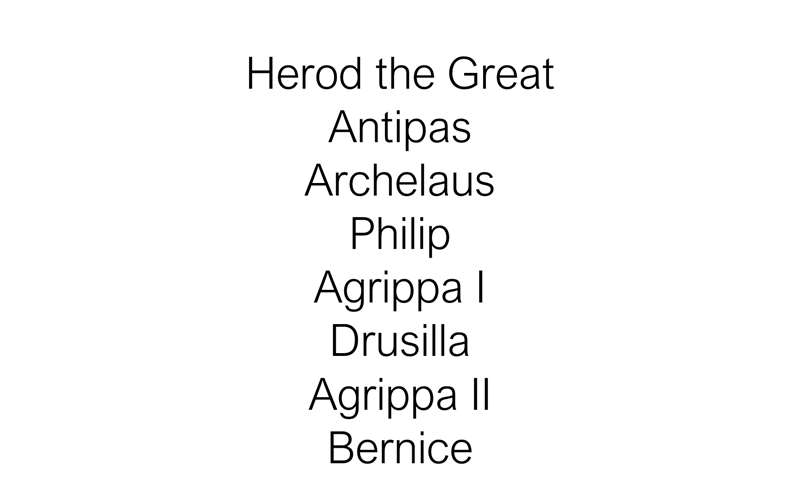
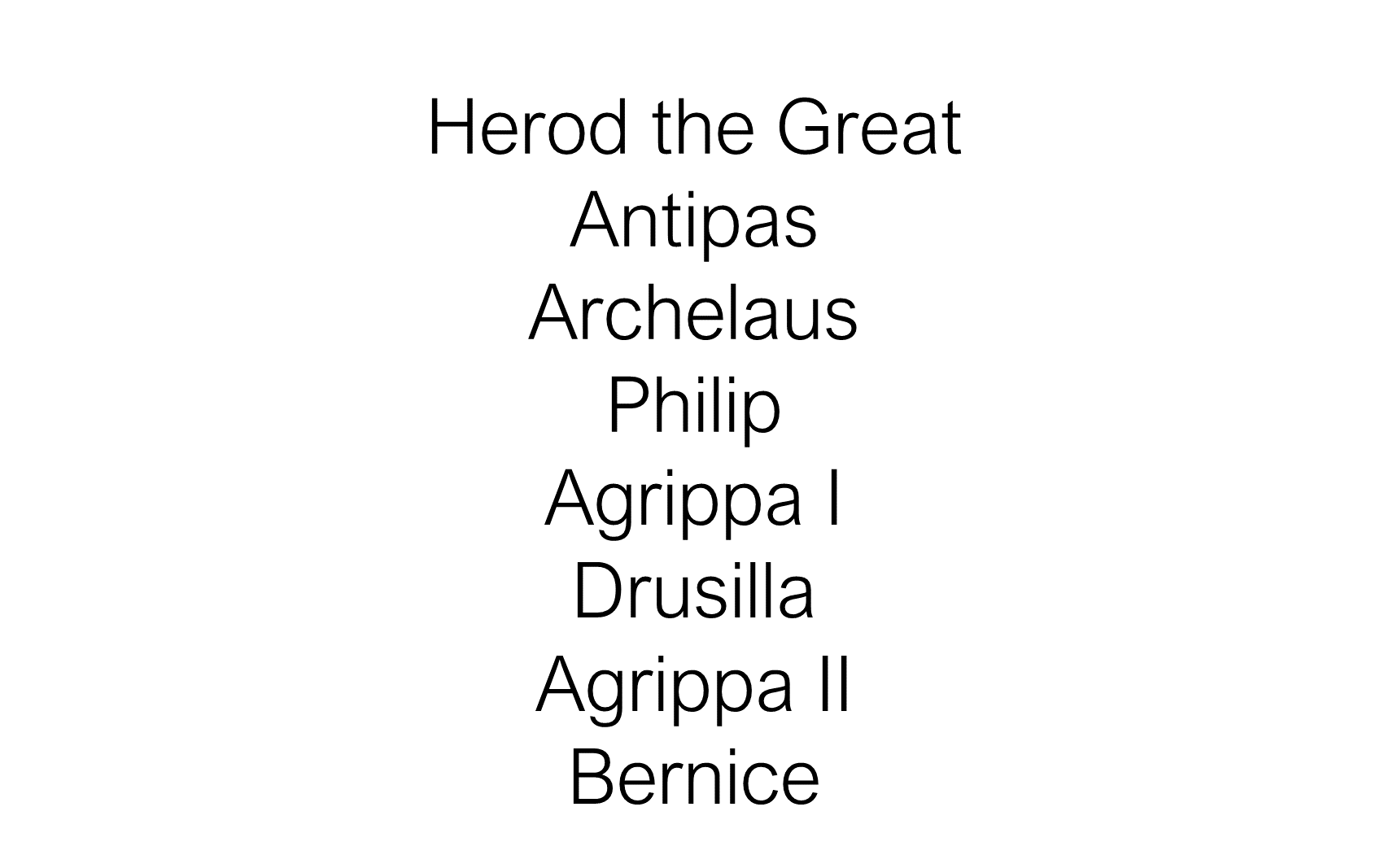
Basically, if you just want to go through the eight, I’ll tell you their contact. Herod the Great, he heard the magi. He heard the religious leaders as they announced Christ’s birth, and he died in horrible, painful, sickening death in terror. He was killed by the dual onslaught of gangrene and a venereal disease. In fact, he rotted to death, and at the end they would sprinkle him, his last months, they would sprinkle him with spices because the servants feeding him would vomit from the smell. And so, to be able to be fed, they would sprinkle cinnamon. Can you imagine? Sprinkling spices on someone. That was not a happy ending. His son Herod Antipas, the next one down, ruled from 4 BC to 39 AD Galilee and Perea, and his most notable achievement was he beheaded John the Baptist. Jesus said, John the Baptist is the greatest person born up until this time. And Herod Antipas beheaded him. Archelaus, the next one, ruled from 4 BC to 6 AD. He was alive while Joseph, Mary, Simeon, and Anna, and Zechariah, and Elizabeth all lived and worshiped in the capital city of Jerusalem. Yet he ruthlessly killed the families of Jewish delegations who had gone to Rome to accuse him. He was ruthless, and a murderer, and passes away from history in 6 AD. Philip, the next one down, rules for about 38 years in the town of Peter, and Andrew, and James. That was his territory, the Bethsaida, where Peter, and Andrew, and James were from. That was his area that he ruled. He was right there next to all the big events. As Peter, Andrew, James and John fish the Sea of Galilee and Jesus called them along the seashore right in front of where he lived, and worked, and ruled. And yet, as far as we know, he was never interested, Philip wasn’t. Agrippa I is the grandson. He’s the one that ruled, and killed James, and imprisoned Peter, and was no friend of the Gospel. The next one down, Drusilla we met last time. She sat and watched the greatest evangelist of all times, Paul, preaching about righteousness and judgment to come. And she watched as Felix trembled and was visibly scared and then just went on with her life of sin and had no change. And then this morning, Agrippa II, he actually sat through one of Paul’s greatest messages. But he says the most famous words, you almost persuade me. Almost. In fact, there are hymns written about that almost persuaded, Lord I would be. And what a sadness that he passes off from history, as far as we know, never responding. And then Bernice, she also sat through that message.
What can we learn from that? Remember the Scriptures are given, all of those personages, all eight of them show up in the pages, and all of them are confronted with the Gospel in one way or another. What lesson should we learn from that? Well, it’s a very sobering lesson. And the lesson is think about: few people were so close as the Herod family was. Few had so many opportunities to meet the Messiah, to hear His teaching. When we look at the Scripture and notice the encounters that they had with Jesus and His apostles, we’re amazed. We would all love to have been able to meet the magi or to meet any of the galaxy of those New Testament saints, especially the apostles, like they did. Now, we will someday. But can you imagine having earthly time listening to them? But the legacy of Herod the Great is that he and his children and grandchildren, one after another, either killed or tried to kill anyone connected to Christ. So, you know what the lesson is? Beware of being like Herod. Beware of being unmoved by the Gospel, of letting the glorious message of Christ’s death in our place, burial to take away our sins, and resurrection to give us justification and endless life. Beware of letting that become ho-hum and keep it at an arm’s length.
Well, second detail, let’s look at, it wasn’t just these three, the two Herods and the Roman governor. There’s a lot more. Look at verse 23 of chapter 25 because what we see is the crowd that heard this presentation. There are many important officials that show up, all the security details and the staff of the king and the Roman governor. This is a gathering of the most important pagans and unsaved people in all the land of Israel, and the riveting details are in verse 23. So, it says, on the next day. The first day was the day that Festus says, hey, we’ve got this guy. I don’t know what to do with, his name is Paul, and I’m puzzled. What should I do with him? And so, Agrippa and Bernice say, hey, we’d like to be a part of helping you, the Roman provincial governor, and we’ll come. And so, the next day comes. And it says, the next day, when Agrippa and Bernice had come with great pomp, and had entered the auditorium. Now what’s really interesting, most of these buildings are still around today. In fact, in I don’t know how many days, in September sometime, if they’re still standing and if none of those missiles hit them, we’re actually going to stand in some of those buildings. The place where Paul was imprisoned, the place where this event took place, it’s still standing. It’s still there, this gigantic auditorium facing the Mediterranean Sea where this scene, this pomp and all the prominent officials, it says, the commanders, at the end of verse 23, and the men of the city that were notable, at Festus’ command. They come in and then he says, Paul, bring Paul and put him in front. So, this is just an amazing moment.
What we see in these next few verses is Paul sharing the Gospel again, but he shares it before some of the best-known people of the day. Paul is facing the great-grandson of Herod and his consort, who was his sister. And the situation is amazing because Paul is getting a platform to share the Gospel. You know what’s so interesting about that platform? He doesn’t talk about all the rights, abuses of the Roman Empire. He doesn’t point out the incestuous relationship. He declares Christ, and His sacrifice for sin, and the offer of salvation that can transform them from the inside out. In public, Paul does not denounce people sitting in front of him. He always points them to the One they know down deep. Do you think Agrippa II really didn’t feel guilt for what he was doing with his sister? Do you think that Bernice, who would go with any man she could find didn’t down deep have that conviction? See, Paul was just going to let the Spirit of God work on them.

But listen to the magnitude of what happens. If you look at verse 23, I want to show you three things: the scene, the spectacle, and the contrast. Because the script, this is one of the marvelous chapters in the Bible because what we have is something similar to at the birth of Christ. Herod sitting up in his big palace, Jesus down in the stable, Herod being able to kill anybody at a moment’s notice, Jesus being absolutely helpless and harmless lying in a manger, and that contrast of Herod’s worldly power and Christ’s apparent weakness is the picture of the Gospel. The faith we have in Christ looks weak, and helpless, and temporal. And so, the billionaires, and the hedge fund managers, and the big shots, and the famous seem to have it all here, and we seem to have nothing. And that’s the contrast that’s always in the Bible. It shows up here again; it’s a contrast between the big hitters and Paul, who is a prisoner who stands there, all obviously a prisoner of the Roman Empire, and yet he is the powerful one.
So, listen to the setting, the magnitude of this event. The scene, first of all, is one of the most riveting in the New Testament. On the next day, the day after Festus consulted with Agrippa about Paul, Agrippa came together with Bernice amid great pomp and entered the auditorium. By the way, look at verse 23. Do you see the word pomp? At least that’s what the New King James has. Do you know what the word that God used is? It’s a Greek word, which all of you have heard. It’s called phantasia. Sounds like a Disney word, doesn’t it? Phantasia, it sounds like a ride at Disney World. That’s the word for an audacious show. It only, this word only is here in the New Testament, and it denotes a grand showy pageant. That’s how they came in. It’s what we see when I was at the Shepherd’s Conference in March, in California, we took a wrong turn. We were coming from the conference, and we were headed to eat at a place when we used to live out there, and we took a wrong turn, and we got in the front of one of those grand openings at Grauman’s Theater. The limos were lined up, the police were everywhere, all the band markers were there, and the flashbulbs were going, and we’re creeping along in the one lane they let cars go through and watching these glittering people. It was some movie, I don’t remember which one came out in March, or was premiered in March, but they were all coming out in their pomp. That’s what this is. Imagine a red-carpet event.
And Festus turned Paul’s hearing into an occasion to honor Agrippa. And accordingly, Agrippa and Bernice are accompanied by the commanders of the five tribunes that commanded the five cohorts that were stationed in Caesarea and all the prominent men of the city. So, the spectacle. Paul’s sharing the Gospel was after a spectacle that must have been breathtaking. Agrippa would’ve been decked out in all the trappings of royalty. He is the final descendant of Herod. He had a purple robe. He had a golden crown. He had rings. Perhaps he carried Herod’s scepter. Bernice, though not technically Agrippa’s queen, would’ve been similarly attired. The five tribunes would’ve been wearing their full-dress Roman uniforms. The prominent men of the city would’ve worn their finest clothes. An immaculately dressed honor guard of soldiers undoubtedly escorted the dignitaries into the auditorium. And finally, after all that phantasia, everyone was seated, and Festus gives the command.
Look at verse 23. Festus commanded Paul to be brought in. Wow, the contrast couldn’t have been clearer or more striking. Into the midst of that assembly hall crowded with the most important people of Caesarea and of Israel at that time walked a Jew who is described. By the way, we have a description of Paul. It’s not in the Bible; it’s in extrabiblical literature, but we find it the same description of Paul repeatedly in extrabiblical literature, in church histories, in writings where they’re accusing Christianity, especially their chief spokesman, the Apostle Paul. Now, I don’t know what you think Paul looked like, but this is what eyewitnesses said he looked like in the first century, and it’s amazing to think. Most of us, I don’t think that the, a lot of times we portray more people how we have them in our mind rather than how they’re described in history, but this is what is described. Into this auditorium walked a Jew who is described as short, bald, and physically unimposing, but it gets worse. It says that he had a continuous eyebrow that was unbroken. That doesn’t sound very good. It says he had closely set eyes that often ran with liquid oozing. It sounds like someone we would rush to Bronson, not someone that… And that was, I’m sure the murmurs of surprise must have been just obvious greeting the appearance of this man in contrast to all that pomp. Many in the crowd probably found it hard to believe that this seemingly unimpressive man could have caused so much controversy that the king, and his consort, and the governor, and all the cohorts would be there to hear him. But appearances can be deceiving. History has judged Paul to be one of the most noble and powerful men who ever lived, and the crowd that sat before him and listened end up in history being a bunch of pompous fools who wasted their lives on noneternal things. That’s the crowd.
Now, look at chapter 26. Let’s get into the content, the details, the Gospel. Note the content of Paul’s presentation. He starts talking, starting in verse 2 and talks all the way down through verse 11 about just basically a snapshot of his life story. And then he gets to the center in verse 12, which we read at the beginning of the service, and that’s the heart. It’s the heart, what he is building, everything he talks about builds toward the heart of the message when he met Jesus Christ.
Now, I remember one of the most amazing events that I’ve ever had is when I, and I’ve repeated this in each church that I’ve ever pastored. When I announce that I would like to come and visit as many families in the church as possible, we call it The Hundred Homes, but I let it out that what we’re going to do is our family’s going to share our testimony of how we got saved, and then everybody that we’re visiting is going to share their testimony of salvation. Did you know that everybody wanted us over to eat until they found that out? Do you know why? It’s scary to share your testimony. That’s why we sometimes are not very good at leading people to Christ because we have not practiced expressing what a wonderful change in my life has been wrought since Jesus came into my heart. That’s the single greatest event of our life. Every, it should be the center. It should be that if we get a platform to talk, it should somehow revolve around the fact that we were born lost, and blind, and helpless, and headed toward destruction. And we heard the Gospel maybe for a long time, maybe just once, and God just miraculously changed us. And that’s the heart of what Paul says here. That’s the content.

And what a contrast as Paul is sharing this, what a contrast it is. Paul is Christ’s representative. He’s a prisoner. He’s a man who’s on his way in chains to appear before Caesar. He’s going to be executed. Agrippa, on the other hand, was living in magnificent palaces. He appeared to have great strength. He wielded absolute power by every earthly measure. He was great. All he lacked was what would outlive his brief life. He lacked anything lasting. He had only temporary. Paul had nothing really going for him temporarily. He had everything going for him. Paul lived to honor God and serve others. Agrippa lived for Agrippa. He measured his life by his own measure, and really, as Paul is sharing this Gospel message about what Jesus did in verse 15 and 16 and 17 and what He commissioned him in verse 18. There’s another lesson. It’s a question we all should ask. Which one are we like? Do people see that we have everything in this world and never hear about what we really have that lasts forever? Because Agrippa was standing for here and now. Everything about him, the where he lived, how he dressed, what he did with his life said, this is what I’m living for. Do all the people that know you think this is what you’re living for? Or do they step back, and they’re puzzled at your life, and they go, you are not making great career moves here. You’re not making great financial moves. You’re, what’s wrong with you? And you say, this world is not my home. I’m just passing through. Actually, I’m trying to have as many treasures as possible laid up somewhere beyond the blue, as the hymn writer put it. Which are you like today? Herod Agrippa or Paul? Which way is your life headed today? Are you going Herod’s way or Christ’s way? Paul and Herod were opposites morally, culturally, spiritually, and certainly in terms of their worldly status. And at this moment, Herod Agrippa missed his chance. You can get as close as all the Herod family got to Christ and His apostles and still miss Heaven.
And so, then Paul, here’s the final point, Paul presents what I like to call the impact of the Gospel, and we’re going to end with this. The impact of the Gospel that God always has on those who are saved. Now see, this is what’s so neat. This is Paul telling what Jesus told him God always does when he saves someone. Okay? This is a very important chapter. This is not theologians have argued over the centuries what this means. This is Jesus talking. Verse 18 is, if you have a red-letter edition, in red. Okay? It should all be red. It’s all the Word of God. But this is Jesus talking and Paul recounting it. And basically, what verse 18 says if we ponder it is, Paul defines salvation this way.
And this is the lesson for all of us before we go today; we need to really let this soak in. Salvation is when we have God-opened eyes, not we open them, God opens them. Salvation is when we have a God-turned lifestyle. It’s not, we’re trying our hardest. We’re going to hold on and try and make it happen. We’re really working on this.
In the elder prayer this morning, it was so beautiful. One of the elders was praying, they were saying, deliver us from self-induced sanctification, trying to sanctify ourselves. Do you know what the Bible says? And the very God of peace sanctify you wholly. Do you know what God wants? He just wants us to invite and allow Him to do this. All salvation is, is me inviting, calling out. For whosoever shall call on the name of the Lord. I can’t save myself. I can’t open my eyes. I can’t turn my life God’s direction, but if I will invite Him to, He can. So, that’s how salvation is described—as God-opened eyes and God-turned living. Jesus described salvation as opened eyes, turning, receiving, and being sanctified.
Look at verse 18. Jesus saved Paul, and Jesus explained to him the miraculous events of salvation. And basically, what they are come out in this 18th verse. Now, I’ll just track you through them so you can see them as we read through them. They’re actually seven principles, but they’re in six little phrases. So, there are six powerful dimensions of salvation, and here they are, and I’ll read them to you.
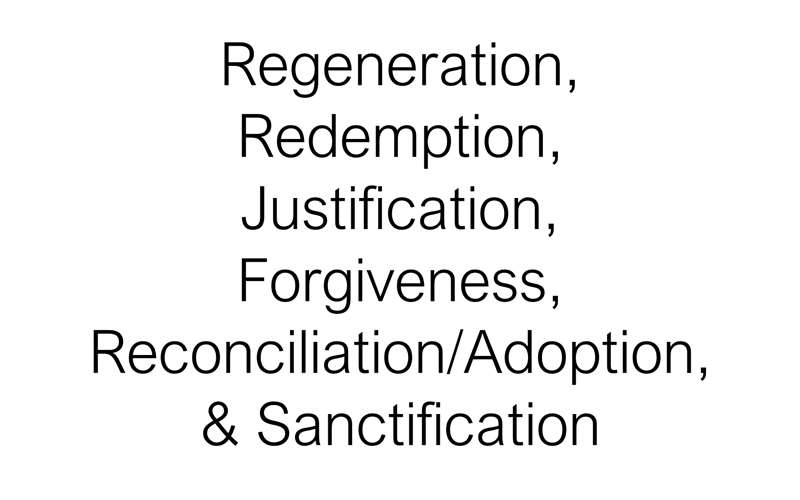
Look at verse 18: to open their eyes. Each one of us is born spiritually blind. We grow up living lost, and helpless, and hopeless in darkness and sin, and Christ’s death alone is all that we can cling to save us from our blind and hopeless life. Do you know what that’s called? Regeneration. Regeneration is when God opens our eyes; it’s when He brings us to life. It’s when we are convicted of our sin, and we respond and reach out to the God that is not more than an arm’s length away from anybody that’s ever lived on this planet. All 40 billion humans that have ever lived, whether they’re pre-flood, post-flood, pre-cross, post-cross. Paul said in Acts 17, God was always an arm’s length away from every human. It’s like He was always standing close by, waiting for them to respond to Him and reach toward Him. What happens when you reach toward God by faith? What happened to me in 1962, and when I got on my knees, and my mother opened the Bible and shared the Gospel, God regenerated me. He opened my eyes, and all of a sudden, the Bible made sense. Tonight’s going to be fun. We have a Q&A from our home groups. We’re studying the book on prayer, and it’s, there are 13 wonderful questions. They’re going to be fun. Do you know what one of them is? How do you know you hear the voice of God? It’s right here. Did you know that when your eyes are opened, all of a sudden, the Bible makes sense? You understand it because the Author lives inside and He teaches us. First John 2 says, the anointing you receive teaches you. God teaches us of Himself. That’s what regeneration is about.
Secondly it says, in order to turn them from darkness to light. We were all born lovers of darkness rather than light. And redemption is when God lifts us up out of the pits of sin, sets our feet on the rock, breaks the shackles of sin, purchases us as His very own, buys us at a price, and so we want to glorify Him. That’s what redemption is all about. That’s the second phrase: in order to turn them from darkness to light. Jesus says, I want to open your eyes. I’m going to regenerate you. I want to turn you from darkness to light. I want to redeem you.
The third phrase, look in verse 18: from the power of Satan unto God. That is encompassing all the work of justification. When we’re transferred from the kingdom of the devil into God’s kingdom, we become the habitation of God. We’re sealed securely by His Spirit. We’re given a lifelong provision of His grace to empower us. That’s the marvelous work that Christ accomplished. We’re justified freely by His grace through the redemption that’s in Christ Jesus.
And then Paul hears Jesus say the fourth phrase in verse 18: that they may receive forgiveness of sins. We’re laden with deadly sins. Jesus said the worst thing that could happen to anybody is they die in their sins. This is forgiveness. When all of our stains, and sins, and guilt are removed, we have a fresh start and a new beginning.
And the fifth phrase, after receive forgiveness of sins is, and an inheritance. We’re impoverished. We are hopeless and helpless. We’re clothed in filthy rags, and this is all about God reconciling and adopting us. John put it this way, to as many as received Him, to them He gave the right to become children of God. We’re adopted, reconciled, no longer enemies.
And then the final phrase, look at verse 18: among those who are sanctified by faith in Me. We desperately need what only Christ can give: purpose, meaning, usefulness, and hope. All of these come from our identity in Christ, and that’s what sanctification is all about. Sanctification is the work of the Spirit using the Word of God to transform our lives, any parts we give Him. Do you know what the fruit of the Spirit is? Love, joy, peace, gentleness, do you know all those wonderful elements? They show which parts of our life God is controlling. Anything we surrender, love springs from it, and joy and peace.
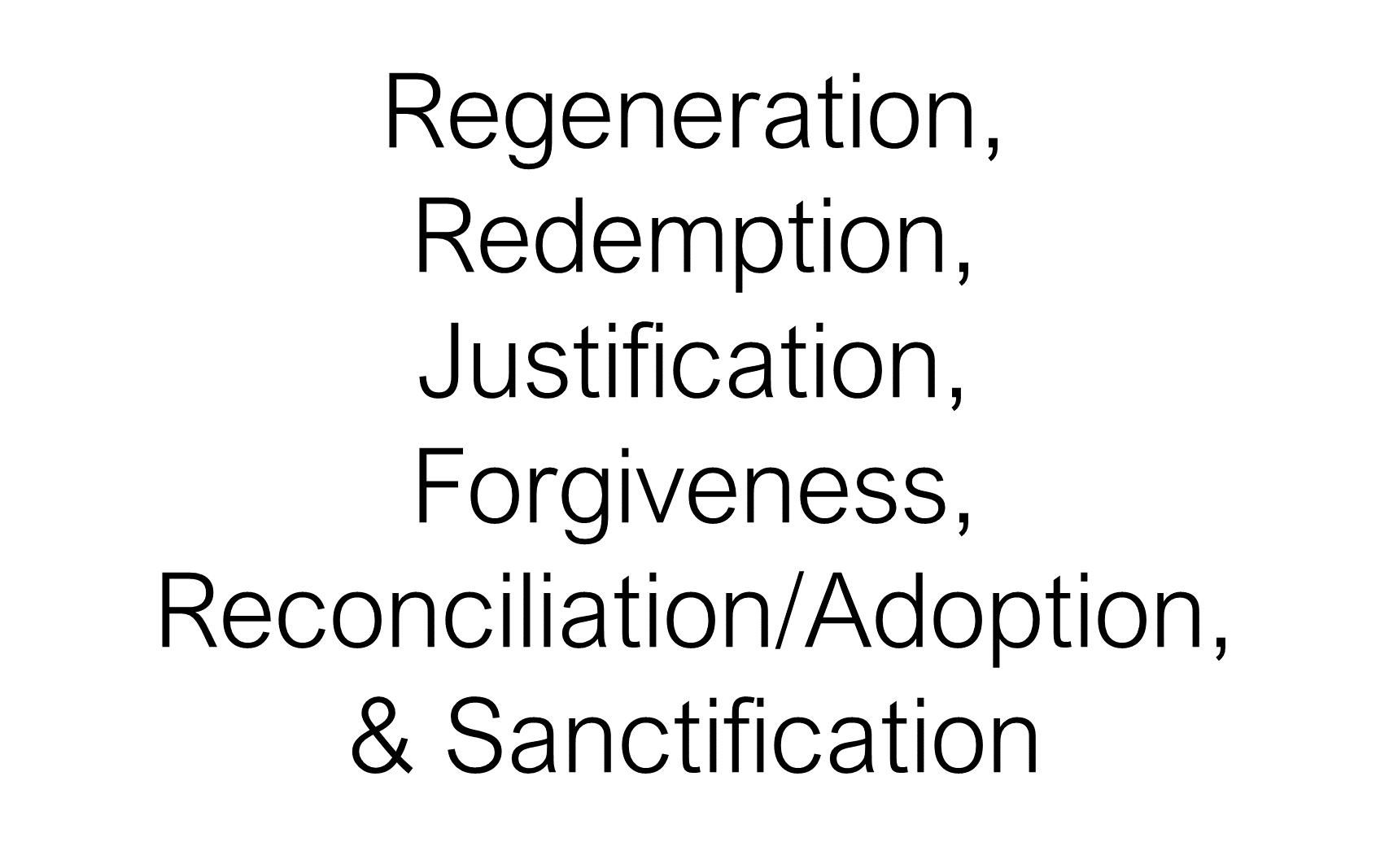
We just looked at one of the greatest chapters in the Bible. It’s when Christ explained the Gospel to Paul. The impact of the Gospel that we share is what I just read to you. He regenerates us, He redeems us, He justifies us, He forgives us, He reconciles and adopts us into His family, and He begins the work of sanctification. The question is, is that ho-hum? That’s the Herodian response. Or is that the center of your life? That’s where Paul was. He said, this event, when Christ did that to me, is the greatest moment of my life. I have never been the same. Has that happened to you? Or did you just join the church? Or did you join Christ? Because when you join Christ, He opens our eyes, He turns us from darkness to light, from the power of Satan unto God. We receive absolute forgiveness of sin, we have an inheritance, we are sanctified, and all because we’re united by faith in Him.
Let’s stand for a word of prayer. As we stand, I invite you back tonight. It’s going to be an incredible time, a record time. I’m going to cover 13 questions, hahaha, yeah. I was just speaking at Gull Lake a couple weeks ago, and I said, and tonight I’m going to cover the whole book of Acts, and they’d sat with me all week long. There was a spontaneous laughter through the auditorium. I just heard it again. Okay, we’re going to try to cover all 13 questions. But before we go, at the end of every service right here at Calvary Bible Church, and probably every Gospel-preaching church in the world, there is always the opportunity for you to respond. And at the end of this service, our elders and some of our godly women are armed with a copy of God’s Word under their arm, and they’re standing here at the end. And if you need to pray with someone, if you need to go over again those elements of salvation, or you just say, I know I’m saved, but not all the cylinders are firing, I kind of want to tune up, that’s what they’re here for. They’ll pray with you. If you need extra time, they’ll take off somewhere and share with you. But make sure that you can describe the greatest day of your life when Jesus saved my soul and yours.
Let’s bow for prayer. Father in Heaven, I thank You that Paul shared his testimony and what a wonderful impact it’s had even to this day. I pray that we would share our testimony and see You use it for Your glory. In the precious name of Jesus, we pray, and all God’s people said, amen. God bless you as you go.
Notes
- Each scene in Acts seems more amazing as we walk through these salvation messages. But of all the presentation of the Gospel, this is by all measures the best, most important, and the deepest impact. Paul shares the story of how Jesus Christ met him on the road to Damascus. In Acts 9, the details are sparse, but here the fullest and clearest account comes to us.
- What we are going to read this morning as we open to Acts 26, is Paul sharing the Gospel again, before some of the better know people of the day. Paul is facing the grandson of Herod and his wife, who is also his sister. So the situation is interesting. Agrippa & Bernice are the talk of Roman culture. Even Rome did not often see incestuous public relationship. But Paul not only doesn’t alter his witness, he actually enlarges it. Paul shares both his conversion and his commission by Christ.
- When Jesus sent Paul into ministry He explains the power of the Gospel and gave Paul a template that we can trace across all of his epistles as the framework of the message that Paul shared in public preaching and teaching, as well as in personal witness and discipleship. These words are deep in their doctrinal truth, and powerful in their application.
- Each of this today can ponder how amazing the work that God began in each of us the moment we called upon Christ.
- This is what God does, this is what we receive when we reach out in faith to the Hand of God extending to us His free gift of salvation. These words are also the
- When Paul recounted the words that Christ used to lead him into a life long ministry of evangelism, he gave us the greatest Gospel sharing account in the Bible.
- The words before us today are from Jesus Christ. No one knows more about salvation than Him. These words are what shaped Paul’s entire ministry. No one knows more about ministry for Christ in His Church, and in winning souls, than the Apostle Paul. Combined the words of Christ on sharing the Gospel combined with the most responsive Gospel sharing apostle of all, makes this: a greatly valuable account.
- First what are the details of this event; then, what are the elements of the Gospel message Paul was to share. Finally, what is the application to our ministry of evangelism and Gospel presentations?
The Amazing Details of the Setting
- King Agrippa was Herod Agrippa II, the son of the Herod who killed James and imprisoned Peter. He was the last of the Herods, who play a prominent role in NT history[1].
- Not Agrippa’s wife, but his consort and sister. (Their sister, Drusilla, was married to the former governor, Felix). Agrippa was living in an incestuous[2] relationship with his own sister, which was the talk of Rome, where Agrippa had grown up. His wicked partner in sin, Bernice, for a while even became the mistress of Emperor Vespasian, then of his son Titus, but always returned to her brother.
Agrippa II (great-grandson of Herod the Great) Acts 25:13, 23; 26:1-29
Bernice (great-granddaughter of Herod the Great) Acts 25:13, 23; 26:1-29
Acts 25:13-23 And after some days King Agrippa and Bernice came to Caesarea to greet Festus. 14 When they had been there many days, Festus laid Paul’s case before the king, saying: “There is a certain man left a prisoner by Felix, 15 about whom the chief priests and the elders of the Jews informed me, when I was in Jerusalem, asking for a judgment against him. 22 Then Agrippa said to Festus, “I also would like to hear the man myself.” “Tomorrow,” he said, “you shall hear him.” 23 So the next day, when Agrippa and Bernice had come with great pomp, and had entered the auditorium with the commanders and the prominent men of the city, at Festus’ command Paul was brought in.
Acts 26:1-29 Then Agrippa said to Paul, “You are permitted to speak for yourself.” So Paul stretched out his hand and answered for himself: 2 “I think myself happy, King Agrippa, because today I shall answer for myself before you concerning all the things of which I am accused by the Jews, 3 especially because you are expert in all customs and questions which have to do with the Jews. Therefore I beg you to hear me patiently. 4 “My manner of life from my youth, which was spent from the beginning among my own nation at Jerusalem, all the Jews know. 5 They knew me from the first, if they were willing to testify, that according to the strictest sect of our religion I lived a Pharisee. 6 And now I stand and am judged for the hope of the promise made by God to our fathers. 7 To this promise our twelve tribes, earnestly serving God night and day, hope to attain. For this hope’s sake, King Agrippa, I am accused by the Jews. 8 Why should it be thought incredible by you that God raises the dead? 9 “Indeed, I myself thought I must do many things contrary to the name of Jesus of Nazareth. 10 This I also did in Jerusalem, and many of the saints I shut up in prison, having received authority from the chief priests; and when they were put to death, I cast my vote against them. 11 And I punished them often in every synagogue and compelled them to blaspheme; and being exceedingly enraged against them, I persecuted them even to foreign cities. 12 “While thus occupied, as I journeyed to Damascus with authority and commission from the chief priests, 13 at midday, O king, along the road I saw a light from heaven, brighter than the sun, shining around me and those who journeyed with me. 14 And when we all had fallen to the ground, I heard a voice speaking to me and saying in the Hebrew language, ‘Saul, Saul, why are you persecuting Me? It is hard for you to kick against the goads.’ 15 So I said, ‘Who are You, Lord?’ And He said, ‘I am Jesus, whom you are persecuting. 16 But rise and stand on your feet; for I have appeared to you for this purpose, to make you a minister and a witness both of the things which you have seen and of the things which I will yet reveal to you. 17 I will deliver you from the Jewish people, as well as from the Gentiles, to whom I now send you, 18 to open their eyes, in order to turn them from darkness to light, and from the power of Satan to God, that they may receive forgiveness of sins and an inheritance among those who are sanctified by faith in Me.’ 19 “Therefore, King Agrippa, I was not disobedient to the heavenly vision, 20 but declared first to those in Damascus and in Jerusalem, and throughout all the region of Judea, and then to the Gentiles, that they should repent, turn to God, and do works befitting repentance. 21 For these reasons the Jews seized me in the temple and tried to kill me. 22 Therefore, having obtained help from God, to this day I stand, witnessing both to small and great, saying no other things than those which the prophets and Moses said would come— 23 that the Christ would suffer, that He would be the first to rise from the dead, and would proclaim light to the Jewish people and to the Gentiles.” 24 Now as he thus made his defense, Festus said with a loud voice, “Paul, you are beside yourself! Much learning is driving you mad!” 25 But he said, “I am not mad, most noble Festus, but speak the words of truth and reason. 26 For the king, before whom I also speak freely, knows these things; for I am convinced that none of these things escapes his attention, since this thing was not done in a corner. 27 King Agrippa, do you believe the prophets? I know that you do believe.” 28 Then Agrippa said to Paul, “You almost persuade me to become a Christian.” 29 And Paul said, “I would to God that not only you, but also all who hear me today, might become both almost and altogether such as I am, except for these chains.”
Herod Bio
- You can get as close as Herod and still miss heaven. Few people were as close to salvation as the Herod family was. Few had so many opportunities to meet the Messiah and to hear His teaching.
So Close Yet So Lost
- As you read the New Testament you immediately begin to notice how many encounters the eight named members of the Herod family had–with Jesus and His message. The Legacy of Herod the Great is–that few families in history have come as close to Jesus’ message as the Herod’ Many members of this ruling family knew of Jesus and His followers. Yet, one after the other, they killed or tried to kill anyone connected to Him.
| Ruler | Notable Deeds | Last Days |
| Herod the Great (37 BC to 4 BC): ruled the Land when Christ’s Birth took place. Matthew 2:1-8, 13-18. | He heard the Magi and Religious leaders announce Christ’s Birth! | He died a horrible, painful, sickening death in terror. He was killed by the dual onslaught of gangrene and venereal diseases. |
| Antipas (son of Herod the Great) ruled 4BC to AD39: ruled Galilee and Perea 40+ years. Mark 6:14-29 Luke 23:8-12. | He beheaded John the Baptist! | New emperor exiled him and claimed his property. |
| Archelaus (son of Herod the Great) ruled 4BC to AD 6 over Judea, Samaria, and Idumaea for 10 years. Matthew 2:22 | He was alive while Joseph, Mary, Simeon, Anna, Zacharias, and Elisabeth all lived and worshipped in his capitol city—Jerusalem! Yet he ruthlessly killed the families of Jewish delegations who had gone to Rome to accuse him. He will always be known for his bloodthirstiness and evil qualities | Exiled to Gaul, then disappeared from history |
| Philip (4 BC to AD 34): ruled area north and east of the Sea of Galilee 37 years. Matthew 14:3; Mark 8:27 | He ruled over the town of Peter, Andrew, James, and John as they fished his Sea of Galilee, and we called by Jesus on his seashore! | Died of natural causes at end of his reign |
| Agrippa 1 (grandson of Herod the Great) ruled AD 36-44: ruled area north and east of Sea of Galilee, Judea 8 years. Acts 12:1-5, 18-24 | He hunted the Apostles, killing some and imprisoning others! | An angel of God stuck him down, eaten up by worms and died |
| Drusilla (wife of the governor Felix and daughter of Agrippa I). Acts 24:24-26 | She sat and watched the greatest evangelist of all time—Paul, preaching about righteousness and judgment to come | Fades from history after Acts 25 presumably lost forever. |
| Agrippa II (great-grandson of Herod the Great) ruled AD 50-70: ruled small portion of his father’s region, had limited rule in Jerusalem. Acts 25:13,23,26:1-29 | He actually sat through one of Paul’s greatest messages! | Was wounded fighting for Rome against the Zealots at Gamla, but the specifics of his death are not known. |
| Bernice (great-granddaughter of Herod the Great). Acts 25:13,23,26:1-29 | She also sat through one of Paul’s greatest messages! | Fades from history after Acts 25-26 presumably lost forever. |
Conclusions from Herod’s Life
- Few people were as close to salvation as the Herod family was. Few had so many opportunities to meet the Messiah and to hear His teaching. When we look at the Scriptures, and notice the encounters the Herod family had with Jesus and His message, we are amazed.
- The Legacy of Herod the Great is that few families in history have come as close to Jesus’ message as the Herod’ Many members of this ruling family knew of Jesus and His followers. Yet, one after the other, they killed or tried to kill anyone connected to Him. So beware of being like Herod.
Now listen as I lay side by side the weak and the strong. Jesus King of Glory contrasted to Herod King of Self.
PROFILES IN CONTRAST:
| Paul was Christ’s Representative (4BC – 28 AD) | Agrippa was Herod the Great’s Grandson (73BC – 4 BC) |
| Jesus slept in a manger where farm animals fed. He laid there seemingly weak and powerless and with no earthly status. In reality He had it all. Jesus possessed eternal power, receives eternal glory, and holds unending authority. | Herod constructed magnificent palaces, he appeared to have great strength, he wielded what seemed to be absolute power, and by every earthly measure had great status. All he lacked was what would outlive his brief life. He completely lacked any eternal status. |
| Jesus was born in Bethlehem as the Promised One, the Messiah from the royal line of David, and the rightful King because of the promises God made to Abraham, Isaac, and Jacob—but He was never accepted as the King of the Jews. | Herod was a usurper to David’s throne, born not in Israel but in Edom, not an Israelite but an Edomite, not an heir to the throne but one whose reign violated God’s rules (Deuteronomy 17:15)–yet he was accepted by the Jews as their king! |
| Jesus lived to honor God, serve others, and to fulfill His Father’s Will. | Herod lived for Herod, he measured life by his own measure, he sought to satisfy himself and to fulfill his own purposes in life. |
| Jesus the Son of God was perfect in sinlessness, kind in His service. | Herod, the king of the Jews, was a wicked in his lifestyle and a cruel tyrant of a ruler. |
| Jesus never sought the power the world could give, but His power as God’s Son is beyond comprehension. | Herod sought and found awesome earthly power, but he never sought nor found the power of God to heal his sin sick soul. |
| Jesus gave His life and ministry as a sacrifice on behalf of other people; | Herod’s life revolved around sacrificing others in order to bring glory and honor to himself. |
| Jesus used the living stones of redeemed people to build His Kingdom (Mt. 16:18; 1 Pet 2:4-8). He lived for God’s Glory, and to seek and save the lost. | Herod tried to defy nature as he built glorious buildings of marble and massive stone blocks to honor himself and promote his standing with Rome. |
| Jesus died on a cross in the agony of His Love, surrounded by sorrowing and loving disciples. He chose to hang there to take away the sin of the world. Everything Christ had He keeps forever. | Herod died in the agony of a dissipated body, hated by his family, and with the blood of many family members upon his hands that he had murdered. All that Herod had he lost. |
Who are you like this morning—Herod or Christ? Which way is your life headed this morning? Are you going Herod’s way or Christ’s way? Jesus and Herod were opposites morally, culturally, spiritually, and certainly in terms of their worldly status.
King Herod the Great ruled Israel from 37 B.C. until his death in 4 B.C. He was king at the time Jesus was born. Here is a summary of Herod’s failed life.
- Herod Was One of the World’s Greatest Builders. Though in ruins, his buildings are still among the greatest.
- The Temple Mount in Jerusalem is an engineering marvel to this day. Masada still evokes wonder. The ruins of Caesarea inspire images of magnificence and awe. The Herodion, the first fortress-palace along Herod’s escape route was built 30 years before Christ’s birth. This spectacular complex, just over three miles southeast of Bethlehem, is typical of the great building projects for which Herod is known. Built upon a high hill, the walls of the upper palace stood about ninety feet tall, and steep earthen ramparts built against the lower half of the structure gave it the shape of a volcanic cone.
- The upper palace dominated the landscape for miles around and even could be seen from Jerusalem nearly ten miles to the north. As the sun rose and set, the Herodion literally cast its shadow across the surrounding towns. The Herodion clearly symbolized Herod’s visionary genius, power, and splendor. As t he third largest palace in the ancient world, its buildings covered about forty-five acres surrounded by about two hundred acres of palace grounds. It included elaborate halls and guest rooms, a terrace more than one thousand feet long, and a huge swimming pool (140 by 200 feet) surrounded by colonnades and a beautiful garden full of exotic plants.
Herod Was One of the World’s Insecurest People. Though Herod controlled more territory than almost any king of the Jews who had ruled before him, yet he saw threats in every corner and cruelly suppressed all resistance real or imagined.
- He especially feared Cleopatra of Egypt, so he built a series of fortress-palaces along an escape route between his palace in Jerusalem and his home country of Edom. From Jerusalem he could travel fewer than ten miles south to the safety of the Herodion, then about thirty miles to the cliff fortress of Masada, across the Dead Sea ten miles to Machaerus, and finally the thirty plus more miles to his homeland of Edom.
Herod Was One of the World’s Greatest Failures. Though he intended to rival the greatest exploits recorded in Biblical history he only managed to become one of the greatest failures of all. Herod and his family got as close to Jesus as anyone could and yet they dies lost, hopeless, and still bearing their own sin.
Herod’s Life Was One Of The World’s Greatest Lessons. Just as the Herod’s building projects towered over the landscape of biblical history, Herod cast his shadow across the history and people of Israel. Although Jesus and Herod were vastly different, God clearly engineered history to bring them together in fulfillment of His purposes.
- Today, the awesome projects that King Herod built lie in ruins, and most people remember him only as the king who had innocent babies killed in an attempt to kill the baby Jesus, the promised Messiah. Herod made his mark in the world and then was gone.
- In contrast, Jesus didn’t leave a single building as a legacy. No one is exactly sure of the locations where He was born or died. Yet His passing changed the world forever. And today He lives! His kingdom has no end, we Christians are His temples, and the eternal truths He revealed remain true today. No matter how strong and glorious Herod appeared to be, the baby in Bethlehem’s manger was stronger. Jesus the Messiah, the Lord of heaven and earth, triumphed over all evil even death! He will return to conquer all earthly powers.
- HEROD MISSED HIS CHANCE. You can get as close as Herod and still miss heaven.
- MESSAGE TWENTY-ONE (Paul recounting Christ’s words): The next Gospel Presentation is in Acts 26:17-20 where we see the Gospel Message directly from Jesus, who is at work doing soul winning on Paul right here in the Book of Acts.
- Jesus describes salvation as opened eyes, turning, receiving, and being sanctified. Jesus who saved Paul, explained to him that the same miraculous events of salvation, accomplished by God’s power, was what God also wanted to see happen in the lives of lost people everywhere Paul preached:
Acts 26:17-20 (NKJV) I will deliver you from the Jewish people, as well as from the Gentiles, to whom I now send you, 18 to open their eyes, in order to turn them from darkness to light, and from the power of Satan to God, that they may receive forgiveness of sins and an inheritance among those who are sanctified by faith in Me.’
- So what did that mean to Paul? He explains it in v. 19-20:
“Therefore, King Agrippa, I was not disobedient to the heavenly vision, 20 “but declared first to those in Damascus and in Jerusalem, and throughout all the region of Judea, and then to the Gentiles, that they should repent, turn to God, and do works befitting repentance.
- What did Paul tell the lost pagans? Did his message differ from one he had for the Jews? No, one Gospel, one salvation, one faith!
Salvation Is: God-Opened Eyes & God-Turned Living
- MESSAGE TWENTY-ONE (Paul recounting Christ’s words): The next Gospel Presentation is in Acts 26:17-20 where we see the Gospel Message directly from Jesus, who is at work doing soul winning on Paul right here in the Book of Acts.
- Jesus describes salvation as opened eyes, turning, receiving, and being sanctified. Jesus who saved Paul, explained to him that the same miraculous events of salvation, accomplished by God’s power, was what God also wanted to see happen in the lives of lost people everywhere Paul preached:
Acts 26:17-18 (NKJV) I will deliver you from the Jewish people, as well as from the Gentiles, to whom I now send you, 18 to open their eyes, in order to turn them from darkness to light, and from the power of Satan to God, that they may receive forgiveness of sins and an inheritance among those who are sanctified by faith in Me.’
- So what did that mean to Paul? He explains it in v. 19-20:
“Therefore, King Agrippa, I was not disobedient to the heavenly vision, 20 “but declared first to those in Damascus and in Jerusalem, and throughout all the region of Judea, and then to the Gentiles, that they should repent, turn to God, and do works befitting repentance.
- What did Paul tell the lost pagans? Did his message differ from one he had for the Jews? No, one Gospel, one salvation, one faith!
- Here is the summary after 21 Gospel Presentations: really repent, turn away from iniquity, be saved from sins, by God’s forgiveness, by believing with all your heart, and God opens your eyes, God turns you from darkness to light, God sets you free from the power of Satan, God gives you an eternal inheritance, God begins a never ending, life-long sanctification—all through faith in Christ Jesus.
Salvation Is: Entering & Living in God’s Kingdom
- MESSAGE twenty-two (Paul): is the final Gospel Message is in Acts 28:31 where salvation is described as coming into God’s Kingdom. The starting message in Acts is: repent; and the concluding message is: enter God’s Kingdom, both rarely if ever used today.
Acts 28:28-31 (NKJV) “Therefore let it be known to you that the salvation of God has been sent to the Gentiles, and they will hear it!” 29 And when he had said these words, the Jews departed and had a great dispute among themselves. 30 Then Paul dwelt two whole years in his own rented house, and received all who came to him, 31 preaching the kingdom of God and teaching the things which concern the Lord Jesus Christ with all confidence, no one forbidding him.
Acts 26:18
- to open their eyes, We all were born spiritually blind Luke 1 REGENERATION we are dead in our trespasses and sins, we are of our father the devil, God reaches down into our hearts, minds, and lives and takes away our spiritual blindness, and gives us eyes to see, love, know, and follow Him
- in order to turn them from darkness to light, we all love darkness rather than light John 1 REDEMPTION God lifts us up out of the pit of sin, sets our feet upon the Rock, breaks the shackles of sin, and purchases us as His very own. We are bought at a price and want to glorify God.
- and from the power of Satan to God, we are born into the devils family Jn 8, and live in his arms 1 John 5 JUSTIFICATION we are transferred from the kingdom of the devil to God’s kingdom. We become the habitation of God, sealed forever securely by His Spirit. We are energized by His grace, and seated in
- that they may receive forgiveness of sins: we are laden with deadly sins “die in sins” that are attracting the eternal fiery wrath of God 2 Th 1 FORGIVENESS freely, completely and final remission of all sins; all our stains are removed; and all our guilt is gone. We have a fresh start, and a new beginning
- and an inheritance: we are impoverished, in rags that are filthy Isaiah 53 RECONCILIATION. God now takes away all the anger and wrath He had towards us in our sins, and makes us family members both by birth and by adoption. It is the end of the war and the start of our eternal family relationship as His children. We have access, we have all the riches of His grace, power, and a future with Him.
- among those who are sanctified by faith in Me.’: we desperately need what only Christ can give. Paul describes SANCTIFICATION
To open their eyes, = we are blind, sightless; ach one of us is born spiritually blind, and we grow up living lost, helpless, and hopeless in the darkness of sin. The purpose of Christ’s death was to save us from the lost, helpless, hopeless life and to present us with the seven gifts of salvation
Salvation Reaches: Blind Sinners in Darkness
We were each born sitting in the darkness, heading towards the precipice of sin; but we didn’t even know it because we were blind. That’s how we each were found by Jesus Christ, when He saved us.
So at the moment of salvation, we are given spiritual sight as a gift from God. The Christmas story gives the clearest picture of how all humans appear in their unsaved state, from God’s perspective.
The Gospel is when Jesus Christ shines into our sin-darkened night life with a Sunrise of forgiven Life & saving Light. Listen anew to the wonder of what we celebrate this Christmas Season from the last few verses of Luke 1:
Luke 1:76-79 (NKJV) “ And you, child, will be called the prophet of the Highest; For you will go before the face of the Lord to prepare His ways, 77 To give knowledge of salvation to His people By the remission of their sins, 78 Through the tender mercy of our God, With which the Dayspring from on high has visited us; 79 To give light to those who sit in darkness and the shadow of death, To guide our feet into the way of peace.”
Matthew 4:16 (NKJV)
The people who sat in darkness have seen a great light,
And upon those who sat in the region and shadow of death
Light has dawned.”
in order to turn them from darkness to light, = we love darkness rather than light
John 3:19 (NKJV) And this is the condemnation, that the light has come into the world, and men loved darkness rather than light, because their deeds were evil.
WE ARE LOST IN DARKNESS
Christmas is the story of the Lord God Almighty, motivated by His great love, sending Jesus to provide the way of salvation to lost humanity sitting in that complete darkness.
Jesus came to Earth as the sunrise [Dayspring] from God, to shine the light of salvation upon all of the lost and sin darkened people of this world.
It is always darkest just before dawn, and that is just how it was. The Roman world of the 1st Century had reached the highest levels of science, literature, culture, engineering, transportation, and medicine known since Adam and Eve stepped from the Garden.
Yet with all that advancement most people were still hopelessly lost, and endlessly troubled by an inability to even control their own fears and desires—let alone know how to come to know the Awesome God of the Universe.
God surveyed His creation and found that the crown of creation, the only creatures made in His image had a soul threatening, terminal illness called sin. In every instance of Christ’s coming (Christmas) there are clues describing what we needed as exactly what Jesus came to offer us.
and from the power of Satan to God, = we are of our father the devil; slaves to his will rm 6, and in the arms of the evil one 1 j 5
John 8:44 (NKJV) You are of your father the devil, and the desires of your father you want to do. He was a murderer from the beginning, and does not stand in the truth, because there is no truth in him. When he speaks a lie, he speaks from his own resources, for he is a liar and the father of it.
1 John 5:20 (NKJV) And we know that the Son of God has come and has given us an understanding, that we may know Him who is true; and we are in Him who is true, in His Son Jesus Christ. This is the true God and eternal life.
2 Tim 2:26
Romans 6:16 (NKJV) Do you not know that to whom you present yourselves slaves to obey, you are that one’s slaves whom you obey, whether of sin leading to death, or of obedience leading to righteousness?
that they may receive forgiveness of sins and = our greatest need is to get something done with our sins die in your sins
John 8:24 (NKJV) Therefore I said to you that you will die in your sins; for if you do not believe that I am He, you will die in your sins.”
an inheritance among those = we are poor, paupers, clothed in filthy rags with no standing, no worth
Isaiah 64:6 (NKJV) But we are all like an unclean thing,
And all our righteousnesses are like filthy rags;
We all fade as a leaf,
And our iniquities, like the wind,
Have taken us away.
who are sanctified by faith = we want to be a vessel useful for the Masters use
Rm 12.1-2
2 Timothy 2:20 (NKJV) But in a great house there are not only vessels of gold and silver, but also of wood and clay, some for honor and some for dishonor.
in Me.’ = we need to be connected to Christ
jn 14.6
John 17:3 (NKJV) And this is eternal life, that they may know You, the only true God, and Jesus Christ whom You have sent.
[1] He was the grand-nephew of Herod Antipas, the Herod of the gospels who wanted Jesus to do a trick, and then mocked Jesus at his crucifixion and to whom Jesus would not even utter a word (Mark 6:14–29; Luke 3:1; 13:31–33; 23:7–12), and he was the great-grandson of Herod the Great, who ruled at the time Jesus was born, and murdered the innocents at Bethlehem in cruel, calculated, cold bloodedness (Matt. 2:1–19; Luke 1:5). He was a man who knew so much, but cared so little.
[2] Drawn from Acts 12, 25 and 26 by John F. MacArthur, Jr., The MacArthur Study Bible, (Dallas: Word Publishing) 1997.