
Four Curtains Three doors
NR3-15 TAB-21 XAS-20
ASGOTB-14
020825PM
Laver and Curtains A STRATEGIC GRASP OF THE BIBLE-14
PORTRAITS OF CHRIST IN THE TABERNACLE 4 Curtains, 3 Doors, 1 Christ
Transcript
.jpg)
But let’s open our Bibles to the Old Testament book of Exodus. And this evening we’re continuing, and for you that come and go and maybe are just here or haven’t been here for a while, we’re looking at how to get a strategic grasp, in other words, how to get ahold of the whole Bible. The way we do that is we find that Christ Jesus Himself is the unifying theme, the overarching thread that weaves together every verse, every chapter, every book of both Testaments. So, Christ is a theme. Tonight, we’re looking at something very interesting. We’re looking at in Exodus 26, what I call four curtains, three doors, but one Christ. And what I want to do, especially for you tonight, is to perhaps turn some of the maybe less used ground in the Scripture to number one, make you look for things that you and I just are comfortable, well-adjusted readers. If we don’t understand something, we just continue reading, and if we don’t know what it’s about, we just continue reading. And I hope you’ll stop and pray and say, how can I see You in all the Scriptures, Lord Jesus? You said, they speak of Me. And He’ll show you; that’s first. Let’s look at the first point, and that’s a roadmap to Heaven, and you can just sit back because a roadmap to Heaven is what I want to show you by giving you a bird’s eye view of the plan of salvation in the Tabernacle.
.jpg)
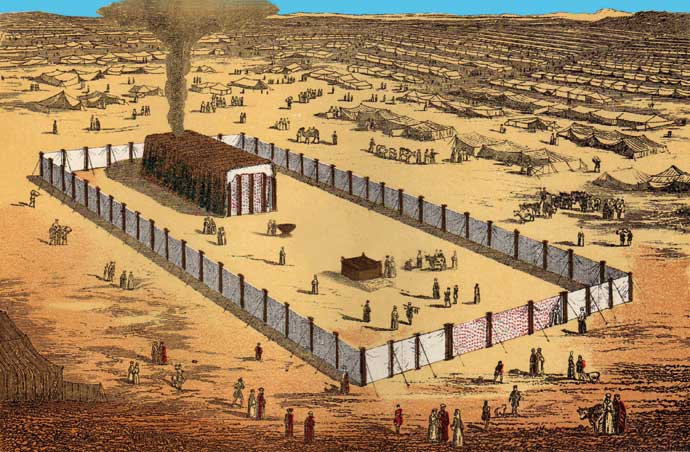
The next slide shows us that picture that we’ve been looking at. Let me just go through that with you. If we were a bird flying over the Tabernacle this evening, this is what we would see going through that front gate. First, sinners have to approach God for salvation. In the Tabernacle, we find salvation at that brazen altar. That’s the first object there through the door. Simple faith in the shed blood of a lamb was all that was needed as a substitute, and that’s all that God required, that whole substitutionary idea. Next, we see daily cleansing, the next where the priest is standing up there. Daily cleansing is portrayed by the laver. And this daily cleansing by exposure to God’s Word also satisfies our spiritual needs. And so, saved and cleansed is the message.
Then, and the next slide shows us the Tabernacle proper, and that is that circled part made up of two parts. It’s actually a little tiny rectangle that’s 15 feet wide and 30 feet long at the front, and 15 by 15 at the back. So, it’s just the size of an oversized living room and a good-sized bedroom. That’s all the Tabernacle was, it was a tent. The back half is called the holy of holies, and it just had one object in it, which was the ark of the covenant with the mercy seat as the lid. The front half had three objects in it: on the right the table of showbread, on the left the candelabra, and in the back the golden altar of incense. And then, and only then, after we go by the altar of sacrifice, which is salvation, the laver, which is daily cleansing and feeding on the Word, only then can we come into the Tabernacle proper, which is that tent there that’s circled. And that was the place of divine worship. Once in that holy place, we can see into the holy of holies, beyond the veil, which is a symbol of Heaven itself. This whole picture that God laid down in the Tabernacle reminds us that Heaven can only become our final resting place when we come God’s appointed way: through the cross, through the cleansing, and in to worship Him. And by the way, Paul said that born-again people are worshipers. So, only worshipers go to Heaven. So, we have to go from the cross to the laver and into worshiping the Lord.
The next slide shows us that those very hard 50 chapters can be very profitable. And every year when we start reading God’s Word, we always plow through the exciting parts. And we get all the flood, and creation. Then we get Abraham, we kind of enjoy him, and then all the problems of Jacob and his boys, and then the great story of Joseph. We love the Exodus, and all of a sudden, we bog down right after we get over the Passover because they get into all these things that are so hard to understand. And that’s, those 50 chapters, are what’s so important. That’s why we need to get the big picture.
And I want to read to you from a seminary text that I picked up this week, and I love the way that this writer wrote this. This is his lesson on the Tabernacle. He said, the building of the Tabernacle is more than simply the building of a place of worship in the desert. The Tabernacle was a microcosm of creation. It was a little piece of Heaven brought to Earth. Even though the list of building materials is there, the lampstands and incense altars, it seems so repetitive and tedious to us modern readers. Now, this is his point. It is precisely that—the sheer mass of material that alerts us to the fact we have arrived at a central concern in the book of Exodus. Then, I love this, the cosmic character of this building is indicated by His construction, having cherubim worked in all over the place was to be an ever-present reminder the Tabernacle is an earthly representation of Heaven. The Tabernacle was made according to strict and precise heavenly patterns, and as thoughtful readers of the Old Testament have noticed for centuries, the precise, perfect dimensions of the Tabernacle. Essentially two cubes as I just showed you: 15 by 15 and then a little bit bigger, 15 by 30 the outer and inner court, and all the other parts, the curtains of the holy place, all of them bring a sense of heavenly order amid the earthly chaos of camping in the wilderness. That’s an overview of those hard 50 chapters.
.jpg)
Question for tonight, next slide, four curtains. Now, this is a picture, and if you look at it, or an artist’s drawing, of the Tabernacle. What you normally see is the outer enclosure, which is that big curtain I told you about that was 450 feet long. That’s outside of this, but inside of that enclosure was this tent. Now, this tent is fascinating. Last time we were together, I told you that after all the times I read the Bible, I never realized till last week or the two weeks ago that the Tabernacle didn’t have a floor. I didn’t even realize that. Boy, that makes the laver even more important, right? Because you get so dirty so often tramping around in all the blood and everything else on the dusty ground. But what I learned this time is, spending the last two weeks reading all these passages over and over again, is that each of the layers. There are four curtains that are draped over this thing; you can see the outermost one is the darker one, then the red one, and the next one, and then the pretty one. Those are all successive layers. And you know what? I have read this chapter 26 so many times and never even bothered to think about why on Earth that order and why those materials. So, four curtains.
The first question we need to ask ourself in the next slide is, why did God make four layers of curtains over His Tabernacle? Why didn’t He have three? Why didn’t He have five? What’s the big deal with having four curtains over His Tabernacle? Let’s look at those layers. The first curtain is the innermost curtain, and we’re going to go through this in detail and read about it in the text. That curtain went all over this framework, and the framework was acacia wood, remember, this wood we’ve talked about earlier. They used it in all the construction made for ship building. Very dense fine-grained wood that was impervious to insects and everything else, overlaid with gold. Those yellow columns are actually overlaid with gold set into, this part was set into, sockets of pure gold. Now, the outer court was the same idea, only they were set into solid brass, 10,000 pounds of brass. In here, there were 10,000 pounds of, or I mean of silver, on the outside. And this was set into, this was silver and the outside was brass. Sorry about that. Let’s stay with the tent.
Let’s look at the first curtain there. The first curtain is ornate, has pictures of cherubim on it. It’s made of four materials, which we’ll study each one. Each one is significant. Now, the second curtain, if you look at it just pulled back in the next slide, specifically was made to be right on top of that pure white linen inlaid with those four colors. Actually, this representation, it doesn’t follow the text. It actually was a pure white curtain that had blue, and red, and purple threads through it. And this actually looks like a red curtain with white on it, that inner one.
The next one was made of goats’ hair. Then after that, the one that’s pointed at now is made of ram skin. Yeah, right there. And then the last one in the back was made of, what, if you have a King James Bible, you’ll see it says badger. Actually, the word is dugong, which the King James people, most of them had never been to the Middle East. They didn’t know what a dugong was, and so they guessed at a badger. Actually, it was a dolphin or a porpoise, and that’s what the newer translations have brought out. So, basically, a leather back side there, you see, was the outer covering, and then the red one was next, and then that goats’ hair one was next. And then the pure white curtain was next. So, four curtains.
.jpg)
But the next slide asks us a question. Why? Why these materials? Why this order? Is there any significance to this? And that’s something that we should always answer for ourselves, and I’ll give you the answer right now. It was to reveal Christ. Isn’t that the purpose of all the Bible? They speak of Me, Jesus said, they testify of Me. Let’s look at the testimony by turning to Exodus 26:1, and you can leave it right there on that slide. And Exodus 26:1 says this, moreover. And we’re going to look at the first curtain, and the first curtain, as you see at the bottom of that slide, was made of pure white linen. Now, listen to it in verse 1. Moreover, you shall make the Tabernacle, which is the name for this 45-foot-long, 15-foot-wide tent, both compartments; the whole thing is called the Tabernacle, you’ll make with 10 curtains of fine woven linen. Now, this linen was Egyptian linen. It was pure white; it was very precious. In fact, according to the ancients, they don’t even make linen like that anymore in our modern society with all of our machinery compared to the linen that the Egyptians were so painstakingly able to produce in this beautiful, pure white linen. But it says, with blue. So, the fine woven linen is pure white with blue, purple, and scarlet threads. So, weave together into the pure white fine twine linen, weave in a very systematic way. As the Holy Spirit led these special, it says the Spirit of God guided them. There’s some great spiritual gifts. Spiritual gifts didn’t start in Acts 2, nor in 1 Corinthians, or any of the other lists. Spiritual gifts started way back in the Old Testament, and their gifts back then were building stuff, and building things with stone and metal, and weaving and things like that, and being able to fabricate this worship tent. But weave together these threads; with artistic designs of cherubim you shall weave them. And then it gives the lengths of all the curtains and all that. So, that’s the first curtain of pure white linen.
Now, let’s talk about the implications of this linen in the next slide because the first application is, it was pure white linen. And the inner curtain, which by the way, when you walked into the Tabernacle, there was no light, no windows, only that lampstand lighting the outer 450 square feet. Then the inner 225 square feet were only lit by the presence of God, the Shekinah glory hovering over the mercy seat. The holy of holies was always just bright as noonday sun because of the Shekinah over it. The outer part, which was 450 square feet with the three special objects—golden table of showbread, and the golden lampstand, and the golden alter of incense—those were lit by that lampstand that always was to be kept burning. But when you were in there and looked up and looked around, if you’re a priest, you were surrounded by a pure white, just like a white room. And in it, as you looked overhead, you would see in the light the overarching wing. See how it says in verse 1, with designs of cherubim. So, these creatures that guard God’s holiness and His presence, we meet first in the book of Genesis, these creatures are woven in representations of them all the way through this pure white linen interior curtain. The perfect righteousness of Christ is what this curtain is talking about. The whiteness reminds us of Christ’s perfect resurrection glory. His perfect righteousness is in that fine twined linen, a pure white Egyptian linen. Which it’s been said that historians say the world is not capable of making this quality of fine linen anymore because we’re in such a hurry. But that is the first aspect of that curtain. It spoke of Christ’s perfect righteousness.
Secondly, it speaks of His perfect representation of God. It’s interesting if you look at verse 1 that God says this. It says, this fine woven linen—which is pure white—blue, purple, and scarlet. And we go, uh huh, and we just read on. Think about what that means in the next slide because the colors anticipate Christ. One thing you’ll find when you read this book is remember, Moses was writing this front half here, the first five, 1500 years before the advent of Christ. And yet, everything he writes in 26:1 of Exodus anticipates Christ. Let me remind you of that. First of all, we find in the purple, you notice it says in verse 1, purple thread. What is that purple? Purple speaks of royalty. Remember, Matthew was the one that presented Christ as the King. And so, there’s a very interesting correspondence that when Jesus Christ is presented in the Gospels, He’s presented in the first Gospel. Not the first one written, but the first one that happens to be placed in our New Testament. By the way, the way they were written are not the order they’re in the New Testament. But Matthew presents Christ in royalty, which is the purple color.
Interesting, and I’ve told you this many times, the four colors and the four qualities of the colors of the Tabernacle totally parallel the cherubim. Remember these four-faced, square-headed creatures that fly around and are always facing God’s throne? Remember them? They always had the same four faces. They had the face of a lion, which speaks of royalty, which is what Matthew talks about Christ as the King.
Second color is red or scarlet, which speaks of sacrifice, which is how Mark presents Christ. He came as the Servant. He didn’t come to be served, but to serve, and to give His life sacrificially. And that is pictured in the cherubim by the scarlet representation in the cherubim is of the ox of the sacrificial ox, the servant, the oxen that were willing to be sacrificed or else were the owners were willing to sacrifice them. I think the oxen really cared, but they were offered as a sacrifice. And so, we see that the colors that are woven into this pure white linen anticipate Christ: purple His royalty, red His sacrifice.
Next, the next is the fact they were on this white, pure linen speaks of—and only the curtain itself, the linen was pure white; the rest were colored—but that speaks of Luke, which remember what Luke was doing? Luke was writing of a concept of the perfect Man. Now, every Greek-cultured person wanted to have perfection. They wanted athletic perfection, they wanted physical perfection, they wanted perfect wisdom. So, Luke presents Jesus Christ as the perfect Man. He’s perfectly compassionate, He is perfectly controlled in every situation, He’s perfectly in touch with God. You can just go through His whole life. He’s perfectly able to deal with every situation, no matter how out of control everything is around Him, He walks through life with serenity. And so, that is the perfection of Christ. The white speaks of perfection; Luke speaks of Him in this way. And in the cherubim, one face was of a lion, another was of an ox, the third face was of a man, and that speaks of Christ as the perfect Son of Man. The perfect Lamb of God, the sacrificial, and the perfect King of Israel; each of these is anticipated.
And the last color of this curtain is blue, and blue, which is represented by an eagle’s face with the cherubim. Four faces being the lion, the ox, eagle, and the man. With this eagle, eagles are known for having perfect sight from very great distances and being very high up in the air. And so, to the oriental mind, an eagle spoke of God who is far above us but can see everything clearly. And so, the cherubim’s face of an eagle anticipates the blue color, which speaks of Heaven, which is the Gospel of John. John is the divine Gospel, always talking about Christ. His genealogy is from everlasting to everlasting. He has supernatural signs, supernatural power to do these wonders, He is revealed over and over as God in human flesh. So, we see the colors anticipating Christ, and that speaks of a perfect representation of God.
The next slide reminds us that He had perfect righteousness. The curtain was white. He had a perfect representation of God with the four colors. But another fascinating thing is that no sin was allowed into God’s presence. You say, what do you mean by that? We don’t have time to do this, but if we looked at the curtain that was at the opening of the Tabernacle courtyard, it’s exactly the same except no cherubim were sewn into it. I’m talking about that big fence I just talked to you about that was 450 feet long set down into brass sockets, that seven and a half foot high, pure white linen fence. The gate for it, or the front doorway, was exactly made of the same pure linen with four different colors: white, purple, blue, and scarlet, but no cherubim. Why? Because the Tabernacle, God said, sin can’t come in here, but into the courtyard to get to that brazen altar, there were no cherubim saying, stay out. God says, come in. You see, the message of the Gospel is to all sinners to come to Christ. But when you get to this Tabernacle proper, it says, sinners stay out until you’ve come to the altar and had your sins dealt with once and for all; until you come to the laver and make sure you have clean hands and a pure heart and get cleansed. So, see there’s a message too in this tent with these cherubim written in as a special difference. The cherubim woven into the entrance curtain of the holy place reminds us that the exclusive nature of this holy place as cherubim are the guardians of God’s holiness, and God as He placed the cherubim at the east entrance to the Garden of Eden after the tree of life had to be guarded in Genesis 3:24. God was saying, you cannot come boldly into My presence anymore. You’re going to be held at arm’s length.
And the next representation of that was when we get to the Tabernacle here, where God is saying, stay out. Stay out. I’m holy, and you’re not. And even to the point that the holy of holies nobody could come into except once a year, trembling with incense surrounding them, a big cloud of smoke, and in their other hand holding the blood. That’s the only way they could go into God’s presence, which showed God saying, stay out. So, there’s a lot here about no sin allowed into this tent.
.jpg)
Let’s look at the next slide as we turn to Exodus 26 and verse 7. And if you’re a Bible marker, by verse 1 I’ve written, Christ’s righteousness. That’s the first curtain; that’s what it speaks of: Christ’s righteousness. That’s why it was a pure white curtain and all that. We just went through the second curtain, exactly different than the opposite of it. The first curtain was primarily white with some colors in it. The second curtain, that second layer, and I’m sorry I’m not a good enough artist. I should have blackened that curtain using some kind of a picture editor thing. That curtain was made of goats’ hair, and goats in the Middle East are jet black. They’re as black as coal. So, obviously the artists that made this beautiful slide doesn’t read the Bible or doesn’t know history, so I don’t know, but they just made it gold, and it’s not supposed to be gold. It should be black because the, look what it says in verse 7, you shall make curtains of goats’ hair. Goats were black. In fact, the Palestine goat, which they, it’s a species. In fact, I looked it up, you can find it on the internet. It’s prized because it makes this glossy black beautiful pelt. They’re just dark, just raven black. But it says, make this curtain of goats’ hair, to be a tent over the Tabernacle. So, you see it’s going to sit right on top of this white curtain with these three colors woven in. And right on top of that is this jet-black curtain.
Now, it’s interesting. The next one on your slide, and don’t turn the slide yet, but the next one is red. And you’re going to see the significance of that between the white and the red. The black is taken care of. The perfect righteousness of Christ and His perfect sacrifice takes care of sin. So, the first point we see about this is that this second curtain of goats’ hair was completely hidden from view to the priest inside the Tabernacle. Now, think about it. The priest going in was surrounded by pure white, totally. Everything was pure white with these three different colors woven in making these beautiful cherubim. But all he saw was pure white linen with cherubim. But what was right on the other side of that white curtain? Jet black. But he never saw that because he was in the presence of God, and sin was not allowed. It was held out by the perfect righteousness of Christ. So, it’s just something to think about, the beautiful pictures here.
It was not hidden from view of those outside. In fact, if you look at verse 12 of Exodus 26, here’s something. Now, I’m sure that the comfortable, well-adjusted at American reader would never even notice this. It says in verse 11, these clasps, but verse 12 says, the remnant that remains of the curtains of the tent, the half curtain that remains, shall hang over the back of the Tabernacle. And a cubit on one side and a cubit on the other side, of what remains the length of the curtain, shall hang over the sides of the Tabernacle, on this side and on that side, to cover it. What they were saying is that this black curtain actually hung down. If you look at the measurements, it actually went down a little bit more than the others, and so you could not see the white curtain at all, the inner one. It was totally covered by this black one, but they even made it. And if you read very carefully what it’s saying, the goats’ hair curtain actually went down to the ground and was a cubit on each side longer than the other curtains. You know what that means? From the outside, you would see this black little edge sticking out under the curtains to remind us all the time that Jesus Christ came to seek and to save, what? Sinners in that blackness. Because, the first point you can see up here, black is for sin. Black goats’ hair, the goats’ hair depicts for us the blackness of sin, of fallen mankind. The Palestinian goat was black; it still is today. This goat was used throughout the Scripture as an example.
In fact, just for a second, hold your finger here, but look at Jesus’ teaching in Matthew 25. You’ll see what the Scriptures think of goats. It’s not positive in Matthew 25 and in verse 32. Jesus is speaking, and He uses a metaphor. He uses an illustration that everybody understood back then. And we are so distant from the Middle East, we have to stop and think and pray about it. But Jesus said this, all the nations will be gathered before Him, and He will separate them from one another, as a shepherd divides his sheep from the goats. Verse 33, He will set the sheep on His right hand. Remember, right hand, the right hand of power and authority is always the good place to be. And verse 33 says, but the goats on His left. So, goats, and now don’t get lost. Go back with me, back to Exodus 26. I don’t want you to miss this, okay. Goats are a picture of badness or of those who are going to be judged, and we see them separated from the sheep in respect to good and bad nations. Goats were used as a sin offering. Now, for just a moment, I want to talk about the fact of why that curtain is so significant, the second curtain being goats’ hair. Now, this for some of you, you’re going to go on to overload. It’s okay, you can just relax for a second, okay. But the Tabernacle is probably one of the best theological teaching tools there is. A lot of times, theological books go much deeper than the Bible does, and they answer things the Bible never answers. And so, you have to be very careful with theology books because they are not biblical, they’re systematic. But in the Scriptures, everything that God sets forth, especially something He spends 50 chapters on, He has a reason for it.
Now, I want to take you into what few people have really spent time thinking about, and that of course is the Day of Atonement. In fact, the Day of Atonement is one of the great events teaching about the sacrifice of Christ. The next slide shows us that He became sin for us. As we read in the Scripture of this goats’ hair curtain was made to hang down over the edge of the Tabernacle a distance of one cubit. This portion was exposed to the view of all the Israelites encamped around that came in. This is a picture of the One who knew no sin, yet 2 Corinthians 5:21, became sin for us. He lived that short period of three years, He was exposed to all of the ignominious insults of man and finally died on the cross. Certainly, to the outside world, He was despised and rejected and judged as a malefactor. But the remnant, this curtain that remains on the outside, reminds us that Jesus Christ became sin for us.
Now, what is that doctrine called? The next slide will remind us of that. He became our sin as He became our substitute. Now, that concept is called He became the substitutionary atonement for us. Now, for this, you need to go to Leviticus. Now, I don’t want to get you stuck in Leviticus but go to chapter 16 with me for just a moment. And if this is new ground, you can at least, if you have those little chapter headings or something, circle them so you remember you were there. But Leviticus 16. It goes Genesis, Exodus, Leviticus, but Leviticus 16 starting in verse 19, and I want to read to you about this and give you an overview of what we’re doing here because we’re looking at the Day of Atonement. The holiest day, most sacred day on the calendar of Israel, the Day of Atonement, Yom HaKippurim, the Great Day of Atonement. But these goats that are used on the Day of Atonement speak of substitution. That’s why I really believe that the order of the curtains is so important because God doesn’t do anything accidentally. And God says right over the pure white linen of Christ’s righteousness, you’ve got to have this black as coal picture of sin, which is a picture of Him becoming sin so that He could be our substitute. Starting in verse 19 of chapter 6, events that have to do with the Day of Atonement. Actually, the whole chapter’s about it, and you can read it all, but let me just summarize it. One requirement of the Mosaic Law was a strange annual ritual involving two male goats. Two male goats. Not two rams, not two bullocks, not two anything but two male goats. And they’re not just male; they have to both be without spot or blemish. Now, there are some groups that say, and some of them are off in Broken Arrow, some of these aberrant groups. They say that one goat was Jesus and one goat was Satan. And that’s this whole idea that Jesus went down and got beat up in Hell, and Satan tortured Him, and all this stuff. It’s a bad view, and it goes off the edge biblically because both goats were supposed to be without spot and without blemish, so both of them are a picture of Christ. So, you don’t even need to spend time arguing that because the without spot or blemish symbolizes purity. But the Jewish high priest would first lay his hand on the head of one goat. Basically, the Day of Atonement was you bring the two goats up, and you lay your hands on the one goat and confess over it the sins of the nation, and then that goat stood there chewing its cud and watching you while the other goat was slain. And then, and only then, after the other goat was offered as an offering, could the second goat be allowed to go free. Now, what this is talking about is the hands on the head of the goat symbolize placing all the sins of the Jewish people on that little animal. That animal is then slain as a sacrifice on a Jewish altar. What happened to the other goat, while thousands watched intently, the Jews simply led the second goat away into the wilderness and released him. They called the second goat the scapegoat. And as soon as the scapegoat vanished from view, the Jews would raise their hands toward the Lord and praise Him for the removal of their sin. Now, that’s the Day of Atonement.
Now, listen, because Royce talks about remembering stuff. I’ll never forget getting three dozen or four dozen TBCer’s up, standing right on the edge of the cliff. Some of them wouldn’t get up to the edge, but right up to the very edge of the cliff where they released the goat to go down the cliff into the wilderness. And we read this passage, and then I told them that when John the Baptist introduced Jesus Christ and pointed at Him and said, behold the Lamb of God, that taketh away the sin of the world. He was saying what the Day of Atonement had declared for 1500 years and what Jesus was. He was the Goat, not only that died for our sins, but He’s the Goat that took our sins on Him and took them away forever. That’s why this Day of Atonement is so important. It’s the two aspects of our salvation. He paid for them, and He removed them from us forever. That’s the two aspects that we’re eternally never going to have to answer for our sins. That’s why 1 John 1:9 says, if we confess our sins—constantly—He is faithful and just—already, once and for all—to have forgiven us our sins. We don’t have to beg Him over and over to forgive. He’s forgiven. We have to agree with Him that we’ve sinned and asked for cleansing. It’s just a beautiful picture. As we, now, there’s nothing wrong with saying, Lord, forgive me. But you don’t have to say, forgive me, please, please, please, because He already has. It’s just like telling your wife how much you love her and say, tell me you love me. I know you do, but you just want to hear it. You don’t demand it. And so, we don’t demand forgiveness. It’s already been offered and given.
But in John 1:29, Jesus was identified as the perfect personal fulfillment of the scapegoat symbolism. Now, what we did that day is we actually did what the Jews did when the scapegoat would go, they would lift their hands to the Lord and say, my sins are gone. My sins are gone. You know what? That’s a healthy thing to do. Satan wants to make us feel guilty. He is the accuser. He wants us to say; I failed God again. He’ll never forgive me. Lie, He already has forgiven you. I failed God again. I can never be cleansed. All you have to do is ask for it. See, it’s the idea of the scapegoat. Jesus Christ has borne away our sin, and when He is the Lamb of God for us, we can lift our hands before God as pure hands, with a pure heart and with clean hands and say, my sins are gone.
So, we actually stood right there on Scapegoat Mountain. Behind you, you could see the Temple Mount. In front of you, all you can see is just barren wilderness. And we stood there, read this account, and then I remember for a lot of people, they just. I said, it’s okay, nobody’s looking from back home, okay. And so, they went like this. I said, aren’t you thankful your sins are gone? They finally got them up and they all said, my sins are gone and shall not be remembered. God, in mercy, tenderly has forgiven them. That’s the picture of this goats’ hair curtain. He is the One who sacrificed in our place, bearing our sins, and He’s also the One who took our sins away and took them as far as the east is from the west. And so, that’s the beautiful picture. And He was not content merely to atone for our guilt; He removed the very presence of our sin from us. And so, we’ll never pay that penalty. So, that’s what that goats’ hair curtain is about.
The next slide shows us another aspect: we must participate. On the Day of Atonement, the holiest day of the sacrificial year, the two goats used to portray Christ’s sacrifice. And on that day, the scapegoat, or the one who lived, was brought to the door of the Tabernacle. Aaron was to lay both of his hands on the scapegoat’s head and confess over him all the iniquities. And this is Leviticus 16:21, where I’ve gotten to, down to verse 21. And he confessed over him all the iniquities of the children of Israel, verse 21 says, and their transgressions, and all their sins, putting them upon the head of the goat, and shall send him away by the hand of a fit man into the wilderness. The record continues, and the goat shall bear upon him all their iniquities to a land not inhabited. And to borrow the language of Leviticus 16, Jesus became our scapegoat. The scapegoat was guilty of nothing, but the high priest became the one to lay the sins of the people on the scapegoat and to send him away. The scapegoat was without sin, but sin was credited to his account as if that goat had committed it, and then God punished him by having him slain, the other goat. And so, you see, you had to have two goats because you couldn’t have a goat slain and then have it walk away. That’s why they used two to represent Christ, but Christ perfectly symbolized both. Christ became the One that God put all of our sins on, even though He’d committed none of them. And Christ became the One who took all of our sins away forever from the presence of God so that we would never be judged for them. And Jesus perfectly fulfilled both halves of this wonderful picture. But for it to work, they had to lay their hands on the goat and confess their sins over it.
You know what the Tabernacle reminds us? Jesus Christ is that inner curtain, our perfect righteousness. He did become sin. He is our substitute, but we have to participate. That’s what I experienced last Monday with that dear couple. I don’t know if they had ever personally cried out to the Lord. That’s why I said you need to, they both claim to be believers, but I said, you must make sure and renew that commitment to Christ. Did you ever with your mouth confess? And what was so sweet is as soon as they started confessing, tears just ran down both of their faces. Amazing to see what happens when we participate, when we say, my sins are on You. You are my substitute. You have become sin for me. I thank You that You have paid the price and are bearing my sins away. And what a beautiful thing.
The last point, and I love this. The last slide says that this black goats’ hair curtain not only was black to remind us of sin and to remind us that Jesus was our scapegoat who became our substitute, that we must lay our hands on Him; but the great thing about it is that our sins are forever gone. If we observe the fact that the goats’ hair curtain, covered with the covering of ram skin dyed red, this gives us a beautiful picture. See, right after that goats’ hair curtain, comes that red one we’re going to look at in a minute. That red right on top of that black between the white and black means my sins are forever Christ’s responsibility. They’re not mine anymore. Now, I’m supposed to not sin willfully after that I received knowledge of the truth, it says in Hebrews often as a warning. I should know that once I am trusting and believing into Jesus Christ, my sins—oh, the bliss of this glorious thought—my sins, not in part, but all of them, are laid on Him; between His perfect righteousness, which caused Him to have to be the perfect substitute. And so, that is sandwiched in there, so our sins are gone forever. That the goats’ hair black curtain was covered with the covering of ram skin dyed red. This gives us a beautiful picture of the blood of Jesus Christ covering the sins of the world. The goats’ hair curtain was held together with these little, and I mentioned this earlier, that they were held together with these little brass attachments. I was reading earlier and mentioned that, and that tells us again of the judgment that Christ took upon Himself for our sin.
.jpg)
Let’s go back to Exodus 26 and look at the third curtain, okay. Exodus 26 and verse 14. Now, I want to draw your attention now. We’ve looked, if you’re writing in your Bible by 26:1, you should have curtain one: Christ’s righteousness. And then by verse 7, curtain two: sin imputed to Christ, or laid on Him. That’s what we just saw with the goats’ hair. Then number three starts in verse 14. In fact, the first half of verse 14, it says this, you shall make a covering of ram skins. That’s a male lamb, a ram. Notice we had to have a male goat, and then we had to have a male sheep. You understand? It has to be a picture of Christ, and Jesus Christ is totally portrayed here. So, they had this rams’ skin dyed red. Isn’t that curious? They would take, they would skin these sheep, these sacrificial sheep. Then they would scrape off the wool and make both sides a leathery surface. And then they would dye them red, blood red. Just amazing imagery.
Let’s think about that because this third curtain, which rested on the black goats’ hair curtain was of male lambs’ skin dyed red. This clearly represents Christ’s substitutionary death. The world does not see His death as being substitutionary. Neither could the world see any of this red skin covering. Now, watch when they put that black or that leather outer covering over it. Only thing, do you see sticking out there that gold curtain? That’s supposed to be black. You could see the black representing Christ’s sin from the outside. But the red curtain was made shorter, so no one could see it. You say, what’s the big deal with that? I’m going to show you; it’s in the New Testament. Turn to 1 Corinthians 1:18. 1 Corinthians 1:18 because you’re going to see, anticipated in the third curtain of the Tabernacle, the truth Paul brings out about our sinful world around us. Just as no one could see that red curtain from the outside, so Paul said this in 1 Corinthians 1 and verse 18. He says, for the message of the cross—that’s Jesus Christ dying as my substitute on the cross, that substitutionary atoning death—is foolishness to those who are perishing. They can’t see it. That’s why the denominations are taking blood out of the hymns. They don’t want to see that red curtain. They don’t want any of that. They don’t want blood. They don’t want substitution. They don’t want death. And as a lot of those liberals say, you bloody religionists. They don’t like that. That’s why they don’t like, there is a fountain filled with blood; and they don’t want to have John Newton’s testimony, for such a worm as I. They alter the words. They don’t want this bloody substitutionary.
So it is that the cross of Christ is foolishness to those who are perishing. But—look what it is for us—to us who are being saved it’s the power of God. And so it was that as Christ’s blood shelters us Christians and covers our sins, so the ram skin, that third curtain, sheltered the Tabernacle and covered the goats’ hair curtain. That black curtain was covered over with the red ram skin, and that was on the foundation of the righteousness of Christ. So, what a beautiful picture.
.jpg)
The next slide takes us to the fourth curtain, and let’s get to back to chapter 26 of Exodus, and we’re going to wrap this up. Exodus 26, look at the second half of verse 14. If you’re marking your Bible, number one was the linen Christ’s righteousness in verse 1. Verse 7 was the black one; that’s the sin imputed to Christ, curtain number two. Number three is the red substitutionary ram skin in the first half of verse 14. Now, the second half of verse 14 says, and, on top of these other three, a covering of—and I’m reading New King James—badger skins. Dugongs, which they didn’t know what they were back then, above that. Now, this is so good. I’m going to just zip through it. These badger, or literally dolphin or porpoise skins, they were sea creatures, were the outer covering. The outer covering, the color, by the way, isn’t revealed in the Scriptures, so whatever color the artist got, that’s great. We don’t know what they are. I have no idea what a porpoise skin turned into leather looks like. It’s dark, and as most commentators say, ugly. But this must have been, to people that looked at it, it must have been strange. Especially if you’re a priest, that everything on the inside was beautiful. Gold, shimmering gold and beautiful pure white linen, and scarlet, and purple, and blue threads, making these cosmic creatures outlined on the curtain. And then when you walked outside after work, you went, oh man, what an ugly, drab, dusty, dirty, dark, old tent. It’s such a picture.
Number one, it was ugly on the outside. Just like the Tabernacle pictured Christ our salvation, we find the Tabernacle appearing unattractive to the outside world. In fact, if you want a verse, Isaiah 53:2 says, He has no form or comeliness; and when we see Him, there is no beauty that we should desire Him. That tent that was ugly reminds us of what Christ looked like on the outside. He was not beautiful, especially in His death for us, but what glories we behold directly underneath that covering of the outer dolphin skins. The Lord Jesus is unattractive to the world at large, but He’s precious to us who love Him, who know Him, and who have been redeemed.
Also, you see up there that this outer skin, not only was it ugly reminding us of Christ had no comeliness or beauty as Isaiah 53:2 says, but secondly, that outer skin there was for protection. It was to protect the very delicate linen curtain from all the ravages of the desert storms. And so, it was a protective curtain for the inside. This dolphin skin covering made adequate protection for the harsh desert storms, so Christ shields us as His own from the onslaughts of Satan. We can remember the hymn that says He hideth my soul in the cleft of the rock. He covers me. So, we are like those priests because we are a priest of God on the inside of this tent. And that thing, and I didn’t even go into the fact it had these tie downs. This thing was really, it could have gone through, scientists have estimated this could have gone through any tornado that went through the area because it had this 10,000-pound solid metal foundation. The only building in the world made with five tons of silver underneath it, holding it down. And on top of that, it had all of these tie down stakes that were just driven way into the desert to hold this outer shell down. So, it speaks of protection.
Thirdly, and this is what I love. I want you to turn back and, oh, I don’t want you to get lost but go to Ezekiel 16 because you won’t understand this until you see what these porpoise skins really were for. And I know I’m going to have to pick up here later, but this is where it gets very exciting. I’ll tell you real quickly now. I’ll pick up here next time but look at Ezekiel 16 and verse 10. The LORD is speaking to Israel and talking about His graciousness to them. In Ezekiel 16 He says, I clothed you with embroidered cloth and gave you sandals of, what does it say? Yeah, porpoise or dolphin or badger skins if you have an Authorized Version. Do you know what that outer layer was for? Why did the children of Israel even have that stuff with them? It was the only known leather that could withstand the sharp rocks and the blazing heat of the desert. Now, I want you to think about this for a second. Go back with me to Exodus, okay. That was just to get your minds thinking. These porpoise or dolphin hides were treasured by desert people because they could be made into foot protection from the sharp rocks. They were not penetrable because of the thickness of this sea creature’s hide. They were not penetrable by the sharp rocks of the desert and the thorns, and also, they were thick enough to keep their feet from being hot. They made their shoes out of it, so they were very precious to these people. And they could use them for the sharp rocks and the scorching trails of the Sinai.
Now, in Exodus 25, just turn back a chapter. Look at verse 3, and the next slide will tell us something. God invited them, at the front end of their 40-year march, God invited them. Look at Exodus 25 verse 3. He said, this is the offering I want from you: I want your gold, I want your silver, I want your bronze; I want your blue, I want your purple, I want your scarlet, verse 4, your fine linen, your goats’ hair; your ram skin dyed red, and I want… And you know what? You could probably part with a little gold. It was heavy. And what would you do with gold in the wilderness anyway? I always thought about that. What would you do with the gold, and the silver, and maybe some of the goats’ hair? It stinks anyway. Who wants it? But who would give up shoes for their children knowing you’re going to have to walk among scorpions, and fiery serpents, and these razor-sharp rocks, where it’s 120 degrees in the daytime? You can walk across the parking lot and burn your feet here, and it’s not 120 in the daytime. He says, I want you to sacrifice. He invited them to invest their treasures in Him.
.jpg)
Look at chapter 35 verses 5 through 8. This is what He says there: take an offering to the LORD. If you have a willing heart, Exodus 35:5, bring it to the LORD. What do you want, LORD? Look at verse 7, rams, 35:7, I want your ram skin. I want your badger skins right there. I want your shoe leather. Okay, now this is, I’m going to end with this. I know you guys are getting nervous and everything else, but next slide. Look at the next slide. God said, I want you to give Me your shoe leather. That’s all He said. I want you to give Me your badger skins because I need to make My curtain out of it. I’m sure a lot of the parents thought about that, and it’s interesting, it says in chapter 35 and in other places that the people willingly gave more than was needed.
Now, look what the LORD did, and this blessed my heart. Turn to Deuteronomy, and we will end there. Okay, Exodus, Leviticus, Numbers, Deuteronomy, because some of you maybe were like me. Because I never took the time to study this, it never blessed my heart. But let me show you something. God says, I’m going to make this ugly protective cover for the tent, and I’m going to make it out of your precious shoe leather, okay. And I want you to sacrifice. I want you to give it up. You can give your shoes, okay, for Me. He didn’t tell them what He was going to do. Look at Deuteronomy 8 and verse 4, because when they gave up their treasures, when they gave their necessities for God to use, they didn’t even know, they should have, but I bet they didn’t as they did it, that God was going to take care of them. One of the most amazing events of the Exodus is chapter 8 of Deuteronomy verse 4. Your garments did not wear out on you, nor did your foot swell these 40 years. Look at Deuteronomy 29:5. You probably said, it doesn’t say anything about shoes. Oh, yes it does. Their feet didn’t swell because Deuteronomy 29:5 says, I have led you 40 years in the wilderness. Your clothes have not worn out. By the way, what did they use goats’ hair for? What did they use ram skins for? They were not just giving up their shoes; they were giving up their clothing materials too at the front end. And you know what the LORD says, 29:5? Deuteronomy 29:5, I have led you 40 years in the wilderness. Your clothes have not worn out on you, and your sandals have not worn out on your feet.
Now, I always preach these ahead of time to my family. You know what my five-, seven-, and nine-year-olds looked at me, and their eyes got big and they said, did they grow with their feet? Because, if you have little people, their feet are always getting too big for their shoes. And boy, they really got the blessing. This, you know what this is saying, if they took, gave up their leather, and God says, your shoes never wore out. I’ll tell you what, there’s a big difference between when you’re one-year-old and forty-year-old what size shoe you wear! Wow, that was a big miracle! They didn’t just wear out; they grew with you. Super shoes! Can you imagine that? Unbelievable.
What does that mean? It means that when you give up your treasures and your necessities for God, He takes care of you, and that’s what the Scriptures say. Philippians 4, don’t be anxious about [anything], but in everything by prayer and supplication, let your requests be made known. Verse 13, God can do all things through Christ in our lives who strengthens us. In verse 19 of Philippians 4, and God supplies all of our needs according to His riches. You know what the lesson of the fourth curtain is? It was ugly like Christ is not very appealing to unsaved people. It was protecting the holy work on the inside, and just like we’re protected in Christ. That’s a great thought. It was made of precious material. Very precious if you live in the desert. God asked them to sacrifice their treasures. And you know what? Every person that sacrificed their treasure got the blessing of a reward from God, and they got a byproduct, which is what is unbelievable. In this, God just says, I’m going to take care of all of your feet. Because you took care of My business, I’ll take care of yours. Something to think about.
.jpg)
The first, the perfect righteousness of Christ, curtain one. Curtain two, He’s our substitute, the scapegoat. Curtain three, His blood covers and washes away all of our sin. Curtain four, Jesus Christ is our protection. He is precious enough for us to sacrifice for, and if we do, He’ll provide for us. What a great lesson. Can’t wait to get to the three doors.
Okay, let’s bow together and thank the Lord for teaching us from His Word tonight. Dear Father in Heaven, I thank You for the blessings of this book. Thank You for the pictures of Christ on every page. And I pray that tonight we wouldn’t get caught up in colors and curtains, but in Christ and Your beauty because only us on the inside can see Your beauty. To the world, they think we’re crazy. Who would go to church twice in one day? And what is wrong with us? And how can we keep going back and back? When are we going to get enough? And we find the more we know of You, we never have enough. We just hunger and thirst after Your righteousness and Your presence as a deer panting for water brooks, so every morning and every evening, we pant to know You better. Oh, I want to know You more. Deep within my heart, there’s a yearning. That’s our desire. May we find You beautiful today and tomorrow until You come or call. And may we be willing to sacrifice things precious to us, even necessities that You might ask us for our children, for our time, for our resources, for our life’s breath. But You’ve promised You’ll provide for us if we do. And so, in that light, we say, thank You. You are worthy. We give ourselves back to You. In the name of Jesus, we pray, and all God’s people said, amen. And God bless [you as you go].
Four Curtains, Three doors, But One Christ
ROAD MAP TO HEAVEN
Essentially, a brief birds eye view of our subject matter should follow along this vein:
- First sinners approach God for salvation. In the Tabernacle we find salvation at the Brazen Altar. Simple faith in the shed blood of a lamb that was without spot or blemish was all that God required.
- Next we see daily cleansing portrayed by the Laver. This daily cleansing by exposure to God’s Word also satisfies our spiritual needs.
- Then and only then can we come into the Tabernacle proper, a place of divine worship.
- Once in the Holy Place we can see into the most Holy Place beyond the Veil, which is a symbol of Heaven itself. Heaven can only become our final resting place when we come God’s appointed way.
THAT INCREDIBLE LONG TEXT
Every year when we start through God’s Word we are confronted with those 50 plus chapters dealing with the Tabernacle. It is so long, so detailed, so confusing at some times and so boring at others. That is why we need to get the big picture. Here is what one seminary text mentions:
“The building[1] of the tabernacle is more than simply the building of a place of worship in the desert. The tabernacle is a microcosm of creation, a piece of heaven on earth. Even though the list of building materials, lamp stands and incense altars may seem repetitive and tedious to modern readers, it is precisely the sheer mass of this material that alerts us to the fact that we have arrived at a central concern of the Exodus story. The cosmic character of the tabernacle is indicated by the manner of its construction. The cherubim worked into the blue, purple and scarlet yarn of the curtains (26:31) were to be an ever-present reminder that the tabernacle was an earthly representation of a higher reality. Moreover, the tabernacle was to be made according to a strict and precise heavenly pattern (see 25:8-9, 40; 26:30; 27:8; 31:11; 39:32, 42–43). As thoughtful readers of the OT have remarked for centuries, the precise, perfect dimensions of the tabernacle (essentially two cubes, the outer court and the inner court, which included the Holy Place and the Most Holy Place) convey a sense of heavenly order amid earthly chaos.”
FOUR CURTAINS WHY
1-2-3-4 WHY ANSWER
Exodus 26:1 “Moreover you shall make the tabernacle with ten curtains of fine woven linen and blue, purple, and scarlet thread; with artistic designs of cherubim you shall weave them. This is the 1st Curtain – – The first of the four layers coving the Tabernacle frame was WHITE linen. This pure white linen was carefully woven through with three other colors (blue, purple, and scarlet) to make a total of FOUR COLORS. This first or inner curtain[2], was the only curtain visible from the inside of the Tabernacle. Carefully designed into this curtain, were the Cherubim. Our Father in Heaven, the Great Designer of the Tabernacle, has given to us a beautiful picture of our Lord.
- PERFECT RIGHTEOUSNESS: This curtain we can say REPRESENTS CHRIST’S PERFECT RESURRECTION GLORY. His perfect righteousness in the “fine-twined linen” which was a pure white Egyptian linen of which it has been said the world is not capable of producing today.
- PERFECT REPRESENTATION OF GOD: His Four-fold presentation in the Gospels are anticipated in the four colors representing Christ as the Son of God (blue or Deity – Eagle), as King (purple or royalty – Lion), and as the Sacrificial Servant of God (scarlet or sacrificial – Ox) and Perfect Son of Man (white or perfection – man). These colors are the same as God instructed for the fabricating of the Outer Court gate.
- NO SIN ALLOWED: There is one special difference. There are Cherubim woven into this entrance curtain to the Holy Place. No Cherubim appear in the Outer Court gate curtain because that Door was open to all sinners. But this was the doorway to intimacy with God and sin excludes us. Cherubim are the guardians of His holiness. God established this truth when He placed Cherubim at the east entrance to the Garden of Eden to guard the Tree of Life after Adam had sinned (Gen. 3:24).
Exodus 26:7 “You shall also make curtains of goats’ hair, to be a tent over the tabernacle. You shall make eleven curtains. This is the 2nd Curtain – The second curtain was one of goat’s hair. We find it completely hidden from view to the priest inside the Tabernacle. It was not hidden from view of those outside. It was sandwiched between the pure white (Christ’s Righteousness) and the red (Christ’s Substitutionary Death). This black curtain is Christ’s becoming sin for us. This is Christ’s IMPUTATION. This is starting to sound like a CEF “wordless book”, and that is exactly what the Lord is doing.
- BLACK FOR SIN: Black Goat’s Hair. The goat’s hair depicts for us the blackness of sin-the sin of fallen mankind. The Palestinian goat was black, and still is today. The goat is invariably used in a bad sense throughout Scripture. We read concerning the separation of the sheep from the goats in respect to the good and bad nations (Matt. 25:32). Goats were used as a sin offering to God; this we find in Leviticus 16:5. This, therefore, pictures for us the blackness of sin. Leviticus 16:5 And he shall take from the congregation of the children of Israel two kids of the goats as a sin offering, and one ram as a burnt offering.
- HE BECAME SIN FOR US: We read in the Scriptures the goat’s hair curtain was made to hang down over the edge of the Tabernacle a distance of one cubit. This portion was exposed to the view of all Israel’s encampment. Is not this a picture of the One who knew no sin, yet became sin for us, and lived the short period of three years, exposed to man’s insults and finally the death of the Cross? Certainly to the outside world He was despised and rejected, and ultimately judged as a malefactor. Exodus 26:12-13 The remnant that remains of the curtains of the tent, the half curtain that remains, shall hang over the back of the tabernacle. 13 And a cubit on one side and a cubit on the other side, of what remains of the length of the curtains of the tent, shall hang over the sides of the tabernacle, on this side and on that side, to cover it.
- GOAT’S FOR SUBSTITUTION: Lev. 16.19-22 One requirement of Moses’ law was a strange[3] annual ritual involving two male goats. Both goats – note this – had to be “without spot or blemish,” symbolizing purity. The Jewish high priest first laid his hand upon the head of one goat, symbolically placing all the sins of the Jewish people upon the little animal. That animal was then slain as a sacrifice upon a Jewish altar. What happened to the other goat? While thousands watched intently, Jews simply led the second goat away into the wilderness and released him! And they called that second goat “scapegoat.” As soon as scapegoat vanished from view, Jews raised their hands toward Yahweh and praised Him for the removal of their sin. When John the Baptist pointed to Jesus and exclaimed, ”Look, the Lamb of God, who takes away the sin of the world!” (John 1:29), he identified Jesus Christ as the perfect, personal fulfillment of Jewish scapegoat symbolism. It took both animals to depict what Christ alone would accomplish when He died for our sins. Not content merely to atone for our guilt, He would also remove the very presence of our sin!
- OUR PARTICIPATION IS NEEDED: On the Day of Atonement, the holiest day of all the sacrificial year, two goats were used to portray Christ’s sacrifice. On the Day of Atonement the scapegoat, or live goat, was brought to the door of the Tabernacle, and Aaron was to lay both his hands on his head and “confess over him all the iniquities of the children of Israel, and all their transgressions in all their sins, putting them upon the head of the goat, and shall send him away by the hand of a fit man into the wilderness.” The record continues: “And the goat shall bear upon him all their iniquities unto a land not inhabited” (Leviticus 16:21-22). To borrow the language of Leviticus 16, Jesus became the “scapegoat”. The Scapegoat was guilty of nothing. But the High Priest, as it were, laid all the sins of the people on the scapegoat and sent him away. He was without sin. But sin was credited to His account as if He had personally committed it and then God punished Him though the fact is He never committed any of it. That’s imputation. But for it to work they had to lay their hands on the goat, and confess their sins over it. So we must confess our sins and lay them upon Him.
- OUR SINS ARE FOREVER GONE: Another significant observation is found in the fact that the goat’s hair curtain was covered with the covering of ram’s skin, dyed red. This gives us a beautiful picture of the blood of Jesus Christ covering the sins of the world. The goat’s hair curtain was held together with taches of brass, telling us again of judgment associated with sin.
The 3rd Curtain – Ram Skins Dyed Red – The inner covering, which rested upon the goat’s hair curtain, consisted of ram’s skin dyed red. THIS CLEARLY REPRESENTS CHRIST’S SUBSTITUTIONARY DEATH. The world does not see His death as being substitutionary, neither could the world see any of the red ram’s skin covering. 1 Corinthians 1:18 For the message of the cross is foolishness to those who are perishing, but to us who are being saved it is the power of God. Christ’s blood shelters the Christian and covers his sin; so it was the ram’s skin covering that sheltered the Tabernacle and covered / the goat’s hair curtain.
The 4th Curtain – Badger/Porpoise (dugong) Skins-Outer Covering – We now come to the outer covering-that of badger skins. The color has not been revealed in the Scriptures, but it must have been unattractive to an observer on the outside.
- UGLY ON THE OUTSIDE: Just like the Tabernacle is a picture of Christ, our salvation, we find the Tabernacle appearing unattractive to the outside world. But what glories we behold directly underneath its coverings and curtains! The Lord Jesus is unattractive to the world at large, but how precious to those who love Him, and are redeemed by His blood. Isaiah 53:2 For He shall grow up before Him as a tender plant, And as a root out of dry ground. He has no form or comeliness; And when we see Him, There is no beauty that we should desire Him.
- PROTECTION ON THE INSIDE: The badger/dolphin skin covering provided adequate protection from the harsh desert storms; so Christ shields His own from the onslaughts of Satan. We can sing with the poet, “He hideth my soul in the cleft of the rock, and covers me there with His hand.”
- PRECIOUS TO THE OWNERS: The porpoise hides were treasured by desert peoples because they could be made into foot protection from the sharp rocks and scorching trails of the Sinai. Ezekiel 16:10 I clothed you in embroidered cloth and gave you sandals of badger skin; I clothed you with fine linen and covered you with silk.
- SACRIFICE INVITED: God asked them to invest their treasures with Him. Exodus 25:3-5 And this is the offering which you shall take from them: gold, silver, and bronze; 4 blue, purple, and scarlet thread, fine linen, and goats’ hair; 5 ram skins dyed red, badger skins, and acacia wood; Exodus 35:5-8 ‘Take from among you an offering to the Lord. Whoever is of a willing heart, let him bring it as an offering to the Lord: gold, silver, and bronze; 6 blue, purple, and scarlet thread, fine linen, and goats’ hair; 7 ram skins dyed red, badger skins, and acacia wood; 8 oil for the light, and spices for the anointing oil and for the sweet incense; 35:23 And every man, with whom was found blue, purple, and scarlet thread, fine linen, goats’ hair, red skins of rams, and badger skins, brought them.
- PROVISION FOR THE GIVERS: When they gave up this treasure they gave their necessities for God to use and He took care of them. Deuteronomy 8:4 Your garments did not wear out on you, nor did your foot swell these forty years. Deuteronomy 29:5 And I have led you forty years in the wilderness. Your clothes have not worn out on you, and your sandals have not worn out on your feet. Philippians 4:6-7 Be anxious for nothing, but in everything by prayer and supplication, with thanksgiving, let your requests be made known to God; 7 and the peace of God, which surpasses all understanding, will guard your hearts and minds through Christ Jesus. 4:13 I can do all things through Christ who strengthens me. 4:19 And my God shall supply all your need according to His riches in glory by Christ Jesus.
[1] Alexander, T. Desmond and Brian S. Rosner, editors, New Dictionary of Biblical Theology, (Downers Grove, Ill: InterVarsity Press) 2000.
[2] Glenn M. Jones, Big Ten Tabernacle Topics. Chicago, Illinois: Moody Press, 1959, 64, [OTC EX-21].
23-26.
[3] Richardson, Eternity, p. 105.
Check Out All The Sermons In The Series
You can find all the sermons and short clips from this series, Christ in all the Scriptures here.
Looking To Study The Bible Like Dr. Barnett?
Dr. Barnett has curated an Amazon page with a large collection of resources he uses in his study of God’s Word. You can check it out here.