If the video above is not available, here are two other ways to view:
FTF-27 HFG-05
150524AM FTF-27 LP-6 Hungering-5.docx
Hungering for God Series, Part-5:
Reflecting The Purpose that God Chose for Fasting By Cultivating Christ’s Compassion For Our Neighbors
Isaiah 58:1-14
Our Almighty God is not prejudiced, He is not unjust, nor is He oppressive.
Our Great God has immense compassion for the poor, the orphans, the widows, the oppressed, the afflicted, and the outcasts.
GOD’S UNCHANGING SOCIAL COMPASSION
God’s constant concern for His people to reflect, support, and seek a just social treatment of fellow humans is a constant theme in the Scriptures.
From the Pentateuch (the first five books of the Bible) to the Prophets (the last 17 books of the Bible), and everywhere in between: God speaks with a consistent voice about the desire He has for justice, mercy, and compassion.
The Apostles Paul & Peter often spoke on God’s behalf concerning societal moral issues.
They spoke of the moral contamination of a society when the sins of homosexuality, evil and other forms of immorality are unchecked. They spoke of God’s concerns for society: while there was an openly gay Emperor. Yet Paul & Peter each went on to affirm that we still were to honor any Emperor, even Nero, as King: despite their moral perfidy. Paul addressed wide rages of social issues as they related to God’s just laws, such as in:
1 Timothy 1:9-10 (NIV) We also know that the law is made not for the righteous but for lawbreakers and rebels, the ungodly and sinful, the unholy and irreligious, for those who kill their fathers or mothers, for murderers, 10 for the sexually immoral, for those practicing homosexuality, for slave traders and liars and perjurers—and for whatever else is contrary to the sound doctrine
In the Old Testament, we find even more explicit descriptions of the evils of society that God’s Word addresses. Here is a brief survey of what those key prophets, whom God prompted, proclaimed about God’s will for a just society.
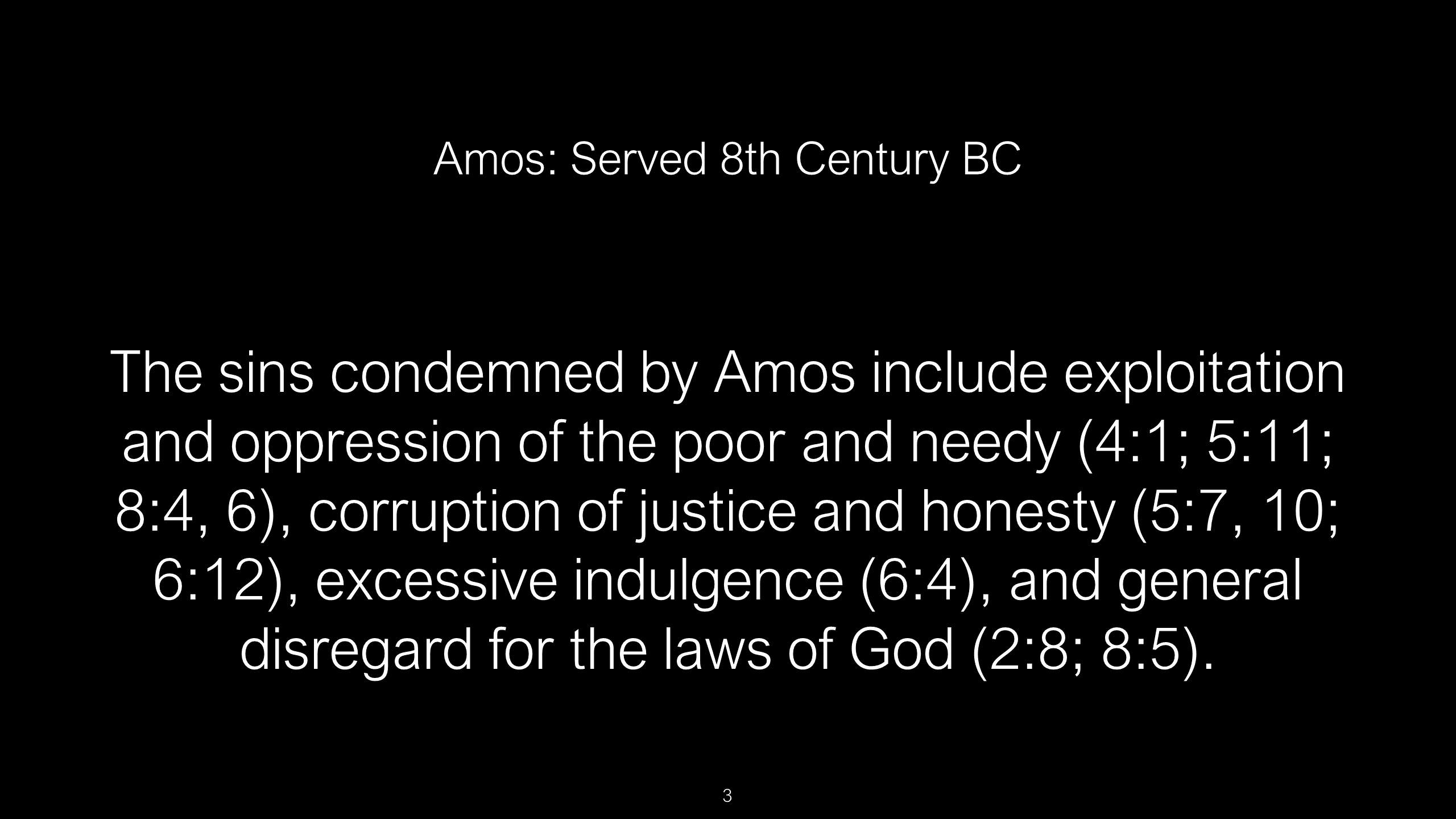
Amos: Served 8th Century BC
The sins condemned by Amos include exploitation and oppression of the poor and needy (4:1; 5:11; 8:4, 6), corruption of justice and honesty (5:7, 10; 6:12), excessive indulgence (6:4), and general disregard for the laws of God (2:8; 8:5).
Transcript
.jpg)
Let’s open our Bibles as we begin this morning to the book of Matthew, chapter 9, Matthew, chapter 9, and verse 36, and I have a very simple question for you as we look at the Scriptures this morning, and that is, do you reflect the most frequently recorded emotion of Jesus Christ? Does your life, does my life, does our way of life, does our going through life reflect what Jesus was like, most of the recorded emotions of Christ? And that emotion is compassion.
Now, basically, what I’m doing this morning, just for you to know, remember, the father of eight children is used to explaining what we’re doing, lest I be asked eight times the same question. I, after all the years of parenting, it taught me to tell everybody what we’re doing multiple times. I’m introducing you to next week, Lord willing’s text. Next week, we’re going to walk through the amazing portion of scripture called Isaiah 58, which reveals the type of compassion God wants His people to have as we go through life. But this morning our question before we go through that, are we reflecting the purpose God chose for fasting? That’s what Isaiah 58 is about. It’s about fasting. Isn’t it interesting the Bible doesn’t talk about fasting. It doesn’t tell what to fast from. It doesn’t tell how long to fast. It doesn’t tell anything about fasting. Fasting was a designated period of time for the Jews to do something. In the New Testament it’s even more oblique. It’s even more unclear what fasting is. As humans, we want to know, fast from what? How long? Where? That’s how we are.
In fact, I just got an email from someone I’ve never met. You know how cyber world is. You can be connected to people you don’t even know who you’re connected to. And they said to me, I hope you know that I just finished my book on fasting and it tells exactly the godly diet that you should have. And I thought, I’ve read the Book. A hundred times. There’s no diet in there, and you wrote an entire book on the diet, down to the recipes, no less. For only $19.95, you can have the Biblical recipes, too, of what to not eat and eat, and everything. I thought, wow.
Fasting is denying self. If you want to know what fasting is, it’s denying self. It’s a part of the spiritual discipline of me saying no, that my body is not running my life. And I deny even necessities to keep in place the fact that God, inhabiting my Spirit, is in control, not my flesh and my appetites and everything else. Prayer is seeking God, fasting is denying self. Do I reflect the purpose God chose for me denying myself? By cultivating Christ’s compassion.
We’re going to study this morning, Christ’s compassion. Now who was Jesus Christ? He reflected God. He is the exact image of God. When you see Jesus doing something, it’s how God is. You understand that? Jesus is the exact representation of the invisible God. He is God the Father reflected in human flesh. And Jesus Christ was most characterized by compassion. And when He was asked what was the greatest of all the law, the greatest expression of the law of God, He says, He reduced down all the law of God to two points. Love God, the Lord your God, completely. And love your neighbor as yourself. Whoa. Do we have Christ’s compassion for our neighbors? For those that live around us. And I don’t just mean in your subdivision. I’m talking about the community of this world of humans.
.jpg)
God has an unchanging social compassion that’s reflected in His Word. Our Almighty God is not prejudiced. We’re just saying that. I pastored in the south for many years. And the Christians of the churches of the south were deeply prejudiced. God is not prejudiced. He is not unjust. He is not oppressive. He has immense compassion for the poor, for the orphans, for the widows, for any who are oppressed, afflicted, and for the outcasts. In fact, God has an unchanging, cover to cover, compassion and concern for society, for people. In fact, God wants us, His people, to reflect, to support, and to seek a just social treatment of fellow humans.
Did you know that’s the constant character of the Bible, Old and New Testament? The Bible has so much become like a supermarket where we push our carts down and we grab the parts we want or like. And sometimes we don’t look at the whole thing. There is an unbroken… from Pentateuch, the first five books, to the Prophets, the last seventeen books of the Old Testament, and everywhere in between, God speaks with a consistent voice about His desire He has for justice, mercy, and compassion. All 39 books of the Old Testament. Unbroken reflection of God’s concern.
When we get to the New Testament, the Apostles Paul and Peter often speak on God’s behalf. Remember, the Old Testament prophets and priests spoke on God’s behalf. And in the New Testament, His apostles speak as God’s representatives. And Peter and Paul especially often spoke on God’s behalf concerning societal issues. And sometimes we don’t think about that. We have to step back and look at what they were saying in the context they were saying it in. They spoke often of the moral contamination of a society where sin, especially the sins of homosexuality, debauchery, and other forms of immorality ran unchecked. We should do the same. There is a corrosive effect of what we’re seeing going on in our world right now. Did you read over the weekend that Roman Catholic, primarily dominated Ireland, just overwhelmingly said that sodomy, homosexuality, gay, everything, is acceptable. That’s wonderful that they said that, but God hasn’t changed. God says it’s wrong. It’s corrosive. It’s totally destructive to a society. Now, we just are supposed to be His mouthpiece. And Paul and Peter spoke of God’s concern for society, especially God’s moral standard, while there was an openly gay emperor.
Have you ever thought about how challenging it was to be a Christian in the first century? While Paul wrote the majority of his epistles, the supreme leader of the world of his day was an openly practicing, flaunting homosexual. He was a flaming homosexual. He rode in his chariot with a castrated male slave by the name of Florus, who was his wife. And what did Paul say? Kill him, protest, riot? What was, Paul said, honor him. Did you catch that? The goal of Christians is not to tear down the political structure of society or to riot against it and to overthrow it. It’s to live in it, constantly speaking into the society, God’s truth. And we keep saying, it’s corrosive, homo, yeah. Did you know that it, there will always be homosexuals, and there always were, and there always will be, until God rules supremely again in the Millennium, and then in the eternal state? But we’re supposed to be like Christ and have compassion for them? I don’t think Christians are particularly described as compassionate about homosexuals these days. Maybe that’s why our message isn’t heard. Paul and Peter went on to affirm that we were still to honor any emperor, even Nero, as king, despite their moral, perfidious behavior. I was told perfidy means debauchery and lowness. And I said, I think perfidious is another word too. And someone, with the help of their phone, after the service, told me that was a word. I didn’t make it up, so I’m thankful for that. But with a perfidious culture, they addressed a wide range of social issues.
For example, if we’re going to go to Matthew chapter 9. But let me just read to you 1 Timothy 1. This is a page right out of Paul’s social commentary when he lived in the Roman world in 1 Timothy. In fact, he was addressing Timothy the pastor of the church in Ephesus that was the largest church in the ancient world, and this is what he told him were to be the issues that he was to be speaking about. Verse 9, of 1 Timothy 1, knowing this, that the law, that’s God’s truth, was not made for the righteous person, but for the lawless and insubordinate, for the ungodly and the sinners, for the unholy and the profane, for the murderers of fathers, for the murderers of mothers, for manslayers. Now look at verse 10, for fornicators. You know what he was affirming? God’s standard of sexuality. God invented sex. God regulates sex. God tells us the only way it operates correctly and properly as He designed it is to not have pornēs. That’s the word fornication. Or for sodomites, verse 10, that’s arsenokoitais. God even differentiates between the active and the passive member in the homosexual relationship. And God says both of them are a perversion. And that’s what you’re supposed to talk about, that this is totally opposed to God’s standard. Whether the whole nation of Ireland approves of it, or whether the whole denomination of the United whatever church approves of it, God does not, and we do not, and we repeat that. We don’t fight that, we don’t protest that, we don’t riot that, we just declare that, and live that, and affirm that, unashamedly.
Someone said to me, what was it, a day or two ago? They said, how do you do that without being judgmental? And I said, you really want to know? Yeah, I said, when you go to the doctor and the doctor takes the whole weight of the laws of science and the whole weight of all the observations and scientific discoveries and he takes all that and then looks at your condition and compares all that truth and all those laws with your condition and he makes a diagnosis. Is that judgmental? That he operates against an unchanging body of truth, and he uses that to not unchanging. Science is constantly changing, but he takes that body of truth, and he diagnoses you. God’s unchanging truth, His forever settled in Heaven truth, diagnoses man, and it is not me that’s judging them, it is God.
Because He wrote the unchanging body of truth, and He says for kidnappers, by the way, if you’re following along in verse 10 of 1 Timothy 1, that was a slave trader. God has always been opposed to slave trading. Even in the first century and prior. Those kidnappers, those who took people against their will and sold them to someone else’s desires, for liars, for perjurers, and if there’s anything else, any other things. They are contrary to sound doctrine. The doctrine that the church taught had a social and a moral content that was reflective of God. In the Old Testament we find even more explicit descriptions of the evils of society that God’s Word addresses.
.jpg)
And so, what I’d like to do with you is do this. I would like to go through, let’s see, 11:07. I’m going to try and do it in five minutes. An overview of the prophets. Now, if you know anything about the Bible is much like a house. There are seventeen books of history. There are seventeen books of prophecy, and there are five books of wisdom. And I’m going to survey these seventeen, starting with Isaiah. Isaiah, Jeremiah, Lamentations, Ezekiel, Daniel, Hosea, Joel, Amos, Obadiah, Jonah, Micah, Nahum, Habakkuk, Zephaniah, Haggai, Zechariah, Malachi. I should get a Bible too, like they gave away in first service, because I know the books of the Bible too. We had the whole front with young people that could say the books of the Bible and got their special study Bible, but let’s go through these seventeen prophets chronologically. We’ll go through them, not in the order of the canon, but in the order they wrote. 2,800 years ago, Amos, the herdsman from Tekoa (not Georgia, by the way, Tekoa in Israel), 2,800 years ago, was the mouthpiece of God, and he condemned the sins of the society around him. And what did Amos, who was God’s voice in the culture, tell the people, whether they listened or not? He said, the exploitation and the oppression of the poor and of the needy always offends God.
Now, I just read an interesting magazine article. Now, don’t, keep eating your salad. But I read an article last week. About how many tomatoes make it to our table in our supermarket. And there are camps with barbed wire where these migrant workers are kept in a concentration camp setting, where a truck comes and they must all get on it at 4 a.m. in the morning, and they are guarded, and they are hunted, and their family is held inside, so that they return from picking our tomatoes. Did you know, whether that bothers me or you, it bothers God, that there are poor and needy people that are oppressed and exploited so that people with money can get what they want to buy with their money? That doesn’t mean don’t boycott Walmart because they have those Mexican tomatoes that are from those concentration camp places. That is not the, that is not what Christians do. We have a concern that issues into action. Did you know they’re actually missionaries that are going down and ministering in those areas to those people, that are in those concentration, those tomato picking concentration camps? You got to read about it. It’s fascinating. These reporters have snuck in and taken pictures. It’s unbelievable. It makes me not want it. It makes me want to grow my own, and have my own children pick them and not force them to do it.
God is opposed to any corruption of justice. Look how the justice system of America has got. If you are wealthy enough, you can get off of almost anything. Honesty. Excessive indulgence. Did you know that God says just because you can afford something, just because you can afford to eat as much as you want, it’s not right to do it? Gluttony is wrong, and so is overindulgence. I saw the picture of the airplane that one of the political candidates is riding around in, and every metal surface of that airplane is covered with gold. That’s an expression. Now, there’s nothing wrong with gold, but indulgence is always wrong in God’s sight, in any form. Personal indulgence, societal indulgence. And general disregard for God’s laws. Okay, so that’s Amos.
.jpg)
Let’s get, that’s longer than five minutes. Let’s go to, faster. Hosea, 2,800 years ago. What were the sins of Hosea’s day? He talked about harlotry, people that were either forced or chose to go into the selling of their bodies. For income, false dealings in any form, violence and bloodshed, which were pervading the society, stealing. Whether it was acceptable or not acceptable, stealing. In the society’s eyes, God said it’s always wrong. Did you know it is, in God’s sight, it’s stealing if you’re paid for something that you didn’t do. That’s acceptable as long as no one finds out. In fact, I found out. I was teaching in the orient a week ago and in the oriental culture something is not wrong unless you are caught. It’s not wrong just because it’s wrong of itself. In eastern thought, it is only, you’re only a convict if you’re caught, not if you just do it. And so that, that’s how Israel thought. And they thought, as long as I don’t get caught for stealing, I’m not a thief. And drunkenness went right along with the overindulgence.
.jpg)
And you get to Micah, and we know Micah. But most often at Christmas, because of the prophecy about Christ coming from Bethlehem, and He who’s going forth was from old, from everlasting, is from oh you of little Bethlehem. But Micah was serving 2,800 years ago. Addressing societal sins for God’s sake. God has an unbroken concern for society’s behavior. And it sounds like a broken record. Basically, the common man was being plundered and oppressed. The poor and the defenseless were being taken advantage of. Justice was being perverted. It sounds like all the other prophets, because God doesn’t change. Bribery and dishonest business practices. The fact that if you move your, I know it’s prudent but there are so many ways that the rich, if they move their headquarters to an island that has no inhabitants, but they have a post office box there, all of us pay taxes, but they don’t. Is that honest? Think about it. It’s acceptable, and if you hire a good CPA and lawyer, you can get a post office address and not pay taxes, and violence and bloodshed, which is so interesting that, not only do we not speak against it, we practice it.
My son, one of my sons, I have five, so you don’t know which one, was staying at one of the premier Christian universities. In the dorms, on a visit to school week. You know what he told me? He said, the boys in the room I stayed, played video games blasting and blowing up and killing until 4 a.m. and slept until noon. And I thought, we buy, and we allow our culture, our children. In fact, there’s a church, when I pastored in Tulsa, the largest church in town, had a room about half this size, an arcade with big stuffed chairs and handheld devices to play video games. They were the biggest youth group in town because you could play simultaneously with hundreds of kids, video games and they weren’t, the bouncing between the block ones. They were blowing up and killing. Did you know? That a society that says that video game violence is amoral. It doesn’t mean it’s wrong because you’re killing a cyber person. That same culture within two years is going to have cyber-sex. Do you know what that is? That is a world more powerful than the real world with the virtual reality. Is that wrong? If it’s not wrong to kill people, then it’s not wrong to be totally involved in a sexual relationship with someone that’s not real. So, it’s okay, right? Because it’s okay to kill them, they’re not real, so we can sexually be involved with them. In Japan, where they’re a generation ahead of us, they’re having a birth decline because the men aren’t interested in women. None of them are like the ones they design on their virtual reality devices. No woman can compete with virtual reality. That idea that violence and bloodshed that’s just imagined is okay. God said it’s wrong whether you think it or whether you do it. Remember? He said whoever thinks in his heart. It’s the same as doing it, gone past the five minutes and meddling now.
.jpg)
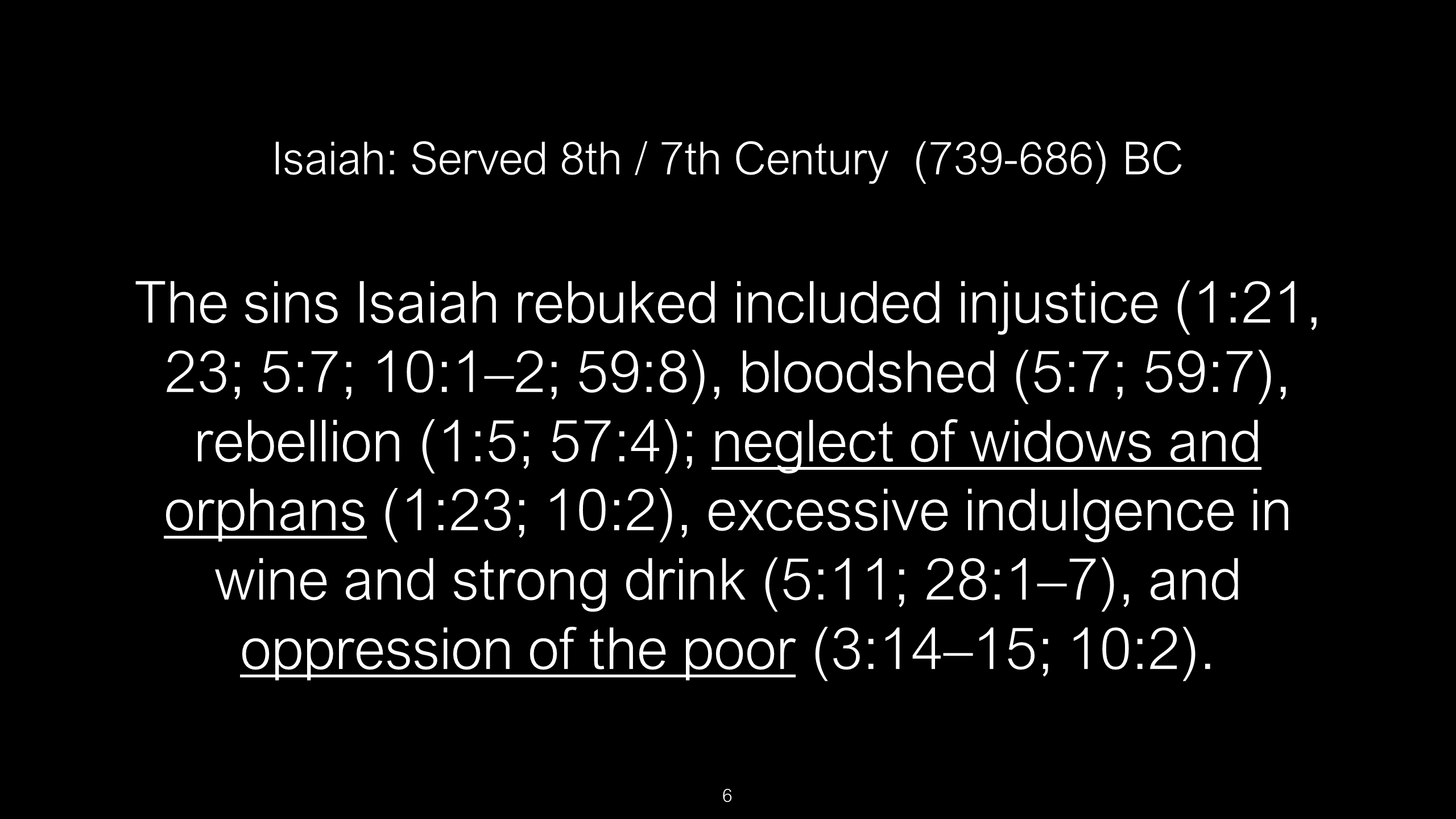
Isaiah is serving the 8th and 7th centuries, and the sins he rebuked are the same. Bloodshed is wrong, injustice is wrong, neglect of widows and orphans is wrong, excessive indulgence. Just because you can afford all that wine and strong drink or what, or food, it’s wrong to indulge in, and oppression of the poor is always wrong in God’s sight.
.jpg)
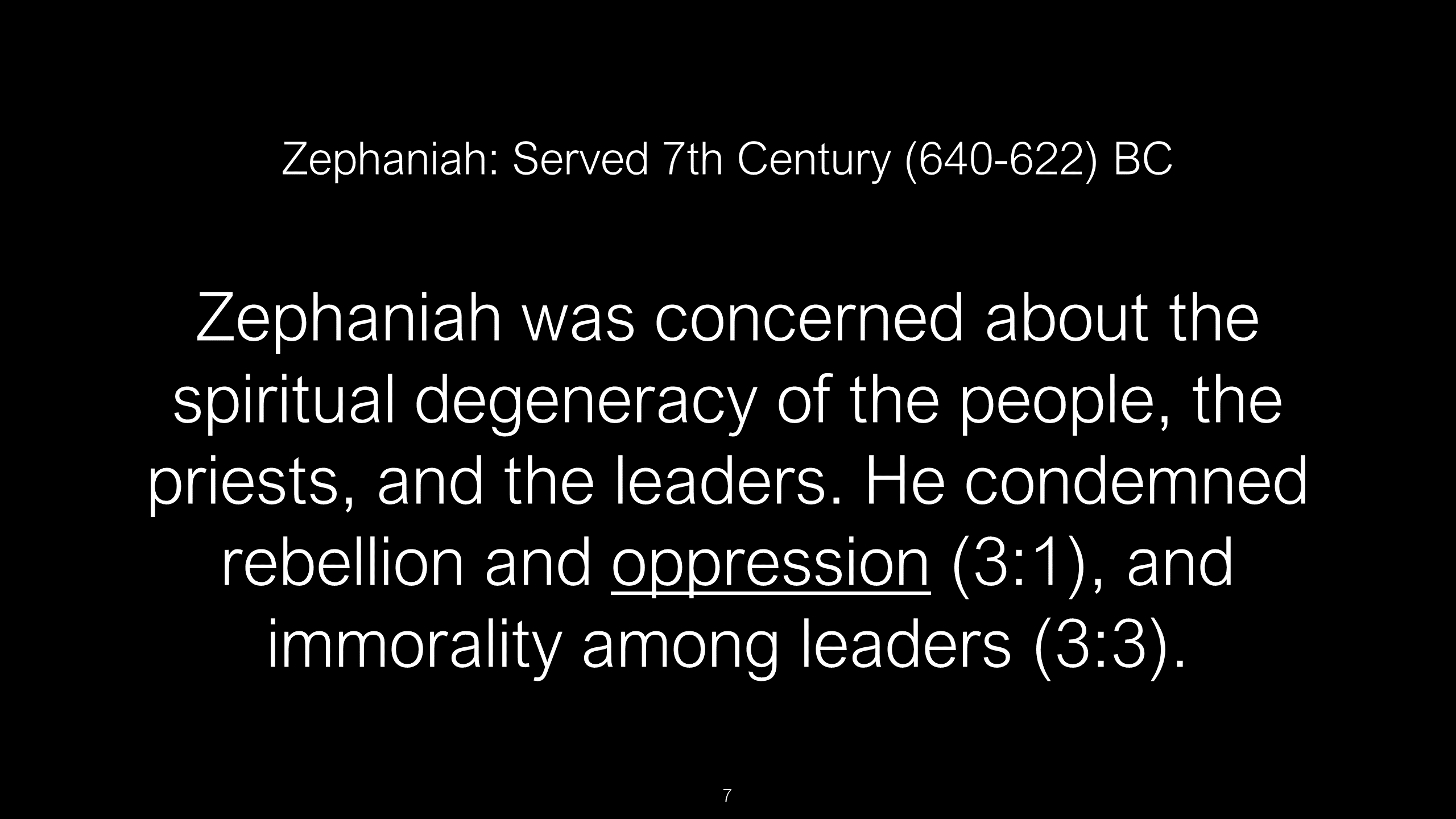
Zephaniah, seventh century. He’s concerned about the spiritual degeneration of the people, of the priests, and of the leaders, and he condemned rebellion, oppression. Oppression, taking advantage of people because they can’t defend themselves, and immorality among the leaders. He spoke to the society.
.jpg)
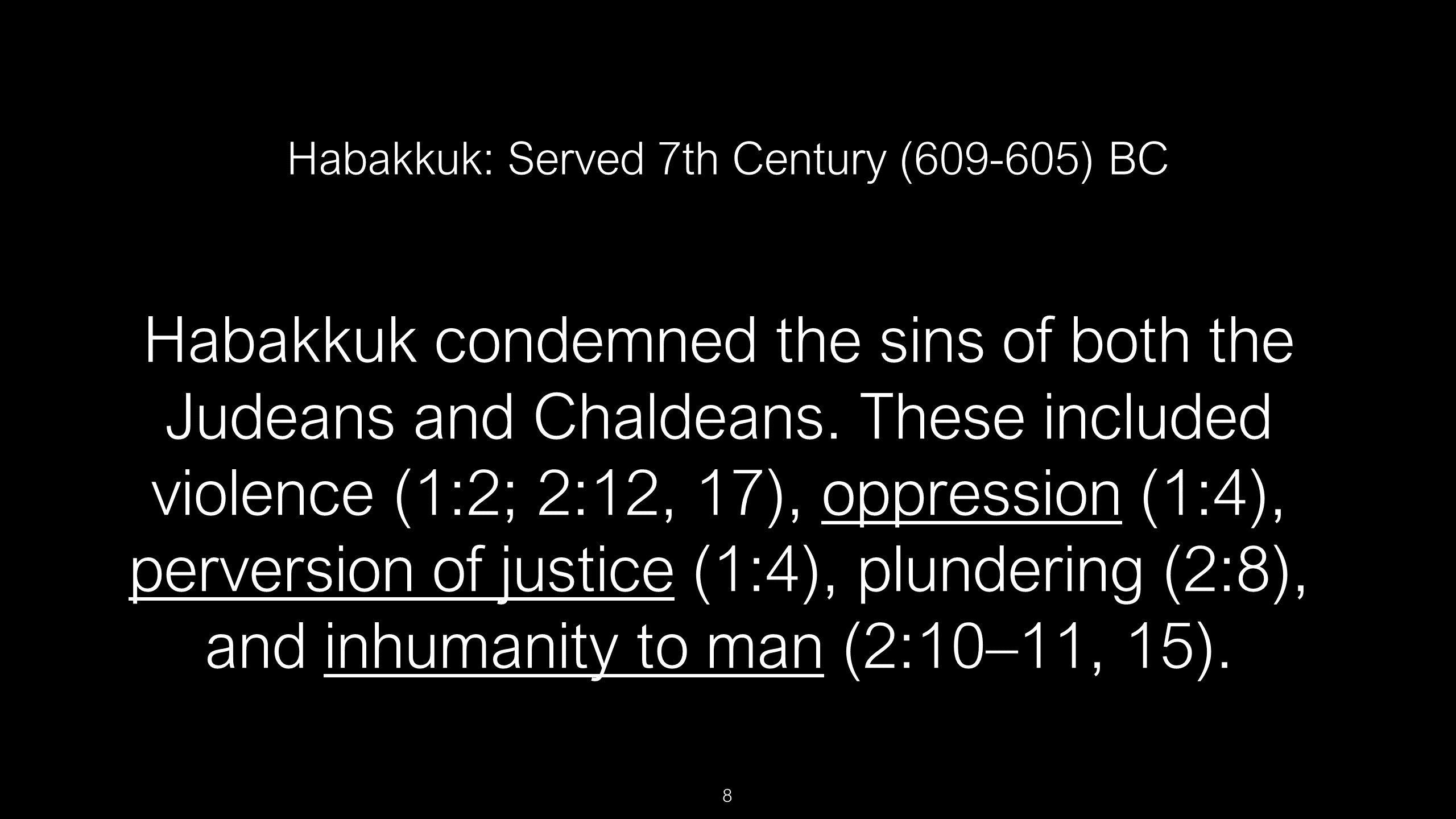
Habakkuk, still 7th century. Condemn the sins of both the Judeans and the Chaldeans. These are the Babylonians. These are the conquerors. This is like the Soviet Union of the 50’s, and he says the things in both home society and their society are wrong. Violence is always wrong. Oppression is always wrong. Perversion of justice is wrong, no matter what form it takes, even if it’s paid for by the wealthy. Plundering anyone is wrong, and inhumanity to people is always wrong.
.jpg)
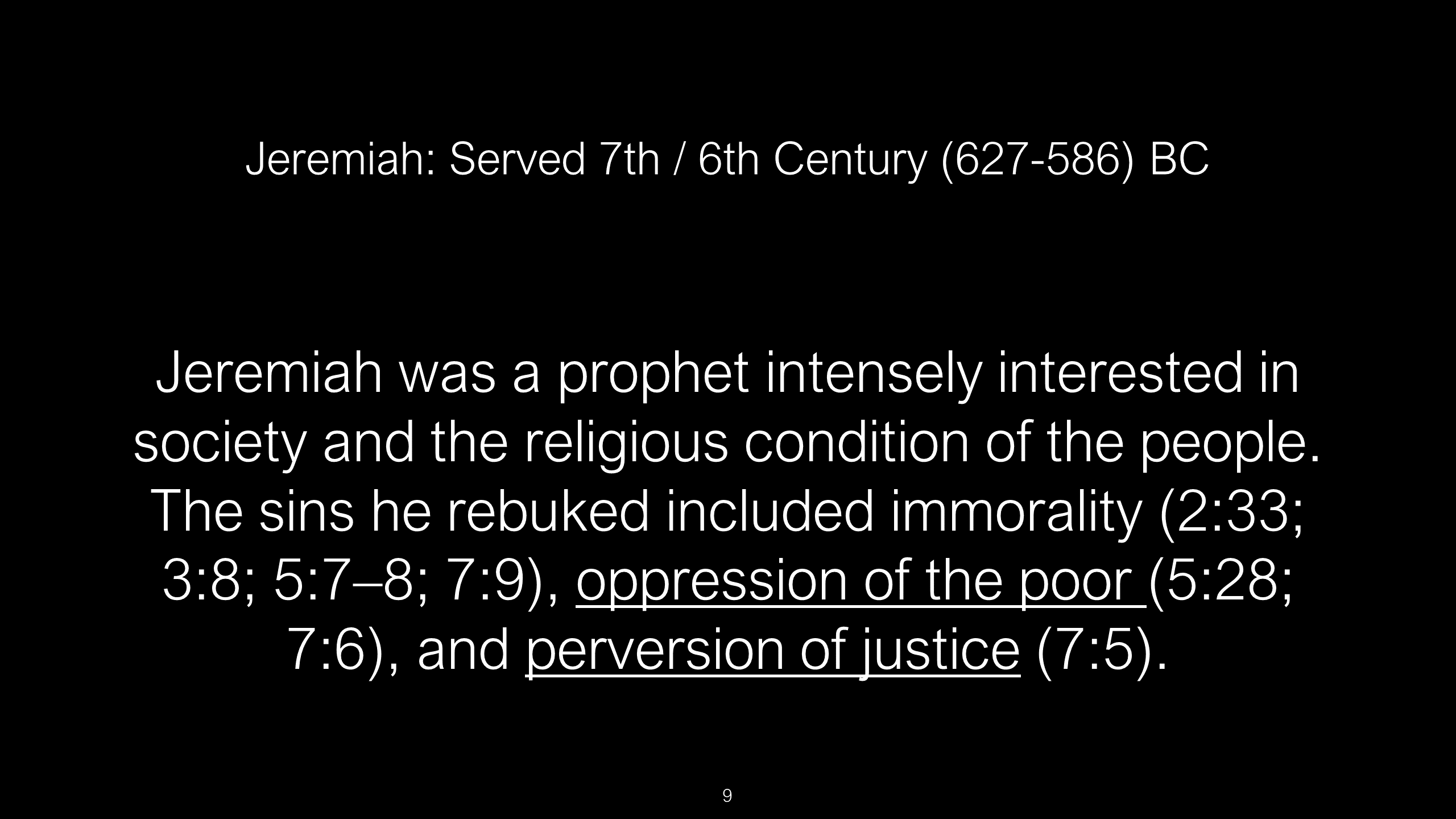
And then we continue to Jeremiah. Jeremiah was probably the most intensely interested in society of all the prophets. In fact, Jeremiah has more words than any other book in the Bible. He had a lot to say. And the religious condition of the people. And he rebuked immorality. He says, it’s God’s standard. It doesn’t matter what Ireland votes. Or how many states ratify it. Or whether the Supreme Court does something. God still is the standard of morality. It’s not public opinion. Oppression of the poor. Perversion of justice. We should feel these things. We should be involved in speaking into society saying that I’m not judging. I’m just diagnosing. I’m God’s diagnostician. I’m one of His, you go to see a doctor, you never see a doctor anymore, you see what, these PAs. We’re God’s PA, into the culture. And we diagnose and say, God says this. We’re not judging, we’re diagnosing.
.jpg)
The oppression of the poor, widows, and orphans is what Ezekiel said was wrong. Bloodshed in any form. Anytime there’s bloodshed. God is very much offended by indiscriminate, gratuitous bloodshed. Now God wanted the Canaanites exterminated. God had the Ammonites exterminated or decimated. God had His people fight the Philistines. There are wars that God said that would be fought for His purposes. But indiscriminate, gratuitous bloodshed. Being entertained by it, like the Roman era, is always wrong. Sexual immorality, always wrong.
.jpg)
.jpg)
Real quickly Zechariah, neglect of justice, oppression of widows, orphans, that’s what the book is about. Malachi, the last of the prophets in the 5th century, perversion of justice, oppression of the helpless. Sounds like a broken record, doesn’t it? That’s because God has a constant voice.
.jpg)
How do we apply this if you take this quick study of the seventeen prophets? God’s prophets confronted societal or social issues in Israelite society. They said any exploitation or oppression of the poor orphans and widows and aliens, any, is always wrong in God’s sight. Any perversion of justice is wrong. Any dishonesty in their business practices, any excessive indulgence, whether it’s in wine, strong drink, or gluttony, any violence of any sort, including bloodshed and plotting evil, are wrong in God’s sight. And all adultery, immorality, and sexual deviation is deviation because it’s defined by the Scriptures. That’s the standard, not the denomination, and not the society. God is. And we speak for Him.
.jpg)
What did God desire? And again, this, remember, we’re talking about the Old Testament. I haven’t jumped in. We’re going in a moment to the New Testament, but in the Old Testament, what did God state?
Number one, His prophet says that God wanted people to repent. We don’t just point out wrong, we say, but there’s hope. There’s, God is a God of compassion. God has moved with compassion. He wants you to repent. He will give you a new beginning. He will give you a fresh start. He will forgive. He will erase. He will treat Christ like He committed your sin.
Second, the prophets told those who knew the Lord to exercise in their lives, justice, righteousness, and loyalty, and they were to challenge the citizens of their day to take positive steps to right the wrongs of society. There’s nothing wrong with saying concentration camps for tomato pickers is wrong. We, did you know that is something that God is concerned about? Not very many Christians. God is. God says it’s wrong to oppress. It is wrong to, to take advantage of the poor and of the needy.
Thirdly, the prophets looked at the establishment coming of the new covenant. See, on that side of the cross, they were looking forward to when the spiritual power for people to walk in the way God wanted would come. It’s come! We’re on this side of the cross. We’re the ones that should be even more redemptive in our lifestyles than the Old Testament people were. Because we have a new heart and a new Spirit, and our stony, hard, calcified, cold heart is gone.
And finally, the prophets anticipated that every wrong would be righted by the coming Messiah. We don’t have to right all the wrongs. We’re supposed to speak into the truth, and as much as within our power, we’re supposed to carry out God’s desires for everyone that’s our neighbor. The Messiah is coming. He’s going to right all wrongs and they were living for the Millennium when Christ would rule.
.jpg)
Now, the balance, though, of ministering in our culture, Amy Carmichael, remember the legendary servant of the Poor in India, was always criticized. Because they said, just preach to those people, just give them the Gospel. And look what she said. One cannot save and then pitchfork souls into Heaven. Souls are more or less securely fastened to the bodies. And as you cannot get the soul out and deal with them separately, you have to take them both together. And I think that’s something that we need to realize that God wants us to take them both together.
.jpg)
Let’s go to chapter 9 of the Gospel by Matthew. And what we’re going to look at is, what was Christ’s most frequent emotion? And as we go through, I’m going to start right here, and you can just, if I’m going too fast, I’m just following this list, okay? Because what we have is there is a verb, in the New Testament, a verb, that’s twelve times, and every time it’s used, connected to Christ. It’s the verb of being moved by compassion, and Christ most often expressed emotion is feeling for humans and their needs. And Jesus is most characterized in His humanity by a love that showed itself in compassion. And every time the verb showing or having compassion is used in the New Testament twelve times. It’s always connected to Jesus. And as we read the Gospels, they emphasize that when Jesus looked at society, it moved Him viscerally. It moved Him, He actually felt a longing to help them. He knew the, who knew better than Christ? They needed the Gospel. But look what else He was concerned about. Let me show you instead of telling you.
Look at Matthew 9:36. “When He saw the multitudes, He was moved with compassion for them. For they were weary and scattered. They were like sheep having no shepherd.” Jesus was concerned about people who were, who had no direction in life, who were just aimless, who were helpless, who were hopeless. And He was, of course He knew that He was their only hope. But just seeing them that way, He wasn’t hard. He wasn’t, just impervious to humanity’s needs.
Go to chapter 14. “Then when Jesus saw the great multitude, He was moved with compassion for them and healed their sick.” He saw them like all of their sorrows and their weaknesses, and their diseases and He was moved and showed compassion by healing their sick. That’s why Christianity alone, do you see any Buddhist missionary hospitals spanning the globe? Honestly. Do you see Buddhism planting mission stations and dealing with lepers and orphans and providing medical services around the world? No. Do you see Islamic hospitals taking care of all the poor and needy of every country of the world? No, you don’t. Christianity alone is characterized by this compassion for people. See, it’s the heart of Christ. He was moved with compassion, 14:14.
Look at 15:32. “Jesus called His disciples to Himself and said, ‘I have compassion on the multitude.'” What for, Jesus? Because they’ve continued with me three days and have nothing to eat. Jesus was concerned about hunger? He was concerned about their physical needs.
Chapter 18, verse 27. He’s telling the story of the unforgiving servant. And “the master of that servant was moved with compassion and released him and forgave him the debt.” He’s talking about God the Father and He’s saying, God is, has compassion for us in our overwhelming burden of being just crushed by our sins. God isn’t happy that we’re being crushed by our sins. He has compassion toward us. He says, I can help you. You’re pinned under that load of sin. You’re going to die. You’re squashed under that. I have the jaws of life. I can open, I can set you free, if you’ll call on me. But compassion.
Look at chapter 20 of Matthew’s Gospel. Jesus had compassion and touched their eyes. These blind men, crying out for help. He had compassion. Now, He touched their eyes and shared the Gospel, but He had compassion for their physical blindness. And their eyes received sight. And they followed Him.
Now, if you turn over to Mark, the next Gospel, chapter 1. In Mark 1, let me get with you. In verse 41, we covered this Sunday night a few weeks ago. This is the leper. And Jesus moved with compassion at this man with his leprosy and his helpless condition. He stretched out His hand and touched him and said, I’m willing, be cleansed.
Chapter 6. We’re going back to the multitudes, like we saw in Matthew, chapter 6, verse 34. “When Jesus came out, He saw a great multitude and was moved with compassion for them, because they were like sheep without a shepherd to lead them, a shepherd to feed them. He began to teach them many things.” They were aimless, and He was moved with compassion.
Chapter 8, verse 2. “I have compassion on the multitude.” It’s a repeat of what we already saw. Because they have continued with me, have nothing to eat. He felt for their needs.
Chapter 9. When his father was talking about his demonized child, Jesus couldn’t listen unmoved. And “he says he’s thrown him both in the fire and the water and it destroy him. If You can do anything, have compassion on us and help us.” Notice again, the having of compassion is connected to Christ. That’s who they felt would dispense compassion.
Did you know when our world thinks of compassion? I’m so thankful for Franklin Graham, aren’t you? Because to the world, he looks like a compassionate extension of Christ. Did you know it isn’t just Franklin? It should be every Christian they know. Isn’t it a compassionate extension of Christ? That’s what we should be.
In Luke chapter 7, verse 13, when the Lord saw her, He had compassion on her. Luke 10, the Samaritan that Jesus is telling the story about, saying what we should all be like. The Samaritan journeyed where the man that was beaten up and near death by the robbers came where he was. And when he saw him, he had compassion. We’re all supposed to be like the good Samaritan. We’re all supposed to have that compassion. We’re not supposed to be like the Levite and the priest and go through life and see all the people that are in their horrific conditions and just say, you deserve it. I’m busy. I’ve got to go do my thing. We’re supposed to have that compassion.
And finally, Luke 15:20, in the prodigal, the man that wasted all of his living on prostitutes and excess, and he arose and came to his father, and while he was still a great while off, his father saw him and had compassion. Do you know what that says? We’re supposed to have God’s compassion for people laden with their sins who come to themselves and say, Oh. I’m eating pig food here and I could go back home, and I would rather be a slave in my father’s house and not eat pig food. And when they realize and repent of their pigsty living, and start coming back smelling like the pigs, we’re supposed to be like chapter 15, verse 20, and have God’s compassion, and run and fall on them and receive them? Ooh. That really doesn’t… those wide-open arms to people coming out of debauchery and sin that are turning to Christ. Arms open wide is not the normal description of evangelical churches these days. That’s the rarity.
.jpg)
Okay, all that to say Jesus was compassionate. He was moved with compassion for confused people, for sick people, for suffering people, for weak people, for desperate, for persistent people, for helpless people, for hopeless people, for bereaved people, for the misfortunate, for the repentant.
.jpg)
Now, the question for us is, do we have Christ’s compassion for the world? Do we see the world the way Christ does? I sat this week; I do this from time to time. I sit and look at the world population clock. And if you haven’t done it, you look it up online. World population clock, United Nations runs it. It’s a very moving sight to watch. In fact, the U.S. Census Bureau has upgraded theirs, and it’s very similar. But basically, there’s this little number, and it’s going up, and what it does is it does a jerky moving up. It goes up 4.3 births and drops back 1.8 deaths. So it goes, and each time what happens is there’s two and a half more souls every second alive. If you look at the numbers, there are 7.245 billion souls alive this moment, and that’s exactly a hundred and some million more than last Memorial Day. A hundred and some million more people.
.jpg)
And to get a bit of perspective, as we sit here alive and relatively safe in Michigan, here in our struggling but prosperous American heartland, we need to reflect on how rich we really are. In fact, Dr. Paul Brandt, and I’ll share, he was a missionary in India, this is what he said. He said, if we were to reduce the whole world of seven and a quarter billion people down to a community of one thousand people, this is what it would look like.
.jpg)
One out of every seven people, this is, if we take all seven billion, one out of every seven would live on a high hill called the developed world. That would be, let’s make the balcony the developed world. Aren’t you glad you came and sat in the balcony up there? That would be the United States, Western Europe, Japan, Korea, Taiwan, Australia, a billion people living up there.
Everyone else on Earth would be down here, where we are, in the rocky bottomland. Parched, usually crowded, dreadfully polluted. The rest of the world. When Bonnie and I were in Beijing, one of the things that was hardest was that it actually makes her sick breathing the air. Did you know often when you’re in China, you cannot, in the industrialized cities, you cannot see across four lanes of traffic. That’s how thick the pollution is. That it’s just like fog. I was looking out the hotel room window in the dark at this glistening city of millions, and it looked like we were living in Cape Cod with the fog rolling in, and they’re far from the water. It was just the smog blowing around, and it distorted the lights. That’s how 85% of humanity lives.
.jpg)
Now, there’s the rich and the not rich. The rich in the balcony and the not rich down below.
.jpg)
What are the rich like in the balcony? Basically, the one billion people, the 15% of humanity, have 60% of the wealth, half of all the homes, 80% of all the commodities, and every one of us billion people earn a $35,000 a year average. Now you say, I don’t. Yeah, but Donald Trump makes up for you, okay, and others. If we averaged out the Western culture, developed world, and the rich people, the 15%, we all earn $35,000 a year.
.jpg)
Now, to compare, look at the bottom land, everyone else in the world. Most, the majority, live on $700 a year. That’s $2 a day. To see that is moving. I was a part of a group once that we traveled on trains all across Russia and spoke and taught and there was a whole teaching team and we rode those trains and every time the trains would pull into a Russian village and stop, everyone knew when the train came, all of the people would come out, and they would have plates in their hands. They knew the train schedule. They would earn their living, and you could see these babushka wearing women villagers, and they would have on their hands plates of what they had cooked. And they would be holding them up, longingly looking, and walking down, looking in each window. Why? Because if we would buy one of their plates, they would earn enough to live. And if they could sell two plates, they’d cover someone else in their family. This is what normal people outside of cities, the vast majority of the poor of this world, live on $700 a year. That’s 1/50th of what we live on. They live on 2% of our annual income. And that’s how they survive. But they’re the richer, see, they’re the upper crust of the poor.
The lower crust is the desperately poor. This is the ones in the National Geographic with the distended or shrunken features. They live on $1 a day. Most, both rich and poor, have an average of five people in each room. You go to the east, the far east, and apartments that have four rooms, twenty people live there. Just look at the clothing coming out of the windows when they’re doing their washing. There’s enough clothes there for an army, and it’s out of one window. Most will never live to see fifty candles on their birthday cake. Most have never seen a birthday cake. And the vast majority of them won’t live to be fifty years old. Even the age expectancy is averaged. Okay.
.jpg)
Veteran missionary Paul Brandt to India once asked, I wonder how the villages on the crowded bottom land, a third of whom are suffering from malnutrition, feel about us up there.
.jpg)
Now that’s nice for him to say that. It isn’t really, doesn’t really matter what they think. Does God think anything about it? So, let’s go, before we go, I thought we’d do this. Turn to the end of your Bible, 1 John chapter 3. So go to Revelation and back up. And I thought that what we would do is talk about compassion. And does God say anything about us who figuratively live in the balcony of the world and have so much that we have to empty and take to Goodwill so we can bring more in? Or we rent space to store because we need it all. Does God say anything about what He expects from us? And before we go, let’s all stand and you follow along in your Bibles. How do you like that? We’ve never read the Bible at the end, have we? So, it’s exciting. And look at 1 John chapter 3. And you just follow along in your Bible starting in verse 14. This is what God says. The Apostle John is speaking for God. And he said, “we know that we have passed from death into life. Because we love the brethren,” we love the other believers. “He who does not love his brother abides in death.” Verse 15. “Whoever hates his brother is a murderer, and you know that no murderer has eternal life abiding in Him. By this we know love, because He laid down His life for us. And we also ought to lay down our lives for the brethren.” Now here’s the hard verse. Verse 17. “But whoever has this world’s goods,” now look up for your Bibles for a minute. You and I have this world’s goods. If you’re wearing a watch, if you have any money in your pocket, if you have clothes that are not threadbare and tattered, if you’re wearing real shoes, and if you’re going to leave here in a self-driving vehicle, we are rich, compared to the rest of the world. Okay, so back down. “But whoever has this world’s goods, and sees his brother in need, and shuts up his heart from him, how does the love of God abide in him? My little children, let us not love in word or in tongue, but in deed and in truth.”
.jpg)
Now the question for us is, are we living with Christlike compassion? Remember the story Jesus told? About the Levite and the priest? They had orthodox doctrine. They believed truth about God, and they walked through life, and could walk right by a bleeding, dying, moaning, suffering, fellow human being. And the Lord says, whoever has this world’s good and sees, and he limits it to believers, his brother in need and shuts up his heart from him. How does the love of God abide in him? Christlike compassion for our fellow humans on Earth frees us to invest in Heaven instead of laying up treasures on Earth. Christlike compassion helps us see that our lifespan and our resources were all given to us by another, the one who owns us and who wants a return on His investment. Christlike compassion comes as we surrender all we have and all we are to Jesus. And as we’ll see next time, that’s the fast of Isaiah 58. It’s a chosen lifestyle that says I will not go through another day of life walking by the broken, the wiped out, those that are on the roadside of my life, without having Christ’s compassion. Boy, that’s not a very popular topic. I don’t think there’s an article about that in Better Homes and Gardens, and Ink, and Fortune, and every other magazine of America. Let’s bow for a word of prayer.
Father, I pray that the Spirit of God that lives within us, Your Spirit, would begin to stir our hearts for all of us to see that we are distribution centers and stewards of a trust fund that You established the moment that You purchased us on the cross. And that we are not our own. That we are bought at a price. And the goal of our lives is to strategize how to most dispense Your love, Your compassion, Your resources of the gifts and treasures You’ve given us in life. How we’re supposed to dispense those for You. We are not to hold on and hoard and bury them, but we are to multiply them by giving them freely in Your name, in the compassion that we have that mirrors Yours. How I pray that all of us will begin to be in the world’s eyes representatives of Christ’s open arms in love and compassion. And that’s the fast that You deserve, and the fast that You desire, and the compassion You saved us to have. And we ask for that now, for You to begin that work in our hearts. In the name of Jesus, we pray, and all of God’s people said, Amen, and God bless you as you go.
NOTES
Our Almighty God is not prejudiced, He is not unjust, nor is He oppressive.
Our Great God has immense compassion for the poor, the orphans, the widows, the oppressed, the afflicted, and the outcasts.
God Unchanging Social Compassion
God’s unchanging concern for His people to reflect, support, and seek a just social treatment of fellow humans is a constant theme in the Scriptures.
From the Pentateuch (the first five books of the Bible) to the Prophets (the last 17 books of the Bible), and everywhere in between: God speaks with a consistent voice about the desire He has for justice, mercy, and compassion.
The Apostles Paul & Peter often spoke on God’s behalf concerning societal moral issues.
They spoke of the moral contamination of a society when the sins of homosexuality, debauchery and other forms of immorality are unchecked. They spoke of God’s concerns for society: while there was an openly gay Emperor. Yet Paul & Peter each went on to affirm that we still were to honor any Emperor, even Nero, as King: despite their more perfidy. Paul addressed wide rages of social issues as they related to God’s just laws, such as in:
1 Timothy 1:9-10 (NIV) We also know that the law is made not for the righteous but for lawbreakers and rebels, the ungodly and sinful, the unholy and irreligious, for those who kill their fathers or mothers, for murderers, 10 for the sexually immoral, for those practicing homosexuality, for slave traders and liars and perjurers—and for whatever else is contrary to the sound doctrine
In the Old Testament we find even more explicit descriptions of the evils of society that God’s Word addresses. Here is a brief survey[1] of just what those key prophets, whom God prompted, proclaimed about what exactly was God’s will for a just society.
Amos: Served 8th Century BC[2]
The sins condemned by Amos include exploitation and oppression of the poor and needy (4:1; 5:11; 8:4, 6), corruption of justice and honesty (5:7, 10; 6:12), excessive indulgence (6:4), and general disregard for the laws of God (2:8; 8:5).
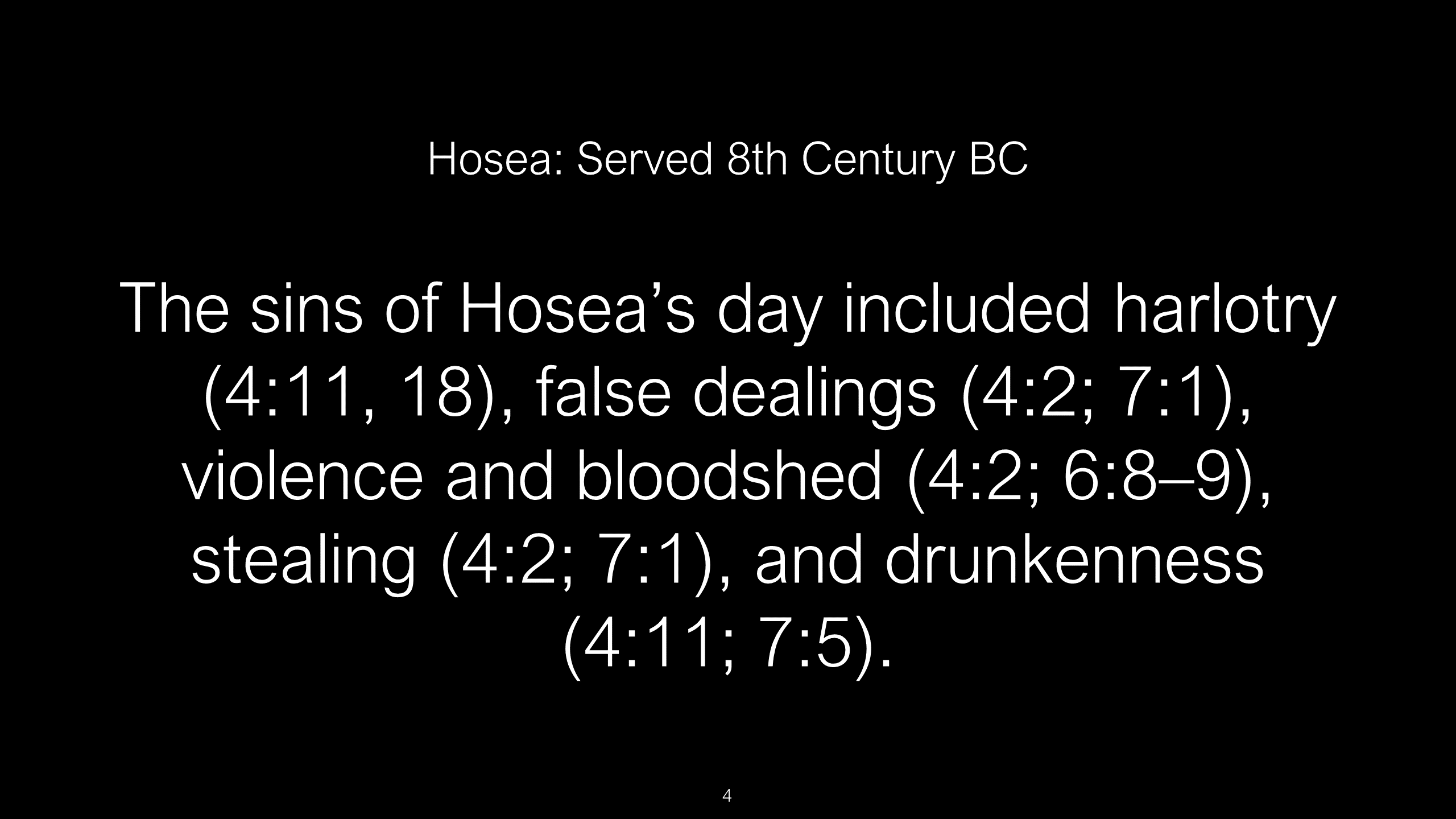
Hosea: Served 8th Century BC[3]
The sins of Hosea’s day included harlotry (4:11, 18), false dealings (4:2; 7:1), violence and bloodshed (4:2; 6:8–9), stealing (4:2; 7:1), drunkenness (4:11; 7:5), idolatry (4:12; 8:4; 13:2), and rebellion against God (9:15; 13:16).
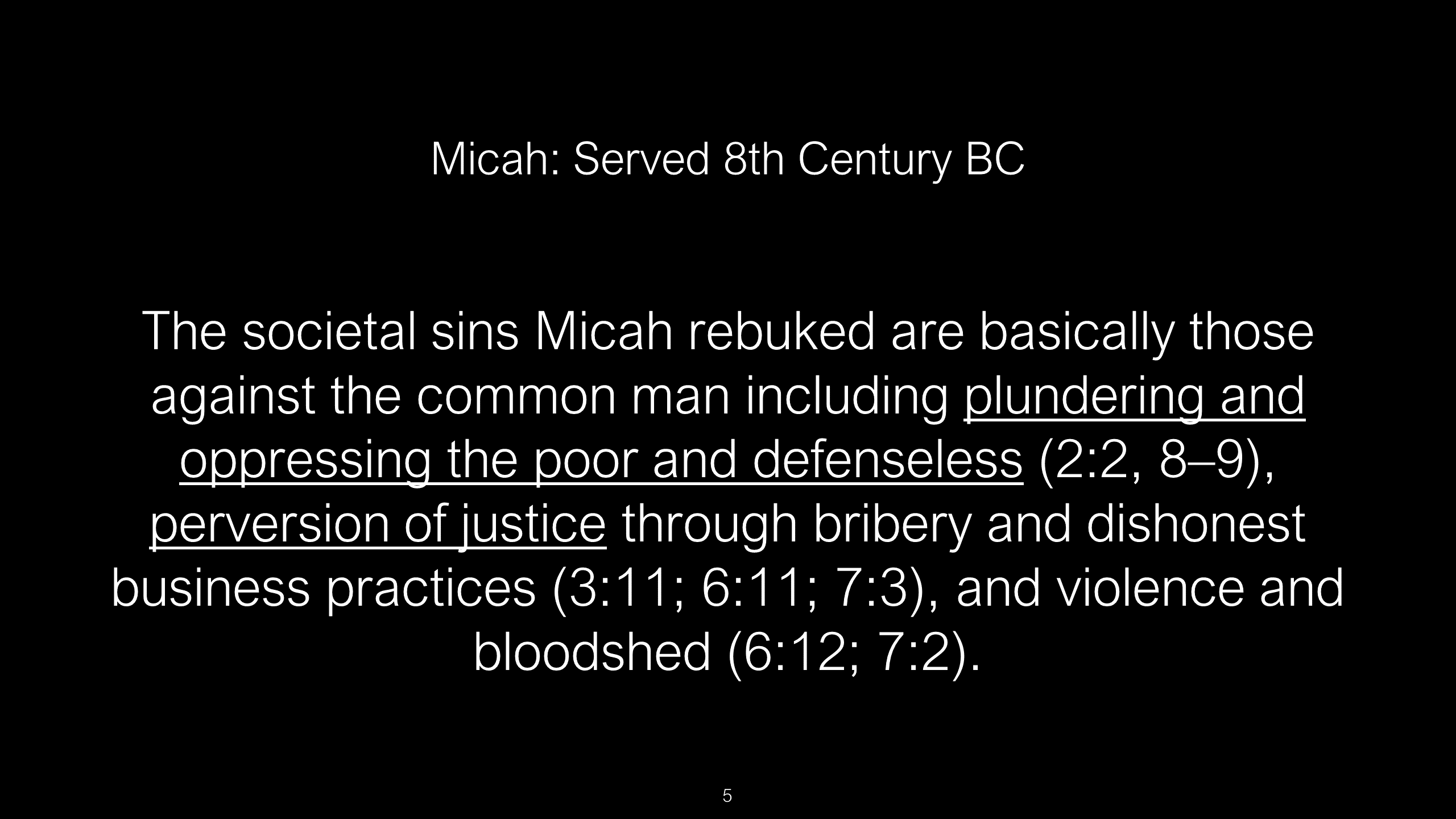
Micah: Served 8th Century BC[4]
The societal sins Micah rebuked are basically those against the common man. These include plundering and oppressing the poor and defenseless (2:2, 8–9), perversion of justice through bribery and dishonest business practices (3:11; 6:11; 7:3), and violence and bloodshed (6:12; 7:2).
Isaiah: Served 8th / 7th Century (739-686) BC[5]
The sins Isaiah rebuked included idolatry (2:8; 48:5), injustice (1:21, 23; 5:7; 10:1–2; 59:8), bloodshed (5:7; 59:7), rebellion (1:5; 57:4); neglect of widows and orphans (1:23; 10:2), excessive indulgence in wine and strong drink (5:11; 28:1–7), and oppression of the poor (3:14–15; 10:2).
Zephaniah: Served 7th Century (640-622) BC[6]
Zephaniah was concerned about the spiritual degeneracy of the people, the priests, and the leaders. He condemned rebellion and oppression (3:1), unbelief (3:2), immorality among leaders (3:3), and disrespect for the Law and holy things (3:4).
Habakkuk: Served 7th Century (609-605) BC[7]
Habakkuk condemned the sins of both the Judeans and Chaldeans. These included violence (1:2; 2:12, 17), oppression (1:4), disregard for the Law (1:4), perversion of justice (1:4), plundering (2:8), inhumanity to man (2:10–11, 15), and idolatry (2:18–19).
Jeremiah: Served 7th / 6th Century (627-586) BC[8]
Jeremiah was a prophet intensely interested in society and the religious condition of the people. The sins he rebuked included immorality (2:33; 3:8; 5:7–8; 7:9), oppression of the poor (5:28; 7:6), and perversion of justice (7:5).
Ezekiel: Served 6th Century (592-575) BC[9]
The sins of Israelite society condemned or rebuked by Ezekiel included oppression of the poor, widows, and orphans (18:12, 16; 22:29), bloodshed (22:3–4), and sexual immorality (18:11; 22:10–11).
Zechariah: Served 6th Century (520-518) BC[10]
The sins he condemned included a neglect of justice (7:9), oppression of widows, orphans, and strangers (7:10).
Malachi: Served 5th Century (432-431) BC[11]
The sins of Judah included perversion of justice (2:9), and oppression of the helpless (3:5).
The Application of the Study
Our Almighty God is not prejudiced, He is not unjust, nor is He oppressive.
Our Great God has immense compassion for the poor, the orphans, the widows, the oppressed, the afflicted, and the outcasts. God’s unchanging concern for His people to reflect, support, and seek a just social treatment of fellow humans is a constant theme in the Scriptures.
God’s prophets in Israel confronted the social issues of Israelite society. The evils the prophets rebuked included the following:
(1) Any exploitation or oppression of the poor, orphans, widows, and aliens,
(2) Any perversion of justice,
(3) Any dishonest business practices,
(4) Any excessive indulgence in wine and strong drink,
(5) All violence of any sort, including bloodshed and plotting evil,
(6) All adultery, immorality, and sexual deviations as defined by the Scriptures,
God’s Declared Desires
“In response[12] to these problems the prophets offered four solutions. The first two relate to what man must do; the other two relate to what God will do.
First, the prophets exhorted the people to repent of their evil and turn back to God (Amos 5:4–6; Hos 6:1–3; Zeph 2:3; Jer 4:14).
Second, the prophets exhorted the people to exercise justice, righteousness, and loyalty. They challenged the citizens of their day to take positive steps to right the wrongs of society (Amos 5:24; Isa 1:16–17; Mic 6:8).
Third, the prophets, particularly Jeremiah and Ezekiel, looked to the establishment of the New Covenant, which will provide the spiritual power for people to walk in the manner required by God (Jer 31:31–34; Ezek 16:60–63; 36:25–28).
Fourth, the prophets anticipated the coming of the Messiah, who will establish justice and righteousness during His millennial reign (Isa 11:4; 42:1–4; Mic 4:2–4).
Some may object to setting forth the prophets as models for Christians in confronting social and moral issues. Admittedly the church is not Israel, and pastors are not biblical prophets.
Yet what is modeled by the prophets is certainly underscored in the New Testament Epistles. It seems that the principles reflected in the prophets are not limited to a particular dispensation.
The prophets balanced spiritual concerns with physical problems, recognizing both man’s part and God’s part in the ultimate solution to each.
The Balance of Christ’s Ministry
This balance is reflected in the words of Amy Carmichael. Speaking in response to criticism of her humanitarian work in India, she said[13],
“One cannot save and then pitchfork souls into heaven…. Souls are more or less securely fastened to bodies…and as you cannot get the souls out and deal with them separately, you have to take them both together.”
We live in a desensitized, cruel world. We need the power of the Spirit to stay tender, compassionate, and Christlike in our daily lives. One of the great works of the Spirit of God is to change our hearts and keep them changed into Christlikeness.
There is one thing you can always notice about Jesus in the pages of the New Testament: His deep concern for the poor, needy, troubled, oppressed, and hurting. His love and compassion stand out in every scene.
Christ’s Most Frequent Emotion
Never forget that Christ’s most frequent emotion was not anger, or disappointment, or frustration.
Christ’s most often expressed emotion is feeling for human needs.
Jesus is most characterized in His humanity by a love that shows itself in compassion.
Every time the verb “showing/having compassion” is used in the New Testament (which is 12x) it always refers to Jesus!
As we read the Gospels, what do they emphasize about what Christ did on earth? They show His great compassion upon weak and wandering humans.
This compassion[14] is the most frequently recorded emotion of Jesus. Watch Him in:
Matthew 9:36 But when He saw the multitudes, He was moved with compassion for them, because they were weary and scattered, like sheep having no shepherd; (same event as Mk. 6:34)
Matthew 14:14 And when Jesus went out He saw a great multitude; and He was moved with compassion for them, and healed their sick;
Matthew 15:32 Now Jesus called His disciples to Himself and said, “I have compassion on the multitude, because they have now continued with Me three days and have nothing to eat. And I do not want to send them away hungry, lest they faint on the way”; (same event as Mk. 8:2)
Matthew 18:27 (NKJV) Then the master of that servant was moved with compassion, released him, and forgave him the debt.
Matthew 20:34 So Jesus had compassion and touched their eyes. And immediately their eyes received sight, and they followed Him.
Mark 1:41 (NKJV) Then Jesus, moved with compassion, stretched out His hand and touched him, and said to him, “I am willing; be cleansed.”
Mark 6:34 (NKJV) And Jesus, when He came out, saw a great multitude and was moved with compassion for them, because they were like sheep not having a shepherd. So He began to teach them many things.
Mark 8:2 (NKJV) “I have compassion on the multitude, because they have now continued with Me three days and have nothing to eat.
Mark 9:22 (NKJV) And often he has thrown him both into the fire and into the water to destroy him. But if You can do anything, have compassion on us and help us.”
Luke 7:13 (NKJV) When the Lord saw her, He had compassion on her and said to her, “Do not weep.”
Luke 10:33 (NKJV) But a certain Samaritan, as he journeyed, came where he was. And when he saw him, he had compassion.
Luke 15:20 (NKJV) “And he arose and came to his father. But when he was still a great way off, his father saw him and had compassion, and ran and fell on his neck and kissed him.
Jesus the Compassionate One
Jesus was moved with compassion: For the confused. For the sick and suffering. For the weak. For the desperate. For the persistent. For the helpless. For the hopeless. For the bereaved. For the misfortunate. For the repentant.
Do We Have His Compassion for Our World?
Jesus is watching us, and warning that choices we make can blind us to spiritual realities around us. In Laodicea, the final of the seven churches of Revelation 2-3, Jesus warned them that their longing for riches caused them to be blinded to their real spiritual condition and needs.
Riches piled up often reflect discontent; and a lack of contentment always has dangerous effects upon our spiritual life. Jesus says we need to ask Him to help us see what love of money can do to us. One area of blindness that discontentment with wealth can produce is an insensitivity to the needs of the less fortunate around us. We often need to check how we are doing in having Christlike compassion for the poor.
To help us all wake up to the needs of the world, and to stir up Christlike compassion, join me in a look at the world as God sees it. One of the great tools to check our heart for those who are in great need is to pause and reflect on the World Population Clock.
It is a very moving sight to watch each second as the numbers changed. The math of this US Census Bureau site is simple:
The number goes up by 4.3 births and down by 1.8 deaths for a net gain of 2.5 new immortal souls on Earth—each second!
The United Nations estimates that we have about 7.245 billion souls alive at this moment[15]. That number is just about 100 million more living souls from last year this on this date! Of course, only our True and Living God knows exactly how many there really are, as well as the number of hairs on each of their heads!
But to get a bit of perspective as we sit here alive and relatively safe in Michigan, here in the struggling but prosperous American heartland—we need to reflect on the people who share life with us here on Earth.
For all of us alive in Michigan, despite our current economic woes, we are better off financially, economically, and comfortably than the vast majority of all the others alive today.
Which is just another way of saying:
How Rich We Are
For a moment, imagine with me that the whole world was represented in just this auditorium. That means, if we were to reduce that unimaginable number of our global population, which is just over 7 ¼ billion people. So if we made all those billions of souls distilled down to a representative group of people sitting in chairs, here is how it would look today.
Our world, shrunken down to a community of 1000 persons, sitting in this auditorium, would be a town in which:
1/7th or about 15% of us live high on a hill called the developed world – that would be the balcony. From our world today the people in the balcony would represent about one billion people who live in the USA, Western Europe, Japan, Taiwan, Australia and Korea.
6/7ths or about 85% of us live on the rocky, often parched, usually crowded, dreadfully polluted bottomland called the rest of the world.
| Wealth | GDP | Population | Pop totals | Region |
| 26% | $ 15.6 Trillion | 5% | 307,553,450 | USA |
| 23% | $ 13.6 Trillion | 7% | 492,000,000 | Europe |
| 12% | $ 7.5 Trillion | 3% | 221,000,000 | SE Asia (Japan, Taiwan, Korea, Australia) |
| 39% | $ 23.4 Trillion | 85% | 6,190,000,000 | China, India & the Rest of World |
The Rich and The Not Rich
We, the fortunate 15% or 1/7th or the 150 out of us in this auditorium on the hill, hold over 60% of the wealth of the whole town,
We balcony dwellers also own over 50% all the homes in town; and each of us have an average of two rooms per person in our homes.
We balcony dwellers also own 85 percent of all the automobiles,
We balcony dwellers own about 80 percent of all the TV sets,
We balcony dwellers own almost 80 percent of all the telephones,
And we balcony dwellers make an average income of over $ 35,000 per person per year.
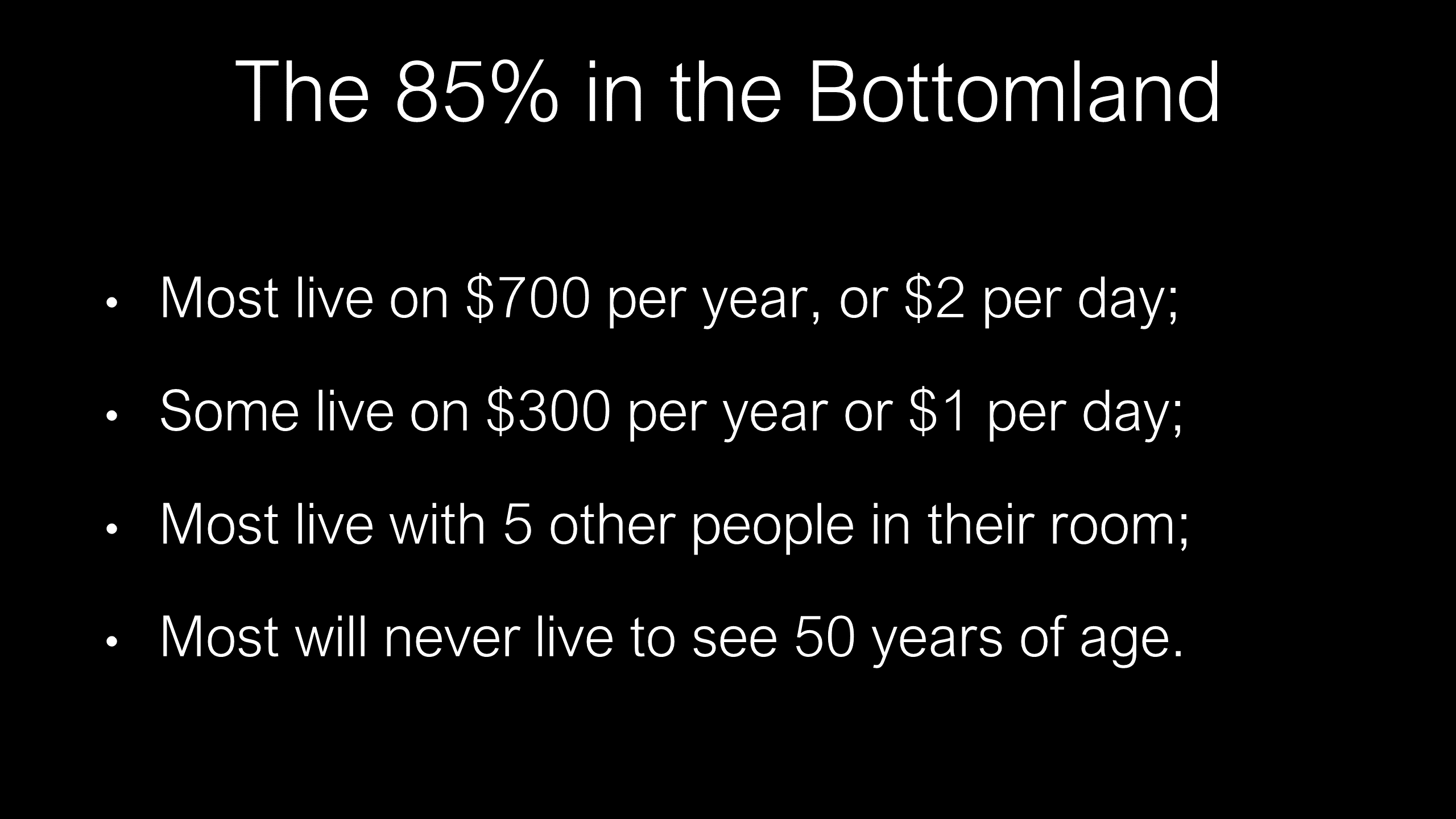
The not-so-fortunate 850 people on the bottom, in the less developed world (when the super-rich who have business dealings with the developed nations are factored out of their region) have learned to survive on 1/50th of our incomes. Most of the other people on Earth survive on roughly $700 per person per year. That means $2 per day is what they live on.
But even among the poor there are more-poor and less-poor.
Of the poor, the vast majority live on less than $300 per year ($1 a day), and are living with 5 other people in their room, and all of them will probably never live to see 50 candles on their birthday cake (if they had ever seen a birthday cake)!
Veteran Missionary to India and noted author Dr. Paul Brandt once asked,
“I wonder how the villagers on the crowded bottomland (a third of whose people are suffering from malnutrition) feel about us folks up there on the hill?”
This takes us right back to Christ’s words to His church and brings up:
The Question of Compassion
What was Christ’s most frequent emotion? Compassion, right? He was moved with compassion. When we aren’t compassionate Jesus points out that there is usually one cause: we are rich and increased with goods, feeling we need nothing, and are not sacrificing for others.
Now turn back to the almost last book of God’s Word, to 1 John.
Please stand, and follow along as we listen to Christ’s words in:
1 John 3.14-18 (NKJV) We know that we have passed from death to life, because we love the brethren. He who does not love his brother abides in death. 15 Whoever hates his brother is a murderer, and you know that no murderer has eternal life abiding in him. 16 By this we know love, because He laid down His life for us. And we also ought to lay down our lives for the brethren. 17 But whoever has this world’s goods, and sees his brother in need, and shuts up his heart from him, how does the love of God abide in him? 18 My little children, let us not love in word or in tongue, but in deed and in truth.
Are We Living with Christ-like Compassion?
Christ-like compassion for our fellow humans on Earth frees us to invest in Heaven instead of laying up our treasures on earth.
Christ-like compassion helps us see that our life span and our resources were all given us by Another, who owns us, and wants a return on His investment.
Christ-like compassion comes as we surrender all we have and are to Jesus.
That is the fast God desired in Isaiah 58.
Hymn # 366 “I Surrender All”
[1] Drawn from an article by J. Carl Laney, (1990). Bibliotheca Sacra, 147 (585), 35–43.
[2] Amos prophesied to Israel during the reigns of Uzziah (791-739 B.C.) and Jeroboam II (793-753 B.C.), when both kingdoms enjoyed peace and prosperity unequaled since the reign of Solomon.
[3] Hosea began his public ministry in the reign of Israel’s King Jeroboam II (793-753 B.C.) and continued into the reign of Hezekiah (728-686 B.C.).
[4] Micah carried out his ministry during the reigns of Jotham (750-731 B.C.), Ahaz (743-715 B.C.), and Hezekiah (728-686 B.C.).
[5] Isaiah began his ministry in the year of King Uzziah’s death (739 B.C.) and continued prophesying until at least the death of Hezekiah (686 B.C.).
[6] Zephaniah ministered in the days of Josiah king of Judah (640-609 B.C.), before the great revival of 621 B.C
[7] The ministry of Habakkuk probably took place early in the reign of Jehoiakim (609-597 B.C.), before the first invasion of the Babylonians (Chaldeans) in 605 B.C. (2 Kings 24:1–2).
[8] Jeremiah was commissioned as a prophet during the reign of Josiah in 627 B.C., and he continued his ministry in Judah through the fall of Jerusalem (586 B.C.).
[9] Ezekiel began his prophetic ministry in 592 B.C. and continued to minister to the exiles in Babylon for at least 27 years (29:17).
[10] Zechariah entered his prophetic ministry in 520 B.C., just two months after Haggai’s first oracle. His last dated prophecy is two years later (518 B.C.).
[11] Malachi probably prophesied between the first and second governorships of Nehemiah (ca. 432-31 B.C.).
[12] Quoted from an article by J. Carl Laney, (1990). Bibliotheca Sacra, 147 (585), 35–43.
[13] Quoted by Ruth A. Tucker in Guardians of the Great Commission (Grand Rapids: Zondervan Publishing House, 1988), p. 134.
[14] Though translated in English as “compassion” these two verses do not contain the Greek word splangknoi, but another word, the one for “mercy”: Matthew 18:33 (NKJV) Should you not also have had compassion on your fellow servant, just as I had pity on you?’ (this is the word eleo or “mercy); Mark 5:19 (NKJV) However, Jesus did not permit him, but said to him, “Go home to your friends, and tell them what great things the Lord has done for you, and how He has had compassion on you.” (this is the word eleo or “mercy)
[15] http://www.census.gov/popclock/?intcmp=home_pop