
If the video above is not available, here are two other ways to view:
Hacking Agag to Pieces
060305PM
DSS-12
1st Samuel 15.3-16.1
Transcript
.jpg)
.jpg)
Let’s look at Psalm 51 and verse 4, and as you turn there, I ask you the question, how bad is sin? How bad is it? Sin is so bad it took God killing His own Son to pay the price of the wrath that sin deserves. Now, that’s quite an abstract thought for most of us. We don’t really know how to comprehend the price of sin in terms that we can understand. We’ve seen the movie, The Passion of the Christ. We’ve read the Gospel so many times, but that idea is hard for us to understand. In Psalm 51:4, that’s the first portion of Scripture we’re going to look at this evening, is one of those places where we make a connection between the great wrath of God which He has for sin and the high price that His furious wrath against sin demands. And as we see that wrath upon sin, and as we understand the price that sin demands, it starts to make us uncomfortable, and we’ll talk about that when we see God’s wrath against the Amalekites.
But Psalm 51:4, against You, You only, have I sinned. David is showing us the model of true, Spirit-prompted conviction, confession, repentance. He says, against You, You only, have I sinned. Remember, this is totally contrary to Saul who didn’t ever think he had done something wrong. This is the model of what we need to all be doing. And done evil, this evil, in Your sight. And all sin, it is only secondarily against individuals. It’s primarily, every sin, every omission, every commission, every deliberate, every whatever you want to call it, infirmity and weakness, and overt and covert sin. Every one of them comes down to this. And done this evil in your sight. Now, here’s the key I want you to think about: that You may be found just when you speak—and look at this—and blameless when You judge.
Now turn back with me to 1 Samuel 15 and verse 3, and I want you to be looking at that verse as I consider with you how bad sin is and how God looks on sin, and how angry, and furious, and filled with wrath God is. Remember, wrath is God’s attitude. It’s not His punishment of sin. Wrath is God’s attitude, and God is revealed as having a continuous wrathful attitude towards sin, though He might not act as we talked about this morning. But when we see God’s attitude about sin, it sometimes makes us uncomfortable, the idea of wrath, and it should. And that discomfort we should, in that discomfort we should respond in gratitude for the gracious gift of Christ’s redeeming love, because Christ’s love and sacrifice keeps us from that wrath being upon us, for Christ’s atoning death, for the endless life He gave us. To more fully appreciate what we have in Christ, we need to step back and consider the character of God, and that’s what Psalm 51:4 says. God is always just when He judges sin. God is always righteous when He has wrath. That is what the Word of God reveals and what we believe. He is always blameless in what He does. That’s what consistently He has revealed about Himself.
.jpg)
And so, as you look at verse 3, think about this: God looked upon these Amalekites who hated Him. The Amalekites hated God. They were attacking the people of God as we saw this morning, cowardly terrorizing the weak and the elderly. But it was more than just a raiding band; it was an attack upon the people of God because they knew these were the miracle people coming out of Egypt. And they preyed upon them knowing that they were basically unarmed and that they were taking out of Egypt all these treasures, and they knew what was going on, and they were attacking the people of God. They detested Israel. They seemed to delight in wicked and destructive acts. And God’s instructions in verse 4 to Saul; therefore, fulfill the vow he swore to Moses.
Now, remember I showed you this morning that in the Amalekites at Rephidim in Exodus 17, that God says that He would always be at war against Amalek. And so, in that passage, God had waited now 500 years. Now, remember we started with Esau, 4000 BC. Then we went to Moses, 3500 BC. Now we’ve moved 500 more years, and now we’re at King Saul, which is 3000 BC. So, we, Amalek is a whole thousand-year-old nation. How old is America? Just over 200. We’re now a thousand years into the history of Amalek. And God has said, Saul, I want you to wipe out the tribe forever. And Saul and his armies were the instrument through which a righteous God would carry out His holy judgment on a sinister people. And that’s how God looked at them. And God is just and righteous, and He saw them that they were so deserving, as are we, of His wrath that they needed to be utterly destroyed. See, don’t think the Amalekites are any worse than we are. We all are sinners deserving God’s wrath. But here’s a group that happened to be out there, and God targeted them. But sometimes when we first see God execute judgment like verse 3 calls for, we pause and secretly wonder why God is so severe.
Look at verse 3, go and attack Amalek, utterly destroy all that they have, do not spare them. Kill both the man—who might be just pleading with you to spare his life—kill the man, the woman—who says, I’m a woman, I’m unarmed; don’t do that—the infant. Now, that’s where we all just go, oh, whoa, wait a minute here. We’re uncomfortable with that. Did you know that all of us are born sinners? Our culture doesn’t make us sinful. Our environment doesn’t make us sinful. Pressures around us doesn’t make us sinful. We are sinners from birth. Now, you talk to some good, upstanding religious American. They go, no, no, no. But that’s what God says, from the womb we go sinning. We are sinners by nature, by choice, as soon as we’re old enough to make choices, and by God’s divine decree. But remember, when we looked at Saul, the first king, I reminded you, God rejected him for this third verse of chapter 15, because God says, I want you to kill both man and woman, and infant and nursing child, and not just the sinful people, but everything associated with them. The ox, the sheep, the camel, and the donkey. Those were the actual orders that God gave Saul.
.jpg)
Now, for just a second, let it soak in. That is God’s attitude towards sin. There you go. You want to know what the wrath of God is? You say, oh it’s, it was sin is so bad, God had to kill his Son Jesus, and that’s an abstraction. Can you see infants, and nursing children, and mothers with their nursing children, and the fathers and all their animals around? God said, kill them all. Exterminate them. God has an attitude about sin which is called wrath. God is a God of wrath against sin. Here we see what lies ahead for all who do not flee to the shadow of Christ’s cross.
But why would God ever say and do such a thing? If we look at these verses all by themselves, it seems harsh and out of place. But when we back up and see what else God has said about these people, it all becomes much clearer. Remember, these people are just the continuation of the sin, and wickedness, and pride, and godless profane lifestyle of their forebearer, Esau, and they’re just expressing it. In fact, if we had time, I’d show you some more. All of Esau’s relatives are talked about. Edom. In the book of Obadiah verse 6, it says Edom was just a magnification of the pride of Esau. And in that context, God says Edom will be utterly destroyed because of their pride, because they are just Esau exposed. Now, Esau just wasn’t that bad of a guy. It’s just an object lesson on sin. We are all that bad of guys. We are all sinners. And see, that’s the idea of how bad sin is. We like to compare ourselves and say, oh, Esau must have been worse. I’m not profane and fornicator, so I’m different, but all unrighteousness is sin, and all sin is transgression against God, and that’s the element we have to think about. And Christ’s death spared us the fury of God’s wrath upon sin, which we rightly deserve. So, one thing we know for sure from 1 Samuel 15:3, this event happened. We know that God really hates sin so much He wanted the extermination absolutely of those people, as He did the Perizzites, the Hivites, the Jebusites, and all the other -ites of the Promised Land, the Canaanite people. God has revealed Himself. He is blameless in His justice. He’s not mocked. God says, whatever we sow we’ll reap. And after century, after century, after century of patience and allowing the descendants of Esau to just multiply and mushroom and grow in their sin, God said, enough is enough, and I want them exterminated.
.jpg)
The truth from Exodus is that only God could give victory over the Amalekites. You remember, Saul here, if you notice in verse 4, Saul gathered 200,000 foot soldiers. He didn’t need that many. He could have done it with a handful. In fact, he could have done it alone. In fact, God didn’t even need him. You understand what I mean? This, the battle is the Lord’s, and as soon as we calculate that, it’s not by might. It’s not by power. It’s by the Spirit’s power. So, Saul got this group of soldiers and God wanted him to utterly destroy this nation, its ferocious, plundering, merciless culture of murder and wickedness. These Amalekites were the first nation to attack Israel when they came out of Egypt. As we saw this morning, they struck the rear, they murdered the weak, the frail, the old who were straggling at the end of the line, and they did so with desire. They preyed upon the helpless, and God exposed them for what they were. Now, we would say, oh, the poor, children and everything. But you let those children grow, they would’ve been just as mercilessly, blood thirsty as their parents because they had inherited from their father and from their forefather, Adam, the sinfulness that we all have. But the critical lesson for us is only the Spirit can defeat sin. And just as only God could cause Amalek to be defeated in battle, as Joshua and as Saul found out, the lesson we’re looking at tonight is the same is true for the Amalek within all of us.
Amalek is just a picture of the rapacious horror of sin that lives within us, even after we’re saved, that is in our flesh. Because in my flesh, there dwells no good thing, and so I have to be at war against my flesh. We win daily battles with the temptations of our flesh only by walking in the Spirit. When we go our own way, we will face Amalek, our flesh, all alone, and we’ll lose. Haven’t you found that out? It’s the common experience we all have. The arm of the flesh will always fail us. When we try and beat flesh with flesh, we always lose and we fall into sin, whatever form it takes in our life. As Paul said, the defeat of our flesh comes only through the victory Christ has already won on the cross, and it’s brought to us step by step as we walk in the truth of the Spirit of God’s power.
And God’s Word clearly warns us that we don’t conquer our flesh by physical means, asceticism. You know that kind of ascetic lifestyle that the monastic types did where they would refuse themselves, like Martin Luther, sleep on the floor with no blanket, eat only bread and water. That did not lessen his or our, if we try it, sinfulness. Ascetism doesn’t do it. Neither does religious activity. Some of the most religiously active people in the world are those who have taken their vows to the Church. And they don’t get married, and they marry the Church, and they spend their lives, and their endless activities has not prevented them, as we read in our newspaper, from being driven by lust and fulfilling those lusts. So, religious activity, ours or theirs, doesn’t do it. Our human effort! I told you many times my, I grew up my parents working in the rescue mission, and every one of those drunks turned over a new leaf every day and went right back. Human effort can’t stop the flesh. It’s only the power of the Holy Spirit that God reminds us.
So, as Paul says in Galatians, the flesh lusts against the Spirit, the Spirit against the flesh, Galatians 5:17, these are contrary to one another. There’s a war going on, and that war that’s hard for us to understand is by God laid out for us in a beautiful graphic picture with this story of Amalek a thousand years, and there’s still future. We’ll see he’s coming back. Flesh can’t defeat flesh. Resolves, promises, fighting, striving in our own power only leads to further defeats. It’s only by yielding to the power of the cross.
.jpg)
Now, turn back to Deuteronomy 25 and verse 17. Just want to show you one quick verse there. God commanded Saul to destroy his enemies completely. That is what we’re commanded to do through Christ to our own flesh. Deuteronomy 25 verses 17 to 19. This is the reminder that Amalek was Israel’s foe, Deuteronomy 25:17, remember what Amalek did to you along the way when you came out of Egypt. This is Moses at the end of his life, after the 40 years of wandering, after he’s brought them up to the Promised Land, as they’re facing that Promised Land, he’s giving them the wonderful rehearsal of what God has done and what they’re to do. Verse 18, how he met you along the way, how he attacked among you all the stragglers at your rear, when you were faint and weary; and he did not fear God. See, God is analyzing the hearts of those people that he wanted destroyed. Therefore, it shall come about, when the LORD your God has given you rest from all your surrounding enemies, in the land which the LORD your God gives you as an inheritance to possess, you shall blot out the memory of Amalek from under Heaven. You must not forget.
Let me give you a little aside here. In the book of Deuteronomy, not only is this in there, but there’s also a little section that talks about someday you’re going to have a king. And Moses said, someday you’re going to have a king, and when you have a king, your king is responsible to by his own hand copy the five books of Moses. He’s supposed to write out his own copy. He’s supposed to go to the Tent of Meeting, the Tabernacle. He’s supposed to get the scrolls. He’s supposed to bring those scrolls out, put them on a table, and handwrite the Law of God. You know what? That would take a long time. Have you ever written your verses out in AWANA or in school when you’re in Bible college or whatever? It takes a long time to write the Bible. You’re looking, and you’re going like this, and the words are different. Can you imagine doing Hebrew, which is kind of a little bit like calligraphy, and it’s backward. And doing it with a, something you have to mix up, a powder and make ink, and you have to get some kind of a writing instrument, and you’re doing all that. Can you imagine how long that busy king would take? I calculated once, it would take almost, with all the prep time and getting the skin ready and drying, and blotting, and mixing, and unrolling, and getting, and looking back and forth, it would take almost a full year of work. Two thousand hours. What a waste, right? Wouldn’t we say? Can you imagine George Bush copying the Encyclopedia Britannica? We’d say, what a waste. He should be presiding as president. But what the king was supposed to come across is this verse I just read. Look again what it says, you, therefore, when you get into the land, verse 19, which the LORD your God gives you, and you finally have the inheritance possessed. Your first duty, after you get that land settled, when you are established and you are the king, you must blot out the memory of Amalek from under Heaven.
.jpg)
Okay, let’s go back to 1 Samuel 15 then because that’s exactly where we are. We’re with the first king, and he was supposed to copy all this down. He was supposed to read the book of Deuteronomy. He was supposed to copy Deuteronomy 25:17 to 19, and the Amalekites were, for him, an apt illustration of obedience or disobedience to God. And so, what does he do in 1 Samuel chapter 15 verses 8 and 9? He also took Agag king of the Amalekites alive. Now wait a minute. Deuteronomy 25 says that you shall blot out the memory. Verse 3 of 1 Samuel 15 says, don’t spare anyone, man, woman, or child, or animal. But he took Agag alive and utterly destroyed all the people with the edge of the sword. But Saul and the people, verse 9, spared Agag and the best of the sheep, the oxen, the fatlings, the lambs, and all that was good. And here’s the key. They were unwilling to utterly destroy them. But everything despised and worthless, that they utterly destroyed. Do you remember the lesson of this verse? I have it written in my Bible. You probably have it written in yours. If you want to fail and waste your life, then keep, and cherish, and hold on to, and fail to destroy what God hates. Now, specifically the interpretation of this passage is destroy Amalekites, Amalek, his descendant, Agag.
The application to our life is what I read to you this morning in Colossians 3 and verse 5. I’ll read it to you again. Therefore, consider the members of your earthly body as dead—in other words, execute—your desires for the following: immorality, impurity, passion, evil desire, and greed, which amounts to idolatry. Why? Because the Amalekites are an illustration of the sin that remains in our life. That sin is already defeated. Remember, every time Moses held his hands up, they just were wiped out by God. All Saul had to do is just go out there. He could’ve gone out there just with whoever, and God would’ve destroyed the Amalekites. All he had to do is obey, and God was doing this, He was blotting out the memory of Amalek. God wants us to remember that sin is already utterly defeated, but it must be dealt with ruthlessly and hacked to pieces, or it will revive and it will come back and bother us.
Keep going to the end of the fifteenth chapter, and I want to show you starting in verse 32 what the righteous one did. By the way, Saul was given this charge, and he didn’t obey it even after he was reminded of it. So, in verse 32, Samuel steps in. Saul kept only the best of what God hated. To God, the Amalekites were a toxic waste. They had to be dealt with. They were emitting dangerous spiritual radiation that would contaminate everyone that came in contact with them. So, when God gave them into Saul’s hand, he wasn’t even to spare their livestock; everyone and everything was to be destroyed. But Saul and his men went through that which God hated and saved the best, they sorted the deadly contaminants and kept the prettiest pieces of it. That’s such a picture of what we do with our flesh. We just cherish the dearest parts. The rest, we don’t want anything to do with, our vicious anger or deep-seated bitterness and jealousy. But those secret desires, we cherish them; we don’t want to get rid of them.
I was thinking about this. Do you remember in Gulf War II when Saddam was so quickly overrun, the quick victory we had, and then the looting took place right in its wake? I’ll always remember the pictures in the Time Magazine of the people who had gone into the atomic facilities and gotten those brightly painted red barrels that had those skull and crossbones on them. Those were such beautiful barrels, and they had hauled them off all over the place to their homes and were using them to put things in like water and other stuff. And those barrels, the Time Magazine story showed, had been previously used for radioactive materials, so they were dangerously irradiated. And what they found is in the days, and weeks, and months after the end of the war, that these people would come into the clinics with horrible radiation sickness because they had taken something that was contaminated into their homes and used them.
.jpg)
In a very similar way, just like those who did not understand that they were drinking water or eating food out of something contaminated, in verse 30 of 1 Samuel 15, Saul briefly understood. He said, I’ve sinned; yet honor me now before the people. And so, Samuel turned after Saul, and Saul worshiped the LORD. And Samuel said, now in verse 32, bring Agag king of the Amalekites here to me. So Agag came to him cautiously. And Agag said, surely the bitterness of death is past. In verse 33—this is the attitude we are to have about sin, what Samuel’s attitude was—Samuel said, as your sword has made women childless, so shall your mother be childless among women. And Samuel—and here’s the picture—hacked Agag in pieces before the LORD. That’s the picture that Paul gives to us. That should be our attitude about how we deal with our sinfulness and our flesh that remains, that draws us back away from God. It is a deadly contaminant. Agag came delicately, it says in King James, to Samuel because he knew he was in trouble. Samuel killed Agag.
Now, that might be strong medicine for some folks, but God is a God of judgment, and God is going to judge wrong and evil. And that obedience of Samuel expressed the wrath that God has against sin. Now, it should, number one, remind us of what Christ has done when we were saved. But number two, it should remind us what God expects our attitude to be about our flesh because that’s what Amalek portrays. The message that I want to underline in your heart and mind is, any part of our old life we spare will come back and slay us and rob us of God’s blessing.
.jpg)
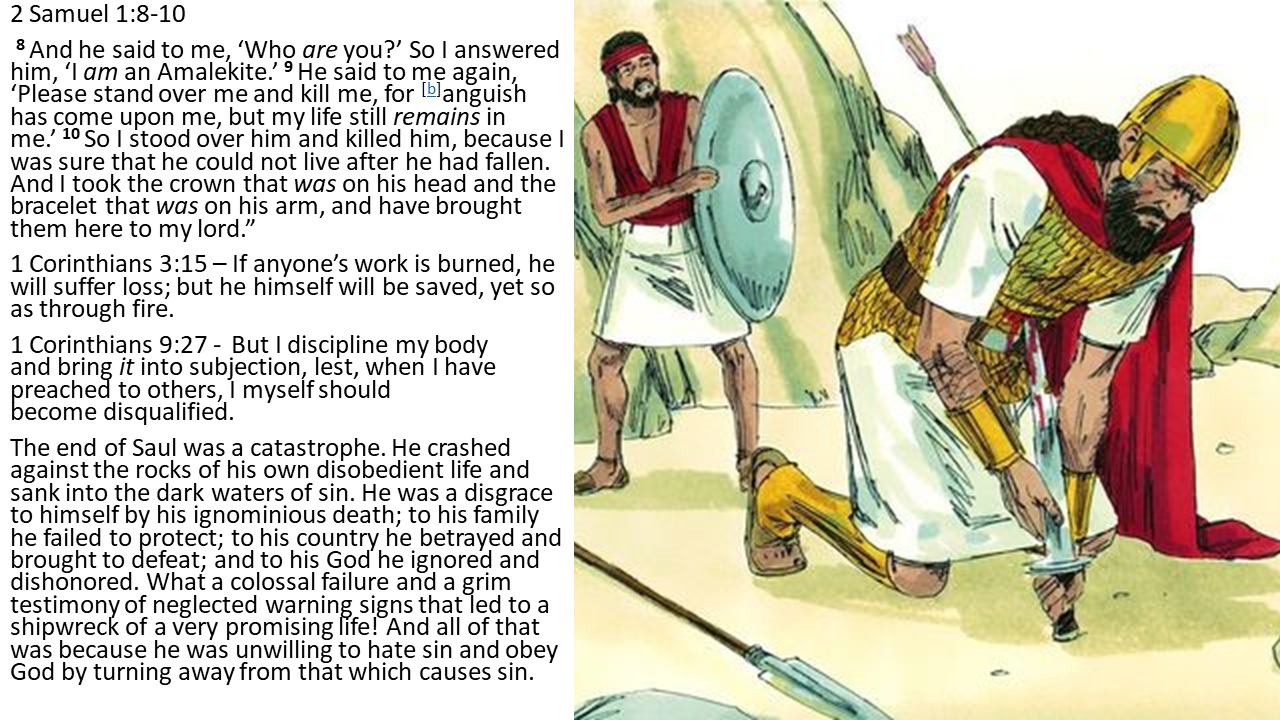
Now, turn to 2 Samuel chapter 1. I’ve had considerable talk about this because someone said, wait a minute, didn’t this Amalekite just fake it that he killed Saul? Remember, it says Saul fell on his sword. I personally think that Saul did commit suicide. He just didn’t finish, and he was just lying there, and this guy came along and finished him off. It doesn’t matter what happened. What matters is this, and verse 8 of 2 Samuel 1, look at this. Saul is there, according to this man’s account, still lingering with life. And he said to me, who are you? And so, I answered him, I am an Amalekite. And he said to me, please stand over me and kill me, anguish has come upon me, my life still remains in me. So, I stood, verse 10, over him and killed him, because I was sure he could not live after he’d fallen. Now look at this, verse 10, and I took the crown that was on his head. There’s the whole lesson of the story. Saul was unwilling to destroy the Amalekites completely, and so Saul was robbed of his crown by an Amalekite. It doesn’t matter whether he killed him or not, he got the crown.
Now take your Bible and look at 1 Corinthians chapter 3 and verse 15, 1 Corinthians chapter 3 and verse 15 because every one of us need to this evening watch out because any part of our flesh, like Agag, that we spare will come back with a vengeance and try and slay us. And 1 Corinthians 3 and verse 15 says, if anyone’s work is burned, he will suffer loss; but he shall be saved, yet so as through fire. You know what that is? Losing rewards, losing the reward of a life lived. And what is it that causes us to lose those rewards? Keep turning to chapter 9 of 1 Corinthians, 1 Corinthians 9. What is it that can get us? Verse 27, I discipline my body, I bring it into subjection, lest, when I’ve preached to others, I myself should become disqualified. Any part of our flesh that we do not deal with the way God told us to deal with it is like an Amalekite. It will come back and rob us and strike us when we’re weakest. And rob us of our crown.
The end of Saul was a catastrophe. He crashed against the rocks of his own disobedient life. He sank into the dark waters of sin. He was a disgrace to himself by his ignominious death, trying to commit or committing suicide. To his family that he didn’t protect, his whole descendants died around him. To his country, he betrayed, and the Philistines overran them. To God, he ignored and dishonored. What a colossal failure. But what a grim testimony of neglecting to obey God. In chapter 15, if he would’ve just slain the Amalekites. Now you know the rest of the story. Amalekites were descendants of, 4000 years ago, Esau. The Amalekites bothered Moses 3500 years ago. The Amalekites did end Saul 3000 years ago. And then 500 years later, 2500 years ago, Haman, the Agag descendant, another Amalekite, signed or had the King Xerxes sign a death warrant for every single Jew in the Persian Empire. It was the closest Israel came to extinction at the hand of the Amalekites. And you know the story of Mordecai and Esther and the whole way God delivered them. Do you see? If you don’t obey God, they keep creeping back up in their murderous desires. That’s what our flesh does.
.jpg)
Now let’s turn to Colossians 2, and I’m going to introduce a thought to you, and I want you to think about it. Colossians chapter 2 verse 6 because I want to talk about how we hack our Agag to pieces, how we keep the Amalekites of our flesh from robbing us of our reward, of neutralizing us from our effectiveness, and it’s this way. If we survey the chapters of God’s Word that tell us how to defeat our enemy, our flesh, we have to remember one thing. Colossians 2:6, as you therefore have received Christ Jesus the Lord—that’s another way of saying the way you got saved and look at the rest of the verse—so walk in Him.
.jpg)
So, I just asked myself, how did I get saved? How was that, that I got saved? Simply by trusting, believing, clinging to the truth that Jesus Christ took my sins, He stood in my place, He bore my punishment, the wrath of God I deserve. The guiltless One took my guilt; the sinless One took my sin. All those things and a lot more. But did I see Jesus do that? Mm-mm [no]. Was I at the cross? No, most of the disciples weren’t even there. They all ran away. The women hung around, but most of them didn’t even see this. So, do we have to see? Do we have to stand there? Do we have to actually witness it? No. How did I see the cross? My mother opened the Bible and explained to me the Gospel, that is God’s record of that event. And you know what? I believed the record, the truth, the revelation of God, the Gospel message of Christ. Now, look back at Colossians 2:6, as you therefore received Jesus Christ. I believed the truth of God’s Word, and God changed me forever. The same way we were saved is the same way we’re supposed to live the rest of our lives. You know what’s so interesting? There’s a disconnect, it appears. We come simply by faith, embracing the truth of the Gospel, and then we live the rest of our life as if it’s all up to us, and it’s all how hard we work, and how hard we hold, and how we feel, and whether we believe enough, and whether we can really trust God.
Was I saved because I completely understood the Gospel? No, that was in 1962. I was six years old. I could hardly read. My mom, I remember, would hold her fingers on the words, and I would, she made me read John 3:16, and I would get mixed up which line I was on. Do you remember when you were so little? Did I understand the Gospel? Did I understand substitutionary atonement? Did I understand imputation? Did I understand the difference between justification and sanctification? Absolutely not. But I understood one simple thing: that I was a sinner, and that Jesus had taken my penalty, my place and offered me forgiveness. So, I wasn’t saved because I completely understood the Gospel. I was saved because I felt that God was trustworthy, and that if He said in His Word that Jesus died in my place, I could trust Him. Was I saved because I felt God save me, because I felt this emotional zip go through me? No, no. It wasn’t a real emotional time. I remember it was just like, yeah, that’s true, and that’s what I want. So, what’s amazing is that we who sometimes feel like we don’t really believe hard enough or whatever, we are handicapped in the rest of our spiritual life because we think it’s based on how hard we believe these truths about our flesh and about the promises of God. We need to apply the faith that you and I have for the work of Christ on the cross in our place and apply it now to the rest of our walk.
Go to Romans chapter 6, okay. And I told you we’d do Romans 6; Ephesians 4 through 6; and then Colossians 3. But let’s just do Romans 6. We’ll just do the first verse that has to do with what we’re supposed to do, and that’s verse 11. There are five chapters, ten verses of the sixth chapter before we get to the first command in the book of Romans. I think that’s very significant. The first command, the first imperative, the first order, the first demanded response of believers in the whole book of Romans isn’t until the eleventh verse of the sixth chapter. And after all of that wonderful doctrine, this is what Paul says in verse 11, likewise. Likewise, what? Verse 10, in the death He died, He died to sin once; but in the life He lives, He lives to God. He’s talking about the work of Christ on the cross and all that He accomplished. And he says, likewise you also, and it reminds me of Colossians 2:6, just like you got saved believing the truth, the simple faith in the Gospel, just like that, this is what I want you to continue applying that same type of faith to what God has done for you. And look what he says in verse 11, New King James, likewise you also, reckon yourselves to be dead indeed to sin, but alive to God in Christ Jesus our Lord. NIV, in the same way, count yourself. That’s a nice rendering of the word! New American, even so, consider yourselves to be dead. Now, what are we supposed to do with that verse? In simple faith that saved you, we need to repeat to ourself.
And I always think about what, in the good old days, my pastor used to say, and he used to preach. Do you think I preach a long time? He preached 65 minutes! That was when we were in California and John MacArthur was my old pastor, and he would preach. But I always remember he said the same thing over and over again. He’d always say, and when you leave here, you need to preach the Gospel to yourself. What’s that? Remind yourself of what Christ accomplished on the cross. Remind yourself of how you got saved and how God accomplished that. And it wasn’t based on how you felt. It wasn’t based on how hard you worked, and you didn’t have to do your part, and He did his part and all that stuff. Those are all errors. So, what we need to do is, looking at Romans 6:11, say something like this: even if I don’t feel it, even if I don’t fully understand it, even if it’s sometimes I don’t even want it, I will, by faith believing You, consider myself dead to sin.
Now, what that consider yourself means is operate on what you know to be true. I know it’s true that if I flip on a switch and the electricity is coming into our house, the light will come on. I don’t have to understand what electricity is because I don’t. I don’t have to understand how that filament doesn’t burn out because I don’t. I don’t have to understand how they’ve vacuum impacted inside that bulb, I don’t. I just [click] the switch. I understand there’s money in the bank, and I go up to Arvest (bank in Tulsa) and stick in that little plastic card, and I don’t understand what it does. I just punch in my little numbers, and it sticks money out. Kids think that’s the neatest thing, by the way. They just want one of those cards. They think that card makes money. And when they’re little, I say, no, you have to put in money to get it back out. And the blessing is I don’t have to put in to get back out from God. He’s already put it all in, and I just operate on what I know is true. And so, I reckon myself to know that I’m dead to sin. When I truly prayed asking in simple faith for Christ to save me, whether I felt a strong emotional feeling or not, God began His work within me. I started changing from the inside out in 1962 when I was saved. The same is true of all these imperatives.
Now, here’s the last thing I want to leave you with. An imperative is a command. And by the way, they’re, I love them. I mark them in red in my Bible. Here are the imperatives. Verse 11, reckon yourselves. Verse 12, don’t let sin reign. Verse 13, don’t present your members. Again, in verse 13, but present yourselves. And then down in verse 16, present yourselves. And then verse 19 at the end, present your members. Those are all imperatives. They are orders that God wants a response from us in. That’s just grammar. Now listen to this, God never commands me to do what He hasn’t already given me the grace to accomplish by faith through His Spirit. You have to operate on what you know is true. You have to stick your ATM card. You have to turn the switch. You have to, here’s what I do with these. If I was going to do the imperatives of chapter 6, I would go through the same process the rest of the way through this chapter. I will not let sin reign because God says, reckon yourself to be dead. I will not let sin reign, verse 12. I will not present my members as instruments of unrighteousness. I will now by faith present myself as Your slave. I want to be Your slave. I ask You to enslave, verse 19, my members.
What does that mean? Say, God, my mind sometimes wanders. I ask You to enslave my mind. That’s 2 Corinthians 10:4-5, bringing every thought into captivity. You know how you do that? Cast down imaginations. If your mind’s always, maybe the movies or something, or fears, or oppression, or anxiety is always getting in your mind. That’s, by the way, the meeting point of our spiritual existence, our connection to God is not by my fingers. It’s spiritually, it’s through my mind. That’s the battle place. That’s the connecting point. So, what am I supposed to do? I want You to enslave my mind. If you have trouble with your emotions, I want You to enslave my emotions. If you have trouble with your desires, I want You to enslave my desires to Your control, Lord. My body, whatever’s out of control. Remember, if anything’s out of control, we haven’t enslaved it to His control. God never asks you and commands you and me to do something He hasn’t already given us the grace and the power to accomplish through the Holy Spirit. So, we just have to say yes to Him and let Him put to death the Amalek that remains in all of us.
.jpg)
Dear Father in Heaven, I thank You for such a beautiful picture we saw in obedient Moses with hands raised to You. The battle was won on top of the mountain. We’re so sorry for Your servant Saul. He thought that he could do things his own way by partial obedience, and he cherished what You hated and told him to hack to pieces. He cherished that, and he paid dearly for it, and so shall we if we do not by Your Spirit put to death our evil desires, our immoralities, our anger, and our wrath, and our malice, and our jealousy, and our angry outbursts, and our whisperings, and backbitings, and anything else that Your Word says we are to mortify and not to allow to grow within us. So, You don’t ask us to do anything You haven’t given us the power to do. And so, tonight I pray that we would learn to say as I received You, Lord, just by believing Your Word and calling out to You, I’m going to walk the same way. Even if I don’t feel it, even if I don’t understand it, even if I don’t know how it’s going to work, I will not let sin reign. I will not present my members. I now, by faith, present myself to You, God. I present myself to You as Your slave, and I ask You to enslave my mind, my emotions, my desires, my body, any member part of me that’s out of control, I want them enslaved to You. And that’s based on the fact You have accomplished all this, and my flesh is already defeated, and I just have to believe You and operate on what I know is true, just like I was saved. Help us to do that and to live this life for Your glory. In name of Jesus, all of God’s servant said, amen. God bless you as you go.
Notes

How bad is sin? Sin is so bad it took God killing His own Son to pay the price of wrath that sin deserved! That is an abstract thought until we see the price of sin is terms we can relate to.
Our first portion of Scripture this evening is just one of those places where we make a connection with the great wrath God has for sin and the high price that furious wrath demands. Please open with me to Psalm 51.
When we see that wrath upon sin it sometimes makes us uncomfortable—and it should. And in that discomfort we should then respond in gratitude for the gracious gift of Christ’s redeeming love, atoning death, and endless life. To more fully appreciate what we have in Christ–we need to step back and consider the character of our God. God is always just, right, and blameless in all He does. That is exactly what He has consistently revealed about Himself1.
Psalm 51:4 Against You, You only, have I sinned, And done this evil in Your sight— That You may be found just when You speak, And blameless when You judge. NKJV
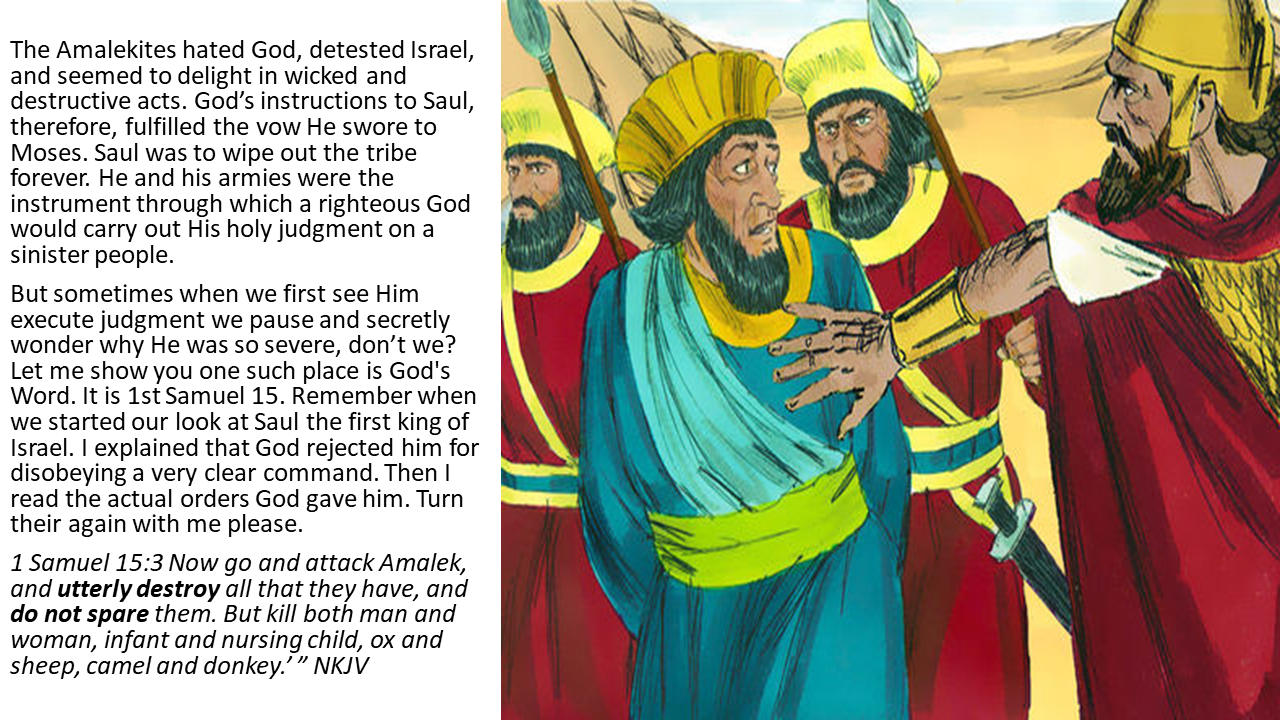
The Amalekites hated God, detested Israel, and seemed to delight in wicked and destructive acts. God’s instructions to Saul, therefore, fulfilled the vow He swore to Moses. Saul was to wipe out the tribe forever. He and his armies were the instrument through which a righteous God would carry out His holy judgment on a sinister people.2
But sometimes when we first see Him execute judgment we pause and secretly wonder why He was so severe, don’t we? Let me show you one such place is God’s Word. It is 1st Samuel 15. Remember when we started our look at Saul the first king of Israel. I explained that God rejected him for disobeying a very clear command. Then I read the actual orders God gave him. Turn their again with me please.
1 Samuel 15:3 Now go and attack Amalek, and utterly destroy all that they have, and do not spare them. But kill both man and woman, infant and nursing child, ox and sheep, camel and donkey.’ ” NKJV
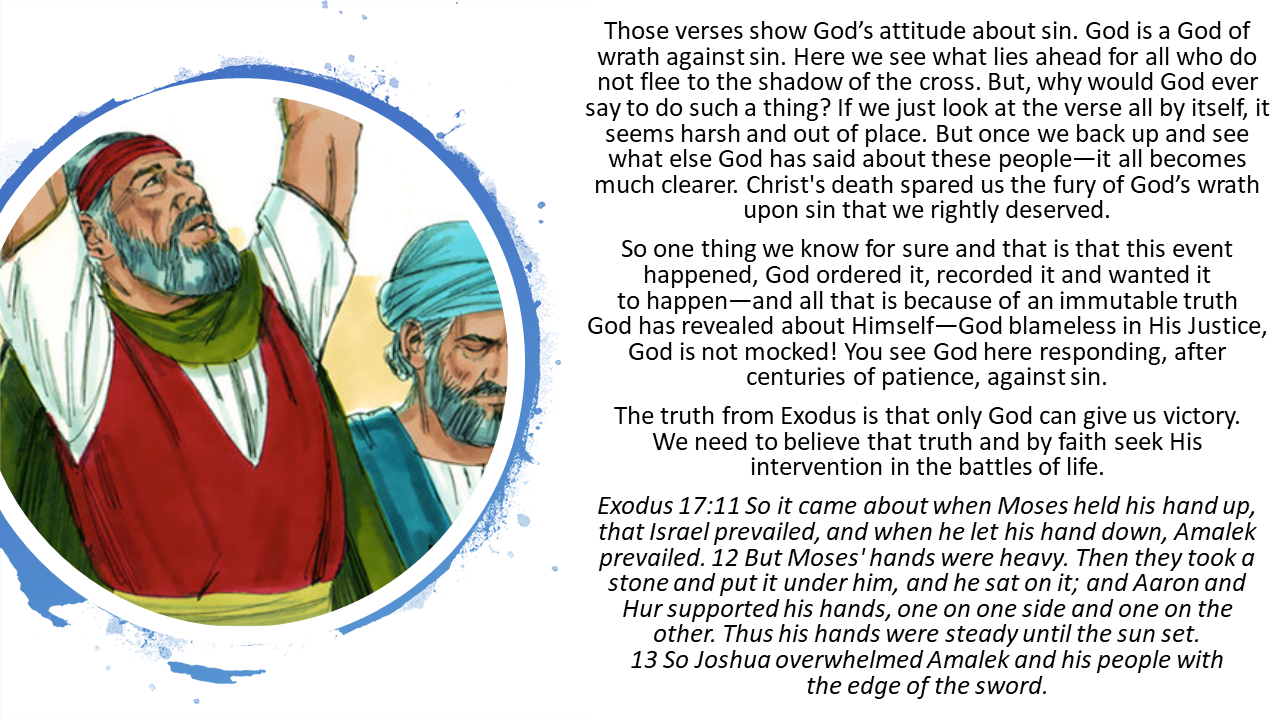
Those verses show God’s attitude about sin. God is a God of wrath against sin. Here we see what lies ahead for all who do not flee to the shadow of the cross. But, why would God ever say to do such a thing? If we just look at the verse all by itself, it seems harsh and out of place. But once we back up and see what else God has said about these people—it all becomes much clearer. Christ’s death spared us the fury of God’s wrath upon sin that we rightly deserved.
So one thing we know for sure and that is that this event happened, God ordered it, recorded it and wanted it to happen—and all that is because of an immutable truth God has revealed about Himself—God blameless in His Justice, God is not mocked! You see God here responding, after centuries of patience, against sin.
The truth from Exodus is that only God can give us victory. We need to believe that truth and by faith seek His intervention in the battles of life.
 Exodus 17:11 So it came about when Moses held his hand up, that Israel prevailed, and when he let his hand down, Amalek prevailed. 12 But Moses’ hands were heavy. Then they took a stone and put it under him, and he sat on it; and Aaron and Hur supported his hands, one on one side and one on the other. Thus his hands were steady until the sun set. 13 So Joshua overwhelmed Amalek and his people with the edge of the sword.
God wanted to utterly destroy this nation and its ferocious, plundering, merciless culture of murder and wickedness. The Amalekites were the 1st nation to attack Israel when they came out of Egypt. They struck the rear and murdered the weak and frail and old who brought up the end of the line. They did so with desire – they preyed upon the helpless and God exposed them for what they were3.
The critical lesson for us is that only the Spirit can defeat our flesh. We win daily battles with the temptations of our flesh by walking in the Spirit. When we go our own way we face Amalek (our flesh) and are defeated. As Paul said the defeat of our flesh comes only through the victory Christ already won for us on the cross, brought to us step by step as we walk believing that truth in the Spirit of God’s power.
God’s Word clearly warns us that we do not conquer our flesh by physical means— asceticism, religious activity, or human effort. It is only by the power of the cross worked out in our life by the Holy Spirit. There is a war always brewing between our flesh and the Spirit of God within us.
“For the flesh lusteth against the Spirit, and the Spirit against the flesh: and these are contrary the one to the other: so that ye cannot do the things that ye would” (Gal. 5:17).
Flesh can’t defeat flesh. Resolves, promises, fighting and striving in our own power only leads to further defeats–it is only by yielding to the power of the cross
God commands them to destroy their enemies completely. As we are to also through Christ.
Amalek was their foe. Deuteronomy 25:17-19 “Remember what Amalek did to you along the way when you came out from Egypt, 18 how he met you along the way and attacked among you all the stragglers at your rear when you were faint and weary; and he did not fear God. 19 “Therefore it shall come about when the LORD your God has given you rest from all your surrounding enemies, in the land which the LORD your God gives you as an inheritance to possess, you shall blot out the memory of Amalek from under heaven; you must not forget. (NASB)
The flesh is our foe. Colossians 3:5 Therefore consider the members of your earthly body as dead to immorality, impurity, passion, evil desire, and greed, which amounts to idolatry. (NASB)
The Amalekites make an apt illustration of the sin that remains in the believer’s life. That sin—already utterly defeated —must be dealt with ruthlessly and hacked to pieces, or it will revive and continue to plunder and pillage our hearts and sap our spiritual strength. We cannot be merciful with Amalek or Agag, or they will turn and try to devour us. In fact, the remaining sin in us often becomes more fiercely determined after it has been overthrown by the gospel.4
Now as we turn past another 500 years of sacred history we come to Saul’s time three thousand years ago. The continuing hatred of God and evil against His people needs to be dealt with. So that is why God wanted Saul to destroy the Amalekites.
1 Samuel 15:8-9 He also took Agag king of the Amalekites alive, and utterly destroyed all the people with the edge of the sword. 9 But Saul and the people spared Agag and the best of the sheep, the oxen, the fatlings, the lambs, and all that was good, and were unwilling to utterly destroy them. But everything despised and worthless, that they utterly destroyed.
He thought, what a shame to destroy everything! So he saved Agag, who was the ruler of the Amalekites. Saul had no right to spare him any more than he had the right to spare the humblest peasant among these people. This nation was wholly given to evil, and the king, above all others, should have been destroyed and judged at this time. Neither had Saul the right to save from destruction the best of the cattle. It would appear that he made his attack for the purpose of obtaining booty and spoil, and God had forbidden that. The Israelites were bringing judgment upon the Amalekites for Almighty God in this particular case.
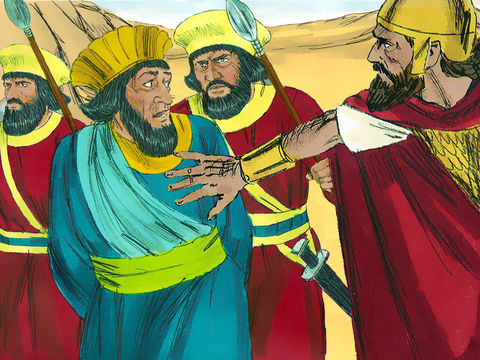 Saul kept only the best – of what God hated. To God the Amalekites were toxic waste that had to be dealt with; they were emitting dangerous spiritual radiation that would contaminate all that came into contact with them. So when God gave them into Saul’s hand he wasn’t to even spare their livestock – every one and every thing was to be destroyed. But Saul and his men went through that which God hated and saved the best. They sorted the deadly contaminants and kept the prettiest. Just like in the recent Gulf War II when looters took the beautiful barrels from reactor sites in Iraq, ignoring the skull and cross bones painted in red on each one. Taking them home they used them to store drinking water – and within days were experiencing deadly radiation sickness.
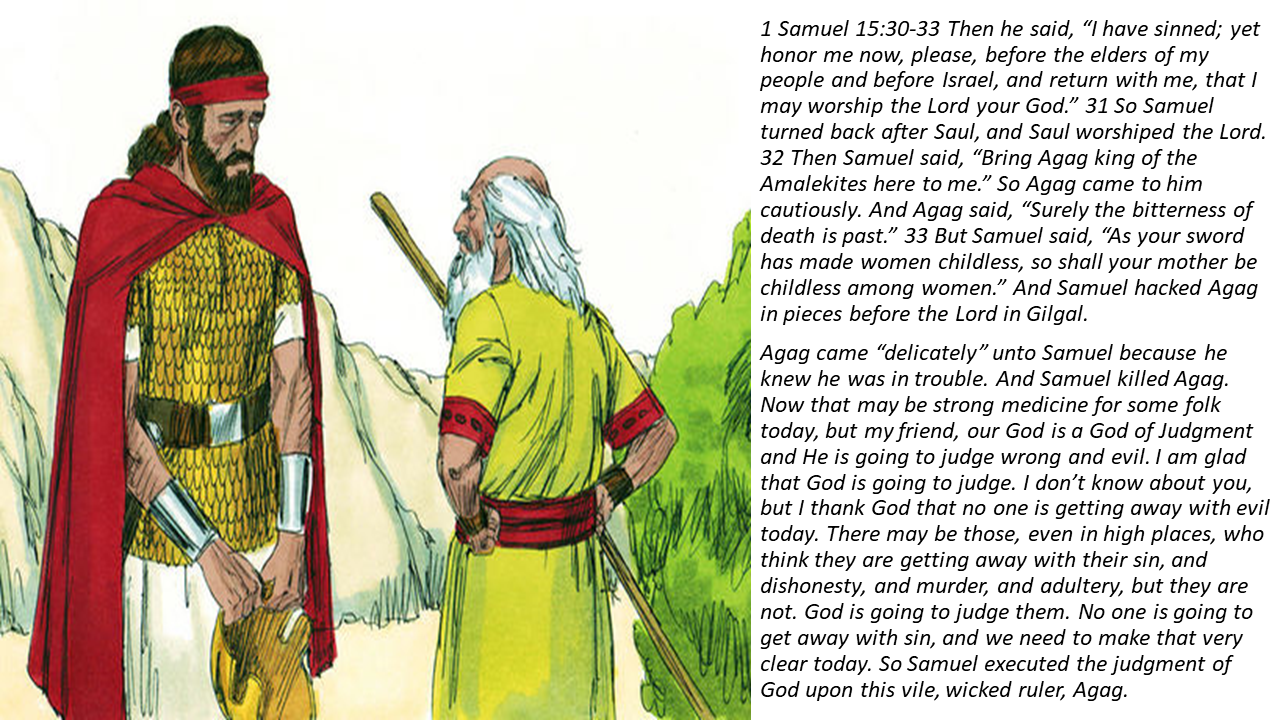
1 Samuel 15:30-33 Then he said, “I have sinned; yet honor me now, please, before the elders of my people and before Israel, and return with me, that I may worship the Lord your God.” 31 So Samuel turned back after Saul, and Saul worshiped the Lord. 32 Then Samuel said, “Bring Agag king of the Amalekites here to me.” So Agag came to him cautiously. And Agag said, “Surely the bitterness of death is past.” 33 But Samuel said, “As your sword has made women childless, so shall your mother be childless among women.” And Samuel hacked Agag in pieces before the Lord in Gilgal.
Agag came “delicately” unto Samuel because he knew he was in trouble. And Samuel killed Agag. Now that may be strong medicine for some folk today, but my friend, our God is a God of Judgment and He is going to judge wrong and evil. I am glad that God is going to judge. I don’t know about you, but I thank God that no one is getting away with evil today. There may be those, even in high places, who think they are getting away with their sin, and dishonesty, and murder, and adultery, but they are not. God is going to judge them. No one is going to get away with sin, and we need to make that very clear today. So Samuel executed the judgment of God upon this vile, wicked ruler, Agag5.
Listen, this is the message I want to underline in your heart and mind. Any part of our old life that we spare will come back and slay us and rob us of God’s blessing, fruitfulness, and rewards.
- Any part of our flesh (like Agag) that we spare will come back with a vengeance and slay us.
- Amalekites (the flesh) always come to strike us down when we are weakest – and then rob us of our crown.
The end of Saul was a catastrophe. He crashed against the rocks of his own disobedient life and sank into the dark waters of sin. He was a disgrace to himself by his ignominious death; to his family he failed to protect; to his country he betrayed and brought to defeat; and to his God he ignored and dishonored. What a colossal failure and a grim testimony of neglected warning signs that led to a shipwreck of a very promising life!
And all of that was because he was unwilling to hate sin and obey God by turning away from that which causes sin.
The battle is already won, the enemy defeated and we just need to believe that and act upon that truth! How do we do that more regularly?
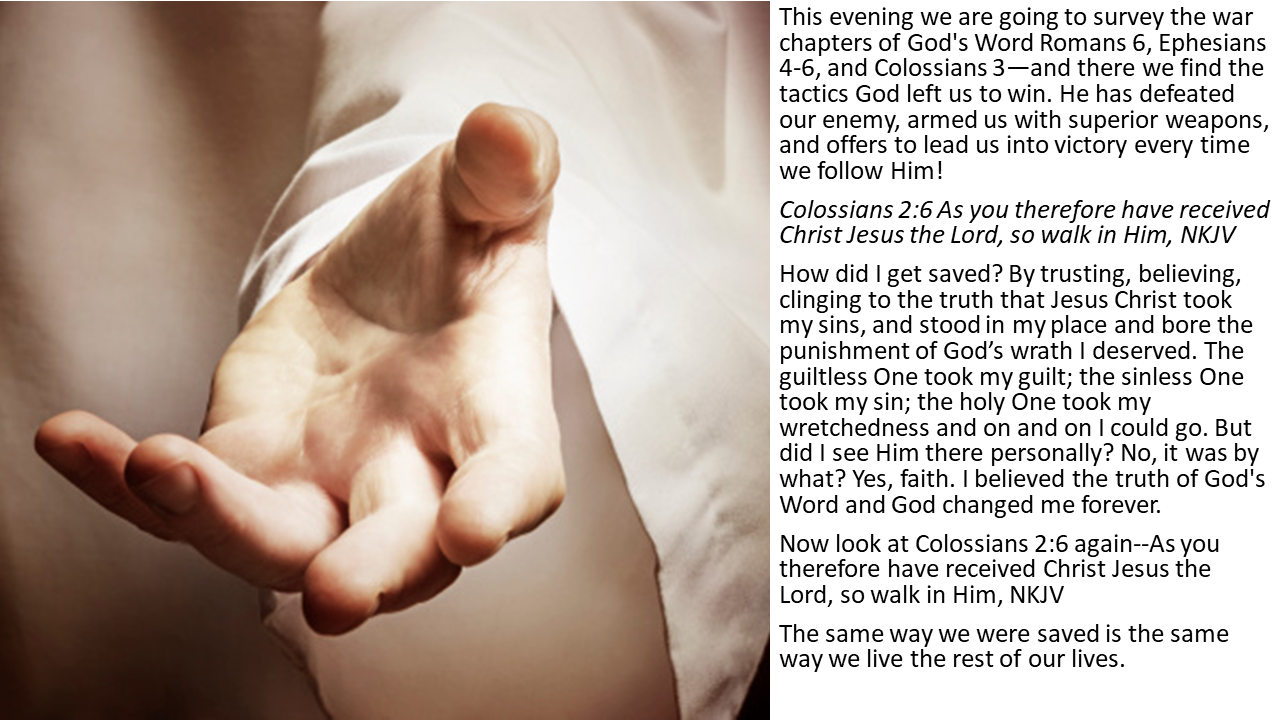
This evening we are going to survey the war chapters of God’s Word Romans 6, Ephesians 4-6, and Colossians 3—and there we find the tactics God left us to win. He has defeated our enemy, armed us with superior weapons, and offers to lead us into victory every time we follow Him!

Colossians 2:6 As you therefore have received Christ Jesus the Lord, so walk in Him, NKJV
How did I get saved? By trusting, believing, clinging to the truth that Jesus Christ took my sins, and stood in my place and bore the punishment of God’s wrath I deserved. The guiltless One took my guilt; the sinless One took my sin; the holy One took my wretchedness and on and on I could go.
But did I see Him there personally? No, it was by what? Yes, faith.
I believed the truth of God’s Word and God changed me forever. Now look at Colossians 2:6 again–As you therefore have received Christ Jesus the Lord, so walk in Him, NKJV
The same way we were saved is the same way we live the rest of our lives.
Was I saved because I completely understood the Gospel? No, I am still understanding more and shall until glory!
Was I saved because I felt that God saved me? No because sometimes I feel that He couldn’t have because I am so unworthy and sinful—does that unsave me? NO.
So apply that faith that you and I have for the work of Christ on the cross in our place and apply it now to the rest of our walk. Join me in Romans 6.
Romans 6:11 Likewise you also, reckon yourselves to be dead indeed to sin, but alive to God in Christ Jesus our Lord. NKJV
Romans 6:11 In the same way, count yourselves dead to sin but alive to God in Christ Jesus. NIV
Romans 6:11 Even so consider yourselves to be dead to sin, but alive to God in Christ Jesus. NASB
Now, in simple faith that saved you repeat that to yourself. (Just like my old pastor John MacArthur always used to tell us ‘preach the Gospel to yourself!’) Say something like this:
Even if I do not feel it, understand it, or even at times want it I WILL by faith, believing YOU consider myself dead to sin. Or in times of need, “Lord I operate on what I know is true, you have made me dead to sin.”
When I truly prayed, asking in simple faith for Christ to save me—whether I felt a strong emotional feeling or not, God began His work within me. I started changing from the inside out. The same is true with these imperatives.
God never commands me to do what He hasn’t already given me the grace to accomplish by faith through His Spirit!
Now go through the same process the rest of the way through Romans 6—
- I will not let sin reign…
- I will not present my members…
- I now by faith present myself to You God…
- I present myself to You Lord as you slave…
- I ask You to enslave my members (my mind, my emotions, my desires, my body, what ones are out of control? If they are out of control they aren’t under Christ’s control…)
1 See also Galatians 6.7; Romans 2.6; Genesis 18:25.
2John F. MacArthur, Jr., The Vanishing Conscience – Drawing the Line in a No-Fault, Guilt-Free World, (Dallas, Texas: Word Publishing) 1997.
3 J. Vernon Magee, p. 268.
4John F. MacArthur, Jr., The Vanishing Conscience – Drawing the Line in a No-Fault, Guilt-Free World, (Dallas, Texas: Word Publishing) 1997.
5 All of this material on 1st Samuel quoted from McGee, J. Vernon, Thru the Bible with J. Vernon McGee, (Nashville: Thomas Nelson Publishers) 2000, c1981.
Slides




Check Out All The Sermons In The Series
You can find all the sermons and short clips from this series, David’s Spiritual Secret here.
Looking To Study The Bible Like Dr. Barnett?
Dr. Barnett has curated an Amazon page with a large collection of resources he uses in his study of God’s Word. You can check it out here.