If the video above is not available, here are two other ways to view:
150426AM FTF-25 LP-4 Hungering-3.docx
HFG-03
Fasting: Hungering for God, Longing for Christ,
Denying Our Flesh & Experiencing God’s Grace
Mark 2:18-22
HOW’S YOUR HUNGER FOR GOD TODAY?
Several weeks ago we began to study about Hungering for God and saw this longing after Jesus with a heart of love and devotion is called Biblical Fasting. And Biblical Fasting, or the voluntary abstinence from good and right things such as food, is a spiritual discipline, which has fallen upon hard times in modern Christianity. So today I repeat our task:
In the Old Testament, we can see that Biblical Fasting was an urgent call to get serious about Knowing God.
In the New Testament we see Biblical Fasting was an ancient spiritual discipline to reschedule my life with God at the center instead of dining, relaxing, amusing, accumulating, advancing, securing, and a multitude of other things that are not wrong – just deadly to intimacy with the Almighty.
In the Early Church of Acts and the Epistles, we see demonstrated that this Hunger for God shaped their lives, their ministry, their worship, and their outreach.
In the Early Church, we see Biblical fasting is a powerful way to yield every part of my life to God’s supremacy.
Conclusion: Biblical Fasting is an immediate way to declare your allegiance to God’s way and glory in every day of your life!
Listen to this brief glimpse from Early Church History as we jump into our study this morning of God’s Word’s New Testament portrait of the Early Church’s Hunger for God.
EARLY BELIEVERS FOCUSED ON ETERNAL MINISTRY
About A.D. 133 Aristides, a teacher of philosophy in the Roman Province of Asia (modern Turkey), presented a defense of Christianity to Emperor Hadrian (AD 117-138). From it, we get a glimpse of what the early Christians were like and why the church grew the way it did—like wildfire—in those centuries.
Now the Christians, O King…have the commandments of the Lord Jesus Christ himself engraved on their hearts, and they observe, looking for the resurrection of the dead and the life of the world to come. They do not covet men’s goods; and love their neighbors; they despise not the widow and grieve not the orphan. He that hath distributeth liberally to him that hath not. If they see a stranger, they bring him under their roof and rejoice over him, as if it were their own brother; for they call themselves brethren, not after the flesh, but after the spirit and in God…. And if there is among them a man that is poor and needy, and they have not an abundance of necessities, they fast two or three days that they may supply the needy with their necessary food. For Christ’s sake, they are ready to lay down their lives. So it was spread abroad, “Behold how they love one another.” What shall we be known for? Let it be that we are willing to die for Christ and, even more, that we are willing to live for him in loving his people—and his enemies. The early Christians fasted so that they would have more to give to the needy, which means they did not have a lot stored up. O Lord, help us see Christ, be satisfied with Christ, and to show Christ as they did.
Transcript
.jpg)
Let’s open our Bibles to the Gospel by Mark chapter 2. And as you’re opening there, we’re looking at one of the most needed and neglected disciplines of Western culture and in America today. We’re looking at Biblical fasting, which is not a popular topic in the most overweight nation on Earth, so it’s not something we do very often but often for at least the last three weeks, but as we open to Mark 2:18-22, we’re examining this topic that Jesus brings up and He brings it up in the context of how we are to live for Him to be useful for Him, and He introduces, if you remember, the sequence. The giving of gifts to poor, prayer, and then fasting, and we’ve been looking at that, and looking at how they’re related. So, this morning fasting is hungering for God.
If you want to know what we’re talking about, it is hungering for God. And hungering for God so much, we neglect other things that are needful, necessary, but we do it intentionally. What’s interesting is, and everyone has come and asked me, and they say what are you talking about? Fasting from what? How often? How much can we eat? How much can’t we eat? How much can we drink? How much can’t we drink? Is it coffee? Is it Diet coke? What do we fast from? Candy bars? Potato chips? And I said, isn’t it interesting the New Testament never quantifies what we’re talking about. It doesn’t say two days, ashes on your face, look bleak, get skinny. It doesn’t give a diet. It gives a goal. And see, that’s the quality is what we’re looking at. You know that you’re fasting when that discipline stirs within you a longing for Christ and His return. Because that’s the goal. Weight loss and getting rid of cholesterol is not That’s what we’re talking about here. We’re talking about hungering for God.
And also, you can see on the screen, longing for Christ. And it has to involve denying our flesh. See, that’s, the ultimate aim of this is to say no to ungodliness and worldly lusts, and to longingly await the glorious appearing of our great God and Savior Jesus Christ. That’s how the Bible defines it. And it only comes when we experience God’s grace. So, this is our study. And this is what we’re camping on for a while, because we all need to ask ourselves an honest question. If we do a personal inventory, we can see this morning whether we’re paddling against the current of our culture, or if we’re just floating downstream with them.
Now, do any of you remember, I grew up in a little tiny Baptist church in, Lansing, Michigan. And we used to I think it was the Red Cedar River. And we would go on church canoe rides. And what that meant is we would go to this place, and we would hire these canoes, and they would drive all the canoes upriver. And they knew which way the river flowed and they knew if they got all these people in the canoes that even if they lost their paddles, they would all end up at the end, and down there at the end was that canoe holder and the person, and he was grabbing the canoes as they went by, and dumping the water out, and sticking them up there. And they know that because of the current of the river, that even if you do nothing, you’ll get there. That’s how Christ describes the world. And He says, broad is the way. And many canoes are on it. And they’re all going the same direction. They’re floating downstream. And everyone’s concerned about whether their canoe’s nicer than everybody else’s canoes. And they’re trying to get as much stuff in their canoe. And they’re showing off to all the other people. And they’re bumping each other. And in the midst of that, Jesus reaches down, meets us in the river, turns our canoe around, hands us the paddles and says you can’t float anymore.
You have to go against everyone else. You are counter cultural. Now, that doesn’t mean picketing and bombing abortion clinics and shooting the tillers of this world. It’s to paddle your canoe against the current of the world, which is, the world is the culture we live in. And everyone in this world is living, as Paul describes them, whose god is their belly. That’s a good description. All the people floating down the river are all concerned about what they want, and what they’re eating, and what they’re desiring, and their god is their belly of materialism, or sensuality, or of some substance, or of hoarding as much stuff as they can, or prolonging their beauty as long as they can, or showing off their physique as much as they can, or their brains, or whatever. And everybody’s preening, and showing off, and floating down the river. And we’re going, oh, excuse me, and they go, what’s wrong with you? We’re saying we’re headed, why are you headed that way? We’re going, as Bunyan said, to the Celestial City. You are headed to the end of the line, which at the end of this river is a drop off into a literal black hole, where you will be suffering the vengeance of eternal fire in the blackness of darkness forever, and it’s called Hell, and they laugh at us, and they keep floating. But now and then, we’ll bump into someone, and they’ll say, You have paddles. You’re going the other direction. Why? And you say, I met Jesus. He stopped my canoe in its tracks, gave me some paddles, turned me around, and I can’t wait to be with Him forever. See, you know whether you’re paddling, by whether you feel the resistance. See, if you just float along, there’s no resistance in life. You just are like everybody else. You dress and talk and act and think and possess and accumulate and enjoy and complain like everybody else until Christ turns you around. And all of a sudden, everything looks different. You’re looking at everybody. Try it sometime. Walk into an elevator and don’t turn around. Just stand like this. Everyone looks at you like, what is wrong with you? That’s every day. Going upriver. The broad way. The narrow way. The broad way that leads to destruction? The narrow, Jesus said, difficult way that leads to Him, an endless life. What is the question to find out whether you’re paddling or just floating along with the flow of everyone else in life?
.jpg)
The question is simply this, how today is your hunger for God? Because you can tell if you’re floating with the rest of the world, you have a suppressed appetite. I remember when I was in seminary, what was the name of that drug? I used to sell for Wyeth labs and in American Home Products and Whitehall Labs. Phenylpropanolamine. I remember it now. And we used to sell phenylpropanolamine. because it made people not hungry. Now, this is in the 80’s when I don’t think they checked all this stuff out, and the diet things were going crazy.
But did you know that the world dispenses a spiritual form of phenylpropanolamine.? And you know what that is? It suppresses our hunger for God. And fasting is a tool. That helps us begin to find and trim away and cut off and divest from anything that neutralizes, suppresses, and diminishes our hunger for God.
This morning, how is your hunger for God? Several weeks ago, we began this study about hungering for God and saw that longing after Jesus with a heart of love and devotion is called Biblical fasting. The New Testament doesn’t say it means only eat, salary, and drink, the soup. It doesn’t say that like the three Hebrew boys, in Babylon. No. It doesn’t quantify it into some little thing that we can say, I’m doing more than you, and you’re not doing enough. See that’s not New Testament-y. It’s whether or not we’re hungering more for God, His truth, and Christ’s return than we were yesterday. If not, we need to do something. We need to remediate that situation.
.jpg)
In the Old Testament, and basically, I wrote these down for you. In the Old Testament, Biblical fasting and remember, in the Old Testament everything was very structured. It was an annual event to get serious about knowing God. And the whole nation had to participate and everything shut down. And they had this national fast. And everybody was checking to make sure you were fasting, and there were some people that really got into it and they really did get serious about knowing God, but God says in the book of Isaiah that the vast majority, it was just something everyone did and they didn’t like it and they didn’t want to do it, and they had to do it, and they’d get in trouble if they didn’t do it, and everybody was checking on them, so they went through it and they made the most of it. By the time we get to the New Testament, Biblical fasting was an ancient spiritual discipline. Now, we have to be really careful about this, because nowadays we have this notion that if the mystics did it, or if the monks did it, or if Saint so-and-so of somewhere did it must be good, because it’s old, and ancient, and it’s spiritual. No. It was an ancient spiritual discipline that went back to this Old Testament, Biblically described, fast. But what it became in the New Testament was a time to reschedule my life with God at the center. Instead of everything else at the center, which what, see if we’re floating with everybody else, we’re listening to them, we’re going along with them, we’re saying, oh, yeah, oh, I’ll try that. Yeah, it sounds good.
And what is the world doing? Dining is at the center. I know people that they collect restaurants, and it’s got to be more exotic. They’ve got to have hummingbird tongues, and they can’t have anything common. They just, they could not eat normal food. Dining. And their whole life is built around the kitchen, and it’s just an aura. They think that they’re doing a cooking show, to live in. Other people, it’s relaxing. Yeah, a lot of that in America. Amusing. Gaming and all that, and a lot of movie watching is amusing. Ah muse, not think. Just carry it along. It’s the theme park, just live for amusement. Accumulating. We have more stuff per person than any culture or civilization has ever had in the history of Earth here today. Most of us are accumulators. And caring for all that stuff totally dissipates a lot of our emotional, mental, and physical energy.
Advancing. That’s what some people are. They’re getting ahead in the world, and they’re going to advance academically, business-wise, in their field, and that’s really what they’re focused on. And if it’s sports, they will neglect anything to advance. And if it’s business, they’ll move anywhere to advance with the company. Leave the family behind, if need be, but I’m going to advance. That’s very much what the floaters are doing.
How about securing? I’m going to accumulate enough stuff. So, no one can tell me what to do. Did you read that last week, the top five tech titans, the barons of the computer world, just last week, the five of them made 13.4 billion dollars? They earned that much in one week? Between the five of them? Yeah, they’re securing their wealth, and a multitude of other things that are not wrong. They’re just deadly to intimacy with the Almighty. And if we’re floating and not paddling against that, pretty soon we’re dining and relaxing and amusing and accumulating and advancing and security and all that other stuff and we’re neglecting intimacy with God.
.jpg)
So, how is your hunger for God today? By the way, we get into the book of Acts and the epistles. We see Biblical fasting shaped their lives. They used it as a tool to shape their lives. They wanted, Paul said, I fast all the time. He says, I want to bring my body into the subjection under the lordship and rule of Jesus Christ. And I don’t want my God to be my belly. And I’m constantly having my life shaped by this ancient spiritual discipline that I’m not going to quantify. Paul never, Paul was great at explaining everything. He doesn’t explain it. He just says, I do it more than you all because I long for His appearing.
And their ministries. Did you know that people, when you get to Acts 14, people that are leading in the church, are chosen and commissioned with the whole church fasting and praying? People were real stakeholders in the church, and in ministry. So much so that they denied other things. Their worship, their outreach, when they were sending out missionaries, the whole church. Paul was sent out. Can you imagine the accrual in Heaven of the people that laid hands and sent Paul out on his first missionary journey? Who his work still extends to us today. And they were the ones that were set apart by the Holy Spirit to send him out. They’re like the founders of Amway. Do you remember back then where they got a quarter percent of everything? And it’s just unbelievable the spiritual benefit of having this fasting that shapes your life and ministry and worship. And finally, the early church, we see a hunger for God as a powerful way to yield every part of my life to God’s supremacy.
.jpg)
Basically, the conclusion is this. Biblical fasting is an immediate way to declare your allegiance to God, and to His way, and glory, in every part of our lives.
.jpg)
Early believers focused their lives on what mattered for eternity. Well, to chapter 2. Now, go to Mark with me. And what we see is the early believers had a heart for ministry. Now before we read this, I want to show you what happened to them. Okay? I’m going to read with you Mark 2, but I want you to see what the people that heard these words from Christ did.
.jpg)
And we have this little snippet from some ancient literature, but I’m going to read you the whole thing, but just the center is this. About A.D. 133, Aristides, he was a teacher of philosophy in the Roman province of Asia, modern Turkey, presented to the emperor Hadrian, the great builder. He built the Pantheon and a lot of other stuff, if you are into Roman culture. Hadrian wanted to know what to do with these Christians. They were just multiplying. Nero tried to, wipe them out, and they just multiplied. So, this man presented a defense, and this is what he said.
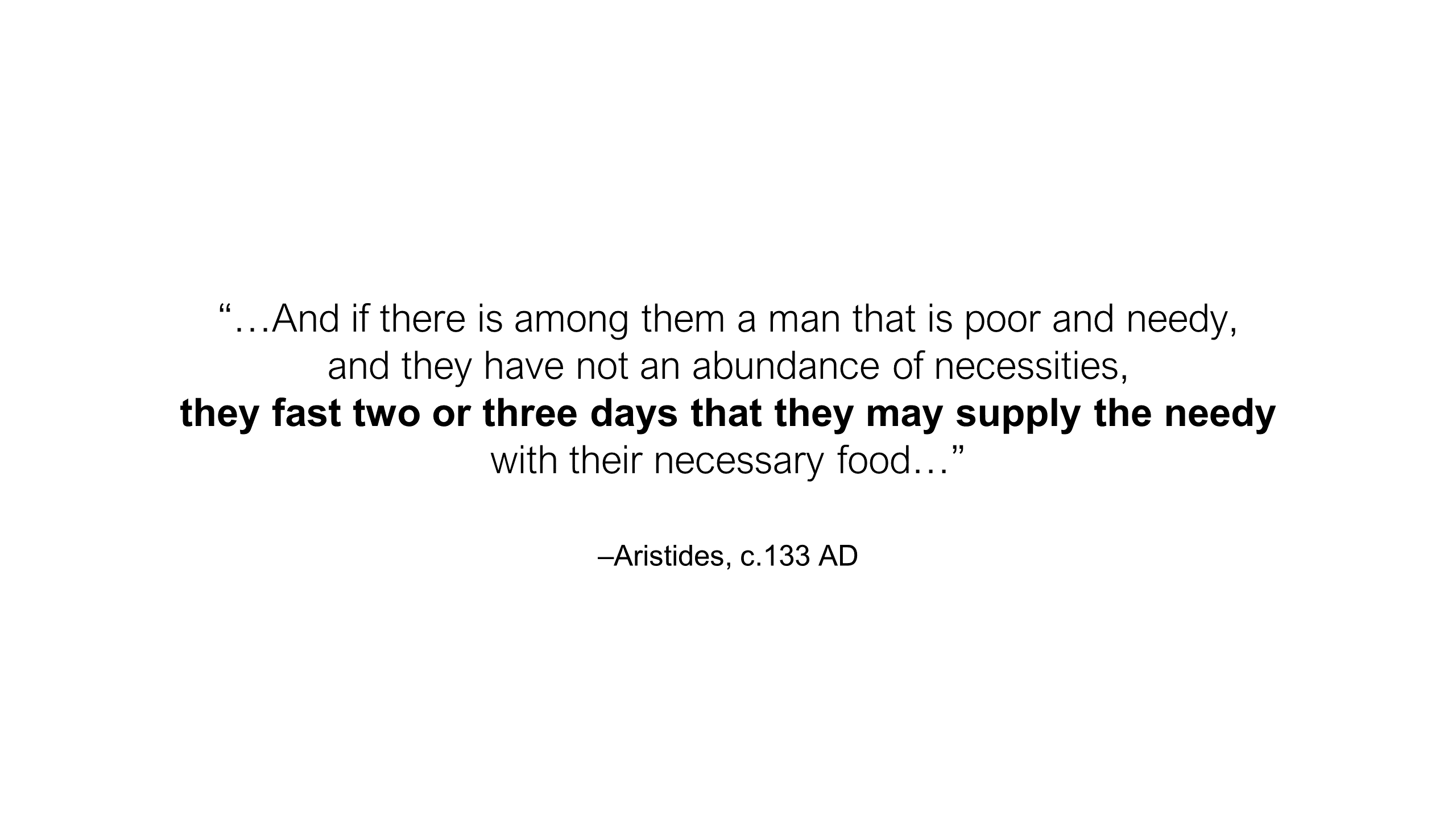
Now the Christians, O King, have the commandments of the Lord Jesus Christ himself engraved on their hearts. And they observe, looking for the resurrection of the dead and the life of the world to come. They do not covet men’s goods. They love their neighbors. They despise not the widow. They grieve not the orphan. He that hath distributeth liberally to him that hath not. If they see a stranger, they bring him under the roof and they rejoice over him as if it was their own brother. For they call themselves brethren, not after the flesh, but after the Spirit and in God. Now this note, this is amazing. And if there is among them a man that is poor and needy, and they have not an abundance of necessities, they fast two or three days, that they may supply the needy with their necessary food.
When’s the last time you did that? Don’t tell us. But it’s rare. Most of us think that when I have, my tuition, and my car all nice, and all my electronic stuff, and my spring break trip all figured out, and everything else paid for, and a little coffee time, whatever’s left, I might give to someone. If they really need it, and I think they’re legit. That’s our float down the stream mindset. Me first, my needs, take care of everything, be comfortable, secure, and everything else. But for Christ’s sake, the early Christians were ready to lay down their lives. And the record of the first century church was, behold how they love one another.
I guess the question for all of us this morning is what will we be known for? Will it be that we’re willing to die for Christ and even more that we’re willing to live for Him by loving people and His enemies? The early Christians fasted so they would have more to give to the needy. That means they did not have a lot stored up. Accounts like that from history are stirring. Isn’t that stirring? That’s, wow. But that isn’t why we fast. You don’t say because Saint Onesiphorus of Cyprius did this, we want to too. No. That’s why we go to Mark chapter 2.
.jpg)
Because let’s look at what the original setting was that Christ had. So, everybody, Mark chapter 2, we’re going to read from verse 20 to 22. Let’s all stand with your Bibles open, follow along. And what I’m going to do is I’m going to read a phrase and then I’m going to comment on it. Okay? I’ll be a little bit like Ezra. Ezra made the whole nation of Israel, 50,000 of them, stand while he read all day long for six hours on a platform, and he would read and explain and read and explain and read and explain. Wouldn’t that be a service? Six hours long. Wow. Let’s not do that. Okay? Here are Christ’s words, and these are the most important words in the Bible on fasting for us. And if you understand what Jesus is saying, this can be life altering.
Okay, verse 20. Mark 2 2:20, “But the days will come when the bridegroom will be taken away from them.” Now look up. What is this talking about? This is again, Jesus is saying, I’m going to die on the cross. I’m going to be buried. I’m going to rise again. And then I’m going to ascend back to My Father and sit at His right hand. This is Jesus talking about His death, burial and resurrection and ascension. And He says, I’m the bridegroom. You’re My bride. I’m going to be taken away from you. And just like the bride, every day, was looking at her calendar and wondering, maybe it’s today, maybe it’s today, maybe it’s today, maybe he’s going to come. I want to be ready at any moment. He might come at night. He might come I don’t know when. I want to be ready. Look at verse 20. “The days will come when your bridegroom will be taken away from them.” Now look at the next phrase. “And then they will fast in those days.” Who’s that? That’s everybody who’s been purchased, bought, redeemed, forgiven, and indwelt by Christ. They. That’s all New Testament believers. Then they will fast in those days. Jesus said that fasting would be universal in His church. Woo. Eating might be, fasting is not. Why?
Look at verse 21. “No one sows a piece of unshrunk cloth,” that’s the new Covenant Church, “on an old garment,” that’s Judaism, “or else the new piece pulls away from the old, and the tear is made worse.” Verse 22, “no one puts new wine into old wineskins; or else the new wine bursts the wineskins and the old, and the wine is spilled, and the wineskins are ruined”. But new wine is put into new wine skins. What’s He talking about? He’s talking about not an external, you must fast on this day and look sad and don’t talk. But it’s a transformational, I’m engaged to Him, and I miss Him so much that I can’t help but think about Him every day and wonder if He’s going to come and get me today. That’s the underlying motivation for fasting, and it changes our lives. Let’s bow.
Father, I pray that You’d teach us a little bit of what it means to long for Your appearing. And not to worry about the mechanics of fasting, but to want the benefits and results of a growing hunger for You, O God. And a growing longing to see Jesus. To see You face to face and be like You, because we will see You as You are. I pray You would stir our hearts today. In the name of Jesus, we pray. Amen.
.jpg)
You may be seated. As you’re seated, have you ever thought about how focused the 1st century church was? This is why. This is why when we read the epistles, we find people that are really on target. And how did the 1st centuries live in a way that we so often don’t? When we look at the epistles, especially, in fact, let’s turn to Philippians chapter 3. You’re in Mark, go to the right. Mark, Luke, John, Acts, Romans, 1 and 2 Corinthians, Galatians, Ephesians, Philippians. Chapter 3, there it is. As you turn there, think about where we’ve gotten. Do we ever grow weary and lessen in our passion for what the early church had? Yes, we do. Do we ever think more of our careers and lives and needs than we do of lost people all around us? Do we ever even lose sight that they’re lost? Do we even, sometimes we’re just floating with the canoes, and we enjoy it. It’s fun. You just feel part of everything. It’s very embarrassing to stand facing everybody in the elevator. It’s very hard to go upstream. And we’re the only ones paddling. They’re floating. They don’t even have paddles. They can’t even go that way. And they’re just so curious about us and mocking us.
One of the key attitudes we find displayed in God’s saints is that all of them were exiles on Earth. The writer of Hebrews says these all died in faith looking for something, a city that has foundations. They were pilgrims here on Earth. They were exiles here on Earth. And Philippians is going to tell us. They were not citizens of Earth; they were citizens of Heaven. And that’s where they were headed, and everybody knew it and saw it. What did this produce? It didn’t produce a detachment from Earthly life or other people. Rather, it led to such a lack of love for things that these early saints actually had abundant time to love and seek and win their neighbors. Now that is an interesting thought. Have you ever thought of all the time you spend gathering, protecting, and caring for our things? Last week, how much of your time has been managing things? Instead of loving, listening, interacting with people. Think of what value that collecting and protecting and caring for things will have in Heaven at Christ’s throne. Versus the same time and energy and strength poured out in a loving passion for the souls of our neighbors. Do you think the most gleaming, I mean I was riding this morning behind someone that was pretty excited.
They had the biggest boat you’ve ever seen. The one motor was the size of a normal motor. The other motor, I don’t think I’ve ever seen one. It was as big as my first car almost, and they had the shiniest boat. It couldn’t have been like that. They had to have worked on it. And they were I could see those men when finally, they turned, I could, they were so excited.
I don’t know what they were doing. Probably they were just going to go sit in a parking lot in the thing and just rub it with gloss. I don’t know what they were doing. But there we’re excited about caring for that gorgeous boat. You say, oh, that’s, I would never do that. No, but we do other things very similarly with things.
Would Kalamazoo be shocked if the hundreds of families at Calvary Bible Church started thinking of others more than about their own things? Isn’t that interesting to think about? Did you know I just described what happened across the Roman world? Churches began to spring up among the people that were self-centered. And these churches were others-centered, and selfless, and different. They were headed a different way. They were going upstream. And everybody was curious. Now they made fun of them, and they mocked them. But down deep they were curious about them. Did you know the way to win the world is not to float down the river with them. That’s church growth ideas. You just don’t rock anybody’s boat. You just float together and hope some of them go to Heaven and that the Lord pulls you out before you go over the cliff. And you just don’t offend any of them. Don’t tell them that they’re headed to destruction. Don’t tell them that their lifestyles are an abomination in sight of God. Don’t tell them about the narrow way. Just float. Wow.
.jpg)
Biblical fasting reflected their longing for Heaven. Look at Philippians 3. I told you to turn with me to Philippians 3, and we’re going to read from verse 19 onward. “Whose end is destruction,” remember the end of the river? He’s talking about fellow floaters. We’re all born floating. And everybody floating down that river, their end is destruction. They’re going to the blackness of darkness forever. “Whose god is their belly.” What characterizes them is their insatiable appetites. Whether it be for thrills, or substances, or for, promoting themselves, or sexual gratification, or athletic gratification. It doesn’t matter. It’s centered on me. And my God is what I hunger for. As Paul eloquently says, their belly. And look at this, “whose glory is in their shame.” But what’s the bottom line? Look at the end of verse 19, “who set their mind…” Their life is around the boat, or the cottage, or the job, or the 403, or the 401, or the next award ceremony, or the next concert, or the next little higher ranking in the games, or whatever. But all of it is tied to the Earth. And that’s the description of a lost person. And the problem is, many 21st century believers act and orient their lives like lost people. And that’s why the Gospel isn’t powerfully going out. Because we’re not living the narrow way. We’re floating the broad way.
Look at verse 20 of Philippians 3. He says, but “our citizenship is in Heaven…” Upstream. “From which we also eagerly wait for the Savior, the LORD Jesus Christ, who will transform our lowly body that may be conformed to His glorious body according to the working by which He is able to subdue all things to Himself.” He said, I long for Christ.
Now, keep going to the right to 1 Thessalonians. So, jump over Colossians and go to 1 Thessalonians 1. This is Paul’s first epistle. And look what it says in 1 Thessalonians 1. Starting in verse 9. He’s hearing about their testimony. Paul has ministered there for a few weeks and he left. And word came back to him of the believers in Thessalonica. And it says, “for they themselves,” verse 9, “declare concerning us what manner of entry we had to you, how you turned to God from idols to serve the living and true God.” So, this is people in Thessalonica were telling others how God had transformed their life. And they no longer were oriented toward the idols of this world, and they were turned to God. Now look at verse 10, “and to wait for His Son from Heaven, whom He raised from the dead, even Jesus who delivers us from the wrath to come.” They were telling all the floaters around them that they were headed to a horrible cataclysmic end. And they said, we’re waiting for a son from Heaven. He’s the one that delivered us from the wrath to come.
Now keep going to the right. 1 Thessalonians, 2 Thessalonians, 1 Timothy, go to 2 Timothy chapter 4. Look at Paul’s, this is the end of his life. He’s in the Mamertine prison. He’s headed toward beheading, probably in one of Nero’s circuses the big places where they had all their chariot races and other things. And this is what Paul says, finally, He, he’s already said, my departure’s at hand, I’m ready to go. “There’s laid up for me a crown of righteousness which the LORD, the righteous judge, will give me on that Day.” Yeah, Paul, you should have one. You’ve written half the New Testament. You’ve started almost every church outside of the Israelite people. They’re all the Gentiles. All of us are spiritual great grandchildren of Paul. Yeah, you ought to get a crown, Paul.
But look at this, in verse 8, “But not to me only, but also to everyone who has loved His appearing”. Paul said, we’re all going to get the same crown, for longing for Christ. That’s why Paul said, I constantly long for Christ, and that’s why Paul said, I fast more than the rest of you do. There’s something inextricably connected. Prayer and fasting with a longing for Christ’s return.
Keep going to the next book, Titus chapter two. You should know Titus well, and my favorite part of it is 11 to 13 of chapter two, and this distills down salvation for the grace of God that brings salvation has appeared to all men. And what does salvations grace do to us? Verse 12, “teaching us that denying ungodliness and worldly lust, we should live soberly, righteously, and godly in this present age.” How do you do that? Verse 13, “looking for the blessed hope and the glorious appearing of our great God and Savior, Jesus Christ.” Wow.
One more go past Titus and Philemon to Hebrews chapter 9, and I just want to show you one more. Hebrews 9. The writer of Hebrews describes salvation in verse 27. He says, “it’s appointed on to men to die once and after this, judgment.” We only live once. We don’t, do the Shirley MacLaine thing over and over again, we die and face judgment, or look at verse 28. So, “Christ was offered once to bear the sins of many, and to those who eagerly wait for Him, those who have received His gift of dying for and bearing the sins, to those who eagerly wait for Him, He will appear a second time.” Eagerly wait. Do you know what the scriptures say characterizes a believer? We eagerly wait for Christ. We long for His appearing. That’s the essence. And that’s how the church started out.
.jpg)
But guess what? Keep going to the right. Go to Revelation. Did you know that the grandchildren of the day of Pentecost already were dulled? And the Bible tells us why. What’s the big problem that dulls the church? It’s in Revelation 3:15. Most of us have caught the enthusiasm of the early church in Acts and the Epistles. It’s just legendary. They were contagiously in love with Jesus. They were fearlessly proclaiming His truth. Most of us have also caught that by the time two generations passed, we find the grandchildren of Pentecost quite different. There’s a dramatic change. Revelation 3:15. “I know your works, that you are neither cold nor hot. I would wish you were cold or hot, so then because you are lukewarm and neither cold nor hot, I will vomit you out of my mouth.” Now what would make such a horrible, gross image of Christ vomiting believers? What? What would prompt that? I remember when we were raising kids, the pharmacist gave us Ipecac. Even sounds Ipecac. And they said, boy, they swallow too many pills, just hold their nose and give them some of that and it’ll all come out. Whatever they’ve got in there. Ipecac. What Ipecac’d Christ? It’s in verse 17. “Because you say, I am rich, have become wealthy, and have need of nothing.” Now wait, that is a Biblical statement of the American dream. Isn’t that what everybody wants? Either get it in the lottery, or work your whole life and kill yourself, or be a flash trader like that little guy in London and make forty million overnight. But do something to be rich, so that you can use the riches to get enough stuff to surround you so that you feel really comfortable and secure, and come to the place where you have need of nothing. And you’re self-reliant, self-made, successful. Did you know people say, oh, we’ve got a, America. We’ve got a, America. We’ve got to have, the free enterprise system. We’ve got to have this. Spread it all over the world. Don’t. Don’t. May our economy not prosper, because it’s causing the worst infection of the church. We are infected with materialism. We think that the reason we go to school, and learn a craft, and learn an art, and learn a form of work, and look for/shop for jobs is so we can be rich, and become wealthy, and have need of nothing. And Jesus says, while I look at you pursuing that course, you don’t know that I see you as wretched, and miserable, and poor, and blind, and naked. Because you are focusing not on my return, but on your canoe, and floating through life with a bigger canoe than everybody else and a more comfortable and secure one.
Verse 18, “I counsel you, buy from Me gold, refined in the fire, that you may be rich, and white garments that you may be clothed, and the shame of your nakedness…” Now that’s interesting, that shame of nakedness. You know what John, the Apostle that wrote these, recorded Christ’s words here. Do you know what he said in 1 John? He says, I don’t want to be a shame before You at Your coming. He says, I don’t want to have neglected clothing myself with the righteous deeds of the saints and instead clothing myself with the finest of the Asia Minor garments. “And white garments that you may be clothed, and the shame of your nakedness may not be revealed. As many as I love,” verse 19, “I rebuke and chase, and therefore be zealous and repent.” The secret to what deadened and dulled and chilled and dissipated the power of the early church is right here. It is an attachment to the things of this world. And actually, to be agitated and angry and fighting over and protecting, like it says in Ecclesiastes, the more you have, the more you want. The more you want; the more other people want it. And the more they want it, the more you protect it. And it just is a vicious cycle. Wow.
.jpg)
.jpg)
What’s the bottom line? The early church, by the third generation, began to focus on this world, not the next. And what happens is they begin to display the danger of misplaced desires. If you want to go back to where we started, to Matthew chapter 6. And we don’t have to go anywhere else after that. So, just get back to the Gospels. Matthew chapter 6. I want to show you the context of how we even got to this. Matthew 6 starts with giving to poor people. The first four verses. Then it gets into prayer. And then by the time we get to verse 16 of chapter 6, it gets into this fasting deal that Jesus talks up. And then He says in verse 19, don’t lay up treasures. And in verse 22, watch out that you don’t have your eyes set on things that aren’t good. And verse 24, you can’t serve God in money. And verse 25, you know you’re serving money when you’re worrying, and worrying, all the way down to verse 31. And then He says in verse 33, the problem is you have misplaced desires. Because God says in verse 33, seek first the reign and supremacy of God in your life, and everything else follows because He brings it in. And you don’t have to spend your life scrapping and scraping and fighting and climbing to get it all. The danger of misplaced desires.
.jpg)
One author who I admire greatly, pastor of, I don’t know, forty years now, he’s emeritus pastor, John Piper, wrote this about the enemies of hungering for God. He said, “the greatest enemy of hunger for God is not poison, but apple pie. It’s not the banquet of the wicked that dulls our appetite for Heaven. It’s the endless nibbling at the table of the world. It’s not the X-rated video. It’s the primetime dribble of triviality that we drink every night. For all the ill Satan can do, when God describes what kept people from the banquet of His love, it was a piece of land, a yoke of oxen, and a wife.”
Do you remember Jesus said, come follow Me, and the guy says, I’ve got a new yoke of oxen. Come follow Me, now I’ve got to buy some land. Come follow Me, now I’m going to get married. It was not bad stuff. The greatest adversary to the love of God is not His enemies, but His gifts. And the most deadly appetites are not for the poison of evil, but for the simple pleasures of Earth. For when these replace an appetite for God Himself, the idolatry is scarcely recognizable and almost incurable. That’s why Jesus said to the final stage of church history, by the way the one we live in, He says, your lifestyle of materialism ipecacs me. I want to vomit you.
.jpg)
What was the solution? That’s what we started on. Look at verse 9 of chapter 6. “In this manner, therefore, pray.” It was praying daily for spiritual hunger. Praying for the kingdom of God. Praying for the reign of God as supreme over my life. That’s what fasting does. It’s how I, it’s a tool to get me back on track with my life scheduled not around consumption, but around God. We want God’s rule over our appetites. We want Him to rule our affections. We want Him to rule over our choices. We even want Him to rule over the church. It’s not ours. It’s His. And so, it changes everything.
.jpg)
In fact, we could say that the benefits of hungering for God is, the more we experience intimacy and fellowship with Him, the more we hunger for Him. It’s just it’s the same thing, the more you want, the more you have, the more you have, the more you want more, and all that. The more of God you have, the more you want. The more of Him you experience, the more you want. Hunger for God prompts hating any beachhead of sin in our life. And that’s usually when we’re in this process of self-denial. We start seeing more that we need to ask God to mortify in our life.
Hunger for God stirs our investing time in His body, the church. If the major focus of God at this time in all the universe is the church, why isn’t it ours? It’s everything else. God will take care of the church. We’ve got to worry about everything else. You associate with what the one you love the most associates with. That’s very much what the Lord is saying. This is what I love. This is what you should love.
.jpg)
So, basically, Biblical fasting helps us focus on why we’re here. What we’re doing with our time and energy. Now go back to where we started. Think of all the time we spend gathering, protecting, and caring for our things. Then think of the value of the collecting, protecting, and caring we’ll have in Heaven at Christ’s throne versus the same time invested in what He left us here to do.
.jpg)
There’s a verse in 1 Corinthians 6:12, Paul says, “All things are lawful unto me, but I will not be brought into the power of any of them. All things are lawful unto me, but I will not be mastered by anything but Christ.” What’s amazing is, what pushes out our hunger for experiencing God is usually good stuff. It’s food, it’s entertainment, it’s the latest news, it’s the status of our investments, it’s the internet, it’s media, music, sports, bodybuilding, health needs. All of these all alone are good and worthy of time, but not at God’s expense.
.jpg)
Where we began. What are you longing for this morning? What are you incurably hungering after? Is it God or is it the world? Are you incurably delighting in God’s Word or trivial pursuits? The greatest destroyers of intimate hunger for God may be the things that are good and right in their place, like coffee, and lawns, and hobby, and travel, and retirement planning, and mall walking, and movie watching, and computer mastering. But any of those that take God’s first place, any of those that become easier for me to turn to than God and His Word, then they become deadly destroyers of my hungering and thirsting after God.
That’s why we’re studying fasting. Because we’re rich. We’re increased with so many distractions. And most of the time, until our boat gets rocked, we don’t need anything. But the grace of God that brings salvation teaches us that denying ungodliness and worldly lusts, we should go through life soberly, righteously, and in godly fear, looking for the blessed appearing and the glorious appearing of our great God and Savior, Jesus Christ. That’s what He left us to do, going on the narrow way.
Let’s all stand together. It’s time to go. And as we stand, I remind you that the invitation is always open. There are always our elders and our Titus 2 women, they’re here at the front. You’ll see them. They stand up here near the front and they have a Bible in their hand. The really good news is not only they are here, but Jesus Christ is here. And there’s two things you might think about this morning. One is, if you say Oh, yeah. I’m distracted. I am accumulating, I’m spending all my time taking care of this stuff. Then Jesus is here, and He actually knows that. He was actually poking you. Talk to Him. Say, Lord, I want to start making incremental steps to phenylpropanolamine my life, to suppress my hunger for things. And I want to increase my hunger for You. That’s the first response. The second response is, I don’t even know what you’re talking about, but I don’t want to go over the, I don’t want to go in the black hole. Then you might need to call out to the Lord and say, be merciful to me, a sinner. There’s only two responses. Come to Christ, follow Christ. That’s it. Let’s bow before Him this morning.
Father in Heaven, I pray that You will stir our hearts to not just hear that we’re supposed to be longing for You, but to do it. To not just hear until You return we’re to be fasting, but to do it. To not just say that’s for someone else. I’m at the most important time in my life, of my career. We don’t even know if we’ll be alive tomorrow. Shouldn’t we be doing today what You’ve asked us to do and not hope that someday in the future we’ll get around to it. While we hear Your voice today, I pray we would respond. In the name of Jesus, we pray, and all God’s people said, Amen. God bless you as you go.
NOTES
As we open to Mark 2:18-22 we are examining the Biblical topic of:
Fasting: Hungering for God, Longing for Christ, Denying Our Flesh & Experiencing God’s Grace.
This is our study because we all need to ask ourselves an honest question. By doing a personal inventory we can see whether we are paddling against the current of our culture or just floating along with the flow of everyone around us in life.
What’s the question? Simply this:
How’s Your Hunger For God Today?
Several weeks ago we began to study about Hungering for God and saw this longing after Jesus with a heart of love and devotion is called Biblical Fasting. And Biblical Fasting, or the voluntary abstinence from good and right things such as food, is a spiritual discipline, which has fallen upon hard times in modern Christianity. So this morning I repeat our task:
In the Old Testament we can see that Biblical Fasting was an urgent call to get serious about Knowing God.
In the New Testament we see Biblical Fasting was an ancient spiritual discipline to reschedule my life with God at the center instead of dining, relaxing, amusing, accumulating, advancing, securing, and a multitude of other things that are not wrong – just deadly to intimacy with the Almighty.
In the Early Church of Acts and the Epistles we see demonstrated that this Hunger for God shaped their lives, their ministry, their worship, and their outreach.
In the Early Church we see Biblical fasting is a powerful way to yield every part of my life to God’s supremacy.
Conclusion: Biblical Fasting is an immediate way to declare your allegiance to God’s way and glory in every day of your life!
Listen to this brief glimpse from Early Church History as we jump into our study this morning of God’s Word’s New Testament portrait of the Early Church’s Hunger for God.
Early Believers Focused On Eternal Ministry
About A.D. 133 Aristides[1], a teacher of philosophy in the Roman Province of Asia (modern Turkey), presented a defense of Christianity to Emperor Hadrian (AD 117-138). From it we get a glimpse of what the early Christians were like and why the church grew the way it did—like wildfire—in those centuries.
Now the Christians, O King…have the commandments of the Lord Jesus Christ himself engraven on their hearts, and they observe, looking for the resurrection of the dead and the life of the world to come. They do not covet men’s goods; and love their neighbors; they despise not the widow, and grieve not the orphan. He that hath distributeth liberally to him that hath not. If they see a stranger, they bring him under their roof and rejoice over him, as if it were their own brother; for they call themselves brethren, not after the flesh, but after the spirit and in God…. And if there is among them a man that is poor and needy, and they have not an abundance of necessities, they fast two or three days that they may supply the needy with their necessary food. For Christ’s sake they are ready to lay down their lives. So it was spread abroad, “Behold how they love one another.” What shall we be known for? Let it be that we are willing to die for Christ and, even more, that we are willing to live for him in loving his people—and his enemies. The early Christians fasted so that they would have more to give to the needy, which means they did not have a lot stored up. O Lord, help us see Christ, be satisfied with Christ, and to show Christ as they did.
Accounts like that from history are interesting, but how do we know that we need to fast as a born again Christian? Jesus gives us the answer in our text we have been studying for the past few weeks. In Mark 2:20-22 Jesus said His children would long for Him until His Return.
So when do we need to fast? When we have lost the intense longing for Christ’s Return!
The Original Setting: Longing For Christ’s Return
Then, Christ’s words this morning are for you. Our text contains the most important words in the Bible on fasting. And these words can change your life if you understand them!
Mark 2:20-22. Lets read them as you follow along in your copy of God’s Word.
20 “But the days will come when the bridegroom will be taken away from them,
(Here is one of the many prophecies Jesus made pointing to the Cross, and His ascension to the Father’s right hand for the period of time we call the Church Age. Jesus was away and we await Him.)
And then they will fast in those days
(Now comes the New Testament fast, it is for those who await the One they love, who is taken away to Heaven. While we wait for the Son we fast. Because we long for Him, we fast!)
21 “No one sews a piece of unshrunk cloth
(Christianity of the New Covenant Church after the Cross)
on an old garment;
(The Old Testament Judaism)
or else the new piece pulls away from the old, and the tear is made worse. 22 “And no one puts new wine into old wineskins; or else the new wine bursts the wineskins, the wine is spilled, and the wineskins are ruined. But new wine must be put into new wineskins.”
First Century Focused Saints
How did the 1st Century saints live that way and we so often don’t? Do you remember from our study of 1st Thessalonians a couple years ago, what was the heartbeat of the early church? Expecting Christ’s Return. Do we ever grow weary and lessen that passion? Yes. So what is Christ’s way to get us to long for His Coming? Look for His coming? Wait for His Coming?
Stop eating, fast, deny ourselves, feel the pain of deprivation, show our allegiance to Him (demonstrated in fasting) as higher than even life (demonstrated in eating). Think with me about these verses, and ask yourself, do you really long for Jesus every day? If not, fasting is for you!
One of the key attitudes we find displayed by God’s saints is that they were exiles on earth, and citizens of Heaven. This produced not a detachment from earthly life or other people, rather it led to such a lacking of love for things that these early saints actually had abundant time to love and seek and win their neighbors. Think of all the time we spend gathering, protecting, and caring for our THINGS. Then think of what value that collecting, protecting, and caring will have in Heaven at Christ’s Throne versus the same time, energy, and strength poured out in loving passion for the souls of our neighbors.
Would Kalamazoo be shocked if the hundreds of families at Calvary Bible Church started thinking of others more than their own THINGS!
Biblical Fasting Reflected Their Longings for Heaven
As one man well stated, “The absence of our fasting is the measure of our contentment with the absence of Christ.”[2]
Listen to the fasting minded hearts of the New Testament saints:
Philippians 3:19-21 whose end is destruction, whose god is their belly, and whose glory is in their shame—who set their mind on earthly things.20 For our citizenship is in heaven, from which we also eagerly wait for the Savior, the Lord Jesus Christ, 21 who will transform our lowly body that it may be conformed to His glorious body, according to the working by which He is able even to subdue all things to Himself.
1 Thessalonians 1:10 and to wait for His Son from heaven, whom He raised from the dead, even Jesus who delivers us from the wrath to come.
2 Tim
othy 4:8 Finally, there is laid up for me the crown of righteousness, which the Lord, the righteous Judge, will give to me on that Day, and not to me only but also to all who have loved His appearing.
Titus 2:11-13 For the grace of God that brings salvation has appeared to all men, 12 teaching us that, denying ungodliness and worldly lusts, we should live soberly, righteously, and godly in the present age, 13 looking for the blessed hope and glorious appearing of our great God and Savior Jesus Christ,
Hebrews 9:28 so Christ was offered once to bear the sins of many. To those who eagerly wait for Him He will appear a second time, apart from sin, for salvation.
Something Dulled Their Passion
Most of us have caught the enthusiasm of the Early Church in Acts and the Epistles.
They were contagiously in love with Jesus, and fearlessly proclaiming His truth. Most of us also have caught that by the time two generations passed, we find that the grandchildren of Pentecost were different.
Note with me the drastic change as we go to the very end of your Bibles.
Revelation 3:15-20 “I know your works, that you are neither cold nor hot. I could wish you were cold or hot. 16 So then, because you are lukewarm, and neither cold nor hot, I will vomit you out of My mouth. 17 Because you say, ‘I am rich, have become wealthy, and have need of nothing’—and do not know that you are wretched, miserable, poor, blind, and naked— 18 I counsel you to buy from Me gold refined in the fire, that you may be rich; and white garments, that you may be clothed, that the shame of your nakedness may not be revealed; and anoint your eyes with eye salve, that you may see. 19 As many as I love, I rebuke and chasten. Therefore be zealous and repent.
The secret to what deadened, dulled, chilled, and dissipated the power of the early church is found in the Doctor’s Report of Revelation 2-3. Jesus the Great Physical came to visit the churches of Asia Minor.
He went to see how the grandchildren of the Apostles and early church were doing and found a very weak pulse. Why? He tells us that they were:
They Focused On This World Not The Next
They were very active, very busy, very wealthy: but spiritually anemic, sickly, powerless, and distracted. They had lost sight of why they were here.
They had lost their longing for Christ to return.
They began to feel, live, and think like: Heaven Can Wait, we need to live for now.
They lost the pilgrim mentality. They no longer felt like strangers on earth. They were rather at home and comfortable on Earth.
One of the key attitudes we find displayed by the 1st Century editions of God’s saints is that they considered themselves exiles on earth, and citizens of Heaven.
This attitude didn’t produce a detachment from earthly life or other people, rather it led to such a lacking of love for things that these early saints actually had abundant and overflowing time to love and seek and win their neighbors.
The Danger of Misplaced Desires
Jesus warned that a great enemy to His children would be “desires for other things” (Mark 4:19). Jesus left us with the only weapon that will lead us into a victorious deepening hunger for intimacy and daily fellowship with our Creator. That weapon is Biblical fasting and we can measure our hunger level for God by our hunger after those other things. God is only glorified by seeking Him first!
Matthew 6:33 “But seek first the kingdom of God and His righteousness, and all these things shall be added to you.
Philippians 3:8 Yet indeed I also count all things loss for the excellence of the knowledge of Christ Jesus my Lord, for whom I have suffered the loss of all things, and count them as rubbish, that I may gain Christ
Enemies Of Hungering For God
Insightful author and pastor John Piper says,
“The greatest enemy of hunger for God is not poison but apple pie. It is not the banquet of the wicked that dulls our appetite for Heaven, but endless nibbling at the table of the world.
It is not the x-rated video, but the prime time dribble of triviality we drink in every night. For all the evil Satan can do, when God describes what keeps us from the banquet of His love, it is a piece of land, a yoke of oxen, and a wife (Luke 14:18-20)
The greatest adversary of love to God is not His enemies but His gifts. And the most deadly appetites are not for the poison of evil, but for the simple pleasures of earth. For when these replace an appetite for God Himself, the idolatry is scarcely recognizable, and almost incurable”.[3]
Praying Daily For Spiritual Hunger
So the Kingdom of God, the reign of God as Supreme over all of our lives is our goal in fasting. We want Him to rule our appetites, we want Him to rule our affections, we want Him to rule over our choices not.
We want God’s Rule in this church, not ours. Then we come before Him seeking His Glory not ours in praying, asking and fasting it changes how we pray.
Now when we ask for Him to lead us into the conquest of those old habits that grip and enslave us, the roadblocks that stand in our path to spiritual maturity – it is so that He may rule in our lives and be glorified.
When we cry out for wayward or unconverted children or spouses to come back maturity – it is so that He may rule in our lives and be glorified.
When we prepare for growth and plan for needs in our church as we fast and pray – it is so that He may rule in our church and be glorified. [4]
The Benefits of Hungering for God
The more we experience intimacy in fellowship with Jesus Christ the more we hunger for Him, and the greater our longings become to be with Him in Heaven.
Then we see our focus in our lives begins to change, the more we long for our Great God and Savior:
Hunger for God prompts Hating any beachhead of sin in our lives,
Hunger for God stirs our Investing our time is Christ’s Body, His Church,
Hunger for God focuses us on Evangelizing of Lost People around the World,
Our Hunger for God fills us with the Knowledge of His Will
And on and on it goes in our lives. Actually, anything less that this growing surrender to the Lord through spiritual hungering and thirsting after God, means that our appetite has been ruined through all the little things that have filled us up. It means we have neglected the greatest food – Our Father and His Kingdom for the lesser food of His gifts in life. That spells spiritual famine, weakness, and failure.
Focused On Why We Are Here
Biblical Fasting can help us refocus on what we are doing with our time and energy.
Now for a moment, think of all the time we spend gathering, protecting, and caring for our THINGS.
Then think of what value that collecting, protecting, and caring will have in Heaven at Christ’s Throne versus the same time, energy, and strength poured out in loving passion for the souls of our neighbors.
Would Kalamazoo be shocked if the hundreds of families at Calvary Bible Church started thinking more about the spiritual needs of PEOPLE; and less about their own THINGS!
Mastered only by Christ
God’s Word says we must be Mastered only by Christ and nothing else. The evidence of being brought under the power of something is that we need it to make it through our day.
Biblical Fasting uncovers and exposes what ever it is that has mastered our lives in place of Christ.
1 Corinthians 6:12 All things are lawful for me, but all things are not h
elpful. All things are lawful for me, but I will not be brought under the power of any.
What do you need to make it through a day? That will be a list of the items that have cast their influential mastering power across your life.
What pushes out your hunger for experiencing the intimacy of fellowship with the Lord in your life?
Do you seek food or entertainment first?
The latest news or the status of your investments first?
The web and your computer first?
The television, radio, music first?
Your sports, body building, health needs first?
All of these are alone good and worthy of time but not at God’s expense, He is to be sought first and deepest of all!
What Are You Longing For?
Are you incurably hungering after God or this world?
Are you incurably delighting in God’s Word or trivial pursuits?
The greatest destroyers of intimate hunger for God may be things that are good and right in their place like coffee and lawns and hobby and travel and retirement planning and mall walking and TV watching and computer mastering.
But any that take God’s first place, and become easier to turn to than God and His Word and His intimate communion, they are then deadly destroyers of our hungering and thirsting after God[5].
Would you like to revitalize your spiritual life?
Would you like to heighten your awareness of God?
Would you like to experience God in such a deep and intimate way that you find yourself absolutely satisfied and contented in a way God’s Word calls perfect peace?
Start longing for Christ’s return so much that it draws you to deny other good things, so that you may focus more and more of your life upon seeking, knowing, enjoying, and pleasing Christ!
[1] Drawn from the Godward Life.
[2] Piper, Hunger for God, p. 93.
[3] Piper, Hunger for God, p. 14.
[4] Piper, Hunger for God, p. 14.
[5] Piper, Hunger for God, p. 14.